ASOR is pleased to announce the establishment (on a trial basis) of a Climate Impact Sustainability Fund to provide micro-grants to ASOR members working in the MENA regions. The establishment of this fund comes on the recommendations of the Ad Hoc Committee on the Climate Impact formed by Sharon Herbert in fall of 2021. This committee was tasked at examining ASOR activities with particular attention to the Annual Meeting. The committee presented its report to the Board of Trustees at its 2022 November meeting in Boston. The committee outlined various alternatives for reducing ASOR’s carbon footprint, one of which was the establishment of a Climate Sustainability Fund.
Section 4.4.3: While existing programs and offset brokers can offer ready-made solutions for managing carbon offsets, ASOR is well-situated to take direct action in offsetting activities. As a funding organization, ASOR could seize this opportunity to establish micro-grants in support of:
Environmentally sustainable projects related to ASOR’s core mission in the MENA regions. Such projects should be designed to follow the best-practice criteria above and could also be subsequently submitted to Gold Standard for certification and further funding as carbon-offset programs.
Supporting the development and implementation of eco-friendly practices in fieldwork/research projects to reduce carbon emissions derived from archaeological fieldwork in MENA regions.
At the 2023 Spring meeting the ASOR Board of Trustees voted to establish such a fund on a trial basis. ASOR is very pleased to have received a challenge gift from an anonymous donor to match gifts to this fund 1:1 up to $20,000. The Board encourages all ASOR members and staff to consider donating either 5% or 10% of their airfare to this pilot Climate Sustainability Fund. Through the anonymous matching program, the impact of these gifts will be doubled. ASOR will thus launch a pilot mini-grants program to fund sustainability initiatives in the MENA regions—the areas where ASOR members conduct their work.
ASOR is well-situated to develop projects in MENA countries geared towards sustainability, carbon mitigation, and cultural heritage that can be funded by mini grants from this Climate Sustainability Fund. The ASOR community is invited to think about projects in the regions in which they work that might benefit from the mini-grants provided by this fund. ASOR is currently in the process of putting together a Grant Committee and establishing an application process for this Fund.
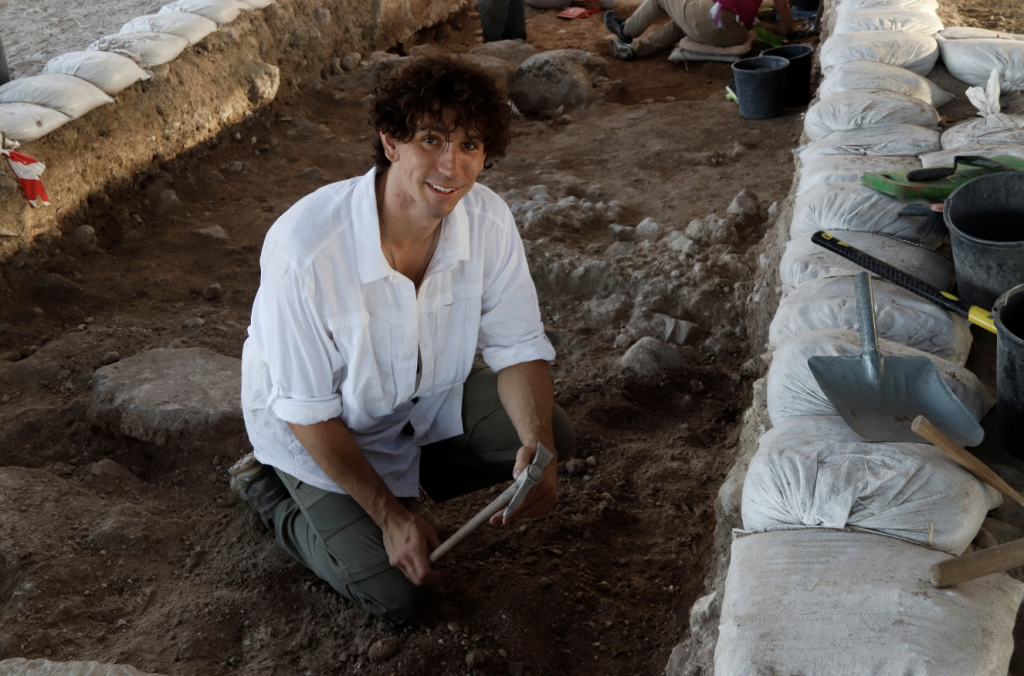
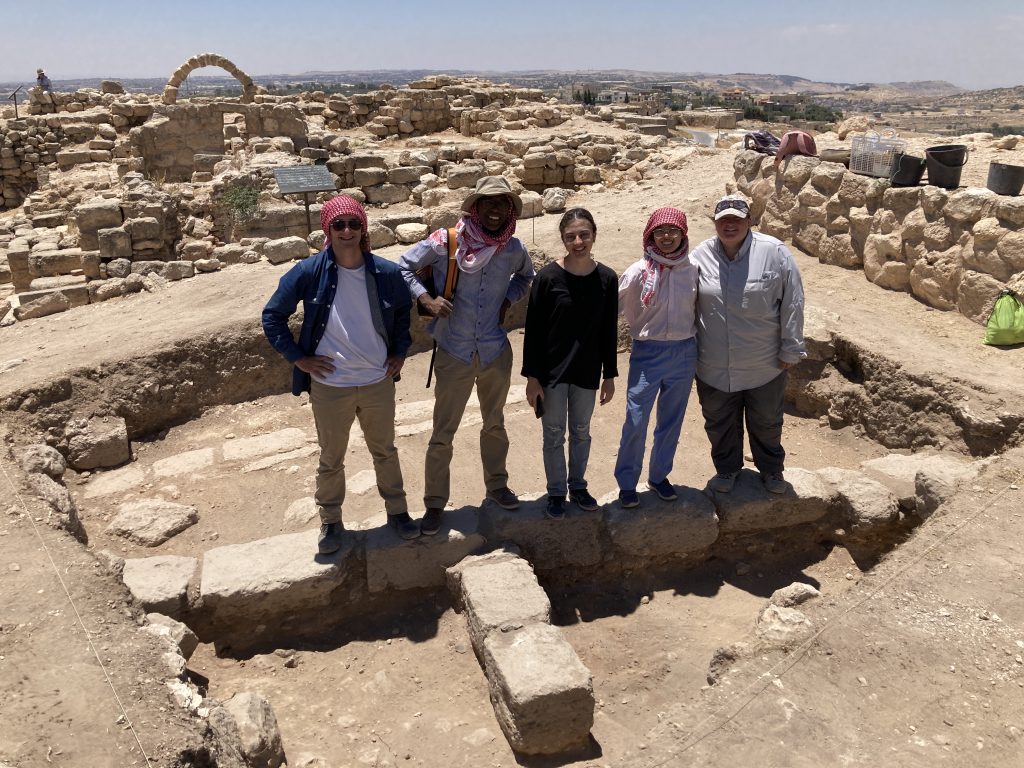
In June of 2022, with help from ASOR and the P. E. MacAllister Scholarship I arrived in Jordan for my first archaeological field season. I would be working as a square supervisor at Tell Hisban. Tell Hisban is a site in Northwest Jordan near the capital of Amman. There are many layers of occupation left by many civilizations at Hisban, from the Assyrians all the way through to the Ottomans as well as occupation by more modern local Bedouin. However, inspired by research conducted in collaboration with Dr. Oystein LaBianca, the focus of my field would be into the Hellenistic and Roman eras. Hisban lies within the region historically occupied by the Decapolis. The Decapolis was a semi-formal political and mercantile league of cities, connected by their common Greek culture and language. As I presented in my poster presentation at the 2021 ASOR conference, we believe Hisban was part of a greater overall cultural program of the Decapolis.
The acropolis at Tell Hisban possesses a Byzantine church as well as the foundations of what has long been believed to have been a Roman public building. This public building has been hypothesized as being specifically a Roman temple. Our goal this field season was to excavate atop the acropolis and search for the floor of this public building; and to incorporate our findings into this overarching theory of Hisban within the cultural program of the Decapolis. Finally confirming that this public building was indeed a Roman temple would have gone a long way toward serving this theory.
Our excavations started, and removal of the modern topsoil revealed occupation by modern local Bedouin. However just below the topsoil we began to uncover walls. We found two non-parallel rows of walls made of repurposed Roman ashlar bricks. These came as a complete surprise to everyone on the dig and caused us to totally change our excavation plans. From here, we made the decision to excavate more closely along the northern row of walls. The sherds that were found imply heavy occupation during the Late Byzantine/Early Islamic eras. Of particular note among these sherds was a number of extremely uncommon triple-glazed, molded-relief Byzantine sherds, we believe to be imported from elsewhere in the Mediterranean.
The excavations of the loci on the northern side of the north wall revealed what we believed to be a storage jar, in situ, with its rim peeking just above the ground. We took a few days bringing the other loci into phase and then began to carefully excavate around the jar. As we dug lower the soil began to turn grey and ashy. Then as we dug flush with the bottom of the jar, we noticed the sides came down completely straight and it didn’t have a bottom. As it would turn out it was not a jar at all but a tabun cooking oven! After this revelation we decided to carefully collect and remove each of the pieces of the oven (as it was still in situ but completely shattered) and bag the soil within the oven to be floated for organic materials. The oven was made of a rough handmade ceramic, we believe to date from the Late Byzantine or Early Islamic eras. Another noteworthy find was a red bead nearby the oven. The bead is carnelian with delicate white paint design on it, as well as a bronze wire still attached to it.
The tabun saga continued however. In the days before we were about to leave for the season, another student and I went to visit a local shopkeeper and old friend of the Hisban excavations and archaeologists in Jordan. We told him about the oven we found and showed him photos of it. He instantly corrected us when we said it was a tabun, he said “no this is a zarb”. We weren’t yet aware of what a zarb was. A tabun is a round and stout oven with a large opening at the bottom, not unlike a pizza oven. A zarb is a straight round oven, generally submerged into the ground, in which food is lowered in from the top rather than the side. After we learned about this we all instantly agreed with our friend, it was a zarb after all and not a tabun. This was a really beautiful moment of local knowledge in action.
My first field season, as often happens in archaeology, did not go as planned. That being said, we made a number of very surprising discoveries. It is still unknown whether or not the building on the acropolis was indeed a temple or not, but our findings are important pieces that help put the story of Hisban together. This dig was an amazing experience for me both personally and academically and I look forward to returning to Hisban to continue our excavations on the acropolis.
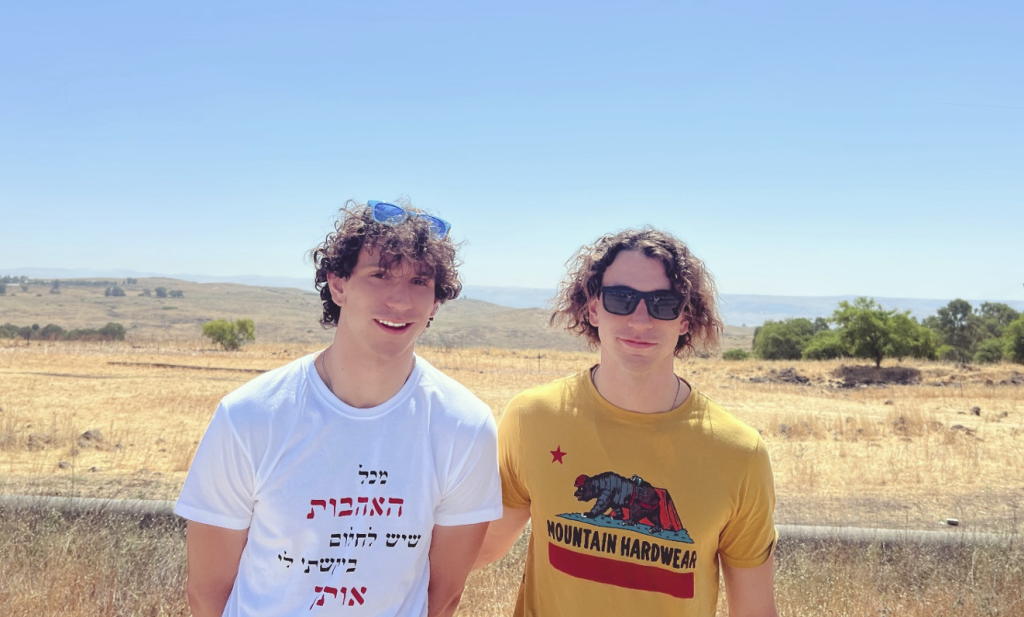
Colton Hodges graduated from Andrews University in 2022. He received a Bachelors’ Degree in Behavioral Science with a concentration on Anthropological Archaeology. He plans to pursue a PhD in archaeology, and work towards his ultimate career goal of becoming a university professor and field researcher.
Want to help more students and early career archaeologists get into the field? Donate to the cause today by selecting “Student Support” as your gift purpose!
Call for Early Career Scholars Committee Members: Community and Networking Team
The Early Career Scholars Committee (ECS) is looking for new members for our Community and Networking team for the upcoming academic year. We are especially interested in applications from people who represent diversity in the field and/or scholars currently working in research that is underrepresented at ASOR. If you wish to be considered by the committee, please fill out the application form below. We will begin reviewing applications on May 1, 2023, and will continue consideration throughout the summer.
PURPOSE:
The “Community and Networking” sub-committee focuses on fostering inclusivity of Early Career Scholars across ASOR. The committee is responsible for creating a welcoming community space for students and early career researchers to come together, socialize, network, exchange ideas and information, and built connectivity across all ASOR disciplines.
FUNCTIONS:
Organize online, virtual events to grow the ASOR ECS community such as coffee hours and book clubs.
Plan and host the Early Career Scholars reception and city outings at the annual meeting.
Maintain and expand the existing ASOR ECS social media channels on Facebook, Twitter, and Instagram.
COMMITMENT:
This committee would entail one hour-long meeting and three hours of service per month.
Recordings of ASOR Annual Meeting paper presentations from the 2020-2022 virtual Annual Meetings are part of the ASOR Online Library. The recordings will remain available to all members who register for the current year’s Annual Meeting for as long as ASOR has the capacity to keep the presentations available online. If you do not want your paper presentation to remain online, please fill out the ASOR Presentation Recording Form to request:
To remove the recording immediately (as soon as we are able);
To replace your paper recording with a new, updated video file that you will provide;
To edit the recording to remove a particular slide(s). This option is contingent on ASOR having staff capacity to edit the video and we will make every effort to accommodate your request.
2022/2023 Mesopotamian Fellowship Report: The Excavations of Qach Rresh (First Season)
Petra Creamer, Emory University[/vc_column_text][mk_divider][vc_column_text]
I. Goals of the Excavations at Qach Rresh
In the very first season of the Emory University excavations at the site of Qach Rresh, located just a few kilometers north of the village of Trpa Spiyan, the team was interested in investigating several questions:
identifying the exact dates of construction and occupation of Qach Rresh
understanding the function of the large buildings discovered in the magnetometry
investigations of 2022
explore why such a site existed in a relatively marginal agricultural area
With a season lasting 5 weeks (from August 31 – October 2, 2022) and supported by the ASOR Mesopotamian Fellowship, the Emory team opened two trenches over the main building remains at Qach Rresh with the intent to begin answering these questions.
Manipulating the photograph using the Digital Epigraphy’s user interface produces the best known available photograph of the inscription. Compare the previously published photograph to that made during our cataloguing efforts.
Prof. Petra Creamer, Emory University, USA (Project Director)
Dr. Kyra Kaercher, USA (Assistant Director, Ceramicist)
Dr. Nathalie Brusgaard, Groningen University, Netherlands (Zooarchaeologist)
Dr. Elise Laugier, Rutgers University, USA (Micropaleobotanist)
Dr. Lucas Proctor, Goethe University Frankfurt-am-Mainz , Germany
(Macropaleobotanist)
Ms. Glynnis Maynard, Cambridge University, UK (Excavator)
Kurdistan Region Project Staff
Kak Ahmad Jodat, Erbil Antiquities, KRG (Project Representative)
Kak Nader Babakr, Erbil Antiquities, KRG (Erbil Governate Director of Antiquities)
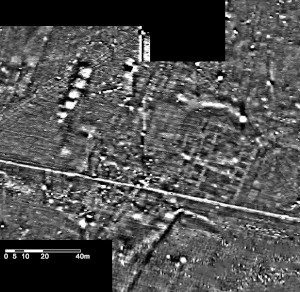
Figure 2: Magnetometry results from 2021, conducted by Petra Creamer as part of EPAS.
Five workmen from Trpa Spiyan
III. Prior Research at Qach Rresh
Qach Rresh was first discovered and recorded by the Erbil Plain Archaeological Survey (EPAS) in 2017 as a single-period Neo-Assyrian (Iron Age) site (EPAS Site Number 458). In 2021, EPAS returned to the site to conduct geophysical investigations with a Bartington 601-2 Gradiometer. The results showed the remains of several large buildings and smaller structures at the site (see Fig. 2).
These results showed an example of an unusual type of Iron Age site which had never been excavated before – a rural village, likely centered around agriculture. However, the presence of large buildings at the site was unexpected, raising questions of imperial involvement in agricultural production.
IV. Excavation and Recording Methodology
The scientific recording of the excavations at Qach Rresh were a combination of digital and traditional. In the field, the excavators would record all contexts and collection lots on paper worksheets, which would then later be entered into digital spreadsheets during lab time in the afternoons.
Spatial recording methods relied upon two Emlid-brand RTK GPSs (Real Time Kinematic Ground Positioning Systems). The setup of two Reach R2 systems (see Fig. 3) allows the user to record points in X-Y space with sub 2cm accuracy. The base RS2 sits stationary while the rover RS2 is moved to mark points. Using this, we were able to mark features of significant interest along the cut, as well as record the location of features within Operation A. These recorded points were then imported into ArcGIS to record the exact location of the features. GIS was a key component of the recording system, since the trenches and their related features could be recorded in real space for reference in this season and future seasons (Fig. 4).
Aerial imagery is now a standard in archaeology. The project employed a Mavic 2 DJI-brand drone to photograph excavation contexts near-daily. The resulting photographs were indispensable in both recording and reconstructing the past features of Qach Rresh. Furthermore, multiple drone photos were used to create 3D digital models of the trenches to record features of interest.
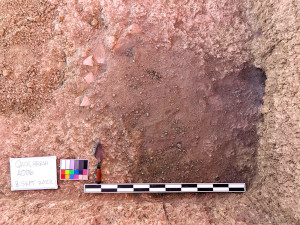
Figure 7: Photograph of A006, the ashy pit abutting Wall A013.
Operation A was opened on August 31st at a size of 20 x 5m. Topsoil removal showed heavy plow scars affecting the remaining features below ground, to a depth of at least 30cm. In the eastern part of the trench (9x3m), we excavated down in 20cm intervals with the intention of uncovering a large set of walls bounding the northwestern part of the courtyard in the main building identified through magnetometry. At a depth of around 50cm, the texture of the soil matrix began to harden, becoming thick and difficult to excavate. While the walls were difficult to identify due to this uniform matrix, we were able to distinguish the wall running roughly from NW-SE based on a pit that had been cut into the fill of the building. The pit itself (A006) was filled with ash, charcoal, animal bone, and broken pottery (Fig. 7). The north edge of the pit abutted the wall, creating a straight line against the south face of it that confirmed the wall’s limits.
The remaining time in Op. A was spent attempting to identify a floor surface of the building’s courtyard. While the fill of the courtyard eventually became less thick (with less collapsed mudbrick) a floor surface remained difficult to identify. We excavated to a depth of 1.83m in the SE corner of the trench in order to reach sterile soil and confirm the beginning of human habitation.
Operation B was opened on September 13 at a size of 10x10m. Like Op. A, the area was affected by plow scars up to 30cm deep underneath the topsoil. Immediately, we noticed a proliferation of broken baked bricks near the top levels, intermixed with river cobbles and sherds. We began to excavate the southern half of the trench, forming a 5x10m area. Roughly 10cm below the surface we discovered two single-course walls of river cobbles, both arranged in right-angles and adjacent to one another (Fig. 9). We theorize that these may be the remnants of pastoral activity, such as pens for livestock or field boundaries.
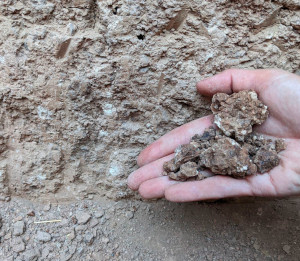
Figure 11: An example of soil containing calcium carbonate crystals (white nodules)
Once below these walls, we proceeded down in 20cm intervals. It quickly became evident that the western half of the trench was very similar in soil type to much of Op. A, where calcium carbonate crystals were intermingled with dark brown, thick soil. In the eastern half of the trench, however, we began to collect large amounts of sherds and animal bones beginning at a depth of 35cm. To focus our efforts, we separated the trench in half and continued to excavate in the eastern half, while also opening a 4x5m area in the northeastern corner of the trench. Based on soil color and texture, we were able to estimate the orientation and thickness of the mudbrick wall bounding the room on its western side (see Fig. 10). We designated this wall before continuing to excavate the room’s fill.
Ceramics, bones, broken baked brick, and partial mudbricks continued to be found as we excavated the room’s fill. At a depth of 82cm we began to excavate a sounding in the northern part of the room with two goals: to excavate down to the room’s floor, and to identify stratigraphic units in the resulting baulk. In total, we identified at least 130cm of fill and 55cm of mudbrick collapse before reaching what we believe to be the main floor of the building. Additionally, there was 30cm of hard-packed soil with few artifacts located just beneath the floor. Below the hard-packed layer we discovered virgin soil, identifiable by having no artifacts and many calcium carbonate crystals (see Figs. 11&12).
Both the buildings in Operation A and Operation B were difficult to identify based on excavation alone, due to significant deterioration in the mudbrick. By using the magnetometry data together with the excavation, we were able to come to several conclusions about the site after one season:
Many of the artifacts collected from the Qach Rresh excavations likely date to the post-Assyrian phase of the Iron Age (c. 600-500 BCE). This is based on the post- Assyrian forms of the ceramics and the common use of grit instead of chaff as a temper.
The rooms of Building B (in Operation B) were clearly used as a dump in the post- Assyrian period.
The room excavated in Building B this season contains at least 130cm of fill from trash deposition. Below these multiple deposition events (which can be identified in the stratigraphy of the baulk – see Fig. 12) there is what appears to be roughly 55cm of mudbrick collapse, likely from the roof of the building. Below this, there is a 30cm thick layer of hard-packed clay with very few artifacts. We interpret this layer to be the remains of the foundation trench constructed before Building B was built.
While initially we approached Qach Rresh believing it to date to the late Neo-Assyrian period (c. 750-600 BCE) we now believe it to have been mainly used in the post-Assyrian period. It is still unknown in what period the buildings were constructed, though it seems likely based on the chaff- tempered ware recovered from the building in Op. A that they may have been constructed in the Neo-Assyrian period, abandoned, and then reused in the post-Assyrian period. Overall, we are also interested in the potential to investigate the post-Assyrian occupation of the Erbil Plain, considering it has been largely underrepresented in archaeological studies.
VII. Summary and future plans
Ultimately, the 2022 season of excavations at Qach Rresh have shown that our initial expectations of the site should be reconsidered not only regarding the site’s dates of occupation, but also in its occupation use. Next season, we will continue to expand the areas of Op. A and Op. B to expose the floor levels of both buildings. Carbon samples were collected during this season, and will be C14 dated to obtain exact dates of the fill of Building B and the ash pit of Building A. Furthermore, we intend to continue applying archaeological scientific methods to the data from Qach Rresh next season, including isotopic analysis of the faunal remains, phytolith analysis, and ceramic petrography. These, combined with further seasons of excavation, will inform us greatly of Qach Rresh’s past.
Paul Lapp’s team last excavated at Tell Ta’annek in 1968, over fifty years ago. During that time, much effort has been expended on the final publication of the site’s stratigraphy and material, even though few final manuscripts have reached the publication stage. Walter Rast’s work with the Iron Age pottery was the notable exception and was published in 1978. The present volume uses Rast’s ceramic chronology as the basis for the periodization of the Iron Age strata excavated by Lapp in 1963, 1966, and 1968. After covering the background of the site and Sellin’s excavation of it in the early twentieth century, Meehl presents the Iron Age stratigraphy area by area, period by period, based on the field notes, reports, plans, and photographs of the excavators. Two chapters describe the Iron Age occupations on Tell Ta’annek, setting them in their regional contexts. Appendices addressing the date of the Iron Age fortifications and fire installations and pits follow. Iron Age pottery forms and drainpipes not included in Rast’s book are included in a third appendix.
ASOR members (with a mailing address in the USA) can purchase a copy of ARS 29 at the discounted price of $35.00 (ca. 65% discount off the list price + $6.00 US media mail shipping) through June 30, 2023, while supplies last. Purchases are restricted to one volume per member. We are unable to offer this discount to members without a US mailing address due to international shipping costs, but you can purchase and ship a copy through the ISD link below. Please contact programs@asor.org with any questions. Click here to purchase your discounted copy in the online store in ASOR’s Portal.
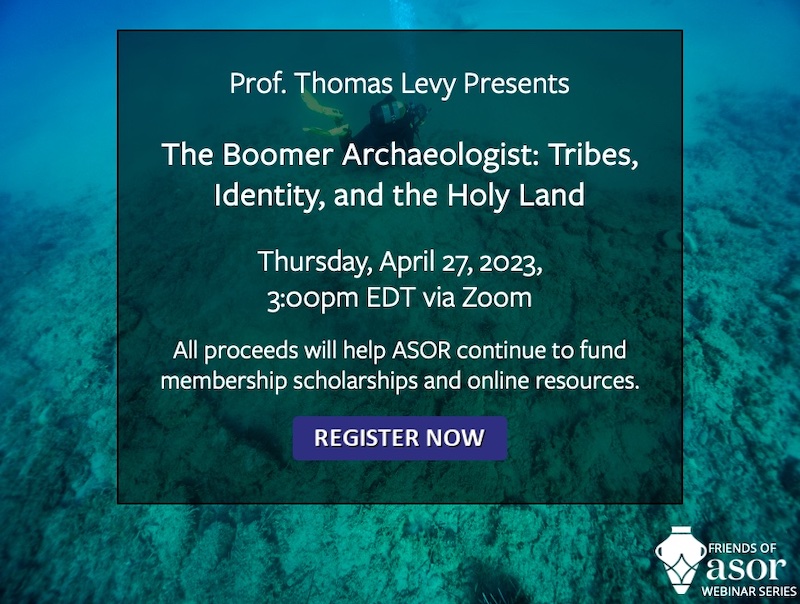
Friends of ASOR present the next webinar in our monthly series on April 27, 2023, at 3:00 pm EDT, featuring Prof. Thomas Levy and moderated by Dr. Ian Jones. For many archaeologists, their lives can best be described as “a life in ruins.” As seen in Tom Levy’s forthcoming book, The Boomer Archaeologist – A Graphic Memoir of Tribes, Identity, and the Holy Land, this is indeed the case. Except for some brief periods working as a cowboy, Levy has worked only as an archaeologist – from early beginnings in the American Southwest in the late 1960s, to professional research in Israel, Greece, and Jordan. Reflecting on more than 50 years as a Levantine field archaeologist, Tom discusses some of the motivations for becoming an archaeologist working in the Holy Land, his role in the application of new methods and theories in the changing field of anthropological archaeology in the eastern Mediterranean, his transition from desert to underwater archaeology, and some of the challenges facing US universities that will affect the future of American research in the field of Levantine archaeology.
Based on his forthcoming graphic memoir, The Boomer Archaeologist, the lecture will include ligne claire drawings by the memoir’s graphic artist Lily Almeida and photographs from several of Prof. Levy’s projects that tell the story of changes in method and theory in Levantine archaeology over the past 50 years. These projects span the metallurgical revolution during the Chalcolithic period, the rise of the Edomite kingdom known from the Hebrew Bible, and ancient environmental and social change observed through underwater archaeology in the eastern Mediterranean.
Join Prof. Levy as he discusses his new graphic memoir in telling the story of a lifetime professional working in and off the coast of the Holy Land. The webinar will conclude with a Q&A session moderated by Dr. Ian Jones (University of California, San Diego).
Prof. Thomas Levy is the Distinguished Professor, and inaugural holder of the Norma Kershaw Chair in the Archaeology of Ancient Israel and Neighboring Lands at the University of California, San Diego. He is the founder and co-director of the Center for Cyber-Archaeology and Sustainability at the Qualcomm Institute at UC San Diego. Elected to the American Academy of Arts and Sciences and holder of an honorary doctorate from Charles University (Czech Republic), Levy is a widely published Levantine field archaeologist with interests in the role of technology, especially early mining and metallurgy, and on the evolution of societies, especially in eastern Mediterranean. Tom has published 15 archaeology books and over 250 scholarly articles. Levy’s recent focuses are on marine archaeology and paleoenvironmental change during the Neolithic to Classical periods off the Carmel coast of Israel with the University of Haifa, where he is a research associate.
This webinar will be recorded and all paid registrants will be sent a link to view the recording.
To receive your ASOR member discount, log into the online store. If you are new to ASOR, please click on the “New Visitor Registration” link to register your e-mail address and choose a password for our online store. Once logged in, navigate to “Meeting and Event Registration” to register for the webinar and pay the fee. Each paid registrant will receive a confirmation e-mail when you pay for the webinar. If you do not receive this e-mail, then you are not registered. Please e-mail membership@asor.org with any questions or issues with registering.
You will be e-mailed the Zoom Webinar link in the week prior to the lecture on April 27, 2023. If you do not receive the link by the close of business two days before the webinar, please e-mail membership@asor.org immediately. This webinar will be recorded and all paid registrants will be sent a link to view the recording.
All proceeds from this webinar are used to fund scholarships for members as well as increasing ASOR’s online resources, which are free to the public.
READY FOR A WEBINAR SEASON PASS?
Buy a season pass for all the webinars* of the 2022-2023 FOA Webinar Season! 1) You will automatically receive the Zoom link for each webinar so no need to register each time. 2) You will also receive the recording of each webinar automatically after the event.
If you have missed webinars earlier in the season and still want to buy the pass, you will receive the links to the recordings of the webinars you missed in your automatic confirmation email after you buy the pass.
*Special symposiums may be excluded from the season pass price.
No more registering for a year if you buy your pass today!
Pricing:
Members: $75.00 Non-Members: $150.00 ASOR Sustaining Members: $0 (automatic registration for each webinar) Not a member yet? Click here to join as a member and receive the 50% off a season pass!
Log into our online store to purchase the season pass for 2022-2023. If you are new to ASOR and do not have a record in our store yet, click here to register. After you login, navigate to the left to “Meeting and Event Registration.” Please e-mail membership@asor.org if you have any questions or issues.
WHY SPONSOR A WEBINAR?
Several levels of support from $50-$1,000 are available. Proceeds go towards membership scholarships and towards increasing ASOR’s virtual resources. Each sponsorship is tax-deductible and you can give your friends free registrations to a webinar!
Bronze Level ($50): up to 2 guest registrations Silver Level ($100): up to 5 guest registrations Gold Level ($500): up to 20 guest registrations Platinum Level ($1,000): up to 50 guest registrations
After you sign up for a sponsorship online or over the phone, email the names and email addresses of your guests to Felice Herman at membership@asor.org, who will send your guests a confirmation and the Zoom link before the webinar.
WANT TO SAVE $6.00 ON THE NEXT WEBINAR?
Join ASOR as a member! Click here for more details about discounts for events and other benefits of membership. Memberships start at $40 for the year as an Associate Member.
You can now purchase the link to the recording of any webinar. You can also purchase the bundle packages of all webinars from the 2020-2022 seasons. Please e-mail membership@asor.org for purchase details.
To see a printable pdf of the webinar titles from the 2020-2021 season, please click here. To see a printable pdf of the webinar titles from the 2021-2022 season, please click here.
Where Are They Now?: A Preview of 2022 ASOR-Affiliated Fieldwork Projects Michael Given (University of Glasgow), Xenia-Paula Kyriakou (Florida Gulf Coast University), Stephen Batiuk (University of Toronto), Monique Roddy (Walla Walla University), Kent Bramlett (La Sierra University), Friedbert Ninow (La Sierra University), and Michael Hoff (University of Nebraska-Lincoln) | March 8, 2022
Tel Rehov: A Major Bronze and Iron Age City in the Jordan Valley Amihai Mazar (Hebrew University of Jerusalem), Nava Panitz-Cohen ( Hebrew University of Jerusalem), Nota Kourou (Athens University), Naama Yahalom-Mack (Hebrew University of Jerusalem), Robert Mullins (Azusa Pacific University) | February 10, 2022
Archaeogaming: Why Video Games Deserve Their Own Archaeology Tine Rassalle (University of North Carolina at Chapel Hill), Shannon Martino (Morton College), Matthew Winter (University of Arizona), Michael Zimmerman (Rhode Island) | April 18, 2021
David Brown, 2022 Steinmetz Scholarship for Active/Reserve Military or Veterans[/vc_column_text][mk_divider][vc_wp_text]
As one of three major settlements in the Huleh Valley, Tel Dan occupies a prominent place not only in its well-known biblical association with the settling of the tribe of Dan in Judges 18, but also in the larger regional history. Its geographic location and boast of abundant natural springs have made it an attractive place to occupy from the Early Bronze Age II to the late Roman period. The late Avraham Biran oversaw excavations there from 1966-1999, with David Ilan of Hebrew Union College leading new excavations since 2005. Over this span of time, excavators have revealed some impressive features at the site including a Middle Bronze gate, an Iron II fortification system, a cultic high place, and of course the Tel Dan Stele. The site remains a major tourist attraction for history and archaeology enthusiasts to partake in exploring the vast treasures Israel has to offer
[/vc_wp_text][vc_row_inner][vc_column_inner][vc_single_image image=”96288″ img_size=”full” add_caption=”yes” alignment=”center” onclick=”img_link_large” img_link_target=”_blank” css=”.vc_custom_1712081676195{padding-right: 10px !important;}”][/vc_column_inner][/vc_row_inner][mk_padding_divider][vc_wp_text]The 2022 season marked the final excavation for Area B—a series of rooms situated directly north of the Iron II fortification system on the southern flank. This area also juxtaposes the interior of the Bronze Age ramparts. A team of students, under the direction of Aaron Burke of the University of California Los Angeles, were assigned three squares in this area. The objectives of this season were to articulate the Iron I strata and reach the terminal Late Bronze phase. Along with students from Hebrew Union College working in Area L, a group totaling forty individuals from around the globe participated in this year’s fieldwork for four weeks covering June-July.
For my part in the excavation, I served as one of three square supervisors in Area B. My Ph.D. research centers on forced migration during the Late Bronze transition to the Iron Age where I seek to identify refugees resettling throughout the southern Levant. As such, this year’s objectives at Tel Dan were fortuitous for my research. We spent our first week removing quite a bit of wash from the area, because no work had been done at the site since 2018. Our second and third weeks were more productive in uncovering various indicators of conflagration including wall collapse, ash, and thick layers of destruction debris. We also analyzed wall interfaces and foundation trenches to better understand the sequencing of phases built up over time. By the fourth week, our area gifted us with a generous reward—pits. We identified them as refuse pits.
Many people consider it strange that archaeologists could be so interested in the garbage of past people, but it is in the trash and the refuse that we can find some of the most valuable information in our reconstruction of ancestral behavior and events. From seeds and botanical analysis to bones and an understanding of diet, from crushed jars to which strata these holes were cut into, I have developed a strong appreciation for the importance of pits and what they contain. Particularly for my research with refugees, who exhibit basic subsistence and storage practices, pits are vital to identifying where refugees settled and what they produced. Needless to say, our efforts this season satisfied a serendipitous end to the Area B excavations.
I look forward to incorporating the data we unearthed at Tel Dan this season into my research and contributing to a better understanding of forced migration, the factors that pushed and pulled people to new regions, and how they reestablished themselves and began to rebuild and rediscover their social identities. I am also grateful to ASOR and to Mr. Charles Steinmetz, the donor for this fellowship, for financially supporting me in my research this season.
David Brown is a Ph.D. candidate in the Department of Near Eastern Languages and Cultures at the University of California Los Angeles. His research is centered on forced migration in the Early Iron Age southern Levant, analyzing how to identify refugees in the material culture according to their push and pull factors as well as how they reconstituted themselves into new social identities after regional changes at the end of the Late Bronze Age transformation.
[/vc_wp_text][mk_divider][vc_wp_text]Want to help more students and early career archaeologists get into the field? Donate to the cause today by selecting “Excavation Scholarships” as your gift purpose!
Zachary Griffith, Eric and Carol Meyers Fellowship recipient
This summer I was able to attend the Huqoq Field School in Israel. I am grateful to ASOR for this scholarship, allowing me to attend this excavation. This was my first excavation outside of the United States, and by far the largest excavation that I have been a part of. During the excavation season I learned a great deal from the staff and supervisors, including Dr. Jodi Magness of the University of North Carolina at Chapel Hill and my Classics Professor at the college I attend, Austin College, the architecture specialist Dr. Martin Wells. Once again, I am thankful for the support of ASOR in making this experience possible.
I am grateful to have been a part of such an important excavation. The main focus of our excavation at Huqoq was the Late Roman synagogue and the Medieval synagogue building. The Huqoq excavation has gained much notoriety for the beautiful, well-preserved, and unique mosaics that were discovered in the Late Roman synagogue. Apart from the emphasis placed on the mosaics, there was much emphasis placed by the staff and supervisors of the significance of the material that can give a date for the Late Roman synagogue. This was especially evident when we visited various other synagogues in Northern Israel, such as those at Capernaum and Sepphoris. At lectures and hearing discussions between various professors at several of these sites, the magnitude of importance for the dating material for our excavation of the Late Roman synagogue at Huqoq was revealed. This dating material is so important to archaeology in this region due to conflicting theories over how the Christianized Roman Empire effected synagogue building and prosperity of the Jewish people under the Roman Empire, as such discussions have led scholars to give dates to synagogues that can differ by a degree of hundreds of years. It was great to be a part of an excavation that by itself is very significant, but that also could also have wide reaching implications for an entire region during the Roman Period.
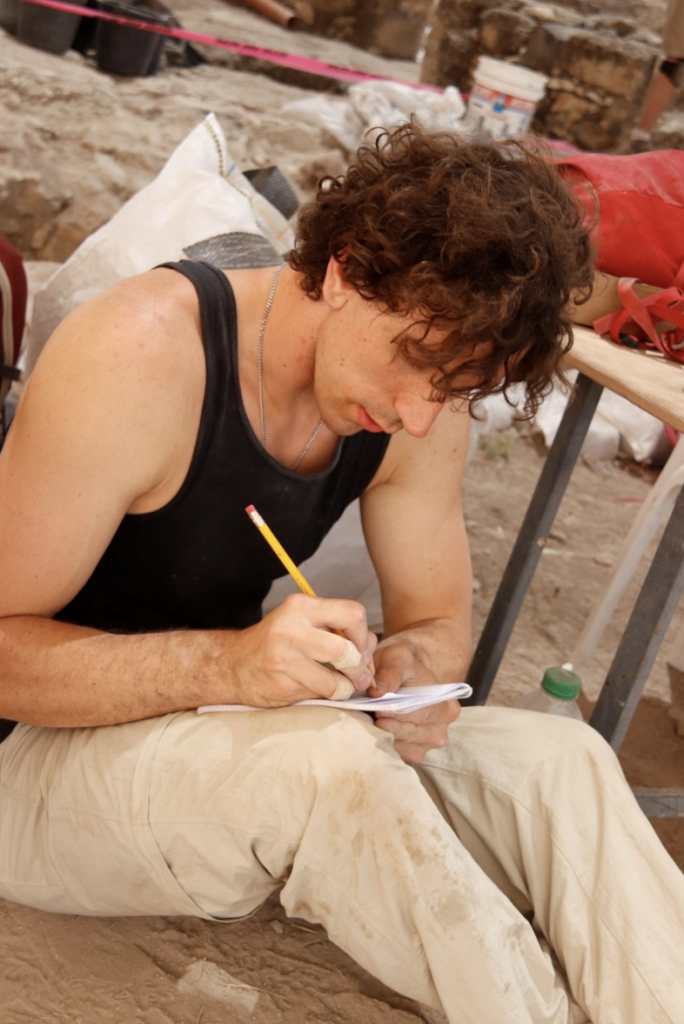
Zach taking notes at the site after a day of excavation.
As a part of the Huqoq excavation I was assigned to the area 3000 North, which was supervised by Dr. Rangar Cline of Oklahoma State University. This was the area that consisted mostly of the Northwestern sections of what was once the Late Roman synagogue and the Medieval synagogue. 3000 North was also where previously unexcavated mosaics were uncovered during this season. In 3000 North I learned a great deal about excavation techniques. Also, due to our proximity to the Late Roman mosaics, and the emphasis placed on finding material to date parts of the site, I frequently sifted the material we excavated. Sifting could be very exhilarating, such as when we would find artifacts that could possibly be used as dating evidence, but also heartbreaking, such as when tesserae was discovered, showing that sections of the Late Roman synagogue’s mosaic would not be preserved.
Zach excavating in 3000 North.
I greatly value the work I did under the direction of architecture specialist. Dr. Martin Wells. I assisted Dr. Wells by moving, washing, and recording various architectural fragments of significance to the excavation. Handling these pieces and gaining first-hand experience from Dr. Wells, I was able to learn a great deal more about the architecture and construction techniques in all phases of the site that we excavated. What is most memorable to me about Huqoq was how rewarding the process of reconstructing the Late Roman and Medieval synagogues could be’ even though it was a very difficult process. This can be highlighted by the way in which the builders of the Medieval synagogue reused material from the Late Roman synagogue, and it is from this reused material that we can gain more evidence of what the Late Roman synagogue may have looked like. In addition to all of the fieldwork, spending time with all of the individuals with the same passion for archaeology was amazing. I will have future colleagues and friends for life.
Zach (left) and his brother, Cayden (right), at the kibbutz.
Zachary Griffith is a Senior at Austin College, where he is majoring in Anthropology, Classics, and History. He also plays goalie for the water polo team at Austin College.
Want to help more students and early career archaeologists get into the field? Donate to the cause today by selecting “Excavation Scholarships” as your gift purpose!
Paul Richards, 2022 ASOR BIPOC Scholarship for Fieldwork Participation[/vc_column_text][mk_divider][vc_wp_text]Near East Archeology was a subject that, by title, I had not heard of until I started looking for a graduate degree covering ancient Israelite history. I knew archeologists went into the Middle East to do work, but I had not delved into more for the career field. After graduating from college with a BA in History I taught History in Cairo for 3 years at an American language high school. Then I taught ESL for 2 ½ years. While in Cairo I visited active dig sites. Visiting the sites sparked my interest in archeology.
When I started my Near East Archeology program at La Sierra University, I was excited for the upcoming dig. Because of the pandemic the normally scheduled dig season was canceled. I was determined to go the next season. By the time the next dig season came around the next year my finances were depleted. I applied for scholarships, and it is only due to being awarded the 2022 ASOR BIPOC Scholarship for Fieldwork Participation, that I was able to join the BRAP excavation trip.
The experience was great. I had been to Jordan on a 30-hour layover before where I took the opportunity and toured around the immediate Amman area. For the excavation I signed up for the full BRAP dig season for six weeks. Being in the archeology classroom learning about archeology and working in the lab was much different than being in the field. While in the field I remembered terminology I had learned in class. It was a continual task matching the term I had learned in class with the meaning or action in the field. The work was hard but every day we dug up something significant to me as a first timer. Finding pottery was exciting. I quickly found out the dig veterans were very used to seeing pottery finds. The schedule was taxing but the finds everyday made it worth it.
In the middle of the season, we went to Petra. I had heard of Petra for a few years and the reports from those who had visited made it sound like the ultimate travel destination for all Near East enthusiasts. Usually people exaggerate, this time the reports were accurate. It was better than going to Disneyland.[/vc_wp_text][vc_row_inner][vc_column_inner][vc_single_image image=”96209″ img_size=”full” add_caption=”yes” alignment=”center” onclick=”img_link_large” img_link_target=”_blank” css=”.vc_custom_1712002492498{padding-right: 10px !important;}”][/vc_column_inner][/vc_row_inner][mk_padding_divider][vc_wp_text]Archeology Becomes Personal
I grew up in and still am active in a distinct faith tradition. Previously my interest in ancient Israelite history had tilted my dig interest towards only going to Israel. I knew there was a lot to learn about ancient Israelite history from its ancient neighbors. Growing up myself in a culture and community where the stories of ancient Israel are accepted on a faith basis, it seemed almost automatic to gravitate towards Jerusalem. In a faith-based environment, especially for laypersons, activities of other ancient people groups are pushed aside and overlooked. It is a task of historians to help laypersons understand the study of Israel’s neighbors, and with proper archeology, enhance our academic understanding of faith-based stories.
The name Moab made a frequent appearance throughout the Old Testament of the Bible. A brief search rendered at least 18 times. The name originated, according to faith traditions, from one of the sons of Lot; Lot was Abraham’s nephew. The birth of Moab occurs in Genesis 19 along with his brother Ammon. The story includes some humiliating and salacious content. This son became the progenitor of the Moabites. The Moabites would become one of Israel’s major antagonists. King David in 2 Samuel 8:2 subjects the Moabites to servitude. Here again, a horrific scene takes place in the scripture tradition. In 2 Kings 3 Mesha King of Moab is mentioned as paying a heavy tribute to the Northern Kingdom. Mesha rebelled after the death of Ahab. The Mesha Stella, a significant find in Near East Archeology, describes a revolt against Israel.
Many inscriptions describing victory may have the veracity of the victory legitimately questioned. This is due to the well-known desire of kings and nations to embellish the greatness of themselves and their people. In the case of Mesha it does appear the inscription holds weight. The Mesha Stella was found at Tell-Dibon, a site our team was able to visit.[/vc_wp_text][vc_single_image image=”96210″ img_size=”full” add_caption=”yes” alignment=”center” onclick=”img_link_large” img_link_target=”_blank” css=”.vc_custom_1712002888768{padding-right: 10px !important;}”][mk_padding_divider][vc_wp_text]Cultural Memory And The Story of Moab
Cultural memory is a topic I have delved into since the beginning of my graduate program. The reality of stories becoming exaggerated results in the need for teachers and writers to execute proper exegesis when dealing with historical topics. Exegesis is a term primarily heard of in theology. But the principal for the term is crucial for every research field.
Preconceived ideas need to be erased before proceeding in the research. During the research process the evidence must speak for itself. In a textual context, a word can be assumed to have one meaning, then with further investigation the researcher realizes the original speaker or writer had a different meaning in mind. This also applies to archeology. As taxing as the physical aspect of archeology is, it is crucial to dispel private ideas and interpretations that can result from classroom and reading work only.
The public figures inside well-known faith traditions have become known for mobilizing their base with shallow motivation. This motivation is often very loosely based on ancient text references. Many public figures use the texts blatantly out of context for private purposes. There is a dual danger in the faith community. One is those who carelessly use history to further an agenda. The other are those who are born into these agendas unawares. Both continue to propagate a false narrative. The latter falls victim to its own cultural memory.
In certain faith-based texts Ruth is the progenitor of King David, Ruth 4:22. Ruth was the daughter in-law of Naomi who became a widow and decided to follow Naomi back to her homeland. There is a parallel story line outside the traditional faith-based text, which teaches Naomi’s other daughter in-law Orpah, a Moabite went back to her people and gave birth to Goliath a Philistine. Goliath has become the stuff of legend. His bio has been stretched to create a superhuman villain that would match today’s comic books.[/vc_wp_text][vc_single_image image=”96211″ img_size=”full” add_caption=”yes” alignment=”center” onclick=”img_link_large” img_link_target=”_blank” css=”.vc_custom_1712003623857{padding-right: 10px !important;}”][mk_divider][vc_wp_text]And Finally
My time in the field has increased my interest in ancient languages. It has increased my interest in the facts of faith-based stories. While in the square my square mates and I had lively discussions over the topics presented above. By the end we were far from exhausting the matter. There will be more to debate and learn on the next excavation.[/vc_wp_text][mk_divider][vc_wp_text]Paul Richards holds a BA in History and a Minor in Communication Art from Oakwood University in Huntsville, AL. He lives in Southern California and is finishing his thesis at La Sierra University in Riverside, CA. Balu’a Regional Archaeological Project (BRAP) – Centers & Museum – La Sierra University. BRAP Jordan (@brapjordan) • Instagram photos and videos. Balu’a Regional Archaeology Project | Facebook.[/vc_wp_text][mk_divider][vc_wp_text]Want to help more students and early career archaeologists get into the field? Donate to the cause today by selecting “Excavation Scholarships” as your gift purpose!


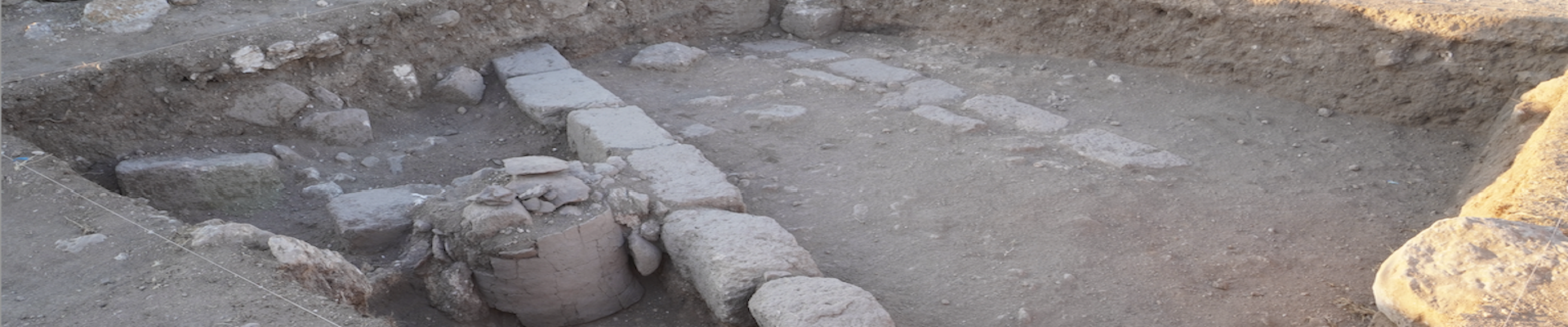
 The excavations of the loci on the northern side of the north wall revealed what we believed to be a storage jar, in situ, with its rim peeking just above the ground. We took a few days bringing the other loci into phase and then began to carefully excavate around the jar. As we dug lower the soil began to turn grey and ashy. Then as we dug flush with the bottom of the jar, we noticed the sides came down completely straight and it didn’t have a bottom. As it would turn out it was not a jar at all but a tabun cooking oven! After this revelation we decided to carefully collect and remove each of the pieces of the oven (as it was still in situ but completely shattered) and bag the soil within the oven to be floated for organic materials. The oven was made of a rough handmade ceramic, we believe to date from the Late Byzantine or Early Islamic eras. Another noteworthy find was a red bead nearby the oven. The bead is carnelian with delicate white paint design on it, as well as a bronze wire still attached to it.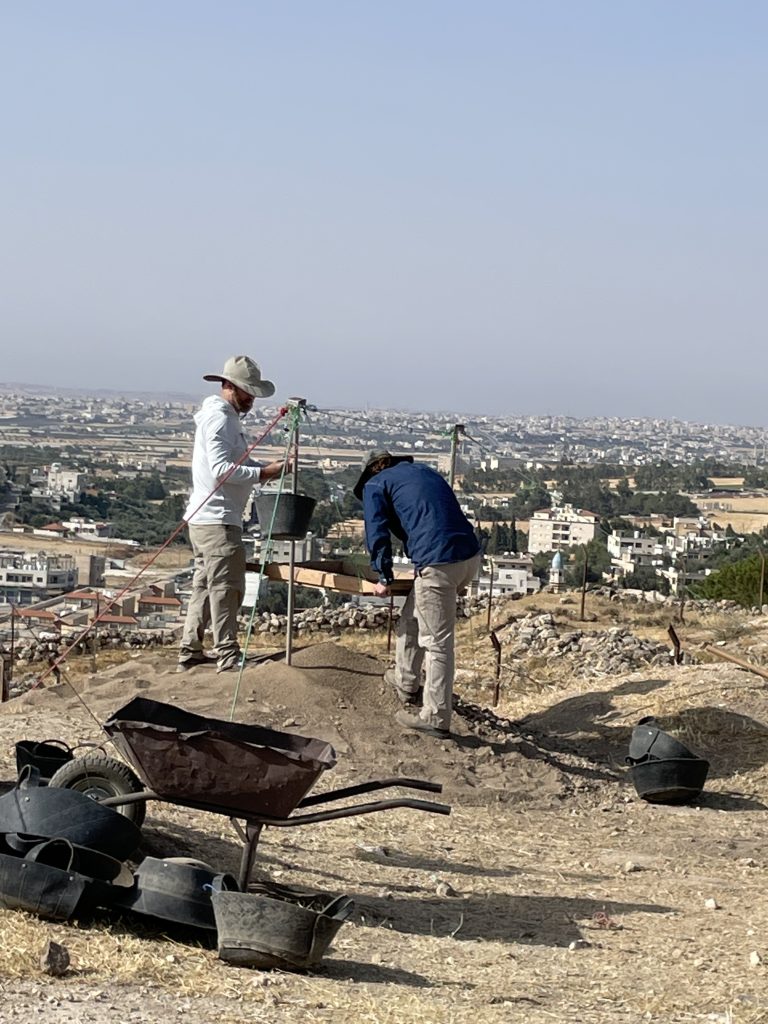
 The
The