
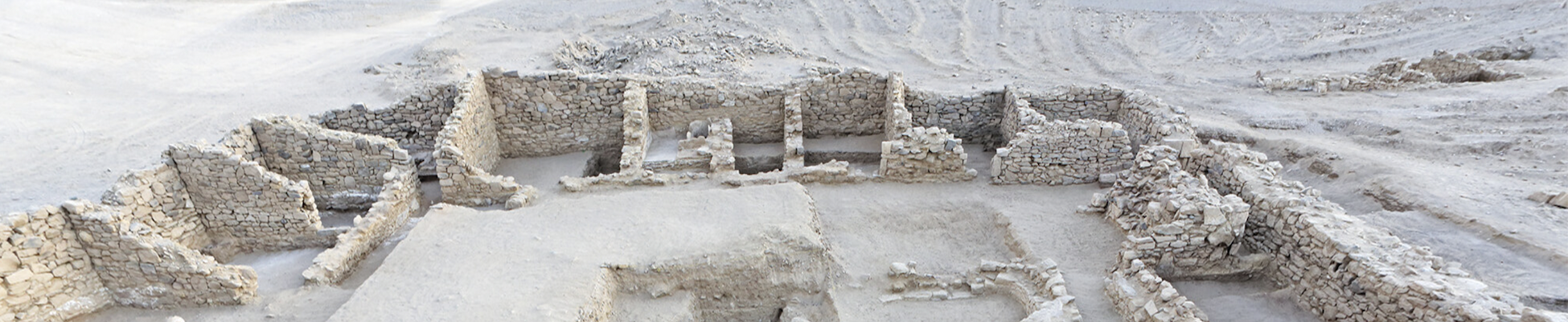

The article presents recent discoveries made by the French Archaeological Mission to the Eastern Desert of Egypt in two Ptolemaic forts occupied in the second half of the 3rd century b.c., Bir Samut and Abbad, located along the road leading from Edfu to Berenike on the Red Sea Coast at the southern fringes of the Ptolemaic Empire. These artifacts, three copper-alloy arrowheads marked with the monogram BE and four Ptolemaic coins minted in Joppa, were recovered in contexts securely dated to the last decades of the 3rd century b.c. Due to the sealed stratigraphy and the discovery of thousands of ostraca and dozens of coins in the same deposits, it is clear that the forts and these objects were abandoned on the eve of the Great Theban Revolt in Egypt, around 207–206 b.c. These discoveries offer an occasion to reassess the corpus of similar arrowheads and coins found in the Eastern Mediterranean. The catalog presented here includes 45 BE arrowheads and 18 Joppa coins and a careful reassessment of the corpus suggests that they were probably produced by the Ptolemaic regime in direct association with the Fourth Syrian War, which ended with the Battle of Raphia in 217 b.c. The geographic distribution of the arrowheads and coins discussed in the article demonstrates the mobility of the Ptolemaic troops after this intense period of conflict.
ASOR Members with online access: log into ASOR’s Online Portal here. Once logged in, click the JOURNALS tab in the top navigation bar. From here you may select which journal you would like to read. If you have online access, you will see your selected journal’s current issue Table of Contents. Click on the “Current Issue” button and you will then be redirected to the University of Chicago Press’s (UCP) platform to immediately start reading any issue of your choice. Tutorials for how to log in to the Online Portal as well as how to navigate to the Portal Journals page can be found here.

Pp. 31–49: “Two Iron Age Alphabetic Inscriptions from Tell eṣ-Ṣâfi/Gath, Israel,” by Esther Eshel, Tania Notarius, Amit Dagan, Maria Eniukhina, Vanessa Workman, and Aren M. Maeir
This paper presents two brief alphabetic inscriptions from Area D in the lower city of Tell eṣ-Ṣâfi/Gath, both deriving from Iron Age IIA contexts. The first is written in an Early Alphabetic script similar to an inscription previously published from the site (Maeir et al. 2008) and is interpreted as being related to the storage of wine. The second, written in later, “formalized” alphabetic script, is quite fragmentary and difficult to decipher, for which several possible interpretations are suggested. These two new inscriptions join the relatively large number of alphabetic inscriptions from Tell eṣ-Ṣâfi/Gath, second only in number to contemporaneous Tel Rehov, and provide additional evidence to the outstanding role of the site during the early Iron Age.
ASOR Members with online access: log into ASOR’s Online Portal here. Once logged in, click the JOURNALS tab in the top navigation bar. From here you may select which journal you would like to read. If you have online access, you will see your selected journal’s current issue Table of Contents. Click on the “Current Issue” button and you will then be redirected to the University of Chicago Press’s (UCP) platform to immediately start reading any issue of your choice. Tutorials for how to log in to the Online Portal as well as how to navigate to the Portal Journals page can be found here.

Pp. 51–72: “Post-Destruction Squatter Phases in the Iron Age IIB–C Southern Levant,” by Eli Itkin
The destructions caused by the military campaigns of the Neo-Assyrian empire in the southern Levant during the Iron Age IIB and IIC (8th–7th centuries b.c.e.) led to mass deportations of local populations and a forced displacement of refugees. Although several studies in recent years have focused their attention on displacement and refugees in the ancient Near East during the period in question, they often deal with large scale processes, while generally neglecting more localized phenomena. Such phenomena include, among others, post-destruction squatter phases. These frequently overlooked strata reflect the resettlement of a site following its destruction by local individuals who were forced, to some degree, to leave their homes for an unknown period. This paper attempts to define some of these post-destruction squatter phases in the archaeological record during the Iron IIB–C through the analysis of nine case studies, and to examine this phenomenon from a refugee standpoint.
ASOR Members with online access: log into ASOR’s Online Portal here. Once logged in, click the JOURNALS tab in the top navigation bar. From here you may select which journal you would like to read. If you have online access, you will see your selected journal’s current issue Table of Contents. Click on the “Current Issue” button and you will then be redirected to the University of Chicago Press’s (UCP) platform to immediately start reading any issue of your choice. Tutorials for how to log in to the Online Portal as well as how to navigate to the Portal Journals page can be found here.

Pp. 73–89: “Why Were the Leaders of the Sea Peoples Called ʿȝ.w and Not wr.w? On the Size and Raiding Character of the Sea Peoples’ Groups,” by Uroš Matić
This paper discusses the use of the terms ʿȝ and wr for the designation of enemy leaders in ancient Egyptian texts of the Ramesside period. Focus is placed on the choice of the term for leaders of the various Sea Peoples’ groups in the texts of the Medinet Habu temple of Ramesses III. The leaders of the Sea Peoples and Shasu are referred to as ʿȝ.w, whereas the leaders of other groups are referred to as wr.w. The terms used for different enemy leaders are indicative of the ancient Egyptian perception of the social organization of the enemy. Focusing on their social organization can provide us with a more stable ground for understanding the Sea Peoples. Several features indicate that they were warrior groups similar to pirates or mercenaries conducting raids, rather than large groups of migrants: 1) the choice of the term for their leaders during the reign of Ramesses III, 2) the relatively small numbers of their captives in the lists of spoils of war of Merneptah, and 3) the fact that no women and children are ever mentioned in these lists, although they are accompanying one of the Sea Peoples’ groups in a single scene from Medinet Habu.
ASOR Members with online access: log into ASOR’s Online Portal here. Once logged in, click the JOURNALS tab in the top navigation bar. From here you may select which journal you would like to read. If you have online access, you will see your selected journal’s current issue Table of Contents. Click on the “Current Issue” button and you will then be redirected to the University of Chicago Press’s (UCP) platform to immediately start reading any issue of your choice. Tutorials for how to log in to the Online Portal as well as how to navigate to the Portal Journals page can be found here.

Pp. 91–111: “Lachish “Letter” 2 (BM 125702): A Polite Letter, an Accreditation Pass, or a Text Used to Teach Letter Writing?,” by Alice Mandell
Lachish 2 is typically described as an enigmatic letter, one that consists mainly of the protocol language used in letter introductions. However, past studies have wrestled with Lines 5–6 of this letter, and noted the linguistic crux posed by the verb ybkr. The present study argues that while Lachish 2 looks like a letter, it plays a different role than letters are traditionally conceived to do (as written communication media that articulate the words of a sender to a recipient). This text’s form, organization, and focus on formulae, and its lack of clear message suggest that Lachish 2 was used as an instructional tool that outlines a letter’s organization and sample epistolary formulae, serving perhaps as a template. This ostracon offers insight into both the practice of letter writing as seen from the internal perspective of a writer, and into education in the process of letter writing in the later days of the Judean monarchy.
ASOR Members with online access: log into ASOR’s Online Portal here. Once logged in, click the JOURNALS tab in the top navigation bar. From here you may select which journal you would like to read. If you have online access, you will see your selected journal’s current issue Table of Contents. Click on the “Current Issue” button and you will then be redirected to the University of Chicago Press’s (UCP) platform to immediately start reading any issue of your choice. Tutorials for how to log in to the Online Portal as well as how to navigate to the Portal Journals page can be found here.

Pp. 113–132: “The Formation of Edom: An Archaeological Critique of the “Early Edom” Hypothesis,” by Piotr Bienkowski
According to the Early Edom hypothesis, the late Iron II kingdom of Edom in southern Jordan emerged from the complex copper-producing society of early Iron II Faynan. A review of the archaeological evidence from the final publication of the Faynan excavations demonstrates that the hypothesis is untenable. There was a chronological gap of 50 to 100+ years between the end of settlement at Faynan, at the end of the 9th century b.c.e., and the earliest settlement in the Edom Highlands; evidence of decreasing social and political complexity at Faynan; no continuity in the scale or technology of copper production at Faynan between early and late Iron II; and completely different settlement patterns at early Iron II Faynan and in the late Iron II highlands, indicating a different economic and social basis. The evidence suggests that early Iron II Faynan was short-lived and linked to the contemporary society in the Negev Highlands, through administration, economy, and workforce. The kingdom of Edom and late Iron II settlement developed in the late 8th century b.c.e. under Assyrian stimulus, which had a direct impact on the expansion of settlement and agriculture, the production of pottery and other goods, and the Arabian trade across the Negev.
ASOR Members with online access: log into ASOR’s Online Portal here. Once logged in, click the JOURNALS tab in the top navigation bar. From here you may select which journal you would like to read. If you have online access, you will see your selected journal’s current issue Table of Contents. Click on the “Current Issue” button and you will then be redirected to the University of Chicago Press’s (UCP) platform to immediately start reading any issue of your choice. Tutorials for how to log in to the Online Portal as well as how to navigate to the Portal Journals page can be found here.

Pp. 133–152: “Note on a White Lustrous Wheel-made Ware Spindle Bottle from Ras Shamra,” by Caroline Sauvage
This study discusses the archaeological and chronological context of a small White Lustrous Wheel-made Ware (WLW-mW) spindle bottle excavated in Ras Shamra by Claude F.-A. Schaeffer in 1933. This spindle bottle is the first of its kind to be positively identified in the Minet el-Beida/Ugarit region, but others could be also identified from Schaeffer’s publications. This spindle bottle belongs to a group of now four similar small WLW-mW examples found in the eastern Mediterranean, which should probably be added to the classification of this ware as a Type IIb. More generally this article reviews the chronology of WLW-mW in the eastern Mediterranean and argues for a broad Late Bronze IB date (1550–1450 b.c.e.) for the ware.
ASOR Members with online access: log into ASOR’s Online Portal here. Once logged in, click the JOURNALS tab in the top navigation bar. From here you may select which journal you would like to read. If you have online access, you will see your selected journal’s current issue Table of Contents. Click on the “Current Issue” button and you will then be redirected to the University of Chicago Press’s (UCP) platform to immediately start reading any issue of your choice. Tutorials for how to log in to the Online Portal as well as how to navigate to the Portal Journals page can be found here.

Pp. 153–179: “An Elite Middle Bronze IIA Warrior Tomb from Yehud, Central Coastal Plain, Israel,” by Gilad Itach, Dor Golan, and Shirly Ben Dor Evian
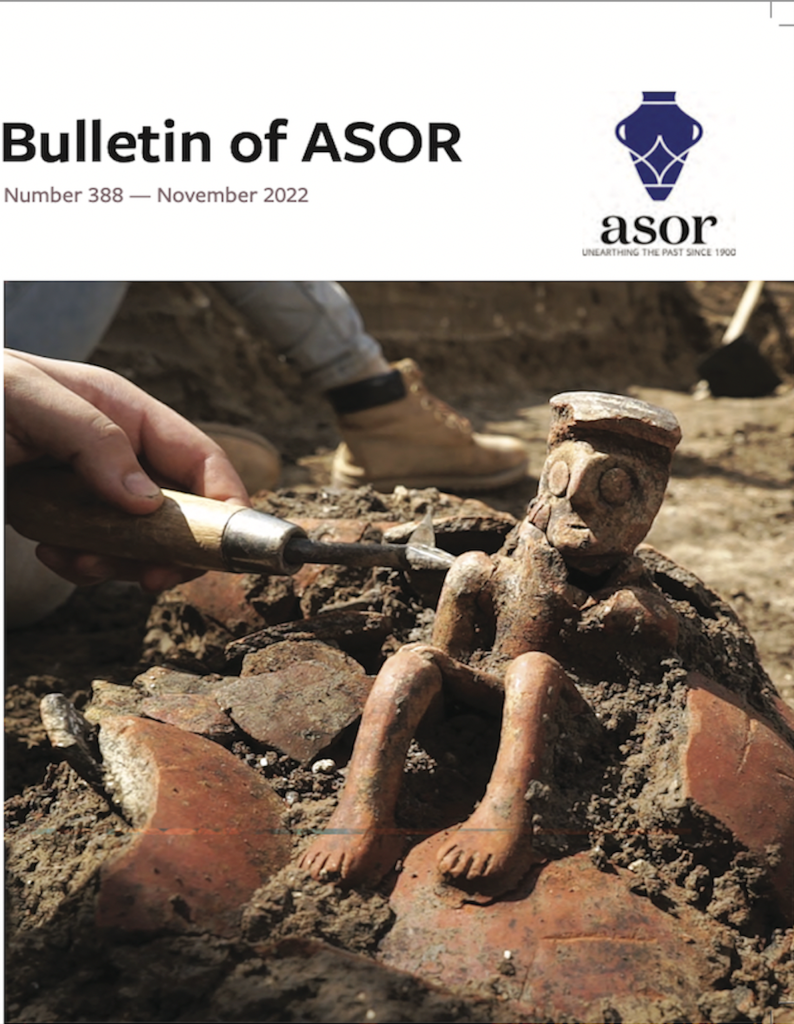
A salvage excavation held at the city of Yehud (Israel) revealed an unusual burial of the Middle Bronze (MB) IIA period. The grave was isolated from other MB burials in the Yehud area and was exceptionally large and rich in terms of the types and diversity of burial offerings, which included pottery vessels, metal objects, and animal bones. An outstanding find among the burial goods was an anthropomorphic jug whose neck was shaped in the form of a seated figure supporting its head with the right hand, evoking the image of Rodin’s “Le Penseur.” This paper presents the grave and offerings uncovered in the excavation and an interpretation of these finds, along with a discussion of the grave within the wider context of Middle Bronze Age burials in Yehud and beyond, suggesting it was associated with an elite warrior, who served most likely as a local leader.
ASOR Members with online access: log into ASOR’s Online Portal here. Once logged in, click the JOURNALS tab in the top navigation bar. From here you may select which journal you would like to read. If you have online access, you will see your selected journal’s current issue Table of Contents. Click on the “Current Issue” button and you will then be redirected to the University of Chicago Press’s (UCP) platform to immediately start reading any issue of your choice. Tutorials for how to log in to the Online Portal as well as how to navigate to the Portal Journals page can be found here.

Pp. 181–210: “The Khirbet Qeiyafa Ostracon: A New Collation Based on the Multispectral Images, with Translation and Commentary,” by Brian Donnelly-Lewis
This paper provides a new collation of the Khirbet Qeiyafa ostracon on the basis of the multispectral images produced by Gregory Bearman and William Christens-Barry in collaboration with a number of imaging labs in 2009. It proposes 59 letters in total, with 12 new readings, including 5 new partial reconstructions, all supported by an analysis of these detailed, high-definition images. This new collation permits a renewed attempt at translation of the ostracon, which is interpreted as a record of the summons of a defendant in a legal dispute. In the course of analysis, it is argued that if the decipherment is accepted, the language of the text appears to be an archaic, dialectal form of Hebrew.
ASOR Members with online access: log into ASOR’s Online Portal here. Once logged in, click the JOURNALS tab in the top navigation bar. From here you may select which journal you would like to read. If you have online access, you will see your selected journal’s current issue Table of Contents. Click on the “Current Issue” button and you will then be redirected to the University of Chicago Press’s (UCP) platform to immediately start reading any issue of your choice. Tutorials for how to log in to the Online Portal as well as how to navigate to the Portal Journals page can be found here.

Pp. 211–233: “Pit, Loculus, and Ossuary: The Family and the Individual in Late Second Temple Judean Burial Caves,” by Eyal Regev and Omri Y. Abadi
From the Hasmonean period until 70 c.e., there were three consecutive types of family burial in Judea: pit-bench caves, loculi caves, and ossuaries. In each, the treatment of skeletal remains and their distribution within the caves attest to different types of family relationships and different ways in which families perceived themselves. It is suggested that the place of the individual within the family developed gradually along with these burial methods. Pit-bench caves from the Hasmonean period were used by a limited number of families who wished to strengthen their ties or self-identity. The skeletal remains in most of the loculi and ossuaries included adults and children who were buried together. Those buried in the loculi and ossuaries were probably nuclear families, maintaining their identity in relation to other members of the extended family who may have been buried in other loculi/ossuaries in the cave. This attests to the growing importance of the nuclear family in society. Burying a person with only a few close relatives (e.g., young children and spouse) commemorated the individual’s identity. Interment in loculi, and to a greater degree in ossuaries, rendered the identity of the nuclear family and the individual more distinct from other nuclear families and individuals in the cave.
ASOR Members with online access: log into ASOR’s Online Portal here. Once logged in, click the JOURNALS tab in the top navigation bar. From here you may select which journal you would like to read. If you have online access, you will see your selected journal’s current issue Table of Contents. Click on the “Current Issue” button and you will then be redirected to the University of Chicago Press’s (UCP) platform to immediately start reading any issue of your choice. Tutorials for how to log in to the Online Portal as well as how to navigate to the Portal Journals page can be found here.

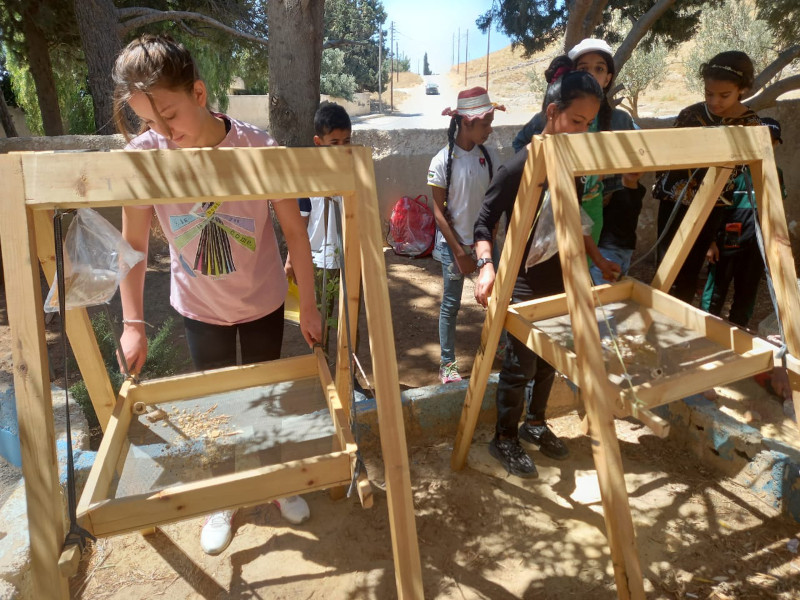

 All of us at ASOR are looking forward to welcoming more than 800 attendees to Boston for the in-person component of ASOR’s 2022 Annual Meeting, November 16-20.