Veterans Dig Fellowship Report: Brianne Thoen

INAUGURAL STEINMETZ FELLOWSHIP FOR VETERANS REPORT

We are pleased to announce that Charlie Steinmetz has agreed to match (up to $5,000) all current-year contributions for veteran or military personnel dig scholarships.

Last year we had 23 applications for a single veterans scholarship. We are grateful for Steinmetz’s challenge gift, and we hope to be able to offer more scholarships in 2020.

Brianne Thoen, 2019 Steinmetz Fellowship Recipient

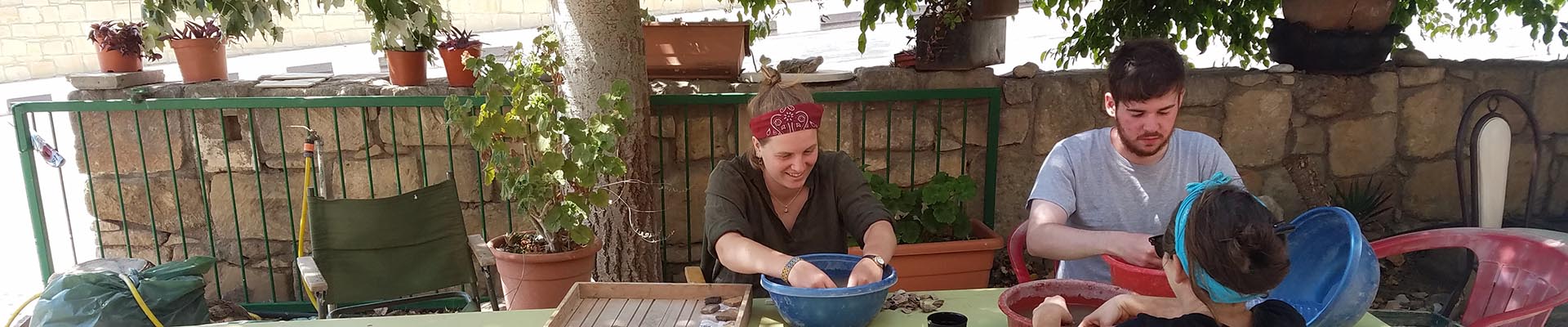
Thanks to the generous support of the Steinmetz Fellowship for Active/Reserve Military or Veterans, I spent a good portion of my summer (10 July–10 August) participating in the eleventh excavation season of Prastio Mesorotsos, a multi-period site in the Pafos district of Cyprus. Situated in the Dhiarizos Valley, the site sits at a crossroads between the lowlands and uplands and between west Cyprus and the rest of the island, showing evidence of near continuous occupation from the Pre-pottery Neolithic to the mid-20th century. Prastio’s prime valley location and proximity to abundant natural resources likely account for its extraordinary longevity.

This season, four areas were investigated, exposing prehistoric remains from the Neolithic, Chalcolithic, and Early and Middle Bronze Ages, including: interior space of a presumed Chalcolithic building featuring a well-preserved plaster hearth and plaster floor; the remains of a round domestic structure with a pit hearth; and elements of material culture such as a unique picrolite stone disc pendant.

While this was my third season with the project, this summer I was invited back as a trainee supervisor. Though only a trainee, I was still responsible for identifying stratigraphy, safe removal of finds, creating accurate scaled plans, and making sure the students in my area did not destroy anything. (Thankfully this was not an issue as the two students I was tasked with overseeing were absolutely fantastic.)

As someone who is not formally trained as an archaeologist (my BA is in Art History, while my MA is in Humanities), coming back in a supervisory capacity was perhaps one of the most stressful things I have done. And yes, that includes my year-long deployment in Iraq.

When my faculty advisor first told me about this project in 2016, I applied on a whim. I did not expect to be accepted because I had absolutely no archaeological experience (save for one Intro to Archaeology class). I am so glad I tried something outside of my comfort zone, because not only am I gaining invaluable experience, but working at Prastio has helped me find the topic for my master’s thesis.

Even though the work is extremely taxing, and heat and humidity is my least favorite weather, I could not imagine any other way to spend my summers. I am very grateful to ASOR and Charles Steinmetz for making it possible for me to participate in this excavation.


Brianne Thoen is a student at the University of Houston, Clear Lake.

Want to help more students and early career archaeologists get into the field? Donate to the cause today by selecting “Excavation Scholarships” as your gift purpose!

If you want your gift to count towards the Steinmetz challenge, please send us an email after you make a gift.

Table of Contents for NEA 82.3 (2019)

[vc_row fullwidth=”true” attached=”true” css=”.vc_custom_1496247803139{padding-top: 0px !important;padding-right: 0px !important;padding-bottom: 0px !important;padding-left: 0px !important;}”][vc_column][vc_single_image image=”54173″ img_size=”full” alignment=”center”][/vc_column][/vc_row][vc_row fullwidth=”true” css=”.vc_custom_1496682730308{padding-top: 10px !important;padding-right: 0px !important;padding-bottom: 0px !important;padding-left: 0px !important;}”][vc_column width=”1/12″ css=”.vc_custom_1496683820796{margin-right: 10px !important;}” offset=”vc_hidden-md vc_hidden-sm vc_hidden-xs”][vc_column_text]

 SHARE

[/vc_column_text][mk_image src=”http://www.asortest.org/wp-content/uploads/2017/01/social-fb-icon4.jpg” image_width=”42″ image_height=”42″ hover=”false” custom_url=”https://www.facebook.com/ASOResearch/” margin_bottom=”0″][mk_image src=”http://www.asortest.org/wp-content/uploads/2017/01/social-tw-icon4.jpg” image_width=”42″ image_height=”42″ hover=”false” custom_url=”https://twitter.com/ASOResearch?ref_src=twsrc%5Egoogle%7Ctwcamp%5Eserp%7Ctwgr%5Eauthor” margin_bottom=”0″][mk_image src=”http://www.asortest.org/wp-content/uploads/2017/01/social-in-icon4.jpg” image_width=”42″ image_height=”42″ hover=”false” custom_url=”https://www.linkedin.com/company/american-schools-of-oriental-research” margin_bottom=”0″][mk_image src=”http://www.asortest.org/wp-content/uploads/2017/01/social-ml-icon_7.jpg” image_width=”42″ image_height=”42″ hover=”false” custom_url=”mailto:asor@bu.edu” margin_bottom=”0″][mk_image src=”http://www.asortest.org/wp-content/uploads/2017/01/blog-icon3.jpg” image_width=”42″ image_height=”42″ hover=”false” custom_url=”http://asorblog.org/” margin_bottom=”0″][/vc_column][vc_column border_color=”rgba(255,255,255,0.01)” width=”1/6″ css=”.vc_custom_1496683923840{margin-right: 20px !important;border-left-width: 2px !important;padding-right: 20px !important;padding-left: 20px !important;border-left-color: #99422f !important;}”][mk_divider divider_color=”rgba(255,255,255,0.01)” thickness=”1″ margin_top=”3″ margin_bottom=”3″][vc_column_text]

ASOR BLOG

NEWS@ASOR

ANCIENT NEAR EAST TODAY

PAST ASOR NEWS, MONTH BY MONTH

FY19 HONOR ROLL OF DONORS

ASOR ANNUAL MEETING

[/vc_column_text][/vc_column][vc_column border_color=”rgba(170,170,170,0.01)” width=”1/2″ css=”.vc_custom_1487276122024{margin-right: 10px !important;margin-bottom: 30px !important;border-right-width: 2px !important;border-bottom-width: 2px !important;padding-top: 30px !important;padding-right: 30px !important;padding-left: 20px !important;background-color: #ffffff !important;border-right-color: rgba(227,228,228,0.75) !important;border-bottom-color: rgba(227,228,228,0.75) !important;}”][vc_row_inner][vc_column_inner width=”1/4″ css=”.vc_custom_1570040186774{padding-right: 10px !important;}”][mk_image src=”http://www.asor.org/wp-content/uploads/2019/09/NEA_82_3jpg.jpg” image_width=”148″ image_height=”200″ crop=”false” hover=”false”][/vc_column_inner][vc_column_inner width=”3/4″][vc_column_text]

Table of Contents for Near Eastern Archaeology 82.3 (September 2019)

[/vc_column_text][/vc_column_inner][/vc_row_inner][vc_row_inner][vc_column_inner css=”.vc_custom_1570040186774{padding-right: 10px !important;}”][vc_column_text]

You can receive NEA (and other ASOR publications) through an ASOR Membership. Please e-mail the Membership office if you have any questions.

[/vc_column_text][/vc_column_inner][/vc_row_inner][mk_divider][vc_row_inner][vc_column_inner width=”1/4″ css=”.vc_custom_1570041002103{padding-right: 10px !important;}”][mk_image src=”http://www.asor.org/wp-content/uploads/2019/09/fg11_200x500.jpg” image_width=”200″ image_height=”500″ crop=”false” hover=”false”][/vc_column_inner][vc_column_inner width=”3/4″][vc_column_text]

Pp. 132-139: “Exile and Return of the First Temple Vessels: Competing Postexilic Perspectives and Claims of Continuity,” by Debra Scoggins Ballentine

Jerusalem’s destruction and the Babylonian exile were catalysts for the composition and redaction of much Judean literature. Authors wrestled with disruption of cultus and the uncertainty of returnees having to sort out their place—both physical spaces and abstract social places—back in Jerusalem and Judah. Stories about the temple vessels feature competing claims about their fate: that they were dismantled or left intact during the exile; that they were stored in a Babylonian temple or used as Babylonian wine goblets; that they were returned to Jerusalem with divine protection; and even that they were temporarily displaced once back in Jerusalem. These varied fates reflect competition between groups and individuals—both historical figures and literary characters—such as Jeremiah, Daniel, Ezra, and Nehemiah. Postexilic authors employed stories about the vessels to privilege particular forms of ritual, endorse select groups and ideologies, and undercut alternative positions.[/vc_column_text][/vc_column_inner][/vc_row_inner][vc_column_text responsive_align=”left”]ASOR Members with online access: navigate to the token link email sent to you before attempting to read this article. Once you have activated your member token, click here to access the above article on The University of Chicago Press Journals’ website.[/vc_column_text][mk_divider][vc_row_inner][vc_column_inner width=”1/4″ css=”.vc_custom_1570041002103{padding-right: 10px !important;}”][mk_image src=”http://www.asor.org/wp-content/uploads/2019/10/fg7_200x500.jpg” image_width=”200″ image_height=”500″ crop=”false” hover=”false”][/vc_column_inner][vc_column_inner width=”3/4″][vc_column_text]

Pp. 140-147: “Another Temple, Another Vessel: Josephus, the Arch of Titus, and Roman Triumphal Propaganda,” by Nathaniel DesRosiers

In 71 CE, the year after the destruction of the second Jerusalem temple, the victorious emperor Vespasian and his son Titus, commander of the Judean
campaign, celebrated their success with a victory triumph through the streets of Rome. Josephus provides a full account of the event in The Jewish War 7.123–58, lingering in particular on his description of the spoils of the Temple as they were paraded through the streets. He states: “The spoils were piled in heaps, but prominent above all were the spoils from the temple in Jerusalem, these included a golden table many talents in weight and a lampstand likewise made of gold” (JW 7.148).[/vc_column_text][/vc_column_inner][/vc_row_inner][vc_column_text responsive_align=”left”]ASOR Members with online access: navigate to the token link email sent to you before attempting to read this article. Once you have activated your member token, click here to access the above article on The University of Chicago Press Journals’ website.[/vc_column_text][mk_divider][vc_row_inner][vc_column_inner width=”1/4″ css=”.vc_custom_1570041002103{padding-right: 10px !important;}”][mk_image src=”http://www.asor.org/wp-content/uploads/2019/09/fg8_200x500.jpg” image_width=”200″ image_height=”500″ crop=”false” hover=”false”][/vc_column_inner][vc_column_inner width=”3/4″][vc_column_text]

Pp. 148-155: “When Yosa Meshita Took the Temple Menorah: A Rabbinic Legend,” by Steven Fine

The rabbis of late antiquity were well aware that after the destruction of the Second Temple the most precious “sacred vessels” had been taken to Rome. Classical rabbinic literature records numerous legends of the destruction including discussions of the fate of the sacred vessels, including “a golden menorah.” At times preserving distant memories of the war, these stories are most significant for the ways that later generations lived with and interpreted the continuing meaning of this national trauma. In this essay I will employ anthropological/folklore approaches better to understand rabbinic texts. That is, I examine the human characters who wrote, performed, heard, and read these traditions in late antiquity (Hasan-Rokem 2003; Fine in press). I focus on the authorship and reception of rabbinic tradition by late antique audiences by undertaking a “thick description” of a story preserved in Genesis Rabbah, a collection of homiletical midrashim assembled in the Galilee near the turn of the fifth century CE. I focus on the treason of a certain Yosa Meshita, suggesting contexts in which this tale “lived,” situating it within the world in which it was authored, performed, and achieved its literary form.

[/vc_column_text][/vc_column_inner][/vc_row_inner][vc_column_text responsive_align=”left”]ASOR Members with online access: navigate to the token link email sent to you before attempting to read this article. Once you have activated your member token, click here to access the above article on The University of Chicago Press Journals’ website.[/vc_column_text][mk_divider][vc_row_inner][vc_column_inner width=”1/4″ css=”.vc_custom_1570041002103{padding-right: 10px !important;}”][mk_image src=”http://www.asor.org/wp-content/uploads/2019/10/fg1_200x500.jpg” image_width=”200″ image_height=”500″ crop=”false” hover=”false”][/vc_column_inner][vc_column_inner width=”3/4″][vc_column_text]Pp. 156-163: “Facing the Holy Ark, in Words and in Images,” by Steven D. Fraade

The ark of the covenant was central to the plan of the Jerusalem Temple and the wilderness tabernacle before it, as the vessel was located in the structures’ holiest, innermost domain. Despite its importance, the ark of the covenant was invisible to virtually all Israelites. Even while the ark was being assembled, disassembled, and transported in the wilderness, the Levitical Kohathites were instructed to shield it from view, including their own (Num 4:5–20). One of the chief obligations of Aaron and his descendants was to deny access to anyone else, including the Levites, to the Holy of Holies, which housed the ark alone, or risk death (Num 18:1–7, 22–23).

[/vc_column_text][/vc_column_inner][/vc_row_inner][vc_column_text responsive_align=”left”]ASOR Members with online access: navigate to the token link email sent to you before attempting to read this article. Once you have activated your member token, click here to access the above article on The University of Chicago Press Journals’ website.[/vc_column_text][mk_divider][vc_row_inner][vc_column_inner width=”1/4″ css=”.vc_custom_1570041002103{padding-right: 10px !important;}”][mk_image src=”http://www.asor.org/wp-content/uploads/2019/10/fg9_200x500.jpg” image_width=”200″ image_height=”500″ crop=”false” hover=”false”][/vc_column_inner][vc_column_inner width=”3/4″][vc_column_text]

Pp. 164-171: “When Is a Menorah Not Just a Menorah? Rethinking Menorah Graffiti in Jewish Mortuary Contexts,” by Karen B. Stern

Hundreds of representations of menorahs have been uncovered from across the ancient world, throughout Egypt, Asia Minor, the Black Sea, Malta, North Africa, Europe, Arabia, Judaea, Palaestina, and Syria. Studied intently by historians, these depictions testify to the symbol’s historical importance, longevity, and myriad uses in antiquity. Many scholars have speculated that the menorahs evoke messianic ideas or those of resurrection; others argue that they signify divine presence or the cosmos at large. Recurring representations of menorahs in modern Jewish religious contexts, in all cases, have assured that the menorah remains the most recognizable of all the temple vessels to modern audiences.

[/vc_column_text][/vc_column_inner][/vc_row_inner][vc_column_text responsive_align=”left”]ASOR Members with online access: navigate to the token link email sent to you before attempting to read this article. Once you have activated your member token, click here to access the above article on The University of Chicago Press Journals’ website.[/vc_column_text][mk_divider][vc_row_inner][vc_column_inner width=”1/4″ css=”.vc_custom_1570041002103{padding-right: 10px !important;}”][mk_image src=”http://www.asor.org/wp-content/uploads/2019/10/fg5_200x500.jpg” image_width=”200″ image_height=”500″ crop=”false” hover=”false”][/vc_column_inner][vc_column_inner width=”3/4″][vc_column_text]

Pp. 172-178: “Remembering the Destruction(s) of the Temple at the Museum of the Bible,” by Cavan Concannon

Tucked away on the fifth floor of the Museum of the Bible (MOTB) in Washington, DC is a worn stone, weighing roughly a ton. Unlike most museum exhibits, this one invites visitors to touch its rough surface. The stone would be unremarkable but for what it was made to support: the terrace of the Second Temple in Jerusalem. The stone is on loan to the MOTB as part of an exhibit called “The People of the Land: History and Archaeology of Ancient Israel” by the Israel Antiquities Authority (IAA). It once formed part of the Western Wall, the massive terrace that supported Herod the Great’s expansion of the Second Temple complex. As visitors touch this piece of the “temple,” they accept the MOTB’s invitation to a pilgrimage experience. As one evangelical news site put it, “It’s an opportunity to get a glimpse of the Holy Land without visiting the Middle East” (Stahl and Mitchell 2017).

[/vc_column_text][/vc_column_inner][/vc_row_inner][vc_column_text responsive_align=”left”]ASOR Members with online access: navigate to the token link email sent to you before attempting to read this article. Once you have activated your member token, click here to access the above article on The University of Chicago Press Journals’ website.[/vc_column_text][mk_divider][vc_row_inner][vc_column_inner width=”1/4″ css=”.vc_custom_1570041002103{padding-right: 10px !important;}”][mk_image src=”http://www.asor.org/wp-content/uploads/2019/10/fg10_200x500.jpg” image_width=”200″ image_height=”500″ crop=”false” hover=”false”][/vc_column_inner][vc_column_inner width=”3/4″][vc_column_text]

Pp. 179-185: (Exhibit Review) “The World Between Empires, Metropolitan Museum of Art, New York,” by Stephanie Lynn Budin

This past March I had the grand opportunity to visit this exhibit curated by Blair Fowlkes-Childs and Michael Seymour, which ran from March through June 2019. The intent of the exhibit was twofold. On the one hand it provided a survey of the various cities, states, and societies that populated the Middle East between the great empires of Rome to the west and Parthia to the east (thus the title of the exhibit), ranging in date from the first century BCE to the mid-third century ce. Of particular interest was how these communities situated between dominant and domineering cultures formed their own identities through the mixture of indigenous and imported traditions, and how these identities were expressed. Thus the placard welcoming visitors to the exhibit reads: Following a journey along ancient trade routes across the Middle East, the exhibition explores how local life and culture were shaped by diverse cities and communities, and how identities were expressed through art.

[/vc_column_text][/vc_column_inner][/vc_row_inner][vc_column_text responsive_align=”left”]ASOR Members with online access: navigate to the token link email sent to you before attempting to read this article. Once you have activated your member token, click here to access the above article on The University of Chicago Press Journals’ website.[/vc_column_text][mk_divider][vc_column_text responsive_align=”left”]

Pp. 186-189: “Third Workshop on Gender, Methodology, and the Ancient Near East: Enhancing Networking and Consolidating an Initiative,” by Katrien De Graef, Agnès Garcia-Ventura, Anne Goddeeris, and Saana Svärd

ASOR Members with online access: navigate to the token link email sent to you before attempting to read this article. Once you have activated your member token, click here to access the above report on The University of Chicago Press Journals’ website.

[/vc_column_text][mk_divider][vc_column_text]

ASOR Members with online access: navigate to the token link email sent to you before attempting to read this issue. Once you have activated your member token, click here to access the the entire issue, including book reviews, on The University of Chicago Press Journals’ website.

[/vc_column_text][/vc_column][vc_column border_color=”rgba(170,170,170,0.01)” width=”1/6″ css=”.vc_custom_1496684098866{margin-right: 5px !important;margin-bottom: 20px !important;border-right-width: 2px !important;border-bottom-width: 2px !important;padding-top: 30px !important;padding-right: 10px !important;padding-left: 10px !important;background-color: #ffffff !important;border-right-color: rgba(227,228,228,0.75) !important;border-bottom-color: rgba(227,228,228,0.75) !important;}”][vc_wp_posts title=”BROWSE THE NEWS ARCHIVE” number=”4″][/vc_column][vc_column border_color=”rgba(170,170,170,0.01)” width=”1/6″ css=”.vc_custom_1496684008271{margin-right: 10px !important;margin-bottom: 30px !important;border-right-width: 2px !important;border-bottom-width: 2px !important;padding-top: 30px !important;padding-right: 20px !important;padding-left: 20px !important;background-color: #ffffff !important;border-right-color: rgba(227,228,228,0.75) !important;border-bottom-color: rgba(227,228,228,0.75) !important;}”][vc_column_text] [/vc_column_text][/vc_column][/vc_row]

Dig Safety Survey 2019

[vc_row fullwidth=”true” attached=”true” css=”.vc_custom_1496247803139{padding-top: 0px !important;padding-right: 0px !important;padding-bottom: 0px !important;padding-left: 0px !important;}”][vc_column][vc_single_image image=”53008″ img_size=”full” alignment=”center”][/vc_column][/vc_row][vc_row fullwidth=”true” css=”.vc_custom_1496682730308{padding-top: 10px !important;padding-right: 0px !important;padding-bottom: 0px !important;padding-left: 0px !important;}”][vc_column width=”1/12″ css=”.vc_custom_1496683820796{margin-right: 10px !important;}” offset=”vc_hidden-md vc_hidden-sm vc_hidden-xs”][vc_column_text]

 SHARE

[/vc_column_text][mk_image src=”http://www.asortest.org/wp-content/uploads/2017/01/social-fb-icon4.jpg” image_width=”42″ image_height=”42″ hover=”false” custom_url=”https://www.facebook.com/ASOResearch/” margin_bottom=”0″][mk_image src=”http://www.asortest.org/wp-content/uploads/2017/01/social-tw-icon4.jpg” image_width=”42″ image_height=”42″ hover=”false” custom_url=”https://twitter.com/ASOResearch?ref_src=twsrc%5Egoogle%7Ctwcamp%5Eserp%7Ctwgr%5Eauthor” margin_bottom=”0″][mk_image src=”http://www.asortest.org/wp-content/uploads/2017/01/social-in-icon4.jpg” image_width=”42″ image_height=”42″ hover=”false” custom_url=”https://www.linkedin.com/company/american-schools-of-oriental-research” margin_bottom=”0″][mk_image src=”http://www.asortest.org/wp-content/uploads/2017/01/social-ml-icon_7.jpg” image_width=”42″ image_height=”42″ hover=”false” custom_url=”mailto:info@asor.org” margin_bottom=”0″][mk_image src=”http://www.asortest.org/wp-content/uploads/2017/01/blog-icon3.jpg” image_width=”42″ image_height=”42″ hover=”false” custom_url=”http://asor.org/blog” margin_bottom=”0″][/vc_column][vc_column border_color=”rgba(255,255,255,0.01)” width=”1/6″ css=”.vc_custom_1496683923840{margin-right: 20px !important;border-left-width: 2px !important;padding-right: 20px !important;padding-left: 20px !important;border-left-color: #99422f !important;}”][mk_divider divider_color=”rgba(255,255,255,0.01)” thickness=”1″ margin_top=”3″ margin_bottom=”3″][vc_column_text]

NEWS@ASOR E-NEWSLETTER

ANCIENT NEAR EAST TODAY E-NEWSLETTER

PAST ASOR NEWS, MONTH BY MONTH

FY19 HONOR ROLL OF DONORS

ASOR ANNUAL MEETING

[/vc_column_text][/vc_column][vc_column border_color=”rgba(170,170,170,0.01)” width=”1/2″ css=”.vc_custom_1487276122024{margin-right: 10px !important;margin-bottom: 30px !important;border-right-width: 2px !important;border-bottom-width: 2px !important;padding-top: 30px !important;padding-right: 30px !important;padding-left: 20px !important;background-color: #ffffff !important;border-right-color: rgba(227,228,228,0.75) !important;border-bottom-color: rgba(227,228,228,0.75) !important;}”][vc_column_text responsive_align=”left”]

SURVEY ON FIELD SAFETY (2019 UPDATE): MIDDLE EAST, NORTH AFRICA, AND THE MEDITERRANEAN BASIN

[For new participants and for all those who took the survey in 2014 & 2015][/vc_column_text][mk_button corner_style=”rounded” size=”xxlarge” bg_color=”#2f2f80″ txt_color=”#dddddd” url=”https://uarizona.co1.qualtrics.com/jfe/form/SV_9Zxgfp5DgpQAp3T” align=”center”]TAKE THE SURVEY[/mk_button][vc_column_text]Stories about romantic escapades on archaeological excavations are legend, as anyone who has worked on a dig can surely attest. We have all heard about happy relationships that began in the field and thrived for decades. But as we also know, excavation lore contains stories of other kinds of “relationships,” as well. This Survey on Field Safety: Middle East, North Africa, and Mediterranean Basin (Update 2019) is designed to understand the ways in which archaeological fieldwork does – or does not – provide a safe and secure setting for all participants.  In particular, it focuses on physical and emotional safety from intimidation, harassment and violence based on gender, sexual orientation, and/or gender identity. It queries, as well, changes that have – or have not – taken place since the original surveys of 2014 and 2015.

Participants on archaeological field projects in the Middle East, North Africa, and the Mediterranean Basin, whether volunteers or staff, live and work within what has been termed a “state of exception.” They are in foreign countries, far from home. They may live and work in isolated settings. They may be unable to travel easily for reasons relating to language, finances, inexperience, scarcity of transportation, dependence upon team leaders, lack of friends or supportive community members, unfamiliarity with local legal systems and/or cultural norms, inhospitable legal systems and/or cultural norms, political unrest, and more. For these reasons, such individuals may be unable to protect themselves from aggressive and unwanted violations of their personal safety and security, and they may find that effective means of dealing with intimidation, harassment, and violence are limited or even non-existent. Conversely, under such conditions, some individuals may be more likely to engage in subtle or flagrant violations of accepted normative behavior.

Beyond documenting and quantifying experiences, the goals of this survey project include building collaboration among professional societies and institutes in order to: determine those factors that contribute to safe and unsafe fieldwork environments; identify areas in which further research is necessary; determine best practices and the means by which to implement them; develop standards, policies and protocols designed to educate and inform all participants in archaeological excavations about ethics and laws in the field and on research projects; develop and offer online trainings; and, provide access to relevant documents for excavation leaders, staff, volunteers, and employees.

Whether or not you have taken this survey in the past, and whichever kinds of experiences you have had, we hope that you will click on the link below, take the survey, and help us make archaeology safer for everyone. Feel free to circulate this letter and the survey link to anyone you think might be interested in it. Finally, if you would like to receive follow-up information regarding the results of this survey, please contact the principal investigator, Beth Alpert Nakhai, Ph.D., R.P.A., Arizona Center for Judaic Studies and School of Anthropology, The University of Arizona, Tucson, Arizona (bnakhai@email.arizona.edu).[/vc_column_text][mk_divider][mk_button corner_style=”rounded” size=”xxlarge” bg_color=”#2f2f80″ txt_color=”#dddddd” url=”https://uarizona.co1.qualtrics.com/jfe/form/SV_9Zxgfp5DgpQAp3T” align=”center”]TAKE THE SURVEY[/mk_button][/vc_column][vc_column border_color=”rgba(170,170,170,0.01)” width=”1/6″ css=”.vc_custom_1496684098866{margin-right: 5px !important;margin-bottom: 20px !important;border-right-width: 2px !important;border-bottom-width: 2px !important;padding-top: 30px !important;padding-right: 10px !important;padding-left: 10px !important;background-color: #ffffff !important;border-right-color: rgba(227,228,228,0.75) !important;border-bottom-color: rgba(227,228,228,0.75) !important;}”][vc_wp_posts title=”BROWSE THE NEWS ARCHIVE” number=”4″][/vc_column][vc_column border_color=”rgba(170,170,170,0.01)” width=”1/6″ css=”.vc_custom_1496684008271{margin-right: 10px !important;margin-bottom: 30px !important;border-right-width: 2px !important;border-bottom-width: 2px !important;padding-top: 30px !important;padding-right: 20px !important;padding-left: 20px !important;background-color: #ffffff !important;border-right-color: rgba(227,228,228,0.75) !important;border-bottom-color: rgba(227,228,228,0.75) !important;}”][vc_column_text] [/vc_column_text][/vc_column][/vc_row][vc_row][vc_column][vc_column_text]

[/vc_column_text][/vc_column][/vc_row][vc_row][vc_column][vc_column_text]

[/vc_column_text][/vc_column][/vc_row]

Early-Career Scholars Receive Free Copies of Pottery Volume

[vc_row fullwidth=”true” attached=”true” css=”.vc_custom_1496247803139{padding-top: 0px !important;padding-right: 0px !important;padding-bottom: 0px !important;padding-left: 0px !important;}”][vc_column][vc_single_image image=”53038″ img_size=”full” alignment=”center”][/vc_column][/vc_row][vc_row fullwidth=”true” css=”.vc_custom_1496682730308{padding-top: 10px !important;padding-right: 0px !important;padding-bottom: 0px !important;padding-left: 0px !important;}”][vc_column width=”1/12″ css=”.vc_custom_1496683820796{margin-right: 10px !important;}” offset=”vc_hidden-md vc_hidden-sm vc_hidden-xs”][vc_column_text]

 SHARE

[/vc_column_text][mk_image src=”http://www.asortest.org/wp-content/uploads/2017/01/social-fb-icon4.jpg” image_width=”42″ image_height=”42″ hover=”false” custom_url=”https://www.facebook.com/ASOResearch/” margin_bottom=”0″][mk_image src=”http://www.asortest.org/wp-content/uploads/2017/01/social-tw-icon4.jpg” image_width=”42″ image_height=”42″ hover=”false” custom_url=”https://twitter.com/ASOResearch?ref_src=twsrc%5Egoogle%7Ctwcamp%5Eserp%7Ctwgr%5Eauthor” margin_bottom=”0″][mk_image src=”http://www.asortest.org/wp-content/uploads/2017/01/social-in-icon4.jpg” image_width=”42″ image_height=”42″ hover=”false” custom_url=”https://www.linkedin.com/company/american-schools-of-oriental-research” margin_bottom=”0″][mk_image src=”http://www.asortest.org/wp-content/uploads/2017/01/social-ml-icon_7.jpg” image_width=”42″ image_height=”42″ hover=”false” custom_url=”mailto:info@asor.org” margin_bottom=”0″][mk_image src=”http://www.asortest.org/wp-content/uploads/2017/01/blog-icon3.jpg” image_width=”42″ image_height=”42″ hover=”false” custom_url=”http://asor.org/blog” margin_bottom=”0″][/vc_column][vc_column border_color=”rgba(255,255,255,0.01)” width=”1/6″ css=”.vc_custom_1496683923840{margin-right: 20px !important;border-left-width: 2px !important;padding-right: 20px !important;padding-left: 20px !important;border-left-color: #99422f !important;}”][mk_divider divider_color=”rgba(255,255,255,0.01)” thickness=”1″ margin_top=”3″ margin_bottom=”3″][vc_column_text]

ASOR BLOG

NEWS@ASOR E-NEWSLETTER

ANCIENT NEAR EAST TODAY E-NEWSLETTER

PAST ASOR NEWS, MONTH BY MONTH

FY19 HONOR ROLL OF DONORS

ASOR ANNUAL MEETING

[/vc_column_text][/vc_column][vc_column border_color=”rgba(170,170,170,0.01)” width=”1/2″ css=”.vc_custom_1487276122024{margin-right: 10px !important;margin-bottom: 30px !important;border-right-width: 2px !important;border-bottom-width: 2px !important;padding-top: 30px !important;padding-right: 30px !important;padding-left: 20px !important;background-color: #ffffff !important;border-right-color: rgba(227,228,228,0.75) !important;border-bottom-color: rgba(227,228,228,0.75) !important;}”][vc_column_text responsive_align=”left”]

EARLY-CAREER SCHOLARS RECEIVE FREE COPIES OF GITIN POTTERY VOLUME III

[/vc_column_text][vc_column_text]One of the major components of ASOR’s Strategic Plan is to increase support of our student and early-career members. We accomplish this in part through scholarships for participation in the Annual Meeting, funding fellowships for summer field work, and offering reduced membership rates. We also provide special opportunities for interaction and networking at the Annual Meeting, and we plan to increase those opportunities at the Annual Meeting in San Diego in November 2019.

In June, we announced the second year of the “Pottery (Volume) Lottery,” during which ASOR would be awarding as many copies as possible of Seymour Gitin’s The Ancient Pottery of Israel and Its Neighbors from the Middle Bronze Age through the Late Bronze Age. These volumes are an outstanding resource for anyone studying the field or just starting their careers. The trilogy has been aptly named, “The Ceramics Bible.”

We are very pleased to announce that ASOR was able to raise enough funds to purchase and ship 86 copies of this fantastic resource to students and early career scholars!

This special offer was made possible by three anonymous donors who has made contributions so that Undergraduate, Graduate, and Early Career Members of ASOR can receive this amazing volume for free. We are incredibly grateful to these donors for this opportunity! The Israel Exploration Society is currently shipping the books to the recipients by surface mail. Note: if you are one of the recipients and have any questions, please e-mail Marta at the ASOR office (info@asor.org).

The following is a list of the winners of the lottery:[/vc_column_text][vc_column_text][/vc_column_text][vc_row_inner][vc_column_inner width=”1/2″][vc_column_text]

  • Dawn Acevedo
  • Betty Adams
  • Faires Austin
  • Jose E. Balcells
  • Adam Bean
  • Nadia Ben-Marzouk
  • Jaime Bennett
  • Johanna Berkheij-Dol
  • William Hart Brown
  • Charlotte Cable
  • Owen Chesnut
  • Caleb Chow
  • Ian Cipin
  • Brigid Clark
  • Mikayla Noel Coad
  • Jacob Damn
  • Andrew Danielson
  • Patricia Y. Dean
  • Heath D. Dewrell
  • Zachary Dunseth
  • Pinar Durgun
  • Tiffany Earley
  • Paul Edgar
  • Simeon Ehrlich
  • Elizabeth Emswiler
  • Tzilla Eshel
  • Walter Foster
  • Florencia Fustinoni
  • Laura Gagne
  • Talmadge L. Gerald
  • Aaron Gidding
  • Casey Gipson
  • Bianca Hand
  • Annette Hansen
  • Geoffrey Hedges-Knyrim
  • Julian Hirsch
  • Jeffrey Paul Hudon
  • Tasha Hunter
  • Eric R. Jensen
  • Ann-Kathrin Jeske
  • Christopher Wayne Jones
  • Deborah Karbashewski
  • Ron Lev

[/vc_column_text][/vc_column_inner][vc_column_inner width=”1/2″][vc_column_text]

  • Brady Liss
  • Albert McClure
  • Lauren K. McCormick
  • Jesse Michael Millek
  • Katarina Mokranova
  • Jacob Moody
  • Veronica Morriss
  • Gary D. Myers
  • Erika Niemann
  • Christina Olson
  • Leann Pace
  • Christine Elizabeth Palmer
  • Paula Phillips
  • George A. Pierce
  • Cielomar Puccio
  • Tine Rassalle
  • Kristina Reed
  • John Will Rice
  • Sarah Richardson
  • Madadh Richey
  • Abelardo Rivas
  • Darrell J. Rohl
  • Jordan Ryan
  • Charles Savelle
  • Daniel Schindler
  • Jason M. Silverman
  • Mali Skotheim
  • D. Charles Smith
  • Bruno Soltic
  • Cale Staley
  • Michael Stewart-Bernard
  • Juan Manuel Tebes
  • Arturo Terrazas
  • Zachary Thomas
  • Oya Topcuoglu
  • Jewel Trail
  • Joshua Walton
  • Philip Webb
  • Lyndelle Webster
  • Eric Welch
  • Aren Wilson-Wright
  • Holly Winter
  • Vanessa Workman
  • Andrew Wright

[/vc_column_text][/vc_column_inner][/vc_row_inner][/vc_column][vc_column border_color=”rgba(170,170,170,0.01)” width=”1/6″ css=”.vc_custom_1496684098866{margin-right: 5px !important;margin-bottom: 20px !important;border-right-width: 2px !important;border-bottom-width: 2px !important;padding-top: 30px !important;padding-right: 10px !important;padding-left: 10px !important;background-color: #ffffff !important;border-right-color: rgba(227,228,228,0.75) !important;border-bottom-color: rgba(227,228,228,0.75) !important;}”][vc_wp_posts title=”BROWSE THE NEWS ARCHIVE” number=”4″][/vc_column][vc_column border_color=”rgba(170,170,170,0.01)” width=”1/6″ css=”.vc_custom_1496684008271{margin-right: 10px !important;margin-bottom: 30px !important;border-right-width: 2px !important;border-bottom-width: 2px !important;padding-top: 30px !important;padding-right: 20px !important;padding-left: 20px !important;background-color: #ffffff !important;border-right-color: rgba(227,228,228,0.75) !important;border-bottom-color: rgba(227,228,228,0.75) !important;}”][vc_column_text] [/vc_column_text][/vc_column][/vc_row]

ASOR Seeks Volunteers for Program Committee

[vc_row fullwidth=”true” attached=”true” css=”.vc_custom_1496247803139{padding-top: 0px !important;padding-right: 0px !important;padding-bottom: 0px !important;padding-left: 0px !important;}”][vc_column][vc_single_image image=”36834″ img_size=”full” alignment=”center”][/vc_column][/vc_row][vc_row fullwidth=”true” css=”.vc_custom_1496682730308{padding-top: 10px !important;padding-right: 0px !important;padding-bottom: 0px !important;padding-left: 0px !important;}”][vc_column width=”1/12″ css=”.vc_custom_1496683820796{margin-right: 10px !important;}” offset=”vc_hidden-md vc_hidden-sm vc_hidden-xs”][vc_column_text]

 SHARE

[/vc_column_text][mk_image src=”http://www.asortest.org/wp-content/uploads/2017/01/social-fb-icon4.jpg” image_width=”42″ image_height=”42″ hover=”false” custom_url=”https://www.facebook.com/ASOResearch/” margin_bottom=”0″][mk_image src=”http://www.asortest.org/wp-content/uploads/2017/01/social-tw-icon4.jpg” image_width=”42″ image_height=”42″ hover=”false” custom_url=”https://twitter.com/ASOResearch?ref_src=twsrc%5Egoogle%7Ctwcamp%5Eserp%7Ctwgr%5Eauthor” margin_bottom=”0″][mk_image src=”http://www.asortest.org/wp-content/uploads/2017/01/social-in-icon4.jpg” image_width=”42″ image_height=”42″ hover=”false” custom_url=”https://www.linkedin.com/company/american-schools-of-oriental-research” margin_bottom=”0″][mk_image src=”http://www.asortest.org/wp-content/uploads/2017/01/social-ml-icon_7.jpg” image_width=”42″ image_height=”42″ hover=”false” custom_url=”mailto:asor@bu.edu” margin_bottom=”0″][mk_image src=”http://www.asortest.org/wp-content/uploads/2017/01/blog-icon3.jpg” image_width=”42″ image_height=”42″ hover=”false” custom_url=”http://asorblog.org/” margin_bottom=”0″][/vc_column][vc_column border_color=”rgba(255,255,255,0.01)” width=”1/6″ css=”.vc_custom_1496683923840{margin-right: 20px !important;border-left-width: 2px !important;padding-right: 20px !important;padding-left: 20px !important;border-left-color: #99422f !important;}”][mk_divider divider_color=”rgba(255,255,255,0.01)” thickness=”1″ margin_top=”3″ margin_bottom=”3″][vc_column_text]

NEWS@ASOR E-NEWSLETTER

ANCIENT NEAR EAST TODAY E-NEWSLETTER

PAST ASOR NEWS, MONTH BY MONTH

FY19 HONOR ROLL OF DONORS

ASOR ANNUAL MEETING

[/vc_column_text][/vc_column][vc_column border_color=”rgba(170,170,170,0.01)” width=”1/2″ css=”.vc_custom_1487276122024{margin-right: 10px !important;margin-bottom: 30px !important;border-right-width: 2px !important;border-bottom-width: 2px !important;padding-top: 30px !important;padding-right: 30px !important;padding-left: 20px !important;background-color: #ffffff !important;border-right-color: rgba(227,228,228,0.75) !important;border-bottom-color: rgba(227,228,228,0.75) !important;}”][vc_column_text responsive_align=”left”]

ASOR SEEKS VOLUNTEERS TO SERVE ON PROGRAM COMMITTEE

[/vc_column_text][vc_column_text]The ASOR Program Committee (PC) is seeking three new members, each to serve one three-year term (2020-22) with the possibility of renewing for a a second term. The PC is responsible for the intellectual content of the Annual Meeting. Specifically, the PC solicits and reviews session proposals and reviews paper abstracts for possible violations of the ASOR Policy on Professional Conduct as needed. The PC aims to represent the temporal, regional, and disciplinary interests of ASOR.

Preference will be given to scholars whose interests complement those already represented on the committee, specifically:
1) Archaeology of Mesopotamia
2) Archaeology of the Levant (Classical and Islamic)
3) Cultural Heritage
4) Museums

Please submit your application form by October 1, 2019. If you have questions, please contact Arlene Press at meetings@asor.org

Click here to read more about the Program Committee and to see a list of current PC members.[/vc_column_text][/vc_column][vc_column border_color=”rgba(170,170,170,0.01)” width=”1/6″ css=”.vc_custom_1496684098866{margin-right: 5px !important;margin-bottom: 20px !important;border-right-width: 2px !important;border-bottom-width: 2px !important;padding-top: 30px !important;padding-right: 10px !important;padding-left: 10px !important;background-color: #ffffff !important;border-right-color: rgba(227,228,228,0.75) !important;border-bottom-color: rgba(227,228,228,0.75) !important;}”][vc_wp_posts title=”BROWSE THE NEWS ARCHIVE” number=”4″][/vc_column][vc_column border_color=”rgba(170,170,170,0.01)” width=”1/6″ css=”.vc_custom_1496684008271{margin-right: 10px !important;margin-bottom: 30px !important;border-right-width: 2px !important;border-bottom-width: 2px !important;padding-top: 30px !important;padding-right: 20px !important;padding-left: 20px !important;background-color: #ffffff !important;border-right-color: rgba(227,228,228,0.75) !important;border-bottom-color: rgba(227,228,228,0.75) !important;}”][vc_column_text] [/vc_column_text][/vc_column][/vc_row][vc_row][vc_column][vc_column_text]

[/vc_column_text][/vc_column][/vc_row][vc_row][vc_column][vc_column_text]

[/vc_column_text][/vc_column][/vc_row]