Ancient Nubia Educational Resources

[vc_row fullwidth=”true” attached=”true” css=”.vc_custom_1496247803139{padding-top: 0px !important;padding-right: 0px !important;padding-bottom: 0px !important;padding-left: 0px !important;}”][vc_column][vc_single_image image=”82049″ img_size=”full” alignment=”center”][/vc_column][/vc_row][vc_row fullwidth=”true” css=”.vc_custom_1496682730308{padding-top: 10px !important;padding-right: 0px !important;padding-bottom: 0px !important;padding-left: 0px !important;}”][vc_column width=”1/12″ css=”.vc_custom_1496683820796{margin-right: 10px !important;}” offset=”vc_hidden-md vc_hidden-sm vc_hidden-xs”][vc_column_text]

 SHARE

[/vc_column_text][mk_image src=”http://www.asortest.org/wp-content/uploads/2017/01/social-fb-icon4.jpg” image_width=”42″ image_height=”42″ hover=”false” custom_url=”https://www.facebook.com/ASOResearch/” margin_bottom=”0″][mk_image src=”http://www.asortest.org/wp-content/uploads/2017/01/social-tw-icon4.jpg” image_width=”42″ image_height=”42″ hover=”false” custom_url=”https://twitter.com/ASOResearch?ref_src=twsrc%5Egoogle%7Ctwcamp%5Eserp%7Ctwgr%5Eauthor” margin_bottom=”0″][mk_image src=”http://www.asortest.org/wp-content/uploads/2017/01/social-in-icon4.jpg” image_width=”42″ image_height=”42″ hover=”false” custom_url=”https://www.linkedin.com/company/american-schools-of-oriental-research” margin_bottom=”0″][mk_image src=”http://www.asortest.org/wp-content/uploads/2017/01/social-ml-icon_7.jpg” image_width=”42″ image_height=”42″ hover=”false” custom_url=”mailto:info@asor.org” margin_bottom=”0″][mk_image src=”http://www.asortest.org/wp-content/uploads/2017/01/blog-icon3.jpg” image_width=”42″ image_height=”42″ hover=”false” custom_url=”http://asor.org/blog” margin_bottom=”0″][/vc_column][vc_column border_color=”rgba(255,255,255,0.01)” width=”1/6″ css=”.vc_custom_1496683923840{margin-right: 20px !important;border-left-width: 2px !important;padding-right: 20px !important;padding-left: 20px !important;border-left-color: #99422f !important;}”][mk_divider divider_color=”rgba(255,255,255,0.01)” thickness=”1″ margin_top=”3″ margin_bottom=”3″][vc_widget_sidebar sidebar_id=”ca-sidebar-39801″][/vc_column][vc_column border_color=”rgba(170,170,170,0.01)” width=”1/2″ css=”.vc_custom_1487276122024{margin-right: 10px !important;margin-bottom: 30px !important;border-right-width: 2px !important;border-bottom-width: 2px !important;padding-top: 30px !important;padding-right: 30px !important;padding-left: 20px !important;background-color: #ffffff !important;border-right-color: rgba(227,228,228,0.75) !important;border-bottom-color: rgba(227,228,228,0.75) !important;}”][vc_column_text responsive_align=”left”]

ANCIENT NUBIA EDUCATIONAL RESOURCES

[/vc_column_text][mk_divider][vc_wp_text]ASOR partnered with Archaeology in the Community (AITC), a local D.C.-based organization specializing in archaeological education, to produce a series of educational videos and lesson plans on Ancient Nubia. The videos are designed for 6th grade teachers to use in fulfillment of Social Studies, Civics, and Geography requirements. Funding for this project was provided by all of the donors to ASOR’s Diversity Initiatives Endowment and the Argosy Foundation.

The Resources

Ancient Nubia Videos

The videos feature interviews with scholars who study Ancient Nubia: Dr. Solange Ashby (Egyptology-Nubiology), Debora Heard (Archaeology), Jenail Marshall (Bioarchaeology), and Dr. Shayla Monroe (Zooarchaeology). They were produced by Sydney A. Pickens, Ali Bavugamenshi, and Dr. Alexandra Jones. Music was provided by 2 Nice Guys Music Production (Teddy Burgh and Teddy Thompson).

The first video introduces Ancient Nubia, its history, geography, and environment. The scholars discuss Nubian religion and cultural traditions such as burial practices, attire, and cattle pastoralism. The first video also covers interactions between Kerma, the first Kingdom of Kush, and Ancient Egypt.[/vc_wp_text][vc_column_text][/vc_column_text][vc_column_text]The second video beings with the second Kushite Kingdom at Napata and discusses a period of renaissance and revival of Egyptian customs and religion. The video covers royal cemeteries, pyramids, and burial customs as well as the role of the queen mother. It concludes with the final Kushite Kingdom of Meroe, including Meroitic writing systems, local religious traditions and animal deities, and powerful queens.

[/vc_column_text][mk_divider][vc_column_text]

Ancient Nubia Curriculum: Lesson Plans and Activities

The lesson plans and activities, created by AITC’s Sydney A. Pickens, meet social sciences requirements for Geography, Economics, Civics, and Historical Thinking and Inquiry. As a bonus, they also cover Cultural Identity and Expression. Activity sheets can be printed out and distributed to students. The Curriculum also includes a teacher kit with guidelines and answer keys for the various activities.

AITC-ASOR Ancient Nubia Curriculum 

Ancient Nubia Video Activity Sheets
Part One:

  • Time, Space, and Geography
  • Cultural Traditions
  • Kerma

Part Two:

  • Napata
  • Meroe

Video activity sheets include map quests, fill-in-the-blank sheets, word finds, diagram labelling, and word scrambles.

Learning to Look: Artifact Observation and Analysis. Curartorial Responsibilities.

  • 33 Questions to Ask an Artifact
  • Loan Acquisition Pitch
  • Artifact Label Writing
  • Exhibition Tours

The Remix: Cultural Continuity, Change, and Comparison.

  • Pyramids
  • Shawabtis
  • Coffins & Sarcophagi
  • Ritual Smiting Scene

Who Tells Your Story: Primary Source Analysis and Uncovering Source Bias.

  • Kamose’s Second Stela at Karnak
  • Strabo’s Geography
  • Meroë Head/Head of Augustus
  • Kawa V: Taharqa’s Donation Stela
  • Temple of Apedemak at Naqa
  • Senworset III: The Semna Stela
  • Acts of the Apostles VII: 26-39, KJV
  • The Baptism of Chamberlain and Queen Candace of Ethiopia
[/vc_column_text][mk_divider][vc_wp_text]

The Process

Part 1: Research and Development

The team began by asking how to make a resource that will be useful for the greatest number of teachers. We wanted our Ancient Nubia resources to be easy to use for teachers and fit well within the requirements of what they need to teach. This involved a detailed examination of common core teaching standards across the U.S. Based on what we found, we chose to focus on educational resource for the 6th grade level.

It was important to the team to feature black scholars who study Ancient Nubia, so that students viewing the video could identify and see themselves in the scholars. We worked with members of the William Leo Hansberry Society as well as ASOR members to find our scholar partners for the videos.[/vc_wp_text][mk_divider][vc_wp_text]

Part 2: Filming and Editing

Solange Ashby and Debora Heard joined members of AITC’s team to film in July of 2021 at the James F. Strange Center in Alexandria, VA. Additional footage was shot by offsite by scholars in LA and Chicago and all editing was handled by AITC’s production team. All photos are courtesy of Dr. Alexandra Jones.[/vc_wp_text][vc_row_inner][vc_column_inner width=”1/2″][vc_single_image image=”76097″ img_size=”full” add_caption=”yes” alignment=”center” css=”.vc_custom_1661274765133{padding-right: 10px !important;padding-bottom: 10px !important;}”][/vc_column_inner][vc_column_inner width=”1/2″][vc_single_image image=”76098″ img_size=”full” add_caption=”yes” alignment=”center” css=”.vc_custom_1661450210742{padding-right: 10px !important;padding-bottom: 10px !important;}”][/vc_column_inner][/vc_row_inner][mk_padding_divider][vc_row_inner][vc_column_inner width=”1/2″][vc_single_image image=”76100″ img_size=”full” add_caption=”yes” alignment=”center” css=”.vc_custom_1661274967407{padding-right: 10px !important;padding-bottom: 10px !important;}”][/vc_column_inner][vc_column_inner width=”1/2″][vc_single_image image=”76101″ img_size=”full” add_caption=”yes” alignment=”center” css=”.vc_custom_1661274982636{padding-right: 10px !important;padding-bottom: 10px !important;}”][/vc_column_inner][/vc_row_inner][mk_padding_divider][mk_divider][vc_wp_text]

Part 3: What’s Next? Future Directions and Plans for More Resources

These videos and the accompanying lesson plans are freely-available on ASOR’s website in the Online Resources section and on AITC’s website. The videos are also available on both ASOR’s and AITC’s YouTube channels. Help us spread the word to teachers and educators you know and inspire others to create educational resources such as these![/vc_wp_text][mk_divider][/vc_column][vc_column border_color=”rgba(170,170,170,0.01)” width=”1/6″ css=”.vc_custom_1496684098866{margin-right: 5px !important;margin-bottom: 20px !important;border-right-width: 2px !important;border-bottom-width: 2px !important;padding-top: 30px !important;padding-right: 10px !important;padding-left: 10px !important;background-color: #ffffff !important;border-right-color: rgba(227,228,228,0.75) !important;border-bottom-color: rgba(227,228,228,0.75) !important;}”][vc_wp_posts title=”BROWSE THE NEWS ARCHIVE” number=”4″][/vc_column][vc_column border_color=”rgba(170,170,170,0.01)” width=”1/6″ css=”.vc_custom_1496684008271{margin-right: 10px !important;margin-bottom: 30px !important;border-right-width: 2px !important;border-bottom-width: 2px !important;padding-top: 30px !important;padding-right: 20px !important;padding-left: 20px !important;background-color: #ffffff !important;border-right-color: rgba(227,228,228,0.75) !important;border-bottom-color: rgba(227,228,228,0.75) !important;}”][vc_column_text] [/vc_column_text][/vc_column][/vc_row]
Seger Grant Report: Tell Umm el-Marra, Syria

Seger Grant Report: Tell Umm el-Marra, Syria

Aerial view of Tell Umm el-Marra.

With funds from the Joe D. Seger Excavation Grant, several hundred line drawing illustrations were prepared for the final report on the Early Bronze Age (third millennium BCE) excavations at Tell Umm el-Marra, Syria.  The excavation project was sponsored by the Johns Hopkins University and the University of Amsterdam.

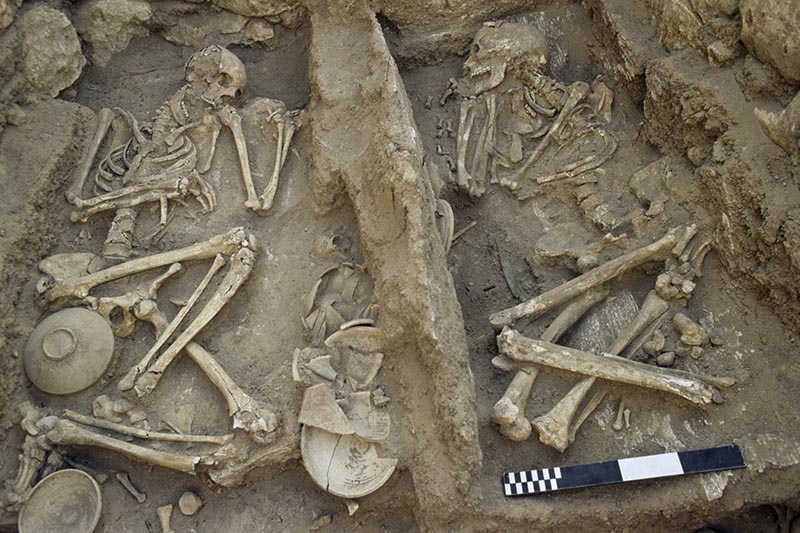
Umm el-Marra was probably the site of ancient Tuba, capital of a kingdom in the Jabbul plain between Aleppo and the Euphrates valley in northern Syria.  In the Early Bronze Age occupation, the earliest at the site, the excavations exposed a complex with ten monumental elite tombs.  These included well-preserved mausoleums with luxury artifacts of gold, silver, and lapis lazuli.  Also of particular interest were installations containing the skeletons of equids and other animals, indicative of sacrificial rituals and interments accompanying the main tombs.  It is likely that the equids were the donkey x onager hybrids referred to as kungas in Early Bronze Age texts, highly valued and associated with royalty.  The Umm el-Marra equids constitute the first archaeological attestation of these special animals. Given these results, the Umm el-Marra necropolis provides a highly unusual and large body of information on ancient Syrian elite mortuary practices and beliefs, including ancestor veneration and animal sacrifice.

Tomb 1, Skeletons B and C.

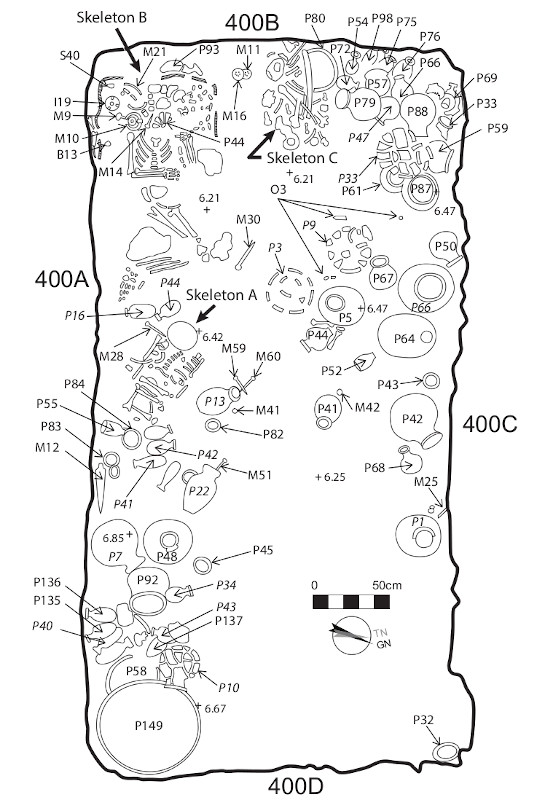
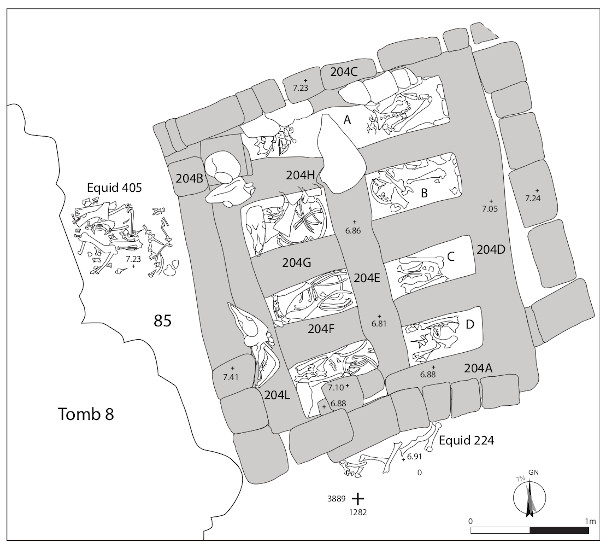
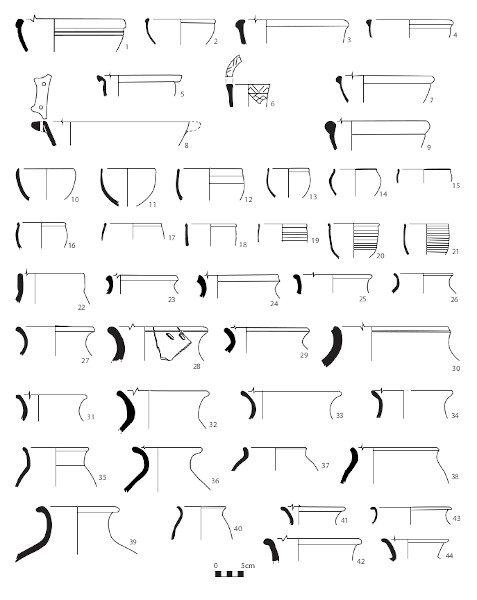
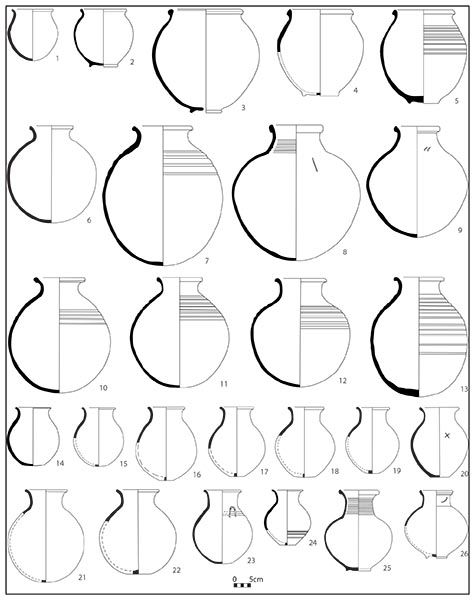
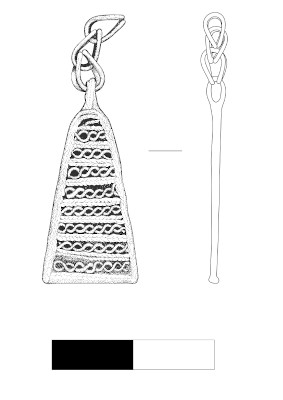
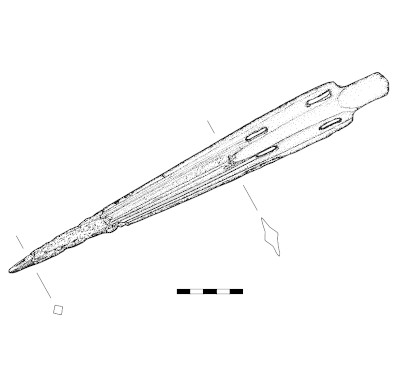
Among the illustrations produced with the assistance of the Seger Grant were architectural plans of the tombs (see Chapter 2 fig. 75), the equid installations (see Chapter 2 fig. 89), and architecture outside the tomb area (see Chapter 2 fig. 201).  Plates of pottery drawings were produced for each Early Bronze occupation phase (see Chapter 3 fig. 2) and for pottery from the tombs (see Chapter 3 fig. 36).  Further, drawings of non-ceramic finds were produced (see Chapter 4 fig. 179 and fig. 221).

Plan of Tomb 4. Chapter 2, Fig. 75.
Equid Installation. Chapter 2, Fig. 89.
Period VI ceramics. Chapter 3, Fig. 2.
Tomb 4, upper layer ceramics. Chapter 3, Fig. 36.
Chapter 4, Fig. 221.
Chapter 4, Fig. 179.

The manuscript of the book, preliminarily titled Animals, Ancestors and Ritual in Early Bronze Age Syria: An Elite Mortuary Complex from Umm el-Marra, was accepted for publication, pending revisions, by Cotsen Institute of Archaeology Press, UCLA, in December 2021.

The Umm el-Marra project is grateful to the Joe D. Seger Excavation Grant and ASOR for the assistance provided.

-Glenn Schwartz, Johns Hopkins University

Table of Contents for JCS 73 (2021)

Table of Contents for Journal of Cuneiform Studies 73 (2021)

You can receive JCS (and other ASOR publications) through an ASOR Membership.
Please e-mail the Membership office if you have any questions.

Pp. 3–8: “A Sargonic Learner’s Tablet with an Invocation of the Goddess Nisaba,” by Hanan A. Al-esawee and Abdulmukrem M. Alezzi

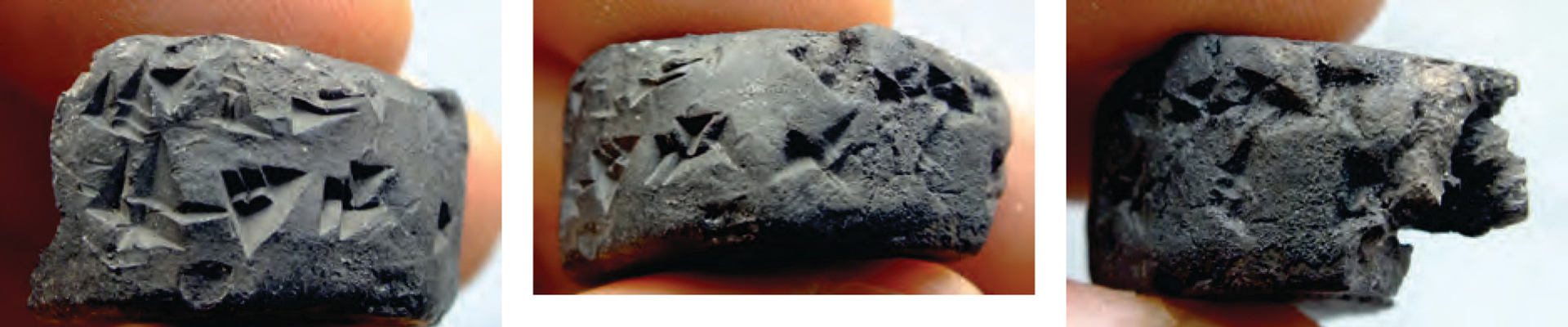
This paper derives from the study of confiscated texts in the Iraq Museum. Here we publish an Umma tablet with the accession number IM 205090, a square school text with three columns on one side and a single one on the other that lists the distribution of very large quantities of silver to various people; it concludes with an invocation to the goddess Nisaba by the learner, who describes himself as an apprentice scribe.

ASOR Members with online access: log into ASOR’s Online Portal here. Once logged in, click the JOURNALS tab in the top navigation bar. From here you may select which journal you would like to read. If you have online access, you will see your selected journal’s current issue Table of Contents. Click on the “Current Issue” button and you will then be redirected to the University of Chicago Press’s (UCP) platform to immediately start reading any issue of your choice. Tutorials for how to log in to the Online Portal as well as how to navigate to the Portal Journals page can be found here.

Pp. 9–70: “In Search of Dugurasu,” by Maria Giovanna Biga and Piotr Steinkeller

The identity of the toponym Dugurasu, which is mentioned some fifty times in the ED IIIb documentation from Ebla, is a highly contested issue. While M. G. Biga had proposed an identification with Egypt, A. Archi then argued that Dugurasu was situated in northwestern Iran. This study offers a systematic examination of all the attestations of Dugurasu, focusing on the types of materials traded between Dugurasu and Ebla. It also considers evidence bearing on Ebla’s commercial partner named DUlu. Characteristically, Ebla and DUlu exchanged the same types of goods as those traded between Ebla and Dugurasu. Our investigation strongly suggests that Dugurasu is either Egypt itself or some place in Palestine that served as an intermediary in exchanges between Egypt and Ebla, while DUlu denotes either Byblos or one of its immediate neighbors.

ASOR Members with online access: log into ASOR’s Online Portal here. Once logged in, click the JOURNALS tab in the top navigation bar. From here you may select which journal you would like to read. If you have online access, you will see your selected journal’s current issue Table of Contents. Click on the “Current Issue” button and you will then be redirected to the University of Chicago Press’s (UCP) platform to immediately start reading any issue of your choice. Tutorials for how to log in to the Online Portal as well as how to navigate to the Portal Journals page can be found here.

Pp. 71–87: “By Order of the King: Ammi-Ditana’s Letter on the Provision of Fodder Barley for the Sheep and Oxen of the Nakkamtum,” by Caroline Janssen

Di 1353 is a letter by King Ammi-ditana of Babylon to the chief lamentation priest of Annunītum. It contains a simple instruction to provide fodder for the oxen and the sheep of a temple storehouse, the nakkamtum. One wonders though what this direct intervention meant on a pragmatic level. The king does not explain himself. But this question can be approached from different angles. What do we know so far about the relation between the palace and the nakkamtum? Does this letter fit into a pattern of royal letter writing? Can we benefit from the fact that we have an archival context for this letter?

ASOR Members with online access: log into ASOR’s Online Portal here. Once logged in, click the JOURNALS tab in the top navigation bar. From here you may select which journal you would like to read. If you have online access, you will see your selected journal’s current issue Table of Contents. Click on the “Current Issue” button and you will then be redirected to the University of Chicago Press’s (UCP) platform to immediately start reading any issue of your choice. Tutorials for how to log in to the Online Portal as well as how to navigate to the Portal Journals page can be found here.

Pp. 89-102: “HS 200B: A Bridal Gift (Tuppu Bibli) from the First Sealand Dynasty,” by Jacob Jan de Ridder

An unusual tablet from the Hilprecht-Sammlung in Jena describes the biblu, “bridewealth,” paid for a girl at her betrothal. Paleographic features and onomastic arguments suggest that the text may be dated to the late Sealand I period, with similarities to documents from the reigns of the Kings Pešgaldarameš and Ayadaragalama. A first edition is offered together with a brief introduction detailing its legal context and historical setting.

ASOR Members with online access: log into ASOR’s Online Portal here. Once logged in, click the JOURNALS tab in the top navigation bar. From here you may select which journal you would like to read. If you have online access, you will see your selected journal’s current issue Table of Contents. Click on the “Current Issue” button and you will then be redirected to the University of Chicago Press’s (UCP) platform to immediately start reading any issue of your choice. Tutorials for how to log in to the Online Portal as well as how to navigate to the Portal Journals page can be found here.

Pp. 103-119: “A New Reading of the Middle Elamite Text Shun I 9,” by Jalil Bakhtiari

There are four complete or almost complete unprovenanced bricks and twenty-one brick fragments from the site of Toll-e Bard-e Karegar in Khuzestan belonging to the only Elamite inscription mentioning the god Kamul. All of them represent exemplars of the one and the same text (ShuN I 9), written in the name of the Elamite king Shutruk-Nahhunte I (ca. 1190–1155 BCE). The text describes a temple that the king had rebuilt and dedicated to the god Kamul. In this article, a new reading and translation of the last sentence of the text that is divided into four sections and compared with parallels in Old and Middle-Elamite texts, is suggested. In addition, the brick fragments TBK 16 and 28 are reread and classified and TBK 89, 114, 122, and 127 are published.

ASOR Members with online access: log into ASOR’s Online Portal here. Once logged in, click the JOURNALS tab in the top navigation bar. From here you may select which journal you would like to read. If you have online access, you will see your selected journal’s current issue Table of Contents. Click on the “Current Issue” button and you will then be redirected to the University of Chicago Press’s (UCP) platform to immediately start reading any issue of your choice. Tutorials for how to log in to the Online Portal as well as how to navigate to the Portal Journals page can be found here.


Pp. 121-134: “Elamite War Chariots and Military Equipment At Ancient Kabnak (ca. 1400 bce),” by Javier Álvarez-Mon and Yasmina Wicks

After entering the second millennium BCE as a military superpower, Elam faded into historical obscurity upon its withdrawal from the broader Near Eastern political scene in 1763 BCE and only reemerged much later as a major player with a sequence of incursions in Mesopotamia beginning in the thirteenth century and culminating in the 1155 BCE fall of the Kassites. During the intervening centuries, neither written nor archaeological sources offer clear signs that Elamite territory had come under the authority of any foreign power. Here the authors propose that a reexamination of evidence from the ancient settlement of Kabnak (modern Haft Tepe), approximately seventeen kilometers southeast of the Elamite lowland capital of Susa, discloses a mid-fifteenth to mid-fourteenth century BCE state-controlled arsenal of war chariots and weaponry that may hold a key to comprehending Elam’s apparent continued resistance to outside forces and its rise as a military superpower in the thirteenth century.

ASOR Members with online access: log into ASOR’s Online Portal here. Once logged in, click the JOURNALS tab in the top navigation bar. From here you may select which journal you would like to read. If you have online access, you will see your selected journal’s current issue Table of Contents. Click on the “Current Issue” button and you will then be redirected to the University of Chicago Press’s (UCP) platform to immediately start reading any issue of your choice. Tutorials for how to log in to the Online Portal as well as how to navigate to the Portal Journals page can be found here.

Pp. 135-178: “Keeping Alive Dead Knowledge: Middle Assyrian Glass Recipes in the Yale Babylonian Collection,” by Shiyanthi Thavapalan

Although they describe Bronze Age technologies and techniques, the Akkadian glassmaking texts are primarily known through later copies from Ashurbanipal’s libraries. The first portion of this paper provides editions of three fragments of previously unknown glass texts from the Middle Assyrian period and examines how and why they came to be written down. The second portion discusses metaphors concerning kinship and bodily experience that explain the relationship between the glassmaker in Mesopotamia, his tools, and his creative process. It is argued here that only by embracing the entire context of the craft process—this includes the behaviors chosen during manufacture as well as the allusions made to social relationships through language, performance, and materials—can we begin to appreciate how knowledge about technologies was transmitted.

ASOR Members with online access: log into ASOR’s Online Portal here. Once logged in, click the JOURNALS tab in the top navigation bar. From here you may select which journal you would like to read. If you have online access, you will see your selected journal’s current issue Table of Contents. Click on the “Current Issue” button and you will then be redirected to the University of Chicago Press’s (UCP) platform to immediately start reading any issue of your choice. Tutorials for how to log in to the Online Portal as well as how to navigate to the Portal Journals page can be found here.

Pp. 179-191: “Inscribed Bullae Found during Excavations on the Northern Slope of Ayanis Fortress in 2015 and a New Urartian Building Name, ÉTamali,” by Kenan Işık, Oğuz Aras, and Ayşegül Akın Aras

The 2014 season of excavations at the Ayanis Fortress of the Urartian Kingdom, located on the eastern shore of Lake Van, revealed a trash layer on the northern slope of the fortress that contained densely packed animal bone remains as well as several inscribed bullae. During the excavations carried out in the same area in 2015 four more inscribed bullae were recovered in the northern fortification wall. This article provides information on the 2015 excavations of the outer side of the northern fortifications and trash layer at Ayanis, with a first edition of the new bullae. These short inscriptions mention the names of people, cities, countries, and professions, as is common in such Urartian bullae. The inscription on a newly discovered bulla mentioning a construction named tamali is important as it informs us about a new building unit whose function is unknown at present.

ASOR Members with online access: log into ASOR’s Online Portal here. Once logged in, click the JOURNALS tab in the top navigation bar. From here you may select which journal you would like to read. If you have online access, you will see your selected journal’s current issue Table of Contents. Click on the “Current Issue” button and you will then be redirected to the University of Chicago Press’s (UCP) platform to immediately start reading any issue of your choice. Tutorials for how to log in to the Online Portal as well as how to navigate to the Portal Journals page can be found here.

Pp. 193-209: “Ancient Mesopotamian Divinatory Series from the British Museum: New Texts and Joins,” by Nicla De Zorzi

This paper contains editions of three previously unpublished omen texts and one commentary text from the collections of the British Museum. BM 36165 and BM 34999 are Late Babylonian manuscripts of Šumma ālu tablet 1 while K 6260 is a join to Šumma izbu tablet 4. BM 47684+ is part of a large Late Babylonian four-column tablet containing a new commentary on physiognomic omens. The edition of these tablets is accompanied by an extensive commentary that discusses the placement of the tablets within the divinatory series, as well as orthographic and interpretative issues.

ASOR Members with online access: log into ASOR’s Online Portal here. Once logged in, click the JOURNALS tab in the top navigation bar. From here you may select which journal you would like to read. If you have online access, you will see your selected journal’s current issue Table of Contents. Click on the “Current Issue” button and you will then be redirected to the University of Chicago Press’s (UCP) platform to immediately start reading any issue of your choice. Tutorials for how to log in to the Online Portal as well as how to navigate to the Portal Journals page can be found here.

Pp. 211-245: “Minor Archives from First-Millennium BCE Babylonia, Part II: The Balīḫû Archive,” by Ludovica Cecilia and Johannes Hackl

The article presents editions of all known texts belonging to the archive of the Sipparean prebendary Marduk-bēlšunu, son of Nabû-balāssu-iqbi, that is, the Balīḫû archive. It is the second part of a series of articles that aims to make available the so-called satellite archives of the Ṣāḫiṭ-ginê A archive (“Marduk-rēmanni archive”) and related and unrelated smaller archives from Sippar, all dating to the long sixth century BCE.

ASOR Members with online access: log into ASOR’s Online Portal here. Once logged in, click the JOURNALS tab in the top navigation bar. From here you may select which journal you would like to read. If you have online access, you will see your selected journal’s current issue Table of Contents. Click on the “Current Issue” button and you will then be redirected to the University of Chicago Press’s (UCP) platform to immediately start reading any issue of your choice. Tutorials for how to log in to the Online Portal as well as how to navigate to the Portal Journals page can be found here.

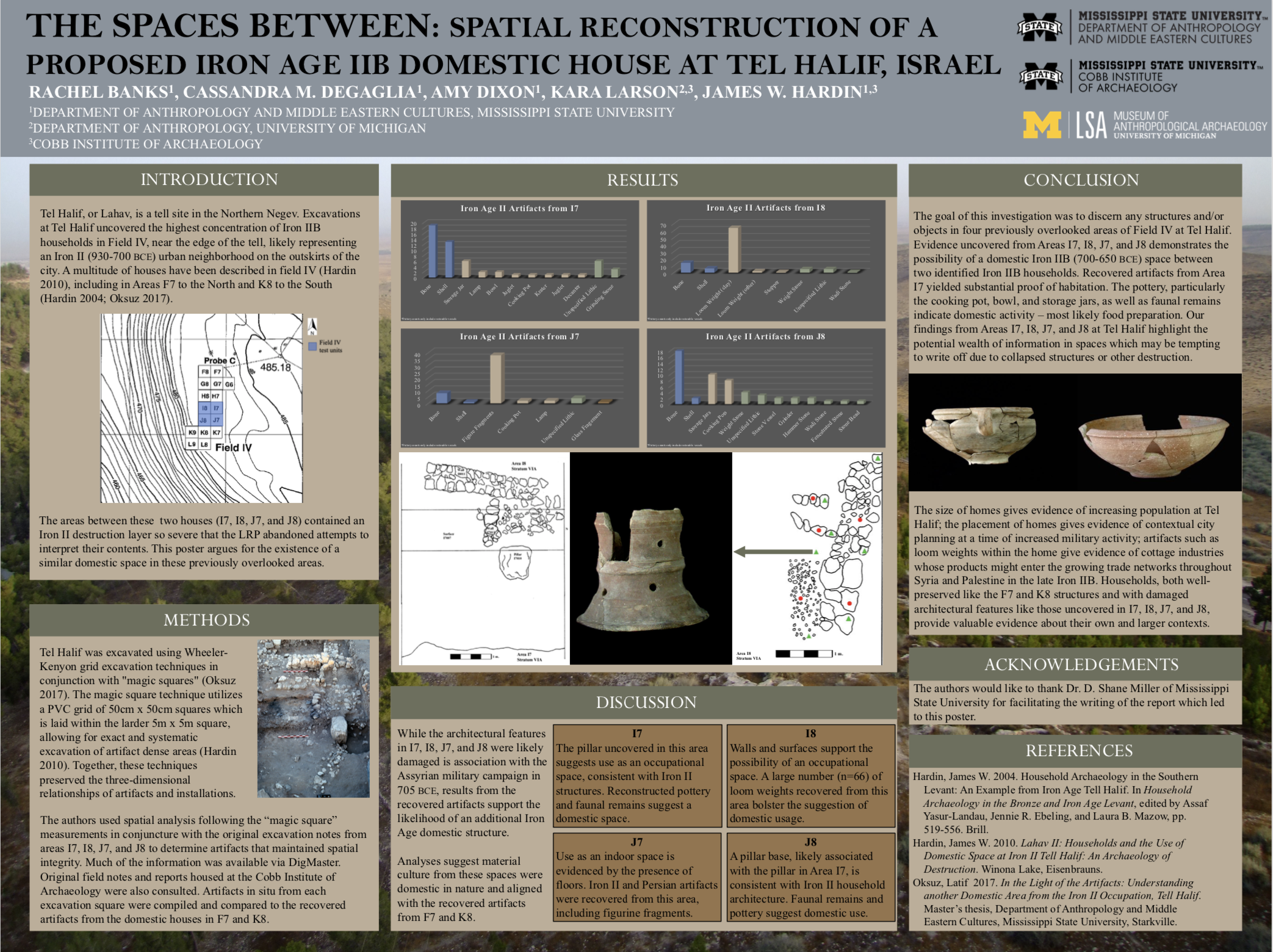
Award Spotlight: 2020 Poster Award, Rachel Banks et al.

The Joy Ungerleider Poster Award Spotlight: Rachel Banks, Cassandra M. DeGaglia, Amy Dixon, Kara Larson, and James W. Hardin

Rachel Banks (Mississippi State University), Cassandra M. DeGaglia (Mississippi State University; Smithsonian Institution), Amy Dixon (Mississippi State University), Kara Larson (University of Michigan; Cobb Institute of Archaeology) and James W. Hardin (Mississippi State University) were awarded the 2020 Joy Ungerleider Poster Award. This award is conferred upon the author(s) of the poster presenting the results of a study about ancient Near Eastern societies in a clear, legible fashion using original graphic content. Subject matter may be based in archaeological sciences, history, anthropology, epigraphy, ethnography, heritage or other scholarly approaches to understanding ancient people in the areas covered by ASOR.

Their poster The Spaces Between: Spatial Reconstruction of a Proposed Iron Age IIB Domestic House at Tel Halif, Israel, present a visually clear, compelling and detailed study of the artifacts from several excavation areas with fragmentary architectural remains in order to reconstruct their likely function. These areas had been so badly damaged during a significant destruction of the site that they were excluded from initial considerations of this period. By comparing the composition of the artifact assemblage from these spaces with those from Iron Age IIB domestic structures in better-understood areas of the site, they are able to convincingly propose a likely domestic function for these spaces. In doing so, they contribute to a better understanding of household archaeology and urban organization at the site of Tel Halif during the Iron Age IIB.

The deadline for submitting a poster proposal for the 2021 Annual Meeting is August 15, 2021. Learn how to submit your poster to either the in-person, virtual, or both components here.