Limited spaces are available for this Getty Conservation Institute funded program – apply today!
[/vc_column_text][vc_column_text]This is a benefit of ASOR membership, with preference given to project directors.*
What?
The Getty Conservation Institute (GCI) and ASOR are partnering to provide members a valuable one-day workshop on emerging realities in conservation and its integration with archaeology.
Update yourself on the what, why and how of conservation.
Understand the role of conservation as an integral part of archaeological practice.
Gain valuable insight and information concerning, planning, budgeting, and funding for conservation.
Develop your conservation network.
Why?
ASOR members aim to make a difference by conserving those traces of the ancient past that we work so hard to discover, interpret and share.
As governments make strategic decisions about which permits to grant, this workshop can help you distinguish your project.
Other benefits?
An extra night’s hotel paid and meals for Sunday after the ASOR meeting supported by The Getty Conservation Institute (GCI).
Binder with conservation reference materials/handouts and instructor contact details.
Materials to use in your collaborative planning, teaching and funding requests with conservation professionals.
Certificate of workshop completion from The Getty Conservation Institute
When and where?
Sunday, November 24, 2019, after the 2019 ASOR Annual Meeting in San Diego, at the conference hotel, The Westin San Diego.
How do I apply?
Click here for the online application form. October 1st is the deadline to apply for this limited space program. Rolling admissions, so apply now.
-Breakfast and lunch
-One complimentary hotel night at The Westin San Diego
Speakers include:
Angelyn Bass, Department of Anthropology, University of New Mexico Harriet ‘Rae’ Beaubien, Museum Conservation Institute, Smithsonian Institution; Museum Studies Program, University of New Mexico Suzanne Davis, Kelsey Museum of Archaeology, University of Michigan Martha Demas, Buildings and Sites Department, Getty Conservation Institute Lynn Swartz Dodd, Religion, Archaeology Research Center, University of Southern California Heather Hurst, Department of Anthropology, Skidmore College Ioanna Kakoulli, Materials Science and Engineering Department, University of California at Los Angeles Douglas Porter, School of Engineering, University of Vermont
Other Questions?
Contact ASOR staff member, Arlene Press, meetings@asor.org
* If you are a project director, but not yet an ASOR member, apply anyway.
Thanks to our generous members, ASOR has raised funds to finance part of the purchase price for a new ASOR home in Alexandria, VA—The James F. Strange Center. Moving into our new home was and is an amazing accomplishment (see moving article), but we are not quite finished. In addition to paying off the debt and furnishing the building, we need a successful Annual Fund drive (ends June 30th) in order to cover one-time expenses associated with moving from Boston to Alexandria.
Fortunately, we have received an extraordinary challenge pledge of $450,000 that will ensure our success for the building—but we need to earn this gift by meeting two separate challenges by June 30 (one by June 30 and one by December 31):
First, we must demonstrate that we are all behind ASOR’s many initiatives by securing 450 unique donors by June 30, 2019. Donations may be for any purpose, including the Annual Fund (unrestricted).
Second (and separate from the participation goal), we must raise $225,000 in new gifts and pledges for the building by December 31, 2019. To date, we have received gifts and pledges of $171,402 for this challenge—so we only need $53,598 more.
[/vc_column_text][mk_divider][mk_skill_meter title=”Progress Towards 450 Donors in Fiscal Year 2018″ percent=”98.8″ title_color=”#777777″ progress_bar_color=”#dd3333″ track_bar_color=”#eeeeee”][mk_divider][vc_column_text responsive_align=”left”]Your membership in ASOR is crucial to our shared success. We thank you for your partnership. Your donations enable ASOR to carry out our mission at a higher level and with greater impact. Even modest gifts add up to create significant support for ASOR, and the high level of donor participation from our memberships helps us attract gifts from foundations and major donors. Truly, every donor is important, and every gift is meaningful. This year, every gift helps us earn an additional $450,000![/vc_column_text][vc_column_text responsive_align=”left”]
If you are one of the 445448 people who has already made a gift, thank you for your support. If you have not yet made a gift this fiscal year, please consider joining the ranks of ASOR donors (click here to see the donors from last year—Fiscal Year 2018). We have just over two weeks to reach our goal, so please make a gift today![/vc_column_text][mk_divider][mk_table]
Katlin Long-Wright, 2018 G. Ernest Wright Fellowship Recipient
Long-Wright squaring out the locus in Area B.
In the heart of the Judean foothills on the Shephelah plane, is the site of an ancient story. The name of this site is Horvat Midras, a group of four areas each with its own mystery and allure. Area A consists of a large structure with an orthogonal layout, bases for columns, a decorated lintel, and a cistern dating to the Byzantine period. Area C consisted of retaining walls and a thick layer of homogeneous pottery dating to the 1st and 2nd C. BCE; the area was classified as a midden and closed in 2017. Area D is a tomb marked by a large stepped pyramid. There are no inscriptions or markers that would indicate who was buried within, yet such an impressive burial must have been for an individual of significant social and economic power. The search continues. Last, is Area B, which I was fortunate enough to excavate for its tale is the most mysterious of them all.
A coin found close to the cave entrance in Area B.
Above ground Area B consisted of destroyed walls, damaged floors, and the entrance to a cistern; ruins of modern habitation. Below ground was another story. Excavation of the cistern in 2017 revealed a tunnel leading to a another room. The goal for this season is to excavate further and attempt to explain what had happened at the site. During the survey, Area B supervisor Tal Ragovski accidentally discovered another cave entrance when he stuck a measuring tool into the ground and it sank, disappearing into the ground below. A square was opened where he serendipitously discovered the second cave entrance. It was in this square of Area B that I excavated along with my classmates and dig supervisor Shir Hoorit of Hebrew University.
The weather was oppressive; the heat had reached 104 degrees Fahrenheit, the wind raged, and the clouds disappeared quickly providing little to no reprieve from the scorching sun. Despite Mother Nature’s attempt to deplete our team of strength, the desire to uncover the secrets of the square outweighed the discomfort. After week one, the plot thickened with the discovery of two walls. The larger, and longer, of the two was comprised of two different masonry styles. The two foundational courses belonged to a Roman period while the course above was Byzantine. The smaller wall, dated to the Mamluk Period. Three different occupation layers, and all of them constructed around the cave entrance. For what purpose?
By the end of week two we had uncovered two more walls, however, one was in fact not a wall but a coincidentally well placed collapse. In the second week the discovery of Roman and Byzantine ceramics became daily and frequent, this helped the team determine that we were reaching earlier occupation layers. A large amphora dating to the Roman Period was discovered next to one of the walls. Although damaged, the contents were sent for analysis. Several tiny bits of charcoal appeared the further down we excavated. A blade was also found and several numismatics, one was identified as Byzantine (a distinctive M could be seen). Who built near this cave entrance, and why?
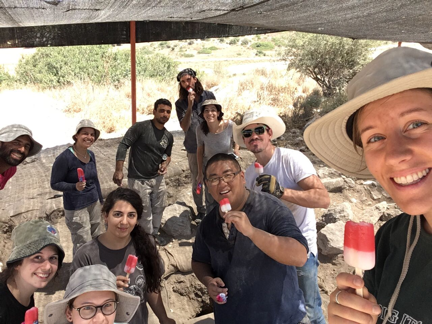
The team taking a popsicle break.
Long-Wright sitting atop some ruins in the national park overlooking the Shephelah plain.
By the end of week three, the cave entrance was fully revealed. A rock hewn arch served as the top of the cave entrance. It was only a few feet below the foundational stones of the walls for the structure. Unfortunately, we reached the collapse of soil into the cave entrance on the third last day of excavation, leaving us no time to excavate that part of the cave. So, who made this cave, and why? Based on the ceramics, artifacts, numismatics, and layout of the cave the supervisors and excavation team determined it was a hiding complex used during the Bar Kokhba Revolt. The cistern was originally used as a miqvah, a Jewish ritual bathing installment. During the Revolt period, the Jewish people would carve through their miqvah and connect it to their underground storage room. They would then dig towards a neighbour’s miqvah and storage room creating a complex network of caves. When the Romans would come to attack, the inhabitants would run into the hiding complexes to escape capture or injury. Several hiding complexes have been discovered in the region, ranging in size and complexity.
Lorem ipsum dolor sit amet, consectetur adipiscing elit. Ut elit tellus, luctus nec ullamcorper mattis, pulvinar dapibus leo.
This excavation was incredible! Unfortunately I could not multiply myself and excavate in each area of the site, but Area B provided more than enough training, and excitement. This season really solidified the idea that archaeology is a mystery solving discipline. Each clue must be taken into account if one wants to determine the story of a site. It’s not about a race to the finish but a methodical perusing of each layer, artifact, and feature to gain a clear understanding of what has transpired. I chose to write this entry in such a way that demonstrates what it is like to be in the field. Each hour, day, and week provides new information, and with that information comes new hypothesis. You are a detective trying to uncover the past, and you only have the evidence at the site, and examples from others, to draw upon. It is fascinating and fulfilling work, and I hope to be fortunate enough to don the trench hat once more in search of buried pasts.
A huge thank you to the American School of Oriental Research, without their financial support I would not have been able to attend the excavations of Horvat Midras in Israel.
Katlin Long-Wright is a Canadian and a graduate from the University of British Columbia’s Classical, Near Eastern, and Religious studies department. His research has an emphasis on Egyptology. He has worked on two excavations: Gerace, Sicily, and Horvat Midras, Israel, and hopes for many more excavation opportunities in the future.
Want to help more students and young archaeologists get into the field? Donate to the cause today by selecting “Excavation Scholarships” as your gift purpose!
[/vc_column_text][vc_column_text]At the 2018 ASOR Annual Meeting, Lynn Swartz Dodd was awarded the The Charles U. Harris Service Award. This award is given in recognition of long term and/or special service as an ASOR Officer or Trustee.
Lynn Swartz Dodd, Associate Professor of the Practice of Religion, University of Southern California, has served as ASOR Secretary from 2013-2018 (two three-year terms). Of the ASOR officer positions, secretary is perhaps the most thankless task. It requires a commitment to serve as an officer on the Executive Committee and the Board of Trustees, but also—on top of this—to take the minutes at every Executive Committee and Board meeting. Trying to be both an informed and engaged participant, while also taking the minutes and keeping straight the contributions of every other participant in the meetings, is no easy task! Yet Lynn exudes a coolness and calm during Executive Committee and Board meetings that does, in fact, make things look easy. During her tenure as ASOR secretary, Lynn also served as Chair of ASOR’s Ethics Task Force and on ASOR’s Publications and Archaeological Research and Policy (CAP) committees. In recognition of her work as secretary, and her six years as an ASOR officer, it is a pleasure to award her the Charles U. Harris Service Award.
Nominate someone for an award. The deadline for service award nominations is September 2, 2019. The deadline for book award nominations September 16, 2019.[/vc_column_text][/vc_column][vc_column border_color=”rgba(170,170,170,0.01)” width=”1/6″ css=”.vc_custom_1496684098866{margin-right: 5px !important;margin-bottom: 20px !important;border-right-width: 2px !important;border-bottom-width: 2px !important;padding-top: 30px !important;padding-right: 10px !important;padding-left: 10px !important;background-color: #ffffff !important;border-right-color: rgba(227,228,228,0.75) !important;border-bottom-color: rgba(227,228,228,0.75) !important;}”][vc_wp_posts title=”BROWSE THE NEWS ARCHIVE” number=”4″][/vc_column][vc_column border_color=”rgba(170,170,170,0.01)” width=”1/6″ css=”.vc_custom_1496684008271{margin-right: 10px !important;margin-bottom: 30px !important;border-right-width: 2px !important;border-bottom-width: 2px !important;padding-top: 30px !important;padding-right: 20px !important;padding-left: 20px !important;background-color: #ffffff !important;border-right-color: rgba(227,228,228,0.75) !important;border-bottom-color: rgba(227,228,228,0.75) !important;}”][vc_column_text]Tweets by ASOResearch [/vc_column_text][/vc_column][/vc_row][vc_row][vc_column][vc_column_text]
Pp. 67-74: “The Mainstream Media and the ‘Shocking Bad Art’ from Cyprus: 1870s New York Reacts to the Cesnola Collections,” by Ann-Marie Knoblauch
When the Metropolitan Museum of Art first opened the doors of its Fifth Avenue building on March 30, 1880, the majority of the exhibition space was occupied by Cypriot art purchased by the Met’s trustees from Luigi Palma di Cesnola in two lots, one in 1872 and another in 1876. The two collections amounted to around twenty thousand objects, all finds Cesnola had acquired while serving as US Consul on the island from 1865–1876. After the acquisition of the second collection, Cesnola left Cyprus to become the first director of the Metropolitan Museum, a position he held until his death in 1904. New Yorkers in the 1870s were most intriguing by the works of limestone sculptures from the sanctuary at Golgoi. In the 1880s these objects would become embroiled in a scandal because of the claim that Cesnola had performed intentionally misleading restorations, but before that disgrace and through much of the 1870s, New Yorkers were processing the arrival of an enormous volume of ancient Cypriot objects in a relatively short amount of time.
ASOR Members with online access: navigate to the token link email sent to you before attempting to read this article. Once you have activated your member token, click here to access the above article on The University of Chicago Press Journals’ website.
Pp. 75-81: “Imagining Henenu,” by Carlos Gracia Zamacona
The Middle Kingdom Theban Project, begun in 2014 under the auspices of the Freie Universität Berlin, represents the resumption of the archaeological activities in the Middle Kingdom necropolis of Deir el-Bahari and Asasif. The site had previously been excavated under the auspices of the Metropolitan Museum of Art, New York, initiated by Herbert Eustis Winlock in 1912 with survey activities followed by excavations from 1921–1922 until 1928 (Arnold 1996: 59). Winlock’s excavations had been preceded by Howard Carter’s in 1910–1911 (Morales et al. 2016: 258). The current excavations began in 2015, and have continued annually through 2018 (Morales et al. 2016, 2017, and 2018) under the auspices of the Universidad de Alcalá (Madrid, Spain), with a fifth season scheduled for October 2019.
ASOR Members with online access: navigate to the token link email sent to you before attempting to read this article. Once you have activated your member token, click here to access the above article on The University of Chicago Press Journals’ website.
Pp. 82-88: “Two Punic Stelae Rediscovered in Philadelphia,” by Jean MacIntosh Turfa
In the University of Pennsylvania Museum, Philadelphia, two small, fragmentary Punic stelae were found in storage by Asian Section Keeper Stephen Lang.1 They were remnants from a large donation, made over a century ago, of part of the variegated collection of Maxwell Sommerville, perhaps best known for engraved gems of all kinds, and also much Asian material. Sommerville (1829–1904) was an affluent Philadelphia businessman who devoted his later life (and funds) to world travel and the collection of antiquities in Europe, Turkey, Syria, Egypt, and North Africa as well as China, Japan, India, Burma, and Thailand. He published memoirs of his travels and catalogues and discussions of the gems and seals. His collection, originally exhibited in the Metropolitan Museum of Art, New York (1888–1891), was placed in the Museum of the University of Pennsylvania (1891) and remained there upon his bequest (see Berges 2002: 11–19). Although Sommerville’s memoir Sands of Sahara (1901) describes some of his North African travels, there is no reference to his acquisition of the Punic artifacts.
ASOR Members with online access: navigate to the token link email sent to you before attempting to read this article. Once you have activated your member token, click here to access the above article on The University of Chicago Press Journals’ website.
Pp. 90-101: “A New Jewelry Hoard from Eleventh-Century BCE Megiddo,” by Eran Arie, Elisabetta Boaretto, Mario A. S. Martin, Dvory Namdar, Orit Shamir, and Naama Yahalom-Mack
A magnificent new jewelry hoard was uncovered on July 11, 2010 in Area H of the northwestern sector of Tel Megiddo. This site in the Jezreel Valley (Israel) is one of the most important in the southern Levant thanks to four archaeological expeditions that have thoroughly excavated the mound and rapidly published the results of their digs (Ussishkin 2018). All expeditions unearthed hoards of different types from the Late Bronze and Iron Ages (Hall 2016). This new hoard was unearthed in a destruction debris, securely dated to the Early Iron Age I, ca. 1070 BCE (local Level H-11, which equals University of Chicago’s Stratum VIIA). During this period, part of a building (remnants of two rooms and an inner courtyard surrounded by three large open courtyards) was found in this area (figs. 1–2; Finkelstein et al. 2017: 267–69). The building is positioned only about 30 m from Canaanite Palace 2041 of the city of Stratum VIIA. This article offers a preliminary publication of the hoard; a full report will soon be published in the Megiddo VI volume (Arie forthcoming a).
ASOR Members with online access: navigate to the token link email sent to you before attempting to read this article. Once you have activated your member token, click here to access the above article on The University of Chicago Press Journals’ website.
Pp. 102-113: “Identifying a Dionysian Community in Ashkelon’s Eastern Cemetery,” by Davida Eisenberg-Degen, Ilan Peretz, and Eriola Jakoel
Ashkelon’s Eastern Cemetery was in continuous use for more than half a millennium, from the Hellenistic through Late Byzantine periods (fig. 1). Several excavations carried out in Ashkelon’s Eastern Cemetery reveal simple hewn graves alongside burial structures (Eisenberg-Degen 2017; Peretz 2017 and references listed there). Grave goods were found in several burials dating to the Roman period. Depositing funerary offerings was a common practice in the Roman era. Roughly a third of the excavated Eastern Cemetery (fig. 2, n=24) contained grave goods (Eisenberg-Degen 2017). Taking into account that some pilfering and plundering most likely took place, this figure is consistent with percentages noted in other Roman-period burials (Findlater et al. 2013: 69–80; Winter 2015: 82–87).
ASOR Members with online access: navigate to the token link email sent to you before attempting to read this article. Once you have activated your member token, click here to access the above article on The University of Chicago Press Journals’ website.
Pp. 114-123: “Joseph’s Tomb: A Model of Traditional Islamic Shrines in Palestine,” by Loay Abu Alsaud and Amer Al-Qobbaj
Joseph’s Shrine is located on the outskirts of the eastern side of the city of Nablus (fig. 1), near Tell Balatah, the site of the Canaanite City of Shechem, and 300 m northwest of Jacob’s Well (Pummer 1993: 139; Bruce 1994: 102). Joseph’s tomb has been venerated throughout the ages by Samaritans (for whom it is the second-holiest site), Jews, Christians, and Muslims. The total area of Joseph’s Shrine is 661 m² and it is located in Block 5, parcel 10, according to early Islamic Immovable Property Records from the Department of Al Awqaf Al Islamyah (Jordanian Islamic Endowments), Nablus (fig. 2). Originally situated on an agricultural plain, it is now surrounded by buildings, due to expansion of housing and schools in central Balata.
ASOR Members with online access: navigate to the token link email sent to you before attempting to read this article. Once you have activated your member token, click here to access the above article on The University of Chicago Press Journals’ website.
[/vc_column_text][mk_divider][vc_column_text]ASOR Members with online access: navigate to the token link email sent to you before attempting to read this issue. Once you have activated your member token, click here to access the the entire issue, including book reviews, on The University of Chicago Press Journals’ website.[/vc_column_text][/vc_column][vc_column border_color=”rgba(170,170,170,0.01)” width=”1/6″ css=”.vc_custom_1496684098866{margin-right: 5px !important;margin-bottom: 20px !important;border-right-width: 2px !important;border-bottom-width: 2px !important;padding-top: 30px !important;padding-right: 10px !important;padding-left: 10px !important;background-color: #ffffff !important;border-right-color: rgba(227,228,228,0.75) !important;border-bottom-color: rgba(227,228,228,0.75) !important;}”][vc_wp_posts title=”BROWSE THE NEWS ARCHIVE” number=”4″][/vc_column][vc_column border_color=”rgba(170,170,170,0.01)” width=”1/6″ css=”.vc_custom_1496684008271{margin-right: 10px !important;margin-bottom: 30px !important;border-right-width: 2px !important;border-bottom-width: 2px !important;padding-top: 30px !important;padding-right: 20px !important;padding-left: 20px !important;background-color: #ffffff !important;border-right-color: rgba(227,228,228,0.75) !important;border-bottom-color: rgba(227,228,228,0.75) !important;}”][vc_column_text]Tweets by ASOResearch [/vc_column_text][/vc_column][/vc_row]
ASOR’s New Home, named in memory of James F. Strange
When ASOR was established in 1900, our office was one large room in a Jerusalem hotel. During the past 119 years, we have dramatically expanded our scholarly capacity and public outreach—both abroad and in North America. By 1925, we built a permanent home in Jerusalem. Yet in North America, we moved frequently, from one host institution to another. Now, it is time for ASOR to establish an independent headquarters to serve our broadened constituencies. In January 2018, we set the goal to of raising $1.5 million to purchase, furnish, and maintain an enduring home for ASOR in Alexandria, VA—our Board having determined that the Washington, D.C., area is the location of greatest strategic benefit to our mission.
As of June 10, 2019, we are thrilled to report that we moving ever closer to our goal! Indeed, over a period of thirteen months, ASOR’s generous friends donated almost $1 million in gifts and pledges to the Building Fund. Buoyed by these donations, we purchased an office building (named in memory of James F. Strange) located at 209 Commerce Street in Alexandria. We started moving in on March 20th, we closed on April 24th, and our materials from the Boston Office arrived on May 4th (see article on the move)!
We are also thrilled to report that a new challenge gift of $450,000 will ensure that ASOR meets and even exceeds our $1.5 million goal. Yet, We need to meet two challenges to “earn” this additional $450,000:
First, we need to demonstrate that we are all behind the purchase of ASOR’s new home and ASOR’s other initiatives by securing 450 donors donating $10 or more to ASOR in this fiscal year (July ’18-June ’19). As of June 10th, we have reached 353 donors, so we need gifts from 97 more individuals, companies, or organizations.
Second, we need to match the challenge of $450,000 by raising $225,000 in new gifts and pledges (made after February 1st), or $1 for every $2 of the donor’s gift. And we are well on our way, as we have received pledges of $166,900 in the past four and half months—so we only need $58,100 more.
How You Can Help. We are almost there! If you have not already made a gift, please consider joining the “450 donors” campaign by donating to ASOR before June 30, 2019 (all gifts, including programs other than the building qualify). If you have already pledged or made a gift to support our new home, please think about increasing your gift or pledge to the building so that we can raise the last $58,100 needed to qualify for this $450,000 challenge.
To recognize your support, we offer naming opportunities at the following levels:
Naming of conference room or floor = $300,000
Naming of an individual office (sizes vary) = $100,000 – $250,000
Name recognition on smaller office spaces = $25,000 – $99,999
Name on plaque recognizing major donors = $10,000 or more
Name on a plaque recognizing all donors at “brick” level or higher = $250 or more
Thanks to our generous members, ASOR has raised funds to finance part of the purchase price for a new ASOR home in Alexandria, VA—The James F. Strange Center. Moving into our new home was and is an amazing accomplishment (see moving article), but we are not quite finished. In addition to paying off the debt and furnishing the building, we need a successful Annual Fund drive (ends June 30th) in order to cover one-time expenses associated with moving from Boston to Alexandria.
Fortunately, we have received an extraordinary challenge pledge of $450,000 that will ensure our success for the building—but we need to earn this gift by meeting two separate challenges by June 30 (one by June 30 and one by December 31):
First, we must demonstrate that we are all behind ASOR’s many initiatives by securing 450 unique donors by June 30, 2019. Donations may be for any purpose, including the Annual Fund (unrestricted).
Second (and separate from the participation goal), we must raise $225,000 in new gifts and pledges for the building by December 31, 2019. To date, we have received gifts and pledges of $171,402 for this challenge—so we only need $53,598 more.
[/vc_column_text][mk_divider][mk_skill_meter title=”Progress Towards 450 Donors in Fiscal Year 2018″ percent=”98.4″ title_color=”#777777″ progress_bar_color=”#dd3333″ track_bar_color=”#eeeeee”][mk_divider][vc_column_text responsive_align=”left”]Your membership in ASOR is crucial to our shared success. We thank you for your partnership. Your donations enable ASOR to carry out our mission at a higher level and with greater impact. Even modest gifts add up to create significant support for ASOR, and the high level of donor participation from our memberships helps us attract gifts from foundations and major donors. Truly, every donor is important, and every gift is meaningful. This year, every gift helps us earn an additional $450,000![/vc_column_text][vc_column_text responsive_align=”left”]
If you are one of the 426443 people who has already made a gift, thank you for your support. If you have not yet made a gift this fiscal year, please consider joining the ranks of ASOR donors (click here to see the donors from last year—Fiscal Year 2018). We have just over two weeks to reach our goal, so please make a gift today![/vc_column_text][mk_divider][mk_table]
Pp. 1–19: “The Terra-cotta Figurines from a Lamp Workshop at Khirbat Shumeila near Beit Nattif, Israel,” by Benyamin Storchan andAchim Lichtenberger
In 1934, excavations conducted at Beit Nattif, in the Judaean Shephelah region, uncovered a rich assemblage of waste from a terra-cotta lamp and figurine workshop. The items produced at the workshop, which are now known by the name of the site, are dated to around 300 c.e. and can be considered a hallmark of the regional material culture of the Late Roman period, a time of wideranging cultural influences. Recent excavations at Khirbat Shumeila, located in the immediate Beit Nattif region, have uncovered the remains of a Beit Nattif lamp workshop. The Khirbat Shumeila workshop can be dated to the late 4th century c.e. During the excavations, a number of typical Beit Nattif figurines and a figurine mold were uncovered, providing an opportunity to analyze the stylistic and morphological development of the figurines over 100 years. While the new workshop was focused primarily on lamp production, figurine production existed as a secondary industry, further implying the existence of multiple parallel workshops in the region.
ASOR Members with online access: navigate to the token link email sent to you before attempting to read this article. Once you have activated your member token, click here to access the above article on The University of Chicago Press Journals’ website.
Pp. 21-40: “Correlated Change: Comparing Modifications to Ceramic Assemblages from Qizlar Qalʾeh, Iran, and Ancient Merv, Turkmenistan, during the Seleucid and Parthian Periods,” by Gabriele Puschnigg, Maria Daghmehchi, and Jebrael Nokandeh
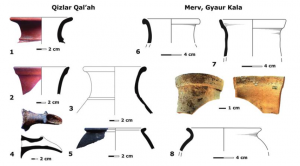
From the Seleucid period onward, substantial transformations occurred in the ceramic assemblages from Qizlar Qalʾeh on the Gorgan Plain and ancient Merv (modern Gyaur Kala). Using quantitative and archaeometric analyses, we assess and compare modifications in vessel repertoires, production techniques, and material sources across both sites to understand the nature and chronology of these changes. Similar technological developments are observed at Qizlar Qalʾeh and Merv, and are examined with regard to a potential Hellenistic reception in the ceramic material. Variations in the chronological distribution of innovations and assemblage composition help us to elucidate the neighborhood relations between eastern Iran and western Central Asia at this time. Our comparisons point toward a common cultural environment for both sites especially during the Early Parthian period, which is demonstrated in the many analogies of manufacturing techniques and vessel shapes. At the same time, we see different continuing local traditions, highlighting the flexible mode in which ceramic repertoires are adapted to the changing requirements under Hellenistic rule.
ASOR Members with online access: navigate to the token link email sent to you before attempting to read this article. Once you have activated your member token, click here to access the above article on The University of Chicago Press Journals’ website.
Pp. 41-56: “Four Judean Bullae from the 2014 Season at Tel Lachish,” by Martin G. Klingbeil, Michael G. Hasel, Yosef Garfinkel, and Néstor H. Petruk
The article presents four decorated epigraphic bullae unearthed in the Level III destruction at Lachish during the 2014 season, focusing on the epigraphic, iconographic, and historical aspects of the seal impressions.
ASOR Members with online access: navigate to the token link email sent to you before attempting to read this article. Once you have activated your member token, click here to access the above article on The University of Chicago Press Journals’ website.
Pp. 57-81: “Uninscribed Amethyst Scarabs from the Southern Levant,” by Arlette David
Prompted by the discovery of a schematic uninscribed amethyst scarab at Tel Abel Beth Maacah in the Upper Galilee, an overview of such scarabs found in the southern Levant is provided, with a typological analysis and a tentative dating and origin of these pieces.
ASOR Members with online access: navigate to the token link email sent to you before attempting to read this article. Once you have activated your member token, click here to access the above article on The University of Chicago Press Journals’ website.
Pp. 83-105: “Foreign Food Plants as Prestigious Gifts: The Archaeobotany of the Amarna Age Palace at Tel Beth-Shemesh, Israel,” Ehud Weiss, Yael Mahler-Slasky, Yoel Melamed, Zvi Lederman, Shlomo Bunimovitz, Shawn Bubel, and Dale Manor
In contrast with the relatively rich documentation from the el-Amarna archive related to the main city-states of the southern Levant in the Amarna Age (Late Bronze Age IIA; 14th century b.c.e.), archaeological data from these sites is still wanting. This unfortunate situation highlights the importance of the ca. 60,000-item plant collection from the recently exposed Late Bronze Age IIA palace at Tel Beth-Shemesh. Room L1505 in the palace—apparently a pantry due to its contents of foodstuffs and vessels for food preparation and consumption—contained eight deposits of carbonized crop plants. Deposits of almost pure grains and very low numbers of weed seeds were found, indicating that these stored food plants were ready to be used in food preparation. Of special interest is the presence of a sizeable amount of two rare pulses in Levantine archaeobotany—fenugreek (Trigonella foenum-graecum) and Cyprus vetch (Lathyrus ochrus)—only found in two other Bronze Age royal contexts: Tutankhamun’s tomb in Egypt and the Late Minoan II Unexplored Mansion in Knossos. Thus, in addition to attesting to the agricultural practices and culinary preferences of a Canaanite ruling court during the Amarna Age, this botanical assemblage also hints at prestigious royal gift exchanges of exotic food plants.
ASOR Members with online access: navigate to the token link email sent to you before attempting to read this article. Once you have activated your member token, click here to access the above article on The University of Chicago Press Journals’ website.
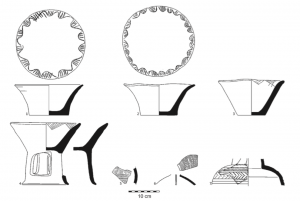
Pp. 107-144: “Tel Yaqush—An Early Bronze Age Village in the Central Jordan Valley, Israel,” by Yael Rotem, Mark Iserlis, Felix Höflmayer, and Yorke M. Rowan
This article highlights the results of five excavation seasons at Tel Yaqush, Israel, conducted between the 1989 and 2000 on behalf of The Oriental Institute at The University of Chicago. Tel Yaqush was a medium-sized village, inhabited during the entire Early Bronze Age period, from the mid-4th to the mid-3rd millennia b.c.e. The excavations exposed a dense settlement begun in the Early Bronze Age (EB) I, which ended in a severe conflagration. Apparently rebuilt at the beginning of EB II, the village remained a small site and technically non-urban throughout the period. Destroyed at the end of EB II, it was renewed in EB III, coinciding with the arrival of people bearing the Khirbet Kerak Ware ceramic tradition. This preliminary report includes new observations following recent studies of Tel Yaqush finds, including a new sequence of 14C dates from EB I to III (published in detail elsewhere). The excavation results summarized here reveal the unique role Tel Yaqush played during the shift to urbanism, and its contribution to our understanding of Early Bronze Age village society in the central Jordan Valley.
ASOR Members with online access: navigate to the token link email sent to you before attempting to read this article. Once you have activated your member token, click here to access the above article on The University of Chicago Press Journals’ website.
Pp. 145-162: “‘Crossing the Lines’—Elaborately Decorated Chalcolithic Basalt Bowls in the Southern Levant,” by Rivka Chasan, Edwin C. M. van den Brink, and Danny Rosenberg
The Late Chalcolithic period in the southern Levant shows a marked increase in symbolic expression. While most Late Chalcolithic basalt bowls are undecorated, notable amounts of these were adorned, and their decorations typically conform to a few canonized conventions. A small amount of the decorated Late Chalcolithic basalt bowls are further incised with unconventional, unique designs on their exteriors. These elaborately decorated basalt bowls stand in sharp contrast to the conventionally decorated ones, thus signifying their different roles. This article discusses their geographic distributions, frequencies, and characteristics, and offers further suggestions as to their position within the Late Chalcolithic symbolic and prestige item systems. The analysis reveals regional patterns—the elaborately decorated basalt bowls are constrained to south of the Yarkon River—suggesting that the function and symbolic value of these bowls were probably geographically restricted. Their limited distribution underlines the exclusivity of these elaborately decorated bowls during the Late Chalcolithic period.
ASOR Members with online access: navigate to the token link email sent to you before attempting to read this article. Once you have activated your member token, click here to access the above article on The University of Chicago Press Journals’ website.
Pp. 163-191: “Canaanite Reḥob: Tel Reḥov in the Late Bronze Age,” by Amihai Mazar, Uri Davidovich, and with an Appendix by Arlette David
Tel Reḥov, identified with Reḥob, was one of the largest Canaanite cities in the southern Levant during the Late Bronze Age (15th–13th centuries b.c.e.). Unlike many other Canaanite settlements, the city was founded in the 15th century after a hiatus beginning in Early Bronze Age III. In this article, four major Late Bronze Age occupation strata are described. Notable is a monumental structure dated to the 14th century b.c.e. with unusual architectural features that could be either the residence of a high-ranking family or an administrative building. During the 13th century b.c.e., this building was replaced by a new structure containing a metalsmith’s workshop, inspired by Egyptian 19th Dynasty techniques, while later building phases belong to the final stages of the Late Bronze Age. No destruction layers were found, and the Late Bronze Age city was rebuilt and continued to thrive throughout the Iron Age I. Five Late Bronze Age plaque figurines, some of particular interest, are also described. An appendix discusses a rare funerary scarab of an Egyptian high official found in the 14th-century b.c.e. edifice.
ASOR Members with online access: navigate to the token link email sent to you before attempting to read this article. Once you have activated your member token, click here to access the above article on The University of Chicago Press Journals’ website.
Pp. 193-202: “Abracadabra, or ‘I Create as I Speak’: A Reanalysis of the First Verb in the Katumuwa Inscription in Light of Northwest Semitic and Hieroglyphic Luwian Parallels,” by Timothy Hogue
Previous translations of the Katumuwa Inscription have either rendered the first verbal phrase (qnt ly) “I commissioned for myself,” or “I acquired for myself.” No scholars have yet defended the possibility that it simply means “I made.” In fact, this is likely the case given the typical monumental rhetoric of Northwest Semitic and Hieroglyphic Luwian monumental inscriptions. In particular, a comparison with verbs of monumenting in Hieroglyphic Luwian inscriptions suggests that the monumenting phrase in the Katumuwa Inscription was calqued on a Luwian phrase. This difference is significant because it reveals an important aspect of the inscription’s monumentality and the Syro-Anatolian conception of the stele. The stele that Katumuwa created was not understood merely as the inscribed object. Rather, the monument was the conjunction of material object, ritual engagement, and the resultant manifestation of the monument’s commissioner. There was no monument apart from Katumuwa, whose voice was preserved in the inscription and whose presence could be reactivated through ritual. Therefore, Katumuwa did in fact “create” the stele as he spoke through it to his monument’s users.
ASOR Members with online access: navigate to the token link email sent to you before attempting to read this article. Once you have activated your member token, click here to access the above article on The University of Chicago Press Journals’ website.
Pp. 203-210: “An Inscribed Sherd in Aramaic Script from Barikot, Pakistan,” by Michael Zellmann-Rohrer and Luca Maria Olivieri
This article discusses a sherd inscribed with a text in Aramaic script from Barikot in Pakistan. The site, known in classical sources on Alexander the Great, has been regularly investigated over the last 40 years. In recent excavation campaigns, new evidence of the earliest phases of the city (500–50 b.c.e.) has been discovered, including the sherd treated here, among other inscribed pottery in Greek and Brāhmī.
ASOR Members with online access: navigate to the token link email sent to you before attempting to read this article. Once you have activated your member token, click here to access the above article on The University of Chicago Press Journals’ website.
Pp. 211-236: “An Eighth-Century b.c.e. Gate Shrine at Tel Lachish, Israel,” by Saar Ganor and Igor Kreimerman
Excavations conducted on behalf of the Israel Antiquities Authority at Tel Lachish exposed the southern half of the six-chambered gate in Level III. In the eastern chamber, a gate shrine was uncovered. The shrine was split in two: a larger northern room and a smaller southern room. The southern room, which served as the holy of holies, had a niche in its southern wall in front of which a double altar was placed. Dozens of bowls and oil lamps were revealed inside the shrine. At some point, evidently prior to the destruction of Level III by Sennacherib in 701 b.c.e., the shrine was desecrated and sealed. This act was evident in the breakage of the altar’s horns and the placement of a latrine in the holy of holies. The available data suggests that the desecration of the shrine should be associated with Hezekiah’s cultic reform (2 Kgs 18:4).
ASOR Members with online access: navigate to the token link email sent to you before attempting to read this article. Once you have activated your member token, click here to access the above article on The University of Chicago Press Journals’ website.
[/vc_column_text][mk_divider][vc_column_text]ASOR Members with online access: navigate to the token link email sent to you before attempting to read this issue. Once you have activated your member token, click here to access the the entire issue, including book reviews, on The University of Chicago Press Journals’ website.[/vc_column_text][/vc_column][vc_column border_color=”rgba(170,170,170,0.01)” width=”1/6″ css=”.vc_custom_1496684098866{margin-right: 5px !important;margin-bottom: 20px !important;border-right-width: 2px !important;border-bottom-width: 2px !important;padding-top: 30px !important;padding-right: 10px !important;padding-left: 10px !important;background-color: #ffffff !important;border-right-color: rgba(227,228,228,0.75) !important;border-bottom-color: rgba(227,228,228,0.75) !important;}”][vc_wp_posts title=”BROWSE THE NEWS ARCHIVE” number=”4″][/vc_column][vc_column border_color=”rgba(170,170,170,0.01)” width=”1/6″ css=”.vc_custom_1496684008271{margin-right: 10px !important;margin-bottom: 30px !important;border-right-width: 2px !important;border-bottom-width: 2px !important;padding-top: 30px !important;padding-right: 20px !important;padding-left: 20px !important;background-color: #ffffff !important;border-right-color: rgba(227,228,228,0.75) !important;border-bottom-color: rgba(227,228,228,0.75) !important;}”][vc_column_text]Tweets by ASOResearch [/vc_column_text][/vc_column][/vc_row]
Thanks to our generous members, ASOR has raised funds to finance part of the purchase price for a new ASOR home in Alexandria, VA—The James F. Strange Center. Moving into our new home was and is an amazing accomplishment (see moving article), but we are not quite finished. In addition to paying off the debt and furnishing the building, we need a successful Annual Fund drive (ends June 30th) in order to cover one-time expenses associated with moving from Boston to Alexandria.
Fortunately, we have received an extraordinary challenge pledge of $450,000 that will ensure our success for the building—but we need to earn this gift by meeting two separate challenges by June 30:
First, we must demonstrate that we are all behind ASOR’s many initiatives by securing 450 unique donors. Donations may be for any purpose, including the Annual Fund (unrestricted).
Second (and separate from the participation goal), we must raise $225,000 in new gifts and pledges for the building. To date, we have received gifts and pledges of $167,237 for this challenge—so we only need $57,763 more.
[/vc_column_text][mk_divider][mk_skill_meter title=”Progress Towards 450 Donors in Fiscal Year 2018″ percent=”86″ title_color=”#777777″ progress_bar_color=”#dd3333″ track_bar_color=”#eeeeee”][mk_divider][vc_column_text responsive_align=”left”]Your membership in ASOR is crucial to our shared success. We thank you for your partnership. Your donations enable ASOR to carry out our mission at a higher level and with greater impact. Even modest gifts add up to create significant support for ASOR, and the high level of donor participation from our memberships helps us attract gifts from foundations and major donors. Truly, every donor is important, and every gift is meaningful. This year, every gift helps us earn an additional $450,000![/vc_column_text][vc_column_text responsive_align=”left”]
If you are one of the 371393 people who has already made a gift, thank you for your support. If you have not yet made a gift this fiscal year, please consider joining the ranks of ASOR donors (click here to see the donors from last year—Fiscal Year 2018). We have just over three weeks to reach our goal, so please make a gift today![/vc_column_text][mk_divider][mk_table]
Thanks to our generous members, ASOR has raised funds to finance part of the purchase price for a new ASOR home in Alexandria, VA—The James F. Strange Center. Moving into our new home was and is an amazing accomplishment (see moving article), but we are not quite finished. In addition to paying off the debt and furnishing the building, we need a successful Annual Fund drive (ends June 30th) in order to cover one-time expenses associated with moving from Boston to Alexandria.
Fortunately, we have received an extraordinary challenge pledge of $450,000 that will ensure our success for the building—but we need to earn this gift by meeting two separate challenges by June 30:
First, we must demonstrate that we are all behind ASOR’s many initiatives by securing 450 unique donors. Donations may be for any purpose, including the Annual Fund (unrestricted).
Second (and separate from the participation goal), we must raise $225,000 in new gifts and pledges for the building. To date, we have received gifts and pledges of $171,102 for this challenge—so we only need $53,898 more.
[/vc_column_text][mk_divider][mk_skill_meter title=”Progress Towards 450 Donors in Fiscal Year 2018″ percent=”94″ title_color=”#777777″ progress_bar_color=”#dd3333″ track_bar_color=”#eeeeee”][mk_divider][vc_column_text responsive_align=”left”]Your membership in ASOR is crucial to our shared success. We thank you for your partnership. Your donations enable ASOR to carry out our mission at a higher level and with greater impact. Even modest gifts add up to create significant support for ASOR, and the high level of donor participation from our memberships helps us attract gifts from foundations and major donors. Truly, every donor is important, and every gift is meaningful. This year, every gift helps us earn an additional $450,000![/vc_column_text][vc_column_text responsive_align=”left”]
If you are one of the 393422 people who has already made a gift, thank you for your support. If you have not yet made a gift this fiscal year, please consider joining the ranks of ASOR donors (click here to see the donors from last year—Fiscal Year 2018). We have just over two weeks to reach our goal, so please make a gift today![/vc_column_text][mk_divider][mk_table]









 art purchased by the Met’s trustees from Luigi Palma di Cesnola in two lots, one in 1872 and another in 1876. The two collections amounted to around twenty thousand objects, all finds Cesnola had acquired while serving as US Consul on the island from 1865–1876. After the acquisition of the second collection, Cesnola left Cyprus to become the first director of the Metropolitan Museum, a position he held until his death in 1904. New Yorkers in the 1870s were most intriguing by the works of limestone sculptures from the sanctuary at Golgoi. In the 1880s these objects would become embroiled in a scandal because of the claim that Cesnola had performed intentionally misleading restorations, but before that disgrace and through much of the 1870s, New Yorkers were processing the arrival of an enormous volume of ancient Cypriot objects in a relatively short amount of time.
 activities in the Middle Kingdom necropolis of Deir el-Bahari and Asasif. The site had previously been excavated under the auspices of the Metropolitan Museum of Art, New York, initiated by Herbert Eustis Winlock in 1912 with survey activities followed by excavations from 1921–1922 until 1928 (Arnold 1996: 59). Winlock’s excavations had been preceded by Howard Carter’s in 1910–1911 (Morales et al. 2016: 258). The current excavations began in 2015, and have continued annually through 2018 (Morales et al. 2016, 2017, and 2018) under the auspices of the Universidad de Alcalá (Madrid, Spain), with a fifth season scheduled for October 2019.
 material. Sommerville (1829–1904) was an affluent Philadelphia businessman who devoted his later life (and funds) to world travel and the collection of antiquities in Europe, Turkey, Syria, Egypt, and North Africa as well as China, Japan, India, Burma, and Thailand. He published memoirs of his travels and catalogues and discussions of the gems and seals. His collection, originally exhibited in the Metropolitan Museum of Art, New York (1888–1891), was placed in the Museum of the University of Pennsylvania (1891) and remained there upon his bequest (see Berges 2002: 11–19). Although Sommerville’s memoir Sands of Sahara (1901) describes some of his North African travels, there is no reference to his acquisition of the Punic artifacts.
 in the southern Levant thanks to four archaeological expeditions that have thoroughly excavated the mound and rapidly published the results of their digs (Ussishkin 2018). All expeditions unearthed hoards of different types from the Late Bronze and Iron Ages (Hall 2016). This new hoard was unearthed in a destruction debris, securely dated to the Early Iron Age I, ca. 1070 BCE (local Level H-11, which equals University of Chicago’s Stratum VIIA). During this period, part of a building (remnants of two rooms and an inner courtyard surrounded by three large open courtyards) was found in this area (figs. 1–2; Finkelstein et al. 2017: 267–69). The building is positioned only about 30 m from Canaanite Palace 2041 of the city of Stratum VIIA. This article offers a preliminary publication of the hoard; a full report will soon be published in the Megiddo VI volume (Arie forthcoming a).
 were found in several burials dating to the Roman period. Depositing funerary offerings was a common practice in the Roman era. Roughly a third of the excavated Eastern Cemetery (fig. 2, n=24) contained grave goods (Eisenberg-Degen 2017). Taking into account that some pilfering and plundering most likely took place, this figure is consistent with percentages noted in other Roman-period burials (Findlater et al. 2013: 69–80; Winter 2015: 82–87).
 (for whom it is the second-holiest site), Jews, Christians, and Muslims. The total area of Joseph’s Shrine is 661 m² and it is located in Block 5, parcel 10, according to early Islamic Immovable Property Records from the Department of Al Awqaf Al Islamyah (Jordanian Islamic Endowments), Nablus (fig. 2). Originally situated on an agricultural plain, it is now surrounded by buildings, due to expansion of housing and schools in central Balata.
 The items produced at the workshop, which are now known by the name of the site, are dated to around 300
  quantitative and archaeometric analyses, we assess and compare modifications in vessel repertoires, production techniques, and material sources across both sites to understand the nature and chronology of these changes. Similar technological developments are observed at Qizlar Qalʾeh and Merv, and are examined with regard to a potential Hellenistic reception in the ceramic material. Variations in the chronological distribution of innovations and assemblage composition help us to elucidate the neighborhood relations between eastern Iran and western Central Asia at this time. Our comparisons point toward a common cultural environment for both sites especially during the Early Parthian period, which is demonstrated in the many analogies of manufacturing techniques and vessel shapes. At the same time, we see different continuing local traditions, highlighting the flexible mode in which ceramic repertoires are adapted to the changing requirements under Hellenistic rule.
 iconographic, and historical aspects of the seal impressions.
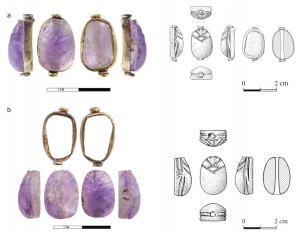 scarabs found in the southern Levant is provided, with a typological analysis and a tentative dating and origin of these pieces.
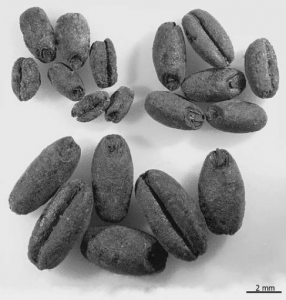 ca. 60,000-item plant collection from the recently exposed Late Bronze Age IIA palace at Tel Beth-Shemesh. Room L1505 in the palace—apparently a pantry due to its contents of foodstuffs and vessels for food preparation and consumption—contained eight deposits of carbonized crop plants. Deposits of almost pure grains and very low numbers of weed seeds were found, indicating that these stored food plants were ready to be used in food preparation. Of special interest is the presence of a sizeable amount of two rare pulses in Levantine archaeobotany—fenugreek (Trigonella foenum-graecum) and Cyprus vetch (Lathyrus ochrus)—only found in two other Bronze Age royal contexts: Tutankhamun’s tomb in Egypt and the Late Minoan II Unexplored Mansion in Knossos. Thus, in addition to attesting to the agricultural practices and culinary preferences of a Canaanite ruling court during the Amarna Age, this botanical assemblage also hints at prestigious royal gift exchanges of exotic food plants.
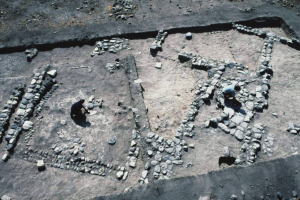 begun in the Early Bronze Age (EB) I, which ended in a severe conflagration. Apparently rebuilt at the beginning of EB II, the village remained a small site and technically non-urban throughout the period. Destroyed at the end of EB II, it was renewed in EB III, coinciding with the arrival of people bearing the Khirbet Kerak Ware ceramic tradition. This preliminary report includes new observations following recent studies of Tel Yaqush finds, including a new sequence of 14C dates from EB I to III (published in detail elsewhere). The excavation results summarized here reveal the unique role Tel Yaqush played during the shift to urbanism, and its contribution to our understanding of Early Bronze Age village society in the central Jordan Valley.
 amounts of these were adorned, and their decorations typically conform to a few canonized conventions. A small amount of the decorated Late Chalcolithic basalt bowls are further incised with unconventional, unique designs on their exteriors. These elaborately decorated basalt bowls stand in sharp contrast to the conventionally decorated ones, thus signifying their different roles. This article discusses their geographic distributions, frequencies, and characteristics, and offers further suggestions as to their position within the Late Chalcolithic symbolic and prestige item systems. The analysis reveals regional patterns—the elaborately decorated basalt bowls are constrained to south of the Yarkon River—suggesting that the function and symbolic value of these bowls were probably geographically restricted. Their limited distribution underlines the exclusivity of these elaborately decorated bowls during the Late Chalcolithic period.
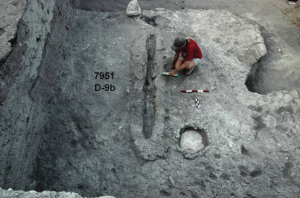 a monumental structure dated to the 14th century b.c.e. with unusual architectural features that could be either the residence of a high-ranking family or an administrative building. During the 13th century b.c.e., this building was replaced by a new structure containing a metalsmith’s workshop, inspired by Egyptian 19th Dynasty techniques, while later building phases belong to the final stages of the Late Bronze Age. No destruction layers were found, and the Late Bronze Age city was rebuilt and continued to thrive throughout the Iron Age I. Five Late Bronze Age plaque figurines, some of particular interest, are also described. An appendix discusses a rare funerary scarab of an Egyptian high official found in the 14th-century b.c.e. edifice.
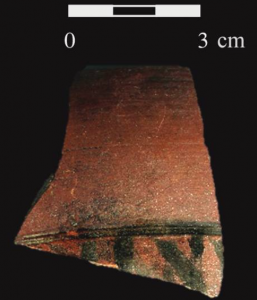 investigated over the last 40 years. In recent excavation campaigns, new evidence of the earliest phases of the city (500–50 b.c.e.) has been discovered, including the sherd treated here, among other inscribed pottery in Greek and Brāhmī.
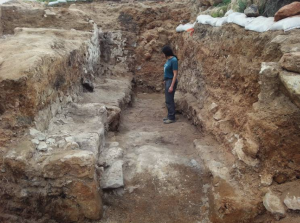 and sealed. This act was evident in the breakage of the altar’s horns and the placement of a latrine in the holy of holies. The available data suggests that the desecration of the shrine should be associated with Hezekiah’s cultic reform (2 Kgs 18:4).