FOA Webinar: James R. Strange on Dec. 2

FRIENDS OF ASOR WEBINARS

Synagogues as Jesus Knew Them

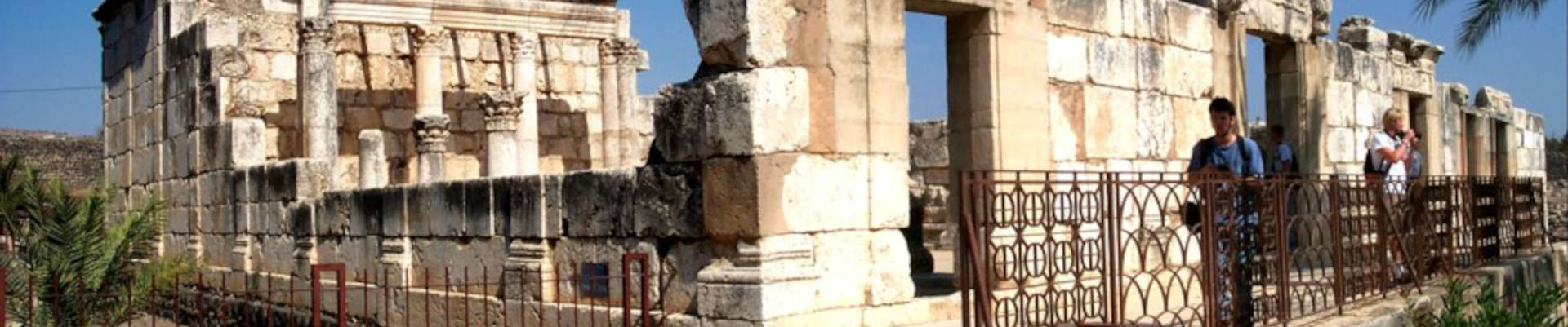
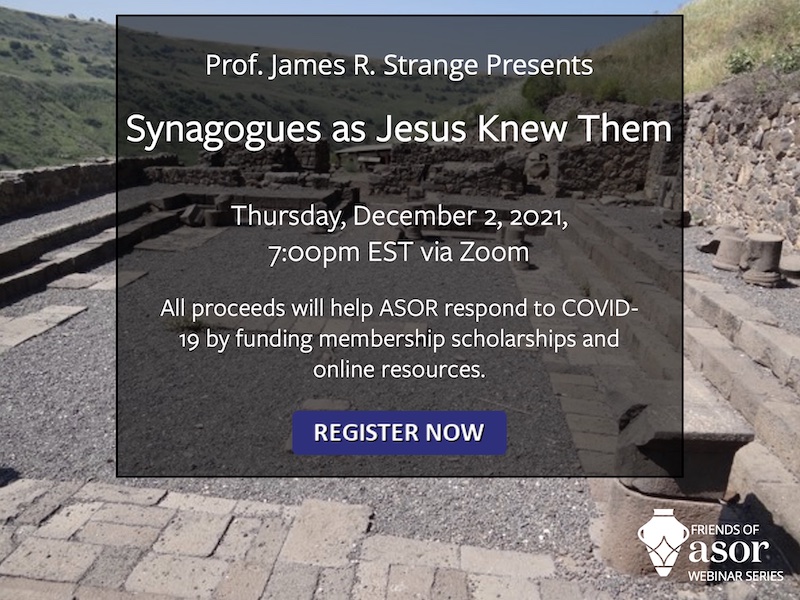
Friends of ASOR present the next webinar in our monthly series on December 2, at 7:00 pm EST, featuring Prof. James R. Strange. For decades, the accepted wisdom among scholars of the canonical gospels was that the “synagogues” that featured in Jesus’ ministry were not buildings but congregations. After all, “gathering” is the plainest meaning of the Greek word synagōgē. Furthermore, in stories in which Jesus taught and healed, and in which he experienced rejection in his hometown of Nazareth, nothing requires that he did these things in a building. Once first-century synagogue buildings started turning up in excavations in Judea, scholars began to accept that some Galilean villages might have included synagogue buildings, and excavations in Capernaum and Gamla appeared to confirm expectations. Then another dispute emerged: some argued that the Jewish synagogue had been a religious institution from its founding while others contended that, so long as the Jerusalem temple stood, synagogues in Palestine were used for secular gatherings. Therefore, these structures began to accommodate religious practices only after the temple was destroyed in 70 CE.

This webinar lecture will draw from literary texts, inscriptions, and archaeological remains to explore these debates. We will ask whether or not synagogue buildings existed in the Galilee during Jesus’ ministry, what happened in early synagogues, which sites have archaeological evidence for the earliest synagogues, and where we should expect to find more as we continue to dig. Join us for this deep dive into how these buildings played a role in Jewish society during Jesus’ lifetime. Dr. Strange will conclude his webinar with a live Q&A session.

James Riley Strange is Charles Jackson Granade and Elizabeth Donald Granade Professor in New Testament at Samford University’s Howard College of Arts and Sciences, where he teaches courses in New Testament and archaeology. He has been directing the Shikhin Excavation Project in Lower Galilee since 2012. Excavations in the village ruins have turned up remains of a ceramics and oil lamp industry and a synagogue that dates to the Roman period. Alongside David A. Fiensy, he is co-editor of the two-volume set, Galilee in the Late Second Temple and Mishnaic Periods (Fortress Press, 2014 and 2015), and he is the author of One Problem After Another: An Introduction to Archaeology, the Gospels, and Understanding Roman Galilee (Eerdmans, forthcoming in 2022).

ASOR Sustaining Members: $0 | ASOR Members: $5 | Public: $10

To receive your ASOR member discount, log into the online store. If you are new to ASOR, please click on the “New Visitor Registration” link to register your e-mail address and choose password for our online store. Once logged in, navigate to “Meeting and Event Registration” to register for the webinar and pay the fee. Each paid registrant will receive a confirmation e-mail when you pay for the webinar. If you do not receive this e-mail, then you are not registered. Please e-mail membership@asor.org with any questions or issues with registering.

You will be e-mailed the Zoom Webinar link in the week prior to the lecture on December 2, 2021. If you do not receive the link by the close of business on the Tuesday before the webinar, please e-mail membership@asor.org immediately. All webinars are recorded and all paid registrants will be sent a link to view the recording.

All proceeds from this lecture are used to fund scholarships for members impacted by COVID-19 as well as increasing ASOR’s online resources, which are free to the public.
WHY SPONSOR A WEBINAR?

Several levels of support from $50-$1,000 are available. Proceeds go towards membership scholarships and towards increasing ASOR’s virtual resources. Each sponsorship is tax-deductible and you can give your friends free registrations to a webinar!

Bronze Level ($50): up to 2 guest registrations
Silver Level ($100): up to 5 guest registrations
Gold Level ($500): up to 20 guest registrations
Platinum Level ($1,000): up to 50 guest registrations

After you sign up for a sponsorship online or over the phone, email the names and email addresses of your guests to Felice Herman at membership@asor.org, who will send your guests a confirmation and the Zoom link before the webinar.

WANT TO SAVE $5.00 ON THE NEXT WEBINAR?

Join ASOR as a member! Click here for more details about discounts for events and other benefits of membership. Memberships start at $40 for the year as an Associate Member.

Not ready to join yet? Become a Friend of ASOR for FREE!

Click here for more details about our online resources.

PAST WEBINARS

You can now purchase the link to the recording of any webinar. You can also purchase the bundle packages of all webinars from the 2020-2022 seasons. Please e-mail membership@asor.org for purchase details.

To see a printable pdf of the webinar titles from the 2020-2021 season, please click here. To see a printable pdf of the webinar titles from the 2021-2022 season, please click here.

Pricing:

Members: $6.00 per recording
Non-Members: $12.00 per recording
Bundle of 2020-2021 Webinars: $75.00
Bundle of 2021-2022 Webinars: $75.00
Bundle of 2020-2022 Webinars: $125.00

2021-2022 Season

A World at War: Protecting Cultural Heritage in Times of Conflict
Patty Gerstenblith (DePaul University), Lisa Ackerman (Columbus Citizens Foundation), Andrew Cohen (Government Professional and Cultural Heritage Expert) | May 12, 2022

Preserving Cultural Heritage in Hisban and Umm al-Jimal, Jordan
Øystein LaBianca (Andrews University), Elizabeth Osinga (Umm al-Jimal Archaeological Project), Darrell Rohl (Calvin University) | April 24, 2022

Back to the Field: Recent Discoveries & Summer Plans 2022
Lorenzo d’Alfonso (ISAW), Kathryn Grossman (NC State University), James R. Strange (Samford University) | April 3, 2022

Uncovering What is Nubian Beneath the Veneer of Egyptianness: Excavating the Archives
Debora Heard (University of Chicago) | March 20, 2022

Where Are They Now?: A Preview of 2022 ASOR-Affiliated Fieldwork Projects
Michael Given (University of Glasgow), Xenia-Paula Kyriakou (Florida Gulf Coast University), Stephen Batiuk (University of Toronto), Monique Roddy (Walla Walla University), Kent Bramlett (La Sierra University), Friedbert Ninow (La Sierra University), and Michael Hoff (University of Nebraska-Lincoln) | March 8, 2022

Excavations at Tel Gezer: A Personal Story
Sam Wolff (Tel Gezer Laboratory) | February 20, 2022

Tel Rehov: A Major Bronze and Iron Age City in the Jordan Valley
Amihai Mazar (Hebrew University of Jerusalem), Nava Panitz-Cohen ( Hebrew University of Jerusalem), Nota Kourou (Athens University), Naama Yahalom-Mack (Hebrew University of Jerusalem), Robert Mullins (Azusa Pacific University) | February 10, 2022

The Not-So-Innocents Abroad: The Beginnings of American Biblical Archaeology
Rachel Hallote (Samford University) | January 20, 2022

Synagogues as Jesus Knew Them
James R. Strange (Samford University) | December 2, 2021

Under Jerusalem: The Buried History of the World’s Most Contested City
Andrew Lawler | November 4, 2021

Jesus and Jerusalem on TV: How Do Bible Documentaries Get Made?
Robert Cargill (University of Iowa) | October 17, 2021

Digging the Divine?: Judahite Pillar Figurines and the Archaeology of Israelite Religion
Erin Darby (University of Tennessee) | October 7, 2021

David, Solomon, and Rehoboam’s Kingdom—The Archaeological Evidence
Yosef Garfinkel (Hebrew University of Jerusalem) | September 19, 2021

From Standing Stones to Sacred Emptiness: Textual and Visual Portrayals of Israel’s God
Theodore Lewis (Johns Hopkins University) | August 29, 2021

2020-2021 Season

Making May Matter: Webinarathon to Endow Diversity
Multiple Speakers | May 21-23, 2021

Archaeogaming: Why Video Games Deserve Their Own Archaeology
Tine Rassalle (University of North Carolina at Chapel Hill), Shannon Martino (Morton College), Matthew Winter (University of Arizona), Michael Zimmerman (Rhode Island) | April 18, 2021

How the Bible Became a Book
William Schniedewind (UCLA) | March 21, 2021

The Mysteries of Mithras in Caesarea: Exploring the Cult’s Rites and Remains
Jane DeRose Evans (Temple University), Alexandra Ratzlaff (Brandeis University) | March 11, 2021

Archaeology and the Hidden Religious Culture of Israelite Women
Carol Meyers (Duke University) | February 21, 2021

Meet the Directors—Fundraiser to Support ASOR’s Affiliated Overseas Research Centers
Matthew J. Adams (AIAR), Pearce Paul Creasman (ACOR), Lindy Crewe (CAARI) | February 11, 2021

Early Synagogues, Jesus, and Galilee—A Jewish Perspective
Eric Meyers (Duke University) | December 13, 2020

Home Sweet Home: Ancient Israelite Households in Context
Cynthia Shafer-Elliott (William Jessup University) | October 18, 2020

Priestesses in the Days of Solomon and Ahab
Susan Ackerman (Dartmouth College) | September 13, 2020

Digging Deeper: How Archaeology Works
Eric H. Cline (The George Washington University) | August 9, 2020

FOA Webinar: Andrew Lawler on Nov. 4

FRIENDS OF ASOR WEBINARS

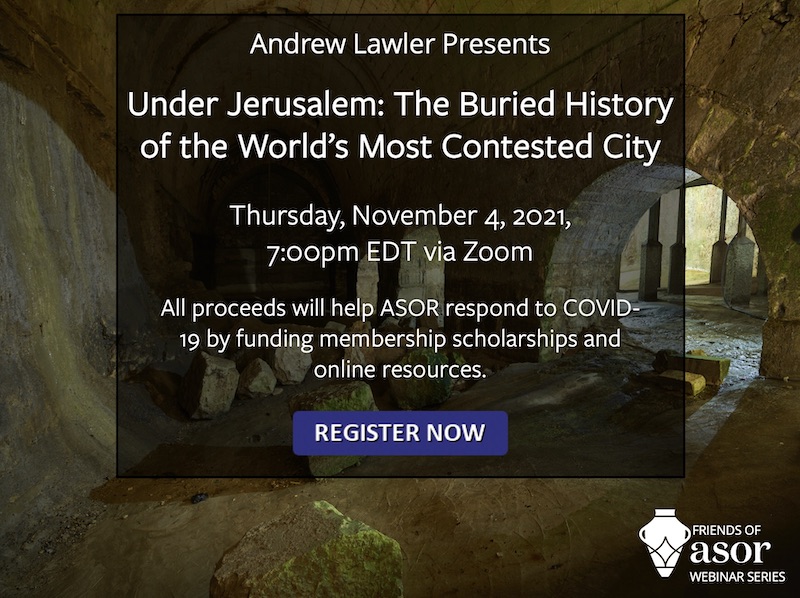
Under Jerusalem: The Buried History of the World’s Most Contested City


Click here to pre-order Andrew Lawler’s new book today! Register and you could win a free copy of the book!

Friends of ASOR present the next webinar in our monthly series on November 4, at 7:00 pm EDT, featuring Andrew Lawler. Sacred to three faiths and revered by more than half the people on the planet, Jerusalem conjures up powerful images of the celestial. Yet beneath its narrow alleys and holy places, the ancient city conceals a labyrinthine, three-dimensional time capsule recording five millennia of bustling prosperity, brutal war, and repeated religious innovation that altered the course of human history.

Since the days when Abraham Lincoln was in the White House, adventurers, archaeologists, and religious zealots have flocked here to hunt for buried treasure, unearth sacred artifacts, and find proof of the Bible’s veracity. That digging to reveal the past continues today—and, in so doing, continues to alter the city’s future.

Journalist Andrew Lawler will take us on a journey through time and beneath Jerusalem, where religion, politics, and science have often combined with exciting, controversial, and, occasionally, violent results. Andrew will conclude his webinar with a live Q&A session.


Andrew Lawler is an American science writer and author of three books. As a journalist, he has  published hundreds of newspaper and magazine articles in more than two dozen countries. His byline has appeared in The New York Times, The Washington Post, National Geographic, Smithsonian, and many others. He is contributing writer for Science and contributing editor for Archaeology. His new book, Under Jerusalem: The Buried History of the World’s Most Contested City, will be published November 2 by Doubleday Publishing. He also is author of The Secret Token: Myth, Obsession, and the Search for the Lost Colony of Roanoke, a national bestseller, and Why Did the Chicken Cross the World?: The Epic Saga of the Bird that Powers Civilization. His work has appeared several times in The Best of Science and Nature Writing.

ASOR Sustaining Members: $0 | ASOR Members: $5 | Public: $10

To receive your ASOR member discount, log into the online store. If you are new to ASOR, please click on the “New Visitor Registration” link to register your e-mail address and choose password for our online store. Once logged in, navigate to “Meeting and Event Registration” to register for the webinar and pay the fee. Each paid registrant will receive a confirmation e-mail when you pay for the webinar. If you do not receive this e-mail, then you are not registered. Please e-mail membership@asor.org with any questions or issues with registering.

You will be e-mailed the Zoom Webinar link in the week prior to the lecture on November 4, 2021. If you do not receive the link by the close of business on the Monday before the webinar, please e-mail membership@asor.org immediately. All webinars are recorded and all paid registrants will be sent a link to view the recording.

All proceeds from this lecture are used to fund scholarships for members impacted by COVID-19 as well as increasing ASOR’s online resources, which are free to the public.

WHY SPONSOR A WEBINAR?

Several levels of support from $50-$1,000 are available. Proceeds go towards membership scholarships and towards increasing ASOR’s virtual resources. Each sponsorship is tax-deductible and you can give your friends free registrations to a webinar!

Bronze Level ($50): up to 2 guest registrations
Silver Level ($100): up to 5 guest registrations
Gold Level ($500): up to 20 guest registrations
Platinum Level ($1,000): up to 50 guest registrations

After you sign up for a sponsorship online or over the phone, email the names and email addresses of your guests to Felice Herman at membership@asor.org, who will send your guests a confirmation and the Zoom link before the webinar.

WANT TO SAVE $5.00 ON THE NEXT WEBINAR?

Join ASOR as a member! Click here for more details about discounts for events and other benefits of membership. Memberships start at $40 for the year as an Associate Member.

Not ready to join yet? Become a Friend of ASOR for FREE!

Click here for more details about our online resources.


PAST WEBINARS

You can now purchase the link to the recording of any webinar. You can also purchase the bundle packages of all webinars from the 2020-2022 seasons. Please e-mail membership@asor.org for purchase details.

To see a printable pdf of the webinar titles from the 2020-2021 season, please click here. To see a printable pdf of the webinar titles from the 2021-2022 season, please click here.

Pricing:

Members: $6.00 per recording
Non-Members: $12.00 per recording
Bundle of 2020-2021 Webinars: $75.00
Bundle of 2021-2022 Webinars: $75.00
Bundle of 2020-2022 Webinars: $125.00

2021-2022 Season

A World at War: Protecting Cultural Heritage in Times of Conflict
Patty Gerstenblith (DePaul University), Lisa Ackerman (Columbus Citizens Foundation), Andrew Cohen (Government Professional and Cultural Heritage Expert) | May 12, 2022

Preserving Cultural Heritage in Hisban and Umm al-Jimal, Jordan
Øystein LaBianca (Andrews University), Elizabeth Osinga (Umm al-Jimal Archaeological Project), Darrell Rohl (Calvin University) | April 24, 2022

Back to the Field: Recent Discoveries & Summer Plans 2022
Lorenzo d’Alfonso (ISAW), Kathryn Grossman (NC State University), James R. Strange (Samford University) | April 3, 2022

Uncovering What is Nubian Beneath the Veneer of Egyptianness: Excavating the Archives
Debora Heard (University of Chicago) | March 20, 2022

Where Are They Now?: A Preview of 2022 ASOR-Affiliated Fieldwork Projects
Michael Given (University of Glasgow), Xenia-Paula Kyriakou (Florida Gulf Coast University), Stephen Batiuk (University of Toronto), Monique Roddy (Walla Walla University), Kent Bramlett (La Sierra University), Friedbert Ninow (La Sierra University), and Michael Hoff (University of Nebraska-Lincoln) | March 8, 2022

Excavations at Tel Gezer: A Personal Story
Sam Wolff (Tel Gezer Laboratory) | February 20, 2022

Tel Rehov: A Major Bronze and Iron Age City in the Jordan Valley
Amihai Mazar (Hebrew University of Jerusalem), Nava Panitz-Cohen ( Hebrew University of Jerusalem), Nota Kourou (Athens University), Naama Yahalom-Mack (Hebrew University of Jerusalem), Robert Mullins (Azusa Pacific University) | February 10, 2022

The Not-So-Innocents Abroad: The Beginnings of American Biblical Archaeology
Rachel Hallote (Samford University) | January 20, 2022

Synagogues as Jesus Knew Them
James R. Strange (Samford University) | December 2, 2021

Under Jerusalem: The Buried History of the World’s Most Contested City
Andrew Lawler | November 4, 2021

Jesus and Jerusalem on TV: How Do Bible Documentaries Get Made?
Robert Cargill (University of Iowa) | October 17, 2021

Digging the Divine?: Judahite Pillar Figurines and the Archaeology of Israelite Religion
Erin Darby (University of Tennessee) | October 7, 2021

David, Solomon, and Rehoboam’s Kingdom—The Archaeological Evidence
Yosef Garfinkel (Hebrew University of Jerusalem) | September 19, 2021

From Standing Stones to Sacred Emptiness: Textual and Visual Portrayals of Israel’s God
Theodore Lewis (Johns Hopkins University) | August 29, 2021

2020-2021 Season

Making May Matter: Webinarathon to Endow Diversity
Multiple Speakers | May 21-23, 2021

Archaeogaming: Why Video Games Deserve Their Own Archaeology
Tine Rassalle (University of North Carolina at Chapel Hill), Shannon Martino (Morton College), Matthew Winter (University of Arizona), Michael Zimmerman (Rhode Island) | April 18, 2021

How the Bible Became a Book
William Schniedewind (UCLA) | March 21, 2021

The Mysteries of Mithras in Caesarea: Exploring the Cult’s Rites and Remains
Jane DeRose Evans (Temple University), Alexandra Ratzlaff (Brandeis University) | March 11, 2021

Archaeology and the Hidden Religious Culture of Israelite Women
Carol Meyers (Duke University) | February 21, 2021

Meet the Directors—Fundraiser to Support ASOR’s Affiliated Overseas Research Centers
Matthew J. Adams (AIAR), Pearce Paul Creasman (ACOR), Lindy Crewe (CAARI) | February 11, 2021

Early Synagogues, Jesus, and Galilee—A Jewish Perspective
Eric Meyers (Duke University) | December 13, 2020

Home Sweet Home: Ancient Israelite Households in Context
Cynthia Shafer-Elliott (William Jessup University) | October 18, 2020

Priestesses in the Days of Solomon and Ahab
Susan Ackerman (Dartmouth College) | September 13, 2020

Digging Deeper: How Archaeology Works
Eric H. Cline (The George Washington University) | August 9, 2020

Nominees for ASOR Board Elections

2021 Nominees for ASOR Board Elections

The ASOR Trustee Nominations Committee has selected four highly qualified members to stand for election for four open positions on the Board of Trustees. The Board sets the direction for ASOR and provides oversight for our organization. Among other responsibilities, members of the Board agree to attend two meetings each year, to participate thoughtfully in the governance process, and to contribute financially to ASOR.

There are two candidates running for two openings as Member-elected Trustees for 3-year terms (Margaret Cohen and Jane DeRose Evans). There are two candidates for two openings as Institutionally-elected Trustees for 3-year terms (Erin Darby and Lynn Swartz Dodd). All candidates are running unopposed. All ASOR members are eligible to vote in the Member-elected Trustee Election, while only Institutional Representatives of the 60 ASOR-member schools may vote in the Institutionally-elected Trustee Election.

ASOR will conduct the elections by online ballot, and all members and Institutional Representatives will receive the appropriate ballot(s) via email on October 20, 2021. We will send out two reminders, and all ballots must be completed by 12:00 PM Eastern Time on Friday, November 12. If you have difficulties completing the online ballot (once they are distributed), please contact Marta Ostovich at programs@asor.org.

Nominees for Membership-elected Trustees
(two to be elected)

 
Margaret Cohen

Margaret Cohen’s academic training is in Hebrew Bible, and her archaeological training comes from more than twenty years of excavations in Israel, Jordan, and Egypt. She is now wrapping up nearly eight years living on the campus of The Albright Institute in Jerusalem where, in pre-COVID times, she was an active participant in the local scholarly community exchange. Prior to her time in Jerusalem, Margaret taught in both large research and small liberal arts settings and has a deep appreciation for and interest in the many forms of the student experience. Her current research focuses on foodways, how food power was wielded in the biblical world, and how some modern-day food movements are informed by ancient texts and practices.

Mission Statement: As we continue to experience uncertainty and change on a global scale, both steadiness and agility are required for ASOR to flourish, to contribute its expertise to the discipline, and to promote its relevancy both in academic and non-academic communities. This may mean altering old models that can feel comfortable, but are not necessarily as productive as they once were, such as imagining future possibilities for scholarly meetings, developing new kinds of venues for publication and exchange of ideas, and embracing innovative programs appearing elsewhere in academia: small, virtual workshops; opportunities reserved for non-TT scholars; social and educational opportunities for members of the general public; the use of virtual tools to connect with future scholars, such as high-school seniors thinking about college or college students considering majors. Driven by its membership, ASOR must constantly adapt to the, at times, divergent needs of those members. Those working to make their mark, those navigating life within their academic positions as well as outside the workplace, and those with hard-won experience that can better the journey for others, all must succeed for the organization to succeed. I am honored to be asked to stand for election to the dedicated group already doing this work, striving to make future-ASOR meaningful for us all.


Jane DeRose Evans

Jane DeRose Evans is Professor and Chair of Art History at Temple University. She specializes in the archaeology of the Roman provinces and especially in ancient numismatics. She is a Fellow of the American Numismatic Society and a member of the Royal Numismatic Society. After excavating for many years in France, she is now project numismatist for the Harvard/Cornell Excavations in Sardis and the George Washington University excavations at Bir Madhkur (Jordan). Recently, she brought to publication The Mithraeum at Caesarea Maritima (ASOR Press) and is completing the final publication on the U-Shaped Building at Caesarea.

Mission Statement: ASOR has been an important part of my scholarly life since graduate school, as a place to find out about excavations and new ways of thinking about the cultural history of the southern Levant and Anatolia. More recently, I have been an active member with the women of ASOR, Chair of the Cultural Heritage Committee, and member of the Executive Committee. I am proud to see ASOR tackle important questions of cultural heritage and ethical responses to threats to the region’s archaeological heritage, as well as undertaking initiatives to extend our diversity and equity footprint. We must retain our valuable mission to bring a greater understanding of our past to a wider audience while we continue to focus our attention on the ethical issues that arise as we seek partnerships with diverse audiences here in North America and overseas.

Nominees for Institutionally-elected Trustees
(two to be elected)

 
Erin Darby

Erin Darby is an associate professor of Religious Studies at the University of Tennessee and the UT Faculty Director of Undergraduate Research and Fellowships. She is an expert in the Hebrew Bible, archaeology, and ancient Near Eastern history and literature. At the University of Tennessee, she is one of the founding members of the Partnership for the Academic Study of Early Judaism, the Knoxville ArabFest cultural festival, the UT Archaeology Day outreach event, and the Tennessee Initiative for Middle East Studies. She leads the Department of Religious Studies diversity action committee, coordinates religious diversity professional development opportunities on the UT campus, and is the outgoing chair of the Chancellor’s Council for Diversity and Inclusion. Darby is also the co-director of the ASOR-affiliated ‘Ayn Gharandal Archaeological Project in southern Jordan, where she is excavating a Nabataean-Islamic period site and leading the UT Dig Jordan study abroad program.

Mission Statement: I have been an active ASOR member since 2008 and have had the privilege of serving in a variety of ways. I was the co-chair of the Junior Scholars Committee (now ‘Early Career Scholars’) for seven years, overseeing its transition to a standing committee and representing the committee on the Chairs Coordinating Council. In this capacity, I also collaborated with the Ethics Working Group and the Initiative on the Status of Women. I have served as the program chair for the Archaeology of the Near East: Bronze and Iron Ages and as co-chair for a number of member-organized sessions. Most recently, I served on the ASOR Ad Hoc Committee for the Location of the Annual Meeting and have served as the chair of the ASOR Diversity, Equity, and Inclusion Taskforce. I was honored to receive an ASOR Membership Service Award in 2017. I have been the ASOR institutional representative for the University of Tennessee since encouraging the university to join ASOR in 2014.

Serving on the Board of Trustees is a way for me to demonstrate my gratitude for how central ASOR has been in my professional life and in the lives of my students. My work with ASOR and with university administration has impressed upon me the importance of supporting ASOR in this time of transition in higher education. Alongside all of our current initiatives, I am particularly interested in thinking creatively about the value we bring to institutional members, ways we can articulate that value to institutions, and how we can maximize our connection to students in their classrooms and through ASOR-affiliated field schools. The challenges that are affecting higher education will certainly have an impact on scholarly societies like ASOR, but I believe that the type of learning encouraged through our programs is unique in the field of higher education and has the potential to yield new development initiatives.


Lynn Swartz Dodd

Lynn Swartz Dodd is Associate Professor of the Practice of Religion at the University of Southern California Dornsife College of Letters, Arts and Sciences. There, she has served as the Director of the Interdisciplinary Archaeology Undergraduate Major and the Director of Undergraduate Studies in Religion. She was also designated a USC Dornsife Distinguished Faculty Fellow.

Dodd’s research centers on archaeology and politics and ancient innovation and social change, particularly the ways that beliefs about the world figure in social change. As Curator of USC’s Archaeology Research Center, she is also engaged in technical material studies, excavation publication projects, and research involving the use of lasers and new imaging techniques in archaeological research and conservation. She is a staff member of the Amuq Valley Research Project Survey (Turkey), the Kenan Tepe Excavations (Tigris River, Turkey), and the Tell al-Judaidah Publication Project (Turkey), as well as the Native American Sacred Landscapes Project (California). Dodd is in addition the co-organizer of the Israeli Palestinian Archaeology Working Group.

Mission Statement: During my term serving as Secretary of the Board of Trustees and Chair of the Ad Hoc Ethics Working Group, I came to understand the critical importance of ASOR members’ perspectives about professional responsibility in all areas of research, publication, and teaching. I support ASOR’s on-going efforts to specify best practices that support safety and respect for all participants in every environment.

I applaud ASOR’s recent decision to open all benefits of membership, including scholarships, to all members regardless of their home location. As an Institutional Representative to the ASOR Board of Trustees, I will work to increase the visible, reciprocal benefits both for institutional members and for ASOR. Also, I will contribute to reimagining institutional membership in ways that enable diverse forms of support for ASOR and its members worldwide. I will encourage ASOR to pursue initiatives that support relevance, diversity, and expanded professional opportunities for ASOR members, including new partnerships with non-profits and other organizations. I affirm ASOR’s tangible efforts to support heritage preservation, documentation and rebuilding in the regions where ASOR members work as reflections of our broad vision of scholarly responsibility and relevance. I will continue to support ASOR personally, and as Chair of the Development Committee, am working to identify others who will support ASOR, both financially and in other ways, so that additional resources can be offered to members who participate in research into, and public understanding of, the history and cultures of the Near East and wider Mediterranean, from the earliest times.

Stipend Report: Loren Clark

7000 Miles Away: Geoarchaeology and Landscape Research in the Middle of a Pandemic

Loren Clark,  2021 Eric & Carol Meyers Summer Stipend Recipient

It has been no small feat, as all of us in archaeology know, to continue archaeological research and collaboration during the COVID-19 pandemic. With the aim of keeping everyone safe and healthy, most fieldwork and travel has come to a halt. For those of us who work outside of our home countries, it has been even more difficult to plan for the future of our research. For those of us conducting research as part of the UC San Diego and the University of Haifa collaboration, this has meant shifting our focus to the archive of sediment cores that were shipped to our lab in San Diego from the other half of our team in Haifa. In-field collection and meetings became Zoom calls, and planning sessions were discussed with maps on a shared screen. The 10hr time difference had our breakfast coffees in San Diego shared with Israeli dinner. Through the hard work of our directors and each team member, we were able to continue a portion of the research that we were conducting pre-pandemic.

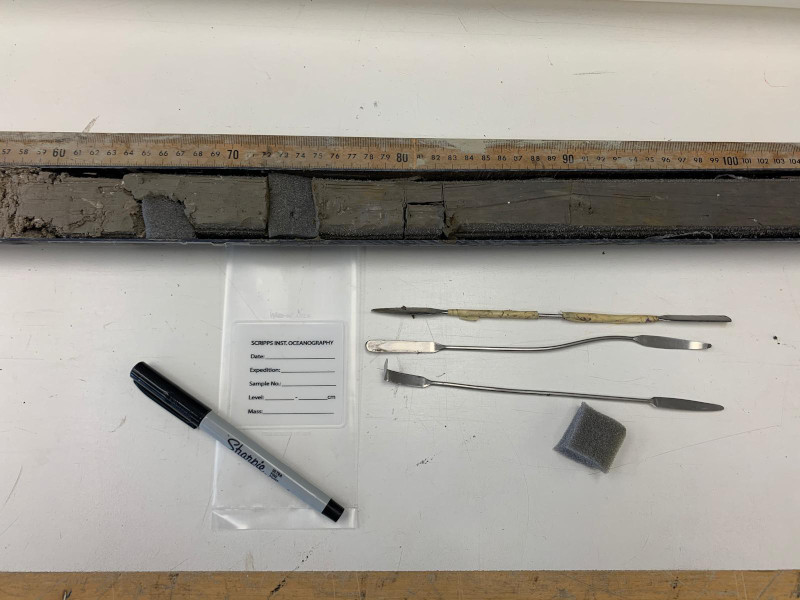
Fellow graduate researcher on this core, Kendall Mahoney, works in the lab amid COVID safety protocols to collect samples for Carbon-14 dating and stable isotope analysis.

These sediment cores contain a high-resolution dataset of depositional processes and environmental change along the Carmel Coast during the Holocene. The specific core that was funded through this stipend is located in the northern part of the Kebara marsh in NW Israel. The analysis of the core in 2020 allowed for preliminary conclusions to be made about cycles of drying and wetting throughout the life of the wetland. Laminations of organic-rich layers juxtaposed against paleosol and sandy layers are present throughout the core, which have allowed us to posit questions related to regional and local climate change.

Core sections were sampled and labeled to be washed and sorted for various analyses.


Once washed and sieved, samples are picked and separated under a microscope to identify the makeup of each coarse fraction.

The goal this summer was to isolate specific proxies that serve as indicators of climate, environmental, and landscape change for the area between the Carmel Ridge and the coast. Specifically, we decided to focus on pyrite as it can be an indicator of changing salinity in waterlogged areas. Understanding the environmental change in the area is crucial in tracking the wetland as a resource for communities from the Neolithic – Iron Age. The Carmel Coast is known for the intense concentration of archaeological sites from various periods of prehistory, and the data that we have compiled will only add to the ever-growing picture of life along this critical landscape. The data from this project is still being analyzed by multiple researchers, including myself, and will be presented at the ASOR 2021 Virtual Annual Meeting in December. It has been an honor to work under this funding from ASOR to continue our research in this remote world. As safe travel opens up for international research, we plan to continue adding to and analyzing the existing datasets along the Carmel Coast.

Loren Clark is a 3rd year PhD student at the University of California, San Diego in the Levantine Archaeology Lab, directed by Dr. Thomas Levy. She is also a scientific diver for the Scripps Center for Marine Archaeology which focuses on submerged archaeology in the Eastern Mediterranean.

To keep up with this project (and many more) being conducted through the collaboration between UCSD and the University of Haifa and being funded by the Koret Foundation, please see our Facebook page: https://www.facebook.com/SCMAKoretProject

During the summer of 2021, ASOR supported 27 undergraduate and graduate students through the Summer Stipend Program. These students undertook non-fieldwork archaeological research projects led by ASOR-affiliated project directors. They also took part in monthly cohort group meetings hosted via zoom. Read a summary of these cohort meetings here.

Stay tuned for more updates from the 2021 Summer Stipend recipients!

Summer Stipend Cohort Meetings

Summer Stipend Cohort Meetings

And just like that, Summer is a wrap and Fall is well underway! But before the first leaves fall, let’s take a look back at what happened during ASOR’s inaugural Summer Stipend program cohort meetings, hosted by Marta Ostovich (ASOR) and Sydney Pickens (ASOR/AITC). The monthly cohort meetings were designed to encourage student connections and promote professional development. Participants from Lebanon to California joined us over the course of the summer to participate in these lively, informative conversations via Zoom: 

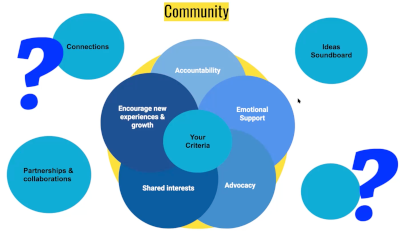
  • Community, Mentorship, and Social Capital. Our first cohort meeting centered around cultivating intentional relationships, both professional and personal. We asked, who are you currently in a community with? We encouraged participants to evaluate their present communities, identify need gaps, and develop a criteria for building relationships that help push them into purpose. We prioritized community over network to encourage genuine, human to human connections that foster more sustainable relationships. This is particularly relevant for the fields of Anthropology and Archaeology, where the work is first and foremost situated within the human experience.
  • Self Advocacy. Our second gathering featured a discussion on finding, making space for, and using your voice in academia. The conversation focused on two phenomena particularly prominent among women and people of color: imposter syndrome and code switching. Imposter syndrome causes people to question their abilities, instilling a fear that they will be exposed as a fraud. Code switching is a strategic shift between language and/or vernacular to communicate more effectively with a given audience. However, the switch is often unidirectional and perpetuates a culture of assimilation to dominant power structures. We explored how these phenomena are fueled and perpetuated by systemic bias, and discussed how more inclusive practices and supportive academic environments can reduce their prevalence. Throughout the conversation, facilitators and participants exchanged tips and tricks for showing up in academia (and elsewhere) both authentically and confidently.
  • Academia Reimagined/Alternative Futures. Our third meeting featured a panel of speakers who shared their experiences and advice on the academic world: Sarah Kielt Costello (University of Houston-Clear Lake), Jay Crisostomo (University of Michigan), Kate Sheeler (Cathedral High School), and Julia Troche (Missouri State University). Many of the Summer Stipend cohort members are interested in pursuing futures in education and all of our guests work in education, though in a variety of settings. They spoke about the experiences that shaped their careers/career paths: from graduate school to navigating the job market. We discussed what an alternative future in archaeology looks like, how to balance research and professional goals with personal well-being, and how the culture of academia is changing.
  • Future Fieldwork. For this meeting, our cohort group was joined by Debra Foran (Wilfrid Laurier University), Rachel Hallotte (SUNY-Purchase), Morag Kersel (DePaul University), and Tom Roby (Getty Conservation Institute) for a conversation on the ins and outs of archaeological fieldwork. This was an interesting conversation since fieldwork has been on hold due to the COVID-19 pandemic, and the Summer Stipend program was focused on non-fieldwork research. This pause in fieldwork offers time to reflect and be thoughtful about getting (or staying) involved with projects in the future. Our guest speakers offered perspectives from their own field projects and experiences, and the cohort students shared what they were looking for in fieldwork. Through this exchange, we identified important considerations for deciding what projects to join. Topics ranged from the professional (how to pick your first field project, how to stay involved long-term with a project, skills that you can gain from fieldwork, etc.) to the very practical (level of support, physical/mental effort required, school credit, project infrastructure, cost, living situations, etc.). 

A huge thank you to all of our guest speakers who joined us for these meetings to share their experiences and chat with the cohort!

As part of their Summer Stipends, each cohort member submitted a report on their research and the first report is now available on the ASOR website. Read Shannon Burton’s report on preparing photographs for exhibits in a planned Community Heritage Center in El-Kurru, Sudan here. Stay tuned for more reports from our Summer Stipend recipients on their research in News@ASOR this fall!

To close out the Summer Stipend program, students are being paired with an ASOR mentor. The goal is to give students a chance to connect with someone in their field who can encourage, support, and guide them along their career paths, and/or provide advice in a specific area (publishing, applying to grad school, etc.). Mentoring is also a major part of ASOR’s Diversity, Equity, and Inclusion initiatives. If you’re interested in mentoring students, please take a moment to fill out our mentor survey. Thank you to everyone who has already signed up to be a mentor! You’ll be hearing from us with more information about the mentorship program in the upcoming weeks.

2022 Annual Meeting Student Paper Award

2022 ANNUAL MEETING STUDENT PAPER AWARD

ASOR is accepting applications for the 2022 Student Paper Award. This award is conferred upon the author(s) of a paper presented during either component (virtual, Oct. 19-23 or in-person/Boston, Nov. 16-19) of the Annual Meeting that conveys the results of a study about ancient Near Eastern and wider Mediterranean societies in a clear, understandable and convincing fashion. The first author and presenter of the paper must be a registered student at the time of presentation in order to be eligible for consideration for this award. Students will need to complete the following steps to be considered for the award. Applications are due November 7.


Students and Early Career Scholars at the 2019 Annual Meeting

1.  Please complete this Google Form in order to apply for the Student Paper Award.

2.  Submit your pre-recorded paper presentation (mp4 video, 20 minutes maximum) by November 7 to Jared Koller (jaredkoller@asor.org) using a DropBox link or other file sharing method. Note: If you are presenting as part of the virtual component in October and your presentation is uploaded to ASOR’s Virtual Meeting Schedule, you may skip step 2 (but the Google Form application is still required).

Applications and paper presentations are both due by November 7.

Please note that this award is independent of the Sean Dever Memorial Prize, which is conferred by the W.F. Albright Institute of Archaeological Research. To learn more about Awards presented at the Annual Meeting, please visit the Honors and Awards page. For questions and inquiries please email info@asor.org.

FOA Webinar: Bob Cargill on Oct. 17

FRIENDS OF ASOR WEBINARS

Jesus and Jerusalem on TV: How Do Bible Documentaries Get Made?

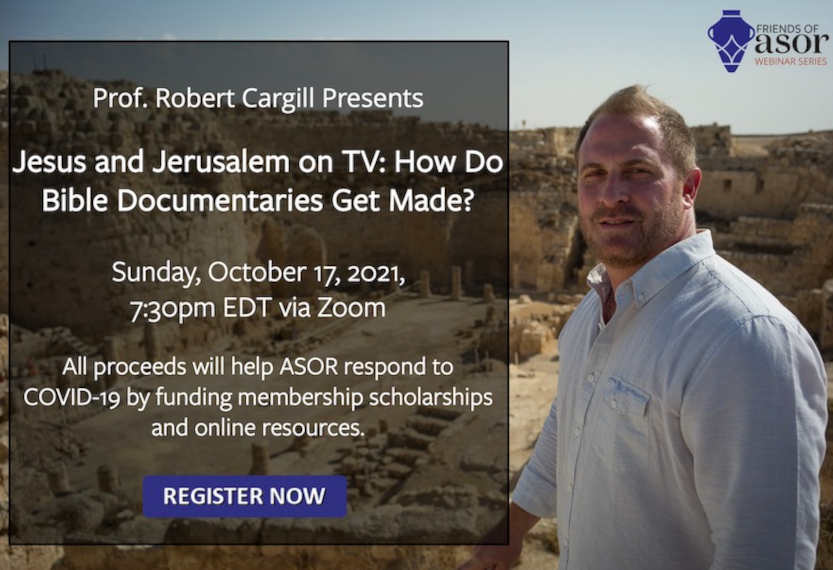
Friends of ASOR present the next webinar in our monthly series on October 17, at 7:30 pm EDT, featuring Prof. Robert Cargill. Have you ever wondered how TV Bible documentaries like those about Jesus and Jerusalem are developed? Who researches and writes them? How do the experts get chosen? How are the reenactments created? And who decides what makes the final cut? (And why did they skip the most important part?!)

This webinar explores how various Bible-related TV documentaries are made, and what goes into making a quality, responsible program about the popular subjects of Jesus and Jerusalem. We will also delve into how some producers sensationalize religion and the holy city (Jerusalem) in an effort to increase ratings, but at the expense of historical accuracy and education. An expert in this area, Dr. Cargill (University of Iowa), has appeared in over 4 dozen documentaries and has consulted on several major documentary series on CNN, History, and National Geographic.

Join us to get a behind-the-scenes tour of the nitty-gritty of making TV documentaries, followed by an “Ask Me Anything” question and answer period with Dr. Cargill.

Dr. Robert R. Cargill (PhD 2008 UCLA, Near Eastern Languages and Cultures) is Associate Professor of Classics and Religious Studies at the University of Iowa and Editor of the new Bible & Archaeology website. He teaches biblical studies, Second Temple Judaism, archaeology, and ancient languages including Biblical Hebrew, Aramaic, Greek, and Syriac. His recent books include Melchizedek, King of Sodom: How Scribes Invented the Biblical Priest-King (Oxford University Press, 2019) and The Cities That Built the Bible (HarperOne, 2016).

A specialist in public biblical scholarship, you can see him regularly on CNN, History, Discovery, and National Geographic, where he contributes and consults on shows like National Geographic’s “Writing the Dead Sea Scrolls,” History’s “Jesus: His Life,” CNN’s “Finding Jesus,” History’s “Bible Secrets Revealed,” and most recently, CNN’s “Jerusalem: City of Faith and Fury.” He has excavated at Banias, Omrit, Haẓor, and most recently at Azekah with Tel Aviv University.

ASOR Sustaining Members: $0 | ASOR Members: $5 | Public: $10

To receive your ASOR member discount, log into the online store. If you are new to ASOR, please click on the “New Visitor Registration” link to register your e-mail address and choose password for our online store. Once logged in, navigate to “Meeting and Event Registration” to register for the webinar and pay the fee. Each paid registrant will receive a confirmation e-mail when you pay for the webinar. If you do not receive this e-mail, then you are not registered. Please e-mail membership@asor.org with any questions or issues with registering.

You will be e-mailed the Zoom Webinar link in the week prior to the lecture on October 17, 2021. If you do not receive the link by the close of business on the Thursday before the webinar, please e-mail membership@asor.org immediately. All webinars are recorded and all paid registrants will be sent a link to view the recording.

All proceeds from this lecture are used to fund scholarships for members impacted by COVID-19 as well as increasing ASOR’s online resources, which are free to the public.

WHY SPONSOR A WEBINAR?

Several levels of support from $50-$1,000 are available. Proceeds go towards membership scholarships and towards increasing ASOR’s virtual resources. Each sponsorship is tax-deductible and you can give your friends free registrations to a webinar!

Bronze Level ($50): up to 2 guest registrations
Silver Level ($100): up to 5 guest registrations
Gold Level ($500): up to 20 guest registrations
Platinum Level ($1,000): up to 50 guest registrations

After you sign up for a sponsorship online or over the phone, email the names and email addresses of your guests to Felice Herman at membership@asor.org, who will send your guests a confirmation and the Zoom link before the webinar.

WANT TO SAVE $5.00 ON THE NEXT WEBINAR?

Join ASOR as a member! Click here for more details about discounts for events and other benefits of membership. Memberships start at $40 for the year as an Associate Member.

Not ready to join yet? Become a Friend of ASOR for FREE!

Click here for more details about our online resources.


PAST WEBINARS

You can now purchase the link to the recording of any webinar. You can also purchase the bundle packages of all webinars from the 2020-2022 seasons. Please e-mail membership@asor.org for purchase details.

To see a printable pdf of the webinar titles from the 2020-2021 season, please click here. To see a printable pdf of the webinar titles from the 2021-2022 season, please click here.

Pricing:

Members: $6.00 per recording
Non-Members: $12.00 per recording
Bundle of 2020-2021 Webinars: $75.00
Bundle of 2021-2022 Webinars: $75.00
Bundle of 2020-2022 Webinars: $125.00

2021-2022 Season

A World at War: Protecting Cultural Heritage in Times of Conflict
Patty Gerstenblith (DePaul University), Lisa Ackerman (Columbus Citizens Foundation), Andrew Cohen (Government Professional and Cultural Heritage Expert) | May 12, 2022

Preserving Cultural Heritage in Hisban and Umm al-Jimal, Jordan
Øystein LaBianca (Andrews University), Elizabeth Osinga (Umm al-Jimal Archaeological Project), Darrell Rohl (Calvin University) | April 24, 2022

Back to the Field: Recent Discoveries & Summer Plans 2022
Lorenzo d’Alfonso (ISAW), Kathryn Grossman (NC State University), James R. Strange (Samford University) | April 3, 2022

Uncovering What is Nubian Beneath the Veneer of Egyptianness: Excavating the Archives
Debora Heard (University of Chicago) | March 20, 2022

Where Are They Now?: A Preview of 2022 ASOR-Affiliated Fieldwork Projects
Michael Given (University of Glasgow), Xenia-Paula Kyriakou (Florida Gulf Coast University), Stephen Batiuk (University of Toronto), Monique Roddy (Walla Walla University), Kent Bramlett (La Sierra University), Friedbert Ninow (La Sierra University), and Michael Hoff (University of Nebraska-Lincoln) | March 8, 2022

Excavations at Tel Gezer: A Personal Story
Sam Wolff (Tel Gezer Laboratory) | February 20, 2022

Tel Rehov: A Major Bronze and Iron Age City in the Jordan Valley
Amihai Mazar (Hebrew University of Jerusalem), Nava Panitz-Cohen ( Hebrew University of Jerusalem), Nota Kourou (Athens University), Naama Yahalom-Mack (Hebrew University of Jerusalem), Robert Mullins (Azusa Pacific University) | February 10, 2022

The Not-So-Innocents Abroad: The Beginnings of American Biblical Archaeology
Rachel Hallote (Samford University) | January 20, 2022

Synagogues as Jesus Knew Them
James R. Strange (Samford University) | December 2, 2021

Under Jerusalem: The Buried History of the World’s Most Contested City
Andrew Lawler | November 4, 2021

Jesus and Jerusalem on TV: How Do Bible Documentaries Get Made?
Robert Cargill (University of Iowa) | October 17, 2021

Digging the Divine?: Judahite Pillar Figurines and the Archaeology of Israelite Religion
Erin Darby (University of Tennessee) | October 7, 2021

David, Solomon, and Rehoboam’s Kingdom—The Archaeological Evidence
Yosef Garfinkel (Hebrew University of Jerusalem) | September 19, 2021

From Standing Stones to Sacred Emptiness: Textual and Visual Portrayals of Israel’s God
Theodore Lewis (Johns Hopkins University) | August 29, 2021

2020-2021 Season

Making May Matter: Webinarathon to Endow Diversity
Multiple Speakers | May 21-23, 2021

Archaeogaming: Why Video Games Deserve Their Own Archaeology
Tine Rassalle (University of North Carolina at Chapel Hill), Shannon Martino (Morton College), Matthew Winter (University of Arizona), Michael Zimmerman (Rhode Island) | April 18, 2021

How the Bible Became a Book
William Schniedewind (UCLA) | March 21, 2021

The Mysteries of Mithras in Caesarea: Exploring the Cult’s Rites and Remains
Jane DeRose Evans (Temple University), Alexandra Ratzlaff (Brandeis University) | March 11, 2021

Archaeology and the Hidden Religious Culture of Israelite Women
Carol Meyers (Duke University) | February 21, 2021

Meet the Directors—Fundraiser to Support ASOR’s Affiliated Overseas Research Centers
Matthew J. Adams (AIAR), Pearce Paul Creasman (ACOR), Lindy Crewe (CAARI) | February 11, 2021

Early Synagogues, Jesus, and Galilee—A Jewish Perspective
Eric Meyers (Duke University) | December 13, 2020

Home Sweet Home: Ancient Israelite Households in Context
Cynthia Shafer-Elliott (William Jessup University) | October 18, 2020

Priestesses in the Days of Solomon and Ahab
Susan Ackerman (Dartmouth College) | September 13, 2020

Digging Deeper: How Archaeology Works
Eric H. Cline (The George Washington University) | August 9, 2020

Stipend Report: Shannon Burton

Stop, Collaborate and Listen!

Shannon Burton, 2021 Platt Summer Stipend Recipient


Drone shot of El-Kurru, showing both the archaeological site in the foreground and the village in the background. El-Kurru was the site of the royal pyramid cemetery of the kings and queens of ancient Kush, ca. 850-350 BCE. Image taken by Kate Rose, 2019.

Receiving a summer stipend from ASOR gave me the opportunity to work with Dr. Geoff Emberling on “Living in Nubia,” a community archaeology project centered around the Sudanese village of El-Kurru. Our project focuses on the ways in which we as archaeologists can work collaboratively with community members and Sudan as a whole to present El-Kurru and its heritage to audiences in both Arabic and English.

This work with El-Kurru village takes many forms, including a set of educational materials and worksheets for teachers that were completed earlier this year and will be workshopped in Sudanese schools this fall. Most of the work I did this summer, however, was on exhibit materials for the planned Community Heritage Center in El-Kurru. This heritage center will focus not only on the archaeological work done at El-Kurru, but also on the village’s local heritage and culture. Part of the materials I helped work through this summer were hundreds of photographs taken by El-Kurru residents. During the 2017, 2018, and 2019 seasons, the archaeological team ran a photo contest for the residents of El-Kurru, in which hundreds of photographs were submitted showcasing all aspects of life in the village. Part of our work this summer involved sorting through these photographs, choosing broader themes and categories for the exhibit, and then meeting virtually with our partners in El-Kurru, particularly our main contacts, Anwar Mahajoub and Sami Elamin, to decide which photos should be on display. These photos will be accompanied by captions written by the local photographers themselves. In addition to work on the heritage center, we also continued working on our plans for a children’s book and a short film about El-Kurru. We made significant progress this summer, and work will continue on all of these projects in the fall.

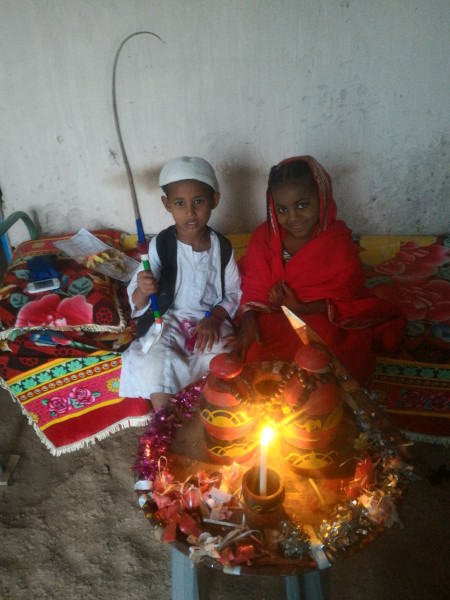
Two children at a wedding, taken by El-Kurru resident Marwa Mahajoob. One of the winning photos from the 2017 Photo Contest.

This deeply collaborative approach between archaeologists and El-Kurru residents is one of my favorite things about our project. All of the materials we are creating, from the heritage center to the children’s book, are things that the residents of El-Kurru themselves have requested, and we make sure that our local partners are consulted in every decision we make. My work with the “Living in Nubia” project has really shown me that archaeological research can and should be done in collaboration with, not just at the expense of, local communities, and this is something I will carry with me throughout the rest of my academic career.

Anwar Mahajoub (left), one of our main collaborators on the project, and Bakri Abdelmoneim, both from El-Kurru village, during filming of a short video at El-Kurru, 2019.

Shannon Burton is a recent graduate from the Classical Archaeology program at the University of Michigan. Her research interests include women in antiquity, archaeobotany, food production and cultivation practices, and community archaeology. She hopes to continue working with the “Living in Nubia” team, as well as go on her first excavation in Sudan in early 2022.

Project website link: https://sites.lsa.umich.edu/nubia/

During the summer of 2021, ASOR supported 27 undergraduate and graduate students through the Summer Stipend Program. These students undertook non-fieldwork archaeological research projects led by ASOR-affiliated project directors. They also took part in monthly cohort group meetings hosted via zoom. Read a summary of these cohort meetings here.

Stay tuned for more updates from the 2021 Summer Stipend recipients!