ASOR Online Portal

ASOR’S NEW ONLINE PORTAL

ASOR has partnered with Rhythm Software to ensure that you will have an intuitive, seamless experience, where you can easily join ASOR, renew your membership, register for events, donate, purchase merchandise, etc. You will also have access to digital versions of ASOR journals through this same online portal.

Watch this video to learn how to set up your account in the portal here.

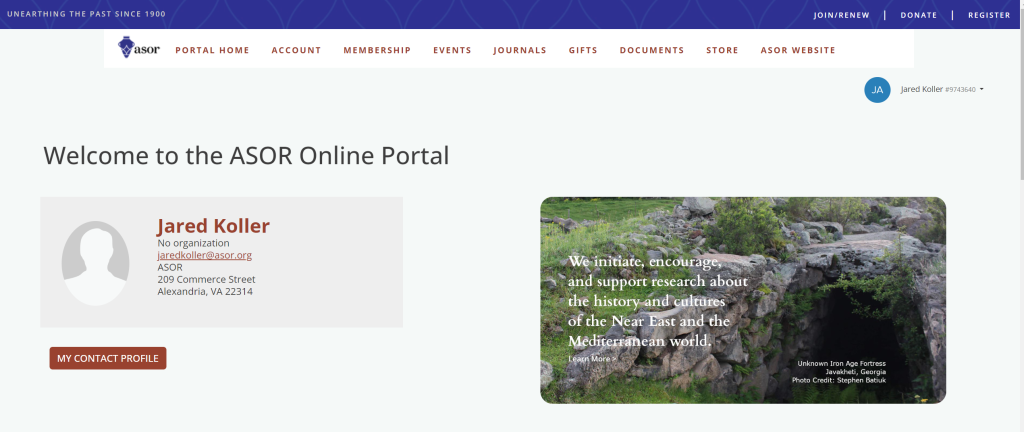
Below is a preview of the home page of the new portal homepage:

If you need to make a payment to ASOR, you can mail in your payment to the office or you can wait until the new portal goes live. If you have any questions or concerns about this transition, please contact membership@asor.org.

Here are some videos to help familiarize yourself with the new online portal:


Logging in

You will be asked to create new credentials (username and password) for the portal, but the system will match you with your existing ASOR contact record if you have one. You will be allowed to recreate the same username (your email address) and password that you currently use for your ASOR account.


ASOR Portal Introduction

Navigate the portal and managing your account. It is intuitive to find what you like to do as well as update your contact information and preferences.


Membership

You can join as a member or renew/change a current membership easily through the portal.


Events

You can browse upcoming events and register on each event’s microsite.


Journals

Depending on your membership package (print delivery, online access, etc), you will be able to directly access ASOR Journals (BASOR, JCS, Maarav, NEA) through the portal. If you have access, you will be redirected to the University of Chicago Press’s (UCP) platform to immediately start reading any issue of your choice.  No login required on the UCP website.


Donations

You can easily donate to your fund of choice, set up a monthly recurring donation, give in honor/memory of someone, or give anonymously in the portal.


Online Store

Browse any ASOR merchandise including webinar recordings, ASOR books, back issues of journals, ASOR logo merchandise (when available), and more. If you need to make a payment to ASOR, you can mail in your payment to the office or you can wait until the new portal goes live. If you have any questions about this transition, please contact membership@asor.org.

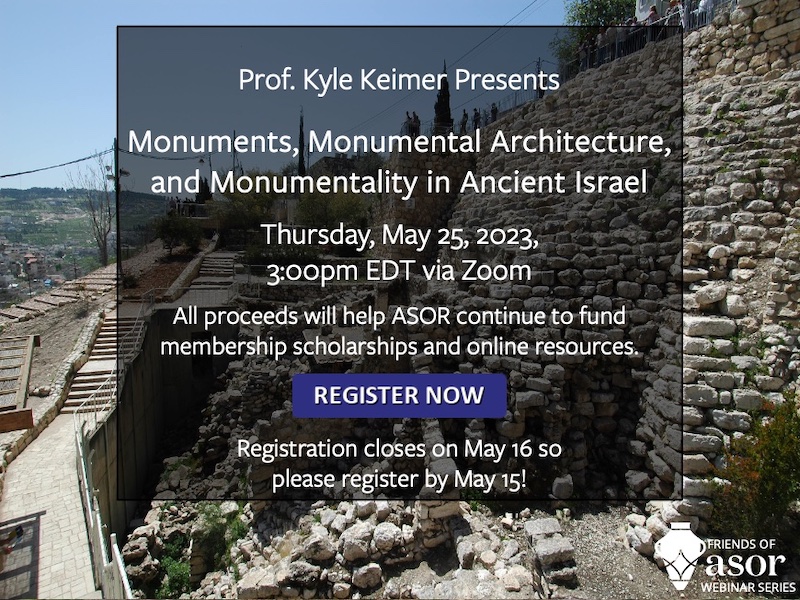
FOA Webinar: Kyle Keimer on May 25

FRIENDS OF ASOR WEBINARS

Monuments, Monumental Architecture, and Monumentality in Ancient Israel

Friends of ASOR present the last webinar this season on May 25, 2023, at 3:00 pm EDT, featuring Dr. Kyle Keimer. “Monumental architecture” is something that is often discussed in the archaeology of ancient Israel, but seldom defined. The same is true for “monuments” in ancient Israel. Following recent directions in anthropological archaeology, this talk defines both terms and incorporates the concept of monumentality to discuss where value and significance lay in ancient Israel. Buildings (political, cultic, and social) and small objects alike had both functional and symbolic aspects, and it is only by considering such aspects equally that it becomes possible to plumb the depths of the biblical text for those architectural features that carried exceptional value.

Join Dr. Kyle Keimer as he surveys the monuments and monumental architecture attested to both in the archaeological record of the Iron Ages I-II and in the Hebrew Bible in order to evaluate their monumentality across differing sociopolitical contexts in pre-monarchic and monarchic Israel (and Judah). A live Q&A session will follow this lecture.

Dr. Kyle Keimer is an Honorary Senior Research Fellow in the Archaeology, History, and Language of Ancient Israel at Macquarie University, Sydney. He co-directed excavations at the site of Khirbet el-Ra’i in southern Israel and is the co-host of The Biblical World podcast. His research bridges both text and archaeology, with an emphasis on the early Iron Age and early Israelite monarchy. His interests also include historical geography and ancient warfare. After finishing his PhD at UCLA, he was a post-doctoral fellow at the W.F. Albright Institute of Archaeology before becoming a Senior Lecturer at Macquarie University. He has over 20 years of archaeological experience in Israel and Cyprus, working on excavations spanning from the Early Bronze Age to the Ottoman Period. His publications include two edited volumes and over 30 articles.

This webinar will be recorded and all paid registrants will be sent a link to view the recording.


REGISTRATION HAS CLOSED

ASOR Sustaining Members: $0 | ASOR Members: $6 | Public: $12
Season Pass: ASOR Sustaining Members: $0 | ASOR Members: $75 | Public: $150
Buy one here!

Online registration will not be available after May 15 due to an ASOR software transition to a new online system and database. Please register before May 15 to ensure you have a spot in the webinar!

Please e-mail membership@asor.org with any questions or issues with registering.

You will be e-mailed the Zoom Webinar link in the week prior to the lecture on May 25, 2023. If you do not receive the link by the close of business two days before the webinar, please e-mail membership@asor.org immediately. This webinar will be recorded and all paid registrants will be sent a link to view the recording.

All proceeds from this webinar are used to fund scholarships for members as well as increasing ASOR’s online resources, which are free to the public.

READY FOR A WEBINAR SEASON PASS?

Buy a season pass for all the webinars* of the 2022-2023 FOA Webinar Season! 1) You will automatically receive the Zoom link for each webinar so no need to register each time. 2) You will also receive the recording of each webinar automatically after the event.

If you have missed webinars earlier in the season and still want to buy the pass, you will receive the links to the recordings of the webinars you missed in your automatic confirmation email after you buy the pass.

*Special symposiums may be excluded from the season pass price.

No more registering for a year if you buy your pass today!

Pricing:

Members: $75.00
Non-Members: $150.00
ASOR Sustaining Members: $0 (automatic registration for each webinar)
Not a member yet? Click here to join as a member and receive the 50% off a season pass!


Log into our online store to purchase the season pass for 2022-2023. If you are new to ASOR and do not have a record in our store yet, click here to register. After you login, navigate to the left to “Meeting and Event Registration.” Please e-mail membership@asor.org if you have any questions or issues.

WHY SPONSOR A WEBINAR?

Several levels of support from $50-$1,000 are available. Proceeds go towards membership scholarships and towards increasing ASOR’s virtual resources. Each sponsorship is tax-deductible and you can give your friends free registrations to a webinar!

Bronze Level ($50): up to 2 guest registrations
Silver Level ($100): up to 5 guest registrations
Gold Level ($500): up to 20 guest registrations
Platinum Level ($1,000): up to 50 guest registrations

After you sign up for a sponsorship online or over the phone, email the names and email addresses of your guests to Felice Herman at membership@asor.org, who will send your guests a confirmation and the Zoom link before the webinar.

WANT TO SAVE $6.00 ON THE NEXT WEBINAR?

Join ASOR as a member! Click here for more details about discounts for events and other benefits of membership. Memberships start at $40 for the year as an Associate Member.

Not ready to join yet? Become a Friend of ASOR for FREE!

Click here for more details about our online resources.

PAST WEBINARS

You can now purchase the link to the recording of any webinar. You can also purchase the bundle packages of all webinars from the 2020-2022 seasons. Please e-mail membership@asor.org for purchase details.

To see a printable pdf of the webinar titles from the 2020-2021 season, please click here. To see a printable pdf of the webinar titles from the 2021-2022 season, please click here.

Pricing:

Members: $6.00 per recording
Non-Members: $12.00 per recording
Bundle of 2020-2021 Webinars: $75.00
Bundle of 2021-2022 Webinars: $75.00
Bundle of 2020-2022 Webinars: $125.00

2021-2022 Season

A World at War: Protecting Cultural Heritage in Times of Conflict
Patty Gerstenblith (DePaul University), Lisa Ackerman (Columbus Citizens Foundation), Andrew Cohen (Government Professional and Cultural Heritage Expert) | May 12, 2022

Preserving Cultural Heritage in Hisban and Umm al-Jimal, Jordan
Øystein LaBianca (Andrews University), Elizabeth Osinga (Umm al-Jimal Archaeological Project), Darrell Rohl (Calvin University) | April 24, 2022

Back to the Field: Recent Discoveries & Summer Plans 2022
Lorenzo d’Alfonso (ISAW), Kathryn Grossman (NC State University), James R. Strange (Samford University) | April 3, 2022

Uncovering What is Nubian Beneath the Veneer of Egyptianness: Excavating the Archives
Debora Heard (University of Chicago) | March 20, 2022

Where Are They Now?: A Preview of 2022 ASOR-Affiliated Fieldwork Projects
Michael Given (University of Glasgow), Xenia-Paula Kyriakou (Florida Gulf Coast University), Stephen Batiuk (University of Toronto), Monique Roddy (Walla Walla University), Kent Bramlett (La Sierra University), Friedbert Ninow (La Sierra University), and Michael Hoff (University of Nebraska-Lincoln) | March 8, 2022

Excavations at Tel Gezer: A Personal Story
Sam Wolff (Tel Gezer Laboratory) | February 20, 2022

Tel Rehov: A Major Bronze and Iron Age City in the Jordan Valley
Amihai Mazar (Hebrew University of Jerusalem), Nava Panitz-Cohen ( Hebrew University of Jerusalem), Nota Kourou (Athens University), Naama Yahalom-Mack (Hebrew University of Jerusalem), Robert Mullins (Azusa Pacific University) | February 10, 2022

The Not-So-Innocents Abroad: The Beginnings of American Biblical Archaeology
Rachel Hallote (Samford University) | January 20, 2022

Synagogues as Jesus Knew Them
James R. Strange (Samford University) | December 2, 2021

Under Jerusalem: The Buried History of the World’s Most Contested City
Andrew Lawler | November 4, 2021

Jesus and Jerusalem on TV: How Do Bible Documentaries Get Made?
Robert Cargill (University of Iowa) | October 17, 2021

Digging the Divine?: Judahite Pillar Figurines and the Archaeology of Israelite Religion
Erin Darby (University of Tennessee) | October 7, 2021

David, Solomon, and Rehoboam’s Kingdom—The Archaeological Evidence
Yosef Garfinkel (Hebrew University of Jerusalem) | September 19, 2021

From Standing Stones to Sacred Emptiness: Textual and Visual Portrayals of Israel’s God
Theodore Lewis (Johns Hopkins University) | August 29, 2021

2020-2021 Season

Making May Matter: Webinarathon to Endow Diversity
Multiple Speakers | May 21-23, 2021

Archaeogaming: Why Video Games Deserve Their Own Archaeology
Tine Rassalle (University of North Carolina at Chapel Hill), Shannon Martino (Morton College), Matthew Winter (University of Arizona), Michael Zimmerman (Rhode Island) | April 18, 2021

How the Bible Became a Book
William Schniedewind (UCLA) | March 21, 2021

The Mysteries of Mithras in Caesarea: Exploring the Cult’s Rites and Remains
Jane DeRose Evans (Temple University), Alexandra Ratzlaff (Brandeis University) | March 11, 2021

Archaeology and the Hidden Religious Culture of Israelite Women
Carol Meyers (Duke University) | February 21, 2021

Meet the Directors—Fundraiser to Support ASOR’s Affiliated Overseas Research Centers
Matthew J. Adams (AIAR), Pearce Paul Creasman (ACOR), Lindy Crewe (CAARI) | February 11, 2021

Early Synagogues, Jesus, and Galilee—A Jewish Perspective
Eric Meyers (Duke University) | December 13, 2020

Home Sweet Home: Ancient Israelite Households in Context
Cynthia Shafer-Elliott (William Jessup University) | October 18, 2020

Priestesses in the Days of Solomon and Ahab
Susan Ackerman (Dartmouth College) | September 13, 2020

Digging Deeper: How Archaeology Works
Eric H. Cline (The George Washington University) | August 9, 2020

FOA Webinar: Thomas Levy on April 27

FRIENDS OF ASOR WEBINARS

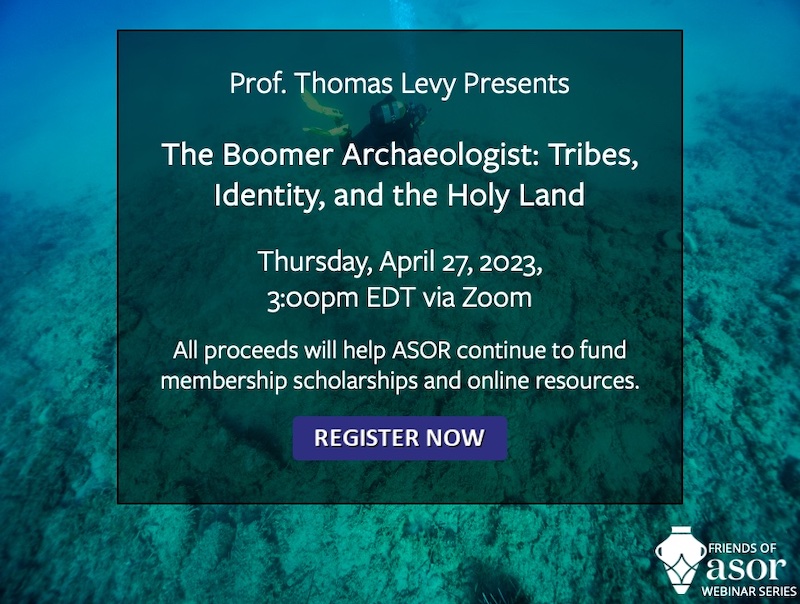
The Boomer Archaeologist: Tribes, Identity, and the Holy Land


Photo Credit: T.E. Levy, Lily Almeida, Bhaveshkumar Suru

Friends of ASOR present the next webinar in our monthly series on April 27, 2023, at 3:00 pm EDT, featuring Prof. Thomas Levy and moderated by Dr. Ian Jones. For many archaeologists, their lives can best be described as “a life in ruins.” As seen in Tom Levy’s forthcoming book, The Boomer Archaeologist – A Graphic Memoir of Tribes, Identity, and the Holy Land, this is indeed the case. Except for some brief periods working as a cowboy, Levy has worked only as an archaeologist – from early beginnings in the American Southwest in the late 1960s, to professional research in Israel, Greece, and Jordan. Reflecting on more than 50 years as a Levantine field archaeologist, Tom discusses some of the motivations for becoming an archaeologist working in the Holy Land, his role in the application of new methods and theories in the changing field of anthropological archaeology in the eastern Mediterranean, his transition from desert to underwater archaeology, and some of the challenges facing US universities that will affect the future of American research in the field of Levantine archaeology.


Based on his forthcoming graphic memoir, The Boomer Archaeologist, the lecture will include ligne claire drawings by the memoir’s graphic artist Lily Almeida and photographs from several of Prof. Levy’s projects that tell the story of changes in method and theory in Levantine archaeology over the past 50 years. These projects span the metallurgical revolution during the Chalcolithic period, the rise of the Edomite kingdom known from the Hebrew Bible, and ancient environmental and social change observed through underwater archaeology in the eastern Mediterranean.

Join Prof. Levy as he discusses his new graphic memoir in telling the story of a lifetime professional working in and off the coast of the Holy Land. The webinar will conclude with a Q&A session moderated by Dr. Ian Jones (University of California, San Diego).


Prof. Thomas Levy is the Distinguished Professor, and inaugural holder of the Norma Kershaw Chair in the Archaeology of Ancient Israel and Neighboring Lands at the University of California, San Diego. He is the founder and co-director of the Center for Cyber-Archaeology and Sustainability at the Qualcomm Institute at UC San Diego. Elected to the American Academy of Arts and Sciences and holder of an honorary doctorate from Charles University (Czech Republic), Levy is a widely published Levantine field archaeologist with interests in the role of technology, especially early mining and metallurgy, and on the evolution of societies, especially in eastern Mediterranean. Tom has published 15 archaeology books and over 250 scholarly articles. Levy’s recent focuses are on marine archaeology and paleoenvironmental change during the Neolithic to Classical periods off the Carmel coast of Israel with the University of Haifa, where he is a research associate.

This webinar will be recorded and all paid registrants will be sent a link to view the recording.

ASOR Sustaining Members: $0 | ASOR Members: $6 | Public: $12
Season Pass: ASOR Sustaining Members: $0 | ASOR Members: $75 | Public: $150
Buy one here!

To receive your ASOR member discount, log into the online store. If you are new to ASOR, please click on the “New Visitor Registration” link to register your e-mail address and choose a password for our online store. Once logged in, navigate to “Meeting and Event Registration” to register for the webinar and pay the fee. Each paid registrant will receive a confirmation e-mail when you pay for the webinar. If you do not receive this e-mail, then you are not registered. Please e-mail membership@asor.org with any questions or issues with registering.

You will be e-mailed the Zoom Webinar link in the week prior to the lecture on April 27, 2023. If you do not receive the link by the close of business two days before the webinar, please e-mail membership@asor.org immediately. This webinar will be recorded and all paid registrants will be sent a link to view the recording.

All proceeds from this webinar are used to fund scholarships for members as well as increasing ASOR’s online resources, which are free to the public.

READY FOR A WEBINAR SEASON PASS?

Buy a season pass for all the webinars* of the 2022-2023 FOA Webinar Season! 1) You will automatically receive the Zoom link for each webinar so no need to register each time. 2) You will also receive the recording of each webinar automatically after the event.

If you have missed webinars earlier in the season and still want to buy the pass, you will receive the links to the recordings of the webinars you missed in your automatic confirmation email after you buy the pass.

*Special symposiums may be excluded from the season pass price.

No more registering for a year if you buy your pass today!

Pricing:

Members: $75.00
Non-Members: $150.00
ASOR Sustaining Members: $0 (automatic registration for each webinar)
Not a member yet? Click here to join as a member and receive the 50% off a season pass!


Log into our online store to purchase the season pass for 2022-2023. If you are new to ASOR and do not have a record in our store yet, click here to register. After you login, navigate to the left to “Meeting and Event Registration.” Please e-mail membership@asor.org if you have any questions or issues.

WHY SPONSOR A WEBINAR?

Several levels of support from $50-$1,000 are available. Proceeds go towards membership scholarships and towards increasing ASOR’s virtual resources. Each sponsorship is tax-deductible and you can give your friends free registrations to a webinar!

Bronze Level ($50): up to 2 guest registrations
Silver Level ($100): up to 5 guest registrations
Gold Level ($500): up to 20 guest registrations
Platinum Level ($1,000): up to 50 guest registrations

After you sign up for a sponsorship online or over the phone, email the names and email addresses of your guests to Felice Herman at membership@asor.org, who will send your guests a confirmation and the Zoom link before the webinar.

WANT TO SAVE $6.00 ON THE NEXT WEBINAR?

Join ASOR as a member! Click here for more details about discounts for events and other benefits of membership. Memberships start at $40 for the year as an Associate Member.

Not ready to join yet? Become a Friend of ASOR for FREE!

Click here for more details about our online resources.

PAST WEBINARS

You can now purchase the link to the recording of any webinar. You can also purchase the bundle packages of all webinars from the 2020-2022 seasons. Please e-mail membership@asor.org for purchase details.

To see a printable pdf of the webinar titles from the 2020-2021 season, please click here. To see a printable pdf of the webinar titles from the 2021-2022 season, please click here.

Pricing:

Members: $6.00 per recording
Non-Members: $12.00 per recording
Bundle of 2020-2021 Webinars: $75.00
Bundle of 2021-2022 Webinars: $75.00
Bundle of 2020-2022 Webinars: $125.00

2021-2022 Season

A World at War: Protecting Cultural Heritage in Times of Conflict
Patty Gerstenblith (DePaul University), Lisa Ackerman (Columbus Citizens Foundation), Andrew Cohen (Government Professional and Cultural Heritage Expert) | May 12, 2022

Preserving Cultural Heritage in Hisban and Umm al-Jimal, Jordan
Øystein LaBianca (Andrews University), Elizabeth Osinga (Umm al-Jimal Archaeological Project), Darrell Rohl (Calvin University) | April 24, 2022

Back to the Field: Recent Discoveries & Summer Plans 2022
Lorenzo d’Alfonso (ISAW), Kathryn Grossman (NC State University), James R. Strange (Samford University) | April 3, 2022

Uncovering What is Nubian Beneath the Veneer of Egyptianness: Excavating the Archives
Debora Heard (University of Chicago) | March 20, 2022

Where Are They Now?: A Preview of 2022 ASOR-Affiliated Fieldwork Projects
Michael Given (University of Glasgow), Xenia-Paula Kyriakou (Florida Gulf Coast University), Stephen Batiuk (University of Toronto), Monique Roddy (Walla Walla University), Kent Bramlett (La Sierra University), Friedbert Ninow (La Sierra University), and Michael Hoff (University of Nebraska-Lincoln) | March 8, 2022

Excavations at Tel Gezer: A Personal Story
Sam Wolff (Tel Gezer Laboratory) | February 20, 2022

Tel Rehov: A Major Bronze and Iron Age City in the Jordan Valley
Amihai Mazar (Hebrew University of Jerusalem), Nava Panitz-Cohen ( Hebrew University of Jerusalem), Nota Kourou (Athens University), Naama Yahalom-Mack (Hebrew University of Jerusalem), Robert Mullins (Azusa Pacific University) | February 10, 2022

The Not-So-Innocents Abroad: The Beginnings of American Biblical Archaeology
Rachel Hallote (Samford University) | January 20, 2022

Synagogues as Jesus Knew Them
James R. Strange (Samford University) | December 2, 2021

Under Jerusalem: The Buried History of the World’s Most Contested City
Andrew Lawler | November 4, 2021

Jesus and Jerusalem on TV: How Do Bible Documentaries Get Made?
Robert Cargill (University of Iowa) | October 17, 2021

Digging the Divine?: Judahite Pillar Figurines and the Archaeology of Israelite Religion
Erin Darby (University of Tennessee) | October 7, 2021

David, Solomon, and Rehoboam’s Kingdom—The Archaeological Evidence
Yosef Garfinkel (Hebrew University of Jerusalem) | September 19, 2021

From Standing Stones to Sacred Emptiness: Textual and Visual Portrayals of Israel’s God
Theodore Lewis (Johns Hopkins University) | August 29, 2021

2020-2021 Season

Making May Matter: Webinarathon to Endow Diversity
Multiple Speakers | May 21-23, 2021

Archaeogaming: Why Video Games Deserve Their Own Archaeology
Tine Rassalle (University of North Carolina at Chapel Hill), Shannon Martino (Morton College), Matthew Winter (University of Arizona), Michael Zimmerman (Rhode Island) | April 18, 2021

How the Bible Became a Book
William Schniedewind (UCLA) | March 21, 2021

The Mysteries of Mithras in Caesarea: Exploring the Cult’s Rites and Remains
Jane DeRose Evans (Temple University), Alexandra Ratzlaff (Brandeis University) | March 11, 2021

Archaeology and the Hidden Religious Culture of Israelite Women
Carol Meyers (Duke University) | February 21, 2021

Meet the Directors—Fundraiser to Support ASOR’s Affiliated Overseas Research Centers
Matthew J. Adams (AIAR), Pearce Paul Creasman (ACOR), Lindy Crewe (CAARI) | February 11, 2021

Early Synagogues, Jesus, and Galilee—A Jewish Perspective
Eric Meyers (Duke University) | December 13, 2020

Home Sweet Home: Ancient Israelite Households in Context
Cynthia Shafer-Elliott (William Jessup University) | October 18, 2020

Priestesses in the Days of Solomon and Ahab
Susan Ackerman (Dartmouth College) | September 13, 2020

Digging Deeper: How Archaeology Works
Eric H. Cline (The George Washington University) | August 9, 2020

FOA Webinar: Yuval Gadot on April 13

FRIENDS OF ASOR WEBINARS

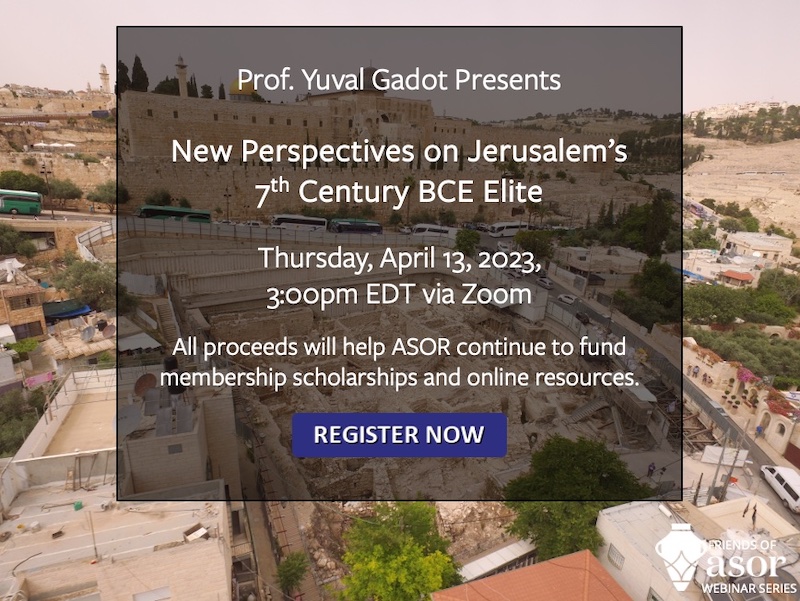
New Perspectives on Jerusalem’s 7th Century BCE Elite

Photo credit: Assaf Perets

Friends of ASOR present the next webinar in our monthly series on April 13, 2023, at 3:00 pm EDT, featuring Prof. Yuval Gadot and moderated by Prof. Thomas Levy. Jerusalem is one of the most excavated places in the world and yet, some very basic questions regarding the city’s size and location are still being debated. Recent finds from the western slope of the southeastern ridge (known also as “the City of David”) shed new and tantalizing light on the city’s development during the 11th-9th centuries BCE, on the wealth of Jerusalem’s elite during the 7th century BCE, and on the city’s destruction and revival during the 6th and 5th centuries BCE.

Photo Credit: Sasha Flit

The lecture will focus on 7th century BCE as it will present the results of recent excavations of an elite associated building (Building 100) that was destroyed by the Babylonians in 586 BCE. The analysis of the plethora of artifacts found inside the building, such as ivory panels, wooden artifacts, and storage jars used for holding flavored wine, exposes the intimate details of the lives of Jerusalem’s elite—their habits and their worldview as they operated within an empyreal network.

Join Prof. Gadot as he discusses his new research in telling the story of one of the world’s most fascinating cities. The webinar will conclude with a Q&A session moderated by Prof. Thomas Levy (University of California, San Diego).


Photo Credit: Sasha Flit

Prof. Yuval Gadot heads the Sonia & Marco Nadler Institute of Archaeology at Tel-Aviv University. He is also lead archaeologist at the “City of David” excavations project in Jerusalem where he co-directs the “Givati Parking Lot” excavations and leads an environmental study of the rural landscape surrounding the city. He obtained his PhD in 2004 from Tel-Aviv University. Between 2004 and 2008, Gadot was a research fellow at the Nelson Glick School of Bible and Archeology at Hebrew Union College (Jerusalem). Between 2005 and 2010, Yuval served as a Field Director for the Institute’s excavations at the Ramat Rachel site (led by Prof. Oded Lipschits and Prof. Manfred Oming). These excavations were published in a large number of publications and final reports. At the same time, he partnered with Prof. Israel Finkelstein and Prof. Steve Weiner in the project “Ancient Israel through the lens of natural and exact sciences,” where he was exposed to the many possibilities that exist in combining science and archaeology.

Since 2018, Gadot has served as the Head of the Department of Archaeology and Ancient Near Eastern Cultures at Tel-Aviv University. He has authored seven archaeological books and over one hundred scientific articles.

This webinar will be recorded and all paid registrants will be sent a link to view the recording.


ASOR Sustaining Members: $0 | ASOR Members: $6 | Public: $12
Season Pass: ASOR Sustaining Members: $0 | ASOR Members: $75 | Public: $150
Buy one here!

To receive your ASOR member discount, log into the online store. If you are new to ASOR, please click on the “New Visitor Registration” link to register your e-mail address and choose a password for our online store. Once logged in, navigate to “Meeting and Event Registration” to register for the webinar and pay the fee. Each paid registrant will receive a confirmation e-mail when you pay for the webinar. If you do not receive this e-mail, then you are not registered. Please e-mail membership@asor.org with any questions or issues with registering.

You will be e-mailed the Zoom Webinar link in the week prior to the lecture on April 13, 2023. If you do not receive the link by the close of business two days before the webinar, please e-mail membership@asor.org immediately. This webinar will be recorded and all paid registrants will be sent a link to view the recording.

All proceeds from this webinar are used to fund scholarships for members as well as increasing ASOR’s online resources, which are free to the public.

READY FOR A WEBINAR SEASON PASS?

Buy a season pass for all the webinars* of the 2022-2023 FOA Webinar Season! 1) You will automatically receive the Zoom link for each webinar so no need to register each time. 2) You will also receive the recording of each webinar automatically after the event.

If you have missed webinars earlier in the season and still want to buy the pass, you will receive the links to the recordings of the webinars you missed in your automatic confirmation email after you buy the pass.

*Special symposiums may be excluded from the season pass price.

No more registering for a year if you buy your pass today!

Pricing:

Members: $75.00
Non-Members: $150.00
ASOR Sustaining Members: $0 (automatic registration for each webinar)
Not a member yet? Click here to join as a member and receive the 50% off a season pass!


Log into our online store to purchase the season pass for 2022-2023. If you are new to ASOR and do not have a record in our store yet, click here to register. After you login, navigate to the left to “Meeting and Event Registration.” Please e-mail membership@asor.org if you have any questions or issues.

WHY SPONSOR A WEBINAR?

Several levels of support from $50-$1,000 are available. Proceeds go towards membership scholarships and towards increasing ASOR’s virtual resources. Each sponsorship is tax-deductible and you can give your friends free registrations to a webinar!

Bronze Level ($50): up to 2 guest registrations
Silver Level ($100): up to 5 guest registrations
Gold Level ($500): up to 20 guest registrations
Platinum Level ($1,000): up to 50 guest registrations

After you sign up for a sponsorship online or over the phone, email the names and email addresses of your guests to Felice Herman at membership@asor.org, who will send your guests a confirmation and the Zoom link before the webinar.

WANT TO SAVE $6.00 ON THE NEXT WEBINAR?

Join ASOR as a member! Click here for more details about discounts for events and other benefits of membership. Memberships start at $40 for the year as an Associate Member.

Not ready to join yet? Become a Friend of ASOR for FREE!

Click here for more details about our online resources.

PAST WEBINARS

You can now purchase the link to the recording of any webinar. You can also purchase the bundle packages of all webinars from the 2020-2022 seasons. Please e-mail membership@asor.org for purchase details.

To see a printable pdf of the webinar titles from the 2020-2021 season, please click here. To see a printable pdf of the webinar titles from the 2021-2022 season, please click here.

Pricing:

Members: $6.00 per recording
Non-Members: $12.00 per recording
Bundle of 2020-2021 Webinars: $75.00
Bundle of 2021-2022 Webinars: $75.00
Bundle of 2020-2022 Webinars: $125.00

2021-2022 Season

A World at War: Protecting Cultural Heritage in Times of Conflict
Patty Gerstenblith (DePaul University), Lisa Ackerman (Columbus Citizens Foundation), Andrew Cohen (Government Professional and Cultural Heritage Expert) | May 12, 2022

Preserving Cultural Heritage in Hisban and Umm al-Jimal, Jordan
Øystein LaBianca (Andrews University), Elizabeth Osinga (Umm al-Jimal Archaeological Project), Darrell Rohl (Calvin University) | April 24, 2022

Back to the Field: Recent Discoveries & Summer Plans 2022
Lorenzo d’Alfonso (ISAW), Kathryn Grossman (NC State University), James R. Strange (Samford University) | April 3, 2022

Uncovering What is Nubian Beneath the Veneer of Egyptianness: Excavating the Archives
Debora Heard (University of Chicago) | March 20, 2022

Where Are They Now?: A Preview of 2022 ASOR-Affiliated Fieldwork Projects
Michael Given (University of Glasgow), Xenia-Paula Kyriakou (Florida Gulf Coast University), Stephen Batiuk (University of Toronto), Monique Roddy (Walla Walla University), Kent Bramlett (La Sierra University), Friedbert Ninow (La Sierra University), and Michael Hoff (University of Nebraska-Lincoln) | March 8, 2022

Excavations at Tel Gezer: A Personal Story
Sam Wolff (Tel Gezer Laboratory) | February 20, 2022

Tel Rehov: A Major Bronze and Iron Age City in the Jordan Valley
Amihai Mazar (Hebrew University of Jerusalem), Nava Panitz-Cohen ( Hebrew University of Jerusalem), Nota Kourou (Athens University), Naama Yahalom-Mack (Hebrew University of Jerusalem), Robert Mullins (Azusa Pacific University) | February 10, 2022

The Not-So-Innocents Abroad: The Beginnings of American Biblical Archaeology
Rachel Hallote (Samford University) | January 20, 2022

Synagogues as Jesus Knew Them
James R. Strange (Samford University) | December 2, 2021

Under Jerusalem: The Buried History of the World’s Most Contested City
Andrew Lawler | November 4, 2021

Jesus and Jerusalem on TV: How Do Bible Documentaries Get Made?
Robert Cargill (University of Iowa) | October 17, 2021

Digging the Divine?: Judahite Pillar Figurines and the Archaeology of Israelite Religion
Erin Darby (University of Tennessee) | October 7, 2021

David, Solomon, and Rehoboam’s Kingdom—The Archaeological Evidence
Yosef Garfinkel (Hebrew University of Jerusalem) | September 19, 2021

From Standing Stones to Sacred Emptiness: Textual and Visual Portrayals of Israel’s God
Theodore Lewis (Johns Hopkins University) | August 29, 2021

2020-2021 Season

Making May Matter: Webinarathon to Endow Diversity
Multiple Speakers | May 21-23, 2021

Archaeogaming: Why Video Games Deserve Their Own Archaeology
Tine Rassalle (University of North Carolina at Chapel Hill), Shannon Martino (Morton College), Matthew Winter (University of Arizona), Michael Zimmerman (Rhode Island) | April 18, 2021

How the Bible Became a Book
William Schniedewind (UCLA) | March 21, 2021

The Mysteries of Mithras in Caesarea: Exploring the Cult’s Rites and Remains
Jane DeRose Evans (Temple University), Alexandra Ratzlaff (Brandeis University) | March 11, 2021

Archaeology and the Hidden Religious Culture of Israelite Women
Carol Meyers (Duke University) | February 21, 2021

Meet the Directors—Fundraiser to Support ASOR’s Affiliated Overseas Research Centers
Matthew J. Adams (AIAR), Pearce Paul Creasman (ACOR), Lindy Crewe (CAARI) | February 11, 2021

Early Synagogues, Jesus, and Galilee—A Jewish Perspective
Eric Meyers (Duke University) | December 13, 2020

Home Sweet Home: Ancient Israelite Households in Context
Cynthia Shafer-Elliott (William Jessup University) | October 18, 2020

Priestesses in the Days of Solomon and Ahab
Susan Ackerman (Dartmouth College) | September 13, 2020

Digging Deeper: How Archaeology Works
Eric H. Cline (The George Washington University) | August 9, 2020

Table of Contents for NEA 86.1 (2023)

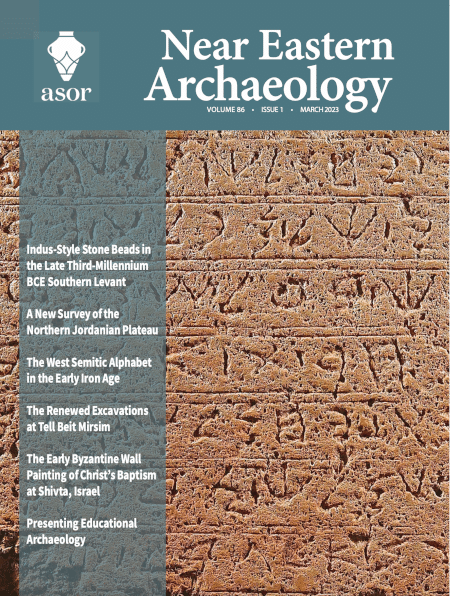
Table of Contents for Near Eastern Archaeology 86.1 (March 2023)

You can receive NEA (and other ASOR publications) through an ASOR Membership.
Please e-mail the Membership office if you have any questions.

Pp. 4-15: “Indus-Style Stone Beads in the Late Third-Millennium BCE Southern Levant: The Role of Trade and Curation in the Distribution of High-Value Ornaments,” by Geoffrey E. Ludvik

This article discusses how identification of stylistic, morphometric, mineralogical, and technological characteristics of carnelian stone beads can provide major insights into EB IV/MB I interregional networks and social differentiation. Based on unique drilling techniques, stylistic shapes, morphometric proportions, and mineralogical characteristics, fifty-four carnelian beads found in Israel/Palestine have been identified as crafted in a manner ultimately diagnostic of the Indus tradition of modern Pakistan and western India. Fifty Indus-style beads in the EB IV/MB I probably reflect increased socio-cultural links to the northern Levant and Mesopotamia during this period, while four beads from later contexts represent long-term curation of valuable ornaments.

ASOR Members with online access: log into ASOR’s Online Portal here. Once logged in, click the JOURNALS tab in the top navigation bar. From here you may select which journal you would like to read. If you have online access, you will see your selected journal’s current issue Table of Contents. Click on the “Current Issue” button and you will then be redirected to the University of Chicago Press’s (UCP) platform to immediately start reading any issue of your choice. Tutorials for how to log in to the Online Portal as well as how to navigate to the Portal Journals page can be found here.

Pp. 16-27: “Tell It Like It Is: Discoveries from a New Survey of the Northern Jordanian Plateau,” by Marta Lorenzon, Antti Lahelma, Maher Tarboush, Elisabeth Holmqvist, Dries Daems, Saimi Kautonen, Joanna Töyräänvuori, Stefan L. Smith, Benjamín Cutillas-Victoria, Maija Holappa, Hussein Al-Sababha, and Ahmed Al-Shorman

This article presents the results of a joint Finnish-Jordanian survey project that focuses on investigating the interrelations of the imperial heartlands and the Levantine region in the Late Bronze and Iron Ages. We used historical satellite images to identify potential sites on the northern Jordanian plateau, after which they were systematically investigated by archaeological survey. Of the sites discovered, the fortified site of Tell al-Assara stands out owing to its prominent location, as indicated by a visibility analysis, and its massive enceinte wall made of ashlars. One of the pottery sherds found at the site bears an inscription in Aramaic. Although Tell al-Assara is remarkably well preserved, many of the sites discovered were already badly damaged by looting and urban development. These alarming developments can only be countered by closely involving local communities in fieldwork projects working in the region.

ASOR Members with online access: log into ASOR’s Online Portal here. Once logged in, click the JOURNALS tab in the top navigation bar. From here you may select which journal you would like to read. If you have online access, you will see your selected journal’s current issue Table of Contents. Click on the “Current Issue” button and you will then be redirected to the University of Chicago Press’s (UCP) platform to immediately start reading any issue of your choice. Tutorials for how to log in to the Online Portal as well as how to navigate to the Portal Journals page can be found here.

Pp. 28-45: “The West Semitic Alphabet in the Early Iron Age: A New Hypothesis,” by Benjamin Sass and Israel Finkelstein

In the hypothesis presented by the authors, stratified, nonmonumental inscriptions and their radiometric datings take center stage for the first time. It is in the living script of these texts rather than in the artificial alphabet of monuments that the evolution of the alphabet in Iron IIA can be studied properly. A key take-home lesson of the work is the significant ninth-century transformations of the alphabet from precursive Proto-Canaanite to supraregional cursive, thence to the well-known regional variants. Under the Omrides, the alphabet in Israel is attested minimally. No Omride texts were recognized at Samaria, nor Baashide texts at Tirzah. The newly founded West Semitic kingdoms since ca. 900 BCE will have constituted the cradle of the cursive, while papyrus or parchment and ink were the cursive’s likeliest vehicle. Alphabetic inscriptions on monuments, including Byblos, all cursive-inspired, will only have emerged in the last third of the ninth century.

ASOR Members with online access: log into ASOR’s Online Portal here. Once logged in, click the JOURNALS tab in the top navigation bar. From here you may select which journal you would like to read. If you have online access, you will see your selected journal’s current issue Table of Contents. Click on the “Current Issue” button and you will then be redirected to the University of Chicago Press’s (UCP) platform to immediately start reading any issue of your choice. Tutorials for how to log in to the Online Portal as well as how to navigate to the Portal Journals page can be found here.

Pp. 46-57: “In the Footsteps of Albright: The Renewed Excavations at Tell Beit Mirsim,” by Igor Kreimerman, Itamar Weissbein, Pnina Torn Broers, and Ofer Naveh

Tell Beit Mirsim in the Judean Shephelah was excavated by William F. Albright and Melvin G. Kyle in the 1920s and 1930s. These excavations established the relative chronology for the entire southern Levant because of good preservation conditions, facilitated by the multiple destruction layers at the site, and thanks to Albright’s familiarity with pottery. Ninety years later, the excavations have been renewed with the aim of investigating the economy and social structure of the kingdom of Judah. The first season of renewed excavations by the Institute of Archaeology at the Hebrew University of Jerusalem has unearthed the remains of Iron Age IIB domestic structures, one of which belongs to the four-room-house type, and an olive oil press. The excellent preservation of the remains enables the reconstruction of activity areas and suggests that Tell Beit Mirsim could be the perfect lab for exploring the economy of the kingdom of Judah.

ASOR Members with online access: log into ASOR’s Online Portal here. Once logged in, click the JOURNALS tab in the top navigation bar. From here you may select which journal you would like to read. If you have online access, you will see your selected journal’s current issue Table of Contents. Click on the “Current Issue” button and you will then be redirected to the University of Chicago Press’s (UCP) platform to immediately start reading any issue of your choice. Tutorials for how to log in to the Online Portal as well as how to navigate to the Portal Journals page can be found here.

Pp. 58-63: “In Situ Implementation of Imaging Techniques Reveals Key Motifs in the Early Byzantine Wall Painting of Christ’s Baptism at Shivta, Israel,” by Ravit Linn, Emma Maayan-Fanar, and Yotam Tepper

Following the rediscovery of the Early Byzantine wall painting of Christ’s baptism in the northern church of Shivta in southern Israel, the painting was investigated with different imaging techniques in order to clarify the scene and to find additional painted motifs and hidden colors and patterns. Besides high-quality photography from close distance on a scaffolding at 3.5 m height, thus at the level of the painting, Near IR photography (NIR), UV wavelengths microscopy, and Visible Induced Luminescence (VIL) imaging were all conducted in order to collect new information on the painting. The combination of several imaging techniques provided new and surprising details on elements of the painting, especially revealing blue color around the head and shoulders of Christ, most probably reminiscent of the River Jordan where the baptism took place.

ASOR Members with online access: log into ASOR’s Online Portal here. Once logged in, click the JOURNALS tab in the top navigation bar. From here you may select which journal you would like to read. If you have online access, you will see your selected journal’s current issue Table of Contents. Click on the “Current Issue” button and you will then be redirected to the University of Chicago Press’s (UCP) platform to immediately start reading any issue of your choice. Tutorials for how to log in to the Online Portal as well as how to navigate to the Portal Journals page can be found here.

Pp. 64-73: “The Finder, Not the Find: Presenting Educational Archaeology,” by Achia Kohn-Tavor

Educational excavation projects focus primarily on the pedagogic values embedded in the archaeological work, while archaeology per se is their secondary goal; therefore, they differ from community archaeology, which mostly incorporates education and community into archaeological projects and objectives. This article articulates this difference and then presents educational archaeology in detail, explaining how it is implemented. To illuminate educational archaeology further, two projects headed by the author are presented, encompassing school students, and domestic and international tourism. Educational archaeology encompasses a variety of benefits that are rather efficiently delivered: social and personal development of the individual, building community and a sense of belonging, and widening one’s scope of knowledge. The call to make archaeology accessible to the broad public is greatly facilitated here, and therefore educational archaeology projects should occupy a larger space among place-based, value-oriented projects.

ASOR Members with online access: log into ASOR’s Online Portal here. Once logged in, click the JOURNALS tab in the top navigation bar. From here you may select which journal you would like to read. If you have online access, you will see your selected journal’s current issue Table of Contents. Click on the “Current Issue” button and you will then be redirected to the University of Chicago Press’s (UCP) platform to immediately start reading any issue of your choice. Tutorials for how to log in to the Online Portal as well as how to navigate to the Portal Journals page can be found here.

FOA Webinar: Tiffany Earley-Spadoni on March 23

FRIENDS OF ASOR WEBINARS

Urartu: Reframing Assyria’s Enigmatic Neighbor

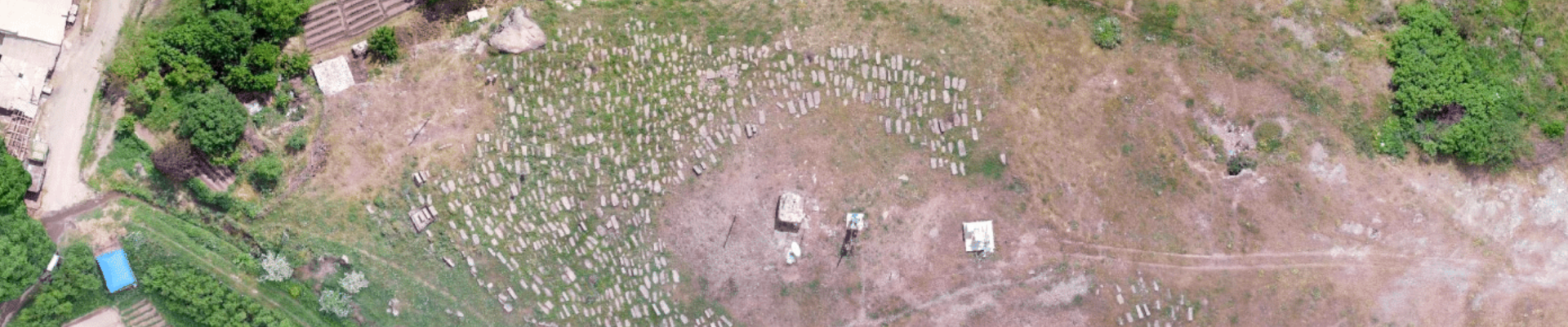
Friends of ASOR present the next webinar in our monthly series on March 23, 2023, at 3:00 pm EDT, featuring Prof. Tiffany Earley-Spadoni and moderated by Prof. Petra Creamer (Emory University). Urartu was a powerful empire located in the imposing highlands of modern-day eastern Turkey, Armenia, and western Iran in the 9th to the 7th centuries BCE. In this lecture, Prof. Earley-Spadoni will provide historical context for Urartu, a thriving, but often overlooked expansionary state. The Urartians left behind an impressive array of archaeological remains ranging from vibrant material culture to evocative texts carved in living stone. Despite its undeniable significance and unique features, the state is frequently framed as being a minor development resulting from the growth of the Assyrian empire to its south.

Rather than being organized around large cities like other empires which had come before, Urartu relied on a rural, regional network of forts, fortresses, and fire beacon stations to defend against threats and impose sovereignty upon the mountainous landscape. The fortified networks allowed for the spread of information and the coordination of military and administrative activities, which helped the kingdom consolidate its power over neighboring regions.

The talk will conclude with a call to reframe the way we think about Urartu. Prof. Earley-Spadoni will suggest that this goal can be achieved by studying Urartian materials and texts as developments that combined local practices and reinterpreted broader regional traditions. Ultimately, she will argue that Urartu must be understood as a historically specific case, and a topic worthy of much more dedicated study.

Tiffany Earley-Spadoni is an Associate Professor of History at the University of Central Florida. Her research consists of spatially-oriented investigations of expansionary state development in the ancient Near East. She received her PhD in Near Eastern Studies from the Johns Hopkins University.

Her current archaeological field projects are the Kurd Qaburstan Project in Iraq and the Vayots Dzor Fortress Landscapes Project in Armenia. Kurd Qaburstan, likely to be identified with the ancient city of Qabra, was a more than 100 ha. walled city with major occupations dating to the Middle and Late Bronze Age periods. The project examines the spatial distribution and character of large-scale public architecture, domestic remains, craft production loci, and fortifications. The organization and experience of urban space is further explored through evidence for distinct neighborhoods and central planning.

In addition to her work on northern Mesopotamian urbanism, the creation of fortified regional networks in response to systematic warfare is the focus of her field work in Armenia. These investigations have revealed evidence for elaborate systems of fire beacon communication and numerous forts and fortresses.

This webinar will be recorded and all paid registrants will be sent a link to view the recording.

ASOR Sustaining Members: $0 | ASOR Members: $6 | Public: $12
Season Pass: ASOR Sustaining Members: $0 | ASOR Members: $75 | Public: $150
Buy one here!

To receive your ASOR member discount, log into the online store. If you are new to ASOR, please click on the “New Visitor Registration” link to register your e-mail address and choose a password for our online store. Once logged in, navigate to “Meeting and Event Registration” to register for the webinar and pay the fee. Each paid registrant will receive a confirmation e-mail when you pay for the webinar. If you do not receive this e-mail, then you are not registered. Please e-mail membership@asor.org with any questions or issues with registering.

You will be e-mailed the Zoom Webinar link in the week prior to the lecture on March 23, 2023. If you do not receive the link by the close of business two days before the webinar, please e-mail membership@asor.org immediately. This webinar will be recorded and all paid registrants will be sent a link to view the recording.

All proceeds from this webinar are used to fund scholarships for members as well as increasing ASOR’s online resources, which are free to the public.

READY FOR A WEBINAR SEASON PASS?

Buy a season pass for all the webinars* of the 2022-2023 FOA Webinar Season! 1) You will automatically receive the Zoom link for each webinar so no need to register each time. 2) You will also receive the recording of each webinar automatically after the event.

If you have missed webinars earlier in the season and still want to buy the pass, you will receive the links to the recordings of the webinars you missed in your automatic confirmation email after you buy the pass.

*Special symposiums may be excluded from the season pass price.

No more registering for a year if you buy your pass today!

Pricing:

Members: $75.00
Non-Members: $150.00
ASOR Sustaining Members: $0 (automatic registration for each webinar)
Not a member yet? Click here to join as a member and receive the 50% off a season pass!


Log into our online store to purchase the season pass for 2022-2023. If you are new to ASOR and do not have a record in our store yet, click here to register. After you login, navigate to the left to “Meeting and Event Registration.” Please e-mail membership@asor.org if you have any questions or issues.

WHY SPONSOR A WEBINAR?

Several levels of support from $50-$1,000 are available. Proceeds go towards membership scholarships and towards increasing ASOR’s virtual resources. Each sponsorship is tax-deductible and you can give your friends free registrations to a webinar!

Bronze Level ($50): up to 2 guest registrations
Silver Level ($100): up to 5 guest registrations
Gold Level ($500): up to 20 guest registrations
Platinum Level ($1,000): up to 50 guest registrations

After you sign up for a sponsorship online or over the phone, email the names and email addresses of your guests to Felice Herman at membership@asor.org, who will send your guests a confirmation and the Zoom link before the webinar.

WANT TO SAVE $6.00 ON THE NEXT WEBINAR?

Join ASOR as a member! Click here for more details about discounts for events and other benefits of membership. Memberships start at $40 for the year as an Associate Member.

Not ready to join yet? Become a Friend of ASOR for FREE!

Click here for more details about our online resources.

PAST WEBINARS

You can now purchase the link to the recording of any webinar. You can also purchase the bundle packages of all webinars from the 2020-2022 seasons. Please e-mail membership@asor.org for purchase details.

To see a printable pdf of the webinar titles from the 2020-2021 season, please click here. To see a printable pdf of the webinar titles from the 2021-2022 season, please click here.

Pricing:

Members: $6.00 per recording
Non-Members: $12.00 per recording
Bundle of 2020-2021 Webinars: $75.00
Bundle of 2021-2022 Webinars: $75.00
Bundle of 2020-2022 Webinars: $125.00

2021-2022 Season

A World at War: Protecting Cultural Heritage in Times of Conflict
Patty Gerstenblith (DePaul University), Lisa Ackerman (Columbus Citizens Foundation), Andrew Cohen (Government Professional and Cultural Heritage Expert) | May 12, 2022

Preserving Cultural Heritage in Hisban and Umm al-Jimal, Jordan
Øystein LaBianca (Andrews University), Elizabeth Osinga (Umm al-Jimal Archaeological Project), Darrell Rohl (Calvin University) | April 24, 2022

Back to the Field: Recent Discoveries & Summer Plans 2022
Lorenzo d’Alfonso (ISAW), Kathryn Grossman (NC State University), James R. Strange (Samford University) | April 3, 2022

Uncovering What is Nubian Beneath the Veneer of Egyptianness: Excavating the Archives
Debora Heard (University of Chicago) | March 20, 2022

Where Are They Now?: A Preview of 2022 ASOR-Affiliated Fieldwork Projects
Michael Given (University of Glasgow), Xenia-Paula Kyriakou (Florida Gulf Coast University), Stephen Batiuk (University of Toronto), Monique Roddy (Walla Walla University), Kent Bramlett (La Sierra University), Friedbert Ninow (La Sierra University), and Michael Hoff (University of Nebraska-Lincoln) | March 8, 2022

Excavations at Tel Gezer: A Personal Story
Sam Wolff (Tel Gezer Laboratory) | February 20, 2022

Tel Rehov: A Major Bronze and Iron Age City in the Jordan Valley
Amihai Mazar (Hebrew University of Jerusalem), Nava Panitz-Cohen ( Hebrew University of Jerusalem), Nota Kourou (Athens University), Naama Yahalom-Mack (Hebrew University of Jerusalem), Robert Mullins (Azusa Pacific University) | February 10, 2022

The Not-So-Innocents Abroad: The Beginnings of American Biblical Archaeology
Rachel Hallote (Samford University) | January 20, 2022

Synagogues as Jesus Knew Them
James R. Strange (Samford University) | December 2, 2021

Under Jerusalem: The Buried History of the World’s Most Contested City
Andrew Lawler | November 4, 2021

Jesus and Jerusalem on TV: How Do Bible Documentaries Get Made?
Robert Cargill (University of Iowa) | October 17, 2021

Digging the Divine?: Judahite Pillar Figurines and the Archaeology of Israelite Religion
Erin Darby (University of Tennessee) | October 7, 2021

David, Solomon, and Rehoboam’s Kingdom—The Archaeological Evidence
Yosef Garfinkel (Hebrew University of Jerusalem) | September 19, 2021

From Standing Stones to Sacred Emptiness: Textual and Visual Portrayals of Israel’s God
Theodore Lewis (Johns Hopkins University) | August 29, 2021

2020-2021 Season

Making May Matter: Webinarathon to Endow Diversity
Multiple Speakers | May 21-23, 2021

Archaeogaming: Why Video Games Deserve Their Own Archaeology
Tine Rassalle (University of North Carolina at Chapel Hill), Shannon Martino (Morton College), Matthew Winter (University of Arizona), Michael Zimmerman (Rhode Island) | April 18, 2021

How the Bible Became a Book
William Schniedewind (UCLA) | March 21, 2021

The Mysteries of Mithras in Caesarea: Exploring the Cult’s Rites and Remains
Jane DeRose Evans (Temple University), Alexandra Ratzlaff (Brandeis University) | March 11, 2021

Archaeology and the Hidden Religious Culture of Israelite Women
Carol Meyers (Duke University) | February 21, 2021

Meet the Directors—Fundraiser to Support ASOR’s Affiliated Overseas Research Centers
Matthew J. Adams (AIAR), Pearce Paul Creasman (ACOR), Lindy Crewe (CAARI) | February 11, 2021

Early Synagogues, Jesus, and Galilee—A Jewish Perspective
Eric Meyers (Duke University) | December 13, 2020

Home Sweet Home: Ancient Israelite Households in Context
Cynthia Shafer-Elliott (William Jessup University) | October 18, 2020

Priestesses in the Days of Solomon and Ahab
Susan Ackerman (Dartmouth College) | September 13, 2020

Digging Deeper: How Archaeology Works
Eric H. Cline (The George Washington University) | August 9, 2020

FOA Webinar: Pinar Durgun on March 9

FRIENDS OF ASOR WEBINARS

How the Ancient World is Saturating Museums with Color

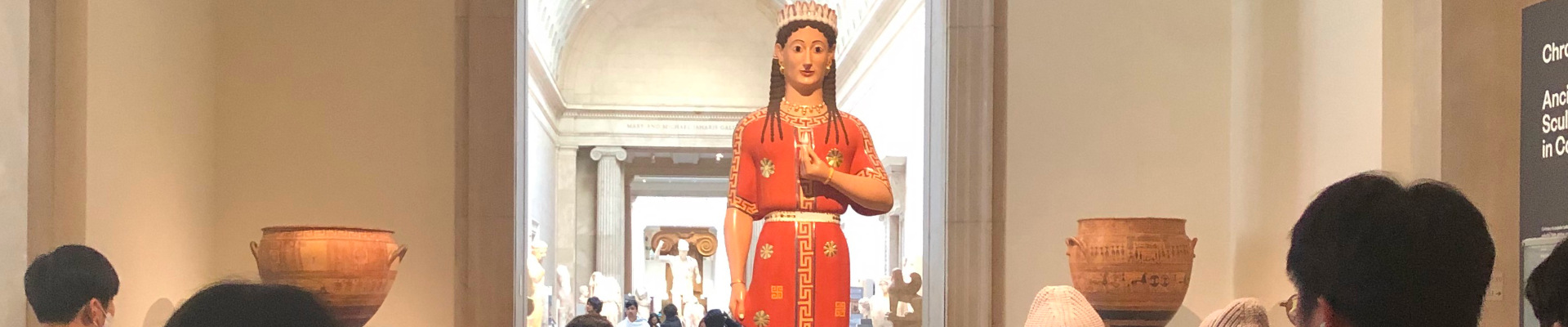
Friends of ASOR present the next webinar in our monthly series on March 9, 2023, at 3:00 pm EST, featuring Dr. Pinar Durgun and moderated by Dr. Kiersten Neumann. It may be difficult to imagine the ancient world in color when museums display ancient objects in white galleries. Ancient objects themselves are now often in varying degrees of white, beige, and brown as the pigments on them often do not survive to our day or may not be visible to our naked eyes. But through archaeology and science, we know that the ancient world was vibrantly colorful. So why do colorful reconstructions look “off” to us? Where does the idea of a white sculpture come from? How can color change the perception of the ancient world for the modern museum visitor? This talk will explore some of the past and present ways of showcasing color in the ancient world and question what can be done for the future.

Join Dr. Durgun as she reveals a world of color and mystery through the lens and experience of both a museum curator and the museum visitor. The webinar will conclude with a Q&A session moderated by Dr. Kiersten Neumann (Oriental Institute).


Dr. Pınar Durgun is an art historically-trained archaeologist with a strong background in anthropology and museums, while also being passionate about outreach and education. She is interested in how museums can help us understand, protect, and engage with the past and how they can better serve our communities today. Her research focuses on ancient Anatolia and western Asia, the history of death and burial, image and identity making, digital museums, and museum ethics. She aims to make academic information about the ancient world accessible, fun, and inclusive. Dr. Durgun creates and curates educational content about art and the ancient world for museums, academic/educational organizations, and for social media. She currently works as a curator for the Vorderasiatisches Museum (Museum of Ancient Near East) in Berlin.

This webinar will be recorded and all paid registrants will be sent a link to view the recording.

ASOR Sustaining Members: $0 | ASOR Members: $6 | Public: $12
Season Pass: ASOR Sustaining Members: $0 | ASOR Members: $75 | Public: $150
Buy one here!

To receive your ASOR member discount, log into the online store. If you are new to ASOR, please click on the “New Visitor Registration” link to register your e-mail address and choose a password for our online store. Once logged in, navigate to “Meeting and Event Registration” to register for the webinar and pay the fee. Each paid registrant will receive a confirmation e-mail when you pay for the webinar. If you do not receive this e-mail, then you are not registered. Please e-mail membership@asor.org with any questions or issues with registering.

You will be e-mailed the Zoom Webinar link in the week prior to the lecture on March 9, 2023. If you do not receive the link by the close of business two days before the webinar, please e-mail membership@asor.org immediately. This webinar will be recorded and all paid registrants will be sent a link to view the recording.

All proceeds from this webinar are used to fund scholarships for members as well as increasing ASOR’s online resources, which are free to the public.

READY FOR A WEBINAR SEASON PASS?

Buy a season pass for all the webinars* of the 2022-2023 FOA Webinar Season! 1) You will automatically receive the Zoom link for each webinar so no need to register each time. 2) You will also receive the recording of each webinar automatically after the event.

If you have missed webinars earlier in the season and still want to buy the pass, you will receive the links to the recordings of the webinars you missed in your automatic confirmation email after you buy the pass.

*Special symposiums may be excluded from the season pass price.

No more registering for a year if you buy your pass today!

Pricing:

Members: $75.00
Non-Members: $150.00
ASOR Sustaining Members: $0 (automatic registration for each webinar)
Not a member yet? Click here to join as a member and receive the 50% off a season pass!


Log into our online store to purchase the season pass for 2022-2023. If you are new to ASOR and do not have a record in our store yet, click here to register. After you login, navigate to the left to “Meeting and Event Registration.” Please e-mail membership@asor.org if you have any questions or issues.


WHY SPONSOR A WEBINAR?

Several levels of support from $50-$1,000 are available. Proceeds go towards membership scholarships and towards increasing ASOR’s virtual resources. Each sponsorship is tax-deductible and you can give your friends free registrations to a webinar!

Bronze Level ($50): up to 2 guest registrations
Silver Level ($100): up to 5 guest registrations
Gold Level ($500): up to 20 guest registrations
Platinum Level ($1,000): up to 50 guest registrations

After you sign up for a sponsorship online or over the phone, email the names and email addresses of your guests to Felice Herman at membership@asor.org, who will send your guests a confirmation and the Zoom link before the webinar.

WANT TO SAVE $6.00 ON THE NEXT WEBINAR?

Join ASOR as a member! Click here for more details about discounts for events and other benefits of membership. Memberships start at $40 for the year as an Associate Member.

Not ready to join yet? Become a Friend of ASOR for FREE!

Click here for more details about our online resources.

PAST WEBINARS

You can now purchase the link to the recording of any webinar. You can also purchase the bundle packages of all webinars from the 2020-2022 seasons. Please e-mail membership@asor.org for purchase details.

To see a printable pdf of the webinar titles from the 2020-2021 season, please click here. To see a printable pdf of the webinar titles from the 2021-2022 season, please click here.

Pricing:

Members: $6.00 per recording
Non-Members: $12.00 per recording
Bundle of 2020-2021 Webinars: $75.00
Bundle of 2021-2022 Webinars: $75.00
Bundle of 2020-2022 Webinars: $125.00

2021-2022 Season

A World at War: Protecting Cultural Heritage in Times of Conflict
Patty Gerstenblith (DePaul University), Lisa Ackerman (Columbus Citizens Foundation), Andrew Cohen (Government Professional and Cultural Heritage Expert) | May 12, 2022

Preserving Cultural Heritage in Hisban and Umm al-Jimal, Jordan
Øystein LaBianca (Andrews University), Elizabeth Osinga (Umm al-Jimal Archaeological Project), Darrell Rohl (Calvin University) | April 24, 2022

Back to the Field: Recent Discoveries & Summer Plans 2022
Lorenzo d’Alfonso (ISAW), Kathryn Grossman (NC State University), James R. Strange (Samford University) | April 3, 2022

Uncovering What is Nubian Beneath the Veneer of Egyptianness: Excavating the Archives
Debora Heard (University of Chicago) | March 20, 2022

Where Are They Now?: A Preview of 2022 ASOR-Affiliated Fieldwork Projects
Michael Given (University of Glasgow), Xenia-Paula Kyriakou (Florida Gulf Coast University), Stephen Batiuk (University of Toronto), Monique Roddy (Walla Walla University), Kent Bramlett (La Sierra University), Friedbert Ninow (La Sierra University), and Michael Hoff (University of Nebraska-Lincoln) | March 8, 2022

Excavations at Tel Gezer: A Personal Story
Sam Wolff (Tel Gezer Laboratory) | February 20, 2022

Tel Rehov: A Major Bronze and Iron Age City in the Jordan Valley
Amihai Mazar (Hebrew University of Jerusalem), Nava Panitz-Cohen ( Hebrew University of Jerusalem), Nota Kourou (Athens University), Naama Yahalom-Mack (Hebrew University of Jerusalem), Robert Mullins (Azusa Pacific University) | February 10, 2022

The Not-So-Innocents Abroad: The Beginnings of American Biblical Archaeology
Rachel Hallote (Samford University) | January 20, 2022

Synagogues as Jesus Knew Them
James R. Strange (Samford University) | December 2, 2021

Under Jerusalem: The Buried History of the World’s Most Contested City
Andrew Lawler | November 4, 2021

Jesus and Jerusalem on TV: How Do Bible Documentaries Get Made?
Robert Cargill (University of Iowa) | October 17, 2021

Digging the Divine?: Judahite Pillar Figurines and the Archaeology of Israelite Religion
Erin Darby (University of Tennessee) | October 7, 2021

David, Solomon, and Rehoboam’s Kingdom—The Archaeological Evidence
Yosef Garfinkel (Hebrew University of Jerusalem) | September 19, 2021

From Standing Stones to Sacred Emptiness: Textual and Visual Portrayals of Israel’s God
Theodore Lewis (Johns Hopkins University) | August 29, 2021

2020-2021 Season

Making May Matter: Webinarathon to Endow Diversity
Multiple Speakers | May 21-23, 2021

Archaeogaming: Why Video Games Deserve Their Own Archaeology
Tine Rassalle (University of North Carolina at Chapel Hill), Shannon Martino (Morton College), Matthew Winter (University of Arizona), Michael Zimmerman (Rhode Island) | April 18, 2021

How the Bible Became a Book
William Schniedewind (UCLA) | March 21, 2021

The Mysteries of Mithras in Caesarea: Exploring the Cult’s Rites and Remains
Jane DeRose Evans (Temple University), Alexandra Ratzlaff (Brandeis University) | March 11, 2021

Archaeology and the Hidden Religious Culture of Israelite Women
Carol Meyers (Duke University) | February 21, 2021

Meet the Directors—Fundraiser to Support ASOR’s Affiliated Overseas Research Centers
Matthew J. Adams (AIAR), Pearce Paul Creasman (ACOR), Lindy Crewe (CAARI) | February 11, 2021

Early Synagogues, Jesus, and Galilee—A Jewish Perspective
Eric Meyers (Duke University) | December 13, 2020

Home Sweet Home: Ancient Israelite Households in Context
Cynthia Shafer-Elliott (William Jessup University) | October 18, 2020

Priestesses in the Days of Solomon and Ahab
Susan Ackerman (Dartmouth College) | September 13, 2020

Digging Deeper: How Archaeology Works
Eric H. Cline (The George Washington University) | August 9, 2020

FOA Webinar: Greg Mumford on February 23

FRIENDS OF ASOR WEBINARS

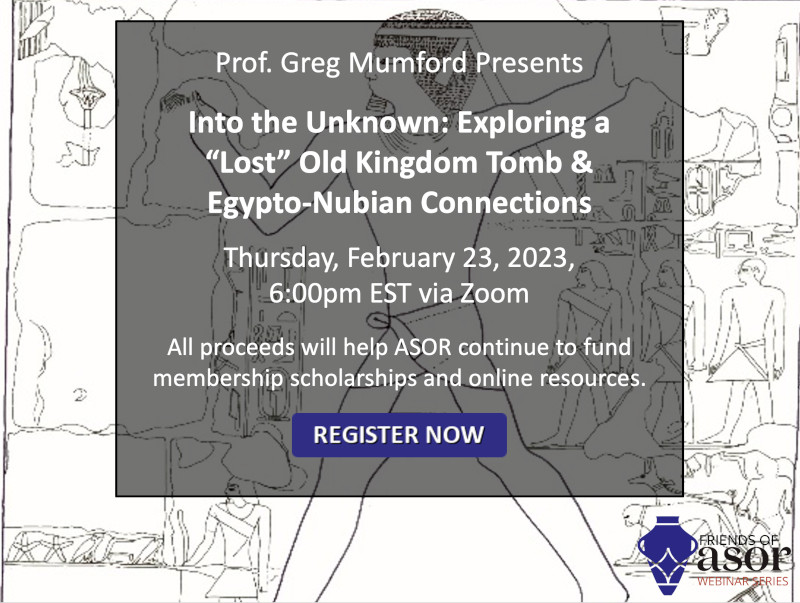
Into the Unknown: Exploring a “Lost” Old Kingdom Tomb & Egypto-Nubian Connections

Friends of ASOR present the next webinar in our monthly series on February 23, 2023, at 6:00 pm EST, featuring Prof. Greg Mumford and moderated by Prof. Stuart Tyson Smith. This presentation briefly introduces the complicated circumstances and setting of a decorative program from a late Old Kingdom tomb belonging to Niankhnisut, who spanned late Dynasty 5 through early Dynasty 6 (temp. Kings Unas to Teti). Like many Ancient Egyptian elite tombs, this tomb chapel apparently displayed extensive damage by the time of its rediscovery and looting in 1917 (during World War I), with looters removing numerous blocks and extensive scenes, which were in turn obtained and dispersed by a dealer, Jacob Hirsch, to at least 18 museums and collections across the globe.  Although the precise location of Niankhnisut’s tomb remained unknown for many decades, in 2000 the Supreme Council of Antiquities (now MoA) located and excavated this tomb, finding further scenes and numerous ex-situ fragments.

This webinar continues with an examination of an aspect of the decoration from Niankhnisut’s tomb, namely Egypto-Nubian relations in the Old Kingdom: Several scenes from this tomb, like many other Old Kingdom elite tombs, illustrate the presence of exotic fauna, frequently in conjunction with little people (i.e., “dwarfs” and/or pygmies), which reflect Egyptian interrelations with Nubia and Punt, which is widely attested via archaeological and textual-pictorial sources. The Old Kingdom court and elite often feature the employment of little people as animal handlers alongside imported Nubian primates, felines, and dogs, with an added emphasis upon the desirability of utilizing dwarfs and sometimes sub-Saharan pygmies, for diverse employment within the royal court and broader settings, including jewelry production, animal handlers, bearers, entertainers, and other roles.  The presentation cannot encompass the much broader aspects of Egypto-Nubian relations during the second millennium BCE, but will touch upon further aspects in relation to Niankhnisut’s tomb scenes and the importation of exotic animals from Nubia. The webinar will conclude with a live Q&A session moderated by Prof. Stuart Tyson Smith (University of California, Santa Barbara).

Professor Greg Mumford grew up in Kenya (1965-1976) and South Africa (1977-1980), during which he accompanied his parents on frequent trips to archaeological sites, museums, and public lectures in these and adjacent countries. Mumford later pursued studies in archaeology and Egyptology at the University of Toronto, expanding his interests to Egypt’s relations with its neighbours.  He direct projects at Tell Tebilla (NE Delta) and Markha Plain (SW Sinai) in Egypt, and work frequently with his spouse, Dr. S. Parcak, on several joint projects, including assisting at el-Lisht, Egypt. Mumford has also participated variously in prehistoric through Roman-Coptic period projects at East Karnak (Luxor), Tomb of Merenptah (Valley of the Kings), Amarna and its vicinity (Middle Egypt), Dakhleh Oasis (Western Desert), Mendes (NE Delta), Tell Kedwa (NW Sinai), and Tell Borg (NW Sinai), and has taught at Wilfrid Laurier University (1995), UCLA (1999-2000), the University of Toronto (1999-2005), and the University of Wales Swansea (2005-2006), and is now based –as an associate professor– at the University of Alabama at Birmingham (2006/7-present).

This webinar will be recorded and all paid registrants will be sent a link to view the recording.

ASOR Sustaining Members: $0 | ASOR Members: $6 | Public: $12
Season Pass: ASOR Sustaining Members: $0 | ASOR Members: $75 | Public: $150
Buy one here!

To receive your ASOR member discount, log into the online store. If you are new to ASOR, please click on the “New Visitor Registration” link to register your e-mail address and choose a password for our online store. Once logged in, navigate to “Meeting and Event Registration” to register for the webinar and pay the fee. Each paid registrant will receive a confirmation e-mail when you pay for the webinar. If you do not receive this e-mail, then you are not registered. Please e-mail membership@asor.org with any questions or issues with registering.

You will be e-mailed the Zoom Webinar link in the week prior to the lecture on February 23, 2023. If you do not receive the link by the close of business on the Tuesday before the webinar, please e-mail membership@asor.org immediately. This webinar will be recorded and all paid registrants will be sent a link to view the recording.

All proceeds from this webinar are used to fund scholarships for members as well as increasing ASOR’s online resources, which are free to the public.

READY FOR A WEBINAR SEASON PASS?

Buy a season pass for all the webinars* of the 2022-2023 FOA Webinar Season! 1) You will automatically receive the Zoom link for each webinar so no need to register each time. 2) You will also receive the recording of each webinar automatically after the event.

If you have missed webinars earlier in the season and still want to buy the pass, you will receive the links to the recordings of the webinars you missed in your automatic confirmation email after you buy the pass.

*Special symposiums may be excluded from the season pass price.

No more registering for a year if you buy your pass today!

Pricing:

Members: $75.00
Non-Members: $150.00
ASOR Sustaining Members: $0 (automatic registration for each webinar)
Not a member yet? Click here to join as a member and receive the 50% off a season pass!

Log into our online store to purchase the season pass for 2022-2023. If you are new to ASOR and do not have a record in our store yet, click here to register. After you login, navigate to the left to “Meeting and Event Registration.” Please e-mail membership@asor.org if you have any questions or issues.

WHY SPONSOR A WEBINAR?

Several levels of support from $50-$1,000 are available. Proceeds go towards membership scholarships and towards increasing ASOR’s virtual resources. Each sponsorship is tax-deductible and you can give your friends free registrations to a webinar!

Bronze Level ($50): up to 2 guest registrations
Silver Level ($100): up to 5 guest registrations
Gold Level ($500): up to 20 guest registrations
Platinum Level ($1,000): up to 50 guest registrations

After you sign up for a sponsorship online or over the phone, email the names and email addresses of your guests to Felice Herman at membership@asor.org, who will send your guests a confirmation and the Zoom link before the webinar.

WANT TO SAVE $6.00 ON THE NEXT WEBINAR?

Join ASOR as a member! Click here for more details about discounts for events and other benefits of membership. Memberships start at $40 for the year as an Associate Member.

Not ready to join yet? Become a Friend of ASOR for FREE!

Click here for more details about our online resources.


PAST WEBINARS

You can now purchase the link to the recording of any webinar. You can also purchase the bundle packages of all webinars from the 2020-2022 seasons. Please e-mail membership@asor.org for purchase details.

To see a printable pdf of the webinar titles from the 2020-2021 season, please click here. To see a printable pdf of the webinar titles from the 2021-2022 season, please click here.

Pricing:

Members: $6.00 per recording
Non-Members: $12.00 per recording
Bundle of 2020-2021 Webinars: $75.00
Bundle of 2021-2022 Webinars: $75.00
Bundle of 2020-2022 Webinars: $125.00

2021-2022 Season

A World at War: Protecting Cultural Heritage in Times of Conflict
Patty Gerstenblith (DePaul University), Lisa Ackerman (Columbus Citizens Foundation), Andrew Cohen (Government Professional and Cultural Heritage Expert) | May 12, 2022

Preserving Cultural Heritage in Hisban and Umm al-Jimal, Jordan
Øystein LaBianca (Andrews University), Elizabeth Osinga (Umm al-Jimal Archaeological Project), Darrell Rohl (Calvin University) | April 24, 2022

Back to the Field: Recent Discoveries & Summer Plans 2022
Lorenzo d’Alfonso (ISAW), Kathryn Grossman (NC State University), James R. Strange (Samford University) | April 3, 2022

Uncovering What is Nubian Beneath the Veneer of Egyptianness: Excavating the Archives
Debora Heard (University of Chicago) | March 20, 2022

Where Are They Now?: A Preview of 2022 ASOR-Affiliated Fieldwork Projects
Michael Given (University of Glasgow), Xenia-Paula Kyriakou (Florida Gulf Coast University), Stephen Batiuk (University of Toronto), Monique Roddy (Walla Walla University), Kent Bramlett (La Sierra University), Friedbert Ninow (La Sierra University), and Michael Hoff (University of Nebraska-Lincoln) | March 8, 2022

Excavations at Tel Gezer: A Personal Story
Sam Wolff (Tel Gezer Laboratory) | February 20, 2022

Tel Rehov: A Major Bronze and Iron Age City in the Jordan Valley
Amihai Mazar (Hebrew University of Jerusalem), Nava Panitz-Cohen ( Hebrew University of Jerusalem), Nota Kourou (Athens University), Naama Yahalom-Mack (Hebrew University of Jerusalem), Robert Mullins (Azusa Pacific University) | February 10, 2022

The Not-So-Innocents Abroad: The Beginnings of American Biblical Archaeology
Rachel Hallote (Samford University) | January 20, 2022

Synagogues as Jesus Knew Them
James R. Strange (Samford University) | December 2, 2021

Under Jerusalem: The Buried History of the World’s Most Contested City
Andrew Lawler | November 4, 2021

Jesus and Jerusalem on TV: How Do Bible Documentaries Get Made?
Robert Cargill (University of Iowa) | October 17, 2021

Digging the Divine?: Judahite Pillar Figurines and the Archaeology of Israelite Religion
Erin Darby (University of Tennessee) | October 7, 2021

David, Solomon, and Rehoboam’s Kingdom—The Archaeological Evidence
Yosef Garfinkel (Hebrew University of Jerusalem) | September 19, 2021

From Standing Stones to Sacred Emptiness: Textual and Visual Portrayals of Israel’s God
Theodore Lewis (Johns Hopkins University) | August 29, 2021

2020-2021 Season

Making May Matter: Webinarathon to Endow Diversity
Multiple Speakers | May 21-23, 2021

Archaeogaming: Why Video Games Deserve Their Own Archaeology
Tine Rassalle (University of North Carolina at Chapel Hill), Shannon Martino (Morton College), Matthew Winter (University of Arizona), Michael Zimmerman (Rhode Island) | April 18, 2021

How the Bible Became a Book
William Schniedewind (UCLA) | March 21, 2021

The Mysteries of Mithras in Caesarea: Exploring the Cult’s Rites and Remains
Jane DeRose Evans (Temple University), Alexandra Ratzlaff (Brandeis University) | March 11, 2021

Archaeology and the Hidden Religious Culture of Israelite Women
Carol Meyers (Duke University) | February 21, 2021

Meet the Directors—Fundraiser to Support ASOR’s Affiliated Overseas Research Centers
Matthew J. Adams (AIAR), Pearce Paul Creasman (ACOR), Lindy Crewe (CAARI) | February 11, 2021

Early Synagogues, Jesus, and Galilee—A Jewish Perspective
Eric Meyers (Duke University) | December 13, 2020

Home Sweet Home: Ancient Israelite Households in Context
Cynthia Shafer-Elliott (William Jessup University) | October 18, 2020

Priestesses in the Days of Solomon and Ahab
Susan Ackerman (Dartmouth College) | September 13, 2020

Digging Deeper: How Archaeology Works
Eric H. Cline (The George Washington University) | August 9, 2020

FOA Webinar: Sarah Parcak on February 8

FRIENDS OF ASOR WEBINARS

Secrets of Egypt’s Middle Kingdom Capital: el-Lisht

Friends of ASOR present the next webinar in our monthly series on February 8, 2023, at 6:00 pm EST, featuring Prof. Sarah Parcak and moderated by Prof. Kara Cooney. This lecture will discuss exciting new discoveries and ongoing work at the site of Lisht, Egypt. Lisht was Egypt’s Middle Kingdom Capital, called Itj-Tawy, dating to ca. 1900 BCE, and contains the pyramids of the two co-founders of Dynasty 12, Amenemhat 1 and Senwosret 1 (father and son), as well as a cemetery with the tombs of the many thousands of officials, artisans, and soldiers who called Itj-Tawy home. The city itself is buried in the floodplain, and its exact location is not known by Egyptologists. It is Egypt’s greatest primarily unexcavated ancient capital, and contains countless treasures that will help to rewrite the history of a period of time about which we know relatively little compared to Egypt’s Old and New Kingdoms (The Pyramid age and Egypt’s Golden age).

The Lisht Mission, a Joint project between the University of Alabama at Birmingham and Egypt’s Ministry of Antiquities, commenced work in 2015, discovering a tomb of a previously unattested individual, over 800 Middle Kingdom tombs, and the hints of Itj-tawy’s suburbs. We will discuss the project, as well as future plans at the site using new mapping technologies.

Join Prof. Parcak as she uncovers the secrets of this intriguing site and what it can tell us about life in Egypt during the Middle Kingdom period. The webinar will conclude with a Q&A session with fellow Egyptologist, Prof. Kara Cooney (University of California, Los Angeles).

Sarah Parcak, is an Archaeologist and Egyptologist and has worked on excavations in 14 countries across the globe since 1999. Sarah attended Yale University for her BA, and received her M.Phil and PhD degrees from Cambridge University in the UK in 2005. She lectured at the University of Wales-Swansea before starting work in the Dept of Anthropology at the University of Alabama at Birmingham in 2006, where she is now a full Professor.

Sarah is the author of Satellite Remote Sensing For Archaeology (Routledge 2009) and Archaeology from Space: How the Future Shapes Our Past (Henry Holt 2019), which won the Phi Beta Kappa 2020 Book Award for Science, as well as many peer-reviewed academic papers. She is a National Geographic Society Explorer, a Young Global Leader, a Fellow of the Society of Antiquaries, a TED Senior Fellow, winner of the 2016 TED Prize, 2016 recipient of the Smithsonian Institute American Ingenuity Award, a 2018 recipient of the Explorer’s Club Lowell Thomas Award, and a 2020 recipient of the Roy Chapman Andrews Society Distinguished Explorer’s Award.

Sarah serves as the Founder and President of Globalxplorer, a non-profit dedicated to using cutting edge technologies to protect and preserve cultural heritage. She co-directs the Joint Lisht Mission with Egypt’s Ministry of Antiquities, which focuses on the excavation and survey of Egypt’s Middle Kingdom capital. Her research has been featured in multiple BBC-Discovery Channel and PBS-Nova documentaries.

Sarah collaborates with her husband, Dr. Greg Mumford, on multiple archaeology projects, when they are not busy chasing after their 10 year-old son Gabriel, who already knows more about ancient Egypt than they do. Her hobbies include birdwatching, golf, and baking.

This webinar will be recorded and all paid registrants will be sent a link to view the recording.

ASOR Sustaining Members: $0 | ASOR Members: $6 | Public: $12
Season Pass: ASOR Sustaining Members: $0 | ASOR Members: $75 | Public: $150
Buy one here!

To receive your ASOR member discount, log into the online store. If you are new to ASOR, please click on the “New Visitor Registration” link to register your e-mail address and choose a password for our online store. Once logged in, navigate to “Meeting and Event Registration” to register for the webinar and pay the fee. Each paid registrant will receive a confirmation e-mail when you pay for the webinar. If you do not receive this e-mail, then you are not registered. Please e-mail membership@asor.org with any questions or issues with registering.

You will be e-mailed the Zoom Webinar link in the week prior to the lecture on February 8, 2023. If you do not receive the link by the close of business two days before the webinar, please e-mail membership@asor.org immediately. This webinar will be recorded and all paid registrants will be sent a link to view the recording.

All proceeds from this webinar are used to fund scholarships for members as well as increasing ASOR’s online resources, which are free to the public.

READY FOR A WEBINAR SEASON PASS?

Buy a season pass for all the webinars* of the 2022-2023 FOA Webinar Season! 1) You will automatically receive the Zoom link for each webinar so no need to register each time. 2) You will also receive the recording of each webinar automatically after the event.

If you have missed webinars earlier in the season and still want to buy the pass, you will receive the links to the recordings of the webinars you missed in your automatic confirmation email after you buy the pass.

*Special symposiums may be excluded from the season pass price.

No more registering for a year if you buy your pass today!

Pricing:

Members: $75.00
Non-Members: $150.00
ASOR Sustaining Members: $0 (automatic registration for each webinar)
Not a member yet? Click here to join as a member and receive the 50% off a season pass!


Log into our online store to purchase the season pass for 2022-2023. If you are new to ASOR and do not have a record in our store yet, click here to register. After you login, navigate to the left to “Meeting and Event Registration.” Please e-mail membership@asor.org if you have any questions or issues.

WHY SPONSOR A WEBINAR?

Several levels of support from $50-$1,000 are available. Proceeds go towards membership scholarships and towards increasing ASOR’s virtual resources. Each sponsorship is tax-deductible and you can give your friends free registrations to a webinar!

Bronze Level ($50): up to 2 guest registrations
Silver Level ($100): up to 5 guest registrations
Gold Level ($500): up to 20 guest registrations
Platinum Level ($1,000): up to 50 guest registrations

After you sign up for a sponsorship online or over the phone, email the names and email addresses of your guests to Felice Herman at membership@asor.org, who will send your guests a confirmation and the Zoom link before the webinar.

WANT TO SAVE $6.00 ON THE NEXT WEBINAR?

Join ASOR as a member! Click here for more details about discounts for events and other benefits of membership. Memberships start at $40 for the year as an Associate Member.

Not ready to join yet? Become a Friend of ASOR for FREE!

Click here for more details about our online resources.

PAST WEBINARS

You can now purchase the link to the recording of any webinar. You can also purchase the bundle packages of all webinars from the 2020-2022 seasons. Please e-mail membership@asor.org for purchase details.

To see a printable pdf of the webinar titles from the 2020-2021 season, please click here. To see a printable pdf of the webinar titles from the 2021-2022 season, please click here.

Pricing:

Members: $6.00 per recording
Non-Members: $12.00 per recording
Bundle of 2020-2021 Webinars: $75.00
Bundle of 2021-2022 Webinars: $75.00
Bundle of 2020-2022 Webinars: $125.00

2021-2022 Season

A World at War: Protecting Cultural Heritage in Times of Conflict
Patty Gerstenblith (DePaul University), Lisa Ackerman (Columbus Citizens Foundation), Andrew Cohen (Government Professional and Cultural Heritage Expert) | May 12, 2022

Preserving Cultural Heritage in Hisban and Umm al-Jimal, Jordan
Øystein LaBianca (Andrews University), Elizabeth Osinga (Umm al-Jimal Archaeological Project), Darrell Rohl (Calvin University) | April 24, 2022

Back to the Field: Recent Discoveries & Summer Plans 2022
Lorenzo d’Alfonso (ISAW), Kathryn Grossman (NC State University), James R. Strange (Samford University) | April 3, 2022

Uncovering What is Nubian Beneath the Veneer of Egyptianness: Excavating the Archives
Debora Heard (University of Chicago) | March 20, 2022

Where Are They Now?: A Preview of 2022 ASOR-Affiliated Fieldwork Projects
Michael Given (University of Glasgow), Xenia-Paula Kyriakou (Florida Gulf Coast University), Stephen Batiuk (University of Toronto), Monique Roddy (Walla Walla University), Kent Bramlett (La Sierra University), Friedbert Ninow (La Sierra University), and Michael Hoff (University of Nebraska-Lincoln) | March 8, 2022

Excavations at Tel Gezer: A Personal Story
Sam Wolff (Tel Gezer Laboratory) | February 20, 2022

Tel Rehov: A Major Bronze and Iron Age City in the Jordan Valley
Amihai Mazar (Hebrew University of Jerusalem), Nava Panitz-Cohen ( Hebrew University of Jerusalem), Nota Kourou (Athens University), Naama Yahalom-Mack (Hebrew University of Jerusalem), Robert Mullins (Azusa Pacific University) | February 10, 2022

The Not-So-Innocents Abroad: The Beginnings of American Biblical Archaeology
Rachel Hallote (Samford University) | January 20, 2022

Synagogues as Jesus Knew Them
James R. Strange (Samford University) | December 2, 2021

Under Jerusalem: The Buried History of the World’s Most Contested City
Andrew Lawler | November 4, 2021

Jesus and Jerusalem on TV: How Do Bible Documentaries Get Made?
Robert Cargill (University of Iowa) | October 17, 2021

Digging the Divine?: Judahite Pillar Figurines and the Archaeology of Israelite Religion
Erin Darby (University of Tennessee) | October 7, 2021

David, Solomon, and Rehoboam’s Kingdom—The Archaeological Evidence
Yosef Garfinkel (Hebrew University of Jerusalem) | September 19, 2021

From Standing Stones to Sacred Emptiness: Textual and Visual Portrayals of Israel’s God
Theodore Lewis (Johns Hopkins University) | August 29, 2021

2020-2021 Season

Making May Matter: Webinarathon to Endow Diversity
Multiple Speakers | May 21-23, 2021

Archaeogaming: Why Video Games Deserve Their Own Archaeology
Tine Rassalle (University of North Carolina at Chapel Hill), Shannon Martino (Morton College), Matthew Winter (University of Arizona), Michael Zimmerman (Rhode Island) | April 18, 2021

How the Bible Became a Book
William Schniedewind (UCLA) | March 21, 2021

The Mysteries of Mithras in Caesarea: Exploring the Cult’s Rites and Remains
Jane DeRose Evans (Temple University), Alexandra Ratzlaff (Brandeis University) | March 11, 2021

Archaeology and the Hidden Religious Culture of Israelite Women
Carol Meyers (Duke University) | February 21, 2021

Meet the Directors—Fundraiser to Support ASOR’s Affiliated Overseas Research Centers
Matthew J. Adams (AIAR), Pearce Paul Creasman (ACOR), Lindy Crewe (CAARI) | February 11, 2021

Early Synagogues, Jesus, and Galilee—A Jewish Perspective
Eric Meyers (Duke University) | December 13, 2020

Home Sweet Home: Ancient Israelite Households in Context
Cynthia Shafer-Elliott (William Jessup University) | October 18, 2020

Priestesses in the Days of Solomon and Ahab
Susan Ackerman (Dartmouth College) | September 13, 2020

Digging Deeper: How Archaeology Works
Eric H. Cline (The George Washington University) | August 9, 2020

FOA Webinar: Katie Paul on January 26

FRIENDS OF ASOR WEBINARS

Antiquities Trafficking in the Age of Social Media: How Big Tech Facilitates and Profits from the Digital Black Market

Friends of ASOR present the next webinar in our monthly series on January 26, 2023, at 6:00pm EST, featuring Katie A. Paul and moderated by Prof. Eric Cline. From the invasion of Ukraine to conflict in Syria, tech platforms like Facebook, YouTube, and TikTok have democratized global engagement in black markets. A new generation of tech-driven traffickers are capitalizing on Big Tech’s unregulated algorithms to maximize reach. Tech companies and traffickers alike profit from crime, providing monetization tools for antiquities looters to make money even without a sale.

When it comes to trafficking of cultural heritage and the financing of terrorism and organized crime, Big Tech platforms like Facebook and YouTube have provided digital toolkits that not only facilitate, but also accelerate the black market in cultural property while lining the pockets of both terror groups and tech companies alike.

Since 2018, the ATHAR Project has tracked networks of black-market antiquities trafficking groups across Facebook and other Big Tech platforms and documented thousands of artifacts trafficked in private and public Facebook groups to preserve critical evidence of looting and trafficking in the MENA region.

Technology companies have largely allowed traffickers and extremists to utilize these tools with impunity. The reach provided by Big Tech platforms has added a new dimension to terror finance and transnational crime, enabling illicit actors to more effectively traffic artifacts and finance their activities.

Facebook announced a ban of the trade of artifacts on its platform in June 2020. But a policy is only as valuable as its enforcement, and despite our multiple efforts to report antiquities trafficking content, Facebook makes no attempt to enforce their policy. Facebook is essentially knowingly facilitating the trafficking of cultural property that can amount to war crimes—and profiting from it.

No innovation of this kind has previously been so readily available to terror groups, transnational criminal organizations, or the average looter as it is today. The ATHAR Project’s years of research on Big Tech’s antiquities black market gives new insights into the next generation of traffickers and the type of regulation needed to reel in the growth of online black markets.

Join Katie Paul as she exposes the illegalities that lurk in plain sight on your favorite social media platforms. The webinar will conclude with a live Q&A session moderated by Prof. Eric Cline (The George Washington University).

Katie A. Paul (@AnthroPaulicy) is an anthropologist and investigative researcher who serves as the director of the Tech Transparency Project (TTP), where she specializes in tracking extremism, disinformation, and criminal activity on online platforms such as Facebook. She also serves as co-director and co-founder of the Antiquities Trafficking and Heritage Anthropology Research (ATHAR) Project and a founding member of the Alliance to Counter Crime Online (ACCO) where she focuses on trafficking, terror finance, and organized crime facilitated by Big Tech platforms.

Previously, Katie served as chief of staff and a research fellow at the Antiquities Coalition, a Washington, DC-based non-profit dedicated to combating cultural racketeering. She holds a bachelor’s degree from Miami University (OH) with a double major in Anthropology and Ancient Greek and earned an M.A. in Anthropology at The George Washington University.

This webinar will be recorded and all paid registrants will be sent a link to view the recording.

ASOR Sustaining Members: $0 | ASOR Members: $6 | Public: $12
Season Pass: ASOR Sustaining Members: $0 | ASOR Members: $75 | Public: $150
Buy one here!

To receive your ASOR member discount, log into the online store. If you are new to ASOR, please click on the “New Visitor Registration” link to register your e-mail address and choose a password for our online store. Once logged in, navigate to “Meeting and Event Registration” to register for the webinar and pay the fee. Each paid registrant will receive a confirmation e-mail when you pay for the webinar. If you do not receive this e-mail, then you are not registered. Please e-mail membership@asor.org with any questions or issues with registering.

You will be e-mailed the Zoom Webinar link in the week prior to the lecture on January 26, 2023. If you do not receive the link by the close of business two days before the webinar, please e-mail membership@asor.org immediately. This webinar will be recorded and all paid registrants will be sent a link to view the recording.

All proceeds from this webinar are used to fund scholarships for members as well as increasing ASOR’s online resources, which are free to the public.

READY FOR A WEBINAR SEASON PASS?

Buy a season pass for all the webinars* of the 2022-2023 FOA Webinar Season! 1) You will automatically receive the Zoom link for each webinar so no need to register each time. 2) You will also receive the recording of each webinar automatically after the event.

If you have missed webinars earlier in the season and still want to buy the pass, you will receive the links to the recordings of the webinars you missed in your automatic confirmation email after you buy the pass.

*Special symposiums may be excluded from the season pass price.

No more registering for a year if you buy your pass today!

Pricing:

Members: $75.00
Non-Members: $150.00
ASOR Sustaining Members: $0 (automatic registration for each webinar)
Not a member yet? Click here to join as a member and receive the 50% off a season pass!


Log into our online store to purchase the season pass for 2022-2023. If you are new to ASOR and do not have a record in our store yet, click here to register. After you login, navigate to the left to “Meeting and Event Registration.” Please e-mail membership@asor.org if you have any questions or issues.

WHY SPONSOR A WEBINAR?

Several levels of support from $50-$1,000 are available. Proceeds go towards membership scholarships and towards increasing ASOR’s virtual resources. Each sponsorship is tax-deductible and you can give your friends free registrations to a webinar!

Bronze Level ($50): up to 2 guest registrations
Silver Level ($100): up to 5 guest registrations
Gold Level ($500): up to 20 guest registrations
Platinum Level ($1,000): up to 50 guest registrations

After you sign up for a sponsorship online or over the phone, email the names and email addresses of your guests to Felice Herman at membership@asor.org, who will send your guests a confirmation and the Zoom link before the webinar.

WANT TO SAVE $6.00 ON THE NEXT WEBINAR?

Join ASOR as a member! Click here for more details about discounts for events and other benefits of membership. Memberships start at $40 for the year as an Associate Member.

Not ready to join yet? Become a Friend of ASOR for FREE!

Click here for more details about our online resources.

PAST WEBINARS

You can now purchase the link to the recording of any webinar. You can also purchase the bundle packages of all webinars from the 2020-2022 seasons. Please e-mail membership@asor.org for purchase details.

To see a printable pdf of the webinar titles from the 2020-2021 season, please click here. To see a printable pdf of the webinar titles from the 2021-2022 season, please click here.

Pricing:

Members: $6.00 per recording
Non-Members: $12.00 per recording
Bundle of 2020-2021 Webinars: $75.00
Bundle of 2021-2022 Webinars: $75.00
Bundle of 2020-2022 Webinars: $125.00

2021-2022 Season

A World at War: Protecting Cultural Heritage in Times of Conflict
Patty Gerstenblith (DePaul University), Lisa Ackerman (Columbus Citizens Foundation), Andrew Cohen (Government Professional and Cultural Heritage Expert) | May 12, 2022

Preserving Cultural Heritage in Hisban and Umm al-Jimal, Jordan
Øystein LaBianca (Andrews University), Elizabeth Osinga (Umm al-Jimal Archaeological Project), Darrell Rohl (Calvin University) | April 24, 2022

Back to the Field: Recent Discoveries & Summer Plans 2022
Lorenzo d’Alfonso (ISAW), Kathryn Grossman (NC State University), James R. Strange (Samford University) | April 3, 2022

Uncovering What is Nubian Beneath the Veneer of Egyptianness: Excavating the Archives
Debora Heard (University of Chicago) | March 20, 2022

Where Are They Now?: A Preview of 2022 ASOR-Affiliated Fieldwork Projects
Michael Given (University of Glasgow), Xenia-Paula Kyriakou (Florida Gulf Coast University), Stephen Batiuk (University of Toronto), Monique Roddy (Walla Walla University), Kent Bramlett (La Sierra University), Friedbert Ninow (La Sierra University), and Michael Hoff (University of Nebraska-Lincoln) | March 8, 2022

Excavations at Tel Gezer: A Personal Story
Sam Wolff (Tel Gezer Laboratory) | February 20, 2022

Tel Rehov: A Major Bronze and Iron Age City in the Jordan Valley
Amihai Mazar (Hebrew University of Jerusalem), Nava Panitz-Cohen ( Hebrew University of Jerusalem), Nota Kourou (Athens University), Naama Yahalom-Mack (Hebrew University of Jerusalem), Robert Mullins (Azusa Pacific University) | February 10, 2022

The Not-So-Innocents Abroad: The Beginnings of American Biblical Archaeology
Rachel Hallote (Samford University) | January 20, 2022

Synagogues as Jesus Knew Them
James R. Strange (Samford University) | December 2, 2021

Under Jerusalem: The Buried History of the World’s Most Contested City
Andrew Lawler | November 4, 2021

Jesus and Jerusalem on TV: How Do Bible Documentaries Get Made?
Robert Cargill (University of Iowa) | October 17, 2021

Digging the Divine?: Judahite Pillar Figurines and the Archaeology of Israelite Religion
Erin Darby (University of Tennessee) | October 7, 2021

David, Solomon, and Rehoboam’s Kingdom—The Archaeological Evidence
Yosef Garfinkel (Hebrew University of Jerusalem) | September 19, 2021

From Standing Stones to Sacred Emptiness: Textual and Visual Portrayals of Israel’s God
Theodore Lewis (Johns Hopkins University) | August 29, 2021

2020-2021 Season

Making May Matter: Webinarathon to Endow Diversity
Multiple Speakers | May 21-23, 2021

Archaeogaming: Why Video Games Deserve Their Own Archaeology
Tine Rassalle (University of North Carolina at Chapel Hill), Shannon Martino (Morton College), Matthew Winter (University of Arizona), Michael Zimmerman (Rhode Island) | April 18, 2021

How the Bible Became a Book
William Schniedewind (UCLA) | March 21, 2021

The Mysteries of Mithras in Caesarea: Exploring the Cult’s Rites and Remains
Jane DeRose Evans (Temple University), Alexandra Ratzlaff (Brandeis University) | March 11, 2021

Archaeology and the Hidden Religious Culture of Israelite Women
Carol Meyers (Duke University) | February 21, 2021

Meet the Directors—Fundraiser to Support ASOR’s Affiliated Overseas Research Centers
Matthew J. Adams (AIAR), Pearce Paul Creasman (ACOR), Lindy Crewe (CAARI) | February 11, 2021

Early Synagogues, Jesus, and Galilee—A Jewish Perspective
Eric Meyers (Duke University) | December 13, 2020

Home Sweet Home: Ancient Israelite Households in Context
Cynthia Shafer-Elliott (William Jessup University) | October 18, 2020

Priestesses in the Days of Solomon and Ahab
Susan Ackerman (Dartmouth College) | September 13, 2020

Digging Deeper: How Archaeology Works
Eric H. Cline (The George Washington University) | August 9, 2020