The Stele of Goddess Lama and Mesopotamian Engagement with the Past
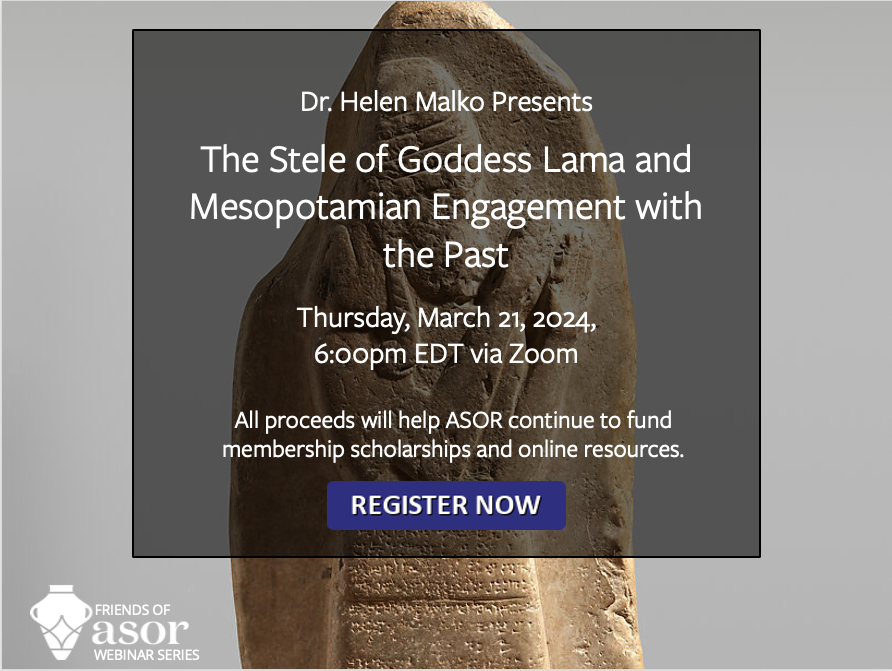
For the people of Mesopotamia, the past was a source of knowledge and inspiration. Their reverence, both in terms of preserving early buildings and monuments and reviving images and ancient writing styles, is evident in archaeological and textual records. While Mesopotamian monuments and images were produced as historical works, inscribed with texts that marked them clearly and linked them to specific events and times, their efficacy was understood to be unlimited. Dated to the reign of king Nazi-Maruttash (ca. 1307–1282 BCE), the stele of the Goddess Lama, currently in the collections of the Metropolitan Museum, offers an excellent opportunity to explore Mesopotamian interaction with the past during the Kassite period (ca. 1574–1157 BCE). Through visual and textual analysis, this talk examines the survival of Lama imagery in this period. It reflects on the religious/political significance of the stele’s production within a broader context. The aim is to demonstrate that the crudely carved and seemingly unimaginative reuse of an earlier protective goddess figure was a deliberately archaizing image and an inspired citation of the past.
This webinar will be recorded and all paid registrants will be sent a link to view the recording.
Helen Malko is the Associate Director of the Stanford Humanities Center, where she oversees various academic programs in the humanities and interpretive social sciences. Before joining Stanford, she worked at the American Center of Research (ACOR) and Columbia University Global Center in Amman, Jordan. Helen holds a Ph.D. in Anthropology and Archaeology from Stony Brook University and a BA from Baghdad University, and she is trained in cultural heritage and preservation studies. She has been awarded multiple fellowships at the Metropolitan Museum and Columbia University in New York and has conducted fieldwork and capacity-building projects in Iraq, Jordan, and Turkey.
*Please log in to the Online Portal BEFORE registering for the webinar. Once you have logged in, you will be able to register under our Events page linked above.
Please e-mail membership@asor.org with any questions or issues with registering.
All proceeds from this webinar are used to fund scholarships for members as well as increasing ASOR’s online resources, which are free to the public.
READY FOR A WEBINAR SEASON PASS?
Buy a season pass for all the webinars* of the 2023-2024 FOA Webinar Season! With a season pass, you will automatically be registered for every webinar in the season, and you will receive the recording of each webinar automatically after the event.
If you have missed webinars earlier in the season and still want to buy the pass, you will receive the links to the recordings of the webinars you missed in your automatic confirmation email after you buy the pass.
*Special symposiums may be excluded from the season pass price.
No more registering for a year if you buy your pass today!
Pricing:
ASOR Sustaining Members: $0 (automatic registration for each webinar) Members: $75 Public: $150
Several levels of support from $50-$1,000 are available. Proceeds go towards membership scholarships and towards increasing ASOR’s virtual resources. Each sponsorship is tax-deductible and you can give your friends free registrations to a webinar! Sponsor a webinar here.
Bronze Level ($50): up to 2 guest registrations Silver Level ($100): up to 5 guest registrations Gold Level ($500): up to 20 guest registrations Platinum Level ($1,000): up to 50 guest registrations
After you sign up for a sponsorship online or over the phone, email the names and email addresses of your guests to Katherine Schmitt at membership@asor.org, who will send your guests a confirmation and the Zoom link before the webinar.
WANT TO SAVE $6.00 ON THE NEXT WEBINAR?
Join ASOR as a member! Click here for more details about discounts for events and other benefits of membership. Memberships start at $40 for the year as an Associate Member.
Please e-mail the Membership office if you have any questions.
Pp. 4–13: “Religion(s) in Seals: Old and New Challenges,” by Fabio Porzia
Although seals are very mobile items and often reused, and although they can be regarded as mass media products given their large distribution in time, space, and different social classes, they are often used by scholars as a tool to map political, cultural, and religious borders. This contribution aims at reassessing the validity of using religious iconography on seals from the first-millennium BCE southern Levant for the study of ancient religion(s) from three aspects: that religion is thematized beyond ethnic borders; that religious motifs are studied beyond the quest of their origin; and that divine images are studied beyond the compulsion to provide them with proper names. Introducing the notion of adaption as a short form for adoption and adaptation, this article supports a more nuanced understanding of seal iconography in terms of shared cultural infrastructure and a common cultural landscape.
ASOR Members with online access: log into ASOR’s Online Portal here. Once logged in, click the JOURNALS tab in the top navigation bar. Tutorials for how to log in to the Online Portal as well as how to navigate to the Portal Journals page can be found here.
Pp. 14-19: “Mastering the Seven-Headed Serpent: A Stamp Seal from Hazor Provides a Missing Link between Cuneiform and Biblical Mythology,” by Christoph Uehlinger
The Stamp Seals from the Southern Levant (SSSL) project is based on a comprehensive corpus, big data, and complex historical scenarios. Sometimes, though, an individual artifact stands out as a highlight in its own right. Such is the case with a stamp seal discovered recently at Tel Hazor. It is unusual in several respects, but mainly because of its spectacular base engraving. The main scene represents a hero fighting a coiled, seven-headed serpent; it is enhanced by a series of mixed creatures and secondary motifs. This article offers a description and analysis of the object, situating its iconography in the long history of combat myths spanning from mid-third-millennium southern Mesopotamia through second-millennium northern Syria to first-millennium Phoenicia and Israel. Most significant for a historian of Near Eastern mythology, the seal provides a visual missing link in the main motif’s literary transition from Late Bronze Age Ugarit to the Hebrew Bible.
ASOR Members with online access: log into ASOR’s Online Portal here. Once logged in, click the JOURNALS tab in the top navigation bar. Tutorials for how to log in to the Online Portal as well as how to navigate to the Portal Journals page can be found here.
Pp. 20-25: “Stamp Seals as Jewelry: Identifying Body Ornaments through Seal Impressions,” by Noa Ranzer
Stamp seals had various functions in the Iron Age southern Levant. In addition to their use as stamping devices, they were also worn on the body like other pieces of jewelry and thus formed but one part of a larger design comprising different objects (e.g., metal wires, pins, fibulae). In their archaeological contexts, however, most seals are detached from their original mountings. Thus, we are left wondering how such a seal was displayed when worn on the body. As part of a more extensive ongoing study on the function of stamp seals during the Iron Age, this article examines how seal impressions can serve as an important dataset to begin identifying specific mounting techniques and, thus, the possible ways different seals were used as jewelry.
ASOR Members with online access: log into ASOR’s Online Portal here. Once logged in, click the JOURNALS tab in the top navigation bar. Tutorials for how to log in to the Online Portal as well as how to navigate to the Portal Journals page can be found here.
Pp. 26-31: “Making a Good Impression: A Typology of Mounted Seal Impressions in the Middle Bronze Age Southern Levant,” by Tatjana Beuthe
Mounted seals have frequently been uncovered in Middle Bronze Age archaeological contexts in the Levant and Egypt. However, direct evidence for the deployment of such seals to mark objects does not appear to have been systematically studied to date. This article presents an initial typology of impressions made using mounted seals found in the southern Levant. Material from the Corpus of Stamp Seals from the Southern Levant (CSSL) database indicates southern Levantine stamp seals set in rings and attached to other types of ornamentation were widely used as tools to create impressions.
ASOR Members with online access: log into ASOR’s Online Portal here. Once logged in, click the JOURNALS tab in the top navigation bar. Tutorials for how to log in to the Online Portal as well as how to navigate to the Portal Journals page can be found here.
Pp. 32-40: “‘Male until Proven Otherwise?’: Searching for Women with the Help of Inscribed Stamp Seals from Jerusalem,” by Bruno Biermann
Archaeological finds are often framed within androcentric biases, for example, representing inscribed seals as male-owned and used objects. However, this picture crumbles under critical examination. This article addresses presumptions about sex and seal ownership, focusing on inscribed seals from the Iron Age IIB–III from Jerusalem. Therefore, this article demonstrates how gender-archaeological research can contribute to new perspectives on Levantine stamp seals and material culture. This approach is based on provenanced artifacts found in archaeological excavations and their context and the careful examination of how gender is expressed or remains ambiguous in the inscriptions on these small objects. The presented dataset of inscribed seals and impressions on sealings and jar handles from Jerusalem suggests that women owned and used inscribed seals for a variety of purposes, including commerce and sealing of containers and jars, as well as being buried with them.
ASOR Members with online access: log into ASOR’s Online Portal here. Once logged in, click the JOURNALS tab in the top navigation bar. Tutorials for how to log in to the Online Portal as well as how to navigate to the Portal Journals page can be found here.
Pp. 42-52: “Scratching the Surface of Middle Bronze Age Scarabs: Investigating Enigmatic Marks on Stamp Seals from Lachish and Megiddo,” by Nadia Ben-Marzouk and Ben Greet
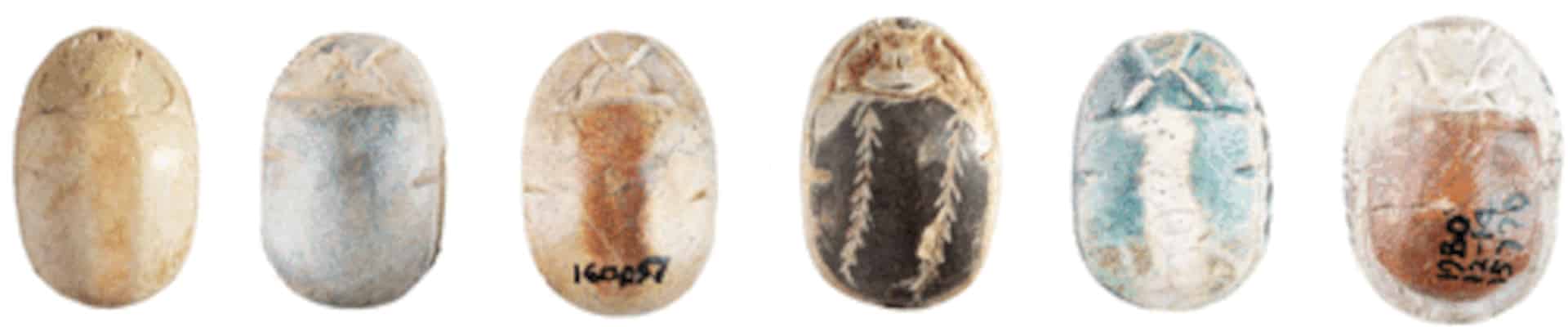
A distinct feature on many Middle Bronze Age scarabs from the southern Levant is the presence of chromatic marks on the backs of these objects, often described as longitudinal lines. Previous explanations have fallen into one of three proposals: Either they are the product of production-related techniques related to firing and glazing, intentionally applied marks, or the byproduct of use-wear related or depositional practices. To date, no critical investigation of these enigmatic marks has been published and thus no consensus reached. However, through new high-resolution photography of the stamp seals from the sites of Lachish and Megiddo in the southern Levant, a systematic analysis was recently permitted. This paper presents the results from a study on these enigmatic marks and a discussion on what the new photography reveals about previous interpretations and possible new directions for the study of this corpus.
ASOR Members with online access: log into ASOR’s Online Portal here. Once logged in, click the JOURNALS tab in the top navigation bar. Tutorials for how to log in to the Online Portal as well as how to navigate to the Portal Journals page can be found here.
Dar Ben Gacem Fellowship Report: ASOR Punic Project—3D Modeling of Stelae and Cippi from Carthage
Brien Garnand, Nederlands Instituut voor het Nabije Oosten, Leiden University
As we approach the 100th and 50th anniversaries of American excavations at the Precinct of Tinnit and Ba’l in Carthage (the so-called “tophet”), and with publication eminent for the final report from the ASOR Punic Project excavations, I have been preparing 3D models—both full-scale printed replicas of individual stelae and a scale model of the entire American sector—in anticipation of a commemorative exhibition. Although there have been dozens of excavations at “tophet” sites across the Mediterranean, we lack publication of final reports with precise contexts. My efforts during this fellowship represent early, tentative steps to remedy this deficit.
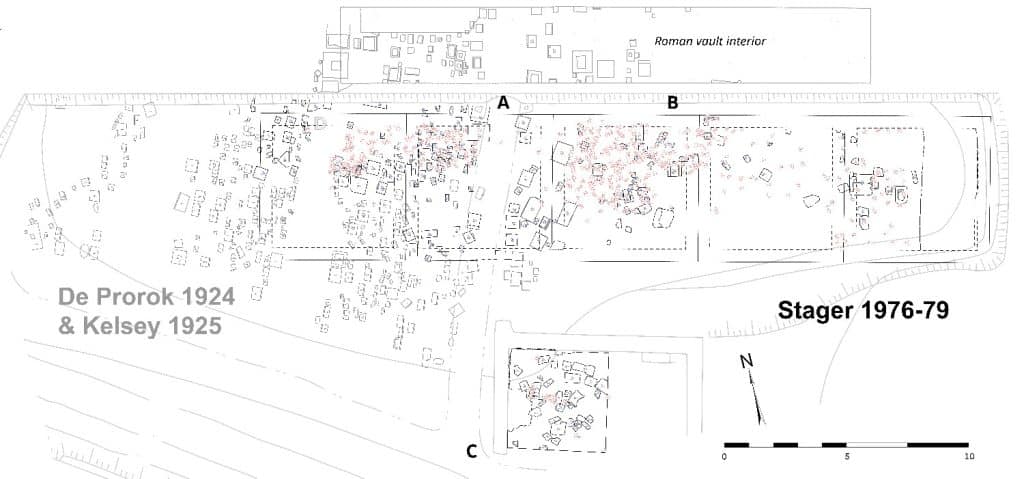
The scale model of the site will represent just the Regulus-Salammbô sector (Fig.1), the precise location of both the excavations of F. W. Kelsey / University of Michigan (1925) and of L. E. Stager / ASOR Punic Project (1975-1979). Total station readings taken in the early 2000s have allowed me to correct the Kelsey-Michigan blueprint plans and the Stager-ASOR field-note plans, but the Kelsey blueprint of stelae inside the Roman vault has yet to be corrected because they lay outside of the total station’s range.
Fig.1. Site plan combining the blueprints of Kelsey-Michigan excavations (grey) with plans from the field notes of the Stager-ASOR excavations (black, blue, red), both within the same Regulus-Salammbô sector of the precinct dedicated to Tinnit and Ba‘l in Carthage (modified from Garnand & Greene 2023: 157, map 4). Note that the alignment of the Roman vault is imprecise.
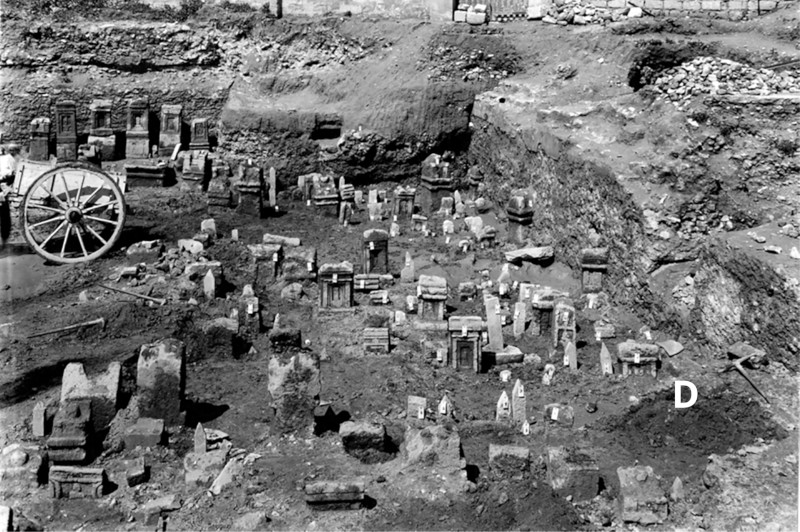
My goals during Dar Ben Gacem fellowship included initial negotiations to make hardware-based scans (Artec Spider) of limestone stelae in museum storerooms as well as actually making preliminary scans using software-based methods (Polycam) of sandstone cippi in the open-air museum at the precinct itself. You can follow the progress at our on-line workspace and on Sketchfab. The former methods will be reserved for those stelae in the Musee national de Carthage and in the Musee du Bardo, currently unavailable while they undergo inventory during museum renovations. I was able, however, to meet with museum curators and colleagues in the INP to make plans for the future. Once scanned, many stelae from American excavations can be replaced back into their precise contexts based upon the archival plans and upon annotated photographs that correspond to those plans (Fig.2).
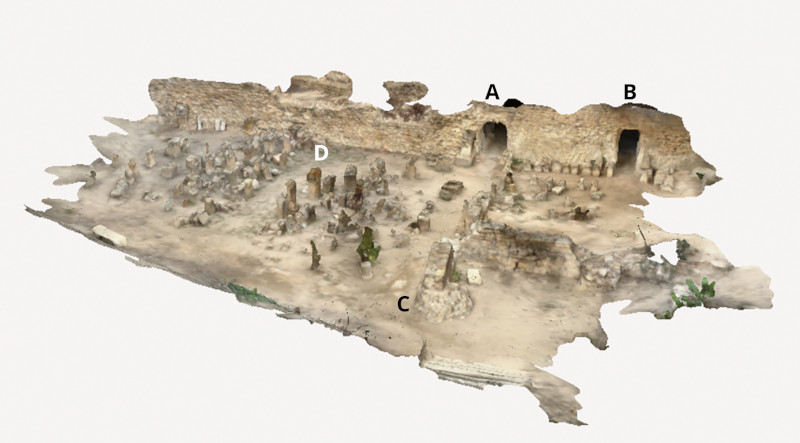
During the fellowship, I was able to stitch together a rough scan of stelae and cippi still in situ, and these stone artifacts and other landmarks will serve as reference points for alignment, e.g. point D in the archival photo (Fig.2) and point C in the plan (Fig.1) relate to key points on my stitched Polycam model (Fig.3). Since I did not have permission to scan stela imbedded inside the Roman foundation vault, for now just the openings in the vault can be roughly aligned with the site plan at points A and B in anticipation of future scanning. While hardware-based scanning can be prohibitively expensive, my preliminary software-based scans required only a LiDAR equipped iPhone 14 Pro. For the moment, however, the hardware-based system does provide higher quality results.
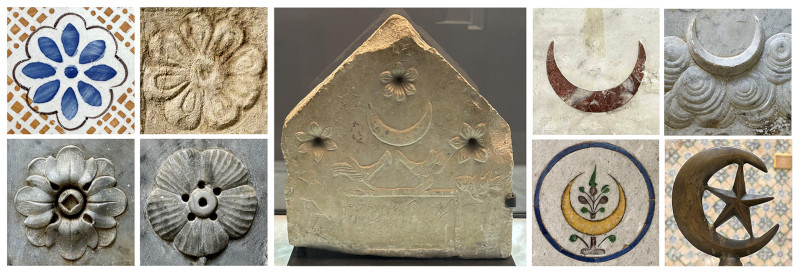
Since I held the inaugural Dar Ben Gacem fellowship, I should offer a preview for future fellows. My hosts provided multiple opportunities to network with Tunisian scholars, US Embassy attaches, and visiting artists, as well as opportunities for conversation with other guests during meals, while the well-appointed scholar apartment provided a refuge for quiet study. This carefully restored beylic official’s residence has a conference room, in nearly continual use, where I presented a hands-on workshop about Polycam. I compared the iconography of stelae that I was scanning to the decorative repertoire of the residence itself (Fig.4). The Dar Ben Gacem has served as a sort of laboratory for the restoration of buildings in the medina of Tunis, so 3D-scanning of interior spaces and architectural details offered a readily transferrable technology that allows for accurate assessment and reconstruction.
Fig.4. Punic iconography from Mactar (Bardo Cb-989) compared to the decorative repertoire of Dar Ben Gacem—the floret (left) and the lunar crescent (right).
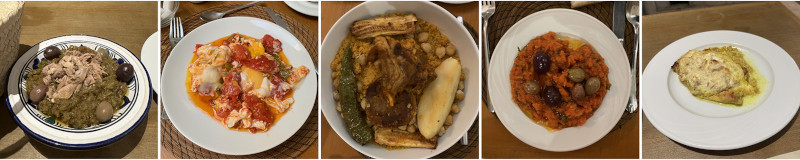
As for the food, simply note that Jamie Oliver picked up tips on Tunisian cuisine while cooking in the Dar Ben Gacem kitchen (Jamie Cooks the MediterraneanS01E02 @20:35-26:00). For an entire month, at each breakfast and dinner, I got to sample authentic fare (Fig.5).
Fig.5. Instagram-worthy fare (from L to R): mechouia, shakshuka, couscous, omek houria, lahmet thon.
Finally, the situation of the residence within the medina means that one can easily explore the UNESCO World Heritage Site just across the threshold. The INP, libraries, and other cultural resources are steps away (particularly resources for medieval and early-modern Tunis), with Carthage accessible via public transit and other archaeological sites within range of a day trip.
ASOR-Affiliated Morocco Project Publishes Evidence About Bronze Age North Africa
Media Release February 20, 2025
ASOR-affiliated archaeology project finds new evidence of earliest farming in NW Africa
ALEXANDRIA, Va. – A new study in the journal Antiquity presents the first evidence of a Bronze Age-era farming settlement in the northwest Maghreb following an ASOR-affiliated excavation in Kach Kouch, Morocco.
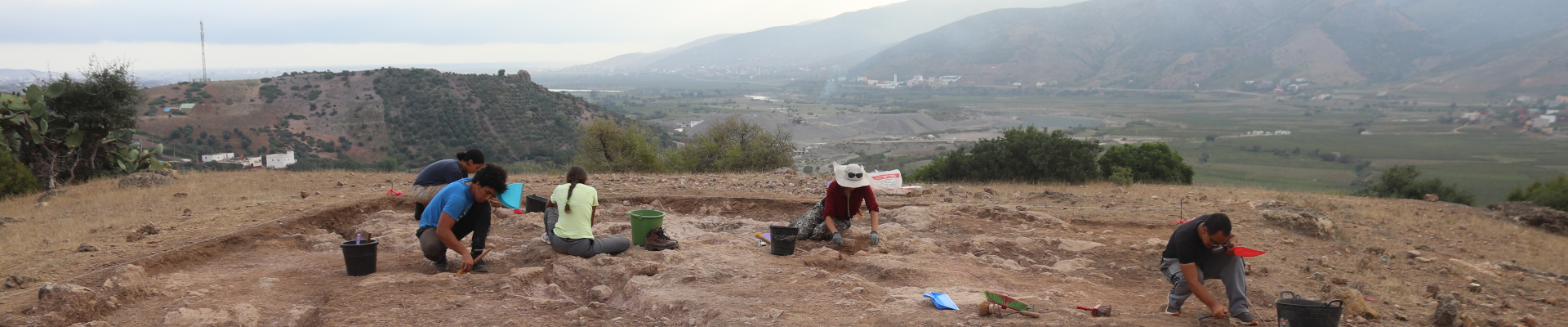
The study, titled “Rethinking late prehistoric Mediterranean Africa: architecture, farming and materiality at Kach Kouch, Morocco,” was published on February 17 in the journal Antiquity by Cambridge University Press. Authors Hamza Benattia, Youssef Bokbot, Jorge Onrubia-Pintado and the rest of the Kach Kouch Archaeological Project team, primarily comprising students from the National Institute of Archaeology and Heritage of Morocco (INSAP), have been conducting excavations and surveys at Kach Kouch, Morocco since 2021 to further the understanding of this hitherto little-known period. They revealed in the Antiquity study the remains of a settlement occupied from 1300 to 600 BCE that was a farming economy before the arrival of the Phoenician conquest.
The team’s research demonstrated that settled occupation in this region stems from social and economic dynamics within local North African communities since at least 2200 BCE, rather than being a result of later interactions with Phoenician communities. Despite the settlement of Phoenician communities along the northern Moroccan coast from the eighth century BCE onwards, local cultural traditions persisted in the inner valleys of the western Rif, Morocco, until the sixth to fifth centuries BCE.
The Kach Kouch settlement practiced animal husbandry and crop cultivation, with crops being processed and stored on site, based on the published findings. Farming, herding, building, and material culture continued from the eighth to seventh centuries BCE to further emphasize the “primary role played by local communities in shaping the social, cultural and economic dynamics of the emergent Moroccan Bronze Age and subsequent Early Mauretanian period” at Kach Kouch, according to the study.
Thanks to the support of an ASOR Stevan B. Dana Grant, the Kach Kouch team continued the research in northwestern Morocco’s Rif mountains in 2023 and early 2024. Extensive survey and targeted excavation along the valleys of Oued Laou and Stehat identified five previously undocumented sites. The newly discovered sites attest to a more stable settled occupation in the region than previously thought, spanning from the Late Prehistory to the Early Mauretanian Period (from c. 2200-400BC), a novel signature for non-Nilotic North Africa.
The publication’s findings stimulate interest in the overlooked region and encourage new narratives in the scholarly discourse on North African archaeology.
About ASOR
The American Society of Overseas Research (ASOR) is a nonprofit 501(c)(3) organization whose mission is to initiate, encourage, and support research into, and public understanding of, the history and cultures of the Near East and wider Mediterranean world, from the earliest times. ASOR fosters original research, archaeological excavations, and explorations; encourages scholarship in the Near East’s basic languages, cultural histories, and traditions; builds support for Near Eastern studies; and advocates high academic standards. ASOR is apolitical and has no religious affiliation.
###
The American Society of Overseas Research The James F. Strange Center 209 Commerce Street Alexandria, VA 22314 E-mail: info@asor.org Telephone: 703-789-9229
Mid-way through excavation, the highest point of the site can be seen in the background near where the Cappadocia Gate and the Palatial Complex are located.
Welcome to Kerkenes, a sprawling Iron Age site located in central Anatolia. This megacity is mysterious as it is vast; Kerkenes was only briefly inhabited for less than a century, before a battle and catastrophic fire caused it to become abandoned. Although the site has been suggested to be that of which Herodotus identifies as Pteria, this description is unconfirmed, and much is left to be learned about the city and its former inhabitants.
Here I joined the ASOR-affiliated Kerkenes Project with the University of Central Florida, where I started my PhD this year working with Kerkenes project director Dr. Scott Branting. Despite a sobering earthquake and busy election season in Turkey preluding our excavation, this year’s field season took place from May until July 2023. Thanks to the generous support of the P.E. MacAllister Fieldwork Scholarship, I was fortunate to participate in an advantageous initial season on the site before starting my PhD program.
[/vc_column_text][vc_wp_text]
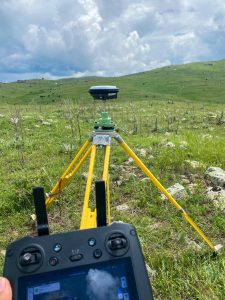
The drone (somewhere up in the sky) and GPS in action.
Kerkenes is located in central Anatolia, in the province of Yozgat. This year the Kerkenes team was lucky to be among the first to experience the opening of the new high-speed rail system that now runs from Ankara to Yozgat (yes, the same name as the province), a city within an hour of the field site. I find the Kerkenes Project unique on account of the variety of research methods and experts that collaborate on the single site. This year we conducted geophysical surveys, drone surveys, and excavation in the field, in addition to ongoing material analysis carried out by conservators, zooarchaeologists, paleobotanists, and ceramicists in the nearby compound’s facilities. Digitalization of previous years’ finds is carried out in any spare time the team has, creating a valuable archive of 3D data about the site.
The timing of the field season in Kerkenes is particularly suited to the wide range of surveys and research that is conducted there. Weather in the first few weeks of the season is typically wet and rainy, the moist ground conducive to resistivity surveys. Perhaps thanks in part to El Niño, we had an unusually rainy year that allowed for resistivity to carry on into nearly mid-June. As the spring rain cleared up, excavation began on Urban Block 8, a section of the city located along the northern edge of the city wall. This block is one of the longest-excavated sections of the site and has yielded valuable data concerning urban development and planning of the city and its perimeter defensive wall.
Over June and July, the excavation team successfully excavated new rooms of this block, providing the project with more data that will help us understand the purposes of the specific structures in Urban Block 8. Based upon the 2022 season’s excavation in adjoining rooms of the block, we anticipated the need for accompanying zooarchaeologist researchers to develop a system by which to differentiate bone fragments from ivory in the field. This system expedited the identification process of many materials and made our work in the trench more efficient.
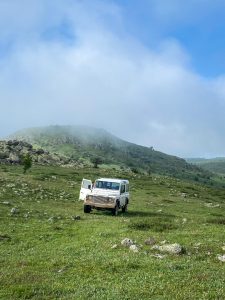
The project’s trusty all-terrain transportation.
Sure enough, this summer’s excavation yielded data which will help us understand the functionality of Urban Block 8’s structures, in addition to the potential diet, animal husbandry practices, storage systems, and art production of the urban block’s residents. Many materials found in Urban Block 8 this year showed evidence of contact with extreme temperatures, serving as further evidence of the reach and intensity of the destructive fire that enveloped the city. The team conducted wet sieving and flotation on many soil samples from this year’s trench, but due to the large volume of soil collected, work from 2023 samples will continue into next year and keep us very busy!
Finds from previous years of the Kerkenes project can be viewed by the public at the nearby Yozgat Museum, as well as in Ankara at the Museum of Anatolian Civilizations. The Kerkenes site will continue to be a source of incredible information about the central Anatolian Iron Age and ancient megacities. Recent work on the site investigates urban planning, pedestrian modeling, and shared social spaces that can be applied to cities anywhere, ancient or modern. I look forward to joining the project in the coming years during my doctoral program to help uncover more of this incredible field site.
Annalise Whalen is a PhD student at the University of Central Florida, where she focuses on digital archaeology of the Middle East. She earned her MTS from Hellenic College Holy Cross Greek Orthodox School of Theology, and received her BA from the University of Massachusetts Amherst.You can find Annalise Whalen on Twitter @AnnaliseWhalen
For more information about the Kerkenes Project visit:
[/vc_wp_text][mk_divider][vc_wp_text]Want to help more students and early career archaeologists get into the field? Donate to the cause today by selecting “Student Support” as your gift purpose!
Twenty Years of Archaeology at a Southern Coastal Site on Cyprus
Friends of ASOR present the next webinar in the 2023-2024 season on March 7, 2024, at 6:00 pm EST, presented by Dr. William Caraher, Dr. Thomas Landvatter, Dr. R. Scott Moore and Dr. Brandon R. Olson.
For the last two decades, the Pyla-Koutsopetria Archaeological Project has explored the coastal region of Pyla village. Located 10 km east of Larnaka and immediately below the famous Late Bronze Age site atop the Kokkinokremos coastal ridge, Koutsopetria featured a now-infilled embayment which likely served as a harbor in antiquity. The location of the site near an ancient harbor and astride the major road running between the ancient cities of Kition and Salamis likely led to the fortification of the prominent coastal height of Vigla in the Hellenistic period. This site likely served as strategic outpost for mercenaries during the tumultuous period after Alexander the Great’s death when his successors battled for control over the island and the Mediterranean littoral. The forces occupying the fort appear to have abandoned it within a generation of its construction leaving behind a fascinating window into the tumultuous life of this strategic site.
During the Roman and Late Roman periods, a prosperous town developed in the coastal zone. Excavations in the 1990s by the Department of Antiquities revealed parts of an Early Christian basilica and the intensive survey carried out by our team showed that the site had trade connections across the Mediterranean. The rise and decline of the Roman period settlement at Koutsopetria was less abrupt than that of its Hellenistic predecessor on Vigla, but our work at Koutsopetria similarly offers a window into an era of significant change on the island. Our excavations and survey at Koutsopetria have revealed that the church and surrounding settlement likely experienced a gradual abandonment over the course of the 7th and 8th centuries. This suggests that the site did not succumb to a catastrophic end at the hands of Arab raiders, but declined gradually perhaps as a result of the changing economic and political landscape of the region.
This talk will interweave the story of the Pyla-Koutsopetria Archaeological Project with our understanding of the history of the site during the Hellenistic, Roman, and Late Roman periods.
R. Scott Moore is Distinguished University Professor of History at Indiana University of Pennsylvania.
Thomas Landvatter is Associate Professor of Greek, Latin, and Ancient Mediterranean Studies and Humanities at Reed College.
William Caraher is Associate Professor and teaches in the Department of History and American Indian Studies at the University of North Dakota.
Brandon R. Olson is Assistant Professor of History at Metropolitan State University of Denver.
Combined they have over a half-century of archaeological experience on Cyprus and elsewhere in the Eastern Mediterranean. Starting in 2003, Caraher and Moore co-directed the Pyla-Koustopetria Archaeological Project on Cyprus with David Pettegrew. Since 2018, the project has continued under the direction of Olson, Landvatter, and education director Justin Stephens.
This webinar will be recorded and all paid registrants will be sent a link to view the recording.
*Please log in to the Online Portal BEFORE registering for the webinar. Once you have logged in, you will be able to register under our Events page linked above.
Please e-mail membership@asor.org with any questions or issues with registering.
All proceeds from this webinar are used to fund scholarships for members as well as increasing ASOR’s online resources, which are free to the public.
READY FOR A WEBINAR SEASON PASS?
Buy a season pass for all the webinars* of the 2023-2024 FOA Webinar Season! With a season pass, you will automatically be registered for every webinar in the season, and you will receive the recording of each webinar automatically after the event.
If you have missed webinars earlier in the season and still want to buy the pass, you will receive the links to the recordings of the webinars you missed in your automatic confirmation email after you buy the pass.
*Special symposiums may be excluded from the season pass price.
No more registering for a year if you buy your pass today!
Pricing:
ASOR Sustaining Members: $0 (automatic registration for each webinar) Members: $75 Public: $150
Several levels of support from $50-$1,000 are available. Proceeds go towards membership scholarships and towards increasing ASOR’s virtual resources. Each sponsorship is tax-deductible and you can give your friends free registrations to a webinar! Sponsor a webinar here.
Bronze Level ($50): up to 2 guest registrations Silver Level ($100): up to 5 guest registrations Gold Level ($500): up to 20 guest registrations Platinum Level ($1,000): up to 50 guest registrations
After you sign up for a sponsorship online or over the phone, email the names and email addresses of your guests to Katherine Schmitt at membership@asor.org, who will send your guests a confirmation and the Zoom link before the webinar.
WANT TO SAVE $6.00 ON THE NEXT WEBINAR?
Join ASOR as a member! Click here for more details about discounts for events and other benefits of membership. Memberships start at $40 for the year as an Associate Member.
2023 Harris Grant Report: Polatlı Landscape Archaeology and Survey Project (PLAS), Turkey
The ASOR Charles Harris Project Grant enabled us to expand our area coverage in Polatlı Landscape Archaeology and Survey Project (PLAS), resulting in the documentation of 19 new sites in the 2023 season.
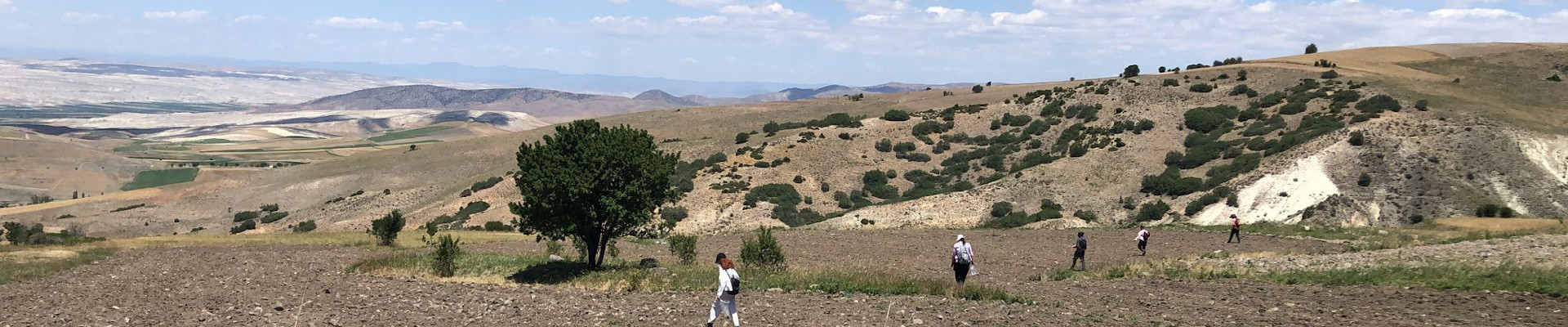
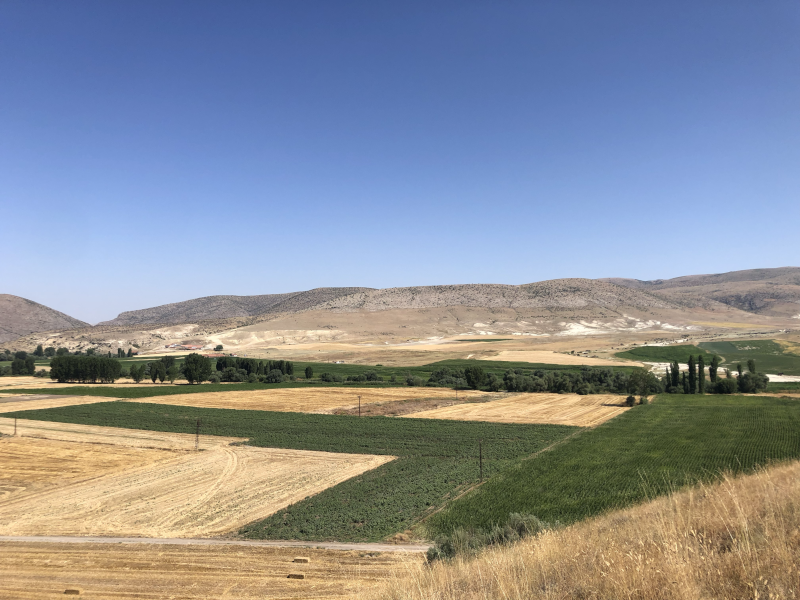
A taste of the Polatlı landscapes, as seen from the top of Hıdırşeyh Höyük.
PLAS is a regional survey that explores the city of Polatlı in the province of Ankara in central Anatolia. We employ a combination of regional and site-based survey techniques to locate sites, to understand their landscape context, to construct their site biographies, and to study their material culture through a sample surface collection. While survey work is inherently diachronic, our dominant focus has always been on the Bronze and Iron Ages to be able to understand the changes this region experienced under Hittite imperialism by focusing on before, during, and after the reach of the Hittite Empire to this region.
The major research objective for PLAS is to trace the imperial strategies of the Hittite Empire along its under-investigated western border. Our survey area neighbors the eastern bank of the Sakarya River. The scarce mentions of this significant river in Hittite texts paint a picture of liminality and suggest that crossing this river towards the west meant leaving the Hittite core region. While Polatlı is home to the long-term excavations at the Phrygian capital Gordion—a freshly minted UNESCO World Heritage site—regional work in this area has been scarce, and rarely targeted the Bronze Age past.
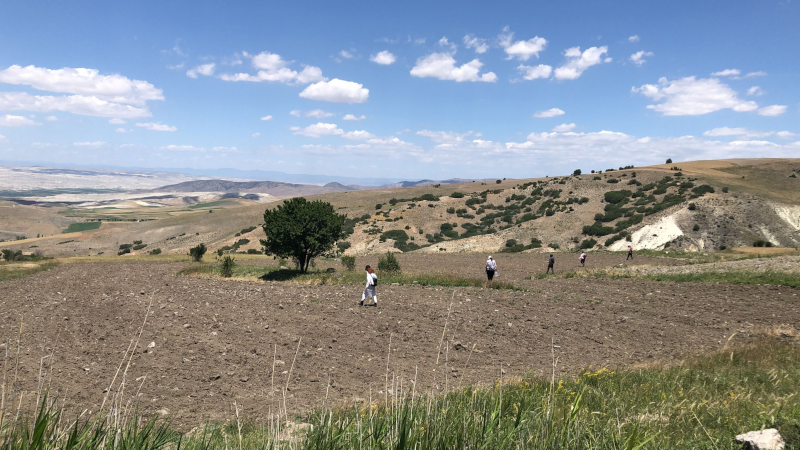
A group from the PLAS 2022 team walking transects at the site of Örenler Mevkii.
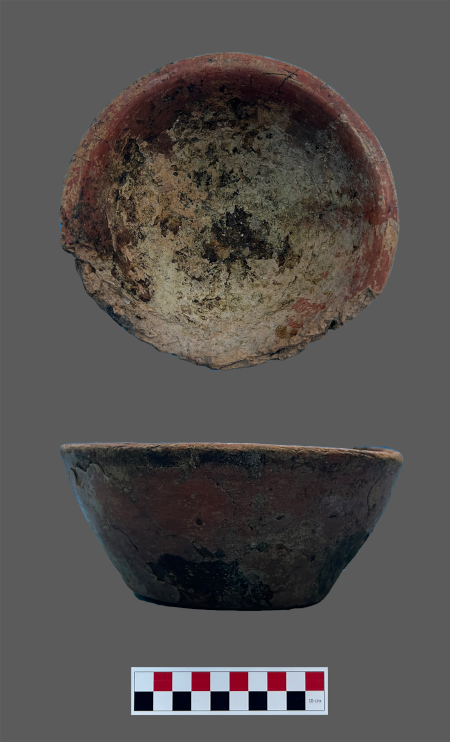
A melting pot yielded from the site of Karayavşan Höyük. Some metal slag still preserved inside can be seen in the top view above.
Our work since 2019 revealed a dense Early Bronze Age occupation in the region. Access to, and control of, metal ores and metalworking technologies seem to be a driving force for this settlement surge, as demonstrated by metal slags and vessels related to metalworking that were yielded from our third millennium BCE sites. Polatlı seems to have suffered from the catastrophic end of the Early Bronze Age that is visible elsewhere in Anatolia, as one third of these sites do not continue into the Middle Bronze Age. The Middle Bronze Age landscape is, however, still one of continuity, as every site occupied in the early second millennium BCE was also occupied in the Early Bronze Age. The full impact of the Hittite Empire is felt in the Late Bronze Age, manifested with three new foundations that exhibit close ties to the core region of the empire to the east in terms of their material assemblage. Following the end of the Bronze Age, the Iron Age of the region looks much different, as it is no longer on the borderlands of an empire but is the center of the Phrygian kingdom.
The Charles Harris Grant enabled us to substantially increase our coverage in 2023. Polatlı is a large city, and having one home base is not enough to be able to access its various landscapes. Through ASOR’s generous support, we were able to temporarily relocate to work in the southern areas of Polatlı we could not work before. We discovered 19 new sites, substantially increasing our dataset and putting the results of our previous seasons to test. As this was our last season for this first phase of the PLAS project, we are grateful to ASOR for helping us expand our research area for better understanding the borderland dynamics in this region.
Müge Durusu-Tanriover, Director of PLAS
(Temple University and Bilkent University)
Learn more about the Polatlı Landscape Archaeology and Survey Project (PLAS) on their website or their Instagram!
John Rinks, 2023 Stevan B. Dana Fieldwork Scholarship Recipient
When I was a young boy, I dug holes in my parent’s backyard. I’m pretty sure I wasn’t expecting to find anything. I just liked to dig. I also read books about pirates and buried treasure. When asked, I would say my plan when I grew up was to find pirate treasure buried on remote Caribbean islands.
John holding two tourias.
Being a volunteer on an excavation in Israel is the grownup version of that young boy’s dream. Spoiler alert: the experience surpassed my expectations, and I am obsessed with it.
Going on “a dig” starts way before the long plane ride. For me, it meant going to the gym every day after work to get (and stay) in shape. I’m 63-years old, with a desk job, and didn’t want to be that “old guy”. I wanted to pull my weight and show the young grad students what hard work looks like. To wield a pickaxe and turia tirelessly for extended hours in 95-degree F heat. To “bucket-chain” over 1,000 buckets of dirt out of the excavation area every day without breaking a sweat (that’s an exaggeration – I sweated plenty).
Not everyone on the dig team started out as gung-ho as me. Some of the college kids didn’t have manual labor experience. But it didn’t take long for them to ramp up. It’s pretty awesome to see twenty-something guys and gals quickly learn how to dig. How hard can it be? Of course, anybody can “dig”. What I’m talking about is next level. Like, listening to the sound the pickaxe head makes when it hits the ground. Or feeling that difference flow up through the shaft handle to your hands. Was that soft dirt, hard dirt, mudbrick, pottery, stone, or an artifact? I’m totally serious. It’s a real thing.
One surprise is the focus of the dig director and supervisors at my site to make everyone’s experience a great one. Volunteers get training, mentoring, and meaningful assignments. First timers are not relegated to menial tasks. One of my roommates was in his thirties and has a desk job like me back in the States. He used his entire three weeks of annual vacation time to be a volunteer on the dig. He loved it.
John in his square with dig director Dr. Shlomit Bechar.
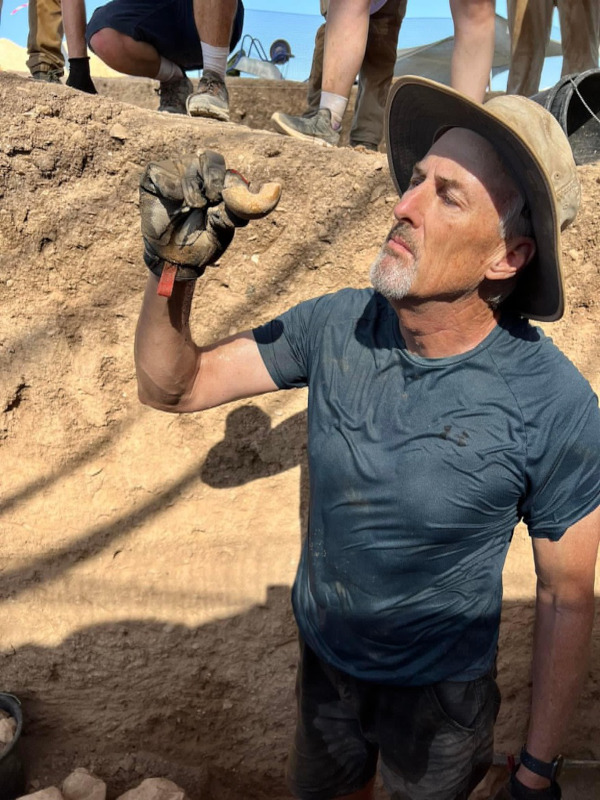
John inspecting a stone mace head he uncovered.
John standing above his
square after 6 weeks of digging.
There are side benefits too. Being on a dig isn’t just that three week or six-week session. It turns into a life experience. Not just the memory aspect of it. It can motivate you to care more about your physical condition and health. You make friends from all over the world and stay in contact on social media. It makes you more interesting to your family and friends, having unique stories to tell and pictures to share. If you read the Bible or history books it gives you “I was there” pictures in your mind of the real thing.
Did we find cool stuff? Of course. Ancient walls and plastered floors – from thousands of years ago. A 3,500-year-old bronze axe head. Ceramic jugs and bowls. A pottery sherd with an Egyptian hieroglyph. A cylinder seal. Large threshold stones leading into a temple – carved from volcanic basalt. And on and on.
One of my favorite pictures from this summer at Tel Hazor Lower City is of me standing above the “hole” I helped dig in six weeks. By itself, the picture isn’t amazing. But when I tell the people I show it to that we started at ground level in the year 2023, and six weeks and nine feet later it was the year 1750 BC more than 3,700 years ago – it becomes amazing! Lots of people like movies and books about time travel; sitting comfortably watching a movie or reading a book. I was there. I touched the stones and artifacts. I time traveled. Words cannot adequately express this phenomenon. You’ll just have to go to a dig one of these summers and see for yourself.
Today I’m writing this report back home in Colorado. When I finish it, I’ll be heading to the fitness gym to work out because the countdown app on my phone says 299 days from now I will be flying from Denver to Tel Aviv because I’m going back. I can hardly wait to see what our team is going to find next summer. Maybe I’ll see you there.
John Rinks is development director at a large Christian high school in Denver, Colorado. Prior to that he was an economics teacher for 18 years and in the defense industry for 15 years in southern California. John is married and has three children and eight grandchildren.
For more information about the Hazor Lower City Excavations visit:

 For the people of Mesopotamia, the past was a source of knowledge and inspiration. Their reverence, both in terms of preserving early buildings and monuments and reviving images and ancient writing styles, is evident in archaeological and textual records. While Mesopotamian monuments and images were produced as historical works, inscribed with texts that marked them clearly and linked them to specific events and times, their efficacy was understood to be unlimited. Dated to the reign of king Nazi-Maruttash (ca. 1307–1282 BCE), the stele of the Goddess Lama, currently in the collections of the Metropolitan Museum, offers an excellent opportunity to explore Mesopotamian interaction with the past during the Kassite period (ca. 1574–1157 BCE). Through visual and textual analysis, this talk examines the survival of Lama imagery in this period. It reflects on the religious/political significance of the stele’s production within a broader context. The aim is to demonstrate that the crudely carved and seemingly unimaginative reuse of an earlier protective goddess figure was a deliberately archaizing image and an inspired citation of the past.
 Helen Malko is the Associate Director of the Stanford Humanities Center, where she oversees various academic programs in the humanities and interpretive social sciences. Before joining Stanford, she worked at the American Center of Research (ACOR) and Columbia University Global Center in Amman, Jordan. Helen holds a Ph.D. in Anthropology and Archaeology from Stony Brook University and a BA from Baghdad University, and she is trained in cultural heritage and preservation studies. She has been awarded multiple fellowships at the Metropolitan Museum and Columbia University in New York and has conducted fieldwork and capacity-building projects in Iraq, Jordan, and Turkey.


 Pp. 4–13: “Religion(s) in Seals: Old and New Challenges,” by Fabio Porzia
 Pp. 14-19: “Mastering the Seven-Headed Serpent: A Stamp Seal from Hazor Provides a Missing Link between Cuneiform and Biblical Mythology,” by Christoph Uehlinger
 Pp. 20-25: “Stamp Seals as Jewelry: Identifying Body Ornaments through Seal Impressions,” by Noa Ranzer
 Pp. 26-31: “Making a Good Impression: A Typology of Mounted Seal Impressions in the Middle Bronze Age Southern Levant,” by Tatjana Beuthe
 Pp. 32-40: “‘Male until Proven Otherwise?’: Searching for Women with the Help of Inscribed Stamp Seals from Jerusalem,” by Bruno Biermann
 Pp. 42-52: “Scratching the Surface of Middle Bronze Age Scarabs: Investigating Enigmatic Marks on Stamp Seals from Lachish and Megiddo,” by Nadia Ben-Marzouk and Ben Greet

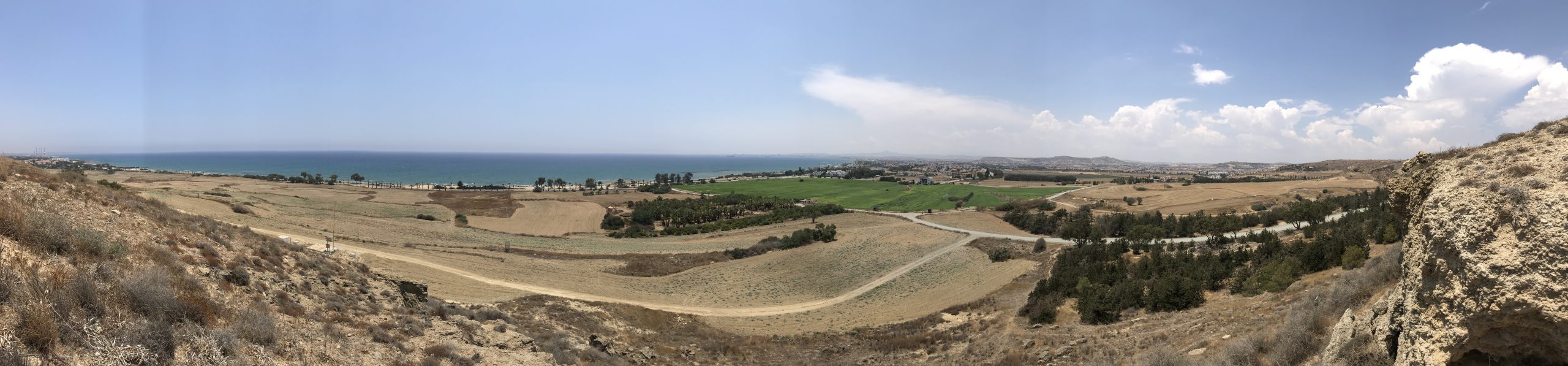
 For the last two decades, the Pyla-Koutsopetria Archaeological Project has explored the coastal region of Pyla village. Located 10 km east of Larnaka and immediately below the famous Late Bronze Age site atop the Kokkinokremos coastal ridge, Koutsopetria featured a now-infilled embayment which likely served as a harbor in antiquity. The location of the site near an ancient harbor and astride the major road running between the ancient cities of Kition and Salamis likely led to the fortification of the prominent coastal height of Vigla in the Hellenistic period. This site likely served as strategic outpost for mercenaries during the tumultuous period after Alexander the Great’s death when his successors battled for control over the island and the Mediterranean littoral. The forces occupying the fort appear to have abandoned it within a generation of its construction leaving behind a fascinating window into the tumultuous life of this strategic site.
 During the Roman and Late Roman periods, a prosperous town developed in the coastal zone. Excavations in the 1990s by the Department of Antiquities revealed parts of an Early Christian basilica and the intensive survey carried out by our team showed that the site had trade connections across the Mediterranean. The rise and decline of the Roman period settlement at Koutsopetria was less abrupt than that of its Hellenistic predecessor on Vigla, but our work at Koutsopetria similarly offers a window into an era of significant change on the island. Our excavations and survey at Koutsopetria have revealed that the church and surrounding settlement likely experienced a gradual abandonment over the course of the 7th and 8th centuries. This suggests that the site did not succumb to a catastrophic end at the hands of Arab raiders, but declined gradually perhaps as a result of the changing economic and political landscape of the region.
 R. Scott Moore is Distinguished University Professor of History at Indiana University of Pennsylvania.
 William Caraher is Associate Professor and teaches in the Department of History and American Indian Studies at the University of North Dakota.