Zachary Griffith, Eric and Carol Meyers Fellowship recipient
This summer I was able to attend the Huqoq Field School in Israel. I am grateful to ASOR for this scholarship, allowing me to attend this excavation. This was my first excavation outside of the United States, and by far the largest excavation that I have been a part of. During the excavation season I learned a great deal from the staff and supervisors, including Dr. Jodi Magness of the University of North Carolina at Chapel Hill and my Classics Professor at the college I attend, Austin College, the architecture specialist Dr. Martin Wells. Once again, I am thankful for the support of ASOR in making this experience possible.
I am grateful to have been a part of such an important excavation. The main focus of our excavation at Huqoq was the Late Roman synagogue and the Medieval synagogue building. The Huqoq excavation has gained much notoriety for the beautiful, well-preserved, and unique mosaics that were discovered in the Late Roman synagogue. Apart from the emphasis placed on the mosaics, there was much emphasis placed by the staff and supervisors of the significance of the material that can give a date for the Late Roman synagogue. This was especially evident when we visited various other synagogues in Northern Israel, such as those at Capernaum and Sepphoris. At lectures and hearing discussions between various professors at several of these sites, the magnitude of importance for the dating material for our excavation of the Late Roman synagogue at Huqoq was revealed. This dating material is so important to archaeology in this region due to conflicting theories over how the Christianized Roman Empire effected synagogue building and prosperity of the Jewish people under the Roman Empire, as such discussions have led scholars to give dates to synagogues that can differ by a degree of hundreds of years. It was great to be a part of an excavation that by itself is very significant, but that also could also have wide reaching implications for an entire region during the Roman Period.
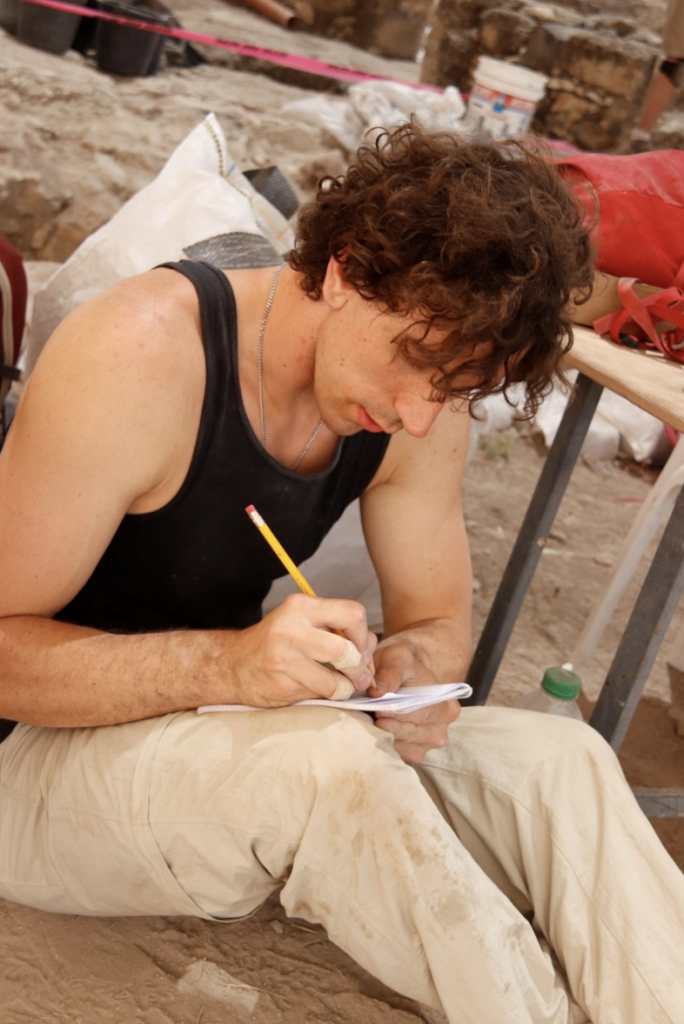
Zach taking notes at the site after a day of excavation.
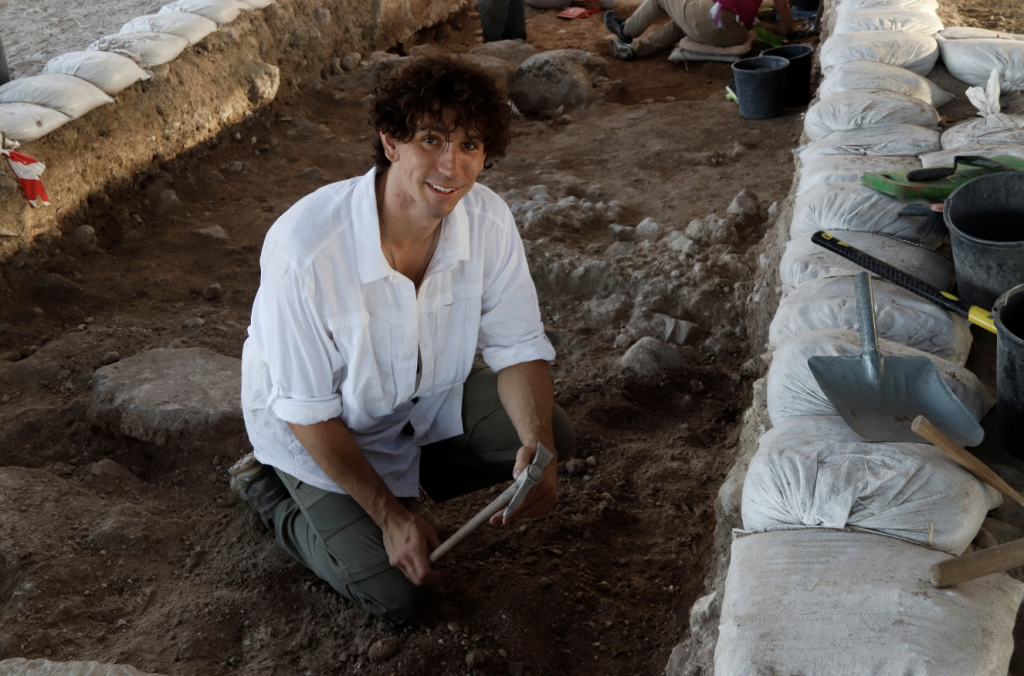
As a part of the Huqoq excavation I was assigned to the area 3000 North, which was supervised by Dr. Rangar Cline of Oklahoma State University. This was the area that consisted mostly of the Northwestern sections of what was once the Late Roman synagogue and the Medieval synagogue. 3000 North was also where previously unexcavated mosaics were uncovered during this season. In 3000 North I learned a great deal about excavation techniques. Also, due to our proximity to the Late Roman mosaics, and the emphasis placed on finding material to date parts of the site, I frequently sifted the material we excavated. Sifting could be very exhilarating, such as when we would find artifacts that could possibly be used as dating evidence, but also heartbreaking, such as when tesserae was discovered, showing that sections of the Late Roman synagogue’s mosaic would not be preserved.
Zach excavating in 3000 North.
I greatly value the work I did under the direction of architecture specialist. Dr. Martin Wells. I assisted Dr. Wells by moving, washing, and recording various architectural fragments of significance to the excavation. Handling these pieces and gaining first-hand experience from Dr. Wells, I was able to learn a great deal more about the architecture and construction techniques in all phases of the site that we excavated. What is most memorable to me about Huqoq was how rewarding the process of reconstructing the Late Roman and Medieval synagogues could be’ even though it was a very difficult process. This can be highlighted by the way in which the builders of the Medieval synagogue reused material from the Late Roman synagogue, and it is from this reused material that we can gain more evidence of what the Late Roman synagogue may have looked like. In addition to all of the fieldwork, spending time with all of the individuals with the same passion for archaeology was amazing. I will have future colleagues and friends for life.
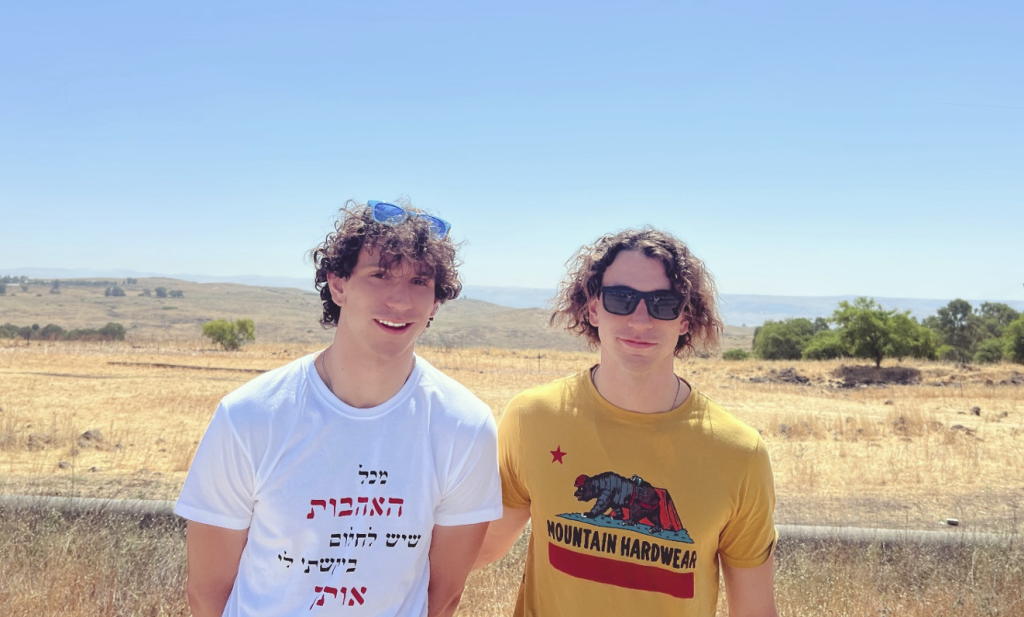
Zach (left) and his brother, Cayden (right), at the kibbutz.
Zachary Griffith is a Senior at Austin College, where he is majoring in Anthropology, Classics, and History. He also plays goalie for the water polo team at Austin College.
Want to help more students and early career archaeologists get into the field? Donate to the cause today by selecting “Excavation Scholarships” as your gift purpose!
Paul Richards, 2022 ASOR BIPOC Scholarship for Fieldwork Participation[/vc_column_text][mk_divider][vc_wp_text]Near East Archeology was a subject that, by title, I had not heard of until I started looking for a graduate degree covering ancient Israelite history. I knew archeologists went into the Middle East to do work, but I had not delved into more for the career field. After graduating from college with a BA in History I taught History in Cairo for 3 years at an American language high school. Then I taught ESL for 2 ½ years. While in Cairo I visited active dig sites. Visiting the sites sparked my interest in archeology.
When I started my Near East Archeology program at La Sierra University, I was excited for the upcoming dig. Because of the pandemic the normally scheduled dig season was canceled. I was determined to go the next season. By the time the next dig season came around the next year my finances were depleted. I applied for scholarships, and it is only due to being awarded the 2022 ASOR BIPOC Scholarship for Fieldwork Participation, that I was able to join the BRAP excavation trip.
The experience was great. I had been to Jordan on a 30-hour layover before where I took the opportunity and toured around the immediate Amman area. For the excavation I signed up for the full BRAP dig season for six weeks. Being in the archeology classroom learning about archeology and working in the lab was much different than being in the field. While in the field I remembered terminology I had learned in class. It was a continual task matching the term I had learned in class with the meaning or action in the field. The work was hard but every day we dug up something significant to me as a first timer. Finding pottery was exciting. I quickly found out the dig veterans were very used to seeing pottery finds. The schedule was taxing but the finds everyday made it worth it.
In the middle of the season, we went to Petra. I had heard of Petra for a few years and the reports from those who had visited made it sound like the ultimate travel destination for all Near East enthusiasts. Usually people exaggerate, this time the reports were accurate. It was better than going to Disneyland.[/vc_wp_text][vc_row_inner][vc_column_inner][vc_single_image image=”96209″ img_size=”full” add_caption=”yes” alignment=”center” onclick=”img_link_large” img_link_target=”_blank” css=”.vc_custom_1712002492498{padding-right: 10px !important;}”][/vc_column_inner][/vc_row_inner][mk_padding_divider][vc_wp_text]Archeology Becomes Personal
I grew up in and still am active in a distinct faith tradition. Previously my interest in ancient Israelite history had tilted my dig interest towards only going to Israel. I knew there was a lot to learn about ancient Israelite history from its ancient neighbors. Growing up myself in a culture and community where the stories of ancient Israel are accepted on a faith basis, it seemed almost automatic to gravitate towards Jerusalem. In a faith-based environment, especially for laypersons, activities of other ancient people groups are pushed aside and overlooked. It is a task of historians to help laypersons understand the study of Israel’s neighbors, and with proper archeology, enhance our academic understanding of faith-based stories.
The name Moab made a frequent appearance throughout the Old Testament of the Bible. A brief search rendered at least 18 times. The name originated, according to faith traditions, from one of the sons of Lot; Lot was Abraham’s nephew. The birth of Moab occurs in Genesis 19 along with his brother Ammon. The story includes some humiliating and salacious content. This son became the progenitor of the Moabites. The Moabites would become one of Israel’s major antagonists. King David in 2 Samuel 8:2 subjects the Moabites to servitude. Here again, a horrific scene takes place in the scripture tradition. In 2 Kings 3 Mesha King of Moab is mentioned as paying a heavy tribute to the Northern Kingdom. Mesha rebelled after the death of Ahab. The Mesha Stella, a significant find in Near East Archeology, describes a revolt against Israel.
Many inscriptions describing victory may have the veracity of the victory legitimately questioned. This is due to the well-known desire of kings and nations to embellish the greatness of themselves and their people. In the case of Mesha it does appear the inscription holds weight. The Mesha Stella was found at Tell-Dibon, a site our team was able to visit.[/vc_wp_text][vc_single_image image=”96210″ img_size=”full” add_caption=”yes” alignment=”center” onclick=”img_link_large” img_link_target=”_blank” css=”.vc_custom_1712002888768{padding-right: 10px !important;}”][mk_padding_divider][vc_wp_text]Cultural Memory And The Story of Moab
Cultural memory is a topic I have delved into since the beginning of my graduate program. The reality of stories becoming exaggerated results in the need for teachers and writers to execute proper exegesis when dealing with historical topics. Exegesis is a term primarily heard of in theology. But the principal for the term is crucial for every research field.
Preconceived ideas need to be erased before proceeding in the research. During the research process the evidence must speak for itself. In a textual context, a word can be assumed to have one meaning, then with further investigation the researcher realizes the original speaker or writer had a different meaning in mind. This also applies to archeology. As taxing as the physical aspect of archeology is, it is crucial to dispel private ideas and interpretations that can result from classroom and reading work only.
The public figures inside well-known faith traditions have become known for mobilizing their base with shallow motivation. This motivation is often very loosely based on ancient text references. Many public figures use the texts blatantly out of context for private purposes. There is a dual danger in the faith community. One is those who carelessly use history to further an agenda. The other are those who are born into these agendas unawares. Both continue to propagate a false narrative. The latter falls victim to its own cultural memory.
In certain faith-based texts Ruth is the progenitor of King David, Ruth 4:22. Ruth was the daughter in-law of Naomi who became a widow and decided to follow Naomi back to her homeland. There is a parallel story line outside the traditional faith-based text, which teaches Naomi’s other daughter in-law Orpah, a Moabite went back to her people and gave birth to Goliath a Philistine. Goliath has become the stuff of legend. His bio has been stretched to create a superhuman villain that would match today’s comic books.[/vc_wp_text][vc_single_image image=”96211″ img_size=”full” add_caption=”yes” alignment=”center” onclick=”img_link_large” img_link_target=”_blank” css=”.vc_custom_1712003623857{padding-right: 10px !important;}”][mk_divider][vc_wp_text]And Finally
My time in the field has increased my interest in ancient languages. It has increased my interest in the facts of faith-based stories. While in the square my square mates and I had lively discussions over the topics presented above. By the end we were far from exhausting the matter. There will be more to debate and learn on the next excavation.[/vc_wp_text][mk_divider][vc_wp_text]Paul Richards holds a BA in History and a Minor in Communication Art from Oakwood University in Huntsville, AL. He lives in Southern California and is finishing his thesis at La Sierra University in Riverside, CA. Balu’a Regional Archaeological Project (BRAP) – Centers & Museum – La Sierra University. BRAP Jordan (@brapjordan) • Instagram photos and videos. Balu’a Regional Archaeology Project | Facebook.[/vc_wp_text][mk_divider][vc_wp_text]Want to help more students and early career archaeologists get into the field? Donate to the cause today by selecting “Excavation Scholarships” as your gift purpose!
Erin Brantmayer, 2022 Stevan B. Dana Scholarship Recipient[/vc_column_text][mk_divider][vc_wp_text]The summer of 2022 saw my fifth year of archaeological work in Israel. A typical summer abroad for me is four to six weeks of very physical work excavating under the hot Levantine sun, but things were a bit different this time. At the Roman and Byzantine site of Birsama, an unexcavated fort and associated settlement area nestled into the region where the Mediterranean coastal plain meets the arid Negev Desert, I and four other sure-footed archaeologists spent two weeks walking around. Our walks, or transects, were along parallel lines about 700 meters long, north to south, covering an area about 250 meters wide east to west. Along these transects, we recorded pottery strewn on the ground’s surface and collected diagnostic sherds – broken pieces of handles, rims, and bases.
These activities were the meat of our preliminary survey. Surveys conducted before excavation are usually done to help archaeologists get a sense of the area they will be digging and to target areas of high interest. For us, high interest in this case meant the area of the fort and the space adjacent to the fort where people would have lived. Additionally, we located some areas with exposed and disturbed architectural elements, including some wall foundations churned up by agricultural vehicles associated with the nearby peanut farm and a few column fragments.
But fieldwalking wasn’t our only survey component – we also did extensive aerial mapping. My archaeological work applies GIS (geographic information science) and drone- and camera-based photography to ancient sites to better understand the spatial relationships that are often harder to see on the ground. This work is incredibly useful for surveying because it is sometimes easier to see features, like buildings, from the air.
[/vc_wp_text][vc_single_image image=”95994″ img_size=”full” add_caption=”yes” alignment=”center” onclick=”img_link_large” img_link_target=”_blank” css=”.vc_custom_1711554000085{padding-right: 10px !important;}”][mk_padding_divider][vc_wp_text]Using a drone equipped with an RTK module, I took over 2,500 pictures to create an orthomosaic of the nearly one square kilometer that comprises our study area. This is awesome because an RTK (real-time kinematic) DGPS is a type of global positioning system that is accurate at the sub-centimeter level – for reference, your phone is only accurate within five meters! So, a drone with RTK is about 1,000 times more accurate than your average GPS app. That accuracy is built into the orthomosaiced images – multiple overlapping photos that are stitched together to create one larger, continuous image. The result is pinpoint accuracy and incredible detail in a single map, from which features and points of interest can be marked and examined.[/vc_wp_text][vc_single_image image=”95995″ img_size=”full” add_caption=”yes” alignment=”center” onclick=”img_link_large” img_link_target=”_blank” css=”.vc_custom_1711554502413{padding-right: 10px !important;}”][mk_padding_divider][vc_wp_text]Our two weeks in the desert were not without their difficulties – survey can be a hard learning curve when you’re used to digging a square. Finding a program to track our fieldwalking was initially difficult, but I did eventually find an app that could track movements, worked on both Androids and iPhones, didn’t need an internet connection, and was free. I also struggled with learning a new system. That awesome RTK drone was one I’ve never used before. I spent eleven of our twelve days at Birsama trying to figure out how to get the system to work, battling through RTK connection errors, malfunctions, thousands of photos not writing to an SD card, and getting the car stuck at 8 PM in the desert four hours before driving to the airport. Everything was eventually unstuck, literally and metaphorically. Just took some perseverance and a crack team of five sure-footed archaeologists.[/vc_wp_text][vc_single_image image=”95996″ img_size=”full” add_caption=”yes” alignment=”center” onclick=”img_link_large” img_link_target=”_blank” css=”.vc_custom_1711554594647{padding-right: 10px !important;}”][mk_divider][vc_wp_text]Erin Brantmayer is currently a doctoral student at the University of Texas at Austin’s Department of Classics. Her research has two foci: exploring how past societies have understood and made use of their natural landscapes and applying digital tools and techniques to archaeological fieldwork. When Erin isn’t studying the ancient Mediterranean or fieldwalking, she can be found walking her dog, Juno, and cooking.
Project website: https://birsama.wordpress.com/[/vc_wp_text][mk_divider][vc_wp_text]Want to help more students and early career archaeologists get into the field? Donate to the cause today by selecting “Excavation Scholarships” as your gift purpose!
Andrew Bock, 2022 Stevan B. Dana Scholarship Recipient[/vc_column_text][mk_divider][vc_wp_text]As a master’s student applying to doctoral programs in Hebrew Bible, I was interested in applying to departments that housed a Levantine archaeologist in order to broaden my understanding of ancient Israelite society and religion beyond the textual evidence. As a doctoral student at UCLA, I have been able to accomplish this goal by participating in seminars on the Late Bronze Age, Iron Age I, Iron Age II, and Archaeology and Collective Identity. Before these courses, I had no exposure to archaeology or site reports and very little exposure to material culture remains. These classes provided a solid foundation for me to understand the types of data with which archaeologists work and the types of questions they ask. Archaeology and material culture, however, cannot be learned by merely reading articles, books, and site reports. Instead, one must get their hands dirty by moving buckets of dirt and creating balks, looking for changes in soil consistency and color, and washing and examining pottery to truly understand archaeology.
This summer I was afforded the opportunity to dig at Tel Dan and see how archaeologists operate in the field. Area B at Tel Dan was my “classroom” for four weeks. There I learned about archaeological methods, how to use different archaeological tools, the value of teamwork and collaboration in archaeology, and how to better understand how archaeologists reconstruct the spaces they are digging through the objects and architecture that is uncovered. While I could write at length about the different aspects of archaeology and material culture that I learned at Tel Dan, but could not have learned in a traditional classroom, I will narrow my description to three activities: taking elevations, flotation practices, and pottery washing and reading.
One of the first days we were at Tel Dan, Dr. David Ilan pulled me aside and showed me how to use the dumpy level. I had to learn how to calibrate the instrument, take the measurement using the level and pole, and how the numbers for the measurements worked to calculate the specific elevations. From that point on, I was tasked with setting up and calibrating the level each morning, determining the height of instrument for the day, taking the majority of the readings with the level, and teaching others in our area to use the level. Understanding how the dumpy level works and correctly operating the level are important skills on an archaeological dig. The dumpy level allowed us to establish the relative heights of objects and loci. These elevations are important because they help us to reconstruct the spatial dimensions of the area and to identify exactly where items were located and where they were found in relation to other objects.[/vc_wp_text][vc_row_inner][vc_column_inner][vc_single_image image=”95793″ img_size=”full” add_caption=”yes” alignment=”center” onclick=”img_link_large” img_link_target=”_blank” css=”.vc_custom_1711398119242{padding-right: 10px !important;}”][/vc_column_inner][/vc_row_inner][mk_padding_divider][vc_wp_text]During the third week of the dig, we began to perform flotations in order to recover tiny artifacts and plant remains from soil samples. One of the other volunteers was in charge of the flotation process because flotation analysis is a large part of his thesis, and he taught other volunteers, including myself, how the flotation process functions. Flotation begins by slowly pouring your dirt sample into a larger bucket and mixing it with water. One then slowly pours the water out of the bucket and through a fine netting in order to capture the smallest plant remains. The larger amount of sludge left in the bucket is then sifted more thoroughly by placing netting over a bucket that has the bottom removed in order to capture the larger plant remains. In order to sift these larger remains from the sludge, one must climb into the river that emanates from the spring at Tel Dan and use the force of the current to sift the sludge through the netting. The plant remains that we recovered were bagged and tagged so they can be analyzed by specialists in a laboratory in the coming months. The hope is that these seed remains will allow us to reconstruct the diet of the people who were living in this area of Tel Dan during the Late Bronze Age to Iron Age I transition. By understanding the diets of the people who lived in this area, we may be able to postulate about the collective identity of the group living in this area during this time period.[/vc_wp_text][vc_single_image image=”95794″ img_size=”full” add_caption=”yes” alignment=”center” onclick=”img_link_large” img_link_target=”_blank” css=”.vc_custom_1711398286718{padding-right: 10px !important;}”][mk_divider][vc_wp_text]Pottery sherds are the most commonly found object in an archaeological dig. Each dig season, volunteers procure buckets and buckets of pottery from each square. Thus, identifying and dating pottery is critical for dating the different stratigraphic levels and attempting to interpret the use of specific areas. The importance of pottery sherds means pottery washing and reading (the identification and dating of pottery sherds) is one of the most critical exercises of each dig day. This event happens in the afternoon after digging has concluded for the day and the volunteers and staff have eaten lunch. Everyone sits with a pottery bucket filled with water that has soaked overnight. With a scrub brush, one scrubs away the dirt from each piece of pottery so one is able to see the color of the pottery and any paint, decoration, or inscribed marking that may be left on the pottery. Each pottery bucket is then laid on trays to dry overnight so it can be read the next day. Pottery reading involves separating the diagnostic pieces or pieces that can help one identify what type of object from which the sherd comes (i.e., rims, bases, handles, decorated pieces) in each tray. Participating in pottery reading with archaeologists who are pottery experts helped me learn more about pottery typology and the production of pottery than any articles or books about pottery that I had previously read in seminars.
In sum, the hands-on learning at Tel Dan helped me better understand the concepts I learned in my archaeology seminars (especially pottery typology!), the tools and methods used on archaeological digs, and how archaeologists make decisions in real time about what they are finding. Overall, I learned many things about archaeology and archaeological methods while on the dig that I never could have learned in the classroom.
As a final note, I would like to thank the generous donations of Stevan B. Dana who made this extremely educational trip possible for me. With his support, I had the opportunity to excavate at Tel Dan for the 2022 dig season. I would also like to thank Professors Aaron Burke and David Ilan for being so patient with me as a first-time volunteer—your guidance and support this season was invaluable and immensely encouraging.[/vc_wp_text][vc_single_image image=”95795″ img_size=”full” add_caption=”yes” alignment=”center” onclick=”img_link_large” img_link_target=”_blank” css=”.vc_custom_1711398441077{padding-right: 10px !important;}”][mk_divider][vc_wp_text]
Andrew Bock is a doctoral student in the Near Eastern Languages and Cultures (NELC) department at the University of California, Los Angeles (UCLA) who specializes in the Hebrew Bible and Northwest Semitic inscriptions. His research interests include prophetic literature and phenomenon in the ancient Near East, scribal revision techniques in the Hebrew Bible and Akkadian literature, Ugarit, and the intersection of material culture and textual evidence.
[/vc_wp_text][mk_divider][vc_wp_text]Want to help more students and early career archaeologists get into the field? Donate to the cause today by selecting “Excavation Scholarships” as your gift purpose!
Emily Yankura, P.E. MacAllister Scholarship for Fieldwork Participation[/vc_column_text][mk_divider][vc_wp_text]My field experience in Jordan this past summer was one which was both long awaited and highly anticipated. I was originally scheduled to participate in the 2020 field season but, for obvious reasons, was unable to go until this past summer. It was an experience that was well worth the wait!
To be honest, I was initially very nervous to be finally leaving for Jordan. This trip had already been delayed so many times that a part of me thought I would graduate before I could go, and the prospect of now actually having to face the challenges I knew were coming was daunting, to say the least. I would be surrounded by a new language and culture, working outdoors in a desert climate, and hiking to site every day in said climate. There would be new food, new physical challenges, new customs – and that wasn’t even touching on the new tools and strategies I was going to have to learn for archaeological field work.
Now, though, I am so glad I went, and so glad I was able to go! I was able to acclimate relatively quickly and soon found myself appreciating the language and culture of Jordan. There were so many differences, large and small, as well as similarities, that had me thinking twice about my own cultural biases. And, once we began excavations, I was relieved to find myself up to the challenge.[/vc_wp_text][vc_row_inner][vc_column_inner][vc_single_image image=”96195″ img_size=”full” add_caption=”yes” alignment=”center” onclick=”img_link_large” img_link_target=”_blank” css=”.vc_custom_1711999521877{padding-right: 10px !important;}”][/vc_column_inner][/vc_row_inner][mk_padding_divider][vc_wp_text]I spent the first three weeks of my time in Jordan excavating in Wadi Mataha with Dr. David Johnson, and then an additional two weeks excavating on the Ad Deir Plateau with Dr. Cynthia Finlayson, under the direction of Dr. Allison Lee as crew chief. Throughout our two months in Jordan our group also had the opportunity to visit various historical and cultural sites. All of these experiences together were an invaluable learning opportunity and opened my eyes to the incredible nature and value of Middle Eastern culture. I gained an appreciation for both the ancient and modern inhabitants of this area by visiting the sites, and through daily interactions with local residents and workers.[/vc_wp_text][vc_single_image image=”96196″ img_size=”full” add_caption=”yes” alignment=”center” onclick=”img_link_large” img_link_target=”_blank” css=”.vc_custom_1711999639735{padding-right: 10px !important;}”][mk_padding_divider][vc_wp_text]My favorite aspect of archaeology is the connection it allows me to feel with the past. I have experienced this before with written reports and theory, but I was thrilled to experience it in actual hands-on fieldwork as well. While excavating, Dr. Lee would often ‘quiz’ us on what we were seeing in the soil – ashy lenses, certain types of artifacts, soil composition – and challenge us to connect those smaller details with a larger picture. These brainstorming sessions were meant as field theories and first impressions, to be checked against further research and site reports later on, but it helped me personally to see how several sherds of coarseware pottery could connect me to the lived experience of ancient Nabataeans at a specific moment in time. It also helped me to better understand how archaeologists transition from digging and uncovering artifacts to using them for analysis. These artifacts we were uncovering would help us to build a picture of the ancient civilization that had left them behind. Archaeologists are actively reconstructing ancient cultures in an attempt to better understand them – and, by extension, ourselves.
At Ad Deir, I learned the value of archaeological context. The area I was assigned to work in was a portion of the Great Circle, which was a water feature/pool on the plateau. In ancient times it would have been filled by seasonal rains; this meant that many of the artifacts we were recovering there had been washed in by water and erosion. Before beginning, I did not fully understand how context could still be derived from objects which had been so clearly taken out of theirs. Now, I know that even these types of objects have value: the different stratigraphic units (SUs) of the Great Circle provide a relative chronology, and within that the types of pottery we find (coarseware, fineware, painted wares, etc.) can help us to know what was being used when. For example, one of our SUs showed a large concentration of pottery and burned bone, along with multiple ashy lenses. This could be an indicator of a cooking and/or eating space, which would mean that the Great Circle was already out of use as a water collector at that time.
The trips we went on were also very educational. They exposed us to other parts of Nabataean culture that were either not present at either of our sites or else still under excavation. Dr. Johnson took us on a tour of Wadi Mataha that showed us the broader context of the tomb complex that we had been excavating. We saw a sprawling network of dozens of other tombs, cisterns, and water channels, most of which remain unexcavated. On a later trip to Little Petra and a High Place we saw what Nabataean worship may have looked like. These glimpses into the broader scope of Nabataean society helped me to better understand the objects and features we were finding back on site.[/vc_wp_text][vc_single_image image=”96200″ img_size=”full” add_caption=”yes” alignment=”center” onclick=”img_link_large” img_link_target=”_blank” css=”.vc_custom_1711999979902{padding-right: 10px !important;}”][mk_divider][vc_wp_text]The most exciting moment of the entire two months, for me, was finding an amethyst bead at the Wadi Mataha site. My Master’s thesis research has been on jewelry found in burial contexts, so when I saw an amethyst bead in the screen it felt almost unreal – I had spent so much time reading about objects like these and looking at small, black-and-white photos of them, that it was hard to believe I now had one right in front of me! There was an inexplicable feeling of connection as I dusted it off to reveal the carefully drilled holes on either side. Someone, a long time ago, had taken the time to take a beautiful stone and shape it into something that could be worn. A human being had created beauty for the sake of beauty (and possibly profit), and it had survived two thousand years to end up in my hand.
My experiences in Jordan are ones which I will never forget. It is a country rich in history and culture, and I hope that one day I will be able to work there as an archaeologist once again![/vc_wp_text][vc_single_image image=”96202″ img_size=”full” add_caption=”yes” alignment=”center” onclick=”img_link_large” img_link_target=”_blank” css=”.vc_custom_1712000520030{padding-right: 10px !important;}”][mk_divider][vc_wp_text]Emily Yankura is a Master’s student at Brigham Young University studying archaeology and museum studies. Her main areas of interest are the history of the ancient Near East and the portrayal of archaeology in popular media.[/vc_wp_text][mk_divider][vc_wp_text]Want to help more students and early career archaeologists get into the field? Donate to the cause today by selecting “Excavation Scholarships” as your gift purpose!
Something Old, Something New, Something Borrowed, Something Blue
Alice Kligerman
Something Old
Landing in Larnaca, Cyprus this summer was the final exhale from the inhale I took leaving in 2019. My undergraduate field school had come to an end, but I knew I was going to see Makounta – Voules again. Participating in the Makounta – Voules Archaeological Project run by Dr. Grossman and Dr. Paulette, both professors at North Carolina State University, was my first experience with archaeological excavation. As the weeks went on, I found myself falling in love with all aspects of Polis Crysochous. Coming back in 2022 felt like the most natural decision. The museums, exhibits, and sites we had visited in 2019 made their appearances this time too, but I had new questions and observations. I still had the same awe filled reaction to all the sites, however. It was almost comforting to walk through the sites flooded with memories of previous photos backdrops, the best views, and the cool spots around the island. Learning from the first time I was here, I made sure to get gelato as often as possible. The biggest full circle moment occurred when I first saw the open trenches. Being a bit more comfortable with moving fast but delicately, I was reacquainted with the architecture I uncovered and detailed in 2019. However, this time I was removing the buckets of dirt we had put back in at the end of the season on the top of the tarp. I could not merely sit back and watch as they pulled the tarp back and revealed “my” archaeology baby: an in-situ pot smash. I am beyond grateful that the directors let me continue to work on it again. As a young archaeologist, it is beyond thrilling to feel the excitement of finding something new and later being able to work intimately with it again.
Me at Nea Paphos
Something New
While I was coming back to familiar land, I was entering a whole new chapter in my career. I was bestowed a supervisory position, rather than a field student. A big learning curve came when I had to learn how to sit back and let someone else dig ‘your’ trench, one I was strongly attached to from 2019 as it was the trench I had worked in. It was a new perspective of field notes and final reports. Additionally, I had to let new archaeologists do the tasks that were my favorite (i.e. balk walk cleaning, articulating, and detailing). Being confronted with this invisible expectation I had, that field excavation roles would be the same as 2019, was something I would never have predicted to be difficult to navigate. Also, since this is a field school, I had to learn to be okay with there being accidents, mistakes, and archaeological contexts fudged on accident. These new perspectives on leading a dig only added to the knowledge and experience basket this summer.
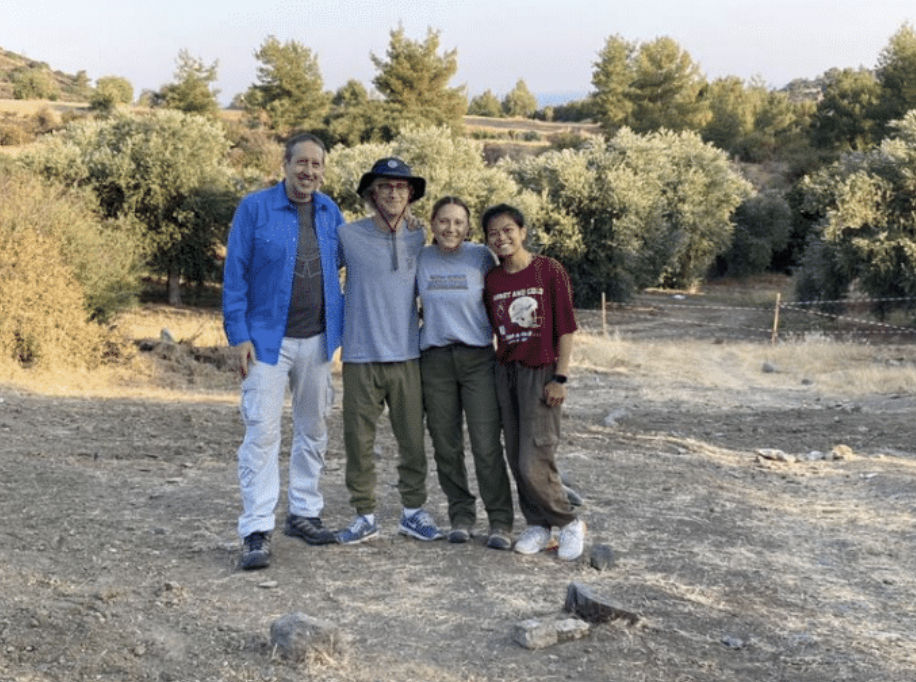
Me and my trenchmates! (left to right) Trench supervisor Eric, Students Shane and Olivia, and me!
Something Borrowed
This year, one of my main emphases was gathering background research for my upcoming master’s thesis. This included traveling around the island to find people to talk to, specific documentation, and other minutia of research. Additionally, some days in the field I had to step out to make sure I was writing and reading. I am very luck to have gotten to know, very well, the directors of the field school. Dr. Grossman and Dr. Paulette are from my undergraduate institution of North Carolina State University (Go Pack!). I owe my love of anthropology and drive for field excavation to these two. Simultaneously, Dr. McCarthy and Dr. Graham (assistant directors of MVAP and primary directors of the Prastio Mesorotsos Archaeological Expedition) are a wealth of information and kindness. What I consider borrowed here is their time, expertise, and mentorship. In addition to the sheer number of credit hours I dedicated to Dr. Grossman and Dr. Paulette, they have always been the source of advice regarding steps towards my professional career. This summer, I was watching how they ran the field school more than last. Not only did this expose me to the process of excavations, but I also listened to the methodological reasons behind specific decisions in the field. MVAP 2019 was my first archaeological field school experience, and I was more interested in excavation and hitting the beach. This year, I found it more interesting to understand more about the archaeology of the site we are excavating and history of the island, specifically in archaeological context to the site. Additionally, they directed me towards the best resources for my thesis research. They helped us get permission to go to the CAARI library, and I gathered a wealth of information. Starting my master’s thesis has been infinitely helped because of the archaeological knowledge I was gaining from them. I consider this borrowed because I will always have the intention to return the favor by learning and using what they taught me in my future as an archaeologist.
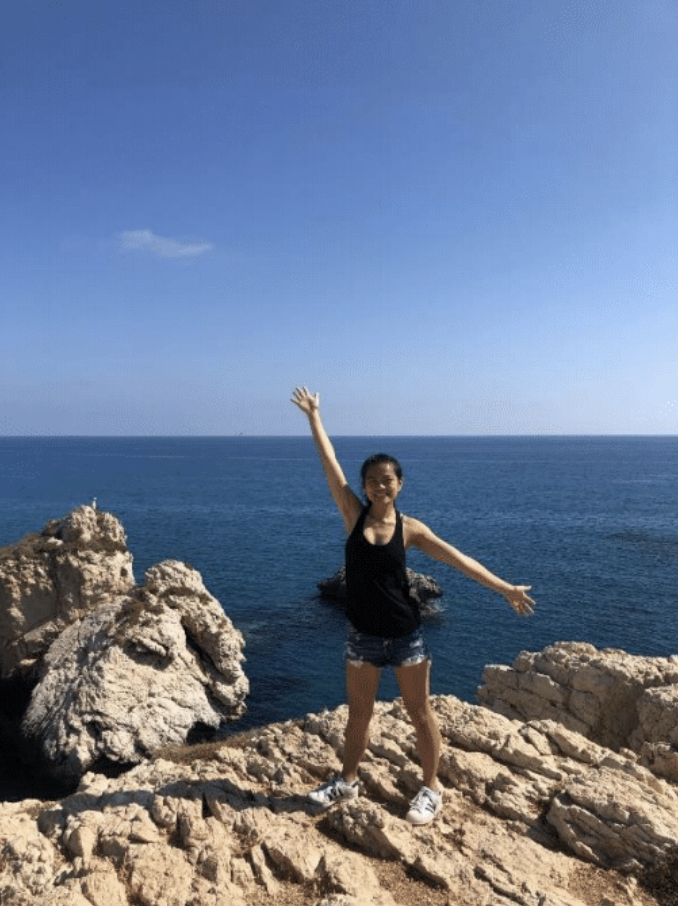
Alice Kligerman on top of Aphrodite's Rock, Cyprus.
Something Blue
Now let’s not forget . . . the site is located on Cyprus, an island in the Mediterranean. Aside from the work that went into the archaeological aspect of this trip, I was fully intending on enjoying the island while I could. Trips to the beach were a must. Many times, I would end up doing my work in settings near the water for the pure relaxation. Fridays were field trip days and, on top of seeing the sites around the island and learning about their significance, there was always a beach stop before heading home. Being reacquainted with the clear, blue gradient waters of the Mediterranean was some of my favorite moments from the trip. I swam to different parts of the beaches than last time, even adventuring into the water-carved caves of Aphrodite’s Rock. I felt like I could breathe clearer than above water while swimming. In conjunction with the blue of the sea, there was the clear blue of the sky. There were a few days of overcast, but the blue sky was present for most of the day, creating an almost ‘light’ feeling. The weather on the island throughout this summer, specifically in the area of Polis Crysochous, was ideal for both fieldwork and leisure.
My summer was filled with new and old experiences in the beloved location of Polis Crysochous, Cyprus. After a COVID-19 break of 2 summer excavations, I was finally able to witness excavation continuity. Seeing the opening of the trenches was very exciting, and the closing of the trenches just as heartbreaking. I was also researching for my thesis, so I was gaining more knowledge about the island’s pre-history, culture, and social dynamics throughout the years. Thus, while I was prepared for there to be new experiences, and expected there to be, I would never have predicted what type. While not in a nuptial setting, I believe this popular saying was appropriate when describing the moving parts of the summer and the many memories made.
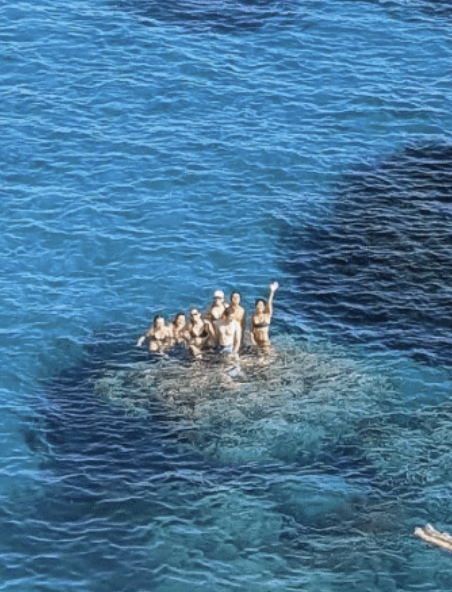
Very pixelated, but taken from the top of Aphrodite's Rock to us below
Alice Kligerman is a second-year master’s student at Florida State University. She received her B.A. in Anthropology in 2018 from North Carolina State University. Currently, she is working on her master’s thesis to defend in the spring of 2023. Her interests lie in the prehistory of Cyprus (7000 BC – ~2500 BC, specifically). She is interested in emergent complex societies and the archaeological evidence of increased social differentiation.
Instagram: @alvkh
Email: ak21y@fsu.edu
Want to help more students and early career archaeologists get into the field? Donate to the cause today by selecting “Excavation Scholarships” as your gift purpose!