FOA Webinar: Rachel Hallote on Jan. 20

FRIENDS OF ASOR WEBINARS

The Not-So-Innocents Abroad: The Beginnings of American Biblical Archaeology


1873 map of Jerusalem

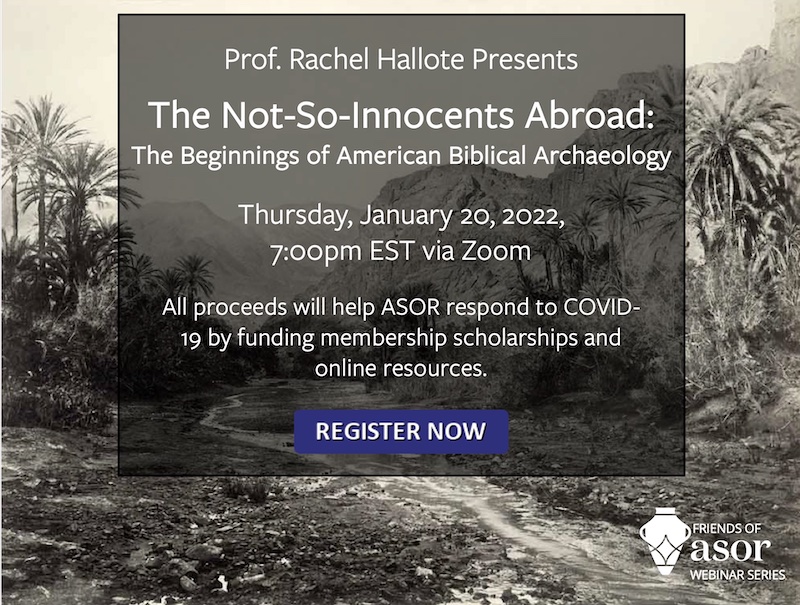
Friends of ASOR present the next webinar in our monthly series on January 20, 2022, at 7:00 pm EST, featuring Prof. Rachel Hallote. When scholars recount the story of the birth of “biblical archaeology,” the British are usually credited as the moving force while the Americans are all but ignored. The British, who were led by their deep political and religious interests in the Holy Land, carried out the first modern archaeological projects in second half of the nineteenth century, with great success. The Americans on the other hand, when mentioned at all, are portrayed as bumbling and incapable.

This webinar will redeem the image of American archaeological exploration in the Holy Land, and put endeavors into their own political, religious, and academic contexts. Not only were American archaeologists active in nineteenth century Palestine, but they were innovative in their techniques and applied a practical, no-nonsense approach to their endeavors. From the founding of the American Palestine Exploration Society to the famous Samaria Expedition of 1908, we will explore the considerable influence of American scholars on the archaeology of the Holy Land.​ Dr. Hallote will conclude her webinar with a live Q&A session.

Rachel Hallote is Professor of History at Purchase College SUNY. An archaeologist, she is also the author of several books and numerous articles about biblical archaeology and the history of archaeology. Her research involves British and American archaeologists who excavated in Ottoman-controlled Palestine in the 19th century. She has worked at numerous archaeological sites in Israel, including Tell Miqne and Megiddo. Her publications include Bible, Map, and Spade: The American Palestine Exploration Society, Frederick Jones Bliss, and the Forgotten Story of Early American Biblical Archaeology and the co-authored volume, The Photographs of the American Palestine Exploration Society. She currently co-hosts an archaeology podcast called This Week in the Ancient Near East.

ASOR Sustaining Members: $0 | ASOR Members: $6 | Public: $12

To receive your ASOR member discount, log into the online store. If you are new to ASOR, please click on the “New Visitor Registration” link to register your e-mail address and choose password for our online store. Once logged in, navigate to “Meeting and Event Registration” to register for the webinar and pay the fee. Each paid registrant will receive a confirmation e-mail when you pay for the webinar. If you do not receive this e-mail, then you are not registered. Please e-mail membership@asor.org with any questions or issues with registering.

You will be e-mailed the Zoom Webinar link in the week prior to the lecture on January 20, 2022. If you do not receive the link by the close of business on the Tuesday before the webinar, please e-mail membership@asor.org immediately. All webinars are recorded and all paid registrants will be sent a link to view the recording.

All proceeds from this lecture are used to fund scholarships for members impacted by COVID-19 as well as increasing ASOR’s online resources, which are free to the public.

WHY SPONSOR A WEBINAR?

Several levels of support from $50-$1,000 are available. Proceeds go towards membership scholarships and towards increasing ASOR’s virtual resources. Each sponsorship is tax-deductible and you can give your friends free registrations to a webinar!

Bronze Level ($50): up to 2 guest registrations
Silver Level ($100): up to 5 guest registrations
Gold Level ($500): up to 20 guest registrations
Platinum Level ($1,000): up to 50 guest registrations

After you sign up for a sponsorship online or over the phone, email the names and email addresses of your guests to Felice Herman at membership@asor.org, who will send your guests a confirmation and the Zoom link before the webinar.

WANT TO SAVE $6.00 ON THE NEXT WEBINAR?

Join ASOR as a member! Click here for more details about discounts for events and other benefits of membership. Memberships start at $40 for the year as an Associate Member.

Not ready to join yet? Become a Friend of ASOR for FREE!

Click here for more details about our online resources.

PAST WEBINARS

You can now purchase the link to the recording of any webinar. You can also purchase the bundle packages of all webinars from the 2020-2022 seasons. Please e-mail membership@asor.org for purchase details.

To see a printable pdf of the webinar titles from the 2020-2021 season, please click here. To see a printable pdf of the webinar titles from the 2021-2022 season, please click here.

Pricing:

Members: $6.00 per recording
Non-Members: $12.00 per recording
Bundle of 2020-2021 Webinars: $75.00
Bundle of 2021-2022 Webinars: $75.00
Bundle of 2020-2022 Webinars: $125.00

2021-2022 Season

A World at War: Protecting Cultural Heritage in Times of Conflict
Patty Gerstenblith (DePaul University), Lisa Ackerman (Columbus Citizens Foundation), Andrew Cohen (Government Professional and Cultural Heritage Expert) | May 12, 2022

Preserving Cultural Heritage in Hisban and Umm al-Jimal, Jordan
Øystein LaBianca (Andrews University), Elizabeth Osinga (Umm al-Jimal Archaeological Project), Darrell Rohl (Calvin University) | April 24, 2022

Back to the Field: Recent Discoveries & Summer Plans 2022
Lorenzo d’Alfonso (ISAW), Kathryn Grossman (NC State University), James R. Strange (Samford University) | April 3, 2022

Uncovering What is Nubian Beneath the Veneer of Egyptianness: Excavating the Archives
Debora Heard (University of Chicago) | March 20, 2022

Where Are They Now?: A Preview of 2022 ASOR-Affiliated Fieldwork Projects
Michael Given (University of Glasgow), Xenia-Paula Kyriakou (Florida Gulf Coast University), Stephen Batiuk (University of Toronto), Monique Roddy (Walla Walla University), Kent Bramlett (La Sierra University), Friedbert Ninow (La Sierra University), and Michael Hoff (University of Nebraska-Lincoln) | March 8, 2022

Excavations at Tel Gezer: A Personal Story
Sam Wolff (Tel Gezer Laboratory) | February 20, 2022

Tel Rehov: A Major Bronze and Iron Age City in the Jordan Valley
Amihai Mazar (Hebrew University of Jerusalem), Nava Panitz-Cohen ( Hebrew University of Jerusalem), Nota Kourou (Athens University), Naama Yahalom-Mack (Hebrew University of Jerusalem), Robert Mullins (Azusa Pacific University) | February 10, 2022

The Not-So-Innocents Abroad: The Beginnings of American Biblical Archaeology
Rachel Hallote (Samford University) | January 20, 2022

Synagogues as Jesus Knew Them
James R. Strange (Samford University) | December 2, 2021

Under Jerusalem: The Buried History of the World’s Most Contested City
Andrew Lawler | November 4, 2021

Jesus and Jerusalem on TV: How Do Bible Documentaries Get Made?
Robert Cargill (University of Iowa) | October 17, 2021

Digging the Divine?: Judahite Pillar Figurines and the Archaeology of Israelite Religion
Erin Darby (University of Tennessee) | October 7, 2021

David, Solomon, and Rehoboam’s Kingdom—The Archaeological Evidence
Yosef Garfinkel (Hebrew University of Jerusalem) | September 19, 2021

From Standing Stones to Sacred Emptiness: Textual and Visual Portrayals of Israel’s God
Theodore Lewis (Johns Hopkins University) | August 29, 2021

2020-2021 Season

Making May Matter: Webinarathon to Endow Diversity
Multiple Speakers | May 21-23, 2021

Archaeogaming: Why Video Games Deserve Their Own Archaeology
Tine Rassalle (University of North Carolina at Chapel Hill), Shannon Martino (Morton College), Matthew Winter (University of Arizona), Michael Zimmerman (Rhode Island) | April 18, 2021

How the Bible Became a Book
William Schniedewind (UCLA) | March 21, 2021

The Mysteries of Mithras in Caesarea: Exploring the Cult’s Rites and Remains
Jane DeRose Evans (Temple University), Alexandra Ratzlaff (Brandeis University) | March 11, 2021

Archaeology and the Hidden Religious Culture of Israelite Women
Carol Meyers (Duke University) | February 21, 2021

Meet the Directors—Fundraiser to Support ASOR’s Affiliated Overseas Research Centers
Matthew J. Adams (AIAR), Pearce Paul Creasman (ACOR), Lindy Crewe (CAARI) | February 11, 2021

Early Synagogues, Jesus, and Galilee—A Jewish Perspective
Eric Meyers (Duke University) | December 13, 2020

Home Sweet Home: Ancient Israelite Households in Context
Cynthia Shafer-Elliott (William Jessup University) | October 18, 2020

Priestesses in the Days of Solomon and Ahab
Susan Ackerman (Dartmouth College) | September 13, 2020

Digging Deeper: How Archaeology Works
Eric H. Cline (The George Washington University) | August 9, 2020

Stipend Report: Olivia Golubowski

Archaeology From Behind the Computer Screen

Olivia Golubowski, 2021 Platt Summer Stipend Recipient

Most people who envision the practice of archaeology find themselves imagining what is colloquially called “the field:” perhaps a desert, perhaps a jungle, perhaps even underwater, but most certainly some aspect of the natural world in which one would hope to find material remains of the human past. Very few, I imagine, would picture the blinding artificial brightness of a computer screen—yet this summer, this was exactly where I found myself practicing the discipline, with my cat sitting in my lap and the comfort of air conditioning close by.


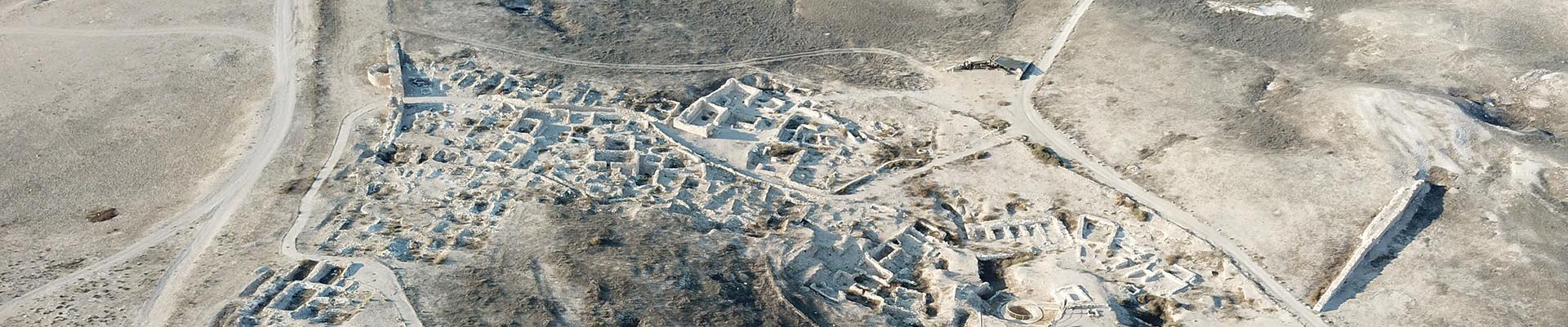
Aerial view of Arad Early Bronze Age town from the southwest. (Courtesy of Matthew J. Adams, ASOR Photo Collection)

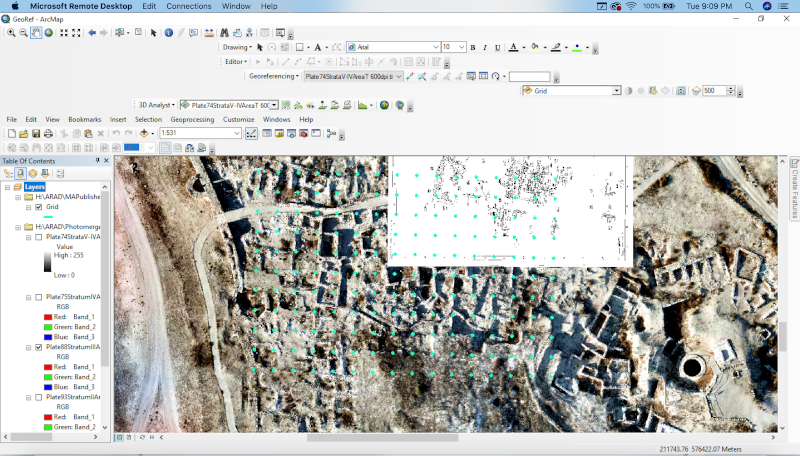
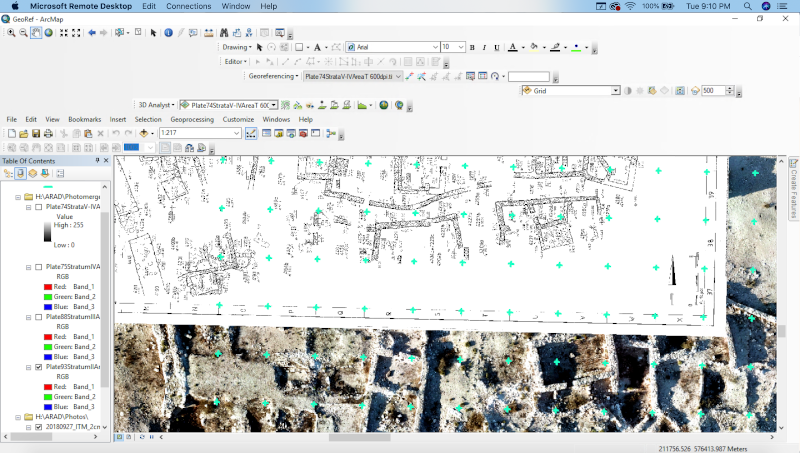
I was lucky enough to be able to work with Dr. Zachary Dunseth on the site of Tel Arad, Israel, all the while from behind my computer screen in Marlton, New Jersey. Instead of a trowel in my hands, my trusted tools were a variety of geographic information system programs, including ArcMap and QGIS. I wasn’t uncovering artifacts, but rather evaluating that which had already been excavated, and my work was like nothing I had expected out of archaeology. Rather than recording finds as they were discovered, I took such records and processed them into something which could be interpreted, manipulated, and above all, accessible.

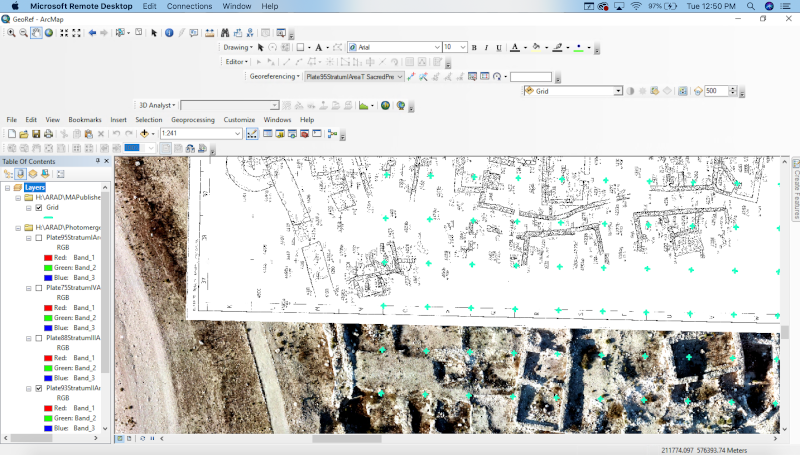
My work started with plans—lots, lots, and lots of plans, all incredibly large and detailed. Physical copies stretched longer across than I was tall, and together, Zach and I began the tedious process of scanning portions of the plans into digital images and then ‘stitching’ the images together via Photoshop to incorporate them once more into the massive plans they physically were. This process might’ve been a bit grueling, especially when a scan didn’t go well or just the tiniest sliver of one portion was missing—but the real challenge, I soon learned, was yet to come.

I was lucky enough to have taken a class in geographic information systems about a semester before beginning my work with Zach, and in that class, I had discovered the joys of georectification, along with the sweet satisfaction of getting a file in just the right spot, with every feature accurately represented spatially. I was about to discover the other, uglier side of georectification: endless calculations, fighting with numbers, and, worst of all, dealing with that one most excruciating aspect of legacy archaeological plans—hand-drawn human error.

Examples of Olivia’s work georectifying the Tel Arad plans.

Needless to say, the process of georectification was not a perfectly smooth one—yet in the end, despite the headaches the computer screen caused and the agony of thinking ‘maybe it will work this time’ only to find that it certainly did not work, I don’t think I would have had it any other way. The work I did was difficult. I balanced human error, miscalculated calculations, stubborn software, and my computer’s ever-decreasing storage space—but by the end of my work, when I was able to upload each and every archaeological plan, georeferenced to the very best of my ability, to our shared Dropbox folder, I felt like the happiest archaeologist on the face of the earth. I had done something which, at times, seemed impossible—and despite my own preconceptions about the way archaeology was ‘supposed’ to work, I had done it all from behind a screen.

Olivia is currently a junior studying biological anthropology and archaeology at Brown University. Her academic interests include mortuary archaeology, geographic information systems, and paleoanthropology. Outside of academics, she enjoys spending time with her little brother, dancing, watching Star Wars, and above all else, her cat.


During the summer of 2021, ASOR supported 27 undergraduate and graduate students through the Summer Stipend Program. These students undertook non-fieldwork archaeological research projects led by ASOR-affiliated project directors. They also took part in monthly cohort group meetings hosted via zoom. Read a summary of these cohort meetings here.

Stay tuned for more updates from the 2021 Summer Stipend recipients!

ASOR Annual Fund Appeal

ASOR Annual Fund Appeal

December 14, 2021

Dear Fellow ASOR Member,

Please consider a gift to ASOR before the end of 2021. Since the beginning of the pandemic, we have expanded our programs and outreach. You, our members, have volunteered and contributed in so many ways to keep ASOR moving forward and carrying out our mission. Thank you.

Here is a highlight of some accomplishments achieved during the pandemic (2020–2021):

  • 1100 Annual Meeting participants from 38 countries and 6 continents: Participants in the in-person and virtual components. More than 400 presentations available in the online library.
  • 559 Scholarships: 270 membership and 289 Annual Meeting scholarships = more than $55,000.
  • 26 FOA Webinars: Launched in August 2020, Friends of ASOR (FOA) has hosted 26 webinars (including a “webinarathon”) and raised almost $36,500 for scholarships and DEI.
  • 27 Summer Stipends: Summer research funds, including six for BIPOC students.
  • 4 Major Cultural Heritage Grants: Thanks to Department of State and anonymous funding, ASOR expanded our work in North Africa to Libya, Tunisia, Algeria, and Morocco.
  • More than $270,000 for Diversity, Equity, and Inclusion: More than 220 members established a $200,000 endowment to support BIPOC scholarships. We also invested $70,000 in special projects and scholarships, including videos to help recruit high school students to archaeology.
  • 3 Journals and 2 Book Series: ASOR continues to carry out our mission of disseminating research through our established publications.
  • More than 750 photos and maps: We added hundreds of images to the ASOR Photo Collection so that our members can confidently use them for teaching and research.
  • We will award more than $200,000 in 2022: 50 dig participation scholarships; 7 grants to dig directors / projects; $20,000+ in heritage mitigation grants; $10,000+ in research grants for members; and $18,000 for Mesopotamian research.
  • Continuation of membership and Annual Meeting scholarships in 2022: We want to continue to support the involvement in ASOR for all members with a financial need.


Thus, our request—all the above is made possible because of gifts and endowments. We ask that you join us in a year-end gift or pledge to support our organization so that we can continue to give back to our members in even more ways than listed here.

Warm regards,

Andrew G. Vaughn, Executive Director             Lynn Swartz Dodd, Chair, ASOR Development

Stipend Report: Lilly Hickox

Casting Light on Humayma’s Roman Town

Lilly Hickox, 2021 Eric and Carol Meyers Summer Stipend Recipient


Hickox studying the lamps of Humayma’s vicus. (photo courtesy of M. Schwenteck)

Humayma, located in the northwest corner of Jordan’s Hisma desert, is a site with a long history of permanent settlement with Nabataean, Roman, Byzantine, and early Islamic periods. Excavations at the Roman town (vicus) have been carried out since the 1990s under the direction of Dr. J.P. Oleson from 1991 to 2005 and Dr. M. Barbara Reeves from 2008 to present.

This summer, I researched the ceramic oil lamps and fragments from the vicus at Humayma remotely. The vicus emerged concurrently with the nearby Roman Fort, shortly after the conquest of the Nabataean Kingdom in 106 CE by Emperor Trajan. This research was made possible through ASOR’s Summer Stipend program and funding supported by the Eric and Carol Meyers Scholarship Fund.

The question driving my research was sparked by the findings from my 2020 undergraduate thesis project, Shedding Light on an Ancient Past: The Analysis of Ceramic Oil Lamps from the Roman Fort at Humayma. During this project, I identified a paucity of Roman-style lamps at the Roman Fort, while Nabataean and South Jordan lamps were prevalent. In order to understand why this was happening at the Fort and how the absence of Roman identity in the lamps relates to the activity of the overall settlement, I specifically looked at the corpus from the vicus this summer.

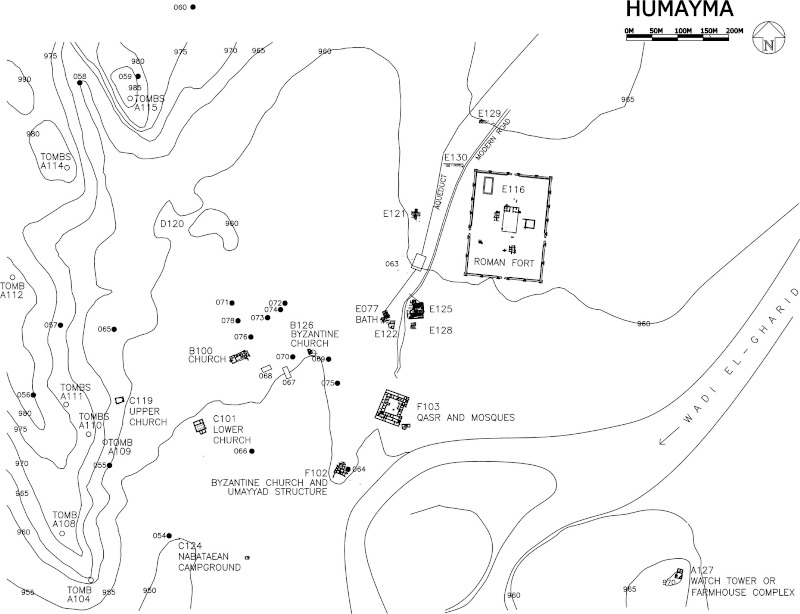
Map of Humayma. (adapted from Reeves 2019, 117 fig 2)

The methodology of this project involved visually examining photographs of lamps, lamp fragments, and mixed pottery fragments. Looking at attributes of shape, discus, shoulder pattern, nozzle, and filling hole, allowed me to identify and catalogue the lamps. These photographs and artefact descriptions were provided by Humayma’s excavators from the 1996, 1998, 2000, 2004, 2005, 2008, 2010, and 2012 field seasons. Neither a comprehensive catalogue nor analysis of the lamps had been carried out until now. This summer, I identified fourteen complete lamps and over 170 lamp fragments.

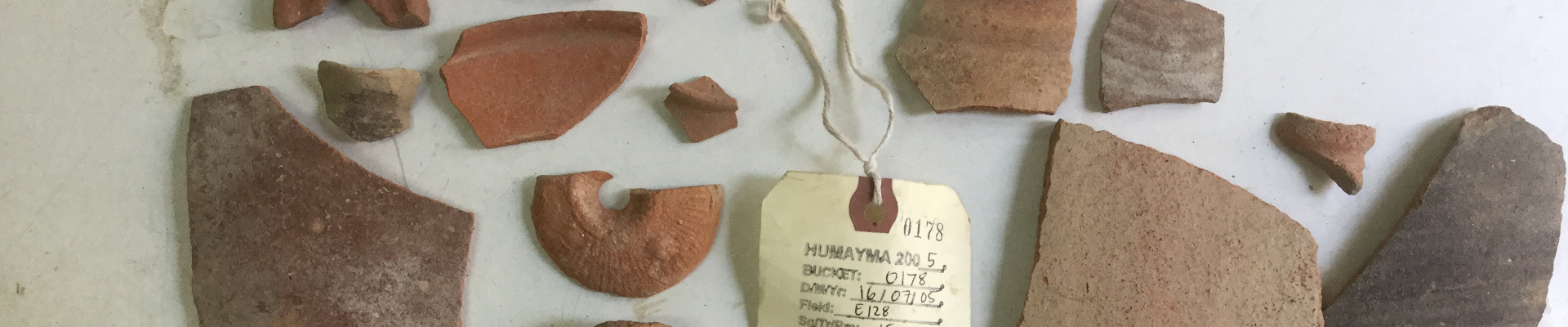
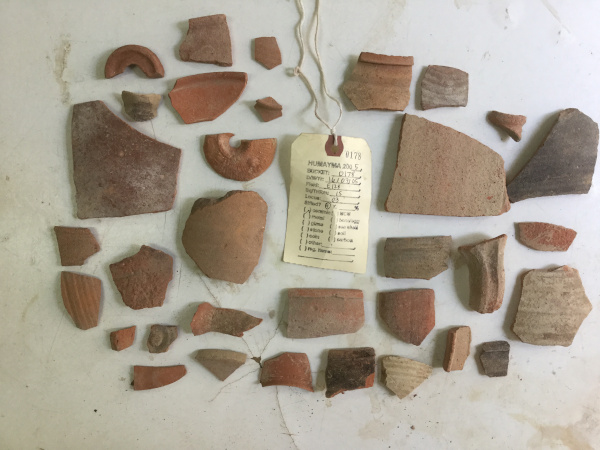
A sample of pottery from area E128. Can you spot a lamp fragment? (photo provided by Dr. M. Barbara Reeves, director of the Humayma Excavation Project)

A Nabataean rosette lamp, one of the most prolific types at the vicus. (photo provided by Dr. M. Barbara Reeves, director of the Humayma Excavation Project)

In this project, I investigated the ceramic oil lamps from three different areas of the vicus. The first area (E077) contained first century CE Nabataean structures that were built over by a bath-house in the Roman period. The Nabataean rosette lamp, dating to the first century CE, likely corresponds to the phase preceding the early second century destruction. Many early Byzantine lamps and some late Roman lamps signify the later occupation of the area.

The second area (E128), a Nabataean or Roman mudbrick structure, contained a majority of Nabataean-style lamps. This structure, made of eclectic materials, was built between the late first century and the middle of the second century. Remarkably, a figural lamp and a boot-shaped lamp were identified in this location, which are both rare for the corpus of the vicus. The boot-shape lamp may align with the later function of the structure in which the area was used as pottery dump until the sixth century CE.


A Roman discus lamp with a gladiatorial combat scene. (photo provided by Dr. M. Barbara Reeves, director of the Humayma Excavation Project)

The final area that I examined was E125, an area possessing a Nabataean-Roman shrine, and various domestic structures, such as a Roman insula. This area yielded the greatest number of lamp fragments, the vast majority being the Nabataean rosette lamp, while fewer were Roman in style. At least three figural lamps were identified, including a symplegma and gladiatorial combat scene. Overall, the lamps from the vicus show a strong parallel with those from Petra.

While this project did not constitute typical field work, it nevertheless presented its own unique challenges. For instance, I relied only on photographic media that was sometimes supplemented by artifact descriptions in order to make an assessment.


Lamp fragments from the E125 shrine. (photo provided by Dr. M. Barbara Reeves, director of the Humayma Excavation Project)

This project contributed to the understanding of the civilian activity at Humayma and may be used to help develop stratigraphic phasing for these areas in the vicus. My next steps will be to look more closely at several anomalous items in the corpus and their parallels. I presented a critical analysis of my findings, considering the corpus from the Fort, at the virtual component of ASOR’s Annual General Meeting in December 2021 (Click here to view the poster).

I would like to personally thank Dr. Reeves for her ongoing support, supervision, and expertise, as well as the Humayma Excavation team for their work, Carol and Eric Meyers for making this possible, and M. Schwenteck for assisting me in translations.

Lilly Hickox is an MA student of Classical and Near Eastern Archaeology at the University of British Columbia. She has been researching the ceramic oil lamps from various locations at Humayma since 2020.

References:

Reeves, M. B. 2019. “The Nabataean and Roman Towns at al-Ḥumayma: an Urban Design Perspective.” Studies in the History and Archaeology of Jordan 13: 115-127.

During the summer of 2021, ASOR supported 27 undergraduate and graduate students through the Summer Stipend Program. These students undertook non-fieldwork archaeological research projects led by ASOR-affiliated project directors. They also took part in monthly cohort group meetings hosted via zoom. Read a summary of these cohort meetings here.

Stay tuned for more updates from the 2021 Summer Stipend recipients!

Table of Contents for NEA 84.4 (2021)

Table of Contents for Near Eastern Archaeology 84.4 (December 2021)


You can receive NEA (and other ASOR publications) through an ASOR Membership. Please e-mail the Membership office if you have any questions.

Pp. 252–261: “New Evidence of Two Transitions in the Neolithic Sequence of Northeastern Iran,” by Kourosh Roustaei and Hasan Rezvani

As early as the 1950s the Zagros range in western Iran has been one of the main arenas for seeking the earliest villages and domestication of plants and animals in the eastern wing of the Fertile Crescent. Pioneering works of Robert Braidwood during the 1950s and early 1960s at a number of sites in Iraqi Kurdestan and the central Zagros region of western Iran, such as Karim Shahir, Jarmo, Asiab, Sarab, not only produced the first information on the Neolithic of this region, but also motivated a series of fieldworks targeting the Neolithic period in western Iran during the 1960s–1970s (e.g., Braidwood). Excavations at the early Neolithic sites of Guran, Ganj Darreh, Abdul Hosein, Ali Kosh, and Chogha Sefid during these two decades contributed significantly to a clearer picture of the Neolithic of the Zagros region and suggested this region as one possible center of early domestication in the Near East (e.g., Hole, Flannery, and Neely). Although this status of the Zagros was partly eclipsed because of both a two-decade hiatus in Neolithic research during 1980s–1990s and the concurrent, increasing investigations on the early Neolithic in the Levant and southeastern Anatolia, it seems that the Zagros is regaining its position regarding early domestication and the initial stages of the Neolithic way of life in the Fertile Crescent through the crucial information obtained from recent excavations at some early Holocene sites, such as Chogha Golan and Sheikhi Abad (e.g., Matthews, Matthews, and Homamadifar; Riehl et al.).


ASOR Members with online access: navigate to the token link email sent to you (search for “token link” in inbox) before attempting to read this article. Once you have activated your member token, click here to access the above article on The University of Chicago Press Journals’ website.

Pp. 262–271: “Umm an-Nar Ritual Building in Dahwa 1 (DH1), Northern Al-Batinah, Oman,” by Nasser S. Al-Jahwari and Khaled A. Douglas

The Umm an-Nar Culture was identified after the first scientific archaeological excavations took place in the Oman Peninsula (modern-day Oman and United Arab Emirates) during the late 1950s by the Danish team at the Umm an-Nar Island in Abu-Dhabi (Frifelt 1991, 1995). Since then, several sites have been excavated by different teams in the region, such as Hili (Cleuziou 1980, 1982), Ras al-Jinz (Cleuziou and Tosi 2000), Bat (Thornton, Cable, and Possehl 2016), Meyaser (Weisgerber 1978, 1981), Bisya/Salut (Orchard and Stanger 1999; Orchard and Orchard 2002), Tell Abraq (Potts 1989, 1990, 1991, 2000), and Asimah (Vogt 1994). These excavations have revealed abundant material about the culture of these third-millennium BCE (2700–2000 BCE) communities. The inhabitants of this region had developed an intensive and complex long-distance trade network with societies in Mesopotamia and the Indus Valley (Cleuziou 2003).


ASOR Members with online access: navigate to the token link email sent to you (search for “token link” in inbox) before attempting to read this article. Once you have activated your member token, click here to access the above article on The University of Chicago Press Journals’ website.

Pp. 272–280: “Gender, Deities, and the Public Image of Sobekneferu,” by Kelly-Anne Diamond

Beginning as early as the Twelfth Dynasty, female masculinity was an alternative for Egyptian royal women seeking to legitimize their claim to the throne, communicate their power, and exercise their authority. The Eighteenth Dynasty female king Hatshepsut (ca. 1473–1458 BCE) attracted the most attention for not conforming to traditional western gender norms. However, three hundred years before Hatshepsut, a lesser-known female king—Sobekneferu (ca. 1777–1773 BCE)—embodied power through her performance of masculinity (Halberstam 1998: 1–5). She promoted herself as king of Egypt by assuming a full royal titulary, employing kingly accoutrements, appropriating masculine garb, portraying herself in strong masculine poses, and adopting male prerogatives. Some of Sobekneferu’s preserved imagery illustrates clearly a woman in masculine poses with royal insignia, but her statue in the Louvre (E 27135) shows her with the addition of male dress items (fig. 1; Berman and Letellier 1996: 47; Grajetzki 2006, 63; Callender 1998a: 233–35). With the creation of this statue, Sobekneferu intentionally modified her attire and intensified her expression of female masculinity.


ASOR Members with online access: navigate to the token link email sent to you search for “token link” in inbox) before attempting to read this article. Once you have activated your member token, click here to access the above article on The University of Chicago Press Journals’ website.

Pp. 282–292: “Discovering Early Syrian Magic: New Aramaic Sources for a Long-Lost Art,” by Jessie DeGrado and Madadh Richey

Few magical texts have been recovered from the Levant dating to the first millennium BCE. Three recently published early Aramaic inscriptions help fill this lacuna: an inscribed cosmetic container from Zincirli, a Lamaštu amulet from the same site, and an Aramaic-inscribed Pazuzu statuette. These texts, dated paleographically to the ninth and eighth centuries BCE, afford a window onto local traditions in the Levant and their interactions with Mesopotamian magic. They also provide an impetus for a reanalysis of the infamous Arslan Tash amulets, offering further context for their texts and iconography.


ASOR Members with online access: navigate to the token link email sent to you (search for “token link” in inbox) before attempting to read this article. Once you have activated your member token, click here to access the above article on The University of Chicago Press Journals’ website.

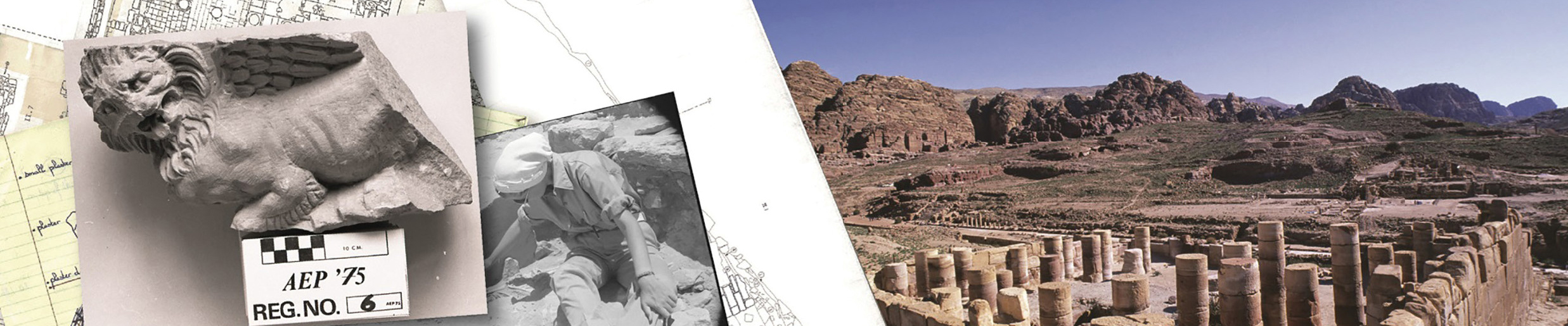
Pp. 293–305: “The Temple of the Winged Lions, Petra: Reassessing a Nabataean Ritual Complex,” by Pauline Piraud-Fournet, John D. M. Green, Noreen Doyle, and Pearce Paul Creasman

The Temple of the Winged Lions (TWL) in Petra is a Nabataean- and Roman-era ritual complex thought to have been founded in the early first century CE (banner photograph and fig. 1). It fell out of use following a major earthquake in 363 CE. This is a contextually rich site for the study of ancient ritual, economy, and society in the Nabataean and Greco-Roman world and part of a larger complex including workshops and domestic spaces. The deity (or deities) once worshiped there remains unknown. The most common suggestion is that the temple was dedicated to Al-‘Uzza, the Arabian divinity whose Greek equivalent was Aphrodite.


ASOR Members with online access: navigate to the token link email sent to you (search for “token link” in inbox) before attempting to read this article. Once you have activated your member token, click here to access the above article on The University of Chicago Press Journals’ website.

Pp. 306–315: “A Sasanian Triumphal Arch in Bishapur,” by Alireza Shahmohammadpour

The Sasanian Kingdom (224–651 CE) was the last dynasty before the Muslim-Arab invasion of Iran (Pourshariati 2008: 1–2). Sasanian-era architectural remains—mostly including palaces, castles, temples, bridges, and dams—are scattered throughout ancient Iran. However, the density of monuments in the southwestern regions of the country and in Mesopotamia is higher than anywhere else. Many of the Sasanian buildings excavated and exposed to the elements in the nineteenth and early twentieth centuries were incorrectly or insufficiently identified by their excavators and have not been subjected to systematic analysis since their initial publication. In the years that have elapsed, erosion and human activity have damaged or erased architectural features that might be useful for understanding Sasanian architecture. One such site is the city of Bishapur in the southwest of Iran. This city was established by Shapur I, the second king of the dynasty, in the middle of the third century and was occupied until the eleventh century, more than four centuries after the fall of the Sasanian Empire (Mehryar 1999: 33). Even at present the surface of the site is covered by apparently random piles of stones, at first glance making recognition of the buildings difficult (fig. 1).


ASOR Members with online access: navigate to the token link email sent to you (search for “token link” in inbox) before attempting to read this article. Once you have activated your member token, click here to access the above article on The University of Chicago Press Journals’ website.

ASOR Office Coordinator Opening

[vc_row fullwidth=”true” attached=”true” css=”.vc_custom_1496247803139{padding-top: 0px !important;padding-right: 0px !important;padding-bottom: 0px !important;padding-left: 0px !important;}”][vc_column][vc_single_image image=”78679″ img_size=”full” alignment=”center”][/vc_column][/vc_row][vc_row fullwidth=”true” css=”.vc_custom_1496682730308{padding-top: 10px !important;padding-right: 0px !important;padding-bottom: 0px !important;padding-left: 0px !important;}”][vc_column width=”1/12″ css=”.vc_custom_1496683820796{margin-right: 10px !important;}” offset=”vc_hidden-md vc_hidden-sm vc_hidden-xs”][vc_column_text]

 SHARE

[/vc_column_text][mk_image src=”http://www.asortest.org/wp-content/uploads/2017/01/social-fb-icon4.jpg” image_width=”42″ image_height=”42″ hover=”false” custom_url=”https://www.facebook.com/ASOResearch/” margin_bottom=”0″][mk_image src=”http://www.asortest.org/wp-content/uploads/2017/01/social-tw-icon4.jpg” image_width=”42″ image_height=”42″ hover=”false” custom_url=”https://twitter.com/ASOResearch?ref_src=twsrc%5Egoogle%7Ctwcamp%5Eserp%7Ctwgr%5Eauthor” margin_bottom=”0″][mk_image src=”http://www.asortest.org/wp-content/uploads/2017/01/social-in-icon4.jpg” image_width=”42″ image_height=”42″ hover=”false” custom_url=”https://www.linkedin.com/company/american-schools-of-oriental-research” margin_bottom=”0″][mk_image src=”http://www.asortest.org/wp-content/uploads/2017/01/social-ml-icon_7.jpg” image_width=”42″ image_height=”42″ hover=”false” custom_url=”mailto:info@asor.org” margin_bottom=”0″][mk_image src=”http://www.asortest.org/wp-content/uploads/2017/01/blog-icon3.jpg” image_width=”42″ image_height=”42″ hover=”false” custom_url=”http://asor.org/blog” margin_bottom=”0″][/vc_column][vc_column border_color=”rgba(255,255,255,0.01)” width=”1/6″ css=”.vc_custom_1496683923840{margin-right: 20px !important;border-left-width: 2px !important;padding-right: 20px !important;padding-left: 20px !important;border-left-color: #99422f !important;}”][mk_divider divider_color=”rgba(255,255,255,0.01)” thickness=”1″ margin_top=”3″ margin_bottom=”3″][vc_widget_sidebar sidebar_id=”ca-sidebar-39801″][/vc_column][vc_column border_color=”rgba(170,170,170,0.01)” width=”1/2″ css=”.vc_custom_1487276122024{margin-right: 10px !important;margin-bottom: 30px !important;border-right-width: 2px !important;border-bottom-width: 2px !important;padding-top: 30px !important;padding-right: 30px !important;padding-left: 20px !important;background-color: #ffffff !important;border-right-color: rgba(227,228,228,0.75) !important;border-bottom-color: rgba(227,228,228,0.75) !important;}”][vc_column_text responsive_align=”left”]

ASOR OFFICE COORDINATOR OPENING

[/vc_column_text][mk_divider][vc_column_text]The American Society of Overseas Research (ASOR) seeks candidates for a full-time Office Coordinator to begin in January 2022. This position is located at The James F. Strange Center—headquarters of ASOR, 209 Commerce St., in historic Old Town Alexandria, VA.

Founded in 1900, the ASOR is a 501(c)(3) non-profit whose mission is to initiate, encourage, and support research into, and public understanding of, the history and cultures of the Near East and wider Mediterranean world, from the earliest times. Please visit www.asor.org for more information.

Primary Responsibilities:

  • Maintain high-quality customer service for our 2,200 members and 16,000 Friends
  • Answer the general ASOR telephone and information e-mail account
  • Assist with ASOR’s off-site Annual Meeting (in November of each year) by providing general administrative support including but not limited to, processing payments, answering questions, and making all attendees feel welcome. Travel to the meeting may be required (once per year)
  • Provide general office support (e.g., scanning, copying, ordering supplies, and processing mail, orders, and bills)
  • Process membership dues, donations, and event registrations in organizational database (NetForumPro)
  • Assist with membership and donation mailings
  • Perform other office duties as assigned

Qualifications / Skills Needed:

  • Associate Degree or equivalent work experience; Bachelor’s Degree preferred
  • 2 years of office experience strongly preferred
  • Experience with databases, Microsoft Office, WordPress, and general office management software required. Experience with social media platforms and website management (using WordPress or similar) preferred
  • Excellent communication and interpersonal skills
  • Attention to detail; ability to multitask and to prioritize

Compensation and Benefits: Hourly pay between $20–24/hr based on experience and qualifications. Benefits include paid vacation and sick time; 10 paid holidays per year; employer retirement contribution (6%); and benefit dollars ($500 per month).

How To Apply: E-mail letter of interest, resume, and contact information for three references to Marta Ostovich at programs@asor.org. The letter of interest should discuss how ASOR as an organization fits into the applicant’s training and career goals. Please include your name and “ASOR Coordinator” in the subject line.

Review of applications will begin immediately and continue until the position is filled.


ASOR is an equal opportunity employer and all qualified applicants will receive consideration for employment without regard to race, color, gender, religion, national origin, disability, veteran status, age, marital status, sexual orientation, gender identity, genetic information, or any other class protected by federal or state law (EEO/AA).[/vc_column_text][/vc_column][vc_column border_color=”rgba(170,170,170,0.01)” width=”1/6″ css=”.vc_custom_1496684098866{margin-right: 5px !important;margin-bottom: 20px !important;border-right-width: 2px !important;border-bottom-width: 2px !important;padding-top: 30px !important;padding-right: 10px !important;padding-left: 10px !important;background-color: #ffffff !important;border-right-color: rgba(227,228,228,0.75) !important;border-bottom-color: rgba(227,228,228,0.75) !important;}”][vc_wp_posts title=”BROWSE THE NEWS ARCHIVE” number=”4″][/vc_column][vc_column border_color=”rgba(170,170,170,0.01)” width=”1/6″ css=”.vc_custom_1496684008271{margin-right: 10px !important;margin-bottom: 30px !important;border-right-width: 2px !important;border-bottom-width: 2px !important;padding-top: 30px !important;padding-right: 20px !important;padding-left: 20px !important;background-color: #ffffff !important;border-right-color: rgba(227,228,228,0.75) !important;border-bottom-color: rgba(227,228,228,0.75) !important;}”][vc_column_text] [/vc_column_text][/vc_column][/vc_row]

ASOR Annual Year-End Appeal Letter

Year-End Appeal Letter From ASOR’s President

December 5, 2022

Dear ASOR Members and Friends,

I am writing today to ask you to consider a gift to ASOR before the end of the year. ASOR is leaving 2022 with a larger membership and wider reach than ever before. Our outreach efforts in cultural heritage and education continue to expand both in the U.S. and abroad. We just completed a resoundingly successful Annual Meeting in Boston, where many of you presented your fieldwork and other research in stimulating papers, posters, and workshops attended by nearly 900 participants. Members came from around the world, many for the first time thanks to travel fellowships made possible by members’ generous donations and State Department Embassy grants. ASOR now has over 100 affiliated fieldwork and publication projects in 18 countries, and our prestigious Archaeological Report Series is producing its 30th volume in as many years. Your gifts funded scholarships, fellowships, and grants for many of these programs. You enabled ASOR to award more than $222,000 in 2022.

In recent years, ASOR has been forging new partnerships in our ever changing 21st century world to broaden our investigations of the ancient world, our collective human past, and cultural heritage. We are now reaching new and underserved audiences in efforts to make ASOR’s work more accessible. These efforts range from simultaneous translation of papers to ambitious educational projects fostering community involvement from the people and scholars in the areas in which we work (see the call for such activities by Iraqi archaeologist Jaafar Jotheri in the most recent issue of our Friends of ASOR Newsletter, The Ancient Near East Today X, No. 12). Meanwhile, your support helps ASOR increase benefits to our original constituencies of biblical specialists and experts in Semitic languages and literatures. In 2023, you will see ASOR add Maarav: A Journal for the Study of the Northwest Semitic Languages and Literatures as our fourth journal. Maarav will be available for no additional charge to all ASOR members above the Associate level.

ASOR is an organization that strives to unite people and transcend ethnic, racial, and religious boundaries. We have made great strides in many areas, and with your continued help we can do much more. The secret to vibrant non-profit growth is a virtuous circle of work and support. The generous funding from you, our donors, enables ASOR to accomplish so much as an organization, but also to award member scholarships and grants for even more external research. The products of this work in turn attract more members and donors to produce and fund even more pioneering efforts. Please help to keep that circle unbroken. Give to ASOR today!

Best wishes for a safe and happy holiday season,

Sharon Herbert
ASOR President

Call for Nominations: DEI Committee

Call for DEI Committee Nominations

At its November 21, 2021, meeting, the ASOR Board of Trustees established a standing committee to work on fostering Diversity, Equity and Inclusion in our organization. The Board appointed Erin Darby of the University of Tennessee as the chair of the newly formed DEI Committee. This committee grew out of DEI Task Force established by President Sharon Herbert in the fall of 2020, and several members of that Task Force will serve on the Committee. We are now seeking volunteers and nominations for additional members of the Committee. Its responsibilities as envisioned by the Board are described briefly in section 5.21 of ASOR’s by-laws as advising ASOR leaders “regarding initiatives ASOR might undertake either individually or jointly with other bodies to reach out to and include diverse communities in ASOR activities in meaningful and sustainable ways. In North America, these communities include, but are not limited to, BIPOC, LGBTQ+, and other underserved groups. Overseas, ASOR will focus on serving its international membership and working with local archaeological communities to promote public engagement in ASOR activities.” Further information on ASOR’s DEI initiatives can be found in section 3 of the 2021-2025 Strategic Plan. Once its full membership is determined, the DEI Committee will work on an expanded charge. Nominations and applications should be sent to Erin Darby and Marta Ostovich.
2021 ASOR Honors & Awards

2021 ASOR HONORS & AWARDS


Each year at the Annual Meeting, ASOR recognizes individuals who have performed outstanding service for the organization, those who have published exceptional academic work, and those who made significant contributions to our field. The following award recipients were honored at the 2021 Annual Meeting in Chicago and during the Members’ Meeting on December 8th as part of the Virtual Annual Meeting. Awards were presented by Lynn Welton, Chair of ASOR’s Honors and Awards Committee.

The W. F. Albright Award. This award honors an individual who has shown special support or made outstanding service contributions to one of the overseas centers, ACOR, AIAR, CAARI, or to one of the overseas committees – the Baghdad Committee and the Damascus Committee. This award is given when such an individual is identified.


ACOR: Awarded to Øystein LaBianca, Trustee, Representative to ASOR Board of Trustees, ACOR.


AIAR: Awarded to Susan Cohen, Trustee, Chair of Fellowship Committee, AIAR


CAARI: Awarded posthumously to F. Bryan Wilkins, former President of the Board of Trustees, CAARI.

The Charles U. Harris Service Award. This award is given in recognition of long term and/or special service as an ASOR officer or Trustee (one award is given annually).

Awarded to Sheila Bishop, President, The Foundation for Biblical Archaeology.

The P. E. MacAllister Field Archaeology Award. This award honors an archaeologist who, during his/her career, has made outstanding contributions to ancient Near Eastern and eastern Mediterranean archaeology (one award is given annually).

Awarded to Andrea Berlin, James R. Wiseman Chair in Classical Archaeology, Professor of Archaeology and Religion, Boston University.

ASOR Membership Service Award. This award recognizes individuals who have made special contributions on behalf of the ASOR membership, through committee, editorial, or office services.

Awarded to Hanan Charaf, Assistant Professor, Department of Art and Archaeology, Lebanese University; former editor of the Archaeological Report Series


Awarded to Kate Grossman, Assistant Professor, Department of Sociology and Anthropology, North Carolina State University; outgoing Chair of the CAP Fellowship Subcommittee


Awarded to Heather McKee, former ASOR Treasurer

The G. Ernest Wright Award. This award is given to the editor/author of the most substantial volume(s) dealing with archaeological material, excavation reports and material culture from the ancient Near East and eastern Mediterranean. This work must be the result of original research published within the past two years (one award is given annually).

Awarded to Allison Mickel, Assistant Professor, Department of Sociology and Anthropology, Lehigh University University, for Why Those Who Shovel Are Silent: A History of Local Archaeological Knowledge and Labor, University Press of Colorado.

The Frank Moore Cross Award. This award is presented to the author/editor of the most substantial volume(s) related to the history and/or religion of the ancient Near East and Eastern Mediterranean. Primary consideration will be given to historical, epigraphic, textual, and comparative literary studies; or to works that advance and/or evaluate new methodological approaches to the literary record(s). This work must be the result of original research published during the past two years (one award is given annually).

Awarded to Geoffrey Khan, Regius Professor of Hebrew, University of Cambridge, for The Tiberian Pronunciation Tradition of Biblical Hebrew, Open Book Publishers.

The Nancy Lapp Popular Book Award. This award is presented to the author/editor of a book published in the last two years that offers a new synthesis of archaeological or textual evidence intended to reach an audience of scholars as well as students and the broader public (one award is given annually).

Awarded to Max Price, Principal Lecturer, Massachusetts Institute of Technology, for Evolution of a Taboo: Pigs and People in the Ancient Near East, Oxford University Press.

The Joy Ungerleider Poster Award. This award is conferred upon the author(s) of the poster presenting the results of a study about ancient Near Eastern societies in a clear, legible fashion using original graphic content. Subject matter may be based in archaeological sciences, history, anthropology, epigraphy, ethnography, heritage or other scholarly approaches to understanding ancient people in the areas covered by ASOR (one award is given annually).

Awarded to Emily L. Simons, University of Melbourne, for the poster: “Griffins in Late Bronze Age East Mediterranean Archaeology.”

Student Paper Award. This award is conferred upon the author(s) of a paper presented during the Annual Meeting that conveys the results of a study about ancient Near Eastern and wider Mediterranean societies in a clear, understandable and convincing fashion. The first author and presenter of the paper must be a registered student at the time of presentation in order to be eligible for consideration for this award.

Awarded to Gretchen Emma Zoeller, University of Pittsburgh, for the paper “A Paleopathological Investigation of Amputation in Ancient Nubia.”