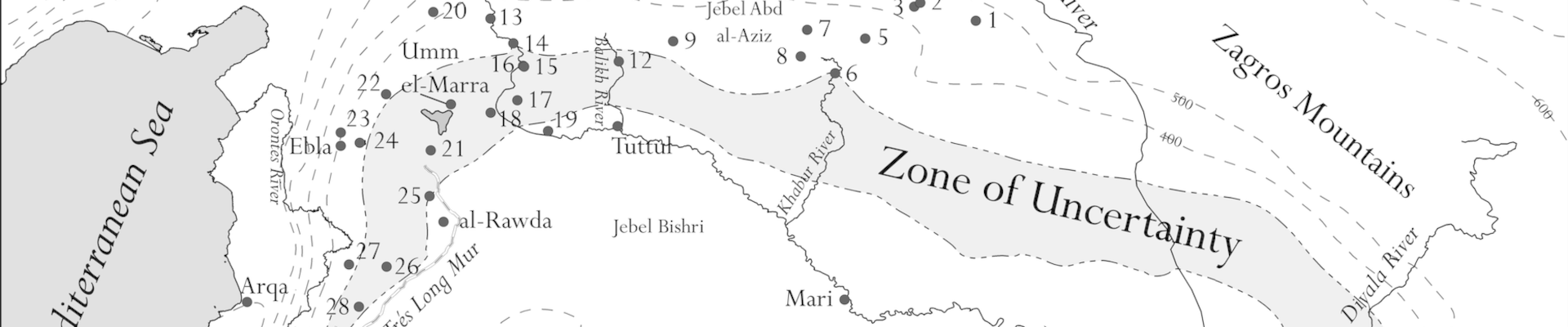
The Publications Committee of the American Society of Overseas Research announces a call for nominations (self-nominations welcome) for the position of Editor of Near Eastern Archaeology for a term to begin January 1, 2025. ASOR Journal Editors serve a three-year term (eligible to be renewed once).
Near Eastern Archaeology, the more popular publication of ASOR, brings to life the ancient world from Mesopotamia to the wider Mediterranean with authoritative analyses and vibrant images. NEA (ISSN 1094-2076) is published four times each year (quarterly) in March, June, September, and December.
The Editor of Near Eastern Archaeology currently receives an annual stipend of $13,000. The Editor—working with an Assistant Editor, Editorial Board, the Publications Committee, and ASOR’s publishing partner The University of Chicago Press—holds full editorial control ofNear Eastern Archaeology. The editor works remotely but is expected to attend the ASOR Annual Meeting to attend both the annual Committee on Publications meeting and the annual meeting of the NEA Editorial Board.
Self-nominations are preferred and should include the following items: 1) a one-paragraph academic biography; 2) a brief statement describing why the candidate is interested in the position; and 3) contact information (including e-mail and telephone number). If a candidate is being nominated by another person, we seek the candidate’s name, a short academic history, a brief statement describing why the candidate would be appropriate for the position, contact information, and, most importantly, a statement from the candidate that she or he agrees to being nominated.
Candidates are also encouraged to contact the current editor, Stephanie Budin (nea-editor@asor.org), or the Chair of the Publications Committee, Kevin McGeough (kmcgeough@gmail.com), for more information about the position and its responsibilities. Nominations for the position should be directed to the ASOR Office c/o Marta Ostovich (programs@asor.org).
Review of applications will begin on September 15, 2024, and will continue until the position is filled. The Publications Committee intends to recommend a candidate to the ASOR Executive Committee of the Board of Trustees and the full ASOR Board before the Annual Meeting in Boston in November 2024.
An Archaeological Survey of the Iraqi Western Desert
Dr. Jaafar Jotheri, Department of Archaeology, University of Al-Qadisiyah
The Iraqi Western Desert has finally been archaeologically surveyed. For decades, this part of Iraq was ignored by both local and international archaeologists. Most Iraqi and international projects focus on Mesopotamia’s floodplain, steppe, and mountains, but not its western desert. One side effect of this project, funded by an ASOR Mesopotamian Fellowship, is that the Iraqi Western Desert is now attracting more local and international researchers. Local postgraduate students have started to take archaeological projects in this area for their theses, and scholars have begun visiting the desert for potential future research projects. More importantly, the Iraqi Official Heritage Authorities have started to create new records and databases for the archaeological sites in this part of Iraq. This project has put the archaeology of this desert in the spotlight and sparked much interest in future research. The dissemination of every step of this project has helped other stakeholders follow its progress and wait with interest for its outcome.
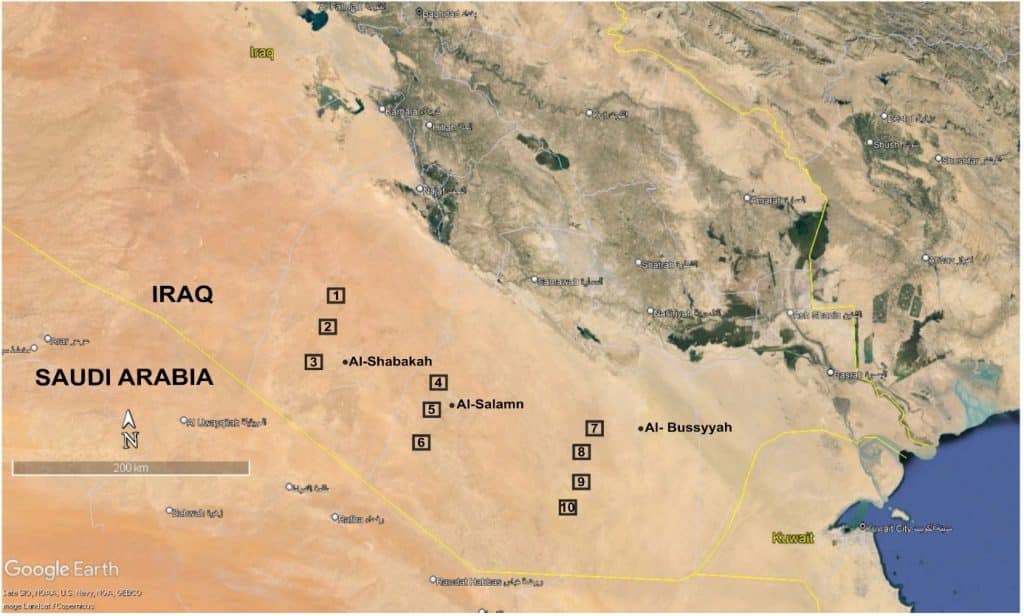
Figure 1: Location map of the ten field trip locations.
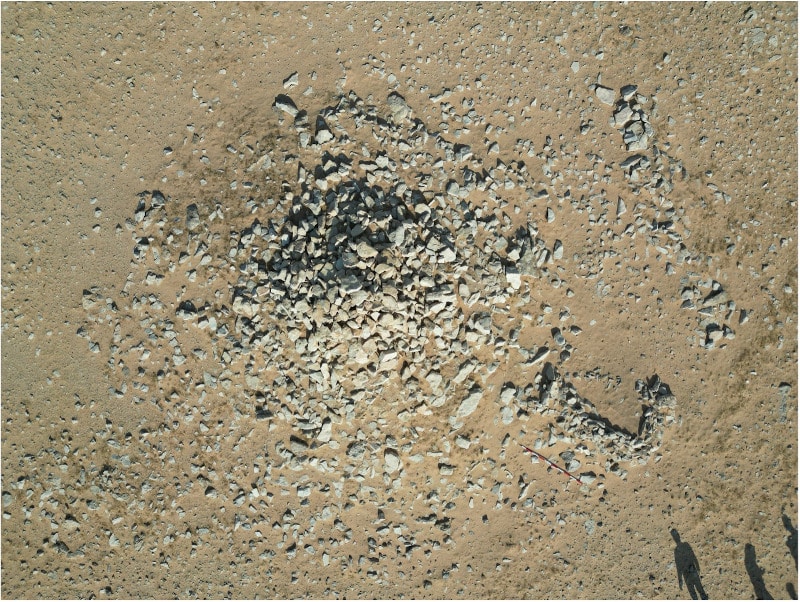
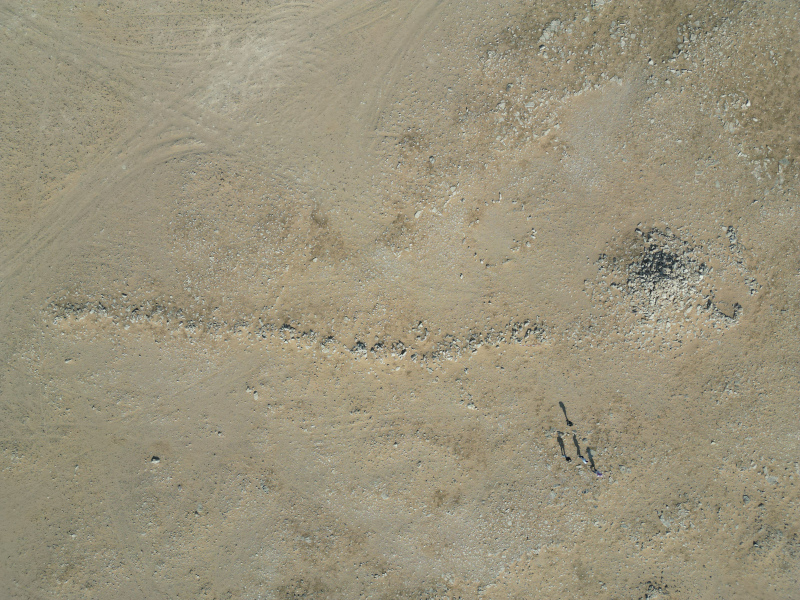
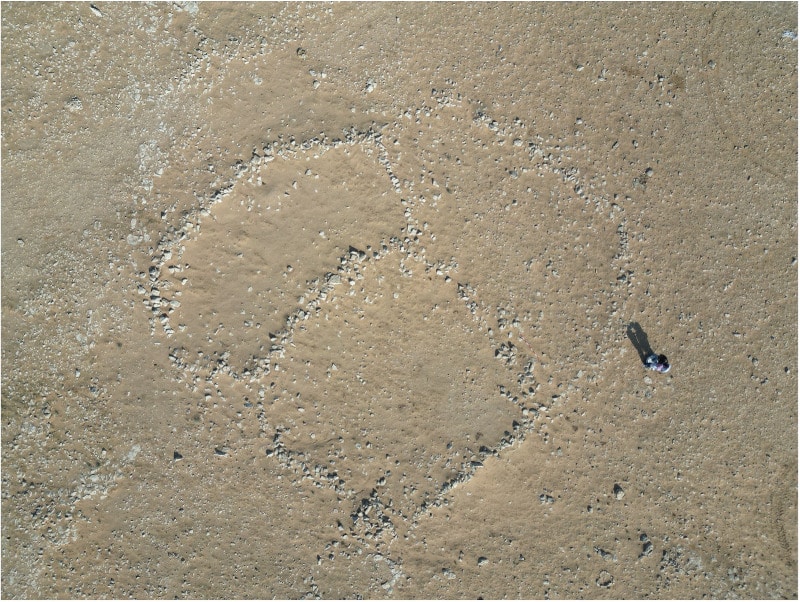
The combination of research methods this project followed has benefited the Iraqi university students and staff. For example, 16 Iraqi students (from Al-Qadisiyah, Kufa, and ThiQar Universities) have been trained in the techniques of remote sensing and GIS to identify more archaeological sites in the desert. We managed to locate and map more than 300 potential sites (enclosures, pendants, and tombs-graves-burials) in the desert using systematic and inclusive remote-sensing surveys.
Figure 2: A drone image shows a tomb-grave-burial in the Iraqi Western Desert in December 2023.
Figure 3: A drone image shows a pendant in the Iraqi Western Desert in December 2023.
Figure 4: A drone image shows Jaafar Jotheri standing close to an enclosure feature in the Iraqi Western Desert in December 2023.
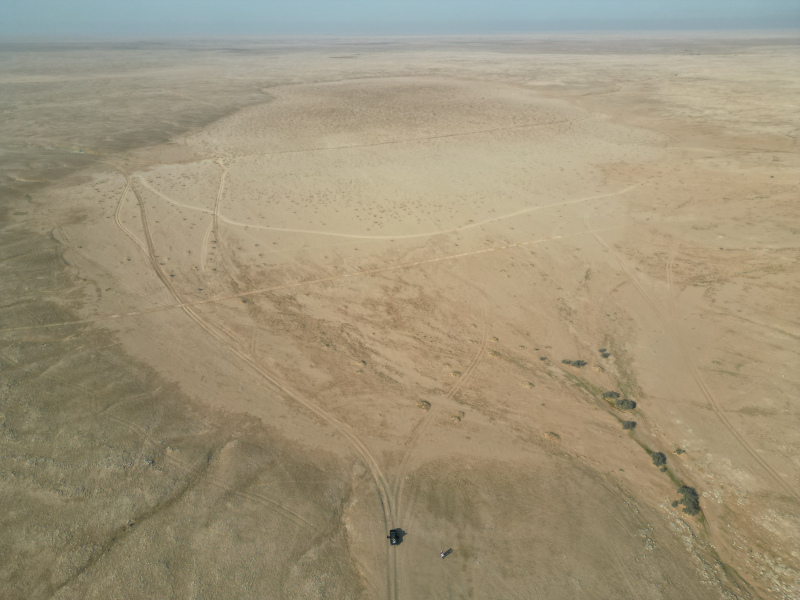
Figure 5: A drone image shows a palaeolake in the Iraqi Western Desert in December 2023.
After completing the office work, we conducted fieldwork, which consisted of ten trips, each to a different part of the desert. Locations were selected based on the remote sensing results. We took five students for fieldwork training that involved identifying the sites that had already been mapped, drawing sketches of the sites, collecting lithics, taking photos, and using drone images. More than 500 lithic samples have been collected, classified, and photographed. These samples will be studied more in the university lab as they show a mix of ages from Palaeolithic to Neolithic. We used two 4×4 cars to travel in the desert, and we were accompanied by guides from the local Bedouin people who knew the roads well. Optically Stimulated Luminescence (OSL) samples were collected from the sediments under the rocks of clusters of enclosures to determine the age of construction of these features. These samples are on their way to the OSL lab. We were lucky to have Dr. Stefan Smith from the University of Helsinki and Dr. Ella Egberts from the University of Leicester with us on two field trips to the desert.
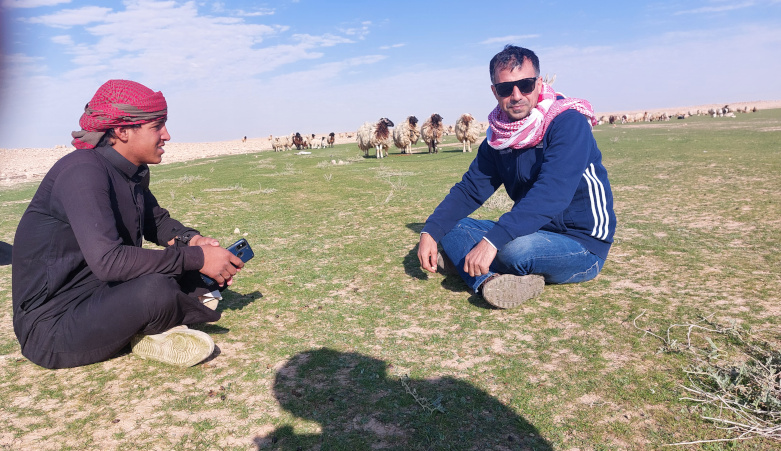
Figure 6: Jaafar Jotheri interviewed some local bedouins about their interpretation of the archaeological features in the Iraqi Western Desert in December 2023.
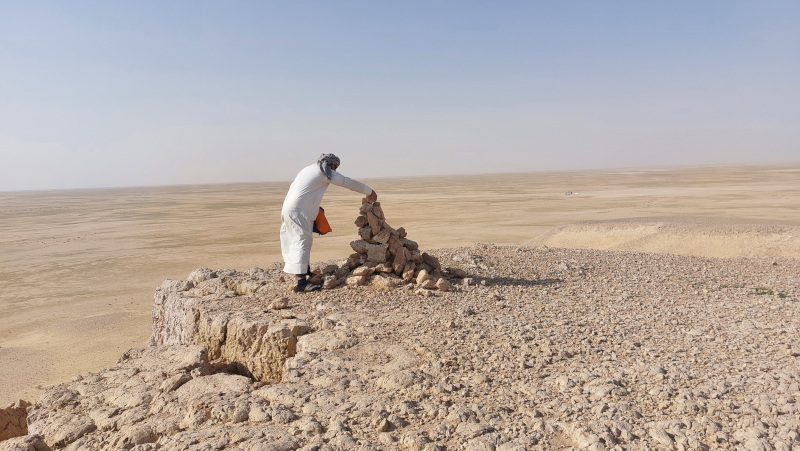
Figure 7: A local bedouin volunteered to repair a tomb-grave-burial feature in the Iraqi Western Desert in December 2023.
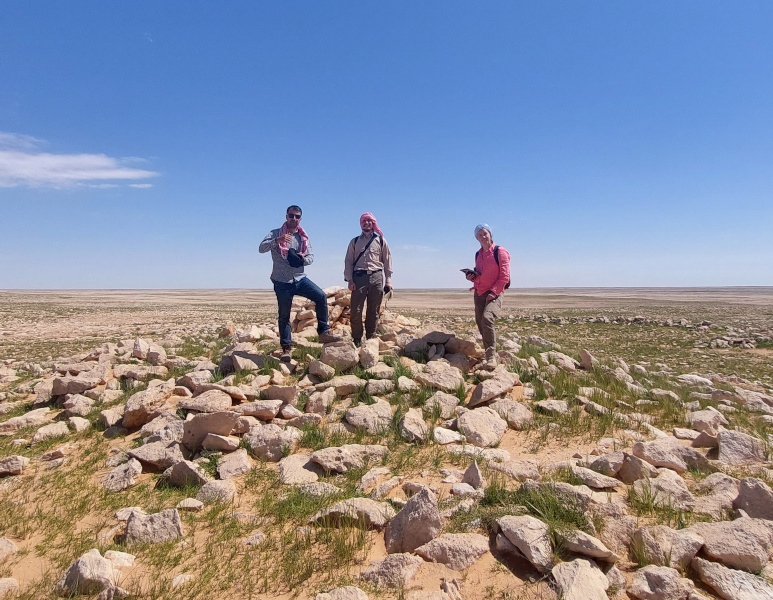
Jaafar Jotheri (recipient of a Mesopotamian Fellowship),, Stefan Smith and Ella Egberts in one of the field trips in the Iraqi Western Desert in March 2024.
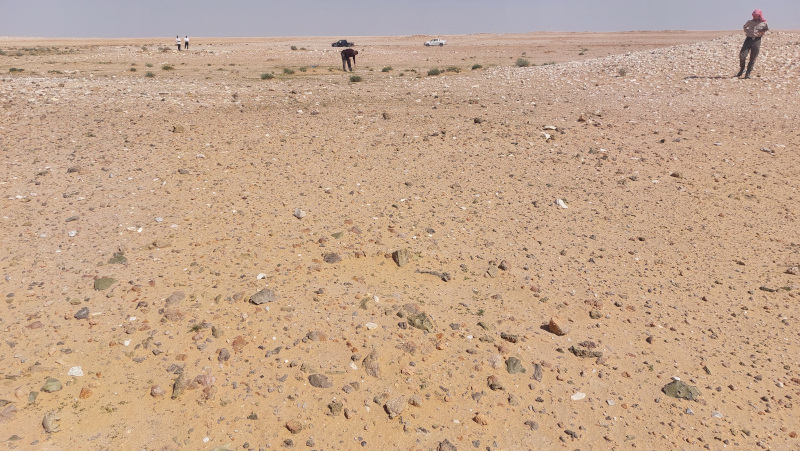
Figure 9: Collecting lithics in the Iraqi Western Desert in March 2024.
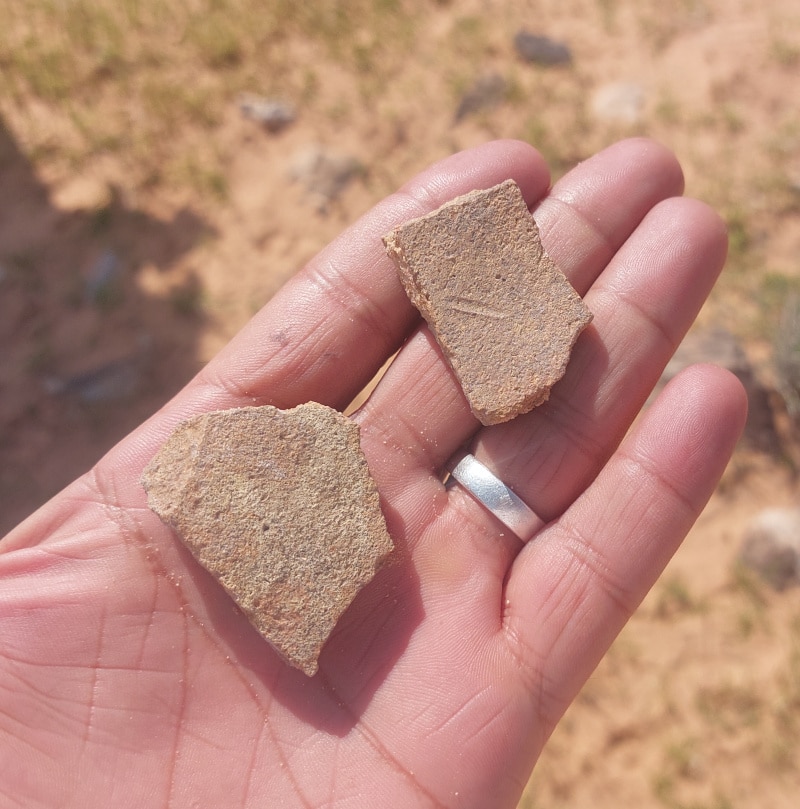
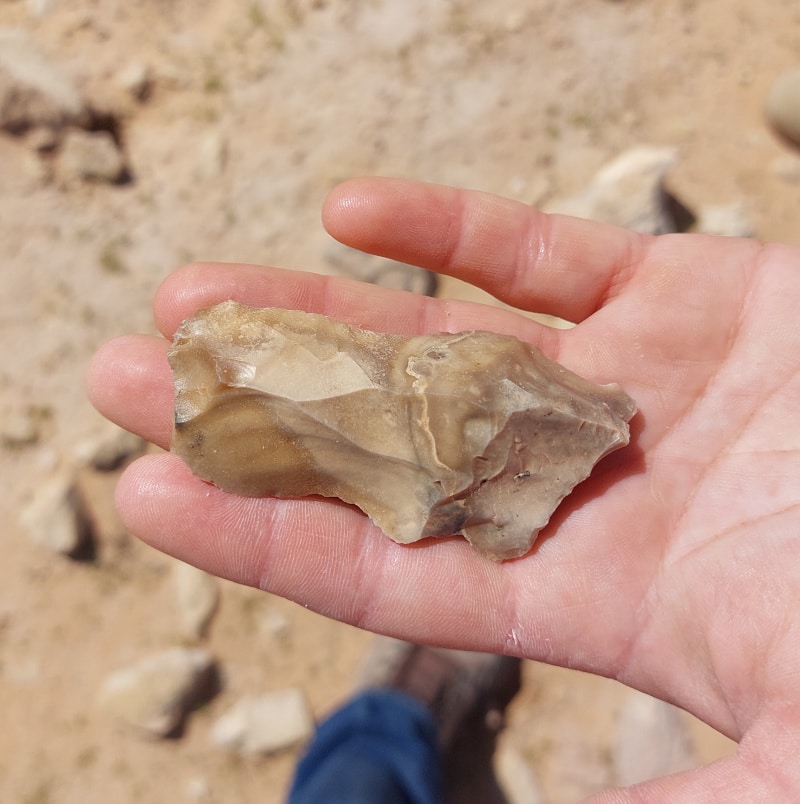
Figures 10 and 11: Some ceramics and lithics collected during fieldwork.
Although the results have not been finalized yet, I delivered three talks about the preliminary findings of this project at international conferences. The first was entitled “What Archaeology and Heritage do we have in the Iraqi Western Desert?” at the British Association of the Near Eastern Archaeology conference January 3–5 in Glasgow. The second paper, “The Natural and Cultural Heritage of the Water Springs in the Iraqi Desert,” was part of an online workshop on bioarchaeology in Mesopotamia at Kiel University, Germany. The third was “Archaeological Features from the Iraqi Western Desert,” which was delivered in person at the 5th International Scientific Conference of the Mesopotamian Archaeology held on March 6th at the University of Al-Qadisiyah. A portion of the results are being prepared for publication in an international journal, and more will be published in a local Iraqi journal. I also submitted an abstract to the ASOR annual conference that will be held this November, which I plan to attend in person.
Sensing the Past: Sensorial Experiences in Ancient Mesopotamia
Friends of ASOR present the next webinar in the 2023-2024 season on May 9, 2024, at 3:00 pm EDT, presented by Dr. Allison Thomason.
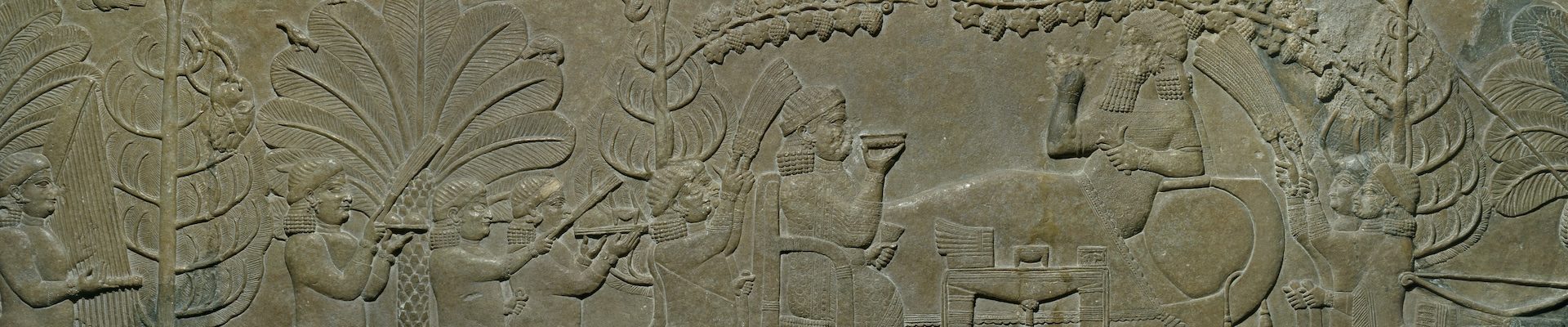
We are all sensing people, and the basic physical structure of our sensing organs has not changed for many thousands of years. But how did ancient humans perceive and experience sensory stimuli in their environment differently than we do today? Dr. Thomason sets out to explore this topic for the ancient Mesopotamians in particular. The history of the senses and explorations of sensory experiences in the ancient world have been increasingly the focus of scholarly research. Archaeologists, art historians and textual scholars have tried to recreate past sensory environments and experiences by using evidence from images, artifacts and ancient texts of all kinds.
In this lecture, Dr. Thomason, a specialist in ancient Mesopotamian material culture, explores how ancient Mesopotamian perceptions of sensory experiences can be compared to our own modern ones, by trying to understand the way that Mesopotamians sensed their environment and material culture and what perceptions they had of certain types of objects, such as metal bowls, wooden gates, and textiles.
This webinar will be recorded and all paid registrants will be sent a link to view the recording.
Dr. Allison Thomason is Professor and Chair of the history department at Southern Illinois University Edwardsville, and serves as their ancient historian. She received her PhD in Art History and Archaeology from Columbia University in 1999 and has taught at SIUE ever since. Her first book, Luxury and Legitimation: Royal Collecting in Ancient Mesopotamia (2005) is still available in print and as an e-book from Routledge Press. She has contributed numerous articles and chapters in books, lectures, and presentations on the material culture of Mesopotamia and the ancient Near East. Recent research interests include dress in the Ancient Near East and she has co-edited (with Kiersten Neumann) an extensive anthology, A Handbook of Senses in the Ancient Near East (Routledge Press 2022). Dr. Thomason is also the co-chair of ASOR’s Program Committee, which plans the Annual Meeting.
This webinar will be recorded and all paid registrants will be sent a link to view the recording.
*Please log in to the Online Portal BEFORE registering for the webinar. Once you have logged in, you will be able to register under our Events page linked above.
Please e-mail membership@asor.org with any questions or issues with registering.
All proceeds from this webinar are used to fund scholarships for members as well as increasing ASOR’s online resources, which are free to the public.
SPONSOR A WEBINAR!
Several levels of support from $50-$1,000 are available. Proceeds go towards membership scholarships and towards increasing ASOR’s virtual resources. Each sponsorship is tax-deductible and you can give your friends free registrations to a webinar! Sponsor a webinar here.
Bronze Level ($50): up to 2 guest registrations Silver Level ($100): up to 5 guest registrations Gold Level ($500): up to 20 guest registrations Platinum Level ($1,000): up to 50 guest registrations
After you sign up for a sponsorship online or over the phone, email the names and email addresses of your guests to Katherine Schmitt at membership@asor.org, who will send your guests a confirmation and the Zoom link before the webinar.
WANT TO SAVE $6.00 ON THE NEXT WEBINAR?
Join ASOR as a member! Click here for more details about discounts for events and other benefits of membership. Memberships start at $40 for the year as an Associate Member.
CCAP 2023: Searching for the Islamic History of Herod’s Great City
Veronica Morriss, 2023 Eric and Carol Meyers Fieldwork Scholarship Recipient
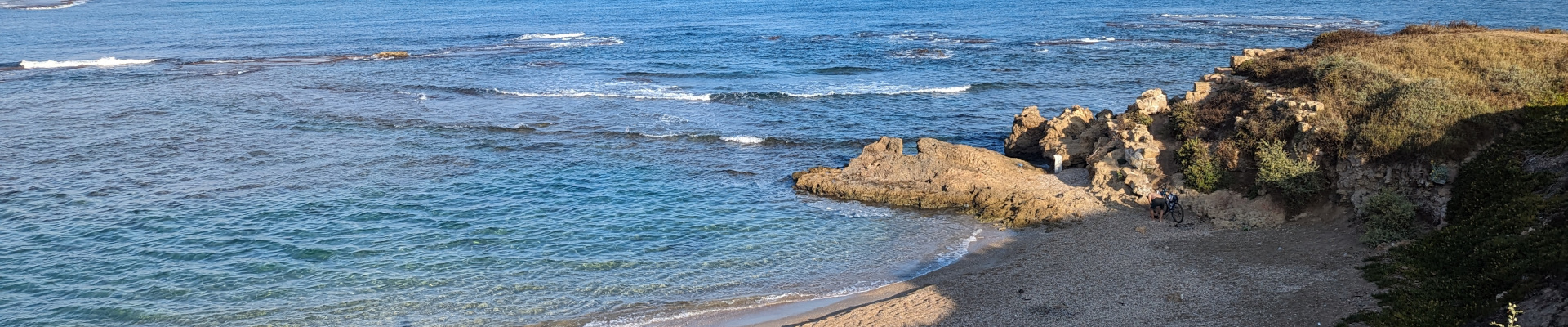
Caesarea is one of the best known and most researched sites in Israel. It’s famous for Herod the Great’s imposing harbor, the Roman hippodrome and theater, the grand Byzantine octagonal church, and its massive Crusader walls. Caesarea has an extensive history of groundbreaking archaeological research, and numerous excavation teams are usually working at the site at once, uncovering the ancient city, one meter at a time.
While the extensive Roman, Byzantine, and Crusader remains at the site have captured popular imagination and been the primary target for most excavations, the city’s role during the early Islamic era is not well understood—and the port played a more important role in Islamic history than it is given credit for.
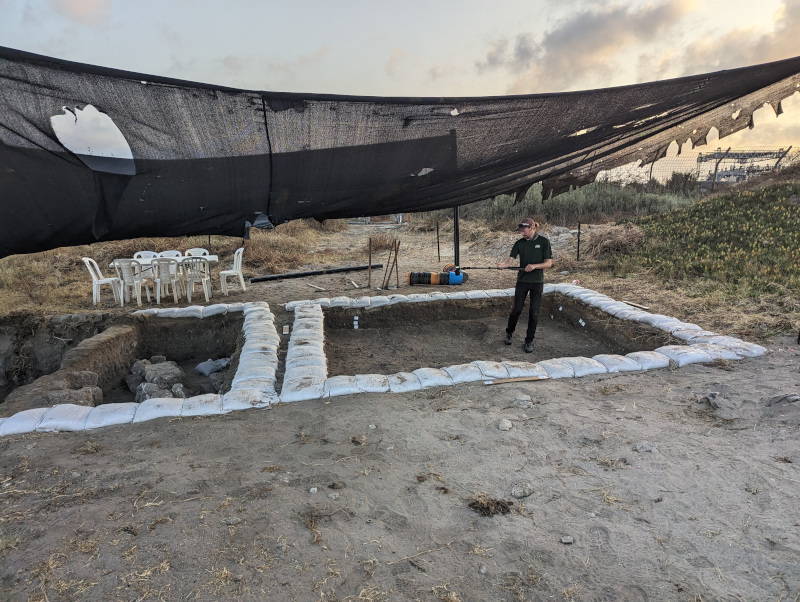
First day on site.
The situation at Caesarea mirrors that of research throughout the Levantine coast. The archaeology of the early Islamic period is often neglected due to a combination of factors, including a bias in site selection and a predilection for Classical sites. These biases and gaps in the data have led to debates about the nature of settlement and trade along the coastal region and whether they declined following the Islamic conquest in the 7th century CE. However, over the last several decades, scholars working throughout the region have begun to question the evidence underlying decline narratives and have produced new evidence that creates a more nuanced and dynamic picture of the era.
In part, this reimagining of the Byzantine-Islamic tradition has inspired our research at Caesarea. According to historical sources, Caesarea played an important role during the Islamic conquest and was targeted by the early caliphs and their forces due to the city’s port and its prominent role in Byzantine trade and logistics. Though Caesarea lost its role as capital of the Byzantine province Palaestina Prima after its capture in 640/1 CE, it continued to be inhabited and was tied into the eastern Mediterranean trade networks and the defense of the coast.
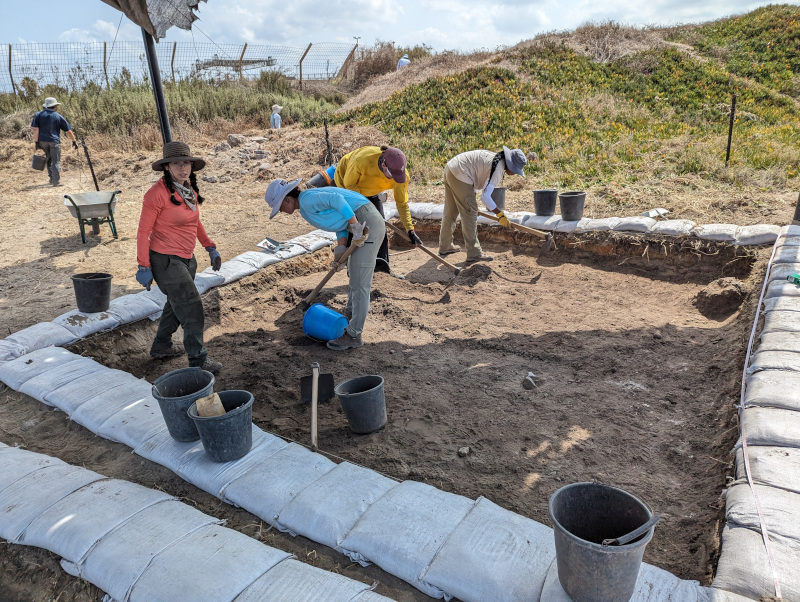
First day of digging.
As part of the Caesarea Coastal Archaeology Project, our team has been exploring several regions of the ancient city, with a primary focus on those that might have Islamic-era remains. My work has been focused on the area south of the Roman theater, just outside of the park. We chose this area (Area FZ) to get a stratigraphic record of the southernmost end of the city near the Byzantine wall. We were also hoping to find traces of the Byzantine-Islamic fortress that was identified during the mid-20th century Italian excavation in the defunct theater.
Gaming dice.
Last year, we uncovered structural remains and material culture that attest to a complex history of mixed use for the area. While we cannot discuss everything that we discovered prior to publication and reporting to the Israel Antiquities Authority, the finds this year point to significant Crusader-era use of this section of the city, as well as Byzantine-Islamic transitional layers, and a thick deposit of amphorae and storage jars. Tantalizing finds from earlier periods include six-sided gaming dice, carved bone hair pins, spindle whorls, dozens of coins, and even a horse skeleton—which many of the students were excited to uncover, having taken zooarchaeology courses at their universities.
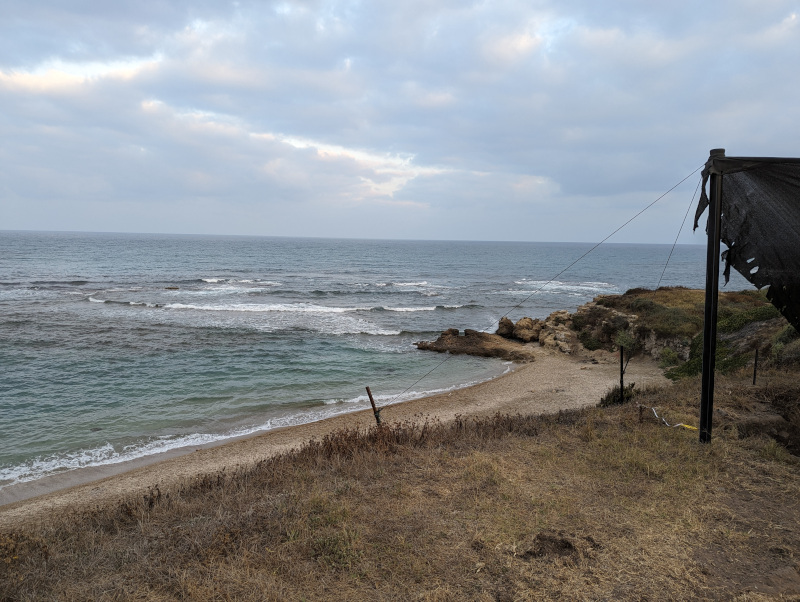
In addition to searching for evidence of an under-represented portion of Israel’s history, our project is focused on training the next generation of archaeologists. Students had a chance to practice careful excavation methods in the field, tagging and recording artifacts, making section drawings, creating 3D models using photogrammetry, and conducting off-shore underwater surveys—which for many of the students was the highlight of the season. Considering it was hot and humid, it was a luxury to be digging a stone’s throw from the Mediterranean!
View from the trenches.
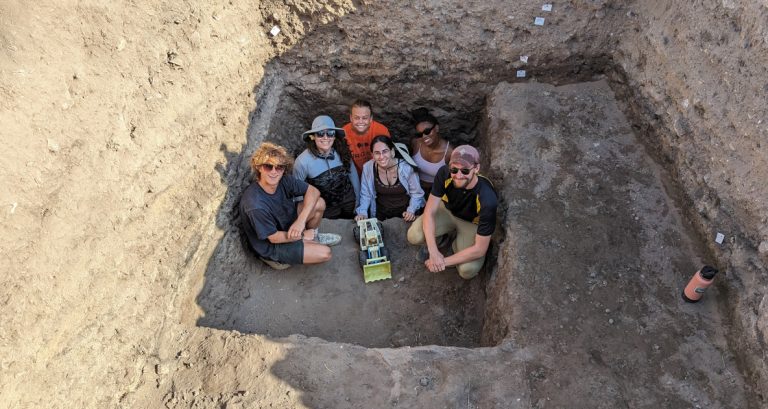
End of field shot.
It was a great season, and we look forward to returning with our team next year to further explore Caesarea’s lost history.
Veronica Morriss earned a PhD in Islamic Archaeology from the Department of Near Eastern Studies at the University of Chicago. She is a maritime archaeologist, and her research focuses on the development of the Islamic/Byzantine maritime frontier of Syria-Palestine and the cross-cultural interactions that characterized the Eastern Mediterranean and its shores during the Early Islamic Period. She co-manages a digital archaeology company with her husband in Hawaii, and when she is not in the field, she writes fantasy romance novels.
Want to help more students and early career archaeologists get into the field? Donate to the cause today by selecting “Excavation Scholarships�? as your gift purpose!
*This internship has been filled. Thank you for your interest.*
The American Society of Overseas Research (ASOR) seeks candidates for a part-time internship position to begin in May. This compensated internship is for the summer (May-August) with start and end dates negotiable. The intern is expected to work 20–25 hours per week. This position is primarily remote, but the successful applicant will need to come into ASOR’s headquarters—The James F. Strange Center, 209 Commerce St., in historic Old Town Alexandria, VA—occasionally to meet with other ASOR staff.
Founded in 1900, the ASOR is a 501(c)(3) non-profit whose mission is to initiate, encourage, and support research into, and public understanding of, the history and cultures of the Near East and wider Mediterranean world, from the earliest times. Please visit www.asor.org for more information.
Primary Responsibilities:
Assist with updating and reconfiguring the ASOR website
Migration and back-up of data
Other projects as assigned by the Information and Website Manager
Qualifications / Skills Desired:
Knowledge of WordPress is a must
Microsoft Office
Database management
Graphic and image design and editing (Adobe Photoshop, Canva, etc.)
Website management (WordPress or similar)
Excellent communication and interpersonal skills
Attention to detail; ability to multitask and to prioritize
Compensation: $15-$20/hr based on experience
How To Apply: E-mail your resume and a brief statement of interest to Jared Koller at jaredkoller@asor.org. Please include your name and “ASOR Digital Humanities Internship” in the subject line.
Review of applications will begin immediately and continue until the position is filled.
ASOR is an equal opportunity employer and all qualified applicants will receive consideration for employment without regard to race, color, gender, religion, national origin, disability, veteran status, age, marital status, sexual orientation, gender identity, genetic information, or any other class protected by federal or state law (EEO/AA).
[/vc_column_text][mk_divider][vc_row_inner][vc_column_inner width=”2/3″ css=”.vc_custom_1706024108985{padding-right: 10px !important;}”][vc_column_text]March Fellowship Madness 2024 has officially come to a close. Thanks to our wonderful donors, ASOR raised $4,750 for Excavation Scholarships. While we did not fully meet our goal, thanks to your gifts ASOR has made tremendous progress toward sending additional students into the field this summer. We are so grateful for the generosity of our donors in supporting the next generation of archaeologists.
Each year, ASOR sponsors many Fieldwork Scholarships for students and volunteers to take part in ASOR Affiliated Projects. ASOR is able to provide these scholarships with the partnership of you, our many members and donors. Your gifts truly make a difference in the lives of students and volunteers interested in fieldwork.
Thank you to each and every one of the donors, members, and Friends of ASOR who contributed this March Fellowship Madness. Read below to see how previous scholarship recipients have been impacted by our generous members.[/vc_column_text][/vc_column_inner][vc_column_inner width=”1/3″][vc_wp_text][/vc_wp_text][/vc_column_inner][/vc_row_inner][mk_divider][vc_column_text]
Hear what past scholarship recipients have to say about their experiences in the field:
“Being on a dig isn’t just that three week or six-week session. It turns into a life experience. Not just the memory aspect of it. It can motivate you to care more about your physical condition and health. You make friends from all over the world and stay in contact on social media. It makes you more interesting to your family and friends, having unique stories to tell and pictures to share. If you read the Bible or history books it gives you “I was there” pictures in your mind of the real thing.
One of my favorite pictures from this summer at Tel Hazor Lower City is of me standing above the “hole” I helped dig in six weeks. By itself, the picture isn’t amazing. But when I tell the people I show it to that we started at ground level in the year 2023, and six weeks and nine feet later it was the year 1750 BC more than 3,700 years ago–it becomes amazing! Lots of people like movies and books about time travel; sitting comfortably watching a movie or reading a book. I was there. I touched the stones and artifacts. I time traveled. Words cannot adequately express this phenomenon. You’ll just have to go to a dig one of these summers and see for yourself.”
-John Rinks, 2023 Stevan B. Dana Fieldwork Scholarship Recipient
“What an exciting season in the field! It was fun to make new friends, learn from many capable archaeologists, and excavate such an interesting and historically significant site. It was inexpressibly rewarding to get back into field work after several years away. I am grateful to ASOR and the P.E. MacAllister Scholarship for making it possible for me to return to the field.“
“As an archaeology student, my education is all about developing my archaeological understandings and perfecting my craft. This is why we all go to school. But there is just something so special and amazing about the moments in our educational journeys when what we have worked to learn evolves from mere theory to applied practice.“
“Overall, this was an unforgettable experience where I got to learn new skills in the field, make meaningful connections, and see new things. I am grateful to Dr. Kevin Fisher and Sheri Pak for organizing this trip and to Dr. Eric and Dr. Carol Meyers for their generous scholarship. Without all your support, my participation in this project would not have been possible!“
-Isabelle Sauvé, 2023 Eric and Carol Meyers Fieldwork Scholarship Recipient
“I can’t say that I didn’t expect how talented, hardworking, and experienced the professors I worked under were; the knowledge they imparted to us students was extraordinary just like their CVs would tell you. What I did not expect was the level of personal support and kindness they extended. I will never forget how these experts at the top of their field still made time to guide me, an undergraduate fresh out of my first year in college. They didn’t just lead by example; they also provided invaluable mentorship. Months later, I am still brushing off the dust from my work clothes, yet what remains even more vividly from this experience than the dust on my belongings or the treasured trowel displayed on my shelf are the wonderful memories of my first adventure in archaeology!“
-Hania Kantzer, 2023 Stevan B. Dana Fieldwork Scholarship Recipient
“It was the exceptional privilege for me to participate in the Huqoq Excavation Project for their final year, not only because it supplemented my academic studies and offered me a close-up view of the Holy Land, but also because it augmented my understanding of the significance of archaeology. For this reason, I am profoundly grateful for those individuals whose assistance made my participation in the Huqoq Excavation Project possible, as well as all the directors, team leaders, and fellow members who made it such an unforgettable and phenomenal experience.“
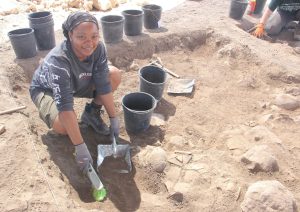
“This July I was fortunate enough to travel to Israel for the first time and participate in the archaeological dig at Tel Abel Beth Maacah, near Metula in Galilee, and it was an unforgettable experience. As an Old Testament student much of my time is focused on the literary and linguistic areas of biblical studies, but on the recommendation from one of my professors I applied to be a participant in the excavation at ABM. This experience, although brief, has given me a practical perspective on my current academic endeavors. Thank you to ASOR and the scholarship donors who made this trip possible.”
“My first excavation season at Gird-I Matrab was a wonderful experience, full of surprising discoveries. I had the opportunity to work with an amazing international team and to discover more about Kurdish culture. I visited places and I met people that contributed to my personal and academic growth. I really look forward to being back in Gird-I Matrab next year!“
“One of my favorite things about archaeology is being part of a community forged through hard work, friendship, collegiality and mutual support. There is almost no better feeling than being covered in mud from head to toe, exhausted, hot, thirsty and hungry and yet somehow finding the energy for a race to the car for the best seat for the ride home while laughing all the way. Being part of this kind of family–a chosen family some might say–is a real privilege and one I look forward to every year.“
-Hélène Maloigne, 2023 Strange and Midkiff Families Fieldwork Scholarship Recipient
“In sum, the hands-on learning at Tel Dan helped me better understand the concepts I learned in my archaeology seminars (especially pottery typology!), the tools and methods used on archaeological digs, and how archaeologists make decisions in real time about what they are finding. Overall, I learned many things about archaeology and archaeological methods while on the dig that I never could have learned in the classroom.“
-Andrew Bock, 2022 Stevan B. Dana Fieldwork Scholarship Recipient
“In addition to all of the fieldwork, spending time with all of the individuals with the same passion for archaeology was amazing. I will have future colleagues and friends for life.“
-Zachary Griffith, 2022 Eric and Carol Meyers Fieldwork Scholarship Recipient
Friends of ASOR present the next webinar in the 2023-2024 season on April 18, 2024, at 3:00 pm EDT, presented by Dr. Aaron Burke.
The Amorites, an ancient Near Eastern group, are infamous in the Bible, where they are remembered among Canaan’s inhabitants at the time of its conquest by Israel. Yet, in Near Eastern studies the Amorite’s origins are only poorly understood. As a collective identity, they are best known for their encounters with the military establishments of Akkad and Ur in the late third millennium, and their alleged role as pastoralists par excellence. However, the shaping of this collective identity must be set against the backdrop of both Akkadian imperial intervention and the declining environmental conditions of this period in the marginal zones of the Fertile Crescent. Tracing the migration of Amorite refugees from agropastoral communities into nearby regions, mercenarism and militarism are seen to play a crucial role in the acquisition of economic and political power by Amorites between 2100 and 1900 BC. Members of this group became founders of well-known Amorite dynasties from Bahrain in the Persian Gulf to the Egyptian Delta. In the wake of the emergence of these dynasties in the early second millennium, traditional means of legitimation served to consolidate their power. Driven by a shared interest in the legitimation of their control, they patronized long-distance trade, construction projects, religious orders, the arts, warfare, fortification building, and standardizations of law. The extensive nature of these efforts have led some to refer to this as “the age of Amorites,” and it may be argued that the material effects of this contributed to the construction of an Amorite koine. This lecture explores the origins of Amorite identity, why it spread, and why it was remembered in later Near Eastern traditions.
Aaron A. Burke received his Ph.D. in Near Eastern Archaeology from The University of Chicago. He is Professor of the Archaeology of Ancient Israel and the Levant, and the Kershaw Chair of the Ancient Eastern Mediterranean Studies in the Department of Near Eastern Languages and Cultures at The University of California, Los Angeles. He is also a member of UCLA’s Cotsen Institute of Archaeology, serving as its editor-in-chief since 2016.
Since 1994, he has excavated in Israel but also Egypt and Turkey, and travelled extensively throughout the Levant from Syria to Lebanon, Jordan, Cyprus, and in Greece, collaborating in field research at Jerusalem, Jaffa, and Tel Dan. He directs The Jaffa Cultural Heritage Project since 2007 and has co-edited three volumes resulting from research in Jaffa, Israel. Expanding upon this research, in 2017 he inaugurated Turning Points, an initiative aimed at exploring the context out of which ancient Israel emerged during the Early Iron Age in the southern Levant, ca. 1200–1000 B.C.
Burke’s research focuses on the social history of the Levant and Eastern Mediterranean during the Bronze and Iron Ages with a particular interest in identity transformations surrounding warfare, forced migration, and long-distance exchange. His first monograph, “Walled Up to Heaven”: The Evolution of Middle Bronze Age Fortification Strategies in the Levant, addressed warfare during a period of Amorite political hegemony. He is also author of The Amorites and the Bronze Age Near East (CUP 2021), which seeks to reconstruct a social history of the Amorites from 2500 to 1500 BC. Since 2021, he is also the series editor for Elements in the Archaeology of Ancient Israel (CUP).
This webinar will be recorded and all paid registrants will be sent a link to view the recording.
*Please log in to the Online Portal BEFORE registering for the webinar. Once you have logged in, you will be able to register under our Events page linked above.
Please e-mail membership@asor.org with any questions or issues with registering.
All proceeds from this webinar are used to fund scholarships for members as well as increasing ASOR’s online resources, which are free to the public.
READY FOR A WEBINAR SEASON PASS?
Buy a season pass for all the webinars* of the 2023-2024 FOA Webinar Season! With a season pass, you will automatically be registered for every webinar in the season, and you will receive the recording of each webinar automatically after the event.
If you have missed webinars earlier in the season and still want to buy the pass, you will receive the links to the recordings of the webinars you missed in your automatic confirmation email after you buy the pass.
*Special symposiums may be excluded from the season pass price.
No more registering for a year if you buy your pass today!
Pricing:
ASOR Sustaining Members: $0 (automatic registration for each webinar) Members: $75 Public: $150
Several levels of support from $50-$1,000 are available. Proceeds go towards membership scholarships and towards increasing ASOR’s virtual resources. Each sponsorship is tax-deductible and you can give your friends free registrations to a webinar! Sponsor a webinar here.
Bronze Level ($50): up to 2 guest registrations Silver Level ($100): up to 5 guest registrations Gold Level ($500): up to 20 guest registrations Platinum Level ($1,000): up to 50 guest registrations
After you sign up for a sponsorship online or over the phone, email the names and email addresses of your guests to Katherine Schmitt at membership@asor.org, who will send your guests a confirmation and the Zoom link before the webinar.
WANT TO SAVE $6.00 ON THE NEXT WEBINAR?
Join ASOR as a member! Click here for more details about discounts for events and other benefits of membership. Memberships start at $40 for the year as an Associate Member.
[/vc_column_text][mk_divider][vc_row_inner][vc_column_inner width=”2/3″ css=”.vc_custom_1706024108985{padding-right: 10px !important;}”][vc_column_text]As of April 10, we have raised $4,750 of our $6,000 goal for March Fellowship Madness. Each year, ASOR sponsors many Fieldwork Scholarships for students and volunteers to take part in ASOR Affiliated Projects. Currently, there are funds to provide scholarships for 40 students, but with your help, we aim to raise $6,000 during March Fellowship Madness to send three additional students into the field during summer 2024.
Thanks to our generous members, we are almost to our goal, which is why we have decided to extend March Fellowship Madness into April. 100% of your gift will go towards Fieldwork Scholarships for students this summer. Please support archaeology’s next generation by making a gift today and selecting “Excavation Scholarships” as the designation for your gift.[/vc_column_text][vc_wp_text][/vc_wp_text][/vc_column_inner][vc_column_inner width=”1/3″][vc_wp_text][/vc_wp_text][mk_padding_divider][/vc_column_inner][/vc_row_inner][vc_row_inner][vc_column_inner width=”1/3″ css=”.vc_custom_1712000838400{padding-right: 20px !important;}”][vc_single_image image=”88991″ img_size=”medium” add_caption=”yes” alignment=”center”][mk_padding_divider size=”30″][vc_single_image image=”85816″ img_size=”medium” add_caption=”yes” alignment=”center”][mk_padding_divider size=”30″][vc_single_image image=”95577″ img_size=”medium” add_caption=”yes” alignment=”center”][mk_padding_divider size=”30″][/vc_column_inner][vc_column_inner width=”1/3″ css=”.vc_custom_1712000851462{padding-right: 20px !important;}”][vc_single_image image=”96194″ img_size=”medium” add_caption=”yes” alignment=”center”][mk_padding_divider size=”30″][vc_single_image image=”96178″ img_size=”medium” add_caption=”yes” alignment=”center”][mk_padding_divider size=”30″][vc_single_image image=”94775″ img_size=”medium” add_caption=”yes” alignment=”center”][mk_padding_divider size=”30″][/vc_column_inner][vc_column_inner width=”1/3″][vc_single_image image=”95213″ img_size=”medium” add_caption=”yes” alignment=”center”][mk_padding_divider size=”30″][vc_single_image image=”85077″ img_size=”medium” add_caption=”yes” alignment=”center”][mk_padding_divider size=”30″][vc_single_image image=”93897″ img_size=”medium” add_caption=”yes” alignment=”center”][mk_padding_divider size=”30″][/vc_column_inner][/vc_row_inner][mk_table]

 The Publications Committee of the American Society of Overseas Research announces a call for nominations (self-nominations welcome) for the position of Editor of Near Eastern Archaeology for a term to begin January 1, 2025. ASOR Journal Editors serve a three-year term (eligible to be renewed once).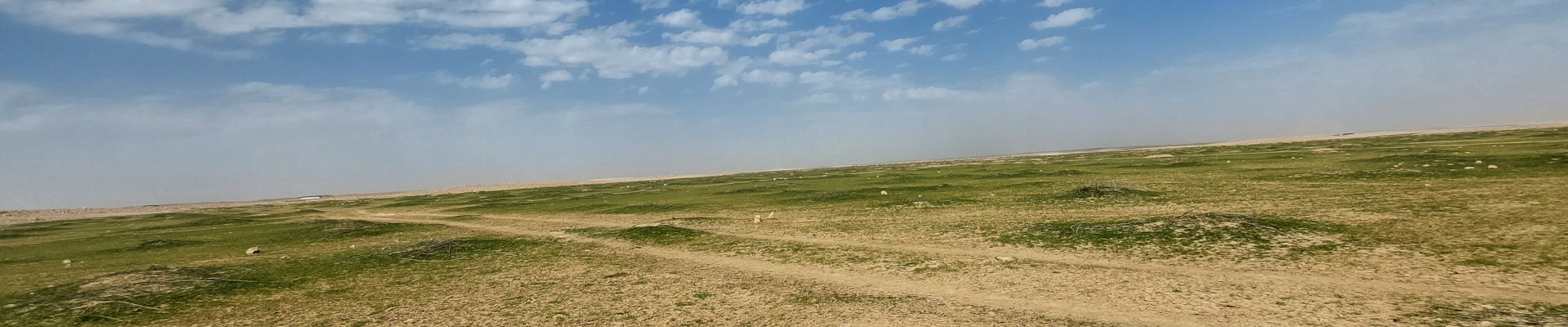

 We are all sensing people, and the basic physical structure of our sensing organs has not changed for many thousands of years. But how did ancient humans perceive and experience sensory stimuli in their environment differently than we do today? Dr. Thomason sets out to explore this topic for the ancient Mesopotamians in particular. The history of the senses and explorations of sensory experiences in the ancient world have been increasingly the focus of scholarly research. Archaeologists, art historians and textual scholars have tried to recreate past sensory environments and experiences by using evidence from images, artifacts and ancient texts of all kinds.
 In this lecture, Dr. Thomason, a specialist in ancient Mesopotamian material culture, explores how ancient Mesopotamian perceptions of sensory experiences can be compared to our own modern ones, by trying to understand the way that Mesopotamians sensed their environment and material culture and what perceptions they had of certain types of objects, such as metal bowls, wooden gates, and textiles.


 Veronica Morriss earned a PhD in Islamic Archaeology from the Department of Near Eastern Studies at the University of Chicago. She is a maritime archaeologist, and her research focuses on the development of the Islamic/Byzantine maritime frontier of Syria-Palestine and the cross-cultural interactions that characterized the Eastern Mediterranean and its shores during the Early Islamic Period. She co-manages a digital archaeology company with her husband in Hawaii, and when she is not in the field, she writes fantasy romance novels.
 [/vc_wp_text][/vc_column_inner][/vc_row_inner][mk_divider][vc_column_text]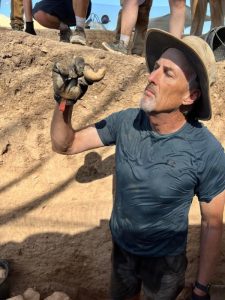
 “
“ “
“ “This July I was fortunate enough to travel to Israel for the first time and participate in the archaeological dig at Tel Abel Beth Maacah, near Metula in Galilee, and it was an unforgettable experience. As an Old Testament student much of my time is focused on the literary and linguistic areas of biblical studies, but on the recommendation from one of my professors I applied to be a participant in the excavation at ABM. This experience, although brief, has given me a practical perspective on my current academic endeavors. Thank you to ASOR and the scholarship donors who made this trip possible.”
 “
“ “
“