FOA Webinar: Jack Green on October 13

FRIENDS OF ASOR WEBINARS

Travels with Olga Tufnell: Memoirs of a “Golden Age” Archaeologist in the Levant

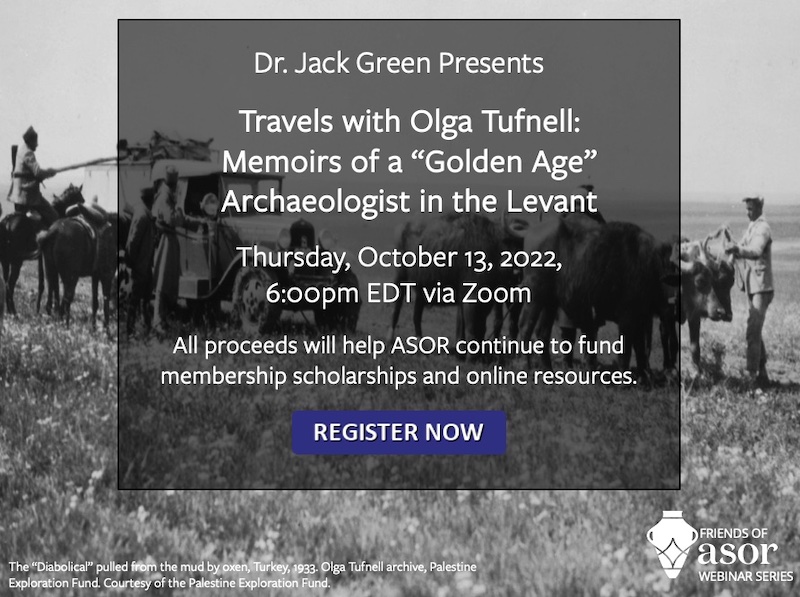
Friends of ASOR present the next webinar in our monthly series on October 13, 2022, at 6:00 pm EDT, featuring Dr. Jack Green and moderated by Dr. Melissa Cradic. This presentation shares insights on the recently published volume (with co-author and co-editor Ros Henry): Olga Tufnell’s ‘Perfect Journey’: Letters and photographs of an archaeologist in the Levant and Mediterranean (UCL Press, 2021).

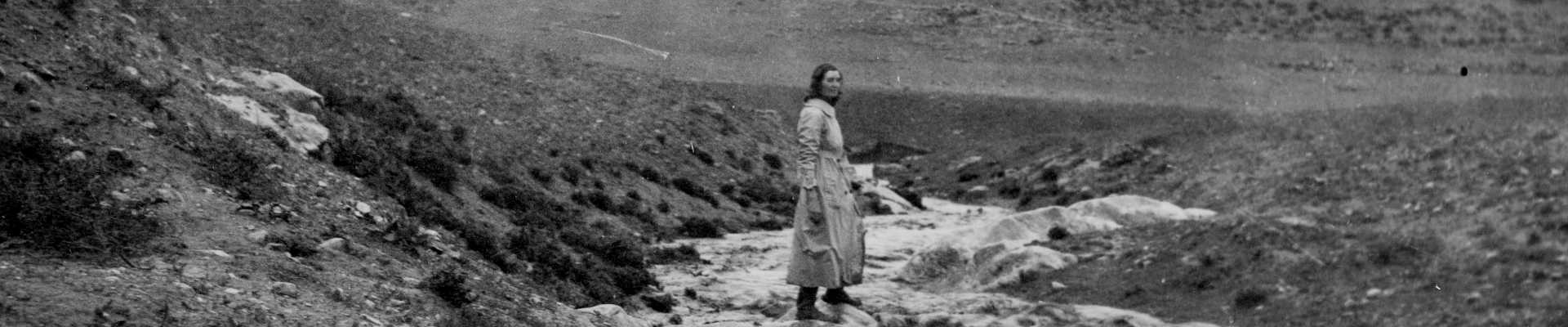
Olga Tufnell (1905–85) was a British archaeologist working in Egypt, Cyprus, and Palestine in the 1920s and 1930s, a so-called “golden age of archaeological discovery.” Based largely on letters and photographs from the Olga Tufnell archive at the Palestine Exploration Fund, this book sheds light on personal experiences of travel and excavation daily life at this extraordinary time.

The letters offer insights into social and professional networks and history of archaeological research, particularly for Palestine under the British Mandate, including the excavations at Tell el Far’ah (South), Tell el-‘Ajjul, and Tell ed-Duweir (ancient Lachish). They provide information about foreign archaeologists, relationships with local workers and community members, and the colonial frameworks they operated within.

Join Dr. Green as he explores aspects of Olga Tufnell’s extensive travel and the emergence of tourism in this period across the East Mediterranean and Levant. The webinar will conclude with a live Q&A session moderated by Dr. Melissa Cradic (Badé Museum, Pacific School of Religion).

Dr. Jack Green, also known as Dr. John D.M. Green, is the Jeffrey Horrell ‘75 and Rodney Rose Director and Chief Curator of the Miami University Art Museum within the College of Creative Arts (Oxford, Ohio). His interests include museum and cultural heritage studies, and the intersection of art and archaeology, and histories of archaeology and museums. Jack’s research focuses on ancient Jordan including the Tell es-Sa‘idiyeh Cemetery Publication Project (British Museum), following his Ph.D thesis (UCL, 2006) on the Late Bronze and Early Iron Age period at this site.

He served as Associate Director of the American Center of Research (ACOR), Amman, Jordan (2017-2021), and is co-editor of ACOR’s Temple of the Winged Lions Publication Project (Petra, Jordan). Jack was Deputy Director of Collections, Research, and Exhibitions at the Corning Museum of Glass, Corning, NY (2016-2017), Chief Curator of the Oriental Institute Museum, University of Chicago (2011-2015), and Curator of Ancient Near East at the Ashmolean Museum, University of Oxford (2007-2011). Jack co-authored and co-edited Olga Tufnell’s ‘Perfect Journey’ with Ros Henry, which was published by UCL Press in 2021.

This webinar will be recorded and all paid registrants will be sent a link to view the recording.

ASOR Sustaining Members: $0 | ASOR Members: $6 | Public: $12
Season Pass: ASOR Sustaining Members: $0 | ASOR Members: $75 | Public: $150
Buy one here!

To receive your ASOR member discount, log into the online store. If you are new to ASOR, please click on the “New Visitor Registration” link to register your e-mail address and choose a password for our online store. Once logged in, navigate to “Meeting and Event Registration” to register for the webinar and pay the fee. Each paid registrant will receive a confirmation e-mail when you pay for the webinar. If you do not receive this e-mail, then you are not registered. Please e-mail membership@asor.org with any questions or issues with registering.

You will be e-mailed the Zoom Webinar link in the week prior to the lecture on October 13, 2022. If you do not receive the link by the close of business on the Tuesday before the webinar, please e-mail membership@asor.org immediately. This webinar will be recorded and all paid registrants will be sent a link to view the recording.

All proceeds from this webinar are used to fund scholarships for members as well as increasing ASOR’s online resources, which are free to the public.

READY FOR A WEBINAR SEASON PASS?

Buy a season pass for all the webinars* of the 2022-2023 FOA Webinar Season! 1) You will automatically receive the Zoom link for each webinar so no need to register each time. 2) You will also receive the recording of each webinar automatically after the event.

If you have missed webinars earlier in the season and still want to buy the pass, you will receive the links to the recordings of the webinars you missed in your automatic confirmation email after you buy the pass.

*Special symposiums may be excluded from the season pass price.

No more registering for a year if you buy your pass today!

Pricing:

Members: $75.00
Non-Members: $150.00
ASOR Sustaining Members: $0 (automatic registration for each webinar)
Not a member yet? Click here to join as a member and receive the 50% off a season pass!


Log into our online store to purchase the season pass for 2022-2023. If you are new to ASOR and do not have a record in our store yet, click here to register. After you login, navigate to the left to “Meeting and Event Registration.” Please e-mail membership@asor.org if you have any questions or issues.
WHY SPONSOR A WEBINAR?

Several levels of support from $50-$1,000 are available. Proceeds go towards membership scholarships and towards increasing ASOR’s virtual resources. Each sponsorship is tax-deductible and you can give your friends free registrations to a webinar!

Bronze Level ($50): up to 2 guest registrations
Silver Level ($100): up to 5 guest registrations
Gold Level ($500): up to 20 guest registrations
Platinum Level ($1,000): up to 50 guest registrations

After you sign up for a sponsorship online or over the phone, email the names and email addresses of your guests to Felice Herman at membership@asor.org, who will send your guests a confirmation and the Zoom link before the webinar.

WANT TO SAVE $6.00 ON THE NEXT WEBINAR?

Join ASOR as a member! Click here for more details about discounts for events and other benefits of membership. Memberships start at $40 for the year as an Associate Member.

Not ready to join yet? Become a Friend of ASOR for FREE!

Click here for more details about our online resources.

PAST WEBINARS

You can now purchase the link to the recording of any webinar. You can also purchase the bundle packages of all webinars from the 2020-2022 seasons. Please e-mail membership@asor.org for purchase details.

To see a printable pdf of the webinar titles from the 2020-2021 season, please click here. To see a printable pdf of the webinar titles from the 2021-2022 season, please click here.

Pricing:

Members: $6.00 per recording
Non-Members: $12.00 per recording
Bundle of 2020-2021 Webinars: $75.00
Bundle of 2021-2022 Webinars: $75.00
Bundle of 2020-2022 Webinars: $125.00

2021-2022 Season

A World at War: Protecting Cultural Heritage in Times of Conflict
Patty Gerstenblith (DePaul University), Lisa Ackerman (Columbus Citizens Foundation), Andrew Cohen (Government Professional and Cultural Heritage Expert) | May 12, 2022

Preserving Cultural Heritage in Hisban and Umm al-Jimal, Jordan
Øystein LaBianca (Andrews University), Elizabeth Osinga (Umm al-Jimal Archaeological Project), Darrell Rohl (Calvin University) | April 24, 2022

Back to the Field: Recent Discoveries & Summer Plans 2022
Lorenzo d’Alfonso (ISAW), Kathryn Grossman (NC State University), James R. Strange (Samford University) | April 3, 2022

Uncovering What is Nubian Beneath the Veneer of Egyptianness: Excavating the Archives
Debora Heard (University of Chicago) | March 20, 2022

Where Are They Now?: A Preview of 2022 ASOR-Affiliated Fieldwork Projects
Michael Given (University of Glasgow), Xenia-Paula Kyriakou (Florida Gulf Coast University), Stephen Batiuk (University of Toronto), Monique Roddy (Walla Walla University), Kent Bramlett (La Sierra University), Friedbert Ninow (La Sierra University), and Michael Hoff (University of Nebraska-Lincoln) | March 8, 2022

Excavations at Tel Gezer: A Personal Story
Sam Wolff (Tel Gezer Laboratory) | February 20, 2022

Tel Rehov: A Major Bronze and Iron Age City in the Jordan Valley
Amihai Mazar (Hebrew University of Jerusalem), Nava Panitz-Cohen ( Hebrew University of Jerusalem), Nota Kourou (Athens University), Naama Yahalom-Mack (Hebrew University of Jerusalem), Robert Mullins (Azusa Pacific University) | February 10, 2022

The Not-So-Innocents Abroad: The Beginnings of American Biblical Archaeology
Rachel Hallote (Samford University) | January 20, 2022

Synagogues as Jesus Knew Them
James R. Strange (Samford University) | December 2, 2021

Under Jerusalem: The Buried History of the World’s Most Contested City
Andrew Lawler | November 4, 2021

Jesus and Jerusalem on TV: How Do Bible Documentaries Get Made?
Robert Cargill (University of Iowa) | October 17, 2021

Digging the Divine?: Judahite Pillar Figurines and the Archaeology of Israelite Religion
Erin Darby (University of Tennessee) | October 7, 2021

David, Solomon, and Rehoboam’s Kingdom—The Archaeological Evidence
Yosef Garfinkel (Hebrew University of Jerusalem) | September 19, 2021

From Standing Stones to Sacred Emptiness: Textual and Visual Portrayals of Israel’s God
Theodore Lewis (Johns Hopkins University) | August 29, 2021

2020-2021 Season

Making May Matter: Webinarathon to Endow Diversity
Multiple Speakers | May 21-23, 2021

Archaeogaming: Why Video Games Deserve Their Own Archaeology
Tine Rassalle (University of North Carolina at Chapel Hill), Shannon Martino (Morton College), Matthew Winter (University of Arizona), Michael Zimmerman (Rhode Island) | April 18, 2021

How the Bible Became a Book
William Schniedewind (UCLA) | March 21, 2021

The Mysteries of Mithras in Caesarea: Exploring the Cult’s Rites and Remains
Jane DeRose Evans (Temple University), Alexandra Ratzlaff (Brandeis University) | March 11, 2021

Archaeology and the Hidden Religious Culture of Israelite Women
Carol Meyers (Duke University) | February 21, 2021

Meet the Directors—Fundraiser to Support ASOR’s Affiliated Overseas Research Centers
Matthew J. Adams (AIAR), Pearce Paul Creasman (ACOR), Lindy Crewe (CAARI) | February 11, 2021

Early Synagogues, Jesus, and Galilee—A Jewish Perspective
Eric Meyers (Duke University) | December 13, 2020

Home Sweet Home: Ancient Israelite Households in Context
Cynthia Shafer-Elliott (William Jessup University) | October 18, 2020

Priestesses in the Days of Solomon and Ahab
Susan Ackerman (Dartmouth College) | September 13, 2020

Digging Deeper: How Archaeology Works
Eric H. Cline (The George Washington University) | August 9, 2020

Fieldwork Report: Rosemary Hanson

The Colors of the Badia

Rosemary Hanson, 2022 Platt Fieldwork Scholarship Recipient

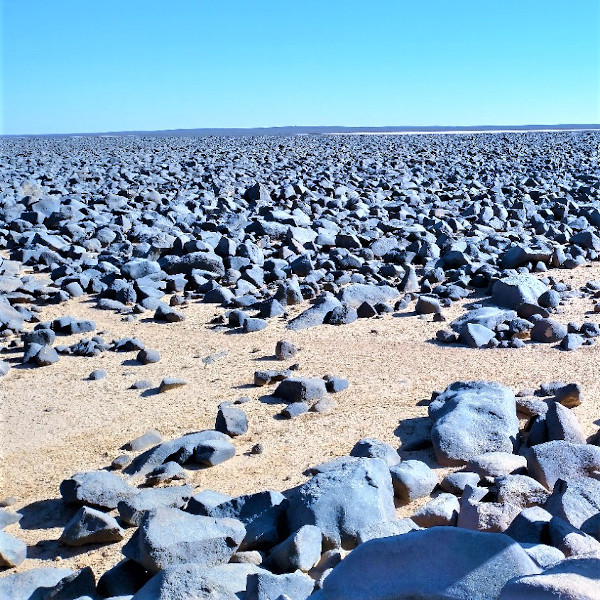
From the sky, the kites of the Jordanian Steppe are easy to spot. The low walls of piled basalt stone stand out against the tan landscape in vivid, dark lines that continue off into the distance. The theory goes that these are the remains of ancient animal traps, guiding prey along the straight lines of the two arms and into the danger of an enclosed area.

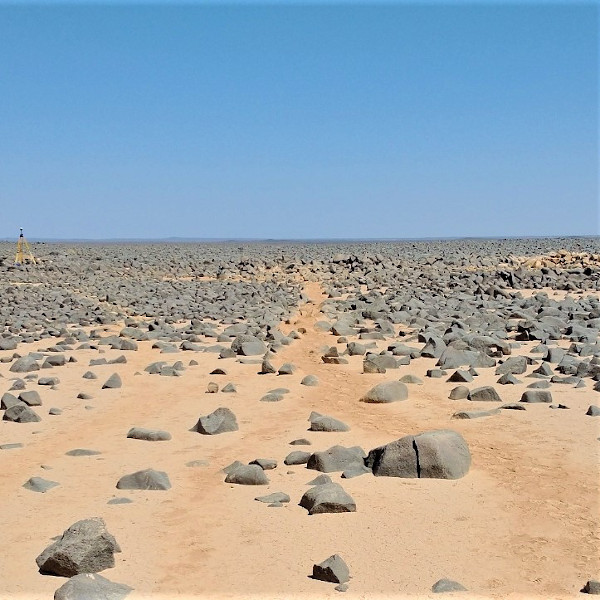
As we walked up to site each morning, I couldn’t help feeling a little bit like one of these ancient ruminants. Like unlucky gazelles, the members of the ‘Kites in Context’ project followed these arms across the basalt fields toward the excavation site. When I had been shown the landscape from above, I had assumed that this route would make for an easy journey – we were following a wall, after all. Yet to my surprise, the unmistakable lines of black on beige that I had seen in the aerial photographs were, on the ground, far less distinct. From ground level, the wall was an uneven gray line in a gray sea of stone. Looking up at the hill, it was only barely possible to pick up the darker shades of a low wall running along it – and even then, only once I was pointed in the right direction – but the closer we got, the more it seemed to vanish into the landscape around it. How on earth was I supposed to follow this every day?

Dusty trails across the basalt.
As your eyes adjust, gray stones suddenly look blue.

Truth be told, I never did get the hang of following walls, but in the end, I did not need to. As we walked the same paths every day, our shoes disturbed the fawn-colored dirt and tracked it across the pewter-colored stones, leaving a little ribbon of sepia across the landscape. Before long, these ephemeral lines of powdery dust criss-crossed the camp, the hills, and the kite enclosure where we were working. Paths between excavation sections, paths over walls to the sieve, paths off into the desert to the bathroom, straight, efficient paths to the tea tent for our afternoon break. Everywhere we went, we trailed dust behind us and this is how I came to know my way around, following the slippery footpaths like an ant follows a scent trail. Had it rained, I would have been totally lost.


Down in the section getting dustier and dustier. Photo credit Quinn Comprosky.

Indeed, it seemed like everything we touched was turning that same dusty-brown hue. When we arrived, everything was colorful. The truck pulled up full of reds and blues and yellows and greens. But in the onslaught of sun and sand and sweat, everything took on a decidedly desert patina. Our clothes were beige, our tents were beige, our notebooks, gear, and pens were beige. No matter how often we washed, our hair and skin were beige. When we sneezed, it was beige. In photos, we all look like the survivors of an explosion in a powder foundation factory.

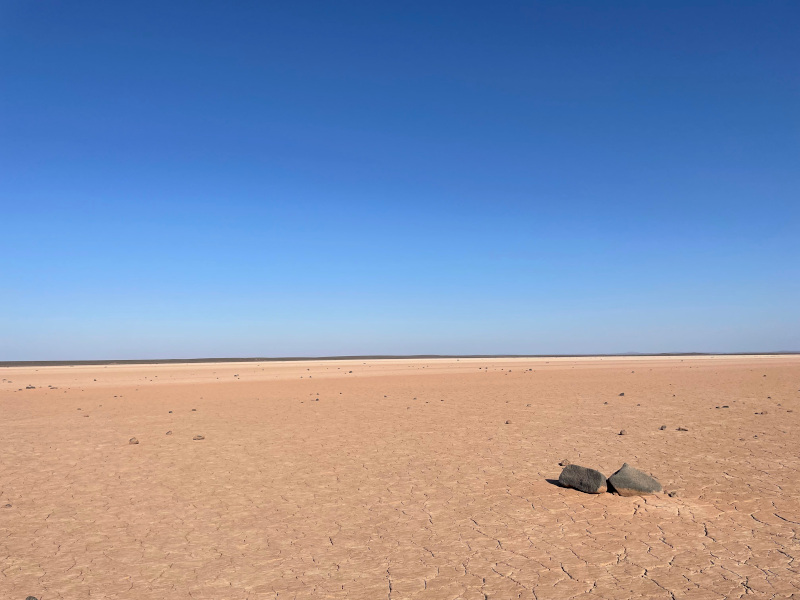
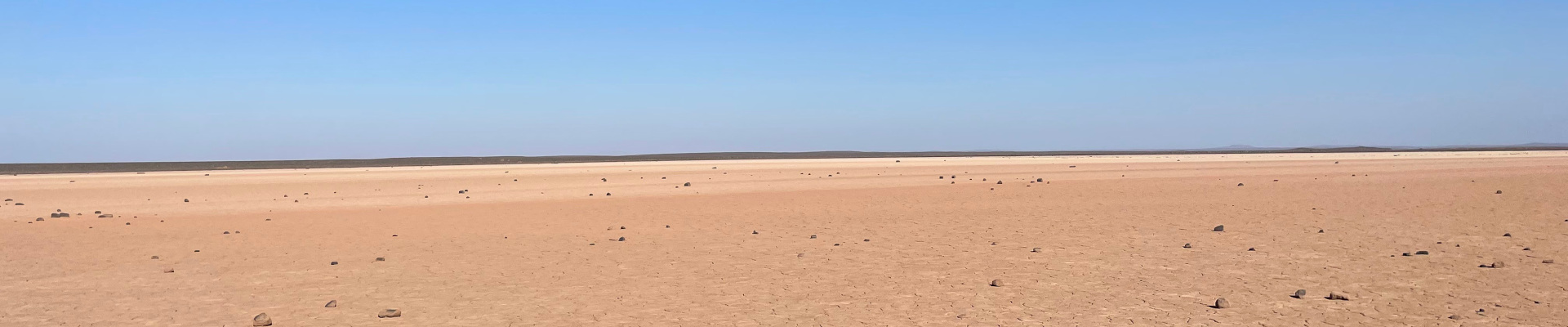
But the more monochrome we became, the more I started to notice new shades in the world around me. My early sketches of the desert are all the same: blue streak, gray streak, tan streak. Above is a wide, expansive blue sky, below is the dusty tan of the local soil, and dividing the two is a line of basalt gray. It’s the same in the high-quality photographs taken by Chad:  the world is black and tan and blue as far as the eye can see. But as my eyes adjusted to this new tritone palette, I began to see new colors in the landscape – shades that I had never imagined could be there. Against the warm tones of the everpresent dirt, the harsh tones of the basalt took on cooler notes.  As we stamped across ancient lava fields, shimmering and shifting in the heat, the oppressive grays began to bloom into a spectrum of muddy blues and dusty purples. In the section, the buried stones seemed to emerge like dusty shards of hazy blue sky. Hot and filthy and tired, I saw the desert differently than when I had arrived, cool and clean and full of energy.

A landscape of blue on grey on tan. Photo credit Jennifer Feng.

For all the horrible heat and the terrible dirt and the wind that blows away anything not nailed down, I like being out in the desert. I like the way that this harsh place makes me see things differently – to see color where I had once seen sepia and trails where I had once seen empty plains of stone. It lets me see with the objective eye of a tape measure and a camera lens, but also with the fallible human eye of someone too hot, too tired, and too frustrated to spot the wall they’re standing on. Of course, it also helps me see the benefit of cold water and air conditioning, but that’s a useful lesson, too, I think.

Rosemary Hanson is a freelance archeological illustrator working out of Sweden. In her normal life, she does not like being hot, dirty, or outside, which is why it is so odd that she absolutely loves working in the Jordanian Desert. There’s just no helping some people.

Want to help more students and early career archaeologists get into the field? Donate to the cause today by selecting “Student Support” as your gift purpose!

Call for Trustee Nominations

CALL FOR TRUSTEE NOMINATIONS 2022

The Trustee Nominations Committee announces an open call for (self) nominations for the ASOR Board of Trustees (Class of 2025). There are three primary responsibilities of the members of the Board of Trustees:

  • Governance: Being aware of issues brought forward to the Board, attending two meetings per year (at your own expense), and bringing issues of concern to the Board.
  • Fundraising and financial management: Leading in development by thinking of new opportunities, leading in giving, and providing oversight on the audited financial statements. We ask that individual trustees aspire to contribute $500 or more annually.
  • Strategic planning and policy development: Leading especially in measures that accord with ASOR’s mission.

We anticipate two openings for Membership-Elected Trustees. Any full ASOR member may be considered for nomination as an Membership-Elected Trustee. If there is someone that you would like the committee to consider—including yourself—please send the person’s name and email address to Marta Ostovich in the ASOR office. Please check with the nominee as to whether they are interested in serving on the ASOR Board of Trustees before sending in their name. If you have any questions about the responsibilities and satisfactions of being a board member, please email Jane DeRose Evans (Chair of the Nominations Committee).

The ASOR office, or a representative from the Nominations Committee, will contact all nominees to describe the responsibilities in greater detail, and to make sure that the nominee is willing to have his or her name discussed by the Trustee Nominations Committee. Please note that nominees will need to submit a brief biography and a mission (or vision) statement for what they would like to accomplish as a trustee to be considered by the Nominations Committee. A sample of these statements can be found in last year’s “Meet Your Board Nominees” webpage. Brief biographies and mission statements should be ca. 200 words each and submitted via e-mail to Marta Ostovich by noon EDT on September 19, 2022.

After the Committee selects individuals for nomination, the election will take place by electronic ballot during October. ASOR is once again conducting online voting to ensure that more of our members are able to participate in this important process. The ASOR office will work with any person who is not able to complete an electronic ballot to ensure that everyone is included.

In order to receive full consideration by the committee, nominations (including supporting documents) should be submitted to programs@asor.org by noon EDT on September 19, 2022.

FOA Webinar: Kevin McGeough on October 27

FRIENDS OF ASOR WEBINARS

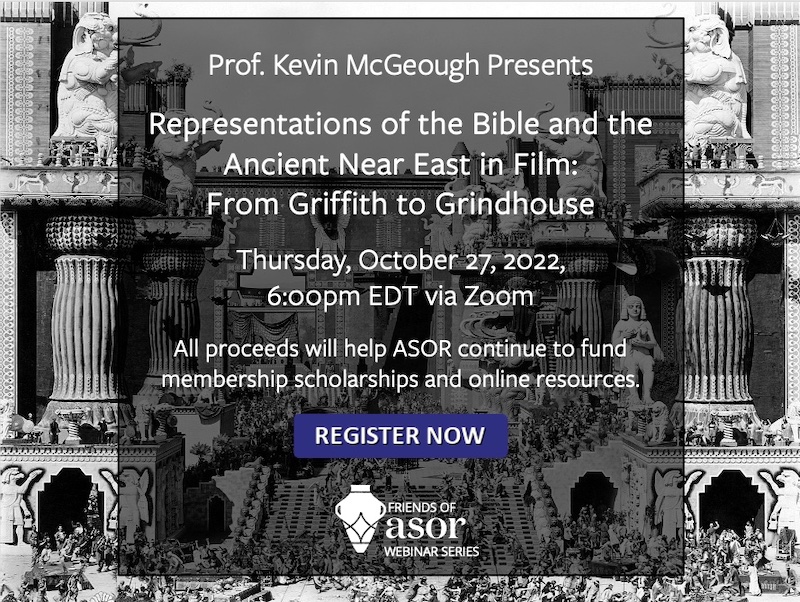
Representations of the Bible and the Ancient Near East in Film: From Griffith to Grindhouse


Registrants receive a 25% discount code to buy this book! A free copy will also be given away during the live webinar.

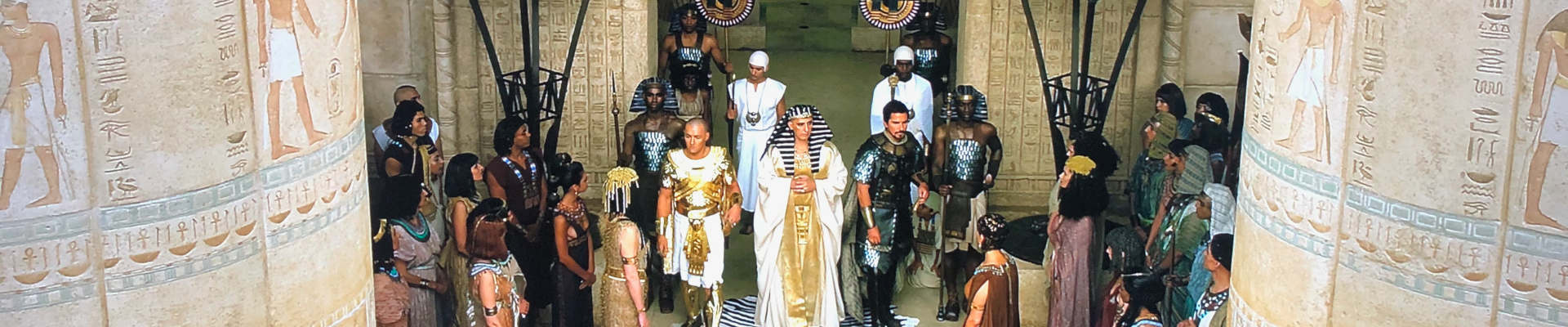
Friends of ASOR present the next webinar in our monthly series on October 27, 2022, at 6:00 pm EDT, featuring Prof. Kevin McGeough and moderated by ANE Today Editor, Dr. Alex Joffe. The Bible and the Ancient Near East have been a subject of movies from the earliest days of film to the present. Stories of Cleopatra, Samson, Moses, and Jesus were compelling for audiences and the challenges of recreating the ancient world in a realistic fashion left viewers awestruck. Films about the ancient world have often been on the cutting edge of cinematic technology because of this, from D.W. Griffith’s recreation of ancient Babylon, to the “cinemascope” of The Robe, to the CGI of Ridley Scott’s Gladiator. However, films like these have also often been flash points for discussions of contemporary moral life. One of the main themes that Dr. McGeough will explore is how these films offer “typological arguments” in which the values of the viewer’s era are justified by witnessing characters with recognizable modern beliefs in ancient situations pitted against villains who hold the opposite values, which are associated with contemporary “others”. After the 1950s, these films showcased veterans dealing with the trauma of their violent encounters, who could be soothed by a faithful wife and by settling down with a family. American Protestantism and democracy are shown, especially through biblical epics of the 1950s and 1960s, as the natural culmination of history. Dr. McGeough argues that viewing the 21st-century Middle East through these lenses has an impact on actual US foreign policy, and these media treatments influence us in unexpected (and often unseeable) ways. Arguments from these films offer apparent scientific accuracy for popular audiences because film can be so realistic. Ironically then, even archaeologically informed film-making can undermine what makes archaeological research in real life so valuable.

These films wax and wane in popularity, so join Prof. McGeough as he explains why this has been the case and discusses how different genres of film impact how the ancient world is treated in the modern era. The webinar will conclude with a live Q&A session moderated by ANE Today Editor, Dr. Alex Joffe.

Dr. Kevin McGeough is Professor of Archaeology in the Department of Geography & Environment at the University of Lethbridge where he holds a Board of Governor’s Research Chair in Archaeological Theory and Reception. The University of Lethbridge is likely the only university in the world in which biblical Hebrew is taught in a geography department. He has excavated in Israel, Egypt, Turkey, Jordan, and Canada and is a co-director of The University of Lethbridge-Royal Alberta Museum Excavations at Head-Smashed-In Buffalo Jump, in southern Alberta.

Kevin has been involved with ASOR publications since his days as an undergraduate, when he compiled an index for five years of Biblical Archaeologist. He has been the editor of ASOR’s Archaeological Report Series and the Annual of ASOR, and is now chair of ASOR’s Committee on Publications. He is currently co-editor of the Alberta Archaeological Review, and is the author of Exchange Relationships at Ugarit, Ugaritic Economic Tablets, and a three-volume work, The Ancient Near East in the Nineteenth Century. His most recent book is Representations of Antiquity in Film: From Griffith to Grindhouse.

This webinar will be recorded and all paid registrants will be sent a link to view the recording.

ASOR Sustaining Members: $0 | ASOR Members: $6 | Public: $12
Season Pass: ASOR Sustaining Members: $0 | ASOR Members: $75 | Public: $150
Buy one here!

To receive your ASOR member discount, log into the online store. If you are new to ASOR, please click on the “New Visitor Registration” link to register your e-mail address and choose a password for our online store. Once logged in, navigate to “Meeting and Event Registration” to register for the webinar and pay the fee. Each paid registrant will receive a confirmation e-mail when you pay for the webinar. If you do not receive this e-mail, then you are not registered. Please e-mail membership@asor.org with any questions or issues with registering.

You will be e-mailed the Zoom Webinar link in the week prior to the lecture on October 27, 2022. If you do not receive the link by the close of business on the Tuesday before the webinar, please e-mail membership@asor.org immediately. This webinar will be recorded and all paid registrants will be sent a link to view the recording.

All proceeds from this webinar are used to fund scholarships for members as well as increasing ASOR’s online resources, which are free to the public.


READY FOR A WEBINAR SEASON PASS?

Buy a season pass for all the webinars* of the 2022-2023 FOA Webinar Season! 1) You will automatically receive the Zoom link for each webinar so no need to register each time. 2) You will also receive the recording of each webinar automatically after the event.

If you have missed webinars earlier in the season and still want to buy the pass, you will receive the links to the recordings of the webinars you missed in your automatic confirmation email after you buy the pass.

*Special symposiums may be excluded from the season pass price.

No more registering for a year if you buy your pass today!

Pricing:

Members: $75.00
Non-Members: $150.00
ASOR Sustaining Members: $0 (automatic registration for each webinar)
Not a member yet? Click here to join as a member and receive the 50% off a season pass!


Log into our online store to purchase the season pass for 2022-2023. If you are new to ASOR and do not have a record in our store yet, click here to register. After you login, navigate to the left to “Meeting and Event Registration.” Please e-mail membership@asor.org if you have any questions or issues.
WHY SPONSOR A WEBINAR?

Several levels of support from $50-$1,000 are available. Proceeds go towards membership scholarships and towards increasing ASOR’s virtual resources. Each sponsorship is tax-deductible and you can give your friends free registrations to a webinar!

Bronze Level ($50): up to 2 guest registrations
Silver Level ($100): up to 5 guest registrations
Gold Level ($500): up to 20 guest registrations
Platinum Level ($1,000): up to 50 guest registrations

After you sign up for a sponsorship online or over the phone, email the names and email addresses of your guests to Felice Herman at membership@asor.org, who will send your guests a confirmation and the Zoom link before the webinar.

WANT TO SAVE $6.00 ON THE NEXT WEBINAR?

Join ASOR as a member! Click here for more details about discounts for events and other benefits of membership. Memberships start at $40 for the year as an Associate Member.

Not ready to join yet? Become a Friend of ASOR for FREE!

Click here for more details about our online resources.


PAST WEBINARS

You can now purchase the link to the recording of any webinar. You can also purchase the bundle packages of all webinars from the 2020-2022 seasons. Please e-mail membership@asor.org for purchase details.

To see a printable pdf of the webinar titles from the 2020-2021 season, please click here. To see a printable pdf of the webinar titles from the 2021-2022 season, please click here.

Pricing:

Members: $6.00 per recording
Non-Members: $12.00 per recording
Bundle of 2020-2021 Webinars: $75.00
Bundle of 2021-2022 Webinars: $75.00
Bundle of 2020-2022 Webinars: $125.00

2021-2022 Season

A World at War: Protecting Cultural Heritage in Times of Conflict
Patty Gerstenblith (DePaul University), Lisa Ackerman (Columbus Citizens Foundation), Andrew Cohen (Government Professional and Cultural Heritage Expert) | May 12, 2022

Preserving Cultural Heritage in Hisban and Umm al-Jimal, Jordan
Øystein LaBianca (Andrews University), Elizabeth Osinga (Umm al-Jimal Archaeological Project), Darrell Rohl (Calvin University) | April 24, 2022

Back to the Field: Recent Discoveries & Summer Plans 2022
Lorenzo d’Alfonso (ISAW), Kathryn Grossman (NC State University), James R. Strange (Samford University) | April 3, 2022

Uncovering What is Nubian Beneath the Veneer of Egyptianness: Excavating the Archives
Debora Heard (University of Chicago) | March 20, 2022

Where Are They Now?: A Preview of 2022 ASOR-Affiliated Fieldwork Projects
Michael Given (University of Glasgow), Xenia-Paula Kyriakou (Florida Gulf Coast University), Stephen Batiuk (University of Toronto), Monique Roddy (Walla Walla University), Kent Bramlett (La Sierra University), Friedbert Ninow (La Sierra University), and Michael Hoff (University of Nebraska-Lincoln) | March 8, 2022

Excavations at Tel Gezer: A Personal Story
Sam Wolff (Tel Gezer Laboratory) | February 20, 2022

Tel Rehov: A Major Bronze and Iron Age City in the Jordan Valley
Amihai Mazar (Hebrew University of Jerusalem), Nava Panitz-Cohen ( Hebrew University of Jerusalem), Nota Kourou (Athens University), Naama Yahalom-Mack (Hebrew University of Jerusalem), Robert Mullins (Azusa Pacific University) | February 10, 2022

The Not-So-Innocents Abroad: The Beginnings of American Biblical Archaeology
Rachel Hallote (Samford University) | January 20, 2022

Synagogues as Jesus Knew Them
James R. Strange (Samford University) | December 2, 2021

Under Jerusalem: The Buried History of the World’s Most Contested City
Andrew Lawler | November 4, 2021

Jesus and Jerusalem on TV: How Do Bible Documentaries Get Made?
Robert Cargill (University of Iowa) | October 17, 2021

Digging the Divine?: Judahite Pillar Figurines and the Archaeology of Israelite Religion
Erin Darby (University of Tennessee) | October 7, 2021

David, Solomon, and Rehoboam’s Kingdom—The Archaeological Evidence
Yosef Garfinkel (Hebrew University of Jerusalem) | September 19, 2021

From Standing Stones to Sacred Emptiness: Textual and Visual Portrayals of Israel’s God
Theodore Lewis (Johns Hopkins University) | August 29, 2021

2020-2021 Season

Making May Matter: Webinarathon to Endow Diversity
Multiple Speakers | May 21-23, 2021

Archaeogaming: Why Video Games Deserve Their Own Archaeology
Tine Rassalle (University of North Carolina at Chapel Hill), Shannon Martino (Morton College), Matthew Winter (University of Arizona), Michael Zimmerman (Rhode Island) | April 18, 2021

How the Bible Became a Book
William Schniedewind (UCLA) | March 21, 2021

The Mysteries of Mithras in Caesarea: Exploring the Cult’s Rites and Remains
Jane DeRose Evans (Temple University), Alexandra Ratzlaff (Brandeis University) | March 11, 2021

Archaeology and the Hidden Religious Culture of Israelite Women
Carol Meyers (Duke University) | February 21, 2021

Meet the Directors—Fundraiser to Support ASOR’s Affiliated Overseas Research Centers
Matthew J. Adams (AIAR), Pearce Paul Creasman (ACOR), Lindy Crewe (CAARI) | February 11, 2021

Early Synagogues, Jesus, and Galilee—A Jewish Perspective
Eric Meyers (Duke University) | December 13, 2020

Home Sweet Home: Ancient Israelite Households in Context
Cynthia Shafer-Elliott (William Jessup University) | October 18, 2020

Priestesses in the Days of Solomon and Ahab
Susan Ackerman (Dartmouth College) | September 13, 2020

Digging Deeper: How Archaeology Works
Eric H. Cline (The George Washington University) | August 9, 2020