ASOR ANNOUNCES REGAN BAKER AS NEW MEMBERSHIP COORDINATOR
ASOR is pleased to announce Regan Baker as ASOR’s new Membership Coordinator! Regan Baker graduated from The George Washington University with a Bachelor’s of Art in Archaeology in May 2023. In February, Regan accepted the role of Office Coordinator and has excelled in her position working with ASOR members and staff at the James F. Strange Center.
This announcement comes with news of Katherine Schmitt’s departure from ASOR as Membership Coordinator. Katherine will be leaving to travel the United States and will be replaced by Regan Baker as the new contact for all ASOR Membership inquiries on May 24, 2024.
It has been a joy to work for ASOR and Katherine would like to thank the ASOR community. She will greatly miss all of the amazing members and staff she was able to meet and work with during her past 2 years at ASOR.
As Membership Coordinator, Regan will be responsible for the growth of both the membership and Friends of ASOR programs, handling membership processing and fulfillment, supporting the Annual Meeting, and website maintenance. Regan looks forward to continuing to work with ASOR’s members and donors!
ASOR WELCOMES MONI ISLAM AS NEW OFFICE COORDINATOR
Moni Islam joined ASOR on April 29 as the new Office Coordinator. He has a Master’s of Arts in Archaeology from Durham University in the United Kingdom, as well as a Bachelor’s of Arts in Anthropology and Global Affairs from George Mason University in Fairfax, Virginia. He has been familiar with ASOR for many years, including having won a 2021 ASOR Summer Stipend Award to work remotely on the Jezreel Expedition Publication Project where he helped organize the project’s open database, conduct research on a Palestinian village, and compile relevant photos and resources.
Moni participated in his first archaeological field school in 2019 in Jordan at Tell Dhiban, a site which was the capital of the Biblical kingdom of Moab from the Iron Age. While finishing up his undergrad at Mason, he also undertook archaeology internships at the Smithsonian’s National Museum of Natural History and Fairfax County Park Authority in 2019. Moni was grateful to be selected as a 2021-22 Fulbright-UK Postgraduate scholar to study his Master’s at Durham University. At Durham, his research focused on the settlement patterns of pre-Islamic Arabia from the 3rd to 7th centuries CE, including studying sites like Mada’in Salih, Qaryat al-Faw, Dumat al-Jandal, Mleiha, and Ma’rib.
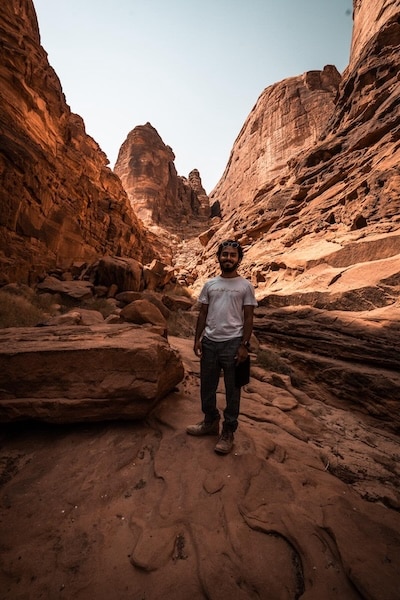
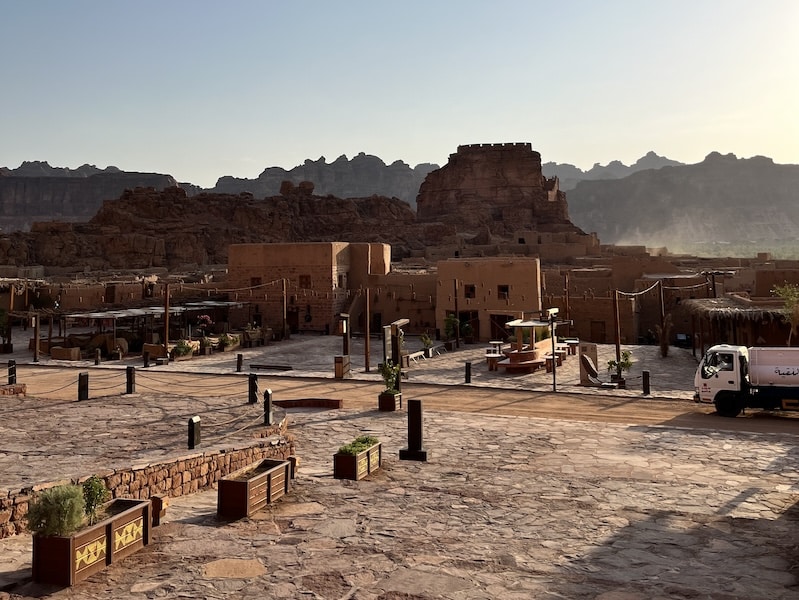
Most recently, Moni was working as an Associate Archaeologist with Chronicle Heritage in the Kingdom of Saudi Arabia. In this role, he provided archaeological supervision on various heritage projects in Al ‘Ula and also participated in the first excavations of the historical district of Ghasibah in Diriyah, the origin of the Saudi royal family and the capital of the first Saudi dynasty from 1727 to 1818.
ASOR is pleased to welcome Moni as he begins the role of Office Coordinator where he will be responsible for assisting the office staff with all administrative tasks, website maintenance, and being the first point of contact for ASOR members. Moni looks forward to interacting with the entire ASOR community!
This announcement also comes with news of Katherine Schmitt’s departure from ASOR as Membership Coordinator. Katherine will be leaving to travel the United States and will be replaced by Regan Baker as the new contact for all ASOR Membership inquiries on May 24, 2024.
Sensing the Past: Sensorial Experiences in Ancient Mesopotamia
Friends of ASOR present the next webinar in the 2023-2024 season on May 9, 2024, at 3:00 pm EDT, presented by Dr. Allison Thomason.
We are all sensing people, and the basic physical structure of our sensing organs has not changed for many thousands of years. But how did ancient humans perceive and experience sensory stimuli in their environment differently than we do today? Dr. Thomason sets out to explore this topic for the ancient Mesopotamians in particular. The history of the senses and explorations of sensory experiences in the ancient world have been increasingly the focus of scholarly research. Archaeologists, art historians and textual scholars have tried to recreate past sensory environments and experiences by using evidence from images, artifacts and ancient texts of all kinds.
In this lecture, Dr. Thomason, a specialist in ancient Mesopotamian material culture, explores how ancient Mesopotamian perceptions of sensory experiences can be compared to our own modern ones, by trying to understand the way that Mesopotamians sensed their environment and material culture and what perceptions they had of certain types of objects, such as metal bowls, wooden gates, and textiles.
This webinar will be recorded and all paid registrants will be sent a link to view the recording.
Dr. Allison Thomason is Professor and Chair of the history department at Southern Illinois University Edwardsville, and serves as their ancient historian. She received her PhD in Art History and Archaeology from Columbia University in 1999 and has taught at SIUE ever since. Her first book, Luxury and Legitimation: Royal Collecting in Ancient Mesopotamia (2005) is still available in print and as an e-book from Routledge Press. She has contributed numerous articles and chapters in books, lectures, and presentations on the material culture of Mesopotamia and the ancient Near East. Recent research interests include dress in the Ancient Near East and she has co-edited (with Kiersten Neumann) an extensive anthology, A Handbook of Senses in the Ancient Near East (Routledge Press 2022). Dr. Thomason is also the co-chair of ASOR’s Program Committee, which plans the Annual Meeting.
This webinar will be recorded and all paid registrants will be sent a link to view the recording.
*Please log in to the Online Portal BEFORE registering for the webinar. Once you have logged in, you will be able to register under our Events page linked above.
Please e-mail membership@asor.org with any questions or issues with registering.
All proceeds from this webinar are used to fund scholarships for members as well as increasing ASOR’s online resources, which are free to the public.
SPONSOR A WEBINAR!
Several levels of support from $50-$1,000 are available. Proceeds go towards membership scholarships and towards increasing ASOR’s virtual resources. Each sponsorship is tax-deductible and you can give your friends free registrations to a webinar! Sponsor a webinar here.
Bronze Level ($50): up to 2 guest registrations Silver Level ($100): up to 5 guest registrations Gold Level ($500): up to 20 guest registrations Platinum Level ($1,000): up to 50 guest registrations
After you sign up for a sponsorship online or over the phone, email the names and email addresses of your guests to Katherine Schmitt at membership@asor.org, who will send your guests a confirmation and the Zoom link before the webinar.
WANT TO SAVE $6.00 ON THE NEXT WEBINAR?
Join ASOR as a member! Click here for more details about discounts for events and other benefits of membership. Memberships start at $40 for the year as an Associate Member.
How did the dead die in Ancient Judah? Death as a social process in Iron Age tombs
Friends of ASOR present the next webinar in the 2023-2024 season on April 4, 2024, at 6:00 pm EDT, presented by Dr. Matthew Suriano.
The descriptions of death, dying, and burial in the Hebrew Bible are brief and ambiguous. The biblical text contains instructions on how to remove the ritual impurity of the dead, but does not contain any instructions for how to bury the dead. Likewise, the description of postmortem existence is ambiguous and seemingly contradictory. The psalms often depict the place of the dead, called Sheol, in tomb-like terms. In poetic passages like Psalm 88, Sheol is described in tomb-like terms as a dark and dreary place. Yet other passages like Gen 37:35, 44:29–31, and Eccl 9:10 imply that Sheol is the common fate for all humanity. Yet the tomb also holds positive connotations in biblical literature. An ideal death involved being buried with your kin inside the family tomb (2 Sam 19:38). Idioms for death used in the Bible, such as “gathered to one’s kin” (see Gen 25:8) and “lay down with one’s fathers” (see 1 Kg 2:10), imply the collective burial rites that would have occurred inside the family tomb. So how do we reconcile these contrasting images? The archaeological exploration of ancient Israelite mortuary remains provides insight into this problem. The excavation and survey of Iron Age tombs from Judah show that the dead received two burials, an initial interment when the body was brought to the tomb, and a secondary burial when their bones were transferred to a collection of bones (called a repository) stored inside the tomb. Death as transition, in ancient Judah, was observed through the physical changes that occurred in the corpse. This talk will examine the possible meanings of this transition, where the body moved from a burial bench to a re-interment inside a bin of bones, and suggest that it indicates a process of dying that began once the corpse was brought to the tomb. This process of dying, which contrasts with our modern concept of clinical death, provides new ways of looking at the complex images of death we find in the Hebrew Bible such as Sheol.
Matthew J. Suriano is an Associate Professor in the Joseph and Rebecca Meyerhoff Center for Jewish Studies at the University of Maryland where he teaches Hebrew Bible, ancient religions, and archaeology. A former fellow at the W.F. Albright Institute of Archaeological Research in Jerusalem, Suriano has also participated in several archaeological excavations and surveys in Israel, most recently at Tel Burna. He has written extensively on death and burial in the ancient world, and his book A History of Death in the Hebrew Bible (Oxford University Press, 2018) won the American Society for Overseas Research’s Frank Moore Cross Award. His research interests also involve Jerusalem and he is currently studying the monolithic tombs in Silwan.
This webinar will be recorded and all paid registrants will be sent a link to view the recording.
*Please log in to the Online Portal BEFORE registering for the webinar. Once you have logged in, you will be able to register under our Events page linked above.
Please e-mail membership@asor.org with any questions or issues with registering.
All proceeds from this webinar are used to fund scholarships for members as well as increasing ASOR’s online resources, which are free to the public.
READY FOR A WEBINAR SEASON PASS?
Buy a season pass for all the webinars* of the 2023-2024 FOA Webinar Season! With a season pass, you will automatically be registered for every webinar in the season, and you will receive the recording of each webinar automatically after the event.
If you have missed webinars earlier in the season and still want to buy the pass, you will receive the links to the recordings of the webinars you missed in your automatic confirmation email after you buy the pass.
*Special symposiums may be excluded from the season pass price.
No more registering for a year if you buy your pass today!
Pricing:
ASOR Sustaining Members: $0 (automatic registration for each webinar) Members: $75 Public: $150
Several levels of support from $50-$1,000 are available. Proceeds go towards membership scholarships and towards increasing ASOR’s virtual resources. Each sponsorship is tax-deductible and you can give your friends free registrations to a webinar! Sponsor a webinar here.
Bronze Level ($50): up to 2 guest registrations Silver Level ($100): up to 5 guest registrations Gold Level ($500): up to 20 guest registrations Platinum Level ($1,000): up to 50 guest registrations
After you sign up for a sponsorship online or over the phone, email the names and email addresses of your guests to Katherine Schmitt at membership@asor.org, who will send your guests a confirmation and the Zoom link before the webinar.
WANT TO SAVE $6.00 ON THE NEXT WEBINAR?
Join ASOR as a member! Click here for more details about discounts for events and other benefits of membership. Memberships start at $40 for the year as an Associate Member.
ASOR WELCOMES DARREN ASHBY AS NEW CHI PROGRAMS MANAGER
Dr. Darren P. Ashby joined ASOR as ASOR CHI’s Programs Manager on March 1. He previously worked at ASOR from 2017 to 2019 where he reported on threats and damage to cultural heritage and led a project to document the current condition of Jewish cultural heritage in Iraq and Syria. In his new role, Darren will work with CHI leadership to support ongoing projects, strengthen relationships between ASOR’s members and partners, and further develop ASOR’s abilities to protect, preserve, and promote the rich cultural heritage of Southwest Asia and North Africa in collaboration with local communities, heritage professionals, and civil society organizations.
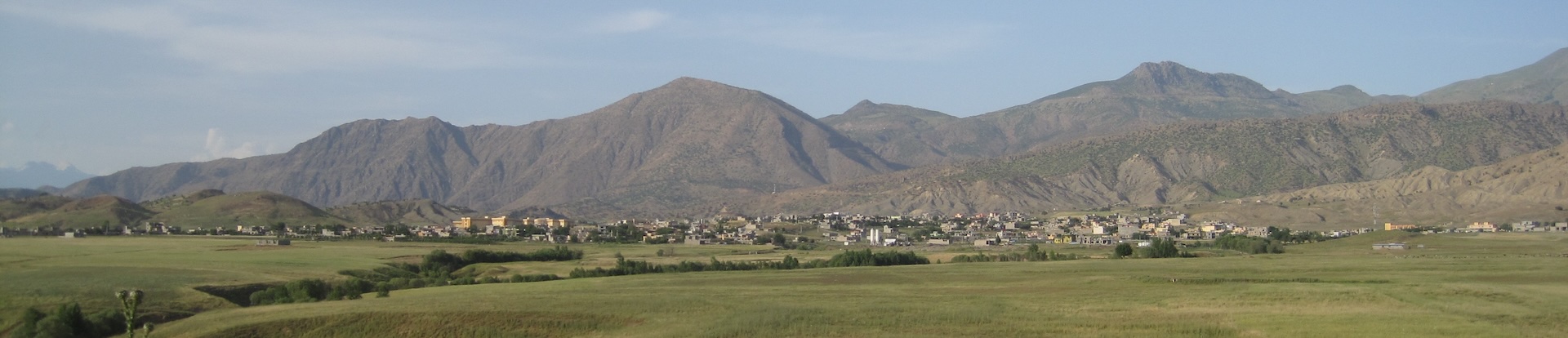
Darren received his Ph.D. from the University of Pennsylvania’s Department of Near Eastern Languages and Civilizations in 2017 with a specialization in the archaeology, art, and history of Ancient Mesopotamia. His doctoral research explored Early Bronze Age economy and society through the study of religious architecture excavated at Tell al-Hiba in Dhi Qar Governorate, Iraq. After graduation, he pursued further archaeological research in Iraq as a member of field excavations at the sites of Tell al-Hiba, Nineveh, and Nimrud.
Most recently, he was Program Manager of the University of Pennsylvania’s Iraq Heritage Stabilization Program (IHSP) where he worked from 2019 to 2024. In this role, he worked closely with IHSP’s leadership and local and international partners to document, stabilize, and restore built and archaeological heritage in northern and central Iraq. Major projects include the restoration of the Sanctuary of Sheikh Adi at Lalish and the Monastery of St. George (Deir Mar Gorgis) in East Mosul with support from the U.S. Department of State as well as the restoration of a 19th-century home (Beit al-Tutunji) in Mosul’s Old City and the emergency assessment and stabilization of the Taq Kisra at Ctesiphon with support from the ALIPH Foundation.
Darren is excited to rejoin the ASOR CHI team and eager to hear more from the ASOR community about their thoughts on ASOR CHI’s current work and future priorities. He can be reached at dashby@asor.org.
ASOR WELCOMES REGAN BAKER AS NEW OFFICE COORDINATOR
Regan Baker graduated from The George Washington University with a Bachelor’s of Art in Archaeology in May 2023. As an archaeology student, Regan quickly became familiar with ASOR, and she is excited to be coming on as the Office Coordinator. Previously, she interned at the Colosseum while studying abroad in Rome, Italy during the Fall 2022 semester. There, she worked in collections storage under the guidance of a supervising archaeologist and assisted with a project on marble pieces from the Imperial Box.
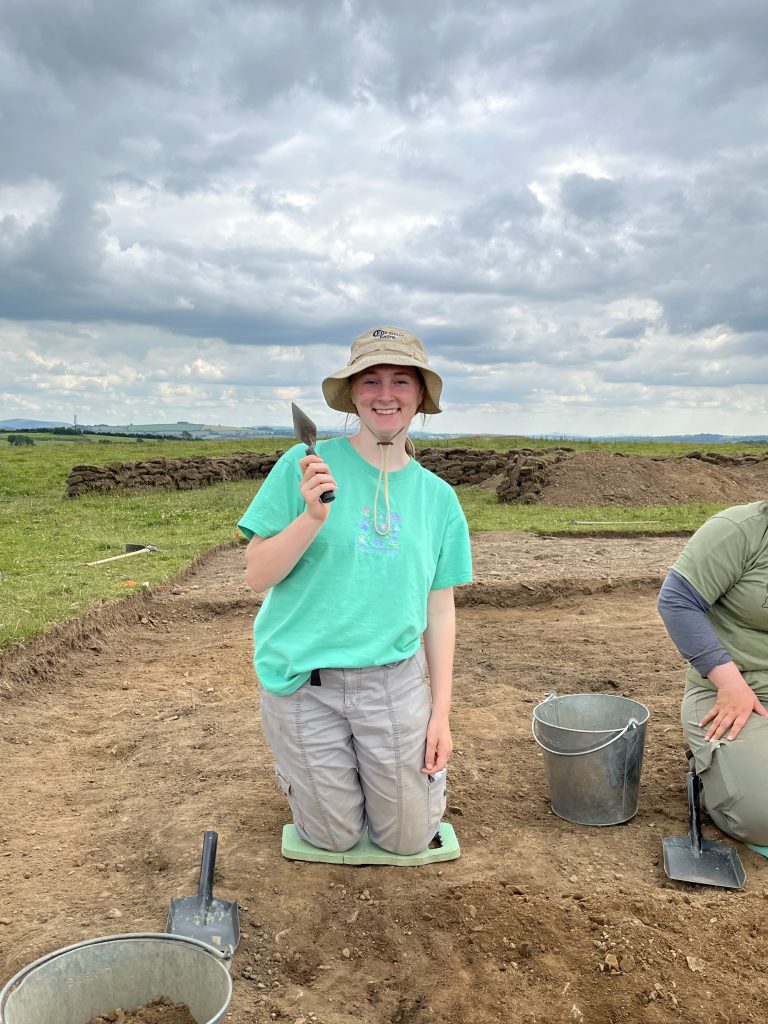
Regan completed her first archaeological field school in 2022 at the site of Dún Ailinne in County Kildare, Ireland. While participating in this field school, she helped excavate a section of what is believed to have been an Iron Age ceremonial site. In addition to learning the basics of field archaeology, she also had the opportunity to receive introductory training in artifact photography and GIS technology. During the four-week field school, Regan took several field trips with the team to other archaeological sites around Ireland, furthering her hands-on experience.
ASOR is pleased to welcome Regan as she begins her role of Office Coordinator. As Office Coordinator, she will be responsible for assisting the office staff with all administrative tasks, website maintenance, and being the first point of contact for members who email, call, or visit the James F. Strange Center. Regan greatly looks forward to growing within her new role and getting to know the inner workings of ASOR!
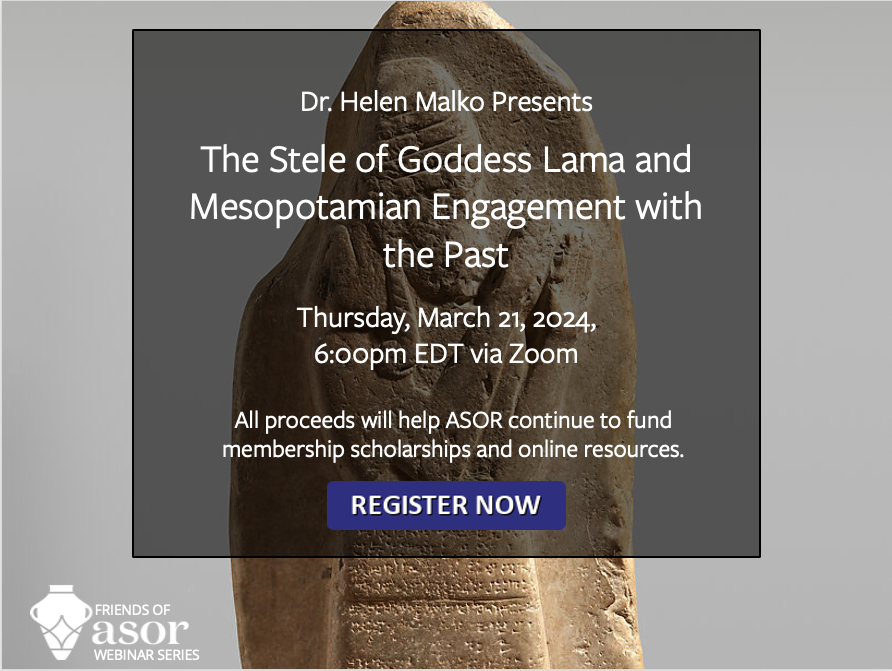
The Stele of Goddess Lama and Mesopotamian Engagement with the Past
For the people of Mesopotamia, the past was a source of knowledge and inspiration. Their reverence, both in terms of preserving early buildings and monuments and reviving images and ancient writing styles, is evident in archaeological and textual records. While Mesopotamian monuments and images were produced as historical works, inscribed with texts that marked them clearly and linked them to specific events and times, their efficacy was understood to be unlimited. Dated to the reign of king Nazi-Maruttash (ca. 1307–1282 BCE), the stele of the Goddess Lama, currently in the collections of the Metropolitan Museum, offers an excellent opportunity to explore Mesopotamian interaction with the past during the Kassite period (ca. 1574–1157 BCE). Through visual and textual analysis, this talk examines the survival of Lama imagery in this period. It reflects on the religious/political significance of the stele’s production within a broader context. The aim is to demonstrate that the crudely carved and seemingly unimaginative reuse of an earlier protective goddess figure was a deliberately archaizing image and an inspired citation of the past.
This webinar will be recorded and all paid registrants will be sent a link to view the recording.
Helen Malko is the Associate Director of the Stanford Humanities Center, where she oversees various academic programs in the humanities and interpretive social sciences. Before joining Stanford, she worked at the American Center of Research (ACOR) and Columbia University Global Center in Amman, Jordan. Helen holds a Ph.D. in Anthropology and Archaeology from Stony Brook University and a BA from Baghdad University, and she is trained in cultural heritage and preservation studies. She has been awarded multiple fellowships at the Metropolitan Museum and Columbia University in New York and has conducted fieldwork and capacity-building projects in Iraq, Jordan, and Turkey.
*Please log in to the Online Portal BEFORE registering for the webinar. Once you have logged in, you will be able to register under our Events page linked above.
Please e-mail membership@asor.org with any questions or issues with registering.
All proceeds from this webinar are used to fund scholarships for members as well as increasing ASOR’s online resources, which are free to the public.
READY FOR A WEBINAR SEASON PASS?
Buy a season pass for all the webinars* of the 2023-2024 FOA Webinar Season! With a season pass, you will automatically be registered for every webinar in the season, and you will receive the recording of each webinar automatically after the event.
If you have missed webinars earlier in the season and still want to buy the pass, you will receive the links to the recordings of the webinars you missed in your automatic confirmation email after you buy the pass.
*Special symposiums may be excluded from the season pass price.
No more registering for a year if you buy your pass today!
Pricing:
ASOR Sustaining Members: $0 (automatic registration for each webinar) Members: $75 Public: $150
Several levels of support from $50-$1,000 are available. Proceeds go towards membership scholarships and towards increasing ASOR’s virtual resources. Each sponsorship is tax-deductible and you can give your friends free registrations to a webinar! Sponsor a webinar here.
Bronze Level ($50): up to 2 guest registrations Silver Level ($100): up to 5 guest registrations Gold Level ($500): up to 20 guest registrations Platinum Level ($1,000): up to 50 guest registrations
After you sign up for a sponsorship online or over the phone, email the names and email addresses of your guests to Katherine Schmitt at membership@asor.org, who will send your guests a confirmation and the Zoom link before the webinar.
WANT TO SAVE $6.00 ON THE NEXT WEBINAR?
Join ASOR as a member! Click here for more details about discounts for events and other benefits of membership. Memberships start at $40 for the year as an Associate Member.
Please e-mail the Membership office if you have any questions.
Pp. 4–13: “Religion(s) in Seals: Old and New Challenges,” by Fabio Porzia
Although seals are very mobile items and often reused, and although they can be regarded as mass media products given their large distribution in time, space, and different social classes, they are often used by scholars as a tool to map political, cultural, and religious borders. This contribution aims at reassessing the validity of using religious iconography on seals from the first-millennium BCE southern Levant for the study of ancient religion(s) from three aspects: that religion is thematized beyond ethnic borders; that religious motifs are studied beyond the quest of their origin; and that divine images are studied beyond the compulsion to provide them with proper names. Introducing the notion of adaption as a short form for adoption and adaptation, this article supports a more nuanced understanding of seal iconography in terms of shared cultural infrastructure and a common cultural landscape.
ASOR Members with online access: log into ASOR’s Online Portal here. Once logged in, click the JOURNALS tab in the top navigation bar. Tutorials for how to log in to the Online Portal as well as how to navigate to the Portal Journals page can be found here.
Pp. 14-19: “Mastering the Seven-Headed Serpent: A Stamp Seal from Hazor Provides a Missing Link between Cuneiform and Biblical Mythology,” by Christoph Uehlinger
The Stamp Seals from the Southern Levant (SSSL) project is based on a comprehensive corpus, big data, and complex historical scenarios. Sometimes, though, an individual artifact stands out as a highlight in its own right. Such is the case with a stamp seal discovered recently at Tel Hazor. It is unusual in several respects, but mainly because of its spectacular base engraving. The main scene represents a hero fighting a coiled, seven-headed serpent; it is enhanced by a series of mixed creatures and secondary motifs. This article offers a description and analysis of the object, situating its iconography in the long history of combat myths spanning from mid-third-millennium southern Mesopotamia through second-millennium northern Syria to first-millennium Phoenicia and Israel. Most significant for a historian of Near Eastern mythology, the seal provides a visual missing link in the main motif’s literary transition from Late Bronze Age Ugarit to the Hebrew Bible.
ASOR Members with online access: log into ASOR’s Online Portal here. Once logged in, click the JOURNALS tab in the top navigation bar. Tutorials for how to log in to the Online Portal as well as how to navigate to the Portal Journals page can be found here.
Pp. 20-25: “Stamp Seals as Jewelry: Identifying Body Ornaments through Seal Impressions,” by Noa Ranzer
Stamp seals had various functions in the Iron Age southern Levant. In addition to their use as stamping devices, they were also worn on the body like other pieces of jewelry and thus formed but one part of a larger design comprising different objects (e.g., metal wires, pins, fibulae). In their archaeological contexts, however, most seals are detached from their original mountings. Thus, we are left wondering how such a seal was displayed when worn on the body. As part of a more extensive ongoing study on the function of stamp seals during the Iron Age, this article examines how seal impressions can serve as an important dataset to begin identifying specific mounting techniques and, thus, the possible ways different seals were used as jewelry.
ASOR Members with online access: log into ASOR’s Online Portal here. Once logged in, click the JOURNALS tab in the top navigation bar. Tutorials for how to log in to the Online Portal as well as how to navigate to the Portal Journals page can be found here.
Pp. 26-31: “Making a Good Impression: A Typology of Mounted Seal Impressions in the Middle Bronze Age Southern Levant,” by Tatjana Beuthe
Mounted seals have frequently been uncovered in Middle Bronze Age archaeological contexts in the Levant and Egypt. However, direct evidence for the deployment of such seals to mark objects does not appear to have been systematically studied to date. This article presents an initial typology of impressions made using mounted seals found in the southern Levant. Material from the Corpus of Stamp Seals from the Southern Levant (CSSL) database indicates southern Levantine stamp seals set in rings and attached to other types of ornamentation were widely used as tools to create impressions.
ASOR Members with online access: log into ASOR’s Online Portal here. Once logged in, click the JOURNALS tab in the top navigation bar. Tutorials for how to log in to the Online Portal as well as how to navigate to the Portal Journals page can be found here.
Pp. 32-40: “‘Male until Proven Otherwise?’: Searching for Women with the Help of Inscribed Stamp Seals from Jerusalem,” by Bruno Biermann
Archaeological finds are often framed within androcentric biases, for example, representing inscribed seals as male-owned and used objects. However, this picture crumbles under critical examination. This article addresses presumptions about sex and seal ownership, focusing on inscribed seals from the Iron Age IIB–III from Jerusalem. Therefore, this article demonstrates how gender-archaeological research can contribute to new perspectives on Levantine stamp seals and material culture. This approach is based on provenanced artifacts found in archaeological excavations and their context and the careful examination of how gender is expressed or remains ambiguous in the inscriptions on these small objects. The presented dataset of inscribed seals and impressions on sealings and jar handles from Jerusalem suggests that women owned and used inscribed seals for a variety of purposes, including commerce and sealing of containers and jars, as well as being buried with them.
ASOR Members with online access: log into ASOR’s Online Portal here. Once logged in, click the JOURNALS tab in the top navigation bar. Tutorials for how to log in to the Online Portal as well as how to navigate to the Portal Journals page can be found here.
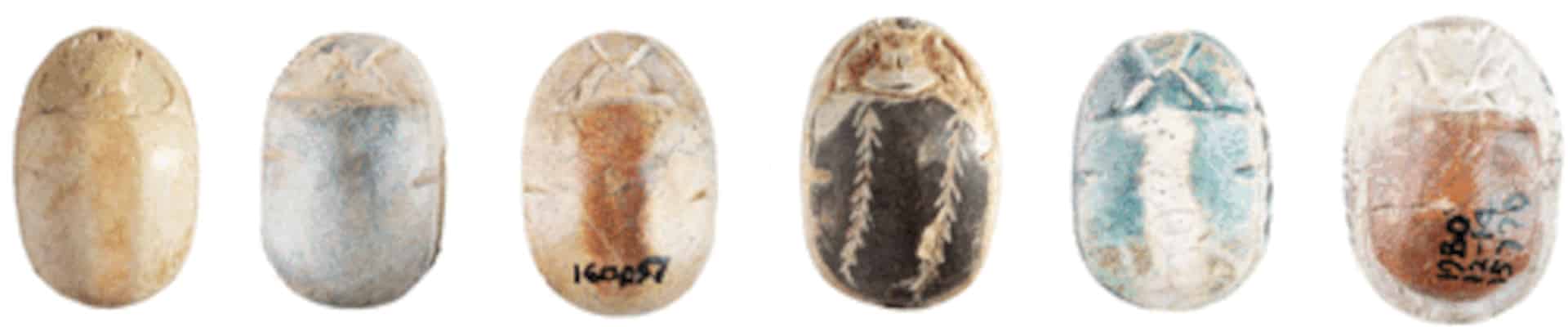
Pp. 42-52: “Scratching the Surface of Middle Bronze Age Scarabs: Investigating Enigmatic Marks on Stamp Seals from Lachish and Megiddo,” by Nadia Ben-Marzouk and Ben Greet
A distinct feature on many Middle Bronze Age scarabs from the southern Levant is the presence of chromatic marks on the backs of these objects, often described as longitudinal lines. Previous explanations have fallen into one of three proposals: Either they are the product of production-related techniques related to firing and glazing, intentionally applied marks, or the byproduct of use-wear related or depositional practices. To date, no critical investigation of these enigmatic marks has been published and thus no consensus reached. However, through new high-resolution photography of the stamp seals from the sites of Lachish and Megiddo in the southern Levant, a systematic analysis was recently permitted. This paper presents the results from a study on these enigmatic marks and a discussion on what the new photography reveals about previous interpretations and possible new directions for the study of this corpus.
ASOR Members with online access: log into ASOR’s Online Portal here. Once logged in, click the JOURNALS tab in the top navigation bar. Tutorials for how to log in to the Online Portal as well as how to navigate to the Portal Journals page can be found here.
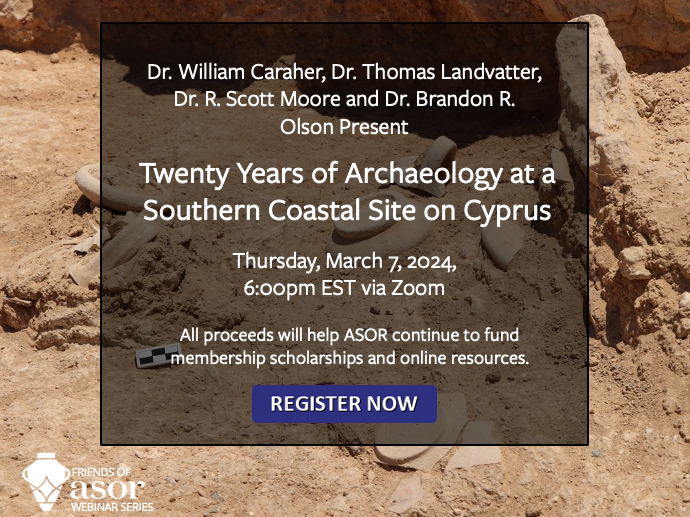
Twenty Years of Archaeology at a Southern Coastal Site on Cyprus
Friends of ASOR present the next webinar in the 2023-2024 season on March 7, 2024, at 6:00 pm EST, presented by Dr. William Caraher, Dr. Thomas Landvatter, Dr. R. Scott Moore and Dr. Brandon R. Olson.
For the last two decades, the Pyla-Koutsopetria Archaeological Project has explored the coastal region of Pyla village. Located 10 km east of Larnaka and immediately below the famous Late Bronze Age site atop the Kokkinokremos coastal ridge, Koutsopetria featured a now-infilled embayment which likely served as a harbor in antiquity. The location of the site near an ancient harbor and astride the major road running between the ancient cities of Kition and Salamis likely led to the fortification of the prominent coastal height of Vigla in the Hellenistic period. This site likely served as strategic outpost for mercenaries during the tumultuous period after Alexander the Great’s death when his successors battled for control over the island and the Mediterranean littoral. The forces occupying the fort appear to have abandoned it within a generation of its construction leaving behind a fascinating window into the tumultuous life of this strategic site.
During the Roman and Late Roman periods, a prosperous town developed in the coastal zone. Excavations in the 1990s by the Department of Antiquities revealed parts of an Early Christian basilica and the intensive survey carried out by our team showed that the site had trade connections across the Mediterranean. The rise and decline of the Roman period settlement at Koutsopetria was less abrupt than that of its Hellenistic predecessor on Vigla, but our work at Koutsopetria similarly offers a window into an era of significant change on the island. Our excavations and survey at Koutsopetria have revealed that the church and surrounding settlement likely experienced a gradual abandonment over the course of the 7th and 8th centuries. This suggests that the site did not succumb to a catastrophic end at the hands of Arab raiders, but declined gradually perhaps as a result of the changing economic and political landscape of the region.
This talk will interweave the story of the Pyla-Koutsopetria Archaeological Project with our understanding of the history of the site during the Hellenistic, Roman, and Late Roman periods.
R. Scott Moore is Distinguished University Professor of History at Indiana University of Pennsylvania.
Thomas Landvatter is Associate Professor of Greek, Latin, and Ancient Mediterranean Studies and Humanities at Reed College.
William Caraher is Associate Professor and teaches in the Department of History and American Indian Studies at the University of North Dakota.
Brandon R. Olson is Assistant Professor of History at Metropolitan State University of Denver.
Combined they have over a half-century of archaeological experience on Cyprus and elsewhere in the Eastern Mediterranean. Starting in 2003, Caraher and Moore co-directed the Pyla-Koustopetria Archaeological Project on Cyprus with David Pettegrew. Since 2018, the project has continued under the direction of Olson, Landvatter, and education director Justin Stephens.
This webinar will be recorded and all paid registrants will be sent a link to view the recording.
*Please log in to the Online Portal BEFORE registering for the webinar. Once you have logged in, you will be able to register under our Events page linked above.
Please e-mail membership@asor.org with any questions or issues with registering.
All proceeds from this webinar are used to fund scholarships for members as well as increasing ASOR’s online resources, which are free to the public.
READY FOR A WEBINAR SEASON PASS?
Buy a season pass for all the webinars* of the 2023-2024 FOA Webinar Season! With a season pass, you will automatically be registered for every webinar in the season, and you will receive the recording of each webinar automatically after the event.
If you have missed webinars earlier in the season and still want to buy the pass, you will receive the links to the recordings of the webinars you missed in your automatic confirmation email after you buy the pass.
*Special symposiums may be excluded from the season pass price.
No more registering for a year if you buy your pass today!
Pricing:
ASOR Sustaining Members: $0 (automatic registration for each webinar) Members: $75 Public: $150
Several levels of support from $50-$1,000 are available. Proceeds go towards membership scholarships and towards increasing ASOR’s virtual resources. Each sponsorship is tax-deductible and you can give your friends free registrations to a webinar! Sponsor a webinar here.
Bronze Level ($50): up to 2 guest registrations Silver Level ($100): up to 5 guest registrations Gold Level ($500): up to 20 guest registrations Platinum Level ($1,000): up to 50 guest registrations
After you sign up for a sponsorship online or over the phone, email the names and email addresses of your guests to Katherine Schmitt at membership@asor.org, who will send your guests a confirmation and the Zoom link before the webinar.
WANT TO SAVE $6.00 ON THE NEXT WEBINAR?
Join ASOR as a member! Click here for more details about discounts for events and other benefits of membership. Memberships start at $40 for the year as an Associate Member.
Contemporary Interventions: The Case for Contemporary Art in Archaeological Museums
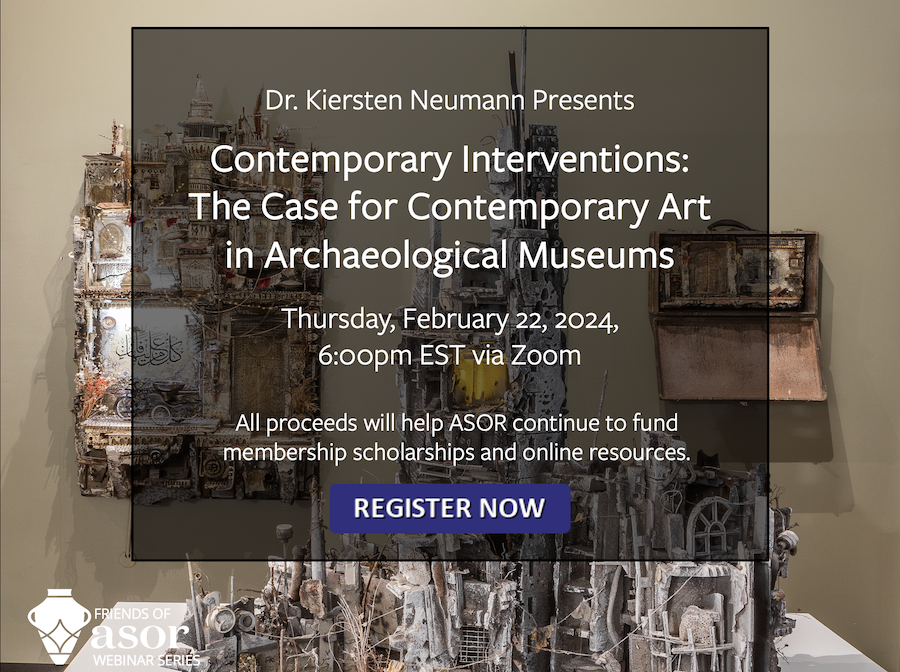
Friends of ASOR present the next webinar in the 2023-2024 season on February 22, 2024, at 6:00 pm EST, presented by Dr. Kiersten Neumann moderated by Dr. Agnete Lassen.
Curating an exhibition of contemporary art comes with the incredible opportunity of collaborating with living artists to realize together how to give voice and vision to their work. Doing so in the space of an archaeological museum brings with it the added opportunity to revisit and reevaluate traditional object narratives and museological methods. For centuries Western cultural institutions and museum exhibitions have advanced historical narratives of ancient West Asia with a singular, authoritative voice, predominantly disconnected from the present. Contemporary installations have the power to forefront and celebrate the complexity and continuity of this rich cultural heritage, presenting postcolonial perspectives and thought-provoking artistic responses that draw on diverse lived experiences, memories, and imagination.
In this webinar, Kiersten Neumann will discuss powerful examples of the pairing of contemporary art and archaeological objects from her own experience as an art historian, archaeologist, and curator, demonstrating some of the ways in which such contemporary interventions, including those by local and diaspora artists and communities, can bring a uniquely humanizing perspective to this history.
The webinar will conclude with a live Q&A session moderated by Dr. Agnete Lassen.
Kiersten Neumann specializes in the art and archaeology of West Asia, with a focus on Assyrian and Achaemenid material culture. In addition to co-editing The Routledge Handbook of the Senses in the Ancient Near East(2022), she has published numerous articles on sensory experience, ritualized practice, and visual culture, as well as on museum practice, collecting histories, and provenance research. She is Curator of the Institute for the Study of Ancient Cultures Museum (ISAC Museum [formerly Oriental Institute Museum]), Research Associate at ISAC, and Lecturer in the Department of Art History at the University of Chicago. At the ISAC Museum, she has curated such exhibitions as Joseph Lindon Smith: The Persepolis Paintings(2022), Making Sense of Marbles: Roman Sculpture at the OI(2022–2023), and Artifacts Also Die (2023), in addition to the museum’s permanent galleries as part of a complete renovation (2019). She has conducted fieldwork in Turkey (Tell Tayinat) and Greece (Athenian Agora), and collaborates on international museum, art, and cultural heritage projects and exhibitions. Originally from Vancouver, Canada, she received her B.A. and M.A. from the University of British Columbia and her Ph.D. from the University of California, Berkeley, during which time she also worked at the Badè Museum of Biblical Archaeology in Berkeley, ultimately as Associate Curator and Interim Director. Kiersten became involved with ASOR in 2008. In addition to being an active participant at the ASOR annual meetings, she is a member of the Program Committee (co-chair since 2022), which she represents on the Chairs Coordinating Council; she was a member of the Ad Hoc Committee on ASOR’s Name (2020); and she joined the Board of Trustees in January of this year.
This webinar will be recorded and all paid registrants will be sent a link to view the recording.
*Please log in to the Online Portal BEFORE registering for the webinar. Once you have logged in, you will be able to register under our Events page linked above.
Please e-mail membership@asor.org with any questions or issues with registering.
All proceeds from this webinar are used to fund scholarships for members as well as increasing ASOR’s online resources, which are free to the public.
READY FOR A WEBINAR SEASON PASS?
Buy a season pass for all the webinars* of the 2023-2024 FOA Webinar Season! With a season pass, you will automatically be registered for every webinar in the season, and you will receive the recording of each webinar automatically after the event.
If you have missed webinars earlier in the season and still want to buy the pass, you will receive the links to the recordings of the webinars you missed in your automatic confirmation email after you buy the pass.
*Special symposiums may be excluded from the season pass price.
No more registering for a year if you buy your pass today!
Pricing:
ASOR Sustaining Members: $0 (automatic registration for each webinar) Members: $75 Public: $150
Several levels of support from $50-$1,000 are available. Proceeds go towards membership scholarships and towards increasing ASOR’s virtual resources. Each sponsorship is tax-deductible and you can give your friends free registrations to a webinar! Sponsor a webinar here.
Bronze Level ($50): up to 2 guest registrations Silver Level ($100): up to 5 guest registrations Gold Level ($500): up to 20 guest registrations Platinum Level ($1,000): up to 50 guest registrations
After you sign up for a sponsorship online or over the phone, email the names and email addresses of your guests to Katherine Schmitt at membership@asor.org, who will send your guests a confirmation and the Zoom link before the webinar.
WANT TO SAVE $6.00 ON THE NEXT WEBINAR?
Join ASOR as a member! Click here for more details about discounts for events and other benefits of membership. Memberships start at $40 for the year as an Associate Member.

 ASOR is pleased to announce Regan Baker as ASOR’s new Membership Coordinator! Regan Baker graduated from The George Washington University with a Bachelor’s of Art in Archaeology in May 2023. In February, Regan accepted the role of Office Coordinator and has excelled in her position working with ASOR members and staff at the James F. Strange Center.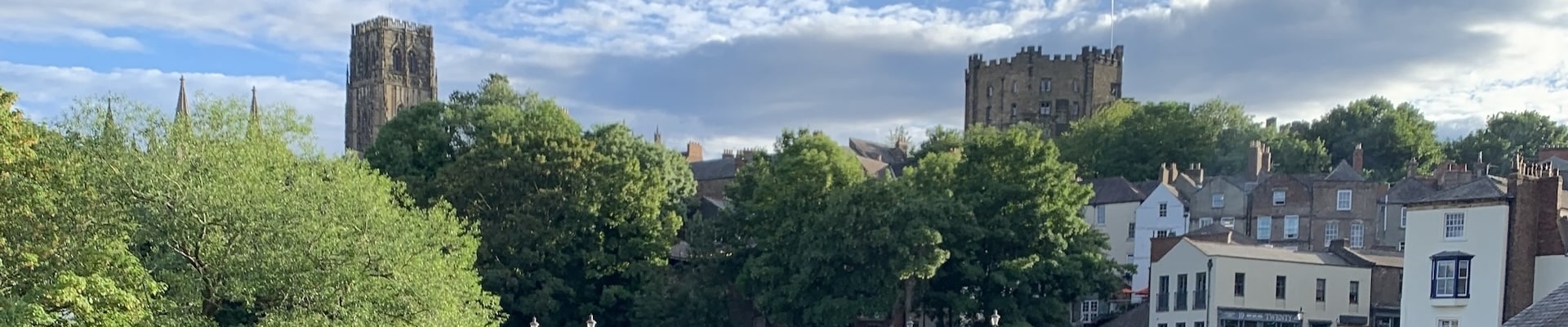
 Moni Islam joined ASOR on April 29 as the new Office Coordinator. He has a Master’s of Arts in Archaeology from Durham University in the United Kingdom, as well as a Bachelor’s of Arts in Anthropology and Global Affairs from George Mason University in Fairfax, Virginia. He has been familiar with ASOR for many years, including having won a 2021 ASOR Summer Stipend Award to work remotely on the Jezreel Expedition Publication Project where he helped organize the project’s open database, conduct research on a Palestinian village, and compile relevant photos and resources.
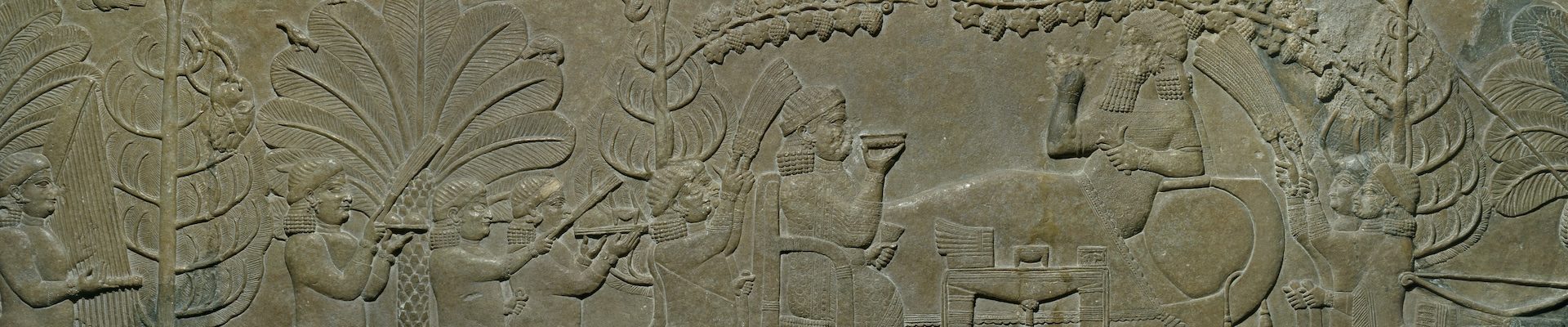

 We are all sensing people, and the basic physical structure of our sensing organs has not changed for many thousands of years. But how did ancient humans perceive and experience sensory stimuli in their environment differently than we do today? Dr. Thomason sets out to explore this topic for the ancient Mesopotamians in particular. The history of the senses and explorations of sensory experiences in the ancient world have been increasingly the focus of scholarly research. Archaeologists, art historians and textual scholars have tried to recreate past sensory environments and experiences by using evidence from images, artifacts and ancient texts of all kinds.
 In this lecture, Dr. Thomason, a specialist in ancient Mesopotamian material culture, explores how ancient Mesopotamian perceptions of sensory experiences can be compared to our own modern ones, by trying to understand the way that Mesopotamians sensed their environment and material culture and what perceptions they had of certain types of objects, such as metal bowls, wooden gates, and textiles.


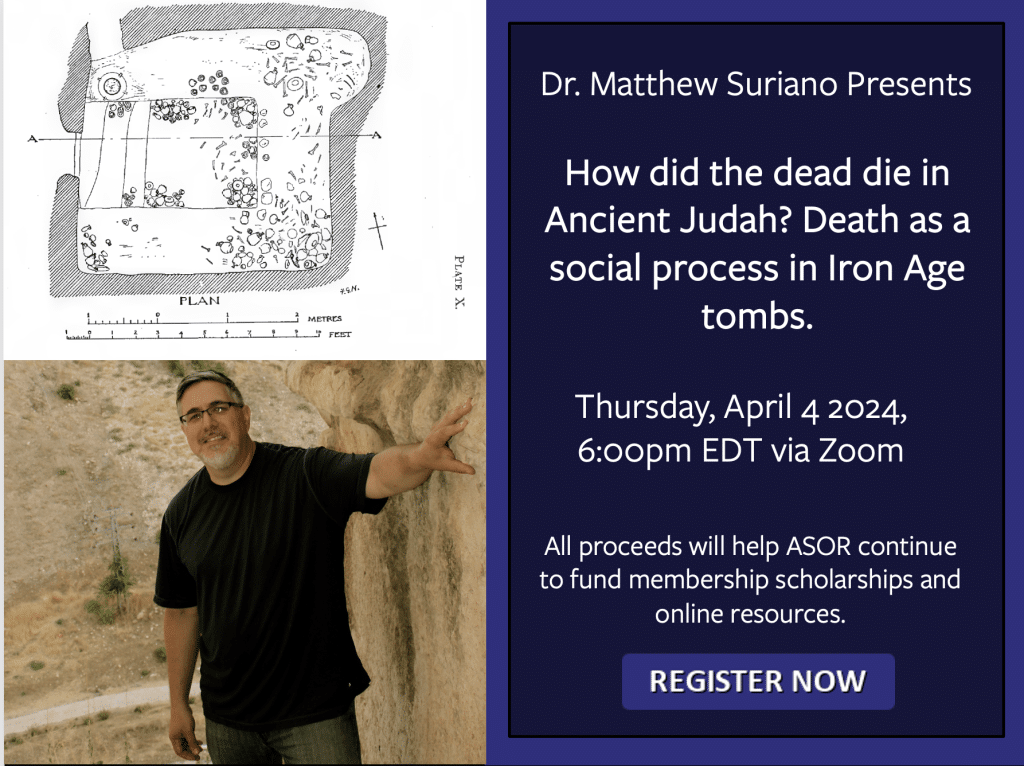
 Matthew J. Suriano is an Associate Professor in the Joseph and Rebecca Meyerhoff Center for Jewish Studies at the University of Maryland where he teaches Hebrew Bible, ancient religions, and archaeology. A former fellow at the W.F. Albright Institute of Archaeological Research in Jerusalem, Suriano has also participated in several archaeological excavations and surveys in Israel, most recently at Tel Burna. He has written extensively on death and burial in the ancient world, and his book A History of Death in the Hebrew Bible (Oxford University Press, 2018) won the American Society for Overseas Research’s Frank Moore Cross Award. His research interests also involve Jerusalem and he is currently studying the monolithic tombs in Silwan.

 Dr. Darren P. Ashby joined ASOR as ASOR CHI’s Programs Manager on March 1. He previously worked at ASOR from 2017 to 2019 where he reported on threats and damage to cultural heritage and led a project to document the current condition of Jewish cultural heritage in Iraq and Syria. In his new role, Darren will work with CHI leadership to support ongoing projects, strengthen relationships between ASOR’s members and partners, and further develop ASOR’s abilities to protect, preserve, and promote the rich cultural heritage of Southwest Asia and North Africa in collaboration with local communities, heritage professionals, and civil society organizations.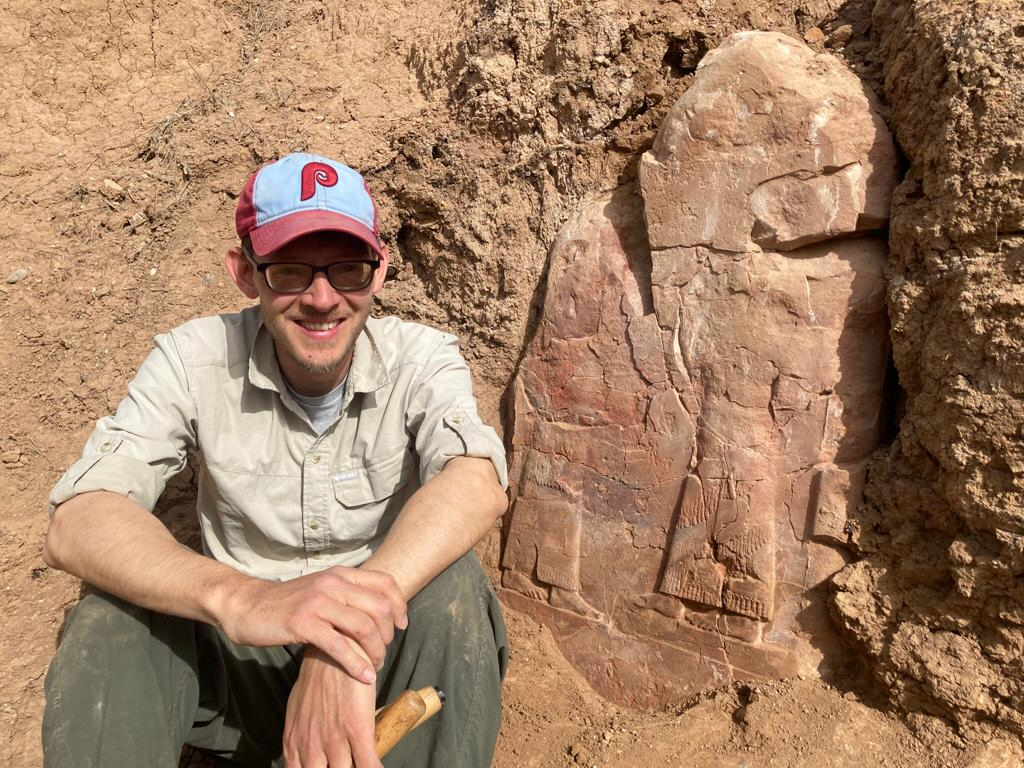
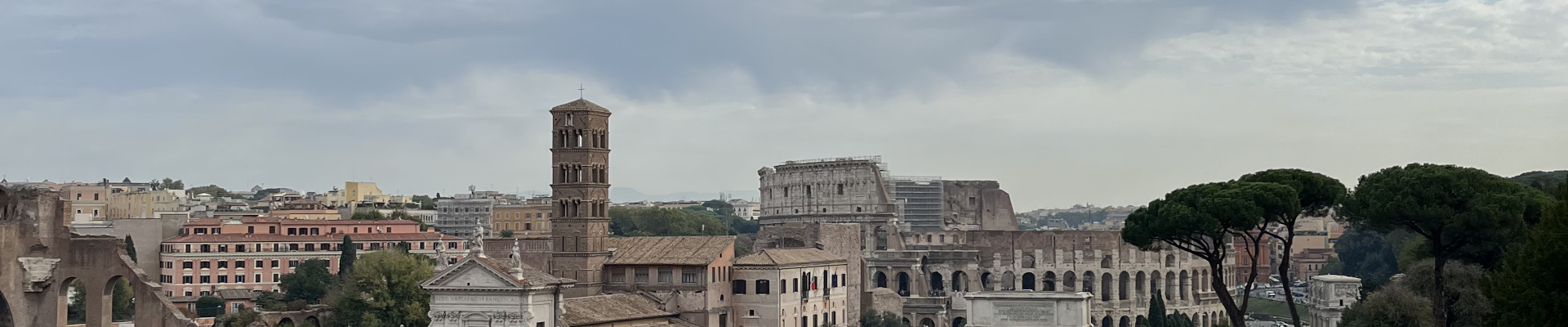
 Regan Baker graduated from The George Washington University with a Bachelor’s of Art in Archaeology in May 2023. As an archaeology student, Regan quickly became familiar with ASOR, and she is excited to be coming on as the Office Coordinator. Previously, she interned at the Colosseum while studying abroad in Rome, Italy during the Fall 2022 semester. There, she worked in collections storage under the guidance of a supervising archaeologist and assisted with a project on marble pieces from the Imperial Box.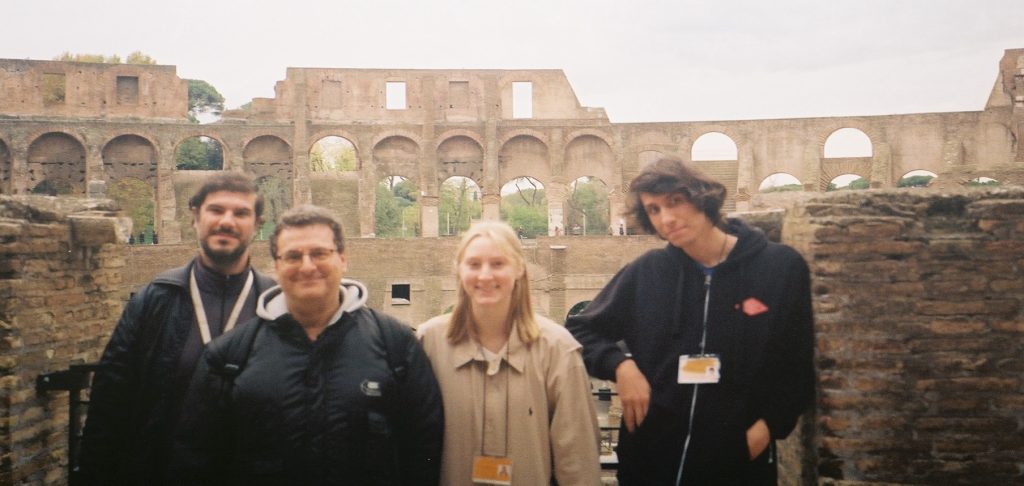

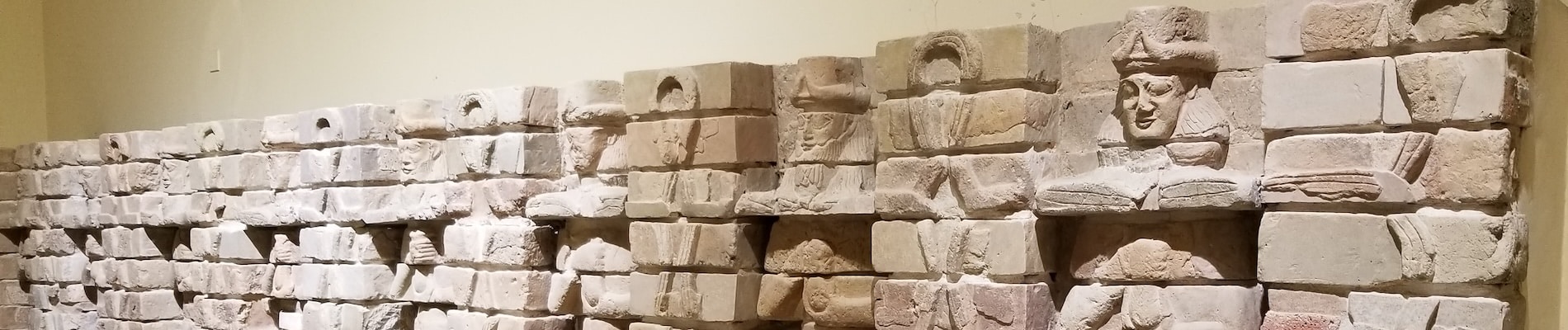
 For the people of Mesopotamia, the past was a source of knowledge and inspiration. Their reverence, both in terms of preserving early buildings and monuments and reviving images and ancient writing styles, is evident in archaeological and textual records. While Mesopotamian monuments and images were produced as historical works, inscribed with texts that marked them clearly and linked them to specific events and times, their efficacy was understood to be unlimited. Dated to the reign of king Nazi-Maruttash (ca. 1307–1282 BCE), the stele of the Goddess Lama, currently in the collections of the Metropolitan Museum, offers an excellent opportunity to explore Mesopotamian interaction with the past during the Kassite period (ca. 1574–1157 BCE). Through visual and textual analysis, this talk examines the survival of Lama imagery in this period. It reflects on the religious/political significance of the stele’s production within a broader context. The aim is to demonstrate that the crudely carved and seemingly unimaginative reuse of an earlier protective goddess figure was a deliberately archaizing image and an inspired citation of the past.
 Helen Malko is the Associate Director of the Stanford Humanities Center, where she oversees various academic programs in the humanities and interpretive social sciences. Before joining Stanford, she worked at the American Center of Research (ACOR) and Columbia University Global Center in Amman, Jordan. Helen holds a Ph.D. in Anthropology and Archaeology from Stony Brook University and a BA from Baghdad University, and she is trained in cultural heritage and preservation studies. She has been awarded multiple fellowships at the Metropolitan Museum and Columbia University in New York and has conducted fieldwork and capacity-building projects in Iraq, Jordan, and Turkey.


 Pp. 4–13: “Religion(s) in Seals: Old and New Challenges,” by Fabio Porzia
 Pp. 14-19: “Mastering the Seven-Headed Serpent: A Stamp Seal from Hazor Provides a Missing Link between Cuneiform and Biblical Mythology,” by Christoph Uehlinger
 Pp. 20-25: “Stamp Seals as Jewelry: Identifying Body Ornaments through Seal Impressions,” by Noa Ranzer
 Pp. 26-31: “Making a Good Impression: A Typology of Mounted Seal Impressions in the Middle Bronze Age Southern Levant,” by Tatjana Beuthe
 Pp. 32-40: “‘Male until Proven Otherwise?’: Searching for Women with the Help of Inscribed Stamp Seals from Jerusalem,” by Bruno Biermann
 Pp. 42-52: “Scratching the Surface of Middle Bronze Age Scarabs: Investigating Enigmatic Marks on Stamp Seals from Lachish and Megiddo,” by Nadia Ben-Marzouk and Ben Greet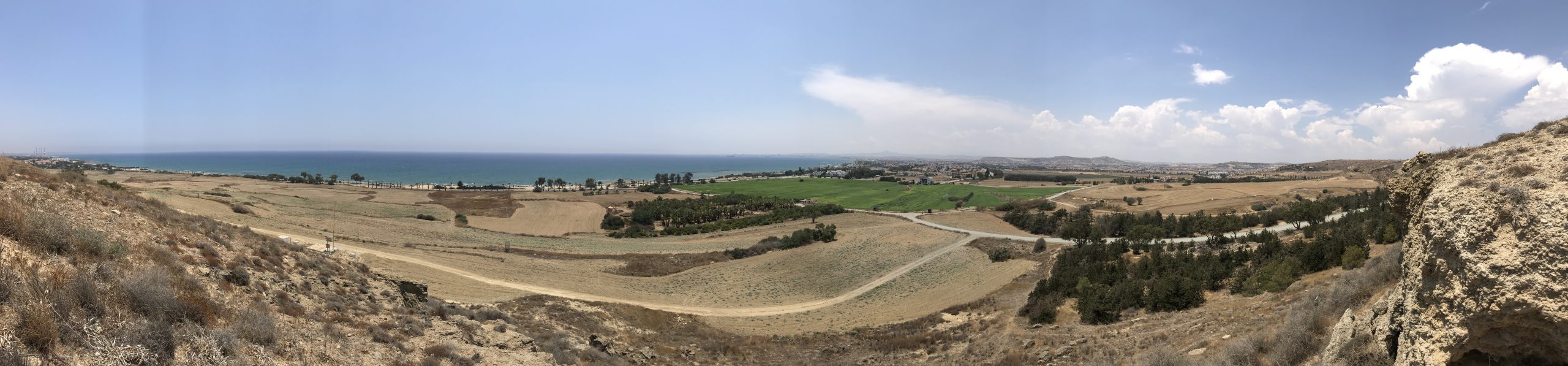
 For the last two decades, the Pyla-Koutsopetria Archaeological Project has explored the coastal region of Pyla village. Located 10 km east of Larnaka and immediately below the famous Late Bronze Age site atop the Kokkinokremos coastal ridge, Koutsopetria featured a now-infilled embayment which likely served as a harbor in antiquity. The location of the site near an ancient harbor and astride the major road running between the ancient cities of Kition and Salamis likely led to the fortification of the prominent coastal height of Vigla in the Hellenistic period. This site likely served as strategic outpost for mercenaries during the tumultuous period after Alexander the Great’s death when his successors battled for control over the island and the Mediterranean littoral. The forces occupying the fort appear to have abandoned it within a generation of its construction leaving behind a fascinating window into the tumultuous life of this strategic site.
 During the Roman and Late Roman periods, a prosperous town developed in the coastal zone. Excavations in the 1990s by the Department of Antiquities revealed parts of an Early Christian basilica and the intensive survey carried out by our team showed that the site had trade connections across the Mediterranean. The rise and decline of the Roman period settlement at Koutsopetria was less abrupt than that of its Hellenistic predecessor on Vigla, but our work at Koutsopetria similarly offers a window into an era of significant change on the island. Our excavations and survey at Koutsopetria have revealed that the church and surrounding settlement likely experienced a gradual abandonment over the course of the 7th and 8th centuries. This suggests that the site did not succumb to a catastrophic end at the hands of Arab raiders, but declined gradually perhaps as a result of the changing economic and political landscape of the region.
 R. Scott Moore is Distinguished University Professor of History at Indiana University of Pennsylvania.
 William Caraher is Associate Professor and teaches in the Department of History and American Indian Studies at the University of North Dakota.

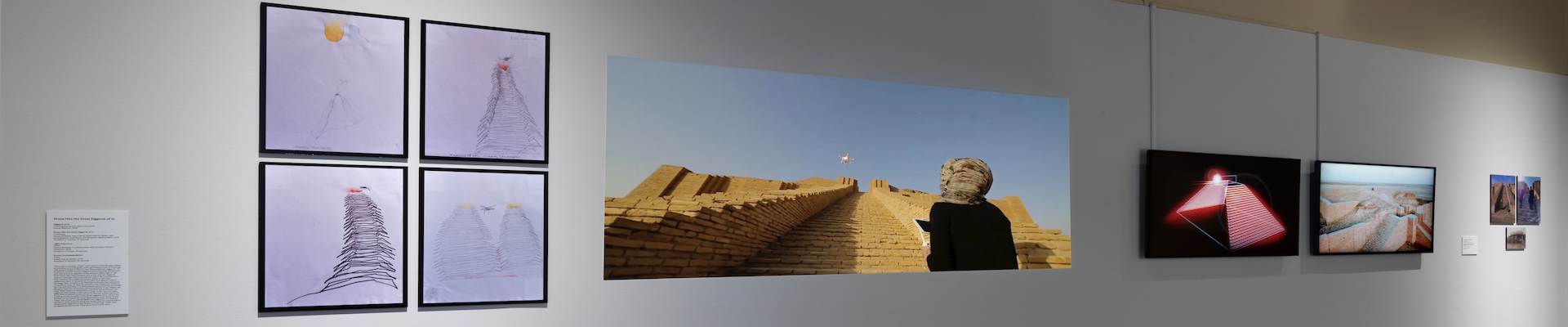
 Curating an exhibition of contemporary art comes with the incredible opportunity of collaborating with living artists to realize together how to give voice and vision to their work. Doing so in the space of an archaeological museum brings with it the added opportunity to revisit and reevaluate traditional object narratives and museological methods. For centuries Western cultural institutions and museum exhibitions have advanced historical narratives of ancient West Asia with a singular, authoritative voice, predominantly disconnected from the present. Contemporary installations have the power to forefront and celebrate the complexity and continuity of this rich cultural heritage, presenting postcolonial perspectives and thought-provoking artistic responses that draw on diverse lived experiences, memories, and imagination.
 In this webinar, Kiersten Neumann will discuss powerful examples of the pairing of contemporary art and archaeological objects from her own experience as an art historian, archaeologist, and curator, demonstrating some of the ways in which such contemporary interventions, including those by local and diaspora artists and communities, can bring a uniquely humanizing perspective to this history.