Safia S. Boutaleb, 2022 Eric & Carol Meyers Scholarship for Fieldwork Participation
I’d like to preface my report by saying that this trip was possible thanks to Dr. Eric and Dr. Carol Meyers, whose generous scholarship allows graduate students, like myself, to visit Cyprus and not only gain experience excavating but also form new, valuable connections. Thank you!
Tent on the roof of the old Peltenburg Archaeological Centre in Lemba
This report briefly describes my time in the 2022 field school led by Dr. Lindy Crewe at Kissonerga-Skalia (KS), a Bronze Age site in the Paphos region of Cyprus, dating from at least the Philia Phase (~2400 BCE) to the early Late Cypriot period (~1600 BCE). My experience in the field school was overwhelmingly positive and truly one of a kind. It complimented my previous field school experience in 2019 at Kalavasos-Ayios Dhimitrios, which sparked my love of Cypriot archaeology and the Bronze Age. I was admittedly anxious at first about my participation at Skalia due to some sudden and unexpected accommodation changes for the field school participants.
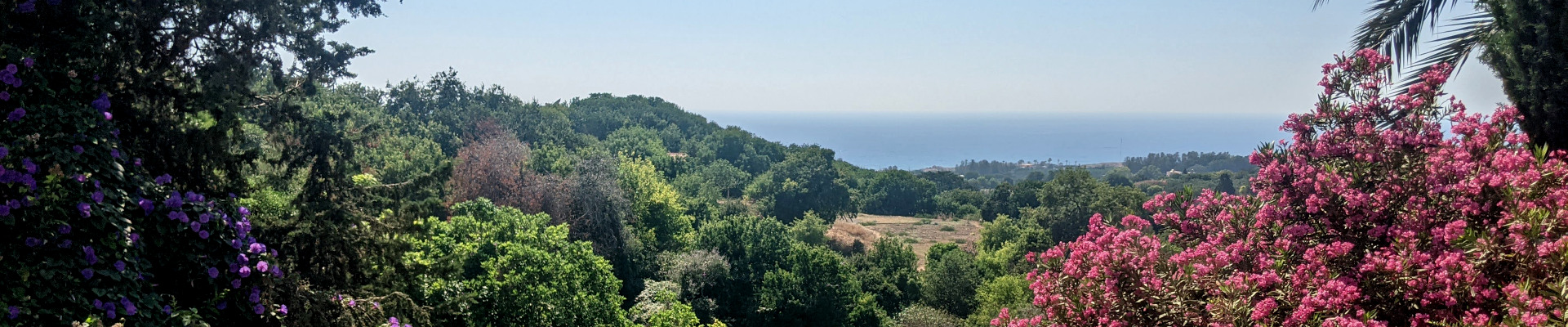
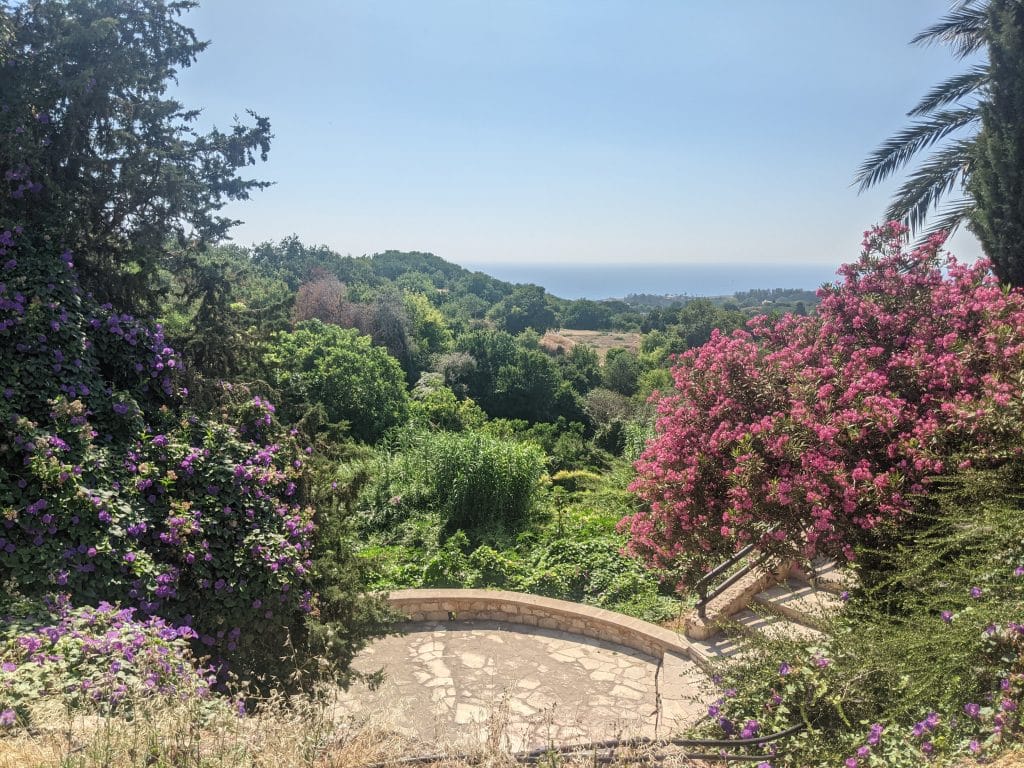
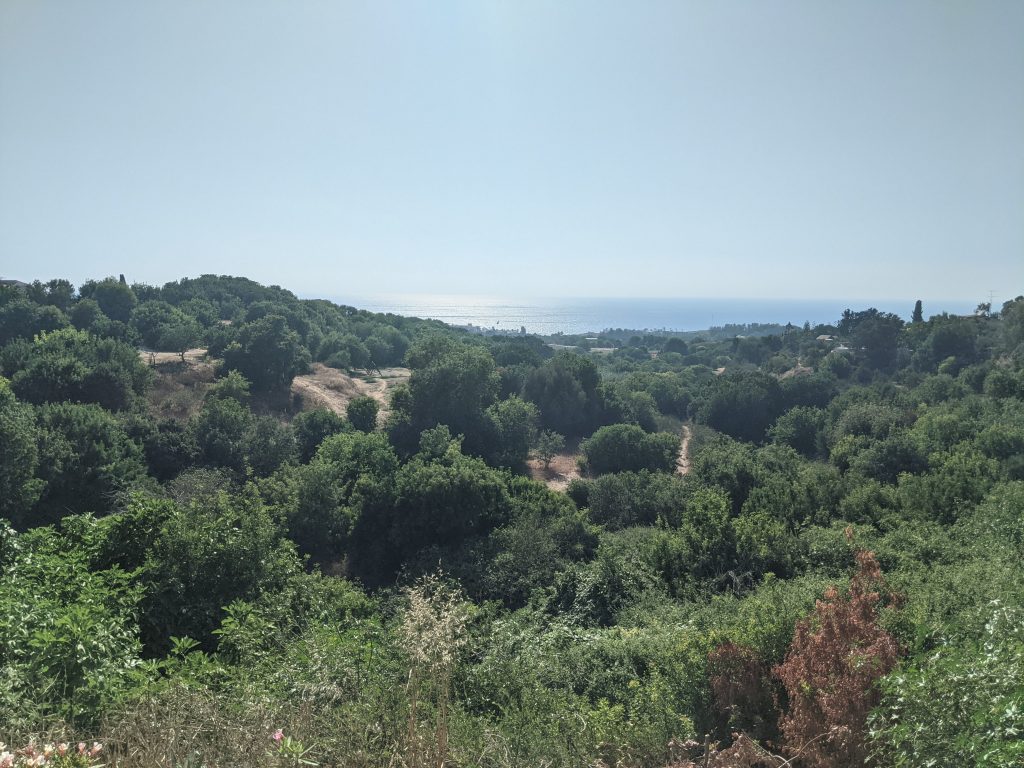
The new accommodations involved camping out in a tent on the roof of the old Peltenburg Archaeological Centre in Lemba for the month. However, after about one week in Lemba, I had adapted to my (very humid) surroundings and realized that the house in Lemba afforded us more independence and the opportunity to become better acquainted with Paul Croft, who resides at and cares for the Lemba centre. The house was beautiful and a place where generations of archaeologists have worked and stayed, making me feel like I had participated in some kind of tradition or initiation into the world of Cypriot archaeology. Moreover, the village of Lemba is an old, picturesque place in the hills overlooking the Mediterranean Sea and boasting thousands of years of human occupation (i.e., not a bad place to call home).
View of sea from Lemba
I was also grateful for the experience of excavating with Crewe and her team at Skalia. Crewe has assembled an eclectic group of supportive and intelligent archaeologists from all kinds of different backgrounds. Some of the supervisors and participants work in academia, others in commercial archaeology and some of them earn a living in entirely different fields. Regardless of their backgrounds, their expertise and experience at the site was invaluable and I greatly appreciated the diversity of their career paths, which can be rare in academic circles.
My own research and responsibilities at the site focused on the faunal remains at Skalia, an experience which I found to be both challenging and rewarding. My own familiarity with animal (and human) anatomy was unpractised, so I benefitted intensely from Croft’s sample collection of bones, which he allowed me to handle whenever necessary. Recognizing gaps in my anatomical knowledge, I did my best to support my team by cleaning and recording the bones, rather than making futile attempts to identify them myself. When errors were made in our records, I took initiative to stay behind and correct the mistake, a process which took two and a half days of work.
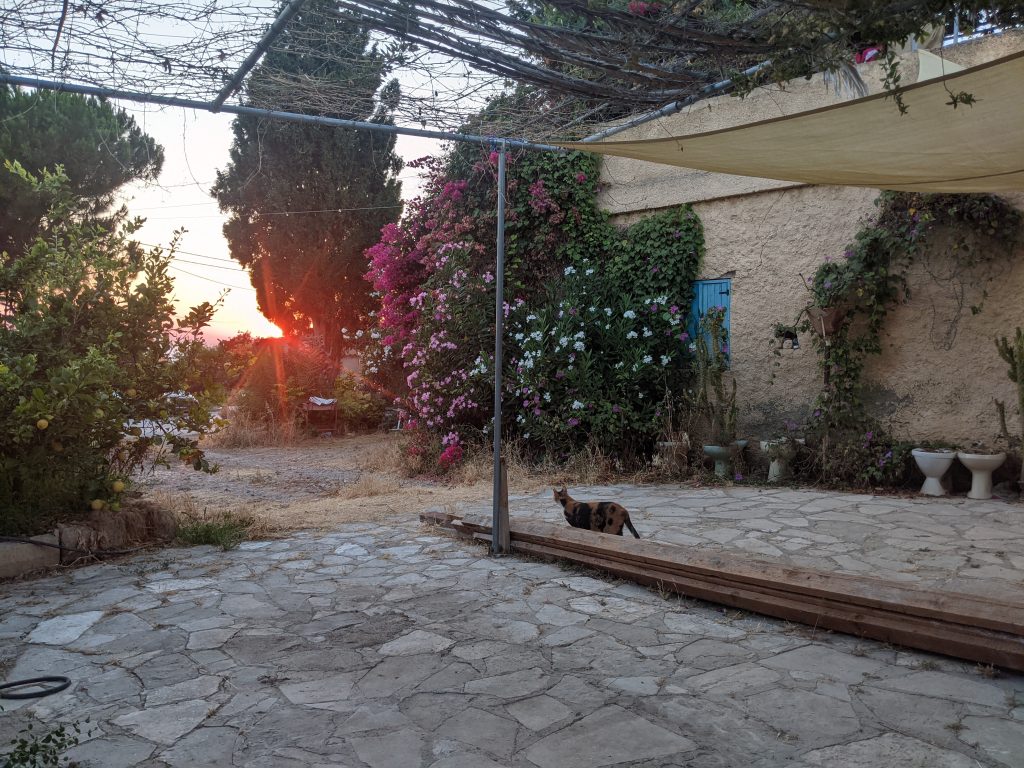
Lemba Sunset
View of sea from Lemba
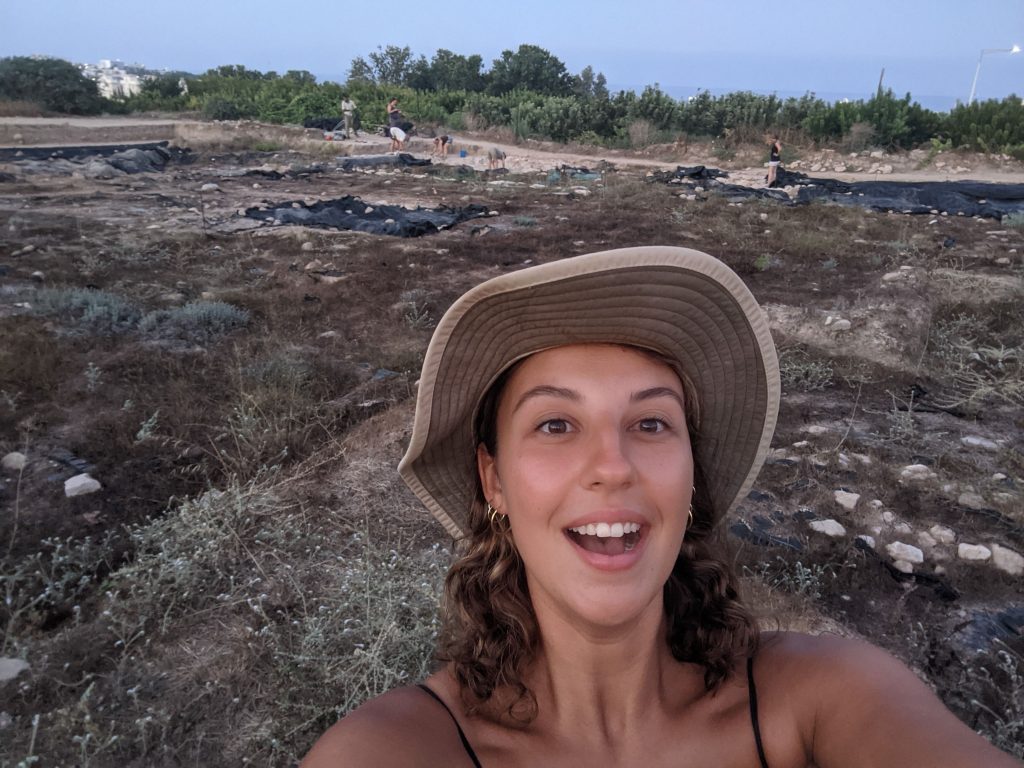
Safia excavating in the field
My honest pride and joy for the season was my work on the floor of Area P/B. I genuinely love field work and I was overjoyed to have found the floor, as I recognize its significance in understanding the basic layout and stratigraphic occupation of a space. Thanks to my cautious work, Muti assigned me responsibility over the floor for about two weeks. A number of my peers came and joined me but none seemed to enjoy it as much as I did. It seems trivial to take such pride in excavating a floor but I remembered how challenging it was to find at Kalavasos-Ayios Dhimitrios and the experience of being able to differentiate tamped earth from mud plaster floor provided me with a skill that I had not anticipated I’d acquire this season. I also felt supported and recognized for my efforts, as the team awarded me the “golden trowel”, one of the many superlative awards given at the end of the field season.
Safia's last day in field!
I would relish the opportunity to return to Kissonerga-Skalia and I am grateful for the experience of meeting and excavating with such an incredible team of professional archaeologists, who taught me not only how to excavate but also showed me that there is more than one path to becoming an archaeologist and that, when in doubt, it is possible to pave your own.
Safia Boutaleb (she/her) is a graduate student completing her Masters of Classical Archaeology at The University of British Columbia in Vancouver, Canada. Her thesis focuses on women’s economic participation in Cyprus during the Late Bronze Age and the many ways their activities in daily life remain overlooked in scholarship of ancient economy. Kissonerga-Skalia 2022 was her second field school in Cyprus she has hopes to return to the island each year to research and participate in field work.
Want to help more students and early career archaeologists get into the field? Donate to the cause today by selecting “Student Support” as your gift purpose!
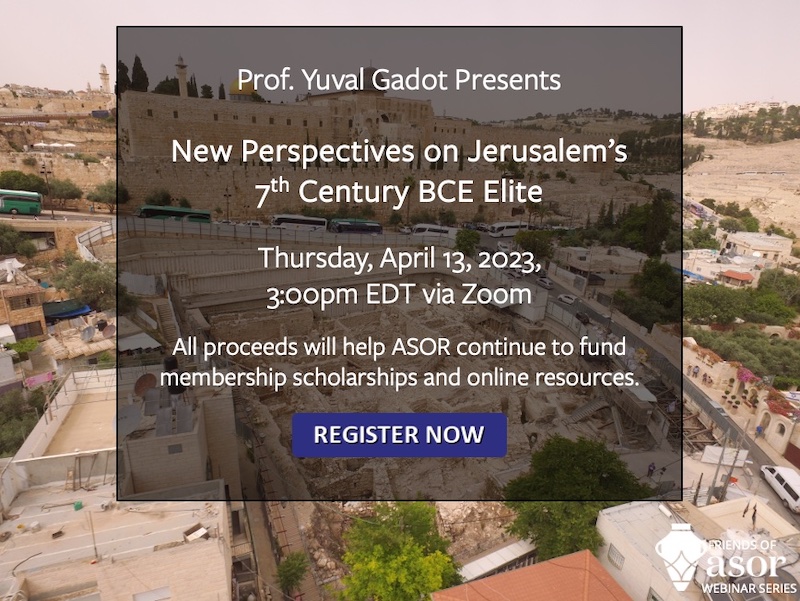
New Perspectives on Jerusalem’s 7th Century BCE Elite
Photo credit: Assaf Perets
Friends of ASOR present the next webinar in our monthly series on April 13, 2023, at 3:00 pm EDT, featuring Prof. Yuval Gadot and moderated by Prof. Thomas Levy. Jerusalem is one of the most excavated places in the world and yet, some very basic questions regarding the city’s size and location are still being debated. Recent finds from the western slope of the southeastern ridge (known also as “the City of David”) shed new and tantalizing light on the city’s development during the 11th-9th centuries BCE, on the wealth of Jerusalem’s elite during the 7th century BCE, and on the city’s destruction and revival during the 6th and 5th centuries BCE.
Photo Credit: Sasha Flit
The lecture will focus on 7th century BCE as it will present the results of recent excavations of an elite associated building (Building 100) that was destroyed by the Babylonians in 586 BCE. The analysis of the plethora of artifacts found inside the building, such as ivory panels, wooden artifacts, and storage jars used for holding flavored wine, exposes the intimate details of the lives of Jerusalem’s elite—their habits and their worldview as they operated within an empyreal network.
Join Prof. Gadot as he discusses his new research in telling the story of one of the world’s most fascinating cities. The webinar will conclude with a Q&A session moderated by Prof. Thomas Levy (University of California, San Diego).
Photo Credit: Sasha Flit
Prof. Yuval Gadot heads the Sonia & Marco Nadler Institute of Archaeology at Tel-Aviv University. He is also lead archaeologist at the “City of David” excavations project in Jerusalem where he co-directs the “Givati Parking Lot” excavations and leads an environmental study of the rural landscape surrounding the city. He obtained his PhD in 2004 from Tel-Aviv University. Between 2004 and 2008, Gadot was a research fellow at the Nelson Glick School of Bible and Archeology at Hebrew Union College (Jerusalem). Between 2005 and 2010, Yuval served as a Field Director for the Institute’s excavations at the Ramat Rachel site (led by Prof. Oded Lipschits and Prof. Manfred Oming). These excavations were published in a large number of publications and final reports. At the same time, he partnered with Prof. Israel Finkelstein and Prof. Steve Weiner in the project “Ancient Israel through the lens of natural and exact sciences,” where he was exposed to the many possibilities that exist in combining science and archaeology.
Since 2018, Gadot has served as the Head of the Department of Archaeology and Ancient Near Eastern Cultures at Tel-Aviv University. He has authored seven archaeological books and over one hundred scientific articles.
This webinar will be recorded and all paid registrants will be sent a link to view the recording.
To receive your ASOR member discount, log into the online store. If you are new to ASOR, please click on the “New Visitor Registration” link to register your e-mail address and choose a password for our online store. Once logged in, navigate to “Meeting and Event Registration” to register for the webinar and pay the fee. Each paid registrant will receive a confirmation e-mail when you pay for the webinar. If you do not receive this e-mail, then you are not registered. Please e-mail membership@asor.org with any questions or issues with registering.
You will be e-mailed the Zoom Webinar link in the week prior to the lecture on April 13, 2023. If you do not receive the link by the close of business two days before the webinar, please e-mail membership@asor.org immediately. This webinar will be recorded and all paid registrants will be sent a link to view the recording.
All proceeds from this webinar are used to fund scholarships for members as well as increasing ASOR’s online resources, which are free to the public.
READY FOR A WEBINAR SEASON PASS?
Buy a season pass for all the webinars* of the 2022-2023 FOA Webinar Season! 1) You will automatically receive the Zoom link for each webinar so no need to register each time. 2) You will also receive the recording of each webinar automatically after the event.
If you have missed webinars earlier in the season and still want to buy the pass, you will receive the links to the recordings of the webinars you missed in your automatic confirmation email after you buy the pass.
*Special symposiums may be excluded from the season pass price.
No more registering for a year if you buy your pass today!
Pricing:
Members: $75.00 Non-Members: $150.00 ASOR Sustaining Members: $0 (automatic registration for each webinar) Not a member yet? Click here to join as a member and receive the 50% off a season pass!
Log into our online store to purchase the season pass for 2022-2023. If you are new to ASOR and do not have a record in our store yet, click here to register. After you login, navigate to the left to “Meeting and Event Registration.” Please e-mail membership@asor.org if you have any questions or issues.
WHY SPONSOR A WEBINAR?
Several levels of support from $50-$1,000 are available. Proceeds go towards membership scholarships and towards increasing ASOR’s virtual resources. Each sponsorship is tax-deductible and you can give your friends free registrations to a webinar!
Bronze Level ($50): up to 2 guest registrations Silver Level ($100): up to 5 guest registrations Gold Level ($500): up to 20 guest registrations Platinum Level ($1,000): up to 50 guest registrations
After you sign up for a sponsorship online or over the phone, email the names and email addresses of your guests to Felice Herman at membership@asor.org, who will send your guests a confirmation and the Zoom link before the webinar.
WANT TO SAVE $6.00 ON THE NEXT WEBINAR?
Join ASOR as a member! Click here for more details about discounts for events and other benefits of membership. Memberships start at $40 for the year as an Associate Member.
You can now purchase the link to the recording of any webinar. You can also purchase the bundle packages of all webinars from the 2020-2022 seasons. Please e-mail membership@asor.org for purchase details.
To see a printable pdf of the webinar titles from the 2020-2021 season, please click here. To see a printable pdf of the webinar titles from the 2021-2022 season, please click here.
Where Are They Now?: A Preview of 2022 ASOR-Affiliated Fieldwork Projects Michael Given (University of Glasgow), Xenia-Paula Kyriakou (Florida Gulf Coast University), Stephen Batiuk (University of Toronto), Monique Roddy (Walla Walla University), Kent Bramlett (La Sierra University), Friedbert Ninow (La Sierra University), and Michael Hoff (University of Nebraska-Lincoln) | March 8, 2022
Tel Rehov: A Major Bronze and Iron Age City in the Jordan Valley Amihai Mazar (Hebrew University of Jerusalem), Nava Panitz-Cohen ( Hebrew University of Jerusalem), Nota Kourou (Athens University), Naama Yahalom-Mack (Hebrew University of Jerusalem), Robert Mullins (Azusa Pacific University) | February 10, 2022
Archaeogaming: Why Video Games Deserve Their Own Archaeology Tine Rassalle (University of North Carolina at Chapel Hill), Shannon Martino (Morton College), Matthew Winter (University of Arizona), Michael Zimmerman (Rhode Island) | April 18, 2021
Please e-mail the Membership office if you have any questions.
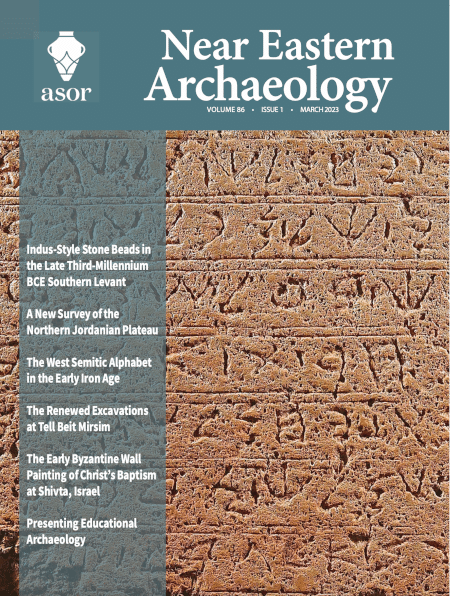
Pp. 4-15: “Indus-Style Stone Beads in the Late Third-Millennium BCE Southern Levant: The Role of Trade and Curation in the Distribution of High-Value Ornaments,” by Geoffrey E. Ludvik
This article discusses how identification of stylistic, morphometric, mineralogical, and technological characteristics of carnelian stone beads can provide major insights into EB IV/MB I interregional networks and social differentiation. Based on unique drilling techniques, stylistic shapes, morphometric proportions, and mineralogical characteristics, fifty-four carnelian beads found in Israel/Palestine have been identified as crafted in a manner ultimately diagnostic of the Indus tradition of modern Pakistan and western India. Fifty Indus-style beads in the EB IV/MB I probably reflect increased socio-cultural links to the northern Levant and Mesopotamia during this period, while four beads from later contexts represent long-term curation of valuable ornaments.
ASOR Members with online access: log into ASOR’s Online Portal here. Once logged in, click the JOURNALS tab in the top navigation bar. From here you may select which journal you would like to read. If you have online access, you will see your selected journal’s current issue Table of Contents. Click on the “Current Issue” button and you will then be redirected to the University of Chicago Press’s (UCP) platform to immediately start reading any issue of your choice. Tutorials for how to log in to the Online Portal as well as how to navigate to the Portal Journals page can be found here.
Pp. 16-27: “Tell It Like It Is: Discoveries from a New Survey of the Northern Jordanian Plateau,” by Marta Lorenzon, Antti Lahelma, Maher Tarboush, Elisabeth Holmqvist, Dries Daems, Saimi Kautonen, Joanna Töyräänvuori, Stefan L. Smith, Benjamín Cutillas-Victoria, Maija Holappa, Hussein Al-Sababha, and Ahmed Al-Shorman
This article presents the results of a joint Finnish-Jordanian survey project that focuses on investigating the interrelations of the imperial heartlands and the Levantine region in the Late Bronze and Iron Ages. We used historical satellite images to identify potential sites on the northern Jordanian plateau, after which they were systematically investigated by archaeological survey. Of the sites discovered, the fortified site of Tell al-Assara stands out owing to its prominent location, as indicated by a visibility analysis, and its massive enceinte wall made of ashlars. One of the pottery sherds found at the site bears an inscription in Aramaic. Although Tell al-Assara is remarkably well preserved, many of the sites discovered were already badly damaged by looting and urban development. These alarming developments can only be countered by closely involving local communities in fieldwork projects working in the region.
ASOR Members with online access: log into ASOR’s Online Portal here. Once logged in, click the JOURNALS tab in the top navigation bar. From here you may select which journal you would like to read. If you have online access, you will see your selected journal’s current issue Table of Contents. Click on the “Current Issue” button and you will then be redirected to the University of Chicago Press’s (UCP) platform to immediately start reading any issue of your choice. Tutorials for how to log in to the Online Portal as well as how to navigate to the Portal Journals page can be found here.
Pp. 28-45: “The West Semitic Alphabet in the Early Iron Age: A New Hypothesis,” by Benjamin Sass and Israel Finkelstein
In the hypothesis presented by the authors, stratified, nonmonumental inscriptions and their radiometric datings take center stage for the first time. It is in the living script of these texts rather than in the artificial alphabet of monuments that the evolution of the alphabet in Iron IIA can be studied properly. A key take-home lesson of the work is the significant ninth-century transformations of the alphabet from precursive Proto-Canaanite to supraregional cursive, thence to the well-known regional variants. Under the Omrides, the alphabet in Israel is attested minimally. No Omride texts were recognized at Samaria, nor Baashide texts at Tirzah. The newly founded West Semitic kingdoms since ca. 900 BCE will have constituted the cradle of the cursive, while papyrus or parchment and ink were the cursive’s likeliest vehicle. Alphabetic inscriptions on monuments, including Byblos, all cursive-inspired, will only have emerged in the last third of the ninth century.
ASOR Members with online access: log into ASOR’s Online Portal here. Once logged in, click the JOURNALS tab in the top navigation bar. From here you may select which journal you would like to read. If you have online access, you will see your selected journal’s current issue Table of Contents. Click on the “Current Issue” button and you will then be redirected to the University of Chicago Press’s (UCP) platform to immediately start reading any issue of your choice. Tutorials for how to log in to the Online Portal as well as how to navigate to the Portal Journals page can be found here.
Pp. 46-57: “In the Footsteps of Albright: The Renewed Excavations at Tell Beit Mirsim,” by Igor Kreimerman, Itamar Weissbein, Pnina Torn Broers, and Ofer Naveh
Tell Beit Mirsim in the Judean Shephelah was excavated by William F. Albright and Melvin G. Kyle in the 1920s and 1930s. These excavations established the relative chronology for the entire southern Levant because of good preservation conditions, facilitated by the multiple destruction layers at the site, and thanks to Albright’s familiarity with pottery. Ninety years later, the excavations have been renewed with the aim of investigating the economy and social structure of the kingdom of Judah. The first season of renewed excavations by the Institute of Archaeology at the Hebrew University of Jerusalem has unearthed the remains of Iron Age IIB domestic structures, one of which belongs to the four-room-house type, and an olive oil press. The excellent preservation of the remains enables the reconstruction of activity areas and suggests that Tell Beit Mirsim could be the perfect lab for exploring the economy of the kingdom of Judah.
ASOR Members with online access: log into ASOR’s Online Portal here. Once logged in, click the JOURNALS tab in the top navigation bar. From here you may select which journal you would like to read. If you have online access, you will see your selected journal’s current issue Table of Contents. Click on the “Current Issue” button and you will then be redirected to the University of Chicago Press’s (UCP) platform to immediately start reading any issue of your choice. Tutorials for how to log in to the Online Portal as well as how to navigate to the Portal Journals page can be found here.
Pp. 58-63: “In Situ Implementation of Imaging Techniques Reveals Key Motifs in the Early Byzantine Wall Painting of Christ’s Baptism at Shivta, Israel,” by Ravit Linn, Emma Maayan-Fanar, and Yotam Tepper
Following the rediscovery of the Early Byzantine wall painting of Christ’s baptism in the northern church of Shivta in southern Israel, the painting was investigated with different imaging techniques in order to clarify the scene and to find additional painted motifs and hidden colors and patterns. Besides high-quality photography from close distance on a scaffolding at 3.5 m height, thus at the level of the painting, Near IR photography (NIR), UV wavelengths microscopy, and Visible Induced Luminescence (VIL) imaging were all conducted in order to collect new information on the painting. The combination of several imaging techniques provided new and surprising details on elements of the painting, especially revealing blue color around the head and shoulders of Christ, most probably reminiscent of the River Jordan where the baptism took place.
ASOR Members with online access: log into ASOR’s Online Portal here. Once logged in, click the JOURNALS tab in the top navigation bar. From here you may select which journal you would like to read. If you have online access, you will see your selected journal’s current issue Table of Contents. Click on the “Current Issue” button and you will then be redirected to the University of Chicago Press’s (UCP) platform to immediately start reading any issue of your choice. Tutorials for how to log in to the Online Portal as well as how to navigate to the Portal Journals page can be found here.
Pp. 64-73: “The Finder, Not the Find: Presenting Educational Archaeology,” by Achia Kohn-Tavor
Educational excavation projects focus primarily on the pedagogic values embedded in the archaeological work, while archaeology per se is their secondary goal; therefore, they differ from community archaeology, which mostly incorporates education and community into archaeological projects and objectives. This article articulates this difference and then presents educational archaeology in detail, explaining how it is implemented. To illuminate educational archaeology further, two projects headed by the author are presented, encompassing school students, and domestic and international tourism. Educational archaeology encompasses a variety of benefits that are rather efficiently delivered: social and personal development of the individual, building community and a sense of belonging, and widening one’s scope of knowledge. The call to make archaeology accessible to the broad public is greatly facilitated here, and therefore educational archaeology projects should occupy a larger space among place-based, value-oriented projects.
ASOR Members with online access: log into ASOR’s Online Portal here. Once logged in, click the JOURNALS tab in the top navigation bar. From here you may select which journal you would like to read. If you have online access, you will see your selected journal’s current issue Table of Contents. Click on the “Current Issue” button and you will then be redirected to the University of Chicago Press’s (UCP) platform to immediately start reading any issue of your choice. Tutorials for how to log in to the Online Portal as well as how to navigate to the Portal Journals page can be found here.
Early Career Scholars Brown Bag on Data Management: Beyond Checkbox Compliance
[/vc_column_text][mk_divider][vc_column_text]
Join ASOR’s Early Career Scholars on March 31, 2023 at 1:00-2:00pm EDT via Zoom for a virtual Brown Bag talk and Q&A on Research Data Management for archaeological research projects, job applications, and beyond!
Archaeological field and research projects accumulate A LOT of data. Artifact data, spatial data, analytical data, the list goes on. Whether you’re working on a thesis or dissertation project, managing an excavation, or applying for a job, it is becoming increasingly crucial to plan and implement data management strategies. Academic job calls now frequently require applicants to submit a statement of data collection & management philosophy, and non-academic job opportunities can be expanded by familiarizing oneself with data management strategies. To address this need for data planning and management, ASOR ECS has invited Dr. Eric Kansa, Program Director of Open Context!
Abstract: “Research Data Management” can often seem like a dry and technocratic hassle. Few feel excited by data management plans made in compliance with the demands of grant making bureaucracies. However, if you choose, data management can mean limitless opportunities for intellectual engagement. Creating, organizing, contextualizing, and communicating information- to your current and your future colleagues and publics – are all integral to virtually every aspect of scholarship. We’ll talk about some of the opportunities for research, teaching, and public engagement afforded by data management. We’ll also discuss how demonstrated experience with data management can help open career opportunities inside and outside of the academy.
Presenter: Eric Kansa, Ph.D., is the Program Director for Open Context, a web-based open access publishing service dedicated to the preservation and accessibility of archaeology research data. Eric’s personal research interests explore research data informatics, research data policy, ethics, and professional context of the digital humanities.
The event, a part of our brown bag lunch series, is a *FREE* benefit for the ASOR community. Registrants will receive an email with Zoom access information prior to the event.
2022 Study of Collections Fellowship Report: Imprints of the Past: Preserving the Largest Known and Uncatalogued Collection of Semitic Artifacts in Europe
James D. Moore, Humboldt Universität zu Berlin
For many years, I have collaborated with the French Institute’s, Cabinet du Corpus Inscriptionum Semiticarum (Cabinet-CIS) within the Académie des Inscriptions et Belles Lettres, and in 2022 an ASOR Study of Collection Fellowship provided me startup funding to seed an ambitious attempt to build the Cabinet-CIS a digital inventory database and begin the process of cataloguing and digitally preserving one of Europe’s most important collections of Semitic artifacts. At the invitation of Christian Robin and Maria Gorea, I was able to complete the build for the collection’s database during two week-long trips to the Cabinet-CIS. This database is now used by scholars and students working on the collection.
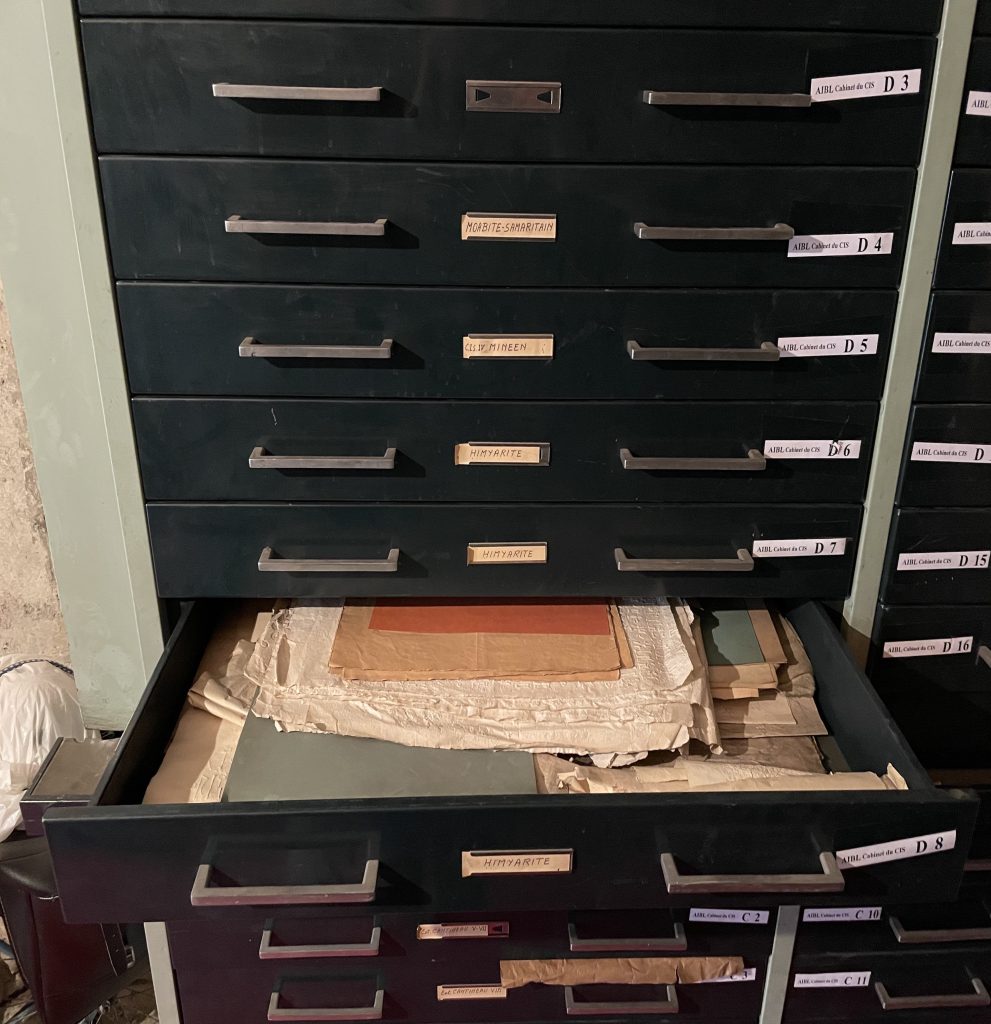
The Cabinet-CIS is known for publishing two monumental series through the late nineteenth and mid-twentieth centuries, the Corpus Inscriptionum Semiticarum and the Répertoire d’épigraphie sémitique. Those compiling these works were sent paper mâché squeezes of the inscriptions in those volumes and in some cases photographs along with detailed descriptions. The collection holds an estimated 10,000+ paper mâché squeezes of Semitic inscriptions from the Near East, North Africa, and the Mediterranean. In some cases these squeezes are of inscriptions which are now lost or inaccessible (due to their location in politically contested regions). Additionally, the collection holds hundreds of original objects and dozens of dossiers of many of the field’s most important figures, such as that of Charles Clermont-Ganneau. Unfortunately, the collection is only loosely organized into boxes and cupboards, for which a short inventory had been compiled.
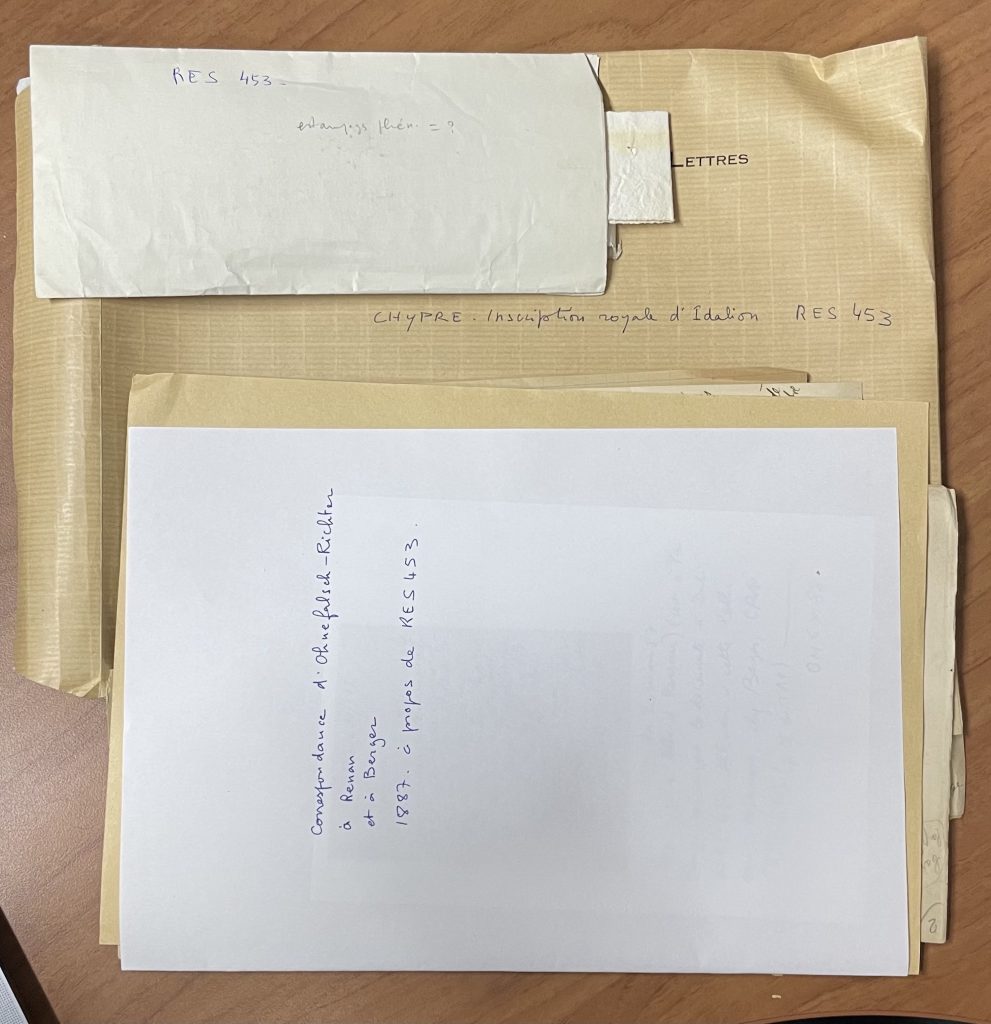
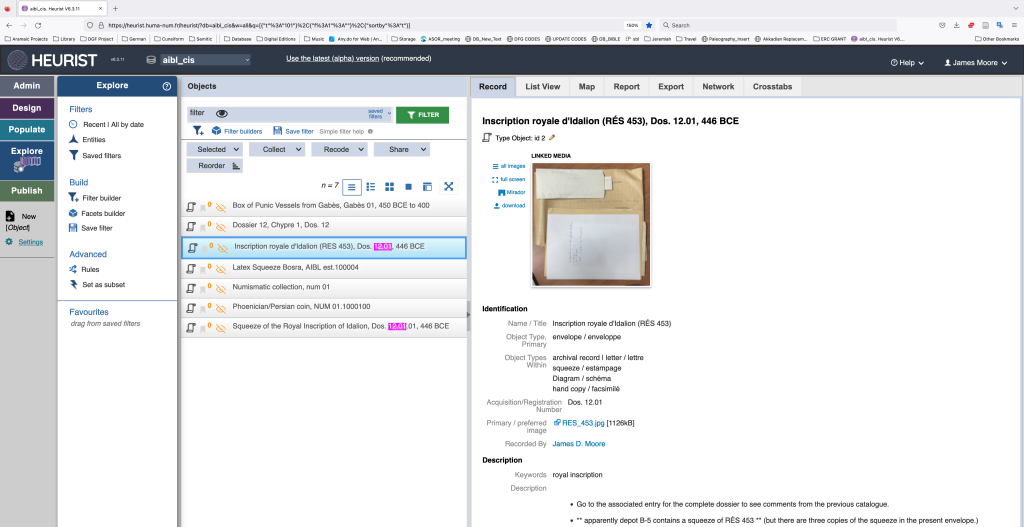
Example of archival materials with squeeze in AIBL-CIS Dossier 12, Chypre 1.
Credit: James D. Moore and Maria Gorea
Example of flat-file storage of Semitic squeezes.
Credit: James D. Moore and Maria Gorea
Although the work was hindered by continued difficulties traveling, due to residual effects of the COVID-19 pandemic, a mid-year trip to the Cabinet-CIS allowed me to assess the needs of the collection and survey its holdings. During that week I built a prototype SQL (PostgreSQL) database and local application which was tested by those working on the collection, specifically Maria Gorea’s students Noémie Carpentier and Narmin Sadykhova. Over the course of many months, I fine-tuned the prototypal database, and at the end of the year, during a second trip to the Cabinet-CIS, I rebuilt the database on the Huma-Num servers using the Heurist database management system, an Open Source information system builder and website publisher developed specifically for Humanities research data. The result is an easy to use inventory database for the Cabinet-CIS’s internal use (though the intention is to make the data accessible through a future website should continued funding be acquired). Here I must thank the Heurist team, in particular Ian Johnson and Michael Falk, for their support and advice along the way.
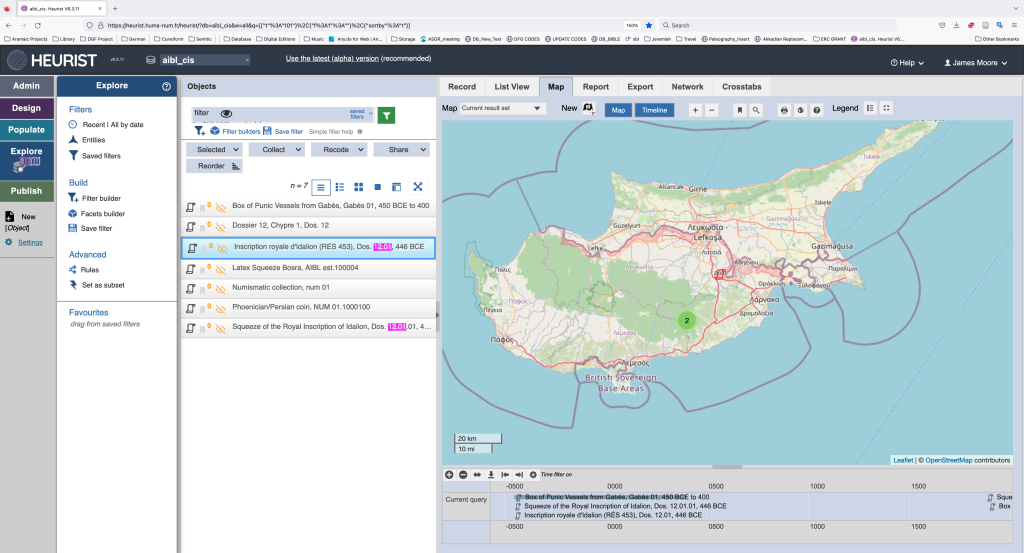
The database includes record entries where all necessary information about an object in the collection can be stored, including metadata, text, and translation. Each entry includes mapping a timeline features for the object along with additional media storage that can be linked to the object.
Example of a database entry’s “Record” for AIBL-CIS Dos. 12.01.
Example of entry’s “Map” (and timeline) for AIBL-CIS Dos. 12.01
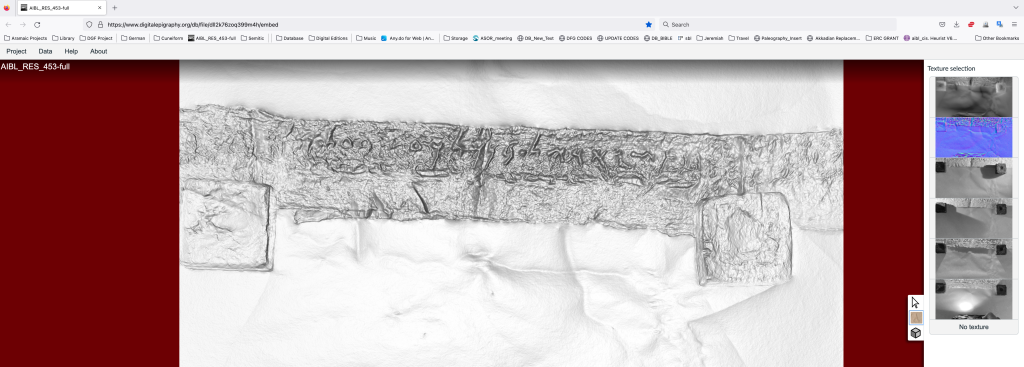
Linked media to the 3D rendering of squeeze AIBL-CIS Dos. 12.01 in the Digital Epigraphy User Interface (see below)
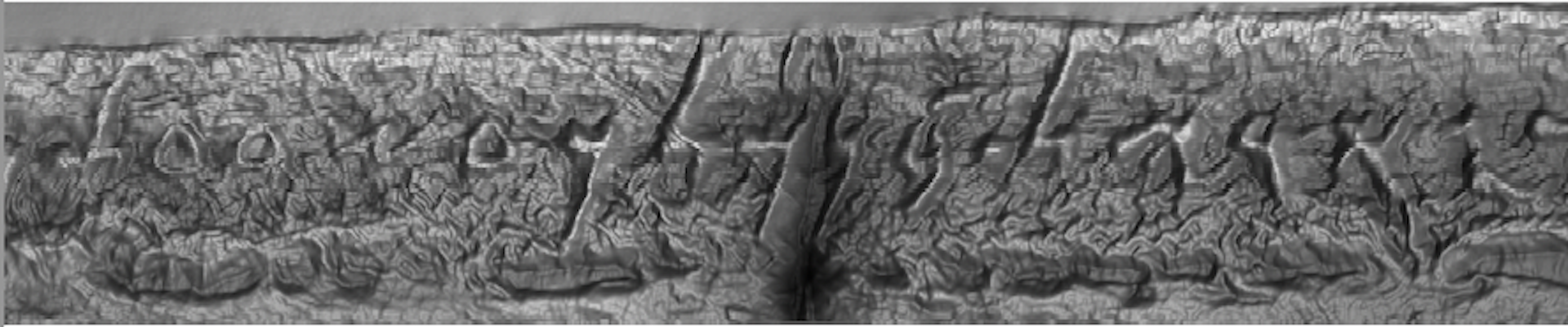
The ultimate objective was to initiate the process of digital preservation of the squeezes and other artifacts. To achieve this, I solicited the support of Angelos Barmpoutis of the Digital Worlds Institute and Eleni Bozia of the Classics Department at the University of Florida, whose Open Source Digital Epigraphy software proved to be an ideal application for our needs. By using scans from a flatbed scanner or raking light photographs one can easily render 3D scans of the squeezes. An example of AIBL-CIS Dos. 12.01.01 “Inscription royale d’Idalion” (446 BCE = RÉS 453; squeeze made in 1887) can be found here.
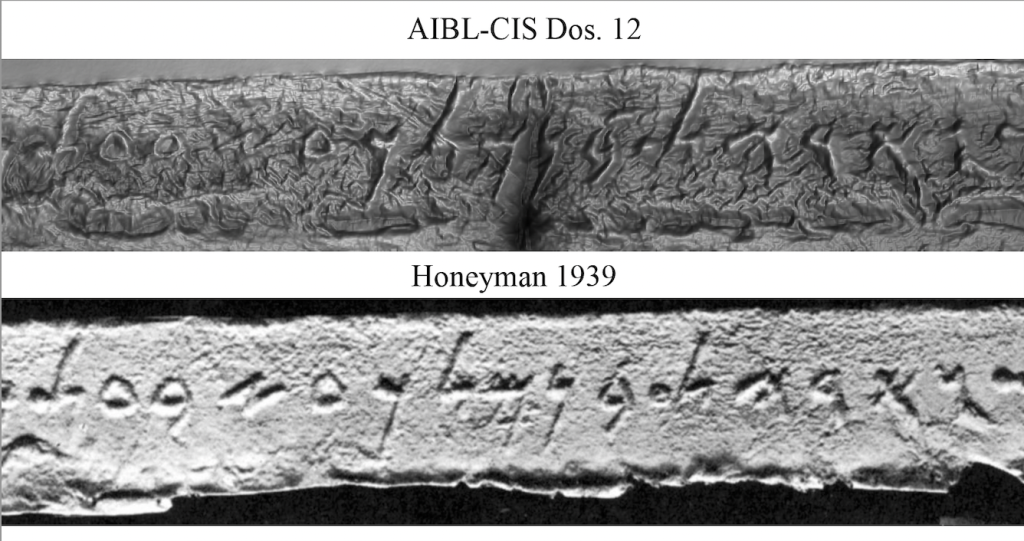
Manipulating the photograph using the Digital Epigraphy’s user interface produces the best known available photograph of the inscription. Compare the previously published photograph to that made during our cataloguing efforts.
Upper photograph of squeeze AIBL-CIS Dos. 12.01.01 made in 1887 depicts the contures of the inscription verses the lower photograph of a sqeeze made and published in 1939 by A. M. Honeyman, “The Phoenician Inscriptions of the Cyprus Museum,” Iraq 6: 104–8.
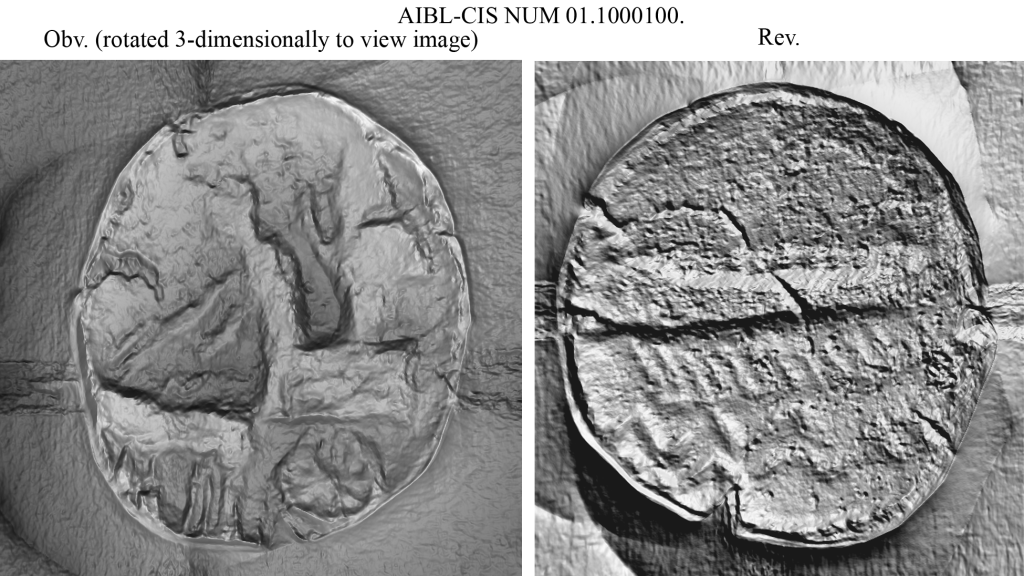
The Cabinet-CIS’s Heurist database and Digital Epigraphy software has far reaching applications for the collection. While one of Maria Gorea’s students, Noémie Carpentier, was working on the Cabinet-CIS’s numismatic collection, I trained her in how to use the software to produce 3D renderings of coins. We scanned the following example of a worn Phoenician (Tyrian) coin minted during the reign of Artaxerxes III (AIBL-CIS NUM 01.1000100), and the 3D rendering makes visible the coin’s features, which are invisible to the eye. You can view the coin using the Digital Epigraphy user interface here:
Credit: Original photographs by James D. Moore, Maria Gorea, Noémie Carpentier, and Narmin Sadykhova. Rendered and displayed using the Digital Epigraphy software.
The consorted efforts of all those mentioned above and the support from ASOR allowed us to achieve our objective of building a digital infrastructure for the Cabinet-CIS with which the digital preservation of its invaluable collection can begin.
Additional Notes The long days spent at the Cabinet-CIS also afforded me opportunities to further my own research. Maria Gorea and I have long teamed up to publish important manuscripts in the Cabinet-CIS, and we used time to finalize manuscripts for a number of publications on two new Phoenician papyri accounts which radiocarbon date to the Persian period, fragments of Aramaic papyri from Elephantine, and a new Aramaic religious text from Egypt radiocarbon dated between the 2nd and early 4th centuries CE.
“AIBL-CIS de Ricci no. 2: A New Jewish and Aramaic Religious Text from Egypt Dating between the 2nd and Early 4th Centuries CE” Dead Sea Discoveries, forthcoming
“New Persian Period Phoenician Papyri Accounts from Egypt in the Académie des Inscriptions et Belles-Lettres, Cabinet du Corpus Inscriptionum Semiticarum,” in Advances in Elephantine and Persian Period Research, eds. J. Moore and P. Schmidtkunz, Studies on Elephantine (forthcoming).
“Radiocarbon Dating an Aramaic Papyrus from Elephantine and a New Aramaic Fragment from the Académie des Inscriptions et Belles-Lettres, Cabinet du Corpus Inscriptionum Semiticarum,” in Advances in Elephantine and Persian Period Research, eds. J. Moore and P. Schmidtkunz, Studies on Elephantine (forthcoming).
“Papyri semitiques du Cabinet du CIS,” Comptes rendus des séances de l’Académie des Inscriptions et Belles-Lettres, Communication of the AIBL 16 April 2021.
J.D. Moore, New Aramaic Papyri from Elephantine in Berlin, Studies on Elephantine 1 (Leiden: Brill), 2022; Open Access: https://brill.com/view/title/61396. (pp. 16–17)
Andalusian Agriculture: A View from Medieval Menorca
Kathleen Forste, 2022 P.E. MacAllister Scholarship for Fieldwork Participation
Thanks to the ASOR Scholarship for Fieldwork Participation, I was able to join the Menorca Archaeology Project (MAP) in Spain to excavate a portion of the medieval settlement at the site of Torre d’en Galmés. This rural 13th century Islamic village, or alqueria, is built atop and abutting (and certainly borrowing from) the ruins of a large post-Talayotic (Iron Age) settlement, and by studying it we can better understanding what life was like during this period and how medieval lifeways have influenced later periods of life on Menorca.
I am the archaeobotanist on the team, meaning I study plant remains like wood charcoal, seeds, and plant parts. The analysis of these remains can help us answer questions about diet and foodways, the crops that people grew and the wild plants they collected, and the types of plant materials they used to build their houses and fuel their fires.
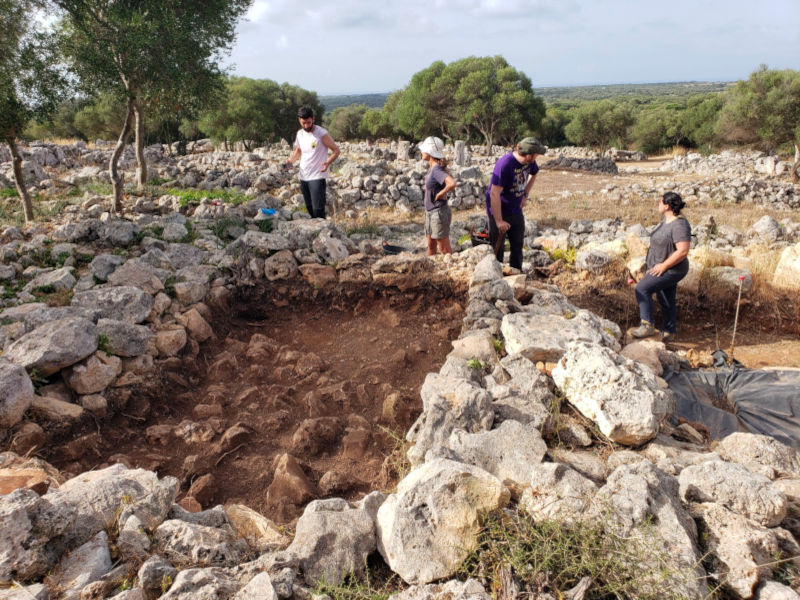
This season, our excavation focused on two houses, one of which was so well-preserved that the plaster on the interior walls and floor were still intact. These houses were built in the typical form of Muslim houses – multiple rooms formed an L that bordered 2 sides of a patio, which was enclosed by 2 other walls to create a private area for the family to relax and perform everyday tasks such as cooking and carding wool to make yarn. The room that was excavated we are interpreting to be a kitchen, based on the presence of hearths, grinding stones, cooking vessels, as well as parallels in construction to other excavated houses of this era. We also found bronze nails just inside the threshold, hinting at the wooden door that would have graced this entryway.
Beginning our excavation of a medieval Islamic house, surrounded by ruins of other medieval houses and post-Talayotic buildings.
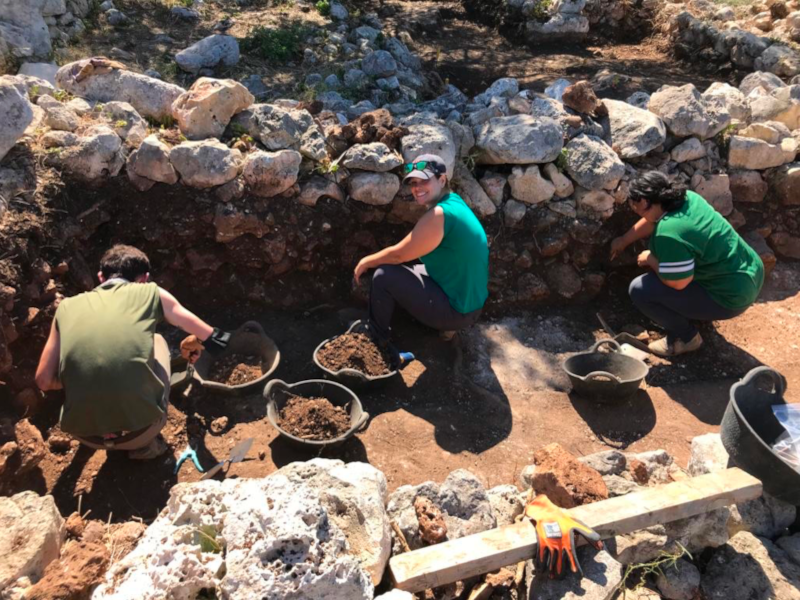
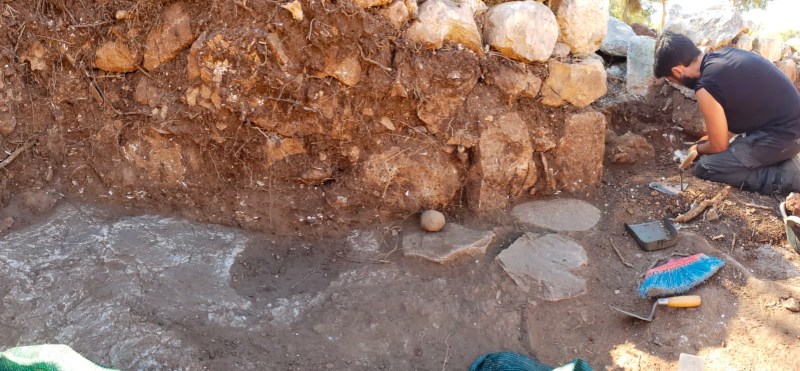
Excavating the east wall of the kitchen. Note the white plaster to the right of the author (middle), and the partially-excavated patio in the background.
The kitchen looking east. Moving left to right you can see the plaster floor, inlaid grinding stone and hand-held grinder in situ, and the doorway (undergoing excavation) that led out to patio.
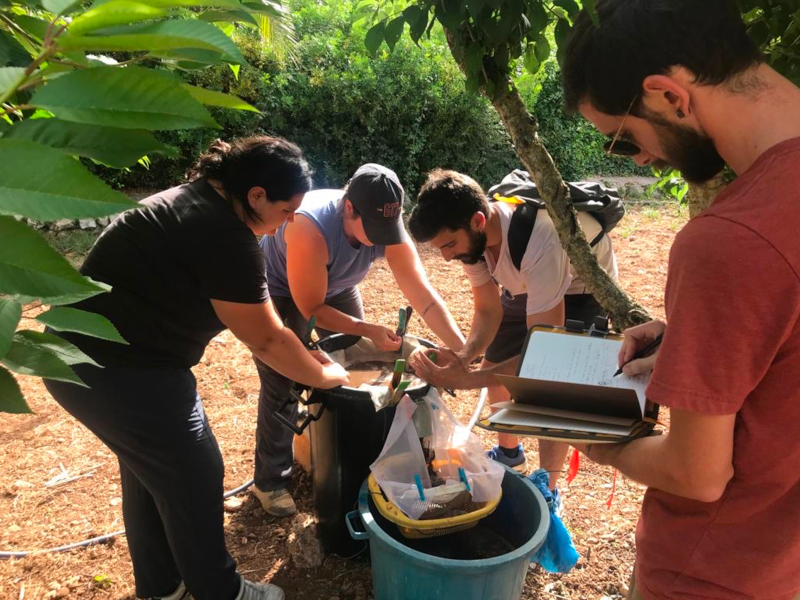
We recovered carbonized plant remains through flotation, a method of using water to separate carbonized plant remains and microartifacts from their surrounding soil matrix. I built a new flotation tank for the project, and trained team members in this method. I will begin analyzing the plant remains from this season during the academic year, and based on findings from the previous season, I expect to find barley (which is a hardy crop that grows well in hot rocky areas and requires a moderate amount of water) and pulses like lentils and chickpeas (which grow best in cooler temperatures and require moderate amounts of water). Based on the growing requirements of these crops, we can begin to hypothesize which types of habitats Menorcan farmers selected for their fields.
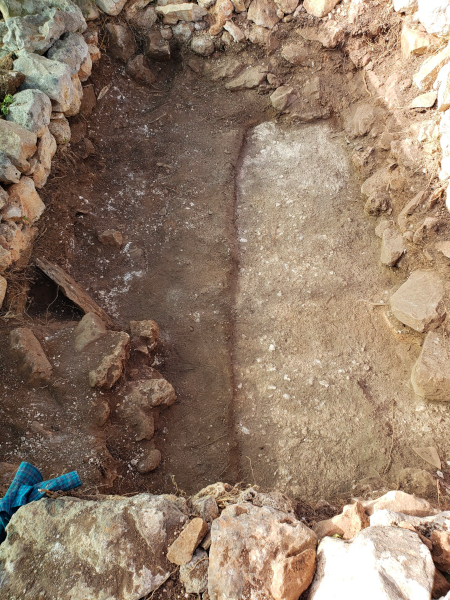
The kitchen looking north. The plaster floor is exposed in the eastern portion (R-hand side) beneath the compacted occupation debris and collapse (intact in the western portion, L-hand side).
Teaching MAP team members how to recover plant remains and microartifacts through flotation.
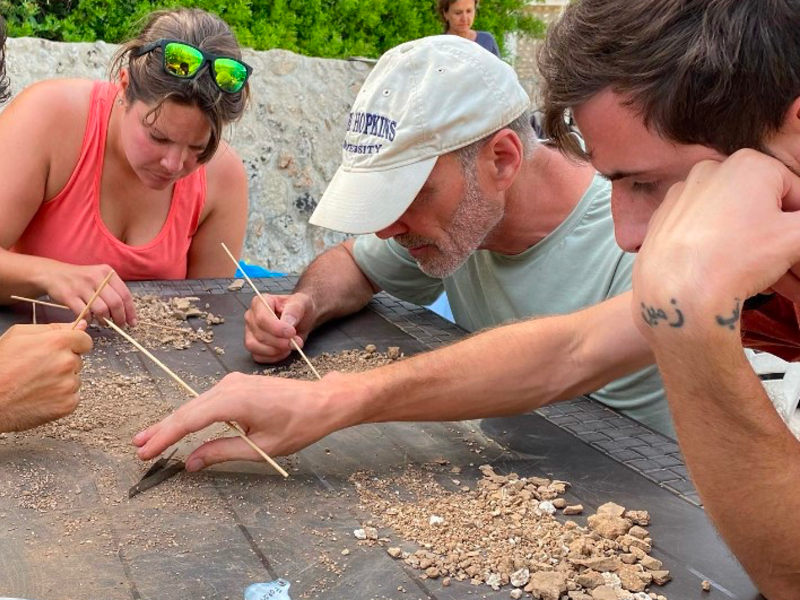
MAP team members sorting the heavy fraction to recover microartifacts like fish bones and small plaster fragments.
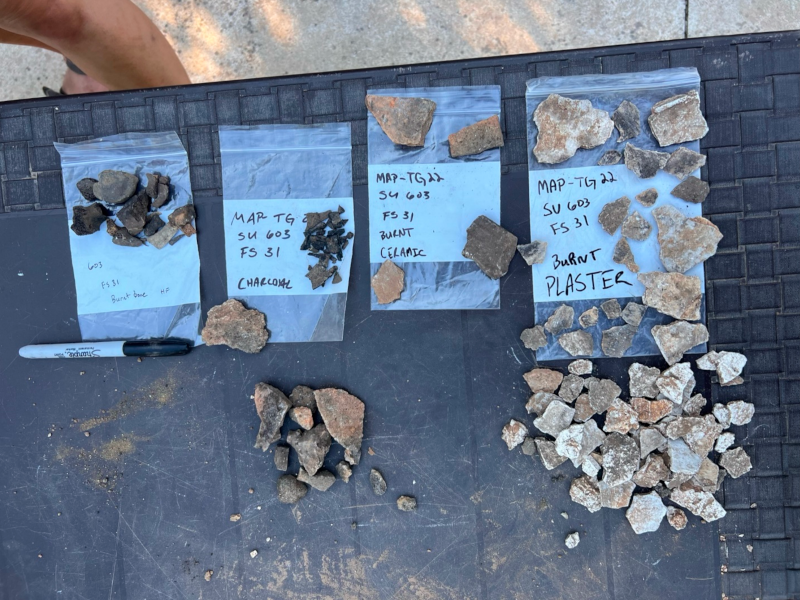
Artifacts recovered from flotation, including lots of wood charcoal (second bag from the left).
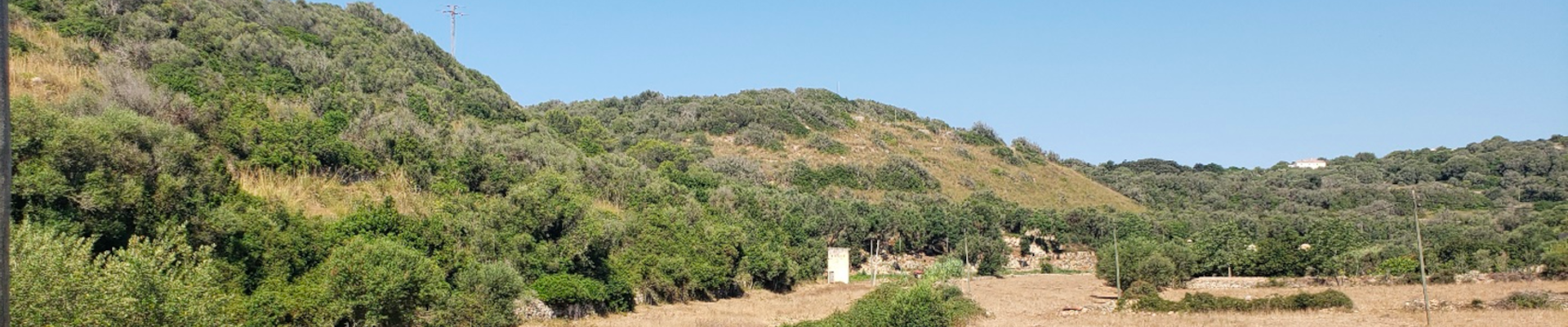
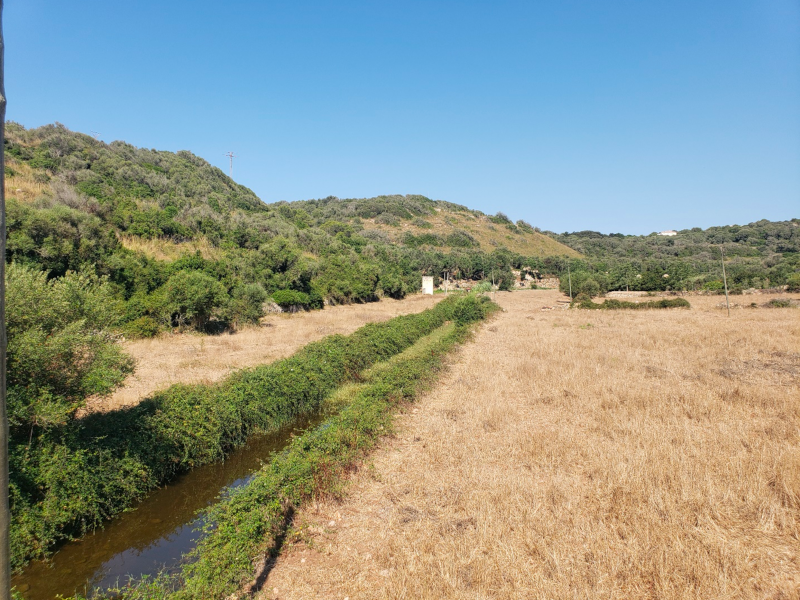
Some of the agricultural engineering of the medieval era is still functional today, like this irrigation canal in a barranco(valley) that waters orchards and fields, creating a direct line between ancient and modern land-use practices.
Flotation was one of the methods employed to understand the way in which the medieval inhabitants managed their surroundings, along with mapping and 3D modeling structures and open spaces linking them. Through this multidisciplinary research we will be able to reconstruct the rhythm of life of medieval Menorca, and the ways in which people cultivated and built their landscapes.
Check out more about our project on Instagram: @MAProject360
Kathleen Forste is an anthropological archaeologist who studies agricultural systems through the analysis of archaeological plant remains, historical sources, and environmental data. Her research focuses on how societies adapt their agricultural systems to various environmental and socioeconomic conditions during the Islamic period (7th through 13th centuries) in the Levant and Iberia. She earned her PhD in 2021 from Boston University, where she is currently a Lecturer of Archaeology.
Want to help more students and early career archaeologists get into the field? Donate to the cause today by selecting “Student Support” as your gift purpose!