FOA Webinar: Back to the Field—Recent Discoveries & Summer Plans on April 3

FRIENDS OF ASOR WEBINAR

Back to the Field: Recent Discoveries & Summer Plans 2022

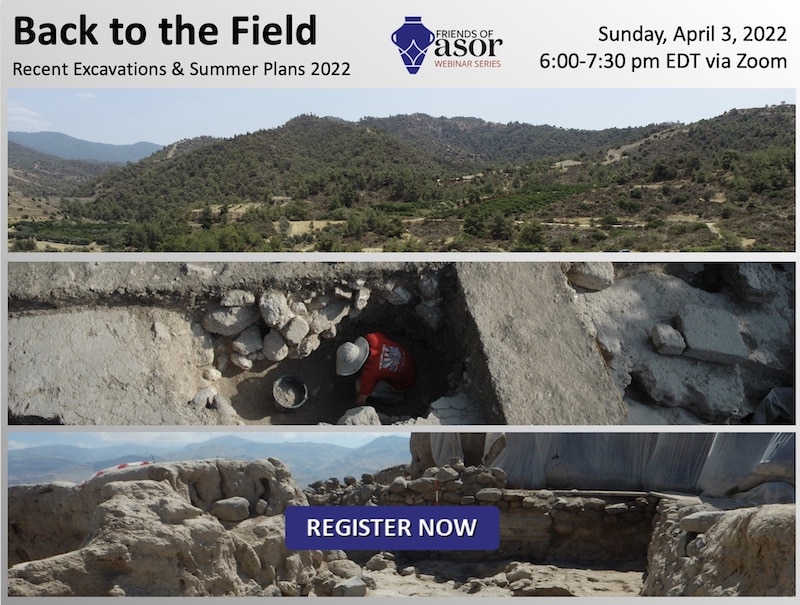
Friends of ASOR presents a free webinar on April 3, 2022 from 6:00pm to 7:30pm EDT, “Back to the Field: Recent Discoveries & Summer Plans 2022,” featuring Lorenzo d’Alfonso, Kathryn Grossman, and James R. Strange. This special event will preview the field seasons of three sites across Turkey (Kinik Höyük Archaeological Project), Cyprus (Makounta-Voules Archaeological Project), and Israel (The Shikhin Excavation Project). The program will include three presentations covering such topics as introductions to each site in its historical context, current excavation and survey progress, and the research focus of the upcoming field season. Join us as we explore some of the exciting projects that ASOR members are currently participating in across the eastern Mediterranean region. The panelists will conclude their webinar with a live Q&A session with the audience. The full program is below. The event will be recorded. This event is free for everyone.

ASOR Sustaining Members: $0 | ASOR Members: $0 | Public: $0

Program Schedule

SUNDAY, APRIL 3, 2022

6:00pm – 6:20pm

Lorenzo d’Alfonso

Institute for the Study of the Ancient World, New York University

Turkey: Niğde Kınık Höyük (N-KH) Archaeological Project

Read the Description

The site of Niğde Kınık Höyük (N-KH) is located in south Cappadocia, in the Niğde province, on the Bor-Ereğli Plain at the foot of the Melendiz Mountains. Excavations at N-KH originated from a survey conducted by the University of Pavia in 2006–2009. Within the sites recorded in the 800 km2 survey of the southeastern slopes of the Melendiz Mountains, N-KH proved to be the largest site with the longest occupation history, from the Early Bronze Age to the Early Ottoman period. In this lecture, Dr. Lorenzo d’Alfonso, director of the project, will present the results of the last two site campaigns (2020-2021) with particular focus on the recent discoveries from the Middle Iron Age and the Hellenistic period, and on the archaeological evidence of cultic activities in first millennium BCE Anatolia. Furthermore, he will report on the design and creation of a showcase for a permanent exhibition at the Niğde Archaeological Museum that includes restored votive statues and figurines from N-KH.

6:20pm – 6:40pm

Kathryn Grossman

North Carolina State University

Cyprus: Makounta Voules Archaeological Project

Read the Description

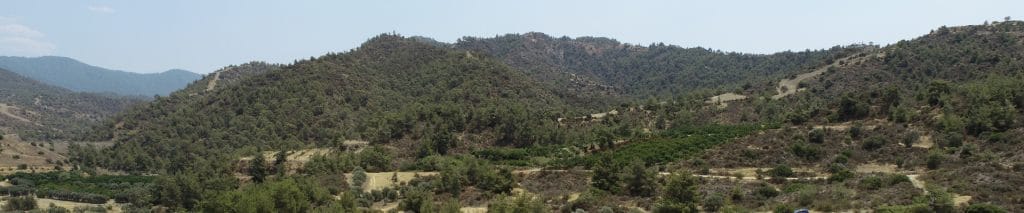
The Chalcolithic and Bronze Age site of Makounta-Voules-Mersinoudia is located on the northwest coast of Cyprus, near the town of Polis Chrysochous. Although research projects elsewhere on the island have frequently targeted Chalcolithic and Bronze Age sites, there have been few scientific excavations of prehistoric remains in this region. In 2017, the Makounta Voules Archaeological Project (MVAP) began with a program of intensive, systematic survey, which revealed Late Chalcolithic and Early-Middle Bronze Age ceramics, along with stone tools, slag, and wall stones spread across a hillslope overlooking the Makounta River. In 2018 and 2019, the MVAP team conducted excavations that revealed a series of Chalcolithic round buildings, a fire installation tentatively identified as a copper smelting furnace, and other stone-built features. With the onset of the COVID-19 pandemic, excavations were put on hold in 2020-21. In 2022, the team will return to the field to continue excavations of the ancient settlement, as well as explore new areas that might be related to early copper mining activity. In this presentation, Dr. Grossman will show results from previous excavation seasons, describe plans for future work, and discuss some of the big-picture questions that guide the research at Makounta-Voules-Mersinoudia.

6:40pm – 7:00pm

James R. Strange

Samford University

Israel: Shikhin Excavation Project

Read the Description

The site of Shikhin sits less than a mile north of the acropolis of ancient Sepphoris. Evidence of activity on the hilltop dates as far back as the Late Bronze Age, but, like many Galilean settlements, the village appears to have been founded between the second and first centuries BCE (the Late Hellenistic period). In the 2022 season, the Shikhin Excavation Project will resume its work in two areas: the remains of a large public building that was probably the village’s synagogue in the Roman period, and an adjacent ceramics industry set up in the courtyards of houses. The most exciting event of the season will be an exercise in experimental archaeology. Yeshu Dray and Ilana Gonen of Restoration of Ancient Technology are building two kilns based on construction methods used at Shikhin. During the 2022 season, Shikhin volunteers will make clay oil lamps that Yeshu and Ilana will fire in both kilns using fuel that would have been used in the ancient period.

7:00pm – 7:30pm

Audience Q&A with all Panelists

Lorem ipsum dolor sit amet, consectetur adipiscing elit. Ut elit tellus, luctus nec ullamcorper mattis, pulvinar dapibus leo.

ASOR Sustaining Members: $0 | ASOR Members: $0 | Public: $0

If you are new to ASOR, please click on the “New Visitor Registration” link to register your e-mail address and choose a password for our online store. Once logged in, navigate to “Meeting and Event Registration” to register for the webinar. Each registrant will receive a confirmation e-mail. If you do not receive this e-mail, then you are not registered. Please e-mail membership@asor.org with any questions or issues with registering.

You will be e-mailed the Zoom Webinar link in the week prior to the webinar on May 12. If you do not receive the link by the close of business on the Tuesday before the event, please e-mail membership@asor.org immediately. This event will be recorded and all paid registrants will be sent a link to view the recording.

Sponsors will be acknowledged during the event. Sponsorships are available at the following levels:

  • Bronze Sponsor: $50
  • Silver Sponsor: $100
  • Gold Sponsor: $500
  • Platinum Sponsor: $1,000

Each sponsor will receive a confirmation e-mail. If you do not receive this e-mail, then we did not receive your sponsorship online.  If you prefer to register or sponsor over the phone, please call 703-789-9230. Please e-mail membership@asor.org with any questions or issues.

Speakers / Presenters

Lorenzo d’Alfonso is a Professor of Archaeology and History of ancient Western Asia at ISAW-NYU and Associate Professor of Archaeology of ancient Western Asia at Pavia University. He has published several books and papers on the history and archaeology of Anatolia and Syria, focusing on the Late Bronze and Iron Ages. His most recent publication is the volume Borders in Archaeology: Anatolia and the South Caucasus Ca. 3500-500 BCE (Peeters 2021) co-edited with K. Rubinson, which was published three months ago. Dr. d’Alfonso has excavated at different sites in Italy, Syria, and has directed an archaeological survey in south Cappadocia, Turkey from 2006-2009, before starting the excavations at Niğde Kınık Höyük in 2011.


Kathryn Grossman is an Assistant Professor of Anthropology in the Department of Sociology and Anthropology at North Carolina State University. She is an archaeologist and zooarchaeologist with expertise in the complex societies of the Near East and eastern Mediterranean. She earned her BA in Archaeology from Tufts University and her PhD in Near Eastern Art and Archaeology from the University of Chicago. Her current research focuses on resistance to state-making, the biographies of early cities, and human-animal relationships in early complex societies. She directs the Makounta-Voules Archaeological Project in Cyprus and has been a senior staff member on archaeological projects in Syria, Cyprus, Egypt, and Iraq. This summer, in addition to directing excavations at Makounta-Voules-Mersinoudia in Cyprus, she will spend two months as a CAORC fellow at the American Center of Research in Jordan, where she will be analyzing animal bones from Petra.


James R. Strange has directed the Shikhin Excavation project since 2012, with Motti Aviam, Tom McCollough, and David Fiensy (2012) as Associate Directors. Dr. Strange is the Charles Jackson Granade and Elizabeth Donald Granade Professor in New Testament at Samford University. With David Fiensy, he is co-editor of the two-volume set Galilee in the Late Second Temple and Mishnaic Periods (Fortress, 2014 and 2015). His book, One Problem After Another: An Introduction to Archaeology, the Gospels, and First Century Roman Galilee is scheduled to come out in 2022.

ASOR is grateful for your support. Each registrant will receive an automated confirmation e-mail. If you do not receive this e-mail, please check you Spam folder and then contact ASOR. If you prefer to register over the phone, please call 703-789-9230. Please e-mail membership@asor.org with any questions or issues.

PAST WEBINARS

You can now purchase the link to the recording of any webinar. You can also purchase the bundle packages of all webinars from the 2020-2022 seasons. Please e-mail membership@asor.org for purchase details.

To see a printable pdf of the webinar titles from the 2020-2021 season, please click here. To see a printable pdf of the webinar titles from the 2021-2022 season, please click here.

Pricing:

Members: $6.00 per recording
Non-Members: $12.00 per recording
Bundle of 2020-2021 Webinars: $75.00
Bundle of 2021-2022 Webinars: $75.00
Bundle of 2020-2022 Webinars: $125.00

2021-2022 Season

A World at War: Protecting Cultural Heritage in Times of Conflict
Patty Gerstenblith (DePaul University), Lisa Ackerman (Columbus Citizens Foundation), Andrew Cohen (Government Professional and Cultural Heritage Expert) | May 12, 2022

Preserving Cultural Heritage in Hisban and Umm al-Jimal, Jordan
Øystein LaBianca (Andrews University), Elizabeth Osinga (Umm al-Jimal Archaeological Project), Darrell Rohl (Calvin University) | April 24, 2022

Back to the Field: Recent Discoveries & Summer Plans 2022
Lorenzo d’Alfonso (ISAW), Kathryn Grossman (NC State University), James R. Strange (Samford University) | April 3, 2022

Uncovering What is Nubian Beneath the Veneer of Egyptianness: Excavating the Archives
Debora Heard (University of Chicago) | March 20, 2022

Where Are They Now?: A Preview of 2022 ASOR-Affiliated Fieldwork Projects
Michael Given (University of Glasgow), Xenia-Paula Kyriakou (Florida Gulf Coast University), Stephen Batiuk (University of Toronto), Monique Roddy (Walla Walla University), Kent Bramlett (La Sierra University), Friedbert Ninow (La Sierra University), and Michael Hoff (University of Nebraska-Lincoln) | March 8, 2022

Excavations at Tel Gezer: A Personal Story
Sam Wolff (Tel Gezer Laboratory) | February 20, 2022

Tel Rehov: A Major Bronze and Iron Age City in the Jordan Valley
Amihai Mazar (Hebrew University of Jerusalem), Nava Panitz-Cohen ( Hebrew University of Jerusalem), Nota Kourou (Athens University), Naama Yahalom-Mack (Hebrew University of Jerusalem), Robert Mullins (Azusa Pacific University) | February 10, 2022

The Not-So-Innocents Abroad: The Beginnings of American Biblical Archaeology
Rachel Hallote (Samford University) | January 20, 2022

Synagogues as Jesus Knew Them
James R. Strange (Samford University) | December 2, 2021

Under Jerusalem: The Buried History of the World’s Most Contested City
Andrew Lawler | November 4, 2021

Jesus and Jerusalem on TV: How Do Bible Documentaries Get Made?
Robert Cargill (University of Iowa) | October 17, 2021

Digging the Divine?: Judahite Pillar Figurines and the Archaeology of Israelite Religion
Erin Darby (University of Tennessee) | October 7, 2021

David, Solomon, and Rehoboam’s Kingdom—The Archaeological Evidence
Yosef Garfinkel (Hebrew University of Jerusalem) | September 19, 2021

From Standing Stones to Sacred Emptiness: Textual and Visual Portrayals of Israel’s God
Theodore Lewis (Johns Hopkins University) | August 29, 2021

2020-2021 Season

Making May Matter: Webinarathon to Endow Diversity
Multiple Speakers | May 21-23, 2021

Archaeogaming: Why Video Games Deserve Their Own Archaeology
Tine Rassalle (University of North Carolina at Chapel Hill), Shannon Martino (Morton College), Matthew Winter (University of Arizona), Michael Zimmerman (Rhode Island) | April 18, 2021

How the Bible Became a Book
William Schniedewind (UCLA) | March 21, 2021

The Mysteries of Mithras in Caesarea: Exploring the Cult’s Rites and Remains
Jane DeRose Evans (Temple University), Alexandra Ratzlaff (Brandeis University) | March 11, 2021

Archaeology and the Hidden Religious Culture of Israelite Women
Carol Meyers (Duke University) | February 21, 2021

Meet the Directors—Fundraiser to Support ASOR’s Affiliated Overseas Research Centers
Matthew J. Adams (AIAR), Pearce Paul Creasman (ACOR), Lindy Crewe (CAARI) | February 11, 2021

Early Synagogues, Jesus, and Galilee—A Jewish Perspective
Eric Meyers (Duke University) | December 13, 2020

Home Sweet Home: Ancient Israelite Households in Context
Cynthia Shafer-Elliott (William Jessup University) | October 18, 2020

Priestesses in the Days of Solomon and Ahab
Susan Ackerman (Dartmouth College) | September 13, 2020

Digging Deeper: How Archaeology Works
Eric H. Cline (The George Washington University) | August 9, 2020

Stipend Report: Alexis Greene

Tell al-Judaidah Publication Project 

Alexis Greene, 2021 Summer Stipend Recipient

In May, I was awarded a grant to allow me to join the Tell al-Judaidah Publication Project which is directed by Lynn Dodd at the University of Southern California. Tell al-Judaidah is notable among excavated sites in the agricultural region around Antioch /Antakya. It’s a tall site that has a water source at the foot of the mound, and there are traces of occupation from the 7th millennium BCE into the 1st millennium CE. Our project is focused on the levels of the site dating from about 2000 BCE and later. We have roughly 3000 years to analyze and document.

Working on this project has allowed me to expand my knowledge of archaeology, stratigraphy, ceramics, and artifacts, and database use. When I started working on this project, I did not have any experience in archaeology, but I had a high degree of interest in the ancient world from which biblical traditions emerged. My involvement in this project allowed me to gain skills and to explore new possibilities for my future.

Our team includes the project director, Lynn Dodd, a faculty member at USC, and post-doctoral scholar Michael Johnson. Mike has extensive field experience working at Tell Atchana/Alalakh, a site with Bronze Age palaces (and much more), and that site is an easy day’s walk from Tell al-Judaidah. Another team member, Onur Hasan Kirman, is a doctoral student of Assoc. Prof. Dr. Murat Akar of the Mustafa Kemal University, Hatay, Turkey. He brings expertise in the material culture of the region and is contributing to the analysis of the Bronze Age pottery. Also, I am working in collaboration with undergraduate students at USC, including Lauren Malkoun. All last year, Lauren worked to find solid comparisons for some of the finds that are located in the collection of the Oriental Institute Museum at the University of Chicago. Now, I have joined her in this effort and I continue to learn the ins and outs of this database system that organizes all the details from Tell al-Judaidah that were brought to light by the 1930s era excavation team from Chicago’s Syro-Hittite Expedition.

The records, drawings, photographs and other material from that field project are now physically stored and cared for at the University of Chicago Oriental Institute Museum. All data about the excavation and its finds are coordinated in OCHRE, a relational, hierarchical database system that is accessible by team members around the world. Via the Internet, I have access to the records of that storied expedition’s work at Tell al-Judaidah, including its black and white photos, field notebooks, pottery drawings, and more.

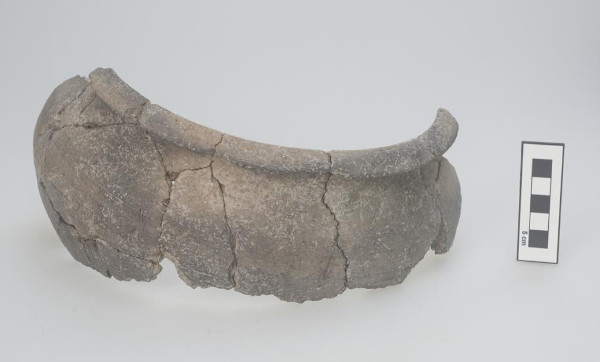
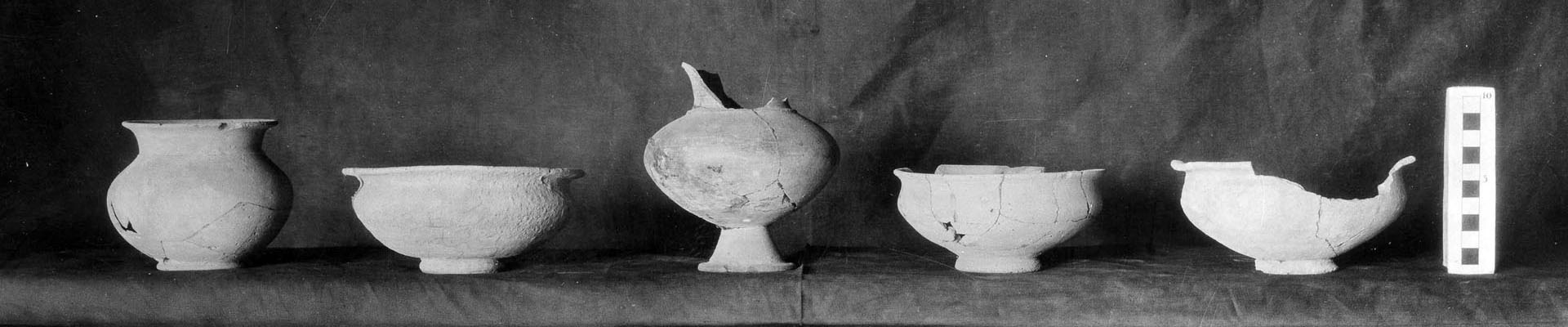
Through reading and discussions with team members, I have learned about key concepts in archaeology. The treasures of the past relate less to gold and more to the clues that a wide range of left-behind materials preserve as we try to piece together the human story (Renfrew & Bahn, 2018). I’ve learned the basics of typology, which refers to the study, analysis, or classification of categories of things, and this can apply to symbols, people, religions, or any category of material culture (Horowitz, 2015). An example of a typological category is simple ware (or plain ware), which is one of several terms used for the Bronze Age plain wheel-made pottery that was produced and consumed in the coastal regions of the Cilician and Amuq Plains and in parts of north-west inland Syria (Pucci, 2019). Another pottery category that I encounter has a distinctive temper and form, as shown in this image of a cook pot with its folded external rim.

Folded external rim. Photo credit: Michael Johnson and Onur Hasan Kirman.

My work on this project has allowed me to become more familiar with the region of Tell al-Judaidah, which includes its relations to neighboring sites and resources (rivers, springs, trade routes, agriculture, and bridges), and broader regimes of political control. For instance, in the late Bronze Age (latter half of the second millennium BCE) the changes that occurred from the 16th to 13th centuries at Alalakh likely would have had an impact on Tell al-Judaidah which was strategically located along trade routes leading to and from the inland cities. During part of this time, the Egyptians and the Hittites vied for control and influence over the smallish kingdoms that were located across the region now known as Syria, Lebanon, Israel, and Gaza, with names that evoke places such as Tyre and Jerusalem, and others names such as Mukish that refer to the area around Tell al-Judaidah.

After my Summer, 2021 ASOR fellowship ended, I decided to accept the invitation to continue working on this project. Lynn Dodd was able to find a way to extend my participation, and I was hired for a part-time research position through USC. My fellow researcher at USC (Lauren) and I are working systematically through each stratigraphic level, identifying available information, finding comparative examples for Judaidah artifacts, noting missing information, and recording errors. We will create a draft report that summarizes our preliminary research and submit this for inclusion in a cited, online publication that continues to grow. I am very grateful to ASOR for supporting me in my first steps on this path of learning about the past and contributing to the creation of new information and understanding.

About Alexis: she moved from her home state of Alabama to San Diego in 2019 after working as a teacher for seven years in private schools in the United States and international schools in Ghana, Macau, and Saudi Arabia. Alexis received a Bachelor of Science in Education from the University of South Alabama in 2010 and a Master of Science in Education from Spring Hill College in 2012. In May 2021, Alexis received a Master of Arts in International Higher Education from Boston College. Alexis’ research interests center around the internationalization of higher education in American society and economics of human capital theory. Through her experiences as an expatriate, Alexis developed a passion for helping international students navigate the waters of higher education. Alexis is a member of the Junior League of San Diego and Women on Course San Diego. 
References

Horowitz, M. T. (2015). The Evolution of Plain Ware Ceramics at the Regional Capital of Alalakh in the 2nd Millennium BC. In Plain Pottery Traditions of the Eastern Mediterranean and Near East 1st Edition (pp. 1–30). Routledge.

Pucci, M. (2019). Excavations in the Plain of Antioch III: Stratigraphy, Pottery, and Small Finds from Chatal Höyük in the Amuq Plain. OIP 143. Oriental Institute Press.

Renfrew, C., & Bahn, P. G. (2018). Archaeology essentials: theories, methods, practice. Thames & Hudson Ltd.

During the summer of 2021, ASOR supported 27 undergraduate and graduate students through the Summer Stipend Program. These students undertook non-fieldwork archaeological research projects led by ASOR-affiliated project directors. They also took part in monthly cohort group meetings hosted via zoom. Read a summary of these cohort meetings here.

Stay tuned for more updates from the 2021 Summer Stipend recipients!

March Madness Challenge: 3/23 Update

MARCH MADNESS CHALLENGE 2022: FILL THE POTS

Update: March 23, 2022

ASOR’s Annual March Madness Challenge continues! This year we are “filling” a different need: supporting the ongoing cost and maintenance of The Levantine Ceramics Project. This incredible resource has been an ASOR publication since 2016. The LCP is an open, interactive website focused on ceramics produced in the Levant from the Neolithic era through the Ottoman period. Thanks to the generosity of three ASOR donors, we have received $5,000 in challenge gifts that can be fully earned by raising $5,000 in matching gifts for a total of $10,000 to keep the LCP running. All gifts will support the ongoing maintenance and hosting of the Levantine Ceramics Project (LCP)— an ASOR open-access publication.

As of March 16, we have received $3,245 in matching gifts, which translates into a total of $6,365 for the LCP. A huge thank you to everyone who has helped fill the pot for the LCP thus far! If you have not made a gift, please consider a gift to help us raise the remaining $1,755 needed to earn all the challenge dollars.

The LCP’s mission

The LCP, an ASOR open-access publication and research project, is a sustainable research tool designed to pull the study of archaeological ceramics into the 21st century.
Why ceramics? Because they comprise the most abundant category of remains found throughout the Near East, and because every excavator must contend with identifying and publishing them, yet the mode by which that is done has not changed in a substantive way since William Flinders Petrie began working in 1880. Constant excavation since then has created unthinkable quantities of data, all disseminated via print (and now digitized versions of print) publications. Print is excellent for many things – but it is remarkably ill-suited for fast exchange of information, collaborative study, and especially the rapid recording of new or changing ideas. Archaeology is a field that is always in a mode of discovery; we need tools that can keep up, that allow us to bring new material into dialogue with that long known, are easy to use, foster sharing, and enable us to readily learn from one other. The LCP is such a tool.

The LCP inspires new questions, and gives us the tools to answer them: Hard borders, civil wars, intractable terrain – these are facts on the ground across the landscapes of the Levant. Swaths of territory that are invisible or inaccessible today were zones of habitation and connection in the past. Archaeological survey and fieldwork fill in the blanks, allow us to see what was, imagine different realities. This is why we pursue such work; this is one of the best rationales for its value now and in the future. The LCP helps deliver on that lofty promise. Four examples of regions, activities, lives able to be seen, mapped, and linked to a wider world via pottery on the LCP:

  • the eastern desert of Egypt: >200 vessels from 25+ already on the LCP with another 1000+ from 200 sites, thanks to integration with the EU/CNRS Desert Networks Project (scheduled for submission this summer).
  • the Hauran of southern Syria: >1000 vessels from 50+ sites, dating from 1200 BCE-200 CE, from the Lajāʾ survey (2003–2009), the Qarrāṣa excavations (2008–2011), plus published and unpublished data from the French Archaeological Mission to Southern Syria, thanks to Jérôme Rohmer’s 2020 Hauran VI. D’Aram à Rome. La Syrie du Sud de l’âge due Fer à l’annexion romaine (XIIe siècle av. J.-C. – Ier siècle apr. J.C.).
  • Rough Cilicia, Turkey: ~200 vessels from 40+ sites, from Nicholas Rauh’s Rough Cilicia Archaeological Survey Project (1996-2011).
  • the maritime networks linking northern and southern Cyprus with the northern Levant: 400+ vessels dating from the Middle Bronze – Iron Ages, from Cyprus and sites in Cilicia and coastal Syria, including 250+ vessels from Tell Tweini in northern Syria, excavated by the University of Leuven from 1999-2007.


The LCP advances ASOR Strategic Plan and Goals by providing easy and open access to new information: The LCP provides quick access to new finds and current ideas, and helps American researchers connect with foreign scholars. Most LCP contributors are based in Europe, Turkey, Cyprus, Lebanon, Jordan, Israel, and Egypt, and are affiliated with foreign research universities or institutes. Not all users are are members of ASOR, yet their enthusiastic embrace of the LCP helps ASOR members stay abreast of work they would otherwise have a hard time accessing or even knowing about in the first place. Keeping the LCP free and open access is critical; if there was a members-only access policy, we would lose the input of most of these foreign contributors. The LCP provides assistance for ASOR-affiliated excavators: LCP interns work with ASOR-affiliated excavators to prepare and submit their pottery to the site. Using the LCP, interns also regularly make connections with material from other sites that excavators had not known about. This has the double benefit of deepening knowledge from excavated material as well as disseminating new information to scholars and students around the world.

The LCP brings disparate, hard-to-find data together, able to be mapped, studied, arranged and re-arranged for connections, ideas, insights. It is worth emphasizing that much of this material crosses borders and links regions that are currently impassible. All appear on the LCP thanks to ASOR’s neutrality as an American-based organization. In this way, ASOR helps frame a vision of the Levant that rises above the current political fray, and enables a new generation to ask and answer new questions, to understand the past – and perhaps therefore also the future – in different ways.

 Read More About The Levantine Ceramics Project (LCP)

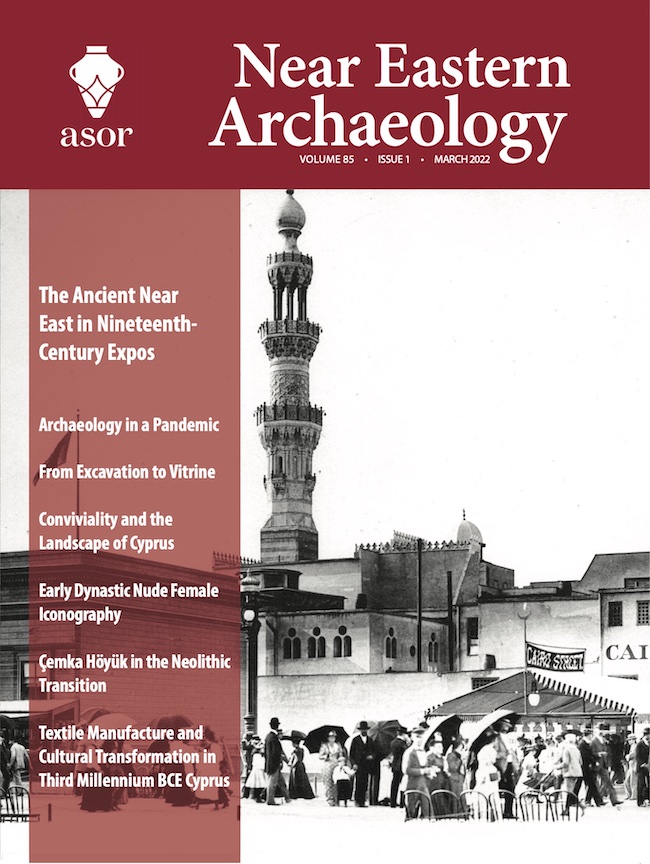
Table of Contents for NEA 85.1 (2022)

Table of Contents for Near Eastern Archaeology 85.1 (March 2022)

You can receive NEA (and other ASOR publications) through an ASOR Membership.
Please e-mail the Membership office if you have any questions.

Pp. 4-11: “Flowing Rock, Dancing around Trees: Conviviality and the Landscape of Cyprus,” by Michael Given

Rocks and trees are often central to the lives of human communities: their role is far more complex and meaningful than supplying resources, status, or symbolism. In a convivial landscape, rocks, trees, and people are deeply connected, showing elaborate and powerful interdependencies. In this article I explore the idea of conviviality through a series of examples from Archaic to early twentieth-century Cyprus. The Acropolis cliffs of Kourion show the fluidity of rock, constantly changing because of the effects of water, weather, and humanity. In the northern Troodos Mountains, trees and people have been highly interconnected: when human activities are relatively diverse and small-scale, the ensuing relationships are resilient and healthy for the whole socioecological community. Human societies can recognize and celebrate this conviviality through stories that grow up around particular rocks and trees, or through rituals focused on sacred stones or enacted by dancing around trees.

ASOR Members with online access: navigate to the token link email sent to you (search for “token link” in inbox) before attempting to read this article. Once you have activated your member token, click here to access the above article on The University of Chicago Press Journals’ website.

Pp. 12-22: “Çemka Höyük, Late Epipaleolithic and PPNA Phase Housing Architecture: Chronological and Typological Change,” by Yunus Çiftçi

In recent studies carried out at the Çemka Höyük settlement on the western flank of the Tigris River in Upper Mesopotamia (Mardin province, Turkey), new information has been obtained on the Late Epipaleolithic and Early Neolithic periods, defined as the Proto-Neolithic. Despite the short-term nature of the excavations, the settlement provides new data about these eras in the region; in particular, the settlement is significant in terms of the Late Epipaleolithic–Neolithic transition as well as of architectural finds belonging to both periods. The rise of permanent settlements and domestic architecture is a focus of examination.

ASOR Members with online access: navigate to the token link email sent to you (search for “token link” in inbox) before attempting to read this article. Once you have activated your member token, click here to access the above article on The University of Chicago Press Journals’ website.

Pp. 24-32: “Through the Eye of a Needle: A Textile Perspective on the Chalcolithic–Bronze Age Transition in Cyprus,” by Giulia Muti

This article argues that a renewed analysis of textile manufacture can bring a fresh perspective to approach the cultural transformations occurring in Cyprus during the mid-third millennium BCE and to investigate their significance. I present the main interpretations on the transition from the Chalcolithic to the Bronze Age as indicated by current archaeological research and explain the value of textile tools as archaeological indicators. Following this, the available data for selected textile activities (fiber exploitation and thread making) are analyzed and discussed. The final aim is to demonstrate how current narratives can be challenged when technology is not the only aspect considered, and productive purposes and raw materials are also included.

ASOR Members with online access: navigate to the token link email sent to you search for “token link” in inbox) before attempting to read this article. Once you have activated your member token, click here to access the above article on The University of Chicago Press Journals’ website.

Pp. 34-43: “Nude Awakenings: Early Dynastic Nude Female Iconography,” by Stephanie Lynn Budin

This article considers the earliest examples of so-called Nude Female iconography that emerged in Mesopotamia in the Early Dynastic period, with a particular focus on the aspects of nudity and gesture. Rather than concluding that these images represent goddesses or concepts such as fertility, the data reveal that in the Early Dynastic period female nudity was no different than male nudity.

ASOR Members with online access: navigate to the token link email sent to you (search for “token link” in inbox) before attempting to read this article. Once you have activated your member token, click here to access the above article on The University of Chicago Press Journals’ website.

Pp. 44-53: “From Excavation to Vitrine: The Afterlife of Late Hellenistic Bovine Terracottas from Niğde Kınık Höyük,” by Roberta Casagrande-Kim, Deniz Üçer Erduran, Emily Frank, and Izel Güngör

In this article the authors present the preliminary results of the study, conservation, and display of a corpus of Hellenistic terracottas from Niğde Kınık Höyük consisting of bovine figures ranging from small protomes to medium-sized bull statues, and to close-to-life-size hoofs and chests. Images of Greek divinities attached to the bulls’ necks suggest that the corpus was pertinent to a cultic tradition related to the Olympic pantheon. The ongoing work combines data collected through excavation, scientific analysis, conservation, and museum practices to understand this unique body of material and effectively present it to academic and museum audiences.

ASOR Members with online access: navigate to the token link email sent to you (search for “token link” in inbox) before attempting to read this article. Once you have activated your member token, click here to access the above article on The University of Chicago Press Journals’ website.

Pp. 54-65: “Progress, Design, and Hyperreal Spectacle: The Ancient Near East in Nineteenth-Century Expos, Fairs, and Geographical Amusements,” by Kevin McGeough

As Near Eastern archaeology developed into an academic discipline throughout the nineteenth century, it led to serious considerations on the relationships between those ancient civilizations and contemporary cultures. Issues of progress and decline were particularly paramount as citizens of the European and North American powers considered what the collapse of ancient civilizations implied about the present. Related to these concerns were interests in material and technological progress, and thus the materiality of the ancient Near East became a subject of debate in regard to contemporary design. Here are explored some of the ways that ancient Egypt and the Near East were presented in these hyperreal spectacles, why the past was so fundamental to discussions of the present and future in the nineteenth century, and why comparative geographical approaches to the topic have been so compelling for nonacademic audiences.

ASOR Members with online access: navigate to the token link email sent to you (search for “token link” in inbox) before attempting to read this article. Once you have activated your member token, click here to access the above article on The University of Chicago Press

Pp. 66-73: “Archaeology in a Pandemic,” by Claire Balandier, Ian Cipin, Britt Hartenberger, and Moni Islam

The COVID-19 pandemic of 2020–2021 has disrupted life in just about every way imaginable. Many in the ASOR community have been hindered by the lack of access to collections, publications, and colleagues. For most archaeologists, fieldwork plans came to a screeching halt in spring 2020. While some were able to resume fieldwork in summer 2020 or summer 2021 with smaller teams and new precautions, many have not traveled overseas in nearly two years. While the long-term impact of the pandemic on the discipline in general and ASOR in particular will not be known for years, it is important to share our individual stories and document how our research lives continue to be affected now. In this essay, four archaeologists—two who were able to participate in archaeological fieldwork in 2020–2021 and two who were not—write about their experiences of archaeology in a pandemic.

ASOR Members with online access: navigate to the token link email sent to you (search for “token link” in inbox) before attempting to read this article. Once you have activated your member token, click here to access the above article on The University of Chicago Press Journals’ website.

Pp. 74-77: “The Case for Digital Site Reports,” by Jennie Ebeling and William Caraher

As ASOR looks ahead to another century of publishing booklength site reports and continues vigorously to support the thorough publication of archaeological sites, the authors, both editors of long-standing ASOR book series, recognize that a period of significant change is upon us. This change is more than simply making conventional paper books available in digital forms and extends to a fundamental rethinking of the publishing process, new ways of thinking about what constitutes a final publication, and new expectations for professional organizations, institutions, and individuals.

ASOR Members with online access: navigate to the token link email sent to you (search for “token link” in inbox) before attempting to read this article. Once you have activated your member token, click here to access the above article on The University of Chicago Press Journals’ website.

Stipend Report: Christine Sylvester

From the Field to the Lab

Christine Sylvester, 2021 G.Ernest Wright/Shirlee Meyers Summer Stipend Recipient


Dr. Foran and I in the Near Eastern Lab at Wilfrid Laurier University, sorting through digitizations of diagnostic pottery pieces.

As is required of most university students majoring in some form of Archaeological studies in Canada, I have had the pleasure to attend field schools both within Canada and internationally. Specifically, in the last couple years, I have been working under Dr. Debra Foran as both a student, attending her field school in Jordan, and as a lab technician working in the Near Eastern Lab at Wilfrid Laurier University.

This has let me experience both the physical and scholarly aspects of archaeology as a profession. ASOR’s Summer Stipend program has given me the opportunity to delve deeper into the laboratory side of archaeology. Last summer I worked on the 2001 survey artifacts found at the site of Khirbat al-Mukhayyat in Jordan.

Diagnostic pottery sherd from 2001 Survey Material being drawn for recording.

While working in the lab, I’ve been introduced to methods of grouping and organizing the pottery found on site and analyzing it based on age, material, and type. I have also been able to see into what it takes to put together a paper for scholarly publication and the amount of collaboration and expertise that goes into understanding the past.


Basalt grinder from the 2001 Khirbat al-Mukhayyat Survey. Object drawing being completed for records.

I’m very grateful for being given this opportunity, and believe that it’s important for students and aspiring archaeologists to have the chance to work in the field and in the lab. Being able to be out there physically digging up the past is a whole experience. It is hands on, there’s a strong sense of community with those that you are working with, and anyone whom I’ve met that has had that opportunity always wishes to be able to go back.

However, working in a lab setting is an entirely different experience. You are able to take what you have found and attach meaning and context to it. I have learned more about what I want to do in these past few months, working alongside Dr. Foran, than I have in a classroom setting until now, and I will strive to continue to work on my interests in the archaeological field!

Christine is a fifth-year university student double majoring in Archaeology and Heritage Studies at Wilfrid Laurier University. She has always been interested in archaeology since she was a kid and has gotten the opportunity to pursue her studies in this topic. Christine has developed a particular interest in bio-archaeology and looks forward to advancing her research in this field.

Read more about the Khirbat al-Mukhayyat Project here. 

During the summer of 2021, ASOR supported 27 undergraduate and graduate students through the Summer Stipend Program. These students undertook non-fieldwork archaeological research projects led by ASOR-affiliated project directors. They also took part in monthly cohort group meetings hosted via zoom. Read a summary of these cohort meetings here.

Stay tuned for more updates from the 2021 Summer Stipend recipients!