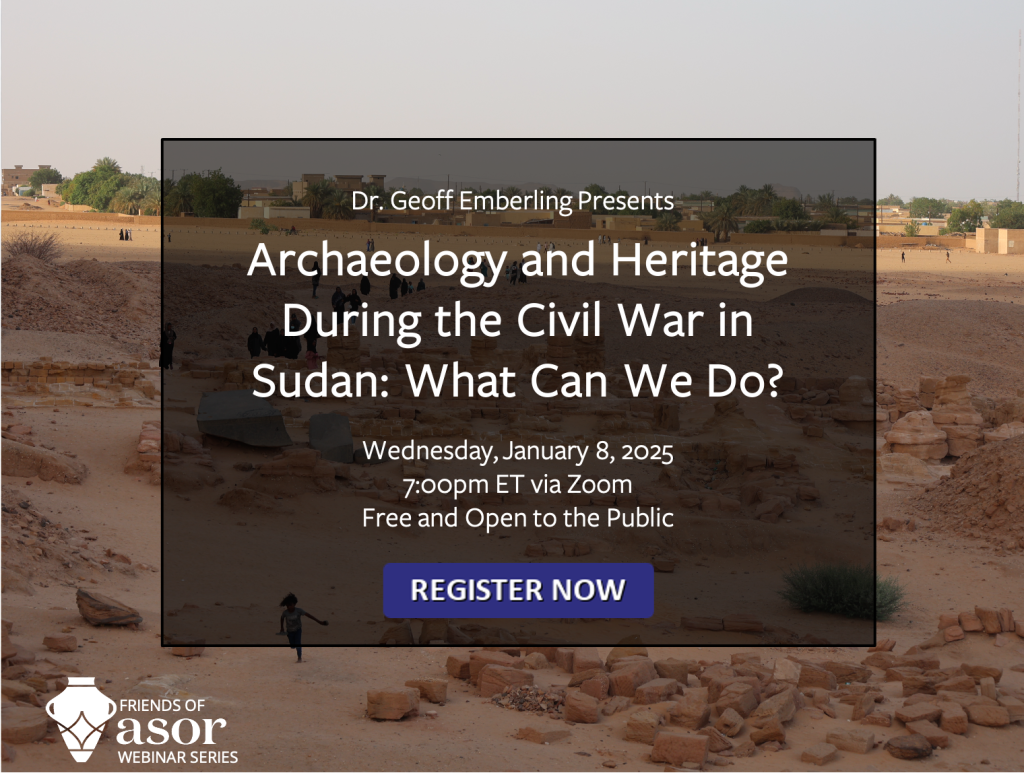
Friends of ASOR present the next webinar of the 2024-2025 season on January 8, 2025, at 7:00 pm EST, presented by Dr. Geoff Emberling. This webinar will be free and open to the public. Registration through Zoom (with a valid email address) is required. This webinar will be recorded and all registrants will be sent a recording link in the days following the webinar.
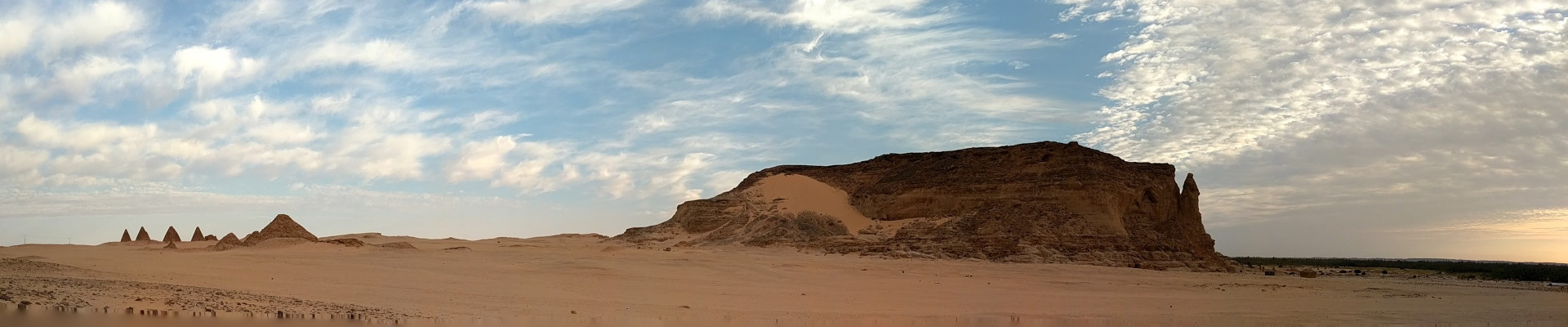
 Archaeologists are moving away from the colonial past of the discipline and are increasingly finding ways of engaging and collaborating with the communities where we work. Since 2016, the University of Michigan archaeological project in northern Sudan that Dr. Emberling co-directs has been conducting research at important sites of the ancient empire of Kush, first at the royal pyramid cemetery of Kushite kings and queens at El-Kurru (ca. 850-350 BCE) and more recently at the major urban center at Jebel Barkal (ancient Napata). Their work has come to be highly collaborative and engages extensively with local communities.
 This talk is not primarily about those excavations. Rather, it will discuss what has happened in Sudan since the outbreak of war in the country in April 2023 with a particular focus on heritage. It will provide an overview of the conflict, discuss real (and imagined) threats to museums, sites, and monuments, and discuss the wide range of responses by the Sudanese government, Sudanese scholars, international institutions, and foreign-based archaeologists. It will also focus on the work done with communities and colleagues at El-Kurru and Jebel Barkal.
 Collaborative relationships developed by the teams and others working in Sudan have made it possible in some cases to continue to work together on on-site management and protection and community engagement, even at a time of unimaginable struggle and hardship in the country. This work has raised the question of whether it is unethical to be focusing on heritage when people are suffering. However, Dr. Emberling and his team have found that through collaborative work (and flexible and generous funding), they are able to provide direct support to a large number of people to continue their archaeological work. This provides meaning and purpose for their archaeological colleagues, while their community engagement activities offer opportunities for local residents and refugees to relax, connect, and even have some fun in the midst of a dire situation. It turns out that heritage is always about people.
 Geoff Emberling is an archaeologist and museum curator at the Kelsey Museum of Archaeology, University of Michigan whose work has focused on the ancient Middle East and Northeast Africa. He is also a longtime ASOR member. He directed excavations at Tell Brak in northeastern Syria until 2004 and then took a position as Museum Director and Chief Curator at what is now the Institute for the Study of Ancient Civilizations (ISAC) at the University of Chicago. While there, he supervised an exhibit on the looting of museums and sites in Iraq around the 2003 US-led invasion.
At that time, he also began his work in northern Sudan (ancient Nubia), first supervising a permanent gallery on ancient Nubia at ISAC and then co-directing a University of Chicago project that contributed to archaeological salvage of the Merowe Dam at the 4th Cataract of the Nile. Since 2013, he has co-directed University of Michigan projects in Sudan, first at the royal pyramid cemetery of ancient Kush known as El-Kurru, and most recently at the Kushite urban center of Jebel Barkal (ancient Napata).
His more recent work has prioritized collaborative and community-engaged work with local professional colleagues and community members in Sudan, including site protection, conservation of monuments, and community education. This approach has prepared him and his team to continue to contribute to work at these sites as well as their protection during the current war in Sudan, which started in April 2023.











 The Richard J. Scheuer Medal. This award honors an individual who has provided truly outstanding, long-term support and service contributions to ASOR (this medal is awarded when such an individual is identified).
 The Charles U. Harris Service Award. This award is given in recognition of long-term and/or special service as an ASOR officer or Trustee (one award is given annually).
 The P. E. MacAllister Field Archaeology Award. This award honors an archaeologist who, during his/her/their career, has made outstanding contributions to ancient Near Eastern and eastern Mediterranean archaeology (one award is given annually).
 Community Engagement and Public Outreach Award. This award recognizes individuals, teams, and organizations who have initiated outstanding educational, informational, or practical projects (including but not limited to classes, programs, exhibits, resources, events, and platforms) with the goal of making subjects and information about the ancient world accessible to wider (particularly non-academic) audiences.
 Awarded to: Kevin McGeough, Professor of Archaeology, University of Lethbridge, for his work as Chair of the Publications Committee.
 Awarded to Jane DeRose Evans, Professor of Roman Art and Archaeology and Chair of Art History, Temple University, for her work as Chair of the Cultural Heritage Committee.
 Awarded to Tiffany Earley-Spadoni, Associate Professor of History, University of Central Florida, for her work as co-chair of the Early Career Scholars Committee.
 The W. F. Albright Service Award. This award honors an individual who has shown special support or made outstanding service contributions to one of the overseas centers (AIAR, CAARI), or to one of the overseas committees – the Baghdad Committee and the Damascus Committee. This award is given when such an individual is identified.
 The G. Ernest Wright Award. This award is given to the editor/author of the most substantial volume(s) dealing with archaeological material, excavation reports and material culture from the ancient Near East and eastern Mediterranean. This work must be the result of original research published within the past two years (one award is given annually).
 The Frank Moore Cross Award. This award is presented to the author/editor of the most substantial volume(s) related to the history and/or religion of the ancient Near East and Eastern Mediterranean. Primary consideration will be given to historical, epigraphic, textual, and comparative literary studies; or to works that advance and/or evaluate new methodological approaches to the literary record(s). This work must be the result of original research published during the past two years (one award is given annually).
 The Nancy Lapp Popular Book Award. This award is presented to the author/editor of a book published in the last two years that offers a new synthesis of archaeological or textual evidence intended to reach an audience of scholars as well as students and the broader public (one award is given annually).
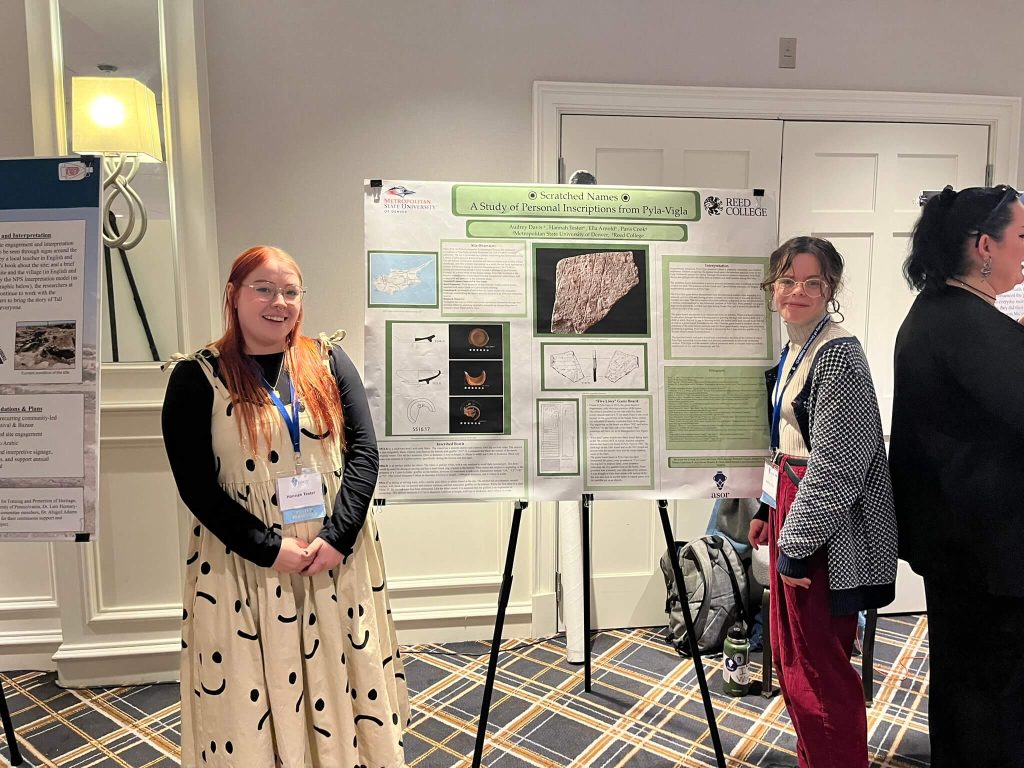
 The Joy Ungerleider Poster Award. This award is conferred upon the author(s) of the poster presenting the results of a study about ancient Near Eastern societies in a clear, legible fashion using original graphic content. Subject matter may be based in archaeological sciences, history, anthropology, epigraphy, ethnography, heritage or other scholarly approaches to understanding ancient people in the areas covered by ASOR (one award is given annually).
 Student Paper Award. This award is conferred upon the author(s) of a paper presented during the Annual Meeting that conveys the results of a study about ancient Near Eastern and wider Mediterranean societies in a clear, understandable, and convincing fashion. The first author and presenter of the paper must be a registered student at the time of presentation in order to be eligible for consideration for this award.