Table of Contents for NEA 86.2 (2023)

[vc_row fullwidth=”true” attached=”true” css=”.vc_custom_1496247803139{padding-top: 0px !important;padding-right: 0px !important;padding-bottom: 0px !important;padding-left: 0px !important;}”][vc_column][vc_single_image image=”90291″ img_size=”full” alignment=”center”][/vc_column][/vc_row][vc_row fullwidth=”true” css=”.vc_custom_1496682730308{padding-top: 10px !important;padding-right: 0px !important;padding-bottom: 0px !important;padding-left: 0px !important;}”][vc_column width=”1/12″ css=”.vc_custom_1496683820796{margin-right: 10px !important;}” offset=”vc_hidden-md vc_hidden-sm vc_hidden-xs”][vc_column_text]

 SHARE

[/vc_column_text][mk_image src=”http://www.asortest.org/wp-content/uploads/2017/01/social-fb-icon4.jpg” image_width=”42″ image_height=”42″ hover=”false” custom_url=”https://www.facebook.com/ASOResearch/” margin_bottom=”0″][mk_image src=”http://www.asortest.org/wp-content/uploads/2017/01/social-tw-icon4.jpg” image_width=”42″ image_height=”42″ hover=”false” custom_url=”https://twitter.com/ASOResearch?ref_src=twsrc%5Egoogle%7Ctwcamp%5Eserp%7Ctwgr%5Eauthor” margin_bottom=”0″][mk_image src=”http://www.asortest.org/wp-content/uploads/2017/01/social-in-icon4.jpg” image_width=”42″ image_height=”42″ hover=”false” custom_url=”https://www.linkedin.com/company/american-schools-of-oriental-research” margin_bottom=”0″][mk_image src=”http://www.asortest.org/wp-content/uploads/2017/01/social-ml-icon_7.jpg” image_width=”42″ image_height=”42″ hover=”false” custom_url=”mailto:asor@bu.edu” margin_bottom=”0″][mk_image src=”http://www.asortest.org/wp-content/uploads/2017/01/blog-icon3.jpg” image_width=”42″ image_height=”42″ hover=”false” custom_url=”http://asorblog.org/” margin_bottom=”0″][/vc_column][vc_column border_color=”rgba(255,255,255,0.01)” width=”1/6″ css=”.vc_custom_1496683923840{margin-right: 20px !important;border-left-width: 2px !important;padding-right: 20px !important;padding-left: 20px !important;border-left-color: #99422f !important;}”][mk_divider divider_color=”rgba(255,255,255,0.01)” thickness=”1″ margin_top=”3″ margin_bottom=”3″][vc_widget_sidebar sidebar_id=”ca-sidebar-39801″][/vc_column][vc_column border_color=”rgba(170,170,170,0.01)” width=”1/2″ css=”.vc_custom_1487276122024{margin-right: 10px !important;margin-bottom: 30px !important;border-right-width: 2px !important;border-bottom-width: 2px !important;padding-top: 30px !important;padding-right: 30px !important;padding-left: 20px !important;background-color: #ffffff !important;border-right-color: rgba(227,228,228,0.75) !important;border-bottom-color: rgba(227,228,228,0.75) !important;}”][vc_row_inner][vc_column_inner css=”.vc_custom_1570040186774{padding-right: 10px !important;}”][vc_column_text]

Table of Contents for Near Eastern Archaeology 86.2 (June 2023)

[/vc_column_text][/vc_column_inner][/vc_row_inner][mk_divider thickness=”1″ margin_top=”10″ margin_bottom=”30″][vc_row_inner][vc_column_inner width=”1/2″ css=”.vc_custom_1651246129117{padding-right: 10px !important;padding-bottom: 15px !important;}”][vc_single_image image=”89453″ img_size=”medium” alignment=”center” onclick=”custom_link” img_link_target=”_blank” link=”https://www.journals.uchicago.edu/toc/nea/2023/86/2″][/vc_column_inner][vc_column_inner width=”1/2″][vc_wp_text]
You can receive NEA (and other ASOR publications) through an ASOR Membership.
Please e-mail the Membership office if you have any questions.
[/vc_wp_text][/vc_column_inner][/vc_row_inner][mk_divider thickness=”1″ margin_top=”30″ margin_bottom=”30″][vc_row_inner][vc_column_inner css=”.vc_custom_1570041002103{padding-right: 10px !important;}”][vc_single_image image=”90275″ img_size=”full” alignment=”center” onclick=”custom_link” img_link_target=”_blank” link=”https://www.journals.uchicago.edu/doi/10.1086/724779″][mk_padding_divider size=”10″][vc_column_text]

Pp. 80–91: “A Review of Nemrik Culture Following Findings in the Southeast Area at Boncuklu Tarla during the 2020 Excavation Season: (Upper Tigris Valley, Mardin, Turkey)

Boncuklu Tarla, located in the upper Tigris Valley, has been inhabited continuously from the Proto-Neolithic until the end of the Pre-Pottery Neolithic. This uninterrupted sequence is not the result of a constant mounding process, but can be seen as the presence of a single occupation layer in large areas during different periods. One of these single-layered areas is located in the southeastern part of the settlement and is dated to the Pre-Pottery Neolithic A (PPNA). The finds unearthed during excavations in this section, in particular the architecture and chipped stones, display similar characteristics to Nemrik Culture, which is thought to be unique to the East Jezirah. These similarities are visible in the architecture and in regular find assemblages. This study considers newly recovered data from southeastern Boncuklu Tarla in regard to their apparent rapport with Nemrik Culture, as well as to outline different cultural aspects of the upper Mesopotamian PPNA.

ASOR Members with online access: log into ASOR’s Online Portal here. Once logged in, click the JOURNALS tab in the top navigation bar. From here you may select which journal you would like to read. If you have online access, you will see your selected journal’s current issue Table of Contents. Click on the “Current Issue” button and you will then be redirected to the University of Chicago Press’s (UCP) platform to immediately start reading any issue of your choice. Tutorials for how to log in to the Online Portal as well as how to navigate to the Portal Journals page can be found here. [/vc_column_text][/vc_column_inner][/vc_row_inner][mk_divider thickness=”1″ margin_top=”10″ margin_bottom=”30″][vc_row_inner][vc_column_inner css=”.vc_custom_1570041002103{padding-right: 10px !important;}”][vc_single_image image=”90276″ img_size=”full” alignment=”center” onclick=”custom_link” img_link_target=”_blank” link=”https://www.journals.uchicago.edu/doi/10.1086/724784″][mk_padding_divider size=”10″][vc_column_text]

Pp. 92-101: “A Unique Painted Sherd from the Mid-Sixth Millennium BCE Neolithic Context of Northeastern Iran,” by Kourosh Roustaei

Depicting animal motifs on pottery vessels of prehistoric cultures of the Iranian Plateau was begun as early as the turn of the seventh millennium BCE in the lowland Susiana Plain of southwestern Iran. Such motifs appeared in the Neolithic of northeastern Iran, known as Chakhmaq Culture, as early as the early sixth millennium BCE. During a stratigraphic excavation at a Neolithic site, dated to ca. 7000–5000 BCE, in the Shahroud Plain of northeastern Iran, a body sherd was found depicting a scene of mating goats rotating around the vessel. Regarding its early date, ca. 5650–5550 cal BCE, and its naturalistic way of representing the animal motifs, this sherd is unique among the contemporaneous Neolithic sites of the Iranian Plateau.

ASOR Members with online access: log into ASOR’s Online Portal here. Once logged in, click the JOURNALS tab in the top navigation bar. From here you may select which journal you would like to read. If you have online access, you will see your selected journal’s current issue Table of Contents. Click on the “Current Issue” button and you will then be redirected to the University of Chicago Press’s (UCP) platform to immediately start reading any issue of your choice. Tutorials for how to log in to the Online Portal as well as how to navigate to the Portal Journals page can be found here. [/vc_column_text][/vc_column_inner][/vc_row_inner][mk_divider thickness=”1″ margin_top=”10″ margin_bottom=”30″][vc_row_inner][vc_column_inner css=”.vc_custom_1570041002103{padding-right: 10px !important;}”][vc_single_image image=”90277″ img_size=”full” alignment=”center” onclick=”custom_link” img_link_target=”_blank” link=”https://www.journals.uchicago.edu/doi/10.1086/724781″][mk_padding_divider size=”10″][vc_column_text]Pp. 102-111: “attīma nannarat šamê u erṣetim—“You Are the Light of Heaven and Earth”: A Study of Two Cylinder Seals with the Goddess in a Nimbus from the Bible Lands Museum, Jerusalem,” by Takayoshi Oshima

In the hypothesis presented by the authors, stratified, nonmonumental inscriptions and their radiometric datings take center stage for the first time. It is in the living script of these texts rather than in the artificial alphabet of monuments that the evolution of the alphabet in Iron IIA can be studied properly. A key take-home lesson of the work is the significant ninth-century transformations of the alphabet from precursive Proto-Canaanite to supraregional cursive, thence to the well-known regional variants. Under the Omrides, the alphabet in Israel is attested minimally. No Omride texts were recognized at Samaria, nor Baashide texts at Tirzah. The newly founded West Semitic kingdoms since ca. 900 BCE will have constituted the cradle of the cursive, while papyrus or parchment and ink were the cursive’s likeliest vehicle. Alphabetic inscriptions on monuments, including Byblos, all cursive-inspired, will only have emerged in the last third of the ninth century.

ASOR Members with online access: log into ASOR’s Online Portal here. Once logged in, click the JOURNALS tab in the top navigation bar. From here you may select which journal you would like to read. If you have online access, you will see your selected journal’s current issue Table of Contents. Click on the “Current Issue” button and you will then be redirected to the University of Chicago Press’s (UCP) platform to immediately start reading any issue of your choice. Tutorials for how to log in to the Online Portal as well as how to navigate to the Portal Journals page can be found here. [/vc_column_text][/vc_column_inner][/vc_row_inner][mk_divider thickness=”1″ margin_top=”10″ margin_bottom=”30″][vc_row_inner][vc_column_inner css=”.vc_custom_1570041002103{padding-right: 10px !important;}”][vc_single_image image=”90281″ img_size=”full” alignment=”center” onclick=”custom_link” img_link_target=”_blank” link=”https://www.journals.uchicago.edu/doi/10.1086/724782″][mk_padding_divider size=”10″][vc_column_text]

Pp. 111-121: “Networks of Specialized Knowledge: Cult and Its Imagery in Early Iron Age Malizi and Palastina,” by Nathan Lovejoy

Recent research focused on the regions of Malatya and the northern Levant has allowed scholars to improve our understanding of the political history of the polities of Malizi and Palastina. The present article examines recent archaeological evidence from Arslantepe and several northern Levantine sites alongside a corpus of textual and iconographic data from the upper Euphrates and the northern Levant in an attempt to identify Early Iron Age networks of cultural exchange that resulted in shared specialized cultic and artistic knowledge. While networks of interaction between these regions may have begun as a product of persistent sociopolitical ties following the fragmentation of the Hittite Empire, this article proposes that it is due to the resilience of major cult centers that Malizi and Palastina were able to exchange specialized cultic knowledge and artistic traditions and employ them in the definition of their new Iron Age cultic and political communities.

ASOR Members with online access: log into ASOR’s Online Portal here. Once logged in, click the JOURNALS tab in the top navigation bar. From here you may select which journal you would like to read. If you have online access, you will see your selected journal’s current issue Table of Contents. Click on the “Current Issue” button and you will then be redirected to the University of Chicago Press’s (UCP) platform to immediately start reading any issue of your choice. Tutorials for how to log in to the Online Portal as well as how to navigate to the Portal Journals page can be found here. [/vc_column_text][/vc_column_inner][/vc_row_inner][mk_divider thickness=”1″ margin_top=”10″ margin_bottom=”30″][vc_row_inner][vc_column_inner css=”.vc_custom_1570041002103{padding-right: 10px !important;}”][vc_single_image image=”90282″ img_size=”full” alignment=”center” onclick=”custom_link” img_link_target=”_blank” link=”https://www.journals.uchicago.edu/doi/10.1086/724787″][mk_padding_divider size=”10″][vc_column_text]

Pp. 122-131: “Excavations of Parthian Human Bone Remains at Liyarsangbon Cemetery, Amlash District, Guilan Province, Iran: with Special Reference to Sexed Patterns of Burial and Gender Discrimination,” by Mohammad Reza Eghdami, Vali Jahani, Majid Gholamzadeh Roudbordeh, and Seyed Hashem Mousavi

[NB: This article deals with human remains] Forty-nine graves were excavated at Liyarsangbon cemetery during two working seasons. The area is covered with thin layers of lime, rocky, and calcareous materials, with a relatively neutral to alkaline soil pH, good for the preservation of human skeletal remains. The remains discovered in excavation were dated to the Parthian and Sasanid periods per the grave goods. With the exception of one adolescent girl killed by knife and some bones of both sexes with cut marks, disease was determined to be the standard cause of death in the population. Furthermore, statistical analysis indicates that neither social status nor sex bias influenced burial types in the Parthian period in the region under study.

ASOR Members with online access: log into ASOR’s Online Portal here. Once logged in, click the JOURNALS tab in the top navigation bar. From here you may select which journal you would like to read. If you have online access, you will see your selected journal’s current issue Table of Contents. Click on the “Current Issue” button and you will then be redirected to the University of Chicago Press’s (UCP) platform to immediately start reading any issue of your choice. Tutorials for how to log in to the Online Portal as well as how to navigate to the Portal Journals page can be found here. [/vc_column_text][/vc_column_inner][/vc_row_inner][mk_divider thickness=”1″ margin_top=”10″ margin_bottom=”30″][vc_row_inner][vc_column_inner css=”.vc_custom_1570041002103{padding-right: 10px !important;}”][vc_single_image image=”90283″ img_size=”full” alignment=”center” onclick=”custom_link” img_link_target=”_blank” link=”https://www.journals.uchicago.edu/doi/10.1086/724783″][mk_padding_divider size=”10″][vc_column_text]

Pp. 132-148: “Manufacturing Technology and Usage of Glass Fragments in Jahangir Dome and Goriye, Sasanid Sites in Western Iran,” by Bita Sodaei, Davoud Agha Aligol, and Leila Khosravi

This article introduces the Sasanid glass found during excavations at the western Iranian sites of Jahangir Dome and Goriye in Ilam province. In addition to architectural remains, different types of Sasanid pottery, glass, and metal vessels were found at these sites. Considering the importance of the glass industry in this period, the purpose of this article is to study the typological styles and chemical compositions of the glass fragments excavated at Jahangir Dome and Goriye to identify the origin of the vitreous materials. Glass fragments from these sites are divided into four groups based on the form and typology and include: vessel fragments, cosmetic containers, bracelets, and beads. According to the elemental analysis, silicon dioxide, sodium oxide, and calcium oxide are the main chemical components in the studied samples, and analyzed glass materials are of a plant-ash silica-soda-lime glass-type.

ASOR Members with online access: log into ASOR’s Online Portal here. Once logged in, click the JOURNALS tab in the top navigation bar. From here you may select which journal you would like to read. If you have online access, you will see your selected journal’s current issue Table of Contents. Click on the “Current Issue” button and you will then be redirected to the University of Chicago Press’s (UCP) platform to immediately start reading any issue of your choice. Tutorials for how to log in to the Online Portal as well as how to navigate to the Portal Journals page can be found here. [/vc_column_text][mk_divider thickness=”1″ margin_top=”10″ margin_bottom=”30″][vc_single_image image=”90284″ img_size=”full” alignment=”center” onclick=”custom_link” img_link_target=”_blank” link=”https://www.journals.uchicago.edu/doi/10.1086/724780″][vc_column_text]

Pp. 146-156: “The Climate Crisis and Archaeological Practice in the Middle East and North Africa: Mitigating the Climate Impact of the ASOR Annual Meeting,” by Virginia Herrmann and Lucas Stephens

The practice of archaeologists of the Middle East and North Africa (MENA) urgently needs decarbonization in the context of a climate crisis disproportionately affecting this region’s people and cultural heritage. Academic conferences are both an invaluable forum for research exchange and networking and a carbon-intensive practice presenting barriers to diversity, equity, and inclusion. This article summarizes a study by the authors and the ASOR Ad Hoc Climate Impact Committee on the carbon footprint of the American Society of Overseas Research Annual Meeting and potential strategies for making the meeting carbon neutral and accessible while retaining engagement. We find that the best strategies for significantly reducing the about 1266 t CO2e produced by the traditional meeting format are: (1) alternation of in-person and virtual meetings; (2) hybrid in-person and virtual meeting; (3) dual-component in-person/virtual meeting; or (4) distributed meeting with US and MENA hubs. Carefully vetted carbon offsets should be purchased for remaining emissions.

ASOR Members with online access: log into ASOR’s Online Portal here. Once logged in, click the JOURNALS tab in the top navigation bar. From here you may select which journal you would like to read. If you have online access, you will see your selected journal’s current issue Table of Contents. Click on the “Current Issue” button and you will then be redirected to the University of Chicago Press’s (UCP) platform to immediately start reading any issue of your choice. Tutorials for how to log in to the Online Portal as well as how to navigate to the Portal Journals page can be found here. [/vc_column_text][/vc_column_inner][/vc_row_inner][mk_divider thickness=”1″ margin_top=”10″ margin_bottom=”30″][vc_single_image image=”90285″ img_size=”full” alignment=”center” onclick=”custom_link” img_link_target=”_blank” link=”https://www.journals.uchicago.edu/doi/10.1086/724786″][vc_column_text]

Pp. 158-165: “Revitalizing Legacy Biblical Archaeology Collections: The Case of the Oberlin Near East Study Collection,” by Julian Hirsch and Amy V. Margaris

Biblical archaeology collections at colleges and universities are typically remnants of an earlier era of collecting and teaching. These collections nonetheless still hunker, dusty and underused, in many university closets today. What larger stories do their histories reveal, and what good are legacy teaching collections now? In this article a recent Oberlin College graduate and one of his college faculty mentors team up to address these questions and offer practical advice for revitalizing legacy biblical archaeology collections, using the Oberlin Near East Study Collection (ONESC) as a case study.

ASOR Members with online access: log into ASOR’s Online Portal here. Once logged in, click the JOURNALS tab in the top navigation bar. From here you may select which journal you would like to read. If you have online access, you will see your selected journal’s current issue Table of Contents. Click on the “Current Issue” button and you will then be redirected to the University of Chicago Press’s (UCP) platform to immediately start reading any issue of your choice. Tutorials for how to log in to the Online Portal as well as how to navigate to the Portal Journals page can be found here. [/vc_column_text][/vc_column][vc_column border_color=”rgba(170,170,170,0.01)” width=”1/6″ css=”.vc_custom_1496684098866{margin-right: 5px !important;margin-bottom: 20px !important;border-right-width: 2px !important;border-bottom-width: 2px !important;padding-top: 30px !important;padding-right: 10px !important;padding-left: 10px !important;background-color: #ffffff !important;border-right-color: rgba(227,228,228,0.75) !important;border-bottom-color: rgba(227,228,228,0.75) !important;}”][vc_wp_posts title=”BROWSE THE NEWS ARCHIVE” number=”4″][/vc_column][vc_column border_color=”rgba(170,170,170,0.01)” width=”1/6″ css=”.vc_custom_1496684008271{margin-right: 10px !important;margin-bottom: 30px !important;border-right-width: 2px !important;border-bottom-width: 2px !important;padding-top: 30px !important;padding-right: 20px !important;padding-left: 20px !important;background-color: #ffffff !important;border-right-color: rgba(227,228,228,0.75) !important;border-bottom-color: rgba(227,228,228,0.75) !important;}”][vc_column_text] [/vc_column_text][/vc_column][/vc_row]
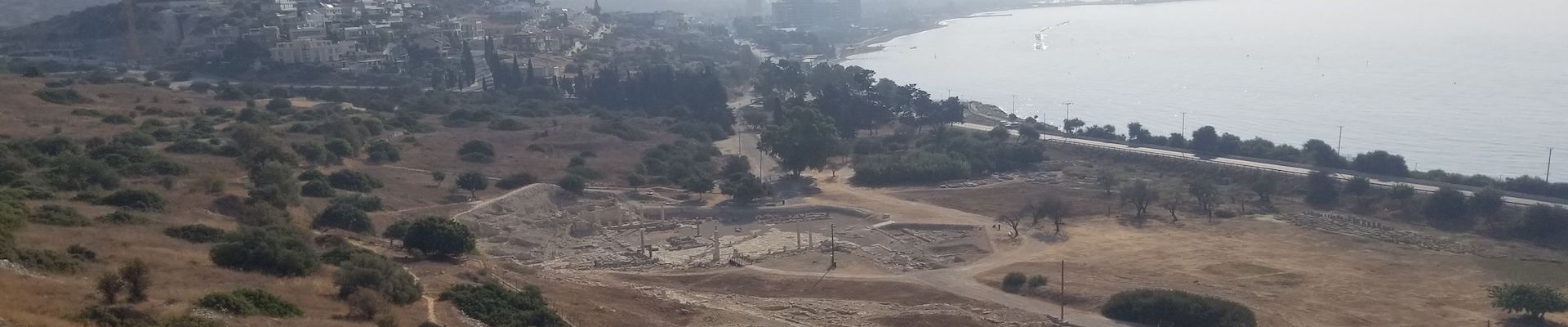
Table of Contents for BASOR 389 (May 2023)

[vc_row fullwidth=”true” attached=”true” css=”.vc_custom_1496247803139{padding-top: 0px !important;padding-right: 0px !important;padding-bottom: 0px !important;padding-left: 0px !important;}”][vc_column][vc_single_image image=”85308″ img_size=”full” alignment=”center”][/vc_column][/vc_row][vc_row fullwidth=”true” css=”.vc_custom_1496682730308{padding-top: 10px !important;padding-right: 0px !important;padding-bottom: 0px !important;padding-left: 0px !important;}”][vc_column width=”1/12″ css=”.vc_custom_1496683820796{margin-right: 10px !important;}” offset=”vc_hidden-md vc_hidden-sm vc_hidden-xs”][vc_column_text]

 SHARE

[/vc_column_text][mk_image src=”http://www.asortest.org/wp-content/uploads/2017/01/social-fb-icon4.jpg” image_width=”42″ image_height=”42″ hover=”false” custom_url=”https://www.facebook.com/ASOResearch/” margin_bottom=”0″][mk_image src=”http://www.asortest.org/wp-content/uploads/2017/01/social-tw-icon4.jpg” image_width=”42″ image_height=”42″ hover=”false” custom_url=”https://twitter.com/ASOResearch?ref_src=twsrc%5Egoogle%7Ctwcamp%5Eserp%7Ctwgr%5Eauthor” margin_bottom=”0″][mk_image src=”http://www.asortest.org/wp-content/uploads/2017/01/social-in-icon4.jpg” image_width=”42″ image_height=”42″ hover=”false” custom_url=”https://www.linkedin.com/company/american-schools-of-oriental-research” margin_bottom=”0″][mk_image src=”http://www.asortest.org/wp-content/uploads/2017/01/social-ml-icon_7.jpg” image_width=”42″ image_height=”42″ hover=”false” custom_url=”mailto:asor@bu.edu” margin_bottom=”0″][mk_image src=”http://www.asortest.org/wp-content/uploads/2017/01/blog-icon3.jpg” image_width=”42″ image_height=”42″ hover=”false” custom_url=”http://asorblog.org/” margin_bottom=”0″][/vc_column][vc_column border_color=”rgba(255,255,255,0.01)” width=”1/6″ css=”.vc_custom_1496683923840{margin-right: 20px !important;border-left-width: 2px !important;padding-right: 20px !important;padding-left: 20px !important;border-left-color: #99422f !important;}”][mk_divider divider_color=”rgba(255,255,255,0.01)” thickness=”1″ margin_top=”3″ margin_bottom=”3″][vc_widget_sidebar sidebar_id=”ca-sidebar-39801″][/vc_column][vc_column border_color=”rgba(170,170,170,0.01)” width=”1/2″ css=”.vc_custom_1487276122024{margin-right: 10px !important;margin-bottom: 30px !important;border-right-width: 2px !important;border-bottom-width: 2px !important;padding-top: 30px !important;padding-right: 30px !important;padding-left: 20px !important;background-color: #ffffff !important;border-right-color: rgba(227,228,228,0.75) !important;border-bottom-color: rgba(227,228,228,0.75) !important;}”][vc_row_inner][vc_column_inner css=”.vc_custom_1651159200767{padding-right: 15px !important;}”][vc_column_text]

Table of Contents for Bulletin of ASOR 389 (May 2023)

[/vc_column_text][/vc_column_inner][/vc_row_inner][mk_divider thickness=”1″ margin_top=”10″ margin_bottom=”30″][vc_row_inner][vc_column_inner width=”1/2″ css=”.vc_custom_1651245957391{padding-right: 10px !important;padding-bottom: 15px !important;}”][vc_single_image image=”89446″ img_size=”medium” alignment=”center” onclick=”custom_link” img_link_target=”_blank” link=”https://www.journals.uchicago.edu/toc/basr/current”][/vc_column_inner][vc_column_inner width=”1/2″][vc_wp_text]
You can receive BASOR (and other ASOR publications) through an ASOR Membership.
Please e-mail the Membership office if you have any questions.
[/vc_wp_text][/vc_column_inner][/vc_row_inner][mk_divider thickness=”1″ margin_top=”30″ margin_bottom=”30″][vc_row_inner][vc_column_inner css=”.vc_custom_1651155052143{padding-right: 10px !important;}”][vc_single_image image=”90311″ img_size=”full” alignment=”center” onclick=”custom_link” img_link_target=”_blank” link=”https://www.journals.uchicago.edu/doi/10.1086/724060″][mk_padding_divider size=”10″][vc_column_text]

Pp. 1-19: “When “the Sweet Gifts of Bacchus” Ended—New Archaeological Evidence for Settlement Changes and the Decline of Wine Production in Late Antique Southern Palestine,” by Gideon Avni, Guy Bar-Oz, and Gil Gambash

Based on the accumulated data from numerous excavations in the hinterland of Gaza and Ashkelon and the results of the comprehensive bioarchaeological research on Late Antique settlement and economy of the Negev Highlands, this article addresses the decline of the flourishing wine industry of southern Palestine, dating it to the second half of the 6th century c.e. The decline in wine production in the region had a direct effect on the rapid abatement of Elusa, the main city of the Negev, and Shivta, a wealthy large village in the western Negev Highlands. Consequently, the extensive system of industrial farms that formed the hub of the flourishing wine industry declined at the same time. This article suggests connecting these events with changes in the patterns of demand, supply, and production of the “sweet gift of Bacchus,” taking into consideration regional aspects, environmental fluctuations, economic transformations, and the decline of consumption markets.

ASOR Members with online access: log into ASOR’s Online Portal here. Once logged in, click the JOURNALS tab in the top navigation bar. From here you may select which journal you would like to read. If you have online access, you will see your selected journal’s current issue Table of Contents. Click on the “Current Issue” button and you will then be redirected to the University of Chicago Press’s (UCP) platform to immediately start reading any issue of your choice. Tutorials for how to log in to the Online Portal as well as how to navigate to the Portal Journals page can be found here.[/vc_column_text][/vc_column_inner][/vc_row_inner][mk_divider thickness=”1″ margin_top=”10″ margin_bottom=”30″][vc_row_inner][vc_column_inner css=”.vc_custom_1651155064988{padding-right: 10px !important;}”][vc_single_image image=”90312″ img_size=”full” alignment=”center” onclick=”custom_link” img_link_target=”_blank” link=”https://www.journals.uchicago.edu/doi/10.1086/724049″][mk_padding_divider size=”10″][vc_column_text]

Pp. 21-33: “Grain Mills from the Late Roman Legionary Camp in Palmyra,” by Grzegorz Majcherek

The Late Antique grain mills from the Roman army camp in Palmyra (Syria) are the first archaeologically documented examples of Roman geared mills in the Levant. Their discovery in the 1980s by the Polish Expedition excavating the Camp of Diocletian provided a body of data that has proved to be of significance for students of both military architecture in Late Antiquity and ancient milling technology. This paper presents the evidence for an advanced type of geared mill and discusses its implications in reference to the existing theoretical reconstruction of the Vitruvian mill.

ASOR Members with online access: log into ASOR’s Online Portal here. Once logged in, click the JOURNALS tab in the top navigation bar. From here you may select which journal you would like to read. If you have online access, you will see your selected journal’s current issue Table of Contents. Click on the “Current Issue” button and you will then be redirected to the University of Chicago Press’s (UCP) platform to immediately start reading any issue of your choice. Tutorials for how to log in to the Online Portal as well as how to navigate to the Portal Journals page can be found here.[/vc_column_text][/vc_column_inner][/vc_row_inner][mk_divider thickness=”1″ margin_top=”10″ margin_bottom=”30″][vc_row_inner][vc_column_inner css=”.vc_custom_1651155073486{padding-right: 10px !important;}”][vc_single_image image=”90313″ img_size=”full” alignment=”center” onclick=”custom_link” img_link_target=”_blank” link=”https://www.journals.uchicago.edu/doi/10.1086/724059″][mk_padding_divider size=”10″][vc_column_text]

Pp. 35-64: “Middle Islamic Rural Occupation at Kani Shaie in Iraqi Kurdistan,” by Mustafa Ahmad and Steve Renette

A wave of new fieldwork in Iraqi Kurdistan during the past decade offers the opportunity to study societies of the Islamic periods from an archaeological perspective. Unfortunately, our current understanding of ceramic typology and chronology in the region still hinges overwhelmingly on datasets from major urban centers and the long-standing analysis of the technological development of glazed wares. The material culture of rural communities, on the other hand, is poorly understood. This causes problems for the reconstruction of the social and economic history of Islamic-era societies, and for survey projects that aim to assess longue durée changes in settlement patterns based on chronological assessments of surface collections. This article presents a coherent corpus of Middle Islamic pottery retrieved from a series of large pits from the site of Kani Shaie in Sulaymaniyah Governorate, Iraqi Kurdistan. Given the small size of the site, the lack of contemporary settlement remains, and the nature of the ceramic assemblage, it is proposed that these pits were used to dump refuse by a small nomadic community or household that returned to the site for a number of years in the 11th–13th century c.e. This small dataset offers glimpses into the lifeways of people who inhabited the border zone between the urbanized lowlands of Mesopotamia and the Zagros Highlands.

ASOR Members with online access: log into ASOR’s Online Portal here. Once logged in, click the JOURNALS tab in the top navigation bar. From here you may select which journal you would like to read. If you have online access, you will see your selected journal’s current issue Table of Contents. Click on the “Current Issue” button and you will then be redirected to the University of Chicago Press’s (UCP) platform to immediately start reading any issue of your choice. Tutorials for how to log in to the Online Portal as well as how to navigate to the Portal Journals page can be found here.[/vc_column_text][/vc_column_inner][/vc_row_inner][mk_divider thickness=”1″ margin_top=”10″ margin_bottom=”30″][vc_row_inner][vc_column_inner css=”.vc_custom_1651155081236{padding-right: 10px !important;}”][vc_single_image image=”90338″ img_size=”full” alignment=”center” onclick=”custom_link” img_link_target=”_blank” link=”https://www.journals.uchicago.edu/doi/10.1086/724269″][mk_padding_divider size=”10″][vc_column_text]

Pp. 65-73: “Grain Tribute in Hittite Syria and the Fall of Ugarit,” by Yoram Cohen and Eduardo Torrecilla

This paper examines the term mānaḫātu in the letters from Hittite officials found at the House of Urtenu from Ugarit and recently published in the Ras Shamra-Ougarit 23 volume (RSO 23, Lackenbacher and Malbran-Labat 2016). This paper proposes that the exact meaning of mānaḫātu—in Ugaritic mnḥ(t)—depends on the context, since it was both a vassal tribute due to the empire by the Ugarit palace (consisting of vast amounts of grain staples) and a form of taxation imposed by the Ugarit palace on merchants and citizens of the kingdom at a local level. In addition, the letters concerning mānaḫātu reveal that the Hittite pressure on its vassal to meet its requirements likely contributed much to exacerbate the food shortage suffered by the kingdom of Ugarit, not long before its fall in the early 12th century b.c.

ASOR Members with online access: log into ASOR’s Online Portal here. Once logged in, click the JOURNALS tab in the top navigation bar. From here you may select which journal you would like to read. If you have online access, you will see your selected journal’s current issue Table of Contents. Click on the “Current Issue” button and you will then be redirected to the University of Chicago Press’s (UCP) platform to immediately start reading any issue of your choice. Tutorials for how to log in to the Online Portal as well as how to navigate to the Portal Journals page can be found here.[/vc_column_text][/vc_column_inner][/vc_row_inner][mk_divider thickness=”1″ margin_top=”10″ margin_bottom=”30″][vc_row_inner][vc_column_inner css=”.vc_custom_1651155088757{padding-right: 10px !important;}”][vc_single_image image=”90314″ img_size=”full” alignment=”center” onclick=”custom_link” img_link_target=”_blank” link=”https://www.journals.uchicago.edu/doi/10.1086/724363″][mk_padding_divider size=”10″][vc_column_text]

Pp. 75-97: “Honoring the Elite Deceased: A Re-Examination of the Shechem Courtyard Complexes,” by Holly A. Winter

The function of the enigmatic Middle Bronze Age Courtyard Complexes at Shechem has remained at the forefront of debate concerning the courtyard palace form. Shechem’s excavators have been unable to agree on the function of the Courtyard Complexes, with some viewing them as palaces and others as temples. Since the only detailed analysis of the Shechem Courtyard Complexes occurred almost four decades ago (Toombs 1985), a reassessment of the material is overdue. An analysis of the Phase 902 Courtyard Complex, the best preserved of the five sequential complexes, supports its architectural association with the courtyard palace form (Oren 1992), while also highlighting a commemorative function, centered around housing and honoring the deceased elite and administering the ancestral funerary cult. Moreover, a functional link with the later Migdol temple and standing stones suggests at least a partial transference of function to this new, and possibly introduced, temple form in the later Middle Bronze Age. Therefore, the Shechem Courtyard Complexes are to be associated with the courtyard palace form, along with a primarily funerary/commemorative function and are perhaps better viewed as elite funerary complexes.

ASOR Members with online access: log into ASOR’s Online Portal here. Once logged in, click the JOURNALS tab in the top navigation bar. From here you may select which journal you would like to read. If you have online access, you will see your selected journal’s current issue Table of Contents. Click on the “Current Issue” button and you will then be redirected to the University of Chicago Press’s (UCP) platform to immediately start reading any issue of your choice. Tutorials for how to log in to the Online Portal as well as how to navigate to the Portal Journals page can be found here.[/vc_column_text][/vc_column_inner][/vc_row_inner][mk_divider thickness=”1″ margin_top=”10″ margin_bottom=”30″][vc_row_inner][vc_column_inner css=”.vc_custom_1651155096100{padding-right: 10px !important;}”][vc_single_image image=”90315″ img_size=”full” alignment=”center” onclick=”custom_link” img_link_target=”_blank” link=”https://www.journals.uchicago.edu/doi/10.1086/724058″][mk_padding_divider size=”10″][vc_column_text]

Pp. 99-119: “The Bamu Stela, Shahr-i Fadak, and Tapeh Shaho: Why Were so Many Monuments Erected around Mount Bamu?” by Sajjad Alibaigi and John MacGinnis

The reliefs and stelae created in the area stretching from Rania in Iraqi Kurdistan to Sar Pol-e Zahab in Iran are among the outstanding cultural materials of the late 3rd and early 2nd millennium b.c., supplementing the information in cuneiform texts for telling the story of important political and military events in the region. Based on the concentration of these reliefs on the northern side of the present-day city of Sar Pol-e Zahab and the picture presented in the cuneiform texts, it appears that the region along the Great Khorasan Road—and especially the area surrounding Sar Pol-e Zahab (ancient Halman)—was the center of major political and military events of that time. The recent discovery of a new stela at Sarab-e Sey Khan and two new rock reliefs at Darvan-e Duhol, coming in addition to the long-known relief at Shaikhan and the stela discovered on Mount Bamu in 1955, requires us to re-evaluate our understanding of this sector of the western Zagros in the late 3rd and early 2nd millennium b.c. This article addresses the question as to why no less than five important monuments were erected in the vicinity of Mount Bamu. The results suggest that these monuments commemorate victories by rulers over the indigenous Bronze Age populations from the mountain kingdoms that lay between Mesopotamia and the high Zagros. Furthermore, study of the archaeological landscape leads to some proposals for the identifications of the polities that were the objects of these attacks. Specifically, sites on the western slopes of Mount Bamu such as Tapeh Shaho, Tapeh Ama-Husein, and Tapeh Qalandari, all three of which appear to have been occupied at this time, lead us to surmise that the main purpose of the attacks on this area was to conquer these settlements, and that these monuments were erected to commemorate these victories.

ASOR Members with online access: log into ASOR’s Online Portal here. Once logged in, click the JOURNALS tab in the top navigation bar. From here you may select which journal you would like to read. If you have online access, you will see your selected journal’s current issue Table of Contents. Click on the “Current Issue” button and you will then be redirected to the University of Chicago Press’s (UCP) platform to immediately start reading any issue of your choice. Tutorials for how to log in to the Online Portal as well as how to navigate to the Portal Journals page can be found here.[/vc_column_text][/vc_column_inner][/vc_row_inner][mk_divider thickness=”1″ margin_top=”10″ margin_bottom=”30″][vc_row_inner][vc_column_inner css=”.vc_custom_1651155102141{padding-right: 10px !important;}”][vc_single_image image=”90316″ img_size=”full” alignment=”center” onclick=”custom_link” img_link_target=”_blank” link=”https://www.journals.uchicago.edu/doi/10.1086/724418″][mk_padding_divider size=”10″][vc_column_text]

Pp. 121-163: “Towards a Better Understanding of the Chronological and Geographical Distribution Patterns of Plain and Painted Handmade Wares in Bilād al-Shām,” by Piotr Makowski

Though it has now been more than 90 years since the phenomenon of plain and painted handmade wares first became apparent to field archaeologists working at historical sites in the territory of Bilād al-Shām, so far relatively little effort has been made to explain it sufficiently. The current paper provides an introductory survey of the available literature and attempts to organize the overall discussion regarding the patterns of their chronological and geographical distribution. Particular attention has been paid to the dating of the appearance of handmade wares and the first phase of their development. Illustrating the occurrence of handmade wares in the form of maps and charts, this article also intends to assess the regional differences in their status as well as the mutual relationship between plain and painted wares.

ASOR Members with online access: log into ASOR’s Online Portal here. Once logged in, click the JOURNALS tab in the top navigation bar. From here you may select which journal you would like to read. If you have online access, you will see your selected journal’s current issue Table of Contents. Click on the “Current Issue” button and you will then be redirected to the University of Chicago Press’s (UCP) platform to immediately start reading any issue of your choice. Tutorials for how to log in to the Online Portal as well as how to navigate to the Portal Journals page can be found here.[/vc_column_text][/vc_column_inner][/vc_row_inner][mk_divider thickness=”1″ margin_top=”10″ margin_bottom=”30″][vc_row_inner][vc_column_inner css=”.vc_custom_1651155108357{padding-right: 10px !important;}”][vc_single_image image=”90317″ img_size=”full” alignment=”center” onclick=”custom_link” img_link_target=”_blank” link=”https://www.journals.uchicago.edu/doi/10.1086/724419″][mk_padding_divider size=”10″][vc_column_text]

Pp. 165-189: “Drowned Landscapes: The Rediscovered Archaeological Heritage of the Mosul Dam Reservoir,” by Paola Sconzo, Francesca Simi, and Andrea Titolo

Like natural catastrophes or armed conflicts, resource extraction projects herald the alteration or destruction of natural and cultural landscapes alike. Dam construction is a major threat to cultural heritage in Western Asian archaeology. One event may result in obliterating hundreds of sites, most of which never reappear or do so only sporadically following cyclical water fluctuation. Destruction of sites remains ongoing, necessitating constant assessment of damage and the establishment of strategies of documentation and maintenance. This paper proposes a new paradigm for future safeguarding and, more widely, a new tool for managing contiguous terrestrial and lacustrine cultural zones. It outlines a new set of cost-efficient tools for observing these archaeological localities’ “emergence patterns” and quickly assessing damage timescales and site areas. As a case study, Iraq’s largest hydroelectric basin, the Mosul Dam reservoir on the upper Tigris, is discussed, as it offers several insights into tackling endemic issues of site recording, monitoring, and threat assessment in a constantly shifting environment. The research has profited from an unexpected drought in 2018 yielding archaeological sites and villages thought forever lost and is informed by new archaeological projects recently undertaken on the eastern bank of the lake.

ASOR Members with online access: log into ASOR’s Online Portal here. Once logged in, click the JOURNALS tab in the top navigation bar. From here you may select which journal you would like to read. If you have online access, you will see your selected journal’s current issue Table of Contents. Click on the “Current Issue” button and you will then be redirected to the University of Chicago Press’s (UCP) platform to immediately start reading any issue of your choice. Tutorials for how to log in to the Online Portal as well as how to navigate to the Portal Journals page can be found here.[/vc_column_text][/vc_column_inner][/vc_row_inner][mk_divider thickness=”1″ margin_top=”10″ margin_bottom=”30″][vc_row_inner][vc_column_inner css=”.vc_custom_1651155116429{padding-right: 10px !important;}”][vc_single_image image=”90318″ img_size=”full” alignment=”center” onclick=”custom_link” img_link_target=”_blank” link=”https://www.journals.uchicago.edu/doi/10.1086/724457″][mk_padding_divider size=”10″][vc_column_text]

Pp. 191–216: “The Archaeology and History of Rock-cut Cisterns and Open Water Reservoirs in the Negev Highlands,” by Andrea Junge, Zachary C. Dunseth, Ruth Shahack-Gross, Israel Finkelstein, and Markus Fuchs

This article provides the final assessment of a large-scale optically stimulated luminescence (OSL) dating project of water installations in the arid Negev Highlands, southern Israel. Results from five open reservoirs and five rock-cut cisterns are reported. By sampling spoil piles, feeding channels, and accumulation of sediments within reservoirs and cisterns, their construction and phases of maintenance and abandonment are dated. Conventional wisdom argued for progress from simpler open reservoirs in the Bronze or Iron Ages to the more sophisticated rock-cut cisterns of the Nabatean–Byzantine periods. It is shown that open reservoirs were dug throughout the history of the region, likely from the Early or Intermediate Bronze Ages until the medieval period, including periods with no stone-built remains in the region. The construction of subterranean cisterns, which calls for more resources and skill, characterize the Late Roman/Byzantine to Early Islamic period. The significance of these results for reconstructing the history of human activity in the region is also discussed.

ASOR Members with online access: log into ASOR’s Online Portal here. Once logged in, click the JOURNALS tab in the top navigation bar. From here you may select which journal you would like to read. If you have online access, you will see your selected journal’s current issue Table of Contents. Click on the “Current Issue” button and you will then be redirected to the University of Chicago Press’s (UCP) platform to immediately start reading any issue of your choice. Tutorials for how to log in to the Online Portal as well as how to navigate to the Portal Journals page can be found here.[/vc_column_text][/vc_column_inner][/vc_row_inner][vc_row_inner][vc_column_inner css=”.vc_custom_1651155116429{padding-right: 10px !important;}”][vc_single_image image=”90319″ img_size=”full” alignment=”center” onclick=”custom_link” img_link_target=”_blank” link=”https://www.journals.uchicago.edu/doi/10.1086/724364″][mk_padding_divider size=”10″][vc_column_text]

Pp. 217-234: “The Identification of the Deity Aramiš/s and the Locations of Qarnē/Qarnīna and Azaʾi/Aṣî in the Tell Taʿyinat Treaty,” by K. Lawson Younger Jr.

For many years not much was known about a deity Aramiš/Aramis, being only mentioned in a few personal names. His identity remained a mystery. But with the discovery of the Esarhaddon Succession Treaty from Tell Taʿyinat, an association with the city and land of Qarnē/Qarnīna, the city and land of ˹azaʾi˺, came to light. Based on the available data found in the personal names, toponymy, and iconography, this article explores the possible identification of this deity and the two toponyms associated with it.

ASOR Members with online access: log into ASOR’s Online Portal here. Once logged in, click the JOURNALS tab in the top navigation bar. From here you may select which journal you would like to read. If you have online access, you will see your selected journal’s current issue Table of Contents. Click on the “Current Issue” button and you will then be redirected to the University of Chicago Press’s (UCP) platform to immediately start reading any issue of your choice. Tutorials for how to log in to the Online Portal as well as how to navigate to the Portal Journals page can be found here.[/vc_column_text][/vc_column_inner][/vc_row_inner][mk_divider thickness=”1″ margin_top=”10″ margin_bottom=”30″][/vc_column][vc_column border_color=”rgba(170,170,170,0.01)” width=”1/6″ css=”.vc_custom_1496684098866{margin-right: 5px !important;margin-bottom: 20px !important;border-right-width: 2px !important;border-bottom-width: 2px !important;padding-top: 30px !important;padding-right: 10px !important;padding-left: 10px !important;background-color: #ffffff !important;border-right-color: rgba(227,228,228,0.75) !important;border-bottom-color: rgba(227,228,228,0.75) !important;}”][vc_wp_posts title=”BROWSE THE NEWS ARCHIVE” number=”4″][/vc_column][vc_column border_color=”rgba(170,170,170,0.01)” width=”1/6″ css=”.vc_custom_1496684008271{margin-right: 10px !important;margin-bottom: 30px !important;border-right-width: 2px !important;border-bottom-width: 2px !important;padding-top: 30px !important;padding-right: 20px !important;padding-left: 20px !important;background-color: #ffffff !important;border-right-color: rgba(227,228,228,0.75) !important;border-bottom-color: rgba(227,228,228,0.75) !important;}”][vc_widget_sidebar sidebar_id=”ca-sidebar-99363″][/vc_column][/vc_row]

Fieldwork Report: Krysten Cruz

Studying the Ancient Inhabitants of the Ayioi Omoloyites Tombs

Krysten Cruz, 2022 Shirlee Meyers-G. Ernest Wright Fellowship Recipient

Scattered throughout the island of Cyprus are tombs both excavated and yet to be discovered.

In 2006, three rock-cut tombs were excavated by the Department of Antiquities in a salvage effort in the Ayioi Omoloyites neighborhood in Nicosia, Cyprus. Tombs 47 and 48 are smaller and date to the Hellenistic period, while Tomb 49 is much larger and dates to the Early Christian period and was likely used as an ossuary. This summer I worked with the Ayioi Omoloyites Bioarchaeological Project to analyze some of the skeletal material removed as part of that salvage effort. With our analyses, we are hoping to understand some aspects of the lives of these people.

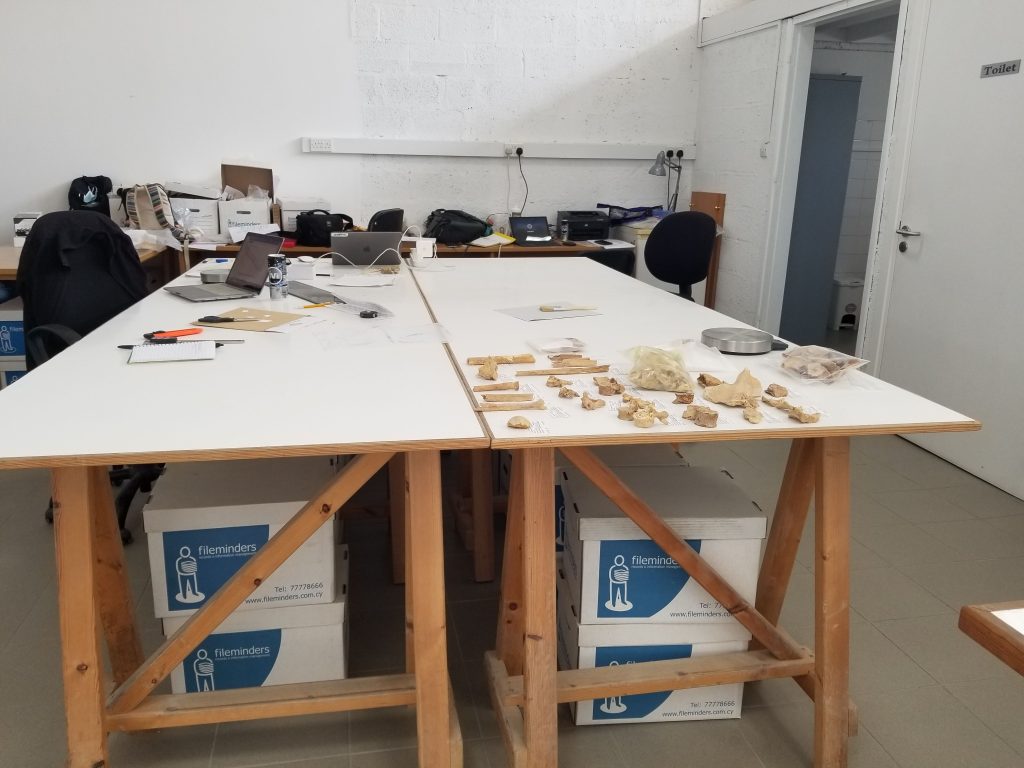
While in Nicosia for this research I stayed at the Cyprus American Archaeological Research Institute. Each day we would leave to work at a lab space provided by the Department of Antiquities where over 60 boxes of skeletal material for this project were stored.

Lab space provided by the Department of Antiquities


Analysis of skeletal material

I helped continue our search for answers by working through more of the commingled skeletal material from Tomb 49. Commingling occurs when the skeletons of two or more individuals are mixed, and currently in Tomb 49 there are over 250 individuals present. Due to the fact that there were no articulated individuals and all of this material is commingled and fragmentary, I would start an analysis by laying out the skeletal elements that were part of a specific context sorting them by the type of bone, what side of the body that element was from, and then which part of the bone it is. I would then conduct an inventory and basic analysis of this material by documenting various standard osteological observations, which also included taking measurements when possible as well as describing any trauma and diseases that may have manifested on the bones. Often there are indicators of stress or disease that can help us understand the health or habitual activities of these individuals when they were alive. We commonly see arthritis in the joints as well as pathologies of the vertebrae which can indicate that someone was likely participating in manual labor.

Although I participated in these general analyses, my main goal of the summer was to conduct research of my own by observing specific areas of the humerus (arm) and femur (thigh). I was looking for skeletal lesions that look like porous areas or spongy bone. There is substantial discussion in the literature about where these lesions are specifically located and what they are supposed to look like in order to be considered evidence of disease or just an indicator of a particular lifestyle, so I tried to take notes and detailed photos. I am attempting to assess whether these lesions are related to a common disease found on the island, or whether they are actually a sign that these individuals were participating in specific activities. This research would help us understand more about the populations during these two different time periods.

Even though we spent a lot of time in the lab working, we still had the opportunity to travel around the island and visit other archaeological sites and museums. It was great to see occupations across different periods in time, and I was particularly excited to go to the Archaeological Museum of the Larnaka District as it has been closed in previous years and contained material from some of the sites we had previously seen.

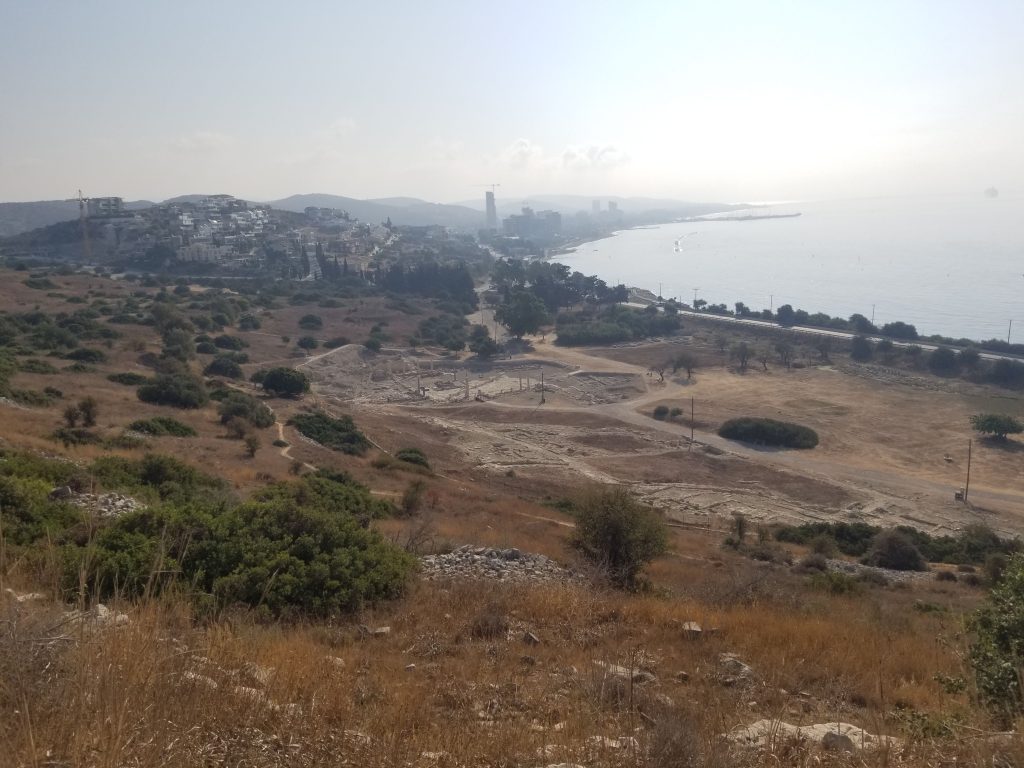
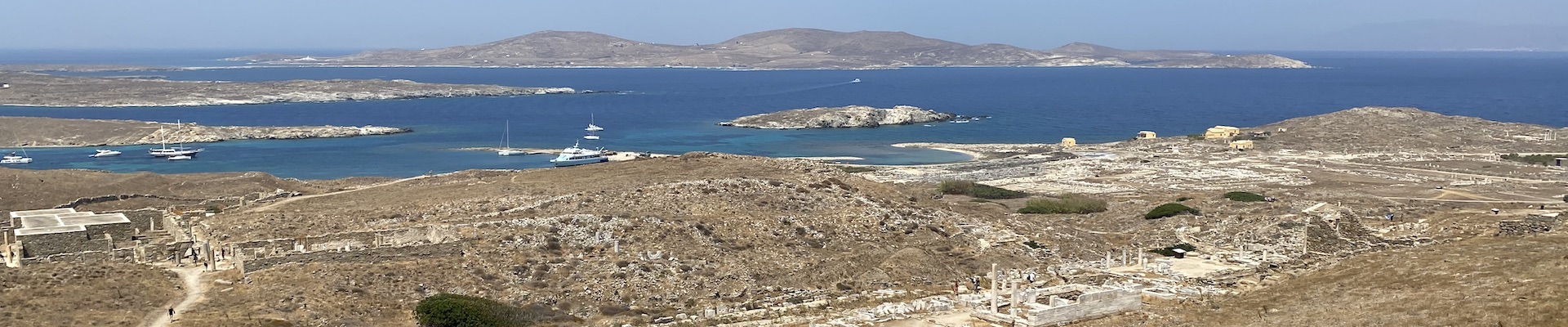
View of the coast from the archaeological site of Amathous

I am very grateful to ASOR and the scholarship’s donors who made these opportunities for research and learning possible. I would also like to thank Dr. Despina Pilides, Archaeologist Yiannis Violaris, and Dr. Nicholas Herrmann for allowing me the opportunity to participate in the Ayioi Omoloyites Bioarchaeological Project, as well as CAARI and the Department of Antiquities for hosting us and our studies.

Krysten Cruz is a PhD student in the Applied Anthropology doctoral program at Texas State University in San Marcos, Texas. Her research interests include forensic anthropology and eastern Mediterranean bioarchaeology.

Want to help more students and early career archaeologists get into the field? Donate to the cause today by selecting “Student Support” as your gift purpose!

2023 Grant & Fellowship Awardees

A shot of the Western Church where the 2022 UJAP excavation took place

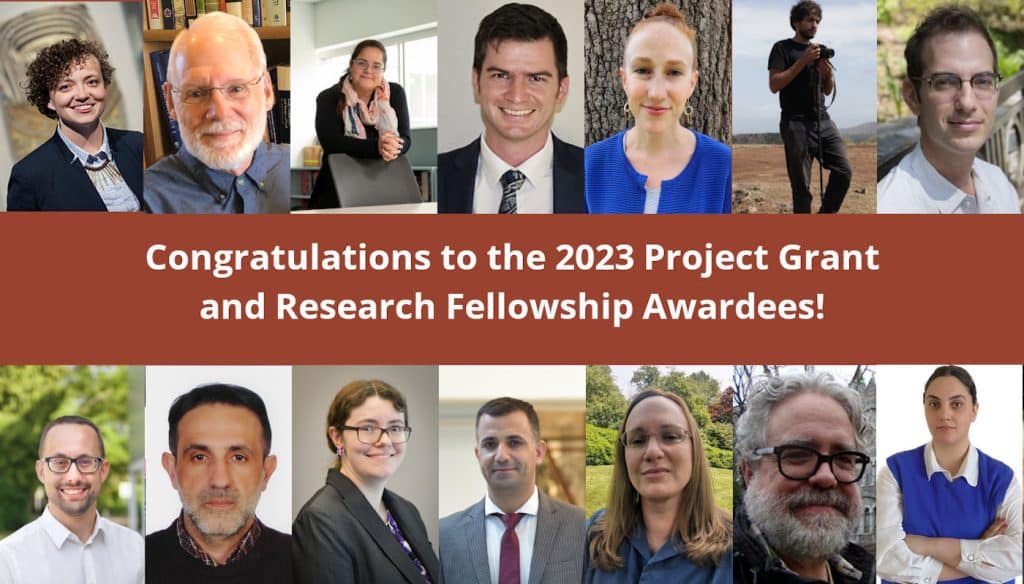
2023 PROJECT GRANT AND RESEARCH FELLOWSHIP AWARDEES

Grants and Fellowships Update

Grants for Archaeological Projects

Stevan B. Dana Project Grants
  • Anne Austin, University of Missouri—St. Louis: Bioarchaeology of Deir el-Medina Research Project (Egypt)
  • Hamza Benattia, University of Barcelona: Unveiling the Farming-Herding Communities of III-I Millennium B.C. Mediterranean Western Maghreb (Morocco)
Stevan B. Dana Project Grant for Israel
  • A. Asa Eger, University of North Carolina at Greensboro: The Caesarea Coastal Archaeological Project (Israel)
Lawrence T. Geraty Community Archaeology Grant
  • Douglas Clark, La Sierra University: Madaba Regional Archaeological Museum Project (Jordan)
Charles Harris Project Grants
  • Andrew Danielson, University of British Columbia: Khirbat al-Mukhayyat Archaeological Project (Jordan)
  • Müge Durusu-Tanriover, Temple University: Polatlı Landscape Archaeology and Survey Project (Turkey)
Joe D. Seger Project Grant
  • Mara Horowitz, Purchase College-SUNY: Kalavasos-Laroumena and Arkhangelos Archaeological Research Project (Cyprus)
Shepard Urgent Action Grants
  • Murat Akar, Hatay Mustafa Kemal University: Post-earthquake Action at Tell Atchana/Alalakh (Hatay, Turkey)
  • Mariam Eloshvili, Ilia State University: Emergency Excavation for Data Collection from the Late Neolithic Settlement at Khramis Didi Gora (Georgia)
  • Paola Sconzo, University of Palermo: Rescue Operations at the Site of Cham Pashaya, II (Kurdistan region of Iraq)

Research Fellowships

Dar Ben Gacem Tunisian Research Fellowship
  • Brien Garnand, Netherlands Instituut voor het Nabije Oosten: ASOR Punic Project—3D Modelling of Stelae and Cippi from Carthage (Tunisia)
Study of Collections Fellowships
  • Helen Dixon, East Carolina University: Study of Punic inscribed stelae with maritime iconography in the collection of the Carthage National Museum (Tunisia)
  • Jon Paul Heyne, University of Dallas: Social Mobility of Religious Minorities in the Medieval Mediterranean: The Case of the Franciscans of the Holy Land Custody (Israel)
William G. Dever Fellowship
  • Kathryn Medill, University of Washington: Lautenschläger Azekah Expedition (Israel)
Mesopotamian Fellowship
  • Jaafar Jotheri, University of Al-Qadisiyah: An Archaeological Survey for the Western Iraqi desert (Iraq)
  • Agnese Vacca, University of Milan: Crafting Complexity. Pottery Production and Consumption at Helawa (Erbil Plain) between the Ubaid and Late Chalcolithic Periods (Iraq)

ASOR Welcomes Katherine Schmitt as New Membership Coordinator

ASOR WELCOMES KATHERINE SCHMITT AS NEW MEMBERSHIP COORDINATOR

Katherine Schmitt began working for ASOR as an intern in September 2022. In May 2023, she graduated from The George Washington University with a Bachelor’s of Science in Biological Anthropology and Archaeology. Her professors at The George Washington University (members of ASOR) first encouraged her to apply for the ASOR internship. As an intern, she contributed to ASOR’s social media presence, website maintenance, and created the Annual Meeting Welcome Packet.
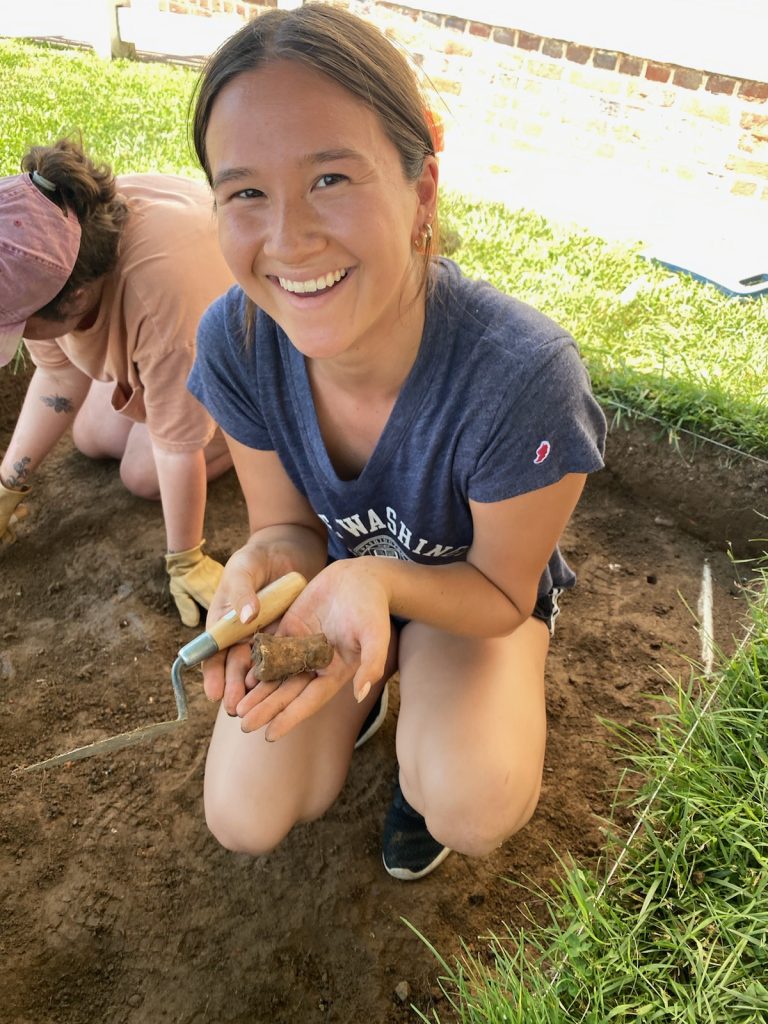
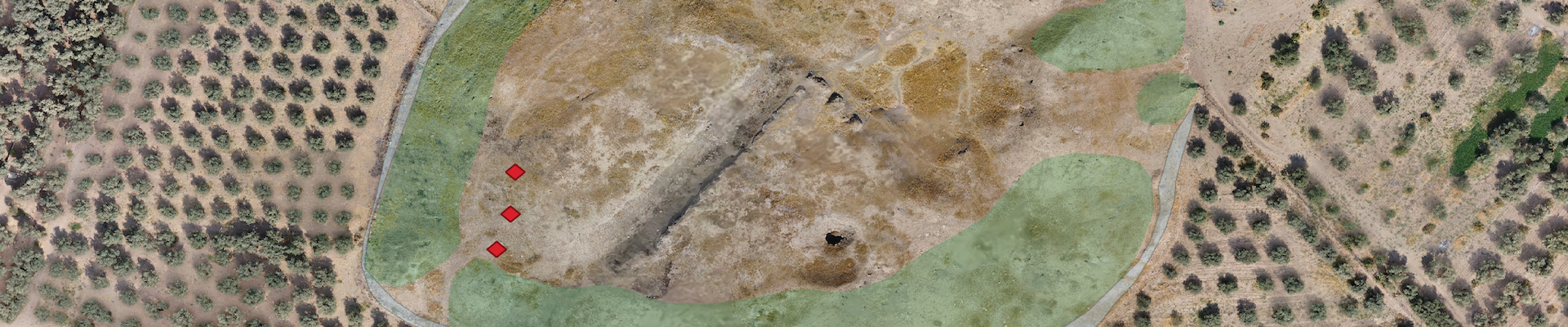
Katherine completed her first archaeological field school in 2021 at George Washington’s Mount Vernon estate in Fairfax County, Virginia. While participating in this field school, she had the opportunity to participate in excavations taking place on the South Lawn as well as in the Archaeology of the Slave Cemetery. This latter project used both ground penetrating radar and excavation techniques to locate graves and identify the bounds of the cemetery. Katherine was also an intern for The George Washington Museum and The Textile Museums’ Cotsen Textile Traces Study Center in 2021. In Spring of 2022, Katherine was able to continue her studies in Archaeology for a semester abroad at the University College of London, UK.

ASOR is pleased to welcome Katherine as she continues working for ASOR in her new role of Membership Coordinator. As Membership Coordinator, she will be responsible for the growth of both the membership and Friends of ASOR programs, handling membership processing and fulfillment, supporting the Annual Meeting, and website maintenance. Katherine looks forward to continuing working with ASOR’s members and donors!

This announcement also comes with news of Felice Herman’s departure from ASOR. Felice has accepted an offer to assume the position of Deputy Director of the President Woodrow Wilson House, a historic site of the National Trust for Historic Preservation, and located in Washington, DC. Katherine will be replacing Felice as the new contact for all ASOR membership inquiries on June 15, 2023.

Mesopotamian Fellowship Report: Khaled Abu Jayyab

2022/2023 Mesopotamian Fellowship Report: Preliminary Report on the Tepe Gawra Lower Town Survey

Khaled Abu Jayyab, University of Toronto

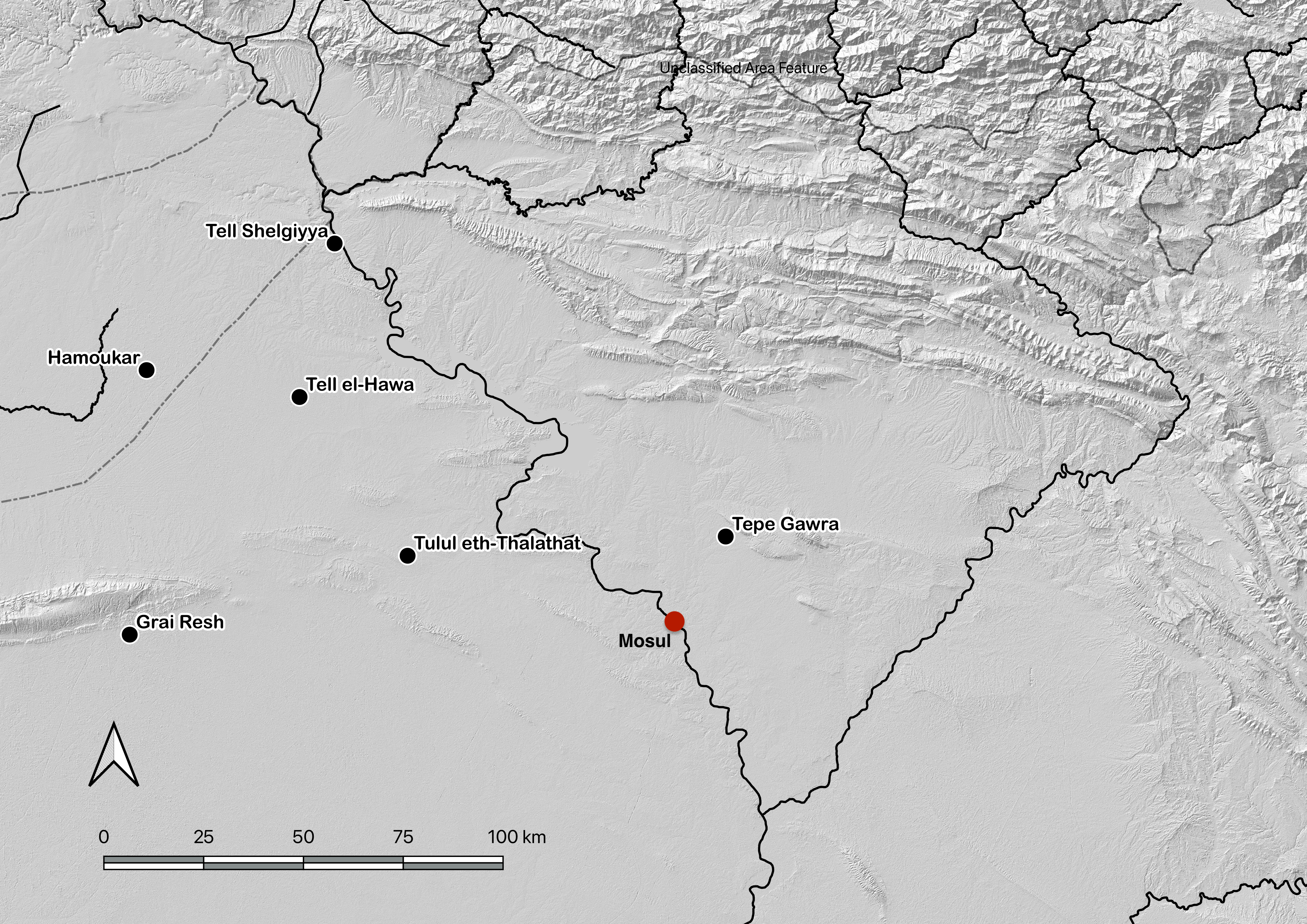
Based on the kind letter of support by the General Directorate of the State Board of Antiquities and Heritage (SBAH), Baghdad, we began the systematic survey of the lower town of Tepe Gawra (344197.14 m E, 4040351.85 m N) in the Ninawa Governate (fig.1) on the 9th of October 2022. Fieldwork at the site was concluded on the 20th of October 2022, with analysis of the recovered materials carried out in the expedition house in the Muthana neighborhood in Mosul. The work at Tepe Gawra was conducted by a Canadian research team from the University of Toronto in partnership with the SBAH office in Mosul.

Figure 1: Location of Tepe Gawra

Location of Tepe Gawra
The site of Tepe Gawra is located in the in the Ninawa Plain in the piedmont of the Zagros Mountains. The site is roughly a kilometer and a half to the south of the town of Fadiliyah, and about the same distance from the ancient Assyrian city of Dur Šarukin (Khorsabad) to its east. Tepe Gawra is located in a well-watered plain with several spring fed streams running through the site or near it. This condition encouraged settlement across time resulting in a long sequence of occupation at the site. Today most of the springs that were near Fadiliyah are dry as a result of tapping into the water table with deep wells and pumps.

History of Work at the site and its Significance
Tepe Gawra has long been seen as an essential site for late prehistoric and early historic periods, not only in Iraq but for the region in its entirety. Despite the significance of Tepe Gawra, there hasn’t been work carried out at the site since the 1930’s. The work conducted at the site by Speiser (1935) and Tobler (1950) has revealed a long occupational sequence dating from the Halaf period to the mid second millennium BC. The sequence has very few short-lived gaps in occupation and as such has become a chronological anchor for the region, especially for late prehistory (Halaf, Ubaid, and Uruk/LC). Analytical work carried out by Abu al-Soof (1974), and more recently, Rothman (2002), has expanded our understanding of the Northern Uruk period and has been key to developing the modern Late Chalcolithic (LC1-LC5) chronological scheme (Rothman ed. 2001; Schwartz 2001).

Despite its small size (roughly 2-3 ha. at its base extent), Tepe Gawra has been the hallmark site for the development of complexity during the Ubaid and Late Chalcolithic periods in the ancient Near East. Excavations at the site revealed a local development of a sophisticated infrastructure manifest in construction of temples, monumental architecture, and elaborate administrative practices. The site throughout its occupation shows an involvement in far flung networks connecting it with Highland Anatolia and the Zagros mountains, with connections as far afield as Afghanistan. These connections were seen in the high concentration of objects made of exotic materials such as obsidian, lapis lazuli, carnelian, copper, gold, and silver (Rothman 2002: 8), in addition to the presence of imported utilitarian and luxury ceramics (Abu Jayyab 2019; Rothman and Blackman 2003). The households at Tepe Gawra were also shown to be involved in multiple craft activities such as woodwork, textile production, elaborate administration, stone tool manufacture, and the production of high-end ceramic wares (see Rothman 2002; Rothman and Blackman 2003).

All together the main mound of the site has furnished evidence of highly specialized activities (administration, exchange, and craft production) with very little evidence of agricultural implements and farming practices. This phenomenon is unique as this degree of specialization was only attested at larger contemporary sites that combined specialized activities with extensive farming practices (e.g. Tell Brak reaches over 100 ha during this period). This situation necessitated that the inhabitants of Tepe Gawra relied on an external source for food. Rothman suggested that a functional segregation between sites existed in the piedmont or the foothills during this time (Rothman 2002: 5). He saw that the site of Tepe Gawra was a ‘center’ at the top of a specialized hierarchical network. Within this network Gawra served as an administrative, religious, and craft hub (Rothman 2002: 5-6). In support of the notion of a center, Frangipane argues that the landscape played a role in limiting urbanism in the piedmont around Tepe Gawra where the terrain may have restricted the expansion of agriculture beyond its natural limit restricting the region from producing enough agricultural surpluses to support a large conglomeration (Frangipane 2009: 135).

Research Aims
There is no doubt as to the significance of Tepe Gawra within the region but was the site truly interdependent as part of a large regional network for subsistence? That is, was the site serving a special function that excluded it from food production? There remains a debate as to whether or not there was a lower Chalcolithic period town around Tepe Gawra. Algaze notes (1993: 71-72) – based on personal communication with Gibson – that the mound was surrounded by a lower town. If this was true then the high mound would have been the acropolis of a larger town that still remains systematically unexplored. Rothman did not reject the idea of the presence of a lower town, however he remained skeptical with the absence of empirical data (Rothman 2002: 19).


The absence of a lower town in the narrative histories of Tepe Gawra coupled with the complexity exhibited at the site has prompted scholars to challenge unilinear models of complexity focused on urbanism. Indeed, the presence or absence of a lower town is central to the notion that Gawra was a regional center dependent on its intra and interregional networks rather than the mobilization of an internal workforce.


Figure 2: Olive orchard around the mound of Tepe Gawra (in the background).

With the kind permission of the SBAH office in Mosul, we had the chance to visit the site on October 1st 2021. The question heading to the site was whether or not the site had a lower town. we were extremely excited to discover a dense scatter of sherds at the lower town, and from what could be observed, many seemed to date to the Late Chalcolithic period. This realization prompted us to apply for the permit to conduct surface survey around the main mound of Tepe Gawra.

The aim of this work at Tepe Gawra was, first, to document and record the full expanse of the settlement beyond the mounded tell area, and to develop a detailed understanding of the occupation history of the lower town. Second, with the expanse of olive orchards around the main mound (fig.2), field investigation of the lower town is an essential undertaking at such an important heritage site in Iraq.

Method
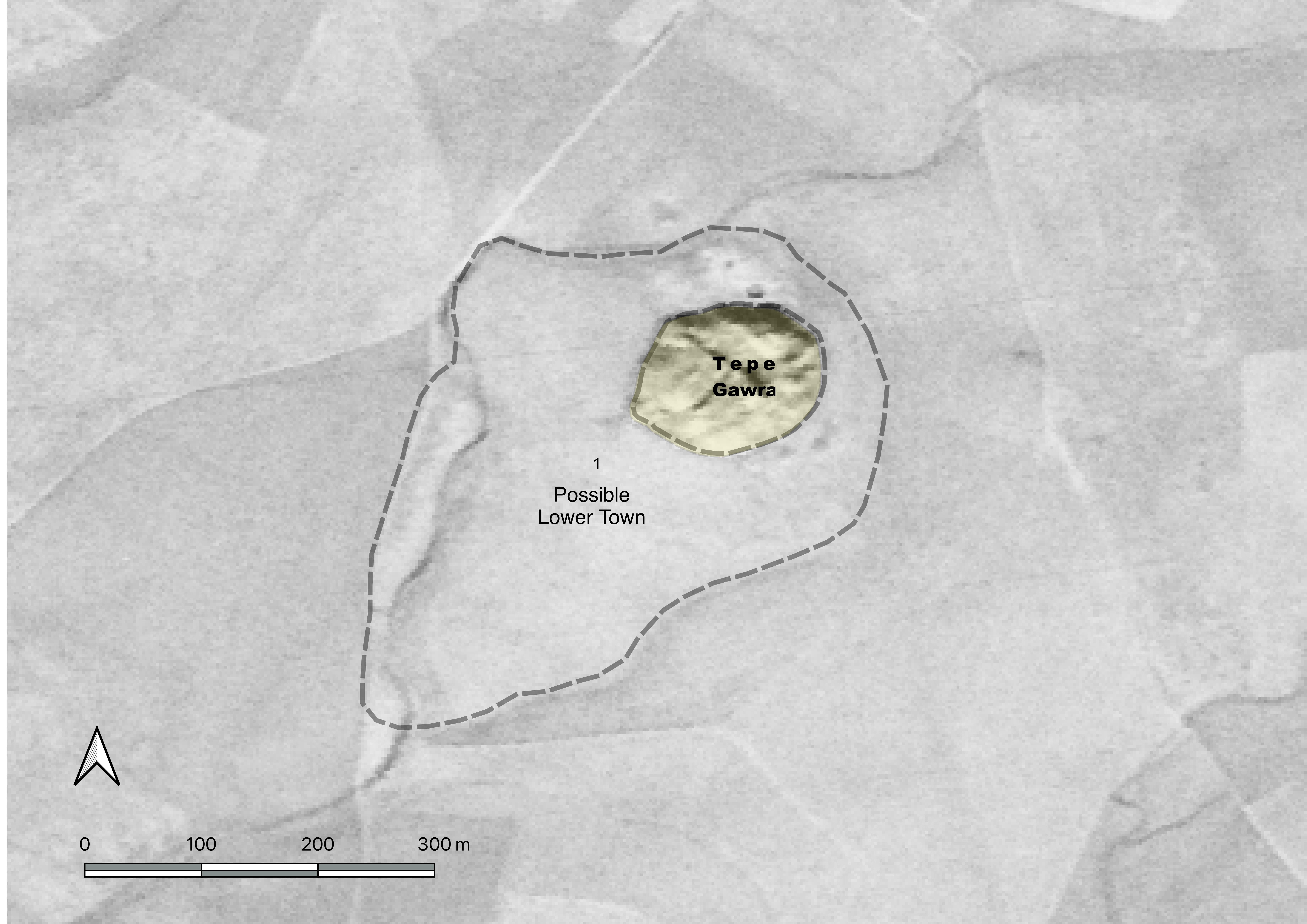
Our approach consisted of combining remote sensing data with field walking to obtain a clearer picture on the cultural and physical surroundings of the site and to document its current state of preservation. Prior to our work in the field, we explored the landscape around the site using satellite imagery (Corona, Keyhole, and Landsat) for two main goals. First, examining corona satellite imagery, has the potential to reveal the presence of anthropogenic soils and, in turn, the extent of human occupation around the site (fig.3). Second, exploring the changes that took place at the site between the late 1960’s and present day.

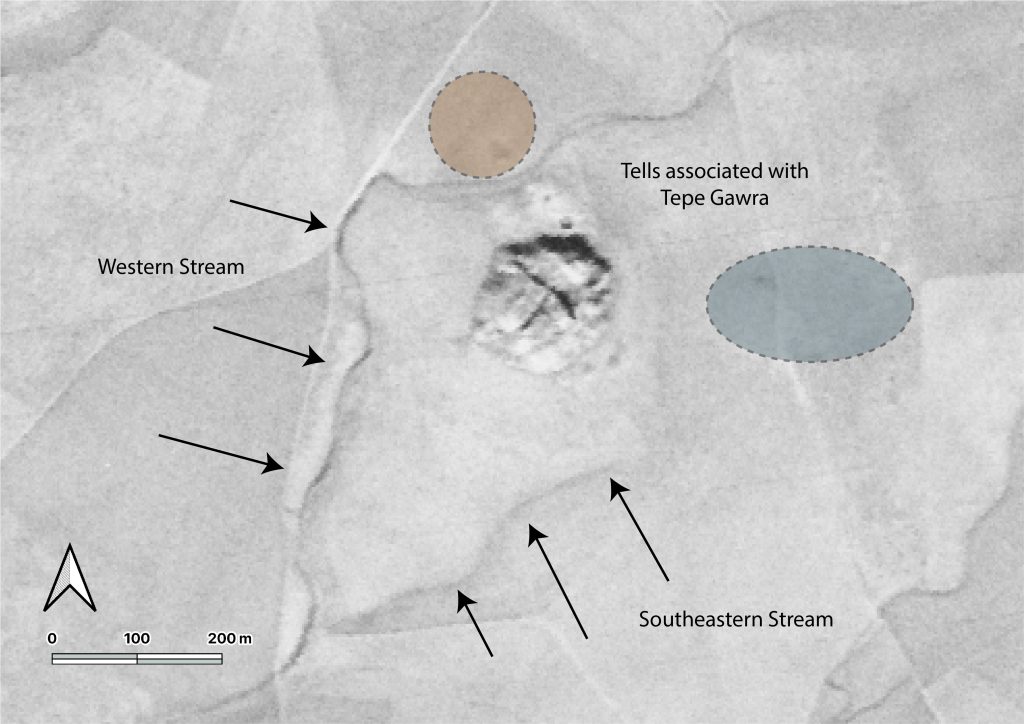
From the legacy satellite imagery, we were able to define a number of features that were otherwise invisible both on the ground and in more recent satellite imagery. From corona imagery, we were able to identify two smaller tells adjacent to the main mound of Tepe Gawra; A first northern tell (fig.4) that was separated from the main mound by a stream. This tell was already indicated in one of Speiser’s early topographic maps of the area (Speiser 1927: fig.2). A second feature was an eastern mound faintly visible only in the corona imagery. There was also a trace of a stream running east of the mound. This stream separated the main mound of Tepe Gawra from the above-mentioned eastern mound (fig.4). Corona and keyhole imagery allowed us to identify, based on soil color and relief, what we believed was the extent of the lower town, and which in turn guided our selection of survey zones (fig.3).

Figure 3: Possible extent of lower town at Tepe Gawra based on soil discoloration (Corona satellite imagery, December 1969).
Figure 4: Traces of Streams and Sites Around Tepe Gawra, Note the Southeastern Stream is no longer visible


Figure 5: DEM of Tepe Gawra

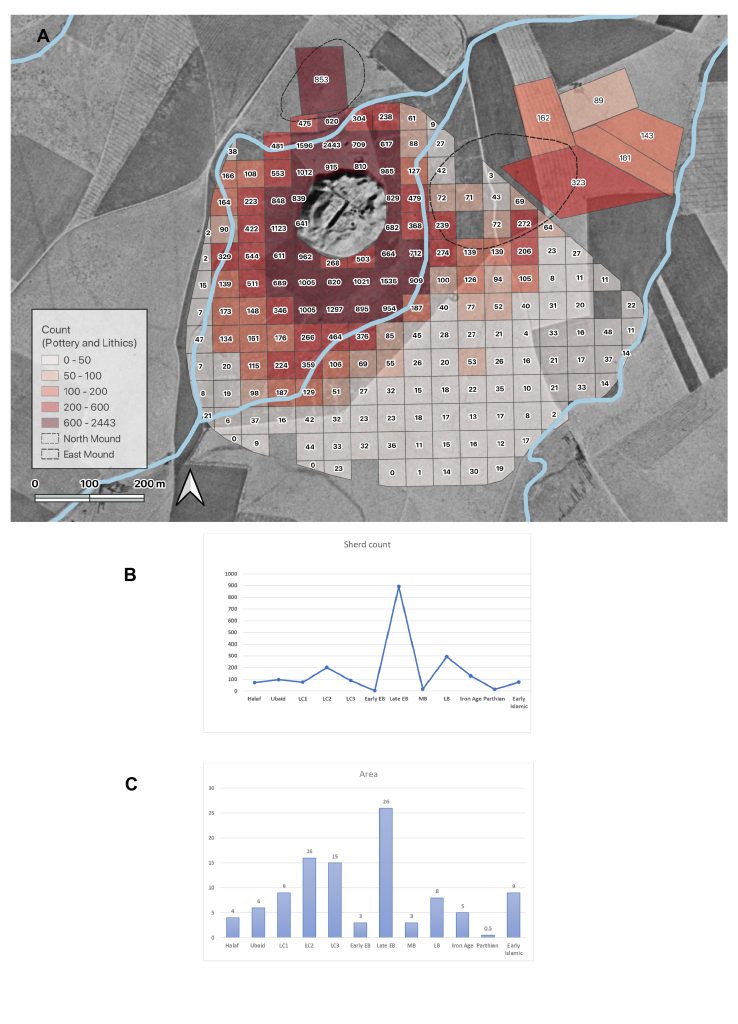
In the field, we conducted a UAV (drone) survey of the site in order to obtain a high-resolution digital elevation model (DEM) and render a 3D model of the Tell and its surroundings (fig.5). This was an important initial step that aims to create an accurate plan of the site and to document its present condition, and assess any possible future threats to it. Our second step was to lay out a collection grid around the site as a precursor to our systematic surface collection of the lower town. The grid contained collection units spaced at regular intervals (50 m) immediately around the tell (fig.6).

All diagnostic artifacts within the units were collected and taken to the expedition house for processing. Processing consists of washing the artifacts, recording and drawing them, with the aim of carrying out a typo-technological study. The typo-technological analysis entails studying the finds (e.g. ceramic sherds, stone tools) with the aim of identifying the relative age of the artifacts and the technological steps taken to produce them (another avenue that may possibly help us determine periodization). We also analyzed the obsidian stone tools with a portable x-ray florescence analyzer (PXRF). The PXRF will allow us to determine the source/s of obsidian artifacts found at the site and begin to explore new network connections that the site was involved in. The information gathered through the material studies will later be connected to the spatial data through a GIS. Through a period-by-period artifact count from each unit we were able to see the extent of occupation in the area surrounding the tell and detect changes in this occupation from one period to the next.

Figure 6: A) Grid and collection units at the in the lower town of Tepe Gawra with full artifact counts. B) Sherd count for each period, C) Estimated area occupied during each period.

Preliminary Results

1-Damage Assessment


Figure 7: Arial photo showing damages to Tepe Gawra.

Both the main mound and the lower town at Tepe Gawra have been subject to anthropogenic disturbances. Chronologically, the initial impact on the settlement resulted from the excavations carried out in the 1930’s (Speiser 1935). The site is believed to be at least 7m higher than its current elevation with several levels completely removed (Levels I-IX). After Level X the site was divided into two parts with excavations focusing exclusively on the northeastern portion of the tell. As such, piles of dirt from the excavations were dumped along the slopes of the mound causing an artificial swelling along the edges and slopes of the mound. We were able to document these dumping piles along the different slopes of the mound (fig.7).


Figure 8: The Dirt Embankment Around the Base of the Mound.

The main mound of Tepe Gawra in addition to the lower town were also impacted by farming activities. Farming activities consisted primarily of the planting of olive orchards around the site (fig.2). According to local farmers the orchard was planted roughly 30 years ago, this coincides with the destabilization of the country and the weakening of the central authorities during the first Gulf War. The olive groves and the infrastructural developments related to them have certainly damaged the lower town extensively. First, clear bulldozing took place at the foot of the main mound in order to level that area and prepare it for agriculture. The majority of the dirt was pushed towards the mound forming a low embankment along the majority of the mound’s circumference (fig.8). Second, the act of planting the trees, and plowing the land, in addition to the irrigation systems associated with them (including lines of watering tubes buried in the ground and running between the trees) churned up large swaths of the lower town at Tepe Gawra. Finally, the construction of a number of farm houses, rest areas, and water collection basins with the orchard impacted the lower town significantly (empty squares in figure 6 were not surveyed primarily due to the presence of such features). All these factors make excavations of the lower town near impossible making this survey all the more important. A further complication to studying the lower town and its surrounding is the construction of a road between Khorsabad and Bashiqa that ran through the eastern mound, leading to its complete removal.

The most recent damage to the site was caused through its use by members of ISIS. The militant group dug an intricate network of tunnels within the mound (fig.9). These tunnels may impact the integrity of the mound and cause collapses in the near future. Besides the structural issues these tunnels caused, due to their size, the impact on the archaeological remains is equally devastating if not more.


Figure 9: ISIS Tunnel Along the Southwestern Slope of the Mound

2-Lower Town Remains
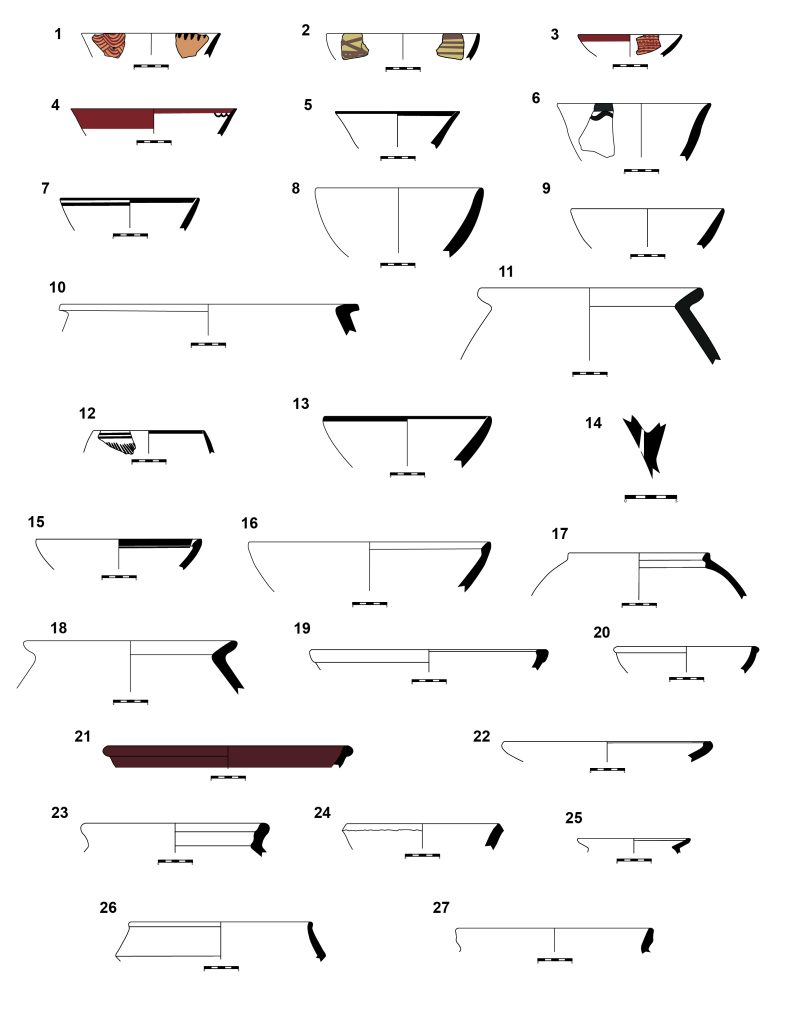
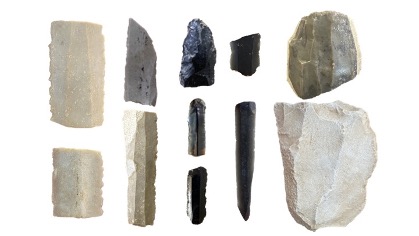
In total, we surveyed 187 50x50m units, in addition to 5 large external units (see fig.6). within these units we counted 43895 sherds (fig.10), and a total of 904 chipped stone artifacts (fig.11). Almost 40% of the materials were made from clear obsidian with a greenish hue, while 55% were made from flint. Of note, we documented a total of 6 Canaanean looking blades on our survey. Their distribution seems to be confined to the northeast area of the survey region, including Zone 3 East and the squares (M5, M6, and M7) adjacent to it. This is of note since Canaanean blades made from lever pressure are characteristic of Late Chalcolithic lithic assemblages and ours were all found in conjunction with Late Chalcolithic pottery.

Figure 10: examples of ceramics collected from Tepe Gawra Lower Town Survey.
Figure 11: collection of stone tools from the Tepe Gawra Lower Town Survey.

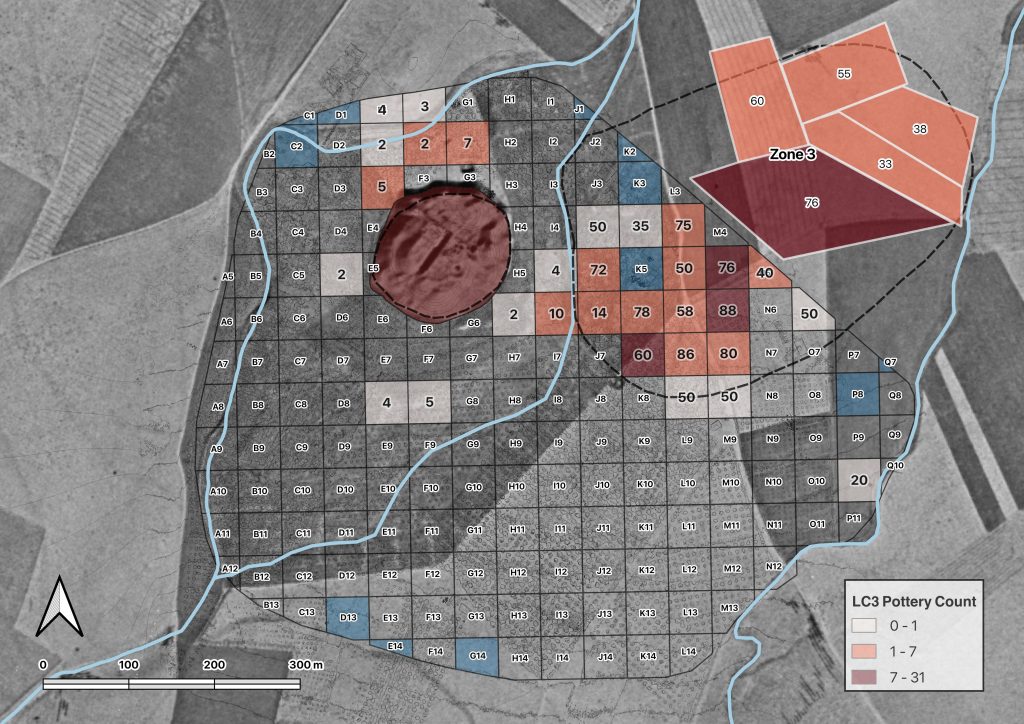
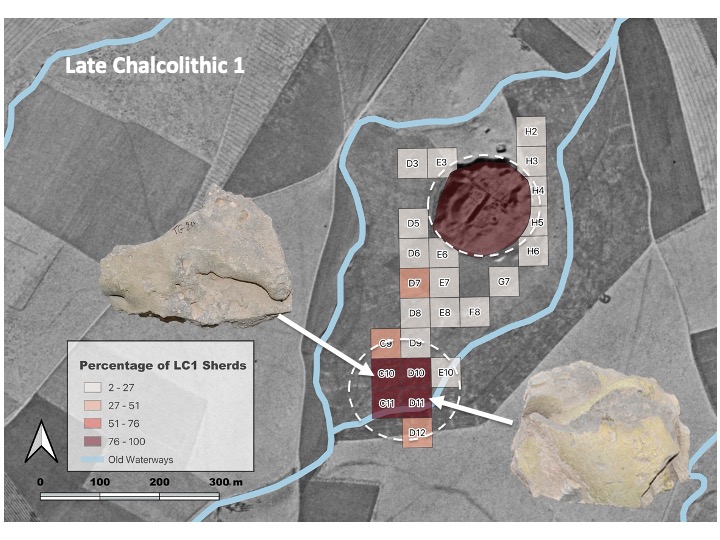
In terms of occupational history, the team was able to document the stages of development at the site where a clear expansion from the main mound clearly began during the Late Chalcolithic 1 period (4600-4200 BC) and continued through to the Late Chalcolithic 3 period (3900-3600 BC) to at which point the site was abandoned until the Ninevite 5 period (3100-2800 BC). During the late Chalcolithic the site expands from roughly 4 ha. (Ubaid Middle Chalcolithic period, 5300-4600 BC) to 9 ha. during the LC1, and later, to 15 ha. during the LC2 and 3 (fig.12). Further, the team was able to isolate a number of distinct activity areas (e.g. pottery making) dating to these periods (fig.13). All this implied that rather than being an isolated small center exclusively reliant on far-flung inter and intraregional networks, Tepe Gawra was going through similar processes of urban expansion, social differentiation, and economic specialization that were occurring at other sites in the region, albeit within its own local trajectory.

Figure 12: LC3 settlement located east of the main mound of Tepe Gawra. Note that the number in the collection unit is the percentage of late EB sherds relative to other sherds collected in the unit.
Figure 13: Extent of Late Chalcolithic 1 (LC1) settlement at Tepe Gawra. Initially the LC 1 occupation was believed to be restricted to the main mound, top dashed circle (3 ha. in extent), however, after survey we now see that the occupation was 3 times the size initially believed (9 ha.). The lower dashed circle points to an LC1 ceramic working area. This was discerned based on the heavy presence of wasters (objects in the image) and pottery slag, which are by-products of ceramic manufacture.

Occupation at the site reached its zenith during the latter part of the 3rd millennium or the Late Early Bronze Age (Akkadian/post Akkadian periods). During this period, we see the largest extent of the site reaching approximately 23 ha., or possibly 36 if we take into consideration units with a low density of sherds (fig.14). The site declines during the Middle Bronze Age, and eventually shifts slightly to the north during the Late Bronze Age and the Iron Age, where the mound of Tepe Gawra itself becomes too narrow at the summit to sustain a village. The Final occupation in the environs of the site occurs during the late Sassanian/Early Islamic period where settlement shifts to the southern edges of the survey zone.


Figure 14: Extent of the late third millennium settlement. Note that the number in the collection unit is the percentage of late EB sherds relative to other sherds collected in the unit.

3-Outreach

Figure 15: Workshop carried out at Qadisiya University by members of the Tepe Gawra Survey Project (From left): Khaled Abu Jayyab, Arno Glasser, Abbas al-Hussainy, and Ira Schwartz.

Another important aspect of the project was to foster close cooperation with local institutes and members of the community. This approach is taken as part of the steps in reforming and decolonizing excavation and survey in Iraq as outlined by Jotheri (2022). Accordingly, the project emphasized the training of members of the SBAH involved. Moreover, following the season members of the project held a workshop at Qadisiya University in Diwaniya, organized by Prof. Abbas al-Hussainy, pertaining to the work at Tepe Gawra, and analytical work on ceramics, lithics, and survey methodology. The workshop was open to faculty, students, and members of the public alike (fig.15).

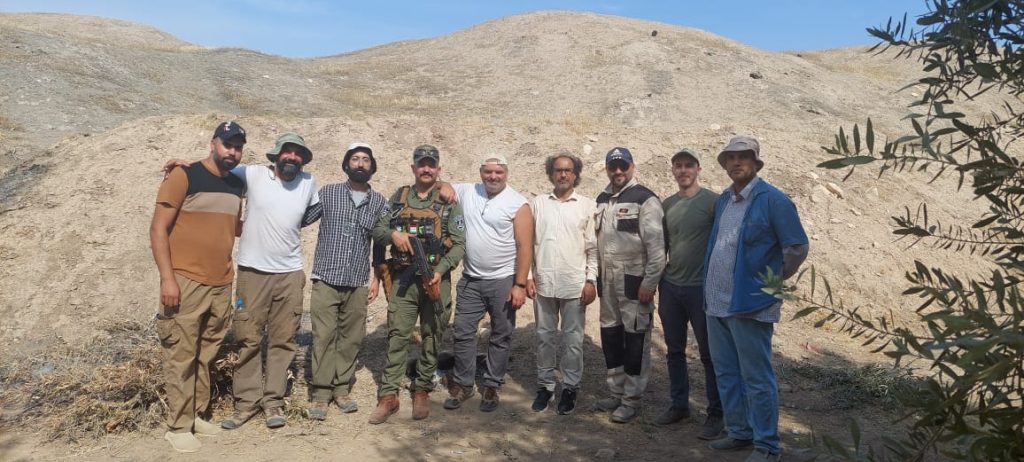
The season’s work at Tepe Gawra was a resounding success despite the tight schedule. This would not have been possible without the financial support provided by the ASOR Mesopotamia Fellowship, and the CRANE project (University of Toronto), In addition to the guidance, motivation, and logistical support provided by Prof. Timothy Harrison (NMC) and Prof. Abbas Al-Hussainy (Qadisiya University). Finally, the work would not have been possible without the monumental efforts of the Tepe Gawra survey team (fig.16), Dr. Stephen Batiuk (NMC, University of Toronto), Dr. Abbas al-Hussainy (Ira Schwartz, Arno Glasser (both U of T, Anthropology, University of Toronto), Hossam Hadi, Abdul Ghani Jbori, and Ahmad Najar (SBAH), whom all put in extra shifts to ensure the data was processed on time and in a scientific manner. The success of this work would not have been possible without them.

Figure 16: Members of the Tepe Gawra Survey team (from left to right): Hossam Hadi, Khaled Abu Jayyab, Ira Schwartz, Hikmet al-Jbouri, Stephen Batiuk, Abbas al-Hussainy, Ahmad Najar, Arno Glasser, and Abdul Ghani Jbori

Bibliography

Abu al-Soof, B. (1974). “Prehistoric Pottery from Nineveh, Gawra, and the Neighboring Sites.” Sumer 30: 1-10.

Abu Jayyab, K. (2012). “A Ceramic Chronology from Hamoukar’s Southern Extension.” In Catherine Marro (ed.) “After the Ubaid: Interpreting Change from the Caucuses to Mesopotamia at the Dawn of Urban Civilization (4500-3500 BC).” 87-128. Varia Anatolica XXVII.

Abu Jayyab, K. (2019). “Nomads in Late Chalcolithic Northern Mesopotamia: Mobility and Social Change in the 5th and 4th Millennium BC.” Unpublished PhD. Thesis, University of Toronto.

Algaze, G. (1993). “The Uruk World System: the Dynamics of Expansion of Early Mesopotamian Civilization.” University of Chicago Press.

Al-Quntar, S. & Abu Jayyab, K. (2014). “The Political Economy of the Upper Khabur in the Late Chalcolithic 1-2: Ceramic Mass-production, Standardization and Specialization.” In McMahon, A. & Crawford, H. (eds.) “Preludes to Urbanism: The Late Chalcolithic of Mesopotamia.” 89-108. McDonald Institute Monographs. Cambridge.

Frangipane, M. (2009). “Non-urban Hierarchical Patterns of Territorial and Political Organization in in Northern Regions of Greater Mesopotamia: Tepe Gawra and Arslantepe.” Subartu XXIII: 135-148.

Jotheri, J. (2022). “Reforming (and Decolonizing) Excavations and Survey in Iraq.” ANE Today X: 12.

Rothman, M. ed. (2001). “Uruk Mesopotamia and Its Neighbors: Cross-cultural Interactions in the Era of State Formation.” School of American Research Press.

Rothman, M. (2002).  “Tepe Gawra: The Evolution of a Small Prehistoric Center in Northern Iraq.” Philadelphia, University of Pennsylvania, Museum of Archaeology and Anthropology Press.

Rothman, M. & Blackman, J. (2003). “Late Fifth and Early Fourth Millennium Exchange Systems in Northern Mesopotamia: Chemical Characterization of Sprig and Impressed Wares.” Al-Rafidan 24: 1-21.

Schwartz, G. (2001). “Syria and the Uruk Expansion.” In Ed. Rothman. M. “Uruk Mesopotamia and Its Neighbors: Cross-cultural Interactions in the Era of State Formation.” 233-264. School of American Research Press.

Speiser, E. (1927). “Preliminary excavations at Tepe Gawra.” Annual of the American Schools of Oriental Research 9: 57-94.

Speiser, E. (1935). “Excavations at Tepe Gawra, I.” Philadelphia: University of Pennsylvania Press.

Tobler, A. J. (1950). “Excavations at Tepe Gawra II.” Philadelphia: University of Pennsylvania Press.