A Home for ASOR—An Update on an Amazing Challenge Gift
[/vc_column_text][vc_column_text]
ASOR’s New Home, located in Old Town, Alexandria, VA
When ASOR was established in 1900, our office was one large room in a Jerusalem hotel. During the past 119 years, we have dramatically expanded our scholarly capacity and public outreach—both abroad and in North America. By 1925, we built a permanent home in Jerusalem. Yet in North America, we moved frequently, from one host institution to another. Now, it is time for ASOR to establish an independent headquarters to serve our broadened constituencies. In January 2018, we set the goal to of raising $1.5 million to purchase, furnish, and maintain an enduring home for ASOR in Alexandria, VA—our Board having determined that the Washington, D.C., area is the location of greatest strategic benefit to our mission.
Today, we are thrilled to report that we are nearing our goal! Indeed, during the past thirteen months, ASOR’s generous friends have donated almost $1 million in gifts and pledges to the Building Fund. Buoyed by these donations, we are under contract to purchase an office building located at 209 Commerce Street in Alexandria. We start moving in on March 20th, and we will close on the purchase on April 24th!
We are also thrilled to report that a new challenge gift of $450,000 will ensure that ASOR meets and even exceeds our $1.5 million goal. We only need to meet two challenges to “earn” this additional $450,000:
First, we need to demonstrate that we are all behind the purchase of ASOR’s new home and ASOR’s other initiatives by securing “450 for $450,000”: that’s 450 donors donating $10 or more to ASOR in this fiscal year (July ’18-June ’19). As of March 15th, we are at 200 donors, so we need gifts from 250 more individuals, companies, or organizations.
Second, we need to match the challenge of $450,000 by raising $225,000 in new gifts and pledges (made after February 1st), or $1 for every $2 of the donor’s gift. And we are well on our way, as we have received pledges of $143,000 in the past month—so we only need $82,000 more.
How You Can Help. We are almost there! If you have not already made a gift, please consider joining the “450 for $450,000” campaign by donating to ASOR before June 30, 2019 (all gifts, including programs other than the building qualify). If you have already pledged or made a gift to support our new home, please think about increasing your gift or pledge to the building so that we can raise the last $92,000 needed to qualify for this $450,000 challenge.
To recognize your support, we offer naming opportunities at the following levels:
Naming of conference room or floor = $300,000
Naming of an individual office (sizes vary) = $100,000 – $250,000
Name recognition on smaller office spaces = $25,000 – $99,999
Name on plaque recognizing major donors = $10,000 or more
Name on a plaque recognizing all donors at “brick” level or higher = $250 or more
THE STUDY SEASON: THE LESS EXCITING, BUT STILL IMPORTANT COUNTERPART OF THE FIELD SEASON
Grant Ginson, 2018 Strange and Midkiff Families Excavation Fellowship Recipient
The author at the Dome of the Rock in Jerusalem.
So you’ve dug, baulk trimmed, mapped, sectioned and backfilled. After a successful excavation season, you look back at all the objects, pottery and samples carefully removed and see that there is a lot of material to study. Sometimes, this material can be studied in the lab while being excavated. But an excavation produces lots of material and it cannot all be studied in a few weeks or even months. In these cases, it is necessary to have a season where you can study the material without having to deal with the necessities of a field season at the same time. This is where the study season comes in: it is an opportunity to engage and to expand the research for a project.
Through the generosity of the Strange and Midkiff Families Excavation Fellowship, I was able to participate for the first time on a study season this summer. The fellowship allowed me to travel to Jordan where I was a part of the Town of Nebo Archaeological Project. A young project, its inaugural season was in 2014, and 2018 was the second study season for the project. I took it as an opportunity to experiment and perform tasks that I never had time to do properly during a field season. This season, I expanded on something that has interested me since I had first seen it in action on a previous field season in 2016: photogrammetry. In 2016, I was shown the basics of photogrammetry and the program Agisoft Photoscan, which I used to create some preliminary models of objects, excavation squares and installations. That same year, I wrote a paper about mapping excavated objects in three-dimensional space using a GIS
Setup one where the object stays stationary and the camera moves around the object.
program. This bestowed on me a desire to create models of excavated objects that could then be used to show their location after excavation in three-dimensional space. With that in mind, I set out to use this study season to create some models of excavated objects.
To create these models, I tried two different methods. The first involved a stationary object that would stay in the same spot while the camera rotated around it at a set distance and different heights. The second used a rudimentary lightbox that would provide an even light around objects and provide a crisp background of white to contrast with the objects being photographed. A turntable was then placed inside the lightbox to rotate objects in front of a stationary camera on a tripod. The first method worked fairly well but it had issues in that it was difficult to get the bottoms of objects and it had a lot of background noise. The second method created very good images that could be used to make complete models that included the bottom and had almost no background noise. Based on these results, I went ahead using the second method, as it was more efficient. There were still some issues with this method, the rudimentary setup meant that the lighting was not entirely even around the objects and there were some issues with keeping shadows off of the objects. To process the images, I decided to try a program called “Capture Reality” that I had heard about at the 2017 AIA conference in Toronto. The results were quite good; and are good enough models for representation and measurement. I experimented with different types of objects, corroded metal, stone mortars, ceramic figurines, basalt grindstones and pots. Each of these had issues that had to be overcome, but each was able to be made into a model by the end of the season. With this opportunity, I started something that will continue with the project: digitizing objects into digital models. As this was my role for the season, my days would typically be spent taking photos, processing data, prepping data and waiting for data to process. This may seem quite unexciting compared to the field season but it is quite necessary. There is a saying often
Setup two where the camera is stationary and the object is rotated on a turntable inside A lightbox.
quoted during excavation that ‘for every hour in the field, three hours are spent in the lab.’ The routine of the day made it hard to believe that I was there for five weeks, as each day became very similar to the last. Not going into the field also meant a much later wakeup at 8am to begin work rather than the usual 4am, giving me considerably more sleep than I was used to while in the field.
The study season is not all work all the time though, and there were new opportunities that could be taken since we were not tied down as much as by an excavation season. For one, it allowed for the visiting of a few other archaeological projects in the area, as well as journeying to the neighbouring country of Israel which I had never gotten to visit during an excavation season. The visits to other excavations broadened my knowledge of other projects as I got to witness how other sites excavate to meet the needs of each project’s research goals. Some look for artifacts down to 4mm and painstakingly look through all material to find as much as possible from the site. Others required a bit of a hike up a wadi (valley) to get to and had architecture that was difficult to distinguish from surrounding material. Others had different ways of setting up equipment like sifts. This also gave me the opportunity to meet other archaeologists and get to know their research and interests.
Through my experience I can say that, while definitely not as exciting as a field season, the study season can be just as fulfilling and rewarding. It has been a time to learn and a time to expand my knowledge. I have ASOR and the Strange and Midkiff Families Excavation Fellowship to thank for that.
The results of a model of a ceramic vessel object.
Grant Ginson is a Wilfred Laurier University Archaeology grad who has worked in Jordan for three field seasons and in Canada for one field season. Grant hopes to use the experience he has gained through ASOR fellowships to continue his education at a graduate level by pursuing a Masters.
Want to help more students and young archaeologists get into the field? Donate to the cause today by selecting “Excavation Scholarships” as your gift purpose!
PICK YOUR TOOLS FOR MARCH FELLOWSHIP MADNESS—2019 (Week 3)
[/vc_column_text][mk_skill_meter title=”We have raised $2,755 of our $6,000 goal!” percent=”46″ title_color=”#000000″ progress_bar_color=”#dd3333″ track_bar_color=”#eeeeee”][mk_divider][vc_column_text]Since 2007, with the generous support of our members and donors, ASOR has awarded over 635fellowships, grants, scholarships, and travel awards. These fellowships and grants total just over $750,000, and they have enabled students and scholars across the Near East and the Mediterranean to uncover the past and to broaden our knowledge of the ancient world. Our goal is to raise $6,000 during March so that we can award 26 fellowships for summer excavation.
This year, give the tools that fellowship recipients need to succeed in the field!
Each tool below corresponds with a giving level. We will also track each tool’s selection to see which one will be used to continue to excavate a special ASOR artifact (see below)! ASOR is fortunate to have many generous members and friends and any gift (tool) will truly make a difference.
Click on a tool to navigate to our online store where you can type in your donation amount. Select “Excavation Scholarships” as your gift purpose:
Below is an artifact a dig fellowship participant is carefully uncovering using the tools you have donated.(Photo by Jim Haberman)
Help today by giving a tool to finish the work! After two weeks, your gifts and tools have helped uncover a corner of this artifact. As the tools increase, the rest of the artifact will be revealed.
Please also remember: we have a matching gift of $450,000 for the new office building that requires 450 donors to donate $10 or more to ASOR by June 30, 2019. Every donation to a fellowship counts towards this challenge, in addition to sending students and early career scholars into the field—so make every dollar count twice for both fellowships and the new office building![/vc_column_text][mk_divider][vc_progress_bar values=”%5B%7B%22label%22%3A%22Brush-%22%2C%22value%22%3A%222%22%2C%22color%22%3A%22custom%22%2C%22customcolor%22%3A%22%235b90bf%22%2C%22customtxtcolor%22%3A%22%23000000%22%7D%2C%7B%22label%22%3A%22Trowl-%22%2C%22value%22%3A%226%22%2C%22color%22%3A%22custom%22%2C%22customcolor%22%3A%22%23b17fe2%22%2C%22customtxtcolor%22%3A%22%23000000%22%7D%2C%7B%22label%22%3A%22Pickaxe-%22%2C%22value%22%3A%229%22%2C%22color%22%3A%22custom%22%2C%22customcolor%22%3A%22%23dda1d4%22%2C%22customtxtcolor%22%3A%22%23000000%22%7D%2C%7B%22label%22%3A%22Shovel-%22%2C%22value%22%3A%223%22%2C%22color%22%3A%22custom%22%2C%22customcolor%22%3A%22%2347a570%22%2C%22customtxtcolor%22%3A%22%23000000%22%7D%2C%7B%22label%22%3A%22Bucket%22%2C%22value%22%3A%221%22%2C%22color%22%3A%22custom%22%2C%22customcolor%22%3A%22%23dd8a0d%22%2C%22customtxtcolor%22%3A%22%23000000%22%7D%2C%7B%22label%22%3A%22Wheelbarrow-%22%2C%22color%22%3A%22custom%22%2C%22customcolor%22%3A%22%2389d653%22%2C%22customtxtcolor%22%3A%22%23000000%22%7D%5D” bgcolor=”custom” units=” Tools” title=”How many tools have you given?” css=”.vc_custom_1553276706380{background-color: #ffffff !important;}” customtxtcolor=”#000000″ custombgcolor=”#ff5b5b”][mk_divider][vc_column_text]If you donate to March Fellowship Madness, you support archaeology in a very direct way. Every gift matters. ASOR does not charge any administrative fee for gifts made during March Fellowship Madness, so 100% of your contribution will support students and early career scholars.
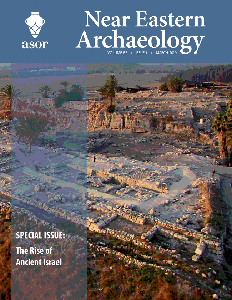
Pp. 5–7: “The Rise of Ancient Israel in the Iron I–IIA: The Need for a Closer Look,” by Omer Sergi and Yuval Gadot
In 1995 and 1996, the periodical Biblical Archaeologist (the former name of Near Eastern Archaeology) staged a debate between Israel Finkelstein and William G. Dever over the origins of ancient Israel (Dever 1995; Finkelstein 1996). This debate, described by the journal’s editor (David Hopkins) as “sharp and pointed,” was the culmination of more than a decade of revolutionary archaeological research that was much influenced by the new historical and archaeological paradigms that took shape in the academic world at the time. The Dever-Finkelstein debate of 1995–1996 was fueled by fresh archaeological data, the result of extensive exploration in the Samaria hills conducted throughout the 1970s and 1980s. From the vantage point of 2018 it seems that despite the many books and articles published since those days, the 1995–1996 debate marks something of a stagnation point, since very few new data have been published since then, and even when new questions have arisen, due to political circumstances there has been no real option to go out to the field and reexcavate.
Click here to access the above article on The University of Chicago Press Journals (ASOR membership with online access and/or subscription to UCP Current Content required).
Pp. 8–15: “First Israel, Core Israel, United (Northern) Israel,” by Israel Finkelstein
The rise of ancient Israel has been studied from the perspectives of archaeology and the biblical text in parallel. Archaeology deals with the settlement processes that took place in the highlands, while biblical exegesis may identify germs of memories that go back to events that took place before the rise of the Hebrew kingdoms and shed light on the ideology of Israelite and Judahite authors regarding the emergence of the Israelite “nation.”
The archaeology of the rise of early Israel, involving the investigation of Iron I sites in the highlands, flourished in the 1980s and introduced new field methodologies and theoretical frameworks. For political reasons, progress in this area has since come to an almost complete standstill, yet recent work in regions bordering on the highlands shed light on several important issues related to the rise of ancient Israel. I refer mainly to the chronology of the process and the impact of climate on the events in Canaan ca. 1250–1100 BCE. The cessation of fieldwork in the highlands has stimulated scholars to revisit the textual traditions regarding the emergence of ancient Israel and to combine the existing archaeological data with the biblical text in a more critical way than was practiced in the past.
Click here to access the above article on The University of Chicago Press Journals (ASOR membership with online access and/or subscription to UCP Current Content required).
Pp. 16–23: “Earliest Israel in Highland Company,” by Lauren Monroe and Daniel E. Fleming
When God calls Jacob “Israel” in Gen 32:29, after grappling with an angel, the name Israel is applied to all the tribal sons of Jacob and thus given a grand geographical range, stretching north to Dan, south to the Negev, and east into modern Jordan. Archaeologists, historians, and biblical scholars most often identify their object of study as “ancient Israel,” as if the biblical name represented something static that could be read back onto the whole historical dimension of their enterprise. Yet, the name Israel was first of all political, and we must expect its use to change with the evolving political landscape. “Israel” identified a polity situated in the southern Levant from at least the late thirteenth century BCE through the end of the kingdom by that name in 720 BCE, and the name is applied to the whole people of God in biblical writing through the Persian period and beyond. Since few would argue that what writers imagined in the sixth or fifth centuries BCE matched “Israel” in the Late Bronze Age Merenptah Inscription, there is much to learn from treating the name with precision.
Click here to access the above article on The University of Chicago Press Journals (ASOR membership with online access and/or subscription to UCP Current Content required).
Pp. 24–31: ““All These Are the Twelve Tribes of Israel”: The Origins of Israel’s Kinship Identity,” by Kristin Weingart
What is Israel and who is an Israelite? While the He- brew Bible has a lot to say about the eponymous patriarch Jacob/Israel, the meaning of his new name, or the people of Israel’s special role among the nations, details on Israel’s definition are sparse. The most comprehensive treatment of the matter is offered in the last and one of the latest books of the Hebrew Bible, the Book of Chronicles originating from the Persian period. This book does not offer any definition of Israel, but it starts with extensive genealogical lists (1 Chr 1–9) presenting a complete inventory of all Israelite tribes, clans, and families appearing in the texts and existing at the Chronicler’s time. Therefore, according to the Chronicler, being an Israelite is a matter of kin: Whoever is born or marries into one of the Israelite tribes is an Israelite, while Israel, in turn, is part and parcel of a greater family of peoples. In the first (in terms of the canon, not of its dating) book of the Bible, the Chronicler’s definition finds its counterpart and basis. The Book of Genesis describes Israel’s development from a small family into a clan that is to become a people. It is structured as a community of twelve tribes and embedded into a network of neighboring peoples who are all traced back to near or distant relatives. So even without a straightforward definition, Israel’s kinship identity seems quite natural to any reader of the Bible.
Click here to access the above article on The University of Chicago Press Journals (ASOR membership with online access and/or subscription to UCP Current Content required).
Pp. 32–41: “The Iron I Settlement Wave in the Samaria Highlands and Its Connection with the Urban Centers,” by Yuval Gadot
The archaeological and historical study of the “Early Israelitie” settlement of the Iron I period in the southern Levant culminated in the early 1990s Novel and revolutionary theoretical thinking in archaeology was brought in as a framework for new explanations and interpretations of old and new material. Socioeconomic transformations (as opposed to migrations) were sought when attempting to explain the “sudden” appearance of hundreds of sites in the highlands of the southern Levant (west and east of the Jordan). The new theories proposed tracing the source of the “early Israelites” to the nomadic society that had lived in the highlands for generations, or to refugees fleeing from the Canaanite urban society. These theories were unique in the fact that they offered an alternative to the migration models based mainly on the books of Joshua (military conquest) or Judges (peaceful infiltration) that had prevailed for many years.
However, no matter how revolutionary these theories were, one fundamental concept was common to all of them: their basic assumption that the settlement of “Early Israel” was a reaction to and outcome of the collapse of the Canaanite urban centers—a downfall that took place at the end of the Late Bronze Age and as part of the “collapse of all civilizations” that was taking place across the board.
Click here to access the above article on The University of Chicago Press Journals (ASOR membership with online access and/or subscription to UCP Current Content required).
Pp. 42–51: “The Formation of Israelite Identity in the Central Canaanite Highlands in the Iron Age I–IIA,” by Omer Sergi
From the early beginnings of the scientific quest for historical Israel, the Israelites were considered outsiders in their land: whether they were understood as geographical outsiders who conquered the land or just peaceful infiltrators, or whether they were viewed as social outsiders—the lower classes of Canaanite society who fled to the hill country—the Israelites were conceived as foreign to the central hill country of Canaan. It was Finkelstein’s study, The Archaeology of the Israelite Settlement, that revolutionized our understanding of pre-monarchic Israel. Finkelstein demonstrated that the settlement wave that characterized the central high- lands in the Iron I was not a one-time phenomenon but a part of a cyclic settlement fluctuation, which had its (similar) predecessors already in the EB I and MB II–III. He, therefore, suggested explaining these settlement fluctuations not as the result of migrations or demographic expansion and withdrawal from the nearby lowlands, but rather in terms of socioeconomic change; that is, shifts toward a more sedentary or a more pastoral way of life, in accordance with political, economic, and social transformations. Finkelstein further argued that the settlement pattern, the architectural layout, and the typical ceramic assemblage of these settlements reflected their agro-pastoral subsistence economy and thus pointed to their background in a mobile pastoral mode of life. In other words, the Iron I settlers in the hill country had never been outsiders, but were rather the indigenous mobile population of the central Canaanite highlands.
Click here to access the above article on The University of Chicago Press Journals (ASOR membership with online access and/or subscription to UCP Current Content required).
Pp. 52–59: “Food, Pork Consumption, and Identity in Ancient Israel,” by Lidar Sapir-Hen
In search of archaeological features that would help identify early Israel and its origin, an older version of this journal (then named Biblical Archaeologist) published twenty years ago the debate between William G. Dever and Israel Finkelstein. The single argument that both researchers agreed upon was that absence of pig remains can be used as an ethnic marker when attempting to identify early Israel. This argument has relied primarily on the publications of the late Brian Hesse and other zooarchaeologists regarding frequencies of pigs from southern Levantine sites dated to the Iron Age. The patterns that emerged from these publications demonstrated high frequencies of pig in sites on the coastal plain, identified as Philistines, and low frequencies or absence in highland sites’ populations. While Hesse and others had argued for caution when using such a dichotomy in pork consumption for cultural identification, the data led, in the following years, to the practice of identifying Iron Age population ethnicity based on pig presence or absence.
Click here to access the above article on The University of Chicago Press Journals (ASOR membership with online access and/or subscription to UCP Current Content required).
[/vc_column_text][mk_divider][vc_column_text]To view the entire issue on The University of Chicago Press Journals, click here.[/vc_column_text][/vc_column][vc_column border_color=”rgba(170,170,170,0.01)” width=”1/6″ css=”.vc_custom_1496684098866{margin-right: 5px !important;margin-bottom: 20px !important;border-right-width: 2px !important;border-bottom-width: 2px !important;padding-top: 30px !important;padding-right: 10px !important;padding-left: 10px !important;background-color: #ffffff !important;border-right-color: rgba(227,228,228,0.75) !important;border-bottom-color: rgba(227,228,228,0.75) !important;}”][vc_wp_posts title=”BROWSE THE NEWS ARCHIVE” number=”4″][/vc_column][vc_column border_color=”rgba(170,170,170,0.01)” width=”1/6″ css=”.vc_custom_1496684008271{margin-right: 10px !important;margin-bottom: 30px !important;border-right-width: 2px !important;border-bottom-width: 2px !important;padding-top: 30px !important;padding-right: 20px !important;padding-left: 20px !important;background-color: #ffffff !important;border-right-color: rgba(227,228,228,0.75) !important;border-bottom-color: rgba(227,228,228,0.75) !important;}”][vc_column_text]Tweets by ASOResearch [/vc_column_text][/vc_column][/vc_row]
PICK YOUR TOOLS FOR MARCH FELLOWSHIP MADNESS—2019 (Week 2)
[/vc_column_text][mk_skill_meter title=”We have raised $2,145 of our $6,000 goal!” percent=”36″ title_color=”#000000″ progress_bar_color=”#dd3333″ track_bar_color=”#eeeeee”][mk_divider][vc_column_text]Since 2007, with the generous support of our members and donors, ASOR has awarded over 635fellowships, grants, scholarships, and travel awards. These fellowships and grants total just over $750,000, and they have enabled students and scholars across the Near East and the Mediterranean to uncover the past and to broaden our knowledge of the ancient world. Our goal is to raise $6,000 during March so that we can award 26 fellowships for summer excavation.
This year, give the tools that fellowship recipients need to succeed in the field!
Each tool below corresponds with a giving level. We will also track each tool’s selection to see which one will be used to continue to excavate a special ASOR artifact (see below)! ASOR is fortunate to have many generous members and friends and any gift (tool) will truly make a difference.
Click on a tool to navigate to our online store where you can type in your donation amount. Select “Excavation Scholarships” as your gift purpose:
Below is an artifact a dig fellowship participant is carefully uncovering using the tools you have donated.
(Photo by Jim Haberman)
Help today by giving a tool to finish the work! After one week, your gifts and tools have helped uncover a corner of this artifact. As the tools increase, the rest of the artifact will be revealed.
Please also remember: we have a matching gift of $450,000 for the new office building that requires 450 donors to donate $10 or more to ASOR by June 30, 2019. Every donation to a fellowship counts towards this challenge, in addition to sending students and early career scholars into the field—so make every dollar count twice for both fellowships and the new office building![/vc_column_text][mk_divider][vc_progress_bar values=”%5B%7B%22label%22%3A%22Brush-%22%2C%22value%22%3A%222%22%2C%22color%22%3A%22custom%22%2C%22customcolor%22%3A%22%235b90bf%22%2C%22customtxtcolor%22%3A%22%23000000%22%7D%2C%7B%22label%22%3A%22Trowl-%22%2C%22value%22%3A%225%22%2C%22color%22%3A%22custom%22%2C%22customcolor%22%3A%22%23b17fe2%22%2C%22customtxtcolor%22%3A%22%23000000%22%7D%2C%7B%22label%22%3A%22Pickaxe-%22%2C%22value%22%3A%226%22%2C%22color%22%3A%22custom%22%2C%22customcolor%22%3A%22%23dda1d4%22%2C%22customtxtcolor%22%3A%22%23000000%22%7D%2C%7B%22label%22%3A%22Shovel-%22%2C%22value%22%3A%223%22%2C%22color%22%3A%22custom%22%2C%22customcolor%22%3A%22%2347a570%22%2C%22customtxtcolor%22%3A%22%23000000%22%7D%2C%7B%22label%22%3A%22Bucket%22%2C%22value%22%3A%221%22%2C%22color%22%3A%22custom%22%2C%22customcolor%22%3A%22%23dd8a0d%22%2C%22customtxtcolor%22%3A%22%23000000%22%7D%2C%7B%22label%22%3A%22Wheelbarrow-%22%2C%22color%22%3A%22custom%22%2C%22customcolor%22%3A%22%2389d653%22%2C%22customtxtcolor%22%3A%22%23000000%22%7D%5D” bgcolor=”custom” units=” Tools” title=”How many tools have you given?” css=”.vc_custom_1552589070657{background-color: #ffffff !important;}” customtxtcolor=”#000000″ custombgcolor=”#ff5b5b”][mk_divider][vc_column_text]If you donate to March Fellowship Madness, you support archaeology in a very direct way. Every gift matters. ASOR does not charge any administrative fee for gifts made during March Fellowship Madness, so 100% of your contribution will support students and early career scholars.
Highcock giving the tour of the rooms in the Achaemenid Building.
For the last five years I have had the exciting opportunity to work at the multi-period site of Niğde-Kınık Höyük, located in south-central Anatolia. The site comprises a walled citadel-mound with four excavation areas (Operations A, B, C, and E) as well as an investigation of the lower town (Operation D), located on the western terrace of the settlement. Work on the citadel has proven extremely interesting for both earlier and later periods: the northern citadel walls were first constructed during the Late Bronze Age when this region was under Hittite hegemony and excavation in Area A has revealed the remains of a substantial local cultic center during the Achaemenid and Hellenistic periods. As a Middle Bronze Age specialist, I have learned a lot about the material culture of other periods in Anatolian history, and my own work in the lower town has proven particularly fruitful in this regard.
Area A: the Hellenistic public plaza in the foreground.
Since 2013, excavations in the lower town of Kınık Höyük have uncovered part of a large domestic building complex dating to the Achaemenid and Hellenistic periods. As evidenced by a high number of cooking installations and weaving implements such as loom weights, this building witnessed a flurry of domestic production activities over the course of the late 1st millennium BCE. We began the 2018 season by excavating the exposed portions of the building to the same phase in order to conserve the architecture and installations therein for future visitors to the site. They will now be able to see a snapshot of daily life in 5th century central Anatolia!
Area D: Part of the Achaemenid Building.
A big gap in our knowledge about the site, however, was the occupational history of the lower town in earlier periods. In fact, there is generally little data about Bronze and Iron Age lower towns within this region of Turkey. This is where the generous funding of the Platt Excavation Fellowship stepped in to help us out! With the funds provided by the fellowship, we were able to remove a modern dump from the lower terrace which had destroyed the later periods of occupation before excavations had even begun at Kınık Höyük. Our hope was to uncover stratigraphy pre-dating the Achaemenid occupational phases in order to reconstruct a diachronic sequence for the 1st millennium lower town. What we ended up discovering, however, was just as interesting and very, very exciting for me personally.
Area D: Phase of the new sounding dating to the Old Assyrian Colony period.
From the first week of excavating in the new area, we began to recover ceramics from disturbed contexts dating to Early and Middle Iron Ages and comparable to types found just inside the western citadel walls (Operation C). What we didn’t expect to find, however, were ceramics dating to the Middle and Early Bronze Ages, including fragments of Anatolian metallic ware jugs (mid-third millennium). Having just completed my dissertation on Middle Bronze Age Anatolia, it was amazing to finally (after 5 years!) have my two research worlds collide in the most unexpected way. Of particular importance is a complete, red-slipped drinking cup recovered from a secure floor context that is identical to examples found in the MBA levels at central Anatolian sites like Acemhöyük and Kültepe. After spending the last few years researching and writing my dissertation on Kültepe, I was blown away to find the same type of material at Kınık Höyük where I had been digging away (happily…) in the Achaemenid period for so long. These discoveries are incredibly important for the site as a whole as we now know that Kınık Höyük was not only occupied during the third and early second millennia, but that it constituted a main center with a lower town that was keyed into trade and production across the entire region. We will now have to adjust our future excavation strategy to address new research questions generated by this season’s finds.
The highlight of this season, however, was our end-of-campaign tour and picnic on the last Friday evening of excavation. Many of the men and women from the two local towns, Altunhisar and Yeşilyurt, who work with us (some since 2010 when the project started) came out with their families and friends to hear a site tour in Turkish, offer their own perspectives on their work, and to partake in a delicious feast of lentil soup, lamb, rice and sweets on the lower terrace. It was wonderful to meet everyone’s extended families and to see the site come alive in a different way (and at a much more comfortable temperature). It was a fitting end to a great season that opened up a lot of new possibilities for the site as both a place for the team’s own research but also as site of public education and interest. The future (and the Bronze Age) is looking bright!
Nancy Highcock is a recent PhD in Ancient Near Eastern and Egyptian Studies at New York University. She is now starting her new position as a Postdoctoral Research Associate as part of the “Memories for Life: Materiality and Memory of Ancient Near Eastern inscribed private objects” project at the McDonald Institute for Archaeology, Cambridge University.
Want to help more students and young archaeologists like Nancy get into the field? Donate to the cause today by selecting “Excavation Scholarships” as your gift purpose!
ASOR ‘average’ members are Field Archaeologists, centered on the eastern Mediterranean basin and Mesopotamia from 2000-100 BCE, who also work in History, Anthropology, and Biblical Studies.
Most of these ASOR members (ca 55%) have been members for 10 years or less, although about 20% have been members for over 20 years.
About 45% of ASOR members attend the Annual Meeting every year or nearly so and an additional 17% attend often – this (when combined with those attending irregularly) comports with other sources that indicate that about 64% of ASOR members generally attend the Annual Meeting.
Many ASOR members are also members of at least one other professional group – over 45% of respondents hold AIA membership and 42% (201/470) are members of SBL (this is a higher percentage than the 1/3 figure provided by SBL for joint membership); about 20% are in SAA. Over ½ of responding ASOR members attend 2 or more professional meetings/ conferences per year with over 40% attending meetings other than SBL on a regular basis. About 55% of responding ASOR members who are also SBL members (129) report they attend the SBL annual meeting on a fairly regular basis. This reportage is in line with that from SBL + ASOR 2017 statistics, which maintain that about 160 registered for both ASOR and SBL annual meetings in 2017. Additionally, the 129 figure comports with the 14-20% figure, from other sources, for the percentage of Annual Meeting attendees who are also SBL members.
2) The Annual Meeting Itself
It is clear that the vast majority of respondents are in favor of the fall season (70%) and the November month (60-86%). Which exact days are preferred showed less uniformity but Thursday and Friday were almost universal, with a shift to earlier or later in the week splitting the responses.
Seventy-five percent of respondents indicated that the Host City is important in their choice to attend or not (Very 23.9%, Usually 24.9%, Sometimes 26.4%) and yet about 63% reported they have chosen to attend every year (44.9%) or most years (17.7%). Ease and cost of travel were primary concerns for city choice (ca 75% each) while local attractions (36%) and location and weather (34%) play a smaller but still significant role.
Regarding the hotel choice, clearly the main three concerns (ca 66% each) deal with getting around (to local restaurants, the airport, public transit) and cost. Free WiFi and having all ASOR meetings in one hotel were also important factors (ca 40% each). About 75% of respondents indicate they would be at least ‘likely’ to book a room in an ASOR conference hotel.
In both of the above – city and hotel – it is clear that transportation and cost were the significant factors.
Expectations for the ASOR Annual Meeting itself showed that quality sessions (90%) and networking opportunities (66%) were the main reasons for attendance. Four additional expectations garnered between 48 and 53%: receptions, booksellers, opportunities to present, and a desire for sufficient and appropriate presentation spaces.
3) Meeting with Others
About 43% of respondents did not feel strongly one way or the other about meeting with anyone else, even though many are also members of other groups and do attend additional meetings (see above). A similar percentage, though, would prefer to meet in some way with another group. Of the other possible groups SBL showed the largest interest (39%) and AIA the second most (21%). Two other groups were at 10%. If ASOR meets ‘with’ another group, over half of respondents prefer to meet separately in such a way so members can attend both meeting without having to choose between them.
4) Comparisons with Previous Surveys and Polls
2016 and 2019 Surveys
The results of this Survey comport reasonably well with the data obtained from the 2016 Survey, which had a significantly lower response rate: ca 240/1700 in 2016 and ca 580/1700 in 2019. Considering those questions that were the same between the two surveys the following data emerge.
In terms of the Meeting Month and Days, the results were almost identical, as were length of membership and frequency of attendance at ASOR AM
A lower percentage of SBL members filled out the 2016 survey, but the frequency of attendance at the SBL meeting was roughly the same as that of 2019.
Regarding whether we should meet with another group, the percentage of “Prefer” decreased in 2019 by a third while that of “Doesn’t Matter” increased by a quarter.
Comparing the 2019 Survey with the November 2018 Straw Poll data.
Given 4 general options (rather than the 9 of the 2019 Survey), 75% of Straw Poll respondents were split evenly between maintaining as close as possible a meeting connection with SBL and completely severing logistical ties with that annual meeting. The same trend is seen in the Survey, yet with a much larger percentage wanting to “stay” with SBL in some manner and about the same wanting a full split.[/vc_column_text][mk_table]
2018 Straw Poll Options
2018 Poll
2019 Survey Question 1
1-5 Year Members
Meet w/ SBL, same time (or shift days) and city
37%
52% (Options 1-3)
68%
Meet w/ SBL, same time not same city (near)
7%
4.6% (Option 4)
—
Alternate (city near SBL + city far from SBL)
17%
11.2% (Options 5-6)
—
Split from SBL entirely
37%
29.3% (Options 7-9)
18%
[/mk_table][vc_column_text]To download detailed results from the survey, click here.[/vc_column_text][/vc_column][vc_column border_color=”rgba(170,170,170,0.01)” width=”1/6″ css=”.vc_custom_1496684098866{margin-right: 5px !important;margin-bottom: 20px !important;border-right-width: 2px !important;border-bottom-width: 2px !important;padding-top: 30px !important;padding-right: 10px !important;padding-left: 10px !important;background-color: #ffffff !important;border-right-color: rgba(227,228,228,0.75) !important;border-bottom-color: rgba(227,228,228,0.75) !important;}”][vc_wp_posts title=”BROWSE THE NEWS ARCHIVE” number=”4″][/vc_column][vc_column border_color=”rgba(170,170,170,0.01)” width=”1/6″ css=”.vc_custom_1496684008271{margin-right: 10px !important;margin-bottom: 30px !important;border-right-width: 2px !important;border-bottom-width: 2px !important;padding-top: 30px !important;padding-right: 20px !important;padding-left: 20px !important;background-color: #ffffff !important;border-right-color: rgba(227,228,228,0.75) !important;border-bottom-color: rgba(227,228,228,0.75) !important;}”][vc_column_text]Tweets by ASOResearch [/vc_column_text][/vc_column][/vc_row]
A Home for ASOR—An Update on an Amazing Challenge Gift
[/vc_column_text][vc_column_text]
ASOR’s New Home, located in Old Town, Alexandria, VA
When ASOR was established in 1900, our office was one large room in a Jerusalem hotel. During the past 119 years, we have dramatically expanded our scholarly capacity and public outreach—both abroad and in North America. By 1925, we built a permanent home in Jerusalem. Yet in North America, we moved frequently, from one host institution to another. Now, it is time for ASOR to establish an independent headquarters to serve our broadened constituencies. In January 2018, we set the goal to of raising $1.5 million to purchase, furnish, and maintain an enduring home for ASOR in Alexandria, VA—our Board having determined that the Washington, D.C., area is the location of greatest strategic benefit to our mission.
Today, we are thrilled to report that we are nearing our goal! Indeed, during the past thirteen months, ASOR’s generous friends have donated almost $1,000,000 in gifts and pledges to the Building Fund. Buoyed by these donations, we are under contract to purchase an office building located at 209 Commerce Street in Alexandria. We start moving in on March 20th, and we will close on the purchase on April 24th!
We are also thrilled to report that a new challenge gift of $450,000 will ensure that ASOR meets and even exceeds our $1.5 million goal. We only need to meet two challenges to “earn” this additional $450,000:
First, we need to demonstrate that we are all behind the purchase of ASOR’s new home and ASOR’s other initiatives by securing “450 for $450,000”: that’s 450 donors donating $10 or more to ASOR in this fiscal year (July ’18-June ’19). As of March 15th, we are at 200 donors, so we need gifts from 250 more individuals, companies, or organizations.
Second, we need to match the challenge of $450,000 by raising $225,000 in new gifts and pledges (made after February 1st), or $1 for every $2 of the donor’s gift. And we are well on our way, as we have received pledges of $133,000 in the past month—so we only need $92,000 more.
How You Can Help. We are almost there! If you have not already made a gift, please consider joining the “450 for $450,000” campaign by donating to ASOR before June 30, 2019 (all gifts, including programs other than the building qualify). If you have already pledged or made a gift to support our new home, please think about increasing your gift or pledge to the building so that we can raise the last $92,000 needed to qualify for this $450,000 challenge.
To recognize your support, we offer naming opportunities at the following levels:
Naming of conference room or floor = $300,000
Naming of an individual office (sizes vary) = $100,000 – $250,000
Name recognition on smaller office spaces = $25,000 – $99,999
Name on plaque recognizing major donors = $10,000 or more
Name on a plaque recognizing all donors at “brick” level or higher = $250 or more