2024 Dana Grant Report: Study of Cultivation Strategies at Khirbet Beit Loya
Bethany Walker, University of Bonn
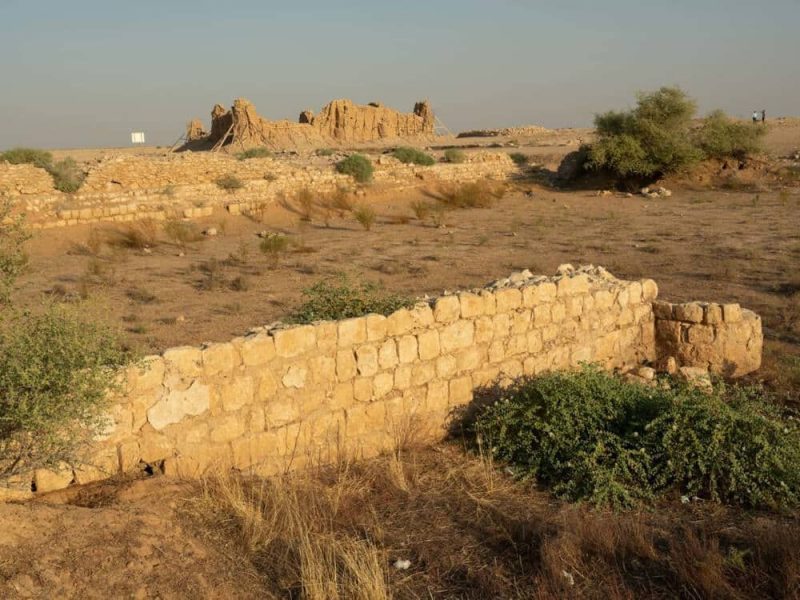
The site of Khirbet Beit Loya is located in the central lowlands of Israel. In the middle of this multiperiod site sits the medieval Islamic village: it occupies the summit of a low hill that offers view of Ashkelon and the Mediterranean coast, Gaza, and the Hebron hills. The extensive village ruins one sees today dates to the Mamluk era, having been suddenly abandoned sometime in the 15th century CE. With the funding provided by the Dana Grant for Israel, we are documenting cultivation strategies and soil enrichment practices from the nearby terraced fields (which are dated by OSL), and comparing them to crop processing and consumption practices in the village. The soil samples were taken from floors and middens of houses, a subterranean stable, and relic agricultural terraces and sent to three laboratories in the U.S. and Europe.
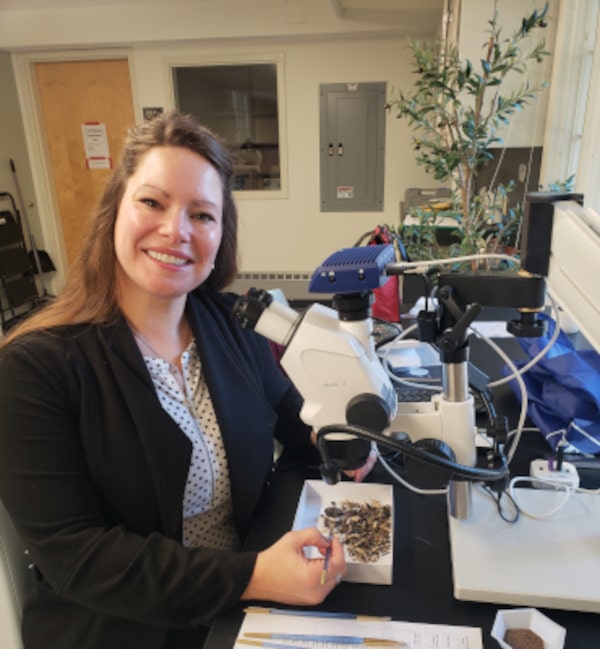
The macrobotanical work has been done by Dr. Kathleen Forste, a postdoctoral scholar at Brown University. Thirty flotation samples were collected in the field by the excavation team, and exported for analysis at Brown University. The first stage of analysis focused on the seeds, fruits, and plant parts. The crops identified are bread/hard wheat, barley, fava bean, along with barley rachis pieces (chaff), and a suite of seeds from wild plants that grow along hillsides and steppe areas (Bromus sp., bromegrass; Trifolium sp., clover) and others that typically grow as field weeds (Lolium cf. temulentum, darnel; Onobrychus sp., sainfoin). The presence of crop seeds, cereal chaff, and agricultural weed seeds suggests local cultivation and processing/cleaning of annual cereals and pulses. Notably absent from this assemblage are fruits such as olive, grape, and date, which were common staples in the past, just like today.
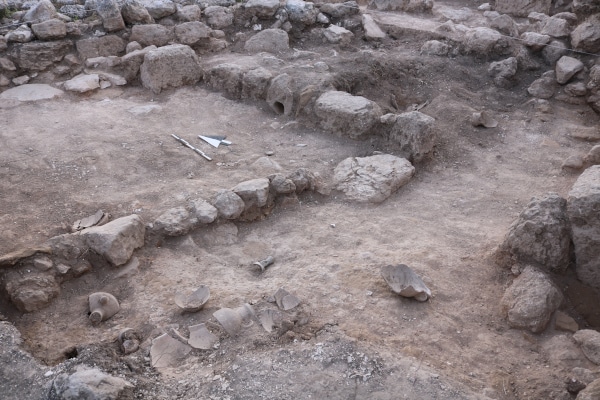
Excavation area showing crushed pottery in place. Photo credit Bethany Walker.
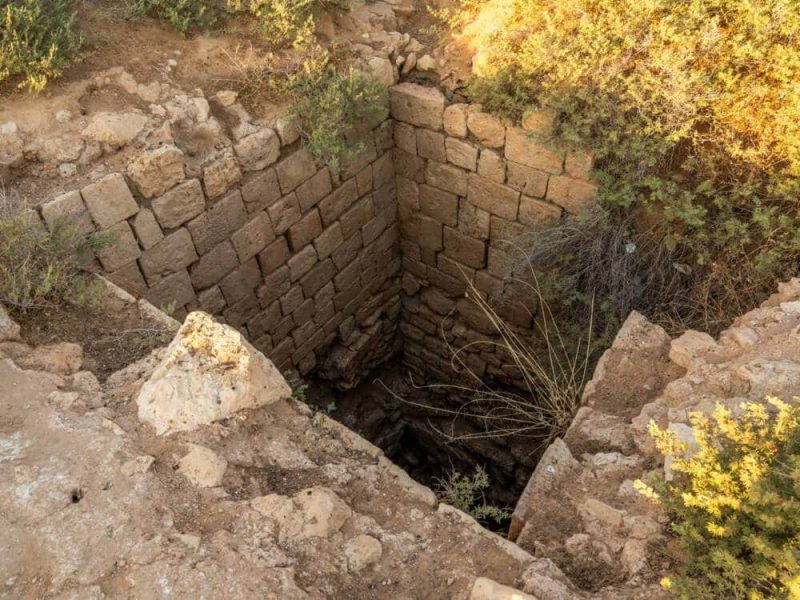
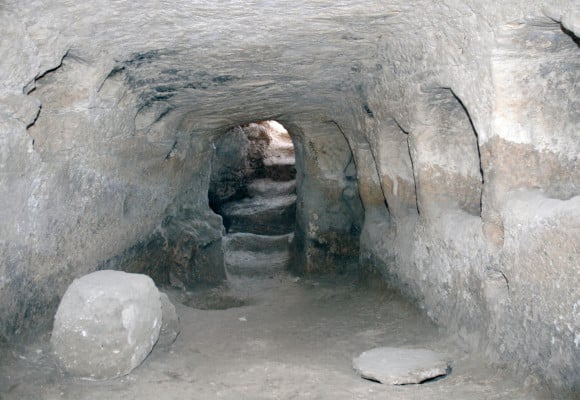
Subterranean stable in Field U. Photo credit Oren Gutfield.
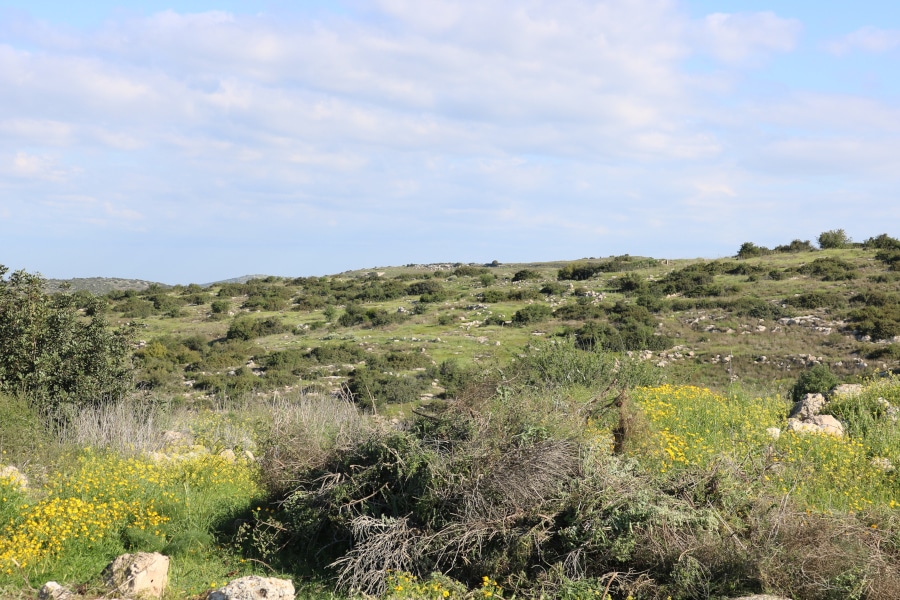
The terraced landscape of Khirbet Beit Loya. Photo credit Bethany Walker.
Outside of the domestic contexts, a comparison was made of the stable and terraces to determine whether the manure from animals raised at the site was used to fertilize the terraced fields (and which animal dung was preferred.) While this lab work is still underway, important preliminary patterns have emerged.
Nine such samples were processed by Dr. Ramona Mörchen (University of Bonn) for plant phosphate and nitrate analysis: six from the stable and three from a nearby agricultural terrace. The stable, unsurprisingly, produced the highest levels of plant-available phosphorus: up to ten times higher than in the terraced fields. Moreover, traces of animal dung (mainly from herbivores) were recovered from the stable floor and pits. The terraced fields, on the other hand, did not produce such markers of enrichment, indicating that they were likely farmed without the use of organic fertilizer.
The same nine samples were also subjected to dung spherulite, phytolith, plant isotope analysis, in order to study the siliceous and non-siliceous microremains. Samples were also analyzed by FTIR spectroscopy to determine their gross mineralogical composition. This work is being done by Prof. Rosa Maria Albert, of the Autonomous University of Barcelona (UAB). The mineralogical composition of the samples shows a high content of calcite, associated with siliceous minerals such as clay, quartz and opal. Phosphates have also been identified in some of the samples. In terms of microremains composition, the results show a high concentration of plant material, as evidence by the large presence of phytoliths, but also of water or very wet conditions, as indicated by the large amount of aqueous microreremains.
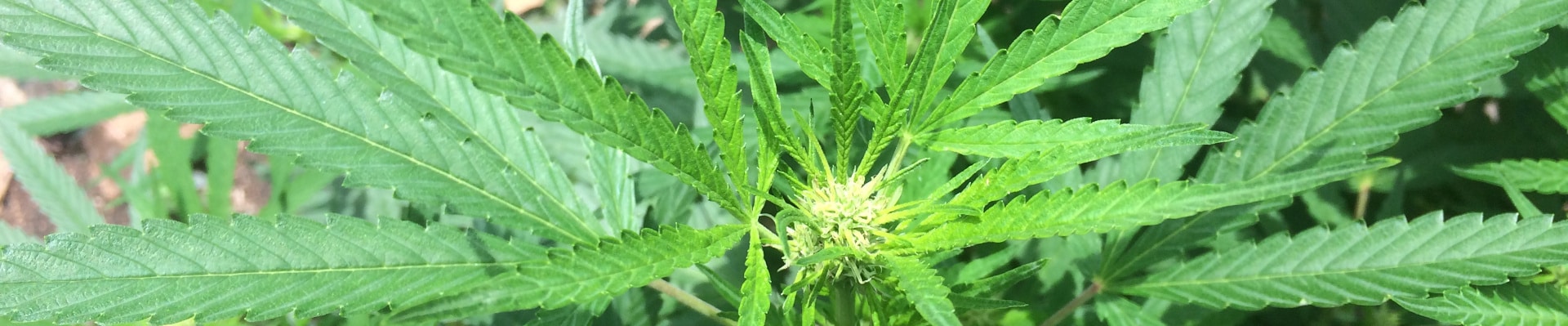
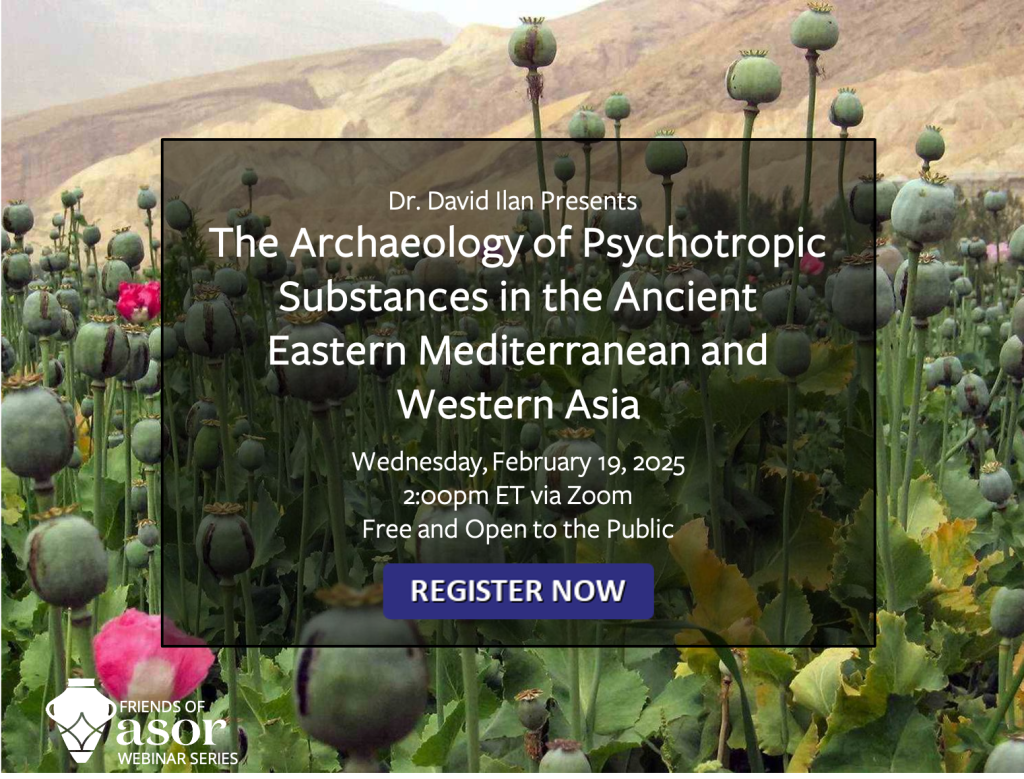
The Archaeology of Psychotropic Substances in the Ancient Eastern Mediterranean and Western Asia
Friends of ASOR present the next webinar of the 2024-2025 season on February 19, 2025, at 2:00 pm EST, presented by Dr. David Ilan. This webinar will be free and open to the public. Registration through Zoom (with a valid email address) is required. This webinar will be recorded and all registrants will be sent a recording link in the days following the webinar.
The texts of the ancient Near East and eastern Mediterranean Bronze and Iron Ages (including the Hebrew Bible) hint at the use of psychotropic substances (“hallucinogens”) in religious and shamanistic rituals. But the archaeological evidence for this is thin on the ground. This talk will look at the various available hallucinogenic substances and at recent research that indicates their consumption by human beings before examining artifacts that Dr. Ilan (and now others) believe are related to achieving altered states of consciousness. These include ring kernoi, seal impressions from the Aegean region, metal sceptres from the Chalcolithic period, ivory wands from the Late Bronze and Iron Ages, and the altars from the Iron Age temple at Tel Arad. The “high place” takes on a new meaning!
A native of Los Angeles, David llan was the director of the Nelson Glueck School of Biblical Archaeology at the Hebrew Union College in Jerusalem from 2003 to 2024. He has excavated at Tel Arad, Tel Malhata, Tel Yoqneam and Tel Megiddo and directed the excavations at Tel Dan from 2005 to 2022. He teaches at the Hebrew Union College and has taught at Tel Aviv University, Hebrew University, Johns Hopkins University and spent a sabbatical year in 2019-2020 at the Center for the Study of Origins of the University of Colorado, Boulder. Dr. Ilan specializes in mortuary archaeology, the archaeology of religion and ritual, ground stone artifacts, ceramic typology and technology, and the Chalcolithic period, the Middle Bronze Age and the early Iron Age of the southern Levant. He is the editor of the journal NGSBA Archaeology and the monograph series of the Nelson Glueck School. Dr. Ilan has published three final excavation reports and numerous articles in scholarly journals and in the popular press. His most recent articles deal with the praxis and paraphernalia of ritual action and religious belief in the ancient Near East, including the use of psychotropic substances.
SPONSOR A WEBINAR!
Several levels of support from $50-$1,000 are available. Proceeds go towards membership scholarships and towards increasing ASOR’s virtual resources. Each sponsorship is tax-deductible and includes benefits! Sponsor a webinar here.
ASOR mourns the passing of long-time member and trustee, Carolyn Midkiff Strange. Below is an excerpt from Carolyn’s obituary. The full obituary is available here.
Lillian Carolyn Midkiff was the youngest of four children, born on April 16, 1937, in Midland, Texas, to Naomi (née Mabry) and Tyson Midkiff. She spent her childhood in Midland, Rankin, and Kerrville, graduating from Kerrville’s Tivy High School in 1955. She especially enjoyed weekends on the family ranch with her father as a young girl, where she helped with the animals and swam with her cousins in the water tanks fed by windmill-operated pumps. Midkiff family reunions attended by seemingly hundreds of cousins were events that—years later—Carolyn, her husband, and children would greatly enjoy.
Carolyn attended one year at Hardin Simmons University, then transferred to Rice University in Houston, graduating with a B.A. in English in 1960. She met the love of her life, Jimmy Francis (Jim) Strange, at Rice, and, after some fitful starts, the two dated, became engaged, and married in Rankin on August 19, 1960.
Carolyn’s and Jim’s eldest children, Mary Elizabeth and James Riley, were born in Kerrville, while Jim taught at Shriner Institute and Carolyn taught high school geometry, her very favorite subject. The family then moved to New Haven, Connecticut, and on to various towns in New Jersey as Jim did graduate work. In these early years Carolyn worked at Esso Research and taught at a Montessori kindergarten. Katherine Alexandra and Joanna Carissa were born after the family moved to Tampa, Florida in 1972.
Andy Vaughn, ASOR Executive Director
Carolyn used to describe herself merely as someone who read a book and decided to do something. She sometimes joked that she should stop reading books.
Well, I can tell you that I read books too, but I don’t change the world after I read a book. Carolyn did.
One example is Ibram X. Kendi’s book, How to be an Antiracist. A key point in this book was that antiracists must make structural change—and Carolyn did just that, and she inspired everyone else to do the same. She was not a person to scream, make demands, or protest. She acted and she inspired others to act.
As one speaker at her memorial service put it, instead of being “All hat and no cattle,” Carolyn was “All cattle and no hat.” Indeed, Carolyn was a woman of action—and that was contagious.
So how did Carolyn make structural change in ASOR that will live on? I’ll share just a partial list of things that Carolyn did of which many ASOR members may not be aware because she did them without fanfare or asking for recognition. She desired action, progress, and change and not praise:
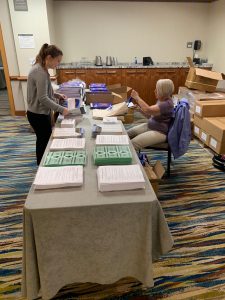
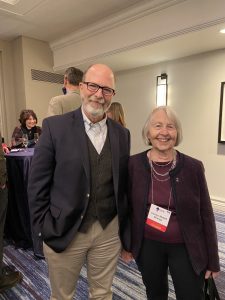
Meagan Shirley and Carolyn Strange
stuffing tote bags at the
2019 Annual Meeting.
BIPOC Endowment: Carolyn made a challenge gift to establish an endowment in ASOR for black and indigenous students to participate in excavations. ASOR currently awards about $100,000 per year in fieldwork participation scholarships (50 scholarships of $2,000 each). Carolyn wanted to ensure that ASOR would enable the participation of black and indigenous students on digs, so she made a $100,000 challenge gift to encourage the wider ASOR community to create an endowment to fund annual awards of at least five (5) scholarships at the $2,000 level. That endowment now has a market value of $292,000. Thus, ASOR will continue to fund at least five dig scholarships plus five (5) travel scholarships to the Annual Meeting for black and indigenous students.
Strange / Midkiff Families Endowment: Carolyn and Jim Strange made a challenge gift to establish one of ASOR’s first endowments for dig scholarships for any ASOR member. Not only has this fund grown to almost $260,000, but its establishment also encouraged other members to make challenge gifts for named endowments to support fieldwork participation scholarships, excavation grants, and member research fellowships.
ASOR’s permanent home in Old Town Alexandria—what is now named the James F. Strange Center. In 2016 when ASOR was evicted from its free office space at Boston University, Carolyn quietly (yet forcefully) told the ASOR Development Committee that we couldn’t fail, and we couldn’t set our sights too low. She argued that ASOR must be bold. She made an extraordinary challenge gift of $750,000 so that ASOR could buy an office building in Alexandria, Virginia and create a board-designated endowment to ensure that we had funds to continue the operations of the physical space. Once more, Carolyn’s leadership inspired others. ASOR purchased our office home, paid off the mortgage, and created a board-designated building endowment that now has a market value of $485,000 (just $15,000 short of our goal). As noted above, this structural change permits ASOR to continue being a flagship organization in archaeology, history, and cultural heritage by operating out of the Washington, DC area without paying rent.
Creating video and training resources for fieldwork safety and cultural competency training.Because ASOR now awards more than $250,000 annually in dig scholarships, excavation grants, and membership research fellowships, Carolyn had the vision that ASOR should also create structural change by increasing cultural competency and awareness by requiring fellowship recipients and project directors to view and read resources that were created ASOR’s DEI committee and other volunteer partners (including Archaeology in the Community and Society of Black Archaeologists). These resources are still being created with money donated by Carolyn, and their impact will be another way that her legacy lives on.
Initiating volunteer participation at the ASOR Annual Meeting and emboldening committees to do their work. Carolyn liked to work behind the scenes. A prime example was her arrival at the Annual Meeting on Monday so that she could assist the ASOR staff with setup. Like her work on excavation projects, Carolyn was at home behind the scenes, and all of the ASOR staff considered her “one of us.” Similarly, Carolyn was inspirational for the DEI Committee and the Membership Committees (see the remembrance by the DEI Committee Co-Chairs). She quietly insisted that committees had to be positive and couldn’t aim low. It was difficult, if not impossible, to tell Carolyn “no” or that it couldn’t be done.
Mary Elizabeth Strange Endowment and renovations of the first floor of the Strange Center: Carolyn made a gift of $200,000 to renovate the first floor of the Strange Center so that ASOR can host heritage educational events in Old Town Alexandria. She also made a $800,000 pledge for an endowment that will distribute about $40,000 annually for programs to bring cultural property protection of the cultures from the Middle East and North Africa to the Strange Center. This endowment will be critical in changing how ASOR views itself as partnering with local community members from the countries where we work. The diaspora members, who now live in the United State, will partner with ASOR to protect heritage at risk both in the U.S. and in the countries of origin. This is another initiative that will make institutional change in ASOR, and it was near to Carolyn’s heart in part because of her two of her grandchildren (Mary Elizabeth’s adopted sons) are from Ethiopia and Thailand.
Carolyn was an ASOR member almost her entire adult life. She was a trustee since 2018. She worked behind the scenes, and was a counselor, friend, and prayer warrior. Saying that Carolyn was a friend to many is an understatement. She made time to talk to so many in her ASOR family. For me, this was also personal. When I was going through a hard time this past year, we spoke at least weekly. I knew that she prayed for me daily, and she sent encouraging texts multiple times a week. I’m certain that I’m not the only one who experienced this type of love and support. She cannot be replaced in ASOR, nor in our world. Yet, her love and her projects will live on because she did indeed create structural change in ASOR, in her church, in her community, and in her family and friends. May her memory be a blessing.
B.W. Ruffner, Honorary ASOR Trustee
It’s a little awkward for a volunteer archaeologist to be honoring someone like Carolyn, but I guess she was a volunteer too. The difference is that my contribution to the discipline is trivial compared to hers. Putting these thoughts on paper has given me an opportunity to remember her unassuming intelligence, her quiet service to ASOR and her family, and how much fun she was to be around.
I have seen only a fraction of Carolyn’s gifts to us. We met briefly at Sepphoris in 1994, then shared some meals at a kibbutz somewhere in Galilee when Jim was documenting some artifacts that were stored in a container there. That was when I discovered how much fun she was to be around. A review of ASOR’s remembrances after Jim’s passing and of Carolyn’s recollections of her time with Vivian Bull at various digs over the years make it clear that she was an invaluable presence on Jim’s excavations, and gave her children their first experience with archaeology.
We got more acquainted over the years at ASOR annual meetings. I always hoped to be at her table for Legacy Dinners. She usually arrived early so she could help the staff get set up and organized and was always available to “back up” when the staff was needed elsewhere. She was a problem solver. A review of her obituary makes it clear that her gifts to the world, both in time and resources, extended far beyond us. She clearly was committed to her church and to racial justice. For the University of South Florida, she supported a chair in Racial Justice, the Department of Religious Studies and the UCF Botanical Gardens.
I got a more complete view of her intelligence, her quiet thoughtful effective unassuming personality – and her sense of humor – at Shikhin. By this time I wasn’t useful with a gufah and wheelbarrow so I slept late and went to the field with her when she served ”second breakfast.” My task was to deal with fever, diarrhea, nausea, dehydration and minor trauma. She took care of everything else. If a tool or some unexpected supply was needed, she went looking for some way to solve the problem. She knew who was sick, and who was homesick. She knew where the volunteers could shop and dealt with financial or travel problems. She was an effective grandmother to them all.
Carolyn and other trustees
at a reception at the
James F. Strange Center in 2024
She kept things organized at the hotel. If there were problems with meals or facilities she resolved them. She made sure things were set up for pottery reading and helped James register data and arrange lectures. I feel sure she helped James arrange our weekend tours too. I suspect that what I saw was just a fraction of her contributions to Jim’s digs over the years.
She and I were a “senior generation” on the team. We had time to share thoughts on the challenges of getting older, and the joys of being grandparents. We talked about our travels over the years, and the values and challenges of our religious denominations and our spiritual lives.
My last time with her was a painful reminder of her quiet self-effacing personality. When she collapsed at an ASOR Board dinner in May at Alexandria, she lay on the floor with us crowded around and said “Get back to your dinner. I will be fine. I’ve done this before. Just leave me here on the floor”. After several hours and IV fluids in the emergency room she recovered and returned to the hotel. I have second guessed myself – and the emergency room – wondering if we missed some clues to the eminent disaster. If she had any early symptoms, she probably ignored them. I’m sure she told the ER “I don’t really need to be here.”
Susan Ackerman, ASOR Past President
Carolyn Midkiff Strange was an inspiration and brought a surge of passionate energy to every part of ASOR she touched. There was nothing that she thought ASOR could not do, or at least could not do better, if we threw out hearts and souls into it—and she used her huge heart and generous soul to lead by example. When we were evicted from our long-time office space at Boston University in 2017, she made the lead gift that we needed to buy a building that would become ASOR’s permanent home, and she inspired the rest of us to raise the funds to cover the rest of the purchase price, even when there were many (myself included) thought it could not be done. Indeed, I will never forget the aftermath of one Development Committee meeting, when the building funding looked grim, and Carolyn (short, sweet, diminutive Carolyn!) took me by the shoulders, shook me, and said, graciously but forcefully, “We can do this.” Well, she did, and the James F. Strange Center in Alexandria, VA— named in honor of her late husband and life partner, Jim Strange—is a lasting tribute to her grit and determination.
And she didn’t stop. She inspired our diversity, inclusion, and equity work, especially when the need became urgent in 2020, once again through her determination that “we can do this” and through her commitment to put her money where her heart and soul demanded: and so she established an endowment to fund excavation scholarships for BIPOC students and gave contributions to support other diversity initiatives. Her fund-raising passion also led her to be an enthusiastic member of the ASOR Development Committee and a moving force when it came to raising monies from others, especially donations to “ASOR 2025 – Strengthening our Foundation | Expanding Horizons – A Call to Action,” an initiative celebrating our 125th year as an organization.
Most recently, Carolyn has donated funding to establish the Mary Elizabeth Strange Endowment for Diaspora Heritage Educational Programming. Moreover, in 2014, Jim and Carolyn Strange jointly established ASOR’s Strange and Midkiff Familes Excavation Fellowships, designated to support the participation of ASOR members as volunteers or staff on excavation projects. The fund has now awarded 24 excavation fellowships, with a total of $46,500 disbursed to grantees.
Carolyn and Jim, each members of ASOR for over fifty years, each members of the ASOR Board of Trustees, and each generous donors, are testaments to what is best in ASOR—and an inspiration to us all.
Teddy Burgh, chair of the Membership and Outreach Committee and ASOR Trustee
My time with Carolyn goes far beyond obligatory cliches and customary superlatives. We didn’t spend a lot of one-on-one time together, but our brief conversations and interactions are memorable. It wasn’t that she said anything profound. There were no remarkable quotes. What resonated with me was Carolyn’s passion and sincerity. Both were palpable. After some of my previous experiences and interactions at ASOR conferences, as well as with various people on excavations, I am extremely sensitive when it comes to trust and sincerity. Many people know what to say and how to say it to present a specific persona or image. Yet, their true feelings can be just the opposite. When I met Carolyn, I will admit that I was guarded and cautious. However, I began to realize that she was for real. Her actions echoed her words. What was also impressive was Carolyn’s desire to learn and see change in the organization. She was extremely candid about what she didn’t understand and wanted to comprehend other points of view. She was open to having difficult conversations. Carolyn not only listened, but she heard what was being said and worked to bring about overdue changes in the organization.
Debora Heard, member of the DEI Committee and the William Leo Hansberry Society
Carolyn Strange was not only a highly-valued member of the DEI Committee, she modeled the self-journey each of us should be undertaking to make this world a better place for all of us.She demonstrated that one could learn what one could not comprehend.In the wake of the protests over the murders of George Floyd, Breonna Taylor, and Ahmaud Arbery, Carolyn found that she could not comprehend the racism, discrimination, privilege, social injustice, and inequality that the protesters were claiming was embedded in US society, but she wanted to know.She was open to learning what she did not understand.She would tell anyone who would listen that reading Ibram X. Kendi’s How to Be an Antiracist opened her eyes and changed her life.Yet, one book could not teach her all that was to know, so every month at our DEI meetings, she would show us what new book she was reading dealing with topics like the perpetuation of racism within the church, social inequality, and systemic forms of racism and discrimination.Carolyn also understood that knowledge alone does not produce change.She took that next step that many neglect.She asked, “What can I do?” and she spent the rest of her life committed to ways to answer that question.
Carolyn hosted a reception for
members of the William Leo
Hansberry Society at the
Annual Meeting in Chicago in 2023.
The first part of her action plan was education.While Carolyn always downplayed her role in archaeology, often saying, “I’m not a scholar,” her modesty did not extend to giving her opinion.In fact, one of Carolyn’s best qualities was her direct, straightforwardness; she was a “truth teller.”As a result, exposing others to the belief-shattering knowledge that she was acquiring was not always easy for her listeners to receive, so she bought books to give in the hopes that the recipients would receive a similar revelation and join her in the work of changing minds and, more importantly, changing society, which leads to the second part of her action plan which was “action.”
Carolyn believed that it was a responsibility as a person, and also as a Christian, to DO all that she could to effect positive change for all people.As a member of ASOR’s Board of Trustees and DEI Committee, she actively worked to ASOR toward greater diversity and inclusivity in its values, its membership, and its impact on the research and disciplines under its purview.She also funded initiatives that would help ASOR begin its own journey of transformation and evolution.
Carolyn Strange was a person who gave her whole heart to what she believed, and she truly believed in diversity, equity, inclusion, accessibility, fairness, and justice.The DEI Committee will sorely miss her, but her contributions to the committee and on ASOR, at large, are a part of her legacy that must be continued.As long as we continue in the work to which she dedicated the last years of her life and as long as we commit ourselves to our own uncomfortable journeys of seeking to understand the lived lives of people of different backgrounds than ourselves and doing the work to improve the lives for all of humanity in whatever small way that we can, we will keep Carolyn Strange and her legacy alive.
Kate Larson and Julia Troche, co-chairs of ASOR’s Diversity, Equity, and Inclusion Committee.
Carolyn and her son,
James R. Strange at the
2021 Annual Meeting.
Among Carolyn’s many legacies to ASOR is her unwavering commitment to building a more inclusive and equitable field of archaeology and study of the ancient world. She pushed herself and others to confront uncomfortable histories through self-education and intentional reflection. She also didn’t hesitate to step forward as a lead donor on numerous diversity initiatives, among them ASOR’s BIPOC fieldwork scholarships that have enabled 13 black, indigenous, and people of color to participate in archaeological excavations since 2022. This sort of financial and institutional support helps ensure those from a wider range of backgrounds, lived experiences, and perspectives can continue to broaden and invigorate our field.
Carolyn was an inaugural member of ASOR’s DEI Committee when it was established as a standing committee by the Board of Trustees in 2021. She provided moral accountability and clarity to the committee from day one, entering all conversations with humility and grace. Her encouragement, calm but strong presence, unwavering support of the work of the committee, and commitment to inclusion permeated our work. She never hesitated to recommend a book, share her own journey, and embrace humility. She is missed profoundly.
Eric and Carol Meyers, ASOR Trustees
Carolyn Strange was a dear friend over the course of more than fifty years. From the early 1970’s to the early 1980’s, she and her family sank deep roots with the Meyerses in the Upper Galilee, and later in the Lower Galilee at Sepphoris near Nazareth.
Jim and Carolyn Strange at Sepphoris.
Carolyn never took the label of being a Galilean lightly: it was her heritage and one that fueled her dedication to inclusivity, tolerance, and commitment to those in need. In recent years she especially devoted time and attention to ASOR and the Albright where she had spent so many years. Her efforts and contributions have enabled both to prosper and grow in a time of great challenge for the Middle East.
In many ways these past years she has enjoyed new friends and new ties that have bound her to the lives of all sorts of individuals, not only to us Galileans but to ASOR and AIAR types from all over the US and globe. And she won their hearts through her charm and straightforward talk.
She has left a legacy, and we all celebrate it. She will always be in our hearts and memories.
Yehi shema mevorekhet, may her name be for a blessing,
ASOR is excited to announce the appointment of the new editor of Near Eastern Archaeology (NEA)—Christina Tsouparopoulou. Christina started her term in January 2025. The new editor succeeded the previous editor, Stephanie Budin, who held the position of NEA editor from 2018-2024. ASOR appreciates the tremendous amount of work that Stephanie has put in over the past six years and acknowledges her unwavering dedication to the journal.
The editor was nominated by the NEA Editorial Search Committee after an extensive public search process. The nomination was unanimously endorsed by ASOR’s Publications Committee, and the editor was unanimously approved by the ASOR Board of Trustees. NEA editors are appointed for a three-year term, with the possibility of being re-appointed for a second term. Her initial term will run from 2025–2027.
Christina Tsouparopoulou (Institute of Archaeology, UKSW) is an Assistant Professor at Cardinal Stefan Wyszyński University in Warsaw and an Honorary Fellow at Durham University working on Near Eastern popular religious practices, identities, cylinder seals, human-animal/environment relations, and digital humanities. She received her PhD from the University of Cambridge with a thesis on Ancient Near Eastern cylinder seals and sealing practice, and has held teaching and research positions at (among others) Heidelberg, Durham, and Cambridge.
Christina is thrilled to join Near Eastern Archaeology as its new editor. She is passionate about advancing research on the ancient Near East and Eastern Mediterranean. As the new editor of Near Eastern Archaeology, she looks forward to working closely with early-career researchers and drawing on her experience in public engagement, including documentary projects like Discovery’s Ancient Armageddon and Lands of the Bible, to make the journal more accessible and engaging, opening up the fascinating world of the ancient Near East to both specialists and a wider audience, while upholding its scholarly excellence.
Archaeological discoveries continually enrich our understanding of the people, culture, history, and literature of the Middle East. The heritage of its peoples – from urban civilization to the Bible – both inspires and fascinates. Near Eastern Archaeology brings to life the ancient world from Mesopotamia to the wider Mediterranean with vibrant images and authoritative analyses. NEA (ISSN 1094-2076) is published four times each year (quarterly): March, June, September, and December.
All manuscripts submitted to Near Eastern Archaeology are subject to a peer review by independent scholars. All articles are sent to two external specialists in the field who are asked to evaluate the manuscripts for their academic quality. The time assigned for the review is normally 30 days; the peer-review process and (if required) the resubmission of revised manuscripts is handled through NEA’s Editorial Management system. NEA’s Editorial Board assists the editor in the peer-review process, e.g., through the recommendation of external reviewers, acceptance decisions, and the revision of manuscripts. All articles must be submitted via NEA‘s electronic manuscript submission portal. Questions, comments, or suggestions for the new editor? You can now contact them at nea-editor@asor.org.
Sarah Jarmer Scott was elected as ASOR’s next Secretary by the Board of Trustees during the Annual Meeting in November 2024. Sarah will serve a three-year term as Secretary until December 31, 2027. Below is her vision statement for ASOR:
ASOR has been a foundationally important organization for me, and I know it has been for others. It would be an honor to give back by serving on the Board, and in doing so I would hope to support and grow its programming and membership. Not only has it provided academic, intellectual, and networking opportunities for my work, it has also provided a community for pedagogical support. My area of scholarship is fundamentally interdisciplinary, while also being inter-regional. As a specialist in Mesopotamian glyptic and visual culture, I engage in dialogue with art historians, archaeologists, philologists, anthropologists, and museum professionals. My own experience in presenting papers and chairing sessions has opened paths for research and publications, as it has for others. The networking and social component – particularly through the annual meetings – has also been important in my own growth and confidence as a scholar. The diversity of attendees and members, as well as the commitment to social justice in the many disciplines represented by ASOR, is an essential component of the organization, and one that is key to its success.
As one of many members who teach at a small college where I am the only person in my area of specialty, ASOR is an important community, as it provides a venue to talk to like-minded researchers and teachers, collaborate, and bring back ideas. While my main role at Wagner is as professor of Art History (where I teach Mesopotamian, Egyptian, Greek, and Islamic Art, Museum Studies, as well as writing seminars), I have also served as Dean and directed a number of grants. Having seen some of the challenges facing higher ed, and sought to empower colleagues and students to find success in their work, I know that organizations like ASOR are essential in bringing deep knowledge and resources to such endeavors; I see opportunity in deeper collaborations between and amongst ASOR, its membership, and higher education institutions and museums.
My experience with ASOR (conference attendee, presenter, session chair, and utilizer of multiple ASOR resources and publications) has given me insight and knowledge of the organization and will serve to make me an excellent Secretary. I’d also like to call attention to my 20 years of experience on the board of the local Staten Island AIA chapter. I am proud of the work I did with them and the amazing programming I developed for that community (lectures, trips, archaeology fairs).
In the years ahead I know ASOR will face many challenges. Surely the organization will rise to those challenges. Continued and emphatic devotion to development of scholarship, diversity, social justice, community-based collaboration, and creative partnership development will enable ASOR to succeed and thrive. I look forward to serving the Board of ASOR.
ASOR would also like to welcome three new trustees to the Class of 2027:
Andrea Berlin (Institutionally-Elected Trustee) Helen Dixon (Membership-Elected Trustee) Emily Hammer (Membership-Elected Trustee)
This summer, I had the opportunity to excavate for the first time at the site of Alalakh (Tell Atchana) in Hatay, Türkiye. Although I had obtained my masters in Archaeology back in 2021, I had not had the chance to participate in archaeological fieldwork at that time because of the COVID-19 pandemic. When I was accepted to excavate at Alalakh this July I could not wait for the project to begin, however, I was surprised by the unique and interesting work I got to be a part of there. Apart from our normal excavation project, my fellow colleagues and I got to be a part of an exciting and groundbreaking experimental archaeological initiative where we worked to reconstruct the site’s mudbrick walls and protect its ancient foundations.
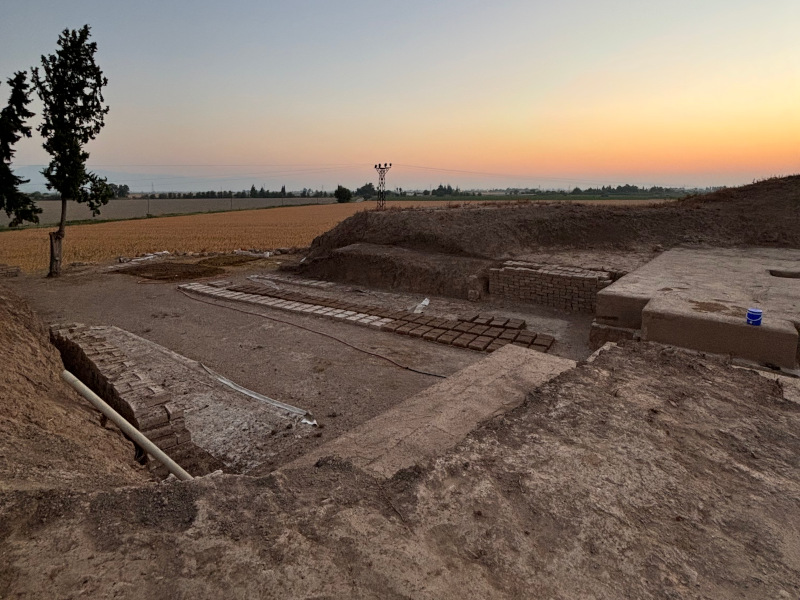
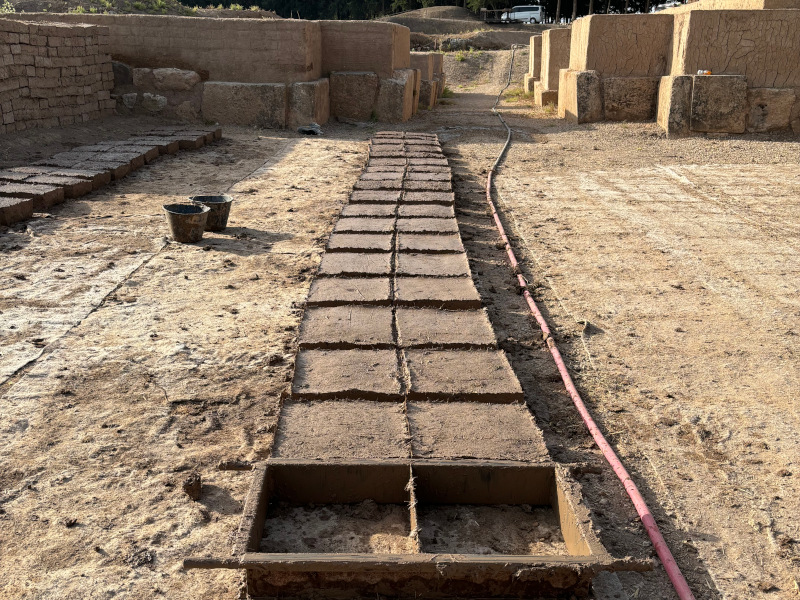
Elevated view of completed and finished mudbricks
On my first day at the site Dr. Akar, our site director, stated that although one of our goals was to uncover the site’s mudbrick architecture; exposing the ancient mudbrick to the elements causes it to rapidly deteriorate. In order to preserve the site’s ancient foundation and to give visitors a better sense of what the site would have looked like in antiquity we would spend part of the summer’s excavation season creating mudbricks and reinforcing the site’s mudbrick walls using ancient building techniques.
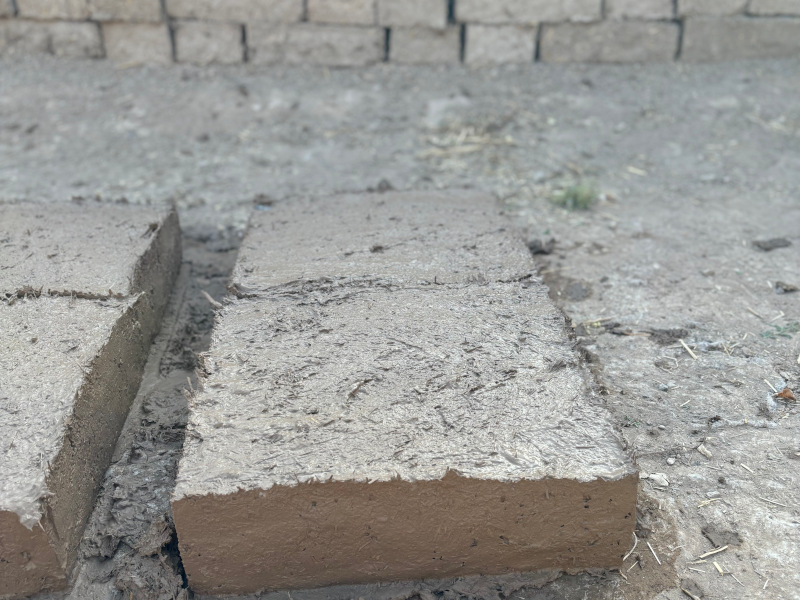
To begin making a mudbrick wall you first need to create the mud bricks. Dr. Akar consulted with members of the local community on mud brick recipes, as up until relatively recently in the adjoining village of Tayfursökmen and the surrounding areas people where still building with mudbrick. However, the practice had sharply fallen out of favor, being replaced by more modern building techniques. The mud that we used was a mixture of soil, straw, and water which we would mix until it was wet and could hold shape. Working in pairs we would then throw the mud into brick shaped molds; the trick was to make sure that copious mud was packed into the corners as this gives the brick its stability. Once the molds were filled, my workmate and I, would remove the mold with one swift, fluid movement – leaving a mud cube behind. Then we would re-set and start the process all over again.
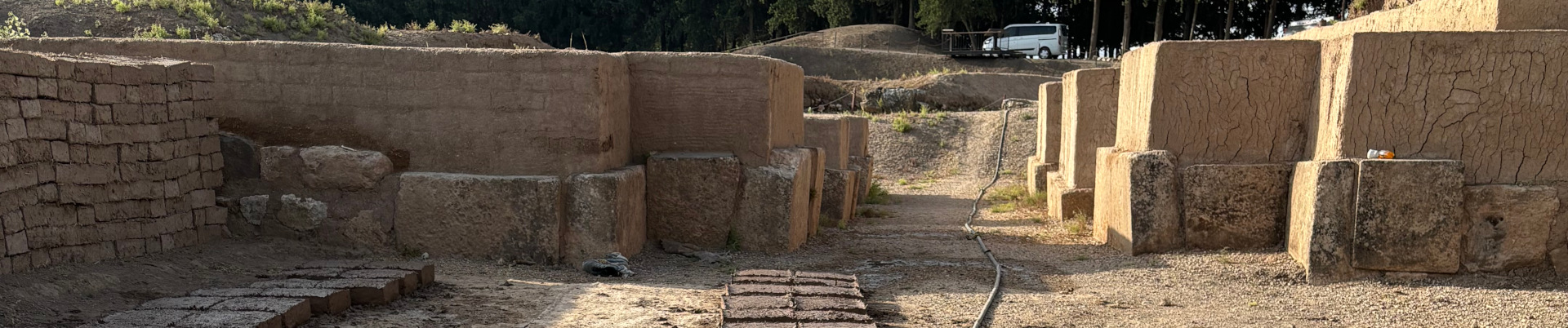
Line of mudbricks and mold
Pair of mudbricks
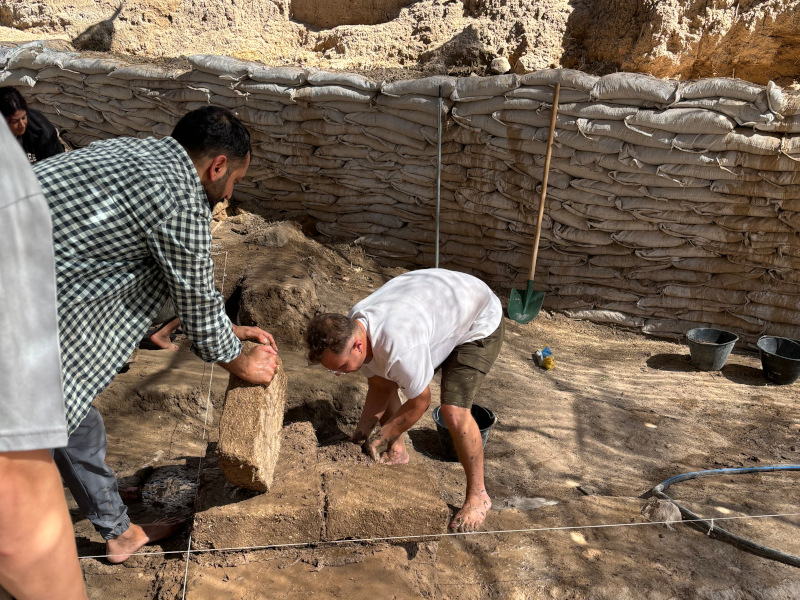
These bricks would be set aside to dry for at least a week before they would be utilized in the next stage of the process, construction. Water was the key ingredient in this step as it allowed us to adhere and secure the bricks to the foundations and to each other. We would wet the surface on which the bricks were to be set and add a substantial, but flattened layer of mud to act as an adhesive. We would then wet the bricks and carefully place them in the mud, adding layers of mud between them so that they would adhere. Finally, we would cover the newly created wall with a final layer of mud and leave it to dry. Once the wall had dried over several days, we would go back and add a final layer of mud in order to smooth and plaster the wall.
Building the wall
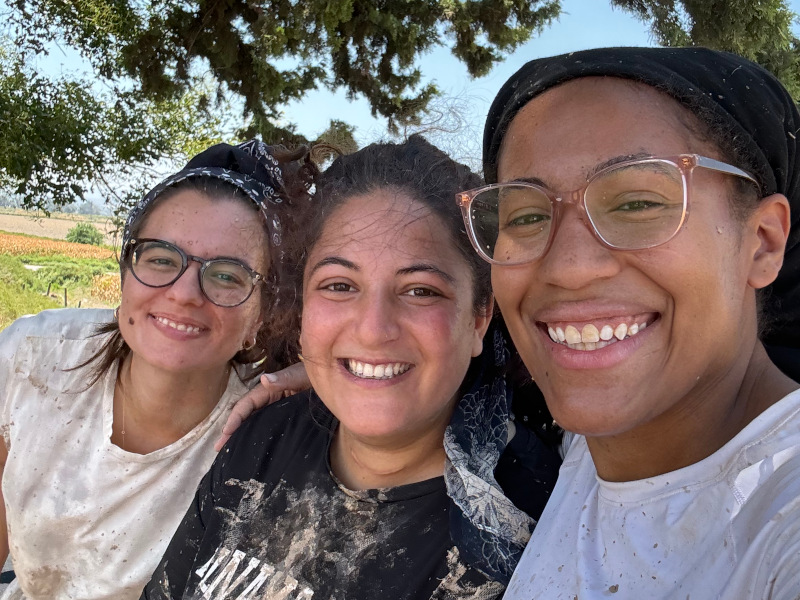
This was a messy and labor-intensive process to be sure and we would always end these days covered in mud from head-to-toe, but the days where we made mudbricks and built walls were also the most fun. Some of my best memories from Alalakh were when we would plaster the mudbrick walls while dancing to YMCA, or when the team would get into an inevitable mud fight! There was also something magical about the process of building as working with the mud would often transport us back to the Middle Bronze Age where we could see in real time the problems that ancient builders would have encountered, and following in their footsteps often used stones, ceramic fragments, water, mud, and straw as solutions. Once we were done with our work looking down at the freshly made walls from the top of the tell, I was often filled with a strong sense of pride knowing that these efforts would help to preserve the site for years to come.
Covered in mud but still having fun
Lauren Cook is a Baltimore-based doctoral student studying Art History at Johns Hopkins University. She is interested in imperialism and alterity in Ancient West Asia. Lauren received a dual BA in Art History and Archaeology from Pitzer College as well as a MPHIL in Mesopotamian Archaeology from the University of Cambridge.
Lauren excavating a Late Bronze Age tablet. Photo courtesy of Murat Akar.
ASOR is now accepting applications for 2025 Fieldwork Participation Scholarships. Learn how to apply here.
Want to help more students and early career archaeologists get into the field? Donate to the cause today by selecting “Fieldwork Scholarships” as your gift purpose!
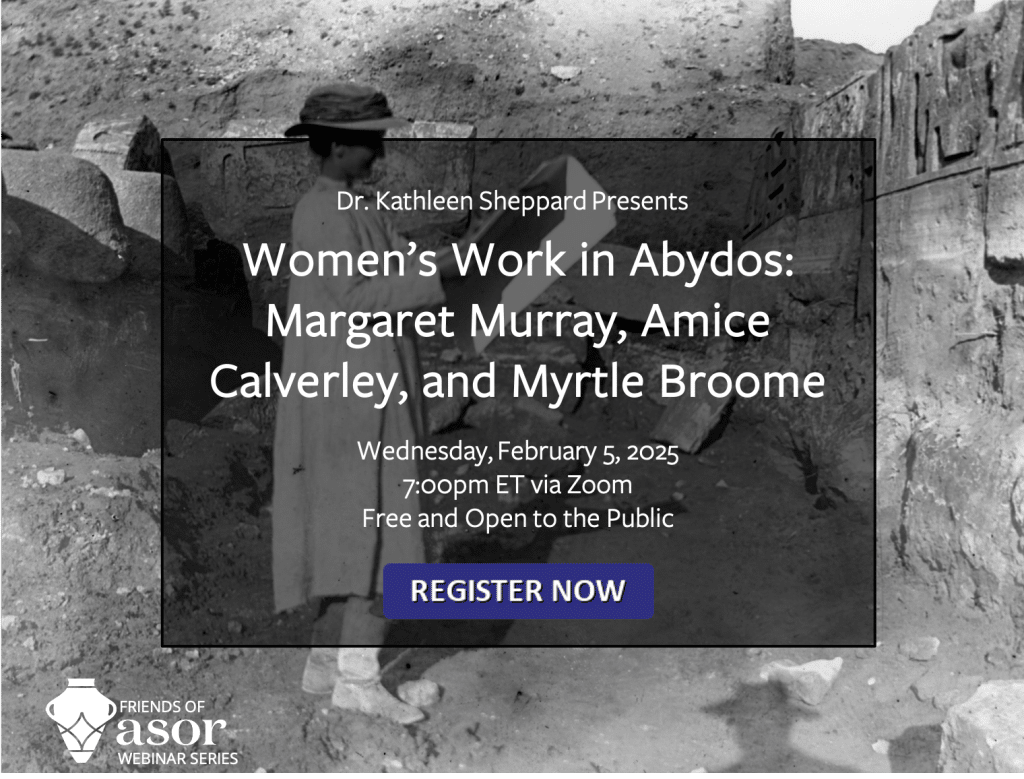
Women’s Work in Abydos: Margaret Murray, Amice Calverley, and Myrtle Broome
Friends of ASOR present the next webinar of the 2024-2025 season on February 5, 2025, at 7:00 pm EST, presented by Dr. Kathleen Sheppard. This webinar will be free and open to the public. Registration through Zoom (with a valid email address) is required. This webinar will be recorded and all registrants will be sent a recording link in the days following the webinar.
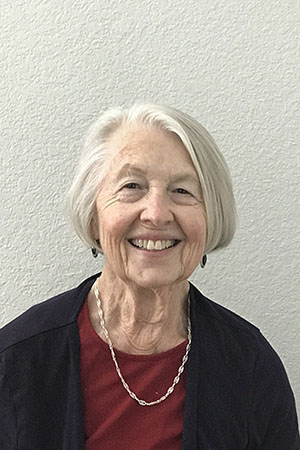
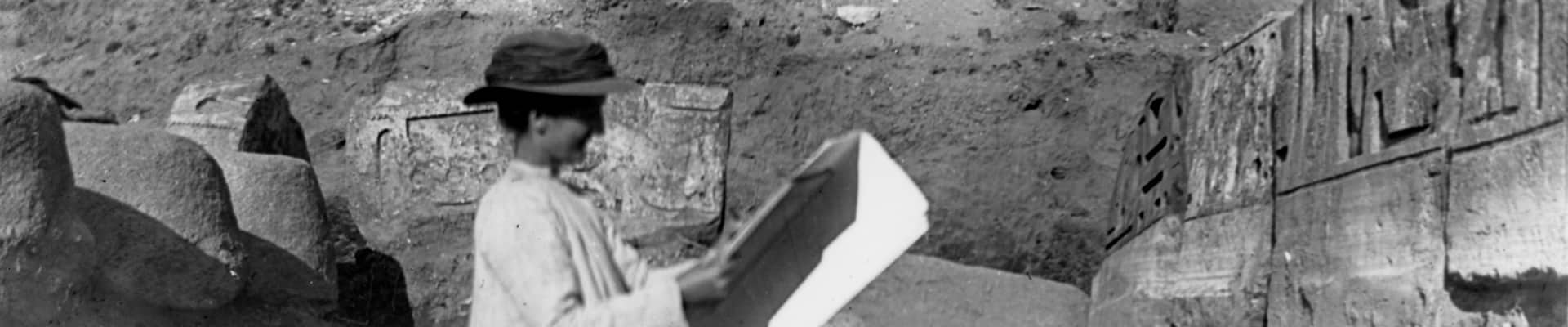
In 1902, Margaret Alice Murray got invited to work in the field—finally. Training with Flinders Petrie for the last eight years, she had taught plenty of students in London, but had never been to Egypt to work herself. She spent only one season at Abydos, working in the Osireion, a special temple that no one had yet fully understood. Two years later, Murray’s publication, The Osireion at Abydos, upended all previous theories about the site. By 1938, Amice Calverley and Myrtle Broome were leaving Abydos, having spent almost a decade copying the art in the Temple of Seti I. Their own publications, The Temple of Sethos I at Abydos, were four volumes of brilliantly painted art from the temple walls in exacting detail. This talk will detail the ways in which the work women did on site at Abydos in the early 20th century impacted our understanding and reception of one of the most important sites in all of ancient Egypt.
Dr. Kathleen Sheppard is Professor in the History and Political Science department at Missouri S&T. Her focus of study is the history of Egyptology. Her most recent book, Women in the Valley of the Kings, tells a history of Egyptology through the perspective of women’s work in the field. Her 2022 book, Tea on the Terrace: Hotels and Egyptologists’ Social Networks, investigates the role of hotels as hubs in the professional and friendship networks of Egyptologists in the late 19th and early 20th century. She received her MA in Egyptian Archaeology from UCL in 2002 and her PhD in History of Science from University of Oklahoma in 2010.
SPONSOR A WEBINAR!
Several levels of support from $50-$1,000 are available. Proceeds go towards membership scholarships and towards increasing ASOR’s virtual resources. Each sponsorship is tax-deductible and includes benefits! Sponsor a webinar here.
Thirsty Work: Building and Brewing on Bronze Age Cyprus
Friends of ASOR present the next webinar of the 2024-2025 season on January 22, 2025, at 2:00 pm EST, presented by Dr. Lindy Crewe. This webinar will be free and open to the public. Registration through Zoom (with a valid email address) is required. This webinar will be recorded and all registrants will be sent a recording link in the days following the webinar.
The last phase of the Middle Bronze Age on Cyprus (c. 1750–1650 BC) saw a number of dramatic changes, both in settlement patterns and structure, with many sites abandoned and new sites founded near the coast. At the exceptional long-lived coastal Bronze Age site of Kissonerga-Skalia near Paphos, a settlement established at the transition to the Early Bronze Age (c. 2400 BC), the site was completely restructured during this time and earlier domestic buildings were built over with an industrial architectural array installed in their place. This was only occupied for one or two generations before Kissonerga-Skalia was abandoned for good. Ongoing excavations are revealing a number of large pyrotechnical features and associated finds within this ‘monumental’ complex dating to the transition from the Middle–Late Bronze Age, a period during which we see the first moves towards urbanism and the integration of Cyprus into eastern Mediterranean trading networks. One of these features, contained within a finely built courtyard, has been interpreted as a ‘drying kiln’ used in the production of beer. The function of the others remains ambiguous, but they may have been used for production of an organic compound or for cooking communally. This lecture will explore how we can interpret this evidence for large-scale production and construction and consider how these features may relate to the desire of all or part of the community at Kissonerga-Skalia to take part in wider Mediterranean social interactions and trade.
Dr Lindy Crewe has been the Director of CAARI since 2017. Prior to this, she was Lecturer in Archaeology at the University of Manchester, UK. Her research focuses on Cypriot prehistory and international interconnections, with a particular interest in the Chalcolithic and the Bronze Age. She is currently directing excavations at the Early–Middle Bronze Age settlement of Kissonerga-Skalia near Paphos. She is the author of two monographs, three edited volumes and over 30 articles, on topics including settlement at Late Bronze Age Enkomi and the Chalcolithic cemeteries at Souskiou. Her most recent work is a volume resulting from a conference organised by CAARI and the British Museum (with co-editors T. Kiely and A. Reeve) entitled ‘Empire and Excavation: Critical Perspectives on Archaeology in British-period Cyprus, 1878–1960’, which will be published in early 2025. She first came to Cyprus and CAARI 30 years ago as an undergraduate student from Australia to excavate at Marki-Alonia and became passionate about the archaeology of the island, spending considerable time staying at CAARI for her doctoral research and beyond.
SPONSOR A WEBINAR!
Several levels of support from $50-$1,000 are available. Proceeds go towards membership scholarships and towards increasing ASOR’s virtual resources. Each sponsorship is tax-deductible and includes benefits! Sponsor a webinar here.
Kiley Stoj, 2024 Eric and Carol Meyers Fieldwork Scholarship Recipient
A typical day living in the small village of Peynir Yemez started about an hour earlier than needed with the adhan informing us that it was 4:30am. This was never really an issue as it was a much more melodic wakeup than the typical jarring buzz of an alarm. Although uncharacteristic for the time of year, there were several mornings we were also greeted with thunderstorms. I can remember a huge clap of thunder waking almost everyone up; we all came out of our rooms and just admired the rain and lightning together while sipping tea and coffee. Unfortunately, after this storm we lost internet connection for almost the remainder of the season, and it was believed the thunder and lightning may have been to blame. Most of the time it was easy enough to fall back asleep until the official wakeup around 5:30; giving most people just enough time to put on their least dusty pieces of clothing, brush their teeth, and grab a cup of coffee and a slice of jellied bread before packing up the van to make the 15-minute drive to the site. The drive over was actually livelier than one might expect for such an early wakeup. We would chat about the games we liked to play, movies we had strong opinions on, and funny anecdotes from prior years or previous digs.
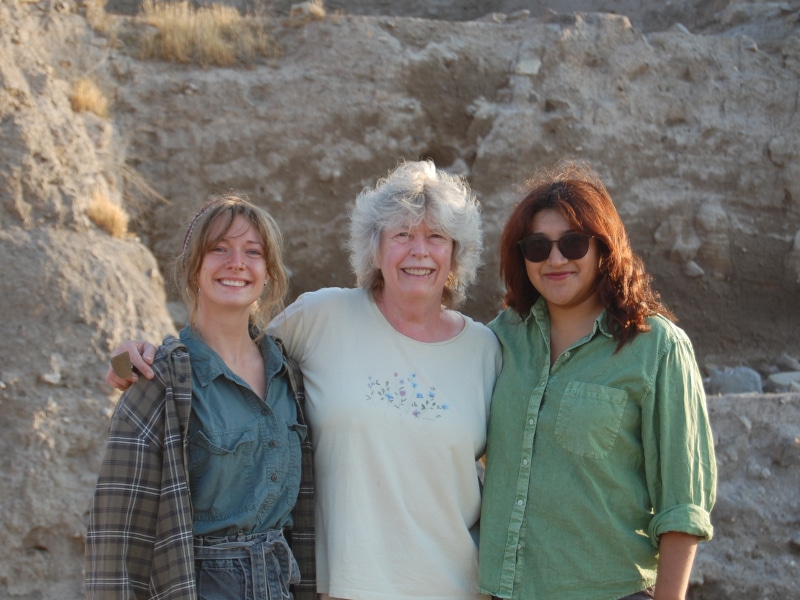
The State University of New Yort at Cortland members of the team. From left to right, me (Cortland alum), Dr. Sharon Steadman (Distinguished Professor at SUNY Cortland, and director of the Çadır Höyük project), and Janet (current archaeology student of Dr. Steadman).
The site of Çadır Höyük is located in the Yozgat province in north central Anatolia, Türkiye. Excavations began in 1994 and continue today. Over this time period the team has documented six millennia of occupation at the site; from at least as early as 5200 BCE to final abandonment in the 13th century CE. The Turkish workers assisting with the project came from the next closest city of Sorgun and were usually waiting for us. Without hesitation they would begin the journey up the mound soon after we arrived; it was a good mix of younger and older workers, some with prior experience and some brand new. The new workers were especially eager to learn the ropes often asking many questions and excited to practice some English with us. It was fun getting to learn a bit about the workers that were a part of our team, their day jobs ranged from farmers, cartographers, and engineers to medical and veterinary students.
The morning started with most supervisors looking over the stratigraphy of their trenches and deciding what task to tackle first. Many times I could look out from my trench and see a group of supervisors huddled around an area delicately, and with the most amazing precision, excavating bones or reading an especially interesting piece of pottery. Many of the foreign members of the team (US, Canada, Europe) would do our best with the little Turkish we knew to delegate tasks; the workers were very patient with us, and I learned pretty quickly that hand signs are an amazing tool. Some of the women I became friends with while there loved to flash me a heart from across the dig to let me know they missed me. We would work until 8am, at which time there was a break for water and some small goodies that the workers always seemed to magically produce, including cookies and fruits. Work in the mornings was always the nicest; it was pleasant to dig before the sun became too intense and wind picked up, as was typical for the afternoon.
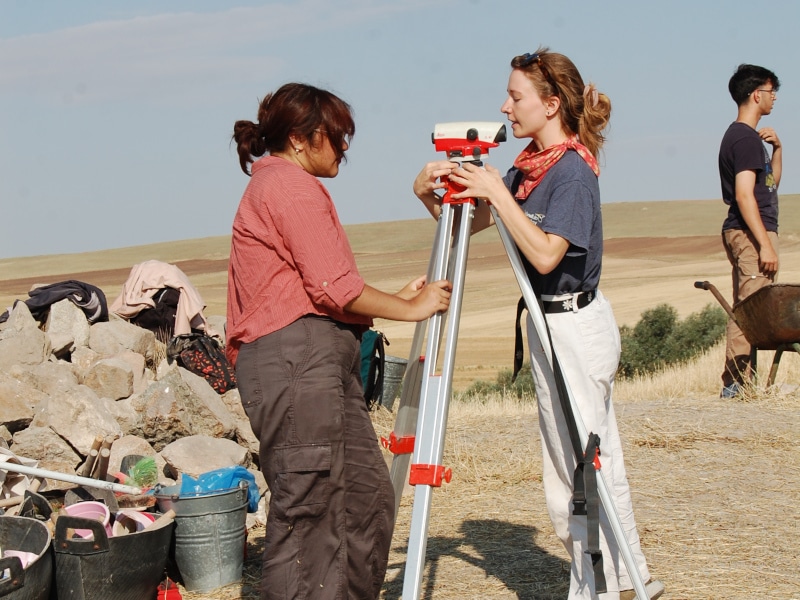
Janet and I are learning a new skill of how to take elevation.
At 9am we called “paydos” or “break” which meant it was time to head down to second breakfast; everyone’s favorite part of the day. We would sit under a tent forming what we called a sandwich circle, passing around the various fixings, everyone either with their preference of many olives or absolutely none. We also always had fresh fruit and small cookies to dunk in our tea – you had to be quick with it or risk ending up with a tea-cookie soup as half your biscuit crumbled off into your cup. This was also a time for the entire team to share their thoughts about their trenches with the group as well as a time to get to know everyone better. Second breakfast was a real pick-me-up, giving everyone their second wind to work through the afternoon.
In the afternoons it was typical for supervisors to hop around from trench to trench seeing how others’ work was going and assist if they needed help troubleshooting a difficult locus or feature. The trenches differed immensely! Some had countless hearths found one on top of the other as they excavated down, others had beautiful stone walls and huge expanses of rooms, one was a marbled masterpiece of mudbrick red, and charcoal black (beautiful but hard to understand), while yet another had walls with huge piles of rocks in between (again amazing to see, less amazing to meticulously draw). When work ended around 12:30-1 we had the option to take the bus back, but many of us would opt to simply drop our bags there and walk. It was peaceful strolling through the village, a great way to wind down and clear your head after a hard day of work. The walk took us past golden fields, and through the village where we would wave to some of the local workers, and occasionally have to skirt around territorial geese.
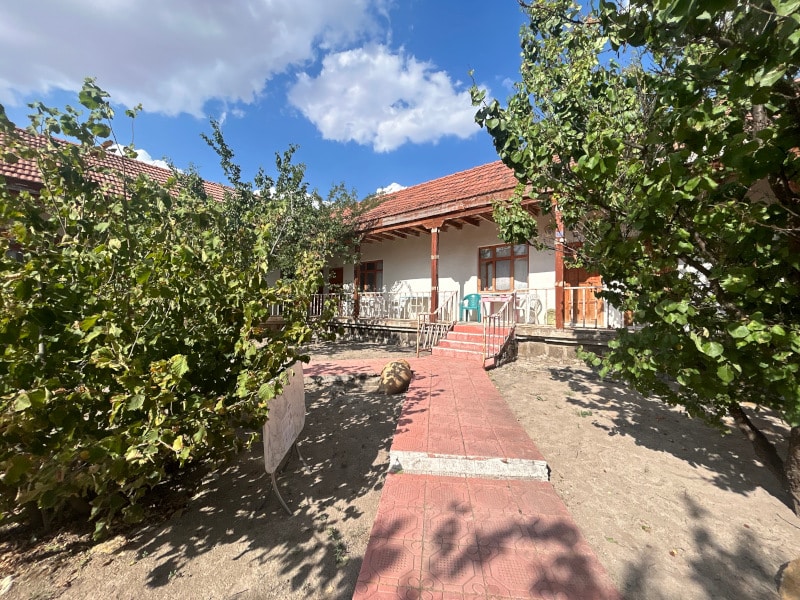
Our living quarters in Peynir Yemez. Filled with fruit and nut trees/shrubs we often snacked from.
Back at the dig house we had down-time until lunch; however, downtime usually meant either cleaning or helping bag artifacts; our director called them “evil jobs” and would always give us a warning on the days we could expect to return to more work. Thankfully many hands made light work, and the jobs were never really as “evil” as we were made to believe. We would all sit down to lunch at 2pm; everyone would take pretty large helpings of food after digging all day and almost always we would make Turkish coffee after so that we had a little kick to keep on going. After lunch people went their separate ways to shower, take naps, or do some reading before our lab hours, which started at 5pm. Many days before lab I would spend time with my new friends picking apricots and plums from the trees, trying my best to learn some Turkish words, and sitting in the sun with a cup of tea as a cool breeze blew by.
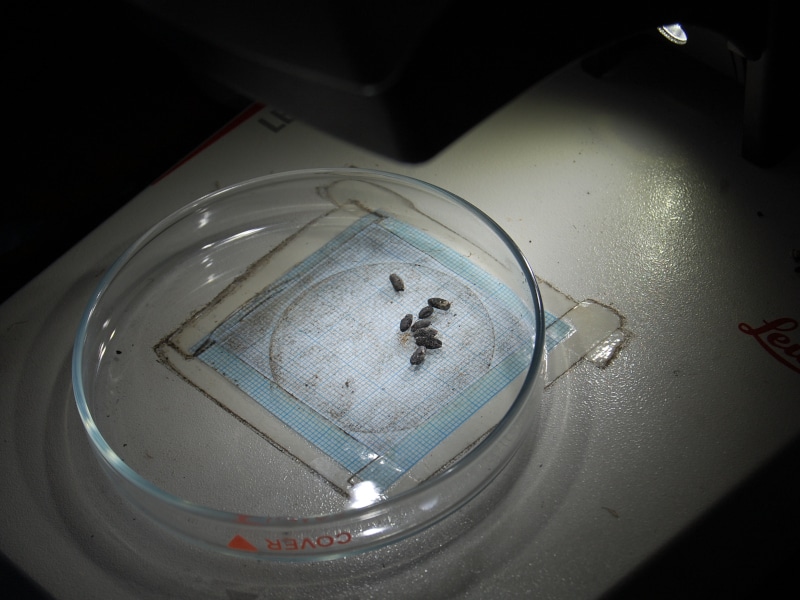
The lab hours were a time to write in our notebooks, fill out feature and locus sheets, or do additional work – such as sorting through soil samples to look for seeds, like the project I was assisting with. It was exciting when someone had uncovered a particularly interesting artifact from that day, and everyone gathered around to see what we could learn. Dinner came shortly after 7pm; everyone would hangout for a bit after dinner ended, but no one stayed up too late after the long workday. Usually at sunset small groups would leave the dig house to walk around the village, it was beautiful to see the reds and pinks of the sunset melt into the expansive landscape of gold and yellow. The village was always very quiet and peaceful; mostly being broken by the bells and bleats from the large herds of sheep and cows on their way home for the night. There were special occasions throughout the season where we would go watch meteor showers; finding a dark hill and lying on the ground all betting on which direction the next one would come from. And on Wednesdays we would have a movie night, projecting a film onto the wall of the lab. Card games also became a very popular past time toward the end of the season, and they would get quite lively and competitive; not only for the ones playing but even drawing in small audiences that would root for different players. Eventually, when the fun had been had, everyone would collapse into bed, ready to start work again the next morning.
Close-up of ancient seeds we found in a soil sample.
I am so fortunate to have had the opportunity to be part of the amazing team at Çadır Höyük. Life and research with limited internet helped slow me down and appreciate the knowledge I had as well as the insights of those around me. Time on this dig has left me with new experiences in archaeological methods and teamwork, provided insight into rural Turkish life, and enriched my life through the many sincere and interesting people I had the pleasure of working with.
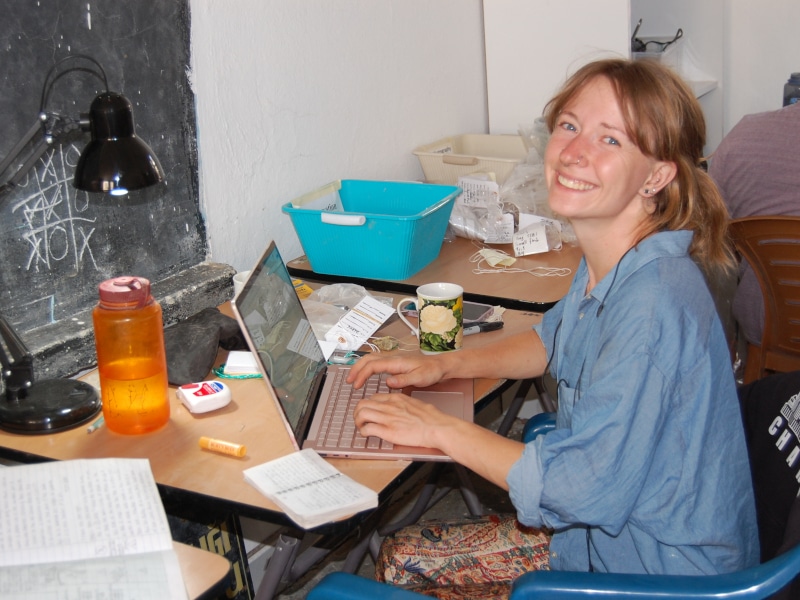
Me during lab hours filling out feature and locus sheets and recording the details of that day's excavations in my trench.
Kiley loves travel, experiencing new things, and meeting people. After graduating from SUNY Cortland, she spent time in India researching medicinal Ayruvedic plants found in the archaeological record from the Iron Age, supported by a Fulbright-Nehru Student Researcher Fellowship. She is interested in the cross-roads of biology and archaeology and extremely thankful that the ASOR scholarship provided an opportunity to explore this further. Currently Kiley is working on her PhD at the University of South Carolina, investigating nocturnal plant-insect interactions and how anthropogenic stressors impact these relationships.
ASOR is now accepting applications for 2025 Fieldwork Participation Scholarships. Learn how to apply here.
Want to help more students and early career archaeologists get into the field? Donate to the cause today by selecting “Fieldwork Scholarships” as your gift purpose!
2024 Shepard Urgent Action Grant: The Rest-stop and Minara of Umm Al-Qurun on the Darb Zubaydah
Rajwan Al-Maiyali (University of Al-Qadisiyah), Richard Wilding (Eye on Heritage)
The Darb Zubaydah
For centuries before the advent of modern air travel, pilgrims travelled long distances by land and sea. In addition to their religious function, pilgrimage routes also served as important arteries for commercial and cultural exchange. The hajj (the annual Islamic pilgrimage)routes followed pre-Islamic trade pathways but gradually evolved to accommodate the specific needs of Islamic pilgrimage. Various routes emerged and flourished during different historical eras, adapting to the rise and fall of successive Islamic empires
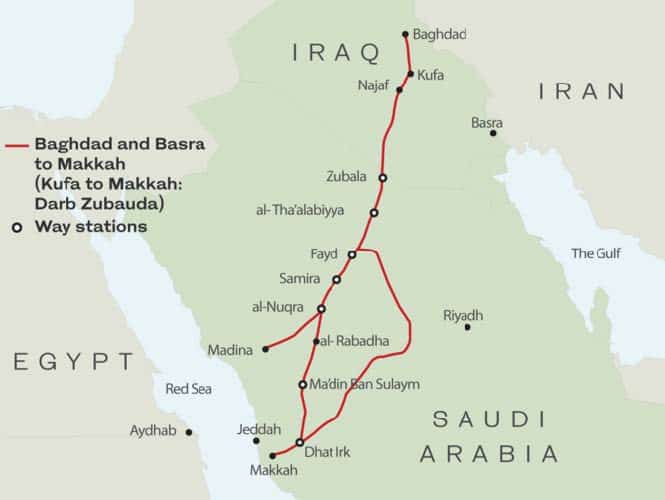
The route connecting the Iraqi cities of Kufa and Baghdad to Makkah was known as the Darb Zubaydah. It grew in importance during the first hundred years of the Abbasid Caliphate from 750 to 850 CE, a period renowned as a golden age of Muslim civilisation. The flourishing Abbasid economy greatly increased the numbers of pilgrims able to undertake the journey to Makkah, exerting greater pressure on the limited water and food resources available in a 1,300 km stretch of desert with no permanent lakes or rivers.
The Darb Zubaydah was named in honour of Zubaydah bint Jafar, wife of the Abbasid Caliph Harun Al-Rashid, recognising enhancements made to infrastructure along the route under her patronage. Zubaydah had witnessed the hardships endured by pilgrims when undertaking the hajj in 792 CE and dedicated her considerable power and resources to improving pilgrims’ safety and comfort.
The route of Darb Zubaydah and its waystations.
The Abbasids originally constructed a series of 27 stations between Kufa and Makkah at intervals suited to the travelling speed of donkeys, horses and camels. They were built at regular distances calculated in barid, a unit of measurement also meaning “postal service”, reflecting the postal and intelligence network that developed alongside the pilgrimage trail to help the Abbasid Caliphs maintain communication and control across their wide empire.
An additional 27 intermediate stations were later added to cater for the increasing number of pedestrian pilgrims, while improvements were also made to the original 27 main stations. The new and enhanced infrastructure included a system of wells, cisterns and dams to provide water for travellers and their animals. Caravanserais, palaces and forts were constructed to improve the pilgrims’ safety and comfort, and some stretches of the route were paved. A series of milestones and markers were installed, with the addition of lighthouses to guide pilgrims who often travelled at night to avoid the daytime heat.
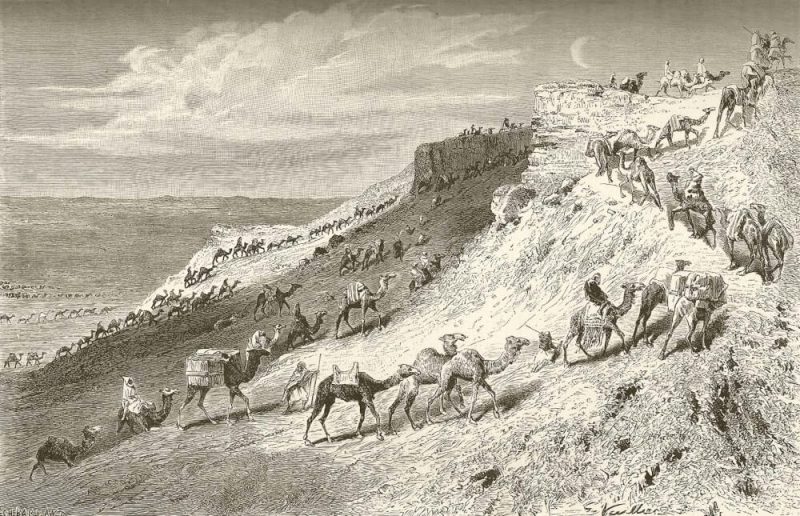
Camel caravan travelling at night, depicted in an engraving by Gaston Vuillier to illustrate the story “A Pilgrimage to Nejd, the Cradle of the Arab Race”, by Lady Anna Blunt, 1878-1879.
In the 10th century, a break in relations between Iraq and Makkah affected the ability of Iraqi and Persian Muslims to undertake the pilgrimage, leading to the progressive decline of the Darb Zubaydah. It was partially revitalised in the 11th century, but never recovered the status of its heyday in the 8th century.
The final organized pilgrimage was carried out in 1243 CE during the reign of Al-Musta’sim, the 37th and last Abbasid caliph ruling from Baghdad. In the following centuries, the trail was almost completely abandoned by pilgrims who forged new routes to Makkah. The last two centuries have seen even more dramatic changes to hajj travel, with the emergence of European maritime companies, the opening of the Suez Canal, the Ottoman Hijaz railway, and finally the arrival of air transport from the mid-20th century.
UNESCO Nomination
The Darb Zubaydah is a transnational nomination for UNESCO World Heritage Site status, jointly submitted by the Republic of Iraq and the Kingdom of Saudi Arabia. It comprises a series of key stations dating from the Abbasid period on the route between Kufa and Makkah. This nomination is part of a long-term programme that also aims to inscribe other hajj pilgrimage routes including the Egyptian and Syrian hajj roads.
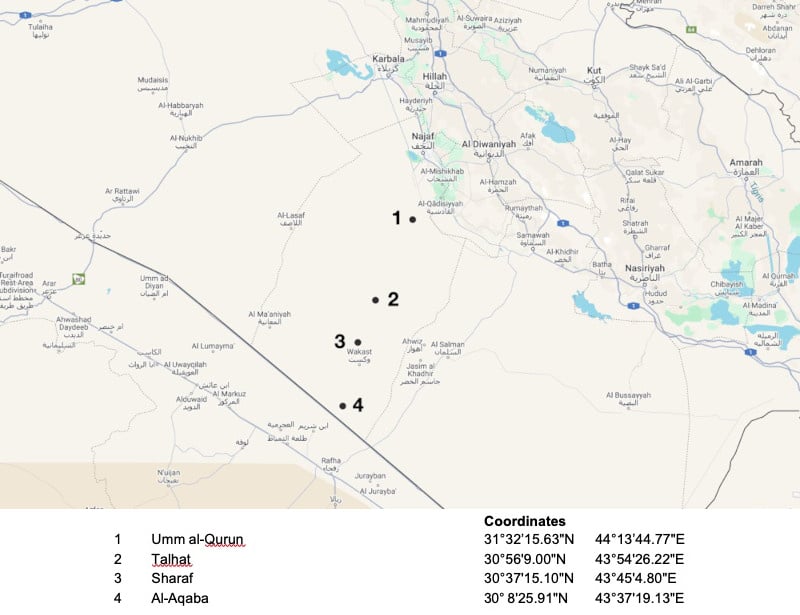
The section of the Darb Zubaydah located in present-day Iraq covers approximately 1/5th of the total length of the route, while the other 4/5th is located in present-day Saudi Arabia. The nomination includes 13 sites, four in Iraq and nine in Saudi Arabia. The four sites in Iraq, from north to south, are the stations at Umm al-Qurun, Talhat, Sharaf and Al-Aqaba.
Umm Al-Qurun
The pilgrim station of Umm Al-Qurun lies 56 km south of Kufa in the Wadi Al-Seba’. It is the first surviving rest-stop on the Darb Zubaydah heading south from Kufa towards Makkah, and the northernmost site of the UNESCO transnational nomination.
The site comprises a pilgrim station complex equipped with water and residential facilities, and a unique surviving example of a manara, or lighthouse, built to guide pilgrims travelling by night.
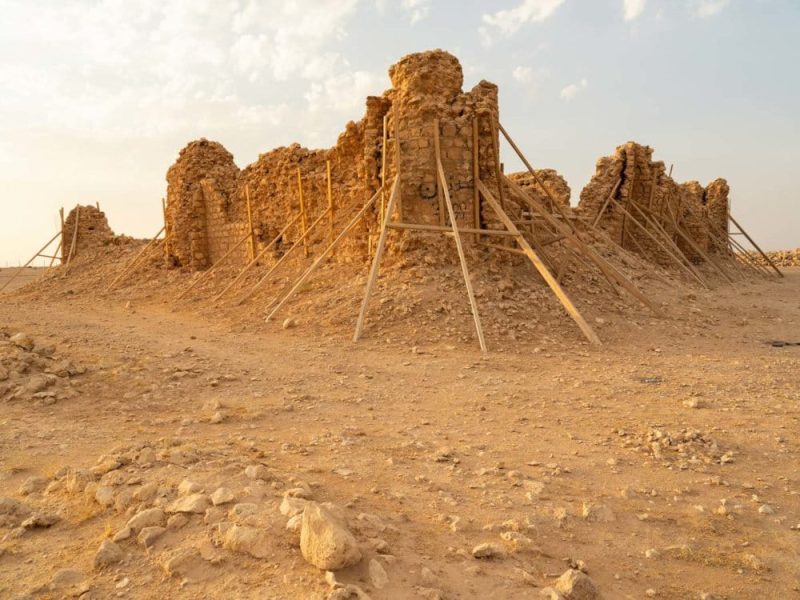
South and East sides of rest house (qsar), September 2024.
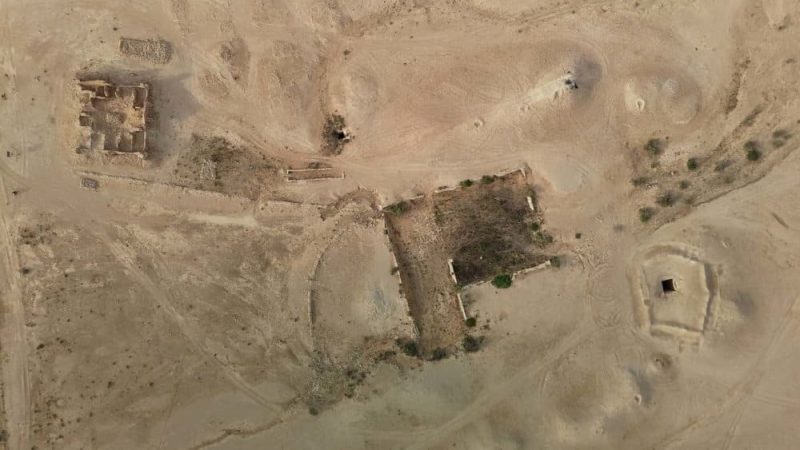
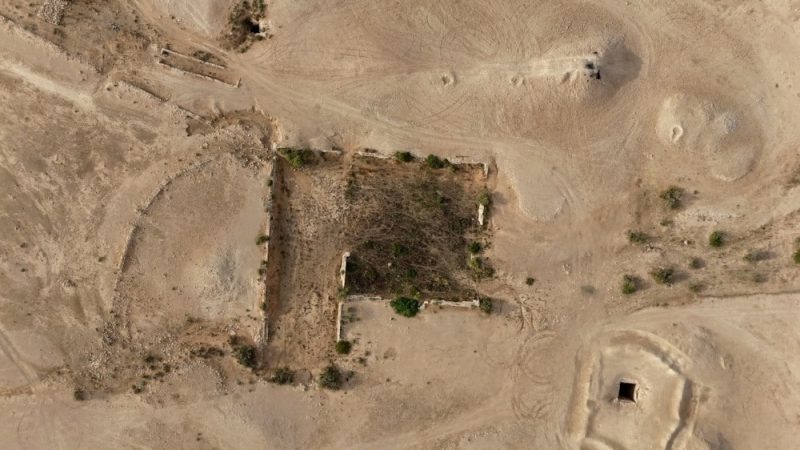
The station complex includes a square-shaped rest house (qsar), two basins (birkat) and two square wells. Although largely filled with sand, the basins are covered with a sparse wild vegetation that indicates more humid soil in contrast to the surrounding desert.
Aerial view of station complex showing rest house (top left), basins (centre) and wells (right and upper centre), September 2024.
The lighthouse of Umm Al-Qurun stands alone in the desert 1.35 km from the station. Its separate location was possibly due to the need for siting on higher ground, whereas the station complex needed to be located at a lower elevation for water collection and wells.
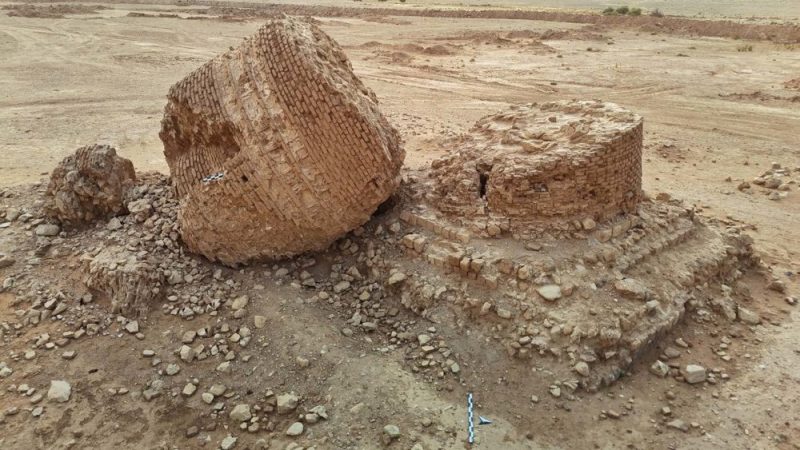
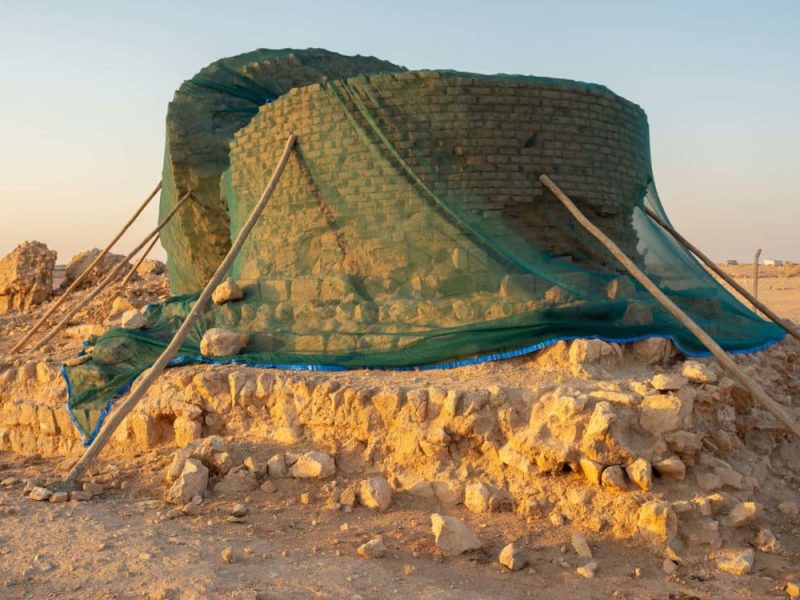
The lighthouse tower has collapsed at an undefined date. The remains of the fallen tower reveal an interior made of fired bricks that likely contained a staircase to access the roof. The cylindrical tower, decorated externally with geometrical patterns, was built over a two-meter- high stone square substructure, and probably reached a total height of 12 metres.
View of manara showing the collapsed cylindrical section and the foundation section, September 2024.
Contemporary developments
Being the closest surviving station on the Darb Zubaydah to the city of Najaf, the surviving architecture at Umm Al-Qurun, especially the lighthouse (manara) and rest house (qsar), has been vulnerable to intentional and unintentional damage. Both structures are now in an extremely vulnerable state and in need of greater protection and stabilisation.
One particularly concerning development is the construction of a modern tarmacked road from Najaf along the route of the Darb Zubaydah. In addition to potentially disrupting important archaeology relating to the hajj route, the road passes extremely close to the site of Umm Al- Qurun, even passing between the station complex and manara.
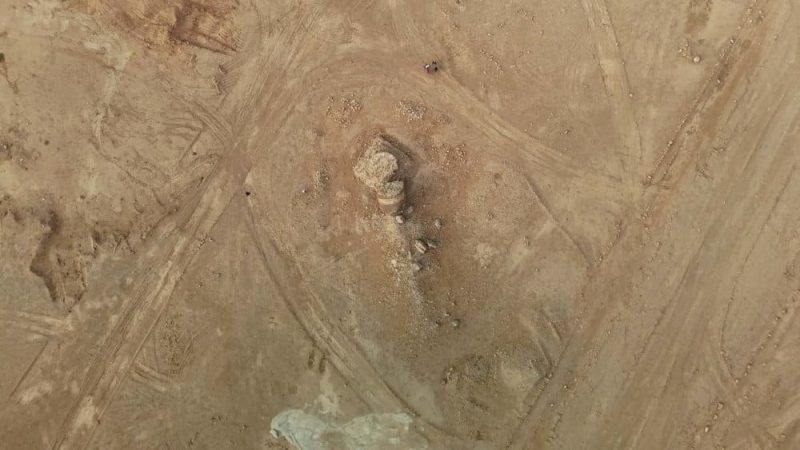
Groundworks associated with the road building have resulted in the digging of numerous ditches close to the manara, and tracks left by bulldozers demonstrate how easily damage could be inflected, even unintentionally, to this unique historical structure. The road will also improve access to the site by private and commercial traffic from Najaf, increasing the risk to these unprotected sites.
Aerial view of collapsed manara at Umm Al-Qurun showing tracks and ditches, September 2024.
Project Outcomes
Funding from ASOR has allowed the project team led by Rajwan Al-Maiyali from the University of Al-Qadisiyah and heritage consultant and photographer Richard Wilding to complete the following measures:
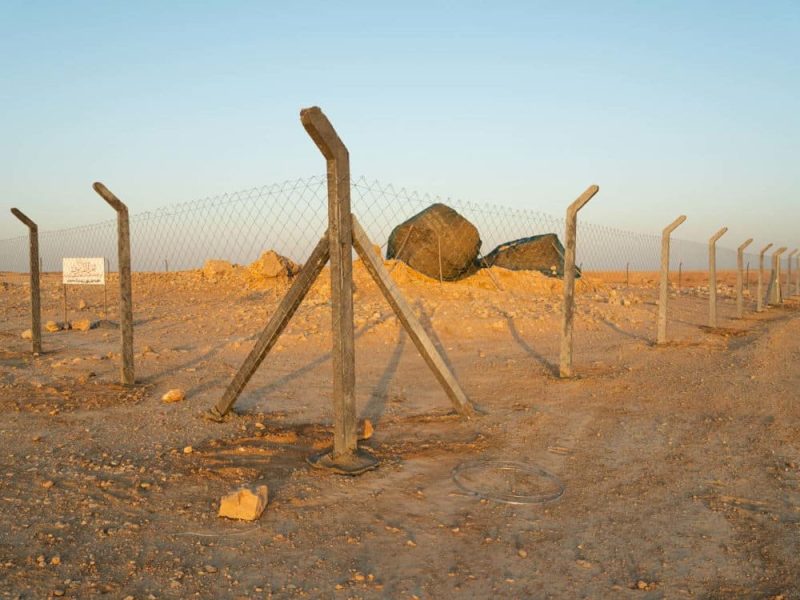
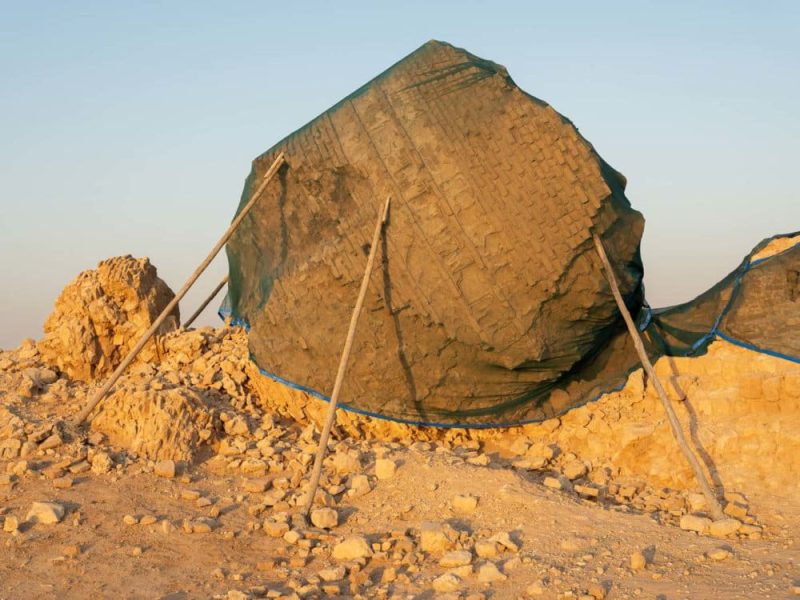
Emergency protection measures around the manara including the erection of a protective fence and covering of the manara
Documentation through photography and drone filming of all structures at Umm Al- Qurun in their current state of preservation.
Community engagement with local stakeholders to increase awareness of the site’s importance and need for greater protection
Emergency protection measures
The most urgent undertaking has been to erect a fence around the manara, which was undertaken in early September. This emphasizes the historical importance of the structure and prevents any unintentional damage to the site through bulldozing or other groundworks.
Additionally, the two main sections of the collapsed manara have been covered with protective netting to prevent erosion.
Fencing installed around manara site, September 2024.
Protective netting installed over cylindrical section of manara, September 2024.
Protective netting installed over foundation section of manara, September 2024.
Photographic Documentation
In addition to photographing the manara before and after the emergency protection measures, the team has also undertaken photography and drone filming of the other structures at Umm Al-Qurun, including the rest house (qsar), basins (birkat) and wells.
Aerial view of cisterns showing vegetation, September 2024.
Cistern walls with qsar in distance, September 2024.
Small well, September 2024.
Community Engagement
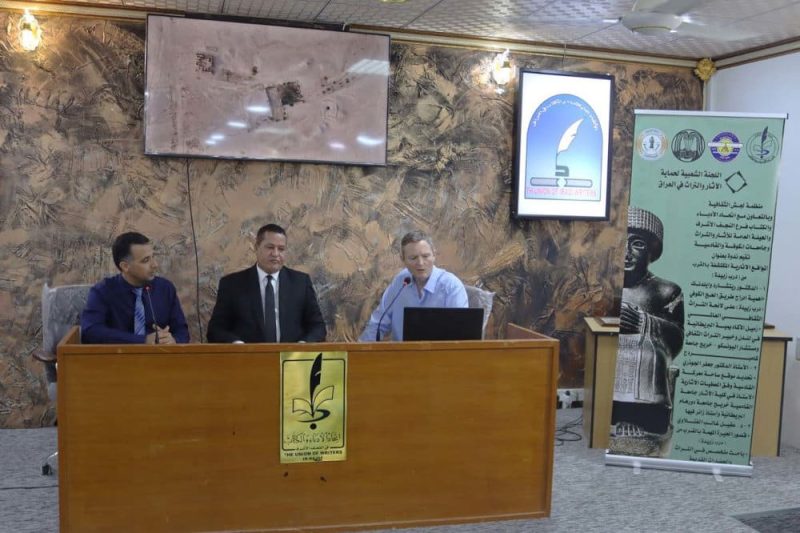
On 14 September 2024, as part of the project’s public outreach and engagement efforts, Rajwan Al-Maiyali and Richard Wilding gave presentations about Umm Al-Qurun and the Darb Zubaydah in a seminar hosted by the Association of Literature and Writers in Najaf. Following the presentations, the team answered questions posed by the audience. The event was subsequently broadcast by two national television stations in Iraq.
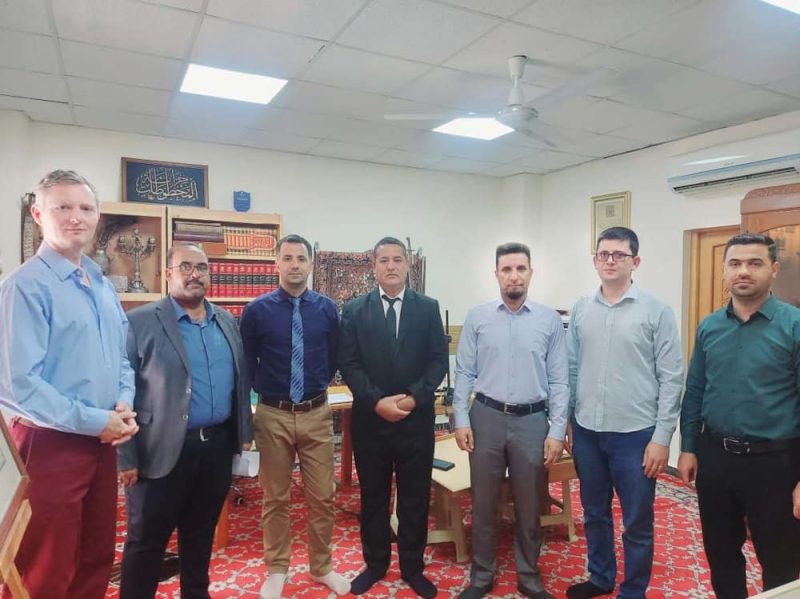
Further outreach work is being undertaken through visits to elders at the Great Mosque of Kufa and a forthcoming workshop being organised with the Karbala Holy Shrines Endowment.
Seminar hosted by the Association of Literature and Writers in Najaf, 14 September 2024.
Team visit to the Great Mosque of Kufa, 14 September 2024.

 The texts of the ancient Near East and eastern Mediterranean Bronze and Iron Ages (including the Hebrew Bible) hint at the use of psychotropic substances (“hallucinogens”) in religious and shamanistic rituals. But the archaeological evidence for this is thin on the ground. This talk will look at the various available hallucinogenic substances and at recent research that indicates their consumption by human beings before examining artifacts that Dr. Ilan (and now others) believe are related to achieving altered states of consciousness. These include ring kernoi, seal impressions from the Aegean region, metal sceptres from the Chalcolithic period, ivory wands from the Late Bronze and Iron Ages, and the altars from the Iron Age temple at Tel Arad. The “high place” takes on a new meaning!
 A native of Los Angeles, David llan was the director of the Nelson Glueck School of Biblical Archaeology at the Hebrew Union College in Jerusalem from 2003 to 2024. He has excavated at Tel Arad, Tel Malhata, Tel Yoqneam and Tel Megiddo and directed the excavations at Tel Dan from 2005 to 2022. He teaches at the Hebrew Union College and has taught at Tel Aviv University, Hebrew University, Johns Hopkins University and spent a sabbatical year in 2019-2020 at the Center for the Study of Origins of the University of Colorado, Boulder. Dr. Ilan specializes in mortuary archaeology, the archaeology of religion and ritual, ground stone artifacts, ceramic typology and technology, and the Chalcolithic period, the Middle Bronze Age and the early Iron Age of the southern Levant. He is the editor of the journal NGSBA Archaeology and the monograph series of the Nelson Glueck School. Dr. Ilan has published three final excavation reports and numerous articles in scholarly journals and in the popular press. His most recent articles deal with the praxis and paraphernalia of ritual action and religious belief in the ancient Near East, including the use of psychotropic substances.
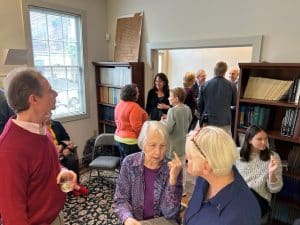
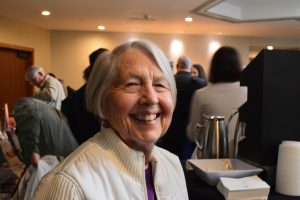
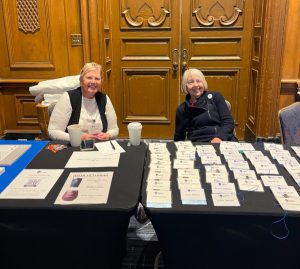
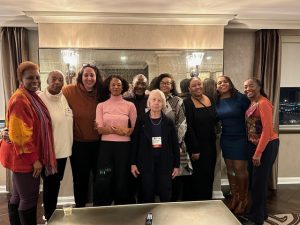




 In 1902, Margaret Alice Murray got invited to work in the field—finally. Training with Flinders Petrie for the last eight years, she had taught plenty of students in London, but had never been to Egypt to work herself. She spent only one season at Abydos, working in the Osireion, a special temple that no one had yet fully understood. Two years later, Murray’s publication, The Osireion at Abydos, upended all previous theories about the site. By 1938, Amice Calverley and Myrtle Broome were leaving Abydos, having spent almost a decade copying the art in the Temple of Seti I. Their own publications, The Temple of Sethos I at Abydos, were four volumes of brilliantly painted art from the temple walls in exacting detail. This talk will detail the ways in which the work women did on site at Abydos in the early 20th century impacted our understanding and reception of one of the most important sites in all of ancient Egypt.
 Dr. Kathleen Sheppard is Professor in the History and Political Science department at Missouri S&T. Her focus of study is the history of Egyptology. Her most recent book, Women in the Valley of the Kings, tells a history of Egyptology through the perspective of women’s work in the field. Her 2022 book, Tea on the Terrace: Hotels and Egyptologists’ Social Networks, investigates the role of hotels as hubs in the professional and friendship networks of Egyptologists in the late 19th and early 20th century. She received her MA in Egyptian Archaeology from UCL in 2002 and her PhD in History of Science from University of Oklahoma in 2010.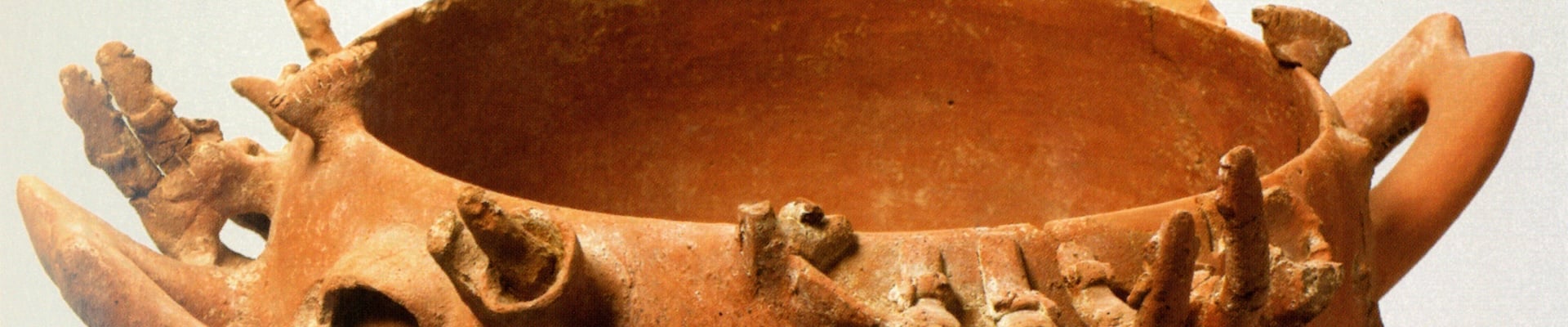

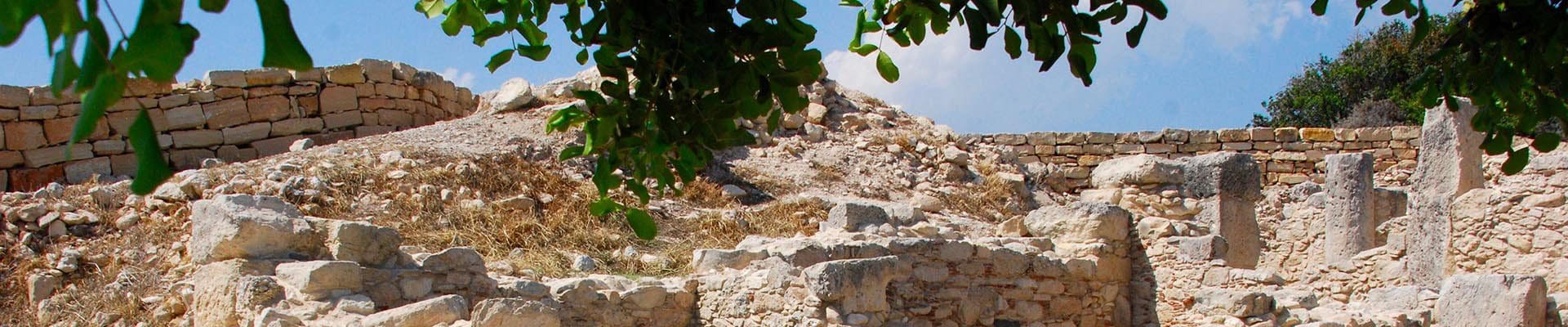
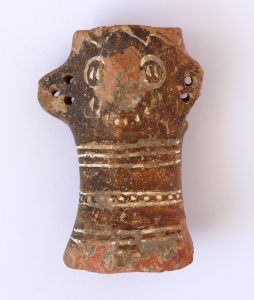 The last phase of the Middle Bronze Age on Cyprus (c. 1750–1650 BC) saw a number of dramatic changes, both in settlement patterns and structure, with many sites abandoned and new sites founded near the coast. At the exceptional long-lived coastal Bronze Age site of Kissonerga-Skalia near Paphos, a settlement established at the transition to the Early Bronze Age (c. 2400 BC), the site was completely restructured during this time and earlier domestic buildings were built over with an industrial architectural array installed in their place. This was only occupied for one or two generations before Kissonerga-Skalia was abandoned for good. Ongoing excavations are revealing a number of large pyrotechnical features and associated finds within this ‘monumental’ complex dating to the transition from the Middle–Late Bronze Age, a period during which we see the first moves towards urbanism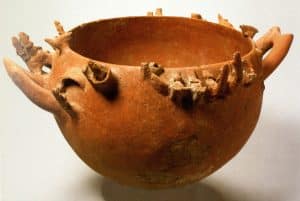
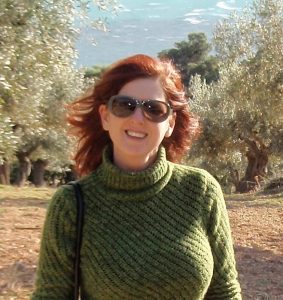 Dr Lindy Crewe has been the Director of CAARI since 2017. Prior to this, she was Lecturer in Archaeology at the University of Manchester, UK. Her research focuses on Cypriot prehistory and international interconnections, with a particular interest in the Chalcolithic and the Bronze Age. She is currently directing excavations at the Early–Middle Bronze Age settlement of Kissonerga-Skalia near Paphos. She is the author of two monographs, three edited volumes and over 30 articles, on topics including settlement at Late Bronze Age Enkomi and the Chalcolithic cemeteries at Souskiou. Her most recent work is a volume resulting from a conference organised by CAARI and the British Museum (with co-editors T. Kiely and A. Reeve) entitled ‘Empire and Excavation: Critical Perspectives on Archaeology in British-period Cyprus, 1878–1960’, which will be published in early 2025. She first came to Cyprus and CAARI 30 years ago as an undergraduate student from Australia to excavate at Marki-Alonia and became passionate about the archaeology of the island, spending considerable time staying at CAARI for her doctoral research and beyond.