Table of Contents for NEA 81.1 (March 2018)

[vc_row fullwidth=”true” attached=”true” css=”.vc_custom_1496247803139{padding-top: 0px !important;padding-right: 0px !important;padding-bottom: 0px !important;padding-left: 0px !important;}”][vc_column][mk_image src=”http://www.asor.org/wp-content/uploads/2018/01/NEA80_4toc-banner.png” image_width=”1920″ image_height=”400″ hover=”false” margin_bottom=”0″][/vc_column][/vc_row][vc_row fullwidth=”true” css=”.vc_custom_1496682730308{padding-top: 10px !important;padding-right: 0px !important;padding-bottom: 0px !important;padding-left: 0px !important;}”][vc_column width=”1/12″ css=”.vc_custom_1496683820796{margin-right: 10px !important;}” offset=”vc_hidden-md vc_hidden-sm vc_hidden-xs”][vc_column_text]

 SHARE

[/vc_column_text][mk_image src=”http://www.asortest.org/wp-content/uploads/2017/01/social-fb-icon4.jpg” image_width=”42″ image_height=”42″ hover=”false” custom_url=”https://www.facebook.com/ASOResearch/” margin_bottom=”0″][mk_image src=”http://www.asortest.org/wp-content/uploads/2017/01/social-tw-icon4.jpg” image_width=”42″ image_height=”42″ hover=”false” custom_url=”https://twitter.com/ASOResearch?ref_src=twsrc%5Egoogle%7Ctwcamp%5Eserp%7Ctwgr%5Eauthor” margin_bottom=”0″][mk_image src=”http://www.asortest.org/wp-content/uploads/2017/01/social-in-icon4.jpg” image_width=”42″ image_height=”42″ hover=”false” custom_url=”https://www.linkedin.com/company/american-schools-of-oriental-research” margin_bottom=”0″][mk_image src=”http://www.asortest.org/wp-content/uploads/2017/01/social-ml-icon_7.jpg” image_width=”42″ image_height=”42″ hover=”false” custom_url=”mailto:asor@bu.edu” margin_bottom=”0″][mk_image src=”http://www.asortest.org/wp-content/uploads/2017/01/blog-icon3.jpg” image_width=”42″ image_height=”42″ hover=”false” custom_url=”http://asorblog.org/” margin_bottom=”0″][/vc_column][vc_column border_color=”rgba(255,255,255,0.01)” width=”1/6″ css=”.vc_custom_1496683923840{margin-right: 20px !important;border-left-width: 2px !important;padding-right: 20px !important;padding-left: 20px !important;border-left-color: #99422f !important;}”][mk_divider divider_color=”rgba(255,255,255,0.01)” thickness=”1″ margin_top=”3″ margin_bottom=”3″][vc_column_text]

ASOR BLOG

NEWS@ASOR

ANCIENT NEAR EAST TODAY

PAST ASOR NEWS, MONTH BY MONTH

FY16 HONOR ROLL OF DONORS

ASOR ANNUAL MEETING

[/vc_column_text][/vc_column][vc_column border_color=”rgba(170,170,170,0.01)” width=”1/2″ css=”.vc_custom_1487276122024{margin-right: 10px !important;margin-bottom: 30px !important;border-right-width: 2px !important;border-bottom-width: 2px !important;padding-top: 30px !important;padding-right: 30px !important;padding-left: 20px !important;background-color: #ffffff !important;border-right-color: rgba(227,228,228,0.75) !important;border-bottom-color: rgba(227,228,228,0.75) !important;}”][vc_column_text responsive_align=”left”]

Table of Contents for Near Eastern Archaeology 81.1 (March 2018)

Subscription Options
You can receive NEA (and other ASOR publications) through an ASOR Membership or through an Individual Subscription. Single issues (subject to availability) are available for purchase, with ASOR members receiving a discount. Please email us if you have any questions.

Pp. 4-5: “The Survey of the Site and Its Insights,” by Joe Uziel and Aren M. Maeir

Since its infancy, archaeological research has used survey as a major tool in both regional studies (see, e.g., Conder and Kitchener 1881) and as a tool for project planning. In the former, survey flourished—despite certain critiques as to the validity of the data collected (e.g., Waelkens and Poblome 2004)—whereas the latter was often used minimally in the interpretation of an individual site’s history. In this sense, the survey at Tell eṣ-Ṣâfi/Gath was groundbreaking in its approach— not only as a tool for planning the project, but as the basis for determining aspects of the history of the site (Uziel and Maeir 2005, 2012). The survey was planned by the division of the site into separate fields, based on discrete micro-topographical features. As opposed to an arbitrary grid, the use of the topography of the site considered that these features may have been formed by the changing settlement of the site over time. For example, the eastern slopes (Areas A and E), which have been extensively excavated, each had its own local phasing, which was determined through their separate survey. Had we used a random grid, it is likely the parts of each of these terraced steps would have been lumped together, making the survey a tool for overall evaluation of the site, but not determining differences in the various areas. This proved critical in the planning of the project, which later, through the implementation of the survey results, managed to determine excavation areas according to the research design of the project.

Click here to access the above article on JSTOR (ASOR membership with online access and/or subscription to JSTOR Current Content required).

Pp. 6-14: “New Insights into the Philistines in Light of Excavations at Tell eṣ-Ṣâfi/Gath,” by Louise A. Hitchcock and Aren M. Maeir

Even though the arrival of the Philistines in the southern Levant is an event that happens “off camera,” that is, before the appearance of their settlement remains, it is an event that was narrativized in the recent past by archaeologists working in Philistia who interpreted the local production of Aegean style pottery as evidence of a massive colonization by Mycenaean migrants (Hitchcock and Maeir 2016a). By and large, the understanding of the Philistines and their culture was centered around the biblical and Egyptian images of the Philistines, and their continued reception and interpretation until modern times.

Click here to access the above article on JSTOR (ASOR membership with online access and/or subscription to JSTOR Current Content required).

Pp. 15-18: “Philistine Decorated Pottery at Tell eṣ-Ṣâfi/Gath,” by Linda G. Meiberg

Almost all of the excavated areas at Tell eṣ-Ṣâfi/Gath have yielded Philistine decorated pottery. This includes Areas A (Strata A6 and A5), E (Stratum E3), F (Stratum F11), and P (Stratum P2) on the upper tell, as well as Area D (Stratum D5) in the lower city, thus indicating that the consumption, if not actual production, of Philistine decorated pottery was quite widespread throughout the entire site during the twelfth through tenth centuries B.C.E.

Click here to access the above article on JSTOR (ASOR membership with online access and/or subscription to JSTOR Current Content required).

Pp. 19-21: “Philistine Burial Customs in Light of the Finds at Tell eṣ-Ṣâfi/Gath,” by Joe Uziel and Aren M. Maeir

Despite over a century of research conducted on the Philistines and their material culture, a very small quantity of finds relating to their burial customs has been reported. This has led to quite a lot of speculation on Philistine mortuary customs, with little evidence in support. At a number of sites, suggestions to distinguish “Philistine” burials were attempted, most notably, the erroneous attribution of the anthropoid coffins to the Philistines (Dothan 1982), the suggested cremation burials found at Azor (Dothan and Dothan 1992; Ben-Shlomo 2008, 2012; Buchennino and Yannai 2010), and the burial caves yielding Philistine bichrome pottery at Tel Eton (Edelstein and Aurant 1992). However, the problematic interpretations of these finds, coupled with the fact that none of this evidence was found at the main urban sites of the Philistines, calls into question their centrality within the Philistine realm, and their attribution on a whole to the ethnic group that populated the southern Coastal Plain.

Click here to access the above article on JSTOR (ASOR membership with online access and/or subscription to JSTOR Current Content required).

Pp. 22-23: “What Language(s) Did the Philistines Speak?,” by Brent Davis

The evidence that we have for the language(s) spoken by the Philistines is not plentiful, but what we do have is interesting (though far from conclusive). Two types of evidence predominate: (1) inscriptions from Philistine sites (thus these inscriptions may have been produced by Philistines), and (2) Philistine words and names borrowed into other languages of the region and recorded (however imperfectly) in non-Philistine records.

Click here to access the above article on JSTOR (ASOR membership with online access and/or subscription to JSTOR Current Content required).

Pp. 24-27: “Microarchaeology at Tell eṣ-Ṣâfi/Gath, Area A,” by Steve Weiner and Elisabetta Boaretto

The overall objective of archaeological excavations is to extract as much reliable information as possible from the whole archaeological record: both macroscopic and microscopic. An effective approach to achieve this goal is to integrate observations on the macroscopic and microscopic records as the excavation proceeds by operating an on-site analytical laboratory at the excavation. In this way important primary context locations can be better identified as they are exposed, and the excavation and sampling strategy can be adapted accordingly (Weiner 2010).

Click here to access the above article on JSTOR (ASOR membership with online access and/or subscription to JSTOR Current Content required).

Pp. 28-33: “Excavations in Area D of the Lower City: Philistine Cultic Remains and Other Finds,” by Amit Dagan, Maria Eniukhina and Aren M. Maeir

During the first decade of the Tell eṣ-Ṣâfi/Gath Excavation Project, various areas in the upper city were excavated. Based on the results of the surface survey, however, it was clear that there was extensive settlement in the area to the north of the upper city up until the Elah Valley riverbed. Ten years ago, the excavations were expanded to the lower city, commencing with Area D (fig. 1). Since then, Area D has been extensively excavated, with a broad range of finds mainly from the Iron Age (for additional excavations in Area K of the lower city, see Welch in this issue). Here we will describe some of these finds, with a particular focus on the Philistine cultic remains.

Click here to access the above article on JSTOR (ASOR membership with online access and/or subscription to JSTOR Current Content required).

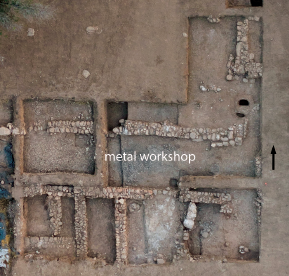
Pp. 34-36: “Iron Age Metal Production at Tell eṣ-Ṣâfi/Gath,” by Adi Eliyahu-Behar and Vanessa Workman

While the increasing appearance of iron objects between the late twelfth and early eleventh centuries B.C.E. has been the greatest indicator for the shift from bronze to iron use that marks the transition to the Iron Age, a nuanced understanding of the technological phenomenon comes from evidence and artifacts of production. The origins of iron production technologies are still hotly debated. In recent years, new and pertinent archaeological data regarding actual iron production, has finally surfaced. Considerable iron production remains of both smelting and smithing had been identified at major sites throughout the region.
Click here to access the above article on JSTOR (ASOR membership with online access and/or subscription to JSTOR Current Content required).

Pp. 37-40: “Women in Distress: Victims of the Iron Age Destruction at Tell eṣ-Ṣâfi/Gath,” by Marina Faerman, Aren M. Maeir, Amit Dagan and Patricia Smith

The widespread signs of destruction and fire seen at Tell eṣ-Ṣâfi/Gath in the upper and lower parts of the city (Namdar et al. 2011; Zukerman and Maeir 2012) include the charred skeletal remains of three women found in Area D, Stratum D3, and five individuals found in Area A, Stratum A3. All appear to have been victims of the same event, namely, the destruction of the city at the end of the ninth century B.C.E. by Hazael of Aram (Maeir 2012). We provide here a detailed description of these remains and the circumstances surrounding their deaths using standards published in Bass 1995 to determine their age and sex, and the Munsell color chart (Ellingham et al. 2015) to estimate the extent and pattern of burning on the bodies.

Click here to access the above article on JSTOR (ASOR membership with online access and/or subscription to JSTOR Current Content required).

Pp. 41-44: “Iron Age Animal Husbandry at Tell eṣ-Ṣâfi/Gath: Notes on the Fauna from Area D,” by Ron Kehati, Amit Dagan and Liora Kolska Horwitz

Faunal remains comprise a significant portion of finds recovered from most archaeological sites in Israel. Among other issues relating to factors such as animal evolution and ecology, their examination can elucidate past human diet, symbolic and cultural behavior, technology relating to animals and animal products, as well as the site’s environment and even paleoclimate of a region (e.g., Reitz and Wing 2008; Russell 2011). These issues were considered when we examined the faunal assemblage recovered from the late Iron Age I (tenth century B.C.E.) through Iron Age IIA-B (post-830 B.C.E.) deposits excavated in Area D at Tell eṣ-Ṣâfi/Gath.

Click here to access the above article on JSTOR (ASOR membership with online access and/or subscription to JSTOR Current Content required).

Pp. 45-47: “Expanding the Lower City: Area K at Tell eṣ-Ṣâfi/Gath,” by Eric L. Welch

Excavations in the lower city of Gath have been ongoing since 2009. In Area D, in the westernmost excavated portion of the lower city, excavations have demonstrated the presence of a well-fortified lower city as early as the eleventh century B.C.E., with the most substantial remains dating to the ninth century B.C.E. (Dagan et al., this issue). With the discovery of a fortified lower city as early as Iron Age I, new research questions about the lower city began to emerge. Of particular interest were questions about the extent of ancient Gath’s lower city and the timeline for when the lower city was inhabited.

Click here to access the above article on JSTOR (ASOR membership with online access and/or subscription to JSTOR Current Content required).

Pp. 48-54: “Judahite Gath in the Eighth Century B.C.E.: Finds in Area F from the Earthquake to the Assyrians,” by Jeffrey R. Chadwick and Aren M. Maeir

After Philistine Gath fell to the Arameans in the late ninth century B.C.E. (Maeir 2008; 2012: 47–48) the huge city atop Tell eṣ-Ṣâfi/Gath was a ghost town for several decades. Some structures had been burnt or otherwise destroyed, but many were simply abandoned to the elements. As years passed, winter storms and the processes of nature eroded the roofs and walls of hundreds of ownerless houses and other buildings. The devastation was alluded to by the Judahite prophet Amos when he predicted the eventual demise of Samaria: “Go down to Gath of the Philistines,” he challenged the Israelites, to behold what complete desolation is like (Amost 6:2; Maeir 2004). Aside from the presence of a few squatters who settled in the north lower-city ruins near the Elah riverbed, the forlorn ghost town of Gath slowly decayed away, until a cataclysmic earthquake shook the entire region somewhere around 760 B.C.E. (Chadwick and Maeir, forthcoming; Maeir 2012:49–50).

Click here to access the above article on JSTOR (ASOR membership with online access and/or subscription to JSTOR Current Content required).

Pp. 55-58: “Textile Production at Iron Age Tell eṣ-Ṣâfi/Gath,” by Deborah Cassuto

Textiles in antiquity were multifunctional, and used much as they are in modern times.1 When we think of textiles, our first thoughts are of clothing. In antiquity, as in modern times, clothing demonstrated social status (e.g., royal, common), occupation (e.g., priestly, military) and ranged from simply constructed frocks to finely manufactured prestige garments. Textiles were also used as furnishings, such as rugs, wall carpets, cushions, and curtains, as boat sails and shelters, or sacks for storage or carriage. In short, they were consumed by everyone for a multitude of needs, ranging from the mundane to the festive, from the functional to the opulent.

Click here to access the above article on JSTOR (ASOR membership with online access and/or subscription to JSTOR Current Content required).

Pp. 59-62: “Iron Age Adornment at Tell eṣ-Ṣâfi/Gath,” by Josephine A. Verduci

Between 1998 and 2014, Iron Age strata from Areas A, C, D, E, F, and P yielded a rich assemblage of 172 objects of adornment. These objects come from contexts dated to the Late Bronze Age-Iron Age transition through to Iron Age IIB. Tomb T1, containing the skeletal remains of over 70 individuals (adults and children) and dated to late Iron I-early Iron IIA, also yielded a large and varied assemblage of 154 adornment objects, not including 65 items of shell that were most likely also used as items of adornment. Among these 326 objects, are examples of metal, stone, and vitreous materials, which are represented by beads, pendants, rings, bangles (bracelets, anklets, and armlets), earrings, and fibulae.

Click here to access the above article on JSTOR (ASOR membership with online access and/or subscription to JSTOR Current Content required).

Pp. 63-65: “Petrographic and Technological Analysis of the Tell eṣ-Ṣâfi/Gath Pottery,” by David Ben-Shlomo

In archaeological research, pottery analysis is of importance for relative dating and reconstructing daily life, as well as for understanding trade patterns and cultural contacts. Trade patterns in table ware and commodities carried in pottery containers can help illuminate the economy and administration of an ancient society. The production technology of pottery, and especially its mode of production, can also reflect social, economic, and political realities in a general manner. However, according to many ethnographic and archaeological studies, the technology of pottery production is relatively conservative, and does not change rapidly.

Click here to access the above article on JSTOR (ASOR membership with online access and/or subscription to JSTOR Current Content required).

Pp. 66-71: “Cooking Installations through the Ages at Tell eṣ-Ṣâfi/Gath,” by Shira Gur-Arieh

While it is debated when exactly humans began regularly to cook their food (Sandgathe and Berna 2017), it is clear that once they did, they never looked back. Cooking raw food improves its nutrient values by enabling more complete digestion, it kills bacteria, and it sometimes helps to preserve the food. But above all, cooking makes many food products taste much better. The combination of such practical benefits, which are essential for our wellbeing, with the communal and social aspects of eating, are what makes cooking and cuisine so central in the culture of many societies worldwide. Yet, although archaeologists are aware of the important role of cooking in the overall assemblage that defines different human cultures, comprehensive study of archaeological cooking installations is still not commonly practiced in excavations of Levantine protohistoric and historic sites (Ebeling and Rogel 2015: 343–44). Such comprehensive studies of cooking technologies, fuel materials, and their spatial and chronological development over time, have the potential to provide invaluable information on topics such as human interaction with the environment, subsistence practice, intercultural transformation, and cultural affiliation, to mention just a few.

Click here to access the above article on JSTOR (ASOR membership with online access and/or subscription to JSTOR Current Content required).

Pp. 72-76: “Seals and Sealings at Tell eṣ-Ṣâfi/Gath,” by Stefan Münger

The currently published glyptic assemblage from Tell eṣ-Ṣâfi/Gath comprises more than sixty seals and sealings (Keel 2013: 94–123; see also Maeir, Shai, and Kolska Horwitz 2011). This corpus provides sound evidence that seals—mostly worn as adornments—and the practice of sealing were part of daily life at Tell eṣ-Ṣâfi/Gath throughout the centuries. In the following, a few outstanding glyptic finds by the current expedition are presented.

Click here to access the above article on JSTOR (ASOR membership with online access and/or subscription to JSTOR Current Content required).

Pp. 77-80: “Plant Use in the Bronze and Iron Ages at Tell eṣ-Ṣâfi/Gath,” by Suembikya Frumin and Ehud Weiss

The long history of settlement at Tell eṣ-Ṣâfi/Gath provides an opportunity to study changes in vegetation and its use in different cultures and periods, as well as aspects relating to local biodiversity over time. These changes may shed light on the local development of agriculture, on cultural changes, on ancient human migrations, and foreign influences. Analyzing archaeological data from several time periods and cultures within the same landscape offers new directions in the study of past cultures, and the origins of their formation (Frumin et al. 2015; Frumin 2017). In the case of the appearance of Philistine culture, which occurred partly through migration, this type of data enables analysis of invasion events using archaeological data, with the aim of reconstructing changes in diet, land use, and in regional and interregional linkages associated with a specific migrant culture.

Click here to access the above article on JSTOR (ASOR membership with online access and/or subscription to JSTOR Current Content required).

Pp. 81-84: “What We Can Learn from the Flint Industries at Tell eṣ-Ṣâfi/Gath,” by Francesco Manclossi and Steven A Rosen

Within Levantine archaeology, the analysis of chipped stone tools from the Metal Ages is reasonably well established. Chipped stone tool manufacture is a reductive process, leaving large quantities of diagnostic waste products, allowing detailed reconstruction not only of the specifics of technologies and function, but also of such issues as on-site/off-site production, trade, and degrees of craft specialization—and ultimately offering insights into social and economic processes not always available from other sources. The materials from Tell eṣ-Ṣâfi/Gath from the Early Bronze (EB), Late Bronze (LB), and Iron Ages (IA) provide a long-term view of these processes at the site, and offer a case study for larger-scale processes.

Click here to access the above article on JSTOR (ASOR membership with online access and/or subscription to JSTOR Current Content required).

Pp. 85-91: “‘The Archaeological Picture Went Blank’: Historical Archaeology and GIS analysis of the Landscape of the Palestinian Village of Tell eṣ-Ṣâfi,” by Liora Kolska Horwitz, Rona Winter-Livneh and Aren M. Maeir

Referring to the dearth of historical archaeological research in Israel, in Between Past and Present: Archaeology, Ideology, and Nationalism in the Modern Middle East, author Neil Silberman states: “Just as the story was beginning to get interesting—when the modern cultures of the region were in the process of formation—the archaeological picture went blank” (1989:233). Since Silberman published his book, the status of historical-archaeological research—notably of the Islamic and Ottoman periods in Israel—has certainly improved. To a large extent, the same cannot be said of archaeological research—either on objects, sites, or historic landscapes—relating to the British Mandate and the early years of the State of Israel.

Click here to access the above article on JSTOR (ASOR membership with online access and/or subscription to JSTOR Current Content required).

[/vc_column_text][mk_divider][vc_column_text]To view the entire issue on JSTOR, click here.[/vc_column_text][/vc_column][vc_column border_color=”rgba(170,170,170,0.01)” width=”1/6″ css=”.vc_custom_1496684098866{margin-right: 5px !important;margin-bottom: 20px !important;border-right-width: 2px !important;border-bottom-width: 2px !important;padding-top: 30px !important;padding-right: 10px !important;padding-left: 10px !important;background-color: #ffffff !important;border-right-color: rgba(227,228,228,0.75) !important;border-bottom-color: rgba(227,228,228,0.75) !important;}”][vc_wp_posts title=”BROWSE THE NEWS ARCHIVE” number=”4″][/vc_column][vc_column border_color=”rgba(170,170,170,0.01)” width=”1/6″ css=”.vc_custom_1496684008271{margin-right: 10px !important;margin-bottom: 30px !important;border-right-width: 2px !important;border-bottom-width: 2px !important;padding-top: 30px !important;padding-right: 20px !important;padding-left: 20px !important;background-color: #ffffff !important;border-right-color: rgba(227,228,228,0.75) !important;border-bottom-color: rgba(227,228,228,0.75) !important;}”][vc_column_text] [/vc_column_text][/vc_column][/vc_row]
Fellowship Report: Megan Ashbrook

MY DAY ON TEL AKKO 

Megan Ashbrook, 2017 Platt Excavation Fellowship Recipient

4:45am: Wakeup and 1st breakfast

Well, sometimes I get up later … it’s hard to get out of bed before sunrise in Israel. But I always have to get a little something to eat before working on the tel. My favorite is a plum and bread with peanut butter on it. Then it’s off to excavations with the rest of the Tel Akko Total Archaeology Project.

5:40am: Arrive at Tel Akko

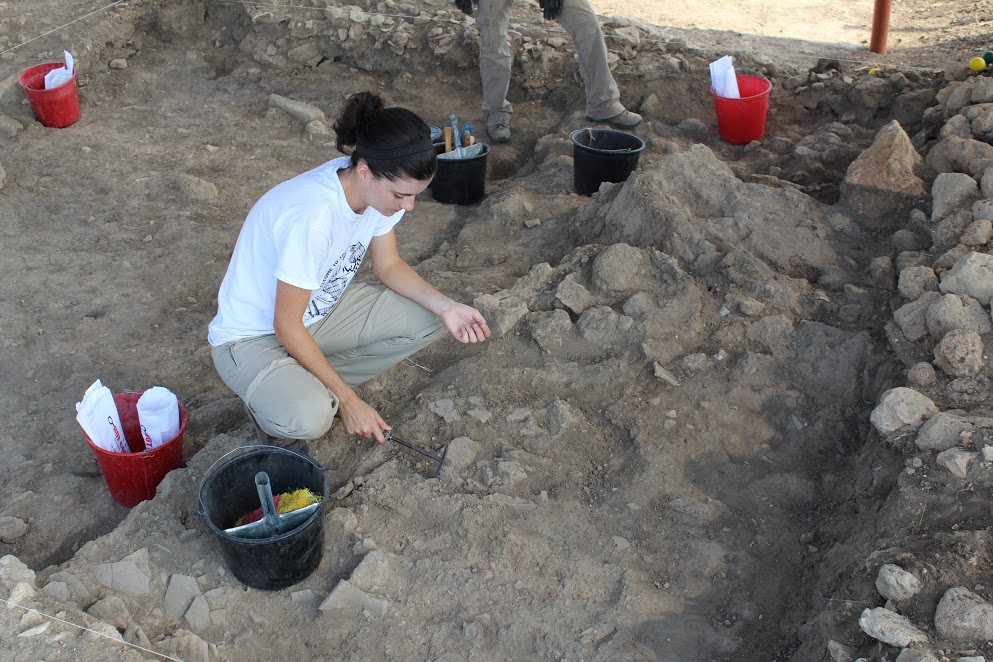
The first thing we all do in the morning is grab our supplies and sweep the park path around the dig site. Our supplies include black buckets for dirt, colored buckets for pottery and small finds, a brush, a trowel, and a patiche. A patiche is almost like a smaller, thinner hammer. This isn’t the most fun part of the day, but I find it gives me some time to wake up before excavation.

5:40-8:30am: Excavation

In the morning, we give our square a general sweep to collect all the loose dirt that blew in overnight. Then we get our plan of the day’s dig from our square supervisor. Then finally we start digging! Mostly, I have been excavating around tabuns (Arabic word for oven) until they are floating and then removing the tabuns. There were four tabuns in my square at the beginning of the season and we are working to remove them all this season.

2017 Tell Akko group

Throughout the day, the tel is filled with music, talking, and conversations. Our excavation has such a great atmosphere and I love it. One professor always goes around and asks everyone, “When was the last time you drank water?” It’s a helpful reminder to stay hydrated in the hot 80-90 degree weather.

Questions and conversations are all around the tel. I have learned to embrace asking questions, every single one. I want to soak up all the knowledge I can while I’m on this excavation. There are people on the dig with their special interests/expertise like metallurgy, lithic tools, Munsell Charts, or ceramics. My interest is in ceramics, though I don’t know the chronology of pottery on the tel very well. I feel really honored, since it is only my first excavation, when someone brings a ceramic sherd or item over for me to look at.

8:30am: Tel Breakfast, also known as 2nd Breakfast

9:00-11:30am: Excavation

After breakfast we all reluctantly get up from the tables and get back to work. Sitting and relaxing for a while makes it hard to get back to work. I usually pick up where I left off before breakfast. For example, if I was trimming a baulk before tel breakfast, I would go back to doing that. A baulk is the half meter section of dirt left on each side of a square. Baulks are helpful to see the stratigraphy of the square. When trimming it, the idea is to make the baulk straight and at a right angle with the floor of the square. Plus it makes the square look clean and nice.

The best part of my day is excavating. Excavation includes so many parts I didn’t know before coming to Tel Akko, like trimming baulks. I also have learned how to use a dumpy level to take elevation points in our square. I find it easy to use and a nice change from digging all day. We take elevations when something significant or special is found, like a unique artifact. In my square, it’s usually a slag cake. Also, elevations are taken at the end of each day not only in my square but every square being excavated at the site. Taking end of the day elevations tells us exactly how far down we excavated that day.

Sherd found on site

I have learned how to identify so many things from digging the past three weeks like bone, vitrified earth, and tabun pieces (which look like really thick clay). This really helps when sifting all the dirt that is pulled out of my square (another skill I have learned). It’s a great feeling when I ask my square supervisor to double check my identification and I got it right!

11:30am-12:00pm: Cleaning and Closing the Square for the Day

Just like at the beginning of the day, we do a general clean sweep of the square to get all the dirt we kicked up throughout excavation. Then I usually help my square supervisor check all our finds for the proper tags and fill out end-of-the-day paperwork.

12:00-12:30pm: Find of the Day

Now that all the squares are closed for the day we can see some cool things people found! Fun or different finds are put up to be voted on, by cheering, for the “find of the day.” Some items that have won are an Egyptian scarab, a ceramic figurine, and a modern bullet.

12:30pm: Walk to the Bus

My day on the tel concludes with carrying all the pottery and soil samples found that day down the long steps to the bus. We need to soak and wash the pottery so it can be studied by the ceramic experts in the lab. I also like to see all the cool pottery found on Tel Akko!

Now there are only a few days left on the tel and I’m wishing for more. I think I wish for more because I have fallen more in love with archaeology (if that’s even possible) and I truly enjoy the people working around me.

Megan Ashbrook is a senior undergraduate at Miami University of Ohio. She is a double major in Anthropology and East Asian Languages and Cultures with a minor in Archaeology. Archaeological ceramic technology and trade is her current area of interest.

Excavation Website: http://www.telakko.com/

Excavation Facebook: https://www.facebook.com/TelAkkoProject/

Tel breakfast is one of the best meals of the day! Every morning I have hummus, green olives, and tea. Depending on what else there is I also have fruit, vegetables, or a peanut butter and jelly pita sandwich. Breakfast is also nice because it is served family style with all of us siting at one long table. I really enjoy passing the food and talking to my friends and finding out what is happening in their squares. I get to hear about fun things like hearths or almost complete vessels.

ASOR Is On The Move

[vc_row fullwidth=”true” attached=”true” css=”.vc_custom_1496247803139{padding-top: 0px !important;padding-right: 0px !important;padding-bottom: 0px !important;padding-left: 0px !important;}”][vc_column][mk_image src=”http://www.asor.org/wp-content/uploads/2018/04/Ruins-Perge-banner-for-post.jpg” image_width=”1920″ image_height=”400″ hover=”false” margin_bottom=”0″][/vc_column][/vc_row][vc_row fullwidth=”true” css=”.vc_custom_1496682730308{padding-top: 10px !important;padding-right: 0px !important;padding-bottom: 0px !important;padding-left: 0px !important;}”][vc_column width=”1/12″ css=”.vc_custom_1496683820796{margin-right: 10px !important;}” offset=”vc_hidden-md vc_hidden-sm vc_hidden-xs”][vc_column_text]

 SHARE

[/vc_column_text][mk_image src=”http://www.asortest.org/wp-content/uploads/2017/01/social-fb-icon4.jpg” image_width=”42″ image_height=”42″ hover=”false” custom_url=”https://www.facebook.com/ASOResearch/” margin_bottom=”0″][mk_image src=”http://www.asortest.org/wp-content/uploads/2017/01/social-tw-icon4.jpg” image_width=”42″ image_height=”42″ hover=”false” custom_url=”https://twitter.com/ASOResearch?ref_src=twsrc%5Egoogle%7Ctwcamp%5Eserp%7Ctwgr%5Eauthor” margin_bottom=”0″][mk_image src=”http://www.asortest.org/wp-content/uploads/2017/01/social-in-icon4.jpg” image_width=”42″ image_height=”42″ hover=”false” custom_url=”https://www.linkedin.com/company/american-schools-of-oriental-research” margin_bottom=”0″][mk_image src=”http://www.asortest.org/wp-content/uploads/2017/01/social-ml-icon_7.jpg” image_width=”42″ image_height=”42″ hover=”false” custom_url=”mailto:asor@bu.edu” margin_bottom=”0″][mk_image src=”http://www.asortest.org/wp-content/uploads/2017/01/blog-icon3.jpg” image_width=”42″ image_height=”42″ hover=”false” custom_url=”http://asorblog.org/” margin_bottom=”0″][/vc_column][vc_column border_color=”rgba(255,255,255,0.01)” width=”1/6″ css=”.vc_custom_1496683923840{margin-right: 20px !important;border-left-width: 2px !important;padding-right: 20px !important;padding-left: 20px !important;border-left-color: #99422f !important;}”][mk_divider divider_color=”rgba(255,255,255,0.01)” thickness=”1″ margin_top=”3″ margin_bottom=”3″][vc_column_text]

ASOR BLOG

NEWS@ASOR

ANCIENT NEAR EAST TODAY

PAST ASOR NEWS, MONTH BY MONTH

FY17 HONOR ROLL OF DONORS

ASOR ANNUAL MEETING

[/vc_column_text][/vc_column][vc_column border_color=”rgba(170,170,170,0.01)” width=”1/2″ css=”.vc_custom_1487276122024{margin-right: 10px !important;margin-bottom: 30px !important;border-right-width: 2px !important;border-bottom-width: 2px !important;padding-top: 30px !important;padding-right: 30px !important;padding-left: 20px !important;background-color: #ffffff !important;border-right-color: rgba(227,228,228,0.75) !important;border-bottom-color: rgba(227,228,228,0.75) !important;}”][vc_column_text responsive_align=”left”]

ASOR IS ON THE MOVE

[/vc_column_text][vc_column_text]By Susan Ackerman, ASOR President

ASOR members may remember that we reported in the June 6, 2017, edition of News@ASOR that the ASOR offices had moved. This move was necessary because our old office building, which was part of the Boston University campus and where we had been granted complimentary office space by BU for the past twenty years, had been sold to a real estate developer, who required us to vacate.

We vacated to space just down the street—from our old offices at 656 Beacon Street to space at 650 Beacon Street. But we knew when we moved last June that this move was only temporary, as 650 Beacon Street is owned by the same real estate developer who bought 656 Beacon and is a building that is slated, like 656 Beacon Street, for redevelopment, beginning at some point in late 2018.

The ASOR Board, advised by the Board’s New Office Committee (chaired by our Board Chair Richard Coffman), thus entered into extensive discussions regarding the best long-term plan for ASOR. This, we have determined, is to purchase a facility to serve as ASOR’s permanent and independent home. The Board has also determined, again through extensive discussion and through site visits, that the optimal location for our new office is in the Washington, D.C., area.

This decision is based on our conviction that a Washington-based location would best support ASOR’s program goals. ASOR’s scholarly work, for example, is necessarily interdisciplinary—not only because we facilitate the work of scholars across disciplines such as archaeology, cultural heritage, history, and linguistics, but because these disciplines are inherently interdisciplinary. Office space in the Washington, D.C., area will further ASOR’s interdisciplinary engagement by providing opportunities for regular contact with colleagues from like-minded learned societies that are also Washington-based, including the American Anthropological Association, the American Council on the Teaching of Foreign Languages, the American Historical Association, the American Research Center in Egypt, the National Geographic Society, and the Society for American Archaeology. Office space in Washington also offers us opportunities for academic and administrative contact with key higher-education associations that help foster (among other things) the scholarship for which ASOR is known: the American Council on Education, the American Association of State Colleges and Universities, the Association of American Colleges and Universities, the Association of American Universities, and the Council of Independent Colleges.

In addition, office space in the Washington, D.C., area will allow ASOR’s cultural heritage team—who have worked since 2014 to document and raise global awareness about damage to cultural heritage sites in war-torn regions of North Africa and the Middle East, through funding provided primarily by the U.S. Department of State—to work more closely with our State Department colleagues and also our allies at the National Endowment for the Humanities, the National Humanities Alliance, and the Council of American Overseas Research Centers (CAORC). Proximity to Washington’s foreign embassies will also benefit ASOR because of the critical role these embassies play in approving and facilitating the U.S.-based, ASOR-affiliated archaeological excavations, field surveys, and other projects that take place overseas.

Within the Washington area, we have tentatively identified Alexandria, VA—where many other non-profit organizations are located and an easy commute to downtown Washington—as the site of ASOR’s potential new home. Twice in the last two months, I, our Executive Director, and two other officers have met with a Washington-based commercial realtor to confirm that there are appropriate properties in Alexandria that are within our price range. We have also confirmed that the legal aspects of the purchase and establishment of our operations in the Washington area will be handled by ASOR’s pro bono law firm, Arnold and Porter, LLC, which is located in Washington, D.C.

Our plan going forward is to rent office space in Alexandria come June 1, 2018, as we begin relocating our office to this new location and as we continue to identify potential properties that we might buy. We also plan to retain our current Boston staff and continue running some of our operations out of Boston through December 31, 2018, for the sake of continuity and so that we might continue to benefit from our staff’s significant expertise and long-term experience in managing ASOR. We have in addition offered our current staff the opportunity to move with us, although, right now, none of them intends to pursue that possibility.

These are big changes for ASOR—and as with all big changes, there are feelings of sadness and loss, as we say goodbye to our long-time Boston home and, more important, to our devoted Boston staff. There is also still a lot to discuss, and many decisions are still in the offing.

But the biggest decision has been made—to purchase a new and permanent home for ASOR in the Washington, D.C., area—and it is an exciting one. ASOR’s first office, established in 1900, was one large room in a Jerusalem hotel. During the succeeding 118 years, we have dramatically expanded our scholarly capacity and public outreach. A permanent home for ASOR is the logical next step for our organization. This office space will transform ASOR, taking us to a new level, as we work to dig deeper and deeper into the past to accomplish more and more in the future.


Image taken from washington.org.[/vc_column_text][/vc_column][vc_column border_color=”rgba(170,170,170,0.01)” width=”1/6″ css=”.vc_custom_1496684098866{margin-right: 5px !important;margin-bottom: 20px !important;border-right-width: 2px !important;border-bottom-width: 2px !important;padding-top: 30px !important;padding-right: 10px !important;padding-left: 10px !important;background-color: #ffffff !important;border-right-color: rgba(227,228,228,0.75) !important;border-bottom-color: rgba(227,228,228,0.75) !important;}”][vc_wp_posts title=”BROWSE THE NEWS ARCHIVE” number=”4″][/vc_column][vc_column border_color=”rgba(170,170,170,0.01)” width=”1/6″ css=”.vc_custom_1496684008271{margin-right: 10px !important;margin-bottom: 30px !important;border-right-width: 2px !important;border-bottom-width: 2px !important;padding-top: 30px !important;padding-right: 20px !important;padding-left: 20px !important;background-color: #ffffff !important;border-right-color: rgba(227,228,228,0.75) !important;border-bottom-color: rgba(227,228,228,0.75) !important;}”][vc_column_text] [/vc_column_text][/vc_column][/vc_row]

March Fellowship Madness is a Success

[vc_row fullwidth=”true” attached=”true” css=”.vc_custom_1496247803139{padding-top: 0px !important;padding-right: 0px !important;padding-bottom: 0px !important;padding-left: 0px !important;}”][vc_column][mk_image src=”http://www.asor.org/wp-content/uploads/2018/04/date-palms-banner-for-post.jpg” image_width=”1920″ image_height=”400″ hover=”false” margin_bottom=”0″][/vc_column][/vc_row][vc_row fullwidth=”true” css=”.vc_custom_1496682730308{padding-top: 10px !important;padding-right: 0px !important;padding-bottom: 0px !important;padding-left: 0px !important;}”][vc_column width=”1/12″ css=”.vc_custom_1496683820796{margin-right: 10px !important;}” offset=”vc_hidden-md vc_hidden-sm vc_hidden-xs”][vc_column_text]

 SHARE

[/vc_column_text][mk_image src=”http://www.asortest.org/wp-content/uploads/2017/01/social-fb-icon4.jpg” image_width=”42″ image_height=”42″ hover=”false” custom_url=”https://www.facebook.com/ASOResearch/” margin_bottom=”0″][mk_image src=”http://www.asortest.org/wp-content/uploads/2017/01/social-tw-icon4.jpg” image_width=”42″ image_height=”42″ hover=”false” custom_url=”https://twitter.com/ASOResearch?ref_src=twsrc%5Egoogle%7Ctwcamp%5Eserp%7Ctwgr%5Eauthor” margin_bottom=”0″][mk_image src=”http://www.asortest.org/wp-content/uploads/2017/01/social-in-icon4.jpg” image_width=”42″ image_height=”42″ hover=”false” custom_url=”https://www.linkedin.com/company/american-schools-of-oriental-research” margin_bottom=”0″][mk_image src=”http://www.asortest.org/wp-content/uploads/2017/01/social-ml-icon_7.jpg” image_width=”42″ image_height=”42″ hover=”false” custom_url=”mailto:asor@bu.edu” margin_bottom=”0″][mk_image src=”http://www.asortest.org/wp-content/uploads/2017/01/blog-icon3.jpg” image_width=”42″ image_height=”42″ hover=”false” custom_url=”http://asorblog.org/” margin_bottom=”0″][/vc_column][vc_column border_color=”rgba(255,255,255,0.01)” width=”1/6″ css=”.vc_custom_1496683923840{margin-right: 20px !important;border-left-width: 2px !important;padding-right: 20px !important;padding-left: 20px !important;border-left-color: #99422f !important;}”][mk_divider divider_color=”rgba(255,255,255,0.01)” thickness=”1″ margin_top=”3″ margin_bottom=”3″][vc_column_text]

ASOR BLOG

NEWS@ASOR E-NEWSLETTER

ANCIENT NEAR EAST TODAY E-NEWSLETTER

PAST ASOR NEWS, MONTH BY MONTH

FY17 HONOR ROLL OF DONORS

ASOR ANNUAL MEETING

[/vc_column_text][/vc_column][vc_column border_color=”rgba(170,170,170,0.01)” width=”1/2″ css=”.vc_custom_1487276122024{margin-right: 10px !important;margin-bottom: 30px !important;border-right-width: 2px !important;border-bottom-width: 2px !important;padding-top: 30px !important;padding-right: 30px !important;padding-left: 20px !important;background-color: #ffffff !important;border-right-color: rgba(227,228,228,0.75) !important;border-bottom-color: rgba(227,228,228,0.75) !important;}”][vc_column_text responsive_align=”left”]

MARCH FELLOWSHIP MADNESS
IS A SUCCESS

[/vc_column_text][vc_column_text]March Fellowship Madness at ASOR was (once again) a huge success. At the beginning of the month, we had funds from endowments and designated gifts to support 18 scholarships of $2,000. We set a goal of funding two more fellowships (or raising $4,000). Thanks to the support of our generous donors, we raised more then $6,000 and awarded 21 dig scholarships. A big THANK YOU to all of those who participated!


It’s never too soon to participate for next year. If you’d like to make a gift to help with scholarships for the summer of 2019, please use our online store at any time during the year and designate your gift for “Excavation Scholarships” in the drop-down menu.[/vc_column_text][mk_divider][mk_skill_meter title=”Money we have raised so far:” percent=”100″ title_color=”#777777″ progress_bar_color=”#dd3333″ track_bar_color=”#eeeeee”][vc_column_text]

We have raised $42,887 out of our $42,000 goal!

[/vc_column_text][mk_button style=”fill” corner_style=”rounded” size=”large” outline_skin=”#1e73be” outline_hover_skin=”#ffffff” url=”https://netforum.avectra.com/eweb/FND/DonateFund.aspx?Site=ASOR&WebCode=DonateNow&Action=Add&prd_key=ad537b8e-eff8-4f2b-8fd7-3f9de1c62edd&fun_key=80ac42fd-74f9-4fe9-ae70-b99051ea42f8&Name=2015%20Development%20Drive%20Donation%20″ align=”center”]Donate Now[/mk_button][mk_divider][vc_column_text]If you donate to March Fellowship Madness, you support archaeology in a very direct way. Every gift matters. ASOR does not charge any administrative fee for gifts made during March Fellowship Madness, so 100% of your contribution will support students who have a demonstrated need.

[/vc_column_text][mk_table]

OTHER WAYS TO DONATE

Donate By Phone Donate By Mail Make A Pledge
(Donate Later)
Call ASOR:
(857) 277-0417
ASOR
P.O. Box 15729
Boston, MA 02215
E-mail ASOR

[/mk_table][/vc_column][vc_column border_color=”rgba(170,170,170,0.01)” width=”1/6″ css=”.vc_custom_1496684098866{margin-right: 5px !important;margin-bottom: 20px !important;border-right-width: 2px !important;border-bottom-width: 2px !important;padding-top: 30px !important;padding-right: 10px !important;padding-left: 10px !important;background-color: #ffffff !important;border-right-color: rgba(227,228,228,0.75) !important;border-bottom-color: rgba(227,228,228,0.75) !important;}”][vc_wp_posts title=”BROWSE THE NEWS ARCHIVE” number=”4″][/vc_column][vc_column border_color=”rgba(170,170,170,0.01)” width=”1/6″ css=”.vc_custom_1496684008271{margin-right: 10px !important;margin-bottom: 30px !important;border-right-width: 2px !important;border-bottom-width: 2px !important;padding-top: 30px !important;padding-right: 20px !important;padding-left: 20px !important;background-color: #ffffff !important;border-right-color: rgba(227,228,228,0.75) !important;border-bottom-color: rgba(227,228,228,0.75) !important;}”][vc_column_text] [/vc_column_text][/vc_column][/vc_row][vc_row][vc_column][vc_column_text]

[/vc_column_text][/vc_column][/vc_row]

Remembrance: James F. Strange (written by Dennis Groh)

[vc_row fullwidth=”true” attached=”true” css=”.vc_custom_1496247803139{padding-top: 0px !important;padding-right: 0px !important;padding-bottom: 0px !important;padding-left: 0px !important;}”][vc_column][mk_image src=”http://www.asor.org/wp-content/uploads/2018/04/Sepphoris-banner-01.jpg” image_width=”1920″ image_height=”400″ hover=”false” margin_bottom=”0″][/vc_column][/vc_row][vc_row fullwidth=”true” css=”.vc_custom_1496682730308{padding-top: 10px !important;padding-right: 0px !important;padding-bottom: 0px !important;padding-left: 0px !important;}”][vc_column width=”1/12″ css=”.vc_custom_1496683820796{margin-right: 10px !important;}” offset=”vc_hidden-md vc_hidden-sm vc_hidden-xs”][vc_column_text]

 SHARE

[/vc_column_text][mk_image src=”http://www.asortest.org/wp-content/uploads/2017/01/social-fb-icon4.jpg” image_width=”42″ image_height=”42″ hover=”false” custom_url=”https://www.facebook.com/ASOResearch/” margin_bottom=”0″][mk_image src=”http://www.asortest.org/wp-content/uploads/2017/01/social-tw-icon4.jpg” image_width=”42″ image_height=”42″ hover=”false” custom_url=”https://twitter.com/ASOResearch?ref_src=twsrc%5Egoogle%7Ctwcamp%5Eserp%7Ctwgr%5Eauthor” margin_bottom=”0″][mk_image src=”http://www.asortest.org/wp-content/uploads/2017/01/social-in-icon4.jpg” image_width=”42″ image_height=”42″ hover=”false” custom_url=”https://www.linkedin.com/company/american-schools-of-oriental-research” margin_bottom=”0″][mk_image src=”http://www.asortest.org/wp-content/uploads/2017/01/social-ml-icon_7.jpg” image_width=”42″ image_height=”42″ hover=”false” custom_url=”mailto:asor@bu.edu” margin_bottom=”0″][mk_image src=”http://www.asortest.org/wp-content/uploads/2017/01/blog-icon3.jpg” image_width=”42″ image_height=”42″ hover=”false” custom_url=”http://asorblog.org/” margin_bottom=”0″][/vc_column][vc_column border_color=”rgba(255,255,255,0.01)” width=”1/6″ css=”.vc_custom_1496683923840{margin-right: 20px !important;border-left-width: 2px !important;padding-right: 20px !important;padding-left: 20px !important;border-left-color: #99422f !important;}”][mk_divider divider_color=”rgba(255,255,255,0.01)” thickness=”1″ margin_top=”3″ margin_bottom=”3″][vc_column_text]

ASOR BLOG

NEWS@ASOR

ANCIENT NEAR EAST TODAY

PAST ASOR NEWS, MONTH BY MONTH

FY17 HONOR ROLL OF DONORS

ASOR ANNUAL MEETING

[/vc_column_text][/vc_column][vc_column border_color=”rgba(170,170,170,0.01)” width=”1/2″ css=”.vc_custom_1487276122024{margin-right: 10px !important;margin-bottom: 30px !important;border-right-width: 2px !important;border-bottom-width: 2px !important;padding-top: 30px !important;padding-right: 30px !important;padding-left: 20px !important;background-color: #ffffff !important;border-right-color: rgba(227,228,228,0.75) !important;border-bottom-color: rgba(227,228,228,0.75) !important;}”][vc_column_text responsive_align=”left”]

IN MEMORIAM—JAMES F. STRANGE (1938–2018)

[/vc_column_text][vc_column_text]Jim Strange (“Abuna” to the Arabs and to many of us who wanted to honor his Baptist ordination with the Arabic version, “Father”) was the consummate ASOR field archaeologist. He could do things in the field few people in our professional history could do. We can continue to read  his voluminous publications, watch him lecture in his various videos and recorded series, visit places now on display where he directed the excavations; but sadly we will never see again the magic he could work as the most skilled field person I have ever seen in scientifically and “artistically” teasing an ancient site into being again—a man whose archaeological gifts made him the perfect choice to be “present at the recreation” of a piece of Roman  or Late Roman antiquity.

After years of digging with, and under Jim, first as part of Eric M. Meyers and Jim’s Meiron Excavation Project in the Upper Galilee, and then as one of Jim’s Associate Directors for many years at The USF Excavations at Sepphoris, I know something of the golden skills that have been lost to us and to future generations as we watched him working in the field.


Jim Strange (left) and Denny Groh reading pottery

After decades of bringing my graduate-professional and Northwestern Ph.D. students to learn and excavate on Jim’s projects, I spent my last ten years at another of my alma maters, Illinois Wesleyan University. When I brought a large group of undergraduate students to Sepphoris in 1997 and they got a look at Jim in the field for the first time in all his digging gear, they came over to me and asked me: “Are you really an archaeologist.” Answering in the affirmative, they demurred and pointed at Jim in his hat and many-pocketed vest, shirt, and trousers (see photo) and said: “he’s an archaeologist. Look at his outfit. You don‘t even have an outfit like that.” I explained that Jim’s appearance was his own look and the outfit allowed him to have both hands free when he needed it and to produce the proper tool from his pockets when needed. I carried a leather shoulder bag (likely because my first teacher in stratigraphy, the great Larry Toombs did). They sniffed their disbelief in my capacity and walked away, still fixated on Jim.

Actually, my students discerned correctly how remarkable Jim was. Well, we need to say goodbye to that palpable Jim and talk about some of his extraordinary gifts.

Jim brought to the field and to research an extraordinary gift for languages, which enabled him to examine and correlate sources for use in expositing the data. One day Thomas R. W. Longstaff of Colby College (Jim’s other Associate Director) and I were discussing with Jim an archaeological problem in Field V at Sepphoris (the large public basilica) when a French tour director came up and asked Jim some questions in French. Jim politely carried on a brief conversation in French; just as he finished a German came up and asked for some information and Jim repeated himself in German. Than an Israeli colleague came up and queried Jim in Hebrew, which Jim answered in kind. Just as we were about to continue, one of the Arab workers needed directions, and an Arabic conversation ensued. Finally, Jim turned back to us ready to continue our discussion. Suddenly he shouted “What language am I speaking?” “English,” we replied. “Oh good,” Jim said. “That’s where I wanted to be.”

As the adopted son of Jerry Donald “Rip” Strange, from an early age Jim grew up with a thorough knowledge of surveying and drawing-to-scale. The architect of a sister excavation at Sepphoris came by one day to explain to Jim that the elevations of our structure did not match with theirs, and Jim needed to correct his. Jim looked at his drawings and said “I think you are about a half a meter off.” After looking at our plans, the architect asked if he could borrow them and went off to correct his drawings.

As for his ability to draw balk, I witnessed Jim do something I didn’t think was possible when we excavated the Gush Halav synagogue in Upper Galilee. Eric Meyers, Jim, and Carol Meyers decided to excavate the opposite corners of the interior quadrant of the synagogue structure, leaving a continuous N/S, E/W balk across the entire synagogue. But because the squares are on opposite sides of the structure, one balk can be drawn straightforwardly as a regular balk to be drawn exactly as seen; but the continuation of the N/S and E/West balks appear to the drawer who is now looking the opposite direction at the second half of the balk. Thus, for example, the drawer can start drawing the N/S balk facing West; but the second half of that balk has to be drawn looking East because the SW quadrant facing that balk has to be viewed from the West [See,Meiron Excavation Project V, Eric M. Meyers, Carol . Meyers, with James F. Strange (Eisenbraums, 1990), p. 5, Fig. 4, paying attention to squares I.4 and I.3; and pp. 29-30, Figs. 5 and 6.]. Whoever draws second half of the continuous balk had to draw it backwards on the section since the archaeologist was looking at the back side of the second half of the section. If you think what I have just written is impossible to understand, get at least this much: half of the N/S and E/W sections that bisected the synagogue to create continuous balks had to be drawn to scale backwards. Who but Jim Strange could perform such an impossible task of backward balk drawing? So he did it.

Daily pottery reading is a must for excavators who want to know in exactly what time-period or kind of space (domestic, commercial, etc.) they are digging as their excavation proceeds. It is a must for most American excavators; and Jim and I did such field-reading together, off-and-on, for forty years. When we had a special season for publication of the structures on the acropolis at Sepphoris, it was required that we open and re-check the field readings of all the critical loci. Field readings are done quickly and on a first or second glance and handling of the pottery, so at the end of digging a field or structure, it is imperative that the first readings be rechecked. We were both surprised and gratified to conclude after opening and re-checking the sherds in every critical locus bag, that only one locus required a slight adjustment in dating.

Jim Strange

Granted that we both know our pottery identification. But the above level of accuracy in field-reading is as much due to how well the readers see and spot the sherds poured out on the table. And our exactitude, I believe, was as much due to Jim’s far seeing and closely discriminating eyes (look at the picture close-up of Jim at lunch at Caesarea and note his eyes). That means Jim had an extraordinary ability to record any even subtle visual changes in normally repetitive mundane objects or even places that we might see every day.

So it was that Jim, Tom, and I were coming down the hill that leads from the Acropolis at Sepphoris to the flat lot where the buses are parked every day. Jim suddenly noticed a couple of weeds that previously had never appeared on that spot and said “look how ‘peaky’ those weeds are.” Well, we said, it is the “dry” season. Jim replied “yes, but we aren’t deep enough into that season that the plants should get no water, unless . . .” And we all said “there’s something directly under the surface keeping the water out.”

Out from behind Jim’s Harry Potter vest comes his trowel, and he begins to scrape the surface. What Jim uncovers in a couple of minutes is the base of a sweetheart column and a wall attached to it. Before we are done chasing that (in several seasons) the huge Field V public basilica has appeared, festooned with lovely mosaics. Ah . . . how we shall miss those restless, unequivocating eyes!

Jim was able to use many of his extraordinary gifts almost until he died. A great man has left us. But frankly some of the young ASOR archaeologists I have seen look pretty good. If they could set themselves to attaining Jim Strange’s levels of expertise, we would still miss Jim. Yet, Jim always looked to the future and to the training of new archaeologists for better clarity and more answers. I think such a new generation would make him very happy indeed.

Dennis E. Groh, Ph.D.
University Chaplain Emeritus
Professor of Humanities and Archaeology (ret.)
Illinois Wesleyan University

Easter Sunday
April 1, 2018[/vc_column_text][/vc_column][vc_column border_color=”rgba(170,170,170,0.01)” width=”1/6″ css=”.vc_custom_1496684098866{margin-right: 5px !important;margin-bottom: 20px !important;border-right-width: 2px !important;border-bottom-width: 2px !important;padding-top: 30px !important;padding-right: 10px !important;padding-left: 10px !important;background-color: #ffffff !important;border-right-color: rgba(227,228,228,0.75) !important;border-bottom-color: rgba(227,228,228,0.75) !important;}”][vc_wp_posts title=”BROWSE THE NEWS ARCHIVE” number=”4″][/vc_column][vc_column border_color=”rgba(170,170,170,0.01)” width=”1/6″ css=”.vc_custom_1496684008271{margin-right: 10px !important;margin-bottom: 30px !important;border-right-width: 2px !important;border-bottom-width: 2px !important;padding-top: 30px !important;padding-right: 20px !important;padding-left: 20px !important;background-color: #ffffff !important;border-right-color: rgba(227,228,228,0.75) !important;border-bottom-color: rgba(227,228,228,0.75) !important;}”][vc_column_text] [/vc_column_text][/vc_column][/vc_row]

Remembrance: James F. Strange (written by Eric & Carol Meyers)

[vc_row fullwidth=”true” attached=”true” css=”.vc_custom_1496247803139{padding-top: 0px !important;padding-right: 0px !important;padding-bottom: 0px !important;padding-left: 0px !important;}”][vc_column][mk_image src=”http://www.asor.org/wp-content/uploads/2018/04/sepphoris-view-banner-for-post.jpg” image_width=”1920″ image_height=”400″ hover=”false” margin_bottom=”0″][/vc_column][/vc_row][vc_row fullwidth=”true” css=”.vc_custom_1496682730308{padding-top: 10px !important;padding-right: 0px !important;padding-bottom: 0px !important;padding-left: 0px !important;}”][vc_column width=”1/12″ css=”.vc_custom_1496683820796{margin-right: 10px !important;}” offset=”vc_hidden-md vc_hidden-sm vc_hidden-xs”][vc_column_text]

 SHARE

[/vc_column_text][mk_image src=”http://www.asortest.org/wp-content/uploads/2017/01/social-fb-icon4.jpg” image_width=”42″ image_height=”42″ hover=”false” custom_url=”https://www.facebook.com/ASOResearch/” margin_bottom=”0″][mk_image src=”http://www.asortest.org/wp-content/uploads/2017/01/social-tw-icon4.jpg” image_width=”42″ image_height=”42″ hover=”false” custom_url=”https://twitter.com/ASOResearch?ref_src=twsrc%5Egoogle%7Ctwcamp%5Eserp%7Ctwgr%5Eauthor” margin_bottom=”0″][mk_image src=”http://www.asortest.org/wp-content/uploads/2017/01/social-in-icon4.jpg” image_width=”42″ image_height=”42″ hover=”false” custom_url=”https://www.linkedin.com/company/american-schools-of-oriental-research” margin_bottom=”0″][mk_image src=”http://www.asortest.org/wp-content/uploads/2017/01/social-ml-icon_7.jpg” image_width=”42″ image_height=”42″ hover=”false” custom_url=”mailto:asor@bu.edu” margin_bottom=”0″][mk_image src=”http://www.asortest.org/wp-content/uploads/2017/01/blog-icon3.jpg” image_width=”42″ image_height=”42″ hover=”false” custom_url=”http://asorblog.org/” margin_bottom=”0″][/vc_column][vc_column border_color=”rgba(255,255,255,0.01)” width=”1/6″ css=”.vc_custom_1496683923840{margin-right: 20px !important;border-left-width: 2px !important;padding-right: 20px !important;padding-left: 20px !important;border-left-color: #99422f !important;}”][mk_divider divider_color=”rgba(255,255,255,0.01)” thickness=”1″ margin_top=”3″ margin_bottom=”3″][vc_column_text]

ASOR BLOG

NEWS@ASOR

ANCIENT NEAR EAST TODAY

PAST ASOR NEWS, MONTH BY MONTH

FY17 HONOR ROLL OF DONORS

ASOR ANNUAL MEETING

[/vc_column_text][/vc_column][vc_column border_color=”rgba(170,170,170,0.01)” width=”1/2″ css=”.vc_custom_1487276122024{margin-right: 10px !important;margin-bottom: 30px !important;border-right-width: 2px !important;border-bottom-width: 2px !important;padding-top: 30px !important;padding-right: 30px !important;padding-left: 20px !important;background-color: #ffffff !important;border-right-color: rgba(227,228,228,0.75) !important;border-bottom-color: rgba(227,228,228,0.75) !important;}”][vc_column_text responsive_align=”left”]

JAMES F. STRANGE: AN APPRECIATION

Written by Eric and Carol Meyers

[/vc_column_text][vc_column_text]James F. (Jim) Strange was our close collaborator for more than a decade and has also been a dear friend for more than four decades. This double relationship goes back to the late 1960s at Tel Gezer where Jim and Eric first met. That initial acquaintance brought an awareness of our shared interest in the archaeological recovery of early Judaism and Christianity and led us all to the Galilee. From 1970 to 1981 we excavated together at four Upper Galilean villages, all with synagogues: Khirbet Shema‘, Meiron, Gush Ḥalav, and Nabratein. We also broke with the usual practice of excavators leaving their families behind; we brought our own families with us to the field and encouraged senior staff to bring their spouses and children.

Thus our relationship deepened not only with Jim but also with his wife Carolyn, who served as Registrar for several seasons at Khirbet Shema‘ and Meiron (and subsequently had other roles on Jim’s later projects), and their children. Sometimes we even had a “kids’ tent” for the offspring. As soon as the children of the Stranges, Meyerses, and other staff were old enough to lug a gufah or manipulate a sifter, they were put to work in the trenches. For the Strange family (but not ours!), this early field experience apparently had a profound impact, for several of the young Stranges are now themselves professionals in archaeology. Perhaps there could be no greater testimony to Jim’s passion for archaeology, which we have always greatly admired, than the fact that he has passed it on to the next generation of his family.

Much of the preparation of the final reports in those early years was done in Durham, and Jim came often to stay with us at our home and work with us on the publications of our excavations and also on the book that Eric and Jim wrote together: Archaeology, the Rabbis, and Early Christianity (Abingdon 1981). When we were not with him in the Duke library or at our offices, we were at home laying out pottery and artifact plates—a task that had to be done manually in those days—on our dining room table. Because all of this was time consuming, Jim was with us so often, sometimes for weeks, that our daughters thought of him as a regular member of the family. At one point, our younger daughter, accustomed to seeing Jim every day in the summers and also during the weeks he stayed with us when working on publications, introduced him to others as her “second daddy.” It’s no wonder we often call him fondly “abunah,” a phrase coined early in the Upper Galilee years when we had to explain to our Druze workers that Jim was a man of the cloth and an archaeologist.

An important component of our Upper Galilee digs was our Field School, which, in addition to the field work, included daily pottery reading and registration, evening lectures and seminars, and weekend tours of our sites and also of others in the region. Jim was an indispensable part of the process: he drafted our invaluable and much used “Manual for Area Supervisors”; he explained our various procedures with characteristic wit and wisdom as well as good-humored patience; and in the lectures and tours he conveyed to both students and staff his deep knowledge of the region and its history. Moreover, he was savvy with the technology of recording as well as of digging; as a result we began to use a computer to record data as early as 1980.

Jim Strange, 2017 Annual Meeting

Just as important, Jim’s keen eye for ceramics contributed enormously to the development of a ceramic typology for the Hellenistic through Byzantine periods. In the 1970s, the pottery of these periods was not well known. Thus one of the chief aims of our years together was to lay the groundwork for a serious, stratigraphically focused approach to the archaeology of the Greco-Roman period; this endeavor would be based on a solid ceramic typology. We accomplished this goal in our years together in no small part because of Jim’s expertise. Another objective was to excavate small Jewish villages, especially ones with synagogues, rather than the urban sites favored by so many archaeologists at that time. Very few synagogue sites had been excavated in the years since the German team of Kohl and Watzinger conducted soundings at number of synagogue sites at the beginning of the twentieth century. By excavating four sites with synagogues, we were able to contribute to what became a rapidly growing and flourishing field—the excavation of classical-period sites in Galilee.

After excavation of those four Upper Galilean village sites, we turned to Lower Galilee and the great urban site of Sepphoris. Although we parted ways and organized separate excavation teams and established different research goals, at heart we all remained faithful Galileans. We all still feel a special kinship to Galilee, especially to the Galilee of early Judaism and Christianity. For, through surveys and field trips as well as excavations, we had become familiar with virtually every nook and cranny of the region.

We shared many archaeological and academic experiences with Jim, and we are delighted to be offering our appreciation to this volume celebrating his many notable contributions to the fields of archaeology, Galilean studies, and the history of ancient Judaism and Christianity. But what is most vivid and what has united us through the years is the close friendship we forged with Jim and his family in our digging days. This special relationship continued in no small measure because of our participation in meetings of the American Schools of Oriental Research (ASOR). Indeed, ASOR has been the instrument that has enabled us to see each other regularly after our field work together came to an end. At the same time, our loyalty to ASOR over the years is in no small measure a byproduct of the strong feelings we developed together in the field.

Jim Strange will be sorely missed. May his memory be for a blessing.


Excerpted and slightly revised and taken from his recent Festschrift: A City Set on a Hill: Essays in Honor of James F. Strange. Edited by Daniel A. Warner and Donald D. Binder. Mountain Home, AR 72654: BorderStone Press, LLC, 2014.[/vc_column_text][/vc_column][vc_column border_color=”rgba(170,170,170,0.01)” width=”1/6″ css=”.vc_custom_1496684098866{margin-right: 5px !important;margin-bottom: 20px !important;border-right-width: 2px !important;border-bottom-width: 2px !important;padding-top: 30px !important;padding-right: 10px !important;padding-left: 10px !important;background-color: #ffffff !important;border-right-color: rgba(227,228,228,0.75) !important;border-bottom-color: rgba(227,228,228,0.75) !important;}”][vc_wp_posts title=”BROWSE THE NEWS ARCHIVE” number=”4″][/vc_column][vc_column border_color=”rgba(170,170,170,0.01)” width=”1/6″ css=”.vc_custom_1496684008271{margin-right: 10px !important;margin-bottom: 30px !important;border-right-width: 2px !important;border-bottom-width: 2px !important;padding-top: 30px !important;padding-right: 20px !important;padding-left: 20px !important;background-color: #ffffff !important;border-right-color: rgba(227,228,228,0.75) !important;border-bottom-color: rgba(227,228,228,0.75) !important;}”][vc_column_text] [/vc_column_text][/vc_column][/vc_row]