Fieldwork Report: Sofia Kane

A Typical Day with the Vayots Dzor Fortress Landscapes Project

Sofia Kane, 2022 Strange-Midkiff Scholarship Recipient

Thanks to the support of the Strange-Midkiff Scholarship for Fieldwork Participation, I was able to travel to Vayots Dzor, Armenia, in July of 2022 to participate in archaeological fieldwork. I joined the Vayots Dzor Fortress Landscapes Project, directed by Dr. Tiffany Earley-Spadoni, Dr. Arthur Petrosyan, and Dr. Boris Gasparyan.

The Vayots Dzor Fortress Landscapes Project is a multi-period project consisting both of survey and excavation, with concentrations of material from the Late Bronze/Early Iron Age as well as the medieval period.

This was my first field season in Armenia. For four weeks in July, I lived in the town of Areni while surveying and excavating. I greatly enjoyed working on a multi-period excavation, since my own focus is the late medieval period. It was interesting to collaborate with students focusing on other time periods and to discover more about the landscape from a diachronic perspective.

So, what does a typical day with the Vayots Dzor Fortress Landscapes Project look like?
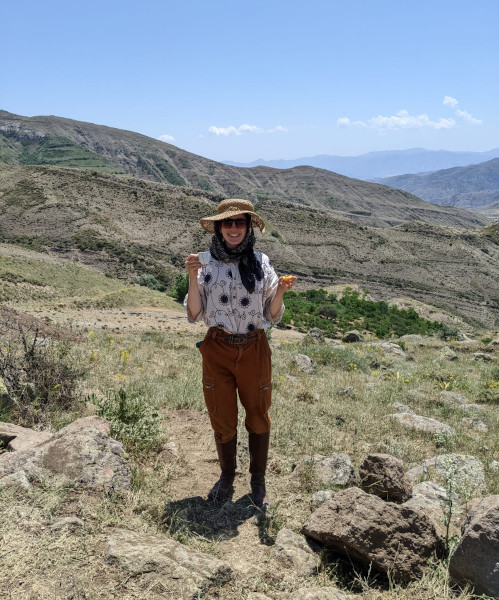
Sofia Kane participating on the Vayots Dzor Fortress Landscapes Project in Armenia.

In the morning, we would wake up and have a filling breakfast prepared by our host. This started with lavash (soft flatbread), cheese, and fresh herbs such as basil and chives, which were combined together into a rolled sandwich. This staple of Armenian cuisine was accompanied by eggs, tea, and honey.

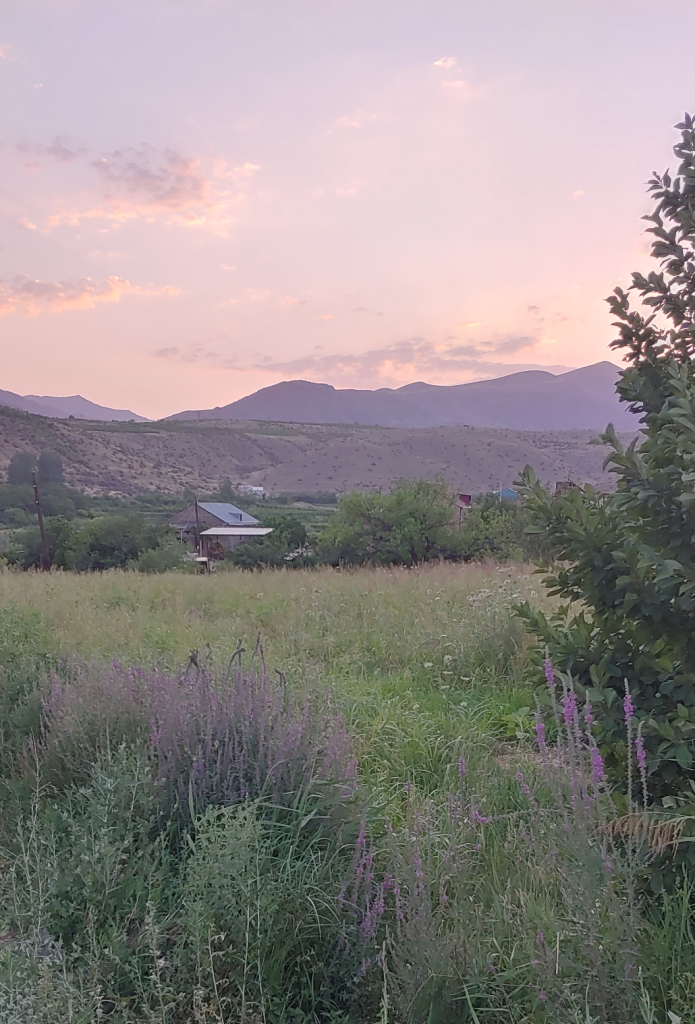
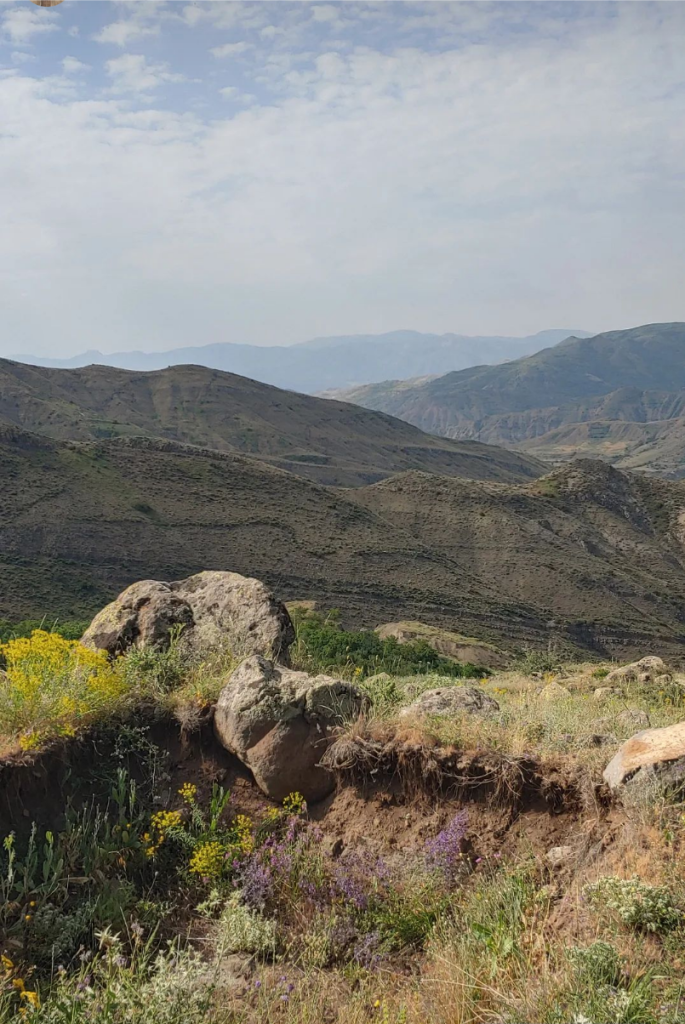
Next, we would split into two teams: one for the excavation, and one for survey. I was usually excavating, although on some days, I stayed at the dig house to illustrate finds, and on other days, I joined the survey team. The drive to the excavation featured beautiful glimpses of the Armenian countryside and a winding final stretch up into the hills. At the end of the drive, we unloaded the van and carried picks, buckets, trowels, and other tools up to the trench.

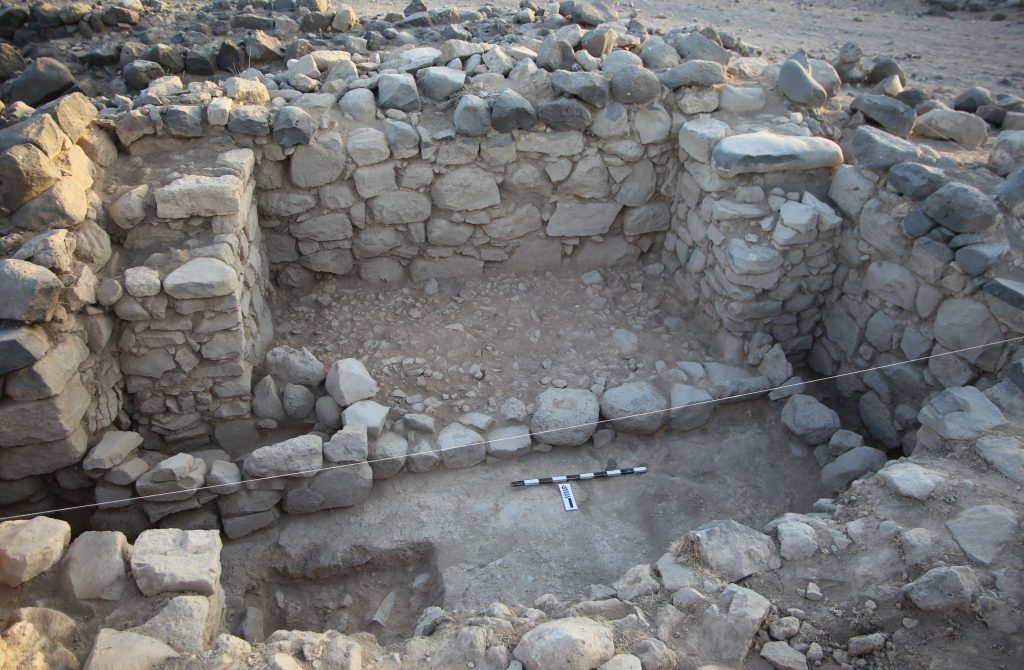
Once we got to the site, my role was to record sketches of the trench and daily summaries on the record-keeping sheets, and to excavate with pick and trowel. The area we were excavating had already been excavated in a previous season; our goal was to expand the pre-existing trench and to reach bedrock, thereby documenting all layers of habitation of the site.

Lorem ipsum dolor sit amet, consectetur adipiscing elit. Ut elit tellus, luctus nec ullamcorper mattis, pulvinar dapibus leo.
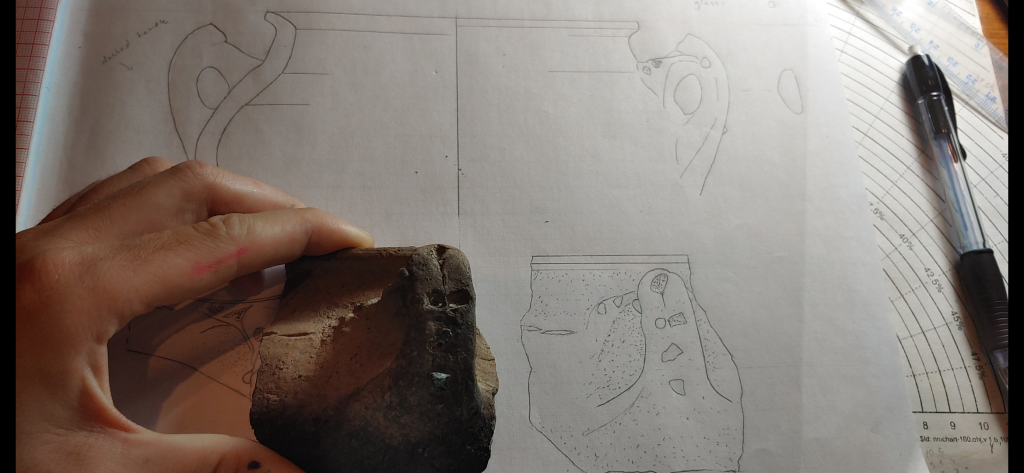
We ate lunch in the field and ended fieldwork in the mid-afternoon. After returning to the dig house and having our daily break, lab work commenced. My lab job was to illustrate the artifacts, mostly ceramics. I illustrated new ceramic finds by pencil, and digitally inked scans of penciled drawings from a previous season. I also had the opportunity to teach other students how to illustrate archaeological artifacts.

One question I am often asked is, why illustrate artifacts at all, when photography is faster? One answer is that illustration makes it possible to show objects in section. If one were to slice a vessel from top to bottom, the section is what the slice would look like. The section makes it easier to compare vessels from multiple sites and publications to see whether they are similar. Trying to record a vessel’s section with a photograph would result in a distorted image, and it would require damaging the vessel.

Illustration also makes it possible to re-create what a complete, or nearly complete, vessel would look like from only a few sherds. If one were to simply photograph a sherd, it would not reveal much about what the vessel looked like as a whole.

Meanwhile, photography has complementary uses: it can show the colors of glazes and surface decorations, and close-up photographs are able to show the composition of the clay. Together, photography and illustration create a balanced visual record of an archaeological artifact.
Towards the end of the season, we took final photos of the trench in the early-morning light, and I drew a top-plan of the trench. Drawing the top plan required about five hours of carefully measuring and sketching, because every rock and other feature of the trench needed to be plotted accurately in relation to the rest of the trench.

After wrapping up fieldwork, we carefully packed the artifacts for storage, transported them to the storage facility, and left for the capital city of Yerevan. Although this was my first summer in Armenia, I certainly hope it will not be my last.

Sofia Kane is a master’s student at the University of Crete in Rethymno, Crete in the Department of History and Archaeology, supervised by Dr. Antonis Anastasopoulos. Her research interests include archaeological illustration, medieval through Ottoman material culture, and the Ottoman-European scientific and intellectual networks of the 16th century.

Read more about Vayots Dzor Fortress Landscapes Project here.

Want to help more students and early career archaeologists get into the field? Donate to the cause today by selecting “Student Support” as your gift purpose!
FOA Webinar: Chris Rollston on January 12

FRIENDS OF ASOR WEBINARS

“Earliest Inscription Found!” Exposing Sensationalism in the Field of Ancient Inscriptions


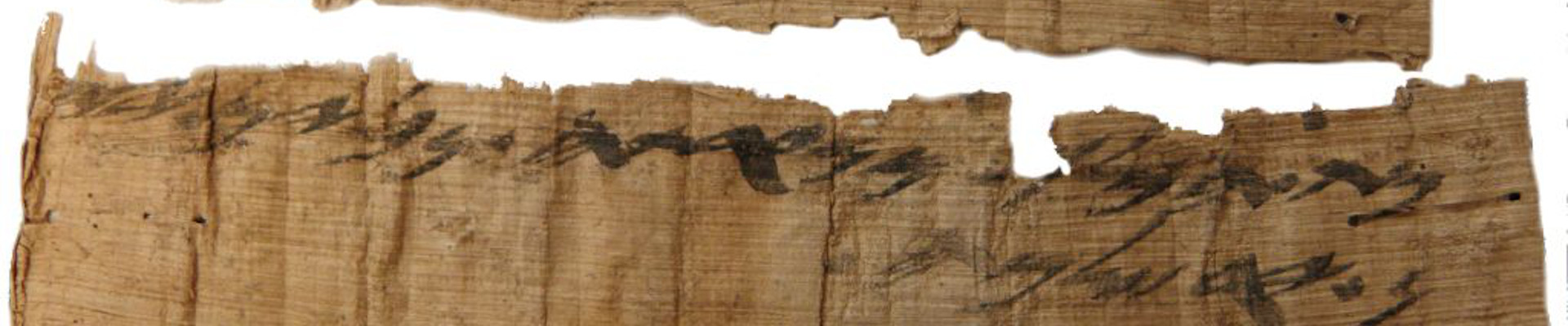
The “‘Ishamael’ Papyrus.” Photo credit: Shai Halevi/IAA via Zenger

Friends of ASOR present the next webinar in our monthly series on January 12, 2023, at 6:00pm EST, featuring Prof. Christopher Rollston and moderated by Prof. Seth Sanders. It has become commonplace during recent times for some scholar to make grandiose claims about an ancient inscription, or an inscription that is claimed to be “ancient” (in the case of modern forgeries which appear on the antiquities market). Such inscriptions (from excavations or from the market) will often be touted as referring to a famous king, a great prophet, or to hail from the city of Jerusalem, or even from the Temple in Jerusalem. In addition, such inscriptions will sometimes be asserted to be “the oldest,” “the first,” or “the most significant.” This lecture will focus on several such inscriptions, including “the ‘Ishamael’ Papyrus,” the recently announced “Hezekiah Stone Inscription,” the “Mount Ebal Curse Inscription,” the “Isaiah Bulla,” and the “Jerusalem Papyrus.” This lecture will call for a healthy dose of realism and caution with regard to all such things.

Join Prof. Rollston as he exposes the truth behind some of the most interesting claims of authenticity of ancient text in the modern world. The webinar will conclude with a live Q&A session moderated by Prof. Seth Sanders (University of California, Davis).

Christopher Rollston is Professor of Northwest Semitic Languages and Literatures at George Washington University (Washington, DC), where he is also Chair of the Department of Classical and Near Eastern Languages and Civilizations. He holds an MA and Ph.D. from Johns Hopkins University, and is a member of Phi Beta Kappa honor society. He publishes widely in the fields of Biblical and Ancient Near Eastern Studies, especially the field of ancient inscriptions (in Hebrew, Aramaic, Phoenician, Greek, Akkadian), and he often serves as a “debunker” of sensational claims regarding inscriptions. He has held two National Endowment for the Humanities Fellowships (one in Israel and one in Jordan).

For six years, he served as the co-editor of the Bulletin of the American Society of Overseas Research, and for twenty years, he served as the editor of MAARAV, a journal of Northwest Semitic languages and literatures. Several years ago, his volume entitled Writing and Literacy in the World of Ancient Israel: Epigraphic Evidence from the Iron Age was selected for the ASOR Frank Moore Cross Prize in Epigraphy. More recently, he has published two edited volumes, Enemies and Friends of the State: Ancient Prophecy in Context (Eisenbrauns, 2018), and Biblical and Ancient Near Eastern Studies in Honor of P. Kyle McCarter Jr. (Society of Biblical Literature, 2022). Chris was also a 2020 recipient of the ASOR Membership Service Award.

This webinar will be recorded and all paid registrants will be sent a link to view the recording.

ASOR Sustaining Members: $0 | ASOR Members: $6 | Public: $12
Season Pass: ASOR Sustaining Members: $0 | ASOR Members: $75 | Public: $150
Buy one here!

To receive your ASOR member discount, log into the online store. If you are new to ASOR, please click on the “New Visitor Registration” link to register your e-mail address and choose a password for our online store. Once logged in, navigate to “Meeting and Event Registration” to register for the webinar and pay the fee. Each paid registrant will receive a confirmation e-mail when you pay for the webinar. If you do not receive this e-mail, then you are not registered. Please e-mail membership@asor.org with any questions or issues with registering.

You will be e-mailed the Zoom Webinar link in the week prior to the lecture on January 12, 2023. If you do not receive the link by the close of business on the Tuesday before the webinar, please e-mail membership@asor.org immediately. This webinar will be recorded and all paid registrants will be sent a link to view the recording.

All proceeds from this webinar are used to fund scholarships for members as well as increasing ASOR’s online resources, which are free to the public.


READY FOR A WEBINAR SEASON PASS?

Buy a season pass for all the webinars* of the 2022-2023 FOA Webinar Season! 1) You will automatically receive the Zoom link for each webinar so no need to register each time. 2) You will also receive the recording of each webinar automatically after the event.

If you have missed webinars earlier in the season and still want to buy the pass, you will receive the links to the recordings of the webinars you missed in your automatic confirmation email after you buy the pass.

*Special symposiums may be excluded from the season pass price.

No more registering for a year if you buy your pass today!

Pricing:

Members: $75.00
Non-Members: $150.00
ASOR Sustaining Members: $0 (automatic registration for each webinar)
Not a member yet? Click here to join as a member and receive the 50% off a season pass!


Log into our online store to purchase the season pass for 2022-2023. If you are new to ASOR and do not have a record in our store yet, click here to register. After you login, navigate to the left to “Meeting and Event Registration.” Please e-mail membership@asor.org if you have any questions or issues.

WHY SPONSOR A WEBINAR?

Several levels of support from $50-$1,000 are available. Proceeds go towards membership scholarships and towards increasing ASOR’s virtual resources. Each sponsorship is tax-deductible and you can give your friends free registrations to a webinar!

Bronze Level ($50): up to 2 guest registrations
Silver Level ($100): up to 5 guest registrations
Gold Level ($500): up to 20 guest registrations
Platinum Level ($1,000): up to 50 guest registrations

After you sign up for a sponsorship online or over the phone, email the names and email addresses of your guests to Felice Herman at membership@asor.org, who will send your guests a confirmation and the Zoom link before the webinar.

WANT TO SAVE $6.00 ON THE NEXT WEBINAR?

Join ASOR as a member! Click here for more details about discounts for events and other benefits of membership. Memberships start at $40 for the year as an Associate Member.

Not ready to join yet? Become a Friend of ASOR for FREE!

Click here for more details about our online resources.

PAST WEBINARS

You can now purchase the link to the recording of any webinar. You can also purchase the bundle packages of all webinars from the 2020-2022 seasons. Please e-mail membership@asor.org for purchase details.

To see a printable pdf of the webinar titles from the 2020-2021 season, please click here. To see a printable pdf of the webinar titles from the 2021-2022 season, please click here.

Pricing:

Members: $6.00 per recording
Non-Members: $12.00 per recording
Bundle of 2020-2021 Webinars: $75.00
Bundle of 2021-2022 Webinars: $75.00
Bundle of 2020-2022 Webinars: $125.00

2021-2022 Season

A World at War: Protecting Cultural Heritage in Times of Conflict
Patty Gerstenblith (DePaul University), Lisa Ackerman (Columbus Citizens Foundation), Andrew Cohen (Government Professional and Cultural Heritage Expert) | May 12, 2022

Preserving Cultural Heritage in Hisban and Umm al-Jimal, Jordan
Øystein LaBianca (Andrews University), Elizabeth Osinga (Umm al-Jimal Archaeological Project), Darrell Rohl (Calvin University) | April 24, 2022

Back to the Field: Recent Discoveries & Summer Plans 2022
Lorenzo d’Alfonso (ISAW), Kathryn Grossman (NC State University), James R. Strange (Samford University) | April 3, 2022

Uncovering What is Nubian Beneath the Veneer of Egyptianness: Excavating the Archives
Debora Heard (University of Chicago) | March 20, 2022

Where Are They Now?: A Preview of 2022 ASOR-Affiliated Fieldwork Projects
Michael Given (University of Glasgow), Xenia-Paula Kyriakou (Florida Gulf Coast University), Stephen Batiuk (University of Toronto), Monique Roddy (Walla Walla University), Kent Bramlett (La Sierra University), Friedbert Ninow (La Sierra University), and Michael Hoff (University of Nebraska-Lincoln) | March 8, 2022

Excavations at Tel Gezer: A Personal Story
Sam Wolff (Tel Gezer Laboratory) | February 20, 2022

Tel Rehov: A Major Bronze and Iron Age City in the Jordan Valley
Amihai Mazar (Hebrew University of Jerusalem), Nava Panitz-Cohen ( Hebrew University of Jerusalem), Nota Kourou (Athens University), Naama Yahalom-Mack (Hebrew University of Jerusalem), Robert Mullins (Azusa Pacific University) | February 10, 2022

The Not-So-Innocents Abroad: The Beginnings of American Biblical Archaeology
Rachel Hallote (Samford University) | January 20, 2022

Synagogues as Jesus Knew Them
James R. Strange (Samford University) | December 2, 2021

Under Jerusalem: The Buried History of the World’s Most Contested City
Andrew Lawler | November 4, 2021

Jesus and Jerusalem on TV: How Do Bible Documentaries Get Made?
Robert Cargill (University of Iowa) | October 17, 2021

Digging the Divine?: Judahite Pillar Figurines and the Archaeology of Israelite Religion
Erin Darby (University of Tennessee) | October 7, 2021

David, Solomon, and Rehoboam’s Kingdom—The Archaeological Evidence
Yosef Garfinkel (Hebrew University of Jerusalem) | September 19, 2021

From Standing Stones to Sacred Emptiness: Textual and Visual Portrayals of Israel’s God
Theodore Lewis (Johns Hopkins University) | August 29, 2021

2020-2021 Season

Making May Matter: Webinarathon to Endow Diversity
Multiple Speakers | May 21-23, 2021

Archaeogaming: Why Video Games Deserve Their Own Archaeology
Tine Rassalle (University of North Carolina at Chapel Hill), Shannon Martino (Morton College), Matthew Winter (University of Arizona), Michael Zimmerman (Rhode Island) | April 18, 2021

How the Bible Became a Book
William Schniedewind (UCLA) | March 21, 2021

The Mysteries of Mithras in Caesarea: Exploring the Cult’s Rites and Remains
Jane DeRose Evans (Temple University), Alexandra Ratzlaff (Brandeis University) | March 11, 2021

Archaeology and the Hidden Religious Culture of Israelite Women
Carol Meyers (Duke University) | February 21, 2021

Meet the Directors—Fundraiser to Support ASOR’s Affiliated Overseas Research Centers
Matthew J. Adams (AIAR), Pearce Paul Creasman (ACOR), Lindy Crewe (CAARI) | February 11, 2021

Early Synagogues, Jesus, and Galilee—A Jewish Perspective
Eric Meyers (Duke University) | December 13, 2020

Home Sweet Home: Ancient Israelite Households in Context
Cynthia Shafer-Elliott (William Jessup University) | October 18, 2020

Priestesses in the Days of Solomon and Ahab
Susan Ackerman (Dartmouth College) | September 13, 2020

Digging Deeper: How Archaeology Works
Eric H. Cline (The George Washington University) | August 9, 2020

Harris Grant Report: Khirbat al-Balu‘a, Jordan

2022 Harris Grant Report: Khirbat al-Balu‘a, Jordan

The ASOR Charles Harris Project Grant helped to fund the first season of excavations in the Islamic period village at Khirbat al-Balu‘a on the northern Karak Plateau in central Jordan. This excavation is part of the Balu‘a Regional Archaeology Project (BRAP), directed by Kent Bramlett, Monique Roddy, and Friedbert Ninow.

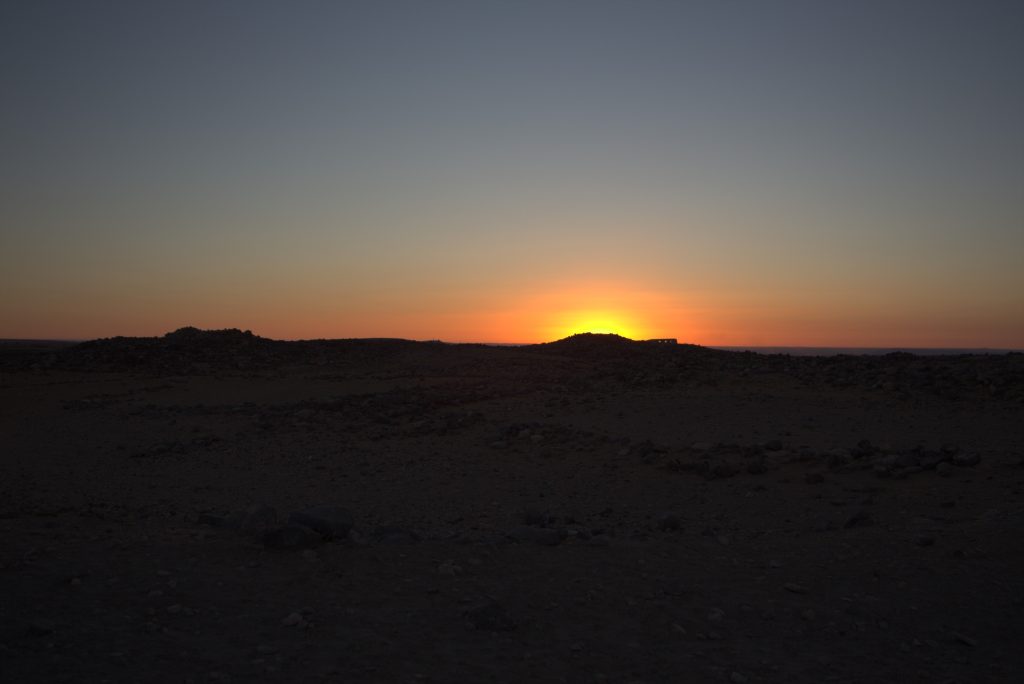
Morning arrival at Khirbat al-Balu‘a, looking east from the Khan
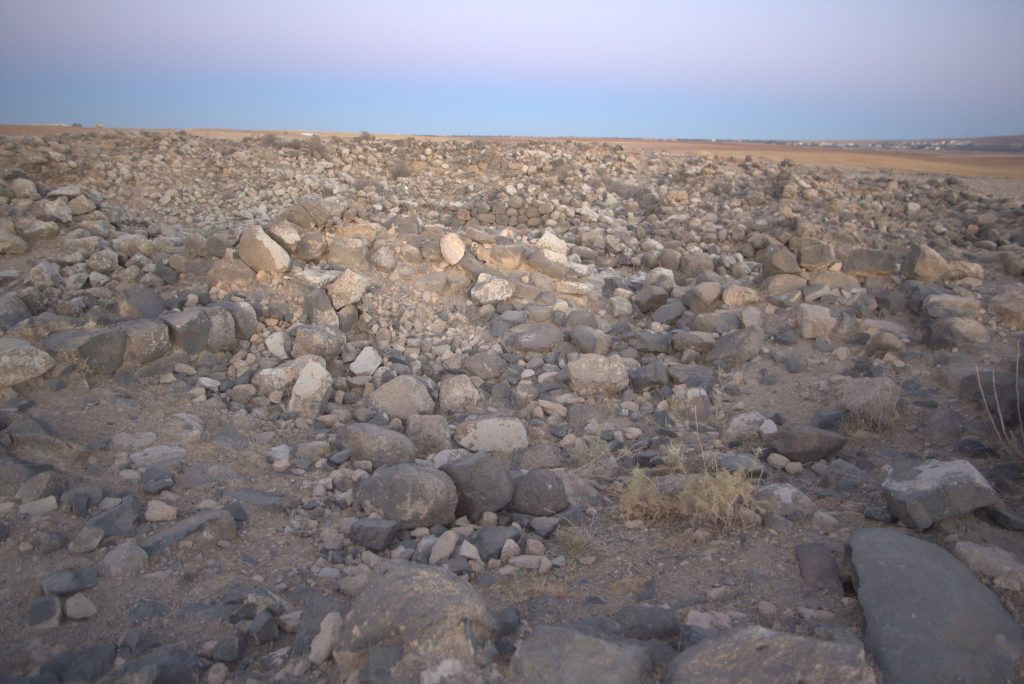
The Khan prior to excavation

Prior to this season, BRAP has focused on investigation of the impressive Iron Age remains in the northern and eastern portions of the site, which remain a research priority. This season, the Harris Grant allowed the project to expand investigations to the Middle (ca. 1000-1400 AD) and Late (post-1400 AD) Islamic period village in the southwestern portion of the site. Much remains unknown about the village, including its name and the exact chronology of its occupation. Its location and the presence of a large (ca. 40 x 40 m) square structure, which we tentatively identify as a khan/road inn, on its western edge, however, seem to suggest that it served as a stopping point for people travelling to and from the regional capital of Karak, perhaps including caravans of hajj pilgrims during the Middle Islamic period. Other features identifiable on the surface of the village, including grain threshing floors and a small olive press, point to the village’s agricultural economy.

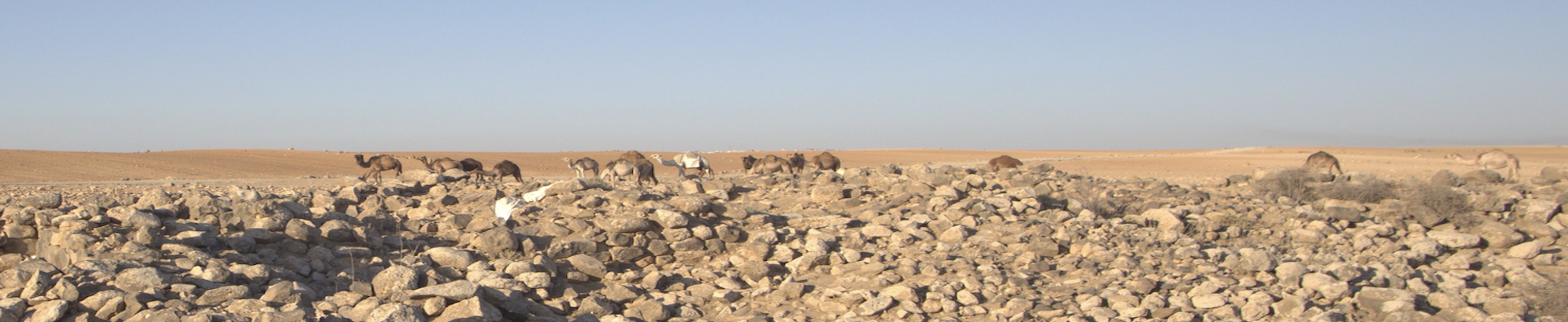
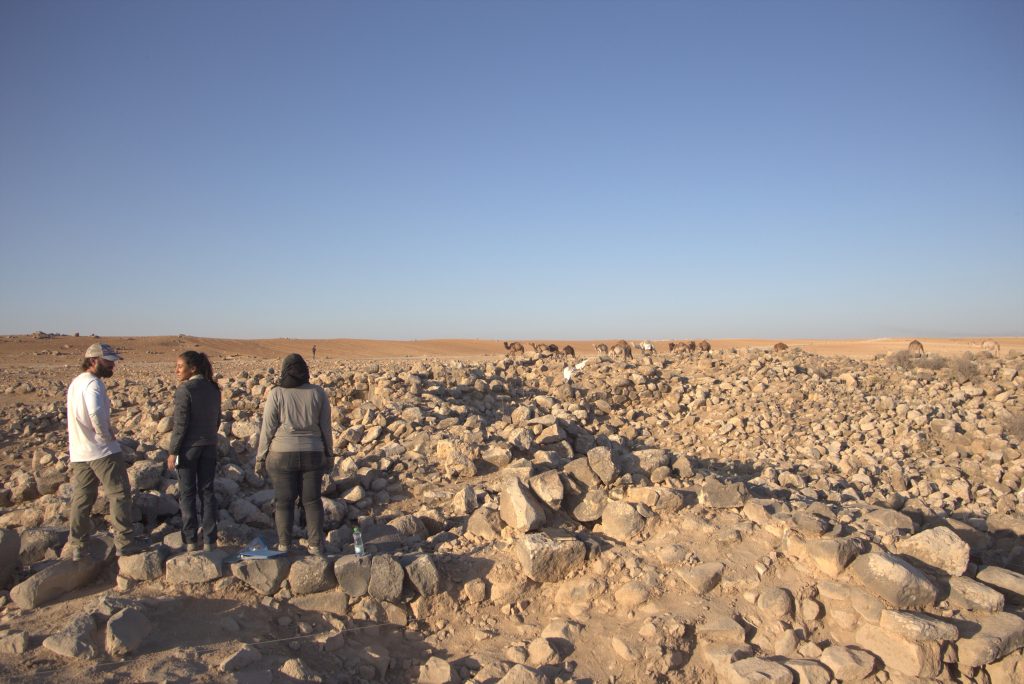
Taking a break to watch a herd of camels cross the road near the Khan.

Team Khan (Jadah Ryan, Peter Tucci, Saraa Myran, London Perlis, Roma Aatifi, and ‘Ammar Hijazin) hard at work

The BRAP Islamic Village Excavations will investigate these economic aspects of the site, as well as the social structure of the village, the daily lives of the site’s residents, and the environment of the Karak Plateau. We chose to begin our work in the Khan, however, in order to more accurately determine the original function of the building and to better understand its relationship to the village itself. The excavations this season revealed remodeling and reuse of the Khan early in the Late Islamic period (probably the 16th or 17th century AD) as a living space, storeroom, or both. The Khan may have gone out of use as a result of the eastward shift of the hajj route under the Ottomans in the 16th century, but its reuse not long after this shows that the village maintained a thriving agricultural economy.

The Late Islamic reuse phase of the Khan at the end of the season.

We plan to continue investigating this economic transition in future BRAP season, and we thank ASOR for supporting the establishment of our long-term research into the Islamic period on the Karak Plateau, an important but understudied facet of the archaeology of Jordan.

-Ian Jones, Field Director of the Middle Islamic Village,
University of California, San Diego

Table of Contents for NEA 85.4 (2022)

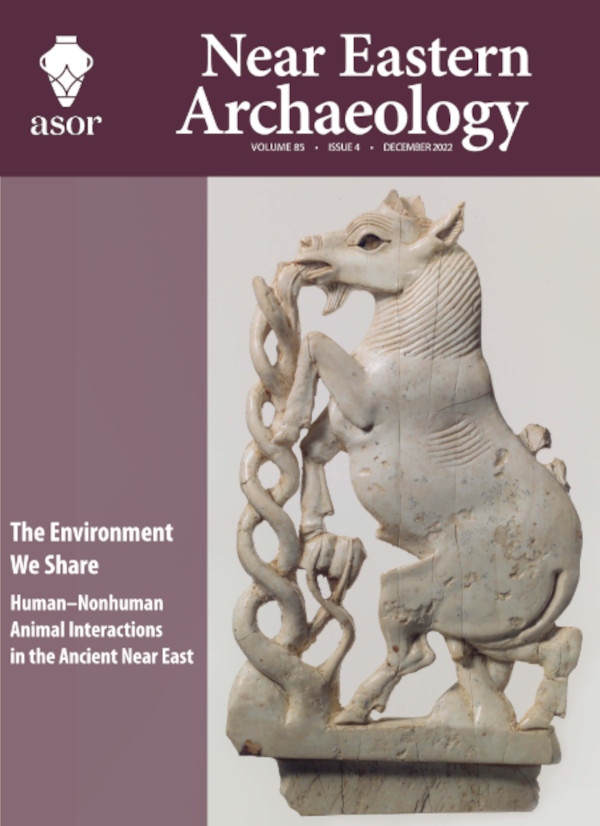
Table of Contents for Near Eastern Archaeology 85.4 (December 2022)

You can receive NEA (and other ASOR publications) through an ASOR Membership.
Please e-mail the Membership office if you have any questions.

Pp. 244–247: “The Environment We Share: Human–Nonhuman Animal Interactions in the Ancient Near East,” by Romina Della Casa and Lidar Sapir-Hen

The studies in this volume display the complexity of human and animal bonds, contributing to the deconstruction of the dichotomy expressed in Western academic traditions between humans and nature. With the goal of contributing to current interdisciplinary debates about the interactions between humans and other animals through the lens of the ancient Near East, this issue opens a space for interdisciplinary collaboration between scholars who explore how ancient societies interacted with their environs, how they experienced and perceived other animals, and how we can grasp a better understanding of the impact other animals had on human societies.

ASOR Members with online access: navigate to the token link email sent to you (search for “token link” in inbox) before attempting to read this article. Once you have activated your member token, click here to access the above article on The University of Chicago Press Journals’ website.

Pp. 248–257: “Flattening the Wild in the Ancient Near East,” by Benjamin S. Arbuckle, Christine Mikeska, and Theo McLeod Kassebaum

In this article the authors explore the impact of wild-domestic dualisms on how wild animals are conceived and framed in the zooarchaeology of the ancient Near East. They argue that this dominant framework flattens the wild into an artificially homogenous entity and funnels scholarly engagement with wild animals into a narrow range of topics. They explore examples from the archaeozoological literature as well as ancient texts that suggest that rather than being peripheral and exotic participants, wild animals were ubiquitous and important contributors to hybrid, multispecies Bronze Age societies. They further suggest a more robust zooarchaeology of the wild through application of flat ontologies and related decentering frameworks.

ASOR Members with online access: navigate to the token link email sent to you search for “token link” in inbox) before attempting to read this article. Once you have activated your member token, click here to access the above article on The University of Chicago Press Journals’ website.

Pp. 258–269: “Encountering Ancient Environments: The Impact of Nonhuman Animals on Populations of Hittite Anatolia,” by Romina Della Casa

This article surveys different textual genres from Hittite tablet collections of Hattusa (Boğazköy/Boğazkale) and Tapikka (Maşat Höyük) with the goal of exploring specific instances where one can detect human responses, strategies, and adaptations in the face of the active presence and behavior of ancient nonhuman animals (henceforth animals). The examples under study explore the animal side of human-animal encounters and involve locusts, wolves, pigs, dogs, donkeys, horses, sheep, and cattle. They reveal the existence of at least two main interrelated modes through which these animals impacted human behavior. One exhibits animal competition with humans for food, leading ancient Anatolian populations to devise strategies to minimize their impact on nearby resources. The other reflects that the behavior of certain animals encouraged practices of containment, regulation, mobility, and care, depicting, overall, key features of how animals shaped the daily life of ancient Anatolia’s human inhabitants.

ASOR Members with online access: navigate to the token link email sent to you (search for “token link” in inbox) before attempting to read this article. Once you have activated your member token, click here to access the above article on The University of Chicago Press Journals’ website.

Pp. 270–278: “Ancient Mesopotamian Animal Omens: Structure and Patterns of Meaning,” by Nicla De Zorzi

The article addresses a Babylonian collection of omens regarding animals and their behavior. These omens are part of a large series of terrestrial omens that is known as Šumma ālu (ina mēlê šakin) “If a city (is set on a height).” The main argument of this article is that these animal omens should not be seen as straightforward reflections of actual animal behavior, but are conceived as a culturally constructed bestiarium, that is, as a mirror of human society. This will be demonstrated through a series of case studies.

ASOR Members with online access: navigate to the token link email sent to you (search for “token link” in inbox) before attempting to read this article. Once you have activated your member token, click here to access the above article on The University of Chicago Press Journals’ website.

Pp. 280–287: “The Merdītu-Offerings: Animal Sacrifice in First-Millennium Babylonian Religious Contexts,” by Rocío Da Riva

Some Late Babylonian texts containing evidence on temple ceremonies refer to a sacrificial offering called merdītu, which was performed on special occasions in the sanctuaries of Uruk and Babylon. The merdītu was a libation of sorts poured directly onto the decapitated head of a sheep and onto the heart extracted from an ox or bull. Although the texts are not very informative, they contain some interesting data on the internal structure of the temples, the ritualization of space, and on the cultic performers involved in the ceremonies.

ASOR Members with online access: navigate to the token link email sent to you (search for “token link” in inbox) before attempting to read this article. Once you have activated your member token, click here to access the above article on The University of Chicago Press Journals’ website.

Pp. 288–295: “Always a Hunter: The Role of Wild Animals during the Late Bronze and Iron Ages of the Southern Levant,” by Lidar Sapir-Hen

By the Late Bronze and Iron Ages in the southern Levant, livestock animals were the dominant meat source, and wild animals constituted a very small supplementary proportion of economy. As a result, wild animals often receive limited attention in studies of these periods. This article aims to examine the role of wild animals based on a large body of published zooarchaeological data. By studying temporal changes in species presence and frequencies, the study tracks the local diminution in several wild species; reveals a clear preference for hunting deer in sites of the Iron Ages, regardless of changes in local landscape; and shows that various other wild animals can be correlated to assemblages that are identified with Egyptian presence. Based on these observations and with correlation to historic events and cultural changes, wild animals’ roles in the economic and symbolic world of past societies are discussed.

ASOR Members with online access: navigate to the token link email sent to you (search for “token link” in inbox) before attempting to read this article. Once you have activated your member token, click here to access the above article on The University of Chicago Press Journals’ website.

Pp. 296–305: “Human–Animal Encounters on Early Iron Age Stamp Seals,” by Ido Koch

Human-animal relations are manifested in encounters that range from confrontation and subjugation to harmonious coexistence. For thousands of years, these encounters have triggered diverse associations that at times have been materialized into visual languages that, despite spatial and chronological particularities, share scenes and protagonists. This essay deals with the depictions of these animals and scenes on early Iron Age stamp seals from the southern Levant. It provides an overview of three typical scenes: figure atop an animal, figure confronting an animal, and figure alongside an animal. Four animals are depicted: the lion, the bull, the ibex, and the ostrich. At the same time, the Iron Age was the last phase of such iconography after millennia of development. During the Iron Age IIB, additional images became popular and widespread, and the animal encounters lost their importance on the local stamp seals.

ASOR Members with online access: navigate to the token link email sent to you (search for “token link” in inbox) before attempting to read this article. Once you have activated your member token, click here to access the above article on The University of Chicago Press Journals’ website.

Pp. 306–308: “She Who Wrote: Enheduanna and Women of Mesopotamia ca. 3400–2000 BCE,” by Stephanie Lynn Budin

The author reviews the exhibit “She Who Wrote: Enheduanna and Women of Mesopotamia” which is on display at the Morgan Library and Museum in New York City from October 2022 to February 2023.

ASOR Members with online access: navigate to the token link email sent to you (search for “token link” in inbox) before attempting to read this article. Once you have activated your member token, click here to access the above article on The University of Chicago Press Journals’ website.

ASOR Members with online access: navigate to the token link email sent to you before attempting to read this issue. Once you have activated your member token, click here to access the the entire issue, including book reviews, on The University of Chicago Press Journals’ website.

2022 Annual Meeting Recap

ASOR 2022 Annual Meeting Recap

In-Person Component | Boston, November 16-19
Virtual Component | Online, October 19-23

The 2022 ASOR Annual Meeting, once again, had both virtual and in-person components.  The virtual component was held online, October 19-23, and the in-person component took place at the Boston Park Plaza, November 16-19.

More than 1,000 people registered for the meeting and more than 600 individuals gave presentations on the 2022 Academic Program. Presenters represented more than 40 countries and 6 continents.

Read on for a summary of each component and click here to see 2022 Honors & Awards that were announced at the Members’ Meeting on November 18th in Boston. If you attended the meeting, please provide important feedback by completing the 2022 Annual Meeting Evaluation.

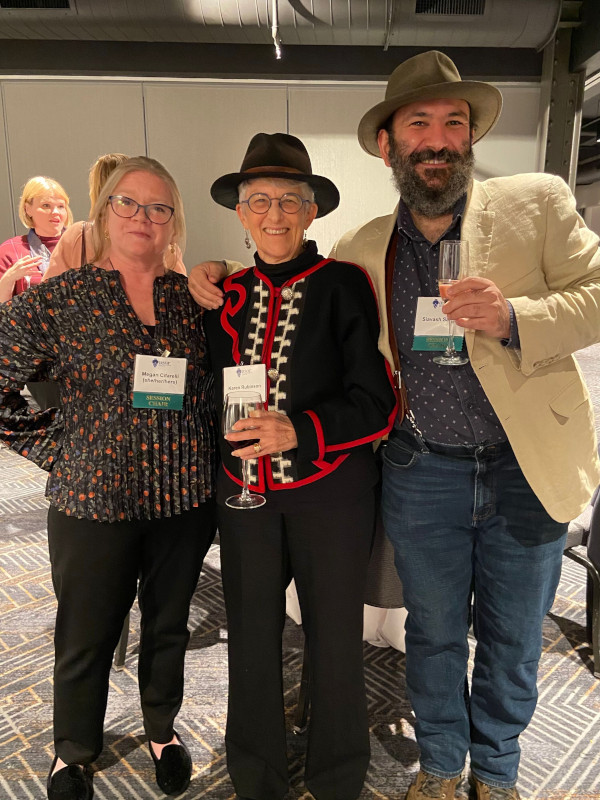
Megan Cifarelli, Karen Rubinson, and Siavash Samei at the Rubinson Celebration. Not for use without permission.

Virtual Component: Online, October 19-23

Nearly 300 presentations were given as part of ASOR’s virtual component in 65 sessions over five days. Attendees viewed pre-recorded paper presentations ahead of the meeting and engaged in discussion sessions online with the presenters. All of the recorded content from the virtual component of the 2022 ASOR Annual Meeting will be available to registered attendees on ASOR’s Virtual Meeting Platform through June 2023.

In-Person Component: Boston, November 16-19

ASOR welcomed nearly 900 attendees in-person at the Boston Park Plaza. Dr. Solange Ashby opened the meeting on November 16 with her Plenary Address titled, Women of the Sacred South: Nubian Women in the temple and Upon the Throne. The presentation generated a lot of discussion and enthusiasm which continued throughout the evening at the Welcome Reception.

The Academic Program was especially robust with 105 sessions and workshops over three days. More than 500 papers, posters, and workshop presentations were delivered in Boston. ASOR CHI projects brought speakers from Tunisia and Libya to Boston to present in multiple sessions, thanks to State Department Embassy grants, and many participants were able to attend the meeting for the first time thanks to travel fellowships funded by generous donations from our members.

Attendees in Boston enjoyed several receptions and special functions during the meeting, such as a reception hosted by CAARI, the Early Career Scholars Reception, and the Women’s Mentoring Lunch was held again for the first time since before the pandemic. The Harvard Museum of the Ancient Near East (HMANE) hosted a private reception for ASOR attendees on Saturday evening after the sessions ended.

ASOR would like to thank everyone who participated and contributed to the success of the 2022 Annual Meeting. We hope that you enjoyed the meeting and will continue to enjoy the photos and the recorded content from the virtual component which will remain online through June 2023.

Please save the dates for ASOR’s 2023 Annual Meeting with a virtual component (October 18-21) and the in-person meeting at the Hilton Chicago (November 15-18). The Call for Member-Organized Session & Workshop Proposals will be open from December 15, 2022 – January 15, 2023.

2022 ASOR Honors & Awards

2022 ASOR HONORS & AWARDS


Each year at the Annual Meeting, ASOR recognizes individuals who have performed outstanding service for the organization, those who have published exceptional academic work, and those who made significant contributions to our field. The following award recipients were honored at the 2022 Annual Meeting in Boston. Awards were presented by Lynn Welton, Chair of ASOR’s Honors and Awards Committee.

The W. F. Albright Award. This award honors an individual who has shown special support or made outstanding service contributions to one of the overseas centers, ACOR, AIAR, CAARI, or to one of the overseas committees – the Baghdad Committee and the Damascus Committee. This award is given when such an individual is identified.

ACOR: Awarded to John P. Oleson, Distinguished Professor Emeritus at University of Victoria; Member of ACOR’s Board of Trustees.

The Charles U. Harris Service Award. This award is given in recognition of long term and/or special service as an ASOR officer or Trustee (one award is given annually).

Awarded to Richard L. Coffman, Managing Director at the Coffman Law Firm; outgoing Chair of ASOR’s Board of Trustees.

The P. E. MacAllister Field Archaeology Award. This award honors an archaeologist who, during his/her career, has made outstanding contributions to ancient Near Eastern and eastern Mediterranean archaeology (one award is given annually).

Awarded to Glenn Schwartz, Whiting Professor of Archaeology at Johns Hopkins University.

ASOR Membership Service Award. This award recognizes individuals who have made special contributions on behalf of the ASOR membership, through committee, editorial, or office services.

Awarded to Helen Dixon, Assistant Professor of History, East Carolina University; outgoing Co-Chair of the ASOR Program Committee.


Awarded to Ann-Marie Knoblauch, Associate Professor of Art History and Associate Director of the School of Visual Arts, Virginia Tech University; Secretary, ASOR’s Board of Trustees and Executive Committee.

ASOR Community Outreach and Public Engagement. This award recognizes individuals, teams, and organizations who have initiated outstanding educational, informational, or practical projects (including but not limited to classes, programs, exhibits, resources, events, platforms) with the goal of making subjects and information about the ancient world accessible to wider (particularly non-academic) audiences.

Awarded to Melissa Cradic and Samuel Pfister, for their virtual exhibit, Unsilencing the Archives: Laborers of the Tell en-Nasbeh Excavations (1926-1935).

To view the virtual exhibit, click here.

The G. Ernest Wright Award. This award is given to the editor/author of the most substantial volume(s) dealing with archaeological material, excavation reports and material culture from the ancient Near East and eastern Mediterranean. This work must be the result of original research published within the past two years (one award is given annually).

Awarded to Andrea De Giorgi, Associate Professor, Florida State University; and Asa Eger, Associate Professor, University of North Carolina at Greensboro; for Antioch: A History.

The Frank Moore Cross Award. This award is presented to the author/editor of the most substantial volume(s) related to the history and/or religion of the ancient Near East and Eastern Mediterranean. Primary consideration will be given to historical, epigraphic, textual, and comparative literary studies; or to works that advance and/or evaluate new methodological approaches to the literary record(s). This work must be the result of original research published during the past two years (one award is given annually).

Awarded to Carolina López Ruíz, Professor, University of Chicago Divinity School and Department of Classics, for Phoenicians and the Making of the Mediterranean. 

The Nancy Lapp Popular Book Award. This award is presented to the author/editor of a book published in the last two years that offers a new synthesis of archaeological or textual evidence intended to reach an audience of scholars as well as students and the broader public (one award is given annually).

Awarded to Paul Collins, Keeper of the Middle East at the British Museum, for The Sumerians. 

The Joy Ungerleider Poster Award. This award is conferred upon the author(s) of the poster presenting the results of a study about ancient Near Eastern societies in a clear, legible fashion using original graphic content. Subject matter may be based in archaeological sciences, history, anthropology, epigraphy, ethnography, heritage or other scholarly approaches to understanding ancient people in the areas covered by ASOR (one award is given annually).

Awarded to Brady Liss, Matthew Howland, Anthony Tamberino, Mohammad Najjar, and Thomas E. Levy, University of California San Diego, for the poster: “Digitally Cleaning the Section: Using Archived Photographs to Reconstruct Stratigraphic Sections in Faynan, Jordan.”

Student Paper Award. This award is conferred upon the author(s) of a paper presented during the Annual Meeting that conveys the results of a study about ancient Near Eastern and wider Mediterranean societies in a clear, understandable and convincing fashion. The first author and presenter of the paper must be a registered student at the time of presentation in order to be eligible for consideration for this award.

Awarded to Alia Fares, University of Cologne, Germany and Landward Research, Ireland, for the paper “Archaeology at Your Doorstep-Building Heritage Awareness on the Lebanon Mountain Trail and for Beirut’s Traumatized Youth.”

Click here to watch the pre-recorded paper presentation. 

2023 Annual Meeting Recap

ASOR 2023 Annual Meeting Recap

Chicago and Hybrid | November 15-18

ASOR held its first-ever hybrid format meeting with both in-person and virtual participation last month, November 15-18, at the Hilton Chicago and online.

More than 1,000 people were registered for the meeting with nearly 800 attending in Chicago. There was an increase in virtual attendance leading up to the Annual Meeting as current conditions in the Middle East impacted many registrants and program participants.

During the opening remarks, ASOR’s Executive Director, Andrew Vaughn, and ASOR President, Sharon Herbert, both mentioned the profound impact of the war in Israel and Gaza on the meeting and for our membership. The absence of many colleagues who had planned to come to Chicago was sorely felt and acknowledged.

While recognizing the challenges related to the situation in the Middle East and the hybrid logistics of the meeting, the meeting offered a way for attendees in Chicago and online to share their research and make meaningful connections. If you attended the 2023 Annual Meeting in Chicago or online, please complete the 2023 Annual Meeting Evaluation to provide valuable feedback that will be considered as we plan for 2024 and beyond.

Read on for a summary of the 2023 Annual Meeting, including features from the academic program, the business schedule, special events, and the 2023 ASOR Honors & Awards.

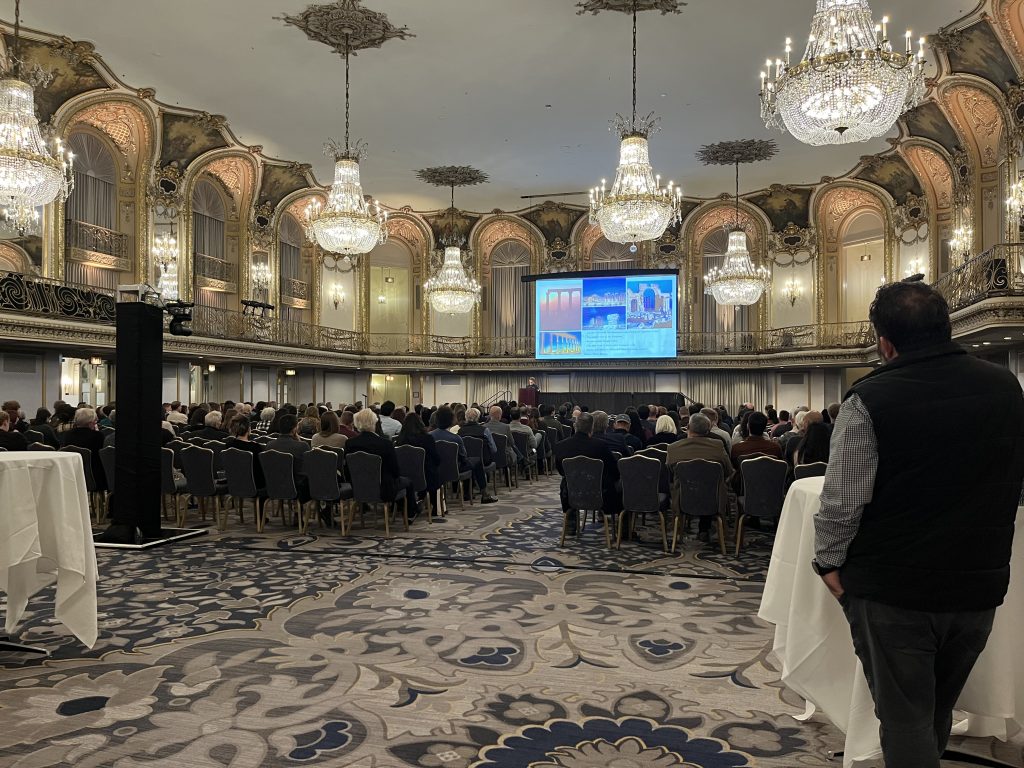
Attendees gathered to listen to Dr. Rubina Raja's Plenary Address to open up the 2023 Annual Meeting. Not for use without permission.

The 2023 hybrid ASOR Annual Meeting opened on Wednesday, November 15, with the Plenary Address by Dr. Rubina Raja (Aarhus University) titled, Death by Data? Or What Has a Decade of Research on Palmyrene Funerary Sculpture Taught Us about the Ancient World? The presentation generated a lot of discussion and enthusiasm which continued throughout the evening at the Welcome Reception.

The sessions and workshops of the academic program took place Thursday-Saturday, November 16-18, with presenters representing 35 countries and 6 continents. More than 500 presentations were given in Chicago and online as part of 112 sessions and workshops. The Poster Session featured 34 projects shared in Chicago, as well a virtual poster gallery. The recorded content of the Annual Meeting is being edited and will be available to registered attendees via the ASOR Hybrid Meeting Platform from mid-December through July of 2024.

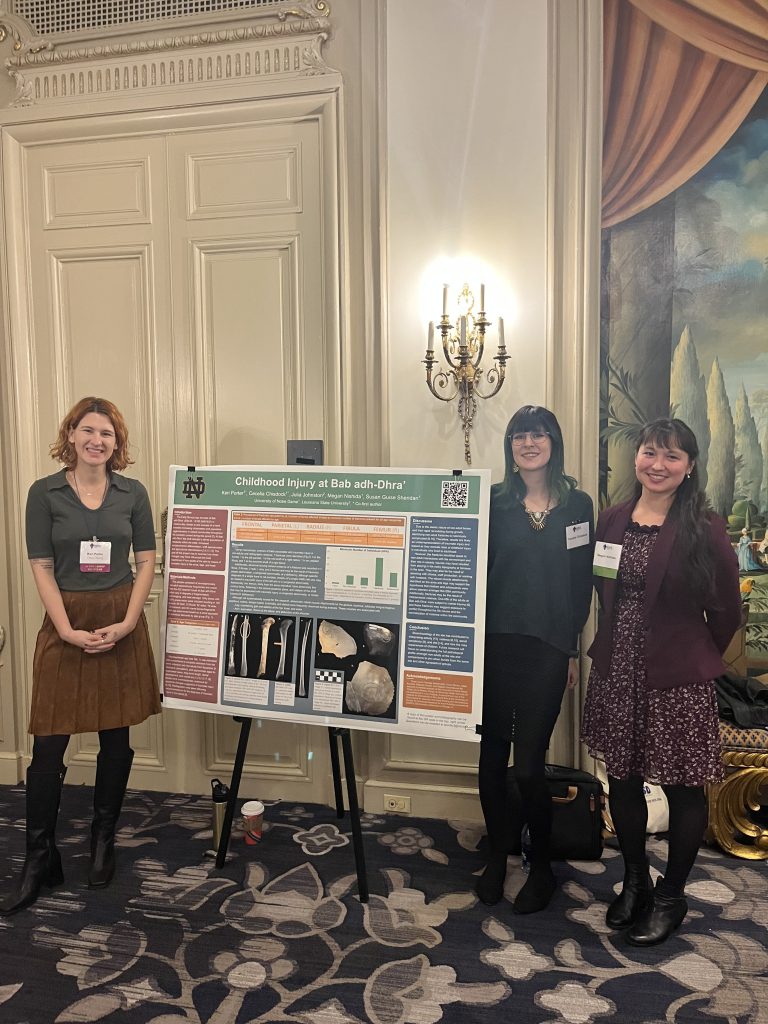
From left; Keri Porter, Cecilia Chisdock, and Megan Nishida present their poster at the Poster Session. Not for use without permission.

Attendees in Chicago enjoyed several special events at the Hilton Chicago and at local museums. Dr. William Parkinson gave a lecture at the Field Museum and offered a walk-through of the new exhibit, First Kings of Europe. Events at the Hilton Chicago included the Women’s Mentoring Lunch, the Early Career Scholars brown-bag lunch panel, and Roundtable Discussions were offered for the first time at ASOR. Receptions were hosted during the event by ASOR, UCLA, and CAARI, as well a celebration in honor of Thomas E. Levy’s festschrift. The Institute for the Study of Ancient Cultures (ISAC) Museum at the University of Chicago hosted a private reception for ASOR attendees on Saturday evening after the meeting ended.

ASOR would like to thank everyone who participated and contributed to the success of the 2023 Annual Meeting. Please enjoy some of the memorable moments captured in the photo album below, and we hope you will continue to enjoy the recorded content from the meeting through June 2024.

Please mark your calendars for ASOR’s 2024 Hybrid Annual Meeting at the Hilton Boston Park Plaza and online, November 20–23. The Call for Member-Organized Session & Workshop proposals will be open from December 15, 2023–January 15, 2024.

FOA Webinar: The Transformation of Ancient Caesarea on Dec. 15

FRIENDS OF ASOR WEBINAR

From Paganism to Christianity to Islam: The Transformation of Ancient Caesarea

Friends of ASOR presents a webinar on December 15, 2022 from 3:00pm to 4:30pm EDT, “From Paganism to Christianity to Islam: The Transformation of Ancient Caesarea,” featuring Prof. Marsha Rozenblit, Prof. Yael Arnon, and Anna Iamim. This webinar will trace the archaeological evidence for the history of Caesarea Maritima, built by King Herod the Great of Judaea in the late first century BCE on the coast of what is today Israel. At Caesarea, Herod built a splendid city, replete with a theater, hippodrome, palace, aqueduct, city streets, sewers, and especially a magnificent temple dedicated to the pagan gods Roma and Augustus. This temple was located on a specially constructed “hill,” the so-called Temple Platform, and it served as a “harbor temple,” visible to ships entering the artificial harbor constructed by Herod and his engineers. Caesarea flourished as the capital of Roman Palestine and especially in the so-called “Byzantine” period after the Christianization of the Roman Empire in the fourth century CE, reaching its largest extent in size and population in the sixth century CE. The city continued to thrive in a somewhat smaller form after the Muslim conquest in 640 CE and also during the Crusader occupation in the twelfth and thirteenth centuries, but finally ceased to function with the defeat of the Crusaders in 1265.


A lucky winner will receive a free copy of this book!

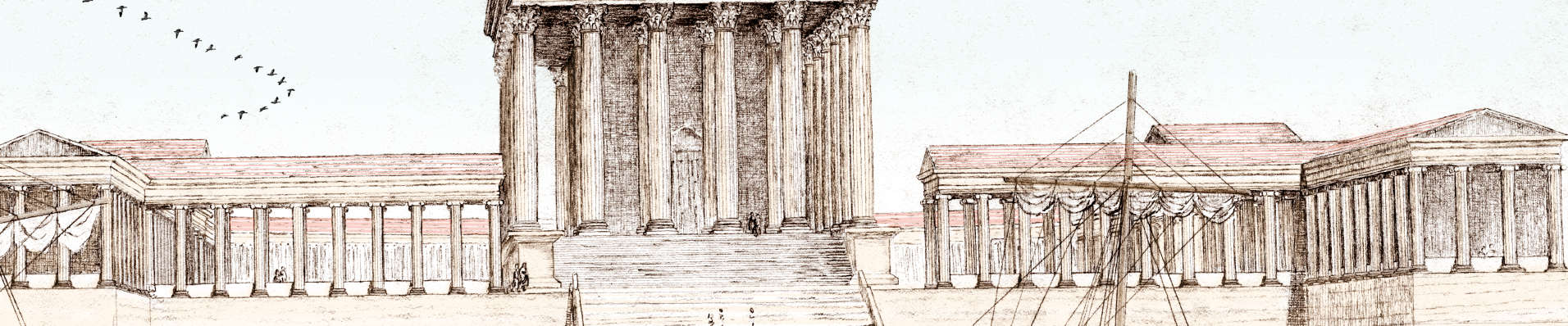
Archaeologist Kenneth Holum, a professor of Ancient History at the University of Maryland, who passed away in 2017, led the excavations between 1989 and 2003 on the Temple Platform at Caesarea as part of the Combined Caesarea Expeditions with the late Avner Raban of Haifa University leading the excavations of the harbor. This webinar will focus on the archaeological findings on the Temple Platform from the Roman and Byzantine periods, including discoveries about the pagan temple, its willful destruction by the Christian authorities of Caesarea around the year 400 CE, and the construction on the same spot around 500 CE of a large, beautiful, octagonal Christian church, which served as a “harbor church,” visible to all boats that entered the still active harbor in the sixth and seventh centuries. These findings have been meticulously described in Caesarea Maritima: Excavations in the Old City 1989-2003 Conducted by the University of Maryland and the University of Haifa, Final Reports, Volume 1, edited by Kenneth G. Holum (ASOR, Archaeological Reports 27, 2020). Holum finished all the work on the volume before his death, and his wife, Marsha Rozenblit, the moderator of this webinar, oversaw the publication of the volume.

The webinar will consist of short presentations by Rozenblit (University of Maryland) as moderator, by Yael Arnon, the chief ceramicist at the site; and Anna Iamim, who completed all the architectural plans. Rozenblit will then moderate a discussion of the most important findings at the site. The final 20 minutes will be devoted to a live Q&A session with the audience and panelists. The event will be recorded.


ASOR Sustaining Members: $0 | ASOR Members: $6 | Public: $12

Speakers / Presenters

Marsha Rozenblit is the Harvey M. Meyerhoff Professor of Jewish History at the University of Maryland. She is a specialist in the history of the Jews in Austria-Hungary and its successor states, and she has written several books and many scholarly articles on such topics as the Jews of Vienna, the impact of World War I on the Jews, and Jewish marriage and courtship practices. She is the moderator of this session because her late husband Kenneth Holum directed the land excavations on the Temple Platform at Caesarea for many years. After his death in 2017, she oversaw the publication of the final reports from his excavations at Caesarea.

Yael Arnon is a Professor of Archaeology at Oranim College in Israel. At the beginning of her academic career, she focused on early Islamic archaeology, especially material culture. Over the years, she has expanded her studies to include artistic and architectural aspects of archaeology as well as more recent periods of history in the Islamic world in general and the Land of Israel in particular. In 2008, Arnon published a book about the material culture of the early Islamic and Crusader periods in Caesarea, and the relationship between pottery styles and coin dating (Oxford University Press). Arnon’s future research includes changes in Islamic art over time, in particular in Israel and the Galilee. For many years she worked as registrar and ceramicist at Caesarea.

Anna Iamim was a long-time friend and colleague of Ken Holum. At Caesarea, she produced the graphic field documentation, contributed chapters, and drew the architectural reconstructions on the cover of Caesarea Maritima: Excavations in the Old City 1989-2003, Final Reports, Vol. 1, edited by Kenneth G. Holum, ASOR, Archaeological Reports 27 (2020).

ASOR Sustaining Members: $0 | ASOR Members: $6 | Public: $12

To receive your ASOR member discount, log into the online store. If you are new to ASOR, please click on the “New Visitor Registration” link to register your e-mail address and choose a password for our online store. Once logged in, navigate to “Meeting and Event Registration” to register for the webinar and pay the fee. Each paid registrant will receive a confirmation e-mail when you pay for the webinar. If you do not receive this e-mail, then you are not registered. Please e-mail membership@asor.org with any questions or issues with registering.

You will be e-mailed the Zoom Webinar link in the week prior to the lecture on December 15, 2022. If you do not receive the link by the close of business on the Tuesday before the webinar, please e-mail membership@asor.org immediately. This webinar will be recorded and all paid registrants will be sent a link to view the recording.

All proceeds from this lecture are used to fund scholarships for members impacted by COVID-19 as well as increasing ASOR’s online resources, which are free to the public.

READY FOR A WEBINAR SEASON PASS?

Buy a season pass for all the webinars* of the 2022-2023 FOA Webinar Season! 1) You will automatically receive the Zoom link for each webinar so no need to register each time. 2) You will also receive the recording of each webinar automatically after the event.

If you have missed webinars earlier in the season and still want to buy the pass, you will receive the links to the recordings of the webinars you missed in your automatic confirmation email after you buy the pass.

*Special symposiums may be excluded from the season pass price.

No more registering for a year if you buy your pass today!

Pricing:

Members: $75.00
Non-Members: $150.00
ASOR Sustaining Members: $0 (automatic registration for each webinar)
Not a member yet? Click here to join as a member and receive the 50% off a season pass!


Log into our online store to purchase the season pass for 2022-2023. If you are new to ASOR and do not have a record in our store yet, click here to register. After you login, navigate to the left to “Meeting and Event Registration.” Please e-mail membership@asor.org if you have any questions or issues.

WHY SPONSOR A WEBINAR?

Several levels of support from $50-$1,000 are available. Proceeds go towards membership scholarships and towards increasing ASOR’s virtual resources. Each sponsorship is tax-deductible and you can give your friends free registrations to a webinar!

Bronze Level ($50): up to 2 guest registrations
Silver Level ($100): up to 5 guest registrations
Gold Level ($500): up to 20 guest registrations
Platinum Level ($1,000): up to 50 guest registrations

After you sign up for a sponsorship online or over the phone, email the names and email addresses of your guests to Felice Herman at membership@asor.org, who will send your guests a confirmation and the Zoom link before the webinar.


WANT TO SAVE $6.00 ON THE NEXT WEBINAR?

Join ASOR as a member! Click here for more details about discounts for events and other benefits of membership. Memberships start at $40 for the year as an Associate Member.

Not ready to join yet? Become a Friend of ASOR for FREE!

Click here for more details about our online resources.

PAST WEBINARS

You can now purchase the link to the recording of any webinar. You can also purchase the bundle packages of all webinars from the 2020-2022 seasons. Please e-mail membership@asor.org for purchase details.

To see a printable pdf of the webinar titles from the 2020-2021 season, please click here. To see a printable pdf of the webinar titles from the 2021-2022 season, please click here.

Pricing:

Members: $6.00 per recording
Non-Members: $12.00 per recording
Bundle of 2020-2021 Webinars: $75.00
Bundle of 2021-2022 Webinars: $75.00
Bundle of 2020-2022 Webinars: $125.00

2021-2022 Season

A World at War: Protecting Cultural Heritage in Times of Conflict
Patty Gerstenblith (DePaul University), Lisa Ackerman (Columbus Citizens Foundation), Andrew Cohen (Government Professional and Cultural Heritage Expert) | May 12, 2022

Preserving Cultural Heritage in Hisban and Umm al-Jimal, Jordan
Øystein LaBianca (Andrews University), Elizabeth Osinga (Umm al-Jimal Archaeological Project), Darrell Rohl (Calvin University) | April 24, 2022

Back to the Field: Recent Discoveries & Summer Plans 2022
Lorenzo d’Alfonso (ISAW), Kathryn Grossman (NC State University), James R. Strange (Samford University) | April 3, 2022

Uncovering What is Nubian Beneath the Veneer of Egyptianness: Excavating the Archives
Debora Heard (University of Chicago) | March 20, 2022

Where Are They Now?: A Preview of 2022 ASOR-Affiliated Fieldwork Projects
Michael Given (University of Glasgow), Xenia-Paula Kyriakou (Florida Gulf Coast University), Stephen Batiuk (University of Toronto), Monique Roddy (Walla Walla University), Kent Bramlett (La Sierra University), Friedbert Ninow (La Sierra University), and Michael Hoff (University of Nebraska-Lincoln) | March 8, 2022

Excavations at Tel Gezer: A Personal Story
Sam Wolff (Tel Gezer Laboratory) | February 20, 2022

Tel Rehov: A Major Bronze and Iron Age City in the Jordan Valley
Amihai Mazar (Hebrew University of Jerusalem), Nava Panitz-Cohen ( Hebrew University of Jerusalem), Nota Kourou (Athens University), Naama Yahalom-Mack (Hebrew University of Jerusalem), Robert Mullins (Azusa Pacific University) | February 10, 2022

The Not-So-Innocents Abroad: The Beginnings of American Biblical Archaeology
Rachel Hallote (Samford University) | January 20, 2022

Synagogues as Jesus Knew Them
James R. Strange (Samford University) | December 2, 2021

Under Jerusalem: The Buried History of the World’s Most Contested City
Andrew Lawler | November 4, 2021

Jesus and Jerusalem on TV: How Do Bible Documentaries Get Made?
Robert Cargill (University of Iowa) | October 17, 2021

Digging the Divine?: Judahite Pillar Figurines and the Archaeology of Israelite Religion
Erin Darby (University of Tennessee) | October 7, 2021

David, Solomon, and Rehoboam’s Kingdom—The Archaeological Evidence
Yosef Garfinkel (Hebrew University of Jerusalem) | September 19, 2021

From Standing Stones to Sacred Emptiness: Textual and Visual Portrayals of Israel’s God
Theodore Lewis (Johns Hopkins University) | August 29, 2021

2020-2021 Season

Making May Matter: Webinarathon to Endow Diversity
Multiple Speakers | May 21-23, 2021

Archaeogaming: Why Video Games Deserve Their Own Archaeology
Tine Rassalle (University of North Carolina at Chapel Hill), Shannon Martino (Morton College), Matthew Winter (University of Arizona), Michael Zimmerman (Rhode Island) | April 18, 2021

How the Bible Became a Book
William Schniedewind (UCLA) | March 21, 2021

The Mysteries of Mithras in Caesarea: Exploring the Cult’s Rites and Remains
Jane DeRose Evans (Temple University), Alexandra Ratzlaff (Brandeis University) | March 11, 2021

Archaeology and the Hidden Religious Culture of Israelite Women
Carol Meyers (Duke University) | February 21, 2021

Meet the Directors—Fundraiser to Support ASOR’s Affiliated Overseas Research Centers
Matthew J. Adams (AIAR), Pearce Paul Creasman (ACOR), Lindy Crewe (CAARI) | February 11, 2021

Early Synagogues, Jesus, and Galilee—A Jewish Perspective
Eric Meyers (Duke University) | December 13, 2020

Home Sweet Home: Ancient Israelite Households in Context
Cynthia Shafer-Elliott (William Jessup University) | October 18, 2020

Priestesses in the Days of Solomon and Ahab
Susan Ackerman (Dartmouth College) | September 13, 2020

Digging Deeper: How Archaeology Works
Eric H. Cline (The George Washington University) | August 9, 2020