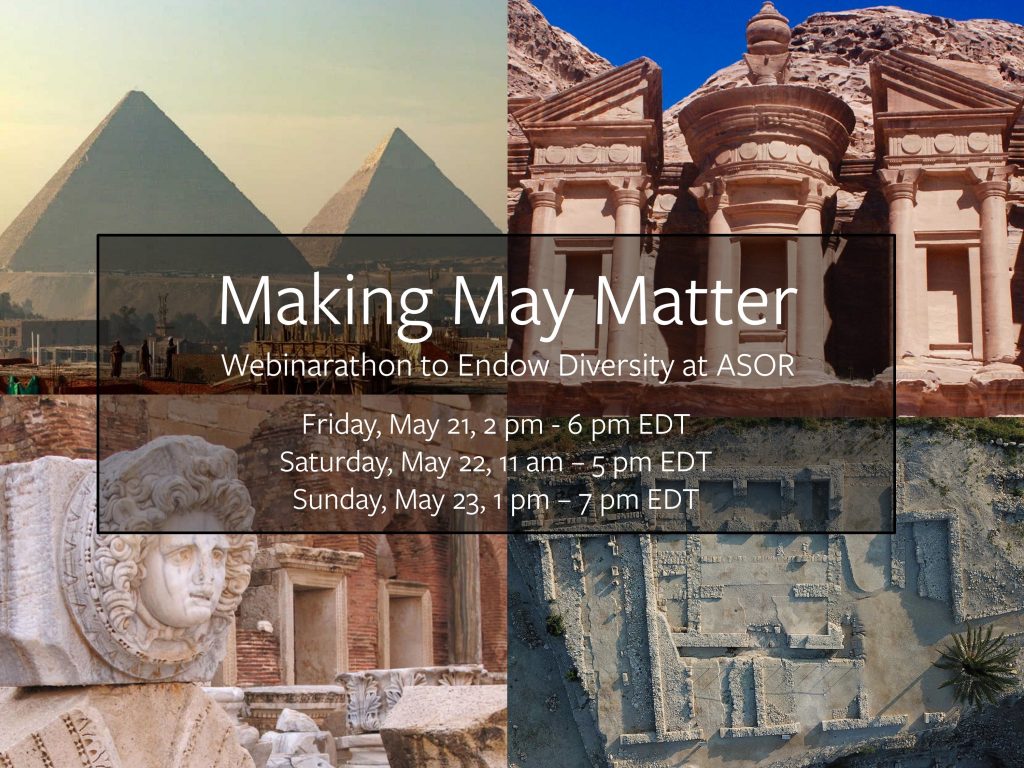
Making May Matter—Webinarathon to Endow Diversity at ASOR

FRIENDS OF ASOR PRESENT—MAKING MAY MATTER WEBINARATHON

 
  • 3-day event included 16 hours of lectures and panels
  • 24 internationally renowned scholars
  • Donate to access recordings (suggested contribution = $100 or more)
  • All contributions will be doubly matched

Friends of ASOR is pleased to announce a three-day event  (May 21-23) that featured 11 webinar sessions with more than 20 internationally renowned speakers, moderators, and discussants presenting on a wide range of topics covering the lands where ASOR members work. The full program is below. The event was recorded. All donors to Diversity Initiatives before June 30th will receive links to the recordings of the sessions for each day.

Program Schedule

FRIDAY, MAY 21, 2021

(Click here for a PDF copy of the schedule)

2:00pm – 3:00pm

Eric H. Cline

The George Washington University

7 Years After 1177—What Has Changed Since I Published My Book

Read the Description

In the seven years since 1177 BC: The Year Civilization Collapsed was first published in 2014, much more data have become available. These include additional texts from Ugarit; DNA analyses of burials found in Ashkelon; and new studies of lake sediments, stalagmites in caves, and coring from lakes and lagoons, in regions stretching from Italy and Greece to Turkey, Syria, Lebanon, Israel, and Iran. All of it points ever more conclusively to a megadrought that impacted much of the Aegean and Eastern Mediterranean, beginning ca. 1200 BC and lasting between 150 and 300 years, which drove the Collapse.

3:00pm – 3:30pm

Break

3:30pm – 4:30pm

Carol Meyers

Duke University

My Life as An Archaeologist—How My Mind Has Changed, and How It Has Stayed the Same

Read the Description

In this conversation with renowned archaeologist Prof. Carol Meyers of Duke University, we will hear how her views, especially about excavation strategy, have changed and how they have stayed the same over the many decades of her career. This will also be an opportunity for webinar attendees to hear Carol describe how she became involved in archaeology and how she was able to do field work as a mother of young children. She will be happy to answer questions about her life as an archaeologist and professor. She will be joined by Susan Ackerman as moderator and Erin Darby as a discussant.

4:30pm – 5:00pm

Break


5:00pm – 6:00pm

Christopher Rollston, Katherine Jones, and Thomas Kline

The George Washington University

Pious Textual Forgeries: From Shapira to the Museum of the Bible

Read the Description

The pillaging of archaeological sites has been a perennial problem for a very long time, with one result being the presence of various artifacts, including inscriptions, on the antiquities market. In addition, the market has also been flooded at times with forged artifacts, including inscriptions. Venality and hubris are often the name of the game. This forum focuses on laws regarding the sale of antiquities, as well as proven methodologies for ferreting out modern forgeries, thus, helping to ensure that our constructs of ancient languages, society, and religion are built on real data, not modern fabrications.

SATURDAY, MAY 22, 2021

11:00am – 12:00pm

Felix Höflmayer

Austrian Academy of Sciences

Identities in the Age of Internationalism: Tel Lachish in the Late Bronze Age

Read the Description

Tel Lachish is one of the major sites of the southern Levant during the Late Bronze Age (c. 1600-1200 BCE). Finds from several different archaeological expeditions testify to the importance of the site during the ‘International Age’ of the mid-late second millennium BCE. Egyptian, Cypriot, and Aegean imports show how Lachish was embedded in international trade routes and the presence of early alphabetic, Egyptian Hieratic, and cuneiform writing paint a dazzling picture of a vibrant international city during that time. This talk will highlight recent finds and how they help us understand Tel Lachish during the Late Bronze Age.


12:00pm – 12:30pm

Break


12:30pm – 1:30pm

Stuart Swiny

University at Albany, State University of New York

My Life as An Archaeologist—How My Mind Has Changed, and How It Has Stayed the Same

Read the Description

A candid discussion with well-known archaeologist Stuart Swiny focusing on his accomplishments and periodic tribulations throughout a career started by a visit to the Lascaux Cave at age 4.  Stuart will share his advice on how to engage a broader public and succeed in a competitive, but deeply rewarding and varied profession, yet one that offers few openings. His vocation led him from France to Turkey, to Iran then Afghanistan, Cyprus and ultimately the USA, weathering coups and wars along the way. He looks forward to answering your questions about his life as an archaeologist in the field and in the classroom. He will be joined by Ann-Marie Knoblauch as moderator and Michael Toumazou as a discussant.


1:30pm – 2:00pm

Break


2:00pm – 3:00pm

Megan A. Perry

East Carolina University

Life and Death on Petra’s North Ridge

Read the Description

The mysterious Nabataeans, builders of the magnificent city of Petra, have long fascinated scholars and the public. Our understanding of Petra’s urban life recently has been transformed with the excavation of tombs within the ancient city. The human skeletal remains from these tombs have illuminated the origins of the city’s residents, their disease profiles, and what foods they relied on in this desert environment. This lecture demonstrates how Petra’s dead can inform what life was like in this ancient city.


3:00pm – 3:30pm

Break


3:30pm -4:30pm

Debora Heard

University of Chicago

Black in Ancient History: Disciplinary Divides and a Call for Change

Read the Description

A moderated Q&A conversation with scholar Debora Heard reflecting on the experiences that led her to Nubian studies. This discussion will examine disciplinary divides through the life and legacy of William Leo Hansberry, the founding of the William Leo Hansberry Society, and collaborative efforts between ASOR, Archaeology in the Community, and Hansberry Society members to promote disciplinary changes through youth education. Sydney Pickens will serve as moderator for this discussion.

SUNDAY, MAY 23, 2021

1:00pm – 2:00pm

Kara Cooney

UCLA

When Women Ruled the World—An Egyptian View

Read the Description

A woman’s power in the ancient world (and perhaps even today) was always compromised from the outset, and this lecture will address the root causes of this social inequality through the lens of ancient Egypt. Given this social reality in the ancient world, how then did women negotiate their limited leadership roles? Were they able to rule “behind the throne” so to speak? How are we to find a woman’s power when it was so habitually cloaked by a man’s dominance? This lecture will address those questions and ask how much of this ancient reality still touches us today.


2:00pm – 2:30pm

Break


2:30pm – 3:30pm

Ahmad Emrage and William Raynolds

University of Benghazi and ASOR

Translating Outreach into Action: Cultivating Heritage Volunteerism in Libya

Read the Description

Over the past several years, ASOR has worked closely with the Libyan Department of Antiquities and the Boy Scouts and Girl Guides of Libya to host a series of “Pop-Up” activities at sites around the country including Sabratha, Ghadames, Benghazi and Cyrene. These have been opportunities to directly engage volunteers in critical site cleaning and stabilization activities at a time when the national and local governments do not have operating budgets to support this work. This culture of volunteerism is not new in Libya. In fact, the Libyan Scouting movement is now nearly 70 years old. Yet this kind of collaboration working to protect cultural heritage sites represents a new direction, harnessing considerable energy from Libyan volunteers of all ages.


3:30pm – 4:00pm

Break


4:00pm – 5:00pm

Larry Geraty

La Sierra University

My Life as An Archaeologist—How My Mind Has Changed, and How It Has Stayed the Same

Read the Description

A candid discussion with renowned scholar, Lawrence Geraty, about his struggles and triumphs over his years as an archaeologist. Larry will share his best tips for entering and succeeding in this field while answering your questions about his daily life as an archaeologist. He will be joined by Theodore Burgh as moderator and Timothy Harrison as a discussant.


5:00pm – 5:30pm

Break


5:30pm – 6:30pm

Jennie Ebeling

University of Evansville

Jezebel and Naboth’s Vineyard—What Recent Excavations at Jezreel Reveal About the Bloody Biblical Story

Read the Description

In addition to offering new information about the technology and scale of wine production in the Iron Age (ca. 1200-586 BCE), the discovery of a well-preserved winery complex at Jezreel in Israel’s Galilee also provides context for the dramatic story of Naboth’s vineyard in 1 Kings 21. This lecture presents the results of the Jezreel Expedition’s recent excavations and how they inform on some of the events that brought down the House of Ahab, including the death of ancient Israel’s infamous Queen Jezebel.

Preliminary List of  Discussants and Moderators
(see biographies below)

  • Susan Ackerman, Dartmouth College
  • Theodore Burgh, University of North Carolina—Wilmington
  • Erin Darby, University of Tennessee—Knoxville
  • Tiffany Earley-Spadoni, University of Central Florida
  • Timothy Harrison, University of Toronto
  • Ann-Marie Knoblauch, Virginia Tech University
  • Sydney A. Pickens, Archaeology in the Community
  • Tine Rassalle, University of North Carolina at Chapel Hill
  • Cynthia Shafer-Elliott, William Jessup University
  • Michael K. Toumazou, Davidson College

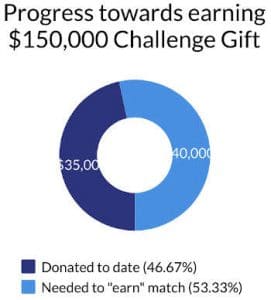
All proceeds from this event will be applied to the 2-for-1 matching challenge gift campaign to endow diversity initiatives at ASOR that ends on June 30th. You can make a donation today to take part in this unique event and help ASOR earn the $150,000 challenge gift. We have raised $35,000 of the $75,000 goal thus far, and so we have earned $70,000 in matching dollars. We need to raise $40,000 more before June 30th to earn the remaining $80,000 in matching dollars.

The suggested donation level for the webinarathon is $100 or more. Everyone who makes a contribution of any amount to Diversity Initiatives in May will receive access the recordings of the webinar event, “Making May Matter.” If you are unable to make a contribution at this time, but would still like view the recordings, please e-mail ASOR for a complimentary registration.


Sponsors were acknowledged during the event. Sponsorships are available at the following levels:

  • DEI Sponsor: $250 (includes 5 gift registrations to share)
  • DEI Patron: $500 (includes 10 gift registrations to share)
  • DEI Benefactor: $1,000 (includes 25 gift registrations to share)
  • DEI Champion: $2,500 (includes unlimited gifts registrations to share)
  • DEI Ambassador: $5,000 (includes unlimited gift registrations to share)

Each donor will receive a confirmation e-mail with the links to view the recordings on Dropbox. If you do not receive this e-mail, then we did not receive your donation online.  If you prefer to donate over the phone, please call 703-789-9230. Please e-mail membership@asor.org with any questions or issues with donating.

Speakers / Presenters

Eric H. Cline is Professor of Classics and Anthropology, Director of the Capitol Archaeological Institute, and former Chair of the Department of Classical and Near Eastern Languages and Civilizations at The George Washington University, in Washington DC. With degrees from Dartmouth, Yale, and the University of Pennsylvania, he is an active field archaeologist with more than 30 seasons of excavation and survey experience, including ten seasons at the site of Megiddo (biblical Armageddon) in Israel and eight seasons at Tel Kabri, also in Israel, where he is currently Co-Director. His 2014 book 1177 BC: The Year Civilization Collapsed was considered for a Pulitzer Prize. He is the author or editor of 20 books, which have been translated into sixteen languages, as well as nearly 100 articles, and several recorded lecture courses.


Kathlyn (Kara) Cooney is a professor of Egyptian Art and Architecture and Chair of the Department of Near Eastern Languages and Cultures at UCLA. Cooney’s research in coffin reuse, primarily focusing on the 21st Dynasty, is ongoing. Her book Recycling for Death will appear in the coming year with American University Press in Cairo. This research investigates the socioeconomic and political turmoil that has plagued the period, ultimately affecting funerary and burial practices in ancient Egypt. Her latest book, When Women Ruled the World: Six Queens of Egypt, was published in 2018 by National Geographic. Her next book, The Good Kings: Absolute Power in Ancient Egypt and the Modern World appears with National Geographic in 2021.


Jennie Ebeling is associate professor of archaeology at the University of Evansville and co-director (with Norma Franklin) of the Jezreel Expedition in Israel. A former Fulbright fellow, she has been awarded fellowships from the NEH, the Lady Davis Trust, and the W.F. Albright Institute of Archaeological Research in Jerusalem for research in Israel and Jordan. Ebeling served as an ASOR Trustee for nine years and Vice President (Membership) for three and received the Charles U. Harris Service Award in 2013. She currently edits ASOR’s Archaeological Report Series. Ebeling is the co-editor of four volumes and the author of Women’s Lives in Biblical Times (T&T Clark, Int’l, 2010).


Ahmad Emrage is ASOR’s representative for heritage activities in Libya (East), Dr. Emrage manages ASOR’s cultural heritage grants and activities in the eastern area of Libya. He also serves as a senior advisor for ASOR’s work throughout Libya and North Africa. Emrage holds the B.A. and M.A. degrees in Archaeology from University of Benghazi, and the Ph.D. degree from the School of Archaeology and Ancient History, University of Leicester. During the 2019–20 academic year, Emrage held a Fulbright Fellowship to teach courses on Libyan cultural heritage at Oberlin College (Ohio, USA).


Lawrence (Larry) T. Geraty, President Emeritus, Director of the Foundation Board and Associate Director of the Center for Near Eastern Studies at La Sierra University, has been engaged with Near Eastern archaeology and with ASOR and its affiliate schools for more than five decades. In this time, he has taken on leadership roles as ASOR President from 2002 to 2006 and by serving on the ASOR Board through 2016 and acting as an Honorary Trustee since then. Larry has also served as ACOR trustee (1976-2002), Secretary-Treasurer (1983) and vice-president (1993). The creation of the newly endowed ASOR Lawrence T. Geraty Community Archaeology Endowment will heighten awareness of cultural heritage by engaging and facilitating partnerships with local communities in heritage protection and community archaeology.


Felix Höflmayer studied Egyptology and Classical Archaeology at the University of Vienna and received his PhD in 2010. From 2009 to 2013, he was a researcher at the Orient Department of the German Archaeological Institute, in Amman (Hashemite Kingdom of Jordan) and Berlin. From 2013 to 2015, he was the Post-Doctoral Fellow at the Oriental Institute of the University of Chicago. In 2015, he returned to the Austrian Academy of Sciences in Vienna. Felix teaches at the Institute of Old Testament Studies and Biblical Archaeology, the Institute of Oriental Studies, and the Institute of Egyptology at the University of Vienna. Since 2017, he co-directs the Austrian excavations at Tel Lachish (Israel) together with Katharina Streit.


Katherine Jones is a statistician and data scientist, and is currently pursuing graduate studies in mathematics at The George Washington University. In her professional work, Kate focuses on quantitative economic analysis; she works on teams which study antitrust and competition effects, often using Big Data.


Thomas Kline is a partner at the law firm Cultural Heritage Partners in Washington, D.C. He is responsible for a number of groundbreaking cases, including setting precedent in the law governing recovery of antiquities and Nazi-looted art. Tom advises clients on a wide variety of art and cultural property matters, including ownership, theft, authenticity, breach of contract, and insurance. Since 1989 he has specialized in cultural heritage-related litigation, arbitration, alternative dispute resolution, and advice and counseling, representing governments, museums, churches, foundations, and families. Tom is an Adjunct Professorial Lecturer at The George Washington University, Museum Studies Program.


Carol Meyers received the A.B. with honors from Wellesley College and the M.A. and Ph.D. in Near Eastern and Judaic Studies from Brandeis University. She is currently the Mary Grace Wilson Professor Emerita of Religious Studies at Duke University. Meyers is the author of more than 450 articles, reports, reference-book entries, and reviews; and she has authored, co-authored, or edited twenty-two books. Her 2013 book, Rediscovering Eve: Ancient Israelite Women in Context, is a landmark study of women in ancient Israelite society. Meyers has worked on numerous digs since she was an undergraduate, and she has been a staff member and then co-director of several archaeological projects in Israel. She has been a frequent consultant for media productions relating to archaeology and the Bible, including A&E’s Mysteries of the Bible series, DreamWorks’s “Prince of Egypt,” NOVA’s “The Bible’s Buried Secrets,” and several National Geographic documentaries.


Megan A. Perry is Professor of Anthropology with East Carolina University. She holds degrees from the University of New Mexico (Ph.D.), Case Western Reserve University (M.A.), and Boston University (B.A.). Her primary research interests involve investigating human skeletal remains to assess ancient disease, diet, and mobility patterns, in addition to mortuary practices of ancient populations in 1st to 6th century A.D. Jordan. Professor Perry has been working on archaeological projects in Jordan for over 25 years, and she is on the Board of the American Center of Overseas Research (ACOR) in Amman, Jordan.


Debora Heard is a Ph.D. Candidate in Anthropology at the University of Chicago specializing in Nubian archaeology and Egyptian history and language. Her current research compares the inscriptions and iconography of Kushite temples dedicated to the gods Amun and Apedemak. For more than a decade, she has given public lectures on various aspects of ancient Nubian society, particularly the role of royal women in Kushite society. A member of several archaeological and ancient studies organizations, she is the organizer and a founding member of the newly-launched William Leo Hansberry Society, which is committed to providing African-descended people pathways to careers in ancient Nile Valley and Northeast African Studies.


William Raynolds is Co-director of the Garden Collection at the Egyptian Museum in Cairo (Egypt), a consultant for the World Monuments Fund (Haiti), the J. M. Kaplan Fund, the American Archaeological Mission in Libya, and Co-Director of ASOR Cultural Heritage Initiatives. Following his time at Yarmouk University (Jordan), where he was a Fulbright Fellow affiliated with the Department of Archaeology, Mr. Raynolds completed his MSc. in Historic Preservation from Columbia University, New York (2009).


Christopher Rollston (MA, Ph.D. Johns Hopkins University) is Professor of Northwest Semitic Languages and Literatures at George Washington University (Washington, D.C.), where he is Chair of the Department of Classical and Near Eastern Languages and Civilizations. His research focuses heavily on writing and literacy in the world of the Bible, ancient scribal education, ancient Israelite religion, modern forged inscriptions. He has lectured and published widely in the field. For six years, he co-edited (with Eric H. Cline) BASOR. Rollston’s volume entitled Forging History in the Ancient World of the Bible & the Modern World of Biblical Studies is forthcoming with Eerdmans.


Stuart Swiny: Born in Scotland, and educated in France and England, Professor Swiny completed his doctoral degree at the London University, Institute of Archaeology. He has conducted archaeological and anthropological research in Iran, Afghanistan, Cyprus, and has also excavated in France, Turkey (underwater), and Egypt. Swiny served as longtime Director of the Cyprus American Archaeological Research Institute (CAARI). In 1996, he was appointed professor in Classics and Anthropology at the University at Albany, and later served as director of the Institute of Cyrpriot Studies. Swiny, archaeologist whose work on Cyprus now spans six decades, is currently the Curator of the Sawin Museum in Dover, MA.

Discussants, Hosts, & Session Moderators

Susan Ackerman is the Preston H. Kelsey Professor of Religion, Professor of Women’s, Gender, and Sexuality Studies, and the former Chair of both the Department of Religion and the Program in Women’s, Gender, and Sexuality Studies at Dartmouth College. She also earned her A.B. degree at Dartmouth, and earned a Masters of Theological Studies at Harvard Divinity School and a Ph.D. in Near Eastern Languages and Civilizations from the Harvard Graduate School of Arts and Sciences. Her research specialties include the religion of ancient Israel, women and gender in ancient Israel, myth and ritual studies in ancient Israel. She recently completed a draft of a new book, on women and the religion of ancient Israel, and is currently at work on another book on Israelite women’s life-cycle rituals.


Theodore (Teddy) Burgh is Professor and Chair of the Department of Philosophy and Religion at the University of North Carolina Wilmington. His research specialties include the archaeology of ancient Israel and the Near East, the Hebrew Bible, archaeomusicology (the study of ancient music culture), the reconstruction of Syro-Palestinian and Near Eastern music culture and cataloging musical artifacts, utilization analysis of Syro-Palestinian sacred and secular space, and ethnomusicology. Burgh is himself an accomplished musician (he plays flute, clarinet, and saxophone), and in addition to his university career, he enjoys composing and performing. He is a member of the FROG Project and Lee Venters and Vermillion Sands (Wilmington, NC). Burgh has been on the ASOR Board of Trustees since 2015, and he is currently Chair of ASOR’s Membership and Outreach Committee.


Erin Darby is an associate professor of Religious Studies at the University of Tennessee. She is an expert in the Hebrew Bible, archaeology, and ancient Near Eastern history and literature. At the University of Tennessee, she is one of the founding members of the Partnership for the Academic Study of Early Judaism, the Knoxville ArabFest cultural festival, the UT Archaeology Day outreach event, and the Tennessee Initiative for Middle East Studies. Darby is also the co-director of the ASOR-affiliated ‘Ayn Gharandal Archaeological Project in southern Jordan, where she is excavating a Nabataean-Islamic period site and leading the UT Dig Jordan study abroad program.


Tiffany Earley-Spadoni is an Assistant Professor of History at the University of Central Florida. She directs the ASOR-affiliated Vayots Dzor Fortress Landscapes Project in Armenia, and is the Chair of ASOR’s Early Career Scholars Committee. She is a field archaeologist and historian of the ancient Near East. She has authored numerous articles in esteemed scholarly publications such as the Journal of Archaeological Science and Advances in Archaeological Practice. Her monograph project, Landscapes of Warfare: Urartu in Ancient Near Eastern Context is under advance contract with the University Press of Colorado. She received her PhD from the Johns Hopkins University.


Timothy Harrison is Professor of Near Eastern Archaeology in the Department of Near and Middle Eastern Civilizations at the University of Toronto. Dr. Harrison earned the Ph.D. in Near Eastern Archaeology from the University of Chicago. He has directed excavations at the Bronze and Iron Age site of Tell Madaba, Jordan, and currently is directing the Tayinat Archaeological Project on the Plain of Antioch in southeastern Turkey. In 2012, he launched the CRANE Project (Computational Research on the Ancient Near East), an international consortium of projects conducting research in the Orontes Watershed (www.crane.utoronto.ca). He served as President of ASOR from 2008–2013.


Ann-Marie Knoblauch is Associate Professor of Art History and Associate Director of the School of Visual Arts at Virginia Tech. Her research interests bridge east and west, especially Cyprus and Greece during the archaic and classical periods. She is especially concerned with articulating the voices of underrepresented groups in the ancient Mediterranean world — non-Athenian and non-male — through the material culture left behind. This approach to the ancient world manifests itself in two main research endeavors, investigations into the visual iconography of Athenian women and active fieldwork on the island of Cyprus. Knoblauch has been involved in the excavations of Idalion, Cyprus, since 1998, and on Cyprus, she has also excavated at Yeronisos Island. She has also excavated in Israel and Greece.


Sydney A. Pickens is a dancer, archaeologist, and educator who is passionate about making archaeology accessible and exciting through embodied learning. She is an Archaeology Educator for Archaeology in the Community, and specializes in K-12 archaeology educational programming.


Tine Rassalle is a PhD candidate in the Religious Studies department at the University of North Carolina at Chapel Hill. She has an MA in Archaeology of the ancient Near East from Gent University (Belgium) and another BA in Hebrew and Aramaic Languages and Cultures from Leiden University (the Netherlands). Her main research focuses on the material culture of ancient Judaism and early Christianity in Palestine. She is currently finishing up her dissertation project: a digital database of coin deposits found in ancient synagogues from Late Antique Palestine. Tine is the field supervisor of the Horvat Kur excavations in the Galilee, an executive staff member of SASA (Save Ancient Studies Alliance), and a member of the ASOR Early Career Scholars Committee. 


Cynthia Shafer-Elliott (Ph.D., The University of Sheffield) is Associate Dean of the School of Theology and Leadership and Associate Professor of Hebrew Bible & Archaeology at William Jessup University. Dr. Shafer-Elliott specializes in the cultural and social contexts of ancient Israel and Judah, particularly within domestic contexts. Her publications include: Food in Ancient Judah: Domestic Cooking in the Time of the Hebrew Bible (2013) and editor of The 5 Minute Archaeologist in the Southern Levant (2016), along with numerous chapters, encyclopedia articles, articles, essays, and papers presented on food, households, and gender. She is currently co-editing the T & T Clark Handbook of Food in the Hebrew Bible and Ancient Israel. An experienced field archaeologist, she is part of the archaeological excavations at Tel Halif and Tel Abel Beth Maacah.


Michael K. Toumazou is a native of Famagusta, Cyprus. He attended Franklin & Marshall College (BA, Physics & Classics, 1977), Loyola University of Chicago (MA, Classics, 1980) and Bryn Mawr College (MA, & Ph.D., Classical & Near Eastern Archaeology, 1983, 1987).  He has taught at Davidson College (Davidson, NC) since 1987 where he served as Chair of the Department of Classics (1995-2001), directed Davidson’s Classics Study Abroad Program (2003, 2007, 2012) and received Davidson’s most prestigious teaching award in 2003. In 1990 he founded, and since then directed, the Athienou Archaeological Project in Athienou, Cyprus, in conjunction with an archaeological field school, supported by multiple NSF-REU-Site Awards (1995-2015). As an NEH Senior Scholar at CAARI (spring 1995) he investigated looting practices on Cyprus. Toumazou has translated into English two books on Cypriot topics, has lectured widely and published many reports and articles on his field work on the island.

ASOR is grateful for you support. Each donor will receive an automated tax receipt and a separate confirmation e-mail with links to view the recordings of the sessions on Dropbox. If you do not receive these e-mails, please check you Spam folder and then contact ASOR. If did not receive the e-mails, that probably means that we did not receive you online donation. If you prefer to donate over the phone, please call +1-703-789-9230. Please e-mail membership@asor.org with any questions or issues with donating, or to request a complimentary regsitration.

Table of Contents for BASOR 385 (May 2021)

Table of Contents for Bulletin of ASOR 385 (May 2021)

You can receive BASOR (and other ASOR publications) through an ASOR Membership. Please e-mail the Membership office if you have any questions.

Pp. 1–32: “Late Prehistory of the Lower Galilee: Multi-Faceted Investigations of Wadi el-Ashert,” by Yorke M. Rowan, Morag M. Kersel, Austin Chad Hill,  and Thomas M. Urban

In the southern Levant, fundamental changes in economic organization, mortuary practices, and settlement patterns took place during the 5th to early 4th millennium b.c.e., or the Chalcolithic period (ca. 4500–3700/3600 b.c.e.). Our best evidence derives from sites in the Negev, and to a lesser degree, the Jordan Valley and Golan Heights, and the mortuary sites along the coast. The goal of the Galilee Prehistory Project is to examine this period based on information from a different environmental region, by undertaking survey and excavation in the Galilee, a region with virtually no radiocarbon dates or plans derived from Chalcolithic sites. The multi-faceted investigation of the Wadi el-Ashert included unpiloted aerial vehicle fly-overs during different seasons, geophysical and pedestrian survey, and methodical sub-surface test sampling. The comprehensive approach to this prehistoric landscape resulted in a more nuanced understanding of the site.

ASOR Members with online access: navigate to the token link email sent to you before attempting to read this article. Once you have activated your member token, click here to access the above article on The University of Chicago Press Journals’ website.

Pp. 33–51: “Middle Bronze Age Zincirli: The Date of “Hilani I” and the End of Middle Bronze II,” by Virginia R. Herrmann and David Schloen

Zincirli Höyük in southern Turkey is best known as the Iron Age city of Samʾal, but recent excavations by the Chicago-Tübingen Expedition have discovered important remains of the Middle Bronze Age II, destroyed in a conflagration. This article presents two major interim results for Zincirli’s settlement history that also have implications for the architectural history and chronology of the Northern Levant. In addition to a wealth of material that gives new insight into local administration and production and interregional connections between Syria and Anatolia, the excavations have revealed that the monumental building Hilani I, though long assumed to be the earliest palace of the Iron Age, dates instead to the Middle Bronze Age. Contemporary parallels suggest that it was a broadroom temple rather than a bīt ḫilāni palace. Furthermore, radiocarbon analysis and ceramic evidence date the destruction to the mid- to late 17th century b.c.e. and thus suggest that the agent of the destruction was Ḫattušili I in his campaign against Zalwar (Zalpa), nearby Tilmen Höyük. Future research on the Middle Bronze Age at Zincirli promises to illuminate its connection to a little-known Syro-Anatolian exchange network, probably centered on Aleppo, which the rising Hittite kingdom may have hoped to disrupt or co-opt.

ASOR Members with online access: navigate to the token link email sent to you before attempting to read this article. Once you have activated your member token, click here to access the above article on The University of Chicago Press Journals’ website.

Pp. 53–86: “Middle Bronze Age Zincirli: An Interim Report on Architecture, Small Finds, and Ceramics from a Monumental Complex of the 17th Century b.c.e.,” by Kathryn R. Morgan and Sebastiano Soldi

Recent excavations at the site of Zincirli Höyük in southeastern Turkey have revealed significant remains of the Middle Bronze Age II period, with evidence for local food (and probably wine) production and storage, textile production, and administrative activities. Certain cylinder seal and vessel types further indicate that the site was well-integrated into a contemporary exchange network linking the Euphrates, North Syria, and central Anatolia. The newly discovered complex includes the massive Hilani I, heretofore attributed to the Iron Age but now believed to be a Middle Bronze Age temple rather than a bīt ḫilāni palace. This preliminary report presents architecture, ceramics, and small finds associated with this complex, DD, which comprises, in addition to Hilani I, two well-provisioned buildings (DD/I and DD/II), a street, and exterior work spaces, and was destroyed in a conflagration in the mid-17th century b.c.e. Ongoing research by the Chicago-Tübingen Expedition seeks to illuminate the function of Complex DD and Hilani I, as well as the regional significance of the site, including its political relationship to nearby Tilmen Höyük/Zalwar, destroyed in the campaigns of Ḫattušili I, and its role in the trade of luxury commodities such as wine and textiles.

ASOR Members with online access: navigate to the token link email sent to you before attempting to read this article. Once you have activated your member token, click here to access the above article on The University of Chicago Press Journals’ website.

Pp. 87–97: “An Anatolian-Style Lead Figurine from the Assyrian Colony Period Found in the Middle Bronze Age Palace of Tel Kabri,” by Assaf Yasur-Landau, Eric H. Cline, Sturt W. Manning, and Gilberto Artioli

Excavations during the summer of 2017 in the earlier phases of the courtyard of the palace at Tel Kabri turned up pieces of figurines as well as horn cores within a context of Phase 4 or 5 (late 19th to early 18th centuries b.c.e.). One figurine, portraying two deities, belongs to a type of Anatolian lead figurine known from the Assyrian Colony period. Initial results from Lead Isotope Analysis (LIA) suggest that an Anatolian provenance is indeed a plausible option. This is the first find of its type to be found in the southern Levant.


ASOR Members with online access: navigate to the token link email sent to you before attempting to read this article. Once you have activated your member token, click here to access the above article on The University of Chicago Press Journals’ website.

Pp. 99–117: “Phoenician Cedar Oil from Amphoriskoi at Tel Kedesh: Implications Concerning Its Production, Use, and Export during the Hellenistic Age,” by Andrew J. Koh, Andrea M. Berlin, and Sharon C. Herbert

Archaeologists and historians have routinely attributed “branded” goods to particular regions and cultural groups, often without rigorous analysis. Phoenician cedar oil is perhaps one of the best-known examples from antiquity. Hellenistic Tel Kedesh in the Upper Galilee region of the Levant is particularly relevant for these discussions by virtue of its strategic role as a border settlement in Phoenicia during one of the most dynamic periods in ancient history. As a concise contribution to these discussions, we present here an interdisciplinary analysis of amphoriskoi found with ca. 2,000 impressed sealings from the archive complex of the Persian-Hellenistic Administrative Building. While the building was constructed under the Achaemenids and occupied in both the Ptolemaic and Seleucid eras, the archive was in use only under the Seleucids in the first half of the of the 2nd century b.c.e. Blending organic residue analysis with archaeological and textual data has allowed us to identify with certainty one of the value-added goods most closely attached to ancient Phoenicia, true cedar oil from Cedrus libani. This discovery not only empirically verifies this well-known association for the first time, but also provides a rich context in which to test our assumptions about culturally-branded goods, the role they played in participant societies, and the mechanisms and systems in place that facilitated their production, use, and export.

ASOR Members with online access: navigate to the token link email sent to you before attempting to read this article. Once you have activated your member token, click here to access the above article on The University of Chicago Press Journals’ website.

Pp. 119–130: “A Middle Bronze II Cylinder Seal of North Syrian Style from Tel Shimron (Jezreel Valley),” by Elisa Roßberger

The first excavation season at Tel Shimron brought to light a well-preserved hematite cylinder seal of outstanding artistic quality dating to the Middle Bronze IIA–B. The depicted creatures belong to the Egyptian and Syro-Levantine art spheres, but their rendering and the integration of additional pictorial elements conforms more to the latter. Stylistically, the seal relates to the Northern Levantine coastal region, and in particular to a group characterized by its deep and fluid linear carvings and plastic modeling of animal bodies in motion. Together with an example from Tell el-ʿAjjul, its discovery in the Jezreel Plain marks the southern-most secured findspot for a seal of this style, and offers a welcome opportunity for a renewed discussion on processes of artistic interaction and hybridization in the Middle Bronze Age Levant.

ASOR Members with online access: navigate to the token link email sent to you before attempting to read this article. Once you have activated your member token, click here to access the above article on The University of Chicago Press Journals’ website.

Pp. 131–152: “The Space Syntax of Canaanite Cultic Spaces: A Unique Category of Spatial Configuration within the Bronze Age Southern Levant,” by Matthew Susnow

The existence of temples within urban, rural, and extramural settings in the Middle and Late Bronze Age southern Levant is well documented. However, defining what qualifies these spaces as “cultic” is significantly less clear. Accordingly, in this paper I utilize access analysis to define sacred space as a unique category of spatial configuration within the region, one that contrasts with other types of public and domestic spaces. As such, the trajectory and evolution of Canaanite temples and cultic architecture diverge in a number of ways from other types of spaces. I demonstrate this visually by supplying justified gamma maps for cultic and non-cultic architecture, underscoring the contrasting nature between the access to, movement through, and control of Canaanite temples and that of their domestic and palatial counterparts. The implications of this are remarkable. What emerges from this study is that Canaanite temples were unique not only in terms of the role they played within their surrounding landscapes and region, but also in how they were differentiated from temples and temple institutions of the surrounding ancient Near East, with relation to the rise of urbanization, social complexity, and elite control of religious institutions.

ASOR Members with online access: navigate to the token link email sent to you before attempting to read this article. Once you have activated your member token, click here to access the above article on The University of Chicago Press Journals’ website.

Pp. 153–170: “Was a “Gate Shrine” Built at the Level III Inner City Gate of Lachish? A Response to Ganor and Kreimerman,” by David Ussishkin

The city gate of Level III at biblical Lachish dates to the Iron Age IIB period and was destroyed in the Assyrian conquest in 701 b.c.e. In 2015–2016, Saar Ganor and Igor Kreimerman excavated the southern wing of the inner gate. In a recent issue of this journal, Ganor and Kreimerman (2019) suggested that the innermost, southern chamber of the gatehouse was a “gate shrine,” that the “gate shrine” was desecrated during the reform of Hezekiah, that it was turned into a symbolic toilet, and then sealed. The present paper has four aims. First, it presents an integral picture of the inner gatehouse based on all the excavations which took place there. Second, it argues that there was no gate shrine in the gatehouse. Third, it argues that the assumed gate shrine was not desecrated during the time of Hezekiah’s reform. Fourth, it shows that the innermost, southern chamber contained an installation of secular nature that parallels that in the innermost northern side of the gatehouse.

ASOR Members with online access: navigate to the token link email sent to you before attempting to read this article. Once you have activated your member token, click here to access the above article on The University of Chicago Press Journals’ website.

Pp. 171–200: “The Sidon’s/Ṣaydā Northern Hinterland during the Early Byzantine–Early Islamic Transition,” by Mariusz Gwiazda, Joanna Piątkowska-Małecka, Urszula Wicenciak, Piotr Makowski, and Tomasz Barański

The paper focuses on the archaeological evidence for settlement, cultural, and economic change in the Sidon’s (Ṣaydā) northern hinterland in the period of transition from early Byzantine to early Islamic times (7th–8th century c.e.). The changes were reconstructed based on the outcome of archaeological research at the sites of Porphyreon (modern Jiyeh) and Chhîm in the Sidon’s/Ṣaydā economic hinterland. The evidence confirms a continuity, although in reduced form, of occupation after the Arab conquest and a complete abandonment in the second half of the 7th or the beginning of the 8th century. The situation here bears similarity to other parts of Phoenicia, struck at the time with a settlement crisis that resulted in both a reduction of the population and a decline in the importance of cities, among others. These events were not sudden; they resulted from a process lasting several decades and impacting mainly the coastal area.

ASOR Members with online access: navigate to the token link email sent to you before attempting to read this article. Once you have activated your member token, click here to access the above article on The University of Chicago Press Journals’ website.

Pp. 201–218: “Ancient Pot-Bellows: A Review Forty Years On,” by Christopher John Davey

After a brief introduction to pot-bellows, their corpus is reviewed, identifying objects and evidence that have emerged since the first paper about them was published by the author (Davey ). The propositions made in that paper are assessed and most are found to have stood the test of time. If anything, the new evidence has added complexity to this field of study, especially where the origin of the technology is concerned.

ASOR Members with online access: navigate to the token link email sent to you before attempting to read this article. Once you have activated your member token, click here to access the above article on The University of Chicago Press Journals’ website.

Pp. 219–243: “Intermediate Bronze Age Crescent-Headed Figures in the Negev Highlands,” by Lior Schwimer and Yuval Yekutieli

This paper presents the discovery of a unique and widespread type of petroglyphs in the Western Negev Highlands, depicting human figures with crescent-shaped headgear, knee-high garments, and crescent pommel daggers. It proposes a methodology for dating this style and its historical context by: (1) analysis of presence or absence of specific animal species in the engraved scenes; (2) examination of the occurrence of particular attributes that appear in the scenes within dated contexts across the ancient Near East; and (3) study of the fit between the incised panels’ locations and the distribution of dated archaeological sites in the region and the routes connecting them. Based on this composite analysis, it is proposed that these petroglyphs are associated with groups participating in the copper trade that operated in the Sinai-Negev-Edom region during the Intermediate Bronze Age (ca. 2500–2000 b.c.e.).

ASOR Members with online access: navigate to the token link email sent to you before attempting to read this article. Once you have activated your member token, click here to access the above article on The University of Chicago Press Journals’ website.

Shepard Urgent Action Grants Anniversary

SHEPARD URGENT ACTION GRANTS ANNIVERSARY

The support of the Outer Arch of the Tabira Gate before the Stabilization Project began. (Photo: Akam Omer Ahmed, A UIS CACHE)

Established in 2020 with annual contributions from a generous donor, the Shepard Urgent Action Grants program was created to support emergency and rapid response activities on archaeological sites in the greater Mediterranean region. This April marks the first year of the Shepard Grant Program. In the inaugural year, Shepard Grants provided a total of $15,000 to projects with urgent need. Read more about the first two projects that received Shepard Grants below.

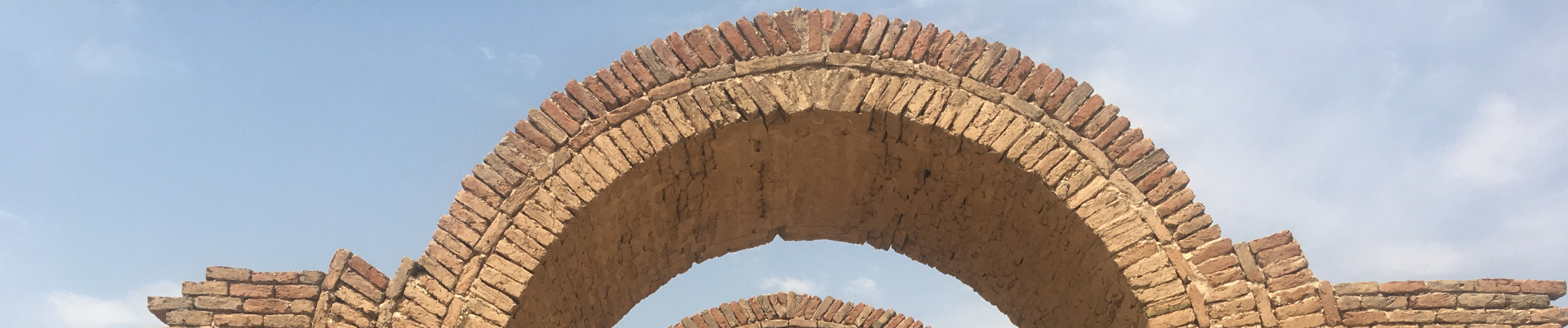
Tobin Hartnell (American University of Iraq, Sulaimani) “The Tabira Gate Stabilization Project at Ashur”. The Tabira Gate serves as one of the iconic features of the ancient site of Ashur, which was founded in the mid-third millennium BCE. Destroyed by ISIL in 2015, the Gate was in danger of collapse and in urgent need of stabilization. The 2020 Shepard Grant enabled construction of mud-bricks to stabilize the structure before the rainy season. The Grant also provided funds for the necessary protective health equipment to support the team during the COVID-19 pandemic and funding for a series of interviews with the local community on heritage. Read the full report here.

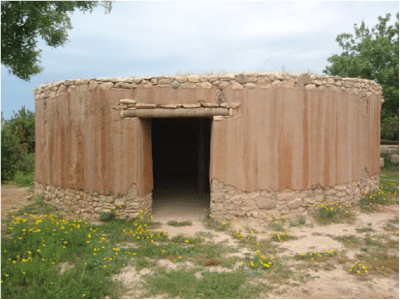
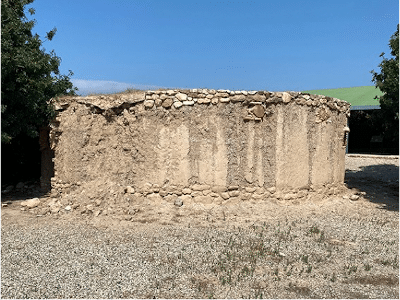
Lindy Crewe (Cyprus American Archaeological Research Institute) “Stabilisation and refurbishment of a Chalcolithic roundhouse visitor centre at the archaeological site of Kissonerga-Mosphilia, Paphos District, Cyprus”. In 2010, a reconstruction of the famous “Pithos House” was created as part of the visitor centre at Kissonerga-Mosphilia in order to integrate archaeology into an accessible narrative and encourage alternative tourism in the area. A 3D rendering of the roundhouse can be found here. Since then, heavy rains have severely damaged the roundhouse reconstruction and repairs are necessary to make the structure ready for visitors to the site. Work on the roundhouse is ongoing and a full report on the project will be available this summer.

The Kissonerga-Mosphilia roundhouse replica in 2011. (Photo: L. Crewe)
The extent of erosion caused by heavy rains on the exterior walls of the Pithos House replica. (Photo: L. Crewe, June 2020)

Click here for more information on applying for a Shepard Urgent Action Grant. 

ASOR plans to award an additional $15,000 in Shepard Urgent Action Grants in 2021. Award amounts may range from $2,500 to $10,000, with most awards ranging from $2,500 to $5,000. Applicants who request more than $5,000 will not be considered for smaller grants if their proposal is not successful; at present the program strongly encourages applications under $5,000 so that more urgent projects can be support. The application deadline is rolling, and review of applications is ongoing. Because these grants are intended for emergency (or truly urgent) activities, ASOR will strive to provide a response within four to six weeks from submission of the application. Funds are normally available within 5-10 business days after all paperwork has been completed by successful applicants, and transfer of funds is contingent on complying with U.S. and international regulations and laws. Questions about Shepard Urgent Action Grants should be directed to Marta Ostovich.

Gifts Matched 2-for-1: Diversity Campaign Update May 4

Building a Foundation for a More Diverse ASOR

Update—May 4, 2021

ASOR is excited to announce a 2-for-1 challenge gift of $150,000 that will serve as the cornerstone of a targeted campaign (scheduled completion, June 2021) to raise $250,000 to promote diversity, equity, and inclusion in all of our endeavors.

ASOR needs to raise $75,000 to earn the $150,000 challenge gift. As of May 4, 2021, we have raised $35,100. We encourage you to give and join us on May 21-23 for our “Making May Matter—Webinarathon to Endow Diversity at ASOR” event. Each donation to Diversity Initiatives will include a registration to the three days of lectures and discussions on a wide range of topics.

This campaign will fund short-term and long-term initiatives that will advance the strategic planning started in 2020 by ASOR’s newly formed Diversity, Equity, and Inclusion Task Force. The purpose of this initiative is to permanently increase participation in ASOR by students and scholars who are African American/Black and Indigenous People of Color (BIPOC).

This ambitious, expedited campaign is made possible by a 2:1 leadership pledge of $150,000 by Trustee Carolyn Midkiff Strange. We can reach our goal by raising $75,000. Every dollar contributed (up to $75,000) will be matched with two dollars. A contribution of $100, will be matched with $200; a gift of $5,000, will be matched with $10,000; and so forth.
In the short-term, ASOR will use $50,000 to increase participation in ASOR by BIPOC students at the secondary, undergraduate, and graduate levels. $25,000 is in hand through a combination of prior gifts and current distributions. Part of these short-term funds will underwrite Summer Stipends and Annual Meeting travel grants for BIPOC students. The rest of the short-term funds will buoy an already-launched partnership with Archaeology in the Community. AITC is a successful non-profit centered in Washington D.C. that fosters student and community involvement in archaeology, with an emphasis on under-served groups. Together with AITC, and building on their experience, we are developing educational resources to promote engagement in archaeology by secondary level students.

ASOR will use the remaining $200,000 from this campaign to establish a permanent endowment that will generate $10,000 per year to support research scholarships, internships, and travel fellowships dedicated to BIPOC students. These fellowships will be a foundation for future efforts and will be a tangible sign of ASOR’s commitment to long-term change.

Extending social equity and equal opportunity throughout all sectors of our world is one of the foremost challenges facing us today. You can join ASOR in making this change happen. Please consider a gift of any amount to help us earn this extraordinary $150,000 challenge gift.

OTHER WAYS TO DONATE

Donate By PhoneDonate By MailMake A Pledge
(Donate Later)
Call ASOR:
(703) 789-9229
ASOR
209 Commerce Street
Alexandria, VA 22314
E-mail ASOR

Black Scholars Matter Initiative

Accepting Applications for Black Scholars Matter Initiative

Applications for the Black Scholars Matter Initiative are now open!

Humans Against Poor Scholarship, in partnership with ASOR, is offering grants of $1,000 to Black undergraduate students in their junior or senior year of study, in order to help cover the costs of attending the ASOR annual meeting (Chicago, November 17th-20th 2021). Two grants of $1,000 are available (one provided from H.A.P.S. funds, and one matched by ASOR). In addition, thanks to a generous partnership with ASOR, one year’s conference registration, and a two-year student membership to ASOR will also be awarded to the two successful applicants.

To help students navigate what can be a deeply daunting experience, successful applicants will also be paired with Ph.D. students or early career scholars who will act as a mentor during the conference. This grant not only provides financial aid for conference attendance, but gives Black students the opportunity to start forming professional networks that are so crucial for developing an academic career.
Applications can be submitted via that H.A.P.S. website, and will be accepted until May 14th 2021: https://www.hapsfund.com/applybsm

Comments and questions can be directed to hapsfund@gmail.com, and donations are being accepted at www.hapsfund.com/donate. For more information, please see the BSM webpage: www.hapsfund.com/blackstudentsmatter.

Help ASOR support BIPOC scholarship by considering a donation to our Diversity Initiatives.

Please choose “Diversity Initiatives” from the drop-down menu in the
online donation module to designate your gift to this 2-for-1 Challenge Campaign.

Thank you to all our generous members and donors!


OTHER WAYS TO DONATE

Donate By PhoneDonate By MailMake A Pledge
(Donate Later)
Call ASOR:
(703) 789-9229
ASOR
209 Commerce Street
Alexandria, VA 22314
E-mail ASOR

March Fellowship Madness 2021 Success

March Fellowship Madness Success—$14,000 Raised

Update April 5: $14,000 raised towards diversity challenge campaign

Progress towards $20,000 March Goal
 
Update April 5, 2021

Thanks to 63 ASOR members, March Fellowship Madness 2021 was a success. We didn’t reach our goal of $20,000, but we made tremendous progress ($14,000) towards earning the $150,000 challenge gift to endow BIPOC fellowships.

Since 2007, ASOR has awarded over 830 fellowships, grants, dig scholarships, and travel awards totaling more than $900,000. During the past month, we focused on raising $20,000 for BIPOC scholarships and our diversity challenge campaign. Thanks to an extraordinary challenge gift, every dollar of the $14,000 contributed during March will be matched with two dollars. We thus raised a total of $42,000 in March towards endowing BIPOC fellowships in perpetuity.

The generous 2-for-1 challenge gift by ASOR Trustee Carolyn Midkiff Strange means that a contribution of $25 will be matched with $50; a gift of $100 will be matched with $200; a gift of $1,000 will be matched with $2,000; and so forth. The $14,000 contributed by ASOR members during March Fellowship Madness goal moved ASOR much closer towards raising the $75,000 that is needed to fully “earn” this transformative $150,000 challenge gift. Thank you to all 63 people who contributed! If you have not yet contributed, or if you are in a position to make another gift, there is still time. We have until June 30, 2021 to raise the remaining $40,515 to earn the entire $150,000 challenge gift.
In addition to supporting BIPOC stipends and scholarships in 2021, ASOR will use these gifts to endow research scholarships, internships, and travel fellowships dedicated to BIPOC students and early career scholars. These fellowships and grants will be a foundation for future efforts, and will serve as a tangible sign of ASOR’s commitment to long-term change.

Extending social equity and equal opportunity throughout all sectors of our world is one of the foremost imperatives facing us today. You can join ASOR in making a lasting difference. Consider a gift of any amount to help us earn this extraordinary challenge gift.

Please choose “Diversity Initiatives” from the drop-down menu in the
online donation module to designate your gift to this 2-for-1 Challenge Campaign.

Thank you to all our generous members and donors!


OTHER WAYS TO DONATE

Donate By PhoneDonate By MailMake A Pledge
(Donate Later)
Call ASOR:
(703) 789-9229
ASOR
209 Commerce Street
Alexandria, VA 22314
E-mail ASOR

مبادرات التراث الثقافي في أفريقيا اليوم

[vc_row fullwidth=”true” attached=”true” css=”.vc_custom_1496247803139{padding-top: 0px !important;padding-right: 0px !important;padding-bottom: 0px !important;padding-left: 0px !important;}”][vc_column][vc_single_image image=”92761″ img_size=”full” alignment=”center”][/vc_column][/vc_row][vc_row fullwidth=”true” css=”.vc_custom_1620063527766{padding-top: 0px !important;padding-right: 0px !important;padding-bottom: 0px !important;padding-left: 0px !important;}”][vc_column width=”1/12″ css=”.vc_custom_1496683820796{margin-right: 10px !important;}” offset=”vc_hidden-md vc_hidden-sm vc_hidden-xs”][vc_column_text]

 SHARE

[/vc_column_text][mk_image src=”http://www.asortest.org/wp-content/uploads/2017/01/social-fb-icon4.jpg” image_width=”42″ image_height=”42″ hover=”false” custom_url=”https://www.facebook.com/ASOResearch/” margin_bottom=”0″][mk_image src=”http://www.asortest.org/wp-content/uploads/2017/01/social-tw-icon4.jpg” image_width=”42″ image_height=”42″ hover=”false” custom_url=”https://twitter.com/ASOResearch?ref_src=twsrc%5Egoogle%7Ctwcamp%5Eserp%7Ctwgr%5Eauthor” margin_bottom=”0″][mk_image src=”http://www.asortest.org/wp-content/uploads/2017/01/social-in-icon4.jpg” image_width=”42″ image_height=”42″ hover=”false” custom_url=”https://www.linkedin.com/company/american-schools-of-oriental-research” margin_bottom=”0″][mk_image src=”http://www.asortest.org/wp-content/uploads/2017/01/social-ml-icon_7.jpg” image_width=”42″ image_height=”42″ hover=”false” custom_url=”mailto:info@asor.org” margin_bottom=”0″][mk_image src=”http://www.asortest.org/wp-content/uploads/2017/01/blog-icon3.jpg” image_width=”42″ image_height=”42″ hover=”false” custom_url=”http://asor.org/blog” margin_bottom=”0″][/vc_column][vc_column border_color=”rgba(255,255,255,0.01)” width=”1/6″ css=”.vc_custom_1496683923840{margin-right: 20px !important;border-left-width: 2px !important;padding-right: 20px !important;padding-left: 20px !important;border-left-color: #99422f !important;}”][mk_divider divider_color=”rgba(255,255,255,0.01)” thickness=”1″ margin_top=”3″ margin_bottom=”3″][vc_widget_sidebar sidebar_id=”ca-sidebar-39801″][/vc_column][vc_column border_color=”rgba(170,170,170,0.01)” width=”1/2″ css=”.vc_custom_1487276122024{margin-right: 10px !important;margin-bottom: 30px !important;border-right-width: 2px !important;border-bottom-width: 2px !important;padding-top: 30px !important;padding-right: 30px !important;padding-left: 20px !important;background-color: #ffffff !important;border-right-color: rgba(227,228,228,0.75) !important;border-bottom-color: rgba(227,228,228,0.75) !important;}”][vc_column_text responsive_align=”left”]

مبادرات التراث الثقافي في أفريقيا اليوم

[/vc_column_text][vc_row_inner][vc_column_inner width=”1/2″ css=”.vc_custom_1711131898290{padding-right: 10px !important;}”][vc_wp_text]

View Page in English

[/vc_wp_text][/vc_column_inner][vc_column_inner width=”1/2″][vc_wp_text]

Voir cette page en français

[/vc_wp_text][/vc_column_inner][/vc_row_inner][mk_divider][vc_wp_text]

جدول البرنامج

انقر على روابط الجلسة أدناه لعرض الجدول الزمني لكل يوم

[/vc_wp_text][vc_row_inner][vc_column_inner width=”1/3″ css=”.vc_custom_1711469918695{padding-right: 10px !important;}”][vc_wp_text]

الخميس 11 نيسان/أبريل

ليبيا

[/vc_wp_text][/vc_column_inner][vc_column_inner width=”1/3″ css=”.vc_custom_1711469927415{padding-right: 10px !important;}”][vc_wp_text]

الجمعة 12 نيسان/أبريل

شمال افريقيا

[/vc_wp_text][/vc_column_inner][vc_column_inner width=”1/3″][vc_wp_text]

السبت 13 نيسان/أبريل

الساحل

[/vc_wp_text][/vc_column_inner][/vc_row_inner][vc_single_image image=”95724″ img_size=”full” alignment=”center” onclick=”custom_link”][mk_padding_divider size=”20″][vc_wp_text]

تعلن ASOR CHI بفخر عن مبادرات التراث الثقافي في أفريقيا اليوم، وهي ندوة مجانية مدتها ثلاثة أيام تسلط الضوء على عمل المتخصصين في التراث المحلي والأكاديميين ومنظمات المجتمع المدني لحماية التراث الثقافي والحفاظ عليه وتعزيزه في شمال أفريقيا ومنطقة الساحل. ترحب بكم ASOR لحضور الندوة عبر تطبيق ZOOM في الفترة الممتدة من 11 إلى 13 أبريل/نيسان، والتي ستتضمن نشاطات التراث الثقافي في ليبيا (11 أبريل/نيسان)، والمغرب العربي (12 أبريل/نيسان)، ومنطقة الساحل (13 أبريل/نيسان).ستستمر كل جلسة من الساعة 11:00 إلى الساعة 13:00 بتوقيت شرق الولايات المتحدة.

  • لا يشترط التسجيل لحضور هذا الحدث. يرجى العودة إلى صفحة الويب هذه في كل يوم من أيام الندوة للوصول إلى رابط Zoom.
  • سيتم توفير ترجمة فورية باللغات العربية والإنجليزية والفرنسية.

[/vc_wp_text][mk_padding_divider size=”20″][mk_divider margin_bottom=”30″][vc_wp_text]

حماية التراث الثقافي الليبي

الخميس 11 نيسان/أبريل 2024

١١-١٢ بتوقيت شرق الولايات المتحدة | العروض التقديمية (10 دقائق لكل منها)

١٢-١ بتوقيت شرق الولايات المتحدة | المناقشات الخاضعة للإشراف

[/vc_wp_text][mk_button style=”outline” corner_style=”rounded” outline_skin=”#2f2f80″ outline_hover_skin=”#ffffff” url=”https://asor-org.zoom.us/j/85986119884″ target=”_blank” align=”center”]انضم إلى الندوة على زووم[/mk_button][mk_divider][vc_wp_text]

رؤساء الجلسة

عايدة م. الجروشي

الجمعية الأمريكية للأبحاث الخارجية ASOR

احمد إمراج

الجمعية الأمريكية للأبحاث الخارجية ASOR

[/vc_wp_text][mk_divider divider_width=”one_half” thickness=”1″][vc_wp_text]

جيف امبرلينج

جامعة ميشيغان، الولايات المتحدة الأمريكية

التراث الثقافي في الأوقات المضطربة: المشاركة التعاونية في الكرو وجبل البركل، السودان

[/vc_wp_text][mk_divider divider_width=”one_third” thickness=”1″][vc_wp_text]

مفتاح أحمد الحداد

جامعة الزيتونة ودائرة الآثار، ليبيا

نهج عملي لحماية مواقع التراث الثقافي من النشاط البشري في ليبيا: وادي ماجر كمثال لدراسة حالة

[/vc_wp_text][mk_divider divider_width=”one_third” thickness=”1″][vc_wp_text]

أحمد بوزيان

جامعة ليستر، المملكة المتحدة

معاصر الزيتون القديمة وإنتاج الزيت في برقة (شمال شرق ليبيا)

[/vc_wp_text][mk_divider divider_width=”one_third” thickness=”1″][vc_wp_text]

عايدة م. الجروشي

الجمعية الأمريكية للأبحاث الخارجية ASOR

توثيق الاستمرار في تحويل مركز طرابلس التاريخي: تغيير حي بلخير

[/vc_wp_text][mk_divider divider_width=”one_third” thickness=”1″][vc_wp_text]

خالد محمد الهدار

جامعة بنغازي، ليبيا

وضع المتاحف الأثرية الليبية أثناء الحرب والسلم وسبل حمايتها

[/vc_wp_text][mk_divider divider_width=”one_third” thickness=”1″][vc_wp_text]

جوليا نيكولاوس

علم الآثار البحرية المهددة بالانقراض في شمال أفريقيا; جامعة أولستر، المملكة المتحدة

استكشاف آثار تغير المناخ وتآكل السواحل على التراث البحري في ليبيا

[/vc_wp_text][mk_divider margin_bottom=”30″][vc_wp_text]

التراث الثقافي في شمال افريقيا

الجمعة 12 نيسان/أبريل 2024

١١-١٢،٢٠ بتوقيت شرق الولايات المتحدة | العروض التقديمية (10 دقائق لكل منها)

١٢،٢٠-١ بتوقيت شرق الولايات المتحدة | المناقشات الخاضعة للإشراف

[/vc_wp_text][mk_button style=”outline” corner_style=”rounded” outline_skin=”#2f2f80″ outline_hover_skin=”#ffffff” url=”https://asor-org.zoom.us/j/81853412565″ target=”_blank” align=”center”]انضم إلى الندوة على زووم[/mk_button][mk_divider][vc_wp_text]

رئيسة الجلسة

رتيبة ريجالما

جامعة ابن زهر، المغرب

[/vc_wp_text][mk_divider divider_width=”one_third” thickness=”1″][vc_wp_text]

عواطف بحرون

جامعة منوبة، تونس

المقبرة اليهودية المهددة بالانقراض في مدينة سليمان، تونس

[/vc_wp_text][mk_divider divider_width=”one_third” thickness=”1″][vc_wp_text]

جمال الدين بن سعيدان

قرطاجينا، تونس

توثيق التراث المهدد بالانقراض كأداة للتواصل بين الأقليات التونسية

[/vc_wp_text][mk_divider divider_width=”one_third” thickness=”1″][vc_wp_text]

لسعد دنداني ونوال الدريسي

جامعة منوبة، تونس

مقابر الأقلية اليهودية في تونس بين المفهوم التراثي والتشغيل السياحي: إنجاز خريطة تفاعلية للمقابر اليهودية

[/vc_wp_text][mk_divider divider_width=”one_third” thickness=”1″][vc_wp_text]

جمال مغيوزي

الجمعية الأمريكية للأبحاث الجمعية الأمريكية للأبحاث الخارجية ASOR

نحو الحفاظ على التراث والحوار بين الثقافات

[/vc_wp_text][mk_divider divider_width=”one_third” thickness=”1″][vc_wp_text]

عبد الكريم أوغيناز

مؤسسة الأطلس الكبير، المغرب

الحفاظ على التراث المادي للمغرب: جهود تقييم الحالة ورسم الخرائط من قبل مؤسسة الأطلس الكبير والجمعية الأمريكية للبحوث الخارجية

[/vc_wp_text][mk_divider divider_width=”one_third” thickness=”1″][vc_wp_text]

رتيبة ريجالما

جامعة ابن زهر، المغرب

تجربة الحقيبة المتحفية في المغرب

[/vc_wp_text][mk_divider divider_width=”one_third” thickness=”1″][vc_wp_text]

آسيا صبري، ابتسام صبري، بلقاسم غمري

مخبر الدويريت، تونس

التراث الأمازيغي ضمن مشروع الجمعية الأميركية للأبحاث الخارجية ASOR في تونس

[/vc_wp_text][mk_divider divider_width=”one_third” thickness=”1″][vc_wp_text]

صفوان التليلي

جمعية قرطاجينا، تونس

المساجد الإباضية في جزيرة جربة التونسية: إرث على طريق الانقراض

[/vc_wp_text][mk_divider margin_bottom=”30″][vc_wp_text]

التراث الثقافي في منطقة الساحل

السبت 13 نيسان/أبريل 2024

١١-١٢،٢٠ بتوقيت شرق الولايات المتحدة | العروض التقديمية (10 دقائق لكل منها)

١٢،٢٠-١ بتوقيت شرق الولايات المتحدة | المناقشات الخاضعة للإشراف

[/vc_wp_text][mk_button style=”outline” corner_style=”rounded” outline_skin=”#2f2f80″ outline_hover_skin=”#ffffff” url=”https://asor-org.zoom.us/j/85773313906″ target=”_blank” align=”center”]انضم إلى الندوة على زووم[/mk_button][mk_divider][vc_wp_text]

رئيس الجلسة

جان بول كودوغو

المجلس الدولي للمتاحف ICOM أفريقيا

[/vc_wp_text][mk_divider divider_width=”one_half” thickness=”1″][vc_wp_text]

إدارة التراث في الأوقات غير الآمنة

[/vc_wp_text][mk_divider divider_width=”one_half” thickness=”1″][vc_wp_text]

ايسوف بليمة

جمعية IKAM، بوركينا فاسو

انعدام الأمن والتحديات ووجهات النظر الحالية حول تراث منطقة الساحل

[/vc_wp_text][mk_divider divider_width=”one_third” thickness=”1″][vc_wp_text]

أبوتو كوناتي

جمعية AESPAT، مالي

التدريب على توثيق التراث المهدد للمجتمعات في مالي

[/vc_wp_text][mk_divider divider_width=”one_half” thickness=”1″][vc_wp_text]

دور الجمعيات الثقافية في الحفاظ على التراث

[/vc_wp_text][mk_divider divider_width=”one_half” thickness=”1″][vc_wp_text]

كادياتو سو

جمعية AESPAT، مالي

رفع الوعي المجتمعي وتوثيق التراث الثقافي المهدد في بلدة مينيدجان في مالي

[/vc_wp_text][mk_divider divider_width=”one_third” thickness=”1″][vc_wp_text]

بوريما تيمي

جمعية مبادرات دوجون (ADI)، مالي

جهود جمعية مبادرات دوجون لتوثيق والحفاظ على التراث الثقافي المالي

[/vc_wp_text][mk_divider divider_width=”one_third” thickness=”1″][vc_wp_text]

رهينا بالارابي

جمعية ORALITÉ PLUS، النيجر

أعمال التراث الثقافي التي تقوم بها جمعية ORALITÉ PLUS في النيجر

[/vc_wp_text][mk_divider divider_width=”one_third” thickness=”1″][vc_wp_text]

بيار غويندو

البعثة الثقافية بباندياجارا، مالي

البعثة الثقافية في باندياجارا: العمل على منحدرات باندياجارا (مالي) بالشراكة مع جمعيات ADI و ASOR

[/vc_wp_text][mk_divider divider_width=”one_half” thickness=”1″][vc_wp_text]

حماية التراث والحفاظ عليه من خلال التفاعل الاجتماعي

[/vc_wp_text][mk_divider divider_width=”one_half” thickness=”1″][vc_wp_text]

ماكي غاربا

الثقافة والفنون والإنسانية (CAH)، النيجر جمعية

تثمين وتنشيط الثقافات والمهارات التقليدية في النيجر: حالة النقل العملي للنساء الخزافات من بوبون

[/vc_wp_text][mk_divider divider_width=”one_third” thickness=”1″][vc_wp_text]

كينتيجا بينجدويندي جيرار

جمعية KOOMBI، بوركينا فاسو

دور ومكانة الحداد في مجتمع الموسي في بوركينا فاسو

[/vc_wp_text][mk_divider margin_bottom=”30″][vc_wp_text]

المشرفون / المحاضرون

[/vc_wp_text][mk_divider][vc_wp_text]

د. مفتاح الحداد هو أستاذ في الآثار والتاريخ القديم بجامعة الزيتونة في ترهونة، ليبيا. حصل على الدكتوراه في علم الآثار من جامعة ليستر عام 2010. وفي عام 2012، أصبح أول مدير لمركز توثيق ورقمنة التراث الثقافي التابع لإدارة الآثار الليبية. وقد شارك منذ ذلك الحين في عدد من المشاريع التعاونية بين دائرة الآثار والبعثات والمؤسسات الأثرية الأجنبية، بما في ذلك EAMENA، التدريب على العمل والشراكة من أجل التراث

[/vc_wp_text][mk_divider divider_width=”one_third” thickness=”1″][vc_wp_text]

عواطف بحرون هي مستشارة في التراث وحافظة في متحف القائد الحبيب بورقيبة. هي طالبة دكتوراه في علوم التراث في جامعة منوبة وموضوع اطروحتها هي: “الجماعة اليهودية في مدينة نابل وتأثيرها على يهود الكاب بون في تونس”.

[/vc_wp_text][mk_divider divider_width=”one_third” thickness=”1″][vc_wp_text]

رهينا بالارابي، وُلدت في نيامي، النيجر، ووقعت في حب رواية القصص في سن مبكرة جدًا. في عام 2007، ظهرت لأول مرة في مجال السرد القصصي وبحلول عام 2008 أسست شركتها المسرحية. وهي تدير حاليًا المنظمة الفنية والثقافية ORALITÉ PLUS

[/vc_wp_text][mk_divider divider_width=”one_third” thickness=”1″][vc_wp_text]

ايسوف بليمة، يعمل في IKAM BURKINA SARL وهي منظمة غير ربحية متخصصة في التدريب على ريادة الأعمال الثقافية، على الإدارة والإدارة الثقافية. تعمل IKAM كمركز موارد للصناعات الثقافية والإبداعية في بوركينا فاسو.

[/vc_wp_text][mk_divider divider_width=”one_third” thickness=”1″][vc_wp_text]

جمال الدين بن سعيدان هو عضو في الأقلية الأمازيغية التونسية. هو شغوف بالتاريخ ويشارك في مبادرات مختلفة تهدف إلى حماية التراث التونسي وتوثيقه وتعزيزه. جمال هو عضو في جمعية قرطاجينا التونسية.

[/vc_wp_text][mk_divider divider_width=”one_third” thickness=”1″][vc_wp_text]

د. أحمد محمد بوزيان هو باحث مشارك في مشروع EAMENA في كلية الآثار والتاريخ القديم، جامعة ليسستر، المملكة المتحدة. كما عمل محاضرًا متفرغًا في علم الآثار الكلاسيكية بقسم الآثار بجامعة بنغازي من عام 1994 إلى عام 2012، بما في ذلك دورات تدريس الفخار الروماني وعلم الآثار الميدانية وتقنيات التنقيب الأثري، بالإضافة إلى مهارات ما بعد التنقيب. أدار الدكتور بوزيان العديد من المشاريع الميدانية بما في ذلك أعمال التنقيب في مدينة توشيرا القديمة (توكرا الحديثة) من عام 1994 إلى عام 2012، وحفريات جامعة عمر المختار التدريبية في موقع بالاجراي القديم (البيضاء حاليًا) من عام 2001 إلى عام 2006، وكان المدير المشارك للحفريات الأنجلو/ليبية في أوسبيريدس من عام 1995 الى عام 2006.

[/vc_wp_text][mk_divider divider_width=”one_third” thickness=”1″][vc_wp_text]

لسعد دنداني، أستاذ مساعد بالمعهد العالي للصناعات التراثية بتونس. دكتور في التاريخ المعاصر وباحث في السياحة والتراث في تونس والمغرب العربي. كاتب العديد من المقالات حول تاريخ السياحة في تونس. نشر كتاب حول “سياحة السيارات في تونس”.

[/vc_wp_text][mk_divider divider_width=”one_third” thickness=”1″][vc_wp_text]

نوال الدريسي، أستاذة مساعدة في كلية الآداب والفنون والعلوم الإنسانية بمنوبة. طالبة دكتوراه (السنة النهائية) في السياسة الأمريكية والعلاقات الدولية. تحمل درجة الماجستير في السياسة الخارجية الأمريكية من جامعة ليستر بالمملكة المتحدة. هي أيضًا سفيرة السلام لمنظمة اليونسكو

[/vc_wp_text][mk_divider divider_width=”one_third” thickness=”1″][vc_wp_text]

عايدة م. الجروشي، مهندسة معمارية من ليبيا، حصلت على درجة الدكتوراه في استخدام الأراضي والتخطيط والإدارة والتصميم مع تخصص في الحفاظ على التاريخ من كلية الهندسة المعمارية في جامعة تكساس التقنية. تتمحور أبحاث الجروشي حول التخطيط للحفاظ على التراث التاريخي، وتاريخ التخطيط، والتخطيط والتنمية الدوليين، والنظرية النقدية، والتنمية غير المتكافئة، ودراسات العلوم والتكنولوجيا. د. الجروشي تدرس التقاطع بين الحفاظ على التاريخ والتحضر.

[/vc_wp_text][mk_divider divider_width=”one_third” thickness=”1″][vc_wp_text]

جيف إمبرلينج هو عالم آثار وأمين متحف متخصص في منطقة الشرق الأوسط وشمال أفريقيا. منذ عام 2016، يعمل مع فريق من علماء الآثار السودانيين والدوليين وأخصائيي الترميم لإشراك المجتمعات في التعليم والحفاظ على موقع التراث العالمي لليونسكو “جبل البركل ومواقع منطقة نبتان” في شمال السودان. امتد هذا العمل خلال ثورة شعبية، وانقلاب عسكري، والآن حرب أهلية في السودان.

[/vc_wp_text][mk_divider divider_width=”one_third” thickness=”1″][vc_wp_text]

د. أحمد إمراج هو أستاذ مشارك بقسم الآثار بكلية الآداب جامعة بنغازي. حصل على البكالوريوس والماجستير في الآثار من جامعة بنغازي. وفي عام 2014، حصل على درجة الدكتوراه من كلية الآثار والتاريخ القديم، جامعة ليستر في المملكة المتحدة. خلال العام الدراسي 2019-2020، حصل إمراج على منحة فولبرايت لتدريس دورات حول التراث الثقافي الليبي في كلية أوبرلين (أوهايو، الولايات المتحدة الأمريكية).

بصفته ممثل ASOR لأنشطة التراث في ليبيا، يدير د. إمراج منح وأنشطة التراث الثقافي لASOR في ليبيا.

[/vc_wp_text][mk_divider divider_width=”one_third” thickness=”1″][vc_wp_text]

حصل ماكي غاربا على الماجستير المهني في إدارة الثقافة التراثية من جامعة سنجور بالإسكندرية في مصر. وهو رئيس ومؤسس جمعية الثقافة والفنون والإنسانية (CAH). يعمل غاربا من أجل التراث الثقافي على الأراضي النقابية والجماهيرية في النيجر. يقوم غاربا بتنسيق العديد من المشاريع في المجالات الثقافية والتنمية والتماسك الاجتماعي في النيجر من خلال بوابة التنوع الثقافي https://niger.spla.pro

[/vc_wp_text][mk_divider divider_width=”one_third” thickness=”1″][vc_wp_text]

بلقاسم غمري هو مهندس ميكانيكي ومصور فوتوغرافي حر، مهتم بأساليب وتقنيات توثيق والحفاظ على التراث الثقافي والحضاري.

[/vc_wp_text][mk_divider divider_width=”one_third” thickness=”1″][vc_wp_text]

ولد بيير جويندو في نومبوري (باندياجارا) في مالي. حصل على درجة الماجستير في التاريخ والجغرافيا من المدرسة العليا للأساتذة في باماكو-مالي عام 1999، ودبلوم في الدراسات المهنية المتقدمة (يعادل درجة الماجستير الثاني) في إدارة التراث الثقافي من جامعة سنجور بالإسكندرية في مصر حصل عليه عام 2005

هو محترف في مجال التراث الثقافي، وبعد عامين من الخدمة في عالم المنظمات غير الحكومية، عمل ويستمر في العمل من أجل الحفاظ على القيم الثقافية وتعزيزها على مستوى البعثة الثقافية في باندياجارا حيث يتولى منصب المدير. يشغل منصب رئيس القسم منذ عام 2013

[/vc_wp_text][mk_divider divider_width=”one_third” thickness=”1″][vc_wp_text]

د. خالد الهدار هو أستاذ مشارك في علم الآثار بجامعة بنغازي شرق ليبيا. منذ الثورة الليبية عام 2011، لعب دورًا فعالًا في التوثيق ورفع مستوى الوعي حول الاتجار غير المشروع بالممتلكات الثقافية الليبية. وفي عام 2022، نشرت هيئة المدن التاريخية الليبية كتابه، “كنز بنغازي المفقود: دراسة توثيقية”، تتناول بالتفصيل اختفاء المجموعة الأثرية المهمة التي كانت موجودة في البنك الوطني للتجارة في بنغازي.

[/vc_wp_text][mk_divider divider_width=”one_third” thickness=”1″][vc_wp_text]

أبوتو كوناتي خريج درجة الماجستير في الثقافة والتنمية من جامعة العلوم الاجتماعية والإدارة في باماكو، مالي. يعمل كوناتي حاليًا كعالم آثار ومدرس في كلية التاريخ والجغرافيا بجامعة العلوم الاجتماعية والإدارة في باماكو، بالإضافة إلى كونه مستشار ومنسق محلي لمبادرات التراث الثقافي لASOR في منطقة الساحل.

[/vc_wp_text][mk_divider divider_width=”one_third” thickness=”1″][vc_wp_text]

جان بول كودوجو تدرب كمؤرخ ومحاور معتمداً وسائط متعددة ومستشار في إدارة التراث الثقافي. استفاد من سلسلة من الدورات التدريبية رفيعة المستوى في إدارة التراث الثقافي. شغل تدريجيًا مناصب عليا في مجال إدارة المتاحف ولديه معرفة جيدة بسياسات المتاحف الأفريقية. يشغل حالياً منصب رئيس التحالف الإقليمي لأفريقيا في جمعية المجلس الدولي للمتاحف ICOM أفريقيا. ويعمل أيضا كمستشار لASOR في منطقة الساحل.

[/vc_wp_text][mk_divider divider_width=”one_third” thickness=”1″][vc_wp_text]

ولد جمال المغيوزي بوادي دادس بتنغير بالمغرب. حصل على الإجازة في اللغة الإنجليزية من جامعة القاضي عياض بمراكش. كان دائمًا مهتمًا بالثقافة والتراث. أصبح منسقًا ثقافيًا ميدانيًا في برنامج USAIDـDAKIRA لمؤسسة الأطلس الكبير وفي برنامج مبادرات التراث الثقافي لASOR في المغرب بين عامي 2021 و2023. خلال هذه التجارب، طور اهتماماته في الإثنوغرافيا والأنثروبولوجيا والتراث المحلي والثقافات المشتركة.

[/vc_wp_text][mk_divider divider_width=”one_third” thickness=”1″][vc_wp_text]

جوليا نيكولاوس هي عالمة آثار متخصصة في شمال أفريقيا، في مجال الاستشعار عن بعد وحماية التراث خاصة في ليبيا ومصر وتونس. تتمحور أبحاثها حول التغييرات طويلة المدى في المواقع الأثرية والمناظر الطبيعية، والتي تتضمن استكشاف التحديات الحديثة التي تواجه التراث مثل التحضر والتوسع الزراعي والتأثيرات المرتبطة بالمناخ.

[/vc_wp_text][mk_divider divider_width=”one_third” thickness=”1″][vc_wp_text]

عبد الكريم أوكيناز حاصل على شهادة الدكتوراه، لديه خبرة 8 سنوات في نظم المعلومات الجغرافية، متمكن من إدارة قواعد البيانات المكانية وإنشاء الخرائط لتنفيذ مشاريع التخطيط الحضري والريفي. كمهندس نظم المعلومات الجغرافية عمل في العديد من المكاتب والمنظمات غير الحكومية. وكان أيضًا مستشارًا مستقلاً. وتشمل واجباته جمع البيانات وتحليلها مستخدماً الاستشعار عن بعد لمعالجة صور الأقمار الصناعية وإنشاء خرائط تفاعلية على منصات الإنترنت، بالإضافة لإتقان برامج نظم المعلومات الجغرافية ArcGIS ، QGIS،GOOGLE EARTH PRO ،SAS PLANET بالإضافة إلى ذلك، لديه خبرة في المعالجة التصويرية للصور الرقمية وتوليد بيانات مكانية ثلاثية الأبعاد لاستخدامها في تطبيقات نظم المعلومات الجغرافية وتوثيق التراث الثقافي.

[/vc_wp_text][mk_divider divider_width=”one_third” thickness=”1″][vc_wp_text]

يرتكز كينتيجا بينجدويندي جيرار (المعروف أيضا باسم KPG) على مهنته كحداد من بوركينا فاسو بناءً على المعرفة التي نقلها والده عن أسلافه. تدرب أيضا في الفن المسرحي في واغادوغو وأسس نفسه كقاص مشهور، مما قاده إلى الفوز بالميدالية الفضية في دورة الألعاب الفرانكفونية السادسة عشرة لعام 2009 في بيروت. إن نقل التراث الثقافي غير المادي يقع في قلب رؤيته؛ ولهذا السبب، أنشأ في عام 2008 مركز كومبي الثقافي في أربولي، قريته الأصلية، لتدريب الشباب على ممارسات رواية القصص والرقص والموسيقى.

[/vc_wp_text][mk_divider divider_width=”one_third” thickness=”1″][vc_wp_text]

رتيبة ريجالما أستاذة بجامعة ابن زهر متخصصة في الآثار والتراث. وهي خريجة المعهد الوطني للآثار والتراث ورئيسة قسم سابقة بوزارة الثقافة المغربية. لدى د. ريجالما عدة مقالات حول علم الآثار والتراث وشاركت أيضا في ندوات على المستوى الوطني والدولي.

[/vc_wp_text][mk_divider divider_width=”one_third” thickness=”1″][vc_wp_text]

آسيا الصابري متحصلة على شهادة جامعية في تخصص المحاسبة والمالية. هي أيضا حرفية في المصوغ التقليدي وناشطة في المجتمع المدني.

[/vc_wp_text][mk_divider divider_width=”one_third” thickness=”1″][vc_wp_text]

ابتسام الصابري ناشطة بالمجتمع المدني بتطاوين ونائبة في المجلس المحلي بتطاوين الجنوبية على الدويرات.

[/vc_wp_text][mk_divider divider_width=”one_third” thickness=”1″][vc_wp_text]

كادياتو سو هي من غرب مالي، وبالتحديد من منطقة نيورو في منطقة الساحل. تشغل منصب رئيسة جمعية رابطة الطلاب والمتعاطفين من أجل حماية التراث الثقافي AESPAT. كادياتو شغوفة بالثقافة، والقراءة، والسفر، والاكتشاف.

[/vc_wp_text][mk_divider divider_width=”one_third” thickness=”1″][vc_wp_text]

ولد بوريما تيمي في يندوما سوغول، إقليم دوجون في مالي. حصل على درجة الماجستير في التاريخ والآثار عام 2011 بعد مناقشة أطروحته حول موضوع السيغوي وتعاليمه في منطقة تورو. يعمل حاليا مع الجمعية غير الحكومية جمعية مبادرات دوجون (ADI)، منذ مارس/آذار 2016 كمدير برنامج في قسم الثقافة.

[/vc_wp_text][mk_divider divider_width=”one_third” thickness=”1″][vc_wp_text]

صفوان التليلي مصور فوتوغرافي متخصص في توثيق التراث المادي وغير المادي لتونس، خاصة في جزيرة جربة. أقام العديد من المعارض الفنية وهو ناشط مدني في العديد من الجمعيات الحقوقية والثقافية.

[/vc_wp_text][mk_padding_divider][/vc_column][vc_column border_color=”rgba(170,170,170,0.01)” width=”1/6″ css=”.vc_custom_1496684098866{margin-right: 5px !important;margin-bottom: 20px !important;border-right-width: 2px !important;border-bottom-width: 2px !important;padding-top: 30px !important;padding-right: 10px !important;padding-left: 10px !important;background-color: #ffffff !important;border-right-color: rgba(227,228,228,0.75) !important;border-bottom-color: rgba(227,228,228,0.75) !important;}”][vc_wp_posts title=”BROWSE THE NEWS ARCHIVE” number=”4″][/vc_column][vc_column border_color=”rgba(170,170,170,0.01)” width=”1/6″ css=”.vc_custom_1496684008271{margin-right: 10px !important;margin-bottom: 30px !important;border-right-width: 2px !important;border-bottom-width: 2px !important;padding-top: 30px !important;padding-right: 20px !important;padding-left: 20px !important;background-color: #ffffff !important;border-right-color: rgba(227,228,228,0.75) !important;border-bottom-color: rgba(227,228,228,0.75) !important;}”][/vc_column][/vc_row]

Symposium ASOR CHI : Initiatives du Patrimoine Culturel en Afrique aujourd’hui

[vc_row fullwidth=”true” attached=”true” css=”.vc_custom_1496247803139{padding-top: 0px !important;padding-right: 0px !important;padding-bottom: 0px !important;padding-left: 0px !important;}”][vc_column][vc_single_image image=”92761″ img_size=”full” alignment=”center”][/vc_column][/vc_row][vc_row fullwidth=”true” css=”.vc_custom_1620063527766{padding-top: 0px !important;padding-right: 0px !important;padding-bottom: 0px !important;padding-left: 0px !important;}”][vc_column width=”1/12″ css=”.vc_custom_1496683820796{margin-right: 10px !important;}” offset=”vc_hidden-md vc_hidden-sm vc_hidden-xs”][vc_column_text]

 SHARE

[/vc_column_text][mk_image src=”http://www.asortest.org/wp-content/uploads/2017/01/social-fb-icon4.jpg” image_width=”42″ image_height=”42″ hover=”false” custom_url=”https://www.facebook.com/ASOResearch/” margin_bottom=”0″][mk_image src=”http://www.asortest.org/wp-content/uploads/2017/01/social-tw-icon4.jpg” image_width=”42″ image_height=”42″ hover=”false” custom_url=”https://twitter.com/ASOResearch?ref_src=twsrc%5Egoogle%7Ctwcamp%5Eserp%7Ctwgr%5Eauthor” margin_bottom=”0″][mk_image src=”http://www.asortest.org/wp-content/uploads/2017/01/social-in-icon4.jpg” image_width=”42″ image_height=”42″ hover=”false” custom_url=”https://www.linkedin.com/company/american-schools-of-oriental-research” margin_bottom=”0″][mk_image src=”http://www.asortest.org/wp-content/uploads/2017/01/social-ml-icon_7.jpg” image_width=”42″ image_height=”42″ hover=”false” custom_url=”mailto:info@asor.org” margin_bottom=”0″][mk_image src=”http://www.asortest.org/wp-content/uploads/2017/01/blog-icon3.jpg” image_width=”42″ image_height=”42″ hover=”false” custom_url=”http://asor.org/blog” margin_bottom=”0″][/vc_column][vc_column border_color=”rgba(255,255,255,0.01)” width=”1/6″ css=”.vc_custom_1496683923840{margin-right: 20px !important;border-left-width: 2px !important;padding-right: 20px !important;padding-left: 20px !important;border-left-color: #99422f !important;}”][mk_divider divider_color=”rgba(255,255,255,0.01)” thickness=”1″ margin_top=”3″ margin_bottom=”3″][vc_widget_sidebar sidebar_id=”ca-sidebar-39801″][/vc_column][vc_column border_color=”rgba(170,170,170,0.01)” width=”1/2″ css=”.vc_custom_1487276122024{margin-right: 10px !important;margin-bottom: 30px !important;border-right-width: 2px !important;border-bottom-width: 2px !important;padding-top: 30px !important;padding-right: 30px !important;padding-left: 20px !important;background-color: #ffffff !important;border-right-color: rgba(227,228,228,0.75) !important;border-bottom-color: rgba(227,228,228,0.75) !important;}”][vc_column_text responsive_align=”left”]

Symposium ASOR CHI

Initiatives du Patrimoine Culturel en Afrique aujourd’hui

[/vc_column_text][vc_row_inner][vc_column_inner width=”1/2″ css=”.vc_custom_1711131898290{padding-right: 10px !important;}”][vc_wp_text]

View Page in English

[/vc_wp_text][/vc_column_inner][vc_column_inner width=”1/2″][vc_wp_text]

مشاهدة الصفحة باللغة العربية

[/vc_wp_text][/vc_column_inner][/vc_row_inner][mk_divider][vc_wp_text]

Calendrier du programme

Cliquez sur les liens des sessions ci-dessous pour consulter le programme de chaque journée.

[/vc_wp_text][vc_row_inner][vc_column_inner width=”1/3″ css=”.vc_custom_1711469918695{padding-right: 10px !important;}”][vc_wp_text]

Jeudi 11 avril

Libye

[/vc_wp_text][/vc_column_inner][vc_column_inner width=”1/3″ css=”.vc_custom_1711469927415{padding-right: 10px !important;}”][vc_wp_text]

Vendredi 12 avril

Maghreb

[/vc_wp_text][/vc_column_inner][vc_column_inner width=”1/3″][vc_wp_text]

Samedi 13 avril

Sahel

[/vc_wp_text][/vc_column_inner][/vc_row_inner][vc_single_image image=”95724″ img_size=”full” alignment=”center” onclick=”custom_link”][mk_padding_divider size=”20″][vc_column_text]

ASOR CHI est fier d’annoncer les Initiatives du patrimoine culturel en Afrique aujourd’hui, un symposium gratuit de trois jours qui met en lumière le travail des professionnels du patrimoine local, des universitaires et des organisations de la société civile pour protéger, préserver et promouvoir le patrimoine culturel en Afrique du Nord et au Sahel. ASOR vous invite à assister au symposium via Zoom du 11 au 13 avril, qui présentera des travaux en Libye (11 avril), au Maghreb (12 avril) et au Sahel (13 avril). Chaque session durera de 11h00 à 13h00 EDT/Heure de l’Amérique de l’Est.

  • Aucune inscription n’est nécessaire pour assister à cet événement. Veuillez revenir sur cette page Web chaque jour du symposium pour accéder au lien Zoom.
  • Une traduction simultanée en arabe, anglais et français sera fournie.

[/vc_column_text][mk_padding_divider size=”20″][mk_divider margin_bottom=”30″][vc_wp_text]

Protéger le patrimoine culturel libyen

JEUDI 11 AVRIL 2024

11h00 – 12h00 EDT (15h00 – 16h00 GMT) | Présentations (10 minutes chacune)

12h00 – 13h00 EDT (16h00 – 17h00 GMT) | Discussions modérées

[/vc_wp_text][mk_button style=”outline” corner_style=”rounded” outline_skin=”#2f2f80″ outline_hover_skin=”#ffffff” url=”https://asor-org.zoom.us/j/85986119884″ target=”_blank” align=”center”]Rejoignez le symposium sur Zoom[/mk_button][mk_divider][vc_wp_text]

MODÉRATEURS

Aïda M. Ejroushi

American Society of Overseas Research (ASOR)

Ahmad Emrage

American Society of Overseas Research (ASOR)

[/vc_wp_text][mk_divider divider_width=”one_half” thickness=”1″][vc_wp_text]

Geoff Emberling

Université de Michigan

Le patrimoine culturel en temps tumultueux : engagement collaboratif à El-Kurru et Jebel Barkal, Soudan

[/vc_wp_text][mk_divider divider_width=”one_third” thickness=”1″][vc_wp_text]

Muftah Ahmed Alddad

Université Azzaytuna et Département des Antiquités, Libye

Une approche pratique pour la protection des sites du patrimoine culturel contre l’activité anthropique en Libye : le Wadi Majer comme étude de cas

[/vc_wp_text][mk_divider divider_width=”one_third” thickness=”1″][vc_wp_text]

Ahmed Buzaïan

Université de Leicester, Royaume-Uni

Anciens pressoirs à olives et production d’huile en Cyrénaïque (nord-est de la Libye)

[/vc_wp_text][mk_divider divider_width=”one_third” thickness=”1″][vc_wp_text]

Aïda M. Ejroushi

American Society of Overseas Research (ASOR)

Documenter la poursuite de la transformation du centre historique de Tripoli : changement du quartier de Bilkhair

[/vc_wp_text][mk_divider divider_width=”one_third” thickness=”1″][vc_wp_text]

Khaled M.A. Elhaddar

Université de Benghazi, Libye

Le statut des musées archéologiques libyens durant la guerre et la paix et les moyens de les protéger

[/vc_wp_text][mk_divider divider_width=”one_third” thickness=”1″][vc_wp_text]

Julia Nikolaus

MarEA, Université d’Ulster. Royaume-Uni

Explorer les effets du changement climatique et de l’érosion côtière sur le patrimoine maritime de la Libye

[/vc_wp_text][mk_divider margin_bottom=”30″][vc_wp_text]

Patrimoine culturel au Maghreb

VENDREDI 12 AVRIL 2024

11h00 – 12h20 EDT (15h00 – 16h20 GMT) | Présentations de 10 minutes

12h20 – 13h00 EDT (16h20 – 17h00 GMT) | Discussions modérées

[/vc_wp_text][mk_button style=”outline” corner_style=”rounded” outline_skin=”#2f2f80″ outline_hover_skin=”#ffffff” url=”https://asor-org.zoom.us/j/81853412565″ target=”_blank” align=”center”]Rejoignez le symposium sur Zoom[/mk_button][mk_divider][vc_wp_text]

MODÉRATRICE

Ratiba Rigalma

Université Ibn Zohr, Maroc

[/vc_wp_text][mk_divider divider_width=”one_third” thickness=”1″][vc_wp_text]

Awatef Bahroun

Université de la Manouba, Tunisie

Le cimetière juif en voie de disparition de la ville de Soliman, Tunisie

[/vc_wp_text][mk_divider divider_width=”one_third” thickness=”1″][vc_wp_text]

Jamel Eddine Ben Saidane

Carthagina, Tunisie

Documenter le patrimoine en danger comme outil de connexion des minorités tunisiennes

[/vc_wp_text][mk_divider divider_width=”one_third” thickness=”1″][vc_wp_text]

Lassaad Dandani & Nawel Drissi

Université de la Manouba, Tunisie

Cimetières de la minorité juive en Tunisie entre conception patrimoniale et emploi touristique : finalisation d’une carte interactive des cimetières juifs

[/vc_wp_text][mk_divider divider_width=”one_third” thickness=”1″][vc_wp_text]

Jamal Maghiouzi

American Society of Overseas Research (ASOR)

Vers la préservation du patrimoine et dialogues interculturel

[/vc_wp_text][mk_divider divider_width=”one_third” thickness=”1″][vc_wp_text]

Abdelkarim Ouguinaz

High Atlas Foundation, Maroc

Préserver le patrimoine matériel du Maroc : évaluation et cartographie effectuées par la Fondation du Haut Atlas et l’American Society of Overseas Research (ASOR)

[/vc_wp_text][mk_divider divider_width=”one_third” thickness=”1″][vc_wp_text]

Ratiba Rigalma

Université Ibn Zohr, Maroc

L’expérience de la valise muséale au Maroc

[/vc_wp_text][mk_divider divider_width=”one_third” thickness=”1″][vc_wp_text]

Assia Sabri, Ibtissem Sabri et Belgacem Guemri

Laboratoire Douiret, Tunisie

Le patrimoine amazigh au sein du projet ASOR en Tunisie

[/vc_wp_text][mk_divider divider_width=”one_third” thickness=”1″][vc_wp_text]

Safouane Tlili

Carthagina, Tunisie

Mosquées ibadites de l’île tunisienne de Djerba : un héritage en voie d’extinction

[/vc_wp_text][mk_divider margin_bottom=”30″][vc_wp_text]

Patrimoine culturel au Sahel

SAMEDI 13 AVRIL 2024

11h00 – 12h20 EDT (15h00 – 16h20 GMT) | Présentations (10 minutes chacune)

12h20 – 13h00 EDT (16h20 – 17h00 GMT) | Discussions modérées

[/vc_wp_text][mk_button style=”outline” corner_style=”rounded” outline_skin=”#2f2f80″ outline_hover_skin=”#ffffff” url=”https://asor-org.zoom.us/j/85773313906″ target=”_blank” align=”center”]Rejoignez le symposium sur Zoom[/mk_button][mk_divider][vc_wp_text]

MODÉRATEUR

Jean-Paul Koudougou

International Council of Museums (ICOM) Afrique

[/vc_wp_text][mk_divider divider_width=”one_half” thickness=”1″][vc_wp_text]

I – Gestion du patrimoine en période d’insécurité

[/vc_wp_text][mk_divider divider_width=”one_half” thickness=”1″][vc_wp_text]

Issouf Balima

IKAM, Burkina Faso

Insécurité, défis et perspectives actuelles sur le patrimoine du Sahel

[/vc_wp_text][mk_divider divider_width=”one_third” thickness=”1″][vc_wp_text]

Aboutou Konaté

AESPAT, Mali

Formation à la documentation du patrimoine menacé des communautés au Mali

[/vc_wp_text][mk_divider divider_width=”one_half” thickness=”1″][vc_wp_text]

II – Rôles des associations culturelles dans la préservation du patrimoine

[/vc_wp_text][mk_divider divider_width=”one_half” thickness=”1″][vc_wp_text]

Kadiatou Sow

AESPAT, Mali

Sensibilisation des communautés et documentation du patrimoine culturel menacé dans la commune de Minidjan au Mali

[/vc_wp_text][mk_divider divider_width=”one_third” thickness=”1″][vc_wp_text]

Boureima Teme

Association Dogon Initiatives (ADI), Mali

Les efforts de l’Association Dogon Initiatives pour la documentation et la préservation du patrimoine culturel du Mali

[/vc_wp_text][mk_divider divider_width=”one_third” thickness=”1″][vc_wp_text]

Rahina Balarabé

Oralité Plus, Niger

L’action en faveur du patrimoine culturel d’Oralité Plus au Niger

[/vc_wp_text][mk_divider divider_width=”one_third” thickness=”1″][vc_wp_text]

Pierre Guindo

Mission Culturelle Bandiagara, Mali

Mission Culturelle de Bandiagara : travail sur les falaises de Bandiagara (Mali) en partenariat avec ADI et ASOR

[/vc_wp_text][mk_divider divider_width=”one_half” thickness=”1″][vc_wp_text]

III – Sauvegarde et préservation du patrimoine à travers les actions communautaires

[/vc_wp_text][mk_divider divider_width=”one_half” thickness=”1″][vc_wp_text]

Maki Garba

Culture, Art et Humanité (CAH), Niger

La valorisation et la revitalisation des cultures et savoir-faire traditionnels au Niger : le cas de la transmission pratique des femmes potières du Boubon

[/vc_wp_text][mk_divider divider_width=”one_third” thickness=”1″][vc_wp_text]

Kientega Pingdewindé Gérard

Koombi Culture, Burkina Faso

Rôle et place du forgeron dans la société des Mossé au Burkina Faso

[/vc_wp_text][mk_divider margin_bottom=”30″][vc_wp_text]

Conférenciers / Présentateurs

[/vc_wp_text][mk_divider][vc_wp_text]

Dr. Mftah Alhddad est professeur d’archéologie et d’histoire ancienne à l’université Azzaytuna de Tarhuna, en Libye. Il a obtenu son doctorat en archéologie de l’Université de Leicester en 2010. En 2012, il est devenu le premier directeur du Centre de documentation et de numérisation du patrimoine culturel du Département libyen d’archéologie. Depuis, il a été impliqué dans un nombre de projets de collaboration entre le DoA (Département d’Antiquités) et des missions et institutions archéologiques étrangères, notamment EAMENA, Training in Action et Partnership for Heritage.[/vc_wp_text][mk_divider divider_width=”one_third” thickness=”1″][vc_wp_text]

Awatef Bahroun est consultante en patrimoine et conservatrice au musée Habib Bourguiba. Elle est doctorante en sciences du patrimoine à l’université de Manouba et le sujet de sa thèse est : « La communauté juive de la ville de Nabeul et son impact sur les juifs du Cap Bon en Tunisie ».[/vc_wp_text][mk_divider divider_width=”one_third” thickness=”1″][vc_wp_text]

Rahina Balarabé, née à Niamey au Niger. Rahina est tombée amoureuse du conte dès son plus jeune âge. En 2007, elle fait ses débuts dans le conte et en 2008 et fonde sa compagnie de théâtre. Elle dirige actuellement l’organisme artistique et culturel Oralité Plus.[/vc_wp_text][mk_divider divider_width=”one_third” thickness=”1″][vc_wp_text]

Issouf Balima travaille avec IKAM Burkina Sarl, une association à but non lucratif spécialisée dans la formation à l’entrepreneuriat culturel (Maaya), au management et à l’administration culturelle. IKAM sert de centre de ressources pour les industries culturelles et créatives du Burkina Faso.

 [/vc_wp_text][mk_divider divider_width=”one_third” thickness=”1″][vc_wp_text]

Jamel Eddine Ben Saidane est membre de la minorité amazighe de Tunisie. Il est passionné d’histoire et participe à diverses initiatives visant à protéger, documenter et promouvoir le patrimoine tunisien. Jamal est membre de l’Association tunisienne Carthagina.

 [/vc_wp_text][mk_divider divider_width=”one_third” thickness=”1″][vc_wp_text]

Dr Ahmed M. A. Buzaian est chercheur associé à l’EAMENA, à l’école d’archéologie et d’histoire ancienne à l’université de Leicester, Royaume-Uni. Il a également été chargé de cours à temps plein en archéologie classique au département d’archéologie de l’université de Benghazi, de 1994 à 2012, y compris des cours sur la poterie romaine, l’archéologie de terrain et les techniques de fouilles archéologiques, ainsi que les compétences post-fouille. Dr Buzaian a dirigé de nombreux projets de terrain, notamment des fouilles dans l’ancienne ville de Teucheira (aujourd’hui Tocra) de 1994 à 2012, des fouilles de formation de l’université Omar al-Mukhtar sur l’ancien site de Balagrae (aujourd’hui al-Beida) de 2001 à 2006. Il a aussi co-dirigé les fouilles anglo-libyennes à Euesperides (1995-2006).

 [/vc_wp_text][mk_divider divider_width=”one_third” thickness=”1″][vc_wp_text]

Lassaad Dandani, Maitre-Assistant à l’Institut Supérieur des Métiers du Patrimoine de Tunis. Docteur en Histoire contemporaine et chercheur en tourisme et patrimoine en Tunisie et au Maghreb. Auteur de plusieurs articles sur l ’histoire du tourisme en Tunisie. Il a publié un livre sur « Le tourisme automobile en Tunisie ».[/vc_wp_text][mk_divider divider_width=”one_third” thickness=”1″][vc_wp_text]

Nawel Driss est chargée de cours à la Faculté des Lettres, Arts et Sciences Humaines de la Manouba. Chercheure doctorante (dernière année) en politique américaine et relations internationales. Titulaire d’un master en politique étrangère américaine de l’Université de Leicester, au Royaume-Uni. Elle est également ambassadeur de la paix à l’UNESCO.[/vc_wp_text][mk_divider divider_width=”one_third” thickness=”1″][vc_wp_text]

Dr. Aida M. Ejroushi, une architecte libyenne, a obtenu son doctorat en aménagement du territoire, planification, gestion et conception avec une spécialisation en préservation historique du Collège d’architecture de la Texas Tech University aux Etats-Unis. Les recherches d’Ejroushi portent sur la planification de la préservation historique, l’histoire de la planification, la planification et le développement internationaux, la théorie critique, le développement inégal et les études scientifiques et technologiques. Dr. Ejroushi examine aussi l’intersection entre la préservation historique et l’urbanisation.[/vc_wp_text][mk_divider divider_width=”one_third” thickness=”1″][vc_wp_text]

Geoff Emberling est archéologue et conservateur de musée spécialisé du Moyen-Orient et de l’Afrique du Nord. Depuis 2016, il travaille avec une équipe d’archéologues et de conservateurs soudanais et internationaux pour impliquer les communautés dans l’éducation et la préservation du site du patrimoine mondial de l’UNESCO de « Gebel Barkal et sites de la région de Napatan » dans le nord du Soudan. Ce travail a eu lieu durant une révolution populaire, un coup d’État militaire et actuellement une guerre civile au Soudan.[/vc_wp_text][mk_divider divider_width=”one_third” thickness=”1″][vc_wp_text]

Dr. Ahmad S. M. Emrage est professeur associé au département d’archéologie de la Faculté des arts de l’Université de Benghazi. Il est aussi titulaire d’une licence et d’une maîtrise en archéologie de l’Université de Benghazi. En 2014, il a obtenu un doctorat à l’école d’archéologie et d’histoire ancienne de l’Université de Leicester, au Royaume-Uni. Au cours de l’année universitaire 2019-2020, Emrage a obtenu une bourse Fulbright pour donner des cours sur le patrimoine culturel libyen à Oberlin College (Ohio, États-Unis).

En tant que représentant d’ASOR pour les activités patrimoniales en Libye, Dr. Emrage gère les subventions et les activités du patrimoine culturel d’ASOR en Libye.[/vc_wp_text][mk_divider divider_width=”one_third” thickness=”1″][vc_wp_text]

Maki Garba est titulaire d’un Master professionnel en gestion du patrimoine culturel de l’Université Senghor d’Alexandrie en Égypte. Il est président et fondateur de l’Association Culture, Art et Humanité (CAH). Garba travaille pour le patrimoine culturel sur les terrains associatifs et publics au Niger. Garba coordonne plusieurs projets dans les domaines de la culture, du développement et de la cohésion sociale au Niger à travers le Portail de la Diversité Culturelle https://niger.spla.pro[/vc_wp_text][mk_divider divider_width=”one_third” thickness=”1″][vc_wp_text]

Belgacem Guemri est ingénieur en mécanique et photographe indépendant qui s’intéresse aux méthodes et techniques de documentation et de préservation du patrimoine culturel et civilisationnel.[/vc_wp_text][mk_divider divider_width=”one_third” thickness=”1″][vc_wp_text]

Pierre Guindo est né à Nombori (Bandiagara) au Mali. Il est titulaire d’une Maîtrise en Histoire-Géographie de l’Ecole Normale Supérieure de Bamako-Mali obtenue en 1999, et d’un Diplôme d’Etudes Professionnelles Approfondies (équivalent d’un Master II) en Gestion du Patrimoine Culturel de l’Université Senghor d’Alexandrie en Egypte obtenu en 2005.

Professionnel donc dans le domaine du patrimoine culturel, après deux ans de service dans le monde des ONG, il a œuvré et continue d’œuvrer pour la préservation et la promotion des valeurs culturelles au niveau de la Mission Culturelle de Bandiagara où il est gestionnaire, occupant le poste de chef de service depuis 2013.[/vc_wp_text][mk_divider divider_width=”one_third” thickness=”1″][vc_wp_text]

Dr. Khaled el Haddar est professeur associé d’archéologie à l’Université de Benghazi, dans l’est de la Libye. Depuis la révolution libyenne de 2011, il a joué un rôle déterminant dans la documentation et la sensibilisation au trafic illicite de biens culturels libyens. En 2022, l’Autorité libyenne des villes historiques a publié son livre, « The Missing Benghazi Treasure : a Documentary Study », détaillant la disparition de l’importante collection archéologique qui avait été conservée à la Banque nationale du commerce de Benghazi.[/vc_wp_text][mk_divider divider_width=”one_third” thickness=”1″][vc_wp_text]

Aboutou Konate est diplômé d’un Master en Culture et Développement de l’Université des Sciences Sociales et de Gestion de Bamako, Mali. Actuellement, il est archéologue et instructeur à la Faculté d’histoire et de géographie de l’Université des sciences sociales et de gestion, ainsi que consultant coordonnateur local d’ASOR au Mali dans le cadre des initiatives du patrimoine culturel au Sahel.[/vc_wp_text][mk_divider divider_width=”one_third” thickness=”1″][vc_wp_text]

Jean-Paul Koudougou a suivi une formation d’histoire et de communication multimédia. En tant que consultant en gestion du patrimoine culturel, il a bénéficié d’une série de formations de haut niveau en gestion du patrimoine culturel. Il a progressivement occupé des postes à responsabilité dans le domaine de la gestion des musées et a gagné une bonne connaissance des politiques muséales africaines. Il est président de l’Alliance régionale ICOM Afrique (ICOM-Afrique) et consultant pour ASOR.[/vc_wp_text][mk_divider divider_width=”one_third” thickness=”1″][vc_wp_text]

Jamal Maghiouzi est né dans la vallée du Dadès, à Tinghir, au Maroc. Il est titulaire d’une licence en anglais de l’université Kaddi Ayyad de Marrakech. Il a toujours été intéressé par la culture et le patrimoine. Il est devenu coordinateur culturel de terrain au programme USAID-Dakira/Programme des minorités religieuses et ethniques de la Fondation High Atlas et au programme des Initiatives du Patrimoine Culturel d’ASOR entre 2021 et 2023. Au cours de ces expériences, il a développé ses intérêts pour l’ethnographie, l’anthropologie, le patrimoine local et pour les dialogues interculturels.

 [/vc_wp_text][mk_divider divider_width=”one_third” thickness=”1″][vc_wp_text]

Julia Nikolaus est une archéologue spécialisée en Afrique du Nord, avec une expertise en télédétection et en protection du patrimoine notamment en Libye, en Égypte et en Tunisie. Ses recherches se concentrent sur les changements à long terme des sites et paysages archéologiques, et comprennent l’exploration des défis les plus récents du patrimoine tels que l’urbanisation, l’expansion agricole et les impacts liés au climat.[/vc_wp_text][mk_divider divider_width=”one_third” thickness=”1″][vc_wp_text]

Abdelkarim Ouguinaz est titulaire d’un doctorat. Expert en SIG avec 8 ans d’expérience dans le domaine des SIG. Il est capable de gérer des bases de données spatiales et de créer des cartes pour entreprendre des projets d’aménagement urbain et rural. En tant qu’ingénieur SIG, il a travaillé dans divers bureaux et ONG. Il a également été consultant indépendant. Ses tâches incluent la collecte et l’analyse des données, l’utilisation de la télédétection pour traiter des images satellitaires et créer des cartes interactives sur des plateformes en ligne. Il maîtrise les logiciels SIG tels qu’ArcGIS, QGIS, Google Earth Pro, SasPlanet. De plus, il a de l’expérience dans le traitement photogrammétrique d’images numériques et dans la génération de données spatiales 3D à utiliser dans les applications SIG et la documentation du patrimoine culturel.[/vc_wp_text][mk_divider divider_width=”one_third” thickness=”1″][vc_wp_text]

Kientega Pingdewindé Gérard (alias KPG) ancre son métier de forgeron burkinabè sur un savoir ancestral transmis par son père. Il est également formé à l’art théâtral à Ouagadougou et s’mpose comme un conteur renommé, ce qui lui vaut de remporter la médaille d’argent aux XVIes Jeux de la Francophonie de 2009 à Beyrouth. La transmission du patrimoine culturel immatériel est au cœur de sa vision ; pour cela, il crée en 2008 le Centre Culturel Koombi à Arbollé, son village natal, pour former les jeunes aux pratiques du conte, de la danse et de la musique.[/vc_wp_text][mk_divider divider_width=”one_third” thickness=”1″][vc_wp_text]

Ratiba Rigalma est professeure à l’université Ibn Zohr, spécialisée en archéologie et patrimoine. Elle est diplômée de l’Institut national d’archéologie et du patrimoine et ancienne chef de service au ministère marocain de la Culture. Dr. Rigalma a publié plusieurs articles sur l’archéologie et le patrimoine et a participé à des séminaires au niveau national et international.[/vc_wp_text][mk_divider divider_width=”one_third” thickness=”1″][vc_wp_text]

Assia Sabri est titulaire d’un diplôme universitaire en comptabilité et finance. Elle est également artisane de bijoux traditionnels et militante de la société civile.[/vc_wp_text][mk_divider divider_width=”one_third” thickness=”1″][vc_wp_text]

Ibtissem Sabri est militante de la société civile à Tataouine dans le sud tunisien. Elle est également représentante au conseil local de Tataouine Sud à Douiret.[/vc_wp_text][mk_divider divider_width=”one_third” thickness=”1″][vc_wp_text]

Kadiatou Sow est originaire de l’ouest du Mali, plus précisément de la région de Nioro dans la région du Sahel. Elle est présidente de l’Association des étudiants et sympathisants pour la protection du patrimoine culturel (AESPAT). Kadiatou est passionnée de culture, de lecture, de voyages et de découvertes.[/vc_wp_text][mk_divider divider_width=”one_third” thickness=”1″][vc_wp_text]

Boureima Teme est né à Yendouma Sogol, Pays Dogon au Mali. Il a obtenu son master en Histoire et Archéologie en 2011 après avoir soutenu sa thèse sur le thème du sigui et de ses enseignements dans le domaine du Tôôrô. Actuellement, il travaille au sein de l’ONG Association Dogon Initiatives (ADI) depuis mars 2016 dans le volet culture en tant que chargé de programme.[/vc_wp_text][mk_divider divider_width=”one_third” thickness=”1″][vc_wp_text]

Safouane Tlili est photographe spécialisé dans la documentation du patrimoine matériel et immatériel de la Tunisie, notamment sur l’île de Djerba. Il a organisé plusieurs expositions d’art et est un militant civil au sein de plusieurs associations culturelles ou de défense des droits de l’homme.[/vc_wp_text][mk_padding_divider][/vc_column][vc_column border_color=”rgba(170,170,170,0.01)” width=”1/6″ css=”.vc_custom_1496684098866{margin-right: 5px !important;margin-bottom: 20px !important;border-right-width: 2px !important;border-bottom-width: 2px !important;padding-top: 30px !important;padding-right: 10px !important;padding-left: 10px !important;background-color: #ffffff !important;border-right-color: rgba(227,228,228,0.75) !important;border-bottom-color: rgba(227,228,228,0.75) !important;}”][vc_wp_posts title=”BROWSE THE NEWS ARCHIVE” number=”4″][/vc_column][vc_column border_color=”rgba(170,170,170,0.01)” width=”1/6″ css=”.vc_custom_1496684008271{margin-right: 10px !important;margin-bottom: 30px !important;border-right-width: 2px !important;border-bottom-width: 2px !important;padding-top: 30px !important;padding-right: 20px !important;padding-left: 20px !important;background-color: #ffffff !important;border-right-color: rgba(227,228,228,0.75) !important;border-bottom-color: rgba(227,228,228,0.75) !important;}”][/vc_column][/vc_row]