FOA Webinar: Sharon Herbert on September 21

FRIENDS OF ASOR WEBINARS

The Hellenistic Archive at Tel Kedesh: The Long and Serendipitous Road to Publication-1999-2023


Friends of ASOR present the next webinar in the 2023-2024 season on September 21 2023, at 3:00 pm EDT, presented by ASOR’s President Sharon Herbert moderated by Dr. Jennifer Gates-Foster.  In July of 1999 a University of Michigan/University of Minnesota team excavating at Tel Kedesh of the Upper Galilee uncovered a cache of over 1,200 small highly fired clay pellets carrying impressions of Greek gods and other subjects on their obverse and marks of papyrus records on the reverse.

In the 2000 season another 800 came to light. Impressed pellets such as these were used to witness and seal papyrus documents throughout the Near East in the Hellenistic and Roman eras. Subsequent study proved the sealings found at Kedesh to date to the first ½ of the 2nd c BCE, years in which the Seleucid dynasty controlled the region.Excavation over succeeding years clarified the find spot of the sealings. They and the records they sealed were stored in an archive complex deep within a large administrative building of Achaemenid and Hellenistic date. The archive burned in the mid 2nd c BCE at the end of the Seleucid control of the region or shortly thereafter. The presence of such a relatively large archive at Kedesh indicates significant and unexpected administrative activity at the site in the waning years of the Seleucid Empire. The images chosen for the seal rings impressed on the sealings from Kedesh reflect choices made by individuals living in a mixed Greek and Phoenician environment in times of shifting identities and political affiliations.


The Kedesh archive contained the seventh largest number of Hellenistic sealings (2,043+) excavated in or clearly near their storage place, and is the only provincial archive known within the areas controlled by the Seleucids. The seals identified as impressing these sealings number 1,293. This is the 3rd largest number of seals known from any Hellenistic archive, coming in behind only the enormous archives from Seleucia and Delos. Although we cannot determine with any precision the numbers or subjects of the documents in the archive, the presence of such a relatively large body of material at Kedesh points to significant and unexpected administrative activity at the site in the waning years of the Seleucid Empire. In addition, the images chosen for the seal rings impressed on the sealings from Kedesh reflect choices made by individuals living in a mixed Greek and Phoenician environment in times of shifting identities and political affiliations. The existence of the archive itself and the function(s) it might have served in this remote Seleucid outpost shed light on the administrative practices of the Seleucid dynasts and their relations with local inhabitants of their vast and diffuse territories. The webinar will conclude with a live Q&A session led by Dr. Jennifer Gates-Foster of University of  North Carolina Chapel Hill. 

Sharon Herbert with co-director Andrea Berlin at Kedesh

Sharon Herbert, the current President of ASOR, is the Charles K. Williams II Distinguished University Professor of Classical Archaeology Emerita and Research Associate at the Kelsey Museum of Archaeology at the University of Michigan(2019). Formerly, she served as the chair of the Department of Classical Studies and Director of the Interdepartmental Program in Classical Art and Archaeology at Michigan, where she has enjoyed a remarkable career as a field archaeologist, teacher, and academic administrator since she joined the Michigan faculty in 1973. She is also the former Curator of Greek and Hellenistic Collections and Director Emerita (1997-2013) of the University of Michigan’s Kelsey Museum. Herbert’s research specialties include Hellenistic Egypt and the Near East and ancient ceramics. She is best known for her contributions to the archaeology of Israel, as director of the Tel Anafa excavations from 1978 to 1981 and as co-director of the Tel Kedesh excavations from 1997 to 2012. She has also conducted archaeological fieldwork in Greece, Italy, and Egypt. Her latest book (ARS 30) is on the Hellenistic archive at Kedesh.

This webinar will be recorded and all paid registrants will be sent a link to view the recording.


*Please log in to the Online Portal BEFORE registering for the webinar. Once you have logged in, you will be able to register under our Events page linked above.


ASOR Sustaining Members: $0 | ASOR Members: $6 | Public: $12
Season Pass: ASOR Sustaining Members: $0 | ASOR Members: $75 | Public: $150
Buy one here!

Please e-mail membership@asor.org with any questions or issues with registering.

All proceeds from this webinar are used to fund scholarships for members as well as increasing ASOR’s online resources, which are free to the public.

READY FOR A WEBINAR SEASON PASS?

Buy a season pass for all the webinars* of the 2023-2024 FOA Webinar Season! With a season pass, you will automatically be registered for every webinar in the season, and you will receive the recording of each webinar automatically after the event.

If you have missed webinars earlier in the season and still want to buy the pass, you will receive the links to the recordings of the webinars you missed in your automatic confirmation email after you buy the pass.

*Special symposiums may be excluded from the season pass price.

No more registering for a year if you buy your pass today!

Pricing:

ASOR Sustaining Members: $0 (automatic registration for each webinar)
Members: $75
Public: $150

Not a member yet? Click here to join as a member and receive the 50% off a season pass!

Please e-mail membership@asor.org if you have any questions or issues.

SPONSOR A WEBINAR!

Several levels of support from $50-$1,000 are available. Proceeds go towards membership scholarships and towards increasing ASOR’s virtual resources. Each sponsorship is tax-deductible and you can give your friends free registrations to a webinar! Sponsor a webinar here. 

Bronze Level ($50): up to 2 guest registrations
Silver Level ($100): up to 5 guest registrations
Gold Level ($500): up to 20 guest registrations
Platinum Level ($1,000): up to 50 guest registrations

WHY SPONSOR ONLY ONE?

Season Sponsorships are also available from the ASOR Online Store here! 

Bronze level: $750
Silver level: $1,500
Gold level: $2,500
Platinum level: $5,000
Diamond level: $10,000

Click here for more information on the benefits of becoming a season sponsor or sponsoring a single webinar.

After you sign up for a sponsorship online or over the phone, email the names and email addresses of your guests to Katherine Schmitt at membership@asor.org, who will send your guests a confirmation and the Zoom link before the webinar.

WANT TO SAVE $6.00 ON THE NEXT WEBINAR?

Join ASOR as a member! Click here for more details about discounts for events and other benefits of membership. Memberships start at $40 for the year as an Associate Member.

Not ready to join yet? Become a Friend of ASOR for FREE!

Click here for more details about our online resources.

PAST WEBINARS

You can now purchase the link to the recording of any webinar. You can also purchase the bundle packages of all webinars from the 2020-2022 seasons. Please e-mail membership@asor.org for purchase details.

To see a printable pdf of the webinar titles from the 2020-2021 season, please click here. To see a printable pdf of the webinar titles from the 2021-2022 season, please click here.

Pricing:

Members: $6.00 per recording
Non-Members: $12.00 per recording
Bundle of 2020-2021 Webinars: $75.00
Bundle of 2021-2022 Webinars: $75.00
Bundle of 2020-2022 Webinars: $125.00

2021-2022 Season

A World at War: Protecting Cultural Heritage in Times of Conflict
Patty Gerstenblith (DePaul University), Lisa Ackerman (Columbus Citizens Foundation), Andrew Cohen (Government Professional and Cultural Heritage Expert) | May 12, 2022

Preserving Cultural Heritage in Hisban and Umm al-Jimal, Jordan
Øystein LaBianca (Andrews University), Elizabeth Osinga (Umm al-Jimal Archaeological Project), Darrell Rohl (Calvin University) | April 24, 2022

Back to the Field: Recent Discoveries & Summer Plans 2022
Lorenzo d’Alfonso (ISAW), Kathryn Grossman (NC State University), James R. Strange (Samford University) | April 3, 2022

Uncovering What is Nubian Beneath the Veneer of Egyptianness: Excavating the Archives
Debora Heard (University of Chicago) | March 20, 2022

Where Are They Now?: A Preview of 2022 ASOR-Affiliated Fieldwork Projects
Michael Given (University of Glasgow), Xenia-Paula Kyriakou (Florida Gulf Coast University), Stephen Batiuk (University of Toronto), Monique Roddy (Walla Walla University), Kent Bramlett (La Sierra University), Friedbert Ninow (La Sierra University), and Michael Hoff (University of Nebraska-Lincoln) | March 8, 2022

Excavations at Tel Gezer: A Personal Story
Sam Wolff (Tel Gezer Laboratory) | February 20, 2022

Tel Rehov: A Major Bronze and Iron Age City in the Jordan Valley
Amihai Mazar (Hebrew University of Jerusalem), Nava Panitz-Cohen ( Hebrew University of Jerusalem), Nota Kourou (Athens University), Naama Yahalom-Mack (Hebrew University of Jerusalem), Robert Mullins (Azusa Pacific University) | February 10, 2022

The Not-So-Innocents Abroad: The Beginnings of American Biblical Archaeology
Rachel Hallote (Samford University) | January 20, 2022

Synagogues as Jesus Knew Them
James R. Strange (Samford University) | December 2, 2021

Under Jerusalem: The Buried History of the World’s Most Contested City
Andrew Lawler | November 4, 2021

Jesus and Jerusalem on TV: How Do Bible Documentaries Get Made?
Robert Cargill (University of Iowa) | October 17, 2021

Digging the Divine?: Judahite Pillar Figurines and the Archaeology of Israelite Religion
Erin Darby (University of Tennessee) | October 7, 2021

David, Solomon, and Rehoboam’s Kingdom—The Archaeological Evidence
Yosef Garfinkel (Hebrew University of Jerusalem) | September 19, 2021

From Standing Stones to Sacred Emptiness: Textual and Visual Portrayals of Israel’s God
Theodore Lewis (Johns Hopkins University) | August 29, 2021

2020-2021 Season

Making May Matter: Webinarathon to Endow Diversity
Multiple Speakers | May 21-23, 2021

Archaeogaming: Why Video Games Deserve Their Own Archaeology
Tine Rassalle (University of North Carolina at Chapel Hill), Shannon Martino (Morton College), Matthew Winter (University of Arizona), Michael Zimmerman (Rhode Island) | April 18, 2021

How the Bible Became a Book
William Schniedewind (UCLA) | March 21, 2021

The Mysteries of Mithras in Caesarea: Exploring the Cult’s Rites and Remains
Jane DeRose Evans (Temple University), Alexandra Ratzlaff (Brandeis University) | March 11, 2021

Archaeology and the Hidden Religious Culture of Israelite Women
Carol Meyers (Duke University) | February 21, 2021

Meet the Directors—Fundraiser to Support ASOR’s Affiliated Overseas Research Centers
Matthew J. Adams (AIAR), Pearce Paul Creasman (ACOR), Lindy Crewe (CAARI) | February 11, 2021

Early Synagogues, Jesus, and Galilee—A Jewish Perspective
Eric Meyers (Duke University) | December 13, 2020

Home Sweet Home: Ancient Israelite Households in Context
Cynthia Shafer-Elliott (William Jessup University) | October 18, 2020

Priestesses in the Days of Solomon and Ahab
Susan Ackerman (Dartmouth College) | September 13, 2020

Digging Deeper: How Archaeology Works
Eric H. Cline (The George Washington University) | August 9, 2020

Fieldwork Report: Hélène Maloigne

There is Mud EVERYWHERE!

Hélène Maloigne, 2023 Strange/Midkiff Families Fellowship Recipient

I have been working as object registrar and collections manager at Tell Atchana, Alalakh Excavations in Turkey since 2014. During excavation seasons my work usually consists of recording objects and samples on our database, organising our storage facility and making sure all objects are where they are supposed to be. When specialists come to visit, for example bioarchaeologists, zooarchaeologists, palaeobotanists, or our bead or lithics specialists, I help them find their objects or samples and advise them on recording methods according to our system. I also teach our international group of students object handling and recording skills. For the last ten years I have therefore spent most of my time during season at our research centre where we store our finds and where our offices are, and not in the field. This year I decided to venture out into the great unknown and spend one day a week in the field. Reader, let me tell you: It was muddy!

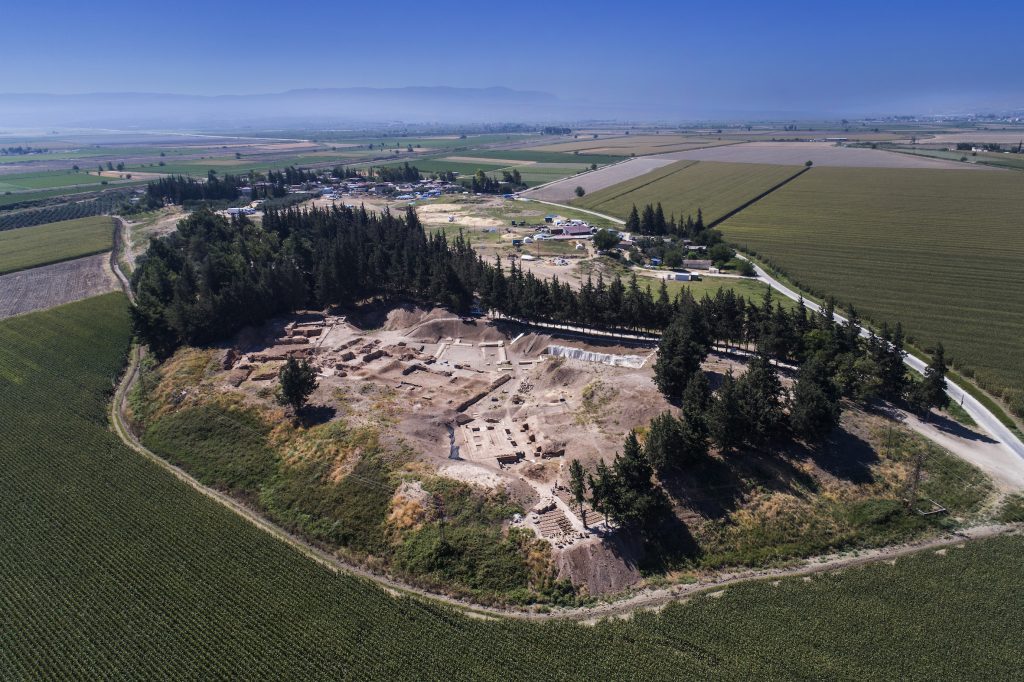
Figure 1: Tell Atchana, ancient Alalakh viewed from the northwest. In the foreground is the Level VII City Gate, where mudbricks are being dried in the sun. The palace and temple area excavated in the 1930s and 1940s is surrounded by trees, beyond which lie further excavation areas, and modern-day farms and villages.

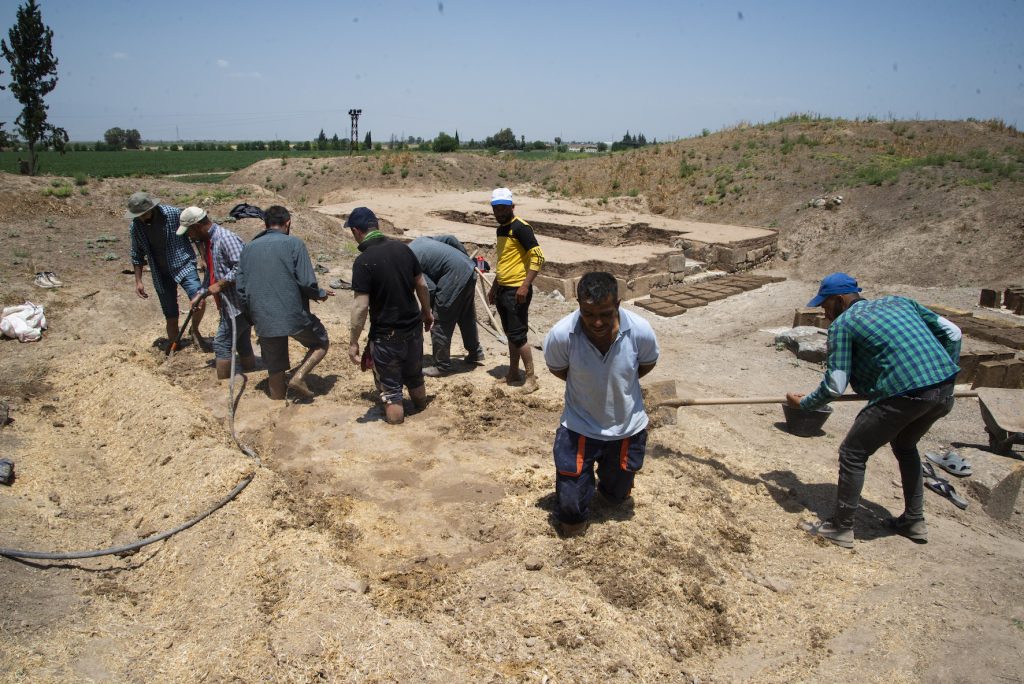
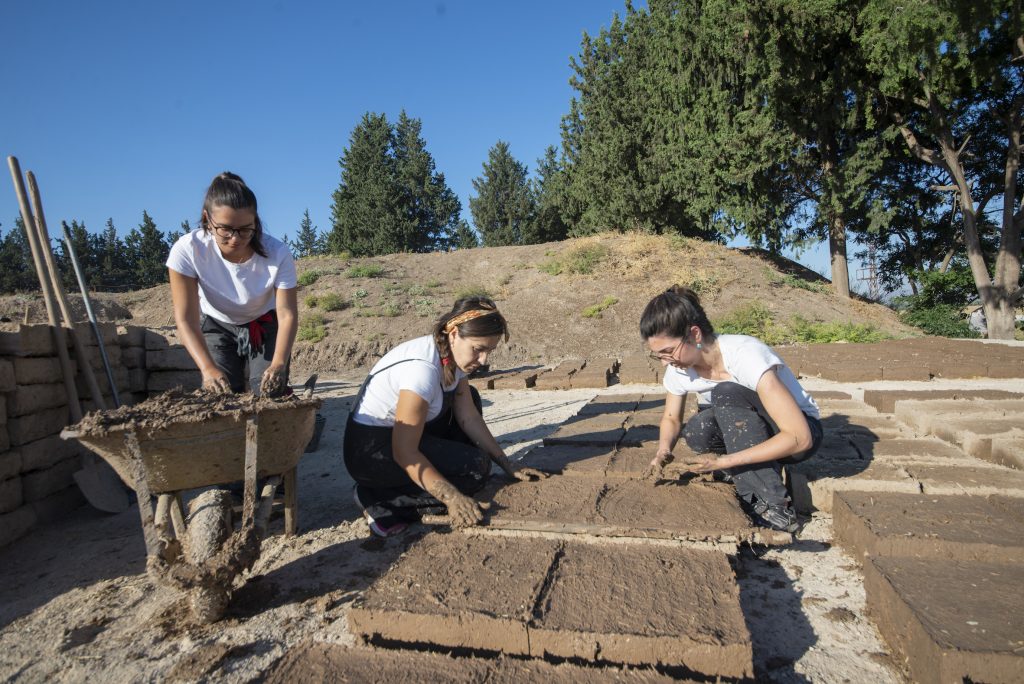
Over the last four years our team has produced nearly 4,000 mudbricks using a traditional recipe mixing straw, soil and water. As you can see (figure 2), this mixing is done by hand or rather by foot. The mixture is left to mature over night and the following day we make the bricks using custom-made metal frames that reproduce the shape and size of the bricks used in ancient Alalakh (figure 3).

Figure 2: The team preparing the mixture of soil, water, and straw.
Figure 3: Team members Defne Bilgili, Gamze Alkan, and Zeynep Türker make mudbricks in metal frames.

They are turned regularly to expose all sides to as much sunlight as possible for about a week. While the constant bending over and pushing the wheelbarrows and water buckets during mudbrick production was bad enough for the back, I had not been prepared for what followed.

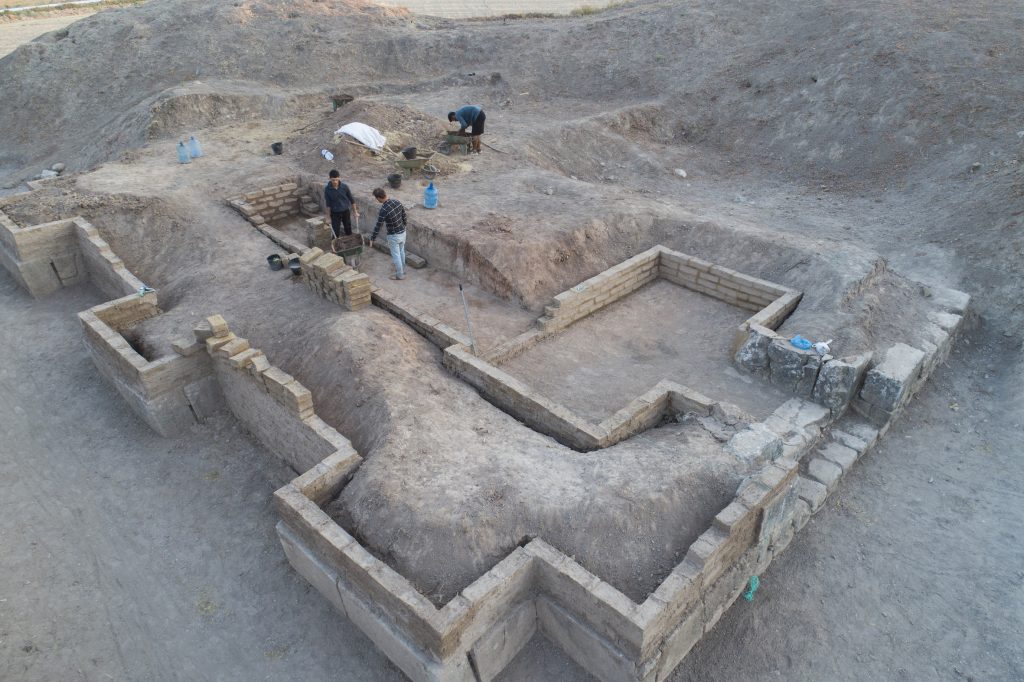
Each of these bricks weigh 30 kg. We use them to reinforce existing walls or surround fragile walls with an additional layer. Layers are joined by mortar, which is sometimes enforced with gravel or additional straw. We then seal the walls by additional mud plastering (figure 4).

Figure 4: The tripartite city gate during preservation. Level VII (Middle Bronze Age).

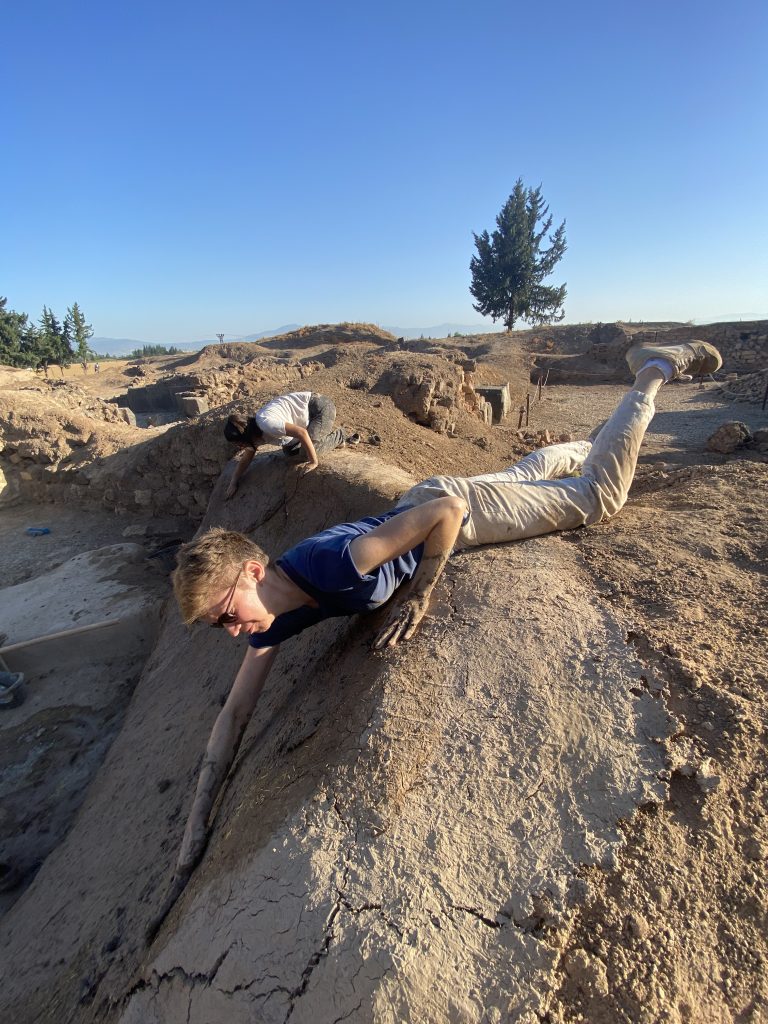
That meant: carry a brick (or in my case asking someone to help me carry it), placing it correctly, adding gravel or straw as temper (which of course also had to be brought in buckets or wheelbarrows), covering the row of bricks with mortar, repeat. From 5:30 in the morning until 1 pm crouching, sitting, getting up, carrying buckets, lifting bricks, pushing wheelbarrows, bending over, being upside down, getting into mud fights, wiping mud off your face, cursing the heat and the mud, and wishing it was lunch time so that you can go to your room and stretch out on your bed…and yet, enjoying every minute of this backbreaking work because you get to do it with your friends.

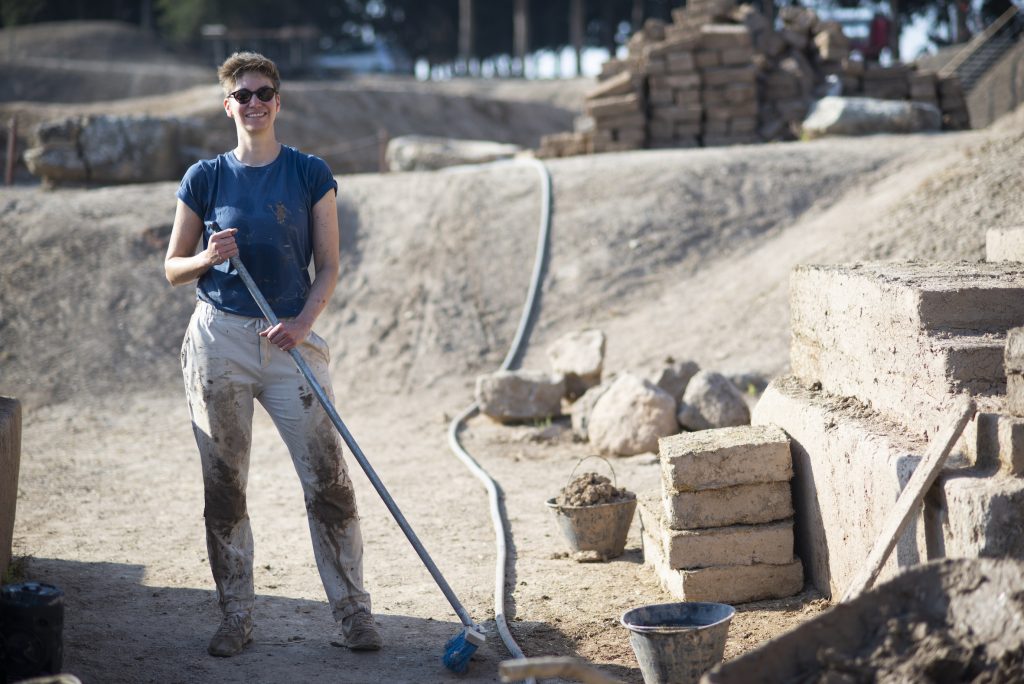
The author plastering a wall in the Level IV palace (Late Bronze Age).

One of my favourite things about archaeology is being part of a community forged through hard work, friendship, collegiality and mutual support. There is almost no better feeling than being covered in mud from head to toe, exhausted, hot, thirsty and hungry and yet somehow finding the energy for a race to the car for the best seat for the ride home while laughing all the way. Being part of this kind of family – a chosen family some might say – is a real privilege and one I look forward to every year.

Figure 6: The author at Tell Atchana after a looooooong day of laying mudbricks.

Hélène Maloigne is a lecturer in History at the School of Humanities & Social Sciences, University of Greenwich. They research the history of archaeology in the Middle East in the 19th/20th century and are Associate Editor for the Bulletin of the History of Archaeology and object registrar at Tell Atchana/Alalakh Excavations (Turkey).

All images © Tell Atchana, Alalakh Excavations Project. Murat Akar, 2023
www.alalakh.org
Instagram:@TellAtchana
https://helenemaloigne.wordpress.com/
Twitter: @HMaloigne

Want to help more students and early career archaeologists get into the field? Donate to the cause today by selecting “Student Support” as your gift purpose!

2023 FOA Seminar in Raleigh-Durham

2023 FRIENDS OF ASOR SEMINAR

October 20-22, Raleigh-Durham, NC

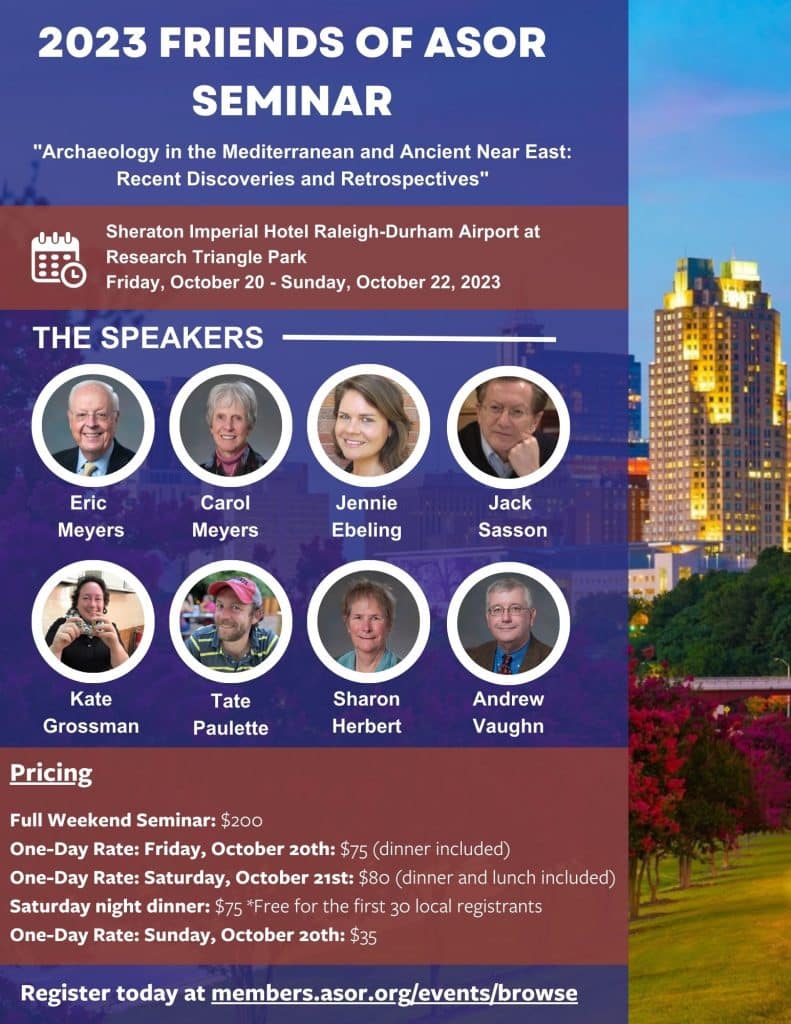
Register today for “Archaeology in the Mediterranean and Ancient Near East: Recent Discoveries and Retrospectives” a Friends of ASOR Weekend Seminar in Raleigh-Durham, NC at the Sheraton Imperial Hotel Raleigh-Durham Airport at Research Triangle Park.

Join us in Raleigh this October for a weekend full of interactive lectures, or register for a One-Day pass! Registration includes admission to presentations on Friday evening, all-day Saturday, and Sunday morning. There will be ample opportunities to engage informally with speakers and panelists. Registration also includes a discount on hotel room rates, dinner on 10/20, lunch on 10/21.

This FOA Seminar will include presentations from Eric Meyers, Carol Meyers, Jennie Ebeling, Kate Grossman, Tate Paulette, and Jack Sasson. Sharon Herbert and Andrew Vaughn will participate as panelists.


Register Now Button


Pricing

(Full weekend seminar with all events included is $200, individual events priced below)

 Friday Oct. 20Saturday Oct. 21Sunday Oct. 22
 Dinner and a private conversation with the seminar’s academic speakers: $75One-day Registration (includes 4 presentations, lunch, and dinner): $100One-day Registration: $50
  Saturday night dinner: $75
*Free for the first 30 local registrants
 
Full Weekend Registration ($200)All of the above includedAll of the above includedAll of the above included


Presentation Schedule

FRIDAY, OCTOBER 20


Dinner

Private conversation with the seminar’s academic speakers

SATURDAY, OCTOBER 21

Morning

Naboth’s Vineyard in Context: Excavating an Iron Age Winery at Jezreel
Jennie Ebeling

The beverage described most frequently in the Hebrew Bible/Old Testament, wine played a major role in the diet, economy, religion, and culture of ancient Israel. A well-preserved winery complex excavated at Jezreel in Israel’s Galilee offers insights into the technology of wine production during the Iron Age (ca. 1200-586 BCE) and provides context for the dramatic story of Naboth’s vineyard in 1 Kings 21.

Food, Gender, and Power in Israelite Households
Carol Meyers

Nothing is more fundamental to human existence than food, and in traditional societies like ancient Israel, growing crops and raising animals and then transforming them into edible form occupied a significant part of the daily life of most people. The latter step–the production of edible products, that is, food­­–was largely the task of women in biblical antiquity. This presentation will look at some of the archaeological materials that women used in making food. Then it will go a step further and look at the social, religious, and other aspects of women’s food-production tasks. In so doing, it will reveal otherwise unnoticed aspects, such as personal and social power, of women’s lives in Israelite households.

Lunch


Afternoon


Tales the Animals Tell: Zooarchaeology and the Multispecies Communities of the Ancient Near East
Kate Grossman

The cities, towns, and countryside of the Near East were populated not just by humans, but also by the animals that lived, worked, and died alongside them. While we tend to think of animals primarily as a source of food and labor, new approaches to the study of human-animal interactions are foregrounding the ways that animals influenced human action and contributed to social life in the ancient world. Drawing on 15+ years of studying animal bones from archaeological sites in Syria, Iraq, Jordan, Egypt, and Cyprus, I will show how the zooarchaeological record provides surprising new insights into the multispecies communities of the ancient Near East.

Beer and Brewing in Ancient Mesopotamia
Tate Paulette

In ancient Mesopotamia, beer was produced on a massive scale and was consumed on a daily basis by people across the socio-economic spectrum. Beer was a gift from the gods, a marker of civilization, a dietary staple, a social lubricant, a ritual necessity, and a reason for celebration. It was consumed at feasts, festivals, and ritual ceremonies, but also at home, on the job, and in neighborhood taverns. It was produced by brewers working for the powerful palace and temple institutions and also by local tavern keepers and homebrewers. This lecture explores the archaeological, artistic, and written evidence for beer and brewing in Mesopotamia, as well as recent efforts to recreate Mesopotamian beer.

Dinner

Plenary Panel


Cultural Heritage in the Age of Conflict: ASOR in North Africa – Andrew Vaughn, Sharon Herbert, Carol Meyers, Eric Meyers, Jack Sasson

SUNDAY, OCTOBER 22

Morning

Of Tombstones and Atlantis: Searching for a Lost Past in Tunis and Djerba
Jack Sasson

In Tunis and Djerba, Jack M. Sasson, a retired (UNC and Vanderbilt) Assyriologist and Biblical scholar, had glimpses of remnant communities that parallel those of his native Syria and Lebanon, alas now as submerged as Atlantis. In this informal talk, he will reflect on his personal experience of that world as evoked by his visit: Arab in culture, Jewish in religion, and French in outlook. Sasson will also report on a striking difference among those communities in their biographic use of tombstones.

Jesus in Galilee: An Archaeological Perspective
Eric Meyers

Recent archaeological discoveries in Galilee have shown beyond any shadow of a doubt that the region was overwhelmingly Jewish in the time of Jesus. There are only a handful of sites that may be identified as gentile or non-Jewish. In addition, the identification of many early synagogues from this period has allowed us to better understand that the multiple references in Josephus and the New Testament are to actually purpose-built structures, chief among them being Magdala. Together with the many stones vessels and ritual baths found, we may today conclude that most of these Jewish sites, which date to the early Roman period, indicate that Jews were practicing purity laws based on the Torah. Also, with little to no Greek attested in the epigraphic finds from this time, therefore, a much more nuanced and accurate picture of Jewish Galilee may be drawn in the most recent quest for the historical Jesus.

Questions about registration? Please contact membership@asor.org or call 703-789-9230.

FOA Webinar: Seth Sanders on August 31

[vc_row fullwidth=”true” attached=”true” css=”.vc_custom_1496247803139{padding-top: 0px !important;padding-right: 0px !important;padding-bottom: 0px !important;padding-left: 0px !important;}”][vc_column][vc_single_image image=”91217″ img_size=”full” alignment=”center”][/vc_column][/vc_row][vc_row fullwidth=”true” css=”.vc_custom_1496682730308{padding-top: 10px !important;padding-right: 0px !important;padding-bottom: 0px !important;padding-left: 0px !important;}”][vc_column width=”1/12″ css=”.vc_custom_1496683820796{margin-right: 10px !important;}” offset=”vc_hidden-md vc_hidden-sm vc_hidden-xs”][vc_column_text]

 SHARE

[/vc_column_text][mk_image src=”http://www.asortest.org/wp-content/uploads/2017/01/social-fb-icon4.jpg” image_width=”42″ image_height=”42″ hover=”false” custom_url=”https://www.facebook.com/ASOResearch/” margin_bottom=”0″][mk_image src=”http://www.asortest.org/wp-content/uploads/2017/01/social-tw-icon4.jpg” image_width=”42″ image_height=”42″ hover=”false” custom_url=”https://twitter.com/ASOResearch?ref_src=twsrc%5Egoogle%7Ctwcamp%5Eserp%7Ctwgr%5Eauthor” margin_bottom=”0″][mk_image src=”http://www.asortest.org/wp-content/uploads/2017/01/social-in-icon4.jpg” image_width=”42″ image_height=”42″ hover=”false” custom_url=”https://www.linkedin.com/company/american-schools-of-oriental-research” margin_bottom=”0″][mk_image src=”http://www.asortest.org/wp-content/uploads/2017/01/social-ml-icon_7.jpg” image_width=”42″ image_height=”42″ hover=”false” custom_url=”mailto:info@asor.org” margin_bottom=”0″][mk_image src=”http://www.asortest.org/wp-content/uploads/2017/01/blog-icon3.jpg” image_width=”42″ image_height=”42″ hover=”false” custom_url=”http://asor.org/blog” margin_bottom=”0″][/vc_column][vc_column border_color=”rgba(255,255,255,0.01)” width=”1/6″ css=”.vc_custom_1496683923840{margin-right: 20px !important;border-left-width: 2px !important;padding-right: 20px !important;padding-left: 20px !important;border-left-color: #99422f !important;}”][mk_divider divider_color=”rgba(255,255,255,0.01)” thickness=”1″ margin_top=”3″ margin_bottom=”3″][vc_widget_sidebar sidebar_id=”ca-sidebar-39801″][/vc_column][vc_column border_color=”rgba(170,170,170,0.01)” width=”1/2″ css=”.vc_custom_1487276122024{margin-right: 10px !important;margin-bottom: 30px !important;border-right-width: 2px !important;border-bottom-width: 2px !important;padding-top: 30px !important;padding-right: 30px !important;padding-left: 20px !important;background-color: #ffffff !important;border-right-color: rgba(227,228,228,0.75) !important;border-bottom-color: rgba(227,228,228,0.75) !important;}”][vc_column_text responsive_align=”left”]

FRIENDS OF ASOR WEBINARS

Who Really Invented the Alphabet?

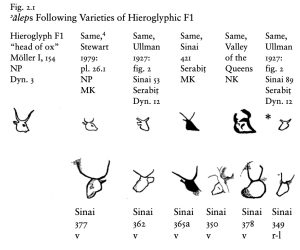
[/vc_column_text][mk_divider][vc_single_image image=”91381″ img_size=”full” alignment=”center” onclick=”custom_link” img_link_target=”_blank” link=”https://members.asor.org/commerce/store?productId=ASOR-SETH-SANDERS-WEBINAR-AUGUST-31-2023-MEMBERS”][mk_padding_divider size=”20″][vc_wp_text]Friends of ASOR present the first webinar in the 2023-2024 season on August 31 2023, at 3:00 pm EDT, featuring Prof. Seth Sanders moderated by Prof. Samuel Boyd.  Who really invented the alphabet? Despite its vast influence, we are still uncertain about precisely where the world’s most influential communication system came from. One reason for this uncertainty is that debate about the alphabet’s origins has tended to focus on questions for which there is no clear evidence–the personal identity, social status, and educational background of the inventor/s, on the one hand, and the exact date of its invention on the other. What we do know for sure about the early alphabet’s background is linguistic and material: it is widely agreed that it was created by speakers of West Semitic language ancestral to Hebrew, Arabic, and Aramaic. And as you can see from the illustration, its letters were closely based on what Egyptian hieroglyphic signs looked like.

But there is another—basically unexplored—avenue that can reveal surprisingly precise information about what the early alphabet’s creators drew on and how they were trained. Because in fact there is ample evidence about what knowledge the earliest alphabetic writers did and did not draw on. First, if the alphabet’s inventors drew on what Egyptian signs looked like, did they know, or care, what they sounded like? That is, is there any evidence that they knew how the Egyptian writing system actually worked? Second is whether anyone was professionally trained in the early alphabet: was it systematized and taught carefully, the way a scribe would, or casually and unevenly transmitted, like a game or informal craft tradition?

This talk will present new evidence for a strictly visual, rather than Egyptian-scribal-based linguistic basis for the alphabet’s origins, and for its informal use by non-scribal—and perhaps also scribal–users during its first 500 years. This evidence for the success of a new sort of non-scribal writing system outside of bureaucratic centers has historical analogies in the spread and development of the Greek alphabet and can help us reflect on the role of play and craft traditions in the invention and spread of new cultural phenomena. The webinar will conclude with a live Q&A session moderated by Prof. Samuel Boyd of the University of Colorado Boulder. 

Seth L. Sanders is an expert in the languages and cultures of the ancient Levant, from Ugaritic and Amorite to Hebrew and Aramaic. He has edited or coedited studies of the cuneiform texts from Israel and Palestine, writing in the ancient Near East, and ancient Jewish sciences, as well as writing two books, The Invention of Hebrew and From Adapa to Enoch: Scribal Culture and Religious Vision in Judea and Babylon. His current work, which has been supported by the NEH and the Guggenheim Foundation, is on a new approach to the composition of the Hebrew Bible, including the first open-access presentation of the sources of the Pentateuch beginning with the Priestly Work at pentateuch.digital. He is also interested in ancient and modern poetic and liturgical performance of religious texts from The Songs of the Sabbath Sacrifice to Black Sabbath. He currently teaches at UC Davis and will join Dalhousie University as McLeod Professor of Classics in Fall 2024.

To purchase a recording of this webinar please visit the ASOR Online Store here.


ASOR Sustaining Members: $0 | ASOR Members: $6 | Public: $12
Season Pass: ASOR Sustaining Members: $0 | ASOR Members: $75 | Public: $150
Buy one here!

Please e-mail membership@asor.org with any questions or issues with registering.

All proceeds from this webinar are used to fund scholarships for members as well as increasing ASOR’s online resources, which are free to the public.

[/vc_wp_text][mk_divider][vc_wp_text]

READY FOR A WEBINAR SEASON PASS?

Buy a season pass for all the webinars* of the 2023-2024 FOA Webinar Season! With a season pass, you will automatically be registered for every webinar in the season, and you will receive the recording of each webinar automatically after the event.

If you have missed webinars earlier in the season and still want to buy the pass, you will receive the links to the recordings of the webinars you missed in your automatic confirmation email after you buy the pass.

*Special symposiums may be excluded from the season pass price.

No more registering for a year if you buy your pass today!

Pricing:

ASOR Sustaining Members: $0 (automatic registration for each webinar)
Members: $75
Public: $150

Not a member yet? Click here to join as a member and receive the 50% off a season pass!

Please e-mail membership@asor.org if you have any questions or issues.

[/vc_wp_text][mk_divider][vc_wp_text]

SPONSOR A WEBINAR!

Several levels of support from $50-$1,000 are available. Proceeds go towards membership scholarships and towards increasing ASOR’s virtual resources. Each sponsorship is tax-deductible and you can give your friends free registrations to a webinar! Sponsor a webinar here. 

Bronze Level ($50): up to 2 guest registrations
Silver Level ($100): up to 5 guest registrations
Gold Level ($500): up to 20 guest registrations
Platinum Level ($1,000): up to 50 guest registrations

WHY SPONSOR ONLY ONE?

Season Sponsorships are also available from the ASOR Online Store here! 

Bronze level: $750
Silver level: $1,500
Gold level: $2,500
Platinum level: $5,000
Diamond level: $10,000

Click here for more information on the benefits of becoming a season sponsor or sponsoring a single webinar.

After you sign up for a sponsorship online or over the phone, email the names and email addresses of your guests to Katherine Schmitt at membership@asor.org, who will send your guests a confirmation and the Zoom link before the webinar.[/vc_wp_text][mk_divider][vc_wp_text]

WANT TO SAVE $6.00 ON THE NEXT WEBINAR?

Join ASOR as a member! Click here for more details about discounts for events and other benefits of membership. Memberships start at $40 for the year as an Associate Member.

Not ready to join yet? Become a Friend of ASOR for FREE!

Click here for more details about our online resources.[/vc_wp_text][mk_divider][vc_widget_sidebar sidebar_id=”ca-sidebar-76362″][/vc_column][vc_column border_color=”rgba(170,170,170,0.01)” width=”1/6″ css=”.vc_custom_1496684098866{margin-right: 5px !important;margin-bottom: 20px !important;border-right-width: 2px !important;border-bottom-width: 2px !important;padding-top: 30px !important;padding-right: 10px !important;padding-left: 10px !important;background-color: #ffffff !important;border-right-color: rgba(227,228,228,0.75) !important;border-bottom-color: rgba(227,228,228,0.75) !important;}”][vc_wp_posts title=”BROWSE THE NEWS ARCHIVE” number=”4″][/vc_column][vc_column border_color=”rgba(170,170,170,0.01)” width=”1/6″ css=”.vc_custom_1496684008271{margin-right: 10px !important;margin-bottom: 30px !important;border-right-width: 2px !important;border-bottom-width: 2px !important;padding-top: 30px !important;padding-right: 20px !important;padding-left: 20px !important;background-color: #ffffff !important;border-right-color: rgba(227,228,228,0.75) !important;border-bottom-color: rgba(227,228,228,0.75) !important;}”][vc_column_text] [/vc_column_text][/vc_column][/vc_row]


Call for Trustee Nominations

CALL FOR TRUSTEE NOMINATIONS 2023

The Trustee Nominations Committee announces an open call for (self) nominations for the ASOR Board of Trustees (Class of 2026). There are three primary responsibilities of the members of the Board of Trustees:

  • Governance: Being aware of issues brought forward to the Board, attending two meetings per year (at your own expense), and bringing issues of concern to the Board.
  • Fundraising and financial management: Leading in development by thinking of new opportunities, leading in giving, and providing oversight on the audited financial statements. We ask that individual trustees aspire to contribute $500 or more annually.
  • Strategic planning and policy development: Leading especially in measures that accord with ASOR’s mission.

We anticipate two openings for Membership-Elected Trustees. Any full ASOR member may be considered for nomination as an Membership-Elected Trustee. If there is someone that you would like the committee to consider—including yourself—please send the person’s name and email address to Marta Ostovich in the ASOR office. Please check with the nominee as to whether they are interested in serving on the ASOR Board of Trustees before sending in their name. If you have any questions about the responsibilities and satisfactions of being a board member, please email Kathryn Grossman, Chair of the Trustee Nominations Committee.

The ASOR office, or a representative from the Nominations Committee, will contact all nominees to describe the responsibilities in greater detail, and to make sure that the nominee is willing to have his or her name discussed by the Trustee Nominations Committee. Please note that nominees will need to submit a brief biography and a mission (or vision) statement for what they would like to accomplish as a trustee to be considered by the Nominations Committee. A sample of these statements can be found in last year’s “Meet Your Board Nominees” webpage. Brief biographies and mission statements should be ca. 200 words each and submitted via e-mail to Marta Ostovich by noon EDT on September 25, 2023.

After the Committee selects individuals for nomination, the election will take place by electronic ballot during October. ASOR is once again conducting online voting to ensure that more of our members are able to participate in this important process. The ASOR office will work with any person who is not able to complete an electronic ballot to ensure that everyone is included.

In order to receive full consideration by the committee, nominations (including supporting documents) should be submitted to programs@asor.org by noon EDT on September 25, 2023.

Fall Internships at ASOR

[vc_row fullwidth=”true” attached=”true” css=”.vc_custom_1496247803139{padding-top: 0px !important;padding-right: 0px !important;padding-bottom: 0px !important;padding-left: 0px !important;}”][vc_column][vc_single_image image=”91124″ img_size=”full” alignment=”center”][/vc_column][/vc_row][vc_row fullwidth=”true” css=”.vc_custom_1496682730308{padding-top: 10px !important;padding-right: 0px !important;padding-bottom: 0px !important;padding-left: 0px !important;}”][vc_column width=”1/12″ css=”.vc_custom_1496683820796{margin-right: 10px !important;}” offset=”vc_hidden-md vc_hidden-sm vc_hidden-xs”][vc_column_text]

 SHARE

[/vc_column_text][mk_image src=”http://www.asortest.org/wp-content/uploads/2017/01/social-fb-icon4.jpg” image_width=”42″ image_height=”42″ hover=”false” custom_url=”https://www.facebook.com/ASOResearch/” margin_bottom=”0″][mk_image src=”http://www.asortest.org/wp-content/uploads/2017/01/social-tw-icon4.jpg” image_width=”42″ image_height=”42″ hover=”false” custom_url=”https://twitter.com/ASOResearch?ref_src=twsrc%5Egoogle%7Ctwcamp%5Eserp%7Ctwgr%5Eauthor” margin_bottom=”0″][mk_image src=”http://www.asortest.org/wp-content/uploads/2017/01/social-in-icon4.jpg” image_width=”42″ image_height=”42″ hover=”false” custom_url=”https://www.linkedin.com/company/american-schools-of-oriental-research” margin_bottom=”0″][mk_image src=”http://www.asortest.org/wp-content/uploads/2017/01/social-ml-icon_7.jpg” image_width=”42″ image_height=”42″ hover=”false” custom_url=”mailto:info@asor.org” margin_bottom=”0″][mk_image src=”http://www.asortest.org/wp-content/uploads/2017/01/blog-icon3.jpg” image_width=”42″ image_height=”42″ hover=”false” custom_url=”http://asor.org/blog” margin_bottom=”0″][/vc_column][vc_column border_color=”rgba(255,255,255,0.01)” width=”1/6″ css=”.vc_custom_1496683923840{margin-right: 20px !important;border-left-width: 2px !important;padding-right: 20px !important;padding-left: 20px !important;border-left-color: #99422f !important;}”][mk_divider divider_color=”rgba(255,255,255,0.01)” thickness=”1″ margin_top=”3″ margin_bottom=”3″][vc_widget_sidebar sidebar_id=”ca-sidebar-39801″][/vc_column][vc_column border_color=”rgba(170,170,170,0.01)” width=”1/2″ css=”.vc_custom_1487276122024{margin-right: 10px !important;margin-bottom: 30px !important;border-right-width: 2px !important;border-bottom-width: 2px !important;padding-top: 30px !important;padding-right: 30px !important;padding-left: 20px !important;background-color: #ffffff !important;border-right-color: rgba(227,228,228,0.75) !important;border-bottom-color: rgba(227,228,228,0.75) !important;}”][vc_column_text responsive_align=”left”]

FALL INTERNSHIPS AT ASOR

[/vc_column_text][mk_divider][vc_column_text responsive_align=”left”]August 29 Update: Thank you to all who applied for an ASOR internship this fall. At this time we are not accepting any new applications. Additional internship opportunities may be available for the Spring Semester.[/vc_column_text][mk_divider][vc_column_text]The American Society of Overseas Research (ASOR) seeks candidates for part-time internship positions to begin on or around September 5th. These compensated internships are for the fall semester (September-December) with the possibility of renewal for the spring semester. Interns are expect to work 10–15 hours per week at ASOR’s headquarters—The James F. Strange Center, 209 Commerce St., in historic Old Town Alexandria, VA. Hours and schedule are flexible depending on school or other commitments.

Founded in 1900, the ASOR is a 501(c)(3) non-profit whose mission is to initiate, encourage, and support research into, and public understanding of, the history and cultures of the Near East and wider Mediterranean world, from the earliest times. Please visit www.asor.org for more information.

Primary Responsibilities:

  • Maintain high-quality customer service for ASOR’s members and friends
  • Answer the general ASOR telephone and information e-mail account
  • Assist with ASOR’s Annual Meeting in Chicago (happening in November) by providing off-site administrative support including but not limited to, processing registration and exhibitor payments, answering attendee questions, and promoting the Annual Meeting on the ASOR website and social media platforms.
  • Provide general office support (e.g., scanning, copying, ordering supplies, and processing mail, orders, and bills)
  • Process membership dues, donations, and event registrations in organizational database
  • Assist with membership and donation mailings
  • Perform other office duties as assigned

Qualifications / Skills Desired:

  • General office management
  • Customer service
  • Microsoft Office
  • Database management
  • Familiarity with social media platforms (Instagram, Facebook, TikTok, and Twitter)
  • Graphic and image design and editing (Adobe Photoshop, Canva, etc.)
  • Website management (WordPress or similar)
  • Excellent communication and interpersonal skills
  • Attention to detail; ability to multitask and to prioritize

Compensation: $15/hr

How To Apply: E-mail your resume and a brief statement of interest to Marta Ostovich at programs@asor.org. Please include your name and “ASOR Internship” in the subject line.

Review of applications will begin immediately and continue until the positions are filled.


ASOR is an equal opportunity employer and all qualified applicants will receive consideration for employment without regard to race, color, gender, religion, national origin, disability, veteran status, age, marital status, sexual orientation, gender identity, genetic information, or any other class protected by federal or state law (EEO/AA).[/vc_column_text][/vc_column][vc_column border_color=”rgba(170,170,170,0.01)” width=”1/6″ css=”.vc_custom_1496684098866{margin-right: 5px !important;margin-bottom: 20px !important;border-right-width: 2px !important;border-bottom-width: 2px !important;padding-top: 30px !important;padding-right: 10px !important;padding-left: 10px !important;background-color: #ffffff !important;border-right-color: rgba(227,228,228,0.75) !important;border-bottom-color: rgba(227,228,228,0.75) !important;}”][vc_wp_posts title=”BROWSE THE NEWS ARCHIVE” number=”4″][/vc_column][vc_column border_color=”rgba(170,170,170,0.01)” width=”1/6″ css=”.vc_custom_1496684008271{margin-right: 10px !important;margin-bottom: 30px !important;border-right-width: 2px !important;border-bottom-width: 2px !important;padding-top: 30px !important;padding-right: 20px !important;padding-left: 20px !important;background-color: #ffffff !important;border-right-color: rgba(227,228,228,0.75) !important;border-bottom-color: rgba(227,228,228,0.75) !important;}”][vc_column_text] [/vc_column_text][/vc_column][/vc_row]
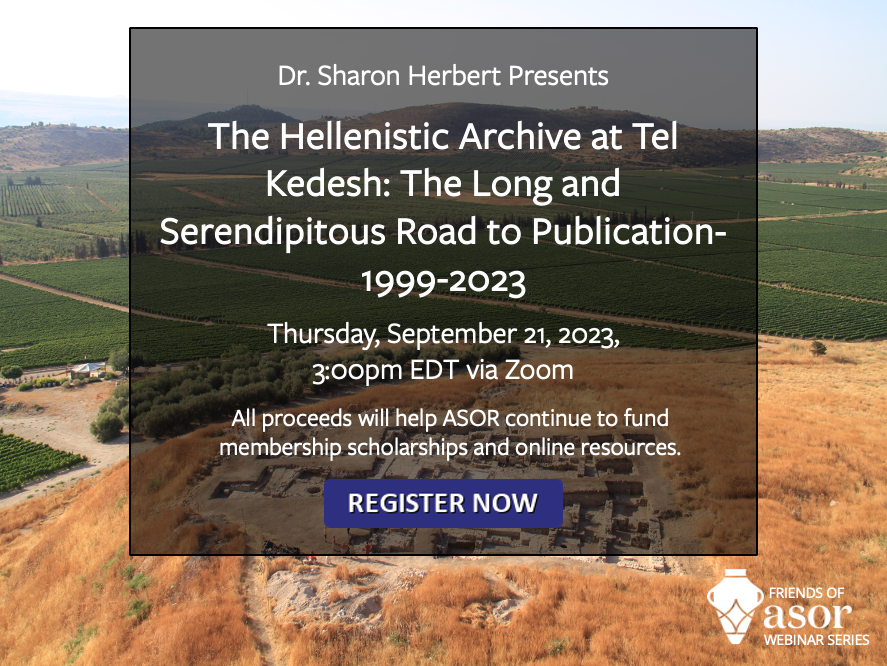
Table of Contents for JCS 75 (2023)

[vc_row fullwidth=”true” attached=”true” css=”.vc_custom_1496247803139{padding-top: 0px !important;padding-right: 0px !important;padding-bottom: 0px !important;padding-left: 0px !important;}”][vc_column][mk_image src=”https://www.asor.org/wp-content/uploads/2022/07/images_large_fg1.jpeg” image_width=”1920″ image_height=”400″ hover=”false” align=”center” margin_bottom=”0″][/vc_column][/vc_row][vc_row fullwidth=”true” attached=”true” css=”.vc_custom_1651165194378{margin-top: 0px !important;padding-right: 0px !important;padding-bottom: 0px !important;padding-left: 0px !important;}”][vc_column width=”1/12″ css=”.vc_custom_1496683820796{margin-right: 10px !important;}” offset=”vc_hidden-md vc_hidden-sm vc_hidden-xs”][vc_column_text]

 SHARE

[/vc_column_text][mk_image src=”http://www.asortest.org/wp-content/uploads/2017/01/social-fb-icon4.jpg” image_width=”42″ image_height=”42″ hover=”false” custom_url=”https://www.facebook.com/ASOResearch/” margin_bottom=”0″][mk_image src=”http://www.asortest.org/wp-content/uploads/2017/01/social-tw-icon4.jpg” image_width=”42″ image_height=”42″ hover=”false” custom_url=”https://twitter.com/ASOResearch?ref_src=twsrc%5Egoogle%7Ctwcamp%5Eserp%7Ctwgr%5Eauthor” margin_bottom=”0″][mk_image src=”http://www.asortest.org/wp-content/uploads/2017/01/social-in-icon4.jpg” image_width=”42″ image_height=”42″ hover=”false” custom_url=”https://www.linkedin.com/company/american-schools-of-oriental-research” margin_bottom=”0″][mk_image src=”http://www.asortest.org/wp-content/uploads/2017/01/social-ml-icon_7.jpg” image_width=”42″ image_height=”42″ hover=”false” custom_url=”mailto:asor@bu.edu” margin_bottom=”0″][mk_image src=”http://www.asortest.org/wp-content/uploads/2017/01/blog-icon3.jpg” image_width=”42″ image_height=”42″ hover=”false” custom_url=”http://asorblog.org/” margin_bottom=”0″][/vc_column][vc_column border_color=”rgba(255,255,255,0.01)” width=”1/6″ css=”.vc_custom_1496683923840{margin-right: 20px !important;border-left-width: 2px !important;padding-right: 20px !important;padding-left: 20px !important;border-left-color: #99422f !important;}”][mk_divider divider_color=”rgba(255,255,255,0.01)” thickness=”1″ margin_top=”3″ margin_bottom=”3″][vc_column_text]

NEWS@ASOR

PAST ASOR NEWS, MONTH BY MONTH

WAYS TO DONATE TO ASOR

FY20 HONOR ROLL OF DONORS (DRAFT)

ASOR LEGACY CIRCLE MEMBERS

DONATE NOW

[/vc_column_text][/vc_column][vc_column border_color=”rgba(170,170,170,0.01)” width=”1/2″ css=”.vc_custom_1651165173114{margin-right: 10px !important;margin-bottom: 30px !important;border-right-width: 2px !important;border-bottom-width: 2px !important;padding-top: 30px !important;padding-right: 30px !important;padding-left: 20px !important;background-color: #ffffff !important;border-right-color: rgba(227,228,228,0.75) !important;border-bottom-color: rgba(227,228,228,0.75) !important;}”][vc_row_inner][vc_column_inner][vc_column_text]

Table of Contents for Journal of Cuneiform Studies 75 (2023)

[/vc_column_text][mk_divider thickness=”1″ margin_top=”10″ margin_bottom=”30″][/vc_column_inner][/vc_row_inner][vc_row_inner][vc_column_inner width=”1/2″ css=”.vc_custom_1651246586407{padding-right: 10px !important;padding-bottom: 15px !important;}”][vc_single_image image=”90988″ img_size=”medium” alignment=”center” onclick=”custom_link” img_link_target=”_blank” link=”https://www.journals.uchicago.edu/toc/jcs/2022/74/1″][/vc_column_inner][vc_column_inner width=”1/2″][vc_wp_text]

You can receive JCS (and other ASOR publications) through an ASOR Membership.
Please e-mail the Membership office if you have any questions.

[/vc_wp_text][/vc_column_inner][/vc_row_inner][mk_divider thickness=”1″ margin_top=”30″ margin_bottom=”30″][vc_row_inner][vc_column_inner css=”.vc_custom_1651156050549{padding-right: 10px !important;}”][vc_single_image image=”90990″ img_size=”1920×400″ alignment=”center” onclick=”custom_link” img_link_target=”_blank” link=”https://www.journals.uchicago.edu/doi/10.1086/725193″][mk_padding_divider size=”10″][vc_column_text]

Pp. 3–12: “A New Old Babylonian Date List with Year Names of Hammurabi,” by Ardalan Khwshnaw

This article contains the publication of a previously unknown date list of the Babylonian king Hammurabi, kept in the Sulaymaniyah Museum in Iraq. The tablet originally contained the year formulas for forty-two years of Hammurabi’s forty-three-year reign. The obverse is better preserved than the reverse and the beginnings of lines on the reverse are mostly broken.

ASOR Members with online access: log into ASOR’s Online Portal here. Once logged in, click the JOURNALS tab in the top navigation bar. From here you may select which journal you would like to read. If you have online access, you will see your selected journal’s current issue Table of Contents. Click on the “Current Issue” button and you will then be redirected to the University of Chicago Press’s (UCP) platform to immediately start reading any issue of your choice. Tutorials for how to log in to the Online Portal as well as how to navigate to the Portal Journals page can be found here. [/vc_column_text][/vc_column_inner][/vc_row_inner][mk_divider thickness=”1″ margin_top=”10″ margin_bottom=”30″][vc_row_inner][vc_column_inner css=”.vc_custom_1651156050549{padding-right: 10px !important;}”][mk_padding_divider size=”10″][vc_column_text]

Pp. 13-26: “Malgum, A Synthesis,” by Rients de Boer

This article collects the new information recently made available concerning the town of Malgum and provides a synthesis of its political history, with a focus on the Old Babylonian period when it was the seat of a small kingdom between ca. 2025 and 1761 BCE. It was eventually conquered by Hammurabi of Babylon in 1761 BCE and large parts of its population were deported. We can trace the whereabouts of these deportees for another ca. forty years in the military province of Lower Yaḫrūrum. In the subsequent Middle Babylonian period, Malgu was the name of a province, but after this time the site appears to have been abandoned, only used much later as a cemetery in Parthian and Sassanian times.

ASOR Members with online access: log into ASOR’s Online Portal here. Once logged in, click the JOURNALS tab in the top navigation bar. From here you may select which journal you would like to read. If you have online access, you will see your selected journal’s current issue Table of Contents. Click on the “Current Issue” button and you will then be redirected to the University of Chicago Press’s (UCP) platform to immediately start reading any issue of your choice. Tutorials for how to log in to the Online Portal as well as how to navigate to the Portal Journals page can be found here. [/vc_column_text][/vc_column_inner][/vc_row_inner][mk_divider thickness=”1″ margin_top=”10″ margin_bottom=”30″][vc_row_inner][vc_column_inner css=”.vc_custom_1651156050549{padding-right: 10px !important;}”][vc_single_image image=”90991″ img_size=”1920×400″ alignment=”center” onclick=”custom_link” img_link_target=”_blank” link=”https://www.journals.uchicago.edu/doi/10.1086/725217″][mk_padding_divider size=”10″][vc_column_text]

Pp. 27-47: “Dur-Abi-ešuh and the Abandonment of Nippur During the Late Old Babylonian Period: A Historical Survey,” by Marine Béranger

This article provides an account of the history of the fortress Dur-Abi-ešuh and offers a survey of the political and military situation of central Babylonia during the Late Old Babylonian period (ca. 1740–1600 BCE). Making use of a long-known but completely overlooked source, it also suggests a date for the complete abandonment of Nippur, the main cult center of the land, between 1631 and 1629 BCE.

ASOR Members with online access: log into ASOR’s Online Portal here. Once logged in, click the JOURNALS tab in the top navigation bar. From here you may select which journal you would like to read. If you have online access, you will see your selected journal’s current issue Table of Contents. Click on the “Current Issue” button and you will then be redirected to the University of Chicago Press’s (UCP) platform to immediately start reading any issue of your choice. Tutorials for how to log in to the Online Portal as well as how to navigate to the Portal Journals page can be found here. [/vc_column_text][/vc_column_inner][/vc_row_inner][mk_divider thickness=”1″ margin_top=”10″ margin_bottom=”30″][vc_row_inner][vc_column_inner css=”.vc_custom_1651156050549{padding-right: 10px !important;}”][vc_single_image image=”90993″ img_size=”1920×400″ alignment=”center” onclick=”custom_link” img_link_target=”_blank” link=”https://www.journals.uchicago.edu/doi/10.1086/725408″][mk_padding_divider size=”10″][vc_column_text]

Pp. 49-59: “A Kassite Exercise Tablet with Omens Concerning the “Yoke” of the Liver,” by Nils P. Heeßel and Elyze Zomer

This paper offers an editio princeps of HS 1898, a Kassite exercise tablet containing an extract with ten liver omens followed by numeric tallies with the 10u-sign. The omens duplicate the fragmentary obverse of a Neo-Babylonian nīru-compendium, the reverse of which in turn replicated omens known from the fifteenth tablet of the bārûtu-series Pān tākalti and the unedited fragment from Nineveh. The student used complicated lexical and graphical variations in writing the technical term nīru, “the Yoke.”

ASOR Members with online access: log into ASOR’s Online Portal here. Once logged in, click the JOURNALS tab in the top navigation bar. From here you may select which journal you would like to read. If you have online access, you will see your selected journal’s current issue Table of Contents. Click on the “Current Issue” button and you will then be redirected to the University of Chicago Press’s (UCP) platform to immediately start reading any issue of your choice. Tutorials for how to log in to the Online Portal as well as how to navigate to the Portal Journals page can be found here. [/vc_column_text][/vc_column_inner][/vc_row_inner][mk_divider thickness=”1″ margin_top=”10″ margin_bottom=”30″][vc_row_inner][vc_column_inner css=”.vc_custom_1651156050549{padding-right: 10px !important;}”][vc_single_image image=”90994″ img_size=”1920×400″ alignment=”center” onclick=”custom_link” img_link_target=”_blank” link=”https://www.journals.uchicago.edu/doi/10.1086/725218″][mk_padding_divider size=”10″][vc_column_text]

Pp. 61-73: “The Taphonomy of Middle Assyrian Cuneiform Tablet Clusters: Archives or Refuse?,” by Victor Klinkenberg and Bleda S. Düring

In this article we report on the taphonomic analysis of several Middle Assyrian tablet clusters to identify the way these objects ended up in the ground. Rather than in-situ archives that were left behind during some catastrophe, we argue that these tablets were often deliberately discarded. Specifically for the tablet clusters we examined, we propose that they were first temporarily discarded in “office bins.” We claim that the occurrence of clustered, homogenous tablet groups at our sites are the result of the occasional emptying of such bins. The methodology we present could be of value for the analysis of other similar tablet-bearing contexts.

ASOR Members with online access: log into ASOR’s Online Portal here. Once logged in, click the JOURNALS tab in the top navigation bar. From here you may select which journal you would like to read. If you have online access, you will see your selected journal’s current issue Table of Contents. Click on the “Current Issue” button and you will then be redirected to the University of Chicago Press’s (UCP) platform to immediately start reading any issue of your choice. Tutorials for how to log in to the Online Portal as well as how to navigate to the Portal Journals page can be found here. [/vc_column_text][/vc_column_inner][/vc_row_inner][mk_divider thickness=”1″ margin_top=”10″ margin_bottom=”30″][vc_row_inner][vc_column_inner css=”.vc_custom_1651156050549{padding-right: 10px !important;}”][vc_single_image image=”90995″ img_size=”1920×400″ alignment=”center” onclick=”custom_link” img_link_target=”_blank” link=”https://www.journals.uchicago.edu/doi/10.1086/725219″][mk_padding_divider size=”10″][vc_column_text]

Pp. 75-92: “The Third Column of Šimâ Milka: A New Attempt,” by Maurizio Viano

Šimâ milka is a wisdom composition known from Late Bronze Age sources found at Hattusa, Emar, and Ugarit. Many studies have been dedicated to this composition, but the fragmentary nature of sources prevented the understanding of several passages, and large portions of the text remain unpreserved or incomplete. The present article attempts a new reconstruction of the third column of the Emar manuscript by placing two fragments at the end of the column, rather than in the middle as in previous editions. This placement results in the restoration of the same line order in the Emar, Ugarit, and Hattusa manuscripts.

ASOR Members with online access: log into ASOR’s Online Portal here. Once logged in, click the JOURNALS tab in the top navigation bar. From here you may select which journal you would like to read. If you have online access, you will see your selected journal’s current issue Table of Contents. Click on the “Current Issue” button and you will then be redirected to the University of Chicago Press’s (UCP) platform to immediately start reading any issue of your choice. Tutorials for how to log in to the Online Portal as well as how to navigate to the Portal Journals page can be found here. [/vc_column_text][/vc_column_inner][/vc_row_inner][mk_divider thickness=”1″ margin_top=”10″ margin_bottom=”30″][vc_row_inner][vc_column_inner css=”.vc_custom_1651156050549{padding-right: 10px !important;}”][vc_single_image image=”90996″ img_size=”1920×400″ alignment=”center” onclick=”custom_link” img_link_target=”_blank” link=”https://www.journals.uchicago.edu/doi/10.1086/725220″][mk_padding_divider size=”10″][vc_column_text]

Pp. 93-107: “The Return of the Text: On Self-Reference in Cuneiform Literature,” by Sophus Helle

The article proposes the existence of a recurrent motif in cuneiform literature, the self-referential climax, in which literary works end by describing how they came into being: In the narrative equivalent of a snake biting its own tail, the poems that employ this motif culminate in their own creation. The article argues that the motif can yield a glimpse into the “implicit poetics” of cuneiform literature, that is, the conception of literature that circulated among cuneiform scholars and composers. It examines three case studies—Inana and Shukaletuda, The Cuthean Legend of Naram-Sîn, and Gilgamesh—arguing that they evince in their self-referential climaxes a distinctly bittersweet notion of textuality, since their creation relies on the tragedy of their main character, in a clear counterposing of content and form.

ASOR Members with online access: log into ASOR’s Online Portal here. Once logged in, click the JOURNALS tab in the top navigation bar. From here you may select which journal you would like to read. If you have online access, you will see your selected journal’s current issue Table of Contents. Click on the “Current Issue” button and you will then be redirected to the University of Chicago Press’s (UCP) platform to immediately start reading any issue of your choice. Tutorials for how to log in to the Online Portal as well as how to navigate to the Portal Journals page can be found here. [/vc_column_text][/vc_column_inner][/vc_row_inner][mk_divider thickness=”1″ margin_top=”10″ margin_bottom=”30″][vc_row_inner][vc_column_inner css=”.vc_custom_1651156050549{padding-right: 10px !important;}”][vc_single_image image=”90997″ img_size=”full” alignment=”center” onclick=”custom_link” img_link_target=”_blank” link=”https://www.journals.uchicago.edu/doi/10.1086/725221″][mk_padding_divider size=”10″][vc_column_text]

Pp. 109-122: “The Battle of Til-Tuba (653 BCE) and its Background Revisited,” by Saeideh Sharifi and Kolsoum Ghazanfari

Most of the information on the Battle of Til-Tuba derives from the narratives found in Assurbanipal’s annals, which are both brief and vague. Even though no Elamite documentation of the event is available, this study attempts to provide a clearer picture of this historical episode by comparing the annals with information preserved in a variety of other media. The results indicate that contrary to the report of the annals, Teumman did not initiate the war with Assyria. Rather, internal circumstances in Elam, including unrest and disorder, provided a good opportunity for Assyria to invade that land. Ultimately, the revolts and the betrayal of high-ranking government officials through the surrender of Hidalu laid the grounds for Teumman’s defeat at the Battle of Til-Tuba.

<ASOR Members with online access: log into ASOR’s Online Portal here. Once logged in, click the JOURNALS tab in the top navigation bar. From here you may select which journal you would like to read. If you have online access, you will see your selected journal’s current issue Table of Contents. Click on the “Current Issue” button and you will then be redirected to the University of Chicago Press’s (UCP) platform to immediately start reading any issue of your choice. Tutorials for how to log in to the Online Portal as well as how to navigate to the Portal Journals page can be found here. [/vc_column_text][/vc_column_inner][/vc_row_inner][mk_divider thickness=”1″ margin_top=”10″ margin_bottom=”30″][vc_row_inner][vc_column_inner css=”.vc_custom_1651156050549{padding-right: 10px !important;}”][vc_single_image image=”90998″ img_size=”full” alignment=”center” onclick=”custom_link” img_link_target=”_blank” link=”https://www.journals.uchicago.edu/doi/10.1086/725222″][mk_padding_divider size=”10″][vc_column_text]

Pp. 123-154: “Age and Masculinities During the Neo-Assyrian Period,” by Ellie Bennett

The age of an individual changes how other elements of identity, like masculinity, are expressed. For example, the modern expectations of “old men” and “young men” are very different. Here, I explore the differences between “young” and “old” men as expressed in the Neo-Assyrian textual corpus on the Open Richly Annotated Cuneiform Corpus (Oracc). This corpus offers a unique opportunity to incorporate recently developed word co-occurrence methods alongside a traditional close reading approach in order to explore the differences between old and young men in Neo-Assyrian texts. I demonstrate that young men were conceptually different from old men, and both were key to the construction of Neo-Assyrian hegemonic masculinities.

ASOR Members with online access: log into ASOR’s Online Portal here. Once logged in, click the JOURNALS tab in the top navigation bar. From here you may select which journal you would like to read. If you have online access, you will see your selected journal’s current issue Table of Contents. Click on the “Current Issue” button and you will then be redirected to the University of Chicago Press’s (UCP) platform to immediately start reading any issue of your choice. Tutorials for how to log in to the Online Portal as well as how to navigate to the Portal Journals page can be found here. [/vc_column_text][/vc_column_inner][/vc_row_inner][mk_divider thickness=”1″ margin_top=”10″][vc_row_inner][vc_column_inner css=”.vc_custom_1651156050549{padding-right: 10px !important;}”][vc_single_image image=”90999″ img_size=”full” alignment=”center” onclick=”custom_link” img_link_target=”_blank” link=”https://www.journals.uchicago.edu/doi/10.1086/725223″][mk_padding_divider size=”10″][vc_column_text]

Pp. 155-169: “Therapeutic Prescriptions and Magical-Medical Rituals Against Fever: An Edition of a Late Babylonian Tablet BM 55516 + BM 55577+1882,0704.188,” by András Bácskay

The tablet BM 55516+ contains therapeutic prescriptions (ointments and fumigations) and magical-medical rituals including incantations against fever (ummu) and “persistent fever” (ummu lazzu). I know of no duplicate, but the prescriptions and the incantations have several parallels on medical tablets from Assur, Nineveh, Kalhu, and Babylon. I first provide an edition of the tablet, including all parallels followed by a discussion of the two magical-medical rituals against fever mentioned in the text.

ASOR Members with online access: log into ASOR’s Online Portal here. Once logged in, click the JOURNALS tab in the top navigation bar. From here you may select which journal you would like to read. If you have online access, you will see your selected journal’s current issue Table of Contents. Click on the “Current Issue” button and you will then be redirected to the University of Chicago Press’s (UCP) platform to immediately start reading any issue of your choice. Tutorials for how to log in to the Online Portal as well as how to navigate to the Portal Journals page can be found here. [/vc_column_text][/vc_column_inner][/vc_row_inner][mk_divider thickness=”1″ margin_top=”10″][vc_row_inner][vc_column_inner css=”.vc_custom_1651156050549{padding-right: 10px !important;}”][vc_single_image image=”91000″ img_size=”full” alignment=”center” onclick=”custom_link” img_link_target=”_blank” link=”https://www.journals.uchicago.edu/doi/10.1086/725224″][mk_padding_divider size=”10″][vc_column_text]

Pp. 171-188: “Nebuchadnezzar II’s Palace Overseer (Ša Pān Ekalli) and The Canal of Abundance Building Projects,” by Małgorzata Sandowicz and Stefan Zawadzki

A document published in this article documents the involvement of one of Nebuchadnezzar II’s top court officials, the palace overseer (ša pān ekalli), in a building project managed by the authorities of the Ebabbar temple of the city of Sippar. To place the project in its chronological and geographic context, five additional legal and administrative texts from the Ebabbar are published for the first time as well.

ASOR Members with online access: log into ASOR’s Online Portal here. Once logged in, click the JOURNALS tab in the top navigation bar. From here you may select which journal you would like to read. If you have online access, you will see your selected journal’s current issue Table of Contents. Click on the “Current Issue” button and you will then be redirected to the University of Chicago Press’s (UCP) platform to immediately start reading any issue of your choice. Tutorials for how to log in to the Online Portal as well as how to navigate to the Portal Journals page can be found here. [/vc_column_text][mk_divider thickness=”1″ margin_top=”10″][vc_single_image image=”91001″ img_size=”full” alignment=”center” onclick=”custom_link” img_link_target=”_blank” link=”https://www.journals.uchicago.edu/doi/10.1086/725225″][mk_padding_divider size=”10″][vc_column_text]

Pp. 189-195: “BM 33878: A Uranology Fragment from Babylon,” by Aino Hätinen

This article presents an edition of a new uranology fragment (BM 33878) from the Babylon Collection of the British Museum. Although small, this fragment offers further information about the social context of the uranology texts in late-period Babylonia.

ASOR Members with online access: log into ASOR’s Online Portal here. Once logged in, click the JOURNALS tab in the top navigation bar. From here you may select which journal you would like to read. If you have online access, you will see your selected journal’s current issue Table of Contents. Click on the “Current Issue” button and you will then be redirected to the University of Chicago Press’s (UCP) platform to immediately start reading any issue of your choice. Tutorials for how to log in to the Online Portal as well as how to navigate to the Portal Journals page can be found here. [/vc_column_text][mk_divider thickness=”1″ margin_top=”10″][vc_single_image image=”91002″ img_size=”full” alignment=”center” onclick=”custom_link” img_link_target=”_blank” link=”https://www.journals.uchicago.edu/doi/10.1086/725226″][mk_padding_divider size=”10″][vc_column_text]

Pp. 197-206: “The Reedition of the Persepolis Treasury Tablet Pt 1963-8,” by Jalil Bakhtiari

Twenty tablets or fragments from the Persepolis Treasury Archive were published by George Cameron in 1965. One of them, the fragment PT 1963-8, which belongs to a group of texts concerning sheep rations, is broken at the bottom. A reconsideration of the text leads to proposed restorations of parts of the missing sections, according to mathematical calculations of rations and comparisons with the other PT tablets.

ASOR Members with online access: log into ASOR’s Online Portal here. Once logged in, click the JOURNALS tab in the top navigation bar. From here you may select which journal you would like to read. If you have online access, you will see your selected journal’s current issue Table of Contents. Click on the “Current Issue” button and you will then be redirected to the University of Chicago Press’s (UCP) platform to immediately start reading any issue of your choice. Tutorials for how to log in to the Online Portal as well as how to navigate to the Portal Journals page can be found here. [/vc_column_text][/vc_column_inner][/vc_row_inner][mk_divider thickness=”1″ margin_top=”10″][/vc_column][vc_column border_color=”rgba(170,170,170,0.01)” width=”1/6″ css=”.vc_custom_1567019974102{margin-right: 5px !important;margin-bottom: 20px !important;border-right-width: 2px !important;border-bottom-width: 2px !important;padding-top: 30px !important;padding-right: 10px !important;padding-left: 10px !important;background-color: #ffffff !important;border-right-color: rgba(227,228,228,0.75) !important;border-bottom-color: rgba(227,228,228,0.75) !important;}”][vc_wp_posts title=”BROWSE THE NEWS ARCHIVE” number=”4″][/vc_column][vc_column border_color=”rgba(170,170,170,0.01)” width=”1/6″ css=”.vc_custom_1496684008271{margin-right: 10px !important;margin-bottom: 30px !important;border-right-width: 2px !important;border-bottom-width: 2px !important;padding-top: 30px !important;padding-right: 20px !important;padding-left: 20px !important;background-color: #ffffff !important;border-right-color: rgba(227,228,228,0.75) !important;border-bottom-color: rgba(227,228,228,0.75) !important;}”][vc_column_text] [/vc_column_text][/vc_column][/vc_row]

2023 Fieldwork Updates

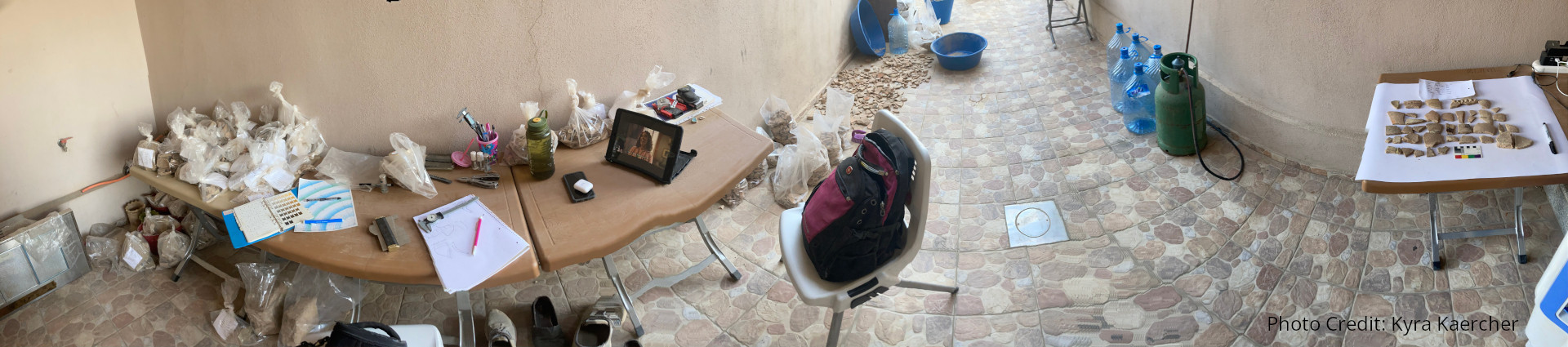
pottery yard photo by Kyra Kaercher

ASOR IN THE FIELD: 2023 FIELDWORK UPDATES

Virtual Archaeology Initiative: @ASOR_Research is now on TikTok

Thanks to the Membership & Outreach Committee, ASOR launched the Virtual Archaeology Initiative this summer. One of the purposes of this initiative is to allow people who cannot or would not be able to participate in actual excavations to feel as if they are still can. The goal is to create digital assets that illustrate or teach various steps involved in the archaeological process. Students who received 2023 fieldwork scholarships have volunteered to document their experiences in the field. These videos will be appearing over the next couple of month’s on ASOR’s newly created TikTok and also eventually on ASOR’s YouTube channel. If you are interested in contributing to the Virtual Archaeology Initiative and having your fieldwork videos on ASOR’s TikTok, please email Marta Ostovich.

Updates from ASOR-Affiliated Projects

Check out the latest updates from the field on the social media pages of these ASOR-affiliated projects and see what ASOR members and students have been up to this summer. If you’d like to include updates from your ASOR-affiliated project on this page, please email Marta Ostovich. Interested in affiliating your project with ASOR? Learn more here. 

Stay tuned in the upcoming months for updates in News@ASOR from students who participated on these projects.