New Excavations at Nessana, Negev: Late Antique Pilgrimage Hub on the Desert Fringe
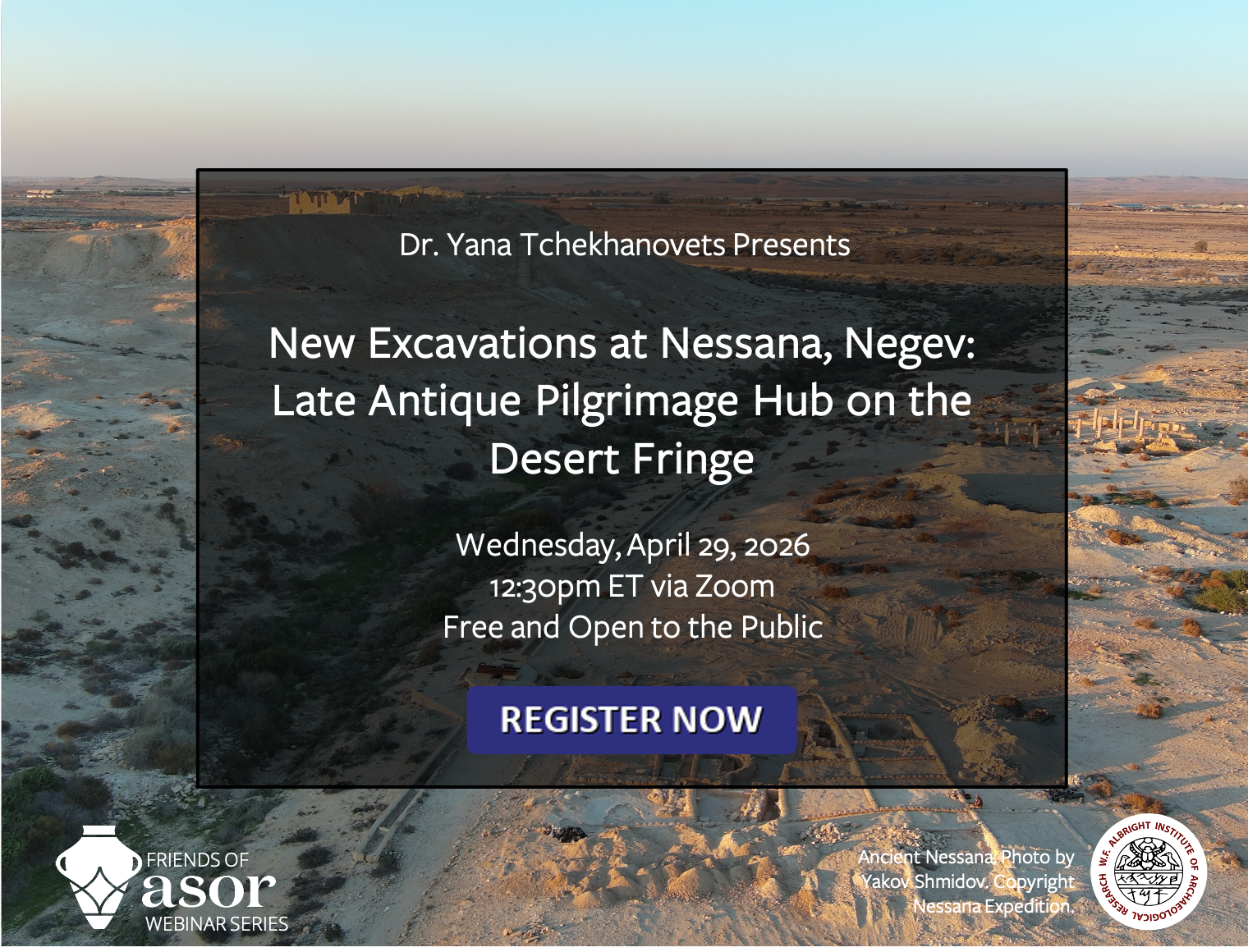
Friends of ASOR present the next webinar of the 2025-2026 season on April 29, 2026, at 12:30 pm EDT, presented by Yana Tchekhanovets. This webinar will be free and open to the public. Registration through Zoom (with a valid email address) is required. This webinar will be recorded and all registrants will be sent a recording link in the days following the webinar.
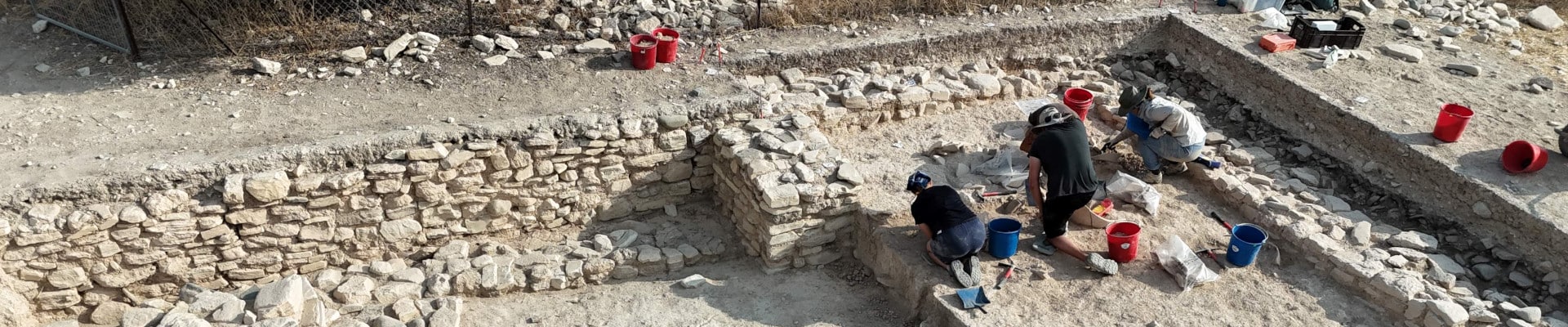
The ancient settlement of Nessana, located in the southwestern Negev, on the modern Israeli–Egyptian border, is a key site for the study of early Christian pilgrimage. Serving as the main caravan hub on the Christian pilgrimage road from the Holy Land to Sinai, Nessana enjoys all the economic benefits of the sacred route and develops into a flourishing urbanized village with caravanserais and numerous churches. This lecture will present the preliminary results of the first four seasons of renewed excavations at the site.
Yana Tchekhanovets is an archaeologist and professor at the Department of Archaeology at the Ben-Gurion University of the Negev. She specializes in late antique archaeology, Caucasian Christian communities of Byzantine Palestine, and the archaeology of pilgrimage. After many years of fieldwork in Jerusalem, Yana is now a director of the new archaeological project at ancient Nessana, Negev.
SUPPORT THE WEBINAR PROGRAM!
Friends of ASOR is pleased to announce that the first webinars of the 2025-2026 season will once again be free and open to the public with a goal to raise $10,000 so that the entire webinar season will be free. Will you support this outreach effort with a tax-deductible contribution? All donors/sponsors with gifts of $100 or more will be recognized in subsequent webinars. Make your gift today and select “webinars” from the dropdown menu.
Designate your gift for “Webinars” in the drop-down menu.
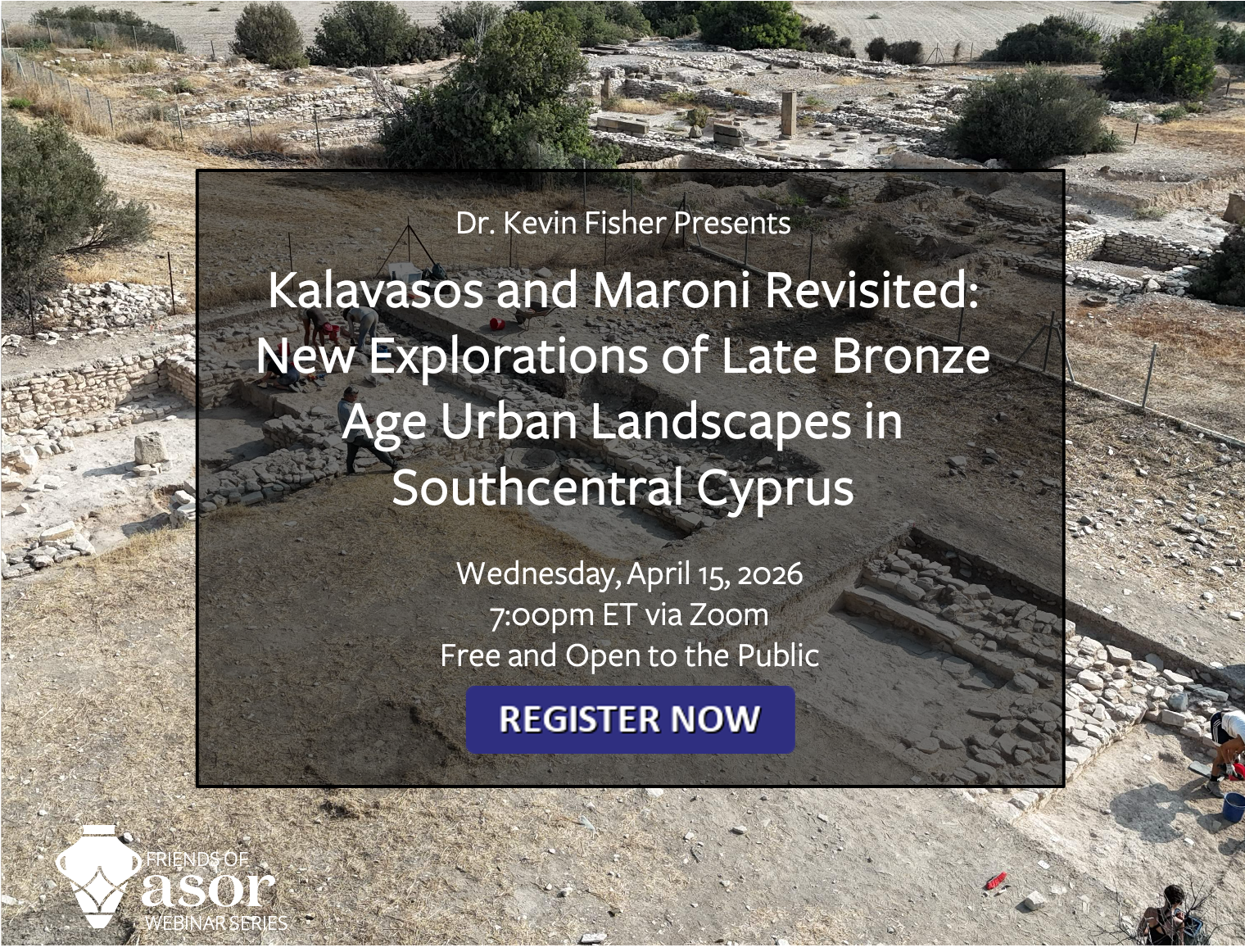
Kalavasos and Maroni Revisited: New Explorations of Late Bronze Age Urban Landscapes in Southcentral Cyprus
Friends of ASOR present the next webinar of the 2025-2026 season on April 15, 2026, at 7:00 pm EDT, presented by Kevin Fisher. This webinar will be free and open to the public. Registration through Zoom (with a valid email address) is required. This webinar will be recorded and all registrants will be sent a recording link in the days following the webinar.
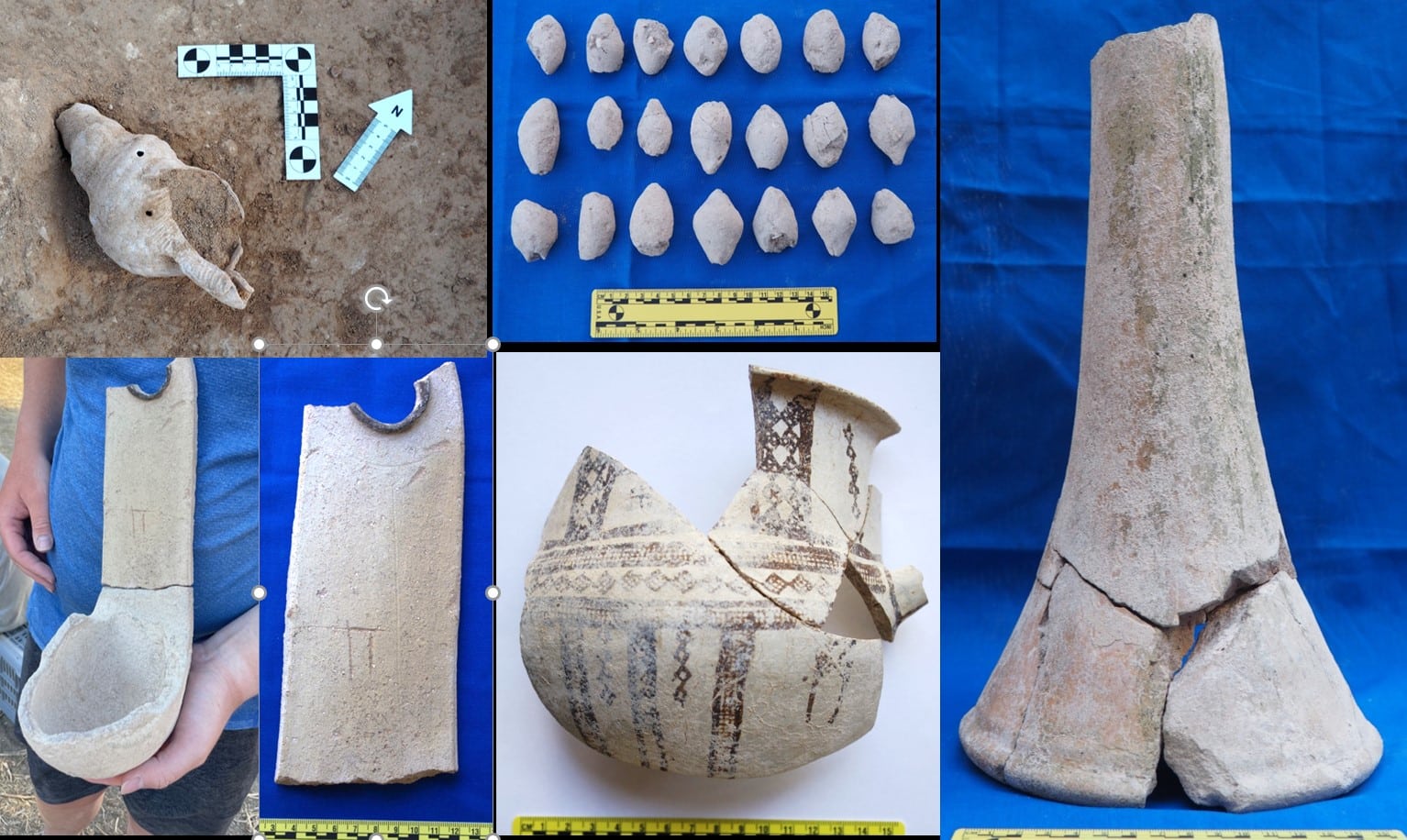
Compared with some of its better-known neighbors in the ancient eastern Mediterranean and Near East, Cyprus sees the relatively late emergence of urbanism. Its first cities appear in the Late Bronze Age (c. 1700-1100 BCE), along with other changes to the built environment, including large-scale monumental architecture and new types of domestic and mortuary architecture. At the same time, we see changes to the economy and sociopolitical organization as the island became a key player in an increasingly interconnected world. This talk presents the results of recent work by the Kalavasos and Maroni Built Environments (KAMBE) Project, a collaborative and interdisciplinary investigation of the relationship between urban landscapes and social change in south-central Cyprus during the Late Bronze Age. It focuses mainly on Kalavasos-Ayios Dhimitrios, an urban center that flourished in the 13th century BCE, where earlier excavations revealed wealthy tombs, monumental buildings and industrial-scale olive oil production. There, remote sensing, excavations, and various specialist studies are revealing fascinating new evidence for ritual activity and monumental construction near the administrative and economic core of the city. We’ll contrast these findings with evidence from the contemporaneous urban center of Maroni, about 7 km away, where the KAMBE project is revealing a rather different story of urban development.
Kevin Fisher is an anthropological archaeologist interested in the relationship between people and their built environments; urbanism and the social dynamics of ancient cities; and the application of remote sensing and digital technologies for recording, analyzing and visualizing archaeological phenomena. His research focuses mainly on the early complex societies of the eastern Mediterranean and Near East, especially Cyprus, although he has worked on projects in Greece, Jordan, Peru, Guatemala, the US and Canada. He is currently Associate Professor of Eastern Mediterranean Archaeology at the University of British Columbia in Vancouver, Canada, and co-director of the Kalavasos and Maroni Built Environments (KAMBE) Project, which is investigating the relationship between urban landscapes, interaction and social change on Late Bronze Age Cyprus (c. 1700-1100 BCE). Kevin was awarded ASOR’s 2025 G. Ernest Wright Award for his book Monumentality, Place-making and Social Interaction on Late Bronze Age Cyprus (Equinox 2023) and is co-editor with Andrew Creekmore of Making Ancient Cities: Space and Place in Early Urban Societies (Cambridge 2014).
SUPPORT THE WEBINAR PROGRAM!
Friends of ASOR is pleased to announce that the first webinars of the 2025-2026 season will once again be free and open to the public with a goal to raise $10,000 so that the entire webinar season will be free. Will you support this outreach effort with a tax-deductible contribution? All donors/sponsors with gifts of $100 or more will be recognized in subsequent webinars. Make your gift today and select “webinars” from the dropdown menu.
Designate your gift for “Webinars” in the drop-down menu.
Early Career Scholars Spring Brown Bag: Dr. Danielle Macdonald
Scientific Publishing in Archaeology: Ask an Editor
Join ASOR’s Early Career Scholars on April 3, 2026 at 12:00pm ET via Zoom for a virtual Brown Bag talk from Dr. Danielle Macdonald about scientific publishing in archaeology.
Please join the ASOR Early Career Brown Bag Lunch Series for a workshop on scientific publishing in archaeology, led by Dr. Danielle Macdonald, co-Editor of the Journal of Archaeological Science: Reports. This session will provide insights into the publication process, including understanding peer review, manuscript preparation best practices, responding to reviewer comments, and current trends in scientific archaeological publishing, including open access models. There will also be an open Q&A at the end to ask questions about publishing in scientifically-oriented journals. Whether you’re a graduate student preparing your first manuscript or an early career scholar looking for some editorial tips, this workshop will offer practical guidance from an editorial perspective.
By Danielle Macdonald, Associate Professor of Anthropology (University of Tulsa)
The event, a part of our brown bag lunch series, is FREE for the ASOR community, but registration is required.
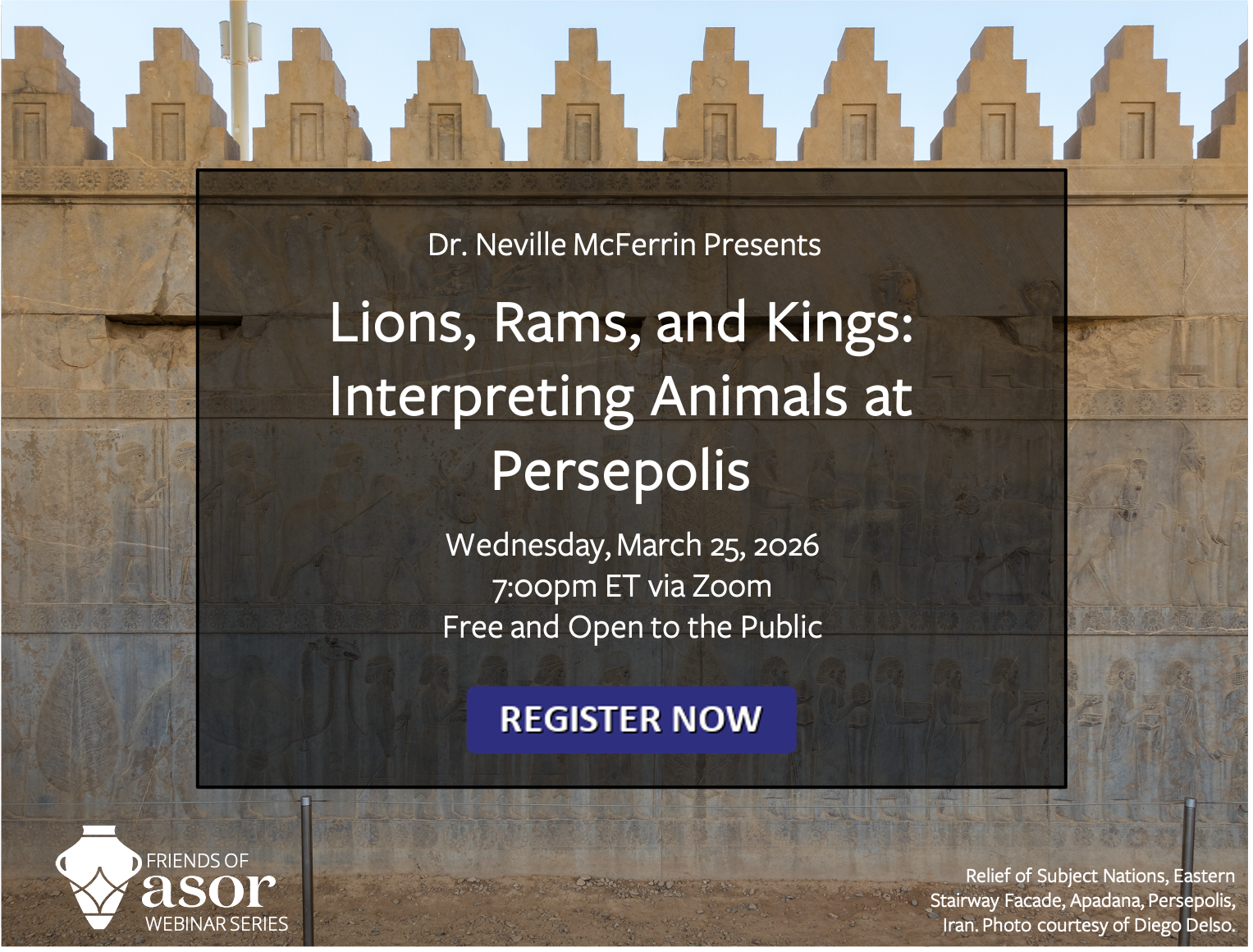
Lions, Rams, and Kings: Interpreting Animals at Persepolis
Friends of ASOR present the next webinar of the 2025-2026 season on March 25, 2026, at 7:00 pm EDT, presented by Neville McFerrin. This webinar will be free and open to the public. Registration through Zoom (with a valid email address) is required. This webinar will be recorded and all registrants will be sent a recording link in the days following the webinar.
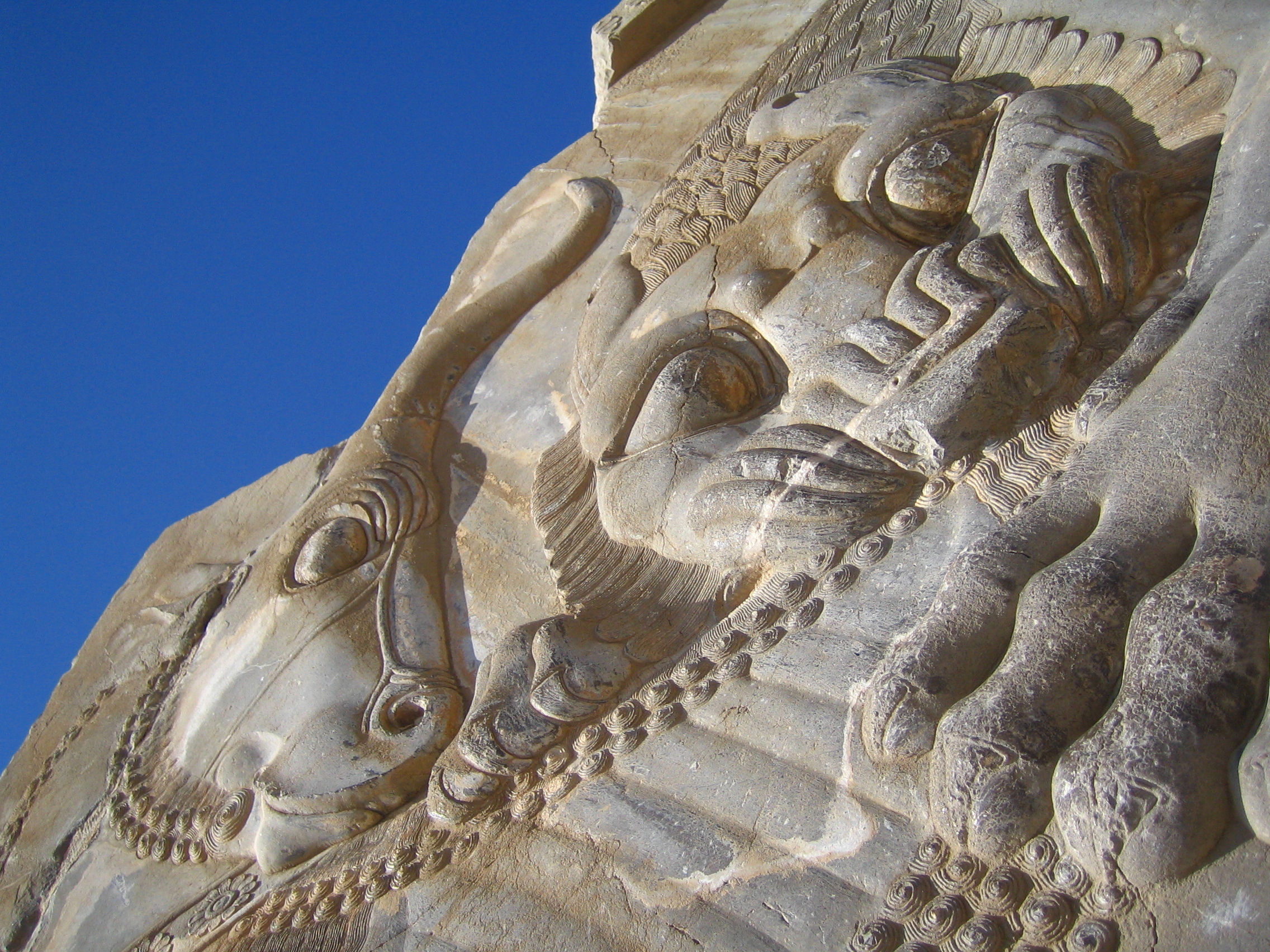
Lion and Bull, Persepolis, Iran. Photo courtesy of Gabriel White.
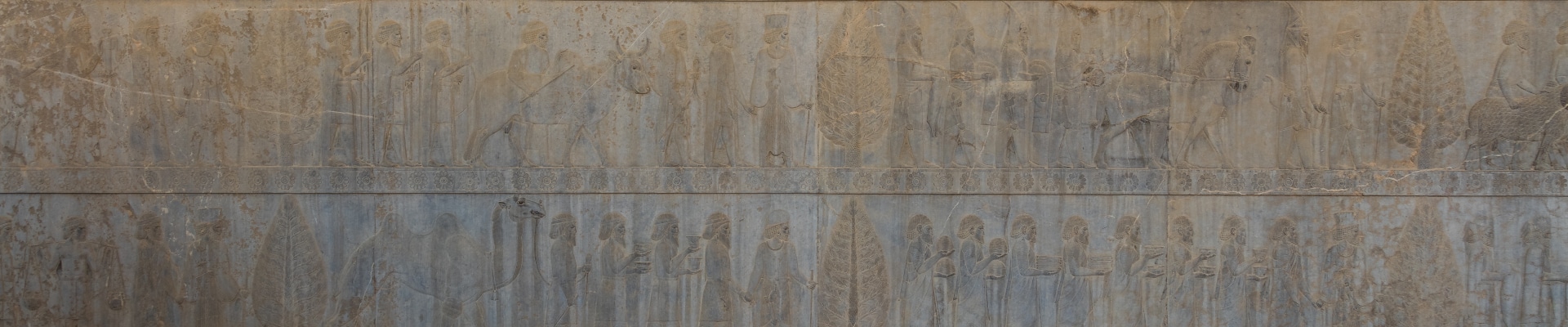
Shortly after 515 BCE, upon the successful conclusion of his military campaigns in Egypt, the Achaemenid king Darius I began construction on a new imperial center: Persepolis. Here, as the records of the Persepolis Fortification Archive attest, individuals from across the empire gathered to conduct the administrative business of an empire that stretched from the Indus River to the Mediterranean Sea and from Egypt to Thrace. It is also here that Darius articulates an ambitious re-imagination of imperial power and interaction, one built upon bonds of cooperation rather than coercion. Across the site, as reliefs depict Persian ushers carefully grasping the hands of delegates from subject nations and as inscriptions name monumental gateways in honor of all lands, a vision of an inclusive empire, one that celebrates diversity as strength, emerges. This novel conceptualization of imperial power was likely alien to many visitors to the site, leaving those who designed the site with a problem. How can the notion of an inclusive empire be conveyed to those who have not experienced it? What concepts might be used to convey such an idea to people from so many different places, with such a wide range of experiences?
Assyrian Delegation, Eastern Stairway Facade, Apadana, Persepolis, Iran. Photo courtesy of Ahmad Masoominezhad.
This talk argues that in reliefs across the site, the designers of Persepolis turn to depictions of animal encounters as a way to demonstrate to visitors the potentials of their imperial system. Through a focus upon depictions of lions, rams, and interactions between these animals and humans, the talk argues that these depictions carefully reference observed animal behavior, building upon the close relationships between humans and animals, particularly in pre-industrial societies, to highlight the agency of animals, even in those situations in which they work on behalf of their human counterparts. By focusing carefully on depicted behavioral cues, the talk suggests that animals across Persepolis signal their willing participation in the activities around them, standing in contrast to previous depictions of animals in the wider area, and serving as doubles for the humans that view them, concluding that, like visitors to the site, like humans depicted in reliefs along side them, these animals join the imperial system as partners, a partnership that parallels that of subject and ruler.
Neville McFerrin holds a PhD in Ancient Mediterranean Art and Archaeology from the Interdepartmental Program of Ancient Mediterranean Art and Archaeology at the University of Michigan. She now serves as an Assistant Professor of Ancient Mediterranean Art in the Department of Art History at the University of North Texas. Her research focuses upon intersections between dress, perception, materiality, and embodiment at the sites of Persepolis and Pompeii. Her published and forthcoming work explores a range of topics from reconsiderations of gender in the reliefs of the Apadana to the fashionability of pearls in late first century BCE Pompeii. It has appeared in multiple journals and edited volumes including Fashioned Selves: Dress and Identity in Antiquity, Fashion Studies, the Handbook of the Senses in the Ancient Near East, and most recently in The Routledge Companion to Seals and Seal Studies in Antiquity. She is currently working on a monograph that considers dress as a lens through which to reinterpret the site of Persepolis.
SUPPORT THE WEBINAR PROGRAM!
Friends of ASOR is pleased to announce that the first webinars of the 2025-2026 season will once again be free and open to the public with a goal to raise $10,000 so that the entire webinar season will be free. Will you support this outreach effort with a tax-deductible contribution? All donors/sponsors with gifts of $100 or more will be recognized in subsequent webinars. Make your gift today and select “webinars” from the dropdown menu.
Designate your gift for “Webinars” in the drop-down menu.
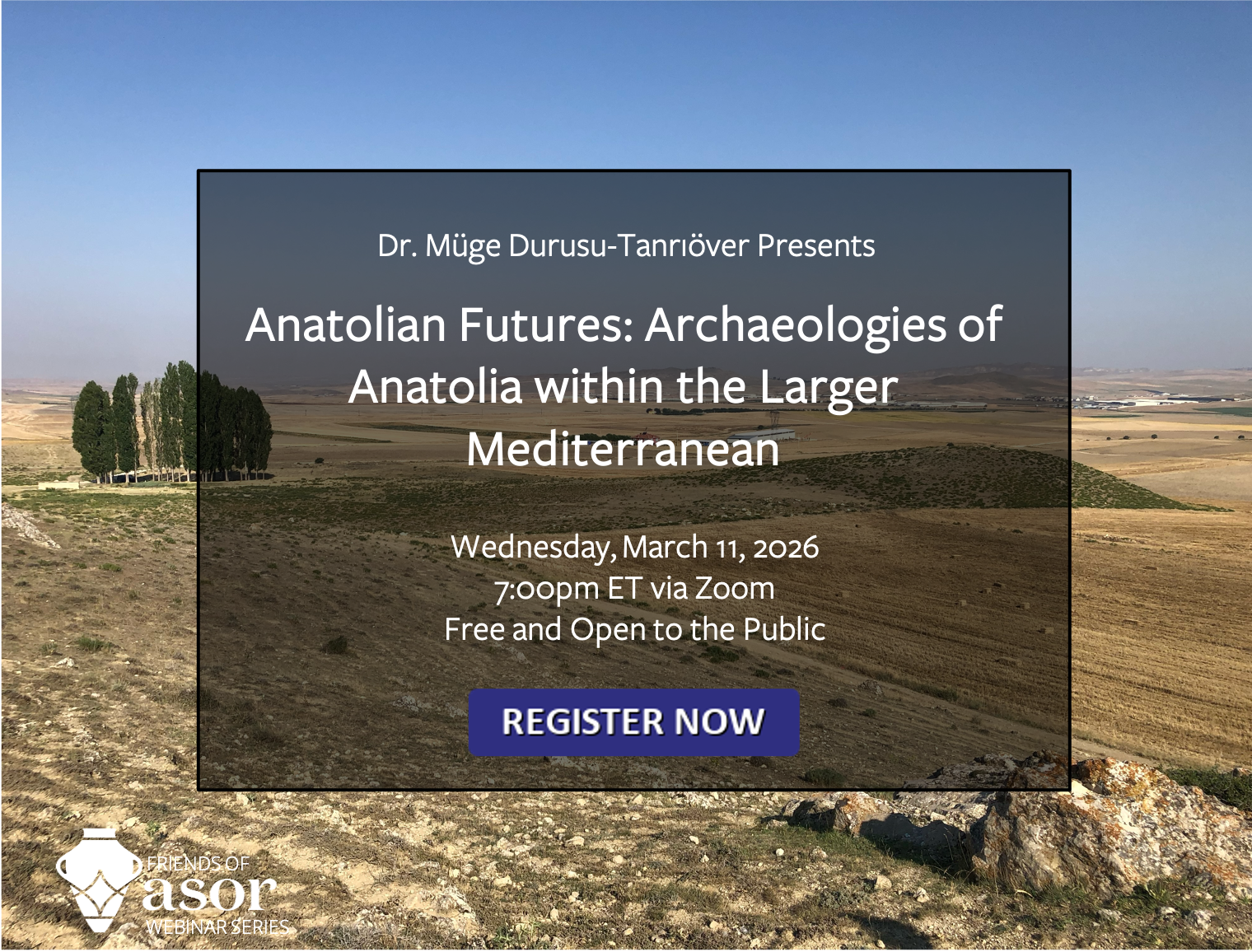
Anatolian Futures: Archaeologies of Anatolia within the Larger Mediterranean
Friends of ASOR present the next webinar of the 2025-2026 season on March 11, 2026, at 7:00 pm EDT, presented by Müge Durusu-Tanrıöver. This webinar will be free and open to the public. Registration through Zoom (with a valid email address) is required. This webinar will be recorded and all registrants will be sent a recording link in the days following the webinar.
Since their beginnings, archaeologies of Anatolia have occupied a liminal position within the larger archaeological traditions of the “Old World.” Seen as a geography in contact with, but never fully belonging to, the archaeologies of Mesopotamia, the Mediterranean, the Aegean, or the Black Sea over the longue durée, certain combinations of time and space in the Anatolian past have been siloed into various sub-fields that either look outwards to neighboring geographies or stay exclusively Anatolian. For instance, the Middle Bronze Age of the central plateau is discussed within frameworks of Mesopotamian archaeology because of the trade routes that linked Assyria to Anatolia, while the period immediately succeeding it has been studied mostly in isolation as a distinctly Anatolian phenomenon, even though the Hittite Empire of the Late Bronze Age thrived on the trade networks of the Middle Bronze Age. Similarly, the classical cities of western Anatolia are staples of Greek and Roman archaeology and are seen as part of a larger Mediterranean world, while the Bronze Age in this same geography falls between the cracks of Anatolian and Aegean traditions, remaining an understudied topic even today. Befitting the common trope of Anatolia as a bridge, the archaeologies of this geography have been fragmented into numerous transitions, some claimed by the larger Mediterranean world, while others remain distinctly Anatolian and idiosyncratic within scholarship.
In this talk, Dr. Durusu-Tanrıöver traces the lineage of this fragmentation across times, places, and people as varied as nineteenth-century European travelers to Anatolia, early Republican Ankara, continual coloniality, and Orientalism. Posing the questions of how we can define Anatolia and what its archaeologies can look like in the later twenty-first century CE, she makes the case for a connected Anatolian archaeology that can both claim its multiple constituents and contribute to the larger debates in Mediterranean archaeology. To this end, she will identify several directions including, but not limited to, deliberate theoretical engagement, multi-disciplinarity, and regional fieldwork looking beyond single sites.
Dr. Müge Durusu-Tanrıöver is an archaeologist whose research explores the strategies and impacts of ancient imperialism on border regions in the eastern Mediterranean during the Bronze and Iron Ages. Her publications and fieldwork to date have mainly focused on the Hittite Empire, approaching this state from its edges through a myriad of lenses, including material culture and hybridity, artistic production, the rhetoric of kingship, and place-making. She holds a PhD in Archaeology and the Ancient World from Brown University and is currently an Assistant Professor in Temple University’s Department of Art History. Since 2019, Dr. Durusu-Tanrıöver has directed the Polatlı Landscape Archaeology and Survey Project (PLAS), a fieldwork initiative that seeks to understand the imperial strategies of the Hittite Empire along its western border, as well as the responses of local communities to the expansion of Hittite power in the region. Dr. Durusu-Tanrıöver has received numerous grants for her research, including a Charles Harris Project Grant from ASOR in 2023.
SUPPORT THE WEBINAR PROGRAM!
Friends of ASOR is pleased to announce that the first webinars of the 2025-2026 season will once again be free and open to the public with a goal to raise $10,000 so that the entire webinar season will be free. Will you support this outreach effort with a tax-deductible contribution? All donors/sponsors with gifts of $100 or more will be recognized in subsequent webinars. Make your gift today and select “webinars” from the dropdown menu.
Designate your gift for “Webinars” in the drop-down menu.
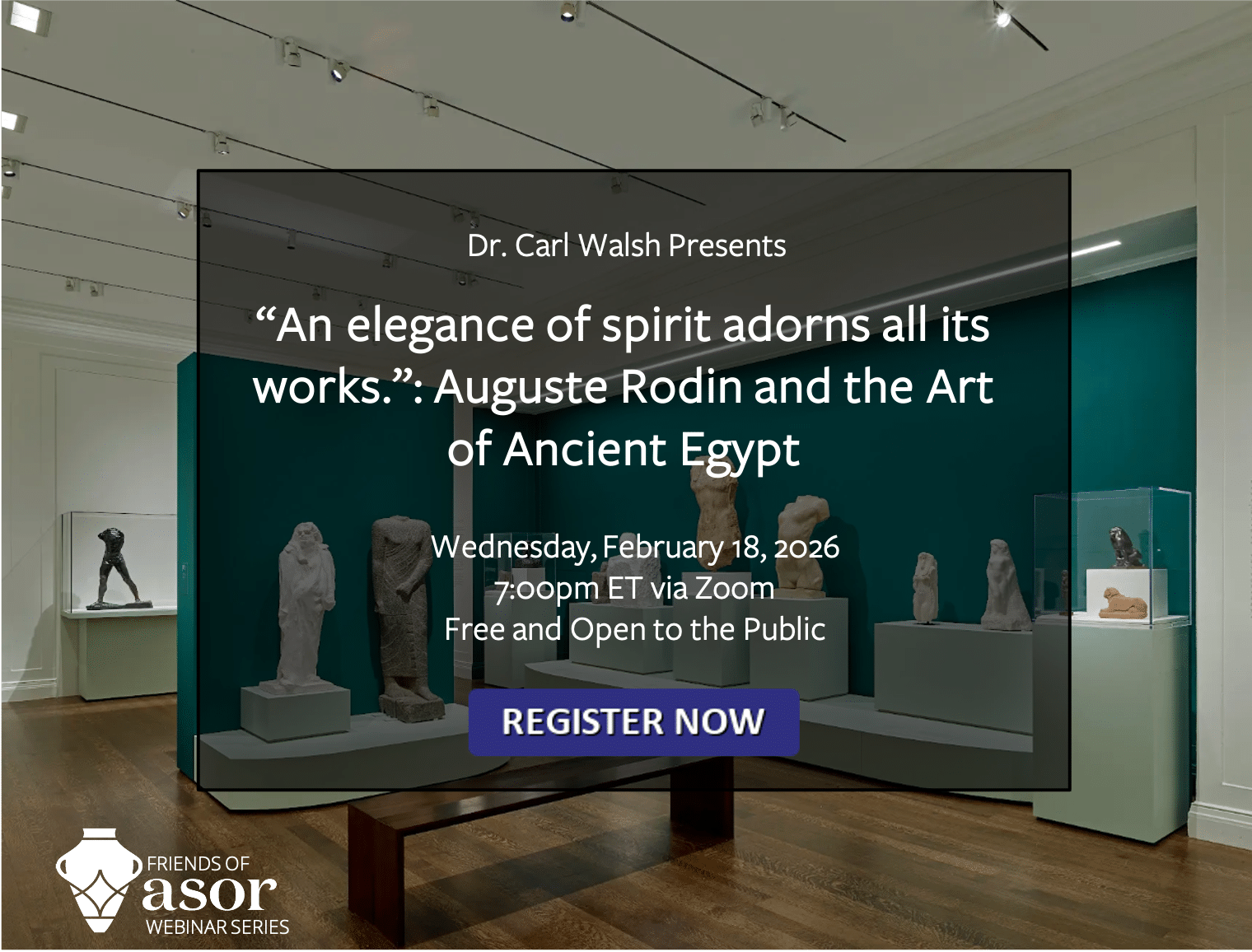
“An elegance of spirit adorns all its works.”: Auguste Rodin and the Art of Ancient Egypt
Friends of ASOR present the next webinar of the 2025-2026 season on February 18, 2026, at 7:00 pm EST, presented by Carl Walsh. This webinar will be free and open to the public. Registration through Zoom (with a valid email address) is required. This webinar will be recorded and all registrants will be sent a recording link in the days following the webinar.
Auguste Rodin. Le Succube (The Succubus). Bronze. 1888 (model), 1890 (casting). Musée Rodin: S.520.
Most people would not conceive of any connection between the works of the master French sculptor Auguste Rodin (1840–1917) and the art of ancient Egypt. Rodin is celebrated as one of the founders of modernist sculpture, who crafted sensual and expressive bodies that embraced the subject and materiality of the medium. Ancient Egyptian sculptors, on the other hand, presented highly codified representations of the human form, which have often been viewed as static, rigid, and somewhat devoid of emotion. The two certainly present radically different bodily aesthetics, divorced by vast temporal and cultural contexts. How then, can we see them as meaningfully related?
This is one of the key questions framing the current exhibition Rodin’s Egypt, now on display at the Institute for the Study of the Ancient World at New York University, in collaboration with the Musée Rodin in Paris, until March 15, 2026. The show explores Rodin’s admiration for the art of ancient Egypt and how he engaged and responded to the Egyptian antiquities he amassed over the course of his life. In this talk, Dr. Walsh will discuss how Rodin became interested in ancient Egyptian art in his waning years and the profound—if subtle—impact it had on the sculptor’s practice through the objects which you can see in the exhibition.
Dr. Carl Walsh holds a PhD in Archaeology from University College London and is an assistant exhibition curator at the Institute for the Study of the Ancient World at New York University. He is dedicated to crafting accessible and engaging stories about the ancient world and has curated multiple exhibitions at ISAW covering the ancient societies of Iraq, Etruria, Islamic Spain, and Egypt, as well as early modern art and photography. He has co-edited Teaching Ancient Egypt in Museums: Pedagogies in Practice, which delves into ethical best practices for engaging learners about ancient Egypt using museum objects and is currently working on a follow up volume that looks more broadly about teaching about ancient West Asia, North Africa, and the Mediterranean in museums. Carl’s research focuses on Bronze Age cross-cultural interactions and his current projects focus on the material culture—such as board games, cosmetics, furniture, and pottery—of the kingdom of Kerma (Kush) in modern Sudan, and considers how these objects reveal the complex interactions between societies across North Africa.
SUPPORT THE WEBINAR PROGRAM!
Friends of ASOR is pleased to announce that the first webinars of the 2025-2026 season will once again be free and open to the public with a goal to raise $10,000 so that the entire webinar season will be free. Will you support this outreach effort with a tax-deductible contribution? All donors/sponsors with gifts of $100 or more will be recognized in subsequent webinars. Make your gift today and select “webinars” from the dropdown menu.
Designate your gift for “Webinars” in the drop-down menu.
The Early Career Scholars (ECS) Committee is looking for new members. The committee requires a commitment of one hour-long meeting and 2-3 hours of outside work per month. We especially seek those interested in supporting ASOR’s Early Career (undergraduate to pre-tenure) community through creative, informal mentoring opportunities.
If you wish to be considered by the committee, please fill out the application form here. Applications will be reviewed on a rolling basis.
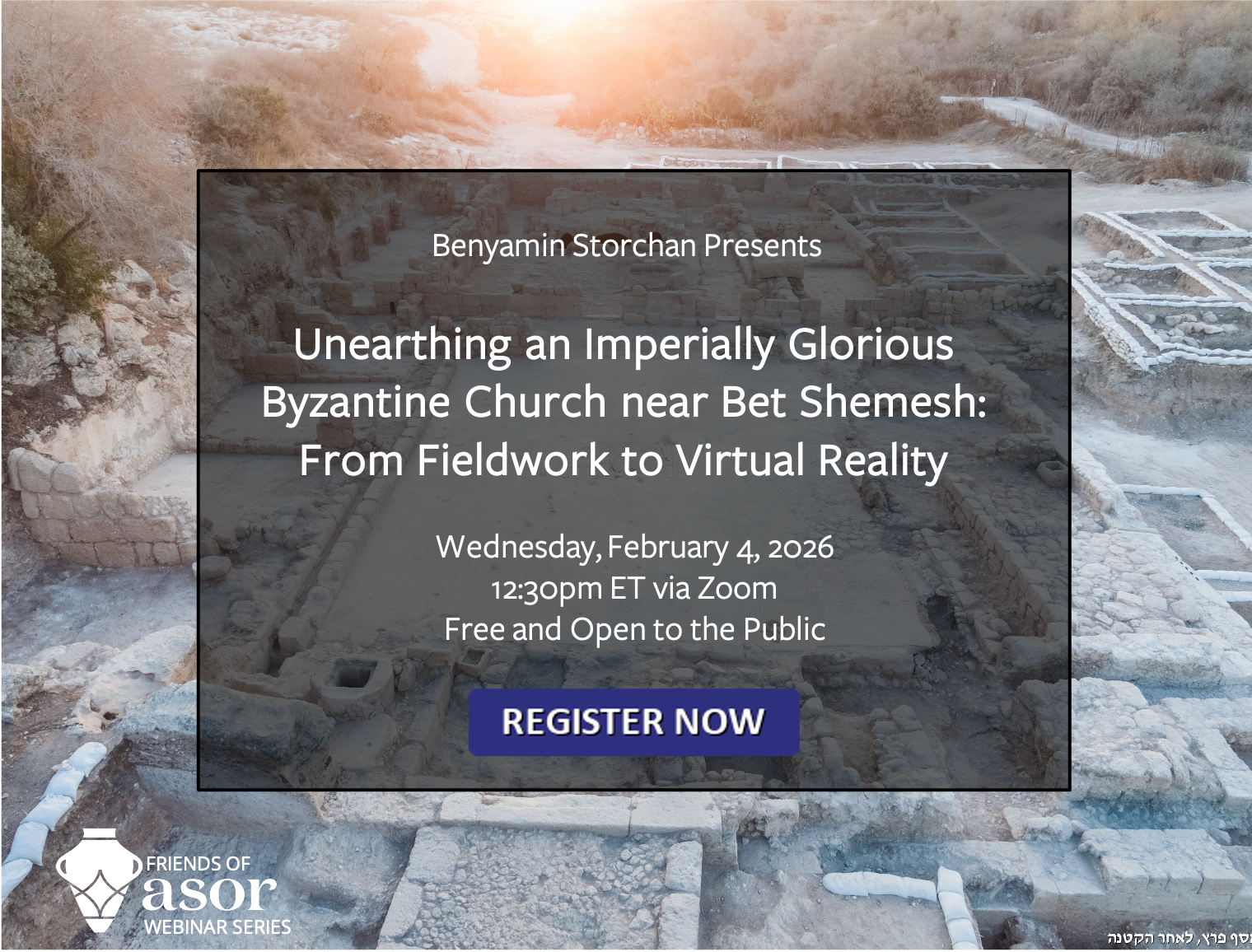
Unearthing an Imperially Glorious Byzantine Church near Bet Shemesh: From Fieldwork to Virtual Reality
Friends of ASOR present the next webinar of the 2025-2026 season on February 4, 2026, at 12:30 pm EST, presented by Benyamin Storchan. This webinar will be free and open to the public. Registration through Zoom (with a valid email address) is required. This webinar will be recorded and all registrants will be sent a recording link in the days following the webinar.
In the heart of the Holy Land, just 15 miles southwest of Jerusalem, lies one of the most remarkable Byzantine churches discovered in recent decades. The archaeological excavations at the Church of the Glorious Martyr unearthed a fascinating five-century story of faith and pilgrimage, yet the greatest mystery remains unsolved: who was the Glorious Martyr venerated in the sacred crypt? This lecture chronicles the remarkable transformation of a simple burial cave that evolved during the Byzantine period into a magnificent pilgrimage site funded by the emperor himself. Based on ancient pilgrim accounts, the site may be connected with a shrine dedicated to the biblical prophet Zechariah that appears on the famous sixth-century Madaba Map. The excavations demonstrate that the church survived political upheavals, earthquakes, and religious transitions, continuing to function even under early Islamic rule. Though the site was abandoned in the tenth century, its archaeological legacy continues to illuminate our understanding of Byzantine pilgrimage, religious architecture, and the complex relationship between Christianity and Islam in the Holy Land. Through 3D modelling and reconstruction, we can now experience the church as ancient pilgrims once did, complete with marble panels, bronze gates, and flickering oil lamps in the sacred crypt below.
Benyamin Storchan is a research excavation archaeologist for the Jerusalem Region of the Israel Antiquities Authority. He is currently a PhD candidate at Ben Gurion University of the Negev, writing a dissertation on Byzantine churches in the Holy Land during the transition to the early Islamic Period. Storchan has directed several large-scale excavations, including the Glorious Martyr excavations, the Pre- and Proto-historic settlements at Eshtaol, and landscape archaeology projects near Bet Shemesh. He has published multiple articles on Byzantine churches in the Holy Land, oil lamp production in the Roman period, and numerous final excavation reports.
SUPPORT THE WEBINAR PROGRAM!
Friends of ASOR is pleased to announce that the first webinars of the 2025-2026 season will once again be free and open to the public with a goal to raise $10,000 so that the entire webinar season will be free. Will you support this outreach effort with a tax-deductible contribution? All donors/sponsors with gifts of $100 or more will be recognized in subsequent webinars. Make your gift today and select “webinars” from the dropdown menu.
Designate your gift for “Webinars” in the drop-down menu.
Experiencing Khirbet et-Tannur: The Story of a Nabatean Temple from the Second through 21st Century
Friends of ASOR present the next webinar of the 2025-2026 season on January 21, 2026, at 7:00 pm EST, presented by Sarah Wenner. This webinar will be free and open to the public. Registration through Zoom (with a valid email address) is required. This webinar will be recorded and all registrants will be sent a recording link in the days following the webinar.
In 106 CE, Rome annexed the Nabataean Kingdom and transformed it into the Roman province of Arabia. While the move ended the political independence of the people living in modern Jordan, southern Syria, the Negev, and northern Saudi Arabia, core elements of Nabataean religion survived. Not long after the annexation, in the 2nd century CE, the Nabataean temple at Khirbet et-Tannur was constructed in Central Jordan, over four miles from the nearest village. Despite the distance, and the steep climb, the pilgrimage site thrived for centuries until its destruction in the 363 CE earthquake. In the subsequent centuries, Tannur’s rare visitors were primarily interested in iconoclastic behavior, not worship.
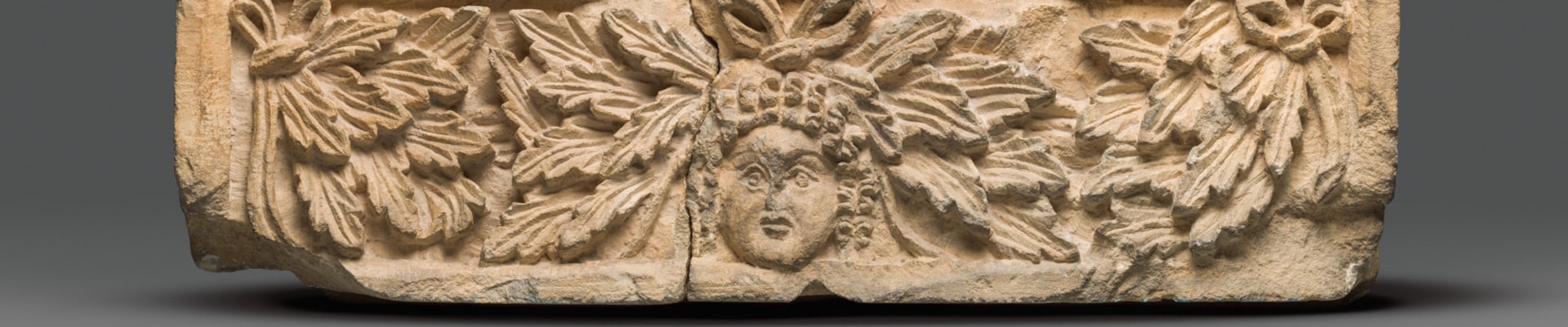
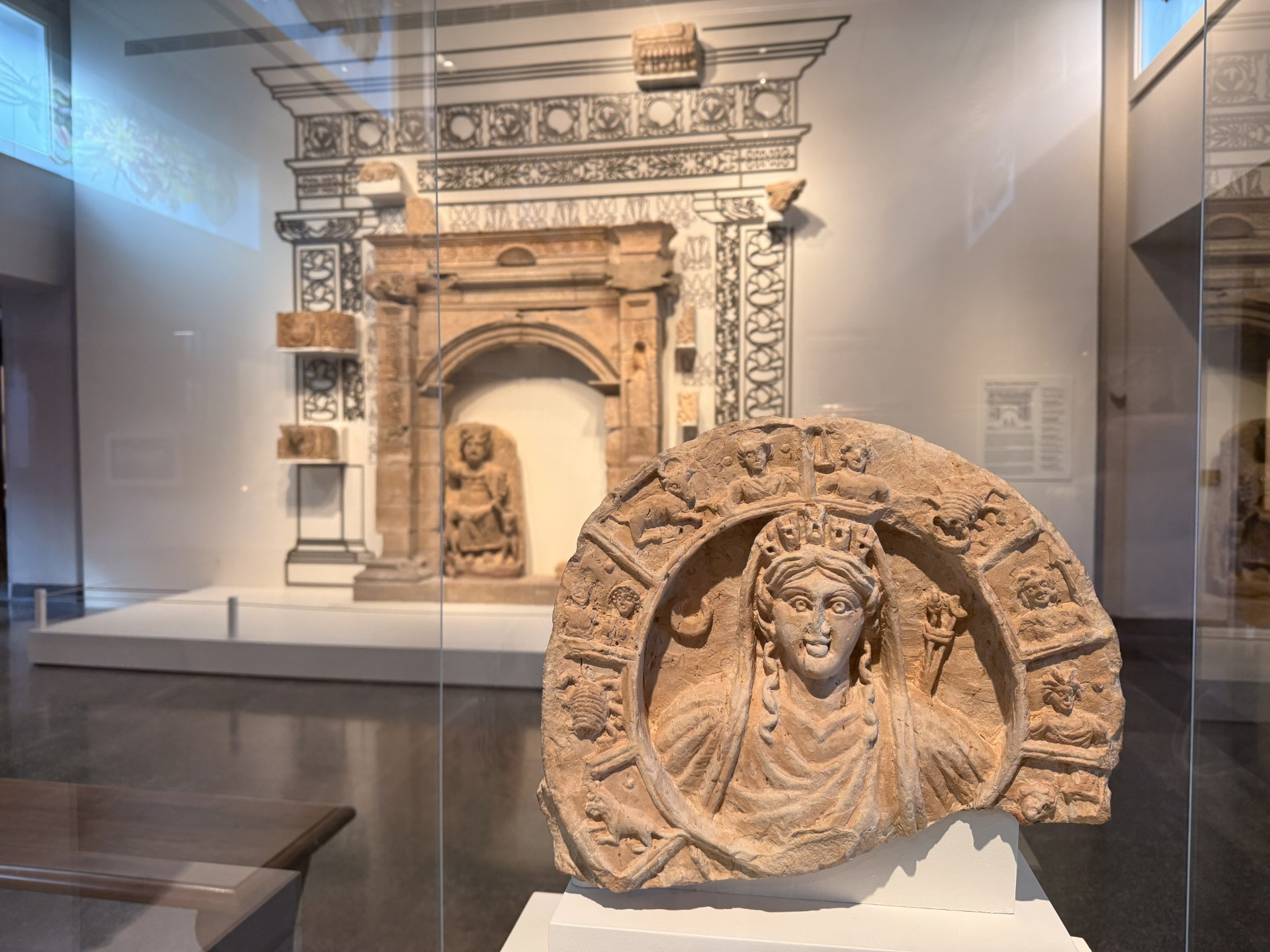
Image courtesy of the Cincinnati Art Museum.
Khirbet et-Tannur lay in ruins until Nelson Glueck and his team began excavation of the site on behalf of the Transjordanian Department of Antiquities and the American Schools of Oriental Research in 1937. Their rediscovery of the Zodiac Roundel with Bust of the Goddess Tyche (Cincinnati Art Museum, 1939.233) and a plethora of other unique sculpture reintroduced the ancient Nabataeans to the world and landed Glueck on the cover of Time magazine. And yet, the site remained largely unpublished until Judith McKenzie’s work in 2013.
Image courtesy of the Cincinnati Art Museum.
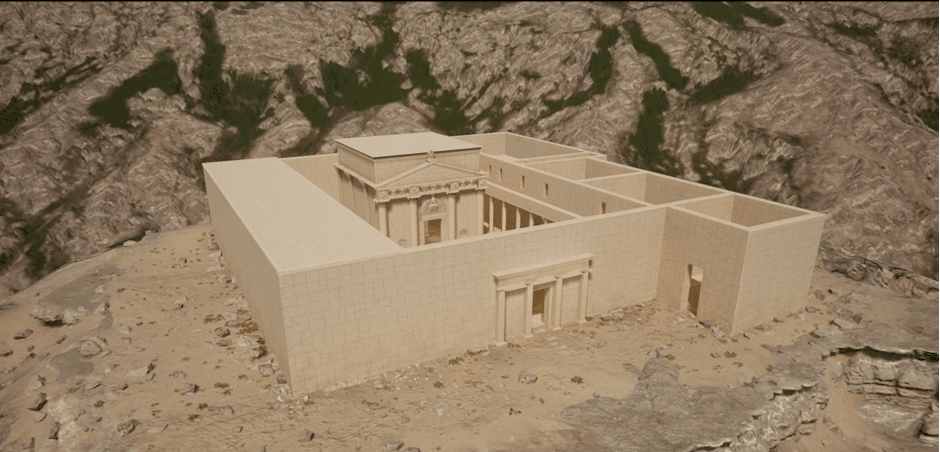
This lecture travels the site’s two millennia history, from its ancient construction and destruction in the Roman period, through Glueck’s adventures in the early-to-mid 20th century, to McKenzie’s publication and the reinstallation of the collection in 2021 at the Cincinnati Art Museum. It explores how Khirbet et-Tannur’s excavations transformed our understanding of the Nabataeans, explains how the materials came to be in Cincinnati, and demonstrates how 21st century innovations (a digital flythrough of the site and an interactive platform) and museum best practices facilitate new connections with the past. Through technology both ancient and new, the Nabataeans at Khirbet et-Tannur live on.
Sarah Wenner, PhD, is the jointly appointed Provenance Researcher & Object Historian at the Cincinnati Art Museum and Assistant Professor at the American Center of Research (Amman, Jordan). A specialist in ancient ceramics and the Nabataeans, Wenner has worked in Jordan for over a decade, including at Petra, Humayma, Wadi Ramm, Aqaba, Khirbet al-Khalde, and Udhruh, as well as at Pompeii (Italy), Tharros (Sardinia), and Monticello (USA). Her research investigates the building of Roman cities through the recycling of ancient waste.
SUPPORT THE WEBINAR PROGRAM!
Friends of ASOR is pleased to announce that the first webinars of the 2025-2026 season will once again be free and open to the public with a goal to raise $10,000 so that the entire webinar season will be free. Will you support this outreach effort with a tax-deductible contribution? All donors/sponsors with gifts of $100 or more will be recognized in subsequent webinars. Make your gift today and select “webinars” from the dropdown menu.
Designate your gift for “Webinars” in the drop-down menu.
Early Career Scholars: Call for Social Media Content Creator 2025-2026
The Early Career Scholars (ECS) Committee is seeking part-time Social Media Content Creators. This paid position offers the opportunity to engage closely with scholars working across disciplines represented by the larger ASOR community. The successful candidate(s) will assist the Community Building Subcommittee of ECS in creating content for the Early Career Scholars Highlight series. We encourage graduate students to apply for this position to gain experience working and networking with early career scholars.
The main responsibilities will be designing, writing content, and scheduling posts; reaching out to potential early career ASOR members about participation in the social media series; and maintaining and using content submitted through our Google submission form. The content creator will report directly to the ECS Community Building Subcommittee and will follow an agreed upon posting schedule.
Candidates should be adept at writing interesting and detailed social media captions to highlight the work and projects of our early career community. Candidates should also have time-management and organizational skills to follow consistent posting schedules. The candidate(s) should be proficient in using social media platforms including Facebook, Instagram, and Canva.
To apply, please submit your CV and a brief statement of interest (250 words max.) detailing your qualifications and motivations for the position. If you have any questions or concerns, please reach out to us at earlycareerscholars@asor.org.
If you wish to be considered by the committee, please fill out the application form here. Review of applications will begin on December 1, 2025 and close on January 30, 2026. The position will run from March 2 to June 30, 2026.

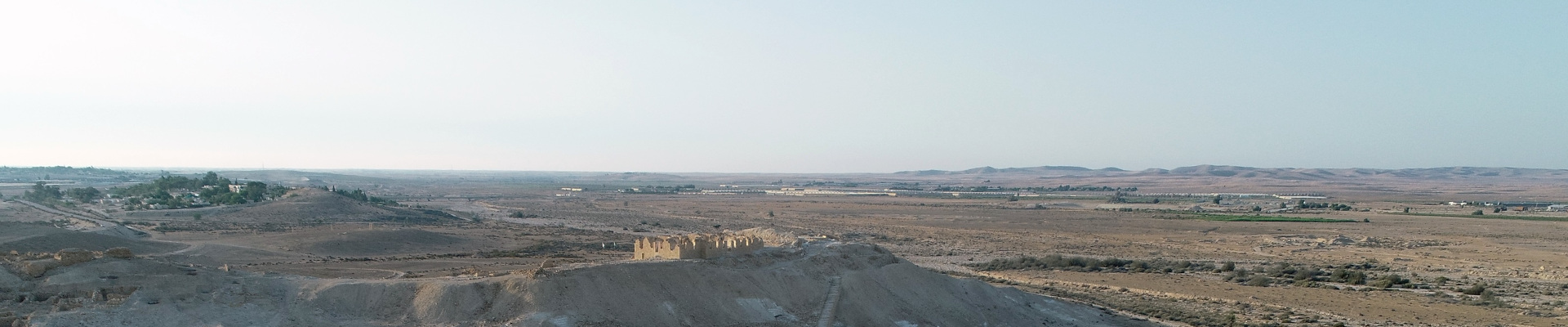
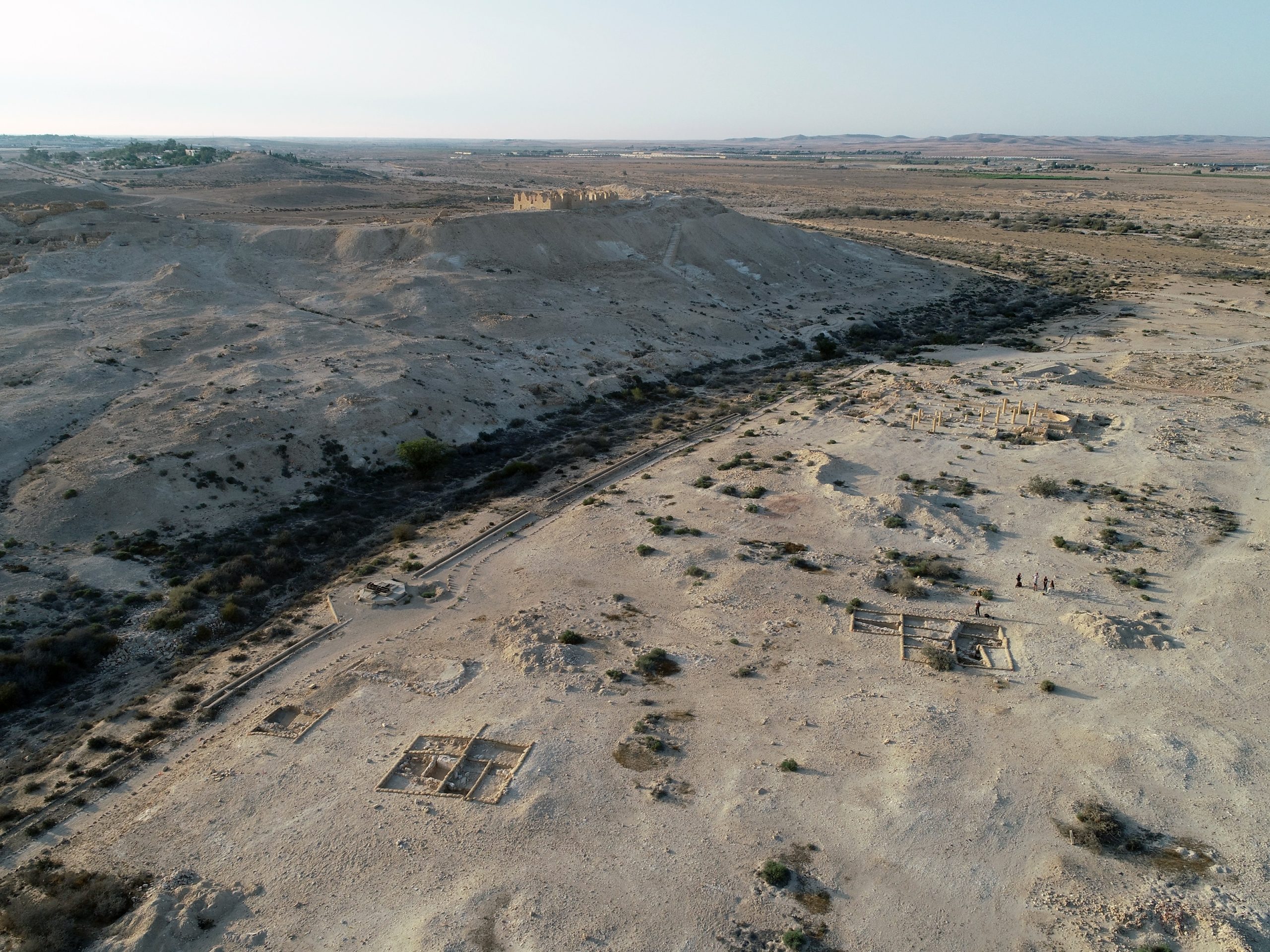 The ancient settlement of Nessana, located in the southwestern Negev, on the modern Israeli–Egyptian border, is a key site for the study of early Christian pilgrimage. Serving as the main caravan hub on the Christian pilgrimage road from the Holy Land to Sinai, Nessana enjoys all the economic benefits of the sacred route and develops into a flourishing urbanized village with caravanserais and numerous churches. This lecture will present the preliminary results of the first four seasons of renewed excavations at the site.
 Yana Tchekhanovets is an archaeologist and professor at the Department of Archaeology at the Ben-Gurion University of the Negev. She specializes in late antique archaeology, Caucasian Christian communities of Byzantine Palestine, and the archaeology of pilgrimage. After many years of fieldwork in Jerusalem, Yana is now a director of the new archaeological project at ancient Nessana, Negev.





 Neville McFerrin holds a PhD in Ancient Mediterranean Art and Archaeology from the Interdepartmental Program of Ancient Mediterranean Art and Archaeology at the University of Michigan. She now serves as an Assistant Professor of Ancient Mediterranean Art in the Department of Art History at the University of North Texas. Her research focuses upon intersections between dress, perception, materiality, and embodiment at the sites of Persepolis and Pompeii. Her published and forthcoming work explores a range of topics from reconsiderations of gender in the reliefs of the Apadana to the fashionability of pearls in late first century BCE Pompeii. It has appeared in multiple journals and edited volumes including Fashioned Selves: Dress and Identity in Antiquity, Fashion Studies, the Handbook of the Senses in the Ancient Near East, and most recently in The Routledge Companion to Seals and Seal Studies in Antiquity. She is currently working on a monograph that considers dress as a lens through which to reinterpret the site of Persepolis.
 Since their beginnings, archaeologies of Anatolia have occupied a liminal position within the larger archaeological traditions of the “Old World.” Seen as a geography in contact with, but never fully belonging to, the archaeologies of Mesopotamia, the Mediterranean, the Aegean, or the Black Sea over the longue durée, certain combinations of time and space in the Anatolian past have been siloed into various sub-fields that either look outwards to neighboring geographies or stay exclusively Anatolian. For instance, the Middle Bronze Age of the central plateau is discussed within frameworks of Mesopotamian archaeology because of the trade routes that linked Assyria to Anatolia, while the period immediately succeeding it has been studied mostly in isolation as a distinctly Anatolian phenomenon, even though the Hittite Empire of the Late Bronze Age thrived on the trade networks of the Middle Bronze Age. Similarly, the classical cities of western Anatolia are staples of Greek and Roman archaeology and are seen as part of a larger Mediterranean world, while the Bronze Age in this same geography falls between the cracks of Anatolian and Aegean traditions, remaining an understudied topic even today. Befitting the common trope of Anatolia as a bridge, the archaeologies of this geography have been fragmented into numerous transitions, some claimed by the larger Mediterranean world, while others remain distinctly Anatolian and idiosyncratic within scholarship.
 In this talk, Dr. Durusu-Tanrıöver traces the lineage of this fragmentation across times, places, and people as varied as nineteenth-century European travelers to Anatolia, early Republican Ankara, continual coloniality, and Orientalism. Posing the questions of how we can define Anatolia and what its archaeologies can look like in the later twenty-first century CE, she makes the case for a connected Anatolian archaeology that can both claim its multiple constituents and contribute to the larger debates in Mediterranean archaeology. To this end, she will identify several directions including, but not limited to, deliberate theoretical engagement, multi-disciplinarity, and regional fieldwork looking beyond single sites.
 Dr. Müge Durusu-Tanrıöver is an archaeologist whose research explores the strategies and impacts of ancient imperialism on border regions in the eastern Mediterranean during the Bronze and Iron Ages. Her publications and fieldwork to date have mainly focused on the Hittite Empire, approaching this state from its edges through a myriad of lenses, including material culture and hybridity, artistic production, the rhetoric of kingship, and place-making. She holds a PhD in Archaeology and the Ancient World from Brown University and is currently an Assistant Professor in Temple University’s Department of Art History. Since 2019, Dr. Durusu-Tanrıöver has directed the Polatlı Landscape Archaeology and Survey Project (PLAS), a fieldwork initiative that seeks to understand the imperial strategies of the Hittite Empire along its western border, as well as the responses of local communities to the expansion of Hittite power in the region. Dr. Durusu-Tanrıöver has received numerous grants for her research, including a

 Dr. Carl Walsh holds a PhD in Archaeology from University College London and is an assistant exhibition curator at the Institute for the Study of the Ancient World at New York University. He is dedicated to crafting accessible and engaging stories about the ancient world and has curated multiple exhibitions at ISAW covering the ancient societies of Iraq, Etruria, Islamic Spain, and Egypt, as well as early modern art and photography. He has co-edited Teaching Ancient Egypt in Museums: Pedagogies in Practice, which delves into ethical best practices for engaging learners about ancient Egypt using museum objects and is currently working on a follow up volume that looks more broadly about teaching about ancient West Asia, North Africa, and the Mediterranean in museums. Carl’s research focuses on Bronze Age cross-cultural interactions and his current projects focus on the material culture—such as board games, cosmetics, furniture, and pottery—of the kingdom of Kerma (Kush) in modern Sudan, and considers how these objects reveal the complex interactions between societies across North Africa.
 The
The 
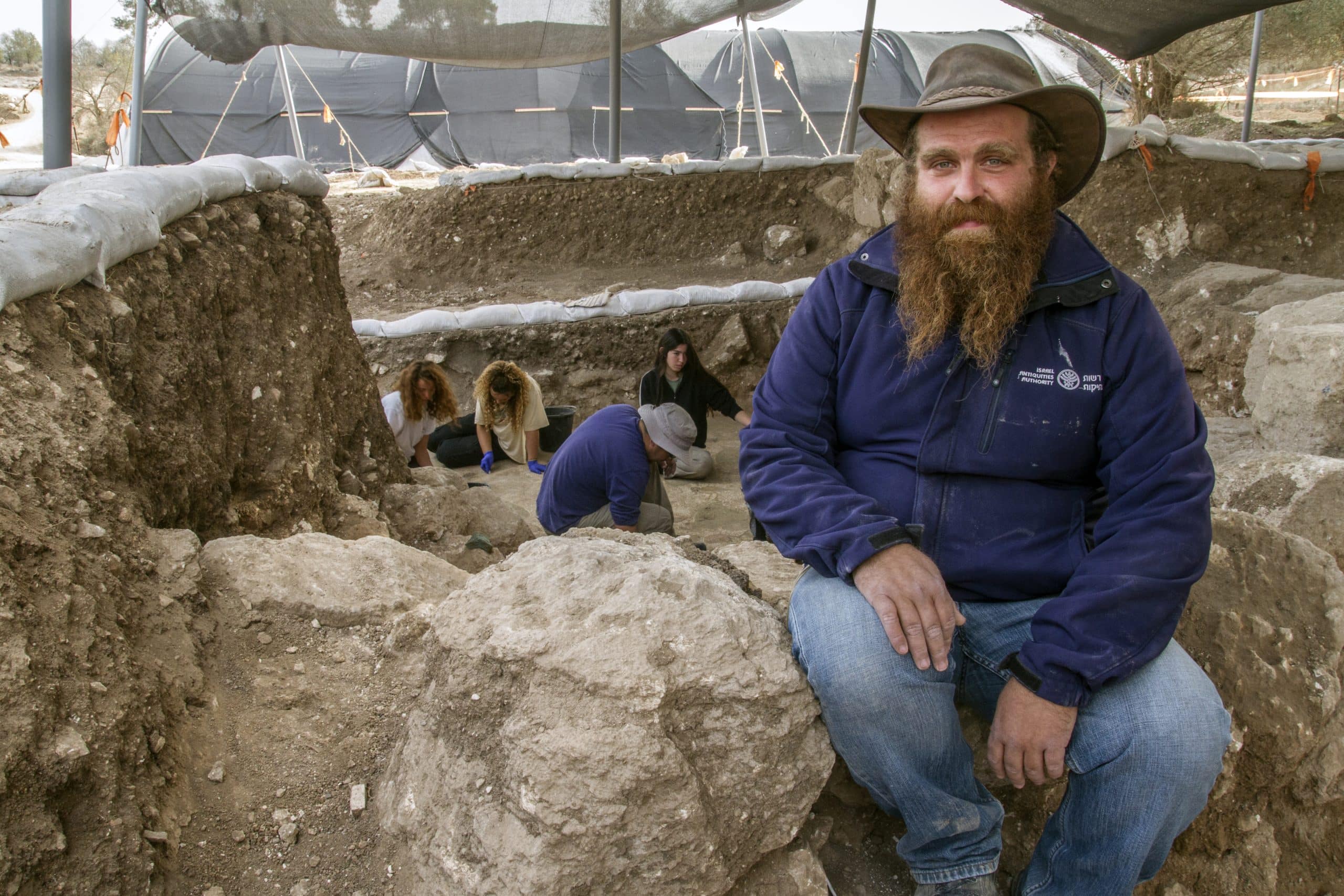 Benyamin Storchan is a research excavation archaeologist for the Jerusalem Region of the Israel Antiquities Authority. He is currently a PhD candidate at Ben Gurion University of the Negev, writing a dissertation on Byzantine churches in the Holy Land during the transition to the early Islamic Period. Storchan has directed several large-scale excavations, including the Glorious Martyr excavations, the Pre- and Proto-historic settlements at Eshtaol, and landscape archaeology projects near Bet Shemesh. He has published multiple articles on Byzantine churches in the Holy Land, oil lamp production in the Roman period, and numerous final excavation reports.
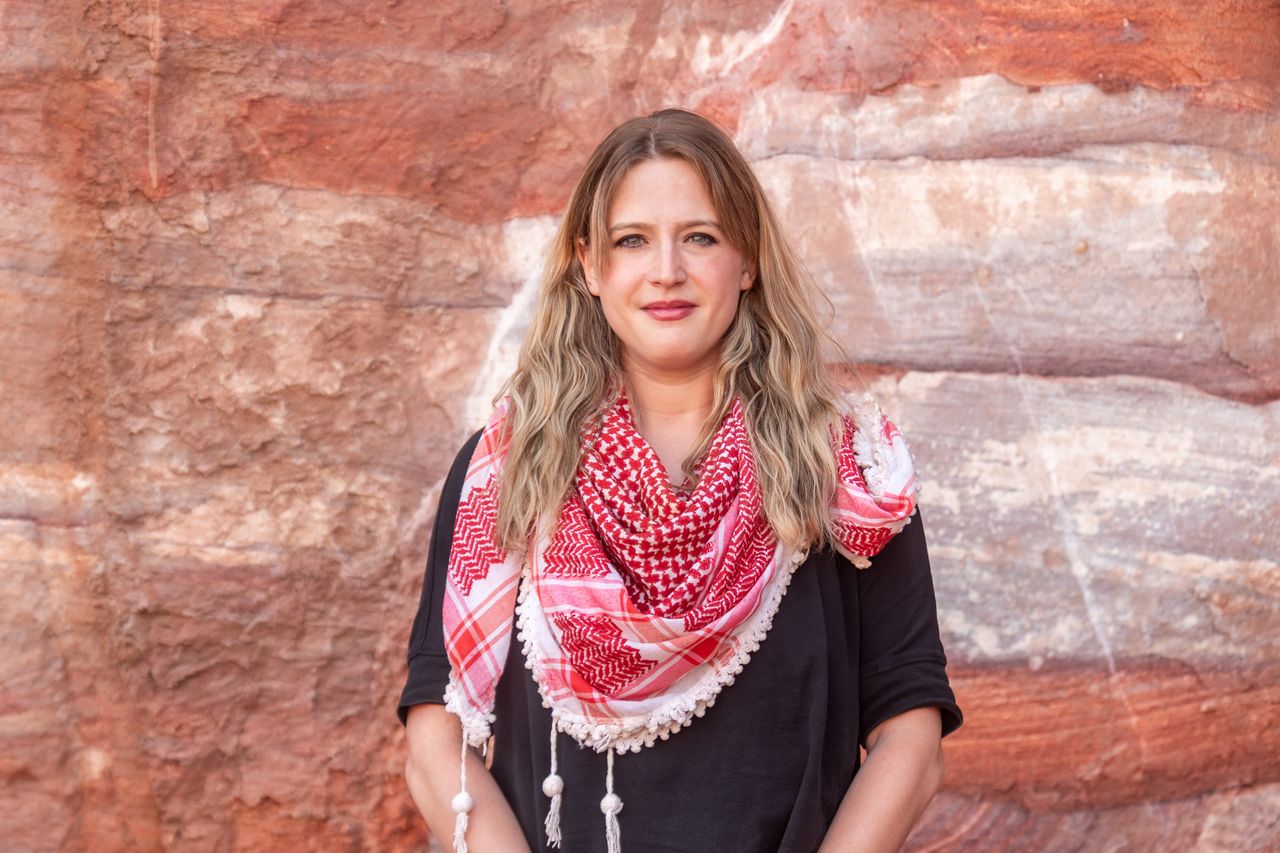 Sarah Wenner, PhD, is the jointly appointed Provenance Researcher & Object Historian at the Cincinnati Art Museum and Assistant Professor at the American Center of Research (Amman, Jordan). A specialist in ancient ceramics and the Nabataeans, Wenner has worked in Jordan for over a decade, including at Petra, Humayma, Wadi Ramm, Aqaba, Khirbet al-Khalde, and Udhruh, as well as at Pompeii (Italy), Tharros (Sardinia), and Monticello (USA). Her research investigates the building of Roman cities through the recycling of ancient waste.
 The
The