 Since their beginnings, archaeologies of Anatolia have occupied a liminal position within the larger archaeological traditions of the “Old World.” Seen as a geography in contact with, but never fully belonging to, the archaeologies of Mesopotamia, the Mediterranean, the Aegean, or the Black Sea over the longue durée, certain combinations of time and space in the Anatolian past have been siloed into various sub-fields that either look outwards to neighboring geographies or stay exclusively Anatolian. For instance, the Middle Bronze Age of the central plateau is discussed within frameworks of Mesopotamian archaeology because of the trade routes that linked Assyria to Anatolia, while the period immediately succeeding it has been studied mostly in isolation as a distinctly Anatolian phenomenon, even though the Hittite Empire of the Late Bronze Age thrived on the trade networks of the Middle Bronze Age. Similarly, the classical cities of western Anatolia are staples of Greek and Roman archaeology and are seen as part of a larger Mediterranean world, while the Bronze Age in this same geography falls between the cracks of Anatolian and Aegean traditions, remaining an understudied topic even today. Befitting the common trope of Anatolia as a bridge, the archaeologies of this geography have been fragmented into numerous transitions, some claimed by the larger Mediterranean world, while others remain distinctly Anatolian and idiosyncratic within scholarship.
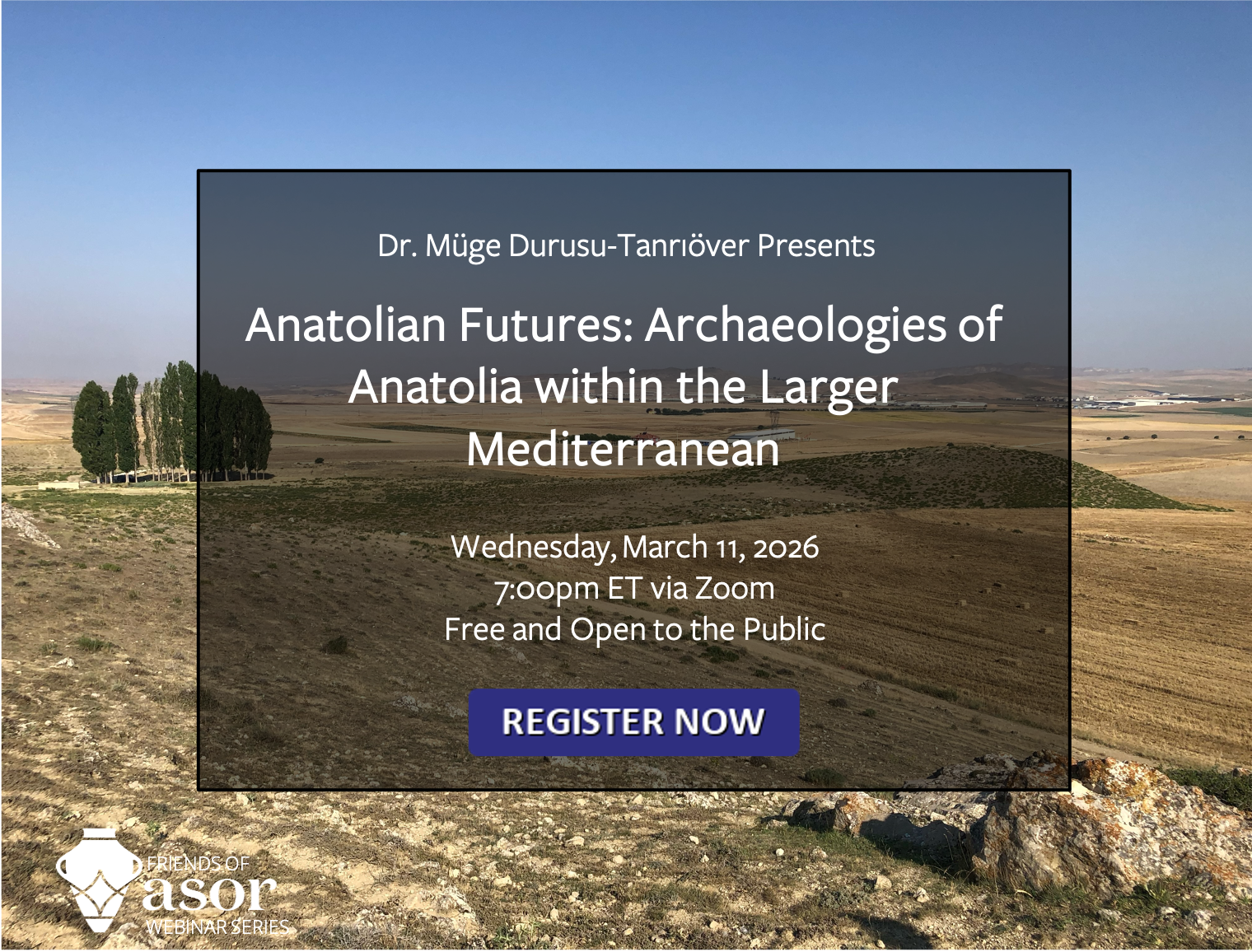
 In this talk, Dr. Durusu-Tanrıöver traces the lineage of this fragmentation across times, places, and people as varied as nineteenth-century European travelers to Anatolia, early Republican Ankara, continual coloniality, and Orientalism. Posing the questions of how we can define Anatolia and what its archaeologies can look like in the later twenty-first century CE, she makes the case for a connected Anatolian archaeology that can both claim its multiple constituents and contribute to the larger debates in Mediterranean archaeology. To this end, she will identify several directions including, but not limited to, deliberate theoretical engagement, multi-disciplinarity, and regional fieldwork looking beyond single sites.
 Dr. Müge Durusu-Tanrıöver is an archaeologist whose research explores the strategies and impacts of ancient imperialism on border regions in the eastern Mediterranean during the Bronze and Iron Ages. Her publications and fieldwork to date have mainly focused on the Hittite Empire, approaching this state from its edges through a myriad of lenses, including material culture and hybridity, artistic production, the rhetoric of kingship, and place-making. She holds a PhD in Archaeology and the Ancient World from Brown University and is currently an Assistant Professor in Temple University’s Department of Art History. Since 2019, Dr. Durusu-Tanrıöver has directed the Polatlı Landscape Archaeology and Survey Project (PLAS), a fieldwork initiative that seeks to understand the imperial strategies of the Hittite Empire along its western border, as well as the responses of local communities to the expansion of Hittite power in the region. Dr. Durusu-Tanrıöver has received numerous grants for her research, including a Charles Harris Project Grant from ASOR in 2023.
SUPPORT THE WEBINAR PROGRAM!
Friends of ASOR is pleased to announce that the first webinars of the 2025-2026 season will once again be free and open to the public with a goal to raise $10,000 so that the entire webinar season will be free. Will you support this outreach effort with a tax-deductible contribution? All donors/sponsors with gifts of $100 or more will be recognized in subsequent webinars. Make your gift today and select “webinars” from the dropdown menu.

Designate your gift for “Webinars” in the drop-down menu.