
Table of Contents for NEA 82.3 (2019)

[vc_row fullwidth=”true” attached=”true” css=”.vc_custom_1496247803139{padding-top: 0px !important;padding-right: 0px !important;padding-bottom: 0px !important;padding-left: 0px !important;}”][vc_column][vc_single_image image=”54173″ img_size=”full” alignment=”center”][/vc_column][/vc_row][vc_row fullwidth=”true” css=”.vc_custom_1496682730308{padding-top: 10px !important;padding-right: 0px !important;padding-bottom: 0px !important;padding-left: 0px !important;}”][vc_column width=”1/12″ css=”.vc_custom_1496683820796{margin-right: 10px !important;}” offset=”vc_hidden-md vc_hidden-sm vc_hidden-xs”][vc_column_text]

 SHARE

[/vc_column_text][mk_image src=”http://www.asortest.org/wp-content/uploads/2017/01/social-fb-icon4.jpg” image_width=”42″ image_height=”42″ hover=”false” custom_url=”https://www.facebook.com/ASOResearch/” margin_bottom=”0″][mk_image src=”http://www.asortest.org/wp-content/uploads/2017/01/social-tw-icon4.jpg” image_width=”42″ image_height=”42″ hover=”false” custom_url=”https://twitter.com/ASOResearch?ref_src=twsrc%5Egoogle%7Ctwcamp%5Eserp%7Ctwgr%5Eauthor” margin_bottom=”0″][mk_image src=”http://www.asortest.org/wp-content/uploads/2017/01/social-in-icon4.jpg” image_width=”42″ image_height=”42″ hover=”false” custom_url=”https://www.linkedin.com/company/american-schools-of-oriental-research” margin_bottom=”0″][mk_image src=”http://www.asortest.org/wp-content/uploads/2017/01/social-ml-icon_7.jpg” image_width=”42″ image_height=”42″ hover=”false” custom_url=”mailto:asor@bu.edu” margin_bottom=”0″][mk_image src=”http://www.asortest.org/wp-content/uploads/2017/01/blog-icon3.jpg” image_width=”42″ image_height=”42″ hover=”false” custom_url=”http://asorblog.org/” margin_bottom=”0″][/vc_column][vc_column border_color=”rgba(255,255,255,0.01)” width=”1/6″ css=”.vc_custom_1496683923840{margin-right: 20px !important;border-left-width: 2px !important;padding-right: 20px !important;padding-left: 20px !important;border-left-color: #99422f !important;}”][mk_divider divider_color=”rgba(255,255,255,0.01)” thickness=”1″ margin_top=”3″ margin_bottom=”3″][vc_column_text]

ASOR BLOG

NEWS@ASOR

ANCIENT NEAR EAST TODAY

PAST ASOR NEWS, MONTH BY MONTH

FY19 HONOR ROLL OF DONORS

ASOR ANNUAL MEETING

[/vc_column_text][/vc_column][vc_column border_color=”rgba(170,170,170,0.01)” width=”1/2″ css=”.vc_custom_1487276122024{margin-right: 10px !important;margin-bottom: 30px !important;border-right-width: 2px !important;border-bottom-width: 2px !important;padding-top: 30px !important;padding-right: 30px !important;padding-left: 20px !important;background-color: #ffffff !important;border-right-color: rgba(227,228,228,0.75) !important;border-bottom-color: rgba(227,228,228,0.75) !important;}”][vc_row_inner][vc_column_inner width=”1/4″ css=”.vc_custom_1570040186774{padding-right: 10px !important;}”][mk_image src=”http://www.asor.org/wp-content/uploads/2019/09/NEA_82_3jpg.jpg” image_width=”148″ image_height=”200″ crop=”false” hover=”false”][/vc_column_inner][vc_column_inner width=”3/4″][vc_column_text]

Table of Contents for Near Eastern Archaeology 82.3 (September 2019)

[/vc_column_text][/vc_column_inner][/vc_row_inner][vc_row_inner][vc_column_inner css=”.vc_custom_1570040186774{padding-right: 10px !important;}”][vc_column_text]

You can receive NEA (and other ASOR publications) through an ASOR Membership. Please e-mail the Membership office if you have any questions.

[/vc_column_text][/vc_column_inner][/vc_row_inner][mk_divider][vc_row_inner][vc_column_inner width=”1/4″ css=”.vc_custom_1570041002103{padding-right: 10px !important;}”][mk_image src=”http://www.asor.org/wp-content/uploads/2019/09/fg11_200x500.jpg” image_width=”200″ image_height=”500″ crop=”false” hover=”false”][/vc_column_inner][vc_column_inner width=”3/4″][vc_column_text]

Pp. 132-139: “Exile and Return of the First Temple Vessels: Competing Postexilic Perspectives and Claims of Continuity,” by Debra Scoggins Ballentine

Jerusalem’s destruction and the Babylonian exile were catalysts for the composition and redaction of much Judean literature. Authors wrestled with disruption of cultus and the uncertainty of returnees having to sort out their place—both physical spaces and abstract social places—back in Jerusalem and Judah. Stories about the temple vessels feature competing claims about their fate: that they were dismantled or left intact during the exile; that they were stored in a Babylonian temple or used as Babylonian wine goblets; that they were returned to Jerusalem with divine protection; and even that they were temporarily displaced once back in Jerusalem. These varied fates reflect competition between groups and individuals—both historical figures and literary characters—such as Jeremiah, Daniel, Ezra, and Nehemiah. Postexilic authors employed stories about the vessels to privilege particular forms of ritual, endorse select groups and ideologies, and undercut alternative positions.[/vc_column_text][/vc_column_inner][/vc_row_inner][vc_column_text responsive_align=”left”]ASOR Members with online access: navigate to the token link email sent to you before attempting to read this article. Once you have activated your member token, click here to access the above article on The University of Chicago Press Journals’ website.[/vc_column_text][mk_divider][vc_row_inner][vc_column_inner width=”1/4″ css=”.vc_custom_1570041002103{padding-right: 10px !important;}”][mk_image src=”http://www.asor.org/wp-content/uploads/2019/10/fg7_200x500.jpg” image_width=”200″ image_height=”500″ crop=”false” hover=”false”][/vc_column_inner][vc_column_inner width=”3/4″][vc_column_text]

Pp. 140-147: “Another Temple, Another Vessel: Josephus, the Arch of Titus, and Roman Triumphal Propaganda,” by Nathaniel DesRosiers

In 71 CE, the year after the destruction of the second Jerusalem temple, the victorious emperor Vespasian and his son Titus, commander of the Judean
campaign, celebrated their success with a victory triumph through the streets of Rome. Josephus provides a full account of the event in The Jewish War 7.123–58, lingering in particular on his description of the spoils of the Temple as they were paraded through the streets. He states: “The spoils were piled in heaps, but prominent above all were the spoils from the temple in Jerusalem, these included a golden table many talents in weight and a lampstand likewise made of gold” (JW 7.148).[/vc_column_text][/vc_column_inner][/vc_row_inner][vc_column_text responsive_align=”left”]ASOR Members with online access: navigate to the token link email sent to you before attempting to read this article. Once you have activated your member token, click here to access the above article on The University of Chicago Press Journals’ website.[/vc_column_text][mk_divider][vc_row_inner][vc_column_inner width=”1/4″ css=”.vc_custom_1570041002103{padding-right: 10px !important;}”][mk_image src=”http://www.asor.org/wp-content/uploads/2019/09/fg8_200x500.jpg” image_width=”200″ image_height=”500″ crop=”false” hover=”false”][/vc_column_inner][vc_column_inner width=”3/4″][vc_column_text]

Pp. 148-155: “When Yosa Meshita Took the Temple Menorah: A Rabbinic Legend,” by Steven Fine

The rabbis of late antiquity were well aware that after the destruction of the Second Temple the most precious “sacred vessels” had been taken to Rome. Classical rabbinic literature records numerous legends of the destruction including discussions of the fate of the sacred vessels, including “a golden menorah.” At times preserving distant memories of the war, these stories are most significant for the ways that later generations lived with and interpreted the continuing meaning of this national trauma. In this essay I will employ anthropological/folklore approaches better to understand rabbinic texts. That is, I examine the human characters who wrote, performed, heard, and read these traditions in late antiquity (Hasan-Rokem 2003; Fine in press). I focus on the authorship and reception of rabbinic tradition by late antique audiences by undertaking a “thick description” of a story preserved in Genesis Rabbah, a collection of homiletical midrashim assembled in the Galilee near the turn of the fifth century CE. I focus on the treason of a certain Yosa Meshita, suggesting contexts in which this tale “lived,” situating it within the world in which it was authored, performed, and achieved its literary form.

[/vc_column_text][/vc_column_inner][/vc_row_inner][vc_column_text responsive_align=”left”]ASOR Members with online access: navigate to the token link email sent to you before attempting to read this article. Once you have activated your member token, click here to access the above article on The University of Chicago Press Journals’ website.[/vc_column_text][mk_divider][vc_row_inner][vc_column_inner width=”1/4″ css=”.vc_custom_1570041002103{padding-right: 10px !important;}”][mk_image src=”http://www.asor.org/wp-content/uploads/2019/10/fg1_200x500.jpg” image_width=”200″ image_height=”500″ crop=”false” hover=”false”][/vc_column_inner][vc_column_inner width=”3/4″][vc_column_text]Pp. 156-163: “Facing the Holy Ark, in Words and in Images,” by Steven D. Fraade

The ark of the covenant was central to the plan of the Jerusalem Temple and the wilderness tabernacle before it, as the vessel was located in the structures’ holiest, innermost domain. Despite its importance, the ark of the covenant was invisible to virtually all Israelites. Even while the ark was being assembled, disassembled, and transported in the wilderness, the Levitical Kohathites were instructed to shield it from view, including their own (Num 4:5–20). One of the chief obligations of Aaron and his descendants was to deny access to anyone else, including the Levites, to the Holy of Holies, which housed the ark alone, or risk death (Num 18:1–7, 22–23).

[/vc_column_text][/vc_column_inner][/vc_row_inner][vc_column_text responsive_align=”left”]ASOR Members with online access: navigate to the token link email sent to you before attempting to read this article. Once you have activated your member token, click here to access the above article on The University of Chicago Press Journals’ website.[/vc_column_text][mk_divider][vc_row_inner][vc_column_inner width=”1/4″ css=”.vc_custom_1570041002103{padding-right: 10px !important;}”][mk_image src=”http://www.asor.org/wp-content/uploads/2019/10/fg9_200x500.jpg” image_width=”200″ image_height=”500″ crop=”false” hover=”false”][/vc_column_inner][vc_column_inner width=”3/4″][vc_column_text]

Pp. 164-171: “When Is a Menorah Not Just a Menorah? Rethinking Menorah Graffiti in Jewish Mortuary Contexts,” by Karen B. Stern

Hundreds of representations of menorahs have been uncovered from across the ancient world, throughout Egypt, Asia Minor, the Black Sea, Malta, North Africa, Europe, Arabia, Judaea, Palaestina, and Syria. Studied intently by historians, these depictions testify to the symbol’s historical importance, longevity, and myriad uses in antiquity. Many scholars have speculated that the menorahs evoke messianic ideas or those of resurrection; others argue that they signify divine presence or the cosmos at large. Recurring representations of menorahs in modern Jewish religious contexts, in all cases, have assured that the menorah remains the most recognizable of all the temple vessels to modern audiences.

[/vc_column_text][/vc_column_inner][/vc_row_inner][vc_column_text responsive_align=”left”]ASOR Members with online access: navigate to the token link email sent to you before attempting to read this article. Once you have activated your member token, click here to access the above article on The University of Chicago Press Journals’ website.[/vc_column_text][mk_divider][vc_row_inner][vc_column_inner width=”1/4″ css=”.vc_custom_1570041002103{padding-right: 10px !important;}”][mk_image src=”http://www.asor.org/wp-content/uploads/2019/10/fg5_200x500.jpg” image_width=”200″ image_height=”500″ crop=”false” hover=”false”][/vc_column_inner][vc_column_inner width=”3/4″][vc_column_text]

Pp. 172-178: “Remembering the Destruction(s) of the Temple at the Museum of the Bible,” by Cavan Concannon

Tucked away on the fifth floor of the Museum of the Bible (MOTB) in Washington, DC is a worn stone, weighing roughly a ton. Unlike most museum exhibits, this one invites visitors to touch its rough surface. The stone would be unremarkable but for what it was made to support: the terrace of the Second Temple in Jerusalem. The stone is on loan to the MOTB as part of an exhibit called “The People of the Land: History and Archaeology of Ancient Israel” by the Israel Antiquities Authority (IAA). It once formed part of the Western Wall, the massive terrace that supported Herod the Great’s expansion of the Second Temple complex. As visitors touch this piece of the “temple,” they accept the MOTB’s invitation to a pilgrimage experience. As one evangelical news site put it, “It’s an opportunity to get a glimpse of the Holy Land without visiting the Middle East” (Stahl and Mitchell 2017).

[/vc_column_text][/vc_column_inner][/vc_row_inner][vc_column_text responsive_align=”left”]ASOR Members with online access: navigate to the token link email sent to you before attempting to read this article. Once you have activated your member token, click here to access the above article on The University of Chicago Press Journals’ website.[/vc_column_text][mk_divider][vc_row_inner][vc_column_inner width=”1/4″ css=”.vc_custom_1570041002103{padding-right: 10px !important;}”][mk_image src=”http://www.asor.org/wp-content/uploads/2019/10/fg10_200x500.jpg” image_width=”200″ image_height=”500″ crop=”false” hover=”false”][/vc_column_inner][vc_column_inner width=”3/4″][vc_column_text]

Pp. 179-185: (Exhibit Review) “The World Between Empires, Metropolitan Museum of Art, New York,” by Stephanie Lynn Budin

This past March I had the grand opportunity to visit this exhibit curated by Blair Fowlkes-Childs and Michael Seymour, which ran from March through June 2019. The intent of the exhibit was twofold. On the one hand it provided a survey of the various cities, states, and societies that populated the Middle East between the great empires of Rome to the west and Parthia to the east (thus the title of the exhibit), ranging in date from the first century BCE to the mid-third century ce. Of particular interest was how these communities situated between dominant and domineering cultures formed their own identities through the mixture of indigenous and imported traditions, and how these identities were expressed. Thus the placard welcoming visitors to the exhibit reads: Following a journey along ancient trade routes across the Middle East, the exhibition explores how local life and culture were shaped by diverse cities and communities, and how identities were expressed through art.

[/vc_column_text][/vc_column_inner][/vc_row_inner][vc_column_text responsive_align=”left”]ASOR Members with online access: navigate to the token link email sent to you before attempting to read this article. Once you have activated your member token, click here to access the above article on The University of Chicago Press Journals’ website.[/vc_column_text][mk_divider][vc_column_text responsive_align=”left”]

Pp. 186-189: “Third Workshop on Gender, Methodology, and the Ancient Near East: Enhancing Networking and Consolidating an Initiative,” by Katrien De Graef, Agnès Garcia-Ventura, Anne Goddeeris, and Saana Svärd

ASOR Members with online access: navigate to the token link email sent to you before attempting to read this article. Once you have activated your member token, click here to access the above report on The University of Chicago Press Journals’ website.

[/vc_column_text][mk_divider][vc_column_text]
ASOR Members with online access: navigate to the token link email sent to you before attempting to read this issue. Once you have activated your member token, click here to access the the entire issue, including book reviews, on The University of Chicago Press Journals’ website.
[/vc_column_text][/vc_column][vc_column border_color=”rgba(170,170,170,0.01)” width=”1/6″ css=”.vc_custom_1496684098866{margin-right: 5px !important;margin-bottom: 20px !important;border-right-width: 2px !important;border-bottom-width: 2px !important;padding-top: 30px !important;padding-right: 10px !important;padding-left: 10px !important;background-color: #ffffff !important;border-right-color: rgba(227,228,228,0.75) !important;border-bottom-color: rgba(227,228,228,0.75) !important;}”][vc_wp_posts title=”BROWSE THE NEWS ARCHIVE” number=”4″][/vc_column][vc_column border_color=”rgba(170,170,170,0.01)” width=”1/6″ css=”.vc_custom_1496684008271{margin-right: 10px !important;margin-bottom: 30px !important;border-right-width: 2px !important;border-bottom-width: 2px !important;padding-top: 30px !important;padding-right: 20px !important;padding-left: 20px !important;background-color: #ffffff !important;border-right-color: rgba(227,228,228,0.75) !important;border-bottom-color: rgba(227,228,228,0.75) !important;}”][vc_column_text] [/vc_column_text][/vc_column][/vc_row]

Table of Contents for NEA 82.2 (June 2019)

[vc_row fullwidth=”true” attached=”true” css=”.vc_custom_1496247803139{padding-top: 0px !important;padding-right: 0px !important;padding-bottom: 0px !important;padding-left: 0px !important;}”][vc_column][mk_image src=”http://www.asor.org/wp-content/uploads/2019/06/NEA82-2_banner.png” image_width=”1920″ image_height=”400″ hover=”false” margin_bottom=”0″][/vc_column][/vc_row][vc_row fullwidth=”true” css=”.vc_custom_1496682730308{padding-top: 10px !important;padding-right: 0px !important;padding-bottom: 0px !important;padding-left: 0px !important;}”][vc_column width=”1/12″ css=”.vc_custom_1496683820796{margin-right: 10px !important;}” offset=”vc_hidden-md vc_hidden-sm vc_hidden-xs”][vc_column_text]

 SHARE

[/vc_column_text][mk_image src=”http://www.asortest.org/wp-content/uploads/2017/01/social-fb-icon4.jpg” image_width=”42″ image_height=”42″ hover=”false” custom_url=”https://www.facebook.com/ASOResearch/” margin_bottom=”0″][mk_image src=”http://www.asortest.org/wp-content/uploads/2017/01/social-tw-icon4.jpg” image_width=”42″ image_height=”42″ hover=”false” custom_url=”https://twitter.com/ASOResearch?ref_src=twsrc%5Egoogle%7Ctwcamp%5Eserp%7Ctwgr%5Eauthor” margin_bottom=”0″][mk_image src=”http://www.asortest.org/wp-content/uploads/2017/01/social-in-icon4.jpg” image_width=”42″ image_height=”42″ hover=”false” custom_url=”https://www.linkedin.com/company/american-schools-of-oriental-research” margin_bottom=”0″][mk_image src=”http://www.asortest.org/wp-content/uploads/2017/01/social-ml-icon_7.jpg” image_width=”42″ image_height=”42″ hover=”false” custom_url=”mailto:asor@bu.edu” margin_bottom=”0″][mk_image src=”http://www.asortest.org/wp-content/uploads/2017/01/blog-icon3.jpg” image_width=”42″ image_height=”42″ hover=”false” custom_url=”http://asorblog.org/” margin_bottom=”0″][/vc_column][vc_column border_color=”rgba(255,255,255,0.01)” width=”1/6″ css=”.vc_custom_1496683923840{margin-right: 20px !important;border-left-width: 2px !important;padding-right: 20px !important;padding-left: 20px !important;border-left-color: #99422f !important;}”][mk_divider divider_color=”rgba(255,255,255,0.01)” thickness=”1″ margin_top=”3″ margin_bottom=”3″][vc_column_text]

ASOR BLOG

NEWS@ASOR

ANCIENT NEAR EAST TODAY

PAST ASOR NEWS, MONTH BY MONTH

FY18 HONOR ROLL OF DONORS

ASOR ANNUAL MEETING

[/vc_column_text][/vc_column][vc_column border_color=”rgba(170,170,170,0.01)” width=”1/2″ css=”.vc_custom_1487276122024{margin-right: 10px !important;margin-bottom: 30px !important;border-right-width: 2px !important;border-bottom-width: 2px !important;padding-top: 30px !important;padding-right: 30px !important;padding-left: 20px !important;background-color: #ffffff !important;border-right-color: rgba(227,228,228,0.75) !important;border-bottom-color: rgba(227,228,228,0.75) !important;}”][vc_column_text responsive_align=”left”]

Table of Contents for Near Eastern Archaeology 82.2 (June 2019)

You can receive NEA (and other ASOR publications) through an ASOR Membership. Please e-mail the Membership office if you have any questions.

Pp. 67-74: “The Mainstream Media and the ‘Shocking Bad Art’ from Cyprus: 1870s New York Reacts to the Cesnola Collections,” by Ann-Marie Knoblauch

When the Metropolitan Museum of Art first opened the doors of its Fifth Avenue building on March 30, 1880, the majority of the exhibition space was occupied by Cypriot art purchased by the Met’s trustees from Luigi Palma di Cesnola in two lots, one in 1872 and another in 1876. The two collections amounted to around twenty thousand objects, all finds Cesnola had acquired while serving as US Consul on the island from 1865–1876. After the acquisition of the second collection, Cesnola left Cyprus to become the first director of the Metropolitan Museum, a position he held until his death in 1904. New Yorkers in the 1870s were most intriguing by the works of limestone sculptures from the sanctuary at Golgoi. In the 1880s these objects would become embroiled in a scandal because of the claim that Cesnola had performed intentionally misleading restorations, but before that disgrace and through much of the 1870s, New Yorkers were processing the arrival of an enormous volume of ancient Cypriot objects in a relatively short amount of time.

ASOR Members with online access: navigate to the token link email sent to you before attempting to read this article. Once you have activated your member token, click here to access the above article on The University of Chicago Press Journals’ website.

Pp. 75-81: “Imagining Henenu,” by Carlos Gracia Zamacona

The Middle Kingdom Theban Project, begun in 2014 under the auspices of the Freie Universität Berlin, represents the resumption of the archaeological activities in the Middle Kingdom necropolis of Deir el-Bahari and Asasif. The site had previously been excavated under the auspices of the Metropolitan Museum of Art, New York, initiated by Herbert Eustis Winlock in 1912 with survey activities followed by excavations from 1921–1922 until 1928 (Arnold 1996: 59). Winlock’s excavations had been preceded by Howard Carter’s in 1910–1911 (Morales et al. 2016: 258). The current excavations began in 2015, and have continued annually through 2018 (Morales et al. 2016, 2017, and 2018) under the auspices of the Universidad de Alcalá (Madrid, Spain), with a fifth season scheduled for October 2019.

ASOR Members with online access: navigate to the token link email sent to you before attempting to read this article. Once you have activated your member token, click here to access the above article on The University of Chicago Press Journals’ website.

Pp. 82-88: “Two Punic Stelae Rediscovered in Philadelphia,” by Jean MacIntosh Turfa

In the University of Pennsylvania Museum, Philadelphia, two small, fragmentary Punic stelae were found in storage by Asian Section Keeper Stephen Lang.1 They were remnants from a large donation, made over a century ago, of part of the variegated collection of Maxwell Sommerville, perhaps best known for engraved gems of all kinds, and also much Asian material. Sommerville (1829–1904) was an affluent Philadelphia businessman who devoted his later life (and funds) to world travel and the collection of antiquities in Europe, Turkey, Syria, Egypt, and North Africa as well as China, Japan, India, Burma, and Thailand. He published memoirs of his travels and catalogues and discussions of the gems and seals. His collection, originally exhibited in the Metropolitan Museum of Art, New York (1888–1891), was placed in the Museum of the University of Pennsylvania (1891) and remained there upon his bequest (see Berges 2002: 11–19). Although Sommerville’s memoir Sands of Sahara (1901) describes some of his North African travels, there is no reference to his acquisition of the Punic artifacts.

ASOR Members with online access: navigate to the token link email sent to you before attempting to read this article. Once you have activated your member token, click here to access the above article on The University of Chicago Press Journals’ website.

Pp. 90-101: “A New Jewelry Hoard from Eleventh-Century BCE Megiddo,” by Eran Arie, Elisabetta Boaretto, Mario A. S. Martin, Dvory Namdar, Orit Shamir, and Naama Yahalom-Mack

A magnificent new jewelry hoard was uncovered on July 11, 2010 in Area H of the northwestern sector of Tel Megiddo. This site in the Jezreel Valley (Israel) is one of the most important in the southern Levant thanks to four archaeological expeditions that have thoroughly excavated the mound and rapidly published the results of their digs (Ussishkin 2018). All expeditions unearthed hoards of different types from the Late Bronze and Iron Ages (Hall 2016). This new hoard was unearthed in a destruction debris, securely dated to the Early Iron Age I, ca. 1070 BCE (local Level H-11, which equals University of Chicago’s Stratum VIIA). During this period, part of a building (remnants of two rooms and an inner courtyard surrounded by three large open courtyards) was found in this area (figs. 1–2; Finkelstein et al. 2017: 267–69). The building is positioned only about 30 m from Canaanite Palace 2041 of the city of Stratum VIIA. This article offers a preliminary publication of the hoard; a full report will soon be published in the Megiddo VI volume (Arie forthcoming a).

ASOR Members with online access: navigate to the token link email sent to you before attempting to read this article. Once you have activated your member token, click here to access the above article on The University of Chicago Press Journals’ website.

Pp. 102-113: “Identifying a Dionysian Community in Ashkelon’s Eastern Cemetery,” by Davida Eisenberg-Degen, Ilan Peretz, and Eriola Jakoel

Ashkelon’s Eastern Cemetery was in continuous use for more than half a millennium, from the Hellenistic through Late Byzantine periods (fig. 1). Several excavations carried out in Ashkelon’s Eastern Cemetery reveal simple hewn graves alongside burial structures (Eisenberg-Degen 2017; Peretz 2017 and references listed there). Grave goods were found in several burials dating to the Roman period. Depositing funerary offerings was a common practice in the Roman era. Roughly a third of the excavated Eastern Cemetery (fig. 2, n=24) contained grave goods (Eisenberg-Degen 2017). Taking into account that some pilfering and plundering most likely took place, this figure is consistent with percentages noted in other Roman-period burials (Findlater et al. 2013: 69–80; Winter 2015: 82–87).

ASOR Members with online access: navigate to the token link email sent to you before attempting to read this article. Once you have activated your member token, click here to access the above article on The University of Chicago Press Journals’ website.

Pp. 114-123: “Joseph’s Tomb: A Model of Traditional Islamic Shrines in Palestine,” by Loay Abu Alsaud and Amer Al-Qobbaj

Joseph’s Shrine is located on the outskirts of the eastern side of the city of Nablus (fig. 1), near Tell Balatah, the site of the Canaanite City of Shechem, and 300 m northwest of Jacob’s Well (Pummer 1993: 139; Bruce 1994: 102). Joseph’s tomb has been venerated throughout the ages by Samaritans (for whom it is the second-holiest site), Jews, Christians, and Muslims. The total area of Joseph’s Shrine is 661 m² and it is located in Block 5, parcel 10, according to early Islamic Immovable Property Records from the Department of Al Awqaf Al Islamyah (Jordanian Islamic Endowments), Nablus (fig. 2). Originally situated on an agricultural plain, it is now surrounded by buildings, due to expansion of housing and schools in central Balata.
ASOR Members with online access: navigate to the token link email sent to you before attempting to read this article. Once you have activated your member token, click here to access the above article on The University of Chicago Press Journals’ website.

[/vc_column_text][mk_divider][vc_column_text]ASOR Members with online access: navigate to the token link email sent to you before attempting to read this issue. Once you have activated your member token, click here to access the the entire issue, including book reviews, on The University of Chicago Press Journals’ website.[/vc_column_text][/vc_column][vc_column border_color=”rgba(170,170,170,0.01)” width=”1/6″ css=”.vc_custom_1496684098866{margin-right: 5px !important;margin-bottom: 20px !important;border-right-width: 2px !important;border-bottom-width: 2px !important;padding-top: 30px !important;padding-right: 10px !important;padding-left: 10px !important;background-color: #ffffff !important;border-right-color: rgba(227,228,228,0.75) !important;border-bottom-color: rgba(227,228,228,0.75) !important;}”][vc_wp_posts title=”BROWSE THE NEWS ARCHIVE” number=”4″][/vc_column][vc_column border_color=”rgba(170,170,170,0.01)” width=”1/6″ css=”.vc_custom_1496684008271{margin-right: 10px !important;margin-bottom: 30px !important;border-right-width: 2px !important;border-bottom-width: 2px !important;padding-top: 30px !important;padding-right: 20px !important;padding-left: 20px !important;background-color: #ffffff !important;border-right-color: rgba(227,228,228,0.75) !important;border-bottom-color: rgba(227,228,228,0.75) !important;}”][vc_column_text] [/vc_column_text][/vc_column][/vc_row]

Table of Contents for BASOR 381 (May 2019)

[vc_row fullwidth=”true” attached=”true” css=”.vc_custom_1496247803139{padding-top: 0px !important;padding-right: 0px !important;padding-bottom: 0px !important;padding-left: 0px !important;}”][vc_column][mk_image src=”http://www.asor.org/wp-content/uploads/2019/06/BASOR381-banner.png” image_width=”1920″ image_height=”400″ hover=”false” align=”center” margin_bottom=”0″][/vc_column][/vc_row][vc_row fullwidth=”true” css=”.vc_custom_1496682730308{padding-top: 10px !important;padding-right: 0px !important;padding-bottom: 0px !important;padding-left: 0px !important;}”][vc_column width=”1/12″ css=”.vc_custom_1496683820796{margin-right: 10px !important;}” offset=”vc_hidden-md vc_hidden-sm vc_hidden-xs”][vc_column_text]

 SHARE

[/vc_column_text][mk_image src=”http://www.asortest.org/wp-content/uploads/2017/01/social-fb-icon4.jpg” image_width=”42″ image_height=”42″ hover=”false” custom_url=”https://www.facebook.com/ASOResearch/” margin_bottom=”0″][mk_image src=”http://www.asortest.org/wp-content/uploads/2017/01/social-tw-icon4.jpg” image_width=”42″ image_height=”42″ hover=”false” custom_url=”https://twitter.com/ASOResearch?ref_src=twsrc%5Egoogle%7Ctwcamp%5Eserp%7Ctwgr%5Eauthor” margin_bottom=”0″][mk_image src=”http://www.asortest.org/wp-content/uploads/2017/01/social-in-icon4.jpg” image_width=”42″ image_height=”42″ hover=”false” custom_url=”https://www.linkedin.com/company/american-schools-of-oriental-research” margin_bottom=”0″][mk_image src=”http://www.asortest.org/wp-content/uploads/2017/01/social-ml-icon_7.jpg” image_width=”42″ image_height=”42″ hover=”false” custom_url=”mailto:asor@bu.edu” margin_bottom=”0″][mk_image src=”http://www.asortest.org/wp-content/uploads/2017/01/blog-icon3.jpg” image_width=”42″ image_height=”42″ hover=”false” custom_url=”http://asorblog.org/” margin_bottom=”0″][/vc_column][vc_column border_color=”rgba(255,255,255,0.01)” width=”1/6″ css=”.vc_custom_1496683923840{margin-right: 20px !important;border-left-width: 2px !important;padding-right: 20px !important;padding-left: 20px !important;border-left-color: #99422f !important;}”][mk_divider divider_color=”rgba(255,255,255,0.01)” thickness=”1″ margin_top=”3″ margin_bottom=”3″][vc_column_text]

NEWS@ASOR E-NEWSLETTER

ANCIENT NEAR EAST TODAY E-NEWSLETTER

PAST ASOR NEWS, MONTH BY MONTH

FY18 HONOR ROLL OF DONORS

ASOR ANNUAL MEETING

[/vc_column_text][/vc_column][vc_column border_color=”rgba(170,170,170,0.01)” width=”1/2″ css=”.vc_custom_1487276122024{margin-right: 10px !important;margin-bottom: 30px !important;border-right-width: 2px !important;border-bottom-width: 2px !important;padding-top: 30px !important;padding-right: 30px !important;padding-left: 20px !important;background-color: #ffffff !important;border-right-color: rgba(227,228,228,0.75) !important;border-bottom-color: rgba(227,228,228,0.75) !important;}”][vc_column_text responsive_align=”left”]

Table of Contents for Bulletin of ASOR 381 (May 2019)

You can receive BASOR (and other ASOR publications) through an ASOR Membership. Please e-mail the Membership office if you have any questions.

Pp. 1–19: “The Terra-cotta Figurines from a Lamp Workshop at Khirbat Shumeila near Beit Nattif, Israel,” by Benyamin Storchan and Achim Lichtenberger

In 1934, excavations conducted at Beit Nattif, in the Judaean Shephelah region, uncovered a rich assemblage of waste from a terra-cotta lamp and figurine workshop. The items produced at the workshop, which are now known by the name of the site, are dated to around 300 c.e. and can be considered a hallmark of the regional material culture of the Late Roman period, a time of wideranging cultural influences. Recent excavations at Khirbat Shumeila, located in the immediate Beit Nattif region, have uncovered the remains of a Beit Nattif lamp workshop. The Khirbat Shumeila workshop can be dated to the late 4th century c.e. During the excavations, a number of typical Beit Nattif figurines and a figurine mold were uncovered, providing an opportunity to analyze the stylistic and morphological development of the figurines over 100 years. While the new workshop was focused primarily on lamp production, figurine production existed as a secondary industry, further implying the existence of multiple parallel workshops in the region.
ASOR Members with online access: navigate to the token link email sent to you before attempting to read this article. Once you have activated your member token, click here to access the above article on The University of Chicago Press Journals’ website.

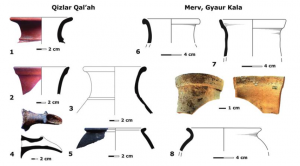
Pp. 21-40: “Correlated Change: Comparing Modifications to Ceramic Assemblages from Qizlar Qalʾeh, Iran, and Ancient Merv, Turkmenistan, during the Seleucid and Parthian Periods,” by Gabriele Puschnigg, Maria Daghmehchi, and Jebrael Nokandeh

From the Seleucid period onward, substantial transformations occurred in the ceramic assemblages from Qizlar Qalʾeh on the Gorgan Plain and ancient Merv (modern Gyaur Kala). Using quantitative and archaeometric analyses, we assess and compare modifications in vessel repertoires, production techniques, and material sources across both sites to understand the nature and chronology of these changes. Similar technological developments are observed at Qizlar Qalʾeh and Merv, and are examined with regard to a potential Hellenistic reception in the ceramic material. Variations in the chronological distribution of innovations and assemblage composition help us to elucidate the neighborhood relations between eastern Iran and western Central Asia at this time. Our comparisons point toward a common cultural environment for both sites especially during the Early Parthian period, which is demonstrated in the many analogies of manufacturing techniques and vessel shapes. At the same time, we see different continuing local traditions, highlighting the flexible mode in which ceramic repertoires are adapted to the changing requirements under Hellenistic rule.
ASOR Members with online access: navigate to the token link email sent to you before attempting to read this article. Once you have activated your member token, click here to access the above article on The University of Chicago Press Journals’ website.

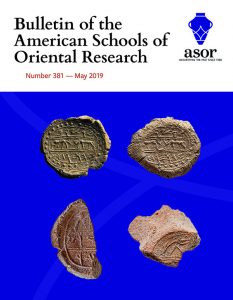
Pp. 41-56: “Four Judean Bullae from the 2014 Season at Tel Lachish,” by Martin G. Klingbeil, Michael G. Hasel, Yosef Garfinkel, and Néstor H. Petruk

The article presents four decorated epigraphic bullae unearthed in the Level III destruction at Lachish during the 2014 season, focusing on the epigraphic, iconographic, and historical aspects of the seal impressions.
ASOR Members with online access: navigate to the token link email sent to you before attempting to read this article. Once you have activated your member token, click here to access the above article on The University of Chicago Press Journals’ website.

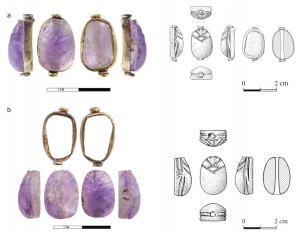
Pp. 57-81: “Uninscribed Amethyst Scarabs from the Southern Levant,” by Arlette David

Prompted by the discovery of a schematic uninscribed amethyst scarab at Tel Abel Beth Maacah in the Upper Galilee, an overview of such scarabs found in the southern Levant is provided, with a typological analysis and a tentative dating and origin of these pieces.
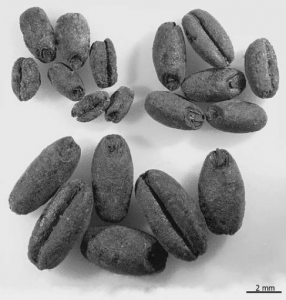
ASOR Members with online access: navigate to the token link email sent to you before attempting to read this article. Once you have activated your member token, click here to access the above article on The University of Chicago Press Journals’ website.

Pp. 83-105: “Foreign Food Plants as Prestigious Gifts: The Archaeobotany of the Amarna Age Palace at Tel Beth-Shemesh, Israel,” Ehud Weiss, Yael Mahler-Slasky, Yoel Melamed, Zvi Lederman, Shlomo Bunimovitz, Shawn Bubel, and Dale Manor

In contrast with the relatively rich documentation from the el-Amarna archive related to the main city-states of the southern Levant in the Amarna Age (Late Bronze Age IIA; 14th century b.c.e.), archaeological data from these sites is still wanting. This unfortunate situation highlights the importance of the ca. 60,000-item plant collection from the recently exposed Late Bronze Age IIA palace at Tel Beth-Shemesh. Room L1505 in the palace—apparently a pantry due to its contents of foodstuffs and vessels for food preparation and consumption—contained eight deposits of carbonized crop plants. Deposits of almost pure grains and very low numbers of weed seeds were found, indicating that these stored food plants were ready to be used in food preparation. Of special interest is the presence of a sizeable amount of two rare pulses in Levantine archaeobotany—fenugreek (Trigonella foenum-graecum) and Cyprus vetch (Lathyrus ochrus)—only found in two other Bronze Age royal contexts: Tutankhamun’s tomb in Egypt and the Late Minoan II Unexplored Mansion in Knossos. Thus, in addition to attesting to the agricultural practices and culinary preferences of a Canaanite ruling court during the Amarna Age, this botanical assemblage also hints at prestigious royal gift exchanges of exotic food plants.
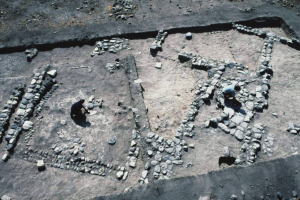
ASOR Members with online access: navigate to the token link email sent to you before attempting to read this article. Once you have activated your member token, click here to access the above article on The University of Chicago Press Journals’ website.

Pp. 107-144: “Tel Yaqush—An Early Bronze Age Village in the Central Jordan Valley, Israel,” by Yael Rotem, Mark Iserlis, Felix Höflmayer, and Yorke M. Rowan

This article highlights the results of five excavation seasons at Tel Yaqush, Israel, conducted between the 1989 and 2000 on behalf of The Oriental Institute at The University of Chicago. Tel Yaqush was a medium-sized village, inhabited during the entire Early Bronze Age period, from the mid-4th to the mid-3rd millennia b.c.e. The excavations exposed a dense settlement begun in the Early Bronze Age (EB) I, which ended in a severe conflagration. Apparently rebuilt at the beginning of EB II, the village remained a small site and technically non-urban throughout the period. Destroyed at the end of EB II, it was renewed in EB III, coinciding with the arrival of people bearing the Khirbet Kerak Ware ceramic tradition. This preliminary report includes new observations following recent studies of Tel Yaqush finds, including a new sequence of 14C dates from EB I to III (published in detail elsewhere). The excavation results summarized here reveal the unique role Tel Yaqush played during the shift to urbanism, and its contribution to our understanding of Early Bronze Age village society in the central Jordan Valley.
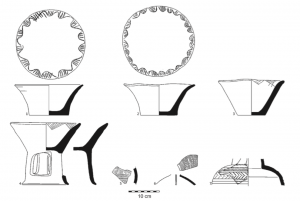
ASOR Members with online access: navigate to the token link email sent to you before attempting to read this article. Once you have activated your member token, click here to access the above article on The University of Chicago Press Journals’ website.

Pp. 145-162: “‘Crossing the Lines’—Elaborately Decorated Chalcolithic Basalt Bowls in the Southern Levant,” by Rivka Chasan, Edwin C. M. van den Brink, and Danny Rosenberg

The Late Chalcolithic period in the southern Levant shows a marked increase in symbolic expression. While most Late Chalcolithic basalt bowls are undecorated, notable amounts of these were adorned, and their decorations typically conform to a few canonized conventions. A small amount of the decorated Late Chalcolithic basalt bowls are further incised with unconventional, unique designs on their exteriors. These elaborately decorated basalt bowls stand in sharp contrast to the conventionally decorated ones, thus signifying their different roles. This article discusses their geographic distributions, frequencies, and characteristics, and offers further suggestions as to their position within the Late Chalcolithic symbolic and prestige item systems. The analysis reveals regional patterns—the elaborately decorated basalt bowls are constrained to south of the Yarkon River—suggesting that the function and symbolic value of these bowls were probably geographically restricted. Their limited distribution underlines the exclusivity of these elaborately decorated bowls during the Late Chalcolithic period.
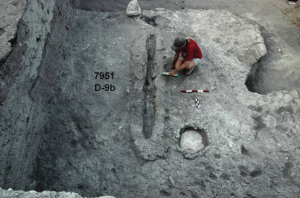
ASOR Members with online access: navigate to the token link email sent to you before attempting to read this article. Once you have activated your member token, click here to access the above article on The University of Chicago Press Journals’ website.

Pp. 163-191: “Canaanite Reḥob: Tel Reḥov in the Late Bronze Age,” by Amihai Mazar, Uri Davidovich, and with an Appendix by Arlette David

Tel Reḥov, identified with Reḥob, was one of the largest Canaanite cities in the southern Levant during the Late Bronze Age (15th–13th centuries b.c.e.). Unlike many other Canaanite settlements, the city was founded in the 15th century after a hiatus beginning in Early Bronze Age III. In this article, four major Late Bronze Age occupation strata are described. Notable is a monumental structure dated to the 14th century b.c.e. with unusual architectural features that could be either the residence of a high-ranking family or an administrative building. During the 13th century b.c.e., this building was replaced by a new structure containing a metalsmith’s workshop, inspired by Egyptian 19th Dynasty techniques, while later building phases belong to the final stages of the Late Bronze Age. No destruction layers were found, and the Late Bronze Age city was rebuilt and continued to thrive throughout the Iron Age I. Five Late Bronze Age plaque figurines, some of particular interest, are also described. An appendix discusses a rare funerary scarab of an Egyptian high official found in the 14th-century b.c.e. edifice.
ASOR Members with online access: navigate to the token link email sent to you before attempting to read this article. Once you have activated your member token, click here to access the above article on The University of Chicago Press Journals’ website.

Pp. 193-202: “Abracadabra, or ‘I Create as I Speak’: A Reanalysis of the First Verb in the Katumuwa Inscription in Light of Northwest Semitic and Hieroglyphic Luwian Parallels,” by Timothy Hogue

Previous translations of the Katumuwa Inscription have either rendered the first verbal phrase (qnt ly) “I commissioned for myself,” or “I acquired for myself.” No scholars have yet defended the possibility that it simply means “I made.” In fact, this is likely the case given the typical monumental rhetoric of Northwest Semitic and Hieroglyphic Luwian monumental inscriptions. In particular, a comparison with verbs of monumenting in Hieroglyphic Luwian inscriptions suggests that the monumenting phrase in the Katumuwa Inscription was calqued on a Luwian phrase. This difference is significant because it reveals an important aspect of the inscription’s monumentality and the Syro-Anatolian conception of the stele. The stele that Katumuwa created was not understood merely as the inscribed object. Rather, the monument was the conjunction of material object, ritual engagement, and the resultant manifestation of the monument’s commissioner. There was no monument apart from Katumuwa, whose voice was preserved in the inscription and whose presence could be reactivated through ritual. Therefore, Katumuwa did in fact “create” the stele as he spoke through it to his monument’s users.

ASOR Members with online access: navigate to the token link email sent to you before attempting to read this article. Once you have activated your member token, click here to access the above article on The University of Chicago Press Journals’ website.

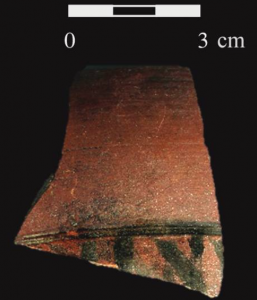
Pp. 203-210: “An Inscribed Sherd in Aramaic Script from Barikot, Pakistan,” by Michael Zellmann-Rohrer and Luca Maria Olivieri

This article discusses a sherd inscribed with a text in Aramaic script from Barikot in Pakistan. The site, known in classical sources on Alexander the Great, has been regularly investigated over the last 40 years. In recent excavation campaigns, new evidence of the earliest phases of the city (500–50 b.c.e.) has been discovered, including the sherd treated here, among other inscribed pottery in Greek and Brāhmī.
ASOR Members with online access: navigate to the token link email sent to you before attempting to read this article. Once you have activated your member token, click here to access the above article on The University of Chicago Press Journals’ website.

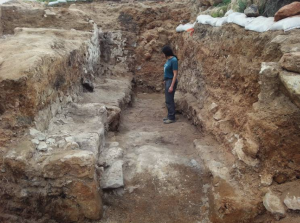
Pp. 211-236: “An Eighth-Century b.c.e. Gate Shrine at Tel Lachish, Israel,” by Saar Ganor and Igor Kreimerman

Excavations conducted on behalf of the Israel Antiquities Authority at Tel Lachish exposed the southern half of the six-chambered gate in Level III. In the eastern chamber, a gate shrine was uncovered. The shrine was split in two: a larger northern room and a smaller southern room. The southern room, which served as the holy of holies, had a niche in its southern wall in front of which a double altar was placed. Dozens of bowls and oil lamps were revealed inside the shrine. At some point, evidently prior to the destruction of Level III by Sennacherib in 701 b.c.e., the shrine was desecrated and sealed. This act was evident in the breakage of the altar’s horns and the placement of a latrine in the holy of holies. The available data suggests that the desecration of the shrine should be associated with Hezekiah’s cultic reform (2 Kgs 18:4).

ASOR Members with online access: navigate to the token link email sent to you before attempting to read this article. Once you have activated your member token, click here to access the above article on The University of Chicago Press Journals’ website.

[/vc_column_text][mk_divider][vc_column_text]ASOR Members with online access: navigate to the token link email sent to you before attempting to read this issue. Once you have activated your member token, click here to access the the entire issue, including book reviews, on The University of Chicago Press Journals’ website.[/vc_column_text][/vc_column][vc_column border_color=”rgba(170,170,170,0.01)” width=”1/6″ css=”.vc_custom_1496684098866{margin-right: 5px !important;margin-bottom: 20px !important;border-right-width: 2px !important;border-bottom-width: 2px !important;padding-top: 30px !important;padding-right: 10px !important;padding-left: 10px !important;background-color: #ffffff !important;border-right-color: rgba(227,228,228,0.75) !important;border-bottom-color: rgba(227,228,228,0.75) !important;}”][vc_wp_posts title=”BROWSE THE NEWS ARCHIVE” number=”4″][/vc_column][vc_column border_color=”rgba(170,170,170,0.01)” width=”1/6″ css=”.vc_custom_1496684008271{margin-right: 10px !important;margin-bottom: 30px !important;border-right-width: 2px !important;border-bottom-width: 2px !important;padding-top: 30px !important;padding-right: 20px !important;padding-left: 20px !important;background-color: #ffffff !important;border-right-color: rgba(227,228,228,0.75) !important;border-bottom-color: rgba(227,228,228,0.75) !important;}”][vc_column_text] [/vc_column_text][/vc_column][/vc_row]

ASOR Election Results (2018)

[vc_row fullwidth=”true” attached=”true” css=”.vc_custom_1496247803139{padding-top: 0px !important;padding-right: 0px !important;padding-bottom: 0px !important;padding-left: 0px !important;}”][vc_column][vc_single_image image=”33590″ img_size=”full” alignment=”center”][/vc_column][/vc_row][vc_row fullwidth=”true” css=”.vc_custom_1496682730308{padding-top: 10px !important;padding-right: 0px !important;padding-bottom: 0px !important;padding-left: 0px !important;}”][vc_column width=”1/12″ css=”.vc_custom_1496683820796{margin-right: 10px !important;}” offset=”vc_hidden-md vc_hidden-sm vc_hidden-xs”][vc_column_text]

 SHARE

[/vc_column_text][mk_image src=”http://www.asortest.org/wp-content/uploads/2017/01/social-fb-icon4.jpg” image_width=”42″ image_height=”42″ hover=”false” custom_url=”https://www.facebook.com/ASOResearch/” margin_bottom=”0″][mk_image src=”http://www.asortest.org/wp-content/uploads/2017/01/social-tw-icon4.jpg” image_width=”42″ image_height=”42″ hover=”false” custom_url=”https://twitter.com/ASOResearch?ref_src=twsrc%5Egoogle%7Ctwcamp%5Eserp%7Ctwgr%5Eauthor” margin_bottom=”0″][mk_image src=”http://www.asortest.org/wp-content/uploads/2017/01/social-in-icon4.jpg” image_width=”42″ image_height=”42″ hover=”false” custom_url=”https://www.linkedin.com/company/american-schools-of-oriental-research” margin_bottom=”0″][mk_image src=”http://www.asortest.org/wp-content/uploads/2017/01/social-ml-icon_7.jpg” image_width=”42″ image_height=”42″ hover=”false” custom_url=”mailto:asor@bu.edu” margin_bottom=”0″][mk_image src=”http://www.asortest.org/wp-content/uploads/2017/01/blog-icon3.jpg” image_width=”42″ image_height=”42″ hover=”false” custom_url=”http://asorblog.org/” margin_bottom=”0″][/vc_column][vc_column border_color=”rgba(255,255,255,0.01)” width=”1/6″ css=”.vc_custom_1496683923840{margin-right: 20px !important;border-left-width: 2px !important;padding-right: 20px !important;padding-left: 20px !important;border-left-color: #99422f !important;}”][mk_divider divider_color=”rgba(255,255,255,0.01)” thickness=”1″ margin_top=”3″ margin_bottom=”3″][vc_column_text]

NEWS@ASOR E-NEWSLETTER

ANCIENT NEAR EAST TODAY E-NEWSLETTER

PAST ASOR NEWS, MONTH BY MONTH

FY18 HONOR ROLL OF DONORS

ASOR ANNUAL MEETING

[/vc_column_text][/vc_column][vc_column border_color=”rgba(170,170,170,0.01)” width=”1/2″ css=”.vc_custom_1487276122024{margin-right: 10px !important;margin-bottom: 30px !important;border-right-width: 2px !important;border-bottom-width: 2px !important;padding-top: 30px !important;padding-right: 30px !important;padding-left: 20px !important;background-color: #ffffff !important;border-right-color: rgba(227,228,228,0.75) !important;border-bottom-color: rgba(227,228,228,0.75) !important;}”][vc_column_text responsive_align=”left”]

ASOR ELECTION RESULTS (2018)

[/vc_column_text][vc_column_text]ASOR announced the newly elected trustees at the 2018 ASOR Annual Meeting in Denver.

There were three openings for Member-elected Trustees (one opening for a 2-year term, and two openings for 3-year terms), and two, three-year openings for Institutionally-elected Trustees. All ASOR members were eligible to vote in the Member-elected Trustee Election, while only Institutional Representatives of the 72 ASOR-member schools voted in the Institutionally-elected Trustee Election.

ASOR conducted the elections by online ballot.

Congratulations and welcome to our new trustees![/vc_column_text][vc_column_text responsive_align=”left”]

Membership-elected Trustees

[/vc_column_text][vc_row_inner][vc_column_inner width=”1/4″ css=”.vc_custom_1503684310141{padding-right: 10px !important;}”][mk_image src=”http://www.asor.org/wp-content/uploads/2018/10/Bonney_Emily.jpg” image_width=”150″ image_height=”250″ hover=”false”][/vc_column_inner][vc_column_inner width=”3/4″][vc_column_text]
Emily Miller Bonney

Emily Miller Bonney is a professor of Liberal Studies at California State University Fullerton, where she currently serves as Interim Dean of the Pollak University Library.  She received her PhD in Greek and Roman art and archaeology from the Institute of Fine Arts at New York University and her JD from the University of California at Los Angeles.  Her research focuses on Bronze Age Crete, and specifically on the application of extended mind and material agency theories to the relationship between the archaeological record and social/political/economic change.  She also examines the ways in which the specific disciplinary frameworks affect the conclusions scholars reach.  Among her publications is the co-edited volume Incomplete Archaeologies: Assembling Knowledge in the Past and Present.  Her recent work re-examines the mortuary evidence for social organization transitions in the Early Bronze Age on Crete, particularly the circular stone tombs, and for cross-crafting in pottery and other media.

Mission Statement: When I returned to the Academy in 1999 after 15 years in the world of law school and legal practice, a colleague suggested I attend an ASOR meeting, and I remain forever grateful for that recommendation.  Like many people I found my vision of my profession changed through contact with ASOR members and activities, and I look forward to the opportunity to serve and give back to the organization as a Board member.  If elected I would work to ensure that ASOR can continue its support of scholarly activity in the field, in research, and in the classroom.  In particular I would encourage continued expansion into all levels of education as well as in the network of municipal libraries and other public fora with an eye to elevating everyone’s awareness of our shared cultural heritage.  The organization has been importantly active in supporting younger scholars’ development and maintenance of professional networks and more recently has begun to provide opportunities to explore careers outside the academy, both efforts to which I am deeply committed.  I also would hope to see ASOR maintain and grow its role as an intermediary between the realms of scholarship and the wider public in its publications and in an array of outreach activities.  To that end I would want to find ways we could continue to expand membership not just among scholars working in the Near East and the Western Mediterranean, but among those interested in understanding antiquity more broadly defined – in Europe, Asia and the Americas.  Finally I would encourage increasing ASOR’s advocacy for the preservation of the peoples and cultures we study.  We all have a stake in deepening our understanding of the civilizations that preceded our own.[/vc_column_text][/vc_column_inner][/vc_row_inner][vc_row_inner][vc_column_inner width=”1/4″ css=”.vc_custom_1503684320408{padding-right: 15px !important;}”][mk_image src=”http://www.asor.org/wp-content/uploads/2018/06/evans.jpg” image_width=”150″ image_height=”250″ hover=”false”][/vc_column_inner][vc_column_inner width=”3/4″][vc_column_text]

Jane DeRose Evans

Jane DeRose Evans is an archaeologist who works in any area that was conquered by the Romans: she has conducted field work in France, England, Greece, Israel, Jordan, and especially Turkey. She has written reports on the coins from the excavations of the synagogue at Sardis, Bir Madkhour, Tell er Ras, Gordion and Sardis.  She is the author of books on the excavation coins of Sardis (Coins from the Excavations at Sardis: Their Archaeological and Economic Contexts, Harvard 2018), and Caesarea Maritima (The JECM Excavation Reports v.6, The Coins and the Hellenistic, Roman, and Byzantine Economy of Palestine, ASOR 2006) and political propaganda (The Art of Persuasion, Michigan 1992). She was editor and contributor to The JECM Excavation Reports v.2: the Mithraeum at Caesarea Maritima (ASOR 2017).  She is preparing a volume on the portico of Area C in Caesarea Maritima.  Currently, she serves as Chair of Art History at Tyler School of Art, Temple University.

Mission statement: ASOR has been an important part of my scholarly life since graduate school, as a place to find out about excavations and new ways of thinking about the cultural history of the southern Levant and Anatolia. More recently, I served on the committee to write the policies on ethics, been an active member with the women of ASOR, and part of the cultural heritage committee. I have been proud to see ASOR move to a stable financial footing, and tackle important questions of cultural heritage and ethical responses to threats to the region’s archaeological heritage.  The organization is entering a new phase, with the movement of the offices, and its relationship to AAR/SBL in flux. I hope to be part of the transition time, as we retain our valuable mission to bring a greater understanding of our past to a wider audience.[/vc_column_text][/vc_column_inner][/vc_row_inner][vc_row_inner][vc_column_inner width=”1/4″ css=”.vc_custom_1503684320408{padding-right: 15px !important;}”][mk_image src=”http://www.asor.org/wp-content/uploads/2018/10/Welch-Headshot-150-x-250.jpg” image_width=”150″ image_height=”250″ hover=”false”][/vc_column_inner][vc_column_inner width=”3/4″][vc_column_text]

Eric Welch

Eric Welch received his PhD in History and Classics and Ancient Mediterranean Studies from the Pennsylvania State University in 2015. Following three years as Visiting Assistant Professor of Jewish Studies at the University of Kansas, he joined the University of Kentucky as a founding lecturer in the Lewis Honors College. As a Senior Lecturer, he teaches across the honors curriculum, including honors courses in Hebrew Bible, History, and Archaeology. Eric has been with the Tell es-Safi/Gath Excavation Project since 2006, where he directs the excavation of a 9th century BCE olive oil production facility. His work at Tell es-Safi has been supported by ASOR’s Heritage Excavation Grant, the Sean William Dever Fellowship, and was presented at the ASOR Annual Meeting with the assistance of the Foundation for Biblical Archaeology Scholarship.

Eric has been an active member of ASOR since 2008 in both scholarship and service. He is a member of the ASOR Early Career Scholars committee and currently serves as co-chair of the committee. He also serves on the ASOR ad hoc committee for the location of the Annual Meeting and is the chair of the ASOR program unit, Archaeology of the Near East: Bronze and Iron Ages.

Mission Statement: My goal in serving ASOR is to represent the voice of early career scholars. As the landscape of employment changes, I intend to be an advocate for our undergraduate, graduate, and post-graduate members as they seek out personal and professional fulfillment. ASOR has always been comprised of specialists who hold jobs outside of traditional tenure track university positions. I want to continue make ASOR a place that embraces career diversity and empowers early career scholars to be active members in ASOR whether their position is academic, peri-academic, or in an industry completely unrelated to the academy.

To do this, I have taken the lead on a mentorship initiative as a part of my work on the Early Career Scholars Committee. My vision is that our early career scholars would have opportunities for mentorship and professional development that reflect the realities of our collective career diversity. As a member of the Board of Trustees, I will be better positioned to communicate the necessity of this initiative to the wider membership body, along with an improved ability to facilitate these mentorship opportunities. It is my hope that efforts like this will contribute to the value of ASOR membership whether one seeks employment in the academy or beyond.

As an early career scholar, I recognize the important role the Annual Meeting plays in my own professional development. A significant portion of our members are the only Near Eastern scholars in their place of work, so the November meeting provides a crucial opportunity to interact with other scholars of the ancient Near East. With a significant portion of our membership having little to no access to professional development funds, it is imperative that the Annual Meeting remain financially feasible for all members. At the same time, I am committed to ensuring that the Annual Meeting is financially viable for ASOR. As a member of the Board of Trustees, I look forward to helping the Annual Meeting continue to benefit the membership of ASOR without becoming a financial liability for our organization.[/vc_column_text][/vc_column_inner][/vc_row_inner][vc_column_text responsive_align=”left”]

Institutionally-elected Trustees

[/vc_column_text][vc_row_inner][vc_column_inner width=”1/4″ css=”.vc_custom_1503684320408{padding-right: 15px !important;}”][mk_image src=”http://www.asor.org/wp-content/uploads/2018/05/dodd.jpg” image_width=”150″ image_height=”250″ hover=”false”][/vc_column_inner][vc_column_inner width=”3/4″][vc_column_text]
Lynn Swartz Dodd

Lynn Swartz Dodd is Associate Professor of the Practice of Religion at the University of Southern California Dornsife College of Letters, Arts and Sciences. There, she has served as the Director of the Interdisciplinary Archaeology Undergraduate Major and the Director of Undergraduate Studies in Religion. She was also designated a USC Dornsife Distinguished Faculty Fellow.

Dodd’s research centers on archaeology and politics, and the ways that beliefs about the world and resources figure in social change. As Curator of USC’s Archaeology Research Center, she is also engaged in material studies, excavation publication projects, and new imaging techniques in archaeological research and conservation. She directs the Tell al-Judaidah Publication Project (Turkey) and Native American Sacred Landscapes Project (California); co-directed the Kenan Tepe Excavations (Tigris River, Turkey); and was field director of the Amuq Valley Research Project Survey (Turkey). Dodd is in addition the co-organizer of the Israeli Palestinian Archaeology Working Group.

Dodd has served ASOR in many capacities: for example, as a member of the Publications Committee and of the Committee on Archaeological Research and Policy (and as Chair of that committee’s Fellowships Subcommittee), and member of the Near Eastern Archaeology Editorial Board. She was the Chair of the Ad Hoc Ethics Working Group that authored the Policy on Professional Conduct adopted by the ASOR Board in April 2015. She has been ASOR Secretary since January 1, 2013.

In November 2015, she received the ASOR Membership Service Award.

Mission Statement: During my term serving as Secretary of the Board of Trustees and Chair of the Ad Hoc Ethics Working Group, I came to understand the critical importance of ASOR members’ perspectives about professional responsibility in all areas of research, publication, and teaching. I support ASOR’s on-going efforts to specify best practices that support safety and respect for all participants in every environment.

I applaud ASOR’s recent decision to open all benefits of membership, including scholarships, to all members regardless of their home location.  As an Institutional Representative to the ASOR Board of Trustees, I will work to increase the visible, reciprocal benefits both for Institutional members and for ASOR. Also, I will contribute to reimagining institutional membership in ways that enable diverse forms of support for ASOR and its members worldwide.  I will encourage ASOR to pursue initiatives that support relevance, diversity, and expanded professional opportunities for ASOR members, including new partnerships with non-profits and other organizations. I affirm ASOR’s tangible efforts to support heritage preservation, documentation and rebuilding in the regions where ASOR members work as reflections of our broad vision of scholarly responsibility and relevance.  I will continue to support ASOR personally, and will seek to identify others who will support ASOR, both financially and in other ways, so that additional resources can be offered to members who participate in research into, and public understanding of, the history and cultures of the Near East and wider Mediterranean, from the earliest times.[/vc_column_text][/vc_column_inner][/vc_row_inner][vc_row_inner][vc_column_inner width=”1/4″ css=”.vc_custom_1503684320408{padding-right: 15px !important;}”][mk_image src=”http://www.asor.org/wp-content/uploads/2018/06/wright.jpg” image_width=”150″ image_height=”250″ hover=”false”][/vc_column_inner][vc_column_inner width=”3/4″][vc_column_text]

J. Edward Wright

Wright is Professor of Hebrew Bible and Early Judaism and Director of The Arizona Center for Judaic Studies at the University of Arizona. Wright’s area of expertise is early Jewish history and religion with particular interest in early Jewish apocryphal texts — texts that shed light on the non-traditional aspects of early Jewish thought and culture, allowing for a more accurate depiction of the rich diversity of early Judaism.

Wright is also a member of the Board of Advisors of the Museum of Biblical Archaeology, a new national public museum that will be devoted to the history, culture, and people of the land of the Bible. In addition, he serves as a co-editor of “The Bible and Interpretation” website, and he is a past President of the Society of Biblical Literature, Pacific Coast Region.

Within ASOR, Wright was the guest editor of a special issue of Near Eastern Archaeology — “The House that Albright Built” (NEA 65/1). He has served as an ASOR Trustee since 2006, and he also served two terms as President of the W. F. Albright Institute for Archaeological Research (AIAR), from 2006-2012. He remains an Honorary Trustee of the Albright. Currently, Wright serves as the Chair of the ASOR Board’s Development Committee. In November 2012, Wright received ASOR’s W. F. Albright Service Award, which honors an individual who has shown special support or made outstanding service contributions to one of the overseas centers, ACOR, AIAR, CAARI, or to one of the overseas committees – the Baghdad Committee and the Damascus Committee.


Mission Statement
: As a trustee I will support ASOR’s mission to support and promote archaeological excavation, scholarly research, student training, and the dissemination of information about the cultures and history of the Near East. As the current chair of the development committee, I am especially interested in promoting development efforts that strive to raise funds to support ASOR’s mission-driven endeavors, and that naturally includes the effort to established our new headquarters in the DC area.

.[/vc_column_text][/vc_column_inner][/vc_row_inner][/vc_column][vc_column border_color=”rgba(170,170,170,0.01)” width=”1/6″ css=”.vc_custom_1496684098866{margin-right: 5px !important;margin-bottom: 20px !important;border-right-width: 2px !important;border-bottom-width: 2px !important;padding-top: 30px !important;padding-right: 10px !important;padding-left: 10px !important;background-color: #ffffff !important;border-right-color: rgba(227,228,228,0.75) !important;border-bottom-color: rgba(227,228,228,0.75) !important;}”][vc_wp_posts title=”BROWSE THE NEWS ARCHIVE” number=”4″][/vc_column][vc_column border_color=”rgba(170,170,170,0.01)” width=”1/6″ css=”.vc_custom_1496684008271{margin-right: 10px !important;margin-bottom: 30px !important;border-right-width: 2px !important;border-bottom-width: 2px !important;padding-top: 30px !important;padding-right: 20px !important;padding-left: 20px !important;background-color: #ffffff !important;border-right-color: rgba(227,228,228,0.75) !important;border-bottom-color: rgba(227,228,228,0.75) !important;}”][vc_column_text] [/vc_column_text][/vc_column][/vc_row]

Nominations Sought for ASOR Trustees

[vc_row fullwidth=”true” attached=”true” css=”.vc_custom_1496247803139{padding-top: 0px !important;padding-right: 0px !important;padding-bottom: 0px !important;padding-left: 0px !important;}”][vc_column][mk_image src=”http://www.asor.org/wp-content/uploads/2018/04/sepphoris-view-banner-for-post.jpg” image_width=”1920″ image_height=”400″ hover=”false” margin_bottom=”0″][/vc_column][/vc_row][vc_row fullwidth=”true” css=”.vc_custom_1496682730308{padding-top: 10px !important;padding-right: 0px !important;padding-bottom: 0px !important;padding-left: 0px !important;}”][vc_column width=”1/12″ css=”.vc_custom_1496683820796{margin-right: 10px !important;}” offset=”vc_hidden-md vc_hidden-sm vc_hidden-xs”][vc_column_text]

 SHARE

[/vc_column_text][mk_image src=”http://www.asortest.org/wp-content/uploads/2017/01/social-fb-icon4.jpg” image_width=”42″ image_height=”42″ hover=”false” custom_url=”https://www.facebook.com/ASOResearch/” margin_bottom=”0″][mk_image src=”http://www.asortest.org/wp-content/uploads/2017/01/social-tw-icon4.jpg” image_width=”42″ image_height=”42″ hover=”false” custom_url=”https://twitter.com/ASOResearch?ref_src=twsrc%5Egoogle%7Ctwcamp%5Eserp%7Ctwgr%5Eauthor” margin_bottom=”0″][mk_image src=”http://www.asortest.org/wp-content/uploads/2017/01/social-in-icon4.jpg” image_width=”42″ image_height=”42″ hover=”false” custom_url=”https://www.linkedin.com/company/american-schools-of-oriental-research” margin_bottom=”0″][mk_image src=”http://www.asortest.org/wp-content/uploads/2017/01/social-ml-icon_7.jpg” image_width=”42″ image_height=”42″ hover=”false” custom_url=”mailto:asor@bu.edu” margin_bottom=”0″][mk_image src=”http://www.asortest.org/wp-content/uploads/2017/01/blog-icon3.jpg” image_width=”42″ image_height=”42″ hover=”false” custom_url=”http://asorblog.org/” margin_bottom=”0″][/vc_column][vc_column border_color=”rgba(255,255,255,0.01)” width=”1/6″ css=”.vc_custom_1496683923840{margin-right: 20px !important;border-left-width: 2px !important;padding-right: 20px !important;padding-left: 20px !important;border-left-color: #99422f !important;}”][mk_divider divider_color=”rgba(255,255,255,0.01)” thickness=”1″ margin_top=”3″ margin_bottom=”3″][vc_column_text]

NEWS@ASOR E-NEWSLETTER

ANCIENT NEAR EAST TODAY E-NEWSLETTER

PAST ASOR NEWS, MONTH BY MONTH

FY18 HONOR ROLL OF DONORS

ASOR ANNUAL MEETING

[/vc_column_text][/vc_column][vc_column border_color=”rgba(170,170,170,0.01)” width=”1/2″ css=”.vc_custom_1487276122024{margin-right: 10px !important;margin-bottom: 30px !important;border-right-width: 2px !important;border-bottom-width: 2px !important;padding-top: 30px !important;padding-right: 30px !important;padding-left: 20px !important;background-color: #ffffff !important;border-right-color: rgba(227,228,228,0.75) !important;border-bottom-color: rgba(227,228,228,0.75) !important;}”][vc_column_text responsive_align=”left”]

TRUSTEE NOMINATIONS COMMITTEE SEEKS NOMINEES

[/vc_column_text][vc_column_text]ASOR’s Trustee Nominations Committee is seeking names of people who are willing to be considered for nomination to the ASOR Board of Trustees (Classes of 2020 and 2021). The committee seeks individuals who are willing to consider service as either Individual Trustees or as Institutional Representative Trustees. We anticipate one opening for an individual trustee in the Class of 2020 (2019-2020) and openings for two individual trustees and two institutional trustees for three-year terms as members of the Class of 2021 (2019-2021). Any full ASOR member may be considered for nomination as an Individual Trustee, while only institutional representatives of ASOR Member Schools may be considered for nomination as an Institutional Representative Trustee.

The ASOR Board of Trustees sets the direction for ASOR and provides oversight for our organization. We encourage you to consider serving on the board, or to share names of people who you think would be a good fit. Among other responsibilities, members of the Board agree to attend two meetings each year at their own expense, to participate thoughtfully in the governance process, and to contribute financially to ASOR. At this stage, nominations may be made simply by sending the person’s name and email address to Marta Ostovich in the ASOR office. Questions about service on the ASOR board or about the selection process may be addressed to Ann-Marie Knoblauch, chair of the nominations committee. Self-nominations are encouraged. The ASOR office will contact all nominees to describe the responsibilities in greater detail, and to make sure that the nominee is willing to have his or her name discussed by the Trustee Nominations Committee.

After the Committee selects individuals for nomination, the election will take place by electronic ballot during October. ASOR is once again conducting online voting to ensure that more of our members are able to participate in this important process. The ASOR office will work with any person who is not able to complete an electronic ballot to make sure that everyone is included.

Members of The Trustee Nominations Committee include Ann-Marie Knoblauch (chair) and Theodore Burgh. In order to receive full consideration by the committee, nominations must be submitted to info@asor.org by September 27, 2018 by October 5, 2018 (extended deadline).[/vc_column_text][/vc_column][vc_column border_color=”rgba(170,170,170,0.01)” width=”1/6″ css=”.vc_custom_1496684098866{margin-right: 5px !important;margin-bottom: 20px !important;border-right-width: 2px !important;border-bottom-width: 2px !important;padding-top: 30px !important;padding-right: 10px !important;padding-left: 10px !important;background-color: #ffffff !important;border-right-color: rgba(227,228,228,0.75) !important;border-bottom-color: rgba(227,228,228,0.75) !important;}”][vc_wp_posts title=”BROWSE THE NEWS ARCHIVE” number=”4″][/vc_column][vc_column border_color=”rgba(170,170,170,0.01)” width=”1/6″ css=”.vc_custom_1496684008271{margin-right: 10px !important;margin-bottom: 30px !important;border-right-width: 2px !important;border-bottom-width: 2px !important;padding-top: 30px !important;padding-right: 20px !important;padding-left: 20px !important;background-color: #ffffff !important;border-right-color: rgba(227,228,228,0.75) !important;border-bottom-color: rgba(227,228,228,0.75) !important;}”][vc_column_text] [/vc_column_text][/vc_column][/vc_row][vc_row][vc_column][vc_column_text] [/vc_column_text][/vc_column][/vc_row]

Open Position for BASOR Copyeditor

[vc_row fullwidth=”true” attached=”true” css=”.vc_custom_1496247803139{padding-top: 0px !important;padding-right: 0px !important;padding-bottom: 0px !important;padding-left: 0px !important;}”][vc_column][mk_image src=”http://www.asor.org/wp-content/uploads/2018/04/GreatTheater-Ephesus-ver2-banner-for-post.jpg” image_width=”1920″ image_height=”400″ hover=”false” margin_bottom=”0″][/vc_column][/vc_row][vc_row fullwidth=”true” css=”.vc_custom_1496682730308{padding-top: 10px !important;padding-right: 0px !important;padding-bottom: 0px !important;padding-left: 0px !important;}”][vc_column width=”1/12″ css=”.vc_custom_1496683820796{margin-right: 10px !important;}” offset=”vc_hidden-md vc_hidden-sm vc_hidden-xs”][vc_column_text]

 SHARE

[/vc_column_text][mk_image src=”http://www.asortest.org/wp-content/uploads/2017/01/social-fb-icon4.jpg” image_width=”42″ image_height=”42″ hover=”false” custom_url=”https://www.facebook.com/ASOResearch/” margin_bottom=”0″][mk_image src=”http://www.asortest.org/wp-content/uploads/2017/01/social-tw-icon4.jpg” image_width=”42″ image_height=”42″ hover=”false” custom_url=”https://twitter.com/ASOResearch?ref_src=twsrc%5Egoogle%7Ctwcamp%5Eserp%7Ctwgr%5Eauthor” margin_bottom=”0″][mk_image src=”http://www.asortest.org/wp-content/uploads/2017/01/social-in-icon4.jpg” image_width=”42″ image_height=”42″ hover=”false” custom_url=”https://www.linkedin.com/company/american-schools-of-oriental-research” margin_bottom=”0″][mk_image src=”http://www.asortest.org/wp-content/uploads/2017/01/social-ml-icon_7.jpg” image_width=”42″ image_height=”42″ hover=”false” custom_url=”mailto:asor@bu.edu” margin_bottom=”0″][mk_image src=”http://www.asortest.org/wp-content/uploads/2017/01/blog-icon3.jpg” image_width=”42″ image_height=”42″ hover=”false” custom_url=”http://asorblog.org/” margin_bottom=”0″][/vc_column][vc_column border_color=”rgba(255,255,255,0.01)” width=”1/6″ css=”.vc_custom_1496683923840{margin-right: 20px !important;border-left-width: 2px !important;padding-right: 20px !important;padding-left: 20px !important;border-left-color: #99422f !important;}”][mk_divider divider_color=”rgba(255,255,255,0.01)” thickness=”1″ margin_top=”3″ margin_bottom=”3″][vc_column_text]

NEWS@ASOR E-NEWSLETTER

ANCIENT NEAR EAST TODAY E-NEWSLETTER

PAST ASOR NEWS, MONTH BY MONTH

FY18 HONOR ROLL OF DONORS

ASOR ANNUAL MEETING

[/vc_column_text][/vc_column][vc_column border_color=”rgba(170,170,170,0.01)” width=”1/2″ css=”.vc_custom_1487276122024{margin-right: 10px !important;margin-bottom: 30px !important;border-right-width: 2px !important;border-bottom-width: 2px !important;padding-top: 30px !important;padding-right: 30px !important;padding-left: 20px !important;background-color: #ffffff !important;border-right-color: rgba(227,228,228,0.75) !important;border-bottom-color: rgba(227,228,228,0.75) !important;}”][vc_column_text responsive_align=”left”]

OPEN POSITION FOR BASOR COPYEDITOR

[/vc_column_text][vc_column_text]The Publications Committee of the American Schools of Oriental Research and the Editors of BASOR (Dr. Eric Cline and Dr. Chris Rollston) announce an open position for Copyeditor of BASOR, with a start-date of 1 January 2019. 

The Bulletin of the American Schools of Oriental Research (BASOR) is a leader among peer-reviewed academic journals of the ancient Near East. For nearly a century, since 1919 when William F. Albright originally founded it as the Bulletin of the American School of Oriental Research in Jerusalem, BASOR has served as a highly respected interdisciplinary English-language forum for scholars worldwide in subject areas such as archaeology, art, anthropology, archaeometry, bioarchaeology, archaeozoology, biblical studies, history, literature, philology, geography, and epigraphy. The journal contains articles written by leading scholars and acknowledged experts in the ancient world that cover a geographical region from Israel and Canaan to ancient Anatolia, Mesopotamia, Cyprus, and Egypt and a chronological range from the Paleolithic period through Islamic times.  The journal appears bi-annually, in May and November.

Candidates interested in this (part-time, contractor) position are encouraged to contact Drs. Cline and Rollston (ehcline@gwu.edu; rollston@gwu.edu) for more information about the position and its responsibilities and to send a current resume and letter of interest to them. Compensation will be competitive and commensurate with experience. Review of applications will begin 1 October 2018.

Job Description:

Following a first round of copyediting by the associate copyeditor:

  • Format Word doc to impose BASOR paragraph styles and standardize formatting anomalies, which facilitates editing and a clean import for the typesetters
  • Undertake a close line editing of the article, checking for spelling, punctuation, grammar, style, and general readability; insert queries into the doc file (as Word Comments) as needed; all edits are made with Track Changes turned on
  • Review tables and formats as needed (the associate copyeditor checks the sums, matches the data in the tables with that in the text)
  • Review the illustrations for size, resolution, legibility, and overall clarity; size and clean up image files as needed (using Photoshop and/or Illustrator), or ask author to do so
  • Compose an email message for the author(s) with instructions for reviewing the edited MS; include a reiteration of all the queries (from the associate copyeditor and the copyeditor) and attach all the edited files, including the article, captions, tables, appendixes, etc.

Following receipt of the reviewed/approved MS from the author:

  • Review all the authorial changes and edit as needed (for spelling, punctuation, etc.)
  • Accept all changes into new doc files (in order to keep the author’s originals intact)
  • If there are additional or unanswered queries, write to the author (or to Editors, or Associate copyeditor) to get answers
  • When all issues have been resolved and changes entered into the appropriate files, gather all finalized files and post on Dropbox; send email to editors and typesetters to alert them that files are posted

When 1st proofs are first posted:

  • Undertake a quick visual review for obvious problems, before proofs are sent to the authors; if something significant is amiss, contact typesetter for a correction; otherwise, give approval to typesetter to send out Dropbox link to the authors
  • Carefully read proofs and mark up a PDF with corrections; in addition to reading the text, review the layout for infelicities and placement of illustrations and tables relative to their callout in the text
  • Collect and collate corrections from the associate copyeditor and the authors, resolving conflicting opinions; insert all corrections into a master PDF file, including suggestions to fix layout problems
  • Revise illustration files as needed
  • Post corrected files and send notice of same to editors and typesetter.

When 2nd proofs are posted:

  • Check the proofs against corrections submitted in 1st proofs
  • Gather any new corrections from authors and editors
  • Resolve all remaining questions and post 2nd proof markups on Dropbox; send email to typesetter and editors

Follow same process for 3rd proofs, as needed, until final proofs are approved.

When all articles are typeset and compiled into a single file:

  • Review proofs for running heads, pagination, and any new material (e.g., table of contents, index, other frontmatter); notify typesetter and editors as needed.
  • Throughout the process: communicate with the authors, editors, co-copyeditor, and typesetters, on questions of content, style, layout, etc.
[/vc_column_text][/vc_column][vc_column border_color=”rgba(170,170,170,0.01)” width=”1/6″ css=”.vc_custom_1496684098866{margin-right: 5px !important;margin-bottom: 20px !important;border-right-width: 2px !important;border-bottom-width: 2px !important;padding-top: 30px !important;padding-right: 10px !important;padding-left: 10px !important;background-color: #ffffff !important;border-right-color: rgba(227,228,228,0.75) !important;border-bottom-color: rgba(227,228,228,0.75) !important;}”][vc_wp_posts title=”BROWSE THE NEWS ARCHIVE” number=”4″][/vc_column][vc_column border_color=”rgba(170,170,170,0.01)” width=”1/6″ css=”.vc_custom_1496684008271{margin-right: 10px !important;margin-bottom: 30px !important;border-right-width: 2px !important;border-bottom-width: 2px !important;padding-top: 30px !important;padding-right: 20px !important;padding-left: 20px !important;background-color: #ffffff !important;border-right-color: rgba(227,228,228,0.75) !important;border-bottom-color: rgba(227,228,228,0.75) !important;}”][vc_column_text] [/vc_column_text][/vc_column][/vc_row][vc_row][vc_column][vc_column_text] [/vc_column_text][/vc_column][/vc_row]

Marta Ostovich is ASOR’s New Manager of Programs

[vc_row fullwidth=”true” attached=”true” css=”.vc_custom_1496247803139{padding-top: 0px !important;padding-right: 0px !important;padding-bottom: 0px !important;padding-left: 0px !important;}”][vc_column][mk_image src=”http://www.asor.org/wp-content/uploads/2018/04/petra-tombs-banner-for-post.jpg” image_width=”1920″ image_height=”400″ hover=”false” margin_bottom=”0″][/vc_column][/vc_row][vc_row fullwidth=”true” css=”.vc_custom_1496682730308{padding-top: 10px !important;padding-right: 0px !important;padding-bottom: 0px !important;padding-left: 0px !important;}”][vc_column width=”1/12″ css=”.vc_custom_1496683820796{margin-right: 10px !important;}” offset=”vc_hidden-md vc_hidden-sm vc_hidden-xs”][vc_column_text]

 SHARE

[/vc_column_text][mk_image src=”http://www.asortest.org/wp-content/uploads/2017/01/social-fb-icon4.jpg” image_width=”42″ image_height=”42″ hover=”false” custom_url=”https://www.facebook.com/ASOResearch/” margin_bottom=”0″][mk_image src=”http://www.asortest.org/wp-content/uploads/2017/01/social-tw-icon4.jpg” image_width=”42″ image_height=”42″ hover=”false” custom_url=”https://twitter.com/ASOResearch?ref_src=twsrc%5Egoogle%7Ctwcamp%5Eserp%7Ctwgr%5Eauthor” margin_bottom=”0″][mk_image src=”http://www.asortest.org/wp-content/uploads/2017/01/social-in-icon4.jpg” image_width=”42″ image_height=”42″ hover=”false” custom_url=”https://www.linkedin.com/company/american-schools-of-oriental-research” margin_bottom=”0″][mk_image src=”http://www.asortest.org/wp-content/uploads/2017/01/social-ml-icon_7.jpg” image_width=”42″ image_height=”42″ hover=”false” custom_url=”mailto:asor@bu.edu” margin_bottom=”0″][mk_image src=”http://www.asortest.org/wp-content/uploads/2017/01/blog-icon3.jpg” image_width=”42″ image_height=”42″ hover=”false” custom_url=”http://asorblog.org/” margin_bottom=”0″][/vc_column][vc_column border_color=”rgba(255,255,255,0.01)” width=”1/6″ css=”.vc_custom_1496683923840{margin-right: 20px !important;border-left-width: 2px !important;padding-right: 20px !important;padding-left: 20px !important;border-left-color: #99422f !important;}”][mk_divider divider_color=”rgba(255,255,255,0.01)” thickness=”1″ margin_top=”3″ margin_bottom=”3″][vc_column_text]

NEWS@ASOR E-NEWSLETTER

ANCIENT NEAR EAST TODAY E-NEWSLETTER

PAST ASOR NEWS, MONTH BY MONTH

FY18 HONOR ROLL OF DONORS

ASOR ANNUAL MEETING

[/vc_column_text][/vc_column][vc_column border_color=”rgba(170,170,170,0.01)” width=”1/2″ css=”.vc_custom_1487276122024{margin-right: 10px !important;margin-bottom: 30px !important;border-right-width: 2px !important;border-bottom-width: 2px !important;padding-top: 30px !important;padding-right: 30px !important;padding-left: 20px !important;background-color: #ffffff !important;border-right-color: rgba(227,228,228,0.75) !important;border-bottom-color: rgba(227,228,228,0.75) !important;}”][vc_column_text responsive_align=”left”]

MARTA OSTOVICH IS ASOR’S NEW MANAGER OF PROGRAMS

[/vc_column_text][vc_column_text]Marta Ostovich began working at ASOR in March 2018, as an Office Assistant. Starting July 1, she assumed a new role as Manager of Programs. Marta will be relocating to Alexandria later in September, and she will work with ASOR Executive Director Andy Vaughn with the transition from Boston to ASOR’s new home and with hiring and training of new staff members. Her duties as Manager of Programs include assisting with fellowships, donor relations, membership fulfillment, planning and support for the Annual Meeting, and website maintenance.

A native Minnesotan, Marta has spent the last 18 years in Boston. She completed her B.A. in the University Professors’ Program at Boston University with a concentration on Archaeology and Ethics. Her undergraduate thesis addressed the interplay of archaeology, politics, and collective memory and was entitled, “Masada: Excavation of a Myth.”

Marta spent 12 years as a staff member on the Spanish island of Menorca as part of Boston University’s archaeological field school at Torre d’en Galmes. In addition to lecturing and assisting with the field school curriculum, she was responsible for supervising both excavation and laboratory work at the site, which was occupied from the Iron Age through Medieval periods. One of the most noteworthy finds was an in-tact kitchen from the Medieval Muslim (13th century) occupation of the site-the first of its kind on the island. Marta assisted with designing an exhibition of the finds from this kitchen for the local museum.  She has also been part of archaeological excavations in Italy and Greece and traveled to Montenegro and Vietnam for cultural heritage work. She continues to be interested in the relationship between cultural tourism and archaeological sites.
Marta is familiar with the academic and administrative sides of archaeological research. While at Boston University, she worked at the Center for Archaeological Studies as an administrator and archives assistant and at the Journal of Field Archaeology as an editorial assistant. In addition to her archaeological background, Marta brings years of experience in the hospitality industry, where she has done everything from mixing drinks behind the bar to financial management of restaurants, to her new position.[/vc_column_text][/vc_column][vc_column border_color=”rgba(170,170,170,0.01)” width=”1/6″ css=”.vc_custom_1496684098866{margin-right: 5px !important;margin-bottom: 20px !important;border-right-width: 2px !important;border-bottom-width: 2px !important;padding-top: 30px !important;padding-right: 10px !important;padding-left: 10px !important;background-color: #ffffff !important;border-right-color: rgba(227,228,228,0.75) !important;border-bottom-color: rgba(227,228,228,0.75) !important;}”][vc_wp_posts title=”BROWSE THE NEWS ARCHIVE” number=”4″][/vc_column][vc_column border_color=”rgba(170,170,170,0.01)” width=”1/6″ css=”.vc_custom_1496684008271{margin-right: 10px !important;margin-bottom: 30px !important;border-right-width: 2px !important;border-bottom-width: 2px !important;padding-top: 30px !important;padding-right: 20px !important;padding-left: 20px !important;background-color: #ffffff !important;border-right-color: rgba(227,228,228,0.75) !important;border-bottom-color: rgba(227,228,228,0.75) !important;}”][vc_column_text] [/vc_column_text][/vc_column][/vc_row]

Submit Your Photos for the ASOR Website

[vc_row fullwidth=”true” attached=”true” css=”.vc_custom_1496247803139{padding-top: 0px !important;padding-right: 0px !important;padding-bottom: 0px !important;padding-left: 0px !important;}”][vc_column][mk_image src=”http://www.asor.org/wp-content/uploads/2018/04/2147ExcavatedRemainsUpperCityHattusha-banner-for-post.jpg” image_width=”1920″ image_height=”400″ hover=”false” margin_bottom=”0″][/vc_column][/vc_row][vc_row fullwidth=”true” css=”.vc_custom_1496682730308{padding-top: 10px !important;padding-right: 0px !important;padding-bottom: 0px !important;padding-left: 0px !important;}”][vc_column width=”1/12″ css=”.vc_custom_1496683820796{margin-right: 10px !important;}” offset=”vc_hidden-md vc_hidden-sm vc_hidden-xs”][vc_column_text]

 SHARE

[/vc_column_text][mk_image src=”http://www.asortest.org/wp-content/uploads/2017/01/social-fb-icon4.jpg” image_width=”42″ image_height=”42″ hover=”false” custom_url=”https://www.facebook.com/ASOResearch/” margin_bottom=”0″][mk_image src=”http://www.asortest.org/wp-content/uploads/2017/01/social-tw-icon4.jpg” image_width=”42″ image_height=”42″ hover=”false” custom_url=”https://twitter.com/ASOResearch?ref_src=twsrc%5Egoogle%7Ctwcamp%5Eserp%7Ctwgr%5Eauthor” margin_bottom=”0″][mk_image src=”http://www.asortest.org/wp-content/uploads/2017/01/social-in-icon4.jpg” image_width=”42″ image_height=”42″ hover=”false” custom_url=”https://www.linkedin.com/company/american-schools-of-oriental-research” margin_bottom=”0″][mk_image src=”http://www.asortest.org/wp-content/uploads/2017/01/social-ml-icon_7.jpg” image_width=”42″ image_height=”42″ hover=”false” custom_url=”mailto:asor@bu.edu” margin_bottom=”0″][mk_image src=”http://www.asortest.org/wp-content/uploads/2017/01/blog-icon3.jpg” image_width=”42″ image_height=”42″ hover=”false” custom_url=”http://asorblog.org/” margin_bottom=”0″][/vc_column][vc_column border_color=”rgba(255,255,255,0.01)” width=”1/6″ css=”.vc_custom_1496683923840{margin-right: 20px !important;border-left-width: 2px !important;padding-right: 20px !important;padding-left: 20px !important;border-left-color: #99422f !important;}”][mk_divider divider_color=”rgba(255,255,255,0.01)” thickness=”1″ margin_top=”3″ margin_bottom=”3″][vc_column_text]

NEWS@ASOR E-NEWSLETTER

ANCIENT NEAR EAST TODAY E-NEWSLETTER

PAST ASOR NEWS, MONTH BY MONTH

FY18 HONOR ROLL OF DONORS

ASOR ANNUAL MEETING

[/vc_column_text][/vc_column][vc_column border_color=”rgba(170,170,170,0.01)” width=”1/2″ css=”.vc_custom_1487276122024{margin-right: 10px !important;margin-bottom: 30px !important;border-right-width: 2px !important;border-bottom-width: 2px !important;padding-top: 30px !important;padding-right: 30px !important;padding-left: 20px !important;background-color: #ffffff !important;border-right-color: rgba(227,228,228,0.75) !important;border-bottom-color: rgba(227,228,228,0.75) !important;}”][vc_column_text responsive_align=”left”]

SUBMIT YOUR PHOTOS FOR THE ASOR WEBSITE

Submit your images, and they may be featured throughout the ASOR website!
[/vc_column_text][vc_column_text]You may have noticed that photos are a central feature of the ASOR website. ASOR wants to feature your best landscapes, panoramas, artifact portraits, and high quality candids. We will choose the images that best suit the site from different countries where ASOR members work to feature in the homepage slideshow that will change monthly. Other images may be chosen for banner images on other webpages throughout the website.

Email your entries, along with an entry form to info@asor.org.

Entries should be high resolution (at least 300 dpi). As described in the submission form, photos should be named in such a way as to describe basic information, the location, and date. Submitters are also encouraged (but not required) to include a brief description of each photo in a Word file that should be sent together with the submission form. By submitting photo(s) and signing the submission form, you guarantee that you are the copyright holder and have the ability to transfer rights to ASOR. You are granting ASOR the non-exclusive right use the photo in any way it sees fit on the ASOR website, in ASOR social media, and/or in ASOR promotional materials. You also grant ASOR the permission and right to use the image(s) on a resource page for members and friends with the understanding that ASOR will not charge for the images.

Please note that ASOR will not accept images of artifacts from the antiquities market or images that might promote the trade of antiquities in any way. Submissions must comply with ASOR’s Policy on Professional Conduct.[/vc_column_text][mk_divider][mk_button size=”xlarge” bg_color=”#2f2f80″ txt_color=”#dddddd” url=”http://www.asor.org/wp-content/uploads/2017/07/Photo-Submission-Rules.pdf” align=”center”]Download Entry Form[/mk_button][/vc_column][vc_column border_color=”rgba(170,170,170,0.01)” width=”1/6″ css=”.vc_custom_1496684098866{margin-right: 5px !important;margin-bottom: 20px !important;border-right-width: 2px !important;border-bottom-width: 2px !important;padding-top: 30px !important;padding-right: 10px !important;padding-left: 10px !important;background-color: #ffffff !important;border-right-color: rgba(227,228,228,0.75) !important;border-bottom-color: rgba(227,228,228,0.75) !important;}”][vc_wp_posts title=”BROWSE THE NEWS ARCHIVE” number=”4″][/vc_column][vc_column border_color=”rgba(170,170,170,0.01)” width=”1/6″ css=”.vc_custom_1496684008271{margin-right: 10px !important;margin-bottom: 30px !important;border-right-width: 2px !important;border-bottom-width: 2px !important;padding-top: 30px !important;padding-right: 20px !important;padding-left: 20px !important;background-color: #ffffff !important;border-right-color: rgba(227,228,228,0.75) !important;border-bottom-color: rgba(227,228,228,0.75) !important;}”][vc_column_text] [/vc_column_text][/vc_column][/vc_row]

ASOR/EPHE European Symposium – Update

[vc_row fullwidth=”true” attached=”true” css=”.vc_custom_1496247803139{padding-top: 0px !important;padding-right: 0px !important;padding-bottom: 0px !important;padding-left: 0px !important;}”][vc_column][mk_image src=”http://www.asor.org/wp-content/uploads/2017/12/banner-view-from-gezer2.jpg” image_width=”1920″ image_height=”400″ hover=”false” margin_bottom=”0″][/vc_column][/vc_row][vc_row fullwidth=”true” css=”.vc_custom_1496682730308{padding-top: 10px !important;padding-right: 0px !important;padding-bottom: 0px !important;padding-left: 0px !important;}”][vc_column width=”1/12″ css=”.vc_custom_1496683820796{margin-right: 10px !important;}” offset=”vc_hidden-md vc_hidden-sm vc_hidden-xs”][vc_column_text]

 SHARE

[/vc_column_text][mk_image src=”http://www.asortest.org/wp-content/uploads/2017/01/social-fb-icon4.jpg” image_width=”42″ image_height=”42″ hover=”false” custom_url=”https://www.facebook.com/ASOResearch/” margin_bottom=”0″][mk_image src=”http://www.asortest.org/wp-content/uploads/2017/01/social-tw-icon4.jpg” image_width=”42″ image_height=”42″ hover=”false” custom_url=”https://twitter.com/ASOResearch?ref_src=twsrc%5Egoogle%7Ctwcamp%5Eserp%7Ctwgr%5Eauthor” margin_bottom=”0″][mk_image src=”http://www.asortest.org/wp-content/uploads/2017/01/social-in-icon4.jpg” image_width=”42″ image_height=”42″ hover=”false” custom_url=”https://www.linkedin.com/company/american-schools-of-oriental-research” margin_bottom=”0″][mk_image src=”http://www.asortest.org/wp-content/uploads/2017/01/social-ml-icon_7.jpg” image_width=”42″ image_height=”42″ hover=”false” custom_url=”mailto:asor@bu.edu” margin_bottom=”0″][mk_image src=”http://www.asortest.org/wp-content/uploads/2017/01/blog-icon3.jpg” image_width=”42″ image_height=”42″ hover=”false” custom_url=”http://asorblog.org/” margin_bottom=”0″][/vc_column][vc_column border_color=”rgba(255,255,255,0.01)” width=”1/6″ css=”.vc_custom_1496683923840{margin-right: 20px !important;border-left-width: 2px !important;padding-right: 20px !important;padding-left: 20px !important;border-left-color: #99422f !important;}”][mk_divider divider_color=”rgba(255,255,255,0.01)” thickness=”1″ margin_top=”3″ margin_bottom=”3″][vc_column_text]

ASOR BLOG

NEWS@ASOR E-NEWSLETTER

ANCIENT NEAR EAST TODAY E-NEWSLETTER

PAST ASOR NEWS, MONTH BY MONTH

FY17 HONOR ROLL OF DONORS

ASOR ANNUAL MEETING

[/vc_column_text][/vc_column][vc_column border_color=”rgba(170,170,170,0.01)” width=”1/2″ css=”.vc_custom_1487276122024{margin-right: 10px !important;margin-bottom: 30px !important;border-right-width: 2px !important;border-bottom-width: 2px !important;padding-top: 30px !important;padding-right: 30px !important;padding-left: 20px !important;background-color: #ffffff !important;border-right-color: rgba(227,228,228,0.75) !important;border-bottom-color: rgba(227,228,228,0.75) !important;}”][vc_column_text responsive_align=”left”]

ASOR/EPHE EUROPEAN SYMPOSIUM: FIRST OVERSEAS SYMPOSIUM TO BE HELD IN PARIS, FRANCE IN SEPTEMBER – UPDATED 8/21/18

[/vc_column_text][vc_column_text]The ASOR Membership and Outreach Committee is pleased to announce its first overseas outreach initiative at the Sorbonne, in partnership with Ecole Pratique des Hautes Etudes – Paris Sciences et Lettres (EPHE-PSL), in Paris, September 4-6, 2018.  The event will be a scholarly symposium with honorary chairs Susan Ackerman, President of ASOR, and Hubert Bost, President of EPHE-PSL. Over 45 scholars from Europe (including Russia), Brazil, Israel, and Turkey will make presentations on the themes of Violence in the Ancient Near East and on Digital Humanities (DH), including a forum-round table in order to set up an action plan regarding the growing inequalities between training in DH, among other discussed topics. Presentations will be video recorded and live broadcast. The symposium participants will also enjoy a guided-tour of the Louvre and a social cocktail in the Luxembourg Garden among other special activities. ASOR members who happen to be in Paris during that time are welcome to join the symposium to hear the presentations. We hope this event will be a first step in expanding European membership and involvement in ASOR. Randy Younker, chair Membership and Outreach Committee, Vanessa Juloux chair, Membership and Outreach Committee Sub-committee for Europe.

For weblinks on the Paris Symposium, see the following:

For section on violence: http://ancient-worlds-symposium.eu/docs/abstracts-violence

For Digital Humanities: http://ancient-worlds-symposium.eu/docs/abstracts-digital-humanities

To see the program: http://ancient-worlds-symposium.eu/docs/program

And detailed schedule: http://ancient-worlds-symposium.eu/docs/schedule

[/vc_column_text][/vc_column][vc_column border_color=”rgba(170,170,170,0.01)” width=”1/6″ css=”.vc_custom_1496684098866{margin-right: 5px !important;margin-bottom: 20px !important;border-right-width: 2px !important;border-bottom-width: 2px !important;padding-top: 30px !important;padding-right: 10px !important;padding-left: 10px !important;background-color: #ffffff !important;border-right-color: rgba(227,228,228,0.75) !important;border-bottom-color: rgba(227,228,228,0.75) !important;}”][vc_wp_posts title=”BROWSE THE NEWS ARCHIVE” number=”4″][/vc_column][vc_column border_color=”rgba(170,170,170,0.01)” width=”1/6″ css=”.vc_custom_1496684008271{margin-right: 10px !important;margin-bottom: 30px !important;border-right-width: 2px !important;border-bottom-width: 2px !important;padding-top: 30px !important;padding-right: 20px !important;padding-left: 20px !important;background-color: #ffffff !important;border-right-color: rgba(227,228,228,0.75) !important;border-bottom-color: rgba(227,228,228,0.75) !important;}”][vc_column_text] [/vc_column_text][/vc_column][/vc_row][vc_row][vc_column][vc_column_text] [/vc_column_text][/vc_column][/vc_row]

Call for Nominations for AASOR Editor

[vc_row fullwidth=”true” attached=”true” css=”.vc_custom_1496247803139{padding-top: 0px !important;padding-right: 0px !important;padding-bottom: 0px !important;padding-left: 0px !important;}”][vc_column][mk_image src=”http://www.asor.org/wp-content/uploads/2018/05/Screen-Shot-2018-05-18-at-9.32.09-AM-2.png” image_width=”1920″ image_height=”400″ hover=”false” margin_bottom=”0″][/vc_column][/vc_row][vc_row fullwidth=”true” css=”.vc_custom_1496682730308{padding-top: 10px !important;padding-right: 0px !important;padding-bottom: 0px !important;padding-left: 0px !important;}”][vc_column width=”1/12″ css=”.vc_custom_1496683820796{margin-right: 10px !important;}” offset=”vc_hidden-md vc_hidden-sm vc_hidden-xs”][vc_column_text]

 SHARE

[/vc_column_text][mk_image src=”http://www.asortest.org/wp-content/uploads/2017/01/social-fb-icon4.jpg” image_width=”42″ image_height=”42″ hover=”false” custom_url=”https://www.facebook.com/ASOResearch/” margin_bottom=”0″][mk_image src=”http://www.asortest.org/wp-content/uploads/2017/01/social-tw-icon4.jpg” image_width=”42″ image_height=”42″ hover=”false” custom_url=”https://twitter.com/ASOResearch?ref_src=twsrc%5Egoogle%7Ctwcamp%5Eserp%7Ctwgr%5Eauthor” margin_bottom=”0″][mk_image src=”http://www.asortest.org/wp-content/uploads/2017/01/social-in-icon4.jpg” image_width=”42″ image_height=”42″ hover=”false” custom_url=”https://www.linkedin.com/company/american-schools-of-oriental-research” margin_bottom=”0″][mk_image src=”http://www.asortest.org/wp-content/uploads/2017/01/social-ml-icon_7.jpg” image_width=”42″ image_height=”42″ hover=”false” custom_url=”mailto:asor@bu.edu” margin_bottom=”0″][mk_image src=”http://www.asortest.org/wp-content/uploads/2017/01/blog-icon3.jpg” image_width=”42″ image_height=”42″ hover=”false” custom_url=”http://asorblog.org/” margin_bottom=”0″][/vc_column][vc_column border_color=”rgba(255,255,255,0.01)” width=”1/6″ css=”.vc_custom_1496683923840{margin-right: 20px !important;border-left-width: 2px !important;padding-right: 20px !important;padding-left: 20px !important;border-left-color: #99422f !important;}”][mk_divider divider_color=”rgba(255,255,255,0.01)” thickness=”1″ margin_top=”3″ margin_bottom=”3″][vc_column_text]

ASOR BLOG

NEWS@ASOR

ANCIENT NEAR EAST TODAY

PAST ASOR NEWS, MONTH BY MONTH

FY18 HONOR ROLL OF DONORS

FY18 HONORIC AND MEMORIAL GIFTS

[/vc_column_text][/vc_column][vc_column border_color=”rgba(170,170,170,0.01)” width=”1/2″ css=”.vc_custom_1487276122024{margin-right: 10px !important;margin-bottom: 30px !important;border-right-width: 2px !important;border-bottom-width: 2px !important;padding-top: 30px !important;padding-right: 30px !important;padding-left: 20px !important;background-color: #ffffff !important;border-right-color: rgba(227,228,228,0.75) !important;border-bottom-color: rgba(227,228,228,0.75) !important;}”][vc_column_text responsive_align=”left”]

CALL FOR NOMINATIONS FOR EDITOR OF THE ANNUAL OF THE AMERICAN SCHOOLS OF ORIENTAL RESEARCH

[/vc_column_text][vc_column_text responsive_align=”left”]The Publications Committee of the American Schools of Oriental Research announces a call for nominations for the Editor of the ASOR Annual (AASOR) for a term to begin 1 January 2019.  ASOR book series editors serve a three-year term eligible to be renewed twice.

The first volume of the AASOR appeared in 1920, making it ASOR’s signature publication. AASOR is a medium for the publication of lengthy preliminary or interim archaeological reports or monograph-length studies relating to archaeology in the Near East. The Editor, working in cooperation with the other ASOR editors, with the Publications Committee, and ASOR’s book publishing partner ISD, holds full editorial control AASOR.

Self-nominations are preferred and should include the following items: 1) a one-paragraph academic biography; 2) a brief statement describing why the candidate is interested in the position; and 3) contact information (including e-mail and phone).  If a candidate is being nominated by another person, we seek the candidate’s name, a short academic history, a brief statement describing why the candidate would be appropriate for the position, contact information, and, most importantly, a statement from the candidate that she or he agrees to their name being placed into nomination.

Candidates are encouraged to contact the current editor, Kevin McGeough (mcgekm@uleth.ca), for more information about the position and its responsibilities. Nominations for each position should be directed to the Chair of the Publications Committee, Charles Jones (cellwoodjones@gmail.com), with a copy to the Director of Membership and Publications, Inda Omerefendic (publications@asor.org).

Review of applications will begin 15 September 2018 with a recommendation of a candidate to the ASOR Executive Committee of the Board of Trustees and the full ASOR Board before the Annual Meeting in Denver in November 2018.[/vc_column_text][/vc_column][vc_column border_color=”rgba(170,170,170,0.01)” width=”1/6″ css=”.vc_custom_1496684098866{margin-right: 5px !important;margin-bottom: 20px !important;border-right-width: 2px !important;border-bottom-width: 2px !important;padding-top: 30px !important;padding-right: 10px !important;padding-left: 10px !important;background-color: #ffffff !important;border-right-color: rgba(227,228,228,0.75) !important;border-bottom-color: rgba(227,228,228,0.75) !important;}”][vc_wp_posts title=”BROWSE THE NEWS ARCHIVE” number=”4″][/vc_column][vc_column border_color=”rgba(170,170,170,0.01)” width=”1/6″ css=”.vc_custom_1496684008271{margin-right: 10px !important;margin-bottom: 30px !important;border-right-width: 2px !important;border-bottom-width: 2px !important;padding-top: 30px !important;padding-right: 20px !important;padding-left: 20px !important;background-color: #ffffff !important;border-right-color: rgba(227,228,228,0.75) !important;border-bottom-color: rgba(227,228,228,0.75) !important;}”][vc_column_text] [/vc_column_text][/vc_column][/vc_row]