Dig Safety Survey 2019

[vc_row fullwidth=”true” attached=”true” css=”.vc_custom_1496247803139{padding-top: 0px !important;padding-right: 0px !important;padding-bottom: 0px !important;padding-left: 0px !important;}”][vc_column][vc_single_image image=”53008″ img_size=”full” alignment=”center”][/vc_column][/vc_row][vc_row fullwidth=”true” css=”.vc_custom_1496682730308{padding-top: 10px !important;padding-right: 0px !important;padding-bottom: 0px !important;padding-left: 0px !important;}”][vc_column width=”1/12″ css=”.vc_custom_1496683820796{margin-right: 10px !important;}” offset=”vc_hidden-md vc_hidden-sm vc_hidden-xs”][vc_column_text]

 SHARE

[/vc_column_text][mk_image src=”http://www.asortest.org/wp-content/uploads/2017/01/social-fb-icon4.jpg” image_width=”42″ image_height=”42″ hover=”false” custom_url=”https://www.facebook.com/ASOResearch/” margin_bottom=”0″][mk_image src=”http://www.asortest.org/wp-content/uploads/2017/01/social-tw-icon4.jpg” image_width=”42″ image_height=”42″ hover=”false” custom_url=”https://twitter.com/ASOResearch?ref_src=twsrc%5Egoogle%7Ctwcamp%5Eserp%7Ctwgr%5Eauthor” margin_bottom=”0″][mk_image src=”http://www.asortest.org/wp-content/uploads/2017/01/social-in-icon4.jpg” image_width=”42″ image_height=”42″ hover=”false” custom_url=”https://www.linkedin.com/company/american-schools-of-oriental-research” margin_bottom=”0″][mk_image src=”http://www.asortest.org/wp-content/uploads/2017/01/social-ml-icon_7.jpg” image_width=”42″ image_height=”42″ hover=”false” custom_url=”mailto:info@asor.org” margin_bottom=”0″][mk_image src=”http://www.asortest.org/wp-content/uploads/2017/01/blog-icon3.jpg” image_width=”42″ image_height=”42″ hover=”false” custom_url=”http://asor.org/blog” margin_bottom=”0″][/vc_column][vc_column border_color=”rgba(255,255,255,0.01)” width=”1/6″ css=”.vc_custom_1496683923840{margin-right: 20px !important;border-left-width: 2px !important;padding-right: 20px !important;padding-left: 20px !important;border-left-color: #99422f !important;}”][mk_divider divider_color=”rgba(255,255,255,0.01)” thickness=”1″ margin_top=”3″ margin_bottom=”3″][vc_column_text]

NEWS@ASOR E-NEWSLETTER

ANCIENT NEAR EAST TODAY E-NEWSLETTER

PAST ASOR NEWS, MONTH BY MONTH

FY19 HONOR ROLL OF DONORS

ASOR ANNUAL MEETING

[/vc_column_text][/vc_column][vc_column border_color=”rgba(170,170,170,0.01)” width=”1/2″ css=”.vc_custom_1487276122024{margin-right: 10px !important;margin-bottom: 30px !important;border-right-width: 2px !important;border-bottom-width: 2px !important;padding-top: 30px !important;padding-right: 30px !important;padding-left: 20px !important;background-color: #ffffff !important;border-right-color: rgba(227,228,228,0.75) !important;border-bottom-color: rgba(227,228,228,0.75) !important;}”][vc_column_text responsive_align=”left”]

SURVEY ON FIELD SAFETY (2019 UPDATE): MIDDLE EAST, NORTH AFRICA, AND THE MEDITERRANEAN BASIN

[For new participants and for all those who took the survey in 2014 & 2015][/vc_column_text][mk_button corner_style=”rounded” size=”xxlarge” bg_color=”#2f2f80″ txt_color=”#dddddd” url=”https://uarizona.co1.qualtrics.com/jfe/form/SV_9Zxgfp5DgpQAp3T” align=”center”]TAKE THE SURVEY[/mk_button][vc_column_text]Stories about romantic escapades on archaeological excavations are legend, as anyone who has worked on a dig can surely attest. We have all heard about happy relationships that began in the field and thrived for decades. But as we also know, excavation lore contains stories of other kinds of “relationships,” as well. This Survey on Field Safety: Middle East, North Africa, and Mediterranean Basin (Update 2019) is designed to understand the ways in which archaeological fieldwork does – or does not – provide a safe and secure setting for all participants.  In particular, it focuses on physical and emotional safety from intimidation, harassment and violence based on gender, sexual orientation, and/or gender identity. It queries, as well, changes that have – or have not – taken place since the original surveys of 2014 and 2015.

Participants on archaeological field projects in the Middle East, North Africa, and the Mediterranean Basin, whether volunteers or staff, live and work within what has been termed a “state of exception.” They are in foreign countries, far from home. They may live and work in isolated settings. They may be unable to travel easily for reasons relating to language, finances, inexperience, scarcity of transportation, dependence upon team leaders, lack of friends or supportive community members, unfamiliarity with local legal systems and/or cultural norms, inhospitable legal systems and/or cultural norms, political unrest, and more. For these reasons, such individuals may be unable to protect themselves from aggressive and unwanted violations of their personal safety and security, and they may find that effective means of dealing with intimidation, harassment, and violence are limited or even non-existent. Conversely, under such conditions, some individuals may be more likely to engage in subtle or flagrant violations of accepted normative behavior.

Beyond documenting and quantifying experiences, the goals of this survey project include building collaboration among professional societies and institutes in order to: determine those factors that contribute to safe and unsafe fieldwork environments; identify areas in which further research is necessary; determine best practices and the means by which to implement them; develop standards, policies and protocols designed to educate and inform all participants in archaeological excavations about ethics and laws in the field and on research projects; develop and offer online trainings; and, provide access to relevant documents for excavation leaders, staff, volunteers, and employees.

Whether or not you have taken this survey in the past, and whichever kinds of experiences you have had, we hope that you will click on the link below, take the survey, and help us make archaeology safer for everyone. Feel free to circulate this letter and the survey link to anyone you think might be interested in it. Finally, if you would like to receive follow-up information regarding the results of this survey, please contact the principal investigator, Beth Alpert Nakhai, Ph.D., R.P.A., Arizona Center for Judaic Studies and School of Anthropology, The University of Arizona, Tucson, Arizona (bnakhai@email.arizona.edu).[/vc_column_text][mk_divider][mk_button corner_style=”rounded” size=”xxlarge” bg_color=”#2f2f80″ txt_color=”#dddddd” url=”https://uarizona.co1.qualtrics.com/jfe/form/SV_9Zxgfp5DgpQAp3T” align=”center”]TAKE THE SURVEY[/mk_button][/vc_column][vc_column border_color=”rgba(170,170,170,0.01)” width=”1/6″ css=”.vc_custom_1496684098866{margin-right: 5px !important;margin-bottom: 20px !important;border-right-width: 2px !important;border-bottom-width: 2px !important;padding-top: 30px !important;padding-right: 10px !important;padding-left: 10px !important;background-color: #ffffff !important;border-right-color: rgba(227,228,228,0.75) !important;border-bottom-color: rgba(227,228,228,0.75) !important;}”][vc_wp_posts title=”BROWSE THE NEWS ARCHIVE” number=”4″][/vc_column][vc_column border_color=”rgba(170,170,170,0.01)” width=”1/6″ css=”.vc_custom_1496684008271{margin-right: 10px !important;margin-bottom: 30px !important;border-right-width: 2px !important;border-bottom-width: 2px !important;padding-top: 30px !important;padding-right: 20px !important;padding-left: 20px !important;background-color: #ffffff !important;border-right-color: rgba(227,228,228,0.75) !important;border-bottom-color: rgba(227,228,228,0.75) !important;}”][vc_column_text] [/vc_column_text][/vc_column][/vc_row][vc_row][vc_column][vc_column_text] [/vc_column_text][/vc_column][/vc_row][vc_row][vc_column][vc_column_text] [/vc_column_text][/vc_column][/vc_row]

ASOR Seeks Volunteers for Program Committee

[vc_row fullwidth=”true” attached=”true” css=”.vc_custom_1496247803139{padding-top: 0px !important;padding-right: 0px !important;padding-bottom: 0px !important;padding-left: 0px !important;}”][vc_column][vc_single_image image=”36834″ img_size=”full” alignment=”center”][/vc_column][/vc_row][vc_row fullwidth=”true” css=”.vc_custom_1496682730308{padding-top: 10px !important;padding-right: 0px !important;padding-bottom: 0px !important;padding-left: 0px !important;}”][vc_column width=”1/12″ css=”.vc_custom_1496683820796{margin-right: 10px !important;}” offset=”vc_hidden-md vc_hidden-sm vc_hidden-xs”][vc_column_text]

 SHARE

[/vc_column_text][mk_image src=”http://www.asortest.org/wp-content/uploads/2017/01/social-fb-icon4.jpg” image_width=”42″ image_height=”42″ hover=”false” custom_url=”https://www.facebook.com/ASOResearch/” margin_bottom=”0″][mk_image src=”http://www.asortest.org/wp-content/uploads/2017/01/social-tw-icon4.jpg” image_width=”42″ image_height=”42″ hover=”false” custom_url=”https://twitter.com/ASOResearch?ref_src=twsrc%5Egoogle%7Ctwcamp%5Eserp%7Ctwgr%5Eauthor” margin_bottom=”0″][mk_image src=”http://www.asortest.org/wp-content/uploads/2017/01/social-in-icon4.jpg” image_width=”42″ image_height=”42″ hover=”false” custom_url=”https://www.linkedin.com/company/american-schools-of-oriental-research” margin_bottom=”0″][mk_image src=”http://www.asortest.org/wp-content/uploads/2017/01/social-ml-icon_7.jpg” image_width=”42″ image_height=”42″ hover=”false” custom_url=”mailto:asor@bu.edu” margin_bottom=”0″][mk_image src=”http://www.asortest.org/wp-content/uploads/2017/01/blog-icon3.jpg” image_width=”42″ image_height=”42″ hover=”false” custom_url=”http://asorblog.org/” margin_bottom=”0″][/vc_column][vc_column border_color=”rgba(255,255,255,0.01)” width=”1/6″ css=”.vc_custom_1496683923840{margin-right: 20px !important;border-left-width: 2px !important;padding-right: 20px !important;padding-left: 20px !important;border-left-color: #99422f !important;}”][mk_divider divider_color=”rgba(255,255,255,0.01)” thickness=”1″ margin_top=”3″ margin_bottom=”3″][vc_column_text]

NEWS@ASOR E-NEWSLETTER

ANCIENT NEAR EAST TODAY E-NEWSLETTER

PAST ASOR NEWS, MONTH BY MONTH

FY19 HONOR ROLL OF DONORS

ASOR ANNUAL MEETING

[/vc_column_text][/vc_column][vc_column border_color=”rgba(170,170,170,0.01)” width=”1/2″ css=”.vc_custom_1487276122024{margin-right: 10px !important;margin-bottom: 30px !important;border-right-width: 2px !important;border-bottom-width: 2px !important;padding-top: 30px !important;padding-right: 30px !important;padding-left: 20px !important;background-color: #ffffff !important;border-right-color: rgba(227,228,228,0.75) !important;border-bottom-color: rgba(227,228,228,0.75) !important;}”][vc_column_text responsive_align=”left”]

ASOR SEEKS VOLUNTEERS TO SERVE ON PROGRAM COMMITTEE

[/vc_column_text][vc_column_text]The ASOR Program Committee (PC) is seeking three new members, each to serve one three-year term (2020-22) with the possibility of renewing for a a second term. The PC is responsible for the intellectual content of the Annual Meeting. Specifically, the PC solicits and reviews session proposals and reviews paper abstracts for possible violations of the ASOR Policy on Professional Conduct as needed. The PC aims to represent the temporal, regional, and disciplinary interests of ASOR.

Preference will be given to scholars whose interests complement those already represented on the committee, specifically:
1) Archaeology of Mesopotamia
2) Archaeology of the Levant (Classical and Islamic)
3) Cultural Heritage
4) Museums

Please submit your application form by October 1, 2019. If you have questions, please contact Arlene Press at meetings@asor.org

Click here to read more about the Program Committee and to see a list of current PC members.[/vc_column_text][/vc_column][vc_column border_color=”rgba(170,170,170,0.01)” width=”1/6″ css=”.vc_custom_1496684098866{margin-right: 5px !important;margin-bottom: 20px !important;border-right-width: 2px !important;border-bottom-width: 2px !important;padding-top: 30px !important;padding-right: 10px !important;padding-left: 10px !important;background-color: #ffffff !important;border-right-color: rgba(227,228,228,0.75) !important;border-bottom-color: rgba(227,228,228,0.75) !important;}”][vc_wp_posts title=”BROWSE THE NEWS ARCHIVE” number=”4″][/vc_column][vc_column border_color=”rgba(170,170,170,0.01)” width=”1/6″ css=”.vc_custom_1496684008271{margin-right: 10px !important;margin-bottom: 30px !important;border-right-width: 2px !important;border-bottom-width: 2px !important;padding-top: 30px !important;padding-right: 20px !important;padding-left: 20px !important;background-color: #ffffff !important;border-right-color: rgba(227,228,228,0.75) !important;border-bottom-color: rgba(227,228,228,0.75) !important;}”][vc_column_text] [/vc_column_text][/vc_column][/vc_row][vc_row][vc_column][vc_column_text] [/vc_column_text][/vc_column][/vc_row][vc_row][vc_column][vc_column_text] [/vc_column_text][/vc_column][/vc_row]

Stay at the Albright Institute’s Residence Hostel, Save 15%

[vc_row fullwidth=”true” attached=”true” css=”.vc_custom_1496247803139{padding-top: 0px !important;padding-right: 0px !important;padding-bottom: 0px !important;padding-left: 0px !important;}”][vc_column][vc_single_image image=”50486″ img_size=”full” alignment=”center”][/vc_column][/vc_row][vc_row fullwidth=”true” css=”.vc_custom_1567017024679{padding-right: 0px !important;padding-bottom: 0px !important;padding-left: 0px !important;}”][vc_column width=”1/12″ css=”.vc_custom_1496683820796{margin-right: 10px !important;}” offset=”vc_hidden-md vc_hidden-sm vc_hidden-xs”][vc_column_text]

 SHARE

[/vc_column_text][mk_image src=”http://www.asortest.org/wp-content/uploads/2017/01/social-fb-icon4.jpg” image_width=”42″ image_height=”42″ hover=”false” custom_url=”https://www.facebook.com/ASOResearch/” margin_bottom=”0″][mk_image src=”http://www.asortest.org/wp-content/uploads/2017/01/social-tw-icon4.jpg” image_width=”42″ image_height=”42″ hover=”false” custom_url=”https://twitter.com/ASOResearch?ref_src=twsrc%5Egoogle%7Ctwcamp%5Eserp%7Ctwgr%5Eauthor” margin_bottom=”0″][mk_image src=”http://www.asortest.org/wp-content/uploads/2017/01/social-in-icon4.jpg” image_width=”42″ image_height=”42″ hover=”false” custom_url=”https://www.linkedin.com/company/american-schools-of-oriental-research” margin_bottom=”0″][mk_image src=”http://www.asortest.org/wp-content/uploads/2017/01/social-ml-icon_7.jpg” image_width=”42″ image_height=”42″ hover=”false” custom_url=”mailto:info@asor.org” margin_bottom=”0″][mk_image src=”http://www.asortest.org/wp-content/uploads/2017/01/blog-icon3.jpg” image_width=”42″ image_height=”42″ hover=”false” custom_url=”http://asor.org/blog” margin_bottom=”0″][/vc_column][vc_column border_color=”rgba(255,255,255,0.01)” width=”1/6″ css=”.vc_custom_1496683923840{margin-right: 20px !important;border-left-width: 2px !important;padding-right: 20px !important;padding-left: 20px !important;border-left-color: #99422f !important;}”][mk_divider divider_color=”rgba(255,255,255,0.01)” thickness=”1″ margin_top=”3″ margin_bottom=”3″][vc_column_text]

NEWS@ASOR

PAST ASOR NEWS, MONTH BY MONTH

WAYS TO DONATE TO ASOR

FY19 HONOR ROLL OF DONORS

ASOR LEGACY CIRCLE MEMBERS

DONATE NOW

[/vc_column_text][/vc_column][vc_column border_color=”rgba(170,170,170,0.01)” width=”1/2″ css=”.vc_custom_1567019591440{margin-right: 10px !important;margin-bottom: 30px !important;border-right-width: 2px !important;border-bottom-width: 2px !important;padding-top: 30px !important;padding-right: 30px !important;padding-left: 20px !important;background-color: #ffffff !important;border-right-color: rgba(227,228,228,0.75) !important;border-bottom-color: rgba(227,228,228,0.75) !important;}”][vc_column_text responsive_align=”left”]

STAY AT THE ALBRIGHT INSTITUTE’S RESIDENCE HOSTEL, SAVE 15%

[/vc_column_text][mk_divider margin_top=”5″ margin_bottom=”5″][vc_column_text responsive_align=”left”]If you’re traveling to Jerusalem, consider staying at the Albright Institute—one of ASOR’s affiliated research centers. A great option for academics, you’ll be in a supportive research-oriented environment with other scholars and professionals. The services and facilities will allow you to focus on your work and maximize your time. You may stay a few nights or for an entire semester. Family apartments and en suite rooms are available, in addition to traditional hostel rooms.

Book now through September 1, 2019, and you can receive a 15% discount on any stay between September 1 – December 31, 2019. (Discount may not to be combined with any other discounts). Click here for rates. Rate includes the following:

  • Half Board: a light self-service breakfast every day, and dinner Monday-Saturday (excluding apartments, which do not include meals)
  • All utilities and high-speed wireless internet
  • Coffee/tea/hot water station at all times.
  • Weekly cleaning and room refresh
  • 24-hour access to the library
  • JSTOR access
  • Parking
  • Access to printing and copying
  • Access to laundry facilities

Email albrightinstitute@aiar.org or sarah.fairman@aiar.org for more information or to book! You may also follow the Albright Institute on Instagram and Facebook to stay on top of other promotions like this one: @albright.institute[/vc_column_text][/vc_column][vc_column border_color=”rgba(170,170,170,0.01)” width=”1/6″ css=”.vc_custom_1567019605029{margin-right: 5px !important;margin-bottom: 20px !important;border-right-width: 2px !important;border-bottom-width: 2px !important;padding-top: 30px !important;padding-right: 10px !important;padding-left: 10px !important;background-color: #ffffff !important;border-right-color: rgba(227,228,228,0.75) !important;border-bottom-color: rgba(227,228,228,0.75) !important;}”][vc_wp_posts title=”BROWSE THE NEWS ARCHIVE” number=”4″][/vc_column][vc_column border_color=”rgba(170,170,170,0.01)” width=”1/6″ css=”.vc_custom_1496684008271{margin-right: 10px !important;margin-bottom: 30px !important;border-right-width: 2px !important;border-bottom-width: 2px !important;padding-top: 30px !important;padding-right: 20px !important;padding-left: 20px !important;background-color: #ffffff !important;border-right-color: rgba(227,228,228,0.75) !important;border-bottom-color: rgba(227,228,228,0.75) !important;}”][vc_column_text] [/vc_column_text][/vc_column][/vc_row]

ASOR Awardee Spotlight: Charles E. Jones

[vc_row fullwidth=”true” css=”.vc_custom_1567005170772{padding-top: 0px !important;padding-right: 0px !important;padding-bottom: 0px !important;padding-left: 0px !important;}”][vc_column][vc_single_image image=”36899″ img_size=”full” alignment=”center”][/vc_column][/vc_row][vc_row fullwidth=”true” css=”.vc_custom_1567017064108{padding-right: 0px !important;padding-bottom: 0px !important;padding-left: 0px !important;}”][vc_column width=”1/12″ css=”.vc_custom_1496683820796{margin-right: 10px !important;}” offset=”vc_hidden-md vc_hidden-sm vc_hidden-xs”][vc_column_text]

 SHARE

[/vc_column_text][mk_image src=”http://www.asortest.org/wp-content/uploads/2017/01/social-fb-icon4.jpg” image_width=”42″ image_height=”42″ hover=”false” custom_url=”https://www.facebook.com/ASOResearch/” margin_bottom=”0″][mk_image src=”http://www.asortest.org/wp-content/uploads/2017/01/social-tw-icon4.jpg” image_width=”42″ image_height=”42″ hover=”false” custom_url=”https://twitter.com/ASOResearch?ref_src=twsrc%5Egoogle%7Ctwcamp%5Eserp%7Ctwgr%5Eauthor” margin_bottom=”0″][mk_image src=”http://www.asortest.org/wp-content/uploads/2017/01/social-in-icon4.jpg” image_width=”42″ image_height=”42″ hover=”false” custom_url=”https://www.linkedin.com/company/american-schools-of-oriental-research” margin_bottom=”0″][mk_image src=”http://www.asortest.org/wp-content/uploads/2017/01/social-ml-icon_7.jpg” image_width=”42″ image_height=”42″ hover=”false” custom_url=”mailto:asor@bu.edu” margin_bottom=”0″][mk_image src=”http://www.asortest.org/wp-content/uploads/2017/01/blog-icon3.jpg” image_width=”42″ image_height=”42″ hover=”false” custom_url=”http://asorblog.org/” margin_bottom=”0″][/vc_column][vc_column border_color=”rgba(255,255,255,0.01)” width=”1/6″ css=”.vc_custom_1496683923840{margin-right: 20px !important;border-left-width: 2px !important;padding-right: 20px !important;padding-left: 20px !important;border-left-color: #99422f !important;}”][mk_divider divider_color=”rgba(255,255,255,0.01)” thickness=”1″ margin_top=”3″ margin_bottom=”3″][vc_column_text]

NEWS@ASOR E-NEWSLETTER

ANCIENT NEAR EAST TODAY E-NEWSLETTER

PAST ASOR NEWS, MONTH BY MONTH

FY18 HONOR ROLL OF DONORS

ASOR ANNUAL MEETING

[/vc_column_text][/vc_column][vc_column border_color=”rgba(170,170,170,0.01)” width=”1/2″ css=”.vc_custom_1567019678113{margin-right: 10px !important;margin-bottom: 30px !important;border-right-width: 2px !important;border-bottom-width: 2px !important;padding-top: 30px !important;padding-right: 30px !important;padding-left: 20px !important;background-color: #ffffff !important;border-right-color: rgba(227,228,228,0.75) !important;border-bottom-color: rgba(227,228,228,0.75) !important;}”][vc_column_text responsive_align=”left”]

AWARDEE SPOTLIGHT: CHARLES (CHUCK) E. JONES

[/vc_column_text][vc_column_text]At the 2018 ASOR Annual Meeting, Chuck Jones was awarded the ASOR Membership Service Award. This award recognizes individuals who have made special contributions on behalf of the ASOR membership, through committee, editorial, or office services.

Charles (Chuck) E. Jones, Tombros Librarian for Classics and Humanities, Pennsylvania State University, has been the chair of ASOR’s Publications Committee for seven years, spanning two three-year terms plus an additional year (from 2012-2014, 2015-2017, 2018). In this role, Chuck has worked diligently both to keep ASOR’s publications program on track and to move it forward in important and exciting new ways. During his tenure, Chuck has overseen the appointments and reappointments of new editors for BASOR, the Archaeological Reports Series, and the Annual of the American Schools of Oriental Research. In 2011, although not yet chair of the Publications Committee, Chuck chaired the search that resulted in the appointment of the NEA editor, and then oversaw the editor’s reappointment for second and third terms. Chuck has also been instrumental in helping to regularize the status and reporting relationship of ASOR’s e-magazine, ANEToday, by bringing its editor onto the Publications Committee. In addition, in 2017-18, he led the Publications Committee in its discussions to move ASOR’s journal publications program into partnership with the University of Chicago Press. He has done all this, moreover, while continuing to champion initiatives dear to his heart—open access and online publishing—and in doing so has positioned ASOR at the forefront of these publication initiatives.

Learn more about ASOR Awards

Nominate someone for an award. The deadline for service award nominations is September 2, 2019. The deadline for book award nominations September 16, 2019.[/vc_column_text][/vc_column][vc_column border_color=”rgba(170,170,170,0.01)” width=”1/6″ css=”.vc_custom_1567019695971{margin-right: 5px !important;margin-bottom: 20px !important;border-right-width: 2px !important;border-bottom-width: 2px !important;padding-top: 30px !important;padding-right: 10px !important;padding-left: 10px !important;background-color: #ffffff !important;border-right-color: rgba(227,228,228,0.75) !important;border-bottom-color: rgba(227,228,228,0.75) !important;}”][vc_wp_posts title=”BROWSE THE NEWS ARCHIVE” number=”4″][/vc_column][vc_column border_color=”rgba(170,170,170,0.01)” width=”1/6″ css=”.vc_custom_1496684008271{margin-right: 10px !important;margin-bottom: 30px !important;border-right-width: 2px !important;border-bottom-width: 2px !important;padding-top: 30px !important;padding-right: 20px !important;padding-left: 20px !important;background-color: #ffffff !important;border-right-color: rgba(227,228,228,0.75) !important;border-bottom-color: rgba(227,228,228,0.75) !important;}”][vc_column_text] [/vc_column_text][/vc_column][/vc_row][vc_row][vc_column][vc_column_text] [/vc_column_text][/vc_column][/vc_row][vc_row][vc_column][vc_column_text] [/vc_column_text][/vc_column][/vc_row]

Fellowship Report: Maria Gajewska

[vc_row fullwidth=”true” attached=”true” css=”.vc_custom_1496247803139{padding-top: 0px !important;padding-right: 0px !important;padding-bottom: 0px !important;padding-left: 0px !important;}”][vc_column][vc_single_image image=”36030″ img_size=”full” alignment=”center”][/vc_column][/vc_row][vc_row fullwidth=”true” css=”.vc_custom_1567016885663{margin-top: 0px !important;padding-right: 0px !important;padding-bottom: 0px !important;padding-left: 0px !important;}”][vc_column width=”1/12″ css=”.vc_custom_1496683820796{margin-right: 10px !important;}” offset=”vc_hidden-md vc_hidden-sm vc_hidden-xs”][vc_column_text]

 SHARE

[/vc_column_text][mk_image src=”http://www.asortest.org/wp-content/uploads/2017/01/social-fb-icon4.jpg” image_width=”42″ image_height=”42″ hover=”false” custom_url=”https://www.facebook.com/ASOResearch/” margin_bottom=”0″][mk_image src=”http://www.asortest.org/wp-content/uploads/2017/01/social-tw-icon4.jpg” image_width=”42″ image_height=”42″ hover=”false” custom_url=”https://twitter.com/ASOResearch?ref_src=twsrc%5Egoogle%7Ctwcamp%5Eserp%7Ctwgr%5Eauthor” margin_bottom=”0″][mk_image src=”http://www.asortest.org/wp-content/uploads/2017/01/social-in-icon4.jpg” image_width=”42″ image_height=”42″ hover=”false” custom_url=”https://www.linkedin.com/company/american-schools-of-oriental-research” margin_bottom=”0″][mk_image src=”http://www.asortest.org/wp-content/uploads/2017/01/social-ml-icon_7.jpg” image_width=”42″ image_height=”42″ hover=”false” custom_url=”mailto:asor@bu.edu” margin_bottom=”0″][mk_image src=”http://www.asortest.org/wp-content/uploads/2017/01/blog-icon3.jpg” image_width=”42″ image_height=”42″ hover=”false” custom_url=”http://asorblog.org/” margin_bottom=”0″][/vc_column][vc_column border_color=”rgba(255,255,255,0.01)” width=”1/6″ css=”.vc_custom_1496683923840{margin-right: 20px !important;border-left-width: 2px !important;padding-right: 20px !important;padding-left: 20px !important;border-left-color: #99422f !important;}”][mk_divider divider_color=”rgba(255,255,255,0.01)” thickness=”1″ margin_top=”3″ margin_bottom=”3″][vc_column_text]

NEWS@ASOR E-NEWSLETTER

ANCIENT NEAR EAST TODAY E-NEWSLETTER

PAST ASOR NEWS, MONTH BY MONTH

FY18 HONOR ROLL OF DONORS

FY19 HONOR ROLL OF DONORS (DRAFT)

ASOR ANNUAL MEETING

[/vc_column_text][/vc_column][vc_column border_color=”rgba(170,170,170,0.01)” width=”1/2″ css=”.vc_custom_1567019849699{margin-right: 10px !important;margin-bottom: 30px !important;border-right-width: 2px !important;border-bottom-width: 2px !important;padding-top: 30px !important;padding-right: 30px !important;padding-left: 20px !important;background-color: #ffffff !important;border-right-color: rgba(227,228,228,0.75) !important;border-bottom-color: rgba(227,228,228,0.75) !important;}”][vc_column_text responsive_align=”left”]

SUPERVISORS DON’T DO MUCH

Maria Gajewska, 2018 Platt Fellowship Recipient[/vc_column_text][vc_column_text]Supervisors don’t do much. At least that’s the impression I got from the excavations I took part in so far. I was digging in the scorching sun, swinging my mattock up and down, doing the decidedly un-

Trying to keep the string steady, remember the measurements, and explain what we’re doing – no wonder posing didn’t quite work out (Salam is providing substantial help by checking the line level on the right.)

ladylike job of stripping off the topsoil for two weeks straight (the joys of excavating a hitherto-unexplored site, where everyone knows there is something under the ground but no one knows quite where, so you move to a new area every Tuesday.) I also cleaned a 16th century skeleton with painstaking care, doing my best not to crack the skull with a dental pick or crumble yet another carpal; rewarded with the sight of a silver, heart-shaped pendant peeking through its ribcage. In both cases, the supervisor presented an imposingly untouchable figure. Well, actually, not necessarily that imposing, more composed and decidedly less-sweaty or panicked or exhausted than me. Understandably, I was thrilled to be invited to supervise an excavation square at Tall Hisban in the summer of 2018. It meant I would go to Jordan for the first time in my life, with a professor whose work I follow and admire, and a team of wonderfully clever and knowledgable students, archaeologists, and historians. Words cannot describe how grateful I am to ASOR and the late Mrs Katherine Barton Platt for the generous grant that allowed me to join the Hisban project. But it also meant I would be a supervisor – an inherently knowledgable and level-headed professional (despite not even having finished my MA at the time,) capable of answering all questions and clearing all doubts while sat on some ancient wall or other. I’d wear a pristine white shirt of the type Mortimer Wheeler favoured. Perhaps, from time to time, my co-workers would bring me a cup of sweet, Arabic tea.

Fast forward to week one of the project and I am indeed drinking off a sweet cup brought to me by one of my co-workers. But the cup is filled with coffee, not tea, and I desperately need this coffee to stay awake at the tender hour of 6 AM. My Field Supervisor and Project Director (the wonderful professor with whom I was so thrilled to work) are giving me pointers on today’s work. ‘Extend this probe.’ ‘Clean that wall.’ ‘Make sure this lens of ash here is a feature.’ Is this a wall or wall tumble, I ask? They don’t know, and now it’s my job to find out.

The Field Supervisor and Director move onto the next square and I return to my team – four brilliant students, three older than me and one more academically senior too, and two local workmen, also older, only one speaking English. My Arabic could be kindly described as ‘budding,’ which is just another way of saying non-existent. They look at me with rapt (if sleepy) attention. I tell them what to do, explain why we’re doing this, and then settle to take a few quick photos of the trench while the light is still good and clear. They pull on their gloves, grab their trowels and buckets, settle to work. I sit down with my blessed pile of paper context sheets and my blessed tablet. It’s the last season of paper recording and the first season of tablet recording at Hisban, which means we – I – have to do both. But at least I get to sit down. My white shirt

Sometimes ‘making the call’ meant sending someone into a hole so deep their head barely peaked out. Here Salam captured Esther in one of her rare moments of visibility (photo credit: Salam Kassem.)

shines in the sun.

Five minutes later the white shirt is smeared with soil (it won’t come off until I soak it in bleach back in London.) We still don’t know whether the pile of stones we’re excavating is a wall or a collapse, and it’s my job to find out. I spend some time scratching it with a trowel and arranging my face into a thoughtful frown. It doesn’t budge. I still don’t know what it is, and my teammate is waiting for a response. She wants to know what to do and I’m supposed to have the answer.

‘Just … work around it gently for now,’ I say, feeling decidedly helpless. ‘I’ll call the director after lunch.’ It’s a poor piece of advice but she takes it and returns to scraping off the surrounding soil quite cheerfully. I need to dash out of the trench and add a quick note on the uncertain status of the wall/tumble on my tablet. And copy it onto the pile of papers.

This situation plays out over and over again through the day, with the wall/collapse and foundation-trench probe, and with the cooking feature too. It plays over the three weeks with just about everything. I dash around, call people, make endless notes and take photos, pull smart faces and try as hard as I can to provide a sort of conceptual grounding for our team. In the afternoons, while most work on their theses and articles or go out for ice cream, the supervisors drink endless cans of iced coffee and pore over the site documentation. I barely touch my trowel, but every day I go to bed exhausted.

I also learn a lot from this exhaustion. Not just that when a supervisor sits down with a context sheet, they’re anything but calm. I learn to interpret changes in soil colour and compaction, and to decide how to proceed with excavating these changes. I learn when to trust my own judgement and when it’s better to call for someone with more expertise. I learn that when you lead, sometimes the best thing is to shut up and listen and you might just learn something new. But sometimes you need to make the call, because nobody else will.

And then there’s that special bond that comes from doing archaeology together. When you see each other at your worst, at 5 am, in your dirtiest clothes, your faces covered

Lunch on top of a tell is quite something (photo credit: Daisy Livingston.)

in a mixture of sunscreen and dust that looks almost like a mud facial. The shared excitement over something as simple as a piece of purple glass, because purple means it is earlier than you previously thought, changing your interpretation of the whole excavated house altogether. The overwhelming joy at having to work twice as fast because it comes from discovering something unexpected and exciting. They won’t put that in a BA Archaeology prospectus. That silent understanding, the camaraderie of sitting down in the middle of an ancient tell, a slice of bread dripping with olive oil and zaatar in one hand, a cup of tea in the other, telling stories of curving house walls, ashy pits, and glazed pottery. It doesn’t sound exciting, but it is from these stories that you get Jerash, Pompeii, and ‘I, Claudius’. We know that. So we see our favourite piece of pottery or metal or glass and we smile like veritable idiots.

I could write a lot about the incredible discoveries we made (but I guess you’ll have to wait for the final publication). Of how I learned to excavate houses and floors and hearths. How useful it has been when planning my MA coursework, how useful it will in all likelihood be when writing my PhD proposal. I could also write about the joys of visiting Shawbak with someone who excavated at Shawbak. Or Qusair ‘Amra, that Mecca of every Islamic archaeologist and art historian. Or Petra, the modern Wonder of the World. It all happened, it was all undescribably wonderful, and I have ASOR to thank for that. But I expect what will stick with me is the simple truth – supervisors do a lot, but teams do everything. My team has been wonderful enough to invite me for post-excavation work to the University of Bonn, which is where I am writing this report now, fresh out of my MA, CV dripping with skills acquired in Hisban. Surrounded by friends who understand why a piece of polychrome sgraffito is enough to postpone lunch by half an hour.


Maria is a recent MA Archaeology graduate from University College London. Passionate about Islamic archaeology, she is currently travelling around the Middle East and North Africa, bouncing between archaeology and heritage projects and putting together a PhD proposal in the meantime.


Tall Hisban Archaeological Park Facebook page

Madaba Plains Project (Hisban, Jalul, Umayri)

[/vc_column_text][mk_divider][vc_column_text]

Want to help more students and young archaeologists get into the field? Donate to the cause today by selecting “Excavation Scholarships” as your gift purpose!

[/vc_column_text][/vc_column][vc_column border_color=”rgba(170,170,170,0.01)” width=”1/6″ css=”.vc_custom_1567019861394{margin-right: 5px !important;margin-bottom: 20px !important;border-right-width: 2px !important;border-bottom-width: 2px !important;padding-top: 30px !important;padding-right: 10px !important;padding-left: 10px !important;background-color: #ffffff !important;border-right-color: rgba(227,228,228,0.75) !important;border-bottom-color: rgba(227,228,228,0.75) !important;}”][vc_wp_posts title=”BROWSE THE NEWS ARCHIVE” number=”4″][/vc_column][vc_column border_color=”rgba(170,170,170,0.01)” width=”1/6″ css=”.vc_custom_1496684008271{margin-right: 10px !important;margin-bottom: 30px !important;border-right-width: 2px !important;border-bottom-width: 2px !important;padding-top: 30px !important;padding-right: 20px !important;padding-left: 20px !important;background-color: #ffffff !important;border-right-color: rgba(227,228,228,0.75) !important;border-bottom-color: rgba(227,228,228,0.75) !important;}”][vc_column_text] [/vc_column_text][/vc_column][/vc_row][vc_row][vc_column][vc_column_text] [/vc_column_text][/vc_column][/vc_row][vc_row][vc_column][vc_column_text] [/vc_column_text][/vc_column][/vc_row]

Fellowship Report: Brittany Ellis

COMMUNITY ARCHAEOLOGY RESEARCH AT TELL HISBAN

Brittany Ellis, 2018 P.E. MacAllister Fellowship Recipient

This year marked the 50th anniversary of the start of the Tell Hisban excavations in Hisban, Jordan. A lot has changed since the project’s inception in 1968. The project’s first director, Siegfried Horn,


Taking notes during an interview on the site.

had hoped to find evidence linking the site to the biblical site of Heshbon and the Old Testament story of the Exodus. When it became clear that the evidence was not there, the project shifted to focus on the Roman, Byzantine, and Islamic periods of occupation and today, the site is one of the foremost places for researchers to study Mamluk history and daily life because of its rich collection of Mamluk farmhouses, a garrison, storerooms, and a bath complex. What brought me to Hisban, though, was none of these things. I came for the people of Hisban, who have been living with and working at the site for generations. As a student studying both archaeology and social anthropology, I am most interested in the intersections and interactions of living and past societies in places like archaeological sites or museums. For my undergraduate honors thesis, I am researching the evolution of community-based research practices in the field of archaeology. Hisban is serving as a case study for me because since, 1996, the project has had an explicit community focus. People from the town had always been involved in the project as hired workers or foremen, and there had also been a substantial number of other Jordanian students, professors, administrators, and even royalty who have been involved in the project over time. But starting with the second phase of the project, there have been a series of community-based initiatives to increase interest in and


At the 50th Anniversary Celebration at Tall Hisban with Shahad Mashallah, who helped organize the festival and worked with the field school throughout the field season.

involvement at the site as well as provide other economic and educational opportunities. The project has sponsored English classes, vocational trainings, school trips, field schools and helped to create the Hisban Cultural Association, a locally-run, non-profit organization.

I came to Hisban this year as a student in the field school with the intention of learning more about the relationships between the foreign-run archaeological project and the local people through participation in the excavations, interviews, and archival research. I encountered many different perspectives of the project and its impact on the community as I worked each day with the foreign and Jordanian students and workers and went to the many events and meetings in the town. Some families in the town had been involved at the site for two or three generations and believed that the project created a lot of opportunities in the town for work, practicing English, learning about other cultures, and learning about the history of their land. For others, the site was just a place for a summer job. Some members of the community knew a lot about research at the site, having learned from the archaeologists there about the Roman, Byzantine, and Islamic periods of occupation; others told me the Americans on the site are just looking for gold—a common narrative in the country. Members of the Hisban Cultural Association had big aspirations of building a


Exploring the underground cave system at Tall Hisban.

guesthouse, museum, and other amenities to increase tourism to the area, but they also used their involvement in the project to boost their own standings in local politics. Ultimately, Tell Hisban and the archaeological project there are deeply embedded in a web of different personal relationships and social processes, and at times, working through these has been overwhelming for me, but I am grateful I got to be involved in the project. I forged very close relationships with some of the families during the course of my work which made the experience more special than I could have imagined.

Finally, a lesson I learned at Hisban that I think can and should be applied in almost any context is that the basis of collaboration, engagement, or partnership has to be mutual respect. Respect is built and shown in simple ways—learning people’s names, sharing responsibility and work, making the effort to understand one another, being willing to learn from someone else—but I cannot overemphasize how crucial it is. Without it, all other community-based initiatives can’t take root and have a lasting, positive impact. As I work to synthesize the hundreds of pages of notes I’ve taken and the hours of interviews I’ve recorded, I am looking forward to continue learning about Tell Hisban, its history, and its people. Finally, I want to thank the co-directors of the Hisban Cultural Heritage Project – Dr. Bethany Walker, Dr. Øystein LaBianca, and Maria Elena Ronza – for allowing me to be part of the project. I also want to thank participants in the 2018 field season and members of the Hisban Cultural Association, the Hisban Women’s Association, the Madaba Directorate of the Department of Antiquities, Hazaa Al-Barary, and Dr. Zeidan Kafafi for their time and support. I am grateful to the American Schools of Oriental Research as well as the American Center for Oriental Research—my home base during my time in Amman—for supporting my project, too.

Tell Hisban Website

Hisban Cultural Heritage Project Facebook Page

Brittany Ellis is a senior at Harvard University, where she studies archaeology, social anthropology, and Arabic. Her undergraduate honors thesis focuses on the emergence of community-oriented archaeological research, using the Hisban Cultural Heritage Project in Jordan as a case study. Brittany serves as a senior news executive for The Harvard Crimson newspaper, a student member of the Harvard Museums of Science and Culture Advisory Board, and a 2018-2019 Science, Religion, and Culture Research Fellow at the Harvard Divinity School.

Want to help more students and young archaeologists get into the field? Donate to the cause today by selecting “Excavation Scholarships” as your gift purpose!

Fellowship Report: Megan Perry

MIGHTY APHRODITE: CONSERVATION AND RESTORATION OF THE PETRA NORTH RIDGE APHRODITE STATUES

Dr. Megan Perry, 2018 Harris Fellowship Recipient

My mentor Patricia Bikai had always warned me that artifacts uncovered during excavation (in her case, carbonized Greek scrolls and mosaic floors of the Petra Church) may require more time and


The two marble Aphrodite statues in situ (photograph by Sophie Tews, PNRP.)

funds than the excavation itself. ASOR’s Harris Excavation Fellowship allows excavations to include experts whose skills may not have been anticipated during the planning stages of the project to address these unexpected finds.

This came to light in the last hour of a typical excavation day of the 2016 season of the Petra North Ridge Project. My co-director of the excavation, S. Thomas Parker, was in Aqaba meeting with officials regarding preservation of his previous excavation site. I was checking on progress in the 1st – 4th century A.D. domestic structure on the south side of the slope when a staff member called in a sing-song voice from the top of the ridge: “oh, Megan….we have something for you…”


Michael Morris (on left) consulting with (L-R) Ibrahim Masha’aleh (Petra Museum Manager), Khairieh ‘Amr (Petra Museum consultant) and Qais Twaissi (Petra Archaeological Park/Petra Development and Tourism Regional Authority) about the disposition of the statues in the new Petra Museum, with one of the PNRP statues under restoration in the foreground (photograph by Barbara Porter, ACOR.)

I climbed up to Area E, a large complex that we now hypothesize is a villa urbana with its own private bath, to find our staff and students gathered at the western-most trench. “What is it?” I asked as I approached the crowd. “A butt!” proclaimed Sophie Tews, supervisor of Area E, and John Rucker, supervisor of the square. I looked down and, indeed, there was a pair of bulbous, smooth, white buttocks protruding from the reddish sand.

For the next three hours, long after the staff and students in other areas went back to their homes and the dig house in nearby Umm Seihoun, we carefully excavated the broken but almost completely reconstructable parts of two statues of the goddess Aphrodite and her companion Eros. These exquisite pieces could be identified as Knidia-type and even contained remnants of paint. Preliminary analysis of the history and polychromy of the statues by Dr. Mark Abbe, Assistant Professor of Art History indeed revealed multiple hues of pink, red, blue, and even gilding that had decorated the 1st through 3rd century A.D. statues, which he concluded were imported to Petra. Although these statues were not found in their original context, they will illuminate the syncretic nature of Nabataean culture and religion at the outer borders of the Classical world, where the indigenous and traditionally aniconic Arabian goddess of Al-‘Uzzá merged with more familiar naturalistic images of the Greek goddess Aphrodite. Only a few sculptural representations of Aphrodite in a clear Greco-Roman style have been recovered from Petra, including a head possibly dating to the 1st century A.D. found in the ruins of the colonnaded street.

The primary concern after excavation, however, was the condition of the statues. Not only did they need to be reconstructed, but iron and bronze pins used in multiple episodes of ancient repair were


Mr. Morris demonstrating to H.E. Dr. Abdelelah al Khatib (ACOR Board) the preferred stance for museum display of one of the PNRP statues (photograph by Barbara Porter, ACOR.)

corroding and causing the marble to crack and fracture. We also wanted this work to be undertaken in Jordan with the consultation of Jordanian scholars and conservation and museum experts. Dr. Abbe recommended that this stage be left to deft hands of the conservator Michael Morris, an expert in marble architecture and sculpture conservation in both archaeological and museum contexts. The Harris Fellowship provided the funds for Mr. Morris’ initial visit to the American Center of Oriental Research in Amman, Jordan, to assess the statues and begin conservation measures and prepare for a return trip to complete conservation, restoration, and mounting the statues for museum display.

Michael Morris traveled to Amman in July, 2018, and after travel delays, spent an intensive two days examining the statues and outlining his needs for his return trip, including a hoist system to position one of the statues in its proper stance for mounting. One major concern he had the level of humidity in ACOR’s conservation lab, which is located in its lowest level and is the conservation lab and storage area for the metal finds. The humidity levels in both labs were felt to be very high and potentially damaging to the ancient metals filled with salts from burial. We recommended the purchase of temperature and relative humidity monitors and dehumidifiers to reduce the humidity level below 50% (aiming for 40%) to slow the corrosion of the pins and mitigate any damage to the metal objects in storage.

It was critical to assess whether the lab and facilities were adequate for conservation, and to determine what materials were available locally. After the visit it became clear that most of the materials were out of date or for specific purposes other than sculpture conservation and that new materials would need to be purchased and brought to ACOR.


Mr. Morris and radiologist Mohammad Ammar studying an x-ray of one Aphrodite head with a pin in the back in need of conservation (photograph by Barbara Porter, ACOR.)

Mr. Morris also had the chance to meet with officials from under-construction Petra Museum, the likely home for the statues after completion of conservation and mounting and to make a plan for the new installation of the two Aphrodites.

Thus, the Harris Fellowship funded a fundamental step in the conservation, preservation, and mounting of these statues. Undertaking this process in Jordan was a deliberate choice by the project co-directors, which allowed the involvement of Jordanian conservators, museum administrators, and scholars of marble statuary from the Jordan Museum, the Department of Antiquities, local universities, and the new Petra Museum under construction in Wadi Musa.

Dr. Megan Perry is a Professor of Anthropology at East Carolina University and co-director of the Petra North Ridge Project. Her research primarily focuses on the actual remains of people living in the past, not artistic renderings carved in marble, but she has greatly enjoyed learning new applications of archaeological science in this project!

Want to help more students and young archaeologists get into the field? Donate to the cause today by selecting “Excavation Scholarships” as your gift purpose!

Workshop on Conservation and Archaeology

[vc_row fullwidth=”true” attached=”true” css=”.vc_custom_1496247803139{padding-top: 0px !important;padding-right: 0px !important;padding-bottom: 0px !important;padding-left: 0px !important;}”][vc_column][mk_image src=”http://www.asor.org/wp-content/uploads/2018/03/excavation-banner.png” image_width=”1920″ image_height=”400″ hover=”false” margin_bottom=”0″][/vc_column][/vc_row][vc_row fullwidth=”true” css=”.vc_custom_1567014347940{margin-top: 30px !important;padding-right: 0px !important;padding-bottom: 0px !important;padding-left: 0px !important;}”][vc_column width=”1/12″ css=”.vc_custom_1496683820796{margin-right: 10px !important;}” offset=”vc_hidden-md vc_hidden-sm vc_hidden-xs”][vc_column_text]

 SHARE

[/vc_column_text][mk_image src=”http://www.asortest.org/wp-content/uploads/2017/01/social-fb-icon4.jpg” image_width=”42″ image_height=”42″ hover=”false” custom_url=”https://www.facebook.com/ASOResearch/” margin_bottom=”0″][mk_image src=”http://www.asortest.org/wp-content/uploads/2017/01/social-tw-icon4.jpg” image_width=”42″ image_height=”42″ hover=”false” custom_url=”https://twitter.com/ASOResearch?ref_src=twsrc%5Egoogle%7Ctwcamp%5Eserp%7Ctwgr%5Eauthor” margin_bottom=”0″][mk_image src=”http://www.asortest.org/wp-content/uploads/2017/01/social-in-icon4.jpg” image_width=”42″ image_height=”42″ hover=”false” custom_url=”https://www.linkedin.com/company/american-schools-of-oriental-research” margin_bottom=”0″][mk_image src=”http://www.asortest.org/wp-content/uploads/2017/01/social-ml-icon_7.jpg” image_width=”42″ image_height=”42″ hover=”false” custom_url=”mailto:asor@bu.edu” margin_bottom=”0″][mk_image src=”http://www.asortest.org/wp-content/uploads/2017/01/blog-icon3.jpg” image_width=”42″ image_height=”42″ hover=”false” custom_url=”http://asorblog.org/” margin_bottom=”0″][/vc_column][vc_column border_color=”rgba(255,255,255,0.01)” width=”1/6″ css=”.vc_custom_1496683923840{margin-right: 20px !important;border-left-width: 2px !important;padding-right: 20px !important;padding-left: 20px !important;border-left-color: #99422f !important;}”][mk_divider divider_color=”rgba(255,255,255,0.01)” thickness=”1″ margin_top=”3″ margin_bottom=”3″][vc_column_text]

NEWS@ASOR E-NEWSLETTER

ANCIENT NEAR EAST TODAY E-NEWSLETTER

PAST ASOR NEWS, MONTH BY MONTH

FY18 HONOR ROLL OF DONORS

FY19 HONOR ROLL OF DONORS (DRAFT)

ASOR ANNUAL MEETING

[/vc_column_text][/vc_column][vc_column border_color=”rgba(170,170,170,0.01)” width=”1/2″ css=”.vc_custom_1567014358552{margin-right: 10px !important;margin-bottom: 30px !important;border-right-width: 2px !important;border-bottom-width: 2px !important;padding-top: 5px !important;padding-right: 30px !important;padding-left: 20px !important;background-color: #ffffff !important;border-right-color: rgba(227,228,228,0.75) !important;border-bottom-color: rgba(227,228,228,0.75) !important;}”][vc_column_text responsive_align=”left”]

GCI-ASOR WORKSHOP ON CONSERVATION AND ARCHAEOLOGY

Limited spaces are available for this Getty Conservation Institute funded program – apply today!

[/vc_column_text][vc_column_text]This is a benefit of ASOR membership, with preference given to project directors.*


What?

The Getty Conservation Institute (GCI) and ASOR are partnering to provide members a valuable one-day workshop on emerging realities in conservation and its integration with archaeology.

  • Update yourself on the what, why and how of conservation.
  • Understand the role of conservation as an integral part of archaeological practice.
  • Gain valuable insight and information concerning, planning, budgeting, and funding for conservation.
  • Develop your conservation network.

Why?

  • ASOR members aim to make a difference by conserving those traces of the ancient past that we work so hard to discover, interpret and share.
  • As governments make strategic decisions about which permits to grant, this workshop can help you distinguish your project.

Other benefits?   

  • An extra night’s hotel paid and meals for Sunday after the ASOR meeting supported by The Getty Conservation Institute (GCI).
  • Binder with conservation reference materials/handouts and instructor contact details.
  • Materials to use in your collaborative planning, teaching and funding requests with conservation professionals.
  • Certificate of workshop completion from The Getty Conservation Institute

When and where?

Sunday, November 24, 2019, after the 2019 ASOR Annual Meeting in San Diego, at the conference hotel, The Westin San Diego.

How do I apply?

Click here for the online application form. October 1st is the deadline to apply for this limited space program. Rolling admissions, so apply now.

Want more details?

Download the Program
*Schedule, speakers, and times are subject to change

FREE Registration includes:

-Breakfast and lunch
-One complimentary hotel night at The Westin San Diego

Speakers include:

Angelyn Bass, Department of Anthropology, University of New Mexico
Harriet ‘Rae’ Beaubien, Museum Conservation Institute, Smithsonian Institution; Museum Studies Program, University of New Mexico
Suzanne Davis, Kelsey Museum of Archaeology, University of Michigan
Martha Demas, Buildings and Sites Department, Getty Conservation Institute
Lynn Swartz Dodd, Religion, Archaeology Research Center, University of Southern California
Heather Hurst, Department of Anthropology, Skidmore College
Ioanna Kakoulli, Materials Science and Engineering Department, University of California at Los Angeles
Douglas Porter, School of Engineering, University of Vermont

Other Questions?
Contact ASOR staff member, Arlene Press, meetings@asor.org

* If you are a project director, but not yet an ASOR member, apply anyway.

[/vc_column_text][/vc_column][vc_column border_color=”rgba(170,170,170,0.01)” width=”1/6″ css=”.vc_custom_1567014365835{margin-right: 5px !important;margin-bottom: 20px !important;border-right-width: 2px !important;border-bottom-width: 2px !important;padding-top: 5px !important;padding-right: 10px !important;padding-left: 10px !important;background-color: #ffffff !important;border-right-color: rgba(227,228,228,0.75) !important;border-bottom-color: rgba(227,228,228,0.75) !important;}”][vc_wp_posts title=”BROWSE THE NEWS ARCHIVE” number=”4″][/vc_column][vc_column border_color=”rgba(170,170,170,0.01)” width=”1/6″ css=”.vc_custom_1496684008271{margin-right: 10px !important;margin-bottom: 30px !important;border-right-width: 2px !important;border-bottom-width: 2px !important;padding-top: 30px !important;padding-right: 20px !important;padding-left: 20px !important;background-color: #ffffff !important;border-right-color: rgba(227,228,228,0.75) !important;border-bottom-color: rgba(227,228,228,0.75) !important;}”][vc_column_text] [/vc_column_text][/vc_column][/vc_row][vc_row][vc_column][vc_column_text]

[/vc_column_text][/vc_column][/vc_row][vc_row][vc_column][vc_column_text]

[/vc_column_text][/vc_column][/vc_row]

Fellowship Report: Katlin Long-Wright

WHAT ON (AND BELOW) EARTH HAPPENED HERE?

Katlin Long-Wright, 2018 G. Ernest Wright Fellowship Recipient

Long-Wright squaring out the locus in Area B.

In the heart of the Judean foothills on the Shephelah plane, is the site of an ancient story. The name of this site is Horvat Midras, a group of four areas each with its own mystery and allure. Area A consists of a large structure with an orthogonal layout, bases for columns, a decorated lintel, and a cistern dating to the Byzantine period. Area C consisted of retaining walls and a thick layer of homogeneous pottery dating to the 1st and 2nd C. BCE; the area was classified as a midden and closed in 2017. Area D is a tomb marked by a large stepped pyramid. There are no inscriptions or markers that would indicate who was buried within, yet such an impressive burial must have been for an individual of significant social and economic power. The search continues. Last, is Area B, which I was fortunate enough to excavate for its tale is the most mysterious of them all.

A coin found close to the cave entrance in Area B.

Above ground Area B consisted of destroyed walls, damaged floors, and the entrance to a cistern; ruins of modern habitation. Below ground was another story. Excavation of the cistern in 2017 revealed a tunnel leading to a another room. The goal for this season is to excavate further and attempt to explain what had happened at the site. During the survey, Area B supervisor Tal Ragovski accidentally discovered another cave entrance when he stuck a measuring tool into the ground and it sank, disappearing into the ground below. A square was opened where he serendipitously discovered the second cave entrance. It was in this square of Area B that I excavated along with my classmates and dig supervisor Shir Hoorit of Hebrew University.

The weather was oppressive; the heat had reached 104 degrees Fahrenheit, the wind raged, and the clouds disappeared quickly providing little to no reprieve from the scorching sun. Despite Mother Nature’s attempt to deplete our team of strength, the desire to uncover the secrets of the square outweighed the discomfort. After week one, the plot thickened with the discovery of two walls. The larger, and longer, of the two was comprised of two different masonry styles. The two foundational courses belonged to a Roman period while the course above was Byzantine. The smaller wall, dated to the Mamluk Period. Three different occupation layers, and all of them constructed around the cave entrance. For what purpose?

By the end of week two we had uncovered two more walls, however, one was in fact not a wall but a coincidentally well placed collapse. In the second week the discovery of Roman and Byzantine ceramics became daily and frequent, this helped the team determine that we were reaching earlier occupation layers. A large amphora dating to the Roman Period was discovered next to one of the walls. Although damaged, the contents were sent for analysis. Several tiny bits of charcoal appeared the further down we excavated. A blade was also found and several numismatics, one was identified as Byzantine (a distinctive M could be seen). Who built near this cave entrance, and why?

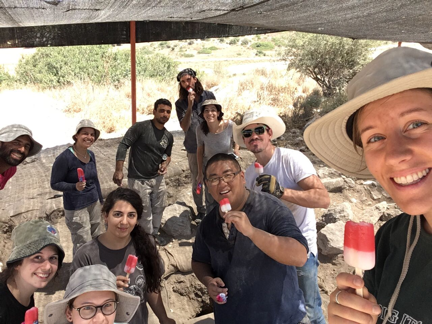
The team taking a popsicle break.

Long-Wright sitting atop some ruins in the national park overlooking the Shephelah plain.

By the end of week three, the cave entrance was fully revealed. A rock hewn arch served as the top of the cave entrance. It was only a few feet below the foundational stones of the walls for the structure. Unfortunately, we reached the collapse of soil into the cave entrance on the third last day of excavation, leaving us no time to excavate that part of the cave. So, who made this cave, and why? Based on the ceramics, artifacts, numismatics, and layout of the cave the supervisors and excavation team determined it was a hiding complex used during the Bar Kokhba Revolt. The cistern was originally used as a miqvah, a Jewish ritual bathing installment. During the Revolt period, the Jewish people would carve through their miqvah and connect it to their underground storage room. They would then dig towards a neighbour’s miqvah and storage room creating a complex network of caves. When the Romans would come to attack, the inhabitants would run into the hiding complexes to escape capture or injury. Several hiding complexes have been discovered in the region, ranging in size and complexity.

Lorem ipsum dolor sit amet, consectetur adipiscing elit. Ut elit tellus, luctus nec ullamcorper mattis, pulvinar dapibus leo.

This excavation was incredible! Unfortunately I could not multiply myself and excavate in each area of the site, but Area B provided more than enough training, and excitement. This season really solidified the idea that archaeology is a mystery solving discipline. Each clue must be taken into account if one wants to determine the story of a site. It’s not about a race to the finish but a methodical perusing of each layer, artifact, and feature to gain a clear understanding of what has transpired. I chose to write this entry in such a way that demonstrates what it is like to be in the field. Each hour, day, and week provides new information, and with that information comes new hypothesis. You are a detective trying to uncover the past, and you only have the evidence at the site, and examples from others, to draw upon. It is fascinating and fulfilling work, and I hope to be fortunate enough to don the trench hat once more in search of buried pasts.

A huge thank you to the American School of Oriental Research, without their financial support I would not have been able to attend the excavations of Horvat Midras in Israel.


Katlin Long-Wright is a Canadian and a graduate from the University of British Columbia’s Classical, Near Eastern, and Religious studies department. His research has an emphasis on Egyptology. He has worked on two excavations: Gerace, Sicily, and Horvat Midras, Israel, and hopes for many more excavation opportunities in the future. 

Want to help more students and young archaeologists get into the field? Donate to the cause today by selecting “Excavation Scholarships” as your gift purpose!

ASOR Awardee Spotlight: Lynn Swartz Dodd

[vc_row fullwidth=”true” attached=”true” css=”.vc_custom_1496247803139{padding-top: 0px !important;padding-right: 0px !important;padding-bottom: 0px !important;padding-left: 0px !important;}”][vc_column][mk_image src=”http://www.asor.org/wp-content/uploads/2018/04/pergamon-museum-lions-banner-for-post.jpg” image_width=”1920″ image_height=”400″ hover=”false” margin_bottom=”0″][/vc_column][/vc_row][vc_row fullwidth=”true” css=”.vc_custom_1496682730308{padding-top: 10px !important;padding-right: 0px !important;padding-bottom: 0px !important;padding-left: 0px !important;}”][vc_column width=”1/12″ css=”.vc_custom_1496683820796{margin-right: 10px !important;}” offset=”vc_hidden-md vc_hidden-sm vc_hidden-xs”][vc_column_text]

 SHARE

[/vc_column_text][mk_image src=”http://www.asortest.org/wp-content/uploads/2017/01/social-fb-icon4.jpg” image_width=”42″ image_height=”42″ hover=”false” custom_url=”https://www.facebook.com/ASOResearch/” margin_bottom=”0″][mk_image src=”http://www.asortest.org/wp-content/uploads/2017/01/social-tw-icon4.jpg” image_width=”42″ image_height=”42″ hover=”false” custom_url=”https://twitter.com/ASOResearch?ref_src=twsrc%5Egoogle%7Ctwcamp%5Eserp%7Ctwgr%5Eauthor” margin_bottom=”0″][mk_image src=”http://www.asortest.org/wp-content/uploads/2017/01/social-in-icon4.jpg” image_width=”42″ image_height=”42″ hover=”false” custom_url=”https://www.linkedin.com/company/american-schools-of-oriental-research” margin_bottom=”0″][mk_image src=”http://www.asortest.org/wp-content/uploads/2017/01/social-ml-icon_7.jpg” image_width=”42″ image_height=”42″ hover=”false” custom_url=”mailto:asor@bu.edu” margin_bottom=”0″][mk_image src=”http://www.asortest.org/wp-content/uploads/2017/01/blog-icon3.jpg” image_width=”42″ image_height=”42″ hover=”false” custom_url=”http://asorblog.org/” margin_bottom=”0″][/vc_column][vc_column border_color=”rgba(255,255,255,0.01)” width=”1/6″ css=”.vc_custom_1496683923840{margin-right: 20px !important;border-left-width: 2px !important;padding-right: 20px !important;padding-left: 20px !important;border-left-color: #99422f !important;}”][mk_divider divider_color=”rgba(255,255,255,0.01)” thickness=”1″ margin_top=”3″ margin_bottom=”3″][vc_column_text]

NEWS@ASOR E-NEWSLETTER

ANCIENT NEAR EAST TODAY E-NEWSLETTER

PAST ASOR NEWS, MONTH BY MONTH

FY18 HONOR ROLL OF DONORS

ASOR ANNUAL MEETING

[/vc_column_text][/vc_column][vc_column border_color=”rgba(170,170,170,0.01)” width=”1/2″ css=”.vc_custom_1487276122024{margin-right: 10px !important;margin-bottom: 30px !important;border-right-width: 2px !important;border-bottom-width: 2px !important;padding-top: 30px !important;padding-right: 30px !important;padding-left: 20px !important;background-color: #ffffff !important;border-right-color: rgba(227,228,228,0.75) !important;border-bottom-color: rgba(227,228,228,0.75) !important;}”][vc_column_text responsive_align=”left”]

AWARDEE SPOTLIGHT: LYNN SWARTZ DODD

[/vc_column_text][vc_column_text]At the 2018 ASOR Annual Meeting, Lynn Swartz Dodd was awarded the The Charles U. Harris Service Award. This award is given in recognition of long term and/or special service as an ASOR Officer or Trustee.

Lynn Swartz Dodd, Associate Professor of the Practice of Religion, University of Southern California, has served as ASOR Secretary from 2013-2018 (two three-year terms). Of the ASOR officer positions, secretary is perhaps the most thankless task. It requires a commitment to serve as an officer on the Executive Committee and the Board of Trustees, but also—on top of this—to take the minutes at every Executive Committee and Board meeting. Trying to be both an informed and engaged participant, while also taking the minutes and keeping straight the contributions of every other participant in the meetings, is no easy task! Yet Lynn exudes a coolness and calm during Executive Committee and Board meetings that does, in fact, make things look easy. During her tenure as ASOR secretary, Lynn also served as Chair of ASOR’s Ethics Task Force and on ASOR’s Publications and Archaeological Research and Policy (CAP) committees. In recognition of her work as secretary, and her six years as an ASOR officer, it is a pleasure to award her the Charles U. Harris Service Award.

Learn more about ASOR Awards

Nominate someone for an award. The deadline for service award nominations is September 2, 2019. The deadline for book award nominations September 16, 2019.[/vc_column_text][/vc_column][vc_column border_color=”rgba(170,170,170,0.01)” width=”1/6″ css=”.vc_custom_1496684098866{margin-right: 5px !important;margin-bottom: 20px !important;border-right-width: 2px !important;border-bottom-width: 2px !important;padding-top: 30px !important;padding-right: 10px !important;padding-left: 10px !important;background-color: #ffffff !important;border-right-color: rgba(227,228,228,0.75) !important;border-bottom-color: rgba(227,228,228,0.75) !important;}”][vc_wp_posts title=”BROWSE THE NEWS ARCHIVE” number=”4″][/vc_column][vc_column border_color=”rgba(170,170,170,0.01)” width=”1/6″ css=”.vc_custom_1496684008271{margin-right: 10px !important;margin-bottom: 30px !important;border-right-width: 2px !important;border-bottom-width: 2px !important;padding-top: 30px !important;padding-right: 20px !important;padding-left: 20px !important;background-color: #ffffff !important;border-right-color: rgba(227,228,228,0.75) !important;border-bottom-color: rgba(227,228,228,0.75) !important;}”][vc_column_text] [/vc_column_text][/vc_column][/vc_row][vc_row][vc_column][vc_column_text]

[/vc_column_text][/vc_column][/vc_row][vc_row][vc_column][vc_column_text]

[/vc_column_text][/vc_column][/vc_row]