
SHARE
[/vc_column_text][mk_image src=”http://www.asortest.org/wp-content/uploads/2017/01/social-fb-icon4.jpg” image_width=”42″ image_height=”42″ hover=”false” custom_url=”https://www.facebook.com/ASOResearch/” margin_bottom=”0″][mk_image src=”http://www.asortest.org/wp-content/uploads/2017/01/social-tw-icon4.jpg” image_width=”42″ image_height=”42″ hover=”false” custom_url=”https://twitter.com/ASOResearch?ref_src=twsrc%5Egoogle%7Ctwcamp%5Eserp%7Ctwgr%5Eauthor” margin_bottom=”0″][mk_image src=”http://www.asortest.org/wp-content/uploads/2017/01/social-in-icon4.jpg” image_width=”42″ image_height=”42″ hover=”false” custom_url=”https://www.linkedin.com/company/american-schools-of-oriental-research” margin_bottom=”0″][mk_image src=”http://www.asortest.org/wp-content/uploads/2017/01/social-ml-icon_7.jpg” image_width=”42″ image_height=”42″ hover=”false” custom_url=”mailto:asor@bu.edu” margin_bottom=”0″][mk_image src=”http://www.asortest.org/wp-content/uploads/2017/01/blog-icon3.jpg” image_width=”42″ image_height=”42″ hover=”false” custom_url=”http://asorblog.org/” margin_bottom=”0″][/vc_column][vc_column border_color=”rgba(255,255,255,0.01)” width=”1/6″ css=”.vc_custom_1496683923840{margin-right: 20px !important;border-left-width: 2px !important;padding-right: 20px !important;padding-left: 20px !important;border-left-color: #99422f !important;}”][mk_divider divider_color=”rgba(255,255,255,0.01)” thickness=”1″ margin_top=”3″ margin_bottom=”3″][vc_column_text] [/vc_column_text][/vc_column][vc_column border_color=”rgba(170,170,170,0.01)” width=”1/2″ css=”.vc_custom_1487276122024{margin-right: 10px !important;margin-bottom: 30px !important;border-right-width: 2px !important;border-bottom-width: 2px !important;padding-top: 30px !important;padding-right: 30px !important;padding-left: 20px !important;background-color: #ffffff !important;border-right-color: rgba(227,228,228,0.75) !important;border-bottom-color: rgba(227,228,228,0.75) !important;}”][vc_column_text responsive_align=”left”]Table of Contents for Near Eastern Archaeology 82.1 (March 2019)
You can receive NEA (and other ASOR publications) through an ASOR Membership. Please e-mail the Membership office if you have any questions.
Pp. 5–7: “The Rise of Ancient Israel in the Iron I–IIA: The Need for a Closer Look,” by Omer Sergi and Yuval Gadot
In 1995 and 1996, the periodical Biblical Archaeologist (the former name of Near Eastern Archaeology) staged a debate between Israel Finkelstein and William G. Dever over the origins of ancient Israel (Dever 1995; Finkelstein 1996). 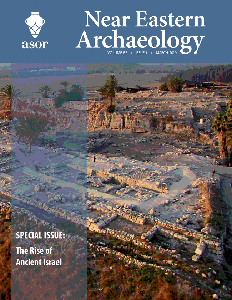 This debate, described by the journal’s editor (David Hopkins) as “sharp and pointed,” was the culmination of more than a decade of revolutionary archaeological research that was much influenced by the new historical and archaeological paradigms that took shape in the academic world at the time. The Dever-Finkelstein debate of 1995–1996 was fueled by fresh archaeological data, the result of extensive exploration in the Samaria hills conducted throughout the 1970s and 1980s. From the vantage point of 2018 it seems that despite the many books and articles published since those days, the 1995–1996 debate marks something of a stagnation point, since very few new data have been published since then, and even when new questions have arisen, due to political circumstances there has been no real option to go out to the field and reexcavate.
Click here to access the above article on The University of Chicago Press Journals (ASOR membership with online access and/or subscription to UCP Current Content required).
Pp. 8–15: “First Israel, Core Israel, United (Northern) Israel,” by Israel Finkelstein
The rise of ancient Israel has been studied from the perspectives of archaeology and the biblical text in parallel. 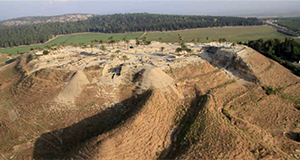 Archaeology deals with the settlement processes that took place in the highlands, while biblical exegesis may identify germs of memories that go back to events that took place before the rise of the Hebrew kingdoms and shed light on the ideology of Israelite and Judahite authors regarding the emergence of the Israelite “nation.”
The archaeology of the rise of early Israel, involving the investigation of Iron I sites in the highlands, flourished in the 1980s and introduced new field methodologies and theoretical frameworks. For political reasons, progress in this area has since come to an almost complete standstill, yet recent work in regions bordering on the highlands shed light on several important issues related to the rise of ancient Israel. I refer mainly to the chronology of the process and the impact of climate on the events in Canaan ca. 1250–1100 BCE. The cessation of fieldwork in the highlands has stimulated scholars to revisit the textual traditions regarding the emergence of ancient Israel and to combine the existing archaeological data with the biblical text in a more critical way than was practiced in the past.
Click here to access the above article on The University of Chicago Press Journals (ASOR membership with online access and/or subscription to UCP Current Content required).
Pp. 16–23: “Earliest Israel in Highland Company,” by Lauren Monroe and Daniel E. Fleming
When God calls Jacob “Israel” in Gen 32:29, after grappling with an angel, the name Israel is applied to all the tribal sons of Jacob and thus given a grand geographical range, stretching north to Dan, south to the Negev, and east into modern Jordan. 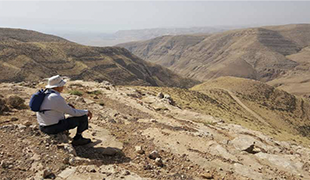 Archaeologists, historians, and biblical scholars most often identify their object of study as “ancient Israel,” as if the biblical name represented something static that could be read back onto the whole historical dimension of their enterprise. Yet, the name Israel was first of all political, and we must expect its use to change with the evolving political landscape. “Israel” identified a polity situated in the southern Levant from at least the late thirteenth century BCE through the end of the kingdom by that name in 720 BCE, and the name is applied to the whole people of God in biblical writing through the Persian period and beyond. Since few would argue that what writers imagined in the sixth or fifth centuries BCE matched “Israel” in the Late Bronze Age Merenptah Inscription, there is much to learn from treating the name with precision.
Click here to access the above article on The University of Chicago Press Journals (ASOR membership with online access and/or subscription to UCP Current Content required).
Pp. 24–31: ““All These Are the Twelve Tribes of Israel”: The Origins of Israel’s Kinship Identity,” by Kristin Weingart
What is Israel and who is an Israelite? While the He- brew Bible has a lot to say about the eponymous patriarch Jacob/Israel, the meaning of his new name,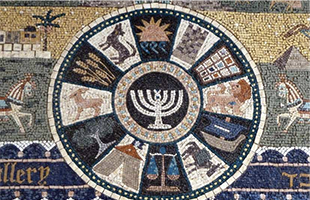 or the people of Israel’s special role among the nations, details on Israel’s definition are sparse. The most comprehensive treatment of the matter is offered in the last and one of the latest books of the Hebrew Bible, the Book of Chronicles originating from the Persian period. This book does not offer any definition of Israel, but it starts with extensive genealogical lists (1 Chr 1–9) presenting a complete inventory of all Israelite tribes, clans, and families appearing in the texts and existing at the Chronicler’s time. Therefore, according to the Chronicler, being an Israelite is a matter of kin: Whoever is born or marries into one of the Israelite tribes is an Israelite, while Israel, in turn, is part and parcel of a greater family of peoples. In the first (in terms of the canon, not of its dating) book of the Bible, the Chronicler’s definition finds its counterpart and basis. The Book of Genesis describes Israel’s development from a small family into a clan that is to become a people. It is structured as a community of twelve tribes and embedded into a network of neighboring peoples who are all traced back to near or distant relatives. So even without a straightforward definition, Israel’s kinship identity seems quite natural to any reader of the Bible.
Click here to access the above article on The University of Chicago Press Journals (ASOR membership with online access and/or subscription to UCP Current Content required).
Pp. 32–41: “The Iron I Settlement Wave in the Samaria Highlands and Its Connection with the Urban Centers,” by Yuval Gadot
The archaeological and historical study of the “Early Israelitie” settlement of the Iron I period in the southern Levant culminated in the early 1990s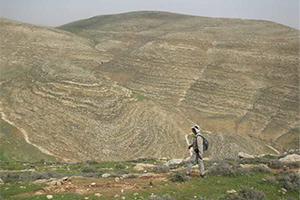 Novel and revolutionary theoretical thinking in archaeology was brought in as a framework for new explanations and interpretations of old and new material. Socioeconomic transformations (as opposed to migrations) were sought when attempting to explain the “sudden” appearance of hundreds of sites in the highlands of the southern Levant (west and east of the Jordan). The new theories proposed tracing the source of the “early Israelites” to the nomadic society that had lived in the highlands for generations, or to refugees fleeing from the Canaanite urban society. These theories were unique in the fact that they offered an alternative to the migration models based mainly on the books of Joshua (military conquest) or Judges (peaceful infiltration) that had prevailed for many years.
However, no matter how revolutionary these theories were, one fundamental concept was common to all of them: their basic assumption that the settlement of “Early Israel” was a reaction to and outcome of the collapse of the Canaanite urban centers—a downfall that took place at the end of the Late Bronze Age and as part of the “collapse of all civilizations” that was taking place across the board.
Click here to access the above article on The University of Chicago Press Journals (ASOR membership with online access and/or subscription to UCP Current Content required).
Pp. 42–51: “The Formation of Israelite Identity in the Central Canaanite Highlands in the Iron Age I–IIA,” by Omer Sergi
From the early beginnings of the scientific quest for historical Israel, the Israelites were considered outsiders in their land: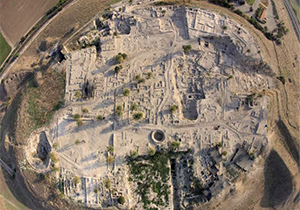 whether they were understood as geographical outsiders who conquered the land or just peaceful infiltrators, or whether they were viewed as social outsiders—the lower classes of Canaanite society who fled to the hill country—the Israelites were conceived as foreign to the central hill country of Canaan. It was Finkelstein’s study, The Archaeology of the Israelite Settlement, that revolutionized our understanding of pre-monarchic Israel. Finkelstein demonstrated that the settlement wave that characterized the central high- lands in the Iron I was not a one-time phenomenon but a part of a cyclic settlement fluctuation, which had its (similar) predecessors already in the EB I and MB II–III. He, therefore, suggested explaining these settlement fluctuations not as the result of migrations or demographic expansion and withdrawal from the nearby lowlands, but rather in terms of socioeconomic change; that is, shifts toward a more sedentary or a more pastoral way of life, in accordance with political, economic, and social transformations. Finkelstein further argued that the settlement pattern, the architectural layout, and the typical ceramic assemblage of these settlements reflected their agro-pastoral subsistence economy and thus pointed to their background in a mobile pastoral mode of life. In other words, the Iron I settlers in the hill country had never been outsiders, but were rather the indigenous mobile population of the central Canaanite highlands.
Click here to access the above article on The University of Chicago Press Journals (ASOR membership with online access and/or subscription to UCP Current Content required).
Pp. 52–59: “Food, Pork Consumption, and Identity in Ancient Israel,” by Lidar Sapir-Hen
In search of archaeological features that would help identify early Israel and its origin,  an older version of this journal (then named Biblical Archaeologist) published twenty years ago the debate between William G. Dever and Israel Finkelstein. The single argument that both researchers agreed upon was that absence of pig remains can be used as an ethnic marker when attempting to identify early Israel. This argument has relied primarily on the publications of the late Brian Hesse and other zooarchaeologists regarding frequencies of pigs from southern Levantine sites dated to the Iron Age. The patterns that emerged from these publications demonstrated high frequencies of pig in sites on the coastal plain, identified as Philistines, and low frequencies or absence in highland sites’ populations. While Hesse and others had argued for caution when using such a dichotomy in pork consumption for cultural identification, the data led, in the following years, to the practice of identifying Iron Age population ethnicity based on pig presence or absence.
Click here to access the above article on The University of Chicago Press Journals (ASOR membership with online access and/or subscription to UCP Current Content required).
[/vc_column_text][mk_divider][vc_column_text]To view the entire issue on The University of Chicago Press Journals, click here.[/vc_column_text][/vc_column][vc_column border_color=”rgba(170,170,170,0.01)” width=”1/6″ css=”.vc_custom_1496684098866{margin-right: 5px !important;margin-bottom: 20px !important;border-right-width: 2px !important;border-bottom-width: 2px !important;padding-top: 30px !important;padding-right: 10px !important;padding-left: 10px !important;background-color: #ffffff !important;border-right-color: rgba(227,228,228,0.75) !important;border-bottom-color: rgba(227,228,228,0.75) !important;}”][vc_wp_posts title=”BROWSE THE NEWS ARCHIVE” number=”4″][/vc_column][vc_column border_color=”rgba(170,170,170,0.01)” width=”1/6″ css=”.vc_custom_1496684008271{margin-right: 10px !important;margin-bottom: 30px !important;border-right-width: 2px !important;border-bottom-width: 2px !important;padding-top: 30px !important;padding-right: 20px !important;padding-left: 20px !important;background-color: #ffffff !important;border-right-color: rgba(227,228,228,0.75) !important;border-bottom-color: rgba(227,228,228,0.75) !important;}”][vc_column_text]Tweets by ASOResearch [/vc_column_text][/vc_column][/vc_row]