[vc_row fullwidth=”true” attached=”true” css=”.vc_custom_1496247803139{padding-top: 0px !important;padding-right: 0px !important;padding-bottom: 0px !important;padding-left: 0px !important;}”][vc_column][vc_single_image image=”81206″ img_size=”1920×400″ alignment=”center”][/vc_column][/vc_row][vc_row fullwidth=”true” css=”.vc_custom_1496682730308{padding-top: 10px !important;padding-right: 0px !important;padding-bottom: 0px !important;padding-left: 0px !important;}”][vc_column width=”1/12″ css=”.vc_custom_1496683820796{margin-right: 10px !important;}” offset=”vc_hidden-md vc_hidden-sm vc_hidden-xs”][vc_column_text]
SHARE
[/vc_column_text][mk_image src=”http://www.asortest.org/wp-content/uploads/2017/01/social-fb-icon4.jpg” image_width=”42″ image_height=”42″ hover=”false” custom_url=”https://www.facebook.com/ASOResearch/” margin_bottom=”0″][mk_image src=”http://www.asortest.org/wp-content/uploads/2017/01/social-tw-icon4.jpg” image_width=”42″ image_height=”42″ hover=”false” custom_url=”https://twitter.com/ASOResearch?ref_src=twsrc%5Egoogle%7Ctwcamp%5Eserp%7Ctwgr%5Eauthor” margin_bottom=”0″][mk_image src=”http://www.asortest.org/wp-content/uploads/2017/01/social-in-icon4.jpg” image_width=”42″ image_height=”42″ hover=”false” custom_url=”https://www.linkedin.com/company/american-schools-of-oriental-research” margin_bottom=”0″][mk_image src=”http://www.asortest.org/wp-content/uploads/2017/01/social-ml-icon_7.jpg” image_width=”42″ image_height=”42″ hover=”false” custom_url=”mailto:asor@bu.edu” margin_bottom=”0″][mk_image src=”http://www.asortest.org/wp-content/uploads/2017/01/blog-icon3.jpg” image_width=”42″ image_height=”42″ hover=”false” custom_url=”http://asorblog.org/” margin_bottom=”0″][/vc_column][vc_column border_color=”rgba(255,255,255,0.01)” width=”1/6″ css=”.vc_custom_1496683923840{margin-right: 20px !important;border-left-width: 2px !important;padding-right: 20px !important;padding-left: 20px !important;border-left-color: #99422f !important;}”][mk_divider divider_color=”rgba(255,255,255,0.01)” thickness=”1″ margin_top=”3″ margin_bottom=”3″][vc_widget_sidebar sidebar_id=”ca-sidebar-39801″][/vc_column][vc_column border_color=”rgba(170,170,170,0.01)” width=”1/2″ css=”.vc_custom_1487276122024{margin-right: 10px !important;margin-bottom: 30px !important;border-right-width: 2px !important;border-bottom-width: 2px !important;padding-top: 30px !important;padding-right: 30px !important;padding-left: 20px !important;background-color: #ffffff !important;border-right-color: rgba(227,228,228,0.75) !important;border-bottom-color: rgba(227,228,228,0.75) !important;}”][vc_row_inner][vc_column_inner css=”.vc_custom_1651159200767{padding-right: 15px !important;}”][vc_column_text]
Table of Contents for Bulletin of ASOR 390 (November 2023)
[/vc_column_text][/vc_column_inner][/vc_row_inner][mk_divider thickness=”1″ margin_top=”10″ margin_bottom=”30″][vc_row_inner][vc_column_inner width=”1/2″ css=”.vc_custom_1651245957391{padding-right: 10px !important;padding-bottom: 15px !important;}”][vc_single_image image=”93804″ img_size=”medium” alignment=”center” onclick=”custom_link” img_link_target=”_blank” link=”https://www.journals.uchicago.edu/toc/basr/current”][/vc_column_inner][vc_column_inner width=”1/2″][vc_wp_text]
Please e-mail the Membership office if you have any questions.
[/vc_wp_text][/vc_column_inner][/vc_row_inner][mk_divider thickness=”1″ margin_top=”30″ margin_bottom=”30″][vc_row_inner][vc_column_inner css=”.vc_custom_1651155052143{padding-right: 10px !important;}”][vc_single_image image=”93805″ img_size=”1000×300″ alignment=”center” onclick=”custom_link” img_link_target=”_blank” link=”https://www.journals.uchicago.edu/doi/10.1086/726144″][mk_padding_divider size=”10″][vc_column_text]
Pp. 1-19: “Close to Us or Far from Them? Unusual Funerary Spaces in Early and Middle Bronze Age Cyprus,” by Luca Bombardieri
A number of recent studies have devoted attention to the archaeology of burial and its implications in Bronze Age Cyprus (Keswani 2004, 2005; Knapp 2018; Webb 2018). This article analyzes some aspects of space negotiation between settlement and funerary areas during the Early and Middle Bronze Age. After briefly discussing current views on this subject, it will focus on specific cases of intramural burial from a set of contemporary contexts and then provide a possible interpretation of this unusual funerary practice. Our sources of evidence for unusual burials in Early and Middle Bronze Age Cyprus are three-fold: burial contexts and locations within inhabited spaces, associated assemblages, and human remains. Each of these will be discussed, before asking whether these data, and their anthropological and ethnographic counterparts, might suggest practices associated with necrophobia in prehistoric Cyprus.
ASOR Members with online access: log into ASOR’s Online Portal here. Once logged in, click the JOURNALS tab in the top navigation bar. Tutorials for how to log in to the Online Portal as well as how to navigate to the Portal Journals page can be found here.
[/vc_column_text][/vc_column_inner][/vc_row_inner][mk_divider thickness=”1″ margin_top=”10″ margin_bottom=”30″][vc_row_inner][vc_column_inner css=”.vc_custom_1651155064988{padding-right: 10px !important;}”][vc_single_image image=”93806″ img_size=”1000×300″ alignment=”center” onclick=”custom_link” img_link_target=”_blank” link=”https://www.journals.uchicago.edu/doi/10.1086/727053″][mk_padding_divider size=”10″][vc_column_text]
Pp. 21-57: “Settlement Systems, Cultural Relationships, and Regional Economy during the Early Bronze Age III-IV in the Northern Shawbak and the Southern Dead Sea Valley: New Insights into the Copper Production System of Faynan,” by Masatoshi Yamafuji
Industrial copper production during the Early Bronze (EB) Age III–IV made the southern Dead SeaValley around Faynan attractive to southern Levantine society. Despite continuous investigations, no previous research has revealed the settlement system or the ceramic regionalism, including the hinter-lands. Forty-one recently confirmed sites from the Early Bronze Age in the northern Shawbak, located to the immediate east of Faynan, contained remarkable settlements in the late EB III and EB IV. A typo-chronological analysis of the ceramic assemblages provided evidence of occupation peaks in the late EB III and a continuation of the settlements in the early EB IV and the earlier phase of the late EB IV. The ceramic types indicate influence from the central southern Levant and the Negev High-lands in both periods. The settlements in the northern Shawbak are expected to have played key roles in the copper production system centered on Faynan. Exploitation of wood for smelting fuel, food provisioning, and circulation of copper were major economic activities. In the EB IV, these settlements co-existed with remnants of pastoral nomadism. Therefore, the economic interdependency between the northern Shawbak and Faynan likely intensified temporarily
ASOR Members with online access: log into ASOR’s Online Portal here. Once logged in, click the JOURNALS tab in the top navigation bar. Tutorials for how to log in to the Online Portal as well as how to navigate to the Portal Journals page can be found here.
[/vc_column_text][/vc_column_inner][/vc_row_inner][mk_divider thickness=”1″ margin_top=”10″ margin_bottom=”30″][vc_row_inner][vc_column_inner css=”.vc_custom_1651155073486{padding-right: 10px !important;}”][vc_single_image image=”93807″ img_size=”1000×300″ alignment=”center” onclick=”custom_link” img_link_target=”_blank” link=”https://www.journals.uchicago.edu/doi/10.1086/726797″][mk_padding_divider size=”10″][vc_column_text]
Pp. 59-95: “Continuity and Change in the Local Production of Hellenistic and Early Roman Cooking Pottery from Nea Paphos (Cyprus),” by Kamila Nocoń and Edyta Marzec
This paper concerns the Hellenistic and Early Roman cooking pottery originating from the area of Nea Paphos, Cyprus. Macroscopic examinations conducted on a few thousand local vessels and their fragments provided the detailed characterization of this group of pottery in terms of the appearance of fabric, typology, and chronology. The integration of these data with the results of laboratory analysis of selected samples revealed that the local production of cooking pottery changed through time in terms of clay composition, shapes, surface treatment, and firing techniques. The transformations observed within the local cooking pottery manufacture seem to correlate with political and social changes as well as the development of Nea Paphos.
ASOR Members with online access: log into ASOR’s Online Portal here. Once logged in, click the JOURNALS tab in the top navigation bar. Tutorials for how to log in to the Online Portal as well as how to navigate to the Portal Journals page can be found here.
[/vc_column_text][/vc_column_inner][/vc_row_inner][mk_divider thickness=”1″ margin_top=”10″ margin_bottom=”30″][vc_row_inner][vc_column_inner css=”.vc_custom_1651155081236{padding-right: 10px !important;}”][vc_single_image image=”93809″ img_size=”1000×300″ alignment=”center” onclick=”custom_link” img_link_target=”_blank” link=”https://www.journals.uchicago.edu/doi/10.1086/727430″][mk_padding_divider size=”10″][vc_column_text]
Pp. 97-111: “The Sheshonq Fragment from Megiddo: A New Interpretation,” by Shirly Ben-Dor Evian and Israel Finklestein
The limestone fragment inscribed with the royal names of king Sheshonq I was found at Tel Megiddo by the Oriental Institute team in 1925. Since its discovery, the piece has been interpreted as part of a large royal stela, erected by the monarch at the site as a sign of Egyptian hegemony. A recent re-examination of the original fragment reveals several anomalies in comparison to the known corpus ofEgyptian stelae. Among these is the fragment’s unusual thickness, more than 50 cm thick, and the absence of smoothed edges on either of its sides. A comparison with contemporaneous (early 22nd Dy-nasty) material from both Egypt and the Levant suggests that the fragment was part of an inscription embedded as an architectural element rather than a stela. The results of recent excavations at Megiddo allow for placing the Sheshonq block stratigraphically and perhaps to identify its original location at the site
ASOR Members with online access: log into ASOR’s Online Portal here. Once logged in, click the JOURNALS tab in the top navigation bar. Tutorials for how to log in to the Online Portal as well as how to navigate to the Portal Journals page can be found here.
[/vc_column_text][/vc_column_inner][/vc_row_inner][mk_divider thickness=”1″ margin_top=”10″ margin_bottom=”30″][vc_row_inner][vc_column_inner css=”.vc_custom_1651155088757{padding-right: 10px !important;}”][vc_single_image image=”93810″ img_size=”1000×300″ alignment=”center” onclick=”custom_link” img_link_target=”_blank” link=”https://www.journals.uchicago.edu/doi/10.1086/727054″][mk_padding_divider size=”10″][vc_column_text]
Pp. 113-128: “Facial Decorations under the Microscope: Decentering Sex and Gender in Phoenician-Punic Coroplastic Art,” by Mireia López-Bertran and Agnès Garcia-Ventura
This paper focuses on a selection of Phoenician-Punic artifacts from the western Mediterranean dating from the 7th to 2nd centuries B.C. It examines some examples of coroplastic art (musician figurines, masks, and protomae) and ostrich eggshells bearing facial decorations, and discusses the different ways in which these decorative motifs have been interpreted in modern scholarship and highlights the centrality of sex and gender in most of these traditional conceptions. It also briefly presents some theoretical insights and shows how, if we decenter sex and gender and instead apply an intersectional approach to the analysis of these materials, some alternative interpretations may emerge.
ASOR Members with online access: log into ASOR’s Online Portal here. Once logged in, click the JOURNALS tab in the top navigation bar. Tutorials for how to log in to the Online Portal as well as how to navigate to the Portal Journals page can be found here.
[/vc_column_text][/vc_column_inner][/vc_row_inner][mk_divider thickness=”1″ margin_top=”10″ margin_bottom=”30″][vc_row_inner][vc_column_inner css=”.vc_custom_1651155096100{padding-right: 10px !important;}”][vc_single_image image=”93811″ img_size=”1000×300″ alignment=”center” onclick=”custom_link” img_link_target=”_blank” link=”https://www.journals.uchicago.edu/doi/10.1086/726585″][mk_padding_divider size=”10″][vc_column_text]
Pp. 129-174: “In the Neighborhood of the Defeated: Urban Analysis of the Provincial Town at Neo-Assyrian Dan” by Yifat Thareani
Assyria’s desire for global domination was marked by the empire’s ideological conception of a“superior”center and an“inferior”periphery. The creation of the Neo-Assyrian provincial system during the 8th–7th centuries B.C.E. was intended to bring order and stability to a chaotic frontier and to create new realities for colonizers and colonized alike. Nevertheless, upon conquering new regions imperial ambitions were reined in by considerations of ecology, demographics, and politics. While the“colonial geography”of the Assyrian empire is often studied from textual, visual, and historical perspectives, it is also marked by distinct material culture expressions that are often explored from a technical point of view. Being one of the main foci of Assyrian imperial expansion, the southern Levant constitutes an ideal case study for investigating material culture manifestations of Assyrian imperial influence on conquered territories. An extensively explored site, the rich archaeological evidence from Tel Dan in the Hula Valley (Stratum Ib) provides a unique opportunity to explore imperial policies of deportation and resettlement in the face of geopolitical forces, as well as Assyrian impact on the everyday life of indigenous populations and recently arrived deportees
ASOR Members with online access: log into ASOR’s Online Portal here. Once logged in, click the JOURNALS tab in the top navigation bar. Tutorials for how to log in to the Online Portal as well as how to navigate to the Portal Journals page can be found here.
[/vc_column_text][/vc_column_inner][/vc_row_inner][mk_divider thickness=”1″ margin_top=”10″ margin_bottom=”30″][vc_row_inner][vc_column_inner css=”.vc_custom_1651155102141{padding-right: 10px !important;}”][vc_single_image image=”93812″ img_size=”1000×300″ alignment=”center” onclick=”custom_link” img_link_target=”_blank” link=”https://www.journals.uchicago.edu/doi/10.1086/724418″][mk_padding_divider size=”10″][vc_column_text]
Pp. 175-187: “The Petrographic Study of the Pottery Assemblage from Naḥal Tsafit and Its Implications for Chalcolithic Copper Production Systems” by Yuval Goren and Steven A. Rosen
Petrographic analysis of ceramics from the Naḥal Tsafit (ca. 4000) campsite located in the Rotem Plain of the eastern Negev reflects pottery origins both in the Hebron Hills and environs, and most notably in the Faynan region. Attributed to the Chalcolithic Middle Timnian pastoral culture, mostly in deserts and contemporary with the Ghassulian culture, the analysis indicates connections to the copper source region in Faynan. Given the nomadic nature of the site, the absence of Ghassulian remains in Faynan, and the location of Naḥal Tsafit between Faynan and the Mediterranean subhumid climatic zone, the role of nomads as prime players in the Chalcolithic copper trade is suggested.
ASOR Members with online access: log into ASOR’s Online Portal here. Once logged in, click the JOURNALS tab in the top navigation bar. Tutorials for how to log in to the Online Portal as well as how to navigate to the Portal Journals page can be found here.[/vc_column_text][/vc_column_inner][/vc_row_inner][mk_divider thickness=”1″ margin_top=”10″ margin_bottom=”30″][vc_row_inner][vc_column_inner css=”.vc_custom_1651155108357{padding-right: 10px !important;}”][vc_single_image image=”93813″ img_size=”1000×300″ alignment=”center” onclick=”custom_link” img_link_target=”_blank” link=”https://www.journals.uchicago.edu/doi/10.1086/726142″][mk_padding_divider size=”10″][vc_column_text]
Pp. 189-207: “The Typology, Chronology, and Development of the Hiding Complexes of Judaea in Light of the New Discoveries at the Nesher-Ramla Quarry Site: A Reevaluation,” by Dvir Raviv
The recent reports of the excavations at el-Khirbe (Nesher-Ramla Quarry) published by Alexander Melamed have revealed, for the first time, the importance of the hiding complex phenomenon in the province of Judaea during the Second Temple period, both in number and with regard to a more sophisticated architecture than had previously been noted. These reports have made this site a key location for study of the topic. A closer study of the excavation reports and a fresh look at all of the data about hiding complexes throughout Judaea indicate some methodological issues. Accordingly, we must be cautious about using this site in order to draw conclusions about hiding complexes in general. This study is intended to highlight and sharpen the contribution of the recent discovery of the Nesher-Ramla systems to the study of the hiding complexes of Judaea, and to discuss the historical background of the circumstances surrounding the phenomenon.
ASOR Members with online access: log into ASOR’s Online Portal here. Once logged in, click the JOURNALS tab in the top navigation bar. Tutorials for how to log in to the Online Portal as well as how to navigate to the Portal Journals page can be found here.[/vc_column_text][/vc_column_inner][/vc_row_inner][mk_divider thickness=”1″ margin_top=”10″ margin_bottom=”30″][vc_row_inner][vc_column_inner css=”.vc_custom_1651155116429{padding-right: 10px !important;}”][vc_single_image image=”93814″ img_size=”1000×300″ alignment=”center” onclick=”custom_link” img_link_target=”_blank” link=”https://www.journals.uchicago.edu/doi/10.1086/727776″][mk_padding_divider size=”10″][vc_column_text]
Pp. 209–243: “Tools of the Trade: Accounting Tokens as an Alternative to Text in the Cuneiform World,” by Lucy Ebony Bennison-Chapman
Small, geometric-shaped clay objects are a common find at settlements across West Asia. They were often overlooked in the past, in favor of more enigmatic clay finds such as figurines, seals, and tablets. Denise Schmandt-Besserat’s seminal work (1992) brought clay objects to the fore, arguing they were mnemonic accounting tokens that evolved directly into the characters of cuneiform script and thus were replaced by writing at the end of the 4th millennium b.c. Evidence from excavations across West Asia increasingly demonstrates that the evolutionary narrative of writing as replacing tokens is too simplistic. Various pathways to complex administration were taken. A review of the evidence demonstrates that the advent of writing did not lead to the abandonment of prehistoric bureaucratic technologies. Tokens continue to be a crucial administrative aid at most sites—used along with clay tags, bullae, seals, sealings, and written texts—into the 1st millennium b.c. This article considers how and why nonliterate bureaucratic technologies remained useful tools of daily life in West Asia for as long as cuneiform was the dominant form of written script. It proves that the theorized trajectory of written texts replacing tokens in accounting is a gross oversimplification of the situation of administration in the early historic period.
ASOR Members with online access: log into ASOR’s Online Portal here. Once logged in, click the JOURNALS tab in the top navigation bar. Tutorials for how to log in to the Online Portal as well as how to navigate to the Portal Journals page can be found here.[/vc_column_text][/vc_column_inner][/vc_row_inner][mk_divider thickness=”1″ margin_top=”10″ margin_bottom=”30″][/vc_column][vc_column border_color=”rgba(170,170,170,0.01)” width=”1/6″ css=”.vc_custom_1496684098866{margin-right: 5px !important;margin-bottom: 20px !important;border-right-width: 2px !important;border-bottom-width: 2px !important;padding-top: 30px !important;padding-right: 10px !important;padding-left: 10px !important;background-color: #ffffff !important;border-right-color: rgba(227,228,228,0.75) !important;border-bottom-color: rgba(227,228,228,0.75) !important;}”][vc_wp_posts title=”BROWSE THE NEWS ARCHIVE” number=”4″][/vc_column][vc_column border_color=”rgba(170,170,170,0.01)” width=”1/6″ css=”.vc_custom_1496684008271{margin-right: 10px !important;margin-bottom: 30px !important;border-right-width: 2px !important;border-bottom-width: 2px !important;padding-top: 30px !important;padding-right: 20px !important;padding-left: 20px !important;background-color: #ffffff !important;border-right-color: rgba(227,228,228,0.75) !important;border-bottom-color: rgba(227,228,228,0.75) !important;}”][vc_column_text] [/vc_column_text][/vc_column][/vc_row]

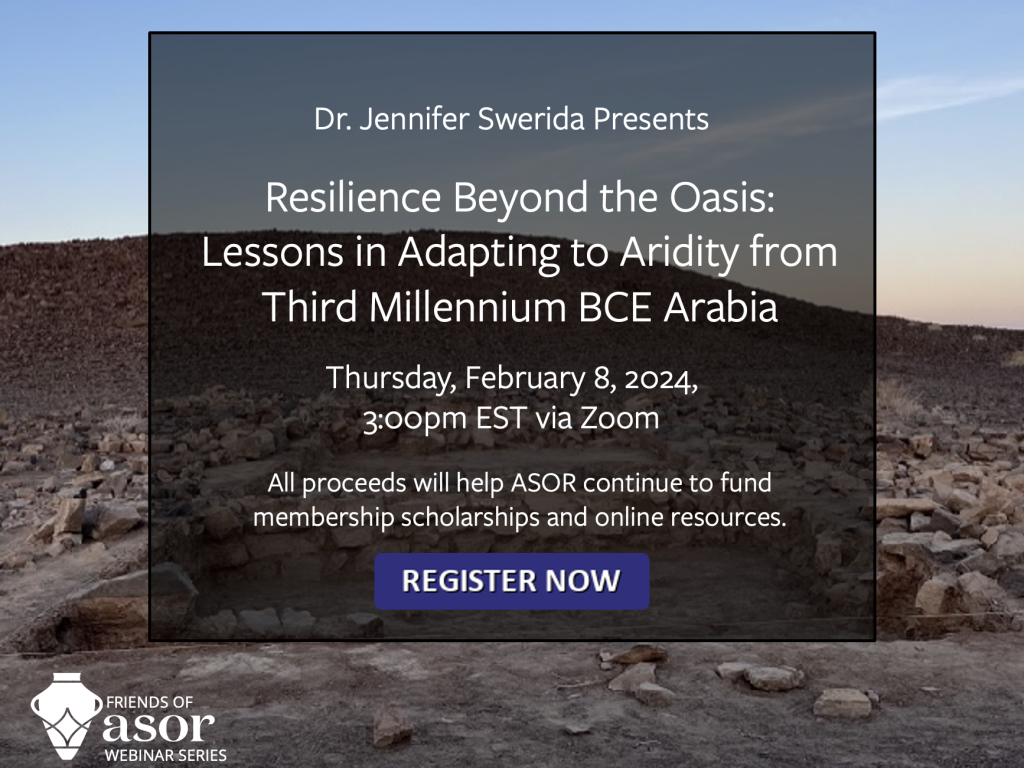
 The Bat landscape of northwestern Oman is one of dense archaeological remains and diverse ecological conditions. The site has been a centre for human activity since the Paleolithic, most famously attested by the Early Bronze Age tombs, towers, and settlement of the UNESCO World Heritage zone. With the support of the US National Endowment for the Humanities, ongoing work by the Bat Archaeological Project aims to reconstruct the site’s Umm an-Nar period (ca. 2700-2000 BC) cultural landscape and the human-environment interactions that led to its creation and resilience.
 The concept of resilience, or the ability of a system to persist and thrive even in the face of perturbations, can be applied to both natural ecosystems and human communities in ancient and modern times. A program of interdisciplinary collaborations integrating geomorphological, archaeobotanical, and phytolith analysis with remote sensing and traditional excavation of domestic spaces on the Bat landscape allows us to trace the arc of Umm an-Nar period activity at Bat alongside its changing environment. A parallel program of ecological survey assessing modern biological (floral and faunal) and hydrological resiliency provides a framework for understanding Bat’s history as a centre for human-environment interaction in the Umm an-Nar period. This lecture will discuss preliminary results of three seasons of resiliency studies at Bat and consider what lessons in adapting to aridity we, as a modern community, can learn from the people of third millennium BCE Arabia.
 Jennifer Swerida holds a PhD from the Department of Near Eastern Studies at Johns Hopkins University with a focus on the archaeology of Arabia. Her research reorients traditional disciplinary boundaries by using insights from the Environmental Humanities to investigate the impact of mobile peoples in the formation of the cultural landscape(s) that shaped the history and culture of West Asia in the third millennium BCE. Her work specifically addresses groups that are underrepresented in modern scholarship, particularly those that occupied areas traditionally considered marginal or peripheral to state-level societies. Working within the landscape-household continuum of social archaeology, Dr. Swerida studies how people in these areas developed cultural mechanisms and socioecological strategies that enabled them to thrive and interact as peers with neighboring states. As Director of the Bat Archaeological Project, she is investigating the emergence of social complexity and cultural adaptations to aridity at the UNESCO World Heritage Site of Bat in Oman. She is a Consulting Scholar for the University of Pennsylvania Museum and a Visiting Assistant Professor at Kennesaw State University.


 This meant making historical figures (such as Ramses III) speak, as well as imagining characters for whom we have no record offering commentary and opinions. To guide the narrative, I introduced two new young characters, Pel (of the Sea Peoples) and Shesha, (an Egyptian scribe) who ask the central question of the book: Why after three prosperous centuries did the civilizations of the Eastern Mediterranean Bronze Age suddenly come to an end? Pel and Sesha are young teenagers, perhaps the same age as a young audience for the book, and although the book is for all ages, I have not simplified the arguments and information Eric presents in the original 1177 BC. When these characters joined the book, (Eric and I came up with them about 50 pages in) their quest gained a personal dimension, and allowed for play with their interactions with the material. Pel, too young to remember the Sea Peoples battles himself, wants to know why his grandfather keeps talking about the glory days before collapse. So why did it happen?
 Glynnis Fawkes was the recipient of a Fulbright Fellowship to Cyprus where she published Archaeology Lives in Cyprus and Cartoons of Cyprus and has worked as an illustrator on archaeological projects in Greece, Cyprus, Israel, Lebanon, Syria, and Turkey. Her comics have appeared on The New Yorker.com, The Comics Journal, Popula.com, and MuthaMagazine.com (for which she was nominated for an Ignatz Award). She is author/illustrator Charlotte Bronte Before Jane Eyre, Persephone’s Garden, and the minicomics Allé Egó and Greek Diary, both of which won medals at the Society of Illustrators’ MoCCA fest in NYC. She lives in Vermont and teaches at the Center for Cartoon Studies.
 Eric H. Cline is Professor of Classics and Anthropology, the former Chair of the Department of Classical and Near Eastern Languages and Civilizations, and the current Director of the Capitol Archaeological Institute at George Washington University, in Washington DC. A National Geographic Explorer, NEH Public Scholar, Getty Scholar, and Fulbright Scholar with degrees from Dartmouth, Yale, and the University of Pennsylvania, he is an active field archaeologist with more than 30 seasons of excavation and survey experience in Israel, Egypt, Jordan, Cyprus, Greece, Crete, and the United States, including ten seasons at Megiddo (1994-2014), where he served as co-director before retiring from the project in 2014, and another ten seasons at Tel Kabri, where he currently serves as Co-Director. He is the author or editor of twenty books and nearly one hundred articles; translations of his books have appeared in nineteen different languages.


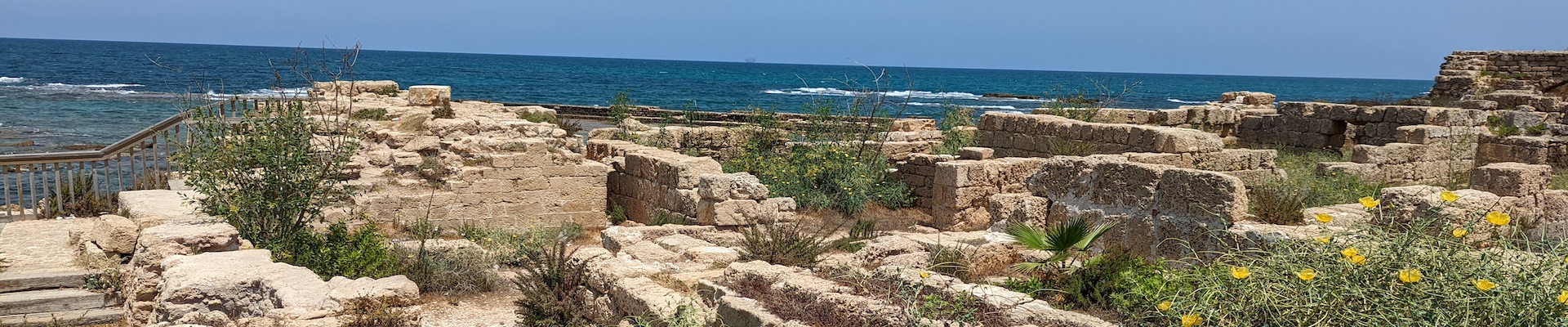
 Friends of ASOR present the next webinar in the 2023-2024 season on December 14 2023, at 6:00 pm EST, presented by Dr. Jennifer Ramsay. In the summer of 1994 I embarked on my first archaeological excavation to King Herod’s Palace at the site of Caesarea Maritima in Israel, where I was thrilled to be bestowed with the title of assistant bone person! After excavating many bones that summer, the director took me aside and said, ‘everyone is doing bones, you should study plant remains’. And just like that, an archaeobotanist was born. Little did I know those many years ago that plant remains recovered from archaeological sites could tell us so much about the past.
 I spent several summers as an archaeobotanist at Caesarea collecting plant remains. It was there that I discovered the importance of the neglected, but informative, ‘weed’. Many economic crops were recovered that illuminated aspects of the agricultural economy in the ancient city, but it was what the weeds could tell us about the environment, seasonality, and agricultural techniques that I found intriguing. I have since been fortunate to work on projects at sites like Petra, Jordan, where the data from the Petra Garden and Pool Complex addressed the questions of how plants functioned in the economy, and how the role of the garden changed through time.
 Additionally, plant remains I analyzed from Nabatean-period tomb deposits in Petra highlighted the role plants played in funerary contexts and contributed to a broader understanding of how they functioned in these ritual events in the ancient world. I have also recovered archaeobotanical data that allowed for a better understanding of the scale and timing of local agricultural production at the ancient site of Bir Madhkur, which lies in the hyper-arid hinterland of Petra. At other sites, for example the Islamic period site of Kinet Höyük in Turkey, the plant remains I analyzed indicated cereal agriculture, but also documented the emergence of a cotton boom, which is attested to in ethnohistorical sources but had rarely been confirmed through archaeobotanical evidence. From examining Neolithic plant remains from the Black Desert in Jordan that indicate a much more verdant environment in the past, to discovering what plants can tell us about provisioning the Roman Army in the East, and even to understanding the role pigeons played in ancient agriculture, plant remains offer vital evidence to our understanding of the past.
 Dr. Jennifer Ramsay (Ph.D. in 2008) is Professor and Chair of the Anthropology Department at SUNY Brockport (State University of New York). She is active on the Board of Trustees for the American Center of Research (ACOR) in Amman and chairs their Fellowship Committee. Jennifer received the Archaeological Institute of America’s Excellence in Undergraduate Teaching Award in 2019 and two State University of New York (SUNY) Chancellor’s Awards for Excellence in Teaching (2014) and Excellence in Faculty Service (2020). Her area of expertise centers on the use of archaeobotany for subsistence reconstruction, understanding trade patterns, recognizing environmental change, and interpreting land-use patterns to gain insight into lifeways of past societies. Although she specializes in the Roman and Late Antique world, Jennifer has also analyzed and published archaeobotanical data from the Neolithic, Bronze and Iron Ages, and Islamic periods. Over her career, she has participated in many archaeological projects in a variety of roles from project archaeobotanist and field school director, to assistant or associate director in Jordan, Israel and Italy at such sites such as Petra, Pompeii and Caesarea Marittima.

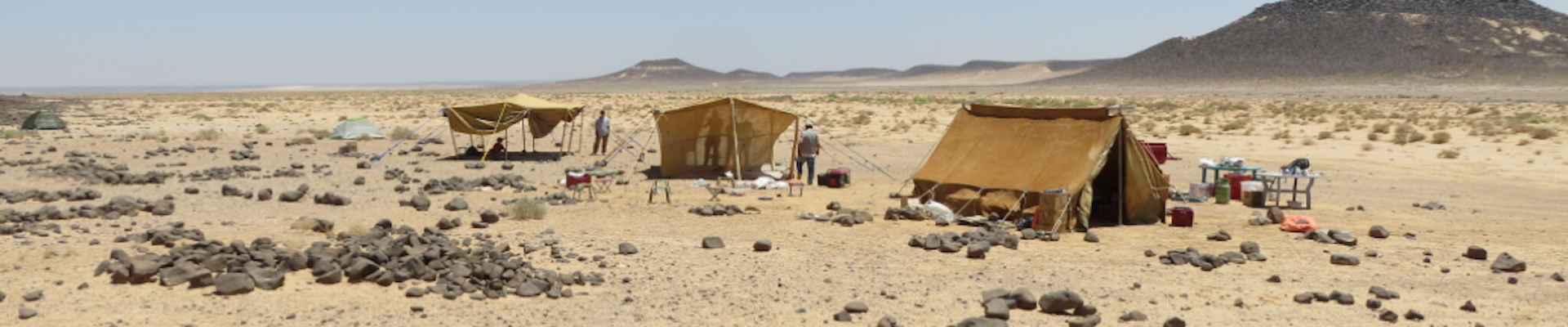
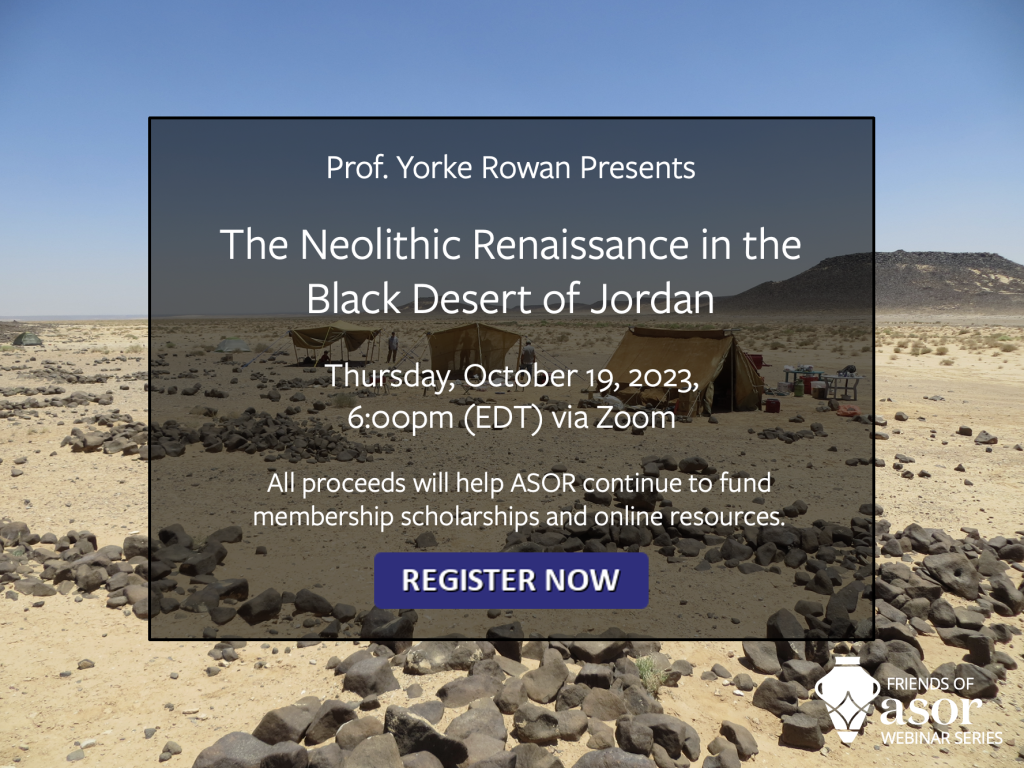
 Friends of ASOR present the next webinar in the 2023-2024 season on January 11th at 6:00pm EST presented by Dr. Yorke Rowan, moderated by Dr. Chad Hill. During the 9th to 8th millennia BCE, climatic conditions created environments that fostered increasing cereal and pulse farming, animal husbandry, and population growth. The “Neolithic Revolution” that occurred across southwest Asia during the Pre-Pottery Neolithic was followed by a much less well-understood period, the Late (or Pottery) Neolithic. Even more obscure, the deserts and steppes beyond the Fertile Crescent were considered underpopulated and of little significance to the larger neolithization process. Through the pioneering field work of people like Alison Betts, Svend Helms and Andrew Garrard, a few structures were known in the steppes and desert of eastern Jordan, an inhospitable region of basalt cobbles and insufficient rainfall for permanent farming. However, recent field research demonstrates that areas such as the Black Desert of eastern Jordan witnessed a sharp uptick in population and building, particularly during the Late Neolithic.
 New data indicates this region was much more hospitable than at present, evident in the clusters of hundreds of permanent structures and extensive chains of hunting traps known as ‘desert kites’. Other enigmatic desert features such as petroglyphs, “wheels” and paths are of unknown date and function, but attest to the recurring use of the region. Join Yorke Rowan as he presents the latest discoveries from the Black Desert of eastern Jordan.
 Yorke Rowan is Research Professor in the Archaeology of the Southern Levant at the Institute for the Study of Ancient Cultures (formerly the OI) at the University of Chicago. He co-directs the NSF funded Kites in Context and the Eastern Badia Archaeological Project, both archaeological field programs in the Black Desert of eastern Jordan. In addition, he directs the Galilee Prehistory Project in northern Israel. He has been a Fulbright Scholar in Jordan and NEH Fellow at American Center for Overseas Research in Amman and the W. F. Albright Institute for Archaeological Research in Jerusalem. His most recent volumes include “The Social Archaeology of the Levant: from Prehistory to the Present” (with A. Yasur-Landau and E. Cline) and recently submitted the proofs for “Shiqmim II: The Phase II Excavations at a Chalcolithic settlement center in the Northern Negev Desert, Israel (1987-1993)” with T. E. Levy and M. M. Burton.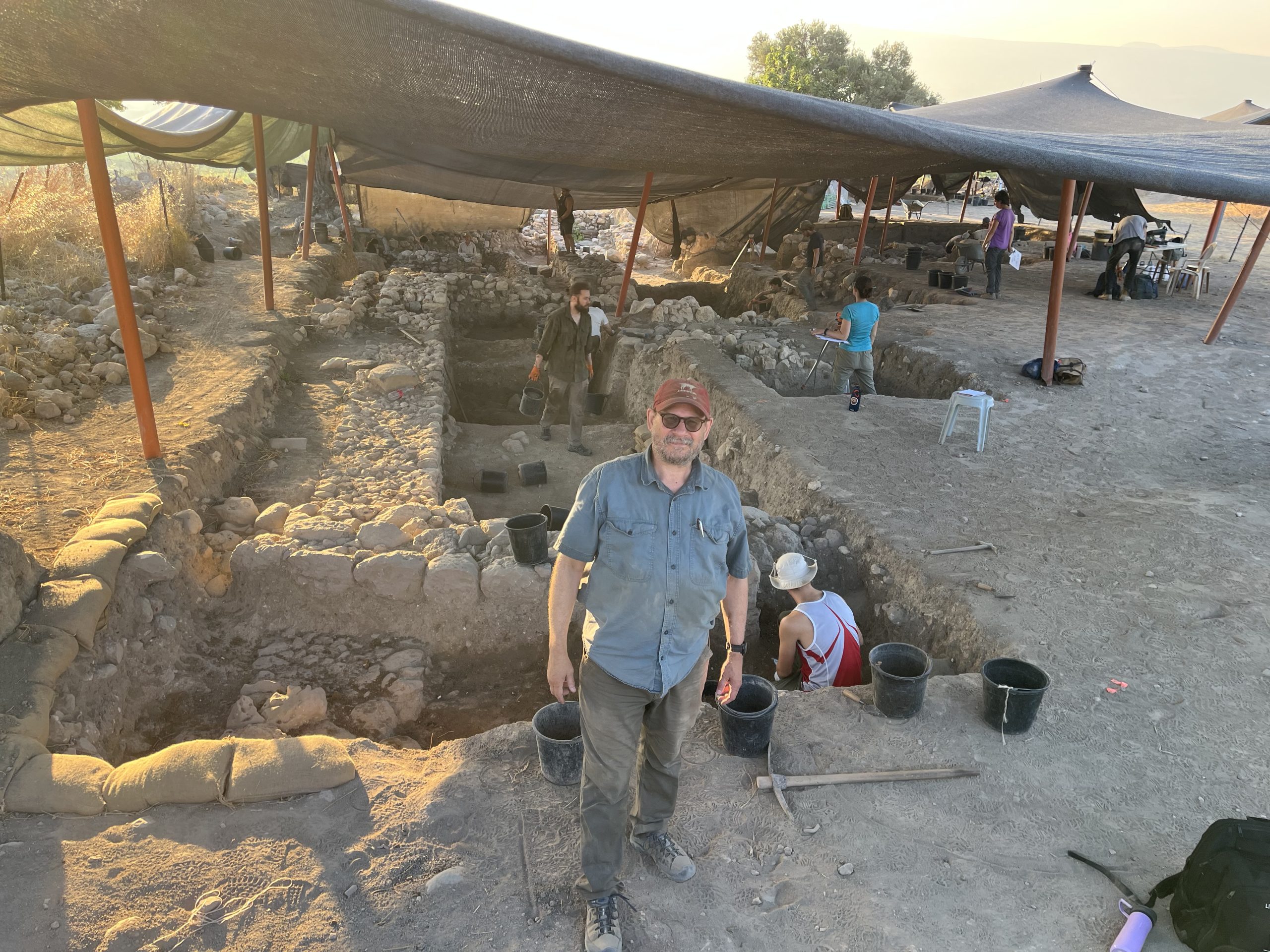
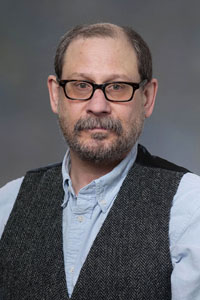 J.P. Dessel is the Steinfeld Professor of Near Eastern Archaeology in the Department of History, and an affiliated member of the Fern and Manfred Steinfeld Program in Judaic Studies at the University of Tennessee, Knoxville. He is also the president of the Albright Institute of Archaeological Research in Jerusalem. He earned his Ph.D. in Near Eastern Studies from the University of Arizona in 1991. He has over 40 seasons in the field working in Israel, Egypt, Turkey, and North America, and co-directed the excavations at Tell el-Wawiyat and Tell ‘Ein Zippori in the Lower Galilee. His research interests include Egypto-Canaanite relations in the fourth millennium, rural complexity in the Late Bronze and Iron Ages, and ceramic technology. Currently he is a senior staff member on the Tayinat Excavation Project in Turkey, and the Tell Abel Beit Ma’acah Excavations. When Dr. Dessel isn’t in the field, he can be found in his kitchen trying to perfect the recipe for red lentil soup, he is very close.


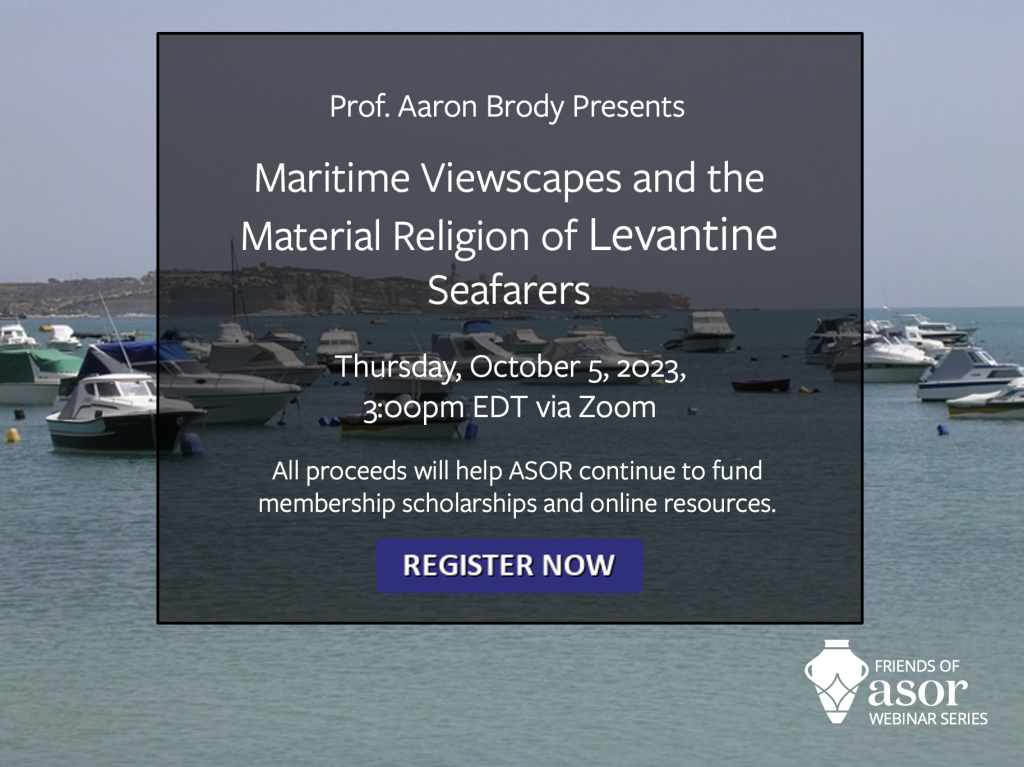
 Friends of ASOR present the next webinar in the 2023-2024 season on October 5 2023, at 3:00 pm EDT, presented by Professor Aaron Brody moderated by Dr. Caroline Sauvage. Ancient seafarers faced dangers and fears posed by the sea and hazards of sailing. Accordingly, specialized sacred beliefs and ritual practices developed among Levantine mariners, who are the focus of this study, which were a subset of terrestrial religion. Sailors honored deities whose maritime, celestial, or meteorological attributes could either benefit or devastate a voyage. While on land, these divine patrons were worshipped in harbor temples and promontory shrines, sometimes with maritime votives. While at sea, divine protection came from the ships themselves, which were considered to be imbued with the spirit of a deity; the vessels also contained sacred spaces that allowed for continued contact with their divine patrons.
 Mariners performed religious ceremonies to enlist and ensure sacred safeguarding and success for their voyages. Maritime features were also part of the funerary practices and mortuary rituals of seafarers. These specialized sacred beliefs and ritual practices were generated by the liminality of the deep and the unique uncertainties and perils at sea, and aided in Levantine maritime exploration, commercial exchanges, and Phoenician settlement that eventually spread throughout the Mediterranean basin and beyond to the Atlantic coasts of Iberia and Morocco.
 Aaron Brody is the Robert and Kathryn Riddell Professor of Bible and Archaeology and Director of the Badè Museum at Pacific School of Religion in Berkeley, California. He has excavated primarily at harbor sites in Israel, including Tel Nami, Ashkelon, Dor, and Tel Akko; and participated in projects in the Negev and Akko Plain and with the Ohlone-Muwekma at sites in northern California. He has held fellowships at the Albright Institute of Archaeological Research in Jerusalem and the American Center of Research in Amman. Recent publications have focused on the topics of household religion, metallurgy, and interregional trade and economy at Tell en-Nasbeh, from holdings in the Badè and Rockefeller Museums. Professor Brody has longstanding research interests on Levantine seafarers, women’s religion and the sea, and underwater, deep-water, and harbor archaeology. He is a co-editor of a new volume, No Place Like Home: Ancient Near Eastern Houses and Households, recently published by Archaeopress. The research he is presenting today is from a chapter he authored in the Handbook of Material Religion in the Ancient Near East, edited by Nicola Laneri and Sharon Steadman, published earlier this year by Bloomsbury Academic press. That chapter and today’s talk are entitled “Maritime Viewscapes and the Material Religion of Levantine Seafarers”.