2022 Study of Collections Fellowship Report: Imprints of the Past: Preserving the Largest Known and Uncatalogued Collection of Semitic Artifacts in Europe
James D. Moore, Humboldt Universität zu Berlin
For many years, I have collaborated with the French Institute’s, Cabinet du Corpus Inscriptionum Semiticarum (Cabinet-CIS) within the Académie des Inscriptions et Belles Lettres, and in 2022 an ASOR Study of Collection Fellowship provided me startup funding to seed an ambitious attempt to build the Cabinet-CIS a digital inventory database and begin the process of cataloguing and digitally preserving one of Europe’s most important collections of Semitic artifacts. At the invitation of Christian Robin and Maria Gorea, I was able to complete the build for the collection’s database during two week-long trips to the Cabinet-CIS. This database is now used by scholars and students working on the collection.
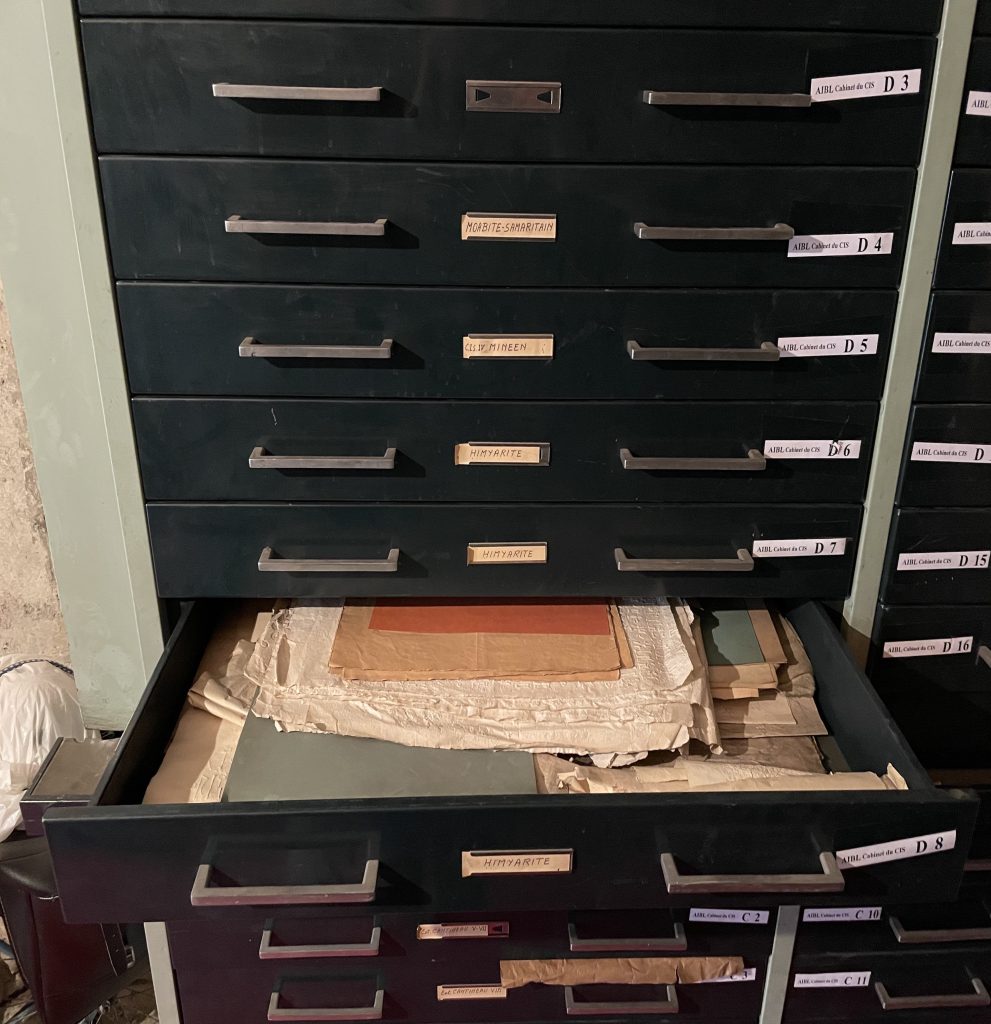
The Cabinet-CIS is known for publishing two monumental series through the late nineteenth and mid-twentieth centuries, the Corpus Inscriptionum Semiticarum and the Répertoire d’épigraphie sémitique. Those compiling these works were sent paper mâché squeezes of the inscriptions in those volumes and in some cases photographs along with detailed descriptions. The collection holds an estimated 10,000+ paper mâché squeezes of Semitic inscriptions from the Near East, North Africa, and the Mediterranean. In some cases these squeezes are of inscriptions which are now lost or inaccessible (due to their location in politically contested regions). Additionally, the collection holds hundreds of original objects and dozens of dossiers of many of the field’s most important figures, such as that of Charles Clermont-Ganneau. Unfortunately, the collection is only loosely organized into boxes and cupboards, for which a short inventory had been compiled.
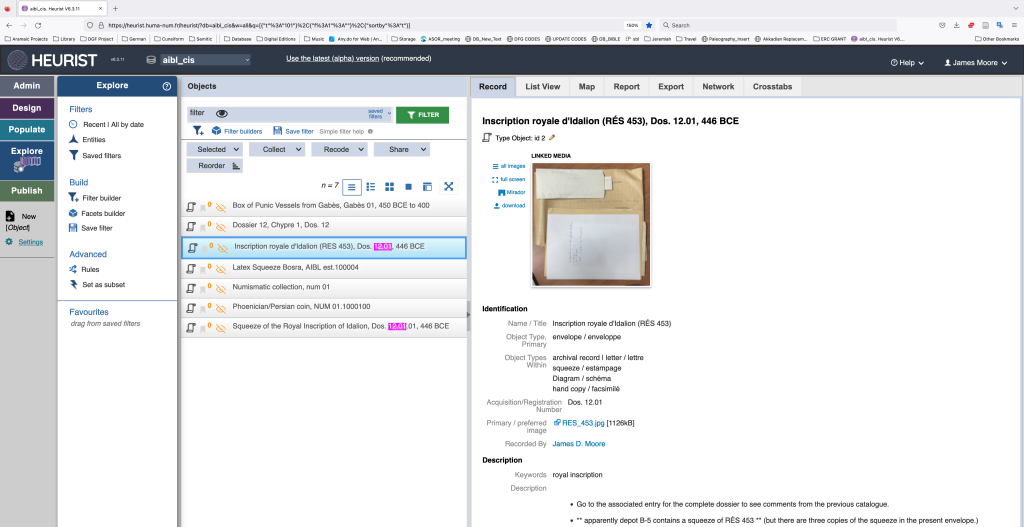
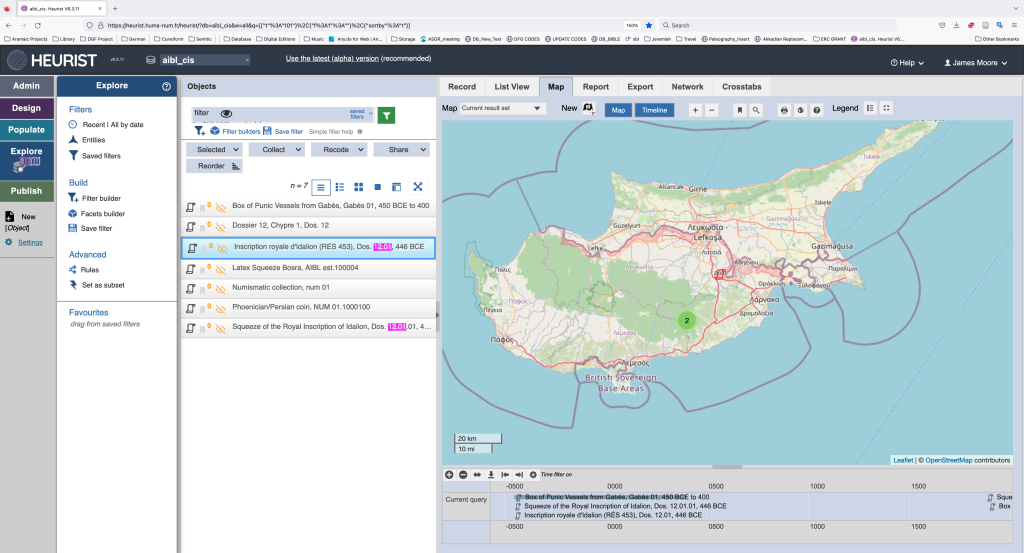
Although the work was hindered by continued difficulties traveling, due to residual effects of the COVID-19 pandemic, a mid-year trip to the Cabinet-CIS allowed me to assess the needs of the collection and survey its holdings. During that week I built a prototype SQL (PostgreSQL) database and local application which was tested by those working on the collection, specifically Maria Gorea’s students Noémie Carpentier and Narmin Sadykhova. Over the course of many months, I fine-tuned the prototypal database, and at the end of the year, during a second trip to the Cabinet-CIS, I rebuilt the database on the Huma-Num servers using the Heurist database management system, an Open Source information system builder and website publisher developed specifically for Humanities research data. The result is an easy to use inventory database for the Cabinet-CIS’s internal use (though the intention is to make the data accessible through a future website should continued funding be acquired). Here I must thank the Heurist team, in particular Ian Johnson and Michael Falk, for their support and advice along the way.
The database includes record entries where all necessary information about an object in the collection can be stored, including metadata, text, and translation. Each entry includes mapping a timeline features for the object along with additional media storage that can be linked to the object.
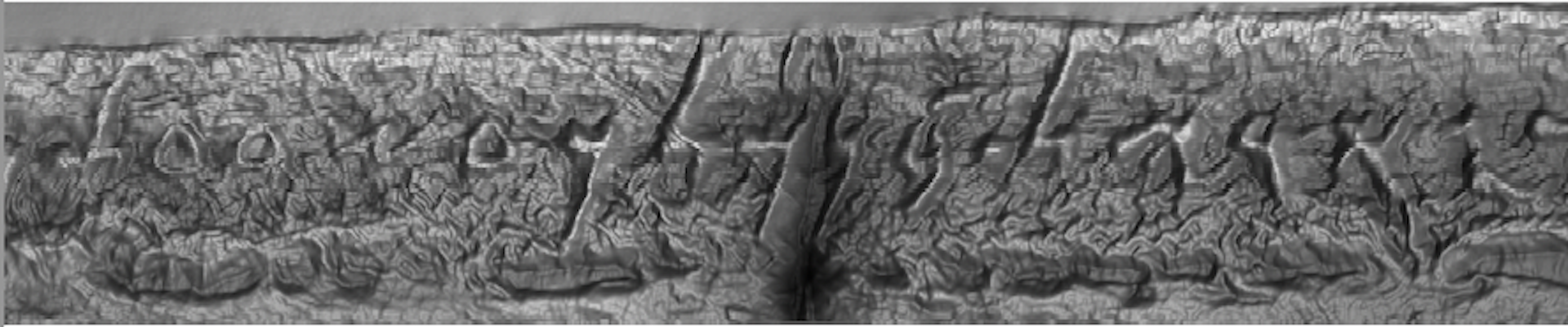
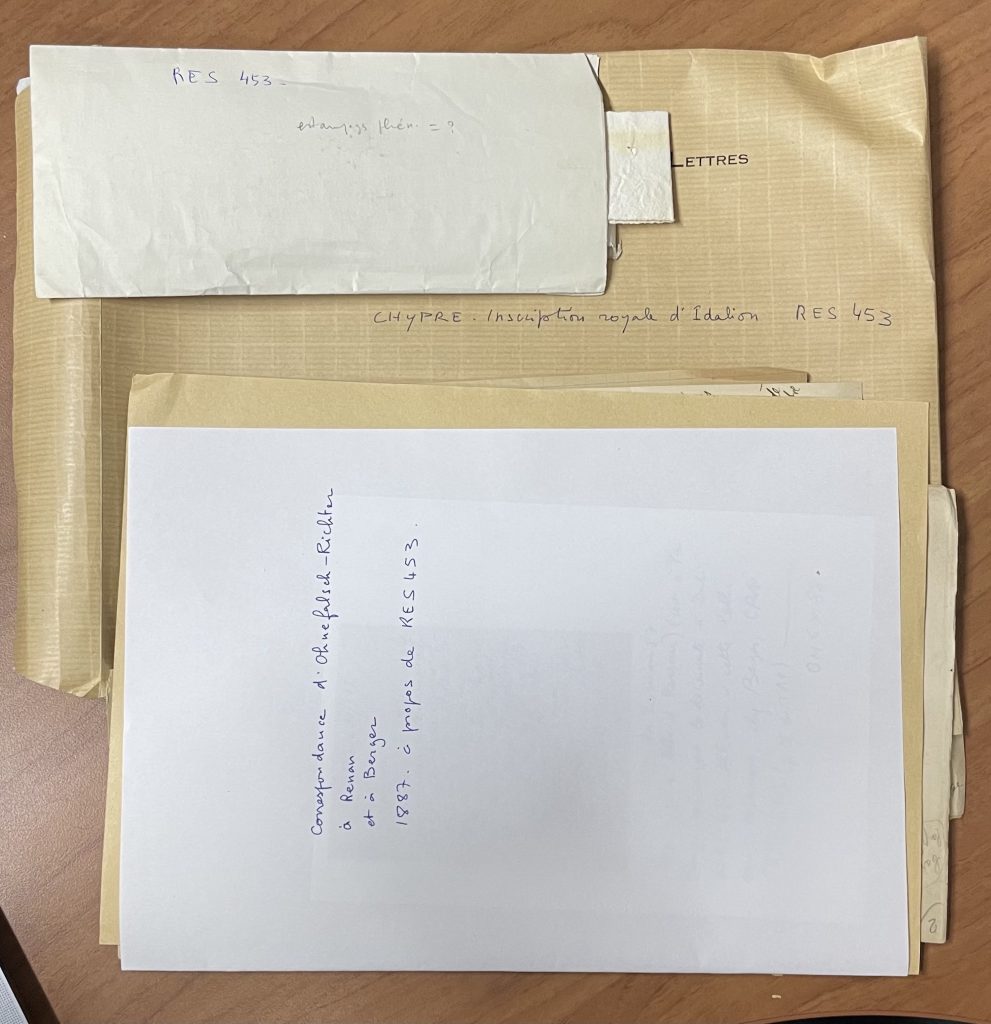
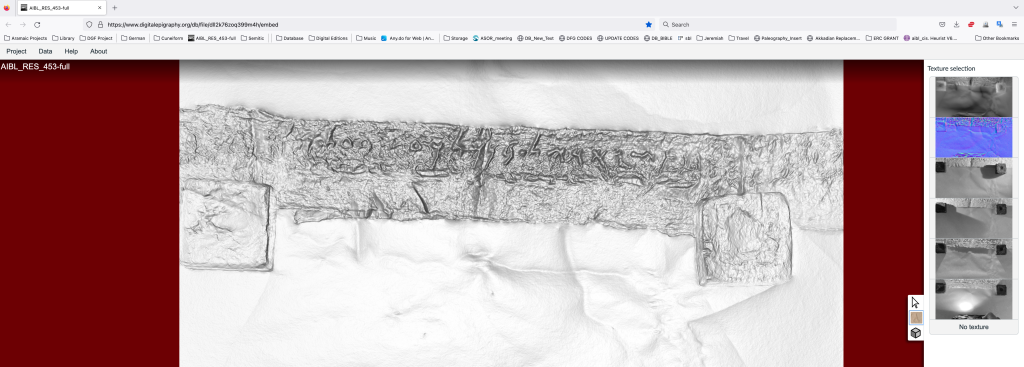
The ultimate objective was to initiate the process of digital preservation of the squeezes and other artifacts. To achieve this, I solicited the support of Angelos Barmpoutis of the Digital Worlds Institute and Eleni Bozia of the Classics Department at the University of Florida, whose Open Source Digital Epigraphy software proved to be an ideal application for our needs. By using scans from a flatbed scanner or raking light photographs one can easily render 3D scans of the squeezes. An example of AIBL-CIS Dos. 12.01.01 “Inscription royale d’Idalion” (446 BCE = RÉS 453; squeeze made in 1887) can be found here.
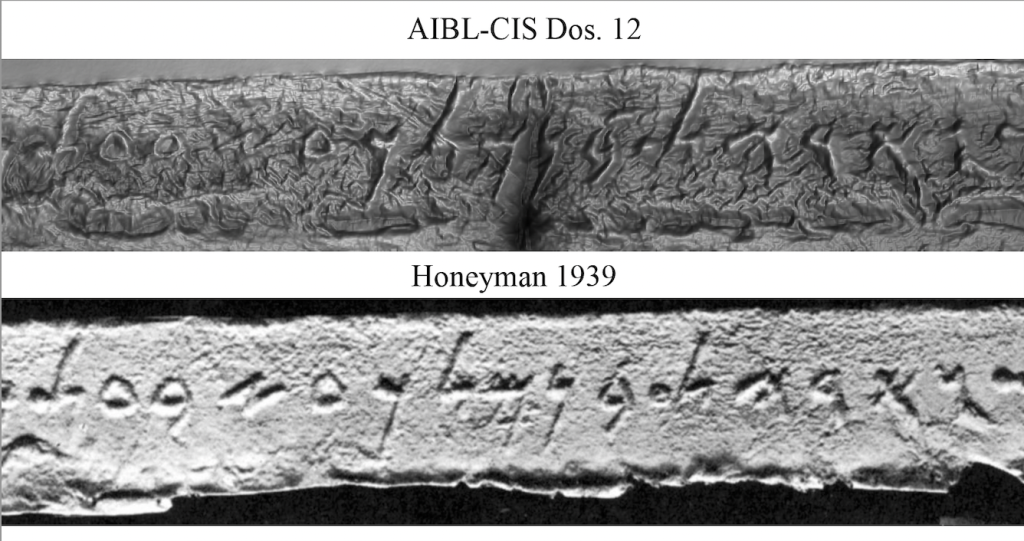
Manipulating the photograph using the Digital Epigraphy’s user interface produces the best known available photograph of the inscription. Compare the previously published photograph to that made during our cataloguing efforts.
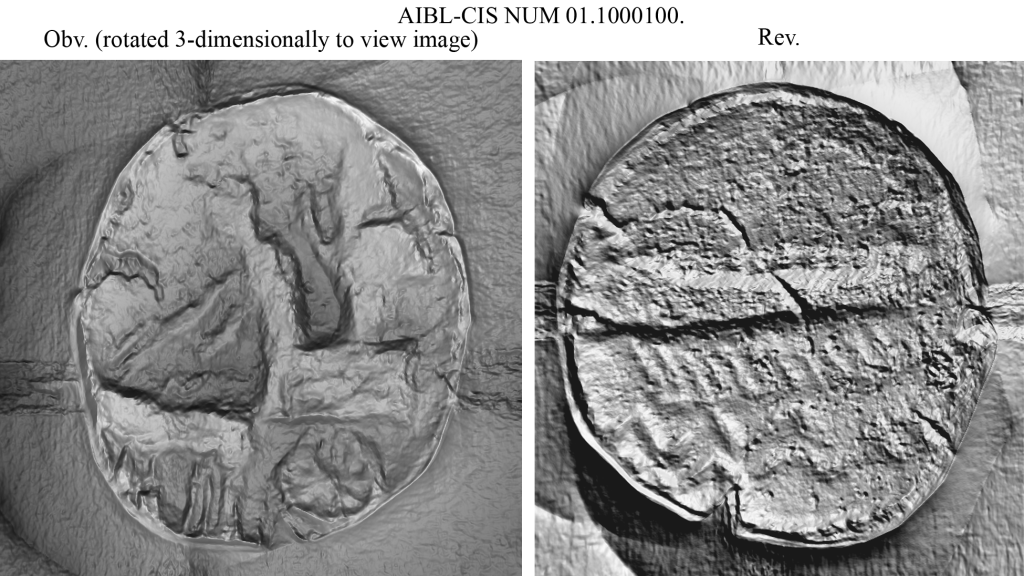
The Cabinet-CIS’s Heurist database and Digital Epigraphy software has far reaching applications for the collection. While one of Maria Gorea’s students, Noémie Carpentier, was working on the Cabinet-CIS’s numismatic collection, I trained her in how to use the software to produce 3D renderings of coins. We scanned the following example of a worn Phoenician (Tyrian) coin minted during the reign of Artaxerxes III (AIBL-CIS NUM 01.1000100), and the 3D rendering makes visible the coin’s features, which are invisible to the eye. You can view the coin using the Digital Epigraphy user interface here:
The consorted efforts of all those mentioned above and the support from ASOR allowed us to achieve our objective of building a digital infrastructure for the Cabinet-CIS with which the digital preservation of its invaluable collection can begin.
Additional Notes
The long days spent at the Cabinet-CIS also afforded me opportunities to further my own research. Maria Gorea and I have long teamed up to publish important manuscripts in the Cabinet-CIS, and we used time to finalize manuscripts for a number of publications on two new Phoenician papyri accounts which radiocarbon date to the Persian period, fragments of Aramaic papyri from Elephantine, and a new Aramaic religious text from Egypt radiocarbon dated between the 2nd and early 4th centuries CE.
- “AIBL-CIS de Ricci no. 2: A New Jewish and Aramaic Religious Text from Egypt Dating between the 2nd and Early 4th Centuries CE” Dead Sea Discoveries, forthcoming
- “New Persian Period Phoenician Papyri Accounts from Egypt in the Académie des Inscriptions et Belles-Lettres, Cabinet du Corpus Inscriptionum Semiticarum,” in Advances in Elephantine and Persian Period Research, eds. J. Moore and P. Schmidtkunz, Studies on Elephantine (forthcoming).
- “Radiocarbon Dating an Aramaic Papyrus from Elephantine and a New Aramaic Fragment from the Académie des Inscriptions et Belles-Lettres, Cabinet du Corpus Inscriptionum Semiticarum,” in Advances in Elephantine and Persian Period Research, eds. J. Moore and P. Schmidtkunz, Studies on Elephantine (forthcoming).
- “Papyri semitiques du Cabinet du CIS,” Comptes rendus des séances de l’Académie des Inscriptions et Belles-Lettres, Communication of the AIBL 16 April 2021.
- J.D. Moore, New Aramaic Papyri from Elephantine in Berlin, Studies on Elephantine 1 (Leiden: Brill), 2022; Open Access: https://brill.com/view/title/61396. (pp. 16–17)