FOA Webinar: Preview of 2022 ASOR-Affiliated Fieldwork Projects on March 8

FRIENDS OF ASOR WEBINAR

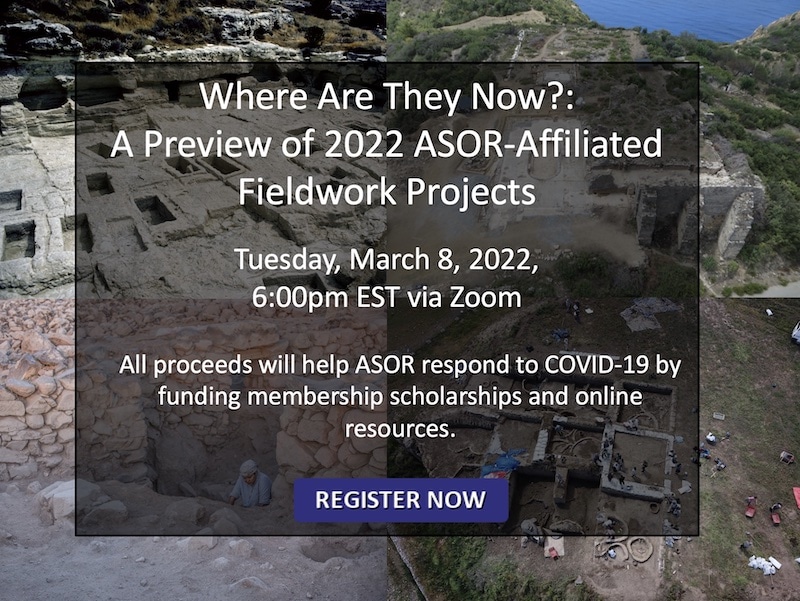
Where Are They Now?: A Preview of 2022 ASOR-Affiliated Fieldwork Projects

Friends of ASOR presents a webinar on March 8, 2022 from 6:00pm to 8:00pm EST, “Where Are They Now?: A Preview of 2022 ASOR-Affiliated Fieldwork Projects,” featuring Michael Given, Xenia-Paula Kyriakou, Stephen Batiuk, Monique Roddy, Kent Bramlett, Friedbert Ninow, and Michael Hoff. This special event will preview the field seasons of four sites across Cyprus (Kourion’s Amathous Gate Cemetery), Georgia (Gadachrili Gora Regional Archaeological Project Expedition), Jordan (Balu’a), and Turkey (Antiochia ad Cragum). The program will include four presentations covering such topics as introductions to each site in its historical context, current excavation and survey progress, the research focus of the upcoming field season, and discussion of past work and scholarship at each site. Join us as we explore some of the exciting projects that ASOR members are currently participating in across the eastern Mediterranean region. The panelists will conclude their webinar with a live Q&A session with the audience. The full program is below. The event will be recorded.

ASOR Sustaining Members: $0 | ASOR Members: $6 | Public: $12

Program Schedule

TUESDAY, MARCH 8, 2022

6:00pm – 6:20pm

Michael Given

University of Glasgow

Xenia-Paula Kyriakou

Florida Gulf Coast University

Cyprus: Kourion’s Amathous Gate Cemetery

Read the Description

Kourion’s Amathous Gate Cemetery lies at the base of the limestone cliffs of Kourion, a well-preserved Greco-Roman port-city on the south coast of Cyprus. The tombs, features, and deposits are the result of a long and complex sequence of activities, from funeral processions and commemorative libations to quarrying limestone, burning marble, and herding goats. This talk will discuss the work of the original excavations at Kourion’s Amathous Gate Cemetery directed by Danielle A. Parks between 1995 and 2000, and the long analysis and writing phase of the project led by a team of her friends and colleagues after she died in 2007. This work has been virtually completed, with a draft of the two volumes of the final publication submitted to the Annual of ASOR. Owing to the pandemic, one more task remains to be done: the analysis and publication of the human remains. We will present our plans for one last field school in June 2022 to study this exciting material.

6:20pm – 6:40pm

Stephen Batiuk

University of Toronto

Georgia: Gadachrili Gora Regional Archaeological Project Expedition

Read the Description

The Gadachrili Gora Regional Archaeological Project Expedition (GRAPE) is a joint venture between the University of Toronto, the Georgian National Museum (GNM) and the National Wine Agency of the Ministry of Agriculture (of the Republic of Georgia). The project aims to investigate the emergence of farming economies in the South Caucasus and the development of horticultural practices and the resultant secondary products, with a focus on viticulture and viniculture. We also aim to look at the influence of Near East societies on the development of local Neolithic and Chalcolithic cultures of Caucasia and, conversely, the reciprocal influence on the Near East. GRAPE represents the archaeological component of a larger interdisciplinary project sponsored by the Georgian National Government entitled the Research and Popularization of Georgian Grape and Wine Culture. The excavations are directed by Mindia Jalabadze (GNM), Stephen Batiuk (University of Toronto), with Khaled Abujayyab (University of Toronto). GRAPE is an international multidisciplinary research project, but also an archaeological field school, which provides a unique opportunity to receive intensive training in archaeological field and survey methods at a series of rural settlements in the Middle Kura region of the Kvemo Kartli province south of the modern city of Marneuli, with a focus on the sites of Gadachrili Gora and Shulaveris Gora.

6:40pm – 6:50pm

Break

6:50pm – 7:10pm

Monique Roddy

Walla Walla University

Kent V. Bramlett

La Sierra University

Friedbert Ninow

La Sierra University

Jordan: Balu’a

Read the Description

Khirbat al-Balu’a is located on the Karak Plateau in Central Jordan. In its location near the Wadi Mujib, Balu’a was able to control a major north-south route in the pre-Classical periods, acting as gatekeeper to the plateau. Balu’a spreads across nearly 16 hectares with some periods inhabiting distinct areas, such as an Iron Age settlement at the core of the site and medieval Islamic remains to the southwest. Given its size and position, Balu’a was likely a prominent site, especially in the Moabite kingdom of the Iron Age. The Iron II Period settlement at Balu’a covers approximately 13.5 hectares. Much of the architecture of this settlement is visible at the surface, including a casemate wall that defines the extent of the Iron Age settlement and structure walls with intact doorways. Excavations from 2012 to 2019 have focused on three main areas at the Iron Age site: the Qasr, a monumental structure at the highest of part of the site, the House, a well-preserved domestic structure, and the Wall, a segment of the fortification system that divided the core of the settlement from a later expansion. This talk will focus on the main discoveries of the Balu’a Regional Archaeological Project at Balu’a (BRAP), and explain the plans for the 2022 excavation season. Find out more about participating at Balu’a here (security forms due by March 1).

7:10pm – 7:30pm

Michael Hoff

University of Nebraska-Lincoln

Turkey: Antiochia ad Cragum in Rough Cilicia

Read the Description

The Roman-era city of Antiochia ad Cragum is located on the Turkish south coast, approximately 40 km southeast of Alanya. In antiquity, the city formed part of the region referred to as western Rough Cilicia. The city was founded by Antiochus IV of Commagene about 41 BCE and eponymously named. Previously the site had served as a base for the notorious “Cilician Pirates,” who raided throughout the Mediterranean from bases mainly situated along this coastline. Excavation began in 2005 with modest explorations of the Northeast Temple. After a few seasons, we expanded operations in the city center, and we have gained a wealth of information regarding the interplay between city and citizens over the past 15 years. We have revealed bath complexes, market shops, the bouleuterion, and several church complexes. Before COVID we had just begun to look at the domestic quarters and in near-future seasons, these will be the focus of our operations.

7:30pm – 8:00pm

Audience Q&A with all Panelists

ASOR Sustaining Members: $0 | ASOR Members: $6 | Public: $12

To receive your ASOR member discount, log into the online store. If you are new to ASOR, please click on the “New Visitor Registration” link to register your e-mail address and choose a password for our online store. Once logged in, navigate to “Meeting and Event Registration” to register for the webinar and pay the fee. Each paid registrant will receive a confirmation e-mail when you pay for the event. If you do not receive this e-mail, then you are not registered. Please e-mail membership@asor.org with any questions or issues with registering.

You will be e-mailed the Zoom Webinar link in the week prior to the webinar on March 8. If you do not receive the link by the close of business on the Friday before the event, please e-mail membership@asor.org immediately. This event will be recorded and all paid registrants will be sent a link to view the recording.

All proceeds from this webinar are used to fund scholarships for members impacted by COVID-19 as well as increasing ASOR’s online resources, which are free to the public.

Sponsors will be acknowledged during the event. Sponsorships are available at the following levels:

  • Bronze Sponsor: $50
  • Silver Sponsor: $100
  • Gold Sponsor: $500
  • Platinum Sponsor: $1,000

Each sponsor will receive a confirmation e-mail. If you do not receive this e-mail, then we did not receive your sponsorship online.  If you prefer to register or sponsor over the phone, please call 703-789-9230. Please e-mail membership@asor.org with any questions or issues.

Speakers / Presenters

Stephen Batiuk is a Senior Research Associate and Lecturer with the Department of Near & Middle Eastern Civilizations, University of Toronto, and co-director of GRAPE – the Gadachrili Gora Regional Archaeological Project Expedition (Republic of Georgia) as well as Director of Excavations for the Tayinat Archaeological Project (Turkey) and the Project Manager for the Computational Research on the Ancient Near East (CRANE) Project. He holds his degrees from the University of Toronto (Ph.D.) and the University of Ottawa, and his areas of specialization include Near Eastern archaeology with a focus in the Bronze and Irons Ages of Turkey, Syria and the Caucasus.


Kent V. Bramlett is a Professor of Archaeology and the History of Antiquity at La Sierra University where he has taught since 2010. He is Chair of the Department of Biblical Studies and Archaeology and Director of Graduate Studies in Archaeology. He is Curator of the Archaeology Collections and Associate Director of the Center for Near Eastern Archaeology at La Sierra University. He earned a Ph.D. in Near Eastern Archaeology at the University of Toronto, specializing in the Late Bronze Age. He is co-director of the Madaba Plains Project excavation at Tall al-‘Umayri and the Balu‘a Regional Archaeological Project, both in Jordan. At La Sierra, he teaches Akkadian, Hieroglyphic Egyptian, and other ancient languages in addition to archaeology classes.


Michael Given is a Senior Lecturer in Archaeology in the School of Humanities, University of Glasgow, Scotland. His research interests include archaeological survey and landscape archaeology, the historical periods in the Eastern Mediterranean, post-Medieval Scotland, the relationship between people and the environment, and conviviality theory. He has carried out fieldwork in Cyprus, Egypt, Greece, Scotland and Turkey. From 2000 to 2012 he was co-director of the Troodos Archaeological and Environmental Survey Project, Cyprus, and he is currently director of the publication phase of the Excavations at Kourion’s Amathous Gate Cemetery, Cyprus. His books include The Archaeology of the Colonized (Routledge, 2004), and Landscape and Interaction: The Troodos Archaeological and Environmental Survey Project, Cyprus (with A.B. Knapp, L. Sollars, J. Noller and V. Kassianidou; 2 volumes; Council for British Research in the Levant, 2013).


Michael Hoff specializes in Greek and Roman archaeology, particularly of Asia Minor in Turkey where he currently conducts research. From 1997 to 2004, Hoff co-directed the architectural survey team of the Rough Cilicia Archaeological Survey Project that documented ancient Roman sites in Turkey. Since 2005, Hoff has served as Project Director for the large-scale excavations of the ancient Roman-era city of Antiochia ad Cragum on the south coast of Turkey. Hoff has excavated previously at the Athenian Agora, Corinth, Crete, and at the Sanctuary of Zeus at Nemea, Greece. In addition to his work on the archaeology of Asia Minor, Hoff also conducts research on the history and topography of Roman Athens. Hoff has authored many articles in international journals and has co-edited several books, including Rough Cilicia: New Historical and Archaeological Approaches (Oxbow Press). Professor Hoff received his B.A. from the University of Missouri, M.A. from Florida State University, and Ph.D. from Boston University. Hoff joined the art history faculty at the University of Nebraska in 1989.


Xenia-Paula Kyriakou is a Lecturer in Legal Studies in the Department of Justice Studies at Gulf Coast University, in Florida. Her research interests include the reconstruction of health and demography in ancient societies, paleoepidemiology, paleo-oncology, the development of standards and methods in forensic anthropology, humanitarian forensics, and necropolitics. She was involved in numerous archaeological excavations as a bioarchaeologist and worked on many forensic cases, including those that address violation of human rights, both in Cyprus and abroad. She is the director of Odyssey Field School, which has been running since 2014 to present day, and offers training and research opportunities to students in the disciplines of bioarchaeology and forensic anthropology.


Friedbert Ninow (Ph.D. 2000, Andrews University) is the Dean of the Richards Divinity School, La Sierra University, and co-director of the Balu’a Regional Archaeological Project. He also directed the Wadi ash-Shkafiya Archaeological Survey as well as excavations at Khirbat al-Ma’mariyah.


Monique D. Roddy is an Assistant Professor in the Department of History and Philosophy at Walla Walla University. She earned her Ph.D. from the University of Chicago with a dissertation on household archaeology in the Early Iron Age in the southern Levant. She worked with the Madaba Plains Project at Tall al-‘Umayri in Jordan from 2004 to 2016 and continues to work as an editor on the final publication series for ‘Umayri. She has co-directed the Balu’a Regional Archaeological Project at Khirbat al-Balu’a since 2017. She has also excavated at Zincirli in southeastern Turkey, Keros in the Cycladic Islands, and Cartagena in southern Spain.

ASOR is grateful for your support. Each registrant will receive an automated confirmation e-mail. If you do not receive this e-mail, please check you Spam folder and then contact ASOR. If you prefer to register over the phone, please call 703-789-9230. Please e-mail membership@asor.org with any questions or issues.
PAST WEBINARS

You can now purchase the link to the recording of any webinar. You can also purchase the bundle packages of all webinars from the 2020-2022 seasons. Please e-mail membership@asor.org for purchase details.

To see a printable pdf of the webinar titles from the 2020-2021 season, please click here. To see a printable pdf of the webinar titles from the 2021-2022 season, please click here.

Pricing:

Members: $6.00 per recording
Non-Members: $12.00 per recording
Bundle of 2020-2021 Webinars: $75.00
Bundle of 2021-2022 Webinars: $75.00
Bundle of 2020-2022 Webinars: $125.00

2021-2022 Season

A World at War: Protecting Cultural Heritage in Times of Conflict
Patty Gerstenblith (DePaul University), Lisa Ackerman (Columbus Citizens Foundation), Andrew Cohen (Government Professional and Cultural Heritage Expert) | May 12, 2022

Preserving Cultural Heritage in Hisban and Umm al-Jimal, Jordan
Øystein LaBianca (Andrews University), Elizabeth Osinga (Umm al-Jimal Archaeological Project), Darrell Rohl (Calvin University) | April 24, 2022

Back to the Field: Recent Discoveries & Summer Plans 2022
Lorenzo d’Alfonso (ISAW), Kathryn Grossman (NC State University), James R. Strange (Samford University) | April 3, 2022

Uncovering What is Nubian Beneath the Veneer of Egyptianness: Excavating the Archives
Debora Heard (University of Chicago) | March 20, 2022

Where Are They Now?: A Preview of 2022 ASOR-Affiliated Fieldwork Projects
Michael Given (University of Glasgow), Xenia-Paula Kyriakou (Florida Gulf Coast University), Stephen Batiuk (University of Toronto), Monique Roddy (Walla Walla University), Kent Bramlett (La Sierra University), Friedbert Ninow (La Sierra University), and Michael Hoff (University of Nebraska-Lincoln) | March 8, 2022

Excavations at Tel Gezer: A Personal Story
Sam Wolff (Tel Gezer Laboratory) | February 20, 2022

Tel Rehov: A Major Bronze and Iron Age City in the Jordan Valley
Amihai Mazar (Hebrew University of Jerusalem), Nava Panitz-Cohen ( Hebrew University of Jerusalem), Nota Kourou (Athens University), Naama Yahalom-Mack (Hebrew University of Jerusalem), Robert Mullins (Azusa Pacific University) | February 10, 2022

The Not-So-Innocents Abroad: The Beginnings of American Biblical Archaeology
Rachel Hallote (Samford University) | January 20, 2022

Synagogues as Jesus Knew Them
James R. Strange (Samford University) | December 2, 2021

Under Jerusalem: The Buried History of the World’s Most Contested City
Andrew Lawler | November 4, 2021

Jesus and Jerusalem on TV: How Do Bible Documentaries Get Made?
Robert Cargill (University of Iowa) | October 17, 2021

Digging the Divine?: Judahite Pillar Figurines and the Archaeology of Israelite Religion
Erin Darby (University of Tennessee) | October 7, 2021

David, Solomon, and Rehoboam’s Kingdom—The Archaeological Evidence
Yosef Garfinkel (Hebrew University of Jerusalem) | September 19, 2021

From Standing Stones to Sacred Emptiness: Textual and Visual Portrayals of Israel’s God
Theodore Lewis (Johns Hopkins University) | August 29, 2021

2020-2021 Season

Making May Matter: Webinarathon to Endow Diversity
Multiple Speakers | May 21-23, 2021

Archaeogaming: Why Video Games Deserve Their Own Archaeology
Tine Rassalle (University of North Carolina at Chapel Hill), Shannon Martino (Morton College), Matthew Winter (University of Arizona), Michael Zimmerman (Rhode Island) | April 18, 2021

How the Bible Became a Book
William Schniedewind (UCLA) | March 21, 2021

The Mysteries of Mithras in Caesarea: Exploring the Cult’s Rites and Remains
Jane DeRose Evans (Temple University), Alexandra Ratzlaff (Brandeis University) | March 11, 2021

Archaeology and the Hidden Religious Culture of Israelite Women
Carol Meyers (Duke University) | February 21, 2021

Meet the Directors—Fundraiser to Support ASOR’s Affiliated Overseas Research Centers
Matthew J. Adams (AIAR), Pearce Paul Creasman (ACOR), Lindy Crewe (CAARI) | February 11, 2021

Early Synagogues, Jesus, and Galilee—A Jewish Perspective
Eric Meyers (Duke University) | December 13, 2020

Home Sweet Home: Ancient Israelite Households in Context
Cynthia Shafer-Elliott (William Jessup University) | October 18, 2020

Priestesses in the Days of Solomon and Ahab
Susan Ackerman (Dartmouth College) | September 13, 2020

Digging Deeper: How Archaeology Works
Eric H. Cline (The George Washington University) | August 9, 2020

ASOR is grateful for your support. Each registrant will receive an automated confirmation e-mail. If you do not receive this e-mail, please check you Spam folder and then contact ASOR. If you prefer to register over the phone, please call 703-789-9230. Please e-mail membership@asor.org with any questions or issues.
FOA Webinar: Sam Wolff on Feb. 20

FRIENDS OF ASOR WEBINARS

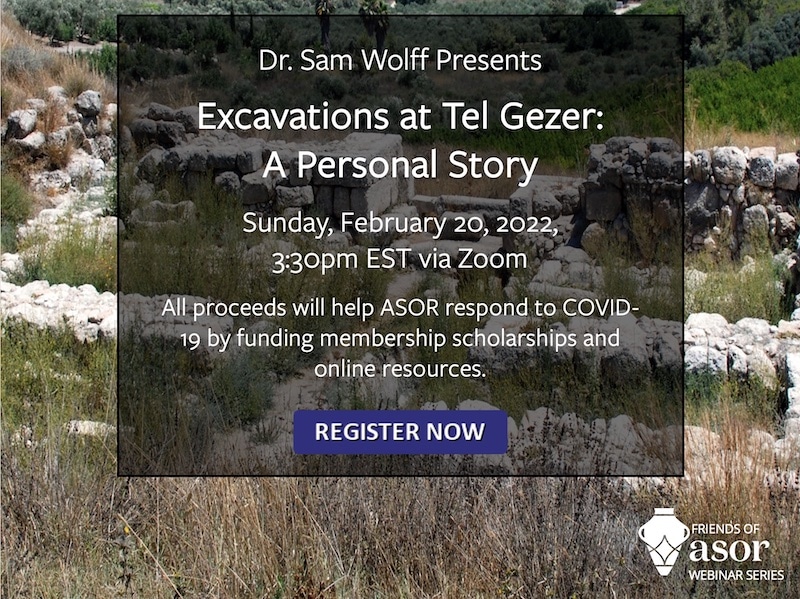
Excavations at Tel Gezer: A Personal Story

Friends of ASOR present the next webinar in our monthly series on February 20, 2022, at 3:30 pm EST, featuring Dr. Sam Wolff. In 1972, a stone vat was discovered in Dr. Sam Wolff’s square in Field VII at Tel Gezer, Israel. Visitors to the square marveled at the lovely “dye vat.” These comments piqued his intellectual curiosity, which led him on a life-long quest to understand this and similar stone installations at Tel Gezer. To aid in this exploration, he returned to the site as co-director of the Tandy Museum excavations (2006-2017).

This webinar will review the results of that project, which took place in the area between the well-known six-chambered Iron Age gate (“Solomon’s Gate”) and that same square that Dr. Wolff excavated in 1972, Field VII. Dr. Wolff will place special emphasis on newly discovered industrial installations, including those related to olive oil production, thus shedding light on important aspects of daily life at Tel Gezer in the Iron Age. Dr. Wolff will conclude his webinar with a live Q&A session.

After volunteering at Tel Gezer in 1972 and 1973, Sam Wolff continued his archaeological studies at the University of Chicago. During that time, he participated in excavations of the Commercial Harbor and Tophet at Carthage (1975-1979) in modern day Tunisia. Wolff received his Ph.D. in 1986. He was Field Supervisor and later Assistant Director of the excavations at Ashkelon (Israel) from 1985 to 1990. He relocated from Chicago to Israel in 1987 with his family. In 1991, he began a 25-year career as a field archaeologist at the Israel Antiquities Authority (IAA). His most important excavations were conducted at the Iron Age I site of Ein Hagit, the multiperiod site of Tel Megadim, and the Iron Age II site at Tel Hamid, a satellite of Tel Gezer. He worked as Co-Director (with Prof. Steve Ortiz) and photographer at the renewed excavations at Tel Gezer from 2006 to 2017. Since retiring from the IAA in 2017, he has been managing the Tel Gezer laboratory and working on articles and final publications of his excavations.

This webinar will be recorded and all paid registrants will be sent a link to view the recording.

ASOR Sustaining Members: $0 | ASOR Members: $6 | Public: $12

To receive your ASOR member discount, log into the online store. If you are new to ASOR, please click on the “New Visitor Registration” link to register your e-mail address and choose password for our online store. Once logged in, navigate to “Meeting and Event Registration” to register for the webinar and pay the fee. Each paid registrant will receive a confirmation e-mail when you pay for the webinar. If you do not receive this e-mail, then you are not registered. Please e-mail membership@asor.org with any questions or issues with registering.

You will be e-mailed the Zoom Webinar link in the week prior to the lecture on February 20, 2022. If you do not receive the link by the close of business on the Thursday before the webinar, please e-mail membership@asor.org immediately. This webinar will be recorded and all paid registrants will be sent a link to view the recording.

All proceeds from this lecture are used to fund scholarships for members impacted by COVID-19 as well as increasing ASOR’s online resources, which are free to the public.

WHY SPONSOR A WEBINAR?

Several levels of support from $50-$1,000 are available. Proceeds go towards membership scholarships and towards increasing ASOR’s virtual resources. Each sponsorship is tax-deductible and you can give your friends free registrations to a webinar!

Bronze Level ($50): up to 2 guest registrations
Silver Level ($100): up to 5 guest registrations
Gold Level ($500): up to 20 guest registrations
Platinum Level ($1,000): up to 50 guest registrations

After you sign up for a sponsorship online or over the phone, email the names and email addresses of your guests to Felice Herman at membership@asor.org, who will send your guests a confirmation and the Zoom link before the webinar.


WANT TO SAVE $6.00 ON THE NEXT WEBINAR?

Join ASOR as a member! Click here for more details about discounts for events and other benefits of membership. Memberships start at $40 for the year as an Associate Member.

Not ready to join yet? Become a Friend of ASOR for FREE!

Click here for more details about our online resources.

PAST WEBINARS

You can now purchase the link to the recording of any webinar. You can also purchase the bundle packages of all webinars from the 2020-2022 seasons. Please e-mail membership@asor.org for purchase details.

To see a printable pdf of the webinar titles from the 2020-2021 season, please click here. To see a printable pdf of the webinar titles from the 2021-2022 season, please click here.

Pricing:

Members: $6.00 per recording
Non-Members: $12.00 per recording
Bundle of 2020-2021 Webinars: $75.00
Bundle of 2021-2022 Webinars: $75.00
Bundle of 2020-2022 Webinars: $125.00

2021-2022 Season

A World at War: Protecting Cultural Heritage in Times of Conflict
Patty Gerstenblith (DePaul University), Lisa Ackerman (Columbus Citizens Foundation), Andrew Cohen (Government Professional and Cultural Heritage Expert) | May 12, 2022

Preserving Cultural Heritage in Hisban and Umm al-Jimal, Jordan
Øystein LaBianca (Andrews University), Elizabeth Osinga (Umm al-Jimal Archaeological Project), Darrell Rohl (Calvin University) | April 24, 2022

Back to the Field: Recent Discoveries & Summer Plans 2022
Lorenzo d’Alfonso (ISAW), Kathryn Grossman (NC State University), James R. Strange (Samford University) | April 3, 2022

Uncovering What is Nubian Beneath the Veneer of Egyptianness: Excavating the Archives
Debora Heard (University of Chicago) | March 20, 2022

Where Are They Now?: A Preview of 2022 ASOR-Affiliated Fieldwork Projects
Michael Given (University of Glasgow), Xenia-Paula Kyriakou (Florida Gulf Coast University), Stephen Batiuk (University of Toronto), Monique Roddy (Walla Walla University), Kent Bramlett (La Sierra University), Friedbert Ninow (La Sierra University), and Michael Hoff (University of Nebraska-Lincoln) | March 8, 2022

Excavations at Tel Gezer: A Personal Story
Sam Wolff (Tel Gezer Laboratory) | February 20, 2022

Tel Rehov: A Major Bronze and Iron Age City in the Jordan Valley
Amihai Mazar (Hebrew University of Jerusalem), Nava Panitz-Cohen ( Hebrew University of Jerusalem), Nota Kourou (Athens University), Naama Yahalom-Mack (Hebrew University of Jerusalem), Robert Mullins (Azusa Pacific University) | February 10, 2022

The Not-So-Innocents Abroad: The Beginnings of American Biblical Archaeology
Rachel Hallote (Samford University) | January 20, 2022

Synagogues as Jesus Knew Them
James R. Strange (Samford University) | December 2, 2021

Under Jerusalem: The Buried History of the World’s Most Contested City
Andrew Lawler | November 4, 2021

Jesus and Jerusalem on TV: How Do Bible Documentaries Get Made?
Robert Cargill (University of Iowa) | October 17, 2021

Digging the Divine?: Judahite Pillar Figurines and the Archaeology of Israelite Religion
Erin Darby (University of Tennessee) | October 7, 2021

David, Solomon, and Rehoboam’s Kingdom—The Archaeological Evidence
Yosef Garfinkel (Hebrew University of Jerusalem) | September 19, 2021

From Standing Stones to Sacred Emptiness: Textual and Visual Portrayals of Israel’s God
Theodore Lewis (Johns Hopkins University) | August 29, 2021

2020-2021 Season

Making May Matter: Webinarathon to Endow Diversity
Multiple Speakers | May 21-23, 2021

Archaeogaming: Why Video Games Deserve Their Own Archaeology
Tine Rassalle (University of North Carolina at Chapel Hill), Shannon Martino (Morton College), Matthew Winter (University of Arizona), Michael Zimmerman (Rhode Island) | April 18, 2021

How the Bible Became a Book
William Schniedewind (UCLA) | March 21, 2021

The Mysteries of Mithras in Caesarea: Exploring the Cult’s Rites and Remains
Jane DeRose Evans (Temple University), Alexandra Ratzlaff (Brandeis University) | March 11, 2021

Archaeology and the Hidden Religious Culture of Israelite Women
Carol Meyers (Duke University) | February 21, 2021

Meet the Directors—Fundraiser to Support ASOR’s Affiliated Overseas Research Centers
Matthew J. Adams (AIAR), Pearce Paul Creasman (ACOR), Lindy Crewe (CAARI) | February 11, 2021

Early Synagogues, Jesus, and Galilee—A Jewish Perspective
Eric Meyers (Duke University) | December 13, 2020

Home Sweet Home: Ancient Israelite Households in Context
Cynthia Shafer-Elliott (William Jessup University) | October 18, 2020

Priestesses in the Days of Solomon and Ahab
Susan Ackerman (Dartmouth College) | September 13, 2020

Digging Deeper: How Archaeology Works
Eric H. Cline (The George Washington University) | August 9, 2020

FOA Webinar Symposium: Tel Rehov on Feb. 10

FRIENDS OF ASOR WEBINAR SYMPOSIUMS

Tel Rehov: A Major Bronze and Iron Age City in the Jordan Valley

 
  • 4 hours of lectures and panel discussion
  • 5 internationally renowned scholars
  • Proceeds fund membership scholarships & online resources

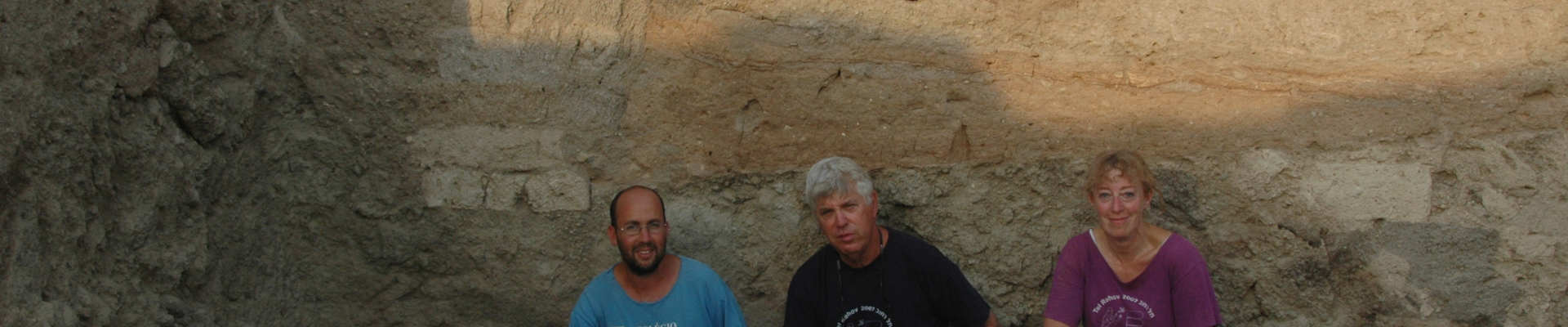
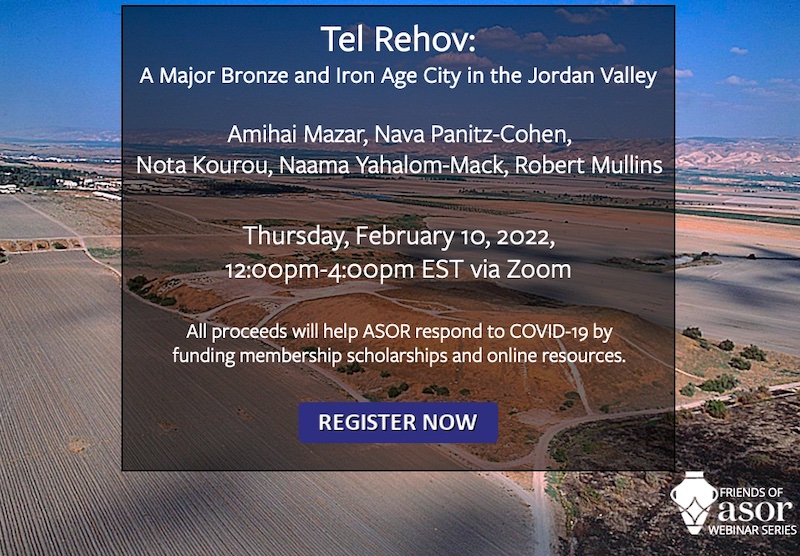
Friends of ASOR presents a webinar symposium on February 10, 2022 from 12:00pm to 4:00pm EST, “Tel Rehov: A Major Bronze and Iron Age City in the Jordan Valley,” featuring Prof. Amihai Mazar, Dr. Nava Panitz-Cohen, Prof. Nota Kourou, Prof. Naama Yahalom-Mack, and Prof. Robert Mullins. This special event will showcase the newly published findings from the site of Tel Rehov in Israel. The program will include 7 unique lectures covering such topics as the primary results from the site, the publication of the excavations, the Iron Age apiary, Tel Rehov in its Biblical historical context, Greek pottery from the site, the 8th century BCE Assyrian conquest, and metal-working. Each 20 minute lecture will be followed by Q&A with the audience and discussion among these distinguished panelists. Join us for an afternoon of exploration and celebration of years of work at this important site. The full program is below. The event will be recorded.

ASOR Sustaining Members: $0 | ASOR Members: $25 | Public: $50

Program Schedule

THURSDAY, FEBRUARY 10, 2022

12:00pm – 12:45pm

Amihai Mazar

The Hebrew University of Jerusalem

Introducing Tel Rehov: The Regional Project, the Site and its Identification, and Survey of the Main Results and Historical Implications

Read the Description

This lecture will provide a general introduction to the Tel Rehov excavations and will present some of the main results. The most significant points are the unusual foundation of a new large city in the Late Bronze Age, the continuity of Canaanite urban life with no significant break until the beginning of the Iron Age II, and the plethora of finds from the Iron Age IIA (10-9th centuries B.C.E). All these discoveries make this city one of the most important sites for studying society, economy, religious practices, and historical issues of the northern kingdom of Israel and the origin of the Nimshite Dynasty.

12:45pm – 1:05pm

Nava Panitz-Cohen

The Hebrew University of Jerusalem

From Spade to Shelf: The Research and Publication of the Tel Rehov Excavations

Read the Description

All archaeology enthusiasts are familiar with the excavation report as presented in a handsome volume sitting on a shelf in the library or in our homes. As someone who has participated in the process of bringing what the spade unearths in an excavation to the final product on your shelf, I will share with you some of the highlights – and frustrations – of this process and why it is, on the one hand, the bane of many archaeologists, yet on the other hand, perhaps the most-important part of any excavation.

1:05pm – 1:15pm

Break

1:15pm – 1:40pm

Amihai Mazar & Nava Panitz-Cohen

The Hebrew University of Jerusalem

What’s the Buzz? The Iron Age Apiary at Tel Rehov

Read the Description

A unique apiary was discovered at Tel Rehov during excavations from 2005 to 2007. About 30 hives made of unfired clay and straw were found in a destruction layer. Reconstruction indicates that there were 100-200 hives arranged in a well-organized system. This is the only apiary discovered so far in the ancient Near East and the Mediterranean world. Remains of charred honeycombs found in the hives contained charred bees, which were identified as most probably an Anatolian subspecies. These discovery raises many questions about subsistence and the economy that will be addressed in this lecture.

1:40pm – 2:05pm

Nava Panitz-Cohen

The Hebrew University of Jerusalem

The Unique Northwestern Quarter at Tel Rehov in its Biblical Historical Context

Read the Description

Among the numerous and fascinating finds from the Tel Rehov excavations is a quarter in the northwestern part of the tell, overlooking the Beth-Shean Valley. The quarter is composed of a series of inter-related buildings, each one with a unique plan. All of the buildings contain a plethora of objects left untouched since the violent destruction; some of them unique, some with evidence of intense weaving and grinding as well as feasting and ritual activities. Among the highlights are inscriptions bearing the names “Nimshi” and “Elisha,” both figures mentioned in the Bible, who played pivotal roles in events that took place in this part of the Israelite kingdom.

2:05pm – 2:30pm

Nota Kourou

The University of Athens

Connections between Greece and the Levant as Reflected by Greek Pottery from Tel Rehov

Read the Description

After the end of the Mycenaean period, Greek pottery appears again in Eastern Mediterranean in the early first millennium BCE, mainly at coastal sites. The astonishing recovery from well-dated contexts at Tel Rehov in the Beth Shean Valley of 14 Greek sherds in Late Protogeometric and Middle Geometric style (late 10th to middle 8th century BCE) forms the largest assemblage of this kind of pottery from an inland site. This dating suggests a connection with newly identified trading routes with the Arabah Valley in Jordan, a location from which copper was exported to Aegean communities, according to recent analytical data from bronze tripods from Olympia. Thus, the Tel Rehov sherds and the exported copper from Jordan could provide a new approach to Greek and Near Eastern relations at the beginning of the first millennium BCE.

2:30pm – 2:40pm

Break

2:40pm – 3:05pm

Robert Mullins

Azusa University, California

Tel Rehov in the 8th Century BCE: Partial Revival and Assyrian Conquest and Domination

Read the Description

Following the destruction of Stratum IV, a smaller city was rebuilt on the upper mound. Two strata can be attributed to Iron IIB. These consist of dwellings in Areas A, B, and J. The fortification system included a casemate wall in the earlier phase and a wide city wall in the latter phase. The slaughter of people in their homes in Area A bears witness to the severity of the Assyrian destruction. Squatter activity that followed included seven burials, some with Assyrian-type bottles, possibly indicating Assyrian presence. One burial was especially rich in finds and perhaps belonged to an elite.

3:05pm -3:30pm

Naama Yahalom-Mack

The Hebrew University of Jerusalem

Metal Working at Tel Rehov

Read the Description

The excavations at Tel Rehov yielded hundreds of metal objects and numerous metallurgical remains that attest to on-site metalworking. The study of such remains and their distribution sheds light on metalworking practices at the site, indicating a considerable change between the Late Bronze and Iron Ages, which are defined by the choice of raw materials, their origin, and metalworking traditions. Particularly significant is the evidence for an Egyptian metalworking tradition during the Late Bronze Age, and the introduction of iron into common use during the Iron IIA (10th and 9th centuries BCE).

3:30pm – 4:00pm

Audience Q&A with all Panelists

ASOR Sustaining Members: $0 | ASOR Members: $25 | Public: $50

To receive your ASOR member discount, log into the online store. If you are new to ASOR, please click on the “New Visitor Registration” link to register your e-mail address and choose password for our online store. Once logged in, navigate to “Meeting and Event Registration” to register for the symposium and pay the fee. Each paid registrant will receive a confirmation e-mail when you pay for the event. If you do not receive this e-mail, then you are not registered. Please e-mail membership@asor.org with any questions or issues with registering.

You will be e-mailed the Zoom Webinar link in the week prior to the symposium on February 10. If you do not receive the link by the close of business on the Tuesday before the event, please e-mail membership@asor.org immediately. This event will be recorded and all paid registrants will be sent a link to view the recording.

All proceeds from this symposium are used to fund scholarships for members impacted by COVID-19 as well as increasing ASOR’s online resources, which are free to the public.

Sponsors will be acknowledged during the event. Sponsorships are available at the following levels:

  • Bronze Sponsor: $50
  • Silver Sponsor: $100
  • Gold Sponsor: $500
  • Platinum Sponsor: $1,000

Each sponsor will receive a confirmation e-mail. If you do not receive this e-mail, then we did not receive your sponsorship online.  If you prefer to register or sponsor over the phone, please call 703-789-9230. Please e-mail membership@asor.org with any questions or issues.


Speakers / Presenters

Nota Kourou is Professor Emerita, Athens University, Greece. She studied Archaeology at Athens University (BA) and continued for her Ph.D at Oxford University, (Somerville College 1974-1979). She taught first as a lecturer and later became a Professor at Athens University from 1979-2012. In 2013, she became a Visiting Professor at Brussells University (ULB). Kourou has lectured at several Universities in the United States, Australia, and Europe, and was an Onassis Senior Lecturer in the United States in 2005. She participated in various excavations in Greece and has directed the Athens University Excavation at Xobourgo on Tenos, Cyclades since 1995, which has revealed a major island settlement.


Amihai Mazar is Professor Emeritus at the Institute of Archaeology of the Hebrew University of Jerusalem. His main fields of interest are the archaeology of the Levant in the Bronze and Iron Ages and the relationship between archaeology and biblical history. He directed large-scale archaeological excavations at Tell Qasile (1973–1974, 1982–1988), Tel Batash (biblical Timnah) (1977–1989), Tel Beth Shean (1989–1996), and Tel Reḥov (1997–2012), as well as several smaller-scale projects. He is the author and editor of numerous publications, including Archaeology of the Land of the Bible, and fourteen volumes of final archaeological field reports. Mazar is a member of the Israel Academy of Sciences and Humanities and laureate of the Israel Prize for archaeological research.


Robert Mullins is Professor and Chair in the Department of Biblical and Religious Studies at Azusa Pacific University. He received his Ph.D from The Hebrew University of Jerusalem. Prior to joining the faculty of APU, he served as a research assistant to Prof. Amihai Mazar and the Beth-Shean Valley Archaeological Project. In addition to his work at Beth-Shean, Rehov, and Gezer, Mullins has also excavated at Tell Atchana (Alalakh) and Zincirli (Sam’al) in southeastern Turkey. He currently co-directs joint excavations at Tel Abel Beth Maacah with the Hebrew University of Jerusalem. His recent publications include the Atlas of the Biblical World (Fortress Press, 2019).


Nava Panitz-Cohen is a researcher at the Institute of Archaeology of the Hebrew University of Jerusalem, where earned her Ph.D, and is now an adjunct instructor and editor of the Qedem Monograph Series of the Institute. Her field work included Tel Batash, Tel Beth-Shean and Tel Rehov, and she participated in the publication of these sites. She is currently co-director of excavations at Tel Abel Beth Maacah in the Hula Valley in northern Israel alongside Naama Yahlom-Mack and Robert Mullins. Her research interests include Bronze and Iron Age ceramics, ceramic technology, household, gender, and experimental archaeology.


Naama Yahalom-Mack is an associate professor of Bronze and Iron Age archaeology at the Institute of Archaeology, The Hebrew University of Jerusalem, and is head of the Institute’s Laboratory for Archaeological Materials and Ancient Technologies. She is currently co-director of the Tel Abel Beth Maacah excavations in the Hula Valley. Her research focuses on archaeometallurgy and on the provenancing of archaeological materials as a proxy for reconstructing ancient trade and economic interaction.

ASOR is grateful for your support. Each registrant will receive an automated confirmation e-mail. If you do not receive this e-mail, please check you Spam folder and then contact ASOR. If you prefer to register over the phone, please call 703-789-9230. Please e-mail membership@asor.org with any questions or issues.

PAST WEBINARS

You can now purchase the link to the recording of any webinar. You can also purchase the bundle packages of all webinars from the 2020-2022 seasons. Please e-mail membership@asor.org for purchase details.

To see a printable pdf of the webinar titles from the 2020-2021 season, please click here. To see a printable pdf of the webinar titles from the 2021-2022 season, please click here.

Pricing:

Members: $6.00 per recording
Non-Members: $12.00 per recording
Bundle of 2020-2021 Webinars: $75.00
Bundle of 2021-2022 Webinars: $75.00
Bundle of 2020-2022 Webinars: $125.00

2021-2022 Season

A World at War: Protecting Cultural Heritage in Times of Conflict
Patty Gerstenblith (DePaul University), Lisa Ackerman (Columbus Citizens Foundation), Andrew Cohen (Government Professional and Cultural Heritage Expert) | May 12, 2022

Preserving Cultural Heritage in Hisban and Umm al-Jimal, Jordan
Øystein LaBianca (Andrews University), Elizabeth Osinga (Umm al-Jimal Archaeological Project), Darrell Rohl (Calvin University) | April 24, 2022

Back to the Field: Recent Discoveries & Summer Plans 2022
Lorenzo d’Alfonso (ISAW), Kathryn Grossman (NC State University), James R. Strange (Samford University) | April 3, 2022

Uncovering What is Nubian Beneath the Veneer of Egyptianness: Excavating the Archives
Debora Heard (University of Chicago) | March 20, 2022

Where Are They Now?: A Preview of 2022 ASOR-Affiliated Fieldwork Projects
Michael Given (University of Glasgow), Xenia-Paula Kyriakou (Florida Gulf Coast University), Stephen Batiuk (University of Toronto), Monique Roddy (Walla Walla University), Kent Bramlett (La Sierra University), Friedbert Ninow (La Sierra University), and Michael Hoff (University of Nebraska-Lincoln) | March 8, 2022

Excavations at Tel Gezer: A Personal Story
Sam Wolff (Tel Gezer Laboratory) | February 20, 2022

Tel Rehov: A Major Bronze and Iron Age City in the Jordan Valley
Amihai Mazar (Hebrew University of Jerusalem), Nava Panitz-Cohen ( Hebrew University of Jerusalem), Nota Kourou (Athens University), Naama Yahalom-Mack (Hebrew University of Jerusalem), Robert Mullins (Azusa Pacific University) | February 10, 2022

The Not-So-Innocents Abroad: The Beginnings of American Biblical Archaeology
Rachel Hallote (Samford University) | January 20, 2022

Synagogues as Jesus Knew Them
James R. Strange (Samford University) | December 2, 2021

Under Jerusalem: The Buried History of the World’s Most Contested City
Andrew Lawler | November 4, 2021

Jesus and Jerusalem on TV: How Do Bible Documentaries Get Made?
Robert Cargill (University of Iowa) | October 17, 2021

Digging the Divine?: Judahite Pillar Figurines and the Archaeology of Israelite Religion
Erin Darby (University of Tennessee) | October 7, 2021

David, Solomon, and Rehoboam’s Kingdom—The Archaeological Evidence
Yosef Garfinkel (Hebrew University of Jerusalem) | September 19, 2021

From Standing Stones to Sacred Emptiness: Textual and Visual Portrayals of Israel’s God
Theodore Lewis (Johns Hopkins University) | August 29, 2021

2020-2021 Season

Making May Matter: Webinarathon to Endow Diversity
Multiple Speakers | May 21-23, 2021

Archaeogaming: Why Video Games Deserve Their Own Archaeology
Tine Rassalle (University of North Carolina at Chapel Hill), Shannon Martino (Morton College), Matthew Winter (University of Arizona), Michael Zimmerman (Rhode Island) | April 18, 2021

How the Bible Became a Book
William Schniedewind (UCLA) | March 21, 2021

The Mysteries of Mithras in Caesarea: Exploring the Cult’s Rites and Remains
Jane DeRose Evans (Temple University), Alexandra Ratzlaff (Brandeis University) | March 11, 2021

Archaeology and the Hidden Religious Culture of Israelite Women
Carol Meyers (Duke University) | February 21, 2021

Meet the Directors—Fundraiser to Support ASOR’s Affiliated Overseas Research Centers
Matthew J. Adams (AIAR), Pearce Paul Creasman (ACOR), Lindy Crewe (CAARI) | February 11, 2021

Early Synagogues, Jesus, and Galilee—A Jewish Perspective
Eric Meyers (Duke University) | December 13, 2020

Home Sweet Home: Ancient Israelite Households in Context
Cynthia Shafer-Elliott (William Jessup University) | October 18, 2020

Priestesses in the Days of Solomon and Ahab
Susan Ackerman (Dartmouth College) | September 13, 2020

Digging Deeper: How Archaeology Works
Eric H. Cline (The George Washington University) | August 9, 2020

FOA Webinar: Rachel Hallote on Jan. 20

FRIENDS OF ASOR WEBINARS

The Not-So-Innocents Abroad: The Beginnings of American Biblical Archaeology


1873 map of Jerusalem

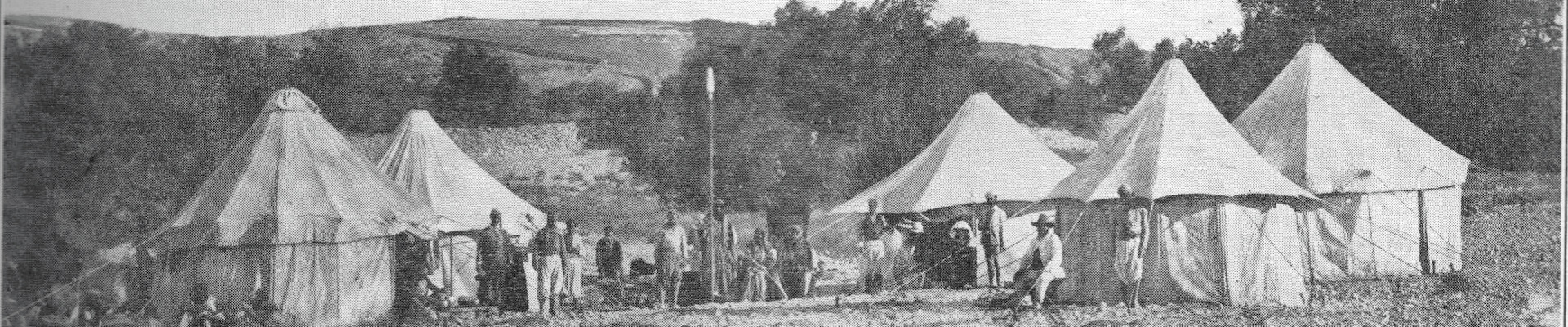
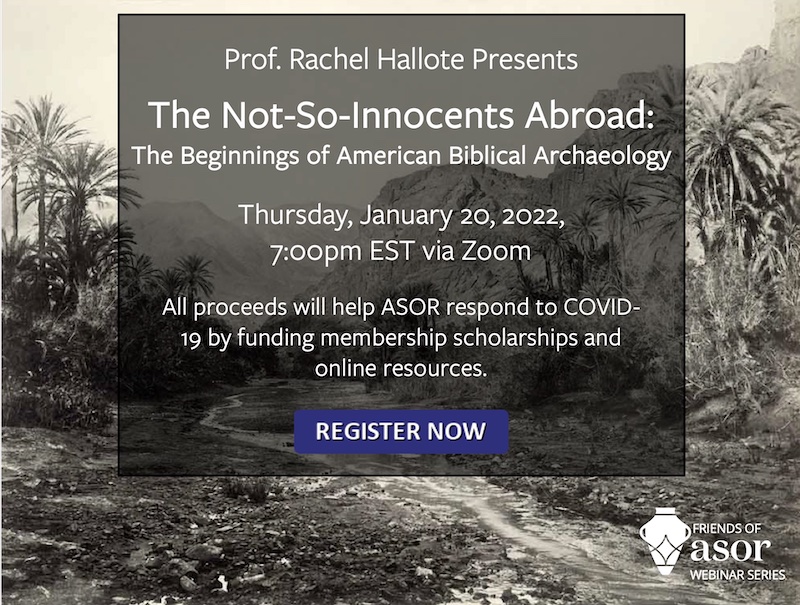
Friends of ASOR present the next webinar in our monthly series on January 20, 2022, at 7:00 pm EST, featuring Prof. Rachel Hallote. When scholars recount the story of the birth of “biblical archaeology,” the British are usually credited as the moving force while the Americans are all but ignored. The British, who were led by their deep political and religious interests in the Holy Land, carried out the first modern archaeological projects in second half of the nineteenth century, with great success. The Americans on the other hand, when mentioned at all, are portrayed as bumbling and incapable.

This webinar will redeem the image of American archaeological exploration in the Holy Land, and put endeavors into their own political, religious, and academic contexts. Not only were American archaeologists active in nineteenth century Palestine, but they were innovative in their techniques and applied a practical, no-nonsense approach to their endeavors. From the founding of the American Palestine Exploration Society to the famous Samaria Expedition of 1908, we will explore the considerable influence of American scholars on the archaeology of the Holy Land.​ Dr. Hallote will conclude her webinar with a live Q&A session.

Rachel Hallote is Professor of History at Purchase College SUNY. An archaeologist, she is also the author of several books and numerous articles about biblical archaeology and the history of archaeology. Her research involves British and American archaeologists who excavated in Ottoman-controlled Palestine in the 19th century. She has worked at numerous archaeological sites in Israel, including Tell Miqne and Megiddo. Her publications include Bible, Map, and Spade: The American Palestine Exploration Society, Frederick Jones Bliss, and the Forgotten Story of Early American Biblical Archaeology and the co-authored volume, The Photographs of the American Palestine Exploration Society. She currently co-hosts an archaeology podcast called This Week in the Ancient Near East.

ASOR Sustaining Members: $0 | ASOR Members: $6 | Public: $12

To receive your ASOR member discount, log into the online store. If you are new to ASOR, please click on the “New Visitor Registration” link to register your e-mail address and choose password for our online store. Once logged in, navigate to “Meeting and Event Registration” to register for the webinar and pay the fee. Each paid registrant will receive a confirmation e-mail when you pay for the webinar. If you do not receive this e-mail, then you are not registered. Please e-mail membership@asor.org with any questions or issues with registering.

You will be e-mailed the Zoom Webinar link in the week prior to the lecture on January 20, 2022. If you do not receive the link by the close of business on the Tuesday before the webinar, please e-mail membership@asor.org immediately. All webinars are recorded and all paid registrants will be sent a link to view the recording.

All proceeds from this lecture are used to fund scholarships for members impacted by COVID-19 as well as increasing ASOR’s online resources, which are free to the public.

WHY SPONSOR A WEBINAR?

Several levels of support from $50-$1,000 are available. Proceeds go towards membership scholarships and towards increasing ASOR’s virtual resources. Each sponsorship is tax-deductible and you can give your friends free registrations to a webinar!

Bronze Level ($50): up to 2 guest registrations
Silver Level ($100): up to 5 guest registrations
Gold Level ($500): up to 20 guest registrations
Platinum Level ($1,000): up to 50 guest registrations

After you sign up for a sponsorship online or over the phone, email the names and email addresses of your guests to Felice Herman at membership@asor.org, who will send your guests a confirmation and the Zoom link before the webinar.

WANT TO SAVE $6.00 ON THE NEXT WEBINAR?

Join ASOR as a member! Click here for more details about discounts for events and other benefits of membership. Memberships start at $40 for the year as an Associate Member.

Not ready to join yet? Become a Friend of ASOR for FREE!

Click here for more details about our online resources.

PAST WEBINARS

You can now purchase the link to the recording of any webinar. You can also purchase the bundle packages of all webinars from the 2020-2022 seasons. Please e-mail membership@asor.org for purchase details.

To see a printable pdf of the webinar titles from the 2020-2021 season, please click here. To see a printable pdf of the webinar titles from the 2021-2022 season, please click here.

Pricing:

Members: $6.00 per recording
Non-Members: $12.00 per recording
Bundle of 2020-2021 Webinars: $75.00
Bundle of 2021-2022 Webinars: $75.00
Bundle of 2020-2022 Webinars: $125.00

2021-2022 Season

A World at War: Protecting Cultural Heritage in Times of Conflict
Patty Gerstenblith (DePaul University), Lisa Ackerman (Columbus Citizens Foundation), Andrew Cohen (Government Professional and Cultural Heritage Expert) | May 12, 2022

Preserving Cultural Heritage in Hisban and Umm al-Jimal, Jordan
Øystein LaBianca (Andrews University), Elizabeth Osinga (Umm al-Jimal Archaeological Project), Darrell Rohl (Calvin University) | April 24, 2022

Back to the Field: Recent Discoveries & Summer Plans 2022
Lorenzo d’Alfonso (ISAW), Kathryn Grossman (NC State University), James R. Strange (Samford University) | April 3, 2022

Uncovering What is Nubian Beneath the Veneer of Egyptianness: Excavating the Archives
Debora Heard (University of Chicago) | March 20, 2022

Where Are They Now?: A Preview of 2022 ASOR-Affiliated Fieldwork Projects
Michael Given (University of Glasgow), Xenia-Paula Kyriakou (Florida Gulf Coast University), Stephen Batiuk (University of Toronto), Monique Roddy (Walla Walla University), Kent Bramlett (La Sierra University), Friedbert Ninow (La Sierra University), and Michael Hoff (University of Nebraska-Lincoln) | March 8, 2022

Excavations at Tel Gezer: A Personal Story
Sam Wolff (Tel Gezer Laboratory) | February 20, 2022

Tel Rehov: A Major Bronze and Iron Age City in the Jordan Valley
Amihai Mazar (Hebrew University of Jerusalem), Nava Panitz-Cohen ( Hebrew University of Jerusalem), Nota Kourou (Athens University), Naama Yahalom-Mack (Hebrew University of Jerusalem), Robert Mullins (Azusa Pacific University) | February 10, 2022

The Not-So-Innocents Abroad: The Beginnings of American Biblical Archaeology
Rachel Hallote (Samford University) | January 20, 2022

Synagogues as Jesus Knew Them
James R. Strange (Samford University) | December 2, 2021

Under Jerusalem: The Buried History of the World’s Most Contested City
Andrew Lawler | November 4, 2021

Jesus and Jerusalem on TV: How Do Bible Documentaries Get Made?
Robert Cargill (University of Iowa) | October 17, 2021

Digging the Divine?: Judahite Pillar Figurines and the Archaeology of Israelite Religion
Erin Darby (University of Tennessee) | October 7, 2021

David, Solomon, and Rehoboam’s Kingdom—The Archaeological Evidence
Yosef Garfinkel (Hebrew University of Jerusalem) | September 19, 2021

From Standing Stones to Sacred Emptiness: Textual and Visual Portrayals of Israel’s God
Theodore Lewis (Johns Hopkins University) | August 29, 2021

2020-2021 Season

Making May Matter: Webinarathon to Endow Diversity
Multiple Speakers | May 21-23, 2021

Archaeogaming: Why Video Games Deserve Their Own Archaeology
Tine Rassalle (University of North Carolina at Chapel Hill), Shannon Martino (Morton College), Matthew Winter (University of Arizona), Michael Zimmerman (Rhode Island) | April 18, 2021

How the Bible Became a Book
William Schniedewind (UCLA) | March 21, 2021

The Mysteries of Mithras in Caesarea: Exploring the Cult’s Rites and Remains
Jane DeRose Evans (Temple University), Alexandra Ratzlaff (Brandeis University) | March 11, 2021

Archaeology and the Hidden Religious Culture of Israelite Women
Carol Meyers (Duke University) | February 21, 2021

Meet the Directors—Fundraiser to Support ASOR’s Affiliated Overseas Research Centers
Matthew J. Adams (AIAR), Pearce Paul Creasman (ACOR), Lindy Crewe (CAARI) | February 11, 2021

Early Synagogues, Jesus, and Galilee—A Jewish Perspective
Eric Meyers (Duke University) | December 13, 2020

Home Sweet Home: Ancient Israelite Households in Context
Cynthia Shafer-Elliott (William Jessup University) | October 18, 2020

Priestesses in the Days of Solomon and Ahab
Susan Ackerman (Dartmouth College) | September 13, 2020

Digging Deeper: How Archaeology Works
Eric H. Cline (The George Washington University) | August 9, 2020

ASOR Annual Year-End Appeal Letter

Year-End Appeal Letter From ASOR’s President

December 5, 2022

Dear ASOR Members and Friends,

I am writing today to ask you to consider a gift to ASOR before the end of the year. ASOR is leaving 2022 with a larger membership and wider reach than ever before. Our outreach efforts in cultural heritage and education continue to expand both in the U.S. and abroad. We just completed a resoundingly successful Annual Meeting in Boston, where many of you presented your fieldwork and other research in stimulating papers, posters, and workshops attended by nearly 900 participants. Members came from around the world, many for the first time thanks to travel fellowships made possible by members’ generous donations and State Department Embassy grants. ASOR now has over 100 affiliated fieldwork and publication projects in 18 countries, and our prestigious Archaeological Report Series is producing its 30th volume in as many years. Your gifts funded scholarships, fellowships, and grants for many of these programs. You enabled ASOR to award more than $222,000 in 2022.

In recent years, ASOR has been forging new partnerships in our ever changing 21st century world to broaden our investigations of the ancient world, our collective human past, and cultural heritage. We are now reaching new and underserved audiences in efforts to make ASOR’s work more accessible. These efforts range from simultaneous translation of papers to ambitious educational projects fostering community involvement from the people and scholars in the areas in which we work (see the call for such activities by Iraqi archaeologist Jaafar Jotheri in the most recent issue of our Friends of ASOR Newsletter, The Ancient Near East Today X, No. 12). Meanwhile, your support helps ASOR increase benefits to our original constituencies of biblical specialists and experts in Semitic languages and literatures. In 2023, you will see ASOR add Maarav: A Journal for the Study of the Northwest Semitic Languages and Literatures as our fourth journal. Maarav will be available for no additional charge to all ASOR members above the Associate level.

ASOR is an organization that strives to unite people and transcend ethnic, racial, and religious boundaries. We have made great strides in many areas, and with your continued help we can do much more. The secret to vibrant non-profit growth is a virtuous circle of work and support. The generous funding from you, our donors, enables ASOR to accomplish so much as an organization, but also to award member scholarships and grants for even more external research. The products of this work in turn attract more members and donors to produce and fund even more pioneering efforts. Please help to keep that circle unbroken. Give to ASOR today!

Best wishes for a safe and happy holiday season,

Sharon Herbert
ASOR President

FOA Webinar: James R. Strange on Dec. 2

FRIENDS OF ASOR WEBINARS

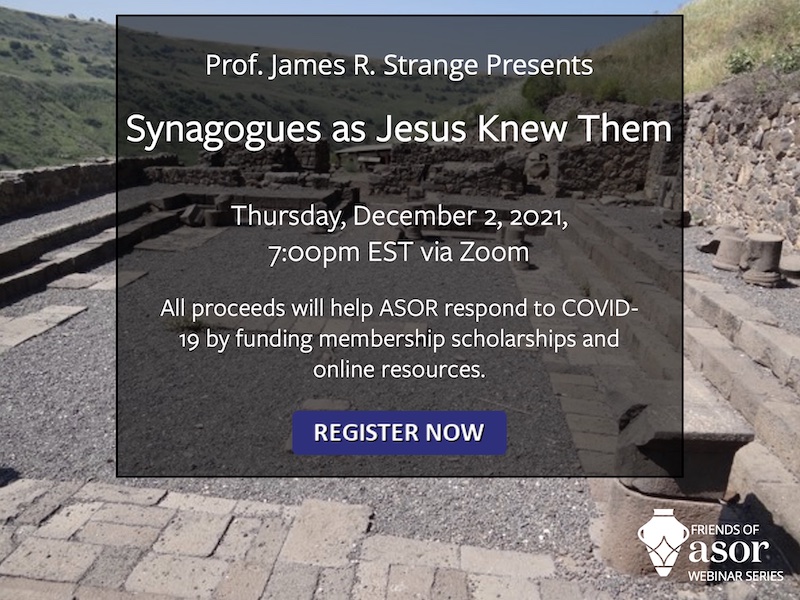
Synagogues as Jesus Knew Them

Friends of ASOR present the next webinar in our monthly series on December 2, at 7:00 pm EST, featuring Prof. James R. Strange. For decades, the accepted wisdom among scholars of the canonical gospels was that the “synagogues” that featured in Jesus’ ministry were not buildings but congregations. After all, “gathering” is the plainest meaning of the Greek word synagōgē. Furthermore, in stories in which Jesus taught and healed, and in which he experienced rejection in his hometown of Nazareth, nothing requires that he did these things in a building. Once first-century synagogue buildings started turning up in excavations in Judea, scholars began to accept that some Galilean villages might have included synagogue buildings, and excavations in Capernaum and Gamla appeared to confirm expectations. Then another dispute emerged: some argued that the Jewish synagogue had been a religious institution from its founding while others contended that, so long as the Jerusalem temple stood, synagogues in Palestine were used for secular gatherings. Therefore, these structures began to accommodate religious practices only after the temple was destroyed in 70 CE.

This webinar lecture will draw from literary texts, inscriptions, and archaeological remains to explore these debates. We will ask whether or not synagogue buildings existed in the Galilee during Jesus’ ministry, what happened in early synagogues, which sites have archaeological evidence for the earliest synagogues, and where we should expect to find more as we continue to dig. Join us for this deep dive into how these buildings played a role in Jewish society during Jesus’ lifetime. Dr. Strange will conclude his webinar with a live Q&A session.

James Riley Strange is Charles Jackson Granade and Elizabeth Donald Granade Professor in New Testament at Samford University’s Howard College of Arts and Sciences, where he teaches courses in New Testament and archaeology. He has been directing the Shikhin Excavation Project in Lower Galilee since 2012. Excavations in the village ruins have turned up remains of a ceramics and oil lamp industry and a synagogue that dates to the Roman period. Alongside David A. Fiensy, he is co-editor of the two-volume set, Galilee in the Late Second Temple and Mishnaic Periods (Fortress Press, 2014 and 2015), and he is the author of One Problem After Another: An Introduction to Archaeology, the Gospels, and Understanding Roman Galilee (Eerdmans, forthcoming in 2022).

ASOR Sustaining Members: $0 | ASOR Members: $5 | Public: $10

To receive your ASOR member discount, log into the online store. If you are new to ASOR, please click on the “New Visitor Registration” link to register your e-mail address and choose password for our online store. Once logged in, navigate to “Meeting and Event Registration” to register for the webinar and pay the fee. Each paid registrant will receive a confirmation e-mail when you pay for the webinar. If you do not receive this e-mail, then you are not registered. Please e-mail membership@asor.org with any questions or issues with registering.

You will be e-mailed the Zoom Webinar link in the week prior to the lecture on December 2, 2021. If you do not receive the link by the close of business on the Tuesday before the webinar, please e-mail membership@asor.org immediately. All webinars are recorded and all paid registrants will be sent a link to view the recording.

All proceeds from this lecture are used to fund scholarships for members impacted by COVID-19 as well as increasing ASOR’s online resources, which are free to the public.

WHY SPONSOR A WEBINAR?

Several levels of support from $50-$1,000 are available. Proceeds go towards membership scholarships and towards increasing ASOR’s virtual resources. Each sponsorship is tax-deductible and you can give your friends free registrations to a webinar!

Bronze Level ($50): up to 2 guest registrations
Silver Level ($100): up to 5 guest registrations
Gold Level ($500): up to 20 guest registrations
Platinum Level ($1,000): up to 50 guest registrations

After you sign up for a sponsorship online or over the phone, email the names and email addresses of your guests to Felice Herman at membership@asor.org, who will send your guests a confirmation and the Zoom link before the webinar.

WANT TO SAVE $5.00 ON THE NEXT WEBINAR?

Join ASOR as a member! Click here for more details about discounts for events and other benefits of membership. Memberships start at $40 for the year as an Associate Member.

Not ready to join yet? Become a Friend of ASOR for FREE!

Click here for more details about our online resources.

PAST WEBINARS

You can now purchase the link to the recording of any webinar. You can also purchase the bundle packages of all webinars from the 2020-2022 seasons. Please e-mail membership@asor.org for purchase details.

To see a printable pdf of the webinar titles from the 2020-2021 season, please click here. To see a printable pdf of the webinar titles from the 2021-2022 season, please click here.

Pricing:

Members: $6.00 per recording
Non-Members: $12.00 per recording
Bundle of 2020-2021 Webinars: $75.00
Bundle of 2021-2022 Webinars: $75.00
Bundle of 2020-2022 Webinars: $125.00

2021-2022 Season

A World at War: Protecting Cultural Heritage in Times of Conflict
Patty Gerstenblith (DePaul University), Lisa Ackerman (Columbus Citizens Foundation), Andrew Cohen (Government Professional and Cultural Heritage Expert) | May 12, 2022

Preserving Cultural Heritage in Hisban and Umm al-Jimal, Jordan
Øystein LaBianca (Andrews University), Elizabeth Osinga (Umm al-Jimal Archaeological Project), Darrell Rohl (Calvin University) | April 24, 2022

Back to the Field: Recent Discoveries & Summer Plans 2022
Lorenzo d’Alfonso (ISAW), Kathryn Grossman (NC State University), James R. Strange (Samford University) | April 3, 2022

Uncovering What is Nubian Beneath the Veneer of Egyptianness: Excavating the Archives
Debora Heard (University of Chicago) | March 20, 2022

Where Are They Now?: A Preview of 2022 ASOR-Affiliated Fieldwork Projects
Michael Given (University of Glasgow), Xenia-Paula Kyriakou (Florida Gulf Coast University), Stephen Batiuk (University of Toronto), Monique Roddy (Walla Walla University), Kent Bramlett (La Sierra University), Friedbert Ninow (La Sierra University), and Michael Hoff (University of Nebraska-Lincoln) | March 8, 2022

Excavations at Tel Gezer: A Personal Story
Sam Wolff (Tel Gezer Laboratory) | February 20, 2022

Tel Rehov: A Major Bronze and Iron Age City in the Jordan Valley
Amihai Mazar (Hebrew University of Jerusalem), Nava Panitz-Cohen ( Hebrew University of Jerusalem), Nota Kourou (Athens University), Naama Yahalom-Mack (Hebrew University of Jerusalem), Robert Mullins (Azusa Pacific University) | February 10, 2022

The Not-So-Innocents Abroad: The Beginnings of American Biblical Archaeology
Rachel Hallote (Samford University) | January 20, 2022

Synagogues as Jesus Knew Them
James R. Strange (Samford University) | December 2, 2021

Under Jerusalem: The Buried History of the World’s Most Contested City
Andrew Lawler | November 4, 2021

Jesus and Jerusalem on TV: How Do Bible Documentaries Get Made?
Robert Cargill (University of Iowa) | October 17, 2021

Digging the Divine?: Judahite Pillar Figurines and the Archaeology of Israelite Religion
Erin Darby (University of Tennessee) | October 7, 2021

David, Solomon, and Rehoboam’s Kingdom—The Archaeological Evidence
Yosef Garfinkel (Hebrew University of Jerusalem) | September 19, 2021

From Standing Stones to Sacred Emptiness: Textual and Visual Portrayals of Israel’s God
Theodore Lewis (Johns Hopkins University) | August 29, 2021

2020-2021 Season

Making May Matter: Webinarathon to Endow Diversity
Multiple Speakers | May 21-23, 2021

Archaeogaming: Why Video Games Deserve Their Own Archaeology
Tine Rassalle (University of North Carolina at Chapel Hill), Shannon Martino (Morton College), Matthew Winter (University of Arizona), Michael Zimmerman (Rhode Island) | April 18, 2021

How the Bible Became a Book
William Schniedewind (UCLA) | March 21, 2021

The Mysteries of Mithras in Caesarea: Exploring the Cult’s Rites and Remains
Jane DeRose Evans (Temple University), Alexandra Ratzlaff (Brandeis University) | March 11, 2021

Archaeology and the Hidden Religious Culture of Israelite Women
Carol Meyers (Duke University) | February 21, 2021

Meet the Directors—Fundraiser to Support ASOR’s Affiliated Overseas Research Centers
Matthew J. Adams (AIAR), Pearce Paul Creasman (ACOR), Lindy Crewe (CAARI) | February 11, 2021

Early Synagogues, Jesus, and Galilee—A Jewish Perspective
Eric Meyers (Duke University) | December 13, 2020

Home Sweet Home: Ancient Israelite Households in Context
Cynthia Shafer-Elliott (William Jessup University) | October 18, 2020

Priestesses in the Days of Solomon and Ahab
Susan Ackerman (Dartmouth College) | September 13, 2020

Digging Deeper: How Archaeology Works
Eric H. Cline (The George Washington University) | August 9, 2020

FOA Webinar: Andrew Lawler on Nov. 4

FRIENDS OF ASOR WEBINARS

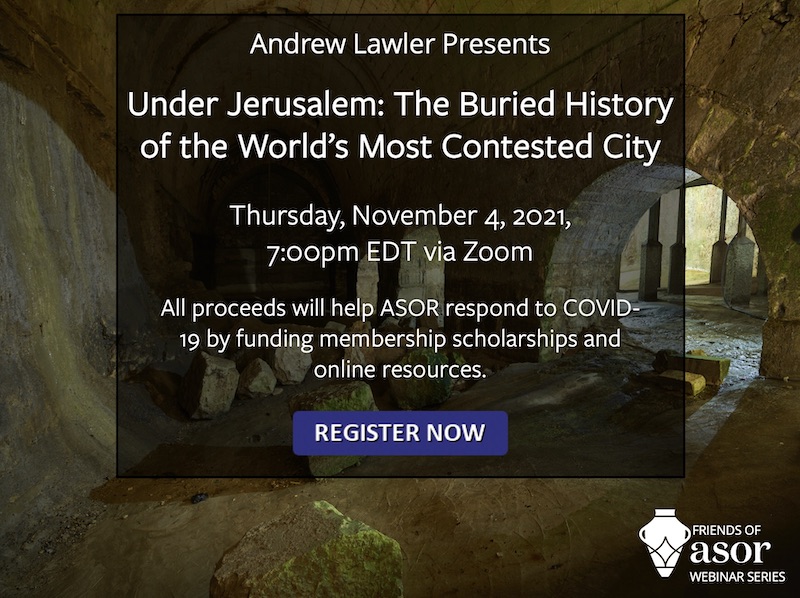
Under Jerusalem: The Buried History of the World’s Most Contested City


Click here to pre-order Andrew Lawler’s new book today! Register and you could win a free copy of the book!

Friends of ASOR present the next webinar in our monthly series on November 4, at 7:00 pm EDT, featuring Andrew Lawler. Sacred to three faiths and revered by more than half the people on the planet, Jerusalem conjures up powerful images of the celestial. Yet beneath its narrow alleys and holy places, the ancient city conceals a labyrinthine, three-dimensional time capsule recording five millennia of bustling prosperity, brutal war, and repeated religious innovation that altered the course of human history.

Since the days when Abraham Lincoln was in the White House, adventurers, archaeologists, and religious zealots have flocked here to hunt for buried treasure, unearth sacred artifacts, and find proof of the Bible’s veracity. That digging to reveal the past continues today—and, in so doing, continues to alter the city’s future.

Journalist Andrew Lawler will take us on a journey through time and beneath Jerusalem, where religion, politics, and science have often combined with exciting, controversial, and, occasionally, violent results. Andrew will conclude his webinar with a live Q&A session.


Andrew Lawler is an American science writer and author of three books. As a journalist, he has  published hundreds of newspaper and magazine articles in more than two dozen countries. His byline has appeared in The New York Times, The Washington Post, National Geographic, Smithsonian, and many others. He is contributing writer for Science and contributing editor for Archaeology. His new book, Under Jerusalem: The Buried History of the World’s Most Contested City, will be published November 2 by Doubleday Publishing. He also is author of The Secret Token: Myth, Obsession, and the Search for the Lost Colony of Roanoke, a national bestseller, and Why Did the Chicken Cross the World?: The Epic Saga of the Bird that Powers Civilization. His work has appeared several times in The Best of Science and Nature Writing.

ASOR Sustaining Members: $0 | ASOR Members: $5 | Public: $10

To receive your ASOR member discount, log into the online store. If you are new to ASOR, please click on the “New Visitor Registration” link to register your e-mail address and choose password for our online store. Once logged in, navigate to “Meeting and Event Registration” to register for the webinar and pay the fee. Each paid registrant will receive a confirmation e-mail when you pay for the webinar. If you do not receive this e-mail, then you are not registered. Please e-mail membership@asor.org with any questions or issues with registering.

You will be e-mailed the Zoom Webinar link in the week prior to the lecture on November 4, 2021. If you do not receive the link by the close of business on the Monday before the webinar, please e-mail membership@asor.org immediately. All webinars are recorded and all paid registrants will be sent a link to view the recording.

All proceeds from this lecture are used to fund scholarships for members impacted by COVID-19 as well as increasing ASOR’s online resources, which are free to the public.

WHY SPONSOR A WEBINAR?

Several levels of support from $50-$1,000 are available. Proceeds go towards membership scholarships and towards increasing ASOR’s virtual resources. Each sponsorship is tax-deductible and you can give your friends free registrations to a webinar!

Bronze Level ($50): up to 2 guest registrations
Silver Level ($100): up to 5 guest registrations
Gold Level ($500): up to 20 guest registrations
Platinum Level ($1,000): up to 50 guest registrations

After you sign up for a sponsorship online or over the phone, email the names and email addresses of your guests to Felice Herman at membership@asor.org, who will send your guests a confirmation and the Zoom link before the webinar.

WANT TO SAVE $5.00 ON THE NEXT WEBINAR?

Join ASOR as a member! Click here for more details about discounts for events and other benefits of membership. Memberships start at $40 for the year as an Associate Member.

Not ready to join yet? Become a Friend of ASOR for FREE!

Click here for more details about our online resources.


PAST WEBINARS

You can now purchase the link to the recording of any webinar. You can also purchase the bundle packages of all webinars from the 2020-2022 seasons. Please e-mail membership@asor.org for purchase details.

To see a printable pdf of the webinar titles from the 2020-2021 season, please click here. To see a printable pdf of the webinar titles from the 2021-2022 season, please click here.

Pricing:

Members: $6.00 per recording
Non-Members: $12.00 per recording
Bundle of 2020-2021 Webinars: $75.00
Bundle of 2021-2022 Webinars: $75.00
Bundle of 2020-2022 Webinars: $125.00

2021-2022 Season

A World at War: Protecting Cultural Heritage in Times of Conflict
Patty Gerstenblith (DePaul University), Lisa Ackerman (Columbus Citizens Foundation), Andrew Cohen (Government Professional and Cultural Heritage Expert) | May 12, 2022

Preserving Cultural Heritage in Hisban and Umm al-Jimal, Jordan
Øystein LaBianca (Andrews University), Elizabeth Osinga (Umm al-Jimal Archaeological Project), Darrell Rohl (Calvin University) | April 24, 2022

Back to the Field: Recent Discoveries & Summer Plans 2022
Lorenzo d’Alfonso (ISAW), Kathryn Grossman (NC State University), James R. Strange (Samford University) | April 3, 2022

Uncovering What is Nubian Beneath the Veneer of Egyptianness: Excavating the Archives
Debora Heard (University of Chicago) | March 20, 2022

Where Are They Now?: A Preview of 2022 ASOR-Affiliated Fieldwork Projects
Michael Given (University of Glasgow), Xenia-Paula Kyriakou (Florida Gulf Coast University), Stephen Batiuk (University of Toronto), Monique Roddy (Walla Walla University), Kent Bramlett (La Sierra University), Friedbert Ninow (La Sierra University), and Michael Hoff (University of Nebraska-Lincoln) | March 8, 2022

Excavations at Tel Gezer: A Personal Story
Sam Wolff (Tel Gezer Laboratory) | February 20, 2022

Tel Rehov: A Major Bronze and Iron Age City in the Jordan Valley
Amihai Mazar (Hebrew University of Jerusalem), Nava Panitz-Cohen ( Hebrew University of Jerusalem), Nota Kourou (Athens University), Naama Yahalom-Mack (Hebrew University of Jerusalem), Robert Mullins (Azusa Pacific University) | February 10, 2022

The Not-So-Innocents Abroad: The Beginnings of American Biblical Archaeology
Rachel Hallote (Samford University) | January 20, 2022

Synagogues as Jesus Knew Them
James R. Strange (Samford University) | December 2, 2021

Under Jerusalem: The Buried History of the World’s Most Contested City
Andrew Lawler | November 4, 2021

Jesus and Jerusalem on TV: How Do Bible Documentaries Get Made?
Robert Cargill (University of Iowa) | October 17, 2021

Digging the Divine?: Judahite Pillar Figurines and the Archaeology of Israelite Religion
Erin Darby (University of Tennessee) | October 7, 2021

David, Solomon, and Rehoboam’s Kingdom—The Archaeological Evidence
Yosef Garfinkel (Hebrew University of Jerusalem) | September 19, 2021

From Standing Stones to Sacred Emptiness: Textual and Visual Portrayals of Israel’s God
Theodore Lewis (Johns Hopkins University) | August 29, 2021

2020-2021 Season

Making May Matter: Webinarathon to Endow Diversity
Multiple Speakers | May 21-23, 2021

Archaeogaming: Why Video Games Deserve Their Own Archaeology
Tine Rassalle (University of North Carolina at Chapel Hill), Shannon Martino (Morton College), Matthew Winter (University of Arizona), Michael Zimmerman (Rhode Island) | April 18, 2021

How the Bible Became a Book
William Schniedewind (UCLA) | March 21, 2021

The Mysteries of Mithras in Caesarea: Exploring the Cult’s Rites and Remains
Jane DeRose Evans (Temple University), Alexandra Ratzlaff (Brandeis University) | March 11, 2021

Archaeology and the Hidden Religious Culture of Israelite Women
Carol Meyers (Duke University) | February 21, 2021

Meet the Directors—Fundraiser to Support ASOR’s Affiliated Overseas Research Centers
Matthew J. Adams (AIAR), Pearce Paul Creasman (ACOR), Lindy Crewe (CAARI) | February 11, 2021

Early Synagogues, Jesus, and Galilee—A Jewish Perspective
Eric Meyers (Duke University) | December 13, 2020

Home Sweet Home: Ancient Israelite Households in Context
Cynthia Shafer-Elliott (William Jessup University) | October 18, 2020

Priestesses in the Days of Solomon and Ahab
Susan Ackerman (Dartmouth College) | September 13, 2020

Digging Deeper: How Archaeology Works
Eric H. Cline (The George Washington University) | August 9, 2020

FOA Webinar: Bob Cargill on Oct. 17

FRIENDS OF ASOR WEBINARS

Jesus and Jerusalem on TV: How Do Bible Documentaries Get Made?

Friends of ASOR present the next webinar in our monthly series on October 17, at 7:30 pm EDT, featuring Prof. Robert Cargill. Have you ever wondered how TV Bible documentaries like those about Jesus and Jerusalem are developed? Who researches and writes them? How do the experts get chosen? How are the reenactments created? And who decides what makes the final cut? (And why did they skip the most important part?!)

This webinar explores how various Bible-related TV documentaries are made, and what goes into making a quality, responsible program about the popular subjects of Jesus and Jerusalem. We will also delve into how some producers sensationalize religion and the holy city (Jerusalem) in an effort to increase ratings, but at the expense of historical accuracy and education. An expert in this area, Dr. Cargill (University of Iowa), has appeared in over 4 dozen documentaries and has consulted on several major documentary series on CNN, History, and National Geographic.

Join us to get a behind-the-scenes tour of the nitty-gritty of making TV documentaries, followed by an “Ask Me Anything” question and answer period with Dr. Cargill.

Dr. Robert R. Cargill (PhD 2008 UCLA, Near Eastern Languages and Cultures) is Associate Professor of Classics and Religious Studies at the University of Iowa and Editor of the new Bible & Archaeology website. He teaches biblical studies, Second Temple Judaism, archaeology, and ancient languages including Biblical Hebrew, Aramaic, Greek, and Syriac. His recent books include Melchizedek, King of Sodom: How Scribes Invented the Biblical Priest-King (Oxford University Press, 2019) and The Cities That Built the Bible (HarperOne, 2016).

A specialist in public biblical scholarship, you can see him regularly on CNN, History, Discovery, and National Geographic, where he contributes and consults on shows like National Geographic’s “Writing the Dead Sea Scrolls,” History’s “Jesus: His Life,” CNN’s “Finding Jesus,” History’s “Bible Secrets Revealed,” and most recently, CNN’s “Jerusalem: City of Faith and Fury.” He has excavated at Banias, Omrit, Haẓor, and most recently at Azekah with Tel Aviv University.

ASOR Sustaining Members: $0 | ASOR Members: $5 | Public: $10

To receive your ASOR member discount, log into the online store. If you are new to ASOR, please click on the “New Visitor Registration” link to register your e-mail address and choose password for our online store. Once logged in, navigate to “Meeting and Event Registration” to register for the webinar and pay the fee. Each paid registrant will receive a confirmation e-mail when you pay for the webinar. If you do not receive this e-mail, then you are not registered. Please e-mail membership@asor.org with any questions or issues with registering.

You will be e-mailed the Zoom Webinar link in the week prior to the lecture on October 17, 2021. If you do not receive the link by the close of business on the Thursday before the webinar, please e-mail membership@asor.org immediately. All webinars are recorded and all paid registrants will be sent a link to view the recording.

All proceeds from this lecture are used to fund scholarships for members impacted by COVID-19 as well as increasing ASOR’s online resources, which are free to the public.

WHY SPONSOR A WEBINAR?

Several levels of support from $50-$1,000 are available. Proceeds go towards membership scholarships and towards increasing ASOR’s virtual resources. Each sponsorship is tax-deductible and you can give your friends free registrations to a webinar!

Bronze Level ($50): up to 2 guest registrations
Silver Level ($100): up to 5 guest registrations
Gold Level ($500): up to 20 guest registrations
Platinum Level ($1,000): up to 50 guest registrations

After you sign up for a sponsorship online or over the phone, email the names and email addresses of your guests to Felice Herman at membership@asor.org, who will send your guests a confirmation and the Zoom link before the webinar.

WANT TO SAVE $5.00 ON THE NEXT WEBINAR?

Join ASOR as a member! Click here for more details about discounts for events and other benefits of membership. Memberships start at $40 for the year as an Associate Member.

Not ready to join yet? Become a Friend of ASOR for FREE!

Click here for more details about our online resources.


PAST WEBINARS

You can now purchase the link to the recording of any webinar. You can also purchase the bundle packages of all webinars from the 2020-2022 seasons. Please e-mail membership@asor.org for purchase details.

To see a printable pdf of the webinar titles from the 2020-2021 season, please click here. To see a printable pdf of the webinar titles from the 2021-2022 season, please click here.

Pricing:

Members: $6.00 per recording
Non-Members: $12.00 per recording
Bundle of 2020-2021 Webinars: $75.00
Bundle of 2021-2022 Webinars: $75.00
Bundle of 2020-2022 Webinars: $125.00

2021-2022 Season

A World at War: Protecting Cultural Heritage in Times of Conflict
Patty Gerstenblith (DePaul University), Lisa Ackerman (Columbus Citizens Foundation), Andrew Cohen (Government Professional and Cultural Heritage Expert) | May 12, 2022

Preserving Cultural Heritage in Hisban and Umm al-Jimal, Jordan
Øystein LaBianca (Andrews University), Elizabeth Osinga (Umm al-Jimal Archaeological Project), Darrell Rohl (Calvin University) | April 24, 2022

Back to the Field: Recent Discoveries & Summer Plans 2022
Lorenzo d’Alfonso (ISAW), Kathryn Grossman (NC State University), James R. Strange (Samford University) | April 3, 2022

Uncovering What is Nubian Beneath the Veneer of Egyptianness: Excavating the Archives
Debora Heard (University of Chicago) | March 20, 2022

Where Are They Now?: A Preview of 2022 ASOR-Affiliated Fieldwork Projects
Michael Given (University of Glasgow), Xenia-Paula Kyriakou (Florida Gulf Coast University), Stephen Batiuk (University of Toronto), Monique Roddy (Walla Walla University), Kent Bramlett (La Sierra University), Friedbert Ninow (La Sierra University), and Michael Hoff (University of Nebraska-Lincoln) | March 8, 2022

Excavations at Tel Gezer: A Personal Story
Sam Wolff (Tel Gezer Laboratory) | February 20, 2022

Tel Rehov: A Major Bronze and Iron Age City in the Jordan Valley
Amihai Mazar (Hebrew University of Jerusalem), Nava Panitz-Cohen ( Hebrew University of Jerusalem), Nota Kourou (Athens University), Naama Yahalom-Mack (Hebrew University of Jerusalem), Robert Mullins (Azusa Pacific University) | February 10, 2022

The Not-So-Innocents Abroad: The Beginnings of American Biblical Archaeology
Rachel Hallote (Samford University) | January 20, 2022

Synagogues as Jesus Knew Them
James R. Strange (Samford University) | December 2, 2021

Under Jerusalem: The Buried History of the World’s Most Contested City
Andrew Lawler | November 4, 2021

Jesus and Jerusalem on TV: How Do Bible Documentaries Get Made?
Robert Cargill (University of Iowa) | October 17, 2021

Digging the Divine?: Judahite Pillar Figurines and the Archaeology of Israelite Religion
Erin Darby (University of Tennessee) | October 7, 2021

David, Solomon, and Rehoboam’s Kingdom—The Archaeological Evidence
Yosef Garfinkel (Hebrew University of Jerusalem) | September 19, 2021

From Standing Stones to Sacred Emptiness: Textual and Visual Portrayals of Israel’s God
Theodore Lewis (Johns Hopkins University) | August 29, 2021

2020-2021 Season

Making May Matter: Webinarathon to Endow Diversity
Multiple Speakers | May 21-23, 2021

Archaeogaming: Why Video Games Deserve Their Own Archaeology
Tine Rassalle (University of North Carolina at Chapel Hill), Shannon Martino (Morton College), Matthew Winter (University of Arizona), Michael Zimmerman (Rhode Island) | April 18, 2021

How the Bible Became a Book
William Schniedewind (UCLA) | March 21, 2021

The Mysteries of Mithras in Caesarea: Exploring the Cult’s Rites and Remains
Jane DeRose Evans (Temple University), Alexandra Ratzlaff (Brandeis University) | March 11, 2021

Archaeology and the Hidden Religious Culture of Israelite Women
Carol Meyers (Duke University) | February 21, 2021

Meet the Directors—Fundraiser to Support ASOR’s Affiliated Overseas Research Centers
Matthew J. Adams (AIAR), Pearce Paul Creasman (ACOR), Lindy Crewe (CAARI) | February 11, 2021

Early Synagogues, Jesus, and Galilee—A Jewish Perspective
Eric Meyers (Duke University) | December 13, 2020

Home Sweet Home: Ancient Israelite Households in Context
Cynthia Shafer-Elliott (William Jessup University) | October 18, 2020

Priestesses in the Days of Solomon and Ahab
Susan Ackerman (Dartmouth College) | September 13, 2020

Digging Deeper: How Archaeology Works
Eric H. Cline (The George Washington University) | August 9, 2020

FOA Webinar: Erin Darby on Oct. 7

FRIENDS OF ASOR WEBINARS

Digging the Divine?: Judahite Pillar Figurines and the Archaeology of Israelite Religion

Friends of ASOR present the next webinar in our monthly series on October 7, at 7:00 pm EDT, featuring Prof. Erin Darby. In this webinar, Dr. Darby will introduce you to the enigmatic female pillar figurines from the nation of Judah in the 8th-6th centuries BCE. These small clay figurines either supporting or holding their breasts are among the most numerous ritual objects uncovered in ancient Israel. However, they are never clearly mentioned in biblical texts and they lack inscriptions or identifying symbols. As a result, they have been interpreted in many ways, including as goddesses, as implements in illicit, popular rituals, and as objects used primarily by women to aid in fertility, birth, and infant health.

We will explore questions scholars ask about these clay statues, like: “Who made them?”, “What was their function?”, and “What do they tell us about religion in ancient Israel?” By focusing on the archaeological context of figurine fragments, we will debate what role archaeological data may play in the interpretation of these important figures.

Join us for this exploration of these mysterious figurines and what they can tell us about the people of Judah. Prof. Darby will conclude her webinar with a live Q&A session.


Registrants now get 25% off of Erin Darby’s new book through Brill!

Dr. Erin Darby is an associate professor of Early Judaism in the Department of Religious Studies and the Faculty Director of Undergraduate Research and Fellowships at the University of Tennessee. Erin is an expert in the archaeology of Israelite religion, with a particular focus on figurines and other cultic objects. These are the focus of her monograph, Interpreting Judean Pillar Figurines: Gender and Empire in Apotropaic Practice (Mohr Siebeck 2014) and a forthcoming co-edited volume entitled Iron Age Terracotta Figurines from the Southern Levant in Context (Brill, fall 2021), as well as several other publications. Her research has been supported by two fellowships from the W. F. Albright Institute of Archaeological Research (AIAR) in Jerusalem. She has also received funding to support her research at the American Center of Research (ACOR) in Amman, Jordan and the Cyprus American Archaeological Research Institute (CAARI), in Nicosia, Cyprus. Her most recent work has focused on figurines and other ritual objects at shrine sites in the Negev Desert of southern Israel and in southern Jordan. She is also an active field archaeologist and co-director of the ‘Ayn Gharandal Archaeological Project in the Wadi Arabah of southern Jordan.
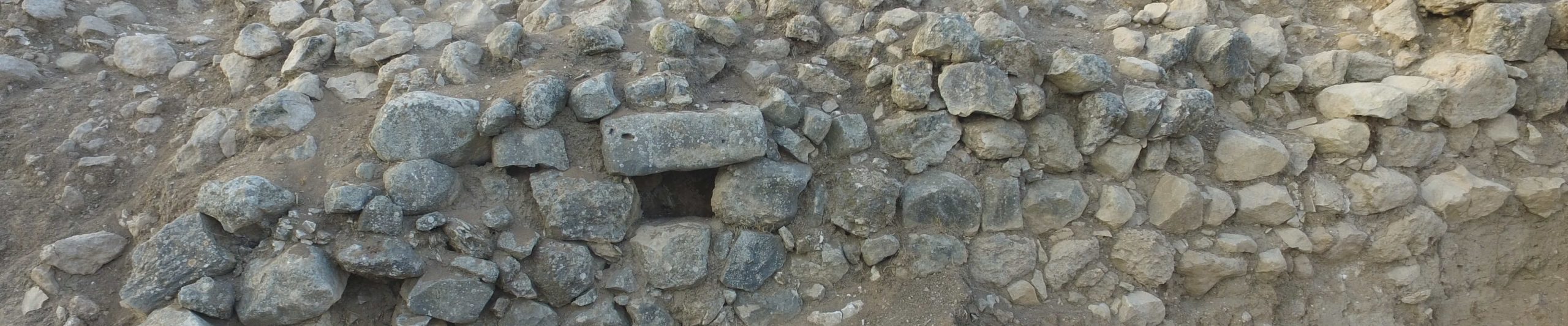
ASOR Sustaining Members: $0 | ASOR Members: $5 | Public: $10

To receive your ASOR member discount, log into the online store. If you are new to ASOR, please click on the “New Visitor Registration” link to register your e-mail address and choose password for our online store. Once logged in, navigate to “Meeting and Event Registration” to register for the webinar and pay the fee. Each paid registrant will receive a confirmation e-mail when you pay for the webinar. If you do not receive this e-mail, then you are not registered. Please e-mail membership@asor.org with any questions or issues with registering.

You will be e-mailed the Zoom Webinar link in the week prior to the lecture on October 7, 2021 If you do not receive the link by the close of business on the Tuesday before the webinar, please e-mail membership@asor.org immediately. All webinars are recorded and all paid registrants will be sent a link to view the recording.

All proceeds from this lecture are used to fund scholarships for members impacted by COVID-19 as well as increasing ASOR’s online resources, which are free to the public.

WHY SPONSOR A WEBINAR?

Several levels of support from $50-$1,000 are available. Proceeds go towards membership scholarships and towards increasing ASOR’s virtual resources. Each sponsorship is tax-deductible and you can give your friends free registrations to a webinar!

Bronze Level ($50): up to 2 guest registrations
Silver Level ($100): up to 5 guest registrations
Gold Level ($500): up to 20 guest registrations
Platinum Level ($1,000): up to 50 guest registrations

After you sign up for a sponsorship online or over the phone, email the names and email addresses of your guests to Felice Herman at membership@asor.org, who will send your guests a confirmation and the Zoom link before the webinar.


WANT TO SAVE $5.00 ON THE NEXT WEBINAR?

Join ASOR as a member! Click here for more details about discounts for events and other benefits of membership. Memberships start at $40 for the year as an Associate Member.

Not ready to join yet? Become a Friend of ASOR for FREE!

Click here for more details about our online resources.

PAST WEBINARS

You can now purchase the link to the recording of any webinar. You can also purchase the bundle packages of all webinars from the 2020-2022 seasons. Please e-mail membership@asor.org for purchase details.

To see a printable pdf of the webinar titles from the 2020-2021 season, please click here. To see a printable pdf of the webinar titles from the 2021-2022 season, please click here.

Pricing:

Members: $6.00 per recording
Non-Members: $12.00 per recording
Bundle of 2020-2021 Webinars: $75.00
Bundle of 2021-2022 Webinars: $75.00
Bundle of 2020-2022 Webinars: $125.00

2021-2022 Season

A World at War: Protecting Cultural Heritage in Times of Conflict
Patty Gerstenblith (DePaul University), Lisa Ackerman (Columbus Citizens Foundation), Andrew Cohen (Government Professional and Cultural Heritage Expert) | May 12, 2022

Preserving Cultural Heritage in Hisban and Umm al-Jimal, Jordan
Øystein LaBianca (Andrews University), Elizabeth Osinga (Umm al-Jimal Archaeological Project), Darrell Rohl (Calvin University) | April 24, 2022

Back to the Field: Recent Discoveries & Summer Plans 2022
Lorenzo d’Alfonso (ISAW), Kathryn Grossman (NC State University), James R. Strange (Samford University) | April 3, 2022

Uncovering What is Nubian Beneath the Veneer of Egyptianness: Excavating the Archives
Debora Heard (University of Chicago) | March 20, 2022

Where Are They Now?: A Preview of 2022 ASOR-Affiliated Fieldwork Projects
Michael Given (University of Glasgow), Xenia-Paula Kyriakou (Florida Gulf Coast University), Stephen Batiuk (University of Toronto), Monique Roddy (Walla Walla University), Kent Bramlett (La Sierra University), Friedbert Ninow (La Sierra University), and Michael Hoff (University of Nebraska-Lincoln) | March 8, 2022

Excavations at Tel Gezer: A Personal Story
Sam Wolff (Tel Gezer Laboratory) | February 20, 2022

Tel Rehov: A Major Bronze and Iron Age City in the Jordan Valley
Amihai Mazar (Hebrew University of Jerusalem), Nava Panitz-Cohen ( Hebrew University of Jerusalem), Nota Kourou (Athens University), Naama Yahalom-Mack (Hebrew University of Jerusalem), Robert Mullins (Azusa Pacific University) | February 10, 2022

The Not-So-Innocents Abroad: The Beginnings of American Biblical Archaeology
Rachel Hallote (Samford University) | January 20, 2022

Synagogues as Jesus Knew Them
James R. Strange (Samford University) | December 2, 2021

Under Jerusalem: The Buried History of the World’s Most Contested City
Andrew Lawler | November 4, 2021

Jesus and Jerusalem on TV: How Do Bible Documentaries Get Made?
Robert Cargill (University of Iowa) | October 17, 2021

Digging the Divine?: Judahite Pillar Figurines and the Archaeology of Israelite Religion
Erin Darby (University of Tennessee) | October 7, 2021

David, Solomon, and Rehoboam’s Kingdom—The Archaeological Evidence
Yosef Garfinkel (Hebrew University of Jerusalem) | September 19, 2021

From Standing Stones to Sacred Emptiness: Textual and Visual Portrayals of Israel’s God
Theodore Lewis (Johns Hopkins University) | August 29, 2021

2020-2021 Season

Making May Matter: Webinarathon to Endow Diversity
Multiple Speakers | May 21-23, 2021

Archaeogaming: Why Video Games Deserve Their Own Archaeology
Tine Rassalle (University of North Carolina at Chapel Hill), Shannon Martino (Morton College), Matthew Winter (University of Arizona), Michael Zimmerman (Rhode Island) | April 18, 2021

How the Bible Became a Book
William Schniedewind (UCLA) | March 21, 2021

The Mysteries of Mithras in Caesarea: Exploring the Cult’s Rites and Remains
Jane DeRose Evans (Temple University), Alexandra Ratzlaff (Brandeis University) | March 11, 2021

Archaeology and the Hidden Religious Culture of Israelite Women
Carol Meyers (Duke University) | February 21, 2021

Meet the Directors—Fundraiser to Support ASOR’s Affiliated Overseas Research Centers
Matthew J. Adams (AIAR), Pearce Paul Creasman (ACOR), Lindy Crewe (CAARI) | February 11, 2021

Early Synagogues, Jesus, and Galilee—A Jewish Perspective
Eric Meyers (Duke University) | December 13, 2020

Home Sweet Home: Ancient Israelite Households in Context
Cynthia Shafer-Elliott (William Jessup University) | October 18, 2020

Priestesses in the Days of Solomon and Ahab
Susan Ackerman (Dartmouth College) | September 13, 2020

Digging Deeper: How Archaeology Works
Eric H. Cline (The George Washington University) | August 9, 2020

FOA Webinar: Yosef Garfinkel on Sept. 19

FRIENDS OF ASOR WEBINARS

David, Solomon, and Rehoboam’s Kingdom—The Archaeological Evidence

Friends of ASOR present the next webinar in our monthly series on September 19, at 4:30 pm EDT, featuring Prof. Yosef Garfinkel. Since 2007, four sites in the Judean Shephelah were investigated: Khirbet Qeiyafa, Khirbet el-Ra‘i, Socoh, and Lachish. Khirbet Qeiyafa and Khirbet el-Ra‘i provided sweeping and cutting-edge data on the early part of the 10th century BCE, the time of King David. The fortified city of Khirbet Qeiyafa was built according to the typical Judean urban plan, a plan that is not found in any city in Philistia or the Kingdom of Israel. Public buildings and large quantities of jars with impressions on their handles indicate the existence of an administration. Two inscriptions were found, suggesting increasing knowledge of reading in this period.

A stone shrine model from Khirbet Qeiyafa provided data on royal building activities in the time of King Solomon that forces us to reconsider previous theories. The stone model is a carved box (35 cm high) and the façade is elegantly profiled, with three interlocking frames around the door and depictions of wooden beams in groups of three, that support the roof (known triglyph in classical architecture). The combination of iconographic and linguistic analysis indicates that the same two architectural components are also described in the biblical text regarding Solomon’s Palace and Solomon’s Temple.

The date for the fortification of Lachish and for it becoming the second-most important city in the kingdom of Judah after Jerusalem has been heavily debated by scholars for generations. Prior the renewed excavations from 2013 to 2017, the various scholarly opinions ranged for more than 250 years, from the early 10th to the mid-8th centuries BCE. New excavations at Lachish from 2013 to 2017 uncovered a previously unknown city wall, dated by 14C to the second half of the 10th century BCE. This date fits well with the biblical tradition in 2 Chronicles 11:9, that Lachish was fortified in the last decades of the 10th century BCE by King Rehoboam.

Join us for this deep dive into some of the most exciting new finds at sites across the biblical kingdom of Judah. Prof. Garfinkel will conclude his webinar with a live Q&A session.

Yosef Garfinkel is Yigael Yadin Professor of Archaeology of the Land of Israel at the Institute of Archaeology, the Hebrew University of Jerusalem. For many years he was a prehistorian, excavating Neolithic and Chalcolithic sites, including Yiftahel, Gesher, Neolithic Ashkelon, Shaar Hagolan and Tel Tsaf. He did extensive research on prehistoric dance, including the publication of articles and a book: Dance at the Dawn of Agriculture. An article on the evolution of human dance had been published recently by Cambridge Archaeological Journal.

Since 2007, he has conducted a regional project in the Judean Shephelah, excavating in Khirbet Qeiyafa (2007-2013), Tel Lachish (2013-2017), and Khirbet al-Rai (since 2015). These sites shed new light on the early phases of the Kingdom of Judah, and indicate that state formation started as early as 1000 BC, the time of David. Prof. Garfinkel has written over 200 publications, including 35 books.

ASOR Sustaining Members: $0 | ASOR Members: $5 | Public: $10

To receive your ASOR member discount, log into the online store. If you are new to ASOR, please click on the “New Visitor Registration” link to register your e-mail address and choose password for our online store. Once logged in, navigate to “Meeting and Event Registration” to register for the webinar and pay the fee. Each paid registrant will receive a confirmation e-mail when you pay for the webinar. If you do not receive this e-mail, then you are not registered. Please e-mail membership@asor.org with any questions or issues with registering.

You will be e-mailed the Zoom Webinar link in the week prior to the lecture on September 19, 2021 If you do not receive the link by the close of business on the Tuesday before the webinar, please e-mail membership@asor.org immediately. All webinars are recorded and all paid registrants will be sent a link to view the recording.

All proceeds from this lecture are used to fund scholarships for members impacted by COVID-19 as well as increasing ASOR’s online resources, which are free to the public.

WHY SPONSOR A WEBINAR?

Several levels of support from $50-$1,000 are available. Proceeds go towards membership scholarships and towards increasing ASOR’s virtual resources. Each sponsorship is tax-deductible and you can give your friends free registrations to a webinar!

Bronze Level ($50): up to 2 guest registrations
Silver Level ($100): up to 5 guest registrations
Gold Level ($500): up to 20 guest registrations
Platinum Level ($1,000): up to 50 guest registrations

After you sign up for a sponsorship online or over the phone, email the names and email addresses of your guests to Felice Herman at membership@asor.org, who will send your guests a confirmation and the Zoom link before the webinar.


WANT TO SAVE $5.00 ON THE NEXT WEBINAR?

Join ASOR as a member! Click here for more details about discounts for events and other benefits of membership. Memberships start at $40 for the year as an Associate Member.

Not ready to join yet? Become a Friend of ASOR for FREE!

Click here for more details about our online resources.


PAST WEBINARS

You can now purchase the link to the recording of any webinar. You can also purchase the bundle packages of all webinars from the 2020-2022 seasons. Please e-mail membership@asor.org for purchase details.

To see a printable pdf of the webinar titles from the 2020-2021 season, please click here. To see a printable pdf of the webinar titles from the 2021-2022 season, please click here.

Pricing:

Members: $6.00 per recording
Non-Members: $12.00 per recording
Bundle of 2020-2021 Webinars: $75.00
Bundle of 2021-2022 Webinars: $75.00
Bundle of 2020-2022 Webinars: $125.00

2021-2022 Season

A World at War: Protecting Cultural Heritage in Times of Conflict
Patty Gerstenblith (DePaul University), Lisa Ackerman (Columbus Citizens Foundation), Andrew Cohen (Government Professional and Cultural Heritage Expert) | May 12, 2022

Preserving Cultural Heritage in Hisban and Umm al-Jimal, Jordan
Øystein LaBianca (Andrews University), Elizabeth Osinga (Umm al-Jimal Archaeological Project), Darrell Rohl (Calvin University) | April 24, 2022

Back to the Field: Recent Discoveries & Summer Plans 2022
Lorenzo d’Alfonso (ISAW), Kathryn Grossman (NC State University), James R. Strange (Samford University) | April 3, 2022

Uncovering What is Nubian Beneath the Veneer of Egyptianness: Excavating the Archives
Debora Heard (University of Chicago) | March 20, 2022

Where Are They Now?: A Preview of 2022 ASOR-Affiliated Fieldwork Projects
Michael Given (University of Glasgow), Xenia-Paula Kyriakou (Florida Gulf Coast University), Stephen Batiuk (University of Toronto), Monique Roddy (Walla Walla University), Kent Bramlett (La Sierra University), Friedbert Ninow (La Sierra University), and Michael Hoff (University of Nebraska-Lincoln) | March 8, 2022

Excavations at Tel Gezer: A Personal Story
Sam Wolff (Tel Gezer Laboratory) | February 20, 2022

Tel Rehov: A Major Bronze and Iron Age City in the Jordan Valley
Amihai Mazar (Hebrew University of Jerusalem), Nava Panitz-Cohen ( Hebrew University of Jerusalem), Nota Kourou (Athens University), Naama Yahalom-Mack (Hebrew University of Jerusalem), Robert Mullins (Azusa Pacific University) | February 10, 2022

The Not-So-Innocents Abroad: The Beginnings of American Biblical Archaeology
Rachel Hallote (Samford University) | January 20, 2022

Synagogues as Jesus Knew Them
James R. Strange (Samford University) | December 2, 2021

Under Jerusalem: The Buried History of the World’s Most Contested City
Andrew Lawler | November 4, 2021

Jesus and Jerusalem on TV: How Do Bible Documentaries Get Made?
Robert Cargill (University of Iowa) | October 17, 2021

Digging the Divine?: Judahite Pillar Figurines and the Archaeology of Israelite Religion
Erin Darby (University of Tennessee) | October 7, 2021

David, Solomon, and Rehoboam’s Kingdom—The Archaeological Evidence
Yosef Garfinkel (Hebrew University of Jerusalem) | September 19, 2021

From Standing Stones to Sacred Emptiness: Textual and Visual Portrayals of Israel’s God
Theodore Lewis (Johns Hopkins University) | August 29, 2021

2020-2021 Season

Making May Matter: Webinarathon to Endow Diversity
Multiple Speakers | May 21-23, 2021

Archaeogaming: Why Video Games Deserve Their Own Archaeology
Tine Rassalle (University of North Carolina at Chapel Hill), Shannon Martino (Morton College), Matthew Winter (University of Arizona), Michael Zimmerman (Rhode Island) | April 18, 2021

How the Bible Became a Book
William Schniedewind (UCLA) | March 21, 2021

The Mysteries of Mithras in Caesarea: Exploring the Cult’s Rites and Remains
Jane DeRose Evans (Temple University), Alexandra Ratzlaff (Brandeis University) | March 11, 2021

Archaeology and the Hidden Religious Culture of Israelite Women
Carol Meyers (Duke University) | February 21, 2021

Meet the Directors—Fundraiser to Support ASOR’s Affiliated Overseas Research Centers
Matthew J. Adams (AIAR), Pearce Paul Creasman (ACOR), Lindy Crewe (CAARI) | February 11, 2021

Early Synagogues, Jesus, and Galilee—A Jewish Perspective
Eric Meyers (Duke University) | December 13, 2020

Home Sweet Home: Ancient Israelite Households in Context
Cynthia Shafer-Elliott (William Jessup University) | October 18, 2020

Priestesses in the Days of Solomon and Ahab
Susan Ackerman (Dartmouth College) | September 13, 2020

Digging Deeper: How Archaeology Works
Eric H. Cline (The George Washington University) | August 9, 2020