FOA Webinar: Brenda Baker on September 29

FRIENDS OF ASOR WEBINARS

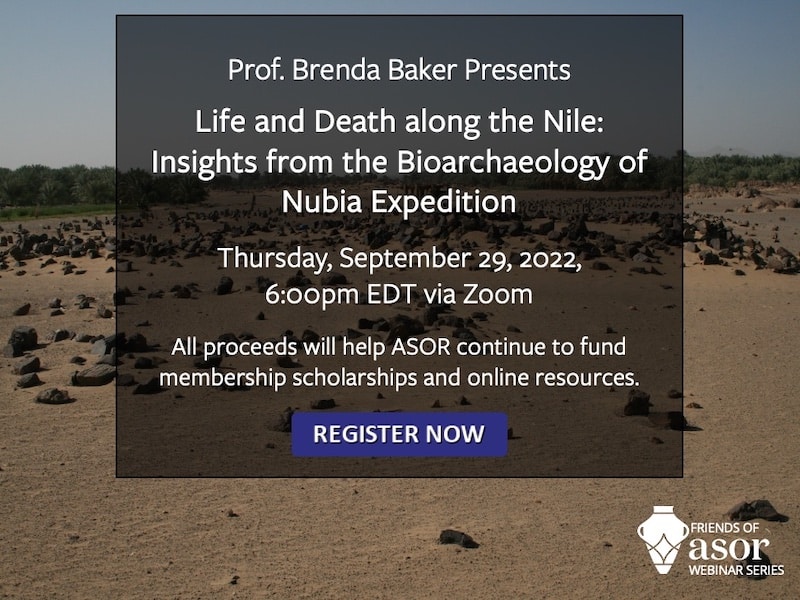
Life and Death along the Nile: Insights from the Bioarchaeology of Nubia Expedition

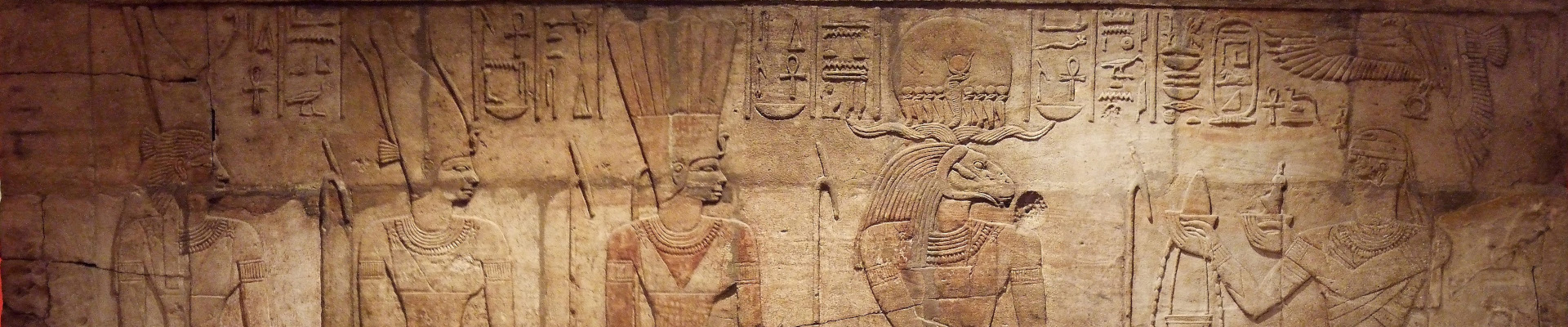
Friends of ASOR present the next webinar in our monthly series on September 29, 2022, at 6:00 pm EDT, featuring Prof. Brenda J. Baker and moderated by Prof. Geoff Emberling. The Bioarchaeology of Nubia Expedition (BONE) project area encompasses nearly 100 square meters on the north bank of the Nile River between the fourth and fifth cataracts in northern Sudan. More than 200 sites from the Earlier (more than 250,000 years ago) Stone Age through the Christian period (c. 550-1400 CE) have been documented. Sites include areas of habitation, rock art and gongs, a fort, and cemeteries. Excavated cemeteries consist of clusters of Kerma period graves (c. 2500-1500 BCE) and a large late Meroitic to Christian period cemetery (used c. 200-1400 CE) with burials of more than 100 individuals.

Recent research includes evaluation of evidence that graves were often re-entered within memory of a person’s death to retrieve heirlooms rather than looted without regard for the deceased. Inclusion of imported grave goods reveals integration into far-flung trade networks through time and biogeochemical analyses of tooth enamel show that people during the Kerma period were highly mobile. Spatial and social organization of cemeteries, and distinct characteristics marked during life (e.g., purposeful removal of teeth) or death (e.g., burial with particular items) illuminate aspects of ancient Nubian identity and mortuary behavior.

Join Dr. Baker as she examines the individuals buried in these cemeteries to reveal little known aspects of the lived experiences of the past people who inhabited this area of ancient Sudan. Please be aware that images of human remains will be shown during this lecture. The webinar will conclude with a live Q&A session moderated by Prof. Geoff Emberling (University of Michigan).

Brenda J. Baker is Associate Professor of Anthropology and Curator of Nubian Collections in the Center for Bioarchaeological Research, School of Human Evolution and Social Change, at Arizona State University. She is Director of the ASU Bioarchaeology of Nubia Expedition (BONE), conducting fieldwork in a project area west of Abu Hamed, Sudan. As a bioarchaeologist, her research integrates archaeology and biological anthropology to investigate the lifeways of past people, their funerary practices, and evidence of disease they experienced. She has worked extensively in the U.S. and at Abydos, Egypt. She is also the bioarchaeologist for Princeton University’s project in Polis, Cyprus, where she is analyzing remains of people who were interred in and around two Late Antique to medieval basilicas. Dr. Baker is a founding co-editor of Bioarchaeology International and serves on the advisory board of the American-Sudanese Archaeological Research Center (AmSARC). She is a co-organizer (with Geoff Emberling) of the ASOR/AmSARC workshop, “Reintegrating Africa in the Ancient World.”

This webinar will be recorded and all paid registrants will be sent a link to view the recording.

ASOR Sustaining Members: $0 | ASOR Members: $6 | Public: $12
Season Pass: ASOR Sustaining Members: $0 | ASOR Members: $75 | Public: $150
Buy one here!

To receive your ASOR member discount, log into the online store. If you are new to ASOR, please click on the “New Visitor Registration” link to register your e-mail address and choose a password for our online store. Once logged in, navigate to “Meeting and Event Registration” to register for the webinar and pay the fee. Each paid registrant will receive a confirmation e-mail when you pay for the webinar. If you do not receive this e-mail, then you are not registered. Please e-mail membership@asor.org with any questions or issues with registering.

You will be e-mailed the Zoom Webinar link in the week prior to the lecture on September 29, 2022. If you do not receive the link by the close of business on the Tuesday before the webinar, please e-mail membership@asor.org immediately. This webinar will be recorded and all paid registrants will be sent a link to view the recording.

All proceeds from this webinar are used to fund scholarships for members as well as increasing ASOR’s online resources, which are free to the public.

Lorem ipsum dolor sit amet, consectetur adipiscing elit. Ut elit tellus, luctus nec ullamcorper mattis, pulvinar dapibus leo.

READY FOR A WEBINAR SEASON PASS?

Buy a season pass for all the webinars* of the 2022-2023 FOA Webinar Season! 1) You will automatically receive the Zoom link for each webinar so no need to register each time. 2) You will also receive the recording of each webinar automatically after the event.

If you have missed webinars earlier in the season and still want to buy the pass, you will receive the links to the recordings of the webinars you missed in your automatic confirmation email after you buy the pass.

*Special symposiums may be excluded from the season pass price.

No more registering for a year if you buy your pass today!

Pricing:

Members: $75.00
Non-Members: $150.00
ASOR Sustaining Members: $0 (automatic registration for each webinar)
Not a member yet? Click here to join as a member and receive the 50% off a season pass!


Log into our online store to purchase the season pass for 2022-2023. If you are new to ASOR and do not have a record in our store yet, click here to register. After you login, navigate to the left to “Meeting and Event Registration.” Please e-mail membership@asor.org if you have any questions or issues.

WHY SPONSOR A WEBINAR?

Several levels of support from $50-$1,000 are available. Proceeds go towards membership scholarships and towards increasing ASOR’s virtual resources. Each sponsorship is tax-deductible and you can give your friends free registrations to a webinar!

Bronze Level ($50): up to 2 guest registrations
Silver Level ($100): up to 5 guest registrations
Gold Level ($500): up to 20 guest registrations
Platinum Level ($1,000): up to 50 guest registrations

After you sign up for a sponsorship online or over the phone, email the names and email addresses of your guests to Felice Herman at membership@asor.org, who will send your guests a confirmation and the Zoom link before the webinar.

WANT TO SAVE $6.00 ON THE NEXT WEBINAR?

Join ASOR as a member! Click here for more details about discounts for events and other benefits of membership. Memberships start at $40 for the year as an Associate Member.

Not ready to join yet? Become a Friend of ASOR for FREE!

Click here for more details about our online resources.

PAST WEBINARS

You can now purchase the link to the recording of any webinar. You can also purchase the bundle packages of all webinars from the 2020-2022 seasons. Please e-mail membership@asor.org for purchase details.

To see a printable pdf of the webinar titles from the 2020-2021 season, please click here. To see a printable pdf of the webinar titles from the 2021-2022 season, please click here.

Pricing:

Members: $6.00 per recording
Non-Members: $12.00 per recording
Bundle of 2020-2021 Webinars: $75.00
Bundle of 2021-2022 Webinars: $75.00
Bundle of 2020-2022 Webinars: $125.00

2021-2022 Season

A World at War: Protecting Cultural Heritage in Times of Conflict
Patty Gerstenblith (DePaul University), Lisa Ackerman (Columbus Citizens Foundation), Andrew Cohen (Government Professional and Cultural Heritage Expert) | May 12, 2022

Preserving Cultural Heritage in Hisban and Umm al-Jimal, Jordan
Øystein LaBianca (Andrews University), Elizabeth Osinga (Umm al-Jimal Archaeological Project), Darrell Rohl (Calvin University) | April 24, 2022

Back to the Field: Recent Discoveries & Summer Plans 2022
Lorenzo d’Alfonso (ISAW), Kathryn Grossman (NC State University), James R. Strange (Samford University) | April 3, 2022

Uncovering What is Nubian Beneath the Veneer of Egyptianness: Excavating the Archives
Debora Heard (University of Chicago) | March 20, 2022

Where Are They Now?: A Preview of 2022 ASOR-Affiliated Fieldwork Projects
Michael Given (University of Glasgow), Xenia-Paula Kyriakou (Florida Gulf Coast University), Stephen Batiuk (University of Toronto), Monique Roddy (Walla Walla University), Kent Bramlett (La Sierra University), Friedbert Ninow (La Sierra University), and Michael Hoff (University of Nebraska-Lincoln) | March 8, 2022

Excavations at Tel Gezer: A Personal Story
Sam Wolff (Tel Gezer Laboratory) | February 20, 2022

Tel Rehov: A Major Bronze and Iron Age City in the Jordan Valley
Amihai Mazar (Hebrew University of Jerusalem), Nava Panitz-Cohen ( Hebrew University of Jerusalem), Nota Kourou (Athens University), Naama Yahalom-Mack (Hebrew University of Jerusalem), Robert Mullins (Azusa Pacific University) | February 10, 2022

The Not-So-Innocents Abroad: The Beginnings of American Biblical Archaeology
Rachel Hallote (Samford University) | January 20, 2022

Synagogues as Jesus Knew Them
James R. Strange (Samford University) | December 2, 2021

Under Jerusalem: The Buried History of the World’s Most Contested City
Andrew Lawler | November 4, 2021

Jesus and Jerusalem on TV: How Do Bible Documentaries Get Made?
Robert Cargill (University of Iowa) | October 17, 2021

Digging the Divine?: Judahite Pillar Figurines and the Archaeology of Israelite Religion
Erin Darby (University of Tennessee) | October 7, 2021

David, Solomon, and Rehoboam’s Kingdom—The Archaeological Evidence
Yosef Garfinkel (Hebrew University of Jerusalem) | September 19, 2021

From Standing Stones to Sacred Emptiness: Textual and Visual Portrayals of Israel’s God
Theodore Lewis (Johns Hopkins University) | August 29, 2021

2020-2021 Season

Making May Matter: Webinarathon to Endow Diversity
Multiple Speakers | May 21-23, 2021

Archaeogaming: Why Video Games Deserve Their Own Archaeology
Tine Rassalle (University of North Carolina at Chapel Hill), Shannon Martino (Morton College), Matthew Winter (University of Arizona), Michael Zimmerman (Rhode Island) | April 18, 2021

How the Bible Became a Book
William Schniedewind (UCLA) | March 21, 2021

The Mysteries of Mithras in Caesarea: Exploring the Cult’s Rites and Remains
Jane DeRose Evans (Temple University), Alexandra Ratzlaff (Brandeis University) | March 11, 2021

Archaeology and the Hidden Religious Culture of Israelite Women
Carol Meyers (Duke University) | February 21, 2021

Meet the Directors—Fundraiser to Support ASOR’s Affiliated Overseas Research Centers
Matthew J. Adams (AIAR), Pearce Paul Creasman (ACOR), Lindy Crewe (CAARI) | February 11, 2021

Early Synagogues, Jesus, and Galilee—A Jewish Perspective
Eric Meyers (Duke University) | December 13, 2020

Home Sweet Home: Ancient Israelite Households in Context
Cynthia Shafer-Elliott (William Jessup University) | October 18, 2020

Priestesses in the Days of Solomon and Ahab
Susan Ackerman (Dartmouth College) | September 13, 2020

Digging Deeper: How Archaeology Works
Eric H. Cline (The George Washington University) | August 9, 2020

FOA Webinar: Kara Cooney on September 15

FRIENDS OF ASOR WEBINARS

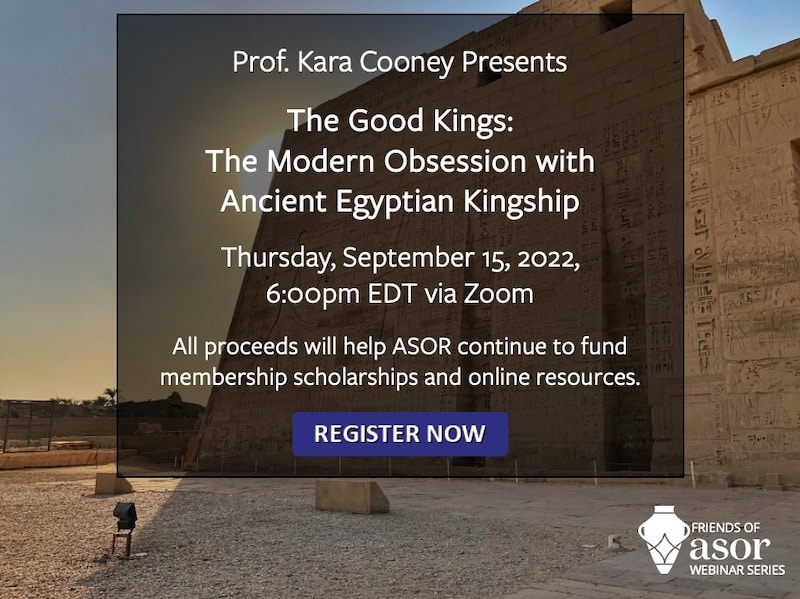
The Good Kings: The Modern Obsession with Ancient Egyptian Kingship


2 signed copies of this book and Sarah Parcak’s book, The Archaeology from Space, will be given away during the webinar!

Friends of ASOR present the next webinar in our monthly series on September 15, 2022, at 6:00 pm EDT, featuring Prof. Kara Cooney and moderated by Prof. Sarah Parcak. In an era when democracies around the world are threatened or crumbling, Egyptologist and best-selling author Kara Cooney examines our modern obsession with ancient Egyptian kingship and especially figures like Tutankhamun, the perennial star of international blockbuster exhibitions. She seeks to understand why the many so often give up power to the few, and what this can mean for our future. This lecture will reveal how the pharaohs and their process of divine kingship can tell us much about the world’s politics, past and present. Every animal-headed god, every monumental temple, every pyramid, every tomb, offers extraordinary insight into a culture that combined deeply held religious beliefs with uniquely human schemes to justify a system in which one ruled over many.

Join Dr. Cooney as she delves into the stories behind some of the most powerful men in all of ancient history, including Tutankhamun, Khufu, Senwosret III, Akenhaten, Ramses II, and Taharqa, to uncover the lessons their kingships can teach us today. The webinar will conclude with a live Q&A session moderated by Prof. Sarah Parcak (University of Alabama at Birmingham).

Dr. Kathlyn (Kara) Cooney is a professor of Egyptology at UCLA and Chair of the Department of Near Eastern Languages and Cultures. Specializing in social history, gender studies, and economies in the ancient world, she received her Ph.D. in Egyptology from Johns Hopkins University. In 2005, she was co-curator of Tutankhamun and the Golden Age of the Pharaohs at the Los Angeles County Museum of Art. Cooney produced a com­parative archaeology television series, entitled Out of Egypt, which aired in 2009 on the Discovery Channel and is available online.

Her popular books include The Woman Who Would Be King: Hatshepsut’s Rise to Power in Ancient Egypt (2014), When Women Ruled the World: Six Queens of Egypt (2018; winner of ASOR’s Nancy Lapp Popular Book award in 2019), and The Good Kings: Absolute Power in Ancient Egypt and the Modern World (2021). Her books, Recycling for Death: Coffin Reuse in Ancient Egypt and the Royal Caches from American University in Cairo Press, and Ancient Egyptian Society: Challenging Assumptions, Exploring Approaches from Routledge are forthcoming.

This webinar will be recorded and all paid registrants will be sent a link to view the recording.

ASOR Sustaining Members: $0 | ASOR Members: $6 | Public: $12
Season Pass: ASOR Sustaining Members: $0 | ASOR Members: $75 | Public: $150
Buy one here!

To receive your ASOR member discount, log into the online store. If you are new to ASOR, please click on the “New Visitor Registration” link to register your e-mail address and choose a password for our online store. Once logged in, navigate to “Meeting and Event Registration” to register for the webinar and pay the fee. Each paid registrant will receive a confirmation e-mail when you pay for the webinar. If you do not receive this e-mail, then you are not registered. Please e-mail membership@asor.org with any questions or issues with registering.

You will be e-mailed the Zoom Webinar link in the week prior to the lecture on September 15, 2022. If you do not receive the link by the close of business on the Tuesday before the webinar, please e-mail membership@asor.org immediately. This webinar will be recorded and all paid registrants will be sent a link to view the recording.

All proceeds from this webinar are used to fund scholarships for members as well as increasing ASOR’s online resources, which are free to the public.

READY FOR A WEBINAR SEASON PASS?

Buy a season pass for all the webinars* of the 2022-2023 FOA Webinar Season! 1) You will automatically receive the Zoom link for each webinar so no need to register each time. 2) You will also receive the recording of each webinar automatically after the event.

If you have missed webinars earlier in the season and still want to buy the pass, you will receive the links to the recordings of the webinars you missed in your automatic confirmation email after you buy the pass.

*Special symposiums may be excluded from the season pass price.

No more registering for a year if you buy your pass today!

Pricing:

Members: $75.00
Non-Members: $150.00
ASOR Sustaining Members: $0 (automatic registration for each webinar)
Not a member yet? Click here to join as a member and receive the 50% off a season pass!


Log into our online store to purchase the season pass for 2022-2023. If you are new to ASOR and do not have a record in our store yet, click here to register. After you login, navigate to the left to “Meeting and Event Registration.” Please e-mail membership@asor.org if you have any questions or issues.

WHY SPONSOR A WEBINAR?

Several levels of support from $50-$1,000 are available. Proceeds go towards membership scholarships and towards increasing ASOR’s virtual resources. Each sponsorship is tax-deductible and you can give your friends free registrations to a webinar!

Bronze Level ($50): up to 2 guest registrations
Silver Level ($100): up to 5 guest registrations
Gold Level ($500): up to 20 guest registrations
Platinum Level ($1,000): up to 50 guest registrations

After you sign up for a sponsorship online or over the phone, email the names and email addresses of your guests to Felice Herman at membership@asor.org, who will send your guests a confirmation and the Zoom link before the webinar.

WANT TO SAVE $6.00 ON THE NEXT WEBINAR?

Join ASOR as a member! Click here for more details about discounts for events and other benefits of membership. Memberships start at $40 for the year as an Associate Member.

Not ready to join yet? Become a Friend of ASOR for FREE!

Click here for more details about our online resources.

PAST WEBINARS

You can now purchase the link to the recording of any webinar. You can also purchase the bundle packages of all webinars from the 2020-2022 seasons. Please e-mail membership@asor.org for purchase details.

To see a printable pdf of the webinar titles from the 2020-2021 season, please click here. To see a printable pdf of the webinar titles from the 2021-2022 season, please click here.

Pricing:

Members: $6.00 per recording
Non-Members: $12.00 per recording
Bundle of 2020-2021 Webinars: $75.00
Bundle of 2021-2022 Webinars: $75.00
Bundle of 2020-2022 Webinars: $125.00

2021-2022 Season

A World at War: Protecting Cultural Heritage in Times of Conflict
Patty Gerstenblith (DePaul University), Lisa Ackerman (Columbus Citizens Foundation), Andrew Cohen (Government Professional and Cultural Heritage Expert) | May 12, 2022

Preserving Cultural Heritage in Hisban and Umm al-Jimal, Jordan
Øystein LaBianca (Andrews University), Elizabeth Osinga (Umm al-Jimal Archaeological Project), Darrell Rohl (Calvin University) | April 24, 2022

Back to the Field: Recent Discoveries & Summer Plans 2022
Lorenzo d’Alfonso (ISAW), Kathryn Grossman (NC State University), James R. Strange (Samford University) | April 3, 2022

Uncovering What is Nubian Beneath the Veneer of Egyptianness: Excavating the Archives
Debora Heard (University of Chicago) | March 20, 2022

Where Are They Now?: A Preview of 2022 ASOR-Affiliated Fieldwork Projects
Michael Given (University of Glasgow), Xenia-Paula Kyriakou (Florida Gulf Coast University), Stephen Batiuk (University of Toronto), Monique Roddy (Walla Walla University), Kent Bramlett (La Sierra University), Friedbert Ninow (La Sierra University), and Michael Hoff (University of Nebraska-Lincoln) | March 8, 2022

Excavations at Tel Gezer: A Personal Story
Sam Wolff (Tel Gezer Laboratory) | February 20, 2022

Tel Rehov: A Major Bronze and Iron Age City in the Jordan Valley
Amihai Mazar (Hebrew University of Jerusalem), Nava Panitz-Cohen ( Hebrew University of Jerusalem), Nota Kourou (Athens University), Naama Yahalom-Mack (Hebrew University of Jerusalem), Robert Mullins (Azusa Pacific University) | February 10, 2022

The Not-So-Innocents Abroad: The Beginnings of American Biblical Archaeology
Rachel Hallote (Samford University) | January 20, 2022

Synagogues as Jesus Knew Them
James R. Strange (Samford University) | December 2, 2021

Under Jerusalem: The Buried History of the World’s Most Contested City
Andrew Lawler | November 4, 2021

Jesus and Jerusalem on TV: How Do Bible Documentaries Get Made?
Robert Cargill (University of Iowa) | October 17, 2021

Digging the Divine?: Judahite Pillar Figurines and the Archaeology of Israelite Religion
Erin Darby (University of Tennessee) | October 7, 2021

David, Solomon, and Rehoboam’s Kingdom—The Archaeological Evidence
Yosef Garfinkel (Hebrew University of Jerusalem) | September 19, 2021

From Standing Stones to Sacred Emptiness: Textual and Visual Portrayals of Israel’s God
Theodore Lewis (Johns Hopkins University) | August 29, 2021

2020-2021 Season

Making May Matter: Webinarathon to Endow Diversity
Multiple Speakers | May 21-23, 2021

Archaeogaming: Why Video Games Deserve Their Own Archaeology
Tine Rassalle (University of North Carolina at Chapel Hill), Shannon Martino (Morton College), Matthew Winter (University of Arizona), Michael Zimmerman (Rhode Island) | April 18, 2021

How the Bible Became a Book
William Schniedewind (UCLA) | March 21, 2021

The Mysteries of Mithras in Caesarea: Exploring the Cult’s Rites and Remains
Jane DeRose Evans (Temple University), Alexandra Ratzlaff (Brandeis University) | March 11, 2021

Archaeology and the Hidden Religious Culture of Israelite Women
Carol Meyers (Duke University) | February 21, 2021

Meet the Directors—Fundraiser to Support ASOR’s Affiliated Overseas Research Centers
Matthew J. Adams (AIAR), Pearce Paul Creasman (ACOR), Lindy Crewe (CAARI) | February 11, 2021

Early Synagogues, Jesus, and Galilee—A Jewish Perspective
Eric Meyers (Duke University) | December 13, 2020

Home Sweet Home: Ancient Israelite Households in Context
Cynthia Shafer-Elliott (William Jessup University) | October 18, 2020

Priestesses in the Days of Solomon and Ahab
Susan Ackerman (Dartmouth College) | September 13, 2020

Digging Deeper: How Archaeology Works
Eric H. Cline (The George Washington University) | August 9, 2020

FOA Webinar: Elizabeth Macaulay on August 28

FRIENDS OF ASOR WEBINARS

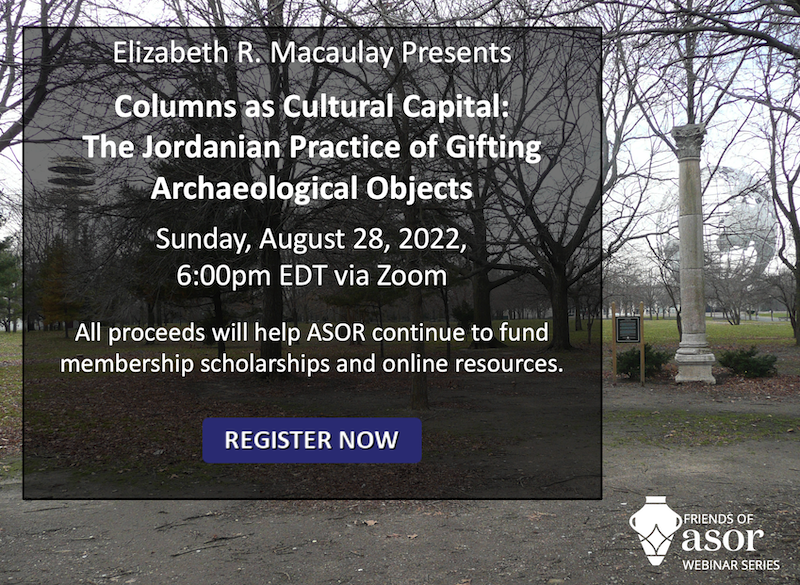
Columns as Cultural Capital: The Jordanian Practice of Gifting Archaeological Objects


Jerash – Temple of Artemis ۏ۱ێ – مŰčۚۯ ۧ۱ŰȘÙ…ÙŠŰł

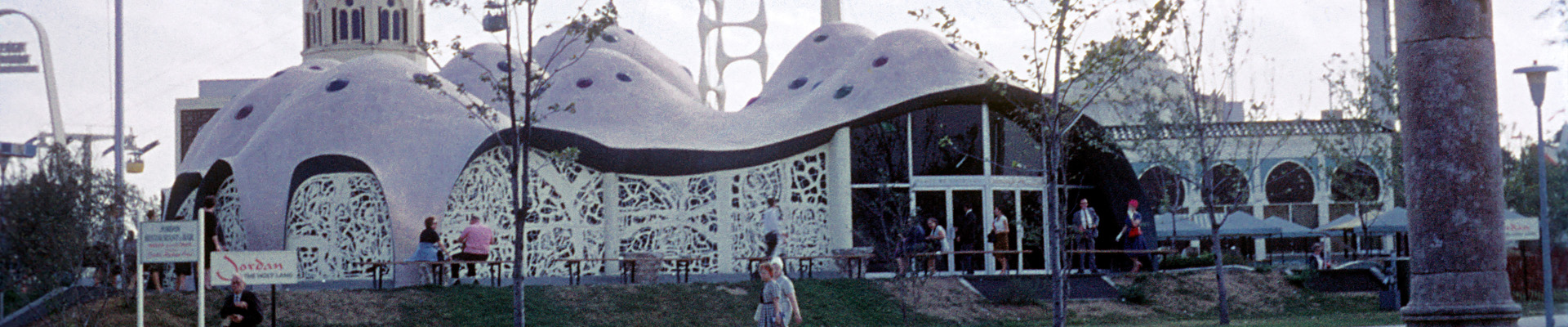
Friends of ASOR present the next webinar in our monthly series on , August 28, 2022, at 6:00 pm EDT, featuring Prof. Elizabeth R. Macaulay and moderated by Prof. Morag Kersel. At the New York 1964/65 World’s Fair, the Hashemite Kingdom of Jordan sponsored a pavilion. Archaeology and the nation’s cultural patrimony were central to several of the displays in the pavilion and were essential to one of the key aims of the pavilion: promoting American tourism to Jordan. A particular vision of archaeology and antiquity, which connected Jordan to the Greco-Roman and Christian pasts was emphasized. The pavilion also aimed to shape American public opinion about the larger geopolitics of the region through a politicized mural about refugees and water rights in the region. As part of the pavilion, a column from Jerash was presented to the city of New York as a lasting token of friendship between Jordan and the United States. In this lecture, the gift of the column will be contextualized in the larger Jordanian practice of gifting columns and capitals to major American cities or various universities with a history of excavations in Jordan. Gifting of columns and capitals is also compared to the Jordanian gifting of a Dead Sea Scroll jar to the Metropolitan Museum of Art (also connected to the World’s Fair) and the Jordanian practice of selling duplicate “Dead Sea Scroll jars” in the 1950s and 1960s.

This talk will examine the public presentation of Jordan’s ancient cultural heritage at the fair and the effectiveness of columns and capitals as diplomatic gifts. The webinar will conclude with a live Q&A session moderated by Prof. Morag Kersel (DePaul University).

Dr. Elizabeth R. Macaulay is an Associate Professor in the Liberal Studies, Middle Eastern and Digital Humanities Programs at the Graduate Center, CUNY, where she also serves as the Executive Officer in M.A. in Liberal Studies. She is a past Trustee of ASOR and a current Trustee of the Archaeological Institute of America and is the Museum Reviews Editor at the American Journal of Archaeology. She is the author or editor of six books, including Bayt Farhi and the Sephardic Palaces of Ottoman Damascus in the Late 18th and 19th Centuries (AASOR/ Manar al-Athar, 2018) and Antiquity in Gotham: The Ancient Architecture of New York City (Fordham, 2021).

If you register, you can now get the link to purchase Dr. Macaulay’s book, Bayt Farhi and the Sephardic Palaces of Ottoman Damascus in the ASOR store. The volume is $25.00 for ASOR Members and $35.00 for the public for those with shipping addresses in the US. Unfortunately, this offer is not available for those outside of the US.

This webinar will be recorded and all paid registrants will be sent a link to view the recording.

ASOR Sustaining Members: $0 | ASOR Members: $6 | Public: $12
Season Pass: ASOR Sustaining Members: $0 | ASOR Members: $75 | Public: $150
Buy one here!

To receive your ASOR member discount, log into the online store. If you are new to ASOR, please click on the “New Visitor Registration” link to register your e-mail address and choose a password for our online store. Once logged in, navigate to “Meeting and Event Registration” to register for the webinar and pay the fee. Each paid registrant will receive a confirmation e-mail when you pay for the webinar. If you do not receive this e-mail, then you are not registered. Please e-mail membership@asor.org with any questions or issues with registering.

You will be e-mailed the Zoom Webinar link in the week prior to the lecture on August 28, 2022. If you do not receive the link by the close of business on the Thursday before the webinar, please e-mail membership@asor.org immediately. This webinar will be recorded and all paid registrants will be sent a link to view the recording.

All proceeds from this lecture are used to fund scholarships for members as well as increasing ASOR’s online resources, which are free to the public.


READY FOR A WEBINAR SEASON PASS?

Buy a season pass for all the webinars* of the 2022-2023 FOA Webinar Season! 1) You will automatically receive the Zoom link for each webinar so no need to register each time. 2) You will also receive the recording of each webinar automatically after the event.

If you have missed webinars earlier in the season and still want to buy the pass, you will receive the links to the recordings of the webinars you missed in your automatic confirmation email after you buy the pass.

*Special symposiums may be excluded from the season pass price.

No more registering for a year if you buy your pass today!

Pricing:

Members: $75.00
Non-Members: $150.00
ASOR Sustaining Members: $0 (automatic registration for each webinar)
Not a member yet? Click here to join as a member and receive the 50% off a season pass!


Log into our online store to purchase the season pass for 2022-2023. If you are new to ASOR and do not have a record in our store yet, click here to register. After you login, navigate to the left to “Meeting and Event Registration.” Please e-mail membership@asor.org if you have any questions or issues.


WHY SPONSOR A WEBINAR?

Several levels of support from $50-$1,000 are available. Proceeds go towards membership scholarships and towards increasing ASOR’s virtual resources. Each sponsorship is tax-deductible and you can give your friends free registrations to a webinar!

Bronze Level ($50): up to 2 guest registrations
Silver Level ($100): up to 5 guest registrations
Gold Level ($500): up to 20 guest registrations
Platinum Level ($1,000): up to 50 guest registrations

After you sign up for a sponsorship online or over the phone, email the names and email addresses of your guests to Felice Herman at membership@asor.org, who will send your guests a confirmation and the Zoom link before the webinar.

WANT TO SAVE $6.00 ON THE NEXT WEBINAR?

Join ASOR as a member! Click here for more details about discounts for events and other benefits of membership. Memberships start at $40 for the year as an Associate Member.

Not ready to join yet? Become a Friend of ASOR for FREE!

Click here for more details about our online resources.

PAST WEBINARS

You can now purchase the link to the recording of any webinar. You can also purchase the bundle packages of all webinars from the 2020-2022 seasons. Please e-mail membership@asor.org for purchase details.

To see a printable pdf of the webinar titles from the 2020-2021 season, please click here. To see a printable pdf of the webinar titles from the 2021-2022 season, please click here.

Pricing:

Members: $6.00 per recording
Non-Members: $12.00 per recording
Bundle of 2020-2021 Webinars: $75.00
Bundle of 2021-2022 Webinars: $75.00
Bundle of 2020-2022 Webinars: $125.00

2021-2022 Season

A World at War: Protecting Cultural Heritage in Times of Conflict
Patty Gerstenblith (DePaul University), Lisa Ackerman (Columbus Citizens Foundation), Andrew Cohen (Government Professional and Cultural Heritage Expert) | May 12, 2022

Preserving Cultural Heritage in Hisban and Umm al-Jimal, Jordan
Øystein LaBianca (Andrews University), Elizabeth Osinga (Umm al-Jimal Archaeological Project), Darrell Rohl (Calvin University) | April 24, 2022

Back to the Field: Recent Discoveries & Summer Plans 2022
Lorenzo d’Alfonso (ISAW), Kathryn Grossman (NC State University), James R. Strange (Samford University) | April 3, 2022

Uncovering What is Nubian Beneath the Veneer of Egyptianness: Excavating the Archives
Debora Heard (University of Chicago) | March 20, 2022

Where Are They Now?: A Preview of 2022 ASOR-Affiliated Fieldwork Projects
Michael Given (University of Glasgow), Xenia-Paula Kyriakou (Florida Gulf Coast University), Stephen Batiuk (University of Toronto), Monique Roddy (Walla Walla University), Kent Bramlett (La Sierra University), Friedbert Ninow (La Sierra University), and Michael Hoff (University of Nebraska-Lincoln) | March 8, 2022

Excavations at Tel Gezer: A Personal Story
Sam Wolff (Tel Gezer Laboratory) | February 20, 2022

Tel Rehov: A Major Bronze and Iron Age City in the Jordan Valley
Amihai Mazar (Hebrew University of Jerusalem), Nava Panitz-Cohen ( Hebrew University of Jerusalem), Nota Kourou (Athens University), Naama Yahalom-Mack (Hebrew University of Jerusalem), Robert Mullins (Azusa Pacific University) | February 10, 2022

The Not-So-Innocents Abroad: The Beginnings of American Biblical Archaeology
Rachel Hallote (Samford University) | January 20, 2022

Synagogues as Jesus Knew Them
James R. Strange (Samford University) | December 2, 2021

Under Jerusalem: The Buried History of the World’s Most Contested City
Andrew Lawler | November 4, 2021

Jesus and Jerusalem on TV: How Do Bible Documentaries Get Made?
Robert Cargill (University of Iowa) | October 17, 2021

Digging the Divine?: Judahite Pillar Figurines and the Archaeology of Israelite Religion
Erin Darby (University of Tennessee) | October 7, 2021

David, Solomon, and Rehoboam’s Kingdom—The Archaeological Evidence
Yosef Garfinkel (Hebrew University of Jerusalem) | September 19, 2021

From Standing Stones to Sacred Emptiness: Textual and Visual Portrayals of Israel’s God
Theodore Lewis (Johns Hopkins University) | August 29, 2021

2020-2021 Season

Making May Matter: Webinarathon to Endow Diversity
Multiple Speakers | May 21-23, 2021

Archaeogaming: Why Video Games Deserve Their Own Archaeology
Tine Rassalle (University of North Carolina at Chapel Hill), Shannon Martino (Morton College), Matthew Winter (University of Arizona), Michael Zimmerman (Rhode Island) | April 18, 2021

How the Bible Became a Book
William Schniedewind (UCLA) | March 21, 2021

The Mysteries of Mithras in Caesarea: Exploring the Cult’s Rites and Remains
Jane DeRose Evans (Temple University), Alexandra Ratzlaff (Brandeis University) | March 11, 2021

Archaeology and the Hidden Religious Culture of Israelite Women
Carol Meyers (Duke University) | February 21, 2021

Meet the Directors—Fundraiser to Support ASOR’s Affiliated Overseas Research Centers
Matthew J. Adams (AIAR), Pearce Paul Creasman (ACOR), Lindy Crewe (CAARI) | February 11, 2021

Early Synagogues, Jesus, and Galilee—A Jewish Perspective
Eric Meyers (Duke University) | December 13, 2020

Home Sweet Home: Ancient Israelite Households in Context
Cynthia Shafer-Elliott (William Jessup University) | October 18, 2020

Priestesses in the Days of Solomon and Ahab
Susan Ackerman (Dartmouth College) | September 13, 2020

Digging Deeper: How Archaeology Works
Eric H. Cline (The George Washington University) | August 9, 2020

Table of Contents for JCS 74 (2022)

[vc_row fullwidth=”true” attached=”true” css=”.vc_custom_1496247803139{padding-top: 0px !important;padding-right: 0px !important;padding-bottom: 0px !important;padding-left: 0px !important;}”][vc_column][mk_image src=”https://www.asor.org/wp-content/uploads/2022/10/JCS-74.2022-1920×400-1.png” image_width=”1920″ image_height=”400″ hover=”false” margin_bottom=”0″][/vc_column][/vc_row][vc_row fullwidth=”true” attached=”true” css=”.vc_custom_1651165194378{margin-top: 0px !important;padding-right: 0px !important;padding-bottom: 0px !important;padding-left: 0px !important;}”][vc_column width=”1/12″ css=”.vc_custom_1496683820796{margin-right: 10px !important;}” offset=”vc_hidden-md vc_hidden-sm vc_hidden-xs”][vc_column_text]

 SHARE

[/vc_column_text][mk_image src=”http://www.asortest.org/wp-content/uploads/2017/01/social-fb-icon4.jpg” image_width=”42″ image_height=”42″ hover=”false” custom_url=”https://www.facebook.com/ASOResearch/” margin_bottom=”0″][mk_image src=”http://www.asortest.org/wp-content/uploads/2017/01/social-tw-icon4.jpg” image_width=”42″ image_height=”42″ hover=”false” custom_url=”https://twitter.com/ASOResearch?ref_src=twsrc%5Egoogle%7Ctwcamp%5Eserp%7Ctwgr%5Eauthor” margin_bottom=”0″][mk_image src=”http://www.asortest.org/wp-content/uploads/2017/01/social-in-icon4.jpg” image_width=”42″ image_height=”42″ hover=”false” custom_url=”https://www.linkedin.com/company/american-schools-of-oriental-research” margin_bottom=”0″][mk_image src=”http://www.asortest.org/wp-content/uploads/2017/01/social-ml-icon_7.jpg” image_width=”42″ image_height=”42″ hover=”false” custom_url=”mailto:asor@bu.edu” margin_bottom=”0″][mk_image src=”http://www.asortest.org/wp-content/uploads/2017/01/blog-icon3.jpg” image_width=”42″ image_height=”42″ hover=”false” custom_url=”http://asorblog.org/” margin_bottom=”0″][/vc_column][vc_column border_color=”rgba(255,255,255,0.01)” width=”1/6″ css=”.vc_custom_1496683923840{margin-right: 20px !important;border-left-width: 2px !important;padding-right: 20px !important;padding-left: 20px !important;border-left-color: #99422f !important;}”][mk_divider divider_color=”rgba(255,255,255,0.01)” thickness=”1″ margin_top=”3″ margin_bottom=”3″][vc_column_text]

NEWS@ASOR

PAST ASOR NEWS, MONTH BY MONTH

WAYS TO DONATE TO ASOR

FY20 HONOR ROLL OF DONORS (DRAFT)

ASOR LEGACY CIRCLE MEMBERS

DONATE NOW

[/vc_column_text][/vc_column][vc_column border_color=”rgba(170,170,170,0.01)” width=”1/2″ css=”.vc_custom_1651165173114{margin-right: 10px !important;margin-bottom: 30px !important;border-right-width: 2px !important;border-bottom-width: 2px !important;padding-top: 30px !important;padding-right: 30px !important;padding-left: 20px !important;background-color: #ffffff !important;border-right-color: rgba(227,228,228,0.75) !important;border-bottom-color: rgba(227,228,228,0.75) !important;}”][vc_row_inner][vc_column_inner][vc_column_text]

Table of Contents for Journal of Cuneiform Studies 74 (2022)

[/vc_column_text][mk_divider thickness=”1″ margin_top=”10″ margin_bottom=”30″][/vc_column_inner][/vc_row_inner][vc_row_inner][vc_column_inner width=”1/2″ css=”.vc_custom_1651246586407{padding-right: 10px !important;padding-bottom: 15px !important;}”][vc_single_image image=”84250″ img_size=”medium” alignment=”center” onclick=”custom_link” img_link_target=”_blank” link=”https://www.journals.uchicago.edu/toc/jcs/2022/74/1″][/vc_column_inner][vc_column_inner width=”1/2″][vc_wp_text]

You can receive JCS (and other ASOR publications) through an ASOR Membership.
Please e-mail the Membership office if you have any questions.

[/vc_wp_text][/vc_column_inner][/vc_row_inner][mk_divider thickness=”1″ margin_top=”30″ margin_bottom=”30″][vc_row_inner][vc_column_inner css=”.vc_custom_1651156050549{padding-right: 10px !important;}”][vc_single_image image=”84240″ img_size=”full” alignment=”center” onclick=”custom_link” img_link_target=”_blank” link=”https://www.journals.uchicago.edu/doi/10.1086/719860″][mk_padding_divider size=”10″][vc_column_text]

Pp. 3–16: “Eduba R: The Customs of the Eduba,” by Niek Veldhuis

Building on the first edition by Alhena Gadotti and Alexandra Kleinerman (), this article provides a fresh look at the Old Babylonian Sumerian literary text commonly referred to as Eduba R, with translation and commentary. In this composition a pupil describes in some detail how a regular day at the scribal school evolves. The text employs many unusual words and phrases and quite a few passages still remain unclear. Some of the unplaced fragments, edited separately by Gadotti and Kleinerman in their edition, may now be placed securely in the reconstructed text.

ASOR Members with online access: log into ASOR’s Online Portal here. Once logged in, click the JOURNALS tab in the top navigation bar. From here you may select which journal you would like to read. If you have online access, you will see your selected journal’s current issue Table of Contents. Click on the “Current Issue” button and you will then be redirected to the University of Chicago Press’s (UCP) platform to immediately start reading any issue of your choice. Tutorials for how to log in to the Online Portal as well as how to navigate to the Portal Journals page can be found here. [/vc_column_text][/vc_column_inner][/vc_row_inner][mk_divider thickness=”1″ margin_top=”10″ margin_bottom=”30″][vc_row_inner][vc_column_inner css=”.vc_custom_1651156050549{padding-right: 10px !important;}”][vc_single_image image=”84241″ img_size=”full” alignment=”center” onclick=”custom_link” img_link_target=”_blank” link=”https://www.journals.uchicago.edu/doi/10.1086/719861″][mk_padding_divider size=”10″][vc_column_text]

Pp. 17-33: “Les MĂ©tiers FĂ©minins Dans Les Palais et Grands Domaines De Syrie et Haute-MĂ©sopotamie au DĂ©but Du IIE MillĂ©naire av. J.-C.,” by Brigitte Lion

The archives discovered in the palaces of Syria and upper Mesopotamia, dating to the Middle Bronze Age, show that many women worked in these buildings. This article brings together data from the sites of Mari (Tell Hariri), Qaáč­áč­arā (Tell Rimah), AĆĄnakkum (Chagar Bazar), Tuttul (Tell Bi’a), and Alalah (Tell Açana) to compile an inventory of the female occupations that were carried out there. The fields represented are housekeeping, kitchen work (including food accounting), gatekeeping, and childcare. Except for nannies, most of these occupations have a male counterpart. Among the different types of sources, the ration lists provide a hierarchy of occupations and within occupations.

ASOR Members with online access: log into ASOR’s Online Portal here. Once logged in, click the JOURNALS tab in the top navigation bar. From here you may select which journal you would like to read. If you have online access, you will see your selected journal’s current issue Table of Contents. Click on the “Current Issue” button and you will then be redirected to the University of Chicago Press’s (UCP) platform to immediately start reading any issue of your choice. Tutorials for how to log in to the Online Portal as well as how to navigate to the Portal Journals page can be found here. [/vc_column_text][/vc_column_inner][/vc_row_inner][mk_divider thickness=”1″ margin_top=”10″ margin_bottom=”30″][vc_row_inner][vc_column_inner css=”.vc_custom_1651156050549{padding-right: 10px !important;}”][vc_single_image image=”84227″ img_size=”full” alignment=”center” onclick=”custom_link” img_link_target=”_blank” link=”https://www.journals.uchicago.edu/doi/10.1086/719862″][mk_padding_divider size=”10″][vc_column_text]

Pp. 35-61: “Un Balag Du Dieu Soleil Utu (MAH 16066),” by Antoine Cavigneaux

This article consists of an edition of the unique, hitherto unpublished balag MAH 16066. Three “narrative” kirugu sections originally totaling 70 lines are followed by an originally 110-line litany that, as shown in a synoptic table, is parallel at several points to at least nine other Old Babylonian second millennium BCE liturgical texts. The composition appears to be associated with a concrete ceremony. As interesting as the core text is the closing line, found also in other balags, with its benediction built on the construction ĆĄĂčd(u)-bi 
 gi4-gi4 to invoke the blessing deities named in the litany.

ASOR Members with online access: log into ASOR’s Online Portal here. Once logged in, click the JOURNALS tab in the top navigation bar. From here you may select which journal you would like to read. If you have online access, you will see your selected journal’s current issue Table of Contents. Click on the “Current Issue” button and you will then be redirected to the University of Chicago Press’s (UCP) platform to immediately start reading any issue of your choice. Tutorials for how to log in to the Online Portal as well as how to navigate to the Portal Journals page can be found here. [/vc_column_text][/vc_column_inner][/vc_row_inner][mk_divider thickness=”1″ margin_top=”10″ margin_bottom=”30″][vc_row_inner][vc_column_inner css=”.vc_custom_1651156050549{padding-right: 10px !important;}”][vc_single_image image=”84228″ img_size=”full” alignment=”center” onclick=”custom_link” img_link_target=”_blank” link=”https://www.journals.uchicago.edu/doi/10.1086/719864″][mk_padding_divider size=”10″][vc_column_text]

Pp. 63-74: “The Sages and the Sons of Nippur: An Edition of LKA 76 (VAT 13839) From Assur,” by Zachary Rubin

The Late Assyrian tablet LKA 76 (VAT 13839) from Assur is inscribed with two bilingual Sumerian-Akkadian texts, possibly incantations for rituals, that are concerned with prominent cities in southern Mesopotamia. The obverse is inscribed with a unique composition in which entities calling themselves the “Sons of Nippur” declare their affiliation with the city of Nippur and its deities. The composition inscribed on the reverse, known to have been incorporated into the apotropaic series bīt mēseri, consists of anecdotes in the lives of four apkallu-sages of human descent. The two compositions bridge the purported origins of Mesopotamian scholarly wisdom in the divine realm with its contemporary utilization among ritual experts.

ASOR Members with online access: log into ASOR’s Online Portal here. Once logged in, click the JOURNALS tab in the top navigation bar. From here you may select which journal you would like to read. If you have online access, you will see your selected journal’s current issue Table of Contents. Click on the “Current Issue” button and you will then be redirected to the University of Chicago Press’s (UCP) platform to immediately start reading any issue of your choice. Tutorials for how to log in to the Online Portal as well as how to navigate to the Portal Journals page can be found here. [/vc_column_text][/vc_column_inner][/vc_row_inner][mk_divider thickness=”1″ margin_top=”10″ margin_bottom=”30″][vc_row_inner][vc_column_inner css=”.vc_custom_1651156050549{padding-right: 10px !important;}”][vc_single_image image=”84229″ img_size=”full” alignment=”center” onclick=”custom_link” img_link_target=”_blank” link=”https://www.journals.uchicago.edu/doi/10.1086/719865″][mk_padding_divider size=”10″][vc_column_text]

Pp. 75-87: “Crime and Punishment in Hittite Anatolia: A New Interpretation of the Verb Ć aku(uÌŻa)-/Ć akuuÌŻai- (with an etymological contribution by Alwin Kloekhorst),” by Willemijn Waal

In Hittite, various verbs with a stem ĆĄaku(uÌŻa)-/ĆĄakuuÌŻai- have been identified. These include the verb ĆĄakuuÌŻai- “to see,” as well as three verbs of which the meaning is less evident: one (CHD ĆĄaku(uÌŻa)-/ĆĄakuuÌŻai- A) referring to a type of penalty, one (CHD ĆĄaku(uÌŻa)-/ĆĄakuuÌŻai- B) which is usually taken to mean “to moisten (?)” or “to soak(?),” and one (CHD ĆĄakuuÌŻai- D) of which the meaning is unknown. In this article, it will be argued that the verbs ĆĄaku(uÌŻa)-/ĆĄakuuÌŻai- A and B are actually one and the same verb with the meaning “to plant,” “to stab,” or “to impale.” This new interpretation not only elucidates some thus far opaque attestations of the verb ĆĄaku(uÌŻa)-/ĆĄakuuÌŻai-, but also improves our understanding of Hittite corporal punishments.

ASOR Members with online access: log into ASOR’s Online Portal here. Once logged in, click the JOURNALS tab in the top navigation bar. From here you may select which journal you would like to read. If you have online access, you will see your selected journal’s current issue Table of Contents. Click on the “Current Issue” button and you will then be redirected to the University of Chicago Press’s (UCP) platform to immediately start reading any issue of your choice. Tutorials for how to log in to the Online Portal as well as how to navigate to the Portal Journals page can be found here. [/vc_column_text][/vc_column_inner][/vc_row_inner][mk_divider thickness=”1″ margin_top=”10″ margin_bottom=”30″][vc_row_inner][vc_column_inner css=”.vc_custom_1651156050549{padding-right: 10px !important;}”][vc_single_image image=”84242″ img_size=”full” alignment=”center” onclick=”custom_link” img_link_target=”_blank” link=”https://www.journals.uchicago.edu/doi/10.1086/719863″][mk_padding_divider size=”10″][vc_column_text]

Pp. 89-108: “Women and the Interpretation of Dreams In Sumerian and Akkadian Literature,” by Gina Konstantopoulos

This article is a study of the place of dream interpretation in key Mesopotamian texts, principally in the Sumerian Cylinders of Gudea, Curse of Agade, Dumuzi’s Dream, and the Akkadian Standard Babylonian Epic of Gilgamesh. In these texts, when the protagonist receives prophetic dreams, he then seeks out a dream-interpreter, usually a woman related to or close to the dreamer. Within the Epic of Gilgamesh, this position is also filled by Enkidu, who interprets Gilgamesh’s dreams as well as his own. Enkidu’s interpretation of his own dream is unusual but not unique, as Narām-SĂźn showcases a similar ability in the Curse of Agade. This discussion is set alongside a consideration of the female dream interpreter (munusensi or ĆĄÄÊŸiltu) as attested outside of the literary sphere. Though attestations to the female dream interpreter are limited, they still far outnumber any references to the women within more technical divinatory contexts, such as the proposed female equivalent to the diviner (bārĂ»), the bārÄ«tu.

ASOR Members with online access: log into ASOR’s Online Portal here. Once logged in, click the JOURNALS tab in the top navigation bar. From here you may select which journal you would like to read. If you have online access, you will see your selected journal’s current issue Table of Contents. Click on the “Current Issue” button and you will then be redirected to the University of Chicago Press’s (UCP) platform to immediately start reading any issue of your choice. Tutorials for how to log in to the Online Portal as well as how to navigate to the Portal Journals page can be found here. [/vc_column_text][/vc_column_inner][/vc_row_inner][mk_divider thickness=”1″ margin_top=”10″ margin_bottom=”30″][vc_row_inner][vc_column_inner css=”.vc_custom_1651156050549{padding-right: 10px !important;}”][vc_single_image image=”84231″ img_size=”full” alignment=”center” onclick=”custom_link” img_link_target=”_blank” link=”https://www.journals.uchicago.edu/doi/10.1086/719866″][mk_padding_divider size=”10″][vc_column_text]

Pp. 109-129: “The Assyrian King of the Broken Obelisk, the Date of the Archive from Giricano, and the Timing of the Assyrian Calendar Reform,” by Daisuke Shibata

Following the recent debate on the dating of the Broken Obelisk, which is commonly believed to have been composed in the reign of Aơơur-bēl-kala, the present article provides a comprehensive review of the issues pertinent to the dating of this Assyrian inscription, as well as related topics such as the date of the Assyrian calendar reform and the Giricano archive. The results reveal that the Broken Obelisk should be attributed to Tiglath-pileser I rather than Aơơur-bēl-kala. The Assyrian calendar reform occurred probably sometime between the thirty-first year (possibly the thirty-third year) to the thirty-sixth year of the reign of Tiglath-pileser I. The Broken Obelisk was composed sometime in the fourth decade of Tiglath-pileser’s reign after this calendar reform, representing the latest version of his annals known to date. The Giricano archive also dates from late in his reign. Many of the events that have been dated to the early years of Aơơur-bēl-kala’s reign, such as the payment of tribute to Assyria by an Egyptian king, took place during the reign of Tiglath-pileser I.

ASOR Members with online access: log into ASOR’s Online Portal here. Once logged in, click the JOURNALS tab in the top navigation bar. From here you may select which journal you would like to read. If you have online access, you will see your selected journal’s current issue Table of Contents. Click on the “Current Issue” button and you will then be redirected to the University of Chicago Press’s (UCP) platform to immediately start reading any issue of your choice. Tutorials for how to log in to the Online Portal as well as how to navigate to the Portal Journals page can be found here. [/vc_column_text][/vc_column_inner][/vc_row_inner][mk_divider thickness=”1″ margin_top=”10″ margin_bottom=”30″][vc_row_inner][vc_column_inner css=”.vc_custom_1651156050549{padding-right: 10px !important;}”][vc_single_image image=”84243″ img_size=”full” alignment=”center” onclick=”custom_link” img_link_target=”_blank” link=”https://www.journals.uchicago.edu/doi/10.1086/719979″][mk_padding_divider size=”10″][vc_column_text]

Pp. 131-137: “The 1975 Kouyunjik Colophon Project and its Consequences for the Collection,” by Julian Edgeworth Reade

This paper relates how in 1975 the writer initiated a project to classify the scholarly tablets of the Kouyunjik Collection by their colophons, which led to the discovery and publication of additional fragments of the collection.

<ASOR Members with online access: log into ASOR’s Online Portal here. Once logged in, click the JOURNALS tab in the top navigation bar. From here you may select which journal you would like to read. If you have online access, you will see your selected journal’s current issue Table of Contents. Click on the “Current Issue” button and you will then be redirected to the University of Chicago Press’s (UCP) platform to immediately start reading any issue of your choice. Tutorials for how to log in to the Online Portal as well as how to navigate to the Portal Journals page can be found here. [/vc_column_text][/vc_column_inner][/vc_row_inner][mk_divider thickness=”1″ margin_top=”10″ margin_bottom=”30″][vc_row_inner][vc_column_inner css=”.vc_custom_1651156050549{padding-right: 10px !important;}”][vc_single_image image=”84244″ img_size=”full” alignment=”center” onclick=”custom_link” img_link_target=”_blank” link=”https://www.journals.uchicago.edu/doi/10.1086/719867″][mk_padding_divider size=”10″][vc_column_text]

Pp. 139-184: “Grain Deliveries to the Royal Palace in Babylon during the Reign of Nebuchadnezzar II,” by Greta Van Buylaere

The present contribution is the editio princeps of six large, single-column tablets, found in the N1 administrative archive of Babylon and presently located in the İstanbul Arkeoloji MĂŒzeleri. They document substantial barley and emmer wheat deliveries to the Babylonian capital in the tenth and twentieth years of Nebuchadnezzar II’s reign and reveal an efficient administrative apparatus with a multitude of palace officials, scribes, accountants, and measurers.

ASOR Members with online access: log into ASOR’s Online Portal here. Once logged in, click the JOURNALS tab in the top navigation bar. From here you may select which journal you would like to read. If you have online access, you will see your selected journal’s current issue Table of Contents. Click on the “Current Issue” button and you will then be redirected to the University of Chicago Press’s (UCP) platform to immediately start reading any issue of your choice. Tutorials for how to log in to the Online Portal as well as how to navigate to the Portal Journals page can be found here. [/vc_column_text][/vc_column_inner][/vc_row_inner][mk_divider thickness=”1″ margin_top=”10″][vc_row_inner][vc_column_inner css=”.vc_custom_1651156050549{padding-right: 10px !important;}”][vc_single_image image=”84234″ img_size=”full” alignment=”center” onclick=”custom_link” img_link_target=”_blank” link=”https://www.journals.uchicago.edu/doi/10.1086/719868″][mk_padding_divider size=”10″][vc_column_text]

Pp. 185-204: “Minor Archives from First-Millennium BCE Babylonia: The Rēˀi-sisĂȘ Archive from Sippar (The Archive of Ć amaĆĄ-Iddin Son of NiqĆ«du Descendant of Rēˀi-sisĂȘ),” by Yuval Levavi

This contribution provides editions of all known texts belonging to the archive of the Rēˀi-sisĂȘ family from Sippar. It further includes a discussion of the (relatively modest scale) business profile of its main protagonist, Ć amaĆĄ-iddin/NiqĆ«du//Rēˀi-sisĂȘ, who was active during the second half of the sixth century BCE (546/530–518 BCE). The present study is the third installation of a larger collaborative effort to make available the Minor Archives from First Millennium BCE Babylonia, the results of which are to be published in volumes of this journal. A companion volume containing copies of all tablets published in this series as well as a comprehensive prosopography is in preparation for the Journal of Cuneiform Studies Supplemental Series.

ASOR Members with online access: log into ASOR’s Online Portal here. Once logged in, click the JOURNALS tab in the top navigation bar. From here you may select which journal you would like to read. If you have online access, you will see your selected journal’s current issue Table of Contents. Click on the “Current Issue” button and you will then be redirected to the University of Chicago Press’s (UCP) platform to immediately start reading any issue of your choice. Tutorials for how to log in to the Online Portal as well as how to navigate to the Portal Journals page can be found here. [/vc_column_text][/vc_column_inner][/vc_row_inner][mk_divider thickness=”1″ margin_top=”10″][vc_row_inner][vc_column_inner css=”.vc_custom_1651156050549{padding-right: 10px !important;}”][vc_single_image image=”84238″ img_size=”full” alignment=”center” onclick=”custom_link” img_link_target=”_blank” link=”https://www.journals.uchicago.edu/doi/10.1086/719980″][mk_padding_divider size=”10″][vc_column_text]

Pp. 205-222: “Eine SpĂ€tbabylonische Synkretistische Hymne an NabĂ»,” by Hannelore Agnethler, Ekaterine Gogokhia, Enrique JimĂ©nez, Alessia Pilloni, and Albert SetĂ€lĂ€

The article contains the first edition of a hymn to NabĂ» probably from Neo-Babylonian or Achaemenid Borsippa. The text, written in a fixed ABAâ€ČB structure, extols NabĂ» by attributing to him some feats traditionally ascribed to other gods, such as killing AnzĂ» or defeating the Sea. NabĂ» is presented as the highest of all gods, which gives occasion to discuss the so-called “Exaltation of NabĂ»â€ in other first-millennium texts.

ASOR Members with online access: log into ASOR’s Online Portal here. Once logged in, click the JOURNALS tab in the top navigation bar. From here you may select which journal you would like to read. If you have online access, you will see your selected journal’s current issue Table of Contents. Click on the “Current Issue” button and you will then be redirected to the University of Chicago Press’s (UCP) platform to immediately start reading any issue of your choice. Tutorials for how to log in to the Online Portal as well as how to navigate to the Portal Journals page can be found here. [/vc_column_text][/vc_column_inner][/vc_row_inner][mk_divider thickness=”1″ margin_top=”10″][/vc_column][vc_column border_color=”rgba(170,170,170,0.01)” width=”1/6″ css=”.vc_custom_1567019974102{margin-right: 5px !important;margin-bottom: 20px !important;border-right-width: 2px !important;border-bottom-width: 2px !important;padding-top: 30px !important;padding-right: 10px !important;padding-left: 10px !important;background-color: #ffffff !important;border-right-color: rgba(227,228,228,0.75) !important;border-bottom-color: rgba(227,228,228,0.75) !important;}”][vc_wp_posts title=”BROWSE THE NEWS ARCHIVE” number=”4″][/vc_column][vc_column border_color=”rgba(170,170,170,0.01)” width=”1/6″ css=”.vc_custom_1496684008271{margin-right: 10px !important;margin-bottom: 30px !important;border-right-width: 2px !important;border-bottom-width: 2px !important;padding-top: 30px !important;padding-right: 20px !important;padding-left: 20px !important;background-color: #ffffff !important;border-right-color: rgba(227,228,228,0.75) !important;border-bottom-color: rgba(227,228,228,0.75) !important;}”][vc_column_text] [/vc_column_text][/vc_column][/vc_row]

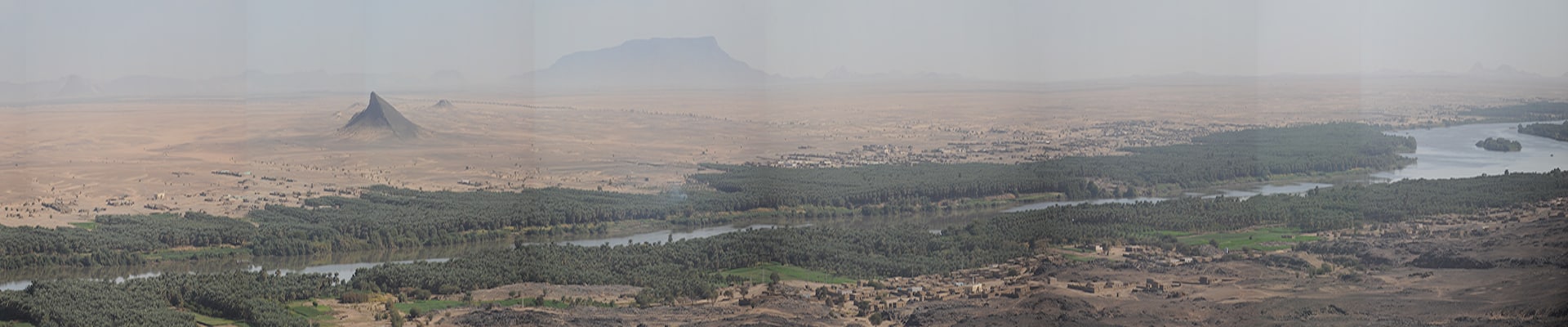
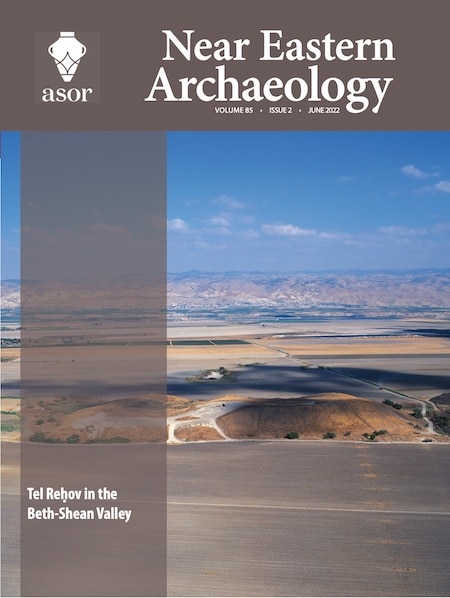
Table of Contents for NEA 85.2 (2022)

Table of Contents for Near Eastern Archaeology 85.2 (June 2022)

You can receive NEA (and other ASOR publications) through an ASOR Membership.
Please e-mail the Membership office if you have any questions.

Pp. 84–89: “Tel Reáž„ov: The Site and Its Excavation,” by Amihai Mazar

The author offers a brief introduction to the excavations at Tel Reងov, beginning with a description of the mound. This is followed by a summary of the appearance of the toponym Reងob in written sources; the identification of the site; and a brief survey of the excavation project, including its goals, the core staff, the excavation areas and the methods used. Finally, it presents the stratigraphic sequence and the structure of the final report that appeared in 2020, as well as reference to an exhibition held on the excavations.

ASOR Members with online access: navigate to the token link email sent to you (search for “token link” in inbox) before attempting to read this article. Once you have activated your member token, click here to access the above article on The University of Chicago Press Journals’ website.

Pp. 90–95: “Tectonic Activity and Site-Formation Processes at Tel Reáž„ov,” by Uri Davidovich and Ezra Zilberman

The site of Tel Reáž„ov is located on one of the most active tectonic fault zones in the Near East—the Western Marginal Fault of the Dead Sea Rift—and was prone to tectonic movements, which had a significant effect on site-formation processes. Geoseismic and geoarchaeological studies conducted as part of the Tel Reáž„ov excavation project suggest that the site was located on an uplifted tectonic block (horst) bounded by faults on the north, west, and south. Recurrent tectonic activity during the Late Holocene resulted in an eastward-tilting of layers and the entire mound, contributed to the shaping of mound boundaries, and constrained the extent of postdepositional erosion.

ASOR Members with online access: navigate to the token link email sent to you (search for “token link” in inbox) before attempting to read this article. Once you have activated your member token, click here to access the above article on The University of Chicago Press Journals’ website.

Pp. 96–109: “The Canaanite City at Tel Reáž„ov: From the Early Bronze Age to the End of the Iron Age I,” by Amihai Mazar, Uri Davidovich, Nava Panitz-Cohen, Yael Rotem, and Amir Sumaka’i Fink

The article describes the development of the city throughout the Late Bronze–Iron Age I sequence. A massive Early Bronze fortification system was revealed on the slope of the upper mound. Following the end of EB III, there was an occupation gap until LB I/IIA, when a ten hectare Canaanite city was founded and became one of the largest cities in the southern Levant, identified with Reáž„ob, mentioned in several Late Bronze Age sources. The unusual foundation of a city in the Late Bronze Age may have been related to the Egyptian garrison town at nearby Beth-Shean. Though exposure was limited in scope, the results indicate that unlike many other sites, Reáž„ov maintained its Canaanite urban character throughout this period with no occupation gap.

ASOR Members with online access: navigate to the token link email sent to you search for “token link” in inbox) before attempting to read this article. Once you have activated your member token, click here to access the above article on The University of Chicago Press Journals’ website.

Pp. 110–125: “Tel Reáž„ov in the Tenth and Ninth Centuries BCE,” by Amihai Mazar

Tel Reងov was the location of one of the largest Iron Age cities in northern Israel during the Iron Age IIA, the main period investigated at the site. This article summarizes the stratigraphy, main architectural features, aspects of daily life and material culture, industries, trade relations, writing, religion and iconography, as well as chronology and historical questions. The finds reflect cultural and economic processes that the city and its environs underwent during this momentous time. Canaanite traditions alongside innovations, economic prosperity, vibrant trade relations with the Phoenician coast and, indirectly, with Egypt, Cyprus, and Greece are evidenced. Notable is the exceptional and peaceful continuity between the Iron I and Iron II cities. The city may have been the hometown of the Nimshi clan, to which Jehu belonged. The city suffered a violent destruction, probably at the hands of Hazael, king of Aram-Damascus.

ASOR Members with online access: navigate to the token link email sent to you (search for “token link” in inbox) before attempting to read this article. Once you have activated your member token, click here to access the above article on The University of Chicago Press Journals’ website.

Pp. 126–131: “The Apiary at Tel Reáž„ov: An Update,” by Amihai Mazar, Nava Panitz-Cohen, and Guy Bloch

The apiary discovered in Stratum V at Tel Reáž„ov in 2005–2007 remains unique in the archaeology of the ancient Near East. Here the authors briefly summarize the data previously published in this journal and add results of new studies, mainly concerning the identification of ancient charred bees trapped in burnt honeycombs found in the hives. Measurements of two wings and one leg, and statistical work based on existing database of modern subspecies, are inconsistent with the Syrian subspecies local to Israel (Apis meliferra syriaca), but were found to be similar to the Anatolian bee (Apis meliferra anatoliaca). We discuss the implications of this result, suggesting trade relations with southern Anatolia. The authors suggest that the beeswax was perhaps related to the copper-based metallurgical industry that entailed casting in the lost wax method, at a time when the copper trade based on the Arabah mines was at its peak.

ASOR Members with online access: navigate to the token link email sent to you (search for “token link” in inbox) before attempting to read this article. Once you have activated your member token, click here to access the above article on The University of Chicago Press Journals’ website.

Pp. 132–145: “The Exceptional Ninth-Century BCE Northwestern Quarter at Tel Reáž„ov,” by Nava Panitz-Cohen and Amihai Mazar

An exceptional architectural complex at Tel Reងov dating to the last phase of the Iron IIA occupation in the ninth century BCE (Stratum IV) was uncovered in Area C, located on the northwestern and highest part of the lower mound. Each of the buildings belonging to this quarter, built exclusively of mud brick, had an exceptional architectural layout, while at the same time, they were interrelated and organized according to a preplanned agenda. All the buildings were completely destroyed by the severe fire that resulted in the abandonment of the lower city at the end of Stratum IV. The abundance of rich remains found in the destruction debris just below topsoil, many of them of a unique nature and reflecting quotidian, cultic, and industrial activities, as well as three inscriptions with personal names, indicate the special role played by this complex, particularly the largest and most exceptional: Building CP.

ASOR Members with online access: navigate to the token link email sent to you (search for “token link” in inbox) before attempting to read this article. Once you have activated your member token, click here to access the above article on The University of Chicago Press Journals’ website.

Pp. 146–151: “Facing Assyria: Tel Reáž„ov in the Late Ninth and the Eighth Centuries BCE,” by Amihai Mazar and Robert A. Mullins

Following the violent destruction of Stratum IV the city at Tel Reងov was rebuilt, yet limited to the upper mound, an area of about three hectares. Two main strata can be attributed to the Iron IIB. A fortification system found in Area B had an earlier phase consisting of a casemate wall with a tower and a later phase with a wide city wall. Dwellings and courtyards were excavated in Areas A, B, and J. The Assyrian destruction was severe, evidenced by the slaughter of people in their homes in Area A. Scanty squatter activity was discovered following the destruction, as were seven burials, some with Assyrian-type pottery bottles, perhaps evidence of Assyrian presence on the summit. One of the burials is especially rich in finds and perhaps belonged to a high-ranking person. (Please note: This article contains images of human skeletal remains.)

ASOR Members with online access: navigate to the token link email sent to you (search for “token link” in inbox) before attempting to read this article. Once you have activated your member token, click here to access the above article on The University of Chicago Press Journals’ website.

Pp. 152–158: “The Iron Age II Figurines and Zoomorphic Vessels of Tel Reáž„ov,” by Raz Kletter and Katri Saarelainen

Forty-nine Iron Age II anthropomorphic and zoomorphic clay figurines and vessels were found at Tel Reងov. Clay was an inexpensive material and small figurines were a common item; yet, this small assemblage still holds surprises. All the figurines were published in Saarelainen and Kletter. Here we present a selection of the figurines in order to illustrate their variety and aesthetic appeal, and also to demonstrate the difficulties in studying and interpreting them. What do we see in them? Images of powerful, but nearly forgotten deities? The faces of bygone generations (and of their animals too)? Or, perhaps, portrayals of important priestesses and warriors?

ASOR Members with online access: navigate to the token link email sent to you (search for “token link” in inbox) before attempting to read this article. Once you have activated your member token, click here to access the above article on The University of Chicago Press Journals’ website.

Pp. 159–163: “Metalworking at Tel Reáž„ov,” by Naama Yahalom-Mack

The excavations at Tel Reáž„ov yielded hundreds of metal objects and numerous metallurgical remains that attest to on-site metalworking. The study of such remains and their distribution sheds light on metalworking practices at the site, indicating a considerable change between the Late Bronze Age and the Iron Age, which comprised both the choice of raw materials (bronze vs. iron), their origin, and metalworking traditions. Particularly significant is the evidence for an Egyptian metalworking tradition during the Late Bronze Age, indicating that the metal industry at Reáž„ov may have been tightly controlled by the neighboring Egyptian stronghold at Beth-Shean. Iron Age I metallurgical remains suggest that the smiths reverted to Canaanite metalworking practices after the Egyptians’ departure. Iron was introduced into common use during the Iron Age IIA, the tenth and ninth centuries BCE.

ASOR Members with online access: navigate to the token link email sent to you (search for “token link” in inbox) before attempting to read this article. Once you have activated your member token, click here to access the above article on The University of Chicago Press Journals’ website.

Pp. 164–169: “Animal Remains from Tel Reáž„ov: Economy and Culture in the Iron Age Settlement,” by Nimrod Marom, Karin Tamar, and Sierra Harding

The Iron Age settlement at Tel Reងov has yielded a large and well-preserved faunal assemblage. Zooarchaeological analysis of these animal remains from the Iron Age is used to discuss aspects of settlement economy, examining both development through time and similarity with contemporaneous assemblages. The results show that the animal economy at the site was not very different from contemporary valley sites in the Southern Levant, but suggest a certain development of the pastoral economy between the Iron Age I and II. In addition, some insights pertaining to the symbolic use of animals can be gleaned from the faunal remains, specifically in respect to side preferences.

ASOR Members with online access: navigate to the token link email sent to you (search for “token link” in inbox) before attempting to read this article. Once you have activated your member token, click here to access the above article on The University of Chicago Press Journals’ website.

Pp. 170–171: “Fish Imported from a Distance and Consumed at Tel Reáž„ov,” by Omri Lernau

Excavations at Tel Reងov brought to light an assemblage of fish remains, dated to different periods covering almost the entire era of occupation of the site. Most kinds of fish were probably purchased in markets along the Mediterranean coast, including local marine and freshwater fish and also several kinds of fish imported from the Nile and from the hypersaline lagoon of Bardawil. Few fish were imported to Reងov from the Red Sea. The long-lasting supply of many kinds of fish to Reងov, together with similar findings in the adjacent Tel Beth-Shean, suggest an organized enterprise of commerce between the Mediterranean coast and the Jordan Valley.

ASOR Members with online access: navigate to the token link email sent to you (search for “token link” in inbox) before attempting to read this article. Once you have activated your member token, click here to access the above article on The University of Chicago Press Journals’ website.

FOA Webinar: A World at War—Protecting Cultural Heritage in Times of Conflict on May 12

FRIENDS OF ASOR WEBINAR

A World at War: Protecting Cultural Heritage in Times of Conflict

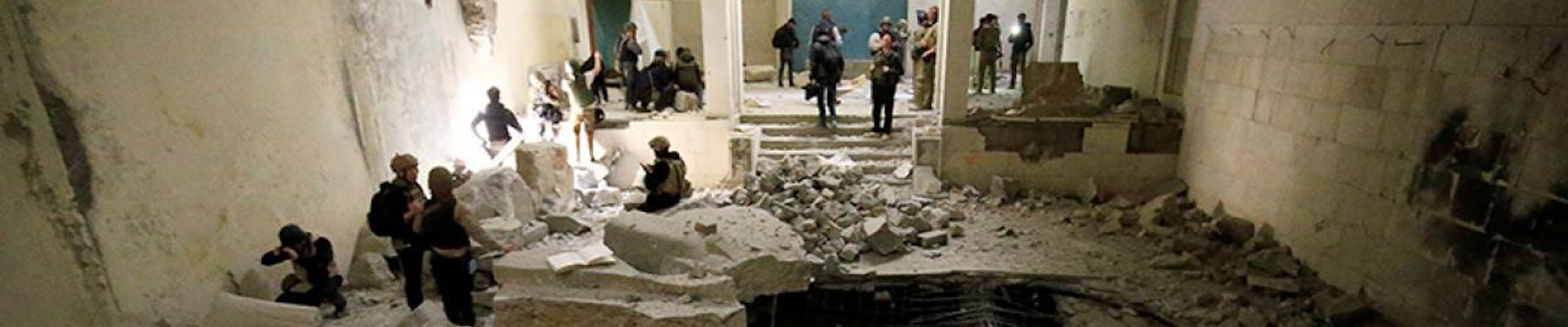
Friends of ASOR & the ASOR Cultural Heritage Committee present a free webinar on May 12, 2022 from 6:30pm to 8:00pm EDT, “A World at War: Protecting Cultural Heritage in Times of Conflict,” featuring Patty Gerstenblith and two discussants—Lisa Ackerman and Andrew Cohen. Jane DeRose Evans will moderate. Cultural heritage is often a victim during armed conflicts. Why is heritage contested in war, and why do some look beyond immediate humanitarian crises to safeguard heritage for the future? Our speaker, Patty Gerstenblith, will examine those questions, and how countries came together to create a body of international law meant to preserve sites and collections in times of armed conflict and its aftermath. Her presentation will be followed by a panel that will discuss ways that the panelists have been involved in helping communities recover their heritage after a war and how anyone with an interest can also get involved. The webinar will be recorded. This event is free for everyone.

ASOR Sustaining Members: $0 | ASOR Members: $0 | Public: $0

While this event is free and open to the public, we encourage participants to consider tax-deductible donations to ASOR’s Cultural Heritage Initiatives (ASOR CHI), which directly supports (i.e. excludes administrative fees) ASOR’s cultural heritage work in North Africa and the Middle East.


Program Schedule

THURSDAY, May 12, 2022

6:30pm – 7:15pm

Patty Gerstenblith

DePaul University

Cultural heritage is often a victim during armed conflicts. Why is heritage contested in war, and why do some look beyond immediate humanitarian crises to safeguard heritage for the future? Our speaker, Patty Gerstenblith, will examine those questions, and how countries came together to create a body of international law meant to preserve sites and collections in times of armed conflict and its aftermath.

7:15pm – 8:00pm

Panel Discussion and Audience Q&A

Patty Gerstenblith, DePaul University
Lisa Ackerman, Executive Director of the Columbus Citizens Foundation
Andrew Cohen, Government Professional and Expert on Cultural Heritage

Discussion moderated by Jane DeRose Evans, Temple University

ASOR Sustaining Members: $0 | ASOR Members: $0 | Public: $0

If you are new to ASOR, please click on the “New Visitor Registration” link to register your e-mail address and choose a password for our online store. Once logged in, navigate to “Meeting and Event Registration” to register for the webinar. Each registrant will receive a confirmation e-mail. If you do not receive this e-mail, then you are not registered. Please e-mail membership@asor.org with any questions or issues with registering.

You will be e-mailed the Zoom Webinar link in the week prior to the webinar on May 12. If you do not receive the link by the close of business on the Tuesday before the event, please e-mail membership@asor.org immediately. This event will be recorded and all paid registrants will be sent a link to view the recording.

Sponsors will be acknowledged during the event. Sponsorships are available at the following levels:

  • Bronze Sponsor: $50
  • Silver Sponsor: $100
  • Gold Sponsor: $500
  • Platinum Sponsor: $1,000

Each sponsor will receive a confirmation e-mail. If you do not receive this e-mail, then we did not receive your sponsorship online.  If you prefer to register or sponsor over the phone, please call 703-789-9230. Please e-mail membership@asor.org with any questions or issues.

Speaker / Presenter


Patty Gerstenblith is a Distinguished Research Professor of Law at DePaul University and director of its Center for Art, Museum and Cultural Heritage Law. She was appointed by President Obama to serve as Chair of the President’s Cultural Property Advisory Committee in the US Department of State on which had previously served as a Public Representative under President Clinton. Since 2020, she has served as President of the Board of Directors of the US Committee of the Blue Shield and Chair of the Blue Shield International Working Group on Illegal Trafficking of Cultural Objects. She was founding president of the Lawyers’ Committee for Cultural Heritage Preservation and editor of the International Journal of Cultural Property and is currently a Research Associate of the Cultural Heritage Center at the University of Pennsylvania Museum of Archaeology and Anthropology. The fourth edition of her casebook, Art, Cultural Heritage and the Law, was published in 2019. Gerstenblith lectures and publishes widely on the subjects of protection of cultural heritage during armed conflict and the international market in cultural objects. Gerstenblith received her AB from Bryn Mawr College, PhD in art history and anthropology from Harvard University, and JD from Northwestern University.

Panelists


Lisa Ackerman is the Executive Director of the Columbus Citizens Foundation, a non-profit organization in New York City committed to fostering an appreciation of Italian-American heritage and achievement through a broad range of philanthropic and cultural activities. Previously, Ackerman served as the Interim Chief Executive Officer, Executive Vice President, and Chief Operating Officer of the World Monuments Fund, an organization founded in 1965 that has assisted in the conservation and development of long-term stewardship strategies at more than 600 sites in 100 countries, and as Executive Vice President of the Samuel H. Kress Foundation. At WMF, where she worked from 2007 to 2019, Ackerman developed multiple international collaborative projects in conservation. In addition to general supervision over approximately 60 projects in 40 countries, she is the senior project manager for activities in Cambodia, Iraq, Libya, Thailand, and Tunisia.

Andrew Cohen is currently a government professional using his experience with the legislative process, congressional oversight, and executive-legislative branch relations to advise the Internal Revenue Service on Congressional affairs. In 2020-21, he was a Brookings Fellow at the U.S. Senate Homeland Security and Governmental Affairs Committee. Prior to that, he worked for over a decade advising the U.S. Department of State on international cultural heritage protection and preservation policy, and representing the United States government in bilateral, multilateral, and intergovernmental fora as an expert on cultural heritage. In 2018-2019, as Executive Director of the Cultural Property Advisory Committee at the State Department, Cohen managed the simultaneous negotiation, signing, and implementation of more than 20 cultural property agreements between the United States and partner countries around the world, including most of the countries in the Near East and wider Mediterranean world. Dr. Cohen holds a Ph.D. in Near Eastern Archaeology and M.A. in Classical Archaeology from Bryn Mawr College.

Moderator


Jane DeRose Evans is Professor and Chair of Art History at Temple University. She specializes in the archaeology of the Roman provinces and especially in ancient numismatics. She is a Fellow of the American Numismatic Society and a member of the Royal Numismatic Society. After excavating for many years in France, she is now project numismatist for the Harvard/Cornell Excavations in Sardis and the George Washington University excavations at Bir Madhkur (Jordan). Recently, she brought to publication The Mithraeum at Caesarea Maritima (ASOR Press.  Evans has been a member of ASOR for many years, and she currently serves on the Cultural Heritage Committee and has testified on behalf of the Memoranda of Understanding that allow intercepting illegally obtained antiquities from Cyprus and Egypt at the US border. Evans served on the ASOR Board from 2011-2013 and then rejoined the Board again in January 2016. She is currently serving as the Chair of the Trustee Nominations Committee and as the Chair of the Cultural Heritage Committee.
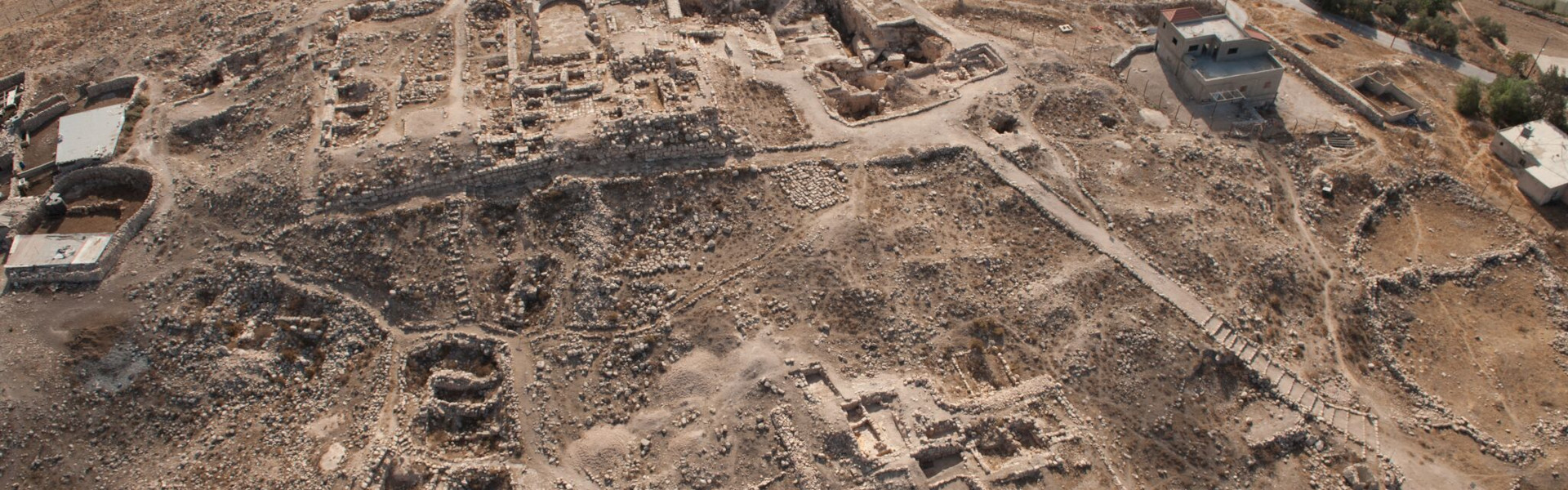
ASOR is grateful for your support. Each registrant will receive an automated confirmation e-mail. If you do not receive this e-mail, please check you Spam folder and then contact ASOR. If you prefer to register over the phone, please call 703-789-9230. Please e-mail membership@asor.org with any questions or issues.


While this event is free and open to the public, we encourage participants to consider tax-deductible donations to ASOR’s Cultural Heritage Initiatives (ASOR CHI), which directly supports (i.e. excludes administrative fees) ASOR’s cultural heritage work in North Africa and the Middle East.

PAST WEBINARS

You can now purchase the link to the recording of any webinar. You can also purchase the bundle packages of all webinars from the 2020-2022 seasons. Please e-mail membership@asor.org for purchase details.

To see a printable pdf of the webinar titles from the 2020-2021 season, please click here. To see a printable pdf of the webinar titles from the 2021-2022 season, please click here.

Pricing:

Members: $6.00 per recording
Non-Members: $12.00 per recording
Bundle of 2020-2021 Webinars: $75.00
Bundle of 2021-2022 Webinars: $75.00
Bundle of 2020-2022 Webinars: $125.00

2021-2022 Season

A World at War: Protecting Cultural Heritage in Times of Conflict
Patty Gerstenblith (DePaul University), Lisa Ackerman (Columbus Citizens Foundation), Andrew Cohen (Government Professional and Cultural Heritage Expert) | May 12, 2022

Preserving Cultural Heritage in Hisban and Umm al-Jimal, Jordan
Øystein LaBianca (Andrews University), Elizabeth Osinga (Umm al-Jimal Archaeological Project), Darrell Rohl (Calvin University) | April 24, 2022

Back to the Field: Recent Discoveries & Summer Plans 2022
Lorenzo d’Alfonso (ISAW), Kathryn Grossman (NC State University), James R. Strange (Samford University) | April 3, 2022

Uncovering What is Nubian Beneath the Veneer of Egyptianness: Excavating the Archives
Debora Heard (University of Chicago) | March 20, 2022

Where Are They Now?: A Preview of 2022 ASOR-Affiliated Fieldwork Projects
Michael Given (University of Glasgow), Xenia-Paula Kyriakou (Florida Gulf Coast University), Stephen Batiuk (University of Toronto), Monique Roddy (Walla Walla University), Kent Bramlett (La Sierra University), Friedbert Ninow (La Sierra University), and Michael Hoff (University of Nebraska-Lincoln) | March 8, 2022

Excavations at Tel Gezer: A Personal Story
Sam Wolff (Tel Gezer Laboratory) | February 20, 2022

Tel Rehov: A Major Bronze and Iron Age City in the Jordan Valley
Amihai Mazar (Hebrew University of Jerusalem), Nava Panitz-Cohen ( Hebrew University of Jerusalem), Nota Kourou (Athens University), Naama Yahalom-Mack (Hebrew University of Jerusalem), Robert Mullins (Azusa Pacific University) | February 10, 2022

The Not-So-Innocents Abroad: The Beginnings of American Biblical Archaeology
Rachel Hallote (Samford University) | January 20, 2022

Synagogues as Jesus Knew Them
James R. Strange (Samford University) | December 2, 2021

Under Jerusalem: The Buried History of the World’s Most Contested City
Andrew Lawler | November 4, 2021

Jesus and Jerusalem on TV: How Do Bible Documentaries Get Made?
Robert Cargill (University of Iowa) | October 17, 2021

Digging the Divine?: Judahite Pillar Figurines and the Archaeology of Israelite Religion
Erin Darby (University of Tennessee) | October 7, 2021

David, Solomon, and Rehoboam’s Kingdom—The Archaeological Evidence
Yosef Garfinkel (Hebrew University of Jerusalem) | September 19, 2021

From Standing Stones to Sacred Emptiness: Textual and Visual Portrayals of Israel’s God
Theodore Lewis (Johns Hopkins University) | August 29, 2021

2020-2021 Season

Making May Matter: Webinarathon to Endow Diversity
Multiple Speakers | May 21-23, 2021

Archaeogaming: Why Video Games Deserve Their Own Archaeology
Tine Rassalle (University of North Carolina at Chapel Hill), Shannon Martino (Morton College), Matthew Winter (University of Arizona), Michael Zimmerman (Rhode Island) | April 18, 2021

How the Bible Became a Book
William Schniedewind (UCLA) | March 21, 2021

The Mysteries of Mithras in Caesarea: Exploring the Cult’s Rites and Remains
Jane DeRose Evans (Temple University), Alexandra Ratzlaff (Brandeis University) | March 11, 2021

Archaeology and the Hidden Religious Culture of Israelite Women
Carol Meyers (Duke University) | February 21, 2021

Meet the Directors—Fundraiser to Support ASOR’s Affiliated Overseas Research Centers
Matthew J. Adams (AIAR), Pearce Paul Creasman (ACOR), Lindy Crewe (CAARI) | February 11, 2021

Early Synagogues, Jesus, and Galilee—A Jewish Perspective
Eric Meyers (Duke University) | December 13, 2020

Home Sweet Home: Ancient Israelite Households in Context
Cynthia Shafer-Elliott (William Jessup University) | October 18, 2020

Priestesses in the Days of Solomon and Ahab
Susan Ackerman (Dartmouth College) | September 13, 2020

Digging Deeper: How Archaeology Works
Eric H. Cline (The George Washington University) | August 9, 2020

FOA Webinar: Preserving Cultural Heritage in Hisban and Umm al-Jimal, Jordan on April 24

FRIENDS OF ASOR WEBINAR

Preserving Cultural Heritage in Hisban and Umm al-Jimal, Jordan

Friends of ASOR presents a webinar on April 24, 2022 from 6:00pm to 7:30pm EDT, ” Preserving Cultural Heritage in Hisban and Umm al-Jimal, Jordan,” featuring Øystein LaBianca, Elizabeth Osinga, and Darrell Rohl. This special event will focus on current work in Jordan through two projects—Hisban (part of the Madaba Plains Project) and the Umm al-Jimal Archaeological Project (UJAP). The program will include two presentations covering introductions to each site and the focus of the 2022 fieldwork season, in particular each project’s efforts to preserve cultural heritage through community engagement. Join us as we explore two of the exciting projects that ASOR members are currently participating in across Jordan. Barbara Porter, former ACOR Director and current ACOR Ambassador, will moderate the program and conclude the webinar with a live Q&A session with the audience and panelists. The full program is below. The event will be recorded.

ASOR Sustaining Members: $0 | ASOR Members: $6 | Public: $12

Program Schedule

SUNDAY, APRIL 24, 2022

6:00pm – 6:30pm

Øystein LaBianca

Andrews University

Jordan: Hisban (part of the Madaba Plains Project)

Read the Description

Tall Hisban stands as a witness to global history and a window on daily life in Jordan through the ages. Here excavators have unearthed traces of multiple civilizations and empires; a thriving market town from the time of the Assyrians, Babylonians, and Persians; large quantities of amphora jars containing tiny fish bones attesting to strong local demand for garum—a fermented fish sauce condiment that was an essential flavor in ancient Greek and Roman cooking; the expertly shaped masonry foundations of a Roman public building; the apse, pillar foundations and partial sections of several mosaic floor panels of two Byzantine basilica churches; and the private residence and bath (Hamam) of the Mamluk governor of this part of Jordan during the 14th century AD. Just as important are evidence of daily life through the ages attested in the large number of pots used for storing and preparing food; the thousands of skeletal fragments of sheep, goats, cattle, horses, mules, poultry, and even fish; and the use and re-use of domestic buildings, courtyards, water channels, and cisterns. A major focus of the 2022 field season will be to explore connections between Greco-Roman Hisban (Esbus) and the cities of the Decapolis. Click here for a short film about the history of the Madaba Plains and click here for a short film on the discoveries at Tall Hisban.

6:30pm – 7:00pm

Darrell Rohl

Calvin University

Elizabeth Osinga

Umm al-Jimal Archaeological Project (UJAP)

Jordan: Umm al-Jimal Archaeological Project (UJAP)

Read the Description

Umm al-Jimal is the best-preserved example of a Late Antique town within the southern Hauran region of Jordan and Syria, featuring the upstanding ruins of more than 150 individual houses, nearly twenty places of worship representing paganism, Christianity, and Islam, as well as large imperial military and administrative structures, and community infrastructure of roads and water management, all enclosed within an intact ancient town wall. Previous archaeological fieldwork has focused on documenting the upstanding remains with limited excavation in order to answer specific research questions. In recent years, the site’s churches have become a particular focus of excavation activity, seeking a better understanding of the relationship between religious practice and domestic life across the site. The 2022 field season will continue this research focus, with a new open-area excavation methodology centered on the enclosed temenos/churchyard of the site’s extramural West Church, including within ancillary rooms attached to the church’s east end. Further fieldwork activities at the site will include on-the-ground inspection and documentation of 30+ potential structural features that have been identified from recent aerial photographs. In addition to fieldwork, there are several ongoing heritage-focused projects: completion of the Interpretive and Hospitality Center and the archaeological park; training of local guides and excavators; continued partnership with the local non-profit, Hand By Hand Heritage; and the completion of Umm al-Jimal’s UNESCO World Heritage Nomination file.

7:00pm – 7:30pm

Audience Q&A with all Panelists

ASOR Sustaining Members: $0 | ASOR Members: $6 | Public: $12

To receive your ASOR member discount, log into the online store. If you are new to ASOR, please click on the “New Visitor Registration” link to register your e-mail address and choose a password for our online store. Once logged in, navigate to “Meeting and Event Registration” to register for the webinar and pay the fee. Each paid registrant will receive a confirmation e-mail when you pay for the webinar. If you do not receive this e-mail, then you are not registered. Please e-mail membership@asor.org with any questions or issues with registering.

You will be e-mailed the Zoom Webinar link in the week prior to the lecture on February 20, 2022. If you do not receive the link by the close of business on the Thursday before the webinar, please e-mail membership@asor.org immediately. This webinar will be recorded and all paid registrants will be sent a link to view the recording.

All proceeds from this lecture are used to fund scholarships for members impacted by COVID-19 as well as increasing ASOR’s online resources, which are free to the public.

Sponsors will be acknowledged during the event. Sponsorships are available at the following levels:

  • Bronze Sponsor: $50
  • Silver Sponsor: $100
  • Gold Sponsor: $500
  • Platinum Sponsor: $1,000

Each sponsor will receive a confirmation e-mail. If you do not receive this e-mail, then we did not receive your sponsorship online.  If you prefer to register or sponsor over the phone, please call 703-789-9230. Please e-mail membership@asor.org with any questions or issues.

Speakers / Presenters

Øystein LaBianca is a Professor of Anthropology in the Department of Behavioral Sciences and Associate Director of the Institute of Archaeology at Andrews University. He is the Senior Director of the Hisban Cultural Heritage Project, a community archaeology project centered at Tall Hisban in Jordan. He holds a Ph.D. in cultural anthropology and archaeology from Brandeis University. LaBianca’s research in Jordan began with studies of long-term human-animal-environment interactions as evidenced by changes over time in animal bone assemblages and related finds uncovered by his excavations and surveys at Tall Hisban. He has also been a leader in introducing community archaeology approaches to archaeological projects in Jordan. He is a long-time member of the boards of trustees of ASOR and ACOR in Amman, Jordan.


Elizabeth Osinga is currently working full-time as a co-director of the Umm al-Jimal Archaeological Project (UJAP). A former student of the late UJAP director Bert de Vries, she has worked with the project since 2012 and her graduate work focused on a socio-economic approach to ceramic analysis at the site (University of Southampton, MA, PhD). When not involved in excavations, grant writing, or other essential projects, she is immersed in Umm al-Jimal’s archive, analyzing the backlog of excavation reports and materials in preparation for long-overdue publication.


Darrell Rohl  is an Assistant Professor of Archaeology, History, and Digital Humanities at Calvin University and is a co-director of the Umm al-Jimal Archaeological Project. A graduate of Andrews University (BSc) and Durham University (MA, PhD), his research has primarily focused on Roman and Late Antique periods in England, Scotland, and Jordan, as well as the application of place theories in archaeological and heritage contexts. He has co-directed excavations with Dr. Elizabeth Osinga at the Hisban North Church (2018) and Umm al-Jimal (2019), and has further fieldwork and research experience in the UK, USA, and Italy.
ASOR is grateful for your support. Each registrant will receive an automated confirmation e-mail. If you do not receive this e-mail, please check you Spam folder and then contact ASOR. If you prefer to register over the phone, please call 703-789-9230. Please e-mail membership@asor.org with any questions or issues.

PAST WEBINARS

You can now purchase the link to the recording of any webinar. You can also purchase the bundle packages of all webinars from the 2020-2022 seasons. Please e-mail membership@asor.org for purchase details.

To see a printable pdf of the webinar titles from the 2020-2021 season, please click here. To see a printable pdf of the webinar titles from the 2021-2022 season, please click here.

Pricing:

Members: $6.00 per recording
Non-Members: $12.00 per recording
Bundle of 2020-2021 Webinars: $75.00
Bundle of 2021-2022 Webinars: $75.00
Bundle of 2020-2022 Webinars: $125.00

2021-2022 Season

A World at War: Protecting Cultural Heritage in Times of Conflict
Patty Gerstenblith (DePaul University), Lisa Ackerman (Columbus Citizens Foundation), Andrew Cohen (Government Professional and Cultural Heritage Expert) | May 12, 2022

Preserving Cultural Heritage in Hisban and Umm al-Jimal, Jordan
Øystein LaBianca (Andrews University), Elizabeth Osinga (Umm al-Jimal Archaeological Project), Darrell Rohl (Calvin University) | April 24, 2022

Back to the Field: Recent Discoveries & Summer Plans 2022
Lorenzo d’Alfonso (ISAW), Kathryn Grossman (NC State University), James R. Strange (Samford University) | April 3, 2022

Uncovering What is Nubian Beneath the Veneer of Egyptianness: Excavating the Archives
Debora Heard (University of Chicago) | March 20, 2022

Where Are They Now?: A Preview of 2022 ASOR-Affiliated Fieldwork Projects
Michael Given (University of Glasgow), Xenia-Paula Kyriakou (Florida Gulf Coast University), Stephen Batiuk (University of Toronto), Monique Roddy (Walla Walla University), Kent Bramlett (La Sierra University), Friedbert Ninow (La Sierra University), and Michael Hoff (University of Nebraska-Lincoln) | March 8, 2022

Excavations at Tel Gezer: A Personal Story
Sam Wolff (Tel Gezer Laboratory) | February 20, 2022

Tel Rehov: A Major Bronze and Iron Age City in the Jordan Valley
Amihai Mazar (Hebrew University of Jerusalem), Nava Panitz-Cohen ( Hebrew University of Jerusalem), Nota Kourou (Athens University), Naama Yahalom-Mack (Hebrew University of Jerusalem), Robert Mullins (Azusa Pacific University) | February 10, 2022

The Not-So-Innocents Abroad: The Beginnings of American Biblical Archaeology
Rachel Hallote (Samford University) | January 20, 2022

Synagogues as Jesus Knew Them
James R. Strange (Samford University) | December 2, 2021

Under Jerusalem: The Buried History of the World’s Most Contested City
Andrew Lawler | November 4, 2021

Jesus and Jerusalem on TV: How Do Bible Documentaries Get Made?
Robert Cargill (University of Iowa) | October 17, 2021

Digging the Divine?: Judahite Pillar Figurines and the Archaeology of Israelite Religion
Erin Darby (University of Tennessee) | October 7, 2021

David, Solomon, and Rehoboam’s Kingdom—The Archaeological Evidence
Yosef Garfinkel (Hebrew University of Jerusalem) | September 19, 2021

From Standing Stones to Sacred Emptiness: Textual and Visual Portrayals of Israel’s God
Theodore Lewis (Johns Hopkins University) | August 29, 2021

2020-2021 Season

Making May Matter: Webinarathon to Endow Diversity
Multiple Speakers | May 21-23, 2021

Archaeogaming: Why Video Games Deserve Their Own Archaeology
Tine Rassalle (University of North Carolina at Chapel Hill), Shannon Martino (Morton College), Matthew Winter (University of Arizona), Michael Zimmerman (Rhode Island) | April 18, 2021

How the Bible Became a Book
William Schniedewind (UCLA) | March 21, 2021

The Mysteries of Mithras in Caesarea: Exploring the Cult’s Rites and Remains
Jane DeRose Evans (Temple University), Alexandra Ratzlaff (Brandeis University) | March 11, 2021

Archaeology and the Hidden Religious Culture of Israelite Women
Carol Meyers (Duke University) | February 21, 2021

Meet the Directors—Fundraiser to Support ASOR’s Affiliated Overseas Research Centers
Matthew J. Adams (AIAR), Pearce Paul Creasman (ACOR), Lindy Crewe (CAARI) | February 11, 2021

Early Synagogues, Jesus, and Galilee—A Jewish Perspective
Eric Meyers (Duke University) | December 13, 2020

Home Sweet Home: Ancient Israelite Households in Context
Cynthia Shafer-Elliott (William Jessup University) | October 18, 2020

Priestesses in the Days of Solomon and Ahab
Susan Ackerman (Dartmouth College) | September 13, 2020

Digging Deeper: How Archaeology Works
Eric H. Cline (The George Washington University) | August 9, 2020

FOA Webinar: Back to the Field—Recent Discoveries & Summer Plans on April 3

FRIENDS OF ASOR WEBINAR

Back to the Field: Recent Discoveries & Summer Plans 2022

Friends of ASOR presents a free webinar on April 3, 2022 from 6:00pm to 7:30pm EDT, “Back to the Field: Recent Discoveries & Summer Plans 2022,” featuring Lorenzo d’Alfonso, Kathryn Grossman, and James R. Strange. This special event will preview the field seasons of three sites across Turkey (Kinik HöyĂŒk Archaeological Project), Cyprus (Makounta-Voules Archaeological Project), and Israel (The Shikhin Excavation Project). The program will include three presentations covering such topics as introductions to each site in its historical context, current excavation and survey progress, and the research focus of the upcoming field season. Join us as we explore some of the exciting projects that ASOR members are currently participating in across the eastern Mediterranean region. The panelists will conclude their webinar with a live Q&A session with the audience. The full program is below. The event will be recorded. This event is free for everyone.

ASOR Sustaining Members: $0 | ASOR Members: $0 | Public: $0

Program Schedule

SUNDAY, APRIL 3, 2022

6:00pm – 6:20pm

Lorenzo d’Alfonso

Institute for the Study of the Ancient World, New York University

Turkey: Niğde Kınık HöyĂŒk (N-KH) Archaeological Project

Read the Description

The site of Niğde Kınık HöyĂŒk (N-KH) is located in south Cappadocia, in the Niğde province, on the Bor-Ereğli Plain at the foot of the Melendiz Mountains. Excavations at N-KH originated from a survey conducted by the University of Pavia in 2006–2009. Within the sites recorded in the 800 km2 survey of the southeastern slopes of the Melendiz Mountains, N-KH proved to be the largest site with the longest occupation history, from the Early Bronze Age to the Early Ottoman period. In this lecture, Dr. Lorenzo d’Alfonso, director of the project, will present the results of the last two site campaigns (2020-2021) with particular focus on the recent discoveries from the Middle Iron Age and the Hellenistic period, and on the archaeological evidence of cultic activities in first millennium BCE Anatolia. Furthermore, he will report on the design and creation of a showcase for a permanent exhibition at the Niğde Archaeological Museum that includes restored votive statues and figurines from N-KH.

6:20pm – 6:40pm

Kathryn Grossman

North Carolina State University

Cyprus: Makounta Voules Archaeological Project

Read the Description

The Chalcolithic and Bronze Age site of Makounta-Voules-Mersinoudia is located on the northwest coast of Cyprus, near the town of Polis Chrysochous. Although research projects elsewhere on the island have frequently targeted Chalcolithic and Bronze Age sites, there have been few scientific excavations of prehistoric remains in this region. In 2017, the Makounta Voules Archaeological Project (MVAP) began with a program of intensive, systematic survey, which revealed Late Chalcolithic and Early-Middle Bronze Age ceramics, along with stone tools, slag, and wall stones spread across a hillslope overlooking the Makounta River. In 2018 and 2019, the MVAP team conducted excavations that revealed a series of Chalcolithic round buildings, a fire installation tentatively identified as a copper smelting furnace, and other stone-built features. With the onset of the COVID-19 pandemic, excavations were put on hold in 2020-21. In 2022, the team will return to the field to continue excavations of the ancient settlement, as well as explore new areas that might be related to early copper mining activity. In this presentation, Dr. Grossman will show results from previous excavation seasons, describe plans for future work, and discuss some of the big-picture questions that guide the research at Makounta-Voules-Mersinoudia.

6:40pm – 7:00pm

James R. Strange

Samford University

Israel: Shikhin Excavation Project

Read the Description

The site of Shikhin sits less than a mile north of the acropolis of ancient Sepphoris. Evidence of activity on the hilltop dates as far back as the Late Bronze Age, but, like many Galilean settlements, the village appears to have been founded between the second and first centuries BCE (the Late Hellenistic period). In the 2022 season, the Shikhin Excavation Project will resume its work in two areas: the remains of a large public building that was probably the village’s synagogue in the Roman period, and an adjacent ceramics industry set up in the courtyards of houses. The most exciting event of the season will be an exercise in experimental archaeology. Yeshu Dray and Ilana Gonen of Restoration of Ancient Technology are building two kilns based on construction methods used at Shikhin. During the 2022 season, Shikhin volunteers will make clay oil lamps that Yeshu and Ilana will fire in both kilns using fuel that would have been used in the ancient period.

7:00pm – 7:30pm

Audience Q&A with all Panelists

Lorem ipsum dolor sit amet, consectetur adipiscing elit. Ut elit tellus, luctus nec ullamcorper mattis, pulvinar dapibus leo.

ASOR Sustaining Members: $0 | ASOR Members: $0 | Public: $0

If you are new to ASOR, please click on the “New Visitor Registration” link to register your e-mail address and choose a password for our online store. Once logged in, navigate to “Meeting and Event Registration” to register for the webinar. Each registrant will receive a confirmation e-mail. If you do not receive this e-mail, then you are not registered. Please e-mail membership@asor.org with any questions or issues with registering.

You will be e-mailed the Zoom Webinar link in the week prior to the webinar on May 12. If you do not receive the link by the close of business on the Tuesday before the event, please e-mail membership@asor.org immediately. This event will be recorded and all paid registrants will be sent a link to view the recording.

Sponsors will be acknowledged during the event. Sponsorships are available at the following levels:

  • Bronze Sponsor: $50
  • Silver Sponsor: $100
  • Gold Sponsor: $500
  • Platinum Sponsor: $1,000

Each sponsor will receive a confirmation e-mail. If you do not receive this e-mail, then we did not receive your sponsorship online.  If you prefer to register or sponsor over the phone, please call 703-789-9230. Please e-mail membership@asor.org with any questions or issues.

Speakers / Presenters

Lorenzo d’Alfonso is a Professor of Archaeology and History of ancient Western Asia at ISAW-NYU and Associate Professor of Archaeology of ancient Western Asia at Pavia University. He has published several books and papers on the history and archaeology of Anatolia and Syria, focusing on the Late Bronze and Iron Ages. His most recent publication is the volume Borders in Archaeology: Anatolia and the South Caucasus Ca. 3500-500 BCE (Peeters 2021) co-edited with K. Rubinson, which was published three months ago. Dr. d’Alfonso has excavated at different sites in Italy, Syria, and has directed an archaeological survey in south Cappadocia, Turkey from 2006-2009, before starting the excavations at Niğde Kınık HöyĂŒk in 2011.


Kathryn Grossman is an Assistant Professor of Anthropology in the Department of Sociology and Anthropology at North Carolina State University. She is an archaeologist and zooarchaeologist with expertise in the complex societies of the Near East and eastern Mediterranean. She earned her BA in Archaeology from Tufts University and her PhD in Near Eastern Art and Archaeology from the University of Chicago. Her current research focuses on resistance to state-making, the biographies of early cities, and human-animal relationships in early complex societies. She directs the Makounta-Voules Archaeological Project in Cyprus and has been a senior staff member on archaeological projects in Syria, Cyprus, Egypt, and Iraq. This summer, in addition to directing excavations at Makounta-Voules-Mersinoudia in Cyprus, she will spend two months as a CAORC fellow at the American Center of Research in Jordan, where she will be analyzing animal bones from Petra.


James R. Strange has directed the Shikhin Excavation project since 2012, with Motti Aviam, Tom McCollough, and David Fiensy (2012) as Associate Directors. Dr. Strange is the Charles Jackson Granade and Elizabeth Donald Granade Professor in New Testament at Samford University. With David Fiensy, he is co-editor of the two-volume set Galilee in the Late Second Temple and Mishnaic Periods (Fortress, 2014 and 2015). His book, One Problem After Another: An Introduction to Archaeology, the Gospels, and First Century Roman Galilee is scheduled to come out in 2022.
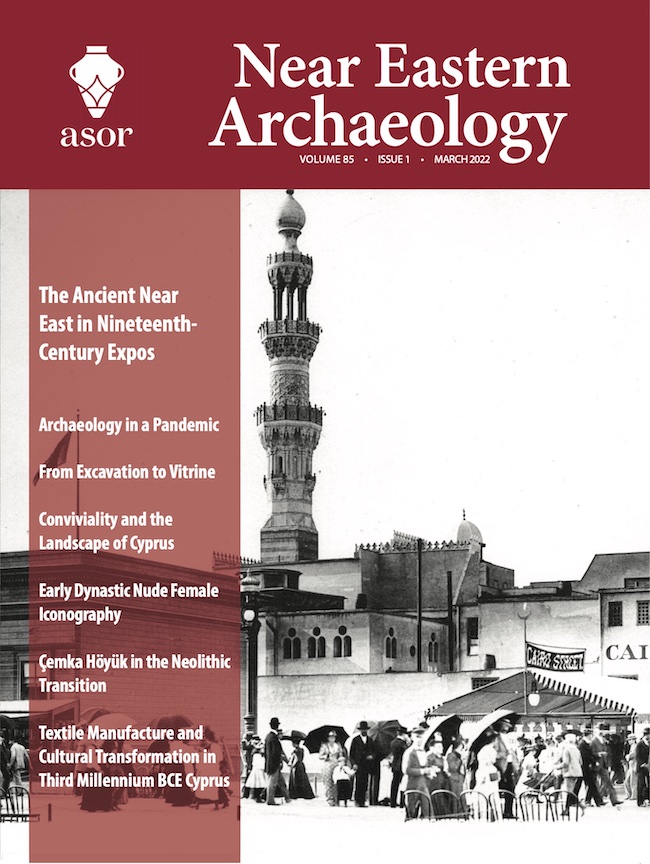
ASOR is grateful for your support. Each registrant will receive an automated confirmation e-mail. If you do not receive this e-mail, please check you Spam folder and then contact ASOR. If you prefer to register over the phone, please call 703-789-9230. Please e-mail membership@asor.org with any questions or issues.

PAST WEBINARS

You can now purchase the link to the recording of any webinar. You can also purchase the bundle packages of all webinars from the 2020-2022 seasons. Please e-mail membership@asor.org for purchase details.

To see a printable pdf of the webinar titles from the 2020-2021 season, please click here. To see a printable pdf of the webinar titles from the 2021-2022 season, please click here.

Pricing:

Members: $6.00 per recording
Non-Members: $12.00 per recording
Bundle of 2020-2021 Webinars: $75.00
Bundle of 2021-2022 Webinars: $75.00
Bundle of 2020-2022 Webinars: $125.00

2021-2022 Season

A World at War: Protecting Cultural Heritage in Times of Conflict
Patty Gerstenblith (DePaul University), Lisa Ackerman (Columbus Citizens Foundation), Andrew Cohen (Government Professional and Cultural Heritage Expert) | May 12, 2022

Preserving Cultural Heritage in Hisban and Umm al-Jimal, Jordan
Øystein LaBianca (Andrews University), Elizabeth Osinga (Umm al-Jimal Archaeological Project), Darrell Rohl (Calvin University) | April 24, 2022

Back to the Field: Recent Discoveries & Summer Plans 2022
Lorenzo d’Alfonso (ISAW), Kathryn Grossman (NC State University), James R. Strange (Samford University) | April 3, 2022

Uncovering What is Nubian Beneath the Veneer of Egyptianness: Excavating the Archives
Debora Heard (University of Chicago) | March 20, 2022

Where Are They Now?: A Preview of 2022 ASOR-Affiliated Fieldwork Projects
Michael Given (University of Glasgow), Xenia-Paula Kyriakou (Florida Gulf Coast University), Stephen Batiuk (University of Toronto), Monique Roddy (Walla Walla University), Kent Bramlett (La Sierra University), Friedbert Ninow (La Sierra University), and Michael Hoff (University of Nebraska-Lincoln) | March 8, 2022

Excavations at Tel Gezer: A Personal Story
Sam Wolff (Tel Gezer Laboratory) | February 20, 2022

Tel Rehov: A Major Bronze and Iron Age City in the Jordan Valley
Amihai Mazar (Hebrew University of Jerusalem), Nava Panitz-Cohen ( Hebrew University of Jerusalem), Nota Kourou (Athens University), Naama Yahalom-Mack (Hebrew University of Jerusalem), Robert Mullins (Azusa Pacific University) | February 10, 2022

The Not-So-Innocents Abroad: The Beginnings of American Biblical Archaeology
Rachel Hallote (Samford University) | January 20, 2022

Synagogues as Jesus Knew Them
James R. Strange (Samford University) | December 2, 2021

Under Jerusalem: The Buried History of the World’s Most Contested City
Andrew Lawler | November 4, 2021

Jesus and Jerusalem on TV: How Do Bible Documentaries Get Made?
Robert Cargill (University of Iowa) | October 17, 2021

Digging the Divine?: Judahite Pillar Figurines and the Archaeology of Israelite Religion
Erin Darby (University of Tennessee) | October 7, 2021

David, Solomon, and Rehoboam’s Kingdom—The Archaeological Evidence
Yosef Garfinkel (Hebrew University of Jerusalem) | September 19, 2021

From Standing Stones to Sacred Emptiness: Textual and Visual Portrayals of Israel’s God
Theodore Lewis (Johns Hopkins University) | August 29, 2021

2020-2021 Season

Making May Matter: Webinarathon to Endow Diversity
Multiple Speakers | May 21-23, 2021

Archaeogaming: Why Video Games Deserve Their Own Archaeology
Tine Rassalle (University of North Carolina at Chapel Hill), Shannon Martino (Morton College), Matthew Winter (University of Arizona), Michael Zimmerman (Rhode Island) | April 18, 2021

How the Bible Became a Book
William Schniedewind (UCLA) | March 21, 2021

The Mysteries of Mithras in Caesarea: Exploring the Cult’s Rites and Remains
Jane DeRose Evans (Temple University), Alexandra Ratzlaff (Brandeis University) | March 11, 2021

Archaeology and the Hidden Religious Culture of Israelite Women
Carol Meyers (Duke University) | February 21, 2021

Meet the Directors—Fundraiser to Support ASOR’s Affiliated Overseas Research Centers
Matthew J. Adams (AIAR), Pearce Paul Creasman (ACOR), Lindy Crewe (CAARI) | February 11, 2021

Early Synagogues, Jesus, and Galilee—A Jewish Perspective
Eric Meyers (Duke University) | December 13, 2020

Home Sweet Home: Ancient Israelite Households in Context
Cynthia Shafer-Elliott (William Jessup University) | October 18, 2020

Priestesses in the Days of Solomon and Ahab
Susan Ackerman (Dartmouth College) | September 13, 2020

Digging Deeper: How Archaeology Works
Eric H. Cline (The George Washington University) | August 9, 2020

Table of Contents for NEA 85.1 (2022)

Table of Contents for Near Eastern Archaeology 85.1 (March 2022)

You can receive NEA (and other ASOR publications) through an ASOR Membership.
Please e-mail the Membership office if you have any questions.

Pp. 4-11: “Flowing Rock, Dancing around Trees: Conviviality and the Landscape of Cyprus,” by Michael Given

Rocks and trees are often central to the lives of human communities: their role is far more complex and meaningful than supplying resources, status, or symbolism. In a convivial landscape, rocks, trees, and people are deeply connected, showing elaborate and powerful interdependencies. In this article I explore the idea of conviviality through a series of examples from Archaic to early twentieth-century Cyprus. The Acropolis cliffs of Kourion show the fluidity of rock, constantly changing because of the effects of water, weather, and humanity. In the northern Troodos Mountains, trees and people have been highly interconnected: when human activities are relatively diverse and small-scale, the ensuing relationships are resilient and healthy for the whole socioecological community. Human societies can recognize and celebrate this conviviality through stories that grow up around particular rocks and trees, or through rituals focused on sacred stones or enacted by dancing around trees.

ASOR Members with online access: navigate to the token link email sent to you (search for “token link” in inbox) before attempting to read this article. Once you have activated your member token, click here to access the above article on The University of Chicago Press Journals’ website.

Pp. 12-22: “Çemka HöyĂŒk, Late Epipaleolithic and PPNA Phase Housing Architecture: Chronological and Typological Change,” by Yunus Çiftçi

In recent studies carried out at the Çemka HöyĂŒk settlement on the western flank of the Tigris River in Upper Mesopotamia (Mardin province, Turkey), new information has been obtained on the Late Epipaleolithic and Early Neolithic periods, defined as the Proto-Neolithic. Despite the short-term nature of the excavations, the settlement provides new data about these eras in the region; in particular, the settlement is significant in terms of the Late Epipaleolithic–Neolithic transition as well as of architectural finds belonging to both periods. The rise of permanent settlements and domestic architecture is a focus of examination.

ASOR Members with online access: navigate to the token link email sent to you (search for “token link” in inbox) before attempting to read this article. Once you have activated your member token, click here to access the above article on The University of Chicago Press Journals’ website.

Pp. 24-32: “Through the Eye of a Needle: A Textile Perspective on the Chalcolithic–Bronze Age Transition in Cyprus,” by Giulia Muti

This article argues that a renewed analysis of textile manufacture can bring a fresh perspective to approach the cultural transformations occurring in Cyprus during the mid-third millennium BCE and to investigate their significance. I present the main interpretations on the transition from the Chalcolithic to the Bronze Age as indicated by current archaeological research and explain the value of textile tools as archaeological indicators. Following this, the available data for selected textile activities (fiber exploitation and thread making) are analyzed and discussed. The final aim is to demonstrate how current narratives can be challenged when technology is not the only aspect considered, and productive purposes and raw materials are also included.

ASOR Members with online access: navigate to the token link email sent to you search for “token link” in inbox) before attempting to read this article. Once you have activated your member token, click here to access the above article on The University of Chicago Press Journals’ website.

Pp. 34-43: “Nude Awakenings: Early Dynastic Nude Female Iconography,” by Stephanie Lynn Budin

This article considers the earliest examples of so-called Nude Female iconography that emerged in Mesopotamia in the Early Dynastic period, with a particular focus on the aspects of nudity and gesture. Rather than concluding that these images represent goddesses or concepts such as fertility, the data reveal that in the Early Dynastic period female nudity was no different than male nudity.

ASOR Members with online access: navigate to the token link email sent to you (search for “token link” in inbox) before attempting to read this article. Once you have activated your member token, click here to access the above article on The University of Chicago Press Journals’ website.

Pp. 44-53: “From Excavation to Vitrine: The Afterlife of Late Hellenistic Bovine Terracottas from Niğde Kınık HöyĂŒk,” by Roberta Casagrande-Kim, Deniz Üçer Erduran, Emily Frank, and Izel GĂŒngör

In this article the authors present the preliminary results of the study, conservation, and display of a corpus of Hellenistic terracottas from Niğde Kınık HöyĂŒk consisting of bovine figures ranging from small protomes to medium-sized bull statues, and to close-to-life-size hoofs and chests. Images of Greek divinities attached to the bulls’ necks suggest that the corpus was pertinent to a cultic tradition related to the Olympic pantheon. The ongoing work combines data collected through excavation, scientific analysis, conservation, and museum practices to understand this unique body of material and effectively present it to academic and museum audiences.

ASOR Members with online access: navigate to the token link email sent to you (search for “token link” in inbox) before attempting to read this article. Once you have activated your member token, click here to access the above article on The University of Chicago Press Journals’ website.

Pp. 54-65: “Progress, Design, and Hyperreal Spectacle: The Ancient Near East in Nineteenth-Century Expos, Fairs, and Geographical Amusements,” by Kevin McGeough

As Near Eastern archaeology developed into an academic discipline throughout the nineteenth century, it led to serious considerations on the relationships between those ancient civilizations and contemporary cultures. Issues of progress and decline were particularly paramount as citizens of the European and North American powers considered what the collapse of ancient civilizations implied about the present. Related to these concerns were interests in material and technological progress, and thus the materiality of the ancient Near East became a subject of debate in regard to contemporary design. Here are explored some of the ways that ancient Egypt and the Near East were presented in these hyperreal spectacles, why the past was so fundamental to discussions of the present and future in the nineteenth century, and why comparative geographical approaches to the topic have been so compelling for nonacademic audiences.

ASOR Members with online access: navigate to the token link email sent to you (search for “token link” in inbox) before attempting to read this article. Once you have activated your member token, click here to access the above article on The University of Chicago Press

Pp. 66-73: “Archaeology in a Pandemic,” by Claire Balandier, Ian Cipin, Britt Hartenberger, and Moni Islam

The COVID-19 pandemic of 2020–2021 has disrupted life in just about every way imaginable. Many in the ASOR community have been hindered by the lack of access to collections, publications, and colleagues. For most archaeologists, fieldwork plans came to a screeching halt in spring 2020. While some were able to resume fieldwork in summer 2020 or summer 2021 with smaller teams and new precautions, many have not traveled overseas in nearly two years. While the long-term impact of the pandemic on the discipline in general and ASOR in particular will not be known for years, it is important to share our individual stories and document how our research lives continue to be affected now. In this essay, four archaeologists—two who were able to participate in archaeological fieldwork in 2020–2021 and two who were not—write about their experiences of archaeology in a pandemic.

ASOR Members with online access: navigate to the token link email sent to you (search for “token link” in inbox) before attempting to read this article. Once you have activated your member token, click here to access the above article on The University of Chicago Press Journals’ website.

Pp. 74-77: “The Case for Digital Site Reports,” by Jennie Ebeling and William Caraher

As ASOR looks ahead to another century of publishing booklength site reports and continues vigorously to support the thorough publication of archaeological sites, the authors, both editors of long-standing ASOR book series, recognize that a period of significant change is upon us. This change is more than simply making conventional paper books available in digital forms and extends to a fundamental rethinking of the publishing process, new ways of thinking about what constitutes a final publication, and new expectations for professional organizations, institutions, and individuals.

ASOR Members with online access: navigate to the token link email sent to you (search for “token link” in inbox) before attempting to read this article. Once you have activated your member token, click here to access the above article on The University of Chicago Press Journals’ website.

FOA Webinar: Debora Heard on March 20

FRIENDS OF ASOR WEBINARS

Uncovering What is Nubian Beneath the Veneer of Egyptianness: Excavating the Archives

Friends of ASOR present the next webinar in our monthly series on March 20, 2022, at 7:30 pm EST, featuring Debora Heard. During the Egyptian New Kingdom colonization of Nubia, Egyptian pharaohs built temples to their gods in the heartland of the Kingdom of Kush. Turning the tables in the 25th Dynasty reign of Egypt, the Kushite kings restored and expanded several of the Egyptian temples in Nubia while building more of their very own. While these temples used Egyptian religious ideology and exhibited Egyptian imagery, a closer examination of the texts and iconography reveals cultural differences that are hidden when viewed with an Egyptian lens. Through an examination of temple architecture, iconography, and inscriptions, this lecture will present a preliminary examination of three Upper Nubian temples – two dedicated to the Egyptian god Amun and one dedicated to the Nubian god Apedemak – in an effort to “uncover what is Nubian beneath the veneer of Egyptianness.”

In the course of this lecture, Debora will share with us her process of excavating the archive of archaeological excavation and inscriptional material for her dissertation as well as provide an intimate look at some of the challenges that minority, first-generation, and working-class students face in pursuing archaeology as a career. Debora will conclude her webinar with a live Q&A session.

Debora Heard is a Ph.D. Candidate in Anthropology specializing in the archaeology and history of ancient Nubia at the University of Chicago where she has also studied the history and language of ancient Kemet. She situates her research at the intersection of anthropology, archaeology, Egyptology, Nubian Studies, African Studies, and Africana Studies. Her dissertation research engages in a regional and temporal analysis of the inscriptions and iconography of the Upper Nubian Kushite temples dedicated to the gods Amun and Apedemak.

For more than fifteen years, she has given public lectures, taught courses, and participated in special programming dedicated to ancient Nubia and Egypt at the Oriental Institute, the Kemetic Institute, Chicago State University, and the University of Nebraska-Omaha. Debora has served as an intern in the Department of Egyptian and Nubian Art at the Museum of Fine Arts in Boston and as a curatorial assistant in the installation of the Picken Family Nubian Gallery of the Oriental Institute Museum in Chicago. She has also excavated at sites in the Nile 4th Cataract region in Sudan. She serves as the organizer and founding member of the William Leo Hansberry Society, which is committed to providing African-descended people with access, opportunity, and training in the fields of ancient Nile Valley and Northeast African Studies.

This webinar will be recorded and all paid registrants will be sent a link to view the recording.

ASOR Sustaining Members: $0 | ASOR Members: $6 | Public: $12

To receive your ASOR member discount, log into the online store. If you are new to ASOR, please click on the “New Visitor Registration” link to register your e-mail address and choose a password for our online store. Once logged in, navigate to “Meeting and Event Registration” to register for the webinar and pay the fee. Each paid registrant will receive a confirmation e-mail when you pay for the webinar. If you do not receive this e-mail, then you are not registered. Please e-mail membership@asor.org with any questions or issues with registering.

You will be e-mailed the Zoom Webinar link in the week prior to the lecture on February 20, 2022. If you do not receive the link by the close of business on the Thursday before the webinar, please e-mail membership@asor.org immediately. This webinar will be recorded and all paid registrants will be sent a link to view the recording.

All proceeds from this lecture are used to fund scholarships for members impacted by COVID-19 as well as increasing ASOR’s online resources, which are free to the public.

WHY SPONSOR A WEBINAR?

Several levels of support from $50-$1,000 are available. Proceeds go towards membership scholarships and towards increasing ASOR’s virtual resources. Each sponsorship is tax-deductible and you can give your friends free registrations to a webinar!

Bronze Level ($50): up to 2 guest registrations
Silver Level ($100): up to 5 guest registrations
Gold Level ($500): up to 20 guest registrations
Platinum Level ($1,000): up to 50 guest registrations

After you sign up for a sponsorship online or over the phone, email the names and email addresses of your guests to Felice Herman at membership@asor.org, who will send your guests a confirmation and the Zoom link before the webinar.

WANT TO SAVE $6.00 ON THE NEXT WEBINAR?

Join ASOR as a member! Click here for more details about discounts for events and other benefits of membership. Memberships start at $40 for the year as an Associate Member.

Not ready to join yet? Become a Friend of ASOR for FREE!

Click here for more details about our online resources.

PAST WEBINARS

You can now purchase the link to the recording of any webinar. You can also purchase the bundle packages of all webinars from the 2020-2022 seasons. Please e-mail membership@asor.org for purchase details.

To see a printable pdf of the webinar titles from the 2020-2021 season, please click here. To see a printable pdf of the webinar titles from the 2021-2022 season, please click here.

Pricing:

Members: $6.00 per recording
Non-Members: $12.00 per recording
Bundle of 2020-2021 Webinars: $75.00
Bundle of 2021-2022 Webinars: $75.00
Bundle of 2020-2022 Webinars: $125.00

2021-2022 Season

A World at War: Protecting Cultural Heritage in Times of Conflict
Patty Gerstenblith (DePaul University), Lisa Ackerman (Columbus Citizens Foundation), Andrew Cohen (Government Professional and Cultural Heritage Expert) | May 12, 2022

Preserving Cultural Heritage in Hisban and Umm al-Jimal, Jordan
Øystein LaBianca (Andrews University), Elizabeth Osinga (Umm al-Jimal Archaeological Project), Darrell Rohl (Calvin University) | April 24, 2022

Back to the Field: Recent Discoveries & Summer Plans 2022
Lorenzo d’Alfonso (ISAW), Kathryn Grossman (NC State University), James R. Strange (Samford University) | April 3, 2022

Uncovering What is Nubian Beneath the Veneer of Egyptianness: Excavating the Archives
Debora Heard (University of Chicago) | March 20, 2022

Where Are They Now?: A Preview of 2022 ASOR-Affiliated Fieldwork Projects
Michael Given (University of Glasgow), Xenia-Paula Kyriakou (Florida Gulf Coast University), Stephen Batiuk (University of Toronto), Monique Roddy (Walla Walla University), Kent Bramlett (La Sierra University), Friedbert Ninow (La Sierra University), and Michael Hoff (University of Nebraska-Lincoln) | March 8, 2022

Excavations at Tel Gezer: A Personal Story
Sam Wolff (Tel Gezer Laboratory) | February 20, 2022

Tel Rehov: A Major Bronze and Iron Age City in the Jordan Valley
Amihai Mazar (Hebrew University of Jerusalem), Nava Panitz-Cohen ( Hebrew University of Jerusalem), Nota Kourou (Athens University), Naama Yahalom-Mack (Hebrew University of Jerusalem), Robert Mullins (Azusa Pacific University) | February 10, 2022

The Not-So-Innocents Abroad: The Beginnings of American Biblical Archaeology
Rachel Hallote (Samford University) | January 20, 2022

Synagogues as Jesus Knew Them
James R. Strange (Samford University) | December 2, 2021

Under Jerusalem: The Buried History of the World’s Most Contested City
Andrew Lawler | November 4, 2021

Jesus and Jerusalem on TV: How Do Bible Documentaries Get Made?
Robert Cargill (University of Iowa) | October 17, 2021

Digging the Divine?: Judahite Pillar Figurines and the Archaeology of Israelite Religion
Erin Darby (University of Tennessee) | October 7, 2021

David, Solomon, and Rehoboam’s Kingdom—The Archaeological Evidence
Yosef Garfinkel (Hebrew University of Jerusalem) | September 19, 2021

From Standing Stones to Sacred Emptiness: Textual and Visual Portrayals of Israel’s God
Theodore Lewis (Johns Hopkins University) | August 29, 2021

2020-2021 Season

Making May Matter: Webinarathon to Endow Diversity
Multiple Speakers | May 21-23, 2021

Archaeogaming: Why Video Games Deserve Their Own Archaeology
Tine Rassalle (University of North Carolina at Chapel Hill), Shannon Martino (Morton College), Matthew Winter (University of Arizona), Michael Zimmerman (Rhode Island) | April 18, 2021

How the Bible Became a Book
William Schniedewind (UCLA) | March 21, 2021

The Mysteries of Mithras in Caesarea: Exploring the Cult’s Rites and Remains
Jane DeRose Evans (Temple University), Alexandra Ratzlaff (Brandeis University) | March 11, 2021

Archaeology and the Hidden Religious Culture of Israelite Women
Carol Meyers (Duke University) | February 21, 2021

Meet the Directors—Fundraiser to Support ASOR’s Affiliated Overseas Research Centers
Matthew J. Adams (AIAR), Pearce Paul Creasman (ACOR), Lindy Crewe (CAARI) | February 11, 2021

Early Synagogues, Jesus, and Galilee—A Jewish Perspective
Eric Meyers (Duke University) | December 13, 2020

Home Sweet Home: Ancient Israelite Households in Context
Cynthia Shafer-Elliott (William Jessup University) | October 18, 2020

Priestesses in the Days of Solomon and Ahab
Susan Ackerman (Dartmouth College) | September 13, 2020

Digging Deeper: How Archaeology Works
Eric H. Cline (The George Washington University) | August 9, 2020