FOA Webinar: Ted Lewis on Aug. 29

FRIENDS OF ASOR WEBINARS

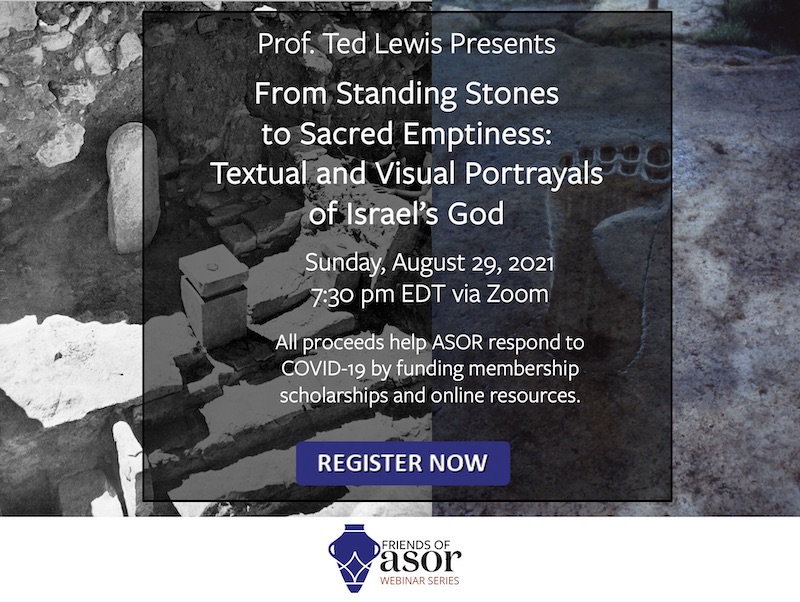
From Standing Stones to Sacred Emptiness: Textual and Visual Portrayals of Israel’s God


Registrants now receive a discount code for 30% off of Ted’s book from Oxford University Press!

Friends of ASOR present the next webinar in our monthly series on August 29, at 7:30 pm EDT, featuring Prof. Theodore Lewis. Portrayals of divinity are incredibly complex as they are culturally, sociologically, politically, and theologically contingent. Asking the simple question about how ancient Israelites and Judahites portrayed God (i.e. El and Yahweh) turns into a historical puzzle, interacting with a wide variety of ancient writers and artisans on how they conceptualized divinity. Did they imagine Israelite El as an enthroned, benevolent patriarch, a majestic bull, or even a solid block of stone? What about Yahweh and the Hebrew Bible’s aniconic tradition that the Almighty is not to be portrayed in concrete form?

This webinar will sift through both visual (archaeological) and textual narratives as they have diverse functions and/or audiences and reflect different kinds of literacies. We’ll look at artisans’ considerable diversity, from standing stone installations to anthropomorphic figurines to bull images. Even within the Hebrew Bible’s aniconic tradition we see diversity—from the ethereal quality of fire to solar metaphors to abstract notions of Yahweh taking up residence via his sacred “Name” or manifesting through “radiance” (kābôd yhwh) that conjures Neo-Assyrian melammu imagery. Strikingly, we’ll also investigate the use of sacred emptiness to portray divinity. How is it that less is more? Wide ranging questions will be explored and invited. Are there archaeological correlates for such abstract expressions? How do we imagine the pragmatic focal points for ritual performance? Join us for this exploration of some of the expressions of divine presence in the lives of ancient Israelites and Judahites. Prof. Lewis will conclude his webinar with a live Q&A session. For more information on this topic, please check out the speaker’s recent article in The Ancient Near East Today on “The (Historical) Origin of God.”

Theodore J. Lewis holds the Blum-Iwry Professorship in Near Eastern Studies at Johns Hopkins University. He is a Semitist, a Hebrew Bible scholar, and a historian of religion whose research has been awarded a Guggenheim Fellowship. Lewis received his Ph.D. from Harvard University and also studied at the Hebrew University in Jerusalem as an ITT Fellow. Prior to coming to Johns Hopkins he taught at Harvard University and the University of Georgia.

Lewis is the author of The Origin and Character of God: The Religion of Ancient Israel through the Lens of Divinity (Oxford University Press), which received the 2020 Frank Moore Cross Award from ASOR for “the most substantial volume related to the history and/or religion of the ancient Near East and Eastern Mediterranean.”  He is also the author of Cults of the Dead in Ancient Israel and Ugarit (Harvard Semitic Monographs) and co-author of Ugaritic Narrative Poetry. He is General Editor of the Writings from the Ancient World series (SBL Press).

ASOR Sustaining Members: $0 | ASOR Members: $5 | Public: $10

To receive your ASOR member discount, log into the online store. If you are new to ASOR, please click on the “New Visitor Registration” link to register your e-mail address and choose password for our online store. Once logged in, navigate to “Meeting and Event Registration” to register for the webinar and pay the fee. Each paid registrant will receive a confirmation e-mail when you pay for the webinar. If you do not receive this e-mail, then you are not registered. Please e-mail membership@asor.org with any questions or issues with registering.

You will be e-mailed the Zoom Webinar link in the week prior to the lecture on August 29, 2021 If you do not receive the link by the close of business on the Tuesday before the webinar, please e-mail membership@asor.org immediately. All webinars are recorded and all paid registrants will be sent a link to view the recording.

All proceeds from this lecture are used to fund scholarships for members impacted by COVID-19 as well as increasing ASOR’s online resources, which are free to the public.

WHY SPONSOR A WEBINAR?

Several levels of support from $50-$1,000 are available. Proceeds go towards membership scholarships and towards increasing ASOR’s virtual resources. Each sponsorship is tax-deductible and you can give your friends free registrations to a webinar!

Bronze Level ($50): up to 2 guest registrations
Silver Level ($100): up to 5 guest registrations
Gold Level ($500): up to 20 guest registrations
Platinum Level ($1,000): up to 50 guest registrations

After you sign up for a sponsorship online or over the phone, email the names and email addresses of your guests to Felice Herman at membership@asor.org, who will send your guests a confirmation and the Zoom link before the webinar.

WANT TO SAVE $5.00 ON THE NEXT WEBINAR?

Join ASOR as a member! Click here for more details about discounts for events and other benefits of membership. Memberships start at $40 for the year as an Associate Member.

Not ready to join yet? Become a Friend of ASOR for FREE!

Click here for more details about our online resources.

PAST WEBINARS

You can now purchase the link to the recording of any webinar. You can also purchase the bundle packages of all webinars from the 2020-2022 seasons. Please e-mail membership@asor.org for purchase details.

To see a printable pdf of the webinar titles from the 2020-2021 season, please click here. To see a printable pdf of the webinar titles from the 2021-2022 season, please click here.

Pricing:

Members: $6.00 per recording
Non-Members: $12.00 per recording
Bundle of 2020-2021 Webinars: $75.00
Bundle of 2021-2022 Webinars: $75.00
Bundle of 2020-2022 Webinars: $125.00

2021-2022 Season

A World at War: Protecting Cultural Heritage in Times of Conflict
Patty Gerstenblith (DePaul University), Lisa Ackerman (Columbus Citizens Foundation), Andrew Cohen (Government Professional and Cultural Heritage Expert) | May 12, 2022

Preserving Cultural Heritage in Hisban and Umm al-Jimal, Jordan
Øystein LaBianca (Andrews University), Elizabeth Osinga (Umm al-Jimal Archaeological Project), Darrell Rohl (Calvin University) | April 24, 2022

Back to the Field: Recent Discoveries & Summer Plans 2022
Lorenzo d’Alfonso (ISAW), Kathryn Grossman (NC State University), James R. Strange (Samford University) | April 3, 2022

Uncovering What is Nubian Beneath the Veneer of Egyptianness: Excavating the Archives
Debora Heard (University of Chicago) | March 20, 2022

Where Are They Now?: A Preview of 2022 ASOR-Affiliated Fieldwork Projects
Michael Given (University of Glasgow), Xenia-Paula Kyriakou (Florida Gulf Coast University), Stephen Batiuk (University of Toronto), Monique Roddy (Walla Walla University), Kent Bramlett (La Sierra University), Friedbert Ninow (La Sierra University), and Michael Hoff (University of Nebraska-Lincoln) | March 8, 2022

Excavations at Tel Gezer: A Personal Story
Sam Wolff (Tel Gezer Laboratory) | February 20, 2022

Tel Rehov: A Major Bronze and Iron Age City in the Jordan Valley
Amihai Mazar (Hebrew University of Jerusalem), Nava Panitz-Cohen ( Hebrew University of Jerusalem), Nota Kourou (Athens University), Naama Yahalom-Mack (Hebrew University of Jerusalem), Robert Mullins (Azusa Pacific University) | February 10, 2022

The Not-So-Innocents Abroad: The Beginnings of American Biblical Archaeology
Rachel Hallote (Samford University) | January 20, 2022

Synagogues as Jesus Knew Them
James R. Strange (Samford University) | December 2, 2021

Under Jerusalem: The Buried History of the World’s Most Contested City
Andrew Lawler | November 4, 2021

Jesus and Jerusalem on TV: How Do Bible Documentaries Get Made?
Robert Cargill (University of Iowa) | October 17, 2021

Digging the Divine?: Judahite Pillar Figurines and the Archaeology of Israelite Religion
Erin Darby (University of Tennessee) | October 7, 2021

David, Solomon, and Rehoboam’s Kingdom—The Archaeological Evidence
Yosef Garfinkel (Hebrew University of Jerusalem) | September 19, 2021

From Standing Stones to Sacred Emptiness: Textual and Visual Portrayals of Israel’s God
Theodore Lewis (Johns Hopkins University) | August 29, 2021

2020-2021 Season

Making May Matter: Webinarathon to Endow Diversity
Multiple Speakers | May 21-23, 2021

Archaeogaming: Why Video Games Deserve Their Own Archaeology
Tine Rassalle (University of North Carolina at Chapel Hill), Shannon Martino (Morton College), Matthew Winter (University of Arizona), Michael Zimmerman (Rhode Island) | April 18, 2021

How the Bible Became a Book
William Schniedewind (UCLA) | March 21, 2021

The Mysteries of Mithras in Caesarea: Exploring the Cult’s Rites and Remains
Jane DeRose Evans (Temple University), Alexandra Ratzlaff (Brandeis University) | March 11, 2021

Archaeology and the Hidden Religious Culture of Israelite Women
Carol Meyers (Duke University) | February 21, 2021

Meet the Directors—Fundraiser to Support ASOR’s Affiliated Overseas Research Centers
Matthew J. Adams (AIAR), Pearce Paul Creasman (ACOR), Lindy Crewe (CAARI) | February 11, 2021

Early Synagogues, Jesus, and Galilee—A Jewish Perspective
Eric Meyers (Duke University) | December 13, 2020

Home Sweet Home: Ancient Israelite Households in Context
Cynthia Shafer-Elliott (William Jessup University) | October 18, 2020

Priestesses in the Days of Solomon and Ahab
Susan Ackerman (Dartmouth College) | September 13, 2020

Digging Deeper: How Archaeology Works
Eric H. Cline (The George Washington University) | August 9, 2020

FOA Webinar: Archaeogaming on Apr. 18

FRIENDS OF ASOR WEBINARS

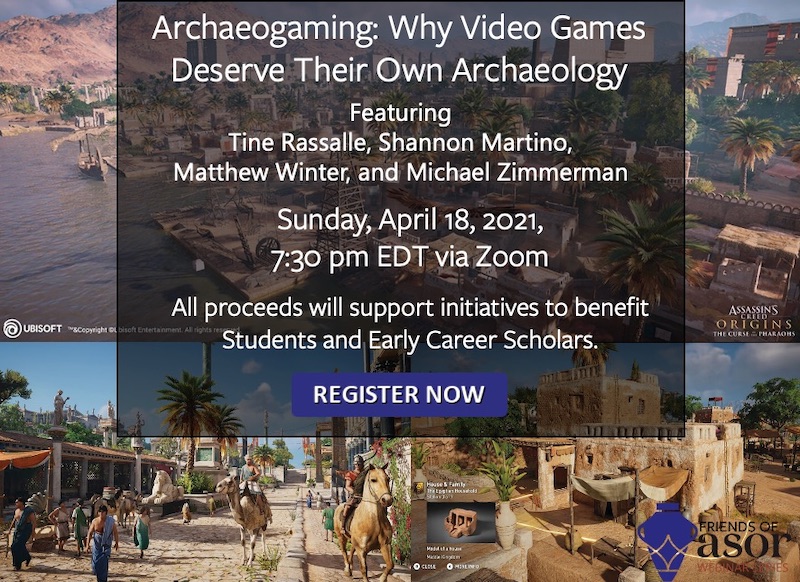
Archaeogaming: Why Video Games Deserve Their Own Archaeology

Friends of ASOR presents the next webinar in our monthly series on April 18, at 7:30 pm EDT. Ever wonder how archaeology “plays” into the world of video games? Following the publication of the March 2021 issue of Near Eastern Archaeology, this webinar and a panel of four scholars will introduce you to the key concepts of “archaeogaming,” or the intersection of archaeology and video games. A rapidly emerging field, archaeogaming studies the representation of archaeology in video games, the historical narratives in video games, the use of video games as pedagogical tools in the archaeological classroom, and so much more. The discussants will seek to demonstrate how video games can no longer be overlooked as tools to communicate with a general audience and how video games are intriguing new subjects and places for archaeologists to study. Digital games are the new archaeological sites, landscapes, and artifacts. Please join us for this exciting and relevant discussion where we will delve into the world of gaming: no previous experience required! The webinar will conclude with a live Q&A session with the panel that will give you the opportunity to ask questions about this exciting new field.

Tine Rassalle is a PhD candidate in the Religious Studies department at the University of North Carolina at Chapel Hill. She has an MA in Archaeology of the ancient Near East from Gent University (Belgium) and another BA in Hebrew and Aramaic Languages and Cultures from Leiden University (the Netherlands). Her main research focuses on the material culture of ancient Judaism and early Christianity in Palestine. She is currently finishing up her dissertation project: a digital database of coin deposits found in ancient synagogues from Late Antique Palestine. Tine is the field supervisor of the Horvat Kur excavations in the Galilee, an executive staff member of SASA (Save Ancient Studies Alliance), and a member of the ASOR Early Career Scholars Committee. Her main hobby, however, is playing video games, which has now started to influence her scholarly work. She has been writing articles and has given talks on archaeogaming, and she recently guest-edited a special issue of ASOR’s Near Eastern Archaeology journal, focused entirely on archaeogaming.


Shannon Martino is an archaeologist and art historian living in Chicago, Illinois, who specializes in archaeological ceramic illustration and ceramic analysis. Shannon graduated from the University of Chicago with an honors BA in Anthropology and earned her PhD from the University of Pennsylvania in Art History. Her work focuses on Chalcolithic ceramics and clay figurines from the eastern Balkans and Turkey and she is currently a member of the Yalburt Yaylası archaeological team and a faculty member of Morton College in Cicero, IL.


Matthew Winter is an archaeologist, with a PhD in Anthropology from the University of Arizona with a focus on the archaeology of the ancient Mediterranean and Near East. In addition to archaeogaming, his research interests focus on archaeological and anthropological theory, social network analysis, ancient urbanism, approaches to the archaeology of religion and identity, and the archaeology and anthropology of food. He has been involved in several different archaeological projects in Italy, Israel, and Jordan.


Michael Zimmerman is an archaeologist, with a PhD from the Joukowsky Institute for Archaeology and the Ancient World at Brown University. He also holds an MA in Classical Languages from the University of Florida. He has been involved in the past ten years in the analysis and publication of pottery, lamps and other ceramic material from the Joint Expeditions to Caesarea Maritima in Israel. His graduate work, centered on the analysis of Hellenistic and Roman period pottery from ‘Iraq al-Amir in Jordan, was published by ASOR in late 2019. He has excavated at a number of archaeological sites, including Caesarea Maritima in Israel, the Petra Great Temple Project in Jordan, and the Middleboro Little League Site in Massachusetts, as he expanded into the field of North American archaeology. His other work and research interests include archaeogaming in pedagogical contexts, antiquities trafficking, cultural heritage law and public policy, pottery studies, the archaeology of the Near East, and the prehistoric archaeology of Northeastern America. He teaches introductory and upper level archaeology courses, Middle Eastern cultures, and myth and folklore courses.

ASOR Sustaining Members: $0 | ASOR Members: $5 | Public: $10

To receive your ASOR member discount, log into the online store. If you are new to ASOR, please click on the “New Visitor Registration” link to register your e-mail address and choose a password for our online store. Once logged in, navigate to “Meeting and Event Registration” to register for the webinar and pay the fee. Each paid registrant will receive a confirmation e-mail when you pay for the webinar. If you do not receive this e-mail, then you are not registered. Please e-mail membership@asor.org with any questions or issues with registering.

You will be e-mailed the Zoom Webinar link in the week prior to the lecture on April 18, 2021. If you do not receive the link by the close of business on the Thursday before the webinar, please e-mail membership@asor.org immediately. All webinars are recorded and all paid registrants will be sent a link to view the recording.

All proceeds will support initiatives to benefit Students and Early Career Scholars.

WHY SPONSOR A WEBINAR?

Several levels of support from $50-$1,000 are available. Proceeds go towards membership scholarships and towards increasing ASOR’s virtual resources. Each sponsorship is tax-deductible and you can give your friends free registrations to a webinar!

Bronze Level ($50): up to 2 guest registrations
Silver Level ($100): up to 5 guest registrations
Gold Level ($500): up to 20 guest registrations
Platinum Level ($1,000): up to 50 guest registrations

After you sign up for a sponsorship online or over the phone, email the names and email addresses of your guests to Felice Herman at membership@asor.org, who will send your guests a confirmation and the Zoom link before the webinar.

WANT TO SAVE $5.00 ON THE NEXT WEBINAR?

Join ASOR as a member! Click here for more details about discounts for events and other benefits of membership. Memberships start at $40 for the year as an Associate Member.

Not ready to join yet? Become a Friend of ASOR for FREE!

Click here for more details about our online resources.

PAST WEBINARS

You can now purchase the link to the recording of any webinar. You can also purchase the bundle packages of all webinars from the 2020-2022 seasons. Please e-mail membership@asor.org for purchase details.

To see a printable pdf of the webinar titles from the 2020-2021 season, please click here. To see a printable pdf of the webinar titles from the 2021-2022 season, please click here.

Pricing:

Members: $6.00 per recording
Non-Members: $12.00 per recording
Bundle of 2020-2021 Webinars: $75.00
Bundle of 2021-2022 Webinars: $75.00
Bundle of 2020-2022 Webinars: $125.00

2021-2022 Season

A World at War: Protecting Cultural Heritage in Times of Conflict
Patty Gerstenblith (DePaul University), Lisa Ackerman (Columbus Citizens Foundation), Andrew Cohen (Government Professional and Cultural Heritage Expert) | May 12, 2022

Preserving Cultural Heritage in Hisban and Umm al-Jimal, Jordan
Øystein LaBianca (Andrews University), Elizabeth Osinga (Umm al-Jimal Archaeological Project), Darrell Rohl (Calvin University) | April 24, 2022

Back to the Field: Recent Discoveries & Summer Plans 2022
Lorenzo d’Alfonso (ISAW), Kathryn Grossman (NC State University), James R. Strange (Samford University) | April 3, 2022

Uncovering What is Nubian Beneath the Veneer of Egyptianness: Excavating the Archives
Debora Heard (University of Chicago) | March 20, 2022

Where Are They Now?: A Preview of 2022 ASOR-Affiliated Fieldwork Projects
Michael Given (University of Glasgow), Xenia-Paula Kyriakou (Florida Gulf Coast University), Stephen Batiuk (University of Toronto), Monique Roddy (Walla Walla University), Kent Bramlett (La Sierra University), Friedbert Ninow (La Sierra University), and Michael Hoff (University of Nebraska-Lincoln) | March 8, 2022

Excavations at Tel Gezer: A Personal Story
Sam Wolff (Tel Gezer Laboratory) | February 20, 2022

Tel Rehov: A Major Bronze and Iron Age City in the Jordan Valley
Amihai Mazar (Hebrew University of Jerusalem), Nava Panitz-Cohen ( Hebrew University of Jerusalem), Nota Kourou (Athens University), Naama Yahalom-Mack (Hebrew University of Jerusalem), Robert Mullins (Azusa Pacific University) | February 10, 2022

The Not-So-Innocents Abroad: The Beginnings of American Biblical Archaeology
Rachel Hallote (Samford University) | January 20, 2022

Synagogues as Jesus Knew Them
James R. Strange (Samford University) | December 2, 2021

Under Jerusalem: The Buried History of the World’s Most Contested City
Andrew Lawler | November 4, 2021

Jesus and Jerusalem on TV: How Do Bible Documentaries Get Made?
Robert Cargill (University of Iowa) | October 17, 2021

Digging the Divine?: Judahite Pillar Figurines and the Archaeology of Israelite Religion
Erin Darby (University of Tennessee) | October 7, 2021

David, Solomon, and Rehoboam’s Kingdom—The Archaeological Evidence
Yosef Garfinkel (Hebrew University of Jerusalem) | September 19, 2021

From Standing Stones to Sacred Emptiness: Textual and Visual Portrayals of Israel’s God
Theodore Lewis (Johns Hopkins University) | August 29, 2021

2020-2021 Season

Making May Matter: Webinarathon to Endow Diversity
Multiple Speakers | May 21-23, 2021

Archaeogaming: Why Video Games Deserve Their Own Archaeology
Tine Rassalle (University of North Carolina at Chapel Hill), Shannon Martino (Morton College), Matthew Winter (University of Arizona), Michael Zimmerman (Rhode Island) | April 18, 2021

How the Bible Became a Book
William Schniedewind (UCLA) | March 21, 2021

The Mysteries of Mithras in Caesarea: Exploring the Cult’s Rites and Remains
Jane DeRose Evans (Temple University), Alexandra Ratzlaff (Brandeis University) | March 11, 2021

Archaeology and the Hidden Religious Culture of Israelite Women
Carol Meyers (Duke University) | February 21, 2021

Meet the Directors—Fundraiser to Support ASOR’s Affiliated Overseas Research Centers
Matthew J. Adams (AIAR), Pearce Paul Creasman (ACOR), Lindy Crewe (CAARI) | February 11, 2021

Early Synagogues, Jesus, and Galilee—A Jewish Perspective
Eric Meyers (Duke University) | December 13, 2020

Home Sweet Home: Ancient Israelite Households in Context
Cynthia Shafer-Elliott (William Jessup University) | October 18, 2020

Priestesses in the Days of Solomon and Ahab
Susan Ackerman (Dartmouth College) | September 13, 2020

Digging Deeper: How Archaeology Works
Eric H. Cline (The George Washington University) | August 9, 2020

Meet the New BASOR Editors

[vc_row fullwidth=”true” attached=”true” css=”.vc_custom_1496247803139{padding-top: 0px !important;padding-right: 0px !important;padding-bottom: 0px !important;padding-left: 0px !important;}”][vc_column][vc_single_image image=”53271″ img_size=”1920×400″ alignment=”center”][/vc_column][/vc_row][vc_row fullwidth=”true” css=”.vc_custom_1496682730308{padding-top: 10px !important;padding-right: 0px !important;padding-bottom: 0px !important;padding-left: 0px !important;}”][vc_column width=”1/12″ css=”.vc_custom_1496683820796{margin-right: 10px !important;}” offset=”vc_hidden-md vc_hidden-sm vc_hidden-xs”][vc_column_text]

 SHARE

[/vc_column_text][mk_image src=”http://www.asortest.org/wp-content/uploads/2017/01/social-fb-icon4.jpg” image_width=”42″ image_height=”42″ hover=”false” custom_url=”https://www.facebook.com/ASOResearch/” margin_bottom=”0″][mk_image src=”http://www.asortest.org/wp-content/uploads/2017/01/social-tw-icon4.jpg” image_width=”42″ image_height=”42″ hover=”false” custom_url=”https://twitter.com/ASOResearch?ref_src=twsrc%5Egoogle%7Ctwcamp%5Eserp%7Ctwgr%5Eauthor” margin_bottom=”0″][mk_image src=”http://www.asortest.org/wp-content/uploads/2017/01/social-in-icon4.jpg” image_width=”42″ image_height=”42″ hover=”false” custom_url=”https://www.linkedin.com/company/american-schools-of-oriental-research” margin_bottom=”0″][mk_image src=”http://www.asortest.org/wp-content/uploads/2017/01/social-ml-icon_7.jpg” image_width=”42″ image_height=”42″ hover=”false” custom_url=”mailto:info@asor.org” margin_bottom=”0″][mk_image src=”http://www.asortest.org/wp-content/uploads/2017/01/blog-icon3.jpg” image_width=”42″ image_height=”42″ hover=”false” custom_url=”http://asor.org/blog” margin_bottom=”0″][/vc_column][vc_column border_color=”rgba(255,255,255,0.01)” width=”1/6″ css=”.vc_custom_1496683923840{margin-right: 20px !important;border-left-width: 2px !important;padding-right: 20px !important;padding-left: 20px !important;border-left-color: #99422f !important;}”][mk_divider divider_color=”rgba(255,255,255,0.01)” thickness=”1″ margin_top=”3″ margin_bottom=”3″][vc_widget_sidebar sidebar_id=”ca-sidebar-39801″][/vc_column][vc_column border_color=”rgba(170,170,170,0.01)” width=”1/2″ css=”.vc_custom_1487276122024{margin-right: 10px !important;margin-bottom: 30px !important;border-right-width: 2px !important;border-bottom-width: 2px !important;padding-top: 30px !important;padding-right: 30px !important;padding-left: 20px !important;background-color: #ffffff !important;border-right-color: rgba(227,228,228,0.75) !important;border-bottom-color: rgba(227,228,228,0.75) !important;}”][vc_column_text responsive_align=”left”]

MEET THE NEW EDITORS OF BASOR

[/vc_column_text][mk_divider][vc_wp_text]Last year, ASOR announced the appointment of the new editors of The Bulletin of ASOR (BASOR)—a team of four scholars from the United States and Europe. All four team members have since started their term in January 2021, working on the May 2021 issue. The new editors succeeded the previous co-editors, Eric Cline and Christopher Rollston. This team of four brings extensive editorial experience and diverse academic backgrounds that reflect the diversity of ASOR’s membership and mandate. The editors were nominated by the BASOR Editorial Search Committee after an extensive public search process. The nomination was unanimously endorsed by ASOR’s Publications Committee, and the editors were unanimously approved by the ASOR Board of Trustees in May 2020. BASOR editors are appointed for a three-year term, with the possibility of being re-appointed for a second term. Their initial term will run from 2021–2023.[/vc_wp_text][vc_row_inner][vc_column_inner width=”1/4″][vc_single_image image=”72927″ add_caption=”yes” alignment=”center” css=”.vc_custom_1614632853896{padding-right: 10px !important;}”][/vc_column_inner][vc_column_inner width=”1/4″][vc_single_image image=”72928″ add_caption=”yes” alignment=”center” css=”.vc_custom_1614632872360{padding-right: 10px !important;}”][/vc_column_inner][vc_column_inner width=”1/4″][vc_single_image image=”72934″ add_caption=”yes” alignment=”center” css=”.vc_custom_1614694724047{padding-right: 10px !important;}”][/vc_column_inner][vc_column_inner width=”1/4″][vc_single_image image=”72935″ add_caption=”yes” alignment=”center” css=”.vc_custom_1614632928270{padding-right: 10px !important;}”][/vc_column_inner][/vc_row_inner][mk_padding_divider][vc_wp_text]Susan Cohen (Montana State University) is an archaeologist, focusing on rural-urban relations and interactions and chronological connections between Egypt and the southern Levant.

Regine Pruzsinszky (Albert-Ludwigs-University Freiburg) is an Assyriologist with a particular interest in Semitic and Hurrian onomastics, Mesopotamian chronology of the second millennium BCE, and the socio-cultural role of musicians in the Ancient Near East. Susan and Regine lead the team as co-editors.

Jana Mynářová (Charles University in Prague) is an Assyriologist and Egyptologist, focusing on political and cultural relations of Egypt and the Near East.

Marwan Kilani (currently a postdoc researcher associated with the Freie Universität in Berlin and the Swiss National Science Foundation) is an Egyptologist and linguist working on cultural and linguistic interactions between Egypt and the Levant. He has a strong interest in methodological questions, and in digital humanities and computational methods applied to the study of the ancient world. Both Jana and Marwan have joined the team as associate editors.

BASOR is a leader among peer-reviewed academic journals of the ancient Near East. Since 1919, BASOR has served as a highly respected interdisciplinary English-language forum for scholars worldwide in subjects pertaining to the archaeological and history of the ancient Near Eastern world. The journal publishes articles by emerging and established scholars of the ancient world focusing on the regions of the Levant, Mesopotamia, Cyprus, Anatolia, Iran, Caucasus, and Egypt with a chronological range from the Paleolithic through the early modern period.

BASOR appears bi-annually, in May and November. Submissions of particular interest include articles that present original research, novel archaeological interpretations, theoretical analysis, and contributions based on innovative approaches to the study of the ancient world. The journal also contains reviews and commentaries on the latest books. Suggestions are also welcomed for occasional theme issues relating to topics of broad scholarly interest. Those interested in publishing in BASOR should continue to submit manuscripts through the online submission system. Questions, comments, or suggestions for the new editors? You can now contact them at basor@asor.org.[/vc_wp_text][/vc_column][vc_column border_color=”rgba(170,170,170,0.01)” width=”1/6″ css=”.vc_custom_1496684098866{margin-right: 5px !important;margin-bottom: 20px !important;border-right-width: 2px !important;border-bottom-width: 2px !important;padding-top: 30px !important;padding-right: 10px !important;padding-left: 10px !important;background-color: #ffffff !important;border-right-color: rgba(227,228,228,0.75) !important;border-bottom-color: rgba(227,228,228,0.75) !important;}”][vc_wp_posts title=”BROWSE THE NEWS ARCHIVE” number=”4″][/vc_column][vc_column border_color=”rgba(170,170,170,0.01)” width=”1/6″ css=”.vc_custom_1496684008271{margin-right: 10px !important;margin-bottom: 30px !important;border-right-width: 2px !important;border-bottom-width: 2px !important;padding-top: 30px !important;padding-right: 20px !important;padding-left: 20px !important;background-color: #ffffff !important;border-right-color: rgba(227,228,228,0.75) !important;border-bottom-color: rgba(227,228,228,0.75) !important;}”][vc_column_text] [/vc_column_text][/vc_column][/vc_row]

FOA Webinar: Bill Schniedewind on Mar. 21

FRIENDS OF ASOR WEBINARS

How the Bible Became a Book

Friends of ASOR presents the next webinar in our monthly series on March 21, at 7:30 pm EDT, featuring Prof. William Schniedewind. An expert in ancient biblical interpretation, the social history of the ancient eastern Mediterranean world, and sociolinguistics of Classical Hebrew, Dr. Schniedewind will address some fundamental questions: How did the Bible become a book? And why did these texts become scripture? This lecture explores answers about the origins of the biblical literary traditions from an anthropological perspective beginning with the epigraphic and archaeological evidence. Early Israel was originally a pastoral and agrarian society, yet it created an extensive literary tradition. Seminal social and political changes in Jerusalem began in the late eighth century and resulted in an expanded role for writing and the beginnings of biblical literature. But archaeological and epigraphic evidence for Hebrew writing ends with the Babylonian exile and does not reemerge until the late Persian period. Join us for this master class on how to examine the Bible based on its linguistic structure and historical background. Prof. Schniedewind will conclude his webinar with a live Q&A session.

William Schniedewind is a Professor of Biblical Studies at UCLA. He has been the Chair of the Department of Near Eastern Languages and Cultures at UCLA and held the Kershaw Endowed Chair of Ancient Eastern Mediterranean Studies. He received a B.A. in Religion from George Fox University (1984), a M.A. in Historical Geography from Jerusalem University College, and a Ph.D. in Bible and Ancient Near East from Brandeis University (1992). He has been a Visiting Scholar at the Hebrew University and a Research Fellow at the Albright Institute of Archaeological Research in Jerusalem. He is the author of six books including How the Bible Became a Book: the Textualization of Ancient Israel (Cambridge University Press, 2004), A Social History of Hebrew: its Origins Through the Rabbinic Period (Yale University Press, 2013), and The Finger of the Scribe: How Scribes Learned to Write the Bible (Oxford University Press, 2019).

ASOR Sustaining Members: $0 | ASOR Members: $5 | Public: $10

To receive your ASOR member discount, log into the online store. If you are new to ASOR, please click on the “New Visitor Registration” link to register your e-mail address and choose password for our online store. Once logged in, navigate to “Meeting and Event Registration” to register for the webinar and pay the fee. Each paid registrant will receive a confirmation e-mail when you pay for the webinar. If you do not receive this e-mail, then you are not registered. Please e-mail membership@asor.org with any questions or issues with registering.

You will be e-mailed the Zoom Webinar link in the week prior to the lecture on March 21, 2021. If you do not receive the link by the close of business on the Thursday before the webinar, please e-mail membership@asor.org immediately. All webinars are recorded and all paid registrants will be sent a link to view the recording.

All proceeds from this lecture are used to fund scholarships for members impacted by COVID-19 as well as increasing ASOR’s online resources, which are free to the public.

WHY SPONSOR A WEBINAR?

Several levels of support from $50-$1,000 are available. Proceeds go towards membership scholarships and towards increasing ASOR’s virtual resources. Each sponsorship is tax-deductible and you can give your friends free registrations to a webinar!

Bronze Level ($50): up to 2 guest registrations
Silver Level ($100): up to 5 guest registrations
Gold Level ($500): up to 20 guest registrations
Platinum Level ($1,000): up to 50 guest registrations

After you sign up for a sponsorship online or over the phone, email the names and email addresses of your guests to Felice Herman at membership@asor.org, who will send your guests a confirmation and the Zoom link before the webinar.

WANT TO SAVE $5.00 ON THE NEXT WEBINAR?

Join ASOR as a member! Click here for more details about discounts for events and other benefits of membership. Memberships start at $40 for the year as an Associate Member.

Not ready to join yet? Become a Friend of ASOR for FREE!

Click here for more details about our online resources.

PAST WEBINARS

You can now purchase the link to the recording of any webinar. You can also purchase the bundle packages of all webinars from the 2020-2022 seasons. Please e-mail membership@asor.org for purchase details.

To see a printable pdf of the webinar titles from the 2020-2021 season, please click here. To see a printable pdf of the webinar titles from the 2021-2022 season, please click here.

Pricing:

Members: $6.00 per recording
Non-Members: $12.00 per recording
Bundle of 2020-2021 Webinars: $75.00
Bundle of 2021-2022 Webinars: $75.00
Bundle of 2020-2022 Webinars: $125.00

2021-2022 Season

A World at War: Protecting Cultural Heritage in Times of Conflict
Patty Gerstenblith (DePaul University), Lisa Ackerman (Columbus Citizens Foundation), Andrew Cohen (Government Professional and Cultural Heritage Expert) | May 12, 2022

Preserving Cultural Heritage in Hisban and Umm al-Jimal, Jordan
Øystein LaBianca (Andrews University), Elizabeth Osinga (Umm al-Jimal Archaeological Project), Darrell Rohl (Calvin University) | April 24, 2022

Back to the Field: Recent Discoveries & Summer Plans 2022
Lorenzo d’Alfonso (ISAW), Kathryn Grossman (NC State University), James R. Strange (Samford University) | April 3, 2022

Uncovering What is Nubian Beneath the Veneer of Egyptianness: Excavating the Archives
Debora Heard (University of Chicago) | March 20, 2022

Where Are They Now?: A Preview of 2022 ASOR-Affiliated Fieldwork Projects
Michael Given (University of Glasgow), Xenia-Paula Kyriakou (Florida Gulf Coast University), Stephen Batiuk (University of Toronto), Monique Roddy (Walla Walla University), Kent Bramlett (La Sierra University), Friedbert Ninow (La Sierra University), and Michael Hoff (University of Nebraska-Lincoln) | March 8, 2022

Excavations at Tel Gezer: A Personal Story
Sam Wolff (Tel Gezer Laboratory) | February 20, 2022

Tel Rehov: A Major Bronze and Iron Age City in the Jordan Valley
Amihai Mazar (Hebrew University of Jerusalem), Nava Panitz-Cohen ( Hebrew University of Jerusalem), Nota Kourou (Athens University), Naama Yahalom-Mack (Hebrew University of Jerusalem), Robert Mullins (Azusa Pacific University) | February 10, 2022

The Not-So-Innocents Abroad: The Beginnings of American Biblical Archaeology
Rachel Hallote (Samford University) | January 20, 2022

Synagogues as Jesus Knew Them
James R. Strange (Samford University) | December 2, 2021

Under Jerusalem: The Buried History of the World’s Most Contested City
Andrew Lawler | November 4, 2021

Jesus and Jerusalem on TV: How Do Bible Documentaries Get Made?
Robert Cargill (University of Iowa) | October 17, 2021

Digging the Divine?: Judahite Pillar Figurines and the Archaeology of Israelite Religion
Erin Darby (University of Tennessee) | October 7, 2021

David, Solomon, and Rehoboam’s Kingdom—The Archaeological Evidence
Yosef Garfinkel (Hebrew University of Jerusalem) | September 19, 2021

From Standing Stones to Sacred Emptiness: Textual and Visual Portrayals of Israel’s God
Theodore Lewis (Johns Hopkins University) | August 29, 2021

2020-2021 Season

Making May Matter: Webinarathon to Endow Diversity
Multiple Speakers | May 21-23, 2021

Archaeogaming: Why Video Games Deserve Their Own Archaeology
Tine Rassalle (University of North Carolina at Chapel Hill), Shannon Martino (Morton College), Matthew Winter (University of Arizona), Michael Zimmerman (Rhode Island) | April 18, 2021

How the Bible Became a Book
William Schniedewind (UCLA) | March 21, 2021

The Mysteries of Mithras in Caesarea: Exploring the Cult’s Rites and Remains
Jane DeRose Evans (Temple University), Alexandra Ratzlaff (Brandeis University) | March 11, 2021

Archaeology and the Hidden Religious Culture of Israelite Women
Carol Meyers (Duke University) | February 21, 2021

Meet the Directors—Fundraiser to Support ASOR’s Affiliated Overseas Research Centers
Matthew J. Adams (AIAR), Pearce Paul Creasman (ACOR), Lindy Crewe (CAARI) | February 11, 2021

Early Synagogues, Jesus, and Galilee—A Jewish Perspective
Eric Meyers (Duke University) | December 13, 2020

Home Sweet Home: Ancient Israelite Households in Context
Cynthia Shafer-Elliott (William Jessup University) | October 18, 2020

Priestesses in the Days of Solomon and Ahab
Susan Ackerman (Dartmouth College) | September 13, 2020

Digging Deeper: How Archaeology Works
Eric H. Cline (The George Washington University) | August 9, 2020

FOA Webinar: Jane DeRose Evans & Alexandra Ratzlaff on Mar. 11

FRIENDS OF ASOR WEBINARS

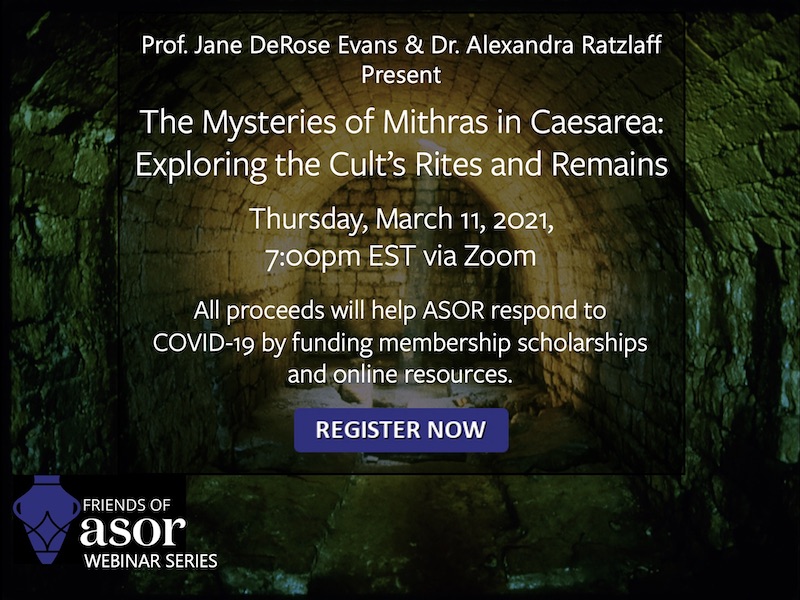
The Mysteries of Mithras in Caesarea: Exploring the Cult’s Rites and Remains

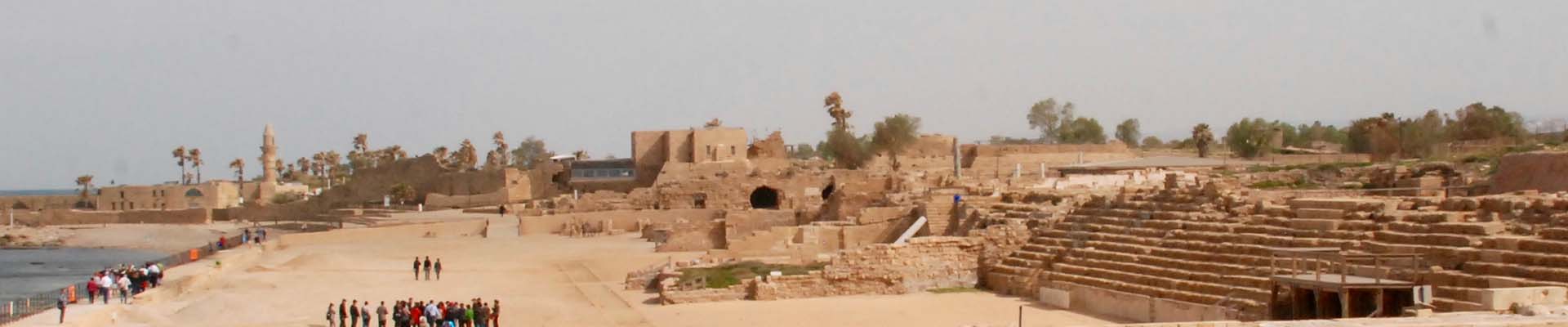
Friends of ASOR presents the next webinar in our monthly series on March 11, at 7:00 pm EST, featuring Prof. Jane DeRose Evans and Dr. Alexandra Ratzlaff. These two experts will take you on a journey underneath the ruins of ancient Caesarea Maritima on the Mediterranean Sea coast of modern Israel. A bustling port city before and during the lifetime of Jesus, this site has provided a wealth of information for scholars studying Caesarea’s Roman era, when it was ruled by Herod the Great, king of Judaea (37 BCE – 4 BCE). When the late Prof. Robert J. Bull’s team arrived to dig in the sand dunes near this ancient harbor in 1974, they discovered a row of warehouses dating to the Roman period. After crawling through several of the structures to decide which one to excavate, they chose the northernmost one in the row. Inside the vault, which had been used in later periods to dispose of decapitated bodies, the excavation team discovered the remains of a Mithraeum, or a place of worship for the mystery cult of Mithras. Join Prof. Evans and Dr. Ratzlaff as they discuss what we know about how the initiates formed the Mithraeum, and what we can uncover about the cult’s secret rites from the frescos painted on the vault walls and the objects left behind following its abandonment. The webinar will conclude with a live Q&A session.

Jane DeRose Evans is Chair and Professor of Art History at Tyler School of Art and Architecture, Temple University. She earned the A.B. in Classics from Franklin & Marshall College, and the M.A. and Ph.D. degrees in Classical Archaeology at the University of Pennsylvania. Jane met Robert Bull (then of Drew University and the Director of the JECM project) when he asked her to publish the excavation coins from the JECM excavations at Caesarea, and she continued to work with him on the materials from Caesarea for many years after they were published. She is currently a numismatist for the Harvard-Cornell Sardis Expeditions and The George Washington University’s Bir Madkhour Project. She leads the team to publish the results of the JECM excavations of the building on top of the warehouses.

Alexandra Ratzlaff is a Lecturer in the Department of Classical Studies at Brandeis University. She earned her BA in Classical Studies and Archaeology at The George Washington University and PhD in Archaeology at Boston University. Alexandra is a Classical and Near Eastern Archaeologist specializing in the Eastern Mediterranean. She is currently an Associate Director of the Tel Kabri Excavations. Beginning in 2021, she will be the Co-Director of a new project at the Roman Fort of Birsama in Israel. She has excavated in Israel on various projects for the last fifteen years. Her research interests include the Roman army, the Late Antique economy, Roman and Byzantine ceramics, Bronze Age economies and state structure. She is also the Project Lead for the Brandeis Techne Group at Autodesk, a long-term research project aimed at developing new equipment and methodologies for digital imaging in archaeology and the humanities.

ASOR Sustaining Members: $0 | ASOR Members: $5 | Public: $10

To receive your ASOR member discount, log into the online store. If you are new to ASOR, please click on the “New Visitor Registration” link to register your e-mail address and choose password for our online store. Once logged in, navigate to “Meeting and Event Registration” to register for the webinar and pay the fee. Each paid registrant will receive a confirmation e-mail when you pay for the webinar. If you do not receive this e-mail, then you are not registered. Please e-mail membership@asor.org with any questions or issues with registering.

You will be e-mailed the Zoom Webinar link in the week prior to the lecture on March 11, 2021. If you do not receive the link by the close of business on the Monday before the webinar, please e-mail membership@asor.org immediately. All webinars are recorded and all paid registrants will be sent a link to view the recording.

All proceeds from this lecture are used to fund scholarships for members impacted by COVID-19 as well as increasing ASOR’s online resources, which are free to the public.

WHY SPONSOR A WEBINAR?

Several levels of support from $50-$1,000 are available. Proceeds go towards membership scholarships and towards increasing ASOR’s virtual resources. Each sponsorship is tax-deductible and you can give your friends free registrations to a webinar!

Bronze Level ($50): up to 2 guest registrations
Silver Level ($100): up to 5 guest registrations
Gold Level ($500): up to 20 guest registrations
Platinum Level ($1,000): up to 50 guest registrations

After you sign up for a sponsorship online or over the phone, email the names and email addresses of your guests to Felice Herman at membership@asor.org, who will send your guests a confirmation and the Zoom link before the webinar.

WANT TO SAVE $5.00 ON THE NEXT WEBINAR?

Join ASOR as a member! Click here for more details about discounts for events and other benefits of membership. Memberships start at $40 for the year as an Associate Member.

Not ready to join yet? Become a Friend of ASOR for FREE!

Click here for more details about our online resources.

PAST WEBINARS

You can now purchase the link to the recording of any webinar. You can also purchase the bundle packages of all webinars from the 2020-2022 seasons. Please e-mail membership@asor.org for purchase details.

To see a printable pdf of the webinar titles from the 2020-2021 season, please click here. To see a printable pdf of the webinar titles from the 2021-2022 season, please click here.

Pricing:

Members: $6.00 per recording
Non-Members: $12.00 per recording
Bundle of 2020-2021 Webinars: $75.00
Bundle of 2021-2022 Webinars: $75.00
Bundle of 2020-2022 Webinars: $125.00

2021-2022 Season

A World at War: Protecting Cultural Heritage in Times of Conflict
Patty Gerstenblith (DePaul University), Lisa Ackerman (Columbus Citizens Foundation), Andrew Cohen (Government Professional and Cultural Heritage Expert) | May 12, 2022

Preserving Cultural Heritage in Hisban and Umm al-Jimal, Jordan
Øystein LaBianca (Andrews University), Elizabeth Osinga (Umm al-Jimal Archaeological Project), Darrell Rohl (Calvin University) | April 24, 2022

Back to the Field: Recent Discoveries & Summer Plans 2022
Lorenzo d’Alfonso (ISAW), Kathryn Grossman (NC State University), James R. Strange (Samford University) | April 3, 2022

Uncovering What is Nubian Beneath the Veneer of Egyptianness: Excavating the Archives
Debora Heard (University of Chicago) | March 20, 2022

Where Are They Now?: A Preview of 2022 ASOR-Affiliated Fieldwork Projects
Michael Given (University of Glasgow), Xenia-Paula Kyriakou (Florida Gulf Coast University), Stephen Batiuk (University of Toronto), Monique Roddy (Walla Walla University), Kent Bramlett (La Sierra University), Friedbert Ninow (La Sierra University), and Michael Hoff (University of Nebraska-Lincoln) | March 8, 2022

Excavations at Tel Gezer: A Personal Story
Sam Wolff (Tel Gezer Laboratory) | February 20, 2022

Tel Rehov: A Major Bronze and Iron Age City in the Jordan Valley
Amihai Mazar (Hebrew University of Jerusalem), Nava Panitz-Cohen ( Hebrew University of Jerusalem), Nota Kourou (Athens University), Naama Yahalom-Mack (Hebrew University of Jerusalem), Robert Mullins (Azusa Pacific University) | February 10, 2022

The Not-So-Innocents Abroad: The Beginnings of American Biblical Archaeology
Rachel Hallote (Samford University) | January 20, 2022

Synagogues as Jesus Knew Them
James R. Strange (Samford University) | December 2, 2021

Under Jerusalem: The Buried History of the World’s Most Contested City
Andrew Lawler | November 4, 2021

Jesus and Jerusalem on TV: How Do Bible Documentaries Get Made?
Robert Cargill (University of Iowa) | October 17, 2021

Digging the Divine?: Judahite Pillar Figurines and the Archaeology of Israelite Religion
Erin Darby (University of Tennessee) | October 7, 2021

David, Solomon, and Rehoboam’s Kingdom—The Archaeological Evidence
Yosef Garfinkel (Hebrew University of Jerusalem) | September 19, 2021

From Standing Stones to Sacred Emptiness: Textual and Visual Portrayals of Israel’s God
Theodore Lewis (Johns Hopkins University) | August 29, 2021

2020-2021 Season

Making May Matter: Webinarathon to Endow Diversity
Multiple Speakers | May 21-23, 2021

Archaeogaming: Why Video Games Deserve Their Own Archaeology
Tine Rassalle (University of North Carolina at Chapel Hill), Shannon Martino (Morton College), Matthew Winter (University of Arizona), Michael Zimmerman (Rhode Island) | April 18, 2021

How the Bible Became a Book
William Schniedewind (UCLA) | March 21, 2021

The Mysteries of Mithras in Caesarea: Exploring the Cult’s Rites and Remains
Jane DeRose Evans (Temple University), Alexandra Ratzlaff (Brandeis University) | March 11, 2021

Archaeology and the Hidden Religious Culture of Israelite Women
Carol Meyers (Duke University) | February 21, 2021

Meet the Directors—Fundraiser to Support ASOR’s Affiliated Overseas Research Centers
Matthew J. Adams (AIAR), Pearce Paul Creasman (ACOR), Lindy Crewe (CAARI) | February 11, 2021

Early Synagogues, Jesus, and Galilee—A Jewish Perspective
Eric Meyers (Duke University) | December 13, 2020

Home Sweet Home: Ancient Israelite Households in Context
Cynthia Shafer-Elliott (William Jessup University) | October 18, 2020

Priestesses in the Days of Solomon and Ahab
Susan Ackerman (Dartmouth College) | September 13, 2020

Digging Deeper: How Archaeology Works
Eric H. Cline (The George Washington University) | August 9, 2020

FOA Webinar: Carol Meyers on Feb. 21

FRIENDS OF ASOR WEBINARS

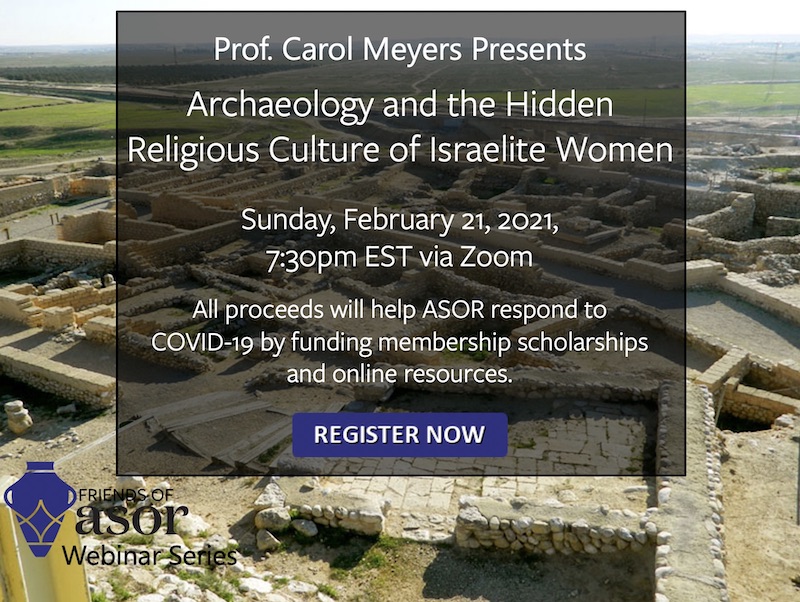
Archaeology and the Hidden Religious Culture of Israelite Women

Friends of ASOR presents the next webinar in our monthly series on February 21, at 7:30 pm EST, featuring Dr. Carol Meyers. An expert in biblical studies, archaeology, and gender in the ancient world, she will address an important question: Who were the most important religious figures in ancient Israel? Most people would probably say that the priests were. But they would be wrong. The main arena of religious life for most people in the biblical period was not the Jerusalem temple or a regional shrine; it was the family household, and women were major figures in household religious activities. Those activities are largely invisible in the Bible with its focus on the priesthood and sacrifice. However, the use of an array of archaeological materials—and also some carefully selected and fascinating ethnographic data—can reveal many aspects of women’s household religious culture and its meaning for the lives of ordinary ancient Israelites.

In this lecture Professor Carol Meyers will take you into the Israelite household for an in-depth look at women’s religious activities, otherwise hidden from view. The webinar will conclude with a live Q&A session.


Registrants now receive a discount code for 30% off of Carol’s book from Oxford University Press!

Carol Meyers received the A.B. with honors from Wellesley College and the M.A. and Ph.D. in Near Eastern and Judaic Studies from Brandeis University. She is currently the Mary Grace Wilson Professor Emerita of Religious Studies at Duke University. A prolific scholar, she has lectured and published widely. She is the author of more than 450 articles, reports, reference-book entries, and reviews; and she has authored, co-authored, or edited twenty-two books. Her 2013 book, Rediscovering Eve: Ancient Israelite Women in Context, is a landmark study of women in ancient Israelite society. Other recent books include a commentary on the book of Exodus and several excavation reports (with Eric Meyers). Among her co-edited volumes are Archaeology, Bible, Politics, and the Media (2012), The Bible in the Public Square (2014), and the Bloomsbury Handbook of Food in the Hebrew Bible and Ancient Israel (forthcoming in 2021).

As a field archaeologist, Meyers has worked on numerous digs since she was an undergraduate, and she has been a staff member and then co-director of several archaeological projects in Israel. She has been a frequent consultant for media productions relating to archaeology and the Bible, including A&E’s Mysteries of the Bible series, DreamWorks’s “Prince of Egypt,” NOVA’s “The Bible’s Buried Secrets,” and several National Geographic documentaries.

Dr. Meyers has served on the editorial boards of many reference works and journals, including the Bulletin of ASOR. She was a senior editor of the Oxford Encyclopedia of Archaeology in the Near East and associate editor of The Torah: A Woman’s Commentary. She is currently a trustee of the American Society of Overseas Research (ASOR) and Vice-President of the Albright Institute of Archaeological Research. She is also a member of the Board of Directors of the Dead Sea Scrolls Foundation and recently served as President of the Society of Biblical Literature. Among her many honors and awards are ASOR’s Charles U. Harris Service Award for her many years of service as an ASOR trustee and ASOR’s P. E. MacAllister Field Archaeology Award for her contributions to Near Eastern archaeology.

ASOR Sustaining Members: $0 | ASOR Members: $5 | Public: $10

To receive your ASOR member discount, log into the online store. If you are new to ASOR, please click on the “New Visitor Registration” link to register your e-mail address and choose password for our online store. Once logged in, navigate to “Meeting and Event Registration” to register for the webinar and pay the fee. Each paid registrant will receive a confirmation e-mail when you pay for the webinar. If you do not receive this e-mail, then you are not registered. Please e-mail membership@asor.org with any questions or issues with registering.

You will be e-mailed the Zoom Webinar link in the week prior to the lecture on February 21, 2021. If you do not receive the link by the close of business on the Thursday before the webinar, please email membership@asor.org immediately. All webinars are recorded and all paid registrants will be sent a link to view the recording.

All proceeds from this lecture are used to fund scholarships for members impacted by COVID-19 as well as increasing ASOR’s online resources, which are free to the public.

WHY SPONSOR A WEBINAR?

Several levels of support from $50-$1,000 are available. Proceeds go towards membership scholarships and towards increasing ASOR’s virtual resources. Each sponsorship is tax-deductible and you can give your friends free registrations to a webinar!

Bronze Level ($50): up to 2 guest registrations
Silver Level ($100): up to 5 guest registrations
Gold Level ($500): up to 20 guest registrations
Platinum Level ($1,000): up to 50 guest registrations

After you sign up for a sponsorship online or over the phone, email the names and email addresses of your guests to Felice Herman at membership@asor.org, who will send your guests a confirmation and the Zoom link before the webinar.

WANT TO SAVE $5.00 ON THE NEXT WEBINAR?

Join ASOR as a member! Click here for more details about discounts for events and other benefits of membership. Memberships start at $40 for the year as an Associate Member.

Not ready to join yet? Become a Friend of ASOR for FREE!

Click here for more details about our online resources.

PAST WEBINARS

You can now purchase the link to the recording of any webinar. You can also purchase the bundle packages of all webinars from the 2020-2022 seasons. Please e-mail membership@asor.org for purchase details.

To see a printable pdf of the webinar titles from the 2020-2021 season, please click here. To see a printable pdf of the webinar titles from the 2021-2022 season, please click here.

Pricing:

Members: $6.00 per recording
Non-Members: $12.00 per recording
Bundle of 2020-2021 Webinars: $75.00
Bundle of 2021-2022 Webinars: $75.00
Bundle of 2020-2022 Webinars: $125.00

2021-2022 Season

A World at War: Protecting Cultural Heritage in Times of Conflict
Patty Gerstenblith (DePaul University), Lisa Ackerman (Columbus Citizens Foundation), Andrew Cohen (Government Professional and Cultural Heritage Expert) | May 12, 2022

Preserving Cultural Heritage in Hisban and Umm al-Jimal, Jordan
Øystein LaBianca (Andrews University), Elizabeth Osinga (Umm al-Jimal Archaeological Project), Darrell Rohl (Calvin University) | April 24, 2022

Back to the Field: Recent Discoveries & Summer Plans 2022
Lorenzo d’Alfonso (ISAW), Kathryn Grossman (NC State University), James R. Strange (Samford University) | April 3, 2022

Uncovering What is Nubian Beneath the Veneer of Egyptianness: Excavating the Archives
Debora Heard (University of Chicago) | March 20, 2022

Where Are They Now?: A Preview of 2022 ASOR-Affiliated Fieldwork Projects
Michael Given (University of Glasgow), Xenia-Paula Kyriakou (Florida Gulf Coast University), Stephen Batiuk (University of Toronto), Monique Roddy (Walla Walla University), Kent Bramlett (La Sierra University), Friedbert Ninow (La Sierra University), and Michael Hoff (University of Nebraska-Lincoln) | March 8, 2022

Excavations at Tel Gezer: A Personal Story
Sam Wolff (Tel Gezer Laboratory) | February 20, 2022

Tel Rehov: A Major Bronze and Iron Age City in the Jordan Valley
Amihai Mazar (Hebrew University of Jerusalem), Nava Panitz-Cohen ( Hebrew University of Jerusalem), Nota Kourou (Athens University), Naama Yahalom-Mack (Hebrew University of Jerusalem), Robert Mullins (Azusa Pacific University) | February 10, 2022

The Not-So-Innocents Abroad: The Beginnings of American Biblical Archaeology
Rachel Hallote (Samford University) | January 20, 2022

Synagogues as Jesus Knew Them
James R. Strange (Samford University) | December 2, 2021

Under Jerusalem: The Buried History of the World’s Most Contested City
Andrew Lawler | November 4, 2021

Jesus and Jerusalem on TV: How Do Bible Documentaries Get Made?
Robert Cargill (University of Iowa) | October 17, 2021

Digging the Divine?: Judahite Pillar Figurines and the Archaeology of Israelite Religion
Erin Darby (University of Tennessee) | October 7, 2021

David, Solomon, and Rehoboam’s Kingdom—The Archaeological Evidence
Yosef Garfinkel (Hebrew University of Jerusalem) | September 19, 2021

From Standing Stones to Sacred Emptiness: Textual and Visual Portrayals of Israel’s God
Theodore Lewis (Johns Hopkins University) | August 29, 2021

2020-2021 Season

Making May Matter: Webinarathon to Endow Diversity
Multiple Speakers | May 21-23, 2021

Archaeogaming: Why Video Games Deserve Their Own Archaeology
Tine Rassalle (University of North Carolina at Chapel Hill), Shannon Martino (Morton College), Matthew Winter (University of Arizona), Michael Zimmerman (Rhode Island) | April 18, 2021

How the Bible Became a Book
William Schniedewind (UCLA) | March 21, 2021

The Mysteries of Mithras in Caesarea: Exploring the Cult’s Rites and Remains
Jane DeRose Evans (Temple University), Alexandra Ratzlaff (Brandeis University) | March 11, 2021

Archaeology and the Hidden Religious Culture of Israelite Women
Carol Meyers (Duke University) | February 21, 2021

Meet the Directors—Fundraiser to Support ASOR’s Affiliated Overseas Research Centers
Matthew J. Adams (AIAR), Pearce Paul Creasman (ACOR), Lindy Crewe (CAARI) | February 11, 2021

Early Synagogues, Jesus, and Galilee—A Jewish Perspective
Eric Meyers (Duke University) | December 13, 2020

Home Sweet Home: Ancient Israelite Households in Context
Cynthia Shafer-Elliott (William Jessup University) | October 18, 2020

Priestesses in the Days of Solomon and Ahab
Susan Ackerman (Dartmouth College) | September 13, 2020

Digging Deeper: How Archaeology Works
Eric H. Cline (The George Washington University) | August 9, 2020

ECS Brown Bag Panel on Academic Careers

[vc_row fullwidth=”true” attached=”true” css=”.vc_custom_1496247803139{padding-top: 0px !important;padding-right: 0px !important;padding-bottom: 0px !important;padding-left: 0px !important;}”][vc_column][vc_single_image image=”36828″ img_size=”1920×400″ alignment=”center”][/vc_column][/vc_row][vc_row fullwidth=”true” css=”.vc_custom_1496682730308{padding-top: 10px !important;padding-right: 0px !important;padding-bottom: 0px !important;padding-left: 0px !important;}”][vc_column width=”1/12″ css=”.vc_custom_1496683820796{margin-right: 10px !important;}” offset=”vc_hidden-md vc_hidden-sm vc_hidden-xs”][vc_column_text]

 SHARE

[/vc_column_text][mk_image src=”http://www.asortest.org/wp-content/uploads/2017/01/social-fb-icon4.jpg” image_width=”42″ image_height=”42″ hover=”false” custom_url=”https://www.facebook.com/ASOResearch/” margin_bottom=”0″][mk_image src=”http://www.asortest.org/wp-content/uploads/2017/01/social-tw-icon4.jpg” image_width=”42″ image_height=”42″ hover=”false” custom_url=”https://twitter.com/ASOResearch?ref_src=twsrc%5Egoogle%7Ctwcamp%5Eserp%7Ctwgr%5Eauthor” margin_bottom=”0″][mk_image src=”http://www.asortest.org/wp-content/uploads/2017/01/social-in-icon4.jpg” image_width=”42″ image_height=”42″ hover=”false” custom_url=”https://www.linkedin.com/company/american-schools-of-oriental-research” margin_bottom=”0″][mk_image src=”http://www.asortest.org/wp-content/uploads/2017/01/social-ml-icon_7.jpg” image_width=”42″ image_height=”42″ hover=”false” custom_url=”mailto:info@asor.org” margin_bottom=”0″][mk_image src=”http://www.asortest.org/wp-content/uploads/2017/01/blog-icon3.jpg” image_width=”42″ image_height=”42″ hover=”false” custom_url=”http://asor.org/blog” margin_bottom=”0″][/vc_column][vc_column border_color=”rgba(255,255,255,0.01)” width=”1/6″ css=”.vc_custom_1496683923840{margin-right: 20px !important;border-left-width: 2px !important;padding-right: 20px !important;padding-left: 20px !important;border-left-color: #99422f !important;}”][mk_divider divider_color=”rgba(255,255,255,0.01)” thickness=”1″ margin_top=”3″ margin_bottom=”3″][vc_widget_sidebar sidebar_id=”ca-sidebar-39801″][/vc_column][vc_column border_color=”rgba(170,170,170,0.01)” width=”1/2″ css=”.vc_custom_1487276122024{margin-right: 10px !important;margin-bottom: 30px !important;border-right-width: 2px !important;border-bottom-width: 2px !important;padding-top: 30px !important;padding-right: 30px !important;padding-left: 20px !important;background-color: #ffffff !important;border-right-color: rgba(227,228,228,0.75) !important;border-bottom-color: rgba(227,228,228,0.75) !important;}”][vc_column_text responsive_align=”left”]

EARLY CAREER SCHOLARS BROWN BAG PANEL ON BUILDING PATHS TO ACADEMIC CAREERS

[/vc_column_text][mk_divider][vc_column_text]The Early Career Scholars of ASOR will hold a virtual panel discussion on building paths to academic careers on February 4, 2021 at 12pm EST via Zoom. The expert panel includes professors from across the US and Israel and originate from various fields in history and archaeology. Speakers will include: Dr. Jay Crisostomo (University of Michigan, Middle East Studies Dept.), Dr. Jane DeRose Evans (Temple University, Art History Dept.), Dr. Aren Maeir (Bar-Ilan University, Land of Israel Studies and Archaeology Dept.), Dr. Julia Troche (Missouri State University, History Dept.), and Dr. K. Lawson Younger (Trinity International University, Divinity School).

The panelists will address topics such as choosing advisors, schools, dissertation topics, building CVs, what skills to acquire as an MA, PhD, post-doc etc. and the current status of the academic job market. To a large extent, the discussion will be shaped by your questions. Please ask them here.

The event, a part of our brown bag lunch series, is a *FREE* benefit for ASOR members. Registration is limited to ASOR members and students at ASOR member schools on a first come, first serve basis. Registrants will receive an email with Zoom access information prior to the event.

[/vc_column_text][/vc_column][vc_column border_color=”rgba(170,170,170,0.01)” width=”1/6″ css=”.vc_custom_1496684098866{margin-right: 5px !important;margin-bottom: 20px !important;border-right-width: 2px !important;border-bottom-width: 2px !important;padding-top: 30px !important;padding-right: 10px !important;padding-left: 10px !important;background-color: #ffffff !important;border-right-color: rgba(227,228,228,0.75) !important;border-bottom-color: rgba(227,228,228,0.75) !important;}”][vc_wp_posts title=”BROWSE THE NEWS ARCHIVE” number=”4″][/vc_column][vc_column border_color=”rgba(170,170,170,0.01)” width=”1/6″ css=”.vc_custom_1496684008271{margin-right: 10px !important;margin-bottom: 30px !important;border-right-width: 2px !important;border-bottom-width: 2px !important;padding-top: 30px !important;padding-right: 20px !important;padding-left: 20px !important;background-color: #ffffff !important;border-right-color: rgba(227,228,228,0.75) !important;border-bottom-color: rgba(227,228,228,0.75) !important;}”][vc_column_text] [/vc_column_text][/vc_column][/vc_row]

FOA Webinar: Eric Meyers on Dec. 13

FRIENDS OF ASOR WEBINARS

Early Synagogues, Jesus, and Galilee—A Jewish Perspective

Magdala Synagogue Stone Piece

Friends of ASOR presents the fourth webinar in our monthly series on December 13, at 7:30pm EST, featuring Dr. Eric Meyers. An expert in Judaic studies, Dr. Meyers will discuss how archaeological work in the Galilee over the past generation and a half has demonstrated that this region was overwhelmingly Jewish in the first centuries BCE and CE. In addition, the work has revealed a kind of common Judaism that was committed to purity regulations as illustrated by the nearly 1,000 ritual baths and stone vessels that have been found throughout the country. The excavations at Sepphoris Theater bear this out and indicate that large urban growth came only after the wars with Rome. The discovery of the Magdala synagogue in Israel from the time of Jesus, as well as others in the north and south, prove beyond any shadow of doubt that the references in the New Testament to synagogues reflect a genuine material reality.

In this lecture, Prof. Eric Meyers will take us on a journey across the Holy Land to discover how Judaism, and its places of worship, have evolved over the centuries. The webinar will conclude with a live Q&A session.

Eric M. Meyers, a 1962 graduate of Dartmouth College, holds an M.A. in Near Eastern and Judaic Studies from Brandeis University, and received the Ph.D. with distinction from Harvard University in Near Eastern Languages and Literatures, specializing in Bible, Jewish History, and archaeology. He served on the active faculty of Duke University from 1969 to 2015 where he has been a Professor since 1979; he presently is the Bernice and Morton Lerner Emeritus Professor of Judaic Studies and Archaeology at Duke University. From 1975-1976, he served as Director of the W. F. Albright School of Archaeological Research in Jerusalem. Meyers has been on the ASOR Board of Trustees for almost 4 decades. Most notably, he served as ASOR’s President from January 1, 1990, through July 1, 1996, and then again from May 2006 through December 2008. Dr. Meyers was recognized by ASOR in 2007 and awarded its highest honor, the Richard J. Scheuer Medal for distinguished service.

Dr. Meyers has authored or co-authored 15 books, edited 20 others, and has published approximately 370 scholarly papers, reports, and reviews in the field of Hebrew Bible and Biblical Archaeology and Jewish History. The final report on the Excavations at Sepphoris appeared in 2018 published by Eisenbrauns/Penn State University Press: The Architecture, Stratigraphy, and Artifacts of the Western Summit of Sepphoris, 2 volumes, with Carol Meyers and Benjamin D. Gordon. Dr. Meyers has been active in many learned societies besides ASOR including the Association of Jewish Studies, the Society of Biblical Literature, the American Academy of Religion, and the Archaeological Institute of America.

Dr. Meyers has directed digs in Israel and Italy for forty years and is perhaps best known for his 1981 discovery of the oldest Ark from ancient Israel, which coincided with the film, The Raiders of the Lost Ark. Dr. Meyers has served as host and narrator for many television programs about the Bible, Jesus, and archeology in Israel on such channels as WNET, A&E Channel, PBS Frontline, History Channel, BBC/Discovery Channel, NOVA, and National Geographic.

ASOR Sustaining Members: $0 | ASOR Members: $5 | Public: $10

To receive your ASOR member discount, log into the online store. If you are new to ASOR, please click on the “New Visitor Registration” link to enter your email and password for our online store. Then navigate to “Meeting and Event Registration” to register for the webinar and pay the fee. Each paid registrant will receive a confirmation email when you pay for the webinar. If you do not receive this email, then you are not registered. Please e-mail membership@asor.org with any questions or issues with registering.

You will be e-mailed the Zoom Webinar link in the week prior to the lecture on December 13, 2020. If you do not receive the link by the close of business on the Thursday before the webinar, please email membership@asor.org immediately. All webinars are recorded and all paid registrants who cannot attend the webinar will be sent a link to download the recording.

All proceeds from this lecture are used to fund scholarships for members impacted by COVID-19 as well as increasing ASOR’s online resources, which are free to the public.

WHY SPONSOR A WEBINAR?

Several levels of support from $50-$1,000 are available. Proceeds go towards membership scholarships and towards increasing ASOR’s virtual resources. Each sponsorship is tax-deductible and you can give your friends free registrations to a webinar!

Bronze Level ($50): up to 2 guest registrations
Silver Level ($100): up to 5 guest registrations
Gold Level ($500): up to 20 guest registrations
Platinum Level ($1,000): up to 50 guest registrations

After you sign up for a sponsorship online or over the phone, email the names and email addresses of your guests to Felice Herman at membership@asor.org, who will send your guests a confirmation and the Zoom link before the webinar.

WANT TO SAVE $5.00 ON THE NEXT WEBINAR?

Join ASOR as a member! Click here for more details about discounts for events and other benefits of membership. Memberships start at $40 for the year as an Associate Member.

Not ready to join yet? Become a Friend of ASOR for FREE!

Click here for more details about our online resources.

PAST WEBINARS

You can now purchase the link to the recording of any webinar. You can also purchase the bundle packages of all webinars from the 2020-2022 seasons. Please e-mail membership@asor.org for purchase details.

To see a printable pdf of the webinar titles from the 2020-2021 season, please click here. To see a printable pdf of the webinar titles from the 2021-2022 season, please click here.

Pricing:

Members: $6.00 per recording
Non-Members: $12.00 per recording
Bundle of 2020-2021 Webinars: $75.00
Bundle of 2021-2022 Webinars: $75.00
Bundle of 2020-2022 Webinars: $125.00

2021-2022 Season

A World at War: Protecting Cultural Heritage in Times of Conflict
Patty Gerstenblith (DePaul University), Lisa Ackerman (Columbus Citizens Foundation), Andrew Cohen (Government Professional and Cultural Heritage Expert) | May 12, 2022

Preserving Cultural Heritage in Hisban and Umm al-Jimal, Jordan
Øystein LaBianca (Andrews University), Elizabeth Osinga (Umm al-Jimal Archaeological Project), Darrell Rohl (Calvin University) | April 24, 2022

Back to the Field: Recent Discoveries & Summer Plans 2022
Lorenzo d’Alfonso (ISAW), Kathryn Grossman (NC State University), James R. Strange (Samford University) | April 3, 2022

Uncovering What is Nubian Beneath the Veneer of Egyptianness: Excavating the Archives
Debora Heard (University of Chicago) | March 20, 2022

Where Are They Now?: A Preview of 2022 ASOR-Affiliated Fieldwork Projects
Michael Given (University of Glasgow), Xenia-Paula Kyriakou (Florida Gulf Coast University), Stephen Batiuk (University of Toronto), Monique Roddy (Walla Walla University), Kent Bramlett (La Sierra University), Friedbert Ninow (La Sierra University), and Michael Hoff (University of Nebraska-Lincoln) | March 8, 2022

Excavations at Tel Gezer: A Personal Story
Sam Wolff (Tel Gezer Laboratory) | February 20, 2022

Tel Rehov: A Major Bronze and Iron Age City in the Jordan Valley
Amihai Mazar (Hebrew University of Jerusalem), Nava Panitz-Cohen ( Hebrew University of Jerusalem), Nota Kourou (Athens University), Naama Yahalom-Mack (Hebrew University of Jerusalem), Robert Mullins (Azusa Pacific University) | February 10, 2022

The Not-So-Innocents Abroad: The Beginnings of American Biblical Archaeology
Rachel Hallote (Samford University) | January 20, 2022

Synagogues as Jesus Knew Them
James R. Strange (Samford University) | December 2, 2021

Under Jerusalem: The Buried History of the World’s Most Contested City
Andrew Lawler | November 4, 2021

Jesus and Jerusalem on TV: How Do Bible Documentaries Get Made?
Robert Cargill (University of Iowa) | October 17, 2021

Digging the Divine?: Judahite Pillar Figurines and the Archaeology of Israelite Religion
Erin Darby (University of Tennessee) | October 7, 2021

David, Solomon, and Rehoboam’s Kingdom—The Archaeological Evidence
Yosef Garfinkel (Hebrew University of Jerusalem) | September 19, 2021

From Standing Stones to Sacred Emptiness: Textual and Visual Portrayals of Israel’s God
Theodore Lewis (Johns Hopkins University) | August 29, 2021

2020-2021 Season

Making May Matter: Webinarathon to Endow Diversity
Multiple Speakers | May 21-23, 2021

Archaeogaming: Why Video Games Deserve Their Own Archaeology
Tine Rassalle (University of North Carolina at Chapel Hill), Shannon Martino (Morton College), Matthew Winter (University of Arizona), Michael Zimmerman (Rhode Island) | April 18, 2021

How the Bible Became a Book
William Schniedewind (UCLA) | March 21, 2021

The Mysteries of Mithras in Caesarea: Exploring the Cult’s Rites and Remains
Jane DeRose Evans (Temple University), Alexandra Ratzlaff (Brandeis University) | March 11, 2021

Archaeology and the Hidden Religious Culture of Israelite Women
Carol Meyers (Duke University) | February 21, 2021

Meet the Directors—Fundraiser to Support ASOR’s Affiliated Overseas Research Centers
Matthew J. Adams (AIAR), Pearce Paul Creasman (ACOR), Lindy Crewe (CAARI) | February 11, 2021

Early Synagogues, Jesus, and Galilee—A Jewish Perspective
Eric Meyers (Duke University) | December 13, 2020

Home Sweet Home: Ancient Israelite Households in Context
Cynthia Shafer-Elliott (William Jessup University) | October 18, 2020

Priestesses in the Days of Solomon and Ahab
Susan Ackerman (Dartmouth College) | September 13, 2020

Digging Deeper: How Archaeology Works
Eric H. Cline (The George Washington University) | August 9, 2020

FOA Webinar: Cynthia Shafer-Elliott on Oct. 18

FRIENDS OF ASOR WEBINARS

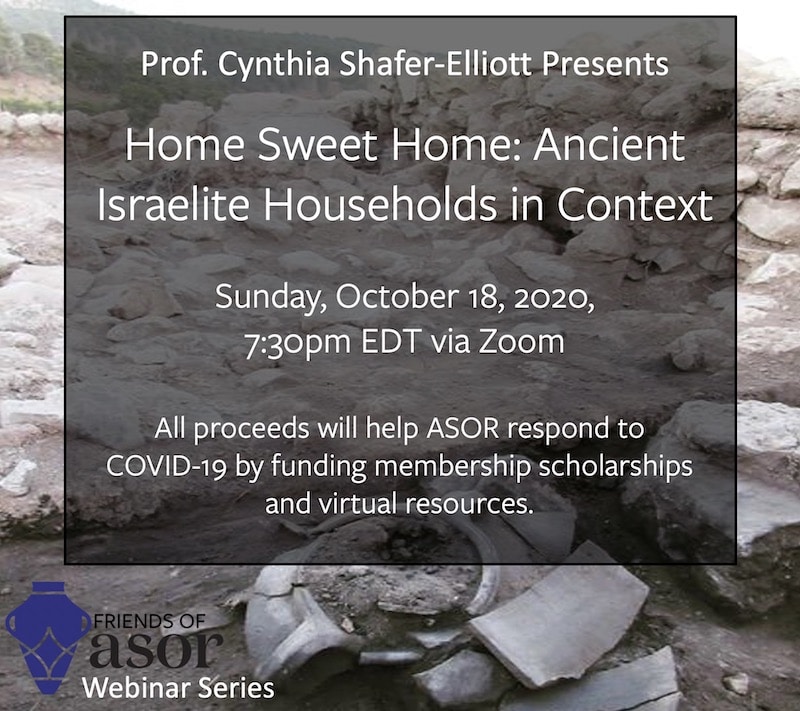
Home Sweet Home: Ancient Israelite Households in Context

Friends of ASOR presents the third webinar in our monthly series on October 18, at 7:30pm EDT, featuring Dr. Cynthia Shafer-Elliott. Our recent quarantine experience has renewed interest in the meaning of ‘home’, whether an apartment in the city or a countryside home. Both in the present as well as in the distant past, the home is the stage for daily life. The form and function of a house, and the activities its household members engage in, can inform us about the daily life of the household and the society of which it is a part.

In this lecture, Dr. Cynthia Shafer-Elliott will introduce the concept of “Household Archaeology” and how it can help us understand the behaviors of kinship and social groups that formed ancient Israelite households. The Iron Age houses at Tell Halif, Israel, will serve to illustrate what the average household was like with particular attention given to the activities of the women of the household and food preparation. The webinar will conclude with a live Q&A session.

Cynthia Shafer-Elliott (Ph.D., The University of Sheffield, England) is an Associate Dean of the School of Theology and Leadership and Associate Professor of Hebrew Bible & Archaeology at William Jessup University in Rocklin, California. Dr. Shafer-Elliott specializes in the cultural and social contexts of ancient Israel and Judah, particularly within domestic contexts.


20% discount from Routledge!

Her major publications include: Food in Ancient Judah: Domestic Cooking in the Time of the Hebrew Bible (2013) and editor of The 5 Minute Archaeologist in the Southern Levant (2016), along with numerous chapters, encyclopedia and dictionary articles, articles, essays, and papers presented on food, households, and gender. She is currently co-editing the T & T Clark Handbook of Food in the Hebrew Bible and Ancient Israel. Dr. Shafer-Elliott is an experienced field archaeologist and is part of the archaeological excavations at Tell Halif and Tell Abel Beth Maacah in Israel.

Thanks to our Silver Sponsor, Routledge, registrants now receive a 20% discount on Prof. Shafer-Elliott’s 2019 book, Food in Ancient Judah. Please email membership@asor.org for the discount code if you have already registered or click the button below to register and receive the code in your confirmation email.

ASOR Sustaining Members: $0 | ASOR Members: $5 | Public: $10

To receive your ASOR member discount, log into the online store. If you are new to ASOR, please click on the “New Visitor Registration” link to enter your email and password for our online store. Then navigate to “Meeting and Event Registration” to register for the webinar and pay the fee. Each paid registrant will receive a confirmation email when you pay for the webinar. If you do not receive this email, then you are not registered. Please e-mail membership@asor.org with any questions or issues with registering.

You will be e-mailed the Zoom Webinar link three times prior to the lecture on October 18, 2020. If you do not receive the link by the Saturday before the webinar, please email membership@asor.org immediately. All webinars are recorded and all paid registrants who cannot attend the webinar will be sent a link to download the recording.

All proceeds from this lecture are used to fund scholarships for members impacted by COVID-19 as well as increasing ASOR’s online resources, which are free to the public.

WHY SPONSOR A WEBINAR?

Several levels of support from $50-$1,000 are available. Proceeds go towards membership scholarships and towards increasing ASOR’s virtual resources. Each sponsorship is tax-deductible and you can give your friends free registrations to a webinar!

Bronze Level ($50): up to 2 guest registrations
Silver Level ($100): up to 5 guest registrations
Gold Level ($500): up to 20 guest registrations
Platinum Level ($1,000): up to 50 guest registrations

After you sign up for a sponsorship online or over the phone, email the names and email addresses of your guests to Felice Herman at membership@asor.org, who will send your guests a confirmation and the Zoom link before the webinar.

WANT TO SAVE $5.00 ON THE NEXT WEBINAR?

Join ASOR as a member! Click here for more details about discounts for events and other benefits of membership. Memberships start at $40 for the year as an Associate Member.

Not ready to join yet? Become a Friend of ASOR for FREE!

Click here for more details about our online resources.


PAST WEBINARS

You can now purchase the link to the recording of any webinar. You can also purchase the bundle packages of all webinars from the 2020-2022 seasons. Please e-mail membership@asor.org for purchase details.

To see a printable pdf of the webinar titles from the 2020-2021 season, please click here. To see a printable pdf of the webinar titles from the 2021-2022 season, please click here.

Pricing:

Members: $6.00 per recording
Non-Members: $12.00 per recording
Bundle of 2020-2021 Webinars: $75.00
Bundle of 2021-2022 Webinars: $75.00
Bundle of 2020-2022 Webinars: $125.00

2021-2022 Season

A World at War: Protecting Cultural Heritage in Times of Conflict
Patty Gerstenblith (DePaul University), Lisa Ackerman (Columbus Citizens Foundation), Andrew Cohen (Government Professional and Cultural Heritage Expert) | May 12, 2022

Preserving Cultural Heritage in Hisban and Umm al-Jimal, Jordan
Øystein LaBianca (Andrews University), Elizabeth Osinga (Umm al-Jimal Archaeological Project), Darrell Rohl (Calvin University) | April 24, 2022

Back to the Field: Recent Discoveries & Summer Plans 2022
Lorenzo d’Alfonso (ISAW), Kathryn Grossman (NC State University), James R. Strange (Samford University) | April 3, 2022

Uncovering What is Nubian Beneath the Veneer of Egyptianness: Excavating the Archives
Debora Heard (University of Chicago) | March 20, 2022

Where Are They Now?: A Preview of 2022 ASOR-Affiliated Fieldwork Projects
Michael Given (University of Glasgow), Xenia-Paula Kyriakou (Florida Gulf Coast University), Stephen Batiuk (University of Toronto), Monique Roddy (Walla Walla University), Kent Bramlett (La Sierra University), Friedbert Ninow (La Sierra University), and Michael Hoff (University of Nebraska-Lincoln) | March 8, 2022

Excavations at Tel Gezer: A Personal Story
Sam Wolff (Tel Gezer Laboratory) | February 20, 2022

Tel Rehov: A Major Bronze and Iron Age City in the Jordan Valley
Amihai Mazar (Hebrew University of Jerusalem), Nava Panitz-Cohen ( Hebrew University of Jerusalem), Nota Kourou (Athens University), Naama Yahalom-Mack (Hebrew University of Jerusalem), Robert Mullins (Azusa Pacific University) | February 10, 2022

The Not-So-Innocents Abroad: The Beginnings of American Biblical Archaeology
Rachel Hallote (Samford University) | January 20, 2022

Synagogues as Jesus Knew Them
James R. Strange (Samford University) | December 2, 2021

Under Jerusalem: The Buried History of the World’s Most Contested City
Andrew Lawler | November 4, 2021

Jesus and Jerusalem on TV: How Do Bible Documentaries Get Made?
Robert Cargill (University of Iowa) | October 17, 2021

Digging the Divine?: Judahite Pillar Figurines and the Archaeology of Israelite Religion
Erin Darby (University of Tennessee) | October 7, 2021

David, Solomon, and Rehoboam’s Kingdom—The Archaeological Evidence
Yosef Garfinkel (Hebrew University of Jerusalem) | September 19, 2021

From Standing Stones to Sacred Emptiness: Textual and Visual Portrayals of Israel’s God
Theodore Lewis (Johns Hopkins University) | August 29, 2021

2020-2021 Season

Making May Matter: Webinarathon to Endow Diversity
Multiple Speakers | May 21-23, 2021

Archaeogaming: Why Video Games Deserve Their Own Archaeology
Tine Rassalle (University of North Carolina at Chapel Hill), Shannon Martino (Morton College), Matthew Winter (University of Arizona), Michael Zimmerman (Rhode Island) | April 18, 2021

How the Bible Became a Book
William Schniedewind (UCLA) | March 21, 2021

The Mysteries of Mithras in Caesarea: Exploring the Cult’s Rites and Remains
Jane DeRose Evans (Temple University), Alexandra Ratzlaff (Brandeis University) | March 11, 2021

Archaeology and the Hidden Religious Culture of Israelite Women
Carol Meyers (Duke University) | February 21, 2021

Meet the Directors—Fundraiser to Support ASOR’s Affiliated Overseas Research Centers
Matthew J. Adams (AIAR), Pearce Paul Creasman (ACOR), Lindy Crewe (CAARI) | February 11, 2021

Early Synagogues, Jesus, and Galilee—A Jewish Perspective
Eric Meyers (Duke University) | December 13, 2020

Home Sweet Home: Ancient Israelite Households in Context
Cynthia Shafer-Elliott (William Jessup University) | October 18, 2020

Priestesses in the Days of Solomon and Ahab
Susan Ackerman (Dartmouth College) | September 13, 2020

Digging Deeper: How Archaeology Works
Eric H. Cline (The George Washington University) | August 9, 2020

Membership Call To Action On ASOR’s Name

[vc_row fullwidth=”true” attached=”true” css=”.vc_custom_1496247803139{padding-top: 0px !important;padding-right: 0px !important;padding-bottom: 0px !important;padding-left: 0px !important;}”][vc_column][vc_single_image image=”55191″ img_size=”full” alignment=”center”][/vc_column][/vc_row][vc_row fullwidth=”true” css=”.vc_custom_1496682730308{padding-top: 10px !important;padding-right: 0px !important;padding-bottom: 0px !important;padding-left: 0px !important;}”][vc_column width=”1/12″ css=”.vc_custom_1496683820796{margin-right: 10px !important;}” offset=”vc_hidden-md vc_hidden-sm vc_hidden-xs”][vc_column_text]

 SHARE

[/vc_column_text][mk_image src=”http://www.asortest.org/wp-content/uploads/2017/01/social-fb-icon4.jpg” image_width=”42″ image_height=”42″ hover=”false” custom_url=”https://www.facebook.com/ASOResearch/” margin_bottom=”0″][mk_image src=”http://www.asortest.org/wp-content/uploads/2017/01/social-tw-icon4.jpg” image_width=”42″ image_height=”42″ hover=”false” custom_url=”https://twitter.com/ASOResearch?ref_src=twsrc%5Egoogle%7Ctwcamp%5Eserp%7Ctwgr%5Eauthor” margin_bottom=”0″][mk_image src=”http://www.asortest.org/wp-content/uploads/2017/01/social-in-icon4.jpg” image_width=”42″ image_height=”42″ hover=”false” custom_url=”https://www.linkedin.com/company/american-schools-of-oriental-research” margin_bottom=”0″][mk_image src=”http://www.asortest.org/wp-content/uploads/2017/01/social-ml-icon_7.jpg” image_width=”42″ image_height=”42″ hover=”false” custom_url=”mailto:info@asor.org” margin_bottom=”0″][mk_image src=”http://www.asortest.org/wp-content/uploads/2017/01/blog-icon3.jpg” image_width=”42″ image_height=”42″ hover=”false” custom_url=”http://asor.org/blog” margin_bottom=”0″][/vc_column][vc_column border_color=”rgba(255,255,255,0.01)” width=”1/6″ css=”.vc_custom_1496683923840{margin-right: 20px !important;border-left-width: 2px !important;padding-right: 20px !important;padding-left: 20px !important;border-left-color: #99422f !important;}”][mk_divider divider_color=”rgba(255,255,255,0.01)” thickness=”1″ margin_top=”3″ margin_bottom=”3″][vc_column_text]

NEWS@ASOR E-NEWSLETTER

ANCIENT NEAR EAST TODAY E-NEWSLETTER

PAST ASOR NEWS, MONTH BY MONTH

LIFETIME HONOR ROLL OF DONORS

FY20 HONOR ROLL OF DONORS

ASOR VIRTUAL ANNUAL MEETING

[/vc_column_text][/vc_column][vc_column border_color=”rgba(170,170,170,0.01)” width=”1/2″ css=”.vc_custom_1487276122024{margin-right: 10px !important;margin-bottom: 30px !important;border-right-width: 2px !important;border-bottom-width: 2px !important;padding-top: 30px !important;padding-right: 30px !important;padding-left: 20px !important;background-color: #ffffff !important;border-right-color: rgba(227,228,228,0.75) !important;border-bottom-color: rgba(227,228,228,0.75) !important;}”][vc_column_text responsive_align=”left”]

MEMBERSHIP CALL TO ACTION ON ASOR’S NAME CHANGE

[/vc_column_text][mk_divider][vc_column_text responsive_align=”left”]

October 6, 2020

[/vc_column_text][vc_column_text]Dear Fellow ASOR Members:

I wrote you all in late August with the exciting news that ASOR’s Board of Trustees had voted to remove the word “Oriental” from ASOR’s name. Now I write with an update and a timeline for the next steps, which will include town halls with the membership and two votes over the next month.

All organizations have moments in their history when a transformative change needs to be made. Recognizing ASOR’s 120-year history of leadership, ASOR’s Board of Trustees voted unanimously to remove the word “Oriental” from our name as the first step to ensure that we took a stand against culturally offensive language. Words matter.

The next step requires a ratification of this change and the Board’s recommendation on ASOR’s new name by a majority of the ASOR membership. You will be asked to choose between two ASOR acronyms: the American Schools of Overseas Research or the American Society of Overseas Research. After the choice is made between “society” and “schools,” we will need a final ratification vote by the membership in order to legally amend ASOR’s Articles of Incorporation.

Below is a summary of how the Board arrived at this decision.

The Ad Hoc Committee on the name change (AHC) has been working since January to consider all alternatives, including new acronyms, descriptive language, and a myriad of other options. Their work included two polls of the membership.

After a great deal of discussion and endless hours of trying to find the best answers, AHC recommended that two names be considered: AARCHE, Association for Archaeological Research, Cultural Heritage, and Education and one of two names using the ASOR acronym, either the American Schools of Overseas Research or the American Society of Overseas Research.

After the AHC submitted its final report, the discussion of the full Board in consultation with the AHC focused on whether the new name should retain the ASOR acronym or be completely different, which opened up the opportunity to solve some of the inherent constraints of the ASOR acronym. In AARCHE’s favor were its freshness and the fact that it reflects better the breadth of ASOR’s current work, particularly in cultural heritage. Against it are its somewhat unwieldy length, unfortunate acronym for a renamed BASOR—”BAARCHE”—and its lack of popularity in the July poll of the membership.

With the lack of a membership mandate for AARCHE or any wholesale change in name, the Board turned to the costs of abandoning the ASOR acronym, both tangible and intangible. Our Executive Director estimates that the necessary changes in our now large website presence would cost between $50,000 and $100,000, amounts which do not include a new branding program. Library subscriptions to the renamed “BAARCHE” would undoubtedly drop. The value of the well-known brand would be lost, which our Development Committee believes would have significant adverse effects on fundraising.

In the Board discussion of the AHC recommendations, various members noted that neither of the choices satisfied the desire of 70.3% of the membership in the March poll that the name reflect the geographical scope of ASOR’s work. Accepting that ASOR’s scope will always change and grow, it seemed prudent to keep the name as simple as possible given all that is required legally to change it, but include a yet to be determined geographical tag line below the name as a descriptor.

After lengthy discussion with the AHC, the Board voted 20-3 to put only the two ASOR acronyms, the American Schools of Overseas Research or the American Society of Overseas Research, up for a membership vote.

What’s next? A membership vote on the name change.

    1. Two Zoom town hall meetings with the membership in October.
    2. A vote on the two names in late October.
    3. A vote on ratification of the winning name in November.

As always, you can contact me directly at president@asor.org with questions or concerns. Thank you for helping our organization take this vital step into a brighter future for us all.

Best regards,

Sharon Herbert
ASOR President[/vc_column_text][/vc_column][vc_column border_color=”rgba(170,170,170,0.01)” width=”1/6″ css=”.vc_custom_1496684098866{margin-right: 5px !important;margin-bottom: 20px !important;border-right-width: 2px !important;border-bottom-width: 2px !important;padding-top: 30px !important;padding-right: 10px !important;padding-left: 10px !important;background-color: #ffffff !important;border-right-color: rgba(227,228,228,0.75) !important;border-bottom-color: rgba(227,228,228,0.75) !important;}”][vc_wp_posts title=”BROWSE THE NEWS ARCHIVE” number=”4″][/vc_column][vc_column border_color=”rgba(170,170,170,0.01)” width=”1/6″ css=”.vc_custom_1496684008271{margin-right: 10px !important;margin-bottom: 30px !important;border-right-width: 2px !important;border-bottom-width: 2px !important;padding-top: 30px !important;padding-right: 20px !important;padding-left: 20px !important;background-color: #ffffff !important;border-right-color: rgba(227,228,228,0.75) !important;border-bottom-color: rgba(227,228,228,0.75) !important;}”][vc_column_text] [/vc_column_text][/vc_column][/vc_row]