The Joy Ungerleider Poster Award Spotlight: Rachel Banks, Cassandra M. DeGaglia, Amy Dixon, Kara Larson, and James W. Hardin
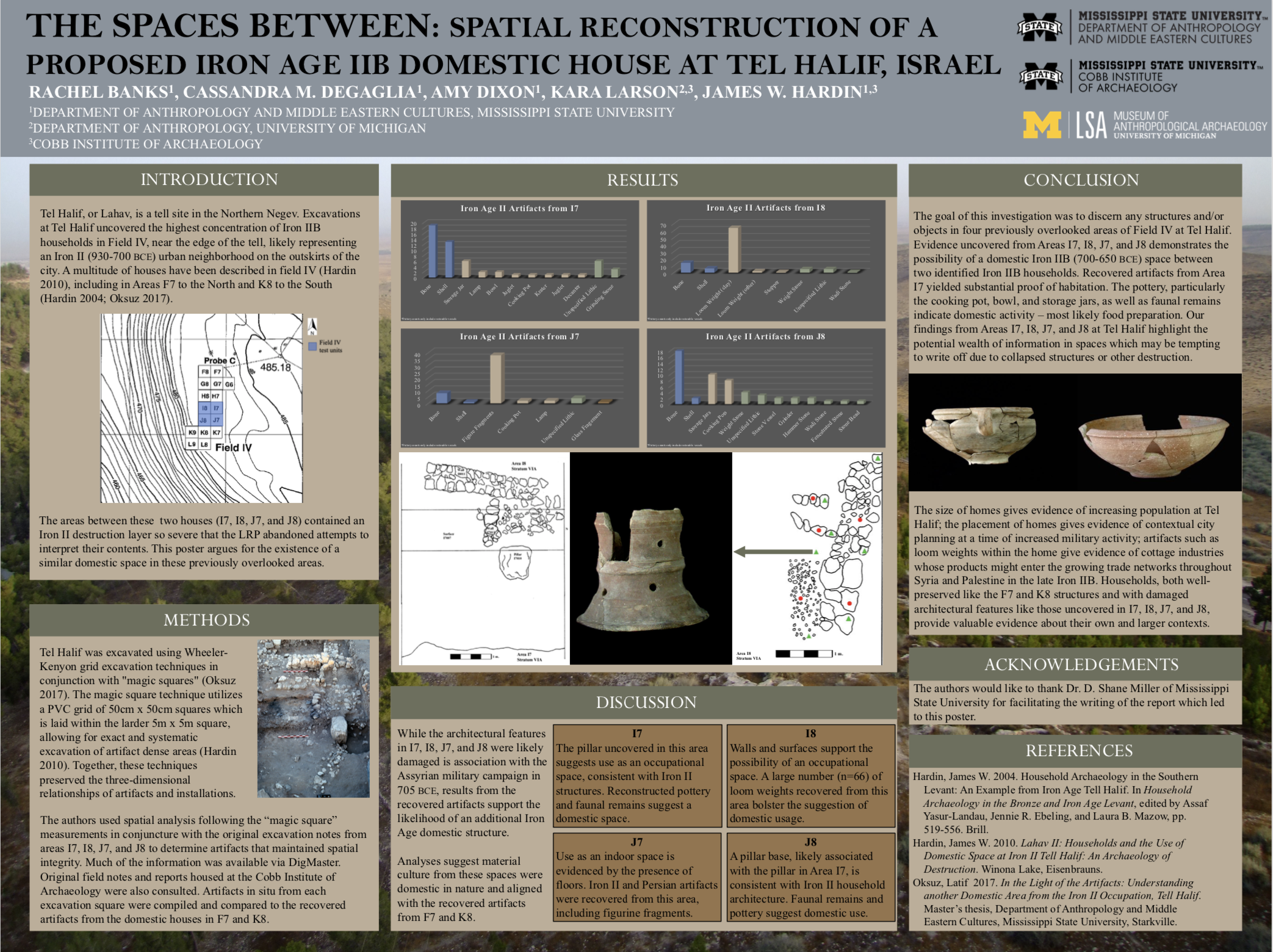
Rachel Banks (Mississippi State University),Cassandra M. DeGaglia (Mississippi State University; Smithsonian Institution),Amy Dixon (Mississippi State University),Kara Larson (University of Michigan; Cobb Institute of Archaeology) andJames W. Hardin (Mississippi State University) were awarded the 2020 Joy Ungerleider Poster Award. This award is conferred upon the author(s) of the poster presenting the results of a study about ancient Near Eastern societies in a clear, legible fashion using original graphic content. Subject matter may be based in archaeological sciences, history, anthropology, epigraphy, ethnography, heritage or other scholarly approaches to understanding ancient people in the areas covered by ASOR.
Their poster The Spaces Between: Spatial Reconstruction of a Proposed Iron Age IIB Domestic House at Tel Halif, Israel, present a visually clear, compelling and detailed study of the artifacts from several excavation areas with fragmentary architectural remains in order to reconstruct their likely function. These areas had been so badly damaged during a significant destruction of the site that they were excluded from initial considerations of this period. By comparing the composition of the artifact assemblage from these spaces with those from Iron Age IIB domestic structures in better-understood areas of the site, they are able to convincingly propose a likely domestic function for these spaces. In doing so, they contribute to a better understanding of household archaeology and urban organization at the site of Tel Halif during the Iron Age IIB.
The deadline for submitting a poster proposal for the 2021 Annual Meeting is August 15, 2021. Learn how to submit your poster to either the in-person, virtual, or both components here.
Update April 5: $14,000 raised towards diversity challenge campaign
Progress towards $20,000 March Goal
Update April 5, 2021
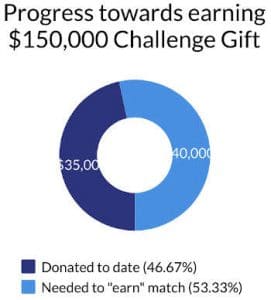
Thanks to 63 ASOR members, March Fellowship Madness 2021 was a success. We didn’t reach our goal of $20,000, but we made tremendous progress ($14,000) towards earning the $150,000 challenge gift to endow BIPOC fellowships.
Since 2007, ASOR has awarded over 830 fellowships, grants, dig scholarships, and travel awards totaling more than $900,000. During the past month, we focused on raising $20,000 for BIPOC scholarships and our diversity challenge campaign. Thanks to an extraordinary challenge gift, every dollar of the $14,000 contributed during March will be matched with two dollars. We thus raised a total of $42,000 in March towards endowing BIPOC fellowships in perpetuity.
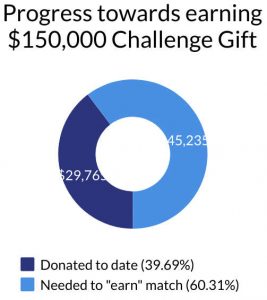
The generous 2-for-1 challenge gift by ASOR Trustee Carolyn Midkiff Strange means that a contribution of $25 will be matched with $50; a gift of $100 will be matched with $200; a gift of $1,000 will be matched with $2,000; and so forth. The $14,000 contributed by ASOR members during March Fellowship Madness goal moved ASOR much closer towards raising the $75,000 that is needed to fully “earn” this transformative $150,000 challenge gift. Thank you to all 63 people who contributed! If you have not yet contributed, or if you are in a position to make another gift, there is still time. We have until June 30, 2021 to raise the remaining $40,515 to earn the entire $150,000 challenge gift.
In addition to supporting BIPOC stipends and scholarships in 2021, ASOR will use these gifts to endow research scholarships, internships, and travel fellowships dedicated to BIPOC students and early career scholars. These fellowships and grants will be a foundation for future efforts, and will serve as a tangible sign of ASOR’s commitment to long-term change.
Extending social equity and equal opportunity throughout all sectors of our world is one of the foremost imperatives facing us today. You can join ASOR in making a lasting difference. Consider a gift of any amount to help us earn this extraordinary challenge gift.
Please choose “Diversity Initiatives” from the drop-down menu in the online donation module to designate your gift to this 2-for-1 Challenge Campaign.
Update March 31: $13,690 raised towards $20,000 goal[/vc_column_text][mk_divider][mk_skill_meter title=”Progress towards $20,000 March Goal” percent=”68″ title_color=”#000000″ progress_bar_color=”#27d2f4″ track_bar_color=”#b2b2b2″][mk_divider][vc_wp_text]
Update March 17, 2021
Since ASOR launched March Fellowship Madness 2021 on March 1, the support of donors has helped us move almost halfway towards our goal. Through the generous support of our members, we have been able to raise $9,095 in the first 17 days of March. With the 2-for-1 match, this means ASOR has received a total of $27,285 for this endowment. Thank you!
This is exceptional progress towards setting up a permanent scholarship fund for BIPOC students and scholars. ASOR still needs the help and support of our members and donors to reach our $20,000 fundraising goal for March Fellowship Madness. Please consider a donation today to help ASOR reach our March goal and to enable us to “earn” all of this incredible $150,000 gift.[/vc_wp_text][mk_divider][vc_wp_text]
Since 2007, ASOR has awarded over 830 fellowships, grants, dig scholarships, and travel awards totaling more than $900,000. In 2021, ASOR plans to award at least 25 summer stipends, six to eight excavation project grants, two Mesopotamian Fellowships, and more than a dozen Annual Meeting Travel Scholarships.
Every year in March, we launch a targeted campaign called March Fellowship Madness to support scholarships. This March we are focusing our efforts on raising $20,000 for BIPOC scholarships. We have received $9,095 through March 17, so we need $10,905 more to reach our goal.
Our $20,000 March goal is part of a larger campaign to support broader ASOR diversity initiatives. Thanks to a generous 2-for-1 challenge gift by ASOR Trustee Carolyn Midkiff Strange, every dollar contributed will be matched with two dollars. A contribution of $25 will be matched with $50; a gift of $100 will be matched with $200; a gift of $1,000 will be matched with $2,000; and so forth.
In addition to supporting BIPOC stipends and scholarships in 2021, ASOR will use these gifts to endow research scholarships, internships, and travel fellowships dedicated to BIPOC students and early career scholars. These fellowships and grants will be a foundation for future efforts, and will serve as a tangible sign of ASOR’s commitment to long-term change.
The $20,000 March Fellowship Madness goal will move ASOR much closer towards raising the $75,000 that is needed to fully “earn” this transformative $150,000 challenge gift. Extending social equity and equal opportunity throughout all sectors of our world is one of the foremost challenges facing us today. You can join ASOR in making this change happen. Consider a gift of any amount to help us earn this extraordinary challenge gift.
[/vc_wp_text][mk_divider][vc_wp_text]
Please choose “Diversity Initiatives” from the drop-down menu in the
online donation module to designate your gift to this 2-for-1 Challenge Campaign.
ASOR Welcomes Meagan Shirley as New Office Coordinator
[/vc_column_text][mk_divider][vc_column_text][/vc_column_text][vc_row_inner][vc_column_inner width=”1/2″ css=”.vc_custom_1570457884703{padding-right: 10px !important;}”][vc_single_image image=”54487″ img_size=”full” alignment=”center” css=”.vc_custom_1571075375103{padding-bottom: 10px !important;}”][/vc_column_inner][vc_column_inner width=”1/2″ css=”.vc_custom_1570458530117{padding-right: 10px !important;}”][vc_column_text]Meagan Shirley joined ASOR as the Office Coordinator on October 1, 2019. Meagan will be assisting the office staff at the James F. Strange Center in Alexandria, VA, with all administrative tasks. Meagan comes to ASOR from George Washington’s Mount Vernon, where she was employed as a Collections Technician. She helped curators and visiting scholars access objects formerly owned by George and Martha Washington.[/vc_column_text][/vc_column_inner][/vc_row_inner][vc_column_text]Prior to this, Meagan worked as a commercial archaeologist with various CRM companies in the greater Washington, D.C., area. She worked on a range of sites, including a Prehistoric quartzite quarry along the Potomac River and a nineteenth-century cemetery in Maryland.[/vc_column_text][vc_column_text]Meagan received her B.A. from The College of Wooster in 2015. Her thesis was titled “Anglo-Saxon and Viking Ship Burials as Indicators of Status and Power.” She continued her studies at the University of Sheffield, UK, where she received her M.A. in Medieval Archaeology in 2016. Meagan focused on the Viking presence in England in the Early Middle Ages, particularly the Great Heathen Army. Her graduate thesis, “An Examination of the Dress Accessories from Torksey,” examined the Viking winter camp at Torksey where members of the Great Heathen Army collected and altered dress accessories. She examined a broad assemblage of dress accessories, including Anglo-Saxon, Merovingian, Irish, and Scandinavian, to hypothesize that the range of multi-cultural accessories along with alterations and secondary usage suggested an occupation by the Great Heathen Army in 872 C.E.[/vc_column_text][vc_row_inner][vc_column_inner width=”1/2″ css=”.vc_custom_1570457884703{padding-right: 10px !important;}”][mk_image src=”http://www.asor.org/wp-content/uploads/2019/10/10561679_10152319350868779_3372774781209231048_n.jpg” hover=”false”][/vc_column_inner][vc_column_inner width=”1/2″ css=”.vc_custom_1570458530117{padding-right: 10px !important;}”][mk_image src=”http://www.asor.org/wp-content/uploads/2019/10/10576906_10203516263979991_2126709758489479762_n.jpg” hover=”false”][/vc_column_inner][/vc_row_inner][vc_column_text]Meagan excavated at the Thornton Abbey Project in Lincolnshire, UK, for several seasons with the University of Sheffield. The twelfth-century Abbey and surrounding precinct were studied for evidence of occupation after the Dissolution of the Monasteries in 1536. However, an Early Medieval church and cemetery were discovered outside of the former Abbey walls. Meagan helped to excavate the cemetery, and subsequent analysis showed 48 people had been the victims of the Plague when the Black Death swept through Europe beginning in 1347. Meagan also helped to conduct GIS work at the Anglo-Saxon site of Little Carlton with a team from the University of Sheffield.
Meagan is extremely excited to be working with the ASOR team. She first heard of ASOR during her undergraduate studies from her professors who attended the Annual Meetings. Meagan is happy that she now gets the opportunity to work officially for ASOR and to assist its members and visitors with any questions or concerns.[/vc_column_text][mk_divider][/vc_column][vc_column border_color=”rgba(170,170,170,0.01)” width=”1/6″ css=”.vc_custom_1496684098866{margin-right: 5px !important;margin-bottom: 20px !important;border-right-width: 2px !important;border-bottom-width: 2px !important;padding-top: 30px !important;padding-right: 10px !important;padding-left: 10px !important;background-color: #ffffff !important;border-right-color: rgba(227,228,228,0.75) !important;border-bottom-color: rgba(227,228,228,0.75) !important;}”][vc_wp_posts title=”BROWSE THE NEWS ARCHIVE” number=”4″][/vc_column][vc_column border_color=”rgba(170,170,170,0.01)” width=”1/6″ css=”.vc_custom_1496684008271{margin-right: 10px !important;margin-bottom: 30px !important;border-right-width: 2px !important;border-bottom-width: 2px !important;padding-top: 30px !important;padding-right: 20px !important;padding-left: 20px !important;background-color: #ffffff !important;border-right-color: rgba(227,228,228,0.75) !important;border-bottom-color: rgba(227,228,228,0.75) !important;}”][vc_column_text]Tweets by ASOResearch [/vc_column_text][/vc_column][/vc_row]
2018 WILLIAM G. DEVER FELLOWSHIP FOR BIBLICAL SCHOLARS FIELD REPORT: HEATH DEWRELL
[/vc_column_text][mk_divider][vc_column_text]For four weeks, just moments before sunrise, I’d file off the bus, march up the tel, and take my position next to one of the poles by my square. Once everyone was in position, we would all raise the poles in unison spreading the shade cloth over the site that would keep us cool enough to work despite the hot Israeli summer sun. Most of the volunteers would then take their places in their assigned areas and begin excavating, carefully scraping away layer after layer of earth and uncovering the material remains of Persian period and late Iron Age Tell Keisan, a Phoenician site a bit inland from Akko. While I did have the opportunity to get my trowel dirty, most mornings I continued to set up while others scraped away. I was serving as assistant square supervisor, which meant that I got to do a lot of the organizational work for our square. After the shade cloth was up, I would set up and calibrate the total station, which we used to record the coordinates of the finds as we excavated. Then I would set up our square’s laptop and printer, which we used in the field to print tags for pottery buckets and labels for small finds, bones, soil samples, etc. As finds came out of the ground, I was responsible for recording their locations, tagging them, and uploading the information into the computer right there on the tel.[/vc_column_text][vc_row_inner][vc_column_inner width=”1/2″ css=”.vc_custom_1570457884703{padding-right: 10px !important;}”][vc_single_image image=”54248″ img_size=”full”][/vc_column_inner][vc_column_inner width=”1/2″ css=”.vc_custom_1570458530117{padding-right: 10px !important;}”][vc_single_image image=”54244″ img_size=”full”][/vc_column_inner][/vc_row_inner][mk_padding_divider size=”20″][vc_column_text]Then, in the afternoon, in addition to the normal work of washing pottery, I worked with my square supervisor to write up the report for the day. This was by far the most educational aspects of my time at Keisan. I got to see the work of interpreting our finds done in real time, and by the time that I was a week in, I was even contributing to the conversation. We would discuss how various installation were related to another stratigraphically. I got to work through the problem of pits from later periods cutting through architecture from an earlier period, resulting in the unusual circumstance of later material below earlier material. It was a puzzle to be solved in real time, with each day offering a few more pieces of data as we tried to reconstruct the history of our portion of the site. Having participated in both the work of excavation and interpretation in real time, I’ll never read a site report the same again.
Then, for four weeks more weeks, I woke up bright and early at the Albright Institute in Jerusalem and decide where my workspace would be for the day. Most days, after a quick breakfast in the dining room, I’d pack my laptop into my satchel and head out either to the Albright’s library or to the library at the École Biblique just around the corner, although on especially pleasant days the balcony outside my apartment served as a lovely makeshift office. Together, these two libraries provided me with all the tools that I needed to make substantial progress on my second monograph. The most enjoyable part of my stay at the Albright was afternoon tea, where I typically enjoyed a strong cup of Israeli coffee and talked with scholars doing archaeological work all over Israel from the Neolithic to the Roman periods. Week by week my conversation partners changed as people left the Albright and new people arrived to take their places. The opportunity to speak so many scholars working in such a variety of specialties and subspecialties was among the most valuable aspects of my time in Israel.
Neither the hands-on experience at Tell Keisan nor the cross-disciplinary dialogue that the Albright provided would have been possible without the William G. Dever Fellowship for Biblical Scholars. Understanding the work of both excavation and interpretation that goes into archaeological fieldwork deepens my ability to incorporate archaeological evidence into my own work. I thank the William G. Dever Fellowships for Biblical Scholars for this incredible opportunity, as well as Elizabeth Bloch-Smith, who brought the fellowship to my attention in the first place and who serves as field director at Tell Keisan. She and my square supervisor, Leann Pace, were generous and patient teachers from whom I learned an enormous amount in four short weeks. I also thank Keisan’s co-directors David Schloen and Gunnar Lehmann, for allowing me to participate in the excavation, as well as and especially the generous donors who make the fellowship and all the good work that it makes possible.[/vc_column_text][mk_divider][vc_column_text]Want to help more students and early career archaeologists get into the field? Donate to the cause today by selecting “Excavation Scholarships” as your gift purpose!
If you want your gift to count towards the Steinmetz challenge, please send us an email after you make a gift.
2018 WILLIAM G. DEVER FELLOWSHIP FOR BIBLICAL SCHOLARS FIELD REPORT: HEATH DEWRELL
[/vc_column_text][mk_divider][vc_column_text]For four weeks, just moments before sunrise, I’d file off the bus, march up the tel, and take my position next to one of the poles by my square. Once everyone was in position, we would all raise the poles in unison spreading the shade cloth over the site that would keep us cool enough to work despite the hot Israeli summer sun. Most of the volunteers would then take their places in their assigned areas and begin excavating, carefully scraping away layer after layer of earth and uncovering the material remains of Persian period and late Iron Age Tell Keisan, a Phoenician site a bit inland from Akko. While I did have the opportunity to get my trowel dirty, most mornings I continued to set up while others scraped away. I was serving as assistant square supervisor, which meant that I got to do a lot of the organizational work for our square. After the shade cloth was up, I would set up and calibrate the total station, which we used to record the coordinates of the finds as we excavated. Then I would set up our square’s laptop and printer, which we used in the field to print tags for pottery buckets and labels for small finds, bones, soil samples, etc. As finds came out of the ground, I was responsible for recording their locations, tagging them, and uploading the information into the computer right there on the tel.[/vc_column_text][vc_row_inner][vc_column_inner width=”1/2″ css=”.vc_custom_1570457884703{padding-right: 10px !important;}”][vc_single_image image=”54248″ img_size=”full”][/vc_column_inner][vc_column_inner width=”1/2″ css=”.vc_custom_1570458530117{padding-right: 10px !important;}”][vc_single_image image=”54244″ img_size=”full”][/vc_column_inner][/vc_row_inner][mk_padding_divider size=”20″][vc_column_text]Then, in the afternoon, in addition to the normal work of washing pottery, I worked with my square supervisor to write up the report for the day. This was by far the most educational aspects of my time at Keisan. I got to see the work of interpreting our finds done in real time, and by the time that I was a week in, I was even contributing to the conversation. We would discuss how various installation were related to another stratigraphically. I got to work through the problem of pits from later periods cutting through architecture from an earlier period, resulting in the unusual circumstance of later material below earlier material. It was a puzzle to be solved in real time, with each day offering a few more pieces of data as we tried to reconstruct the history of our portion of the site. Having participated in both the work of excavation and interpretation in real time, I’ll never read a site report the same again.
Then, for four weeks more weeks, I woke up bright and early at the Albright Institute in Jerusalem and decide where my workspace would be for the day. Most days, after a quick breakfast in the dining room, I’d pack my laptop into my satchel and head out either to the Albright’s library or to the library at the École Biblique just around the corner, although on especially pleasant days the balcony outside my apartment served as a lovely makeshift office. Together, these two libraries provided me with all the tools that I needed to make substantial progress on my second monograph. The most enjoyable part of my stay at the Albright was afternoon tea, where I typically enjoyed a strong cup of Israeli coffee and talked with scholars doing archaeological work all over Israel from the Neolithic to the Roman periods. Week by week my conversation partners changed as people left the Albright and new people arrived to take their places. The opportunity to speak so many scholars working in such a variety of specialties and subspecialties was among the most valuable aspects of my time in Israel.
Neither the hands-on experience at Tell Keisan nor the cross-disciplinary dialogue that the Albright provided would have been possible without the William G. Dever Fellowship for Biblical Scholars. Understanding the work of both excavation and interpretation that goes into archaeological fieldwork deepens my ability to incorporate archaeological evidence into my own work. I thank the William G. Dever Fellowships for Biblical Scholars for this incredible opportunity, as well as Elizabeth Bloch-Smith, who brought the fellowship to my attention in the first place and who serves as field director at Tell Keisan. She and my square supervisor, Leann Pace, were generous and patient teachers from whom I learned an enormous amount in four short weeks. I also thank Keisan’s co-directors David Schloen and Gunnar Lehmann, for allowing me to participate in the excavation, as well as and especially the generous donors who make the fellowship and all the good work that it makes possible.[/vc_column_text][mk_divider][vc_column_text]Want to help more students and early career archaeologists get into the field? Donate to the cause today by selecting “Excavation Scholarships” as your gift purpose!
If you want your gift to count towards the Steinmetz challenge, please send us an email after you make a gift.

 The generous
  Our $20,000 March goal is part of a larger campaign to support broader ASOR diversity initiatives. Thanks to a generous