Media Release
February 20, 2025
ASOR-affiliated archaeology project finds new evidence of earliest farming in NW Africa
ALEXANDRIA, Va. – A new study in the journal Antiquity presents the first evidence of a Bronze Age-era farming settlement in the northwest Maghreb following an ASOR-affiliated excavation in Kach Kouch, Morocco.
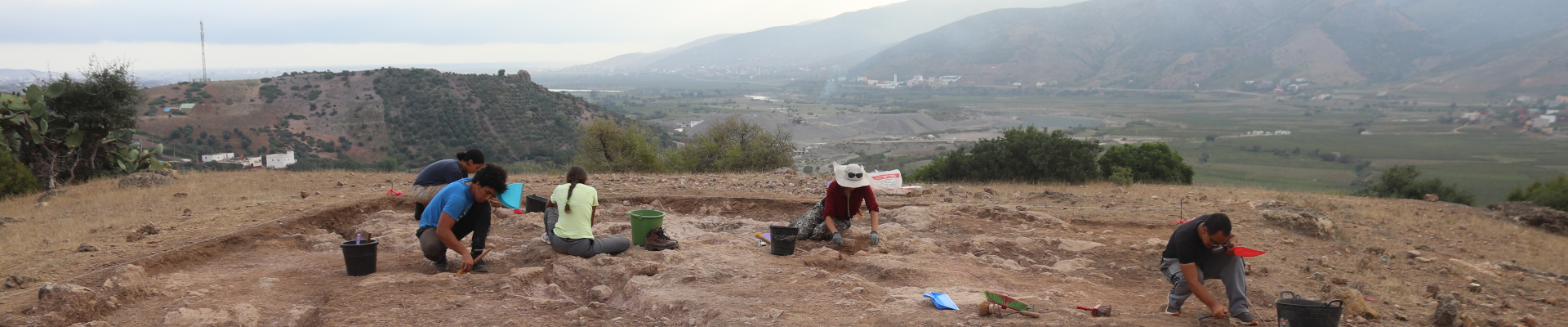
The study, titled “Rethinking late prehistoric Mediterranean Africa: architecture, farming and materiality at Kach Kouch, Morocco,” was published on February 17 in the journal Antiquity by Cambridge University Press. Authors Hamza Benattia, Youssef Bokbot, Jorge Onrubia-Pintado and the rest of the Kach Kouch Archaeological Project team, primarily comprising students from the National Institute of Archaeology and Heritage of Morocco (INSAP), have been conducting excavations and surveys at Kach Kouch, Morocco since 2021 to further the understanding of this hitherto little-known period. They revealed in the Antiquity study the remains of a settlement occupied from 1300 to 600 BCE that was a farming economy before the arrival of the Phoenician conquest.
The team’s research demonstrated that settled occupation in this region stems from social and economic dynamics within local North African communities since at least 2200 BCE, rather than being a result of later interactions with Phoenician communities. Despite the settlement of Phoenician communities along the northern Moroccan coast from the eighth century BCE onwards, local cultural traditions persisted in the inner valleys of the western Rif, Morocco, until the sixth to fifth centuries BCE.
The Kach Kouch settlement practiced animal husbandry and crop cultivation, with crops being processed and stored on site, based on the published findings. Farming, herding, building, and material culture continued from the eighth to seventh centuries BCE to further emphasize the “primary role played by local communities in shaping the social, cultural and economic dynamics of the emergent Moroccan Bronze Age and subsequent Early Mauretanian period” at Kach Kouch, according to the study.
Thanks to the support of an ASOR Stevan B. Dana Grant, the Kach Kouch team continued the research in northwestern Morocco’s Rif mountains in 2023 and early 2024. Extensive survey and targeted excavation along the valleys of Oued Laou and Stehat identified five previously undocumented sites. The newly discovered sites attest to a more stable settled occupation in the region than previously thought, spanning from the Late Prehistory to the Early Mauretanian Period (from c. 2200-400BC), a novel signature for non-Nilotic North Africa.
The publication’s findings stimulate interest in the overlooked region and encourage new narratives in the scholarly discourse on North African archaeology.
About ASOR
The American Society of Overseas Research (ASOR) is a nonprofit 501(c)(3) organization whose mission is to initiate, encourage, and support research into, and public understanding of, the history and cultures of the Near East and wider Mediterranean world, from the earliest times. ASOR fosters original research, archaeological excavations, and explorations; encourages scholarship in the Near East’s basic languages, cultural histories, and traditions; builds support for Near Eastern studies; and advocates high academic standards. ASOR is apolitical and has no religious affiliation.
###
The American Society of Overseas Research
The James F. Strange Center
209 Commerce Street
Alexandria, VA 22314
E-mail: info@asor.org
Telephone: 703-789-9229