
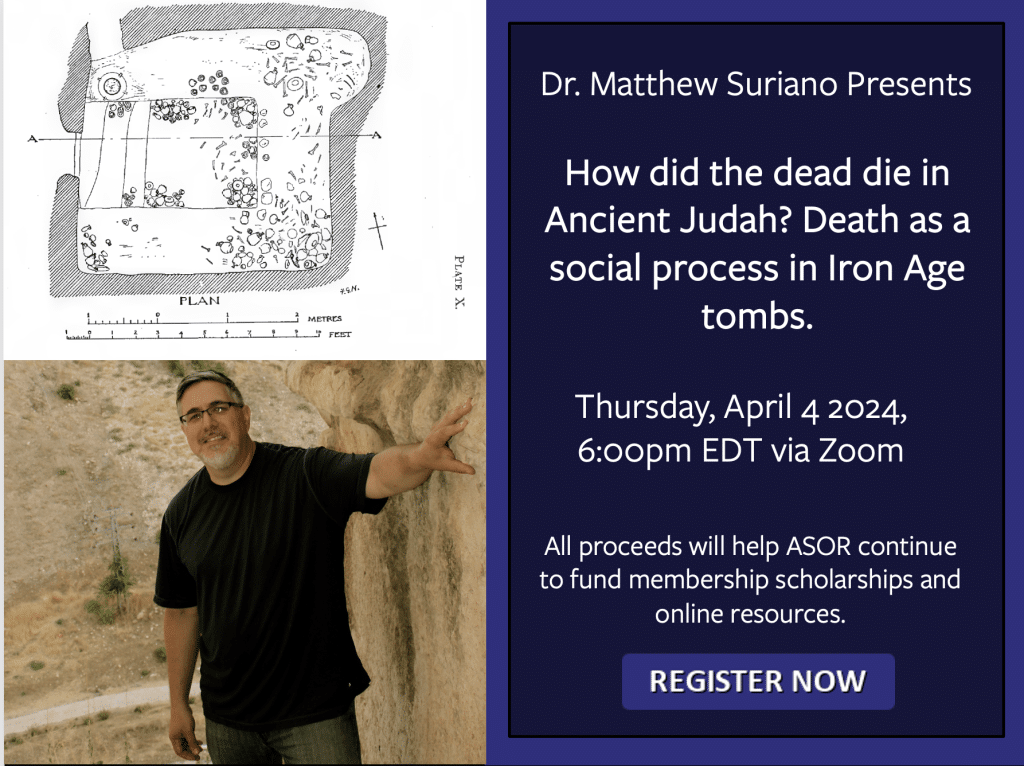
Friends of ASOR present the next webinar in the 2023-2024 season on April 4, 2024, at 6:00 pm EDT, presented by Dr. Matthew Suriano.
The descriptions of death, dying, and burial in the Hebrew Bible are brief and ambiguous. The biblical text contains instructions on how to remove the ritual impurity of the dead, but does not contain any instructions for how to bury the dead. Likewise, the description of postmortem existence is ambiguous and seemingly contradictory. The psalms often depict the place of the dead, called Sheol, in tomb-like terms. In poetic passages like Psalm 88, Sheol is described in tomb-like terms as a dark and dreary place. Yet other passages like Gen 37:35, 44:29–31, and Eccl 9:10 imply that Sheol is the common fate for all humanity. Yet the tomb also holds positive connotations in biblical literature. An ideal death involved being buried with your kin inside the family tomb (2 Sam 19:38). Idioms for death used in the Bible, such as “gathered to one’s kin” (see Gen 25:8) and “lay down with one’s fathers” (see 1 Kg 2:10), imply the collective burial rites that would have occurred inside the family tomb. So how do we reconcile these contrasting images? The archaeological exploration of ancient Israelite mortuary remains provides insight into this problem. The excavation and survey of Iron Age tombs from Judah show that the dead received two burials, an initial interment when the body was brought to the tomb, and a secondary burial when their bones were transferred to a collection of bones (called a repository) stored inside the tomb. Death as transition, in ancient Judah, was observed through the physical changes that occurred in the corpse. This talk will examine the possible meanings of this transition, where the body moved from a burial bench to a re-interment inside a bin of bones, and suggest that it indicates a process of dying that began once the corpse was brought to the tomb. This process of dying, which contrasts with our modern concept of clinical death, provides new ways of looking at the complex images of death we find in the Hebrew Bible such as Sheol.
 Matthew J. Suriano is an Associate Professor in the Joseph and Rebecca Meyerhoff Center for Jewish Studies at the University of Maryland where he teaches Hebrew Bible, ancient religions, and archaeology. A former fellow at the W.F. Albright Institute of Archaeological Research in Jerusalem, Suriano has also participated in several archaeological excavations and surveys in Israel, most recently at Tel Burna. He has written extensively on death and burial in the ancient world, and his book A History of Death in the Hebrew Bible (Oxford University Press, 2018) won the American Society for Overseas Research’s Frank Moore Cross Award. His research interests also involve Jerusalem and he is currently studying the monolithic tombs in Silwan.
This webinar will be recorded and all paid registrants will be sent a link to view the recording.

*Please log in to the Online Portal BEFORE registering for the webinar. Once you have logged in, you will be able to register under our Events page linked above.
ASOR Sustaining Members: $0 | ASOR Members: $6.50 | Public: $13
Season Pass: ASOR Sustaining Members: $0 | ASOR Members: $75 | Public: $155
Buy one here!
Please e-mail membership@asor.org with any questions or issues with registering.
All proceeds from this webinar are used to fund scholarships for members as well as increasing ASOR’s online resources, which are free to the public.
Buy a season pass for all the webinars* of the 2023-2024 FOA Webinar Season! With a season pass, you will automatically be registered for every webinar in the season, and you will receive the recording of each webinar automatically after the event.
If you have missed webinars earlier in the season and still want to buy the pass, you will receive the links to the recordings of the webinars you missed in your automatic confirmation email after you buy the pass.
*Special symposiums may be excluded from the season pass price.
No more registering for a year if you buy your pass today!
Pricing:
ASOR Sustaining Members: $0 (automatic registration for each webinar)
Members: $75
Public: $150
Not a member yet? Click here to join as a member and receive the 50% off a season pass!

Please e-mail membership@asor.org if you have any questions or issues.