CALL FOR NOMINATIONS FOR EDITOR OF NEAR EASTERN ARCHAEOLOGY
[/vc_column_text][vc_column_text responsive_align=”left”]The Publications Committee of the American Schools of Oriental Research announces a call for nominations for the Editor of Near Eastern Archaeology for a term to begin 1 January 2019. ASOR Journal Editors serve a three-year term (eligible to be renewed twice).
Near Eastern Archaeology brings to life the ancient world from Mesopotamia to the wider Mediterranean with vibrant images and authoritative analyses. NEA ( ISSN 1094-2076) is published four times each year (quarterly): March, June, September, and December.
The Editor of Near Eastern Archaeology receives a stipend. The Editor, working with an Editorial Board, the Publications Committee, and ASOR’s publishing partner, The University of Chicago Press, holds full editorial control of Near Eastern Archaeology.
Self-nominations are preferred and should include the following items: 1) a one-paragraph academic biography; 2) a brief statement describing why the candidate is interested in the position; and 3) contact information (including e-mail and phone). If a candidate is being nominated by another person, we seek the candidate’s name, a short academic history, a brief statement describing why the candidate would be appropriate for the position, contact information, and, most importantly, a statement from the candidate that she or he agrees to their name being placed into nomination.
Candidates are also encouraged to contact the current editor, Thomas Schneider (thomas.schneider@ubc.ca), for more information about the positon and its responsibilities. Nominations for each position should be directed to the Chair of the Publications Committee (Charles Jones (cellwoodjones@gmail.com), with a copy to the Director of Membership and Publications, Inda Omerefendic (publications@asor.org).
Review of applications will begin 15 September 2018 with a recommendation of a candidate for appointment to the ASOR Executive Committee of the Board of Trustees and the full ASOR Board before the Annual Meeting in Denver in November 2018.[/vc_column_text][/vc_column][vc_column border_color=”rgba(170,170,170,0.01)” width=”1/6″ css=”.vc_custom_1496684098866{margin-right: 5px !important;margin-bottom: 20px !important;border-right-width: 2px !important;border-bottom-width: 2px !important;padding-top: 30px !important;padding-right: 10px !important;padding-left: 10px !important;background-color: #ffffff !important;border-right-color: rgba(227,228,228,0.75) !important;border-bottom-color: rgba(227,228,228,0.75) !important;}”][vc_wp_posts title=”BROWSE THE NEWS ARCHIVE” number=”4″][/vc_column][vc_column border_color=”rgba(170,170,170,0.01)” width=”1/6″ css=”.vc_custom_1496684008271{margin-right: 10px !important;margin-bottom: 30px !important;border-right-width: 2px !important;border-bottom-width: 2px !important;padding-top: 30px !important;padding-right: 20px !important;padding-left: 20px !important;background-color: #ffffff !important;border-right-color: rgba(227,228,228,0.75) !important;border-bottom-color: rgba(227,228,228,0.75) !important;}”][vc_column_text]Tweets by ASOResearch [/vc_column_text][/vc_column][/vc_row]
This article studies Sumerian terms for minors (dumu, di4-di4-la(2) and lu2 tur-ra) in texts of various genres to define their precise meaning and relationship to kinship and age-grade terminologies. The author argues that dumu is essentially a kinship term “son/daughter, one’s own child, offspring,” which lacks any age connotations. In contrast, di4-di4-la(2) designates children as an age grade. As in other languages, words for children as kinship and children as minors often exchange their semantic domains. Lu2 tur-ra, lit. “minor” is another age-grade term. In contrast, it has a pronounced social connotation and denotes those under patriarchal or professional authority, including children, youths, and young unmarried, or even recently married, individuals, as well as junior professionals.
Click here to access the above article on JSTOR (ASOR membership with online access and/or subscription to JSTOR Current Content required).
Pp. 27-36: “The Stele of Sarab-e Sey Khan: A Recent Discovery of a Second-Millennium Stele on the Iranian–Mesopotamian Borderland in the Western Zagros Mountains,” by Aref Biglari, Sajjad Alibaigi and Masoud Beyranvand
Recent surveys on the eastern hillsides of Bamou Mountain near the current frontiers of Iran and Iraq have led to the discovery of an ancient broken stele in the area of the Sarab-e Sey (Seyed) Khan spring. The stele was made from a large slab of limestone that was broken and of which only two fragments have been recovered so far. The remaining pieces of the stele had a full-size image of a person in a long robe holding a crook in his right hand, undoubtedly a representation of the god Amurru; his left foot rests on the back of a sitting goat while grasping the goat’s horns with his left hand. Another, smaller figure stands to the right of the main figure, near his left shoulder, with in front of him carved a star which could be the symbol of Ishtar. The highly damaged nature of the stele and the absence of an inscription does not allow any precise dating, but it may be proposed that the stele of Sey Khan dates to the Old Babylonian period.
Click here to access the above article on JSTOR (ASOR membership with online access and/or subscription to JSTOR Current Content required).
Pp. 37-51: “The Divine Appointment of the First Antediluvian King: Newly Recovered Content from the Ur Version of the Sumerian Flood Story,” by Jeremiah Peterson
A newly reconstructed manuscript of the Sumerian Flood Story from Old Babylonian Ur furnishes us with further content of the composition, most notably the divine appointment of the first king, Alulim of Eridu. It appears that this text contained an etiology for the pervasive royal image of the king as shepherd of the people.
Click here to access the above article on JSTOR (ASOR membership with online access and/or subscription to JSTOR Current Content required).
Pp. 53-86: “Beginnings of Old Babylonian Babylon: Sumu-abum and Sumu-la-El,” by Rients de Boer
This article studies the lives of two men pivotal in the history of (Old Babylonian) Babylon: Sumu-abum and Sumu-la-El. Sumu-abum was an Amorite tribal and military leader who led groups of Amorite warriors between ca. 1890 and 1860 BCE. He managed to conquer large swaths of northern Babylonian and the Lower Diyala region. In the wake of these conquests, numerous small Amorite kingdoms were set up by his subordinates. The most important one was Sumu-la-El (1880–1845 BCE), who founded the First Dynasty of Babylon. After Sumu-abum’s death, Sumu-la-El subjugated several other petty kings in Babylon’s vicinity and built a string of fortresses around his territory. Through his actions he formed the core of the Babylonian kingdom.
Click here to access the above article on JSTOR (ASOR membership with online access and/or subscription to JSTOR Current Content required).
Pp. 87-114: “On Some Metrological Issues Affecting Yield Estimates in Second-Millennium BCE Upper Mesopotamia,” by Hervé Reculeau
Comparative and quantitative analyses of second millennium BCE agriculture in Upper Mesopotamia are often hindered by the use of absolute values for metrological units of surface and capacity that are based on third millennium southern Mesopotamian documentations. The evidence suggests to the contrary that different metrological systems were used through space and time, and that both their relative and absolute values varied to a great extent, even in cases when similar cuneiform signs and/or unit names were used. This essay analyses the surface and capacity units of Old Babylonian Mari and Assyria in the Old and Middle Assyrian periods, and explores paths to establish their absolute value in modern units by focusing on their internal coherence.
Click here to access the above article on JSTOR (ASOR membership with online access and/or subscription to JSTOR Current Content required).
Pp. 115-166: “Fraud, Forgery, and Fiction: Is There Still Hope for Agum-Kakrime?,” by Susanne Paulus
In this paper, I discuss the authenticity of one of the most controversial Kassite inscriptions known only from post-Kassite copies, the Agum-kakrime Inscription. I revisit the most common arguments brought up against the inscription’s authenticity and then discuss it in the context of other Kassite inscriptions known from later copies. I additionally address the proposed financial motivations for possible forgers as well as potential anachronisms and the Sitz im Leben of the copies discovered in the library of Assurbanipal.
Click here to access the above article on JSTOR (ASOR membership with online access and/or subscription to JSTOR Current Content required).
Pp. 167-188: “Assyrian Antiquities Lost in Translation,” by Julian Edgeworth Reade
Europeans who excavated the great Assyrian cities in the mid-nineteenth century discovered colossal alabaster figures, hundreds of wall panels, and innumerable smaller items that they wished to send home. The journey was perilous and much was lost, most notably sculptures from Khorsabad and elsewhere that were on a French convoy attacked near the Tigris-Euphrates confluence in 1855. There has been much uncertainty over what perished on this and other occasions. This paper integrates the relevant sources, identifies antiquities lost during transport from Khorsabad, the Northwest Palace at Nimrud, the Southwest and North Palaces at Nineveh, and other sites, and compares the loss of original photographs, squeezes and paper archives after arrival in Europe.
Click here to access the above article on JSTOR (ASOR membership with online access and/or subscription to JSTOR Current Content required).
Pp. 189-227: “Two Temple Rituals from Babylon,” by Rocío Da Riva and Gianluca Galetti
BM 40790 (81–04–28, 335) and BM 40854 (81–04–28, 401) + BM 41208 (81–04–28, 756) bear ritual instructions to be carried out in the Esagil. The main activities described deal with Nabû and Nanāya in their cellas: Ezida and Euršaba, respectively. These two tablets clearly belong together, and—together with other tablets now lost—may have originally constituted a series of rituals for the whole year that were connected, in a way or another, to the New Year Festival of Nisan. A striking aspect of BM 40790 and BM 40854+ is the presence of female deities and of female and sexually ambiguous cult attendants. The two texts show a new perspective on temple rituals, in which female agency appears stronger than previously assumed.
Click here to access the above article on JSTOR (ASOR membership with online access and/or subscription to JSTOR Current Content required).
[/vc_column_text][mk_divider][vc_column_text]To view the entire issue on JSTOR, click here.[/vc_column_text][/vc_column][vc_column border_color=”rgba(170,170,170,0.01)” width=”1/6″ css=”.vc_custom_1496684098866{margin-right: 5px !important;margin-bottom: 20px !important;border-right-width: 2px !important;border-bottom-width: 2px !important;padding-top: 30px !important;padding-right: 10px !important;padding-left: 10px !important;background-color: #ffffff !important;border-right-color: rgba(227,228,228,0.75) !important;border-bottom-color: rgba(227,228,228,0.75) !important;}”][vc_wp_posts title=”BROWSE THE NEWS ARCHIVE” number=”4″][/vc_column][vc_column border_color=”rgba(170,170,170,0.01)” width=”1/6″ css=”.vc_custom_1496684008271{margin-right: 10px !important;margin-bottom: 30px !important;border-right-width: 2px !important;border-bottom-width: 2px !important;padding-top: 30px !important;padding-right: 20px !important;padding-left: 20px !important;background-color: #ffffff !important;border-right-color: rgba(227,228,228,0.75) !important;border-bottom-color: rgba(227,228,228,0.75) !important;}”][vc_column_text]Tweets by ASOResearch [/vc_column_text][/vc_column][/vc_row]
Table of Contents for Near Eastern Archaeology 81.2 (June 2018)
Subscription Options You can receive NEA (and other ASOR publications) through an ASOR Membership or through an Individual Subscription. Single issues (subject to availability) are available for purchase, with ASOR members receiving a discount. Please e-mail us if you have any questions.
Pp. 100-107: “The Site of Pella in Jordan: A Case Study for Developing Interpretive Strategies in an Archaeological Heritage Attraction,” by Abdelkader Ababneh
The interpretation of archaeological sites and landscapes for the benefit of the wider public has been of interest to heritage managers, archaeologists, and public groups ever since sites have been open for visitation. However, those responsible for interpreting archaeological sites for presentation to the public often fail to take advantage of a site’s interpretive potential. Interpretation of archaeological sites is a relatively recent activity in Jordan, as is their valuing and heritage management. This study explores issues relating to site interpretation and the potential benefits of improved interpretive strategies. Based on an analysis of the literature and on an exploratory study at the site of Tabqat Fahl (ancient Pella) the author offers concrete recommendations for revealing the potential of the site and improving the interpretive media choices that can be used to communicate the site’s themes to visitors. The aim is to preserve the site into the future and to revitalize it by improving the standard of information about the natural and cultural heritage value found there. Realizing the full potential of the site of Pella is a task that will require the cooperation of a wide range of disciplines and institutions, including historical, architectural, and archaeological.
Click here to access the above article on JSTOR (ASOR membership with online access and/or subscription to JSTOR Current Content required).
Pp. 108-119: “Gertrude Bell’s Mesopotamian Archaeological Photographs,” by Lisa Cooper
Photographs taken by Gertrude Bell during her 1909 and 1911 archaeological trips to Mesopotamia provide not only a valuable record of sites, monuments, and landscapes that have suffered near or complete destruction over the past one hundred years, they also provide insight into the mindset, aims, and agendas Bell held when she produced these images. Her photographs taken at two sites in particular, Assur and Ukhaidir, highlight some of her attitudes and motivations at the time. On the one hand, in the case of Assur, the photos reflect her admiration for her European archaeological colleagues’ skill at excavation and concede their claim to the ancient city’s glorious past. On the other hand, the photographs highlight her efforts to showcase her own archaeological knowledge. Many also reflect a sympathetic stance towards the people of modern Mesopotamia, acknowledging their vital presence and often regarding them as the inheritors of the country’s rich ancient legacy.
Click here to access the above article on JSTOR (ASOR membership with online access and/or subscription to JSTOR Current Content required).
Pp. 120-127: “Ships Graffiti in Maresha Subterranean Complex 89,” by Elie Haddad, Ian Stern and Michal Artzy
During the course of excavations in room 50, Subterranean Complex (SC) 89 at Maresha, several interesting wall drawings were discovered. Located within the southeastern part of the lower city of Maresha, SC 89 bears graffiti depicting four ships. The graffito on the western wall contains a very long warship and additional prows of two warships. The graffito in the entranceway contains a single merchant vessel. The graffiti were scratched into the soft chalk stone with a sharp tool and are typologically datable to the Hellenistic period. The graffito of the warship—the first from Maresha—represents a Macedonian galley according to the authors. They theorize that if the locals were the artists, the ships depicted should represent their vessels. Who did the actual hard labor of the quarrying of these future tombs? The authors suggest the possibility that captives or slaves carried out the task.
Click here to access the above article on JSTOR (ASOR membership with online access and/or subscription to JSTOR Current Content required).
Pp. 128-140: “The Petroglyphs of Domab in the Central Plateau of Iran,” by Ebrahim Karimi
Two clusters of rock art consisting of a considerable number of petroglyphs are identified in the Domab region in the west of the Isfahan province in the central plateau of Iran. Hunting scenes and zoomorphic depictions, mostly ibexes, are the main subjects of rock art in the Domab area. All panels are made on the schist rocks that can be seen all over the region. Several scattered panels that bear geometric markings and depictions of ibexes have also been identified. The petroglyphs of Domab show similarities in terms of subject matter, style, and iconography to the rock art of other regions of central Iran, such as Teymare and Qameshlu national park. The current evidence suggests hunters as the possible creators of some of this rock art.
Click here to access the above article on JSTOR (ASOR membership with online access and/or subscription to JSTOR Current Content required).
Pp. 141-144: “A Rejoinder on the Value of Archaeomagnetic Dating: Integrative Methodology Is the Key to Addressing Levantine Iron Age Chronology,” by Michele D. Stillinger, Joshua M. Feinberg, Erez Ben-Yosef, Ron Shaar, James W. Hardin and Jeffrey A. Blakely
Archaeomagnetic dating is a firmly established dating technique applicable to a wide variety of heat-treated anthropological materials and is advantageous for sites that lack materials suitable for radiocarbon dating. To correct recent misinterpretations of the method, we provide examples of how archaeomagnetic dating curves are calibrated and show how, in some instances, the technique can provide superior results. We emphasize that no single dating technique is capable of resolving the challenging chronology controversies in the Levant, and instead argue that multiple dating methods must be integrated in order to achieve the highest possible temporal resolution.
Click here to access the above article on JSTOR (ASOR membership with online access and/or subscription to JSTOR Current Content required).
Pp. 145-156: “From a Fortified Canaanite City-State to “a City and a Mother” in Israel: Five Seasons of Excavation at Tel Abel Beth Maacah,” by Naama Yahalom-Mack, Nava Panitz-Cohen and Robert Mullins
Tel Abel Beth Maacah is a prominent site on the border of Israel, Syria, and Lebanon where it occupied a strategic geopolitical niche among ancient Canaanites, Israelites, Arameans, and Phoenicians. A survey and five seasons of excavation have revealed an occupation sequence ranging from EB II until modern times with peak occupation dating to MB IIB and Iron Age I–IIA. The robust continuity in settlement from the Late Bronze Age until Iron Age II is a unique phenomenon in this region and sheds important light on the site’s transition from a Canaanite city-state to an Iron Age territorial kingdom, particularly acute in this region, between the Israelite kingdom and that of Aram-Damascus.
Click here to access the above article on JSTOR (ASOR membership with online access and/or subscription to JSTOR Current Content required).
[/vc_column_text][mk_divider][vc_column_text]To view the entire issue on JSTOR, click here.[/vc_column_text][/vc_column][vc_column border_color=”rgba(170,170,170,0.01)” width=”1/6″ css=”.vc_custom_1496684098866{margin-right: 5px !important;margin-bottom: 20px !important;border-right-width: 2px !important;border-bottom-width: 2px !important;padding-top: 30px !important;padding-right: 10px !important;padding-left: 10px !important;background-color: #ffffff !important;border-right-color: rgba(227,228,228,0.75) !important;border-bottom-color: rgba(227,228,228,0.75) !important;}”][vc_wp_posts title=”BROWSE THE NEWS ARCHIVE” number=”4″][/vc_column][vc_column border_color=”rgba(170,170,170,0.01)” width=”1/6″ css=”.vc_custom_1496684008271{margin-right: 10px !important;margin-bottom: 30px !important;border-right-width: 2px !important;border-bottom-width: 2px !important;padding-top: 30px !important;padding-right: 20px !important;padding-left: 20px !important;background-color: #ffffff !important;border-right-color: rgba(227,228,228,0.75) !important;border-bottom-color: rgba(227,228,228,0.75) !important;}”][vc_column_text]Tweets by ASOResearch [/vc_column_text][/vc_column][/vc_row]
Pp. 1-18: “The Kingdom of Geshur and the Expansion of Aram-Damascus into the Northern Jordan Valley: Archaeological and Historical Perspectives,” by Omer Sergi and Assaf Kleiman
Fragmented texts in the Hebrew Bible mention a kingdom named Geshur, usually in contexts that denote its independent existence and relations with King David’s royal court (e.g., 2 Sam 3:3; 13:37–38; 14:32; 15:8). Scholars investigating the history of this kingdom have frequently commented on the ambiguous and non-informative nature of these verses, especially in regard to political history and foreign affairs. Others have emphasized the contribution of archaeological research for elucidating some of the aspects mentioned above, and, in particular, for demonstrating the existence of a territorial entity around the Sea of Galilee during the early 1st millennium B.C.E. Nonetheless, the dynamic discussion has not inspired a reevaluation of the archaeological record in the northern Jordan Valley, the presumed home of the Geshurites, and most scholars have uncritically adopted the traditional archaeological views regarding the dating of sites located in this region. In this article, we challenge the common dating of some key sites (e.g., et-Tell and Tel ʿEn Gev) and consequently reexamine the nature of the political formation that emerged in the region in the early Iron Age and its possible identification with the kingdom of Geshur.
Click here to access the above article on JSTOR (ASOR membership with online access and/or subscription to JSTOR Current Content required).
Pp. 19-41: “Late 1st-Millennium B.C.E. Levantine Dog Burials as an Extension of Human Mortuary Behavior,” by Helen Dixon
Simple dog burials, dating primarily to the second half of the 1st millennium B.C.E. (Persian–Hellenistic periods [ca. 6th–1st centuries B.C.E.]), have been excavated at more than a dozen Levantine sites, ranging from a handful of burials to more than 1,000 at Ashkelon. This study systematizes previously discussed canine interments, distinguishing intentional whole burials from other phenomena (e.g., dogs found in refuse pits), and suggests a new interpretation in light of human mortuary practice in the Iron Age II–III-period (ca. 10th–4th centuries B.C.E.) Levant. The buried dogs seem to be individuals from unmanaged populations living within human settlements and not pets or working dogs. Frequent references to dogs in literary and epigraphic Northwest Semitic evidence (including Hebrew, Phoenician, and Punic personal names) indicate a complex, familiar relationship between dogs and humans in the Iron Age Levant, which included positive associations such as loyalty and obedience. At some point in the mid-1st millennium B.C.E., mortuary rites began to be performed by humans for their feral canine “neighbors” in a manner resembling contemporaneous low-energy–expenditure human burials. This behavioral change may represent a shift in the conception of social boundaries in the Achaemenid–Hellenistic-period Levant.
Click here to access the above article on JSTOR (ASOR membership with online access and/or subscription to JSTOR Current Content required).
Pp. 43-54: “Evidence for Middle Bronze Age Chronology and Synchronisms in the Levant: A Response to Höflmayer et al. 2016,” by Daphna Ben-Tor
In a recent article published in the Bulletin of the American Schools of Oriental Research 375, Felix Höflmayer and his colleagues present a set of radiocarbon data from Tell el-Burak on the Lebanese coast and claim that these data argue for dating the early phase of the Middle Bronze Age in the Levant (Middle Bronze Age IIA/I) between ca. 2000 and the early 18th century B.C. Considering these radiocarbon dates, the authors assert that the low chronology for this period suggested by Manfred Bietak, based on archaeological evidence from Tell el-Dabʿa, should be raised by roughly 120 years. The aim of this article is to show that ceramic and glyptic evidence from Egypt and the Levant firmly support the low chronology and historical synchronisms proposed by Bietak.
Click here to access the above article on JSTOR (ASOR membership with online access and/or subscription to JSTOR Current Content required).
Pp. 55-85: “Archaeology and Conservation of the Middle Phrygian Gate Complex at Gordion, Turkey,” by Semih Gönen, Richard F. Liebhart, Naomi F. Miller and Elspeth R. M. Dusinberre
In 2016, a project was undertaken at Gordion, Turkey, to stabilize and conserve the remains of a rubble platform built early in the Middle Phrygian period (ca. 800–700 b.c.e.) under the vast Gate Complex leading to the megarons on the Citadel Mound. In the process, aspects of Middle Phrygian building strategies came to light that enhanced our understanding gained from the original excavation in the 1950s. This article outlines the archaeology of the Middle Phrygian Gate Complex and the sophisticated internal structures that lent stability to the rubble platform upon which it was built, and examines the recent evaluation and stabilization of the remaining rubble. Internal walls that created a casemate-like structure, combined with strategically placed juniper logs, assisted with the construction of the rubble fill and its structural stability. The use of water-soluble gypsum in the rubble led to the eventual collapse of the walls in antiquity. Conservation and stabilization in 2016 illuminated these features, made the rubble safe again, and improved the visitor’s experience of the site, allowing the gateway of the Early Phrygian period behind the Middle Phrygian Gate Complex to come into its own as a visible access point to the megarons within.
Click here to access the above article on JSTOR (ASOR membership with online access and/or subscription to JSTOR Current Content required).
Pp. 87-102: “Human Figurines from the Region of Tel Halif in Light of Schematic Representations in the Chalcolithic Cultures of the Southern Levant,” by Ianir Milevski, Nimrod Getzov and Amir Ganor
This article presents a newly discovered figurine of chalky limestone found at a cave close to Tel Halif in the northern Negev during salvage excavations conducted after the cave was partially looted. The figurine is compared with the corpus of figurines with similar iconographic characteristics. Two exemplars found years earlier at Tel Halif itself are reexamined. In light of new data, it is suggested that these figurines should be dated to the Chalcolithic period.
Click here to access the above article on JSTOR (ASOR membership with online access and/or subscription to JSTOR Current Content required).
Pp. 103-112: “A Double Abecedary? Halaḥam and ʾAbgad on the TT99 Ostracon,” by Thomas Schneider
This article attempts to advance the debate on the terms inscribed on an ostracon of the Egyptian 18th Dynasty from the excavation of Theban Tomb 99, suggested by Ben Haring to contain the first historical attestation of the Halaḥam sequence. It presents new etymologies for the words listed on the two sides of the document, all of them in Egyptian syllabic writing. The obverse contains at least the five initial consonants of the Halaḥam sequence; the words of the acrostic may form a mnemonic verse. Additionally, the reverse side may provide the first historical attestation of the beginning of the second and historically more consequential ancient alphabet sequence, the ʾAbgad. This sheds important new light on the history of the Semitic alphabets and Egyptian knowledge of alphabetic ordering in the 15th century B.C.E.
Click here to access the above article on JSTOR (ASOR membership with online access and/or subscription to JSTOR Current Content required).
Pp. 113-152: “Distancing the Dead: Late Chalcolithic Burials in Large Maze Caves in the Negev Desert, Israel,” by Uri Davidovich, Micka Ullman, Boaz Langford, Amos Frumkin, Dafina Langgut, Naama Yahalom-Mack, Julia Abramov and Nimrod Marom
The Late Chalcolithic of the southern Levant (ca. 4500–3800 b.c.e.) is known for its extensive use of the subterranean sphere for mortuary practices. Numerous natural and hewn caves, constituting formal extramural cemeteries, were used as secondary burial localities for multiple individuals, refecting and reaffirming social order and/or communal identity and ideology. Recently, two large complex caves located in the northern Negev Highlands, south of the densely settled Late Chalcolithic province of the Beersheba Valley, yielded skeletal evidence for secondary interment of select individuals accompanied by sets of material culture that share distinct similarities. The observed patterns suggest that the interred individuals belonged to sedentary communities engaging in animal husbandry, and they were deliberately distanced after their death, both above-ground (into the desert) and underground (deep inside subterranean mazes), deviating from common cultural practices.
Click here to access the above article on JSTOR (ASOR membership with online access and/or subscription to JSTOR Current Content required).
Pp. 153-169: “Climate, Settlement History, and Olive Cultivation in the Iron Age Southern Levant,” by Israel Finkelstein and Dafina Langgut
In this article, we suggest a palaeo-climate reconstruction of the Iron Age based on pollen diagrams for sediment cores extracted from the center of the Sea of Galilee and from the Zeʾelim ravine on the western shore of the Dead Sea. We describe three pollen zones that roughly correspond to the Iron Age I, Iron Age IIA, and Iron Age IIB–C. Pollen Zone 1 (ca. 1100–950 b.c.e.) is characterized by high arboreal and olive pollen percentages in both records, representing relatively wet climate conditions and intense olive cultivation in the regions west of the lakes. Pollen Zones 2 (ca. 950–750 b.c.e.) and 3 (ca. 750–550 b.c.e.) are typified by a profound reduction in olive cultivation. Based on Mediterranean tree pollen percentages in the Sea of Galilee record and sediment characteristics in the Zeʾelim profile, climate conditions still seem to have been humid, albeit slightly less than in Pollen Zone 1. The low arboreal pollen in Pollen Zones 2 and 3 in the Zeʾelim diagram is probably the result of intense human influence on the natural vegetation in the Judaean highlands. The lowest olive pollen values during the Bronze and Iron Ages were documented in both records at ca. 700 b.c.e., possibly the outcome of depopulation as a result of deportation and the succeeding abandonment of olive orchards. These and other trends discussed in the article show that climate is only one of the factors that influenced settlement processes and economic trends in antiquity.
Click here to access the above article on JSTOR (ASOR membership with online access and/or subscription to JSTOR Current Content required).
Pp. 171-195: “Neolithic Kritou Marottou-Ais Giorkis, Cyprus—Living in the Uplands,” by Alan Henri Simmons, Katelyn DiBenedetto and Levi Keach
For many years, the “Neolithic Package” was believed to be a latecomer to the Mediterranean islands. The oldest Neolithic remains were those from the Cypriot aceramic Khirokitia Culture, starting around 7000 cal b.c. Late by mainland standards, the Khirokitia Culture had few parallels with either the Levantine or Anatolian mainland from which it derived. Recent research, however, has revolutionized perspectives on the colonization of these islands, with Cyprus again playing a major role. We now know that the island had a pre-Neolithic occupation around 12,000 years ago. In addition, an early Neolithic occupation predating the Khirokitia Culture has been documented, with both Pre-Pottery Neolithic A and B (or Cypro-PPNB) phases as early as those on the mainland. Most sites are coastal; however, Cypro-PPNB Ais Giorkis is located in the foothills. Interdisciplinary excavations have revealed it to be a unique occurrence, with some of the earliest directly dated domesticates in the Near East, unusual architecture, and evidence for trade and feasting—all of which are summarized here. Ais Giorkis contributes to emerging research on Cyprus that has reoriented how we view island colonization, early seafaring abilities, domestication processes and accompanying social changes, and the spread of the Neolithic from its core areas.
Click here to access the above article on JSTOR (ASOR membership with online access and/or subscription to JSTOR Current Content required).
Pp. 197-228: “Four Iron Age Silver Hoards from Southern Phoenicia: From Bundles to Hacksilber,” by Tzilla Eshel, Naama Yahalom-Mack, Sariel Shalev, Ofir Tirosh, Yigal Erel and Ayelet Gilboa
Iron Age silver in the Levant has attracted scholarly attention regarding its function as currency. Scholars debate whether hacksilber can be interpreted as representing a pre-monetary economic system, using pre-portioned silver exchanged in standardized weights, which inspired the invention of coins. In this study, four Iron Age silver hoards from southern Phoenicia (Tell Keisan, Tel Dor, ʿEin Hofez, and ʿAkko) are examined from archaeological and analytical perspectives. The combination of a contextual analysis of the hoards, a typological study of the items in them, chemical analysis, and comparison with other Bronze and Iron Age southern Levantine hoards implies that the use of silver as currency changed throughout the Bronze and Iron Ages. In particular, contrary to common interpretations, the hoarding of silver in stamped bundles and the practice of hacking silver do not represent a single phenomenon. Rather, bundling was gradually replaced by the practice of hacking silver ingots to verify their quality. In Iron Age II, during every transaction, the hacked items were weighed using miniature silver items to balance the scales. We conclude that the “hacked silver” economic system was not based on “pre-weighing” and therefore cannot be defined as heralding the use of coins.
Click here to access the above article on JSTOR (ASOR membership with online access and/or subscription to JSTOR Current Content required).
[/vc_column_text][mk_divider][vc_column_text]To view the entire issue, including book reviews, on JSTOR, click here.[/vc_column_text][/vc_column][vc_column border_color=”rgba(170,170,170,0.01)” width=”1/6″ css=”.vc_custom_1496684098866{margin-right: 5px !important;margin-bottom: 20px !important;border-right-width: 2px !important;border-bottom-width: 2px !important;padding-top: 30px !important;padding-right: 10px !important;padding-left: 10px !important;background-color: #ffffff !important;border-right-color: rgba(227,228,228,0.75) !important;border-bottom-color: rgba(227,228,228,0.75) !important;}”][vc_wp_posts title=”BROWSE THE NEWS ARCHIVE” number=”4″][/vc_column][vc_column border_color=”rgba(170,170,170,0.01)” width=”1/6″ css=”.vc_custom_1496684008271{margin-right: 10px !important;margin-bottom: 30px !important;border-right-width: 2px !important;border-bottom-width: 2px !important;padding-top: 30px !important;padding-right: 20px !important;padding-left: 20px !important;background-color: #ffffff !important;border-right-color: rgba(227,228,228,0.75) !important;border-bottom-color: rgba(227,228,228,0.75) !important;}”][vc_column_text]Tweets by ASOResearch [/vc_column_text][/vc_column][/vc_row]
EXECUTIVE COMMITTEE AND BOARD OF TRUSTEES MEETING REPORT
[/vc_column_text][vc_column_text]
By Susan Ackerman ASOR President
Every spring, the ASOR Board of Trustees and the Board’s Executive Committee meet to engage in discussions and undertake items of business that have come forward since the Executive Committee’s and Board’s gatherings at the November Annual Meeting. This year, the Executive Committee and the Board met during the weekend of April 20-21, in Tucson, AZ. We were hosted by ASOR Development Committee Chair Ed Wright and the Arizona Center for Judaic Studies, and both Ed and the staff at the Center went out of their way to make our meetings run smoothly and to facilitate some great “extracurricular” events, including a Middle Eastern banquet followed by stargazing at the University of Arizona’s historic Steward Observatory. Thanks Ed!
The ASOR Budget
The major item on the agenda for the ASOR Board’s spring meetings is always the budget, both a review of the budget for the current fiscal year (FY 18), which will come to an end on June 30, and approving the budget for the upcoming fiscal year (FY 19), which starts on July 1. The FY 18 budget forecast is balanced—indeed, almost perfectly so, as we imagine ending the year with just a small surplus of $80.50! For FY 19, the Board approved a balanced budget of just over $1.3 million.
This FY 19 budget is notably smaller than our FY 18 budget, which totaled a little over $2.2 million. The reason is that our current funding for ASOR’s Cultural Heritage Initiatives (CHI) that comes via our cooperative agreement with the United States Department of State ($900,000) expires on June 30, 2018, and while we hope this cooperative agreement will be extended for another year, this has not yet been determined.
The FY 19 budget also includes some other “unknowns”: most notably, “unknowns” regarding costs we will incur in making ASOR’s big office move, from our long-time home in Boston to the Washington, D.C., area (click here for story). These “unknowns” include moving expenses, costs associated with furnishing new office space, and, ultimately, costs associated with purchasing a permanent home for ASOR. Other “unknowns” are costs in terms of salaries for the new staff members we will need to hire in our new Washington-based office, even as we retain our current Boston staff and continue running some of our operations out of Boston through December 31, 2018, for the sake of continuity and so that we might continue to benefit from our staff’s significant expertise and long-term experience in managing ASOR. The Board did note, with regret, that although we have offered our current staff the opportunity to move with us, right now, only one of them (our newest hire, Office Assistant Marta Ostovich) intends to pursue that possibility.
The Board also discussed details associated with the timing of this move, and especially the offer extended to us by Virginia Theological Seminary, a long-time ASOR Institutional Member, to provide office space through March 2019 on their campus in Alexandria, VA. Since Alexandria—where many other non-profit organizations are located and an easy commute to downtown Washington—is the D.C.-area location we have tentatively as the site of ASOR’s potential new home, having a temporary base at Virginia Theological Seminary as we get our bearings and work to identify potential properties that we might buy is a great boon.
ASOR Officers
The terms of ASOR’s Vice-President, Sharon Herbert, and ASOR’s Secretary, Lynn Swartz Dodd, expire at the end of December 2018, and the Officers Nominations Committee (ONC) worked hard before the Board meeting to identify how these positions should be filled going forward. After extensive deliberations, the ONC decided to recommend to the Board that Sharon Herbert’s term as Vice-President be extended for one more year, until December 31, 2019, so that the Vice-President’s term would be “in sync” with that of the President (which ends on December 31, 2019). The ONC also recommended to the Board that Ann-Marie Knoblauch be appointed as ASOR Secretary. The Board unanimously voted to approve these nominations, and so congratulations and thanks to both Sharon and Ann-Marie on their appointments!
In addition, the Board welcomed two new members: Lisa Ackerman (no relation to me!) and Thomas Schneider. We’re very happy to have these new colleagues on our Board.
Other Business
The Board also considered several other matters of ASOR business, especially administrative changes we are putting into place in conjunction with our upcoming office move. Members may notice, for example, that we will be changing the way we handle the behind-the-scenes work of journal subscriptions—but be assured, what you won’t notice is any change in the journals themselves! We are also looking at moving the ASOR Archives out of the ASOR Office and into a more appropriate facility (one with better climate control, for example). Again, though, members should not notice any change to what is most important for their needs—the accessibility of the ASOR Archives for research purposes.
Overall, the Board and Executive Committee had a busy set of meetings—but also a productive one, and I left Tucson thankful, as I always am, for all that ASOR’s Board members do to ensure that ASOR continues to thrive.[/vc_column_text][/vc_column][vc_column border_color=”rgba(170,170,170,0.01)” width=”1/6″ css=”.vc_custom_1496684098866{margin-right: 5px !important;margin-bottom: 20px !important;border-right-width: 2px !important;border-bottom-width: 2px !important;padding-top: 30px !important;padding-right: 10px !important;padding-left: 10px !important;background-color: #ffffff !important;border-right-color: rgba(227,228,228,0.75) !important;border-bottom-color: rgba(227,228,228,0.75) !important;}”][vc_wp_posts title=”BROWSE THE NEWS ARCHIVE” number=”4″][/vc_column][vc_column border_color=”rgba(170,170,170,0.01)” width=”1/6″ css=”.vc_custom_1496684008271{margin-right: 10px !important;margin-bottom: 30px !important;border-right-width: 2px !important;border-bottom-width: 2px !important;padding-top: 30px !important;padding-right: 20px !important;padding-left: 20px !important;background-color: #ffffff !important;border-right-color: rgba(227,228,228,0.75) !important;border-bottom-color: rgba(227,228,228,0.75) !important;}”][vc_column_text]Tweets by ASOResearch [/vc_column_text][/vc_column][/vc_row]
STUDENT AND EARLY-CAREER MEMBERS RECEIVE FREE COPIES OF GITIN POTTERY VOLUMES
[/vc_column_text][vc_column_text]One of the major components of ASOR’s Strategic Plan is to continue its support of student and early-career members. We provide this support in part through scholarships for participation in the Annual Meeting, with fellowships for summer field work, and with reduced membership rates. We also provide special opportunities for interaction at the Annual Meeting, and we plan to increase those opportunities at the Annual Meeting in Denver in November 2018.
In March, we announced a new way that ASOR would support our student and early-career members—by raising contributions to award as many copies as possible of Seymour Gitin’s The Ancient Pottery of Israel and Its Neighbors from the Iron Age through the Hellenistic Period. These volumes are an outstanding resource. Many are calling them “The Ceramics Bible.”
We are very pleased to announce that ASOR was able to raise funds to purchase and ship sixty copies of this resource! We had requests from 94 student and early-career members, so we were able to support approximately two-thirds of the requests. We are still seeking support to provide copies of this resource to the remaining 33 members, so please e-mail ASOR Executive Director Andy Vaughn (executive-director@asor.org) if you would like to support this initiative.
This special offer was made possible by five anonymous donors who have made contributions so that Undergraduate, Graduate, and Early Career Members of ASOR can receive these amazing volumes for free. A big thank you to these donors for this unique opportunity! ASOR selected 60 members from the 94 applicants at random, and the Israel Exploration Society is currently shipping the sets to the recipients by surface mail. Note: if you are one of the recipients and have any questions, please e-mail Marta at the ASOR office (info@asor.org).
The following is a list of the winners of the lottery:[/vc_column_text][vc_column_text][/vc_column_text][vc_row_inner][vc_column_inner width=”1/2″][vc_column_text]
[/vc_column_text][vc_column_text]Every year, ASOR receives more applications for dig scholarships than we can support. Thanks to the generosity of donors who have supported endowment funds for fellowships, and thanks to donors who make annual gifts, we are able to support more and more scholarships every year. We are very proud that ASOR has become one of the largest sources for funding for individuals who want to participate in excavations in the Middle East and wider Mediterranean regions.
When we began the March Fellowship Madness season, ASOR had approximately $36,000 from endowment and annual funds to support 18 scholarships. We are thrilled that through the generosity of our members who contributed to March Fellowship Madness, we raised more than $6,500. This has allowed ASOR to award 21 dig scholarships – 3 more than at the beginning of March!
THOMAS LEVY RECEIVES HONORARY DEGREE FROM CHARLES UNIVERSITY
[/vc_column_text][vc_column_text]Congratulations to ASOR’s former chair of the Committee on Archaeological Research and Policy, Professor Thomas E. Levy of the University of California, San Diego, who received the degree of Doctor honoris causa from Charles University. Charles University, located in Prague and founded in 1348, is the largest and most renowned Czech university and one of the oldest universities in the world.
The degree was awarded to Professor Levy in April 2018, during the two-day meeting of the University’s International Advisory Board. Levy was cited for his outstanding lifelong scientific achievements and for a significant contribution to the development of research in collaboration with Charles University. As the Charles University press release annoucing Professor Levy’s degree reads:
Professor Levy has worked with the Czech Institute of Egyptology at the Faculty of Philosophy at Charles University in the field of archaeology and contact between ancient Egypt and Syropalestine since the beginning of the 21st century. Levy’s research in the Wadi Feynan territory, where his expeditions discovered unique monuments dating to the period between 3000 BCE and 1000 BCE, has been a major contribution to this field. The Czech Institute of Egyptology carries out work on markedly similar topics and Czech archaeological research in Abusir also offers significant parallels for Levy’s work in the Near East in the field of international trade and also in relation to the genesis of the first complex societies between 3000 BCE and 1000 BCE.
The press release goes on to quote Miroslav Bárta, Director, Czech Institute of Egyptology:
“I’ve been collaborating with Prof. Levy for a long time. I had the opportunity to give lectures at the University of California, while Prof. Levy did the same at Charles University. Recently, our collaboration with Prof. Levy focused on the theory of the punctuated equilibrium and its application in such disciplines as archaeology, Egyptology, history, and last but not least, security studies.”
Congratulations, again, to Professor Levy on this great honor!
To view the booklet from the ceremony, which includes the speech given in honor of Professor Levy and the text of his diploma, click here.[/vc_column_text][/vc_column][vc_column border_color=”rgba(170,170,170,0.01)” width=”1/6″ css=”.vc_custom_1496684098866{margin-right: 5px !important;margin-bottom: 20px !important;border-right-width: 2px !important;border-bottom-width: 2px !important;padding-top: 30px !important;padding-right: 10px !important;padding-left: 10px !important;background-color: #ffffff !important;border-right-color: rgba(227,228,228,0.75) !important;border-bottom-color: rgba(227,228,228,0.75) !important;}”][vc_wp_posts title=”BROWSE THE NEWS ARCHIVE” number=”4″][/vc_column][vc_column border_color=”rgba(170,170,170,0.01)” width=”1/6″ css=”.vc_custom_1496684008271{margin-right: 10px !important;margin-bottom: 30px !important;border-right-width: 2px !important;border-bottom-width: 2px !important;padding-top: 30px !important;padding-right: 20px !important;padding-left: 20px !important;background-color: #ffffff !important;border-right-color: rgba(227,228,228,0.75) !important;border-bottom-color: rgba(227,228,228,0.75) !important;}”][vc_column_text]Tweets by ASOResearch [/vc_column_text][/vc_column][/vc_row]
Table of Contents for Near Eastern Archaeology 81.1 (March 2018)
Subscription Options You can receive NEA (and other ASOR publications) through an ASOR Membership or through an Individual Subscription. Single issues (subject to availability) are available for purchase, with ASOR members receiving a discount. Please email us if you have any questions.
Pp. 4-5: “The Survey of the Site and Its Insights,” by Joe Uziel and Aren M. Maeir
Since its infancy, archaeological research has used survey as a major tool in both regional studies (see, e.g., Conder and Kitchener 1881) and as a tool for project planning. In the former, survey flourished—despite certain critiques as to the validity of the data collected (e.g., Waelkens and Poblome 2004)—whereas the latter was often used minimally in the interpretation of an individual site’s history. In this sense, the survey at Tell eṣ-Ṣâfi/Gath was groundbreaking in its approach— not only as a tool for planning the project, but as the basis for determining aspects of the history of the site (Uziel and Maeir 2005, 2012). The survey was planned by the division of the site into separate fields, based on discrete micro-topographical features. As opposed to an arbitrary grid, the use of the topography of the site considered that these features may have been formed by the changing settlement of the site over time. For example, the eastern slopes (Areas A and E), which have been extensively excavated, each had its own local phasing, which was determined through their separate survey. Had we used a random grid, it is likely the parts of each of these terraced steps would have been lumped together, making the survey a tool for overall evaluation of the site, but not determining differences in the various areas. This proved critical in the planning of the project, which later, through the implementation of the survey results, managed to determine excavation areas according to the research design of the project.
Click here to access the above article on JSTOR (ASOR membership with online access and/or subscription to JSTOR Current Content required).
Pp. 6-14: “New Insights into the Philistines in Light of Excavations at Tell eṣ-Ṣâfi/Gath,” by Louise A. Hitchcock and Aren M. Maeir
Even though the arrival of the Philistines in the southern Levant is an event that happens “off camera,” that is, before the appearance of their settlement remains, it is an event that was narrativized in the recent past by archaeologists working in Philistia who interpreted the local production of Aegean style pottery as evidence of a massive colonization by Mycenaean migrants (Hitchcock and Maeir 2016a). By and large, the understanding of the Philistines and their culture was centered around the biblical and Egyptian images of the Philistines, and their continued reception and interpretation until modern times.
Click here to access the above article on JSTOR (ASOR membership with online access and/or subscription to JSTOR Current Content required).
Pp. 15-18: “Philistine Decorated Pottery at Tell eṣ-Ṣâfi/Gath,” by Linda G. Meiberg
Almost all of the excavated areas at Tell eṣ-Ṣâfi/Gath have yielded Philistine decorated pottery. This includes Areas A (Strata A6 and A5), E (Stratum E3), F (Stratum F11), and P (Stratum P2) on the upper tell, as well as Area D (Stratum D5) in the lower city, thus indicating that the consumption, if not actual production, of Philistine decorated pottery was quite widespread throughout the entire site during the twelfth through tenth centuries B.C.E.
Click here to access the above article on JSTOR (ASOR membership with online access and/or subscription to JSTOR Current Content required).
Pp. 19-21: “Philistine Burial Customs in Light of the Finds at Tell eṣ-Ṣâfi/Gath,” by Joe Uziel and Aren M. Maeir
Despite over a century of research conducted on the Philistines and their material culture, a very small quantity of finds relating to their burial customs has been reported. This has led to quite a lot of speculation on Philistine mortuary customs, with little evidence in support. At a number of sites, suggestions to distinguish “Philistine” burials were attempted, most notably, the erroneous attribution of the anthropoid coffins to the Philistines (Dothan 1982), the suggested cremation burials found at Azor (Dothan and Dothan 1992; Ben-Shlomo 2008, 2012; Buchennino and Yannai 2010), and the burial caves yielding Philistine bichrome pottery at Tel Eton (Edelstein and Aurant 1992). However, the problematic interpretations of these finds, coupled with the fact that none of this evidence was found at the main urban sites of the Philistines, calls into question their centrality within the Philistine realm, and their attribution on a whole to the ethnic group that populated the southern Coastal Plain.
Click here to access the above article on JSTOR (ASOR membership with online access and/or subscription to JSTOR Current Content required).
Pp. 22-23: “What Language(s) Did the Philistines Speak?,” by Brent Davis
The evidence that we have for the language(s) spoken by the Philistines is not plentiful, but what we do have is interesting (though far from conclusive). Two types of evidence predominate: (1) inscriptions from Philistine sites (thus these inscriptions may have been produced by Philistines), and (2) Philistine words and names borrowed into other languages of the region and recorded (however imperfectly) in non-Philistine records.
Click here to access the above article on JSTOR (ASOR membership with online access and/or subscription to JSTOR Current Content required).
Pp. 24-27: “Microarchaeology at Tell eṣ-Ṣâfi/Gath, Area A,” by Steve Weiner and Elisabetta Boaretto
The overall objective of archaeological excavations is to extract as much reliable information as possible from the whole archaeological record: both macroscopic and microscopic. An effective approach to achieve this goal is to integrate observations on the macroscopic and microscopic records as the excavation proceeds by operating an on-site analytical laboratory at the excavation. In this way important primary context locations can be better identified as they are exposed, and the excavation and sampling strategy can be adapted accordingly (Weiner 2010).
Click here to access the above article on JSTOR (ASOR membership with online access and/or subscription to JSTOR Current Content required).
Pp. 28-33: “Excavations in Area D of the Lower City: Philistine Cultic Remains and Other Finds,” by Amit Dagan, Maria Eniukhina and Aren M. Maeir
During the first decade of the Tell eṣ-Ṣâfi/Gath Excavation Project, various areas in the upper city were excavated. Based on the results of the surface survey, however, it was clear that there was extensive settlement in the area to the north of the upper city up until the Elah Valley riverbed. Ten years ago, the excavations were expanded to the lower city, commencing with Area D (fig. 1). Since then, Area D has been extensively excavated, with a broad range of finds mainly from the Iron Age (for additional excavations in Area K of the lower city, see Welch in this issue). Here we will describe some of these finds, with a particular focus on the Philistine cultic remains.
Click here to access the above article on JSTOR (ASOR membership with online access and/or subscription to JSTOR Current Content required).
Pp. 34-36: “Iron Age Metal Production at Tell eṣ-Ṣâfi/Gath,” by Adi Eliyahu-Behar and Vanessa Workman
While the increasing appearance of iron objects between the late twelfth and early eleventh centuries B.C.E. has been the greatest indicator for the shift from bronze to iron use that marks the transition to the Iron Age, a nuanced understanding of the technological phenomenon comes from evidence and artifacts of production. The origins of iron production technologies are still hotly debated. In recent years, new and pertinent archaeological data regarding actual iron production, has finally surfaced. Considerable iron production remains of both smelting and smithing had been identified at major sites throughout the region.
Click here to access the above article on JSTOR (ASOR membership with online access and/or subscription to JSTOR Current Content required).
Pp. 37-40: “Women in Distress: Victims of the Iron Age Destruction at Tell eṣ-Ṣâfi/Gath,” by Marina Faerman, Aren M. Maeir, Amit Dagan and Patricia Smith
The widespread signs of destruction and fire seen at Tell eṣ-Ṣâfi/Gath in the upper and lower parts of the city (Namdar et al. 2011; Zukerman and Maeir 2012) include the charred skeletal remains of three women found in Area D, Stratum D3, and five individuals found in Area A, Stratum A3. All appear to have been victims of the same event, namely, the destruction of the city at the end of the ninth century B.C.E. by Hazael of Aram (Maeir 2012). We provide here a detailed description of these remains and the circumstances surrounding their deaths using standards published in Bass 1995 to determine their age and sex, and the Munsell color chart (Ellingham et al. 2015) to estimate the extent and pattern of burning on the bodies.
Click here to access the above article on JSTOR (ASOR membership with online access and/or subscription to JSTOR Current Content required).
Pp. 41-44: “Iron Age Animal Husbandry at Tell eṣ-Ṣâfi/Gath: Notes on the Fauna from Area D,” by Ron Kehati, Amit Dagan and Liora Kolska Horwitz
Faunal remains comprise a significant portion of finds recovered from most archaeological sites in Israel. Among other issues relating to factors such as animal evolution and ecology, their examination can elucidate past human diet, symbolic and cultural behavior, technology relating to animals and animal products, as well as the site’s environment and even paleoclimate of a region (e.g., Reitz and Wing 2008; Russell 2011). These issues were considered when we examined the faunal assemblage recovered from the late Iron Age I (tenth century B.C.E.) through Iron Age IIA-B (post-830 B.C.E.) deposits excavated in Area D at Tell eṣ-Ṣâfi/Gath.
Click here to access the above article on JSTOR (ASOR membership with online access and/or subscription to JSTOR Current Content required).
Pp. 45-47: “Expanding the Lower City: Area K at Tell eṣ-Ṣâfi/Gath,” by Eric L. Welch
Excavations in the lower city of Gath have been ongoing since 2009. In Area D, in the westernmost excavated portion of the lower city, excavations have demonstrated the presence of a well-fortified lower city as early as the eleventh century B.C.E., with the most substantial remains dating to the ninth century B.C.E. (Dagan et al., this issue). With the discovery of a fortified lower city as early as Iron Age I, new research questions about the lower city began to emerge. Of particular interest were questions about the extent of ancient Gath’s lower city and the timeline for when the lower city was inhabited.
Click here to access the above article on JSTOR (ASOR membership with online access and/or subscription to JSTOR Current Content required).
Pp. 48-54: “Judahite Gath in the Eighth Century B.C.E.: Finds in Area F from the Earthquake to the Assyrians,” by Jeffrey R. Chadwick and Aren M. Maeir
After Philistine Gath fell to the Arameans in the late ninth century B.C.E. (Maeir 2008; 2012: 47–48) the huge city atop Tell eṣ-Ṣâfi/Gath was a ghost town for several decades. Some structures had been burnt or otherwise destroyed, but many were simply abandoned to the elements. As years passed, winter storms and the processes of nature eroded the roofs and walls of hundreds of ownerless houses and other buildings. The devastation was alluded to by the Judahite prophet Amos when he predicted the eventual demise of Samaria: “Go down to Gath of the Philistines,” he challenged the Israelites, to behold what complete desolation is like (Amost 6:2; Maeir 2004). Aside from the presence of a few squatters who settled in the north lower-city ruins near the Elah riverbed, the forlorn ghost town of Gath slowly decayed away, until a cataclysmic earthquake shook the entire region somewhere around 760 B.C.E. (Chadwick and Maeir, forthcoming; Maeir 2012:49–50).
Click here to access the above article on JSTOR (ASOR membership with online access and/or subscription to JSTOR Current Content required).
Pp. 55-58: “Textile Production at Iron Age Tell eṣ-Ṣâfi/Gath,” by Deborah Cassuto
Textiles in antiquity were multifunctional, and used much as they are in modern times.1 When we think of textiles, our first thoughts are of clothing. In antiquity, as in modern times, clothing demonstrated social status (e.g., royal, common), occupation (e.g., priestly, military) and ranged from simply constructed frocks to finely manufactured prestige garments. Textiles were also used as furnishings, such as rugs, wall carpets, cushions, and curtains, as boat sails and shelters, or sacks for storage or carriage. In short, they were consumed by everyone for a multitude of needs, ranging from the mundane to the festive, from the functional to the opulent.
Click here to access the above article on JSTOR (ASOR membership with online access and/or subscription to JSTOR Current Content required).
Pp. 59-62: “Iron Age Adornment at Tell eṣ-Ṣâfi/Gath,” by Josephine A. Verduci
Between 1998 and 2014, Iron Age strata from Areas A, C, D, E, F, and P yielded a rich assemblage of 172 objects of adornment. These objects come from contexts dated to the Late Bronze Age-Iron Age transition through to Iron Age IIB. Tomb T1, containing the skeletal remains of over 70 individuals (adults and children) and dated to late Iron I-early Iron IIA, also yielded a large and varied assemblage of 154 adornment objects, not including 65 items of shell that were most likely also used as items of adornment. Among these 326 objects, are examples of metal, stone, and vitreous materials, which are represented by beads, pendants, rings, bangles (bracelets, anklets, and armlets), earrings, and fibulae.
Click here to access the above article on JSTOR (ASOR membership with online access and/or subscription to JSTOR Current Content required).
Pp. 63-65: “Petrographic and Technological Analysis of the Tell eṣ-Ṣâfi/Gath Pottery,” by David Ben-Shlomo
In archaeological research, pottery analysis is of importance for relative dating and reconstructing daily life, as well as for understanding trade patterns and cultural contacts. Trade patterns in table ware and commodities carried in pottery containers can help illuminate the economy and administration of an ancient society. The production technology of pottery, and especially its mode of production, can also reflect social, economic, and political realities in a general manner. However, according to many ethnographic and archaeological studies, the technology of pottery production is relatively conservative, and does not change rapidly.
Click here to access the above article on JSTOR (ASOR membership with online access and/or subscription to JSTOR Current Content required).
Pp. 66-71: “Cooking Installations through the Ages at Tell eṣ-Ṣâfi/Gath,” by Shira Gur-Arieh
While it is debated when exactly humans began regularly to cook their food (Sandgathe and Berna 2017), it is clear that once they did, they never looked back. Cooking raw food improves its nutrient values by enabling more complete digestion, it kills bacteria, and it sometimes helps to preserve the food. But above all, cooking makes many food products taste much better. The combination of such practical benefits, which are essential for our wellbeing, with the communal and social aspects of eating, are what makes cooking and cuisine so central in the culture of many societies worldwide. Yet, although archaeologists are aware of the important role of cooking in the overall assemblage that defines different human cultures, comprehensive study of archaeological cooking installations is still not commonly practiced in excavations of Levantine protohistoric and historic sites (Ebeling and Rogel 2015: 343–44). Such comprehensive studies of cooking technologies, fuel materials, and their spatial and chronological development over time, have the potential to provide invaluable information on topics such as human interaction with the environment, subsistence practice, intercultural transformation, and cultural affiliation, to mention just a few.
Click here to access the above article on JSTOR (ASOR membership with online access and/or subscription to JSTOR Current Content required).
Pp. 72-76: “Seals and Sealings at Tell eṣ-Ṣâfi/Gath,” by Stefan Münger
The currently published glyptic assemblage from Tell eṣ-Ṣâfi/Gath comprises more than sixty seals and sealings (Keel 2013: 94–123; see also Maeir, Shai, and Kolska Horwitz 2011). This corpus provides sound evidence that seals—mostly worn as adornments—and the practice of sealing were part of daily life at Tell eṣ-Ṣâfi/Gath throughout the centuries. In the following, a few outstanding glyptic finds by the current expedition are presented.
Click here to access the above article on JSTOR (ASOR membership with online access and/or subscription to JSTOR Current Content required).
Pp. 77-80: “Plant Use in the Bronze and Iron Ages at Tell eṣ-Ṣâfi/Gath,” by Suembikya Frumin and Ehud Weiss
The long history of settlement at Tell eṣ-Ṣâfi/Gath provides an opportunity to study changes in vegetation and its use in different cultures and periods, as well as aspects relating to local biodiversity over time. These changes may shed light on the local development of agriculture, on cultural changes, on ancient human migrations, and foreign influences. Analyzing archaeological data from several time periods and cultures within the same landscape offers new directions in the study of past cultures, and the origins of their formation (Frumin et al. 2015; Frumin 2017). In the case of the appearance of Philistine culture, which occurred partly through migration, this type of data enables analysis of invasion events using archaeological data, with the aim of reconstructing changes in diet, land use, and in regional and interregional linkages associated with a specific migrant culture.
Click here to access the above article on JSTOR (ASOR membership with online access and/or subscription to JSTOR Current Content required).
Pp. 81-84: “What We Can Learn from the Flint Industries at Tell eṣ-Ṣâfi/Gath,” by Francesco Manclossi and Steven A Rosen
Within Levantine archaeology, the analysis of chipped stone tools from the Metal Ages is reasonably well established. Chipped stone tool manufacture is a reductive process, leaving large quantities of diagnostic waste products, allowing detailed reconstruction not only of the specifics of technologies and function, but also of such issues as on-site/off-site production, trade, and degrees of craft specialization—and ultimately offering insights into social and economic processes not always available from other sources. The materials from Tell eṣ-Ṣâfi/Gath from the Early Bronze (EB), Late Bronze (LB), and Iron Ages (IA) provide a long-term view of these processes at the site, and offer a case study for larger-scale processes.
Click here to access the above article on JSTOR (ASOR membership with online access and/or subscription to JSTOR Current Content required).
Pp. 85-91: “‘The Archaeological Picture Went Blank’: Historical Archaeology and GIS analysis of the Landscape of the Palestinian Village of Tell eṣ-Ṣâfi,” by Liora Kolska Horwitz, Rona Winter-Livneh and Aren M. Maeir
Referring to the dearth of historical archaeological research in Israel, in Between Past and Present: Archaeology, Ideology, and Nationalism in the Modern Middle East, author Neil Silberman states: “Just as the story was beginning to get interesting—when the modern cultures of the region were in the process of formation—the archaeological picture went blank” (1989:233). Since Silberman published his book, the status of historical-archaeological research—notably of the Islamic and Ottoman periods in Israel—has certainly improved. To a large extent, the same cannot be said of archaeological research—either on objects, sites, or historic landscapes—relating to the British Mandate and the early years of the State of Israel.
Click here to access the above article on JSTOR (ASOR membership with online access and/or subscription to JSTOR Current Content required).
[/vc_column_text][mk_divider][vc_column_text]To view the entire issue on JSTOR, click here.[/vc_column_text][/vc_column][vc_column border_color=”rgba(170,170,170,0.01)” width=”1/6″ css=”.vc_custom_1496684098866{margin-right: 5px !important;margin-bottom: 20px !important;border-right-width: 2px !important;border-bottom-width: 2px !important;padding-top: 30px !important;padding-right: 10px !important;padding-left: 10px !important;background-color: #ffffff !important;border-right-color: rgba(227,228,228,0.75) !important;border-bottom-color: rgba(227,228,228,0.75) !important;}”][vc_wp_posts title=”BROWSE THE NEWS ARCHIVE” number=”4″][/vc_column][vc_column border_color=”rgba(170,170,170,0.01)” width=”1/6″ css=”.vc_custom_1496684008271{margin-right: 10px !important;margin-bottom: 30px !important;border-right-width: 2px !important;border-bottom-width: 2px !important;padding-top: 30px !important;padding-right: 20px !important;padding-left: 20px !important;background-color: #ffffff !important;border-right-color: rgba(227,228,228,0.75) !important;border-bottom-color: rgba(227,228,228,0.75) !important;}”][vc_column_text]Tweets by ASOResearch [/vc_column_text][/vc_column][/vc_row]
[/vc_column_text][vc_column_text]By Susan Ackerman, ASOR President
ASOR members may remember that we reported in the June 6, 2017, edition of News@ASOR that the ASOR offices had moved. This move was necessary because our old office building, which was part of the Boston University campus and where we had been granted complimentary office space by BU for the past twenty years, had been sold to a real estate developer, who required us to vacate.
We vacated to space just down the street—from our old offices at 656 Beacon Street to space at 650 Beacon Street. But we knew when we moved last June that this move was only temporary, as 650 Beacon Street is owned by the same real estate developer who bought 656 Beacon and is a building that is slated, like 656 Beacon Street, for redevelopment, beginning at some point in late 2018.
The ASOR Board, advised by the Board’s New Office Committee (chaired by our Board Chair Richard Coffman), thus entered into extensive discussions regarding the best long-term plan for ASOR. This, we have determined, is to purchase a facility to serve as ASOR’s permanent and independent home. The Board has also determined, again through extensive discussion and through site visits, that the optimal location for our new office is in the Washington, D.C., area.
This decision is based on our conviction that a Washington-based location would best support ASOR’s program goals. ASOR’s scholarly work, for example, is necessarily interdisciplinary—not only because we facilitate the work of scholars across disciplines such as archaeology, cultural heritage, history, and linguistics, but because these disciplines are inherently interdisciplinary. Office space in the Washington, D.C., area will further ASOR’s interdisciplinary engagement by providing opportunities for regular contact with colleagues from like-minded learned societies that are also Washington-based, including the American Anthropological Association, the American Council on the Teaching of Foreign Languages, the American Historical Association, the American Research Center in Egypt, the National Geographic Society, and the Society for American Archaeology. Office space in Washington also offers us opportunities for academic and administrative contact with key higher-education associations that help foster (among other things) the scholarship for which ASOR is known: the American Council on Education, the American Association of State Colleges and Universities, the Association of American Colleges and Universities, the Association of American Universities, and the Council of Independent Colleges.
In addition, office space in the Washington, D.C., area will allow ASOR’s cultural heritage team—who have worked since 2014 to document and raise global awareness about damage to cultural heritage sites in war-torn regions of North Africa and the Middle East, through funding provided primarily by the U.S. Department of State—to work more closely with our State Department colleagues and also our allies at the National Endowment for the Humanities, the National Humanities Alliance, and the Council of American Overseas Research Centers (CAORC). Proximity to Washington’s foreign embassies will also benefit ASOR because of the critical role these embassies play in approving and facilitating the U.S.-based, ASOR-affiliated archaeological excavations, field surveys, and other projects that take place overseas.
Within the Washington area, we have tentatively identified Alexandria, VA—where many other non-profit organizations are located and an easy commute to downtown Washington—as the site of ASOR’s potential new home. Twice in the last two months, I, our Executive Director, and two other officers have met with a Washington-based commercial realtor to confirm that there are appropriate properties in Alexandria that are within our price range. We have also confirmed that the legal aspects of the purchase and establishment of our operations in the Washington area will be handled by ASOR’s pro bono law firm, Arnold and Porter, LLC, which is located in Washington, D.C.
Our plan going forward is to rent office space in Alexandria come June 1, 2018, as we begin relocating our office to this new location and as we continue to identify potential properties that we might buy. We also plan to retain our current Boston staff and continue running some of our operations out of Boston through December 31, 2018, for the sake of continuity and so that we might continue to benefit from our staff’s significant expertise and long-term experience in managing ASOR. We have in addition offered our current staff the opportunity to move with us, although, right now, none of them intends to pursue that possibility.
These are big changes for ASOR—and as with all big changes, there are feelings of sadness and loss, as we say goodbye to our long-time Boston home and, more important, to our devoted Boston staff. There is also still a lot to discuss, and many decisions are still in the offing.
But the biggest decision has been made—to purchase a new and permanent home for ASOR in the Washington, D.C., area—and it is an exciting one. ASOR’s first office, established in 1900, was one large room in a Jerusalem hotel. During the succeeding 118 years, we have dramatically expanded our scholarly capacity and public outreach. A permanent home for ASOR is the logical next step for our organization. This office space will transform ASOR, taking us to a new level, as we work to dig deeper and deeper into the past to accomplish more and more in the future.
Image taken from washington.org.[/vc_column_text][/vc_column][vc_column border_color=”rgba(170,170,170,0.01)” width=”1/6″ css=”.vc_custom_1496684098866{margin-right: 5px !important;margin-bottom: 20px !important;border-right-width: 2px !important;border-bottom-width: 2px !important;padding-top: 30px !important;padding-right: 10px !important;padding-left: 10px !important;background-color: #ffffff !important;border-right-color: rgba(227,228,228,0.75) !important;border-bottom-color: rgba(227,228,228,0.75) !important;}”][vc_wp_posts title=”BROWSE THE NEWS ARCHIVE” number=”4″][/vc_column][vc_column border_color=”rgba(170,170,170,0.01)” width=”1/6″ css=”.vc_custom_1496684008271{margin-right: 10px !important;margin-bottom: 30px !important;border-right-width: 2px !important;border-bottom-width: 2px !important;padding-top: 30px !important;padding-right: 20px !important;padding-left: 20px !important;background-color: #ffffff !important;border-right-color: rgba(227,228,228,0.75) !important;border-bottom-color: rgba(227,228,228,0.75) !important;}”][vc_column_text]Tweets by ASOResearch [/vc_column_text][/vc_column][/vc_row]

 relationship to kinship and age-grade terminologies. The author argues that dumu is essentially a kinship term “son/daughter, one’s own child, offspring,” which lacks any age connotations. In contrast, di4-di4-la(2) designates children as an age grade. As in other languages, words for children as kinship and children as minors often exchange their semantic domains. Lu2 tur-ra, lit. “minor” is another age-grade term. In contrast, it has a pronounced social connotation and denotes those under patriarchal or professional authority, including children, youths, and young unmarried, or even recently married, individuals, as well as junior professionals.
 Recent surveys on the eastern hillsides of Bamou Mountain near the current frontiers of Iran and Iraq have led to the discovery of an ancient broken stele in the area of the Sarab-e Sey (Seyed) Khan spring. The stele was made from a large slab of limestone that was broken and of which only two fragments have been recovered so far. The remaining pieces of the stele had a full-size image of a person in a long robe holding a crook in his right hand, undoubtedly a representation of the god Amurru; his left foot rests on the back of a sitting goat while grasping the goat’s horns with his left hand. Another, smaller figure stands to the right of the main figure, near his left shoulder, with in front of him carved a star which could be the symbol of Ishtar. The highly damaged nature of the stele and the absence of an inscription does not allow any precise dating, but it may be proposed that the stele of Sey Khan dates to the Old Babylonian period.
 Amorite tribal and military leader who led groups of Amorite warriors between ca. 1890 and 1860 BCE. He managed to conquer large swaths of northern Babylonian and the Lower Diyala region. In the wake of these conquests, numerous small Amorite kingdoms were set up by his subordinates. The most important one was Sumu-la-El (1880–1845 BCE), who founded the First Dynasty of Babylon. After Sumu-abum’s death, Sumu-la-El subjugated several other petty kings in Babylon’s vicinity and built a string of fortresses around his territory. Through his actions he formed the core of the Babylonian kingdom.
 kakrime Inscription. I revisit the most common arguments brought up against the inscription’s authenticity and then discuss it in the context of other Kassite inscriptions known from later copies. I additionally address the proposed financial motivations for possible forgers as well as potential anachronisms and the Sitz im Leben of the copies discovered in the library of Assurbanipal.
 Europeans who excavated the great Assyrian cities in the mid-nineteenth century discovered colossal alabaster figures, hundreds of wall panels, and innumerable smaller items that they wished to send home. The journey was perilous and much was lost, most notably sculptures from Khorsabad and elsewhere that were on a French convoy attacked near the Tigris-Euphrates confluence in 1855. There has been much uncertainty over what perished on this and other occasions. This paper integrates the relevant sources, identifies antiquities lost during transport from Khorsabad, the Northwest Palace at Nimrud, the Southwest and North Palaces at Nineveh, and other sites, and compares the loss of original photographs, squeezes and paper archives after arrival in Europe.
 Esagil. The main activities described deal with Nabû and Nanāya in their cellas: Ezida and Euršaba, respectively. These two tablets clearly belong together, and—together with other tablets now lost—may have originally constituted a series of rituals for the whole year that were connected, in a way or another, to the New Year Festival of Nisan. A striking aspect of BM 40790 and BM 40854+ is the presence of female deities and of female and sexually ambiguous cult attendants. The two texts show a new perspective on temple rituals, in which female agency appears stronger than previously assumed.
 ever since sites have been open for visitation. However, those responsible for interpreting archaeological sites for presentation to the public often fail to take advantage of a site’s interpretive potential. Interpretation of archaeological sites is a relatively recent activity in Jordan, as is their valuing and heritage management. This study explores issues relating to site interpretation and the potential benefits of improved interpretive strategies. Based on an analysis of the literature and on an exploratory study at the site of Tabqat Fahl (ancient Pella) the author offers concrete recommendations for revealing the potential of the site and improving the interpretive media choices that can be used to communicate the site’s themes to visitors. The aim is to preserve the site into the future and to revitalize it by improving the standard of information about the natural and cultural heritage value found there. Realizing the full potential of the site of Pella is a task that will require the cooperation of a wide range of disciplines and institutions, including historical, architectural, and archaeological.
 that have suffered near or complete destruction over the past one hundred years, they also provide insight into the mindset, aims, and agendas Bell held when she produced these images. Her photographs taken at two sites in particular, Assur and Ukhaidir, highlight some of her attitudes and motivations at the time. On the one hand, in the case of Assur, the photos reflect her admiration for her European archaeological colleagues’ skill at excavation and concede their claim to the ancient city’s glorious past. On the other hand, the photographs highlight her efforts to showcase her own archaeological knowledge. Many also reflect a sympathetic stance towards the people of modern Mesopotamia, acknowledging their vital presence and often regarding them as the inheritors of the country’s rich ancient legacy.
 southeastern part of the lower city of Maresha, SC 89 bears graffiti depicting four ships. The graffito on the western wall contains a very long warship and additional prows of two warships. The graffito in the entranceway contains a single merchant vessel. The graffiti were scratched into the soft chalk stone with a sharp tool and are typologically datable to the Hellenistic period. The graffito of the warship—the first from Maresha—represents a Macedonian galley according to the authors. They theorize that if the locals were the artists, the ships depicted should represent their vessels. Who did the actual hard labor of the quarrying of these future tombs? The authors suggest the possibility that captives or slaves carried out the task.
 Iran. Hunting scenes and zoomorphic depictions, mostly ibexes, are the main subjects of rock art in the Domab area. All panels are made on the schist rocks that can be seen all over the region. Several scattered panels that bear geometric markings and depictions of ibexes have also been identified. The petroglyphs of Domab show similarities in terms of subject matter, style, and iconography to the rock art of other regions of central Iran, such as Teymare and Qameshlu national park. The current evidence suggests hunters as the possible creators of some of this rock art.
 lack materials suitable for radiocarbon dating. To correct recent misinterpretations of the method, we provide examples of how archaeomagnetic dating curves are calibrated and show how, in some instances, the technique can provide superior results. We emphasize that no single dating technique is capable of resolving the challenging chronology controversies in the Levant, and instead argue that multiple dating methods must be integrated in order to achieve the highest possible temporal resolution.
 Arameans, and Phoenicians. A survey and five seasons of excavation have revealed an occupation sequence ranging from EB II until modern times with peak occupation dating to MB IIB and Iron Age I–IIA. The robust continuity in settlement from the Late Bronze Age until Iron Age II is a unique phenomenon in this region and sheds important light on the site’s transition from a Canaanite city-state to an Iron Age territorial kingdom, particularly acute in this region, between the Israelite kingdom and that of Aram-Damascus.


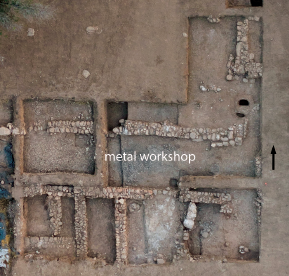


 In addition, office space in the Washington, D.C., area will allow ASOR’s cultural heritage team—who have worked since 2014 to document and raise global awareness about damage to cultural heritage sites in war-torn regions of North Africa and the Middle East, through funding provided primarily by the U.S. Department of State—to work more closely with our State Department colleagues and also our allies at the National Endowment for the Humanities, the National Humanities Alliance, and the Council of American Overseas Research Centers (CAORC). Proximity to Washington’s foreign embassies will also benefit ASOR because of the critical role these embassies play in approving and facilitating the U.S.-based, ASOR-affiliated archaeological excavations, field surveys, and other projects that take place overseas.