
Table of Contents for BASOR 387 (May 2022)

Table of Contents for Bulletin of ASOR 387 (May 2022)

You can receive BASOR (and other ASOR publications) through an ASOR Membership.
Please e-mail the Membership office if you have any questions.

Pp. 1–30: “The Date of Appearance of Philistine Pottery at Megiddo: A Computational Approach” by Eythan Levy, Israel Finkelstein, Mario A. S. Martin, and Eli Piasetzky

This paper addresses the question of the date of appearance of Philistine Bichrome pottery at Megiddo through a new computational approach, using recently developed chronology software. Based on historical dates, we obtain a terminus post quem of 1183 b.c.e. for the start of Philistine Bichrome at Megiddo using a broad model, and a terminus post quem of 1124 b.c.e. under stronger chronological hypotheses. Adding radiocarbon results at 68.2% confidence level to the model yields a narrow range of 1111–1086 b.c.e. for the appearance of Bichrome (1128—1079 b.c.e. for 95.4%). The paper also presents results suggesting that Stratum VIIB ended during, or only slightly before, the reign of Ramesses III (1184–1153 b.c.e.).

ASOR Members with online access: navigate to the token link email sent to you before attempting to read this article. Once you have activated your member token, click here to access the above article on The University of Chicago Press Journals’ website.

Pp. 31–53: “The Southern Levantine Roots of the Phoenician Mercantile Phenomenon,” by Ayelet Gilboa

I propose here a new way to look at the process through which, following the Bronze Age collapse and culminating in the second half of the 9th century b.c.e., polities in south Lebanon became the most important Levantine commercial hubs in the Mediterranean and the main patrons of the so-called Phoenician expansion. My approach differs from others dealing with the Phoenician question in that its definitions are not projected from a yet-to-happen “Phoenician” phenomenon in the West. It is an archaeological bottom-up diachronic approach and considers the entire Levantine coast and not Lebanon only, which is traditionally considered the Phoenician homeland. I argue that what may be termed the earliest Phoenician mercantile maritime ventures, in the early Iron Age, were launched mainly from the Carmel Coast and were directed mainly toward Egypt. Gradually this phenomenon expanded geographically, a process that can be followed closely. It was stimulated and conditioned mainly by the effects of Egypt’s withdrawal from Canaan, by the Late Cypriot IIIA collapse, by the slow recovery of the Syrian coast in the early Iron Age, and by environmental factors. The paper synthesizes several decades of research on Mediterranean issues, mainly in connection to Tel Dor on Israel’s Carmel Coast.

ASOR Members with online access: navigate to the token link email sent to you before attempting to read this article. Once you have activated your member token, click here to access the above article on The University of Chicago Press Journals’ website.

Pp. 55–85: “Ḥorvat Tefen: A Hasmonean Fortress in the Hinterland of ʿAkko-Ptolemais,” by Roi Sabar

Ḥorvat Tefen is located on a prominent hilltop in the Western Galilee, overlooking ʿAkko-Ptolemais and its vicinity. The remains of several rectangular towers, curtain walls, a single gate, and reservoirs are well discernible and suggest it was a military post. This article describes the results of the first excavation undertaken at the site, conducted in 2019 on behalf of the Hebrew University of Jerusalem. The excavations in four of the towers uncovered accumulations above floors as well as the foundations of the walls. The finds indicate this was a short-lived military site that was apparently founded by Alexander Jannaeus in the last years of his reign and abandoned shortly thereafter. The finds are unique in their well-defined chronological range and shed important light on the material culture of the early 1st century b.c.e. Galilee—the heyday of the Hasmonean territorial expansion. Two appendices present the coins and the amphorae finds, both crucial for dating the foundation of the fortress and identifying it as a Hasmonean initiative. In this context, the location of Ḥorvat Tefen suggests it was built to defend a sensitive part of the northwestern border of the Hasmonean state facing ʿAkko-Ptolemais.

ASOR Members with online access: navigate to the token link email sent to you before attempting to read this article. Once you have activated your member token, click here to access the above article on The University of Chicago Press Journals’ website.

Pp. 87–112: “A Middle Bronze Age Assemblage of Bone Inlays from Lachish: Typological, Technological, and Functional Aspects,” by Noam Silverberg, Yosef Garfinkel, Michael G. Hasel, and Naama Yahalom-Mack

Decorated bone inlays are among the fossiles directeurs of Middle Bronze (MB) Age II and early Late Bronze Age assemblages, having been documented since the beginning of archaeological research in the Levant. During the Fourth Expedition to Lachish, an assemblage of 49 decorated bone inlays restored from ca. 200 fragments was found in the rooms of a late MB II monumental building. The inlays were apparently used to decorate wooden boxes. Although such inlays are usually recovered from mortuary contexts, here they were found among daily objects, indicating that the building played an administrative role. In this paper the typological, technological, and functional aspects of the inlays are examined. We reconstruct the use of these objects and discuss the social context in which they were produced and used, providing an additional perspective on such objects and their role in both life and death during the late MB II. Our technological approach included microscopic examination of the inlays, which provided new information on the variability of craft traditions, suggestive of a decentralized production mode.

ASOR Members with online access: navigate to the token link email sent to you before attempting to read this article. Once you have activated your member token, click here to access the above article on The University of Chicago Press Journals’ website.

Pp. 113–138: “Ambiguity of Divine and Royal Portraiture and the Hiyawan Image of Kingship: Political Identity through the Monuments of ÇİNEKÖY and KARATEPE,” by Nathan Lovejoy

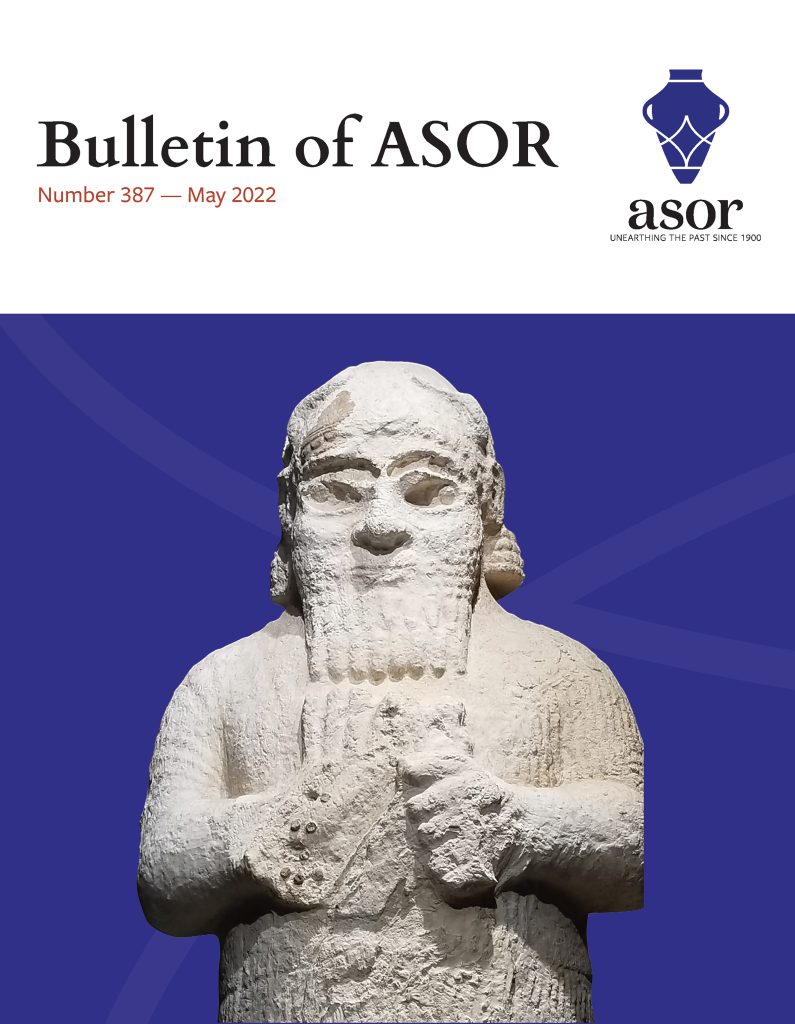
This paper examines the content of the ÇİNEKÖY and KARATEPE Inscriptions, the selection of scripts on the monuments, and the choices of iconography on the two statues of the Storm God. These monuments represent a regionally and temporally specific practice of representation that ambiguously blends elements of divine and royal imagery into a new form, while taking a similar approach to the semiotics of rulership as the Neo-Assyrian kings. The combined elements of the monuments suggest a unique cultural strategy in which the agency of the ruler is blended with that of the Storm God, exemplifying the specific worldview of Iron Age Cilicia that informed their composition. The rulers who created these monuments sought to assert their political identity through the combination of the figural representations, the visuality of the scripts, and the content of the inscriptions; the two monuments illustrate a drastic change in the political agenda of the kingdom of Hiyawa, reflecting a shift in power among opposing political factions. These identities also contain a sense of intentional ambiguity, as the various elements do not immediately support the same message, but rather work together to propagate a multifaceted message of military prowess, commercial interconnectedness, and royal legitimacy and kingship.

ASOR Members with online access: navigate to the token link email sent to you before attempting to read this article. Once you have activated your member token, click here to access the above article on The University of Chicago Press Journals’ website.

Pp. 139–169: “Early Islamic Copper Coins from Excavations in the Central Levant: An Indicator for Ancient Economy,” by Hagit Nol

Legible copper coins from excavations of Early Islamic sites are scarcer than in other periods. They contain, however, valuable information for understanding economic operations. The focus of this paper is the mint-toponyms inscribed on coins that point to their production place. This identification enables network inquiries and economic interpretations on a level that is rarely possible with archaeological finds. The following study utilizes coins of the 7th–9th centuries from excavations in one area in Israel, Palestine, and Jordan. It looks at mint names and the exact location of the coin’s discovery, maps these data with GIS, cross-references characteristics in the data, and detects possible correlations. The paper emphasizes two results. The first is a calculation of the distance that copper coins traveled—locally, regionally, or farther. This result challenges the view that copper coins were only circulated locally. The second result is the identification of sites with coins from four or more mints as marketplaces. Some of these sites are located at the center of large sites, such as Ramla or Beth Shean, but others are their neighboring small sites that acted in parallel. This result disputes Central Place Theory and similar paradigms.

ASOR Members with online access: navigate to the token link email sent to you before attempting to read this article. Once you have activated your member token, click here to access the above article on The University of Chicago Press Journals’ website.

Pp. 171–180: Three Women from Elam: A Revision of the Haft Tappeh Metal Plaque,” by Babak Rafiei-Alavi, Faranak Bahrololoumi, and Sabine Klein

The metal plaque of Haft Tappeh was found more than 60 years ago, and except for a few scenes on terracotta plaques and cylinder seals from both Elam and Mesopotamia with similar but not identical settings, it still has no known parallels in metal and remains a unique example of Elamite art. The present article is a study of this object from the heartland of the Elamite kingdom in the Khuzestan Plain. It revisits the scenic plaque and attempts to correct some of the misunderstandings regarding the identification of its iconography and symbology based on new photos, X-ray images, and lab analysis. The article also tries to place the plaque in its proper spatial and temporal context, using comparative methods and chemical and isotope analysis.

ASOR Members with online access: navigate to the token link email sent to you before attempting to read this article. Once you have activated your member token, click here to access the above article on The University of Chicago Press Journals’ website.

Pp. 181–205: “Moving in Together? Synoikismos and Polis Formation at Sagalassos and in Southwest Anatolia,” by Dries Daems and Peter Talloen

Topics such as polis formation and synoikismos have a rich background in classical studies, history, and archaeology. Such studies have mainly focused on the attestations of synoikismos events in literary sources and inscriptions. The archaeological side of such processes has not always been given equal weight. This paper presents a more encompassing view on patterns of synoikismos and polis formation by incorporating and assessing archaeological evidence in a model of push-pull interactions between local communities and the Hellenistic kingdoms in southwest Anatolia. This model will be applied on a case study of the origin of polis at Sagalassos and its relation with the nearby settlement at Düzen Tepe during its formative years in the Early to Middle Hellenistic period (3rd–2nd centuries b.c.). It will then situate this case in its wider context of settlement patterns and community formation in southwest Anatolia, focusing on the ancient regions of Pisidia, Lycia, and Pamphylia. The paper suggests that interactions between local communities and overarching central administrations offered suitable stimuli that resulted in local communities starting to participate in wider dynamics of economic and political importance. This ultimately resulted in observed patterns of polis formation and a potential synoikismos.

ASOR Members with online access: navigate to the token link email sent to you before attempting to read this article. Once you have activated your member token, click here to access the above article on The University of Chicago Press Journals’ website.

Pp. 207–220: “The Temple and the Town at Early Bronze Age I Megiddo: Faunal Evidence for the Emergence of Complexity,” by Lidar Sapir-Hen, Deirdre N. Fulton, Matthew J. Adams, and Israel Finkelstein

The Early Bronze Age is considered to be the period when complex and hierarchical societies first developed in the southern Levant. The appearance of specialization and social complexity is manifested through different aspects of the production stages of animal economy. In this paper, we examine faunal assemblages from two interconnected contemporaneous neighboring sites of differing characters in the Jezreel Valley, Israel: Megiddo, a cult site, and Tel Megiddo East, a town site. Both assemblages are dated to the Early Bronze Age IB (EB IB; 3090–2950 b.c.e.), at the dawn of urbanization in the Near East. The connection between sites, revealed in previous studies of other aspects, is supported by the analysis of faunal remains that reveals intriguing overlaps and divergences. The results of the current study show that the control of resources by the Great Temple in Megiddo also included access to animals and their products, and that it impacted the animal economy in settlements in its hinterland. The impact of this system demonstrates the Great Temple at the center of a larger regional economic organization in the late EB IB that would presage the urban developments of the EB II–III.

ASOR Members with online access: navigate to the token link email sent to you before attempting to read this article. Once you have activated your member token, click here to access the above article on The University of Chicago Press Journals’ website.
Table of Contents for BASOR 386 (November 2021)

Table of Contents for Bulletin of ASOR 386 (November 2021)


You can receive BASOR (and other ASOR publications) through an ASOR Membership. Please e-mail the Membership office if you have any questions.

Pp. 1–22: “The Making of a Script: Cretan Hieroglyphic and the Quest for Its Origins,” by Silvia Ferrara, Barbara Montecchi, and Miguel Valério

What is the origin of the earliest script in Europe? Is it invented locally or borrowed from an external template? How can we go about addressing this problem? A common view is that the script in question, Cretan Hieroglyphic, is locally created but externally inspired, probably through an influence from Egypt. But this appreciation should be the result of a full examination of the evidence, rather than a superficial appraisal of the script signs. This article reframes this approach, starting with generic assessments on origin and stimulus, and so opens a new avenue that takes into account the following aspects: 1) the establishment of a methodology for cross-comparisons between the Egyptian and Cretan scripts; 2) the situated context of the Egyptian and Cretan scripts in the mid-3rd to late 3rd millennium b.c.e.; 3) the local Cretan seal imagery; and 4) case studies of sign shapes, representing physical and immaterial referents across the Egyptian Hieroglyphic and Cretan repertoires. Only from this broad, multicentric framework, which has input from archaeology, epigraphy, iconography, and paleography, can we establish a solid method to address the origin of Cretan Hieroglyphic.

ASOR Members with online access: navigate to the token link email sent to you before attempting to read this article. Once you have activated your member token, click here to access the above article on The University of Chicago Press Journals’ website.

Pp. 23–46: “Judean Pillar Figurines and “Bed Models” from Tell en-Naṣbeh: Typology and Petrographic Analysis,” by David Ben-Shlomo and Lauren K. McCormick

This article discusses the Judean Pillar Figurines found in Tell en-Naṣbeh. The site yielded the highest number of these Iron Age II figurines after Jerusalem. Our study focuses on the significance of this distribution, the contexts in which the figurines were found at the site, as well as a compositional (petrographic) analysis of their clay. Fifteen anthropomorphic figurines as well as five “bed models” were analyzed by thin section petrography. The results indicate these objects were not made of the commonly used local clay and were probably not locally produced at Tell en-Naṣbeh, though other types of clay objects were. The possibility that the figurines were produced in Jerusalem is discussed, as well as the implications of these results.

ASOR Members with online access: navigate to the token link email sent to you before attempting to read this article. Once you have activated your member token, click here to access the above article on The University of Chicago Press Journals’ website.

Pp. 47–76: “Recent Early Bronze Age Glyptic Finds from Lebanon: The Evidence from Tell Fadous-Kfarabida,” by Hermann Genz and Alexander Ahrens

While Early Bronze Age glyptic finds from the southern Levant as well as from Syria have received considerable attention in the scholarly literature, unfortunately the same cannot be said about the glyptic material from Lebanon. For a long time, Byblos was the only site with a considerable number of Early Bronze Age glyptic finds, but the often unclear stratigraphic and contextual situation of the material hugely diminished its scientific value. Fortunately, in recent years more clearly stratified material has emerged from Sidon, Tell Arqa, and Tell Fadous-Kfarabida, which for the first time enables us to better define the glyptic styles in use in the central Levant during the 4th and 3rd millennia b.c.e. The paper presents the glyptic finds from Tell Fadous-Kfarabida, located on the Lebanese coast just 12 km north of Byblos, with a special emphasis on the iconography of the seals and seal impressions, as well as their contribution towards the external relations of the site.

ASOR Members with online access: navigate to the token link email sent to you before attempting to read this article. Once you have activated your member token, click here to access the above article on The University of Chicago Press Journals’ website.

Pp. 77–93: “A Radiocarbon Sequence for the Late Bronze to Iron Age Transition at Ashkelon: Timing Early Philistine Pottery,” by Yotam Asscher, Mario A. S. Martin, Daniel Master, and Elisabetta Boaretto

From 1985–2014, the Leon Levy Expedition to Ashkelon excavated a trench on the north side of Ashkelon’s central mound (Grid 38) exposing a Bronze and Iron Age sequence over an area of some 450 m2. By combining different radiocarbon sampling strategies used over the years of excavation, an absolute chrono-cultural scheme is constructed for the latter half of the 2nd millennium b.c.e. with a focus on the transition to the Iron Age. This chronology is then synchronized with several nearby sites.

ASOR Members with online access: navigate to the token link email sent to you before attempting to read this article. Once you have activated your member token, click here to access the above article on The University of Chicago Press Journals’ website.

Pp. 95–112: “Performance Frozen in Time: A New Iron Age II Female Ceramic Figurine from Jneneh, North Central Jordan,” by Regine Hunziker-Rodewald and Khaled A. Douglas

To date, about 470 female ceramic figurines are known to originate from Iron Age sites across Jordan. This article sheds light on a distinct type by studying a recently discovered figurine from a newly excavated settlement at Jneneh, Wadi az-Zarqa, in north central Jordan.

ASOR Members with online access: navigate to the token link email sent to you before attempting to read this article. Once you have activated your member token, click here to access the above article on The University of Chicago Press Journals’ website.

Pp. 113–132: “Cybele, Atargatis, or Allāt? A Surprising Tomb Artifact from Petra’s North Ridge,” by Robert Wenning and Megan A. Perry

The complex Nabataean “Götterwelt” incorporates deities from both their own tradition as well as imports from the larger Mediterranean and peninsular Arabian context. In 2014, a small naiskos depicting a possible imported deity was discovered in a tomb containing at minimum eight individuals, located on the northern edge of the ancient city of Petra. Geochemical investigation of the individuals buried in the tomb using strontium (87Sr/86Sr) and oxygen (δ18O) isotopes indicated only locally born individuals were interred within the tomb. The goddess depicted in the bas-relief sculpture is wearing a tunic and covered by a cloak and is flanked by two lions. Comparanda from the eastern Mediterranean showing similar iconography of the naiskos point to the goddess’s identity as Cybele, Atargatis, or Allāt, with most evidence suggesting Allāt. However, the emic perceptions of and ritual praxis involving this object and the goddess beyond its mortuary inclusion remain unclear. Therefore, regardless of the identification of the goddess it venerates, this portable naiskos served an important mortuary purpose for an individual locally born in the Petra region.

ASOR Members with online access: navigate to the token link email sent to you before attempting to read this article. Once you have activated your member token, click here to access the above article on The University of Chicago Press Journals’ website.

Pp. 133–175: “Islamic and Pre-Islamic Glass from Nippur,” by Carol Meyer

Excavation of Area WG at Nippur in 1989 yielded a large corpus of glass ranging in date from late Parthian to Islamic, mainly Abbasid. Islamic glass from Iraq is poorly studied and scrappily published, often concentrating on fancy, luxury vessels. This makes the large group of excavated, datable, domestic glassware from Nippur important for archaeologists dealing with the early Islamic period in Iraq and for those researching Abbasid glass. Further, I propose that Abbasid Levels III and II run later than suggested in the preliminary report, with Level II extending most likely into the early 10th century. This means that at least part of the site of Nippur remained occupied into the period when almost all of southern Iraq was severely depopulated. Finally, I raise the question of what can be gleaned from old, partial field records from a country devastated by decades of sanctions and war.

ASOR Members with online access: navigate to the token link email sent to you before attempting to read this article. Once you have activated your member token, click here to access the above article on The University of Chicago Press Journals’ website.

Pp. 177–207: “Sifting Through: The Characteristics and Significance of Ceramic Strainer-Vessels in the Chalcolithic Period of the Southern Levant,” by Edwin Cornelis Martinus van den Brink, Rivka Chasan, and Danny Rosenberg

A strainer is an autonomous utensil (sieve or colander) or an integral part (filter) of a utensil designed to separate mixtures based on grain size. In the southern Levant, strainer vessels made of clay are known since the Early Chalcolithic period, albeit few in number. The onset of the Late Chalcolithic period reflects a significant increase in the numbers and distribution of these particular vessels even though their numbers per site remain relatively low. This paper surveys foremost Late Chalcolithic strainer vessels from the southern Levant, discussing their morphology, significance and possible role as straining and sifting devices for liquids (e.g., olive or other oils, herbal or botanical mixtures, and alcoholic beverages) and solid substances (e.g., fats and flour). While results from our ongoing organic residue analysis concerning this and other types of Late Chalcolithic vessels are yet to come, we can already suggest that these vessels entail a variety of tasks and that they were used in a number of different contexts based on the variability of strainer vessel types and the strainer morphology.

ASOR Members with online access: navigate to the token link email sent to you before attempting to read this article. Once you have activated your member token, click here to access the above article on The University of Chicago Press Journals’ website.

Pp. 209–220: “Identity Creation and Resource Controlling Strategies: Thoughts on Edomite Ethnogenesis and Development,” by Aren M. Maeir

In this paper I suggest that the evolution of the control of natural resources and trade routes in the Arabah Valley and its environs was the basis for the formation of Edomite identity in the early Iron Age. Building on insights on ethnogenesis in Southeast Asia in the studies of Joseph Scott and James Warren, I attempt to align this with recent discussions on early Edom, and the role that this group played in the regional economic web of the Iron Age.

ASOR Members with online access: navigate to the token link email sent to you before attempting to read this article. Once you have activated your member token, click here to access the above article on The University of Chicago Press Journals’ website.

Pp. 221–236: “The Origin of Imported Jars from 6th Dynasty Abusir: New Light on Early Bronze Age Egyptian-Levantine Relations,” by Karin Sowada, Mary Ownby, and Miroslav Bárta

Thin-section petrography on imported Combed jars from the 6th Dynasty Abusir tomb complex of Qar and his family identified the central Levant, between Beirut and Tripoli, as the production zone of the vessels. Dating to the reign of 6th Dynasty king Pepy II (ca. 2278–2184 b.c.), the jars were made of the same mixed Cretaceous clay type used for imports of the early Old Kingdom. None of the Abusir material was an Egyptian imitation, contrary to previous assessments. The petrography demonstrates the long continuity of exchange networks with a specific area of the central Levant for over 350 years. During the Old Kingdom from the early 4th Dynasty to the late 6th Dynasty, exchange networks with the region intensified, confirming long-held understandings based on fragmentary archaeological data and the slender textual record.

ASOR Members with online access: navigate to the token link email sent to you before attempting to read this article. Once you have activated your member token, click here to access the above article on The University of Chicago Press Journals’ website.

Pp. 237–282: “The Archaeology of Regional Muslim Pilgrimage Reevaluated: The Site of Nabi Rubin (Israel) as a Case Study,” by Itamar Taxel, Avraham (Avi) Sasson, Moshe Fischer, and Nitzan Amitai-Preiss

This research constitutes a first attempt to discuss a Muslim pilgrimage site from a holistic, in-depth archaeological perspective. Our case study is Nabi Rubin, on the southern coastal plain of Israel, which was active from at least the early 15th century until the late British Mandate period and was one of the major foci of Muslim pilgrimage in historical Palestine. Pilgrimage to Nabi Rubin was characterized by a one-month-long organized celebration that took place every summer and attracted masses of pilgrims from Jaffa in the north to Gaza in the south. The research uses the site’s architectural and other human-created and natural landscape features—including historical trees and the rich material culture remnants left behind by pilgrims and other visitors, in addition to the written and photographic historical evidence related to Nabi Rubin—in order to draw additional information that can assist in interpreting the mute physical elements. The study provides a synthesis and interpretation of the site’s chronology, material culture, the activities and behaviors that took place there during festival periods, and methodological aspects of the interpretation of historical trees. The results highlight the uniqueness of Nabi Rubin compared to other Muslim pilgrimage sites in Palestine, and its significant potential for an archaeological research of Muslim pilgrimage in the region.

ASOR Members with online access: navigate to the token link email sent to you before attempting to read this article. Once you have activated your member token, click here to access the above article on The University of Chicago Press Journals’ website.