
Table of Contents for Bulletin of ASOR 386 (November 2021)
You can receive BASOR (and other ASOR publications) through an ASOR Membership. Please e-mail the Membership office if you have any questions.
Pp. 1–22: “The Making of a Script: Cretan Hieroglyphic and the Quest for Its Origins,” by Silvia Ferrara, Barbara Montecchi, and Miguel Valério
What is the origin of the earliest script in Europe? Is it invented locally or borrowed from an external template?  How can we go about addressing this problem? A common view is that the script in question, Cretan Hieroglyphic, is locally created but externally inspired, probably through an influence from Egypt. But this appreciation should be the result of a full examination of the evidence, rather than a superficial appraisal of the script signs. This article reframes this approach, starting with generic assessments on origin and stimulus, and so opens a new avenue that takes into account the following aspects: 1) the establishment of a methodology for cross-comparisons between the Egyptian and Cretan scripts; 2) the situated context of the Egyptian and Cretan scripts in the mid-3rd to late 3rd millennium b.c.e.; 3) the local Cretan seal imagery; and 4) case studies of sign shapes, representing physical and immaterial referents across the Egyptian Hieroglyphic and Cretan repertoires. Only from this broad, multicentric framework, which has input from archaeology, epigraphy, iconography, and paleography, can we establish a solid method to address the origin of Cretan Hieroglyphic.
ASOR Members with online access: navigate to the token link email sent to you before attempting to read this article. Once you have activated your member token, click here to access the above article on The University of Chicago Press Journals’ website.
Pp. 23–46: “Judean Pillar Figurines and “Bed Models” from Tell en-Naṣbeh: Typology and Petrographic Analysis,” by David Ben-Shlomo and Lauren K. McCormick
This article discusses the Judean Pillar Figurines found in Tell en-Naṣbeh.  The site yielded the highest number of these Iron Age II figurines after Jerusalem. Our study focuses on the significance of this distribution, the contexts in which the figurines were found at the site, as well as a compositional (petrographic) analysis of their clay. Fifteen anthropomorphic figurines as well as five “bed models” were analyzed by thin section petrography. The results indicate these objects were not made of the commonly used local clay and were probably not locally produced at Tell en-Naṣbeh, though other types of clay objects were. The possibility that the figurines were produced in Jerusalem is discussed, as well as the implications of these results.
ASOR Members with online access: navigate to the token link email sent to you before attempting to read this article. Once you have activated your member token, click here to access the above article on The University of Chicago Press Journals’ website.
Pp. 47–76: “Recent Early Bronze Age Glyptic Finds from Lebanon: The Evidence from Tell Fadous-Kfarabida,” by Hermann Genz and Alexander Ahrens
While Early Bronze Age glyptic finds from the southern Levant as well as from Syria have received considerable attention in the scholarly literature,  unfortunately the same cannot be said about the glyptic material from Lebanon. For a long time, Byblos was the only site with a considerable number of Early Bronze Age glyptic finds, but the often unclear stratigraphic and contextual situation of the material hugely diminished its scientific value. Fortunately, in recent years more clearly stratified material has emerged from Sidon, Tell Arqa, and Tell Fadous-Kfarabida, which for the first time enables us to better define the glyptic styles in use in the central Levant during the 4th and 3rd millennia b.c.e. The paper presents the glyptic finds from Tell Fadous-Kfarabida, located on the Lebanese coast just 12 km north of Byblos, with a special emphasis on the iconography of the seals and seal impressions, as well as their contribution towards the external relations of the site.
ASOR Members with online access: navigate to the token link email sent to you before attempting to read this article. Once you have activated your member token, click here to access the above article on The University of Chicago Press Journals’ website.
Pp. 77–93: “A Radiocarbon Sequence for the Late Bronze to Iron Age Transition at Ashkelon: Timing Early Philistine Pottery,” by Yotam Asscher, Mario A. S. Martin, Daniel Master, and Elisabetta Boaretto
From 1985–2014, the Leon Levy Expedition to Ashkelon excavated a trench  on the north side of Ashkelon’s central mound (Grid 38) exposing a Bronze and Iron Age sequence over an area of some 450 m2. By combining different radiocarbon sampling strategies used over the years of excavation, an absolute chrono-cultural scheme is constructed for the latter half of the 2nd millennium b.c.e. with a focus on the transition to the Iron Age. This chronology is then synchronized with several nearby sites.
ASOR Members with online access: navigate to the token link email sent to you before attempting to read this article. Once you have activated your member token, click here to access the above article on The University of Chicago Press Journals’ website.
Pp. 113–132: “Cybele, Atargatis, or Allāt? A Surprising Tomb Artifact from Petra’s North Ridge,” by Robert Wenning and Megan A. Perry
The complex Nabataean “Götterwelt” incorporates deities from both their own tradition as well as imports from the larger Mediterranean and peninsular Arabian context.  In 2014, a small naiskos depicting a possible imported deity was discovered in a tomb containing at minimum eight individuals, located on the northern edge of the ancient city of Petra. Geochemical investigation of the individuals buried in the tomb using strontium (87Sr/86Sr) and oxygen (δ18O) isotopes indicated only locally born individuals were interred within the tomb. The goddess depicted in the bas-relief sculpture is wearing a tunic and covered by a cloak and is flanked by two lions. Comparanda from the eastern Mediterranean showing similar iconography of the naiskos point to the goddess’s identity as Cybele, Atargatis, or Allāt, with most evidence suggesting Allāt. However, the emic perceptions of and ritual praxis involving this object and the goddess beyond its mortuary inclusion remain unclear. Therefore, regardless of the identification of the goddess it venerates, this portable naiskos served an important mortuary purpose for an individual locally born in the Petra region.
ASOR Members with online access: navigate to the token link email sent to you before attempting to read this article. Once you have activated your member token, click here to access the above article on The University of Chicago Press Journals’ website.
Pp. 133–175: “Islamic and Pre-Islamic Glass from Nippur,” by Carol Meyer
Excavation of Area WG at Nippur in 1989 yielded a large corpus of glass ranging in date from late Parthian to Islamic,  mainly Abbasid. Islamic glass from Iraq is poorly studied and scrappily published, often concentrating on fancy, luxury vessels. This makes the large group of excavated, datable, domestic glassware from Nippur important for archaeologists dealing with the early Islamic period in Iraq and for those researching Abbasid glass. Further, I propose that Abbasid Levels III and II run later than suggested in the preliminary report, with Level II extending most likely into the early 10th century. This means that at least part of the site of Nippur remained occupied into the period when almost all of southern Iraq was severely depopulated. Finally, I raise the question of what can be gleaned from old, partial field records from a country devastated by decades of sanctions and war.
ASOR Members with online access: navigate to the token link email sent to you before attempting to read this article. Once you have activated your member token, click here to access the above article on The University of Chicago Press Journals’ website.
Pp. 177–207: “Sifting Through: The Characteristics and Significance of Ceramic Strainer-Vessels in the Chalcolithic Period of the Southern Levant,” by Edwin Cornelis Martinus van den Brink, Rivka Chasan, and Danny Rosenberg
A strainer is an autonomous utensil (sieve or colander) or an integral part (filter) of a utensil designed to separate mixtures based on grain size.  In the southern Levant, strainer vessels made of clay are known since the Early Chalcolithic period, albeit few in number. The onset of the Late Chalcolithic period reflects a significant increase in the numbers and distribution of these particular vessels even though their numbers per site remain relatively low. This paper surveys foremost Late Chalcolithic strainer vessels from the southern Levant, discussing their morphology, significance and possible role as straining and sifting devices for liquids (e.g., olive or other oils, herbal or botanical mixtures, and alcoholic beverages) and solid substances (e.g., fats and flour). While results from our ongoing organic residue analysis concerning this and other types of Late Chalcolithic vessels are yet to come, we can already suggest that these vessels entail a variety of tasks and that they were used in a number of different contexts based on the variability of strainer vessel types and the strainer morphology.
ASOR Members with online access: navigate to the token link email sent to you before attempting to read this article. Once you have activated your member token, click here to access the above article on The University of Chicago Press Journals’ website.
Pp. 221–236: “The Origin of Imported Jars from 6th Dynasty Abusir: New Light on Early Bronze Age Egyptian-Levantine Relations,” by Karin Sowada, Mary Ownby, and Miroslav Bárta
Thin-section petrography on imported Combed jars from the 6th Dynasty Abusir tomb complex of Qar  and his family identified the central Levant, between Beirut and Tripoli, as the production zone of the vessels. Dating to the reign of 6th Dynasty king Pepy II (ca. 2278–2184 b.c.), the jars were made of the same mixed Cretaceous clay type used for imports of the early Old Kingdom. None of the Abusir material was an Egyptian imitation, contrary to previous assessments. The petrography demonstrates the long continuity of exchange networks with a specific area of the central Levant for over 350 years. During the Old Kingdom from the early 4th Dynasty to the late 6th Dynasty, exchange networks with the region intensified, confirming long-held understandings based on fragmentary archaeological data and the slender textual record.
ASOR Members with online access: navigate to the token link email sent to you before attempting to read this article. Once you have activated your member token, click here to access the above article on The University of Chicago Press Journals’ website.
Pp. 237–282: “The Archaeology of Regional Muslim Pilgrimage Reevaluated: The Site of Nabi Rubin (Israel) as a Case Study,” by Itamar Taxel, Avraham (Avi) Sasson, Moshe Fischer, and Nitzan Amitai-Preiss
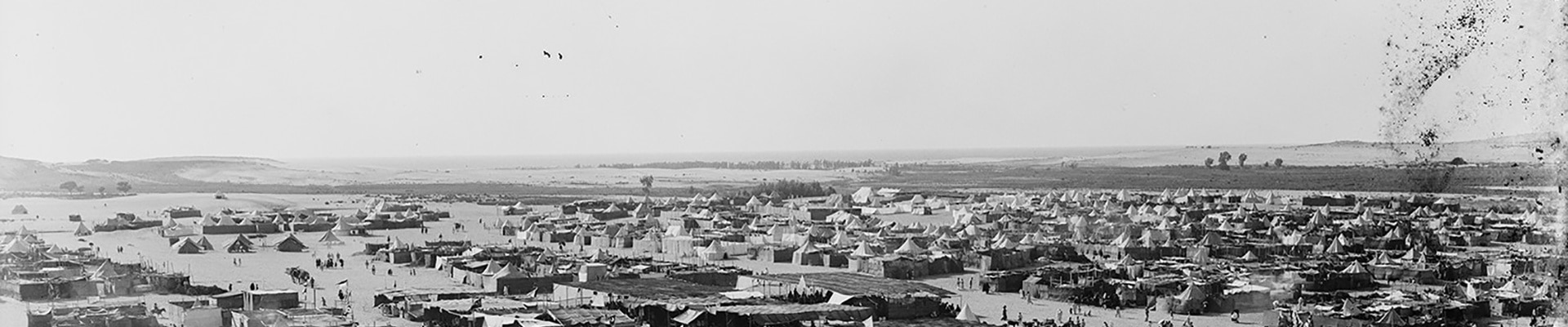
This research constitutes a first attempt to discuss a Muslim pilgrimage site from a holistic, in-depth archaeological perspective.  Our case study is Nabi Rubin, on the southern coastal plain of Israel, which was active from at least the early 15th century until the late British Mandate period and was one of the major foci of Muslim pilgrimage in historical Palestine. Pilgrimage to Nabi Rubin was characterized by a one-month-long organized celebration that took place every summer and attracted masses of pilgrims from Jaffa in the north to Gaza in the south. The research uses the site’s architectural and other human-created and natural landscape features—including historical trees and the rich material culture remnants left behind by pilgrims and other visitors, in addition to the written and photographic historical evidence related to Nabi Rubin—in order to draw additional information that can assist in interpreting the mute physical elements. The study provides a synthesis and interpretation of the site’s chronology, material culture, the activities and behaviors that took place there during festival periods, and methodological aspects of the interpretation of historical trees. The results highlight the uniqueness of Nabi Rubin compared to other Muslim pilgrimage sites in Palestine, and its significant potential for an archaeological research of Muslim pilgrimage in the region.
ASOR Members with online access: navigate to the token link email sent to you before attempting to read this article. Once you have activated your member token, click here to access the above article on The University of Chicago Press Journals’ website.