ASOR Legacy Circle: Why We Joined—by Tom and Alina Levy

[vc_row fullwidth=”true” attached=”true” css=”.vc_custom_1496247803139{padding-top: 0px !important;padding-right: 0px !important;padding-bottom: 0px !important;padding-left: 0px !important;}”][vc_column][mk_image src=”http://www.asor.org/wp-content/uploads/2018/04/Ruins-Perge-banner-for-post.jpg” image_width=”1920″ image_height=”400″ hover=”false” margin_bottom=”0″][/vc_column][/vc_row][vc_row fullwidth=”true” css=”.vc_custom_1496682730308{padding-top: 10px !important;padding-right: 0px !important;padding-bottom: 0px !important;padding-left: 0px !important;}”][vc_column width=”1/12″ css=”.vc_custom_1496683820796{margin-right: 10px !important;}” offset=”vc_hidden-md vc_hidden-sm vc_hidden-xs”][vc_column_text]

 SHARE

[/vc_column_text][mk_image src=”http://www.asortest.org/wp-content/uploads/2017/01/social-fb-icon4.jpg” image_width=”42″ image_height=”42″ hover=”false” custom_url=”https://www.facebook.com/ASOResearch/” margin_bottom=”0″][mk_image src=”http://www.asortest.org/wp-content/uploads/2017/01/social-tw-icon4.jpg” image_width=”42″ image_height=”42″ hover=”false” custom_url=”https://twitter.com/ASOResearch?ref_src=twsrc%5Egoogle%7Ctwcamp%5Eserp%7Ctwgr%5Eauthor” margin_bottom=”0″][mk_image src=”http://www.asortest.org/wp-content/uploads/2017/01/social-in-icon4.jpg” image_width=”42″ image_height=”42″ hover=”false” custom_url=”https://www.linkedin.com/company/american-schools-of-oriental-research” margin_bottom=”0″][mk_image src=”http://www.asortest.org/wp-content/uploads/2017/01/social-ml-icon_7.jpg” image_width=”42″ image_height=”42″ hover=”false” custom_url=”mailto:asor@bu.edu” margin_bottom=”0″][mk_image src=”http://www.asortest.org/wp-content/uploads/2017/01/blog-icon3.jpg” image_width=”42″ image_height=”42″ hover=”false” custom_url=”http://asorblog.org/” margin_bottom=”0″][/vc_column][vc_column border_color=”rgba(255,255,255,0.01)” width=”1/6″ css=”.vc_custom_1496683923840{margin-right: 20px !important;border-left-width: 2px !important;padding-right: 20px !important;padding-left: 20px !important;border-left-color: #99422f !important;}”][mk_divider divider_color=”rgba(255,255,255,0.01)” thickness=”1″ margin_top=”3″ margin_bottom=”3″][vc_column_text]

ASOR BLOG

NEWS@ASOR

ANCIENT NEAR EAST TODAY

PAST ASOR NEWS, MONTH BY MONTH

FY17 HONOR ROLL OF DONORS

ASOR ANNUAL MEETING

[/vc_column_text][/vc_column][vc_column border_color=”rgba(170,170,170,0.01)” width=”1/2″ css=”.vc_custom_1487276122024{margin-right: 10px !important;margin-bottom: 30px !important;border-right-width: 2px !important;border-bottom-width: 2px !important;padding-top: 30px !important;padding-right: 30px !important;padding-left: 20px !important;background-color: #ffffff !important;border-right-color: rgba(227,228,228,0.75) !important;border-bottom-color: rgba(227,228,228,0.75) !important;}”][vc_column_text responsive_align=”left”]

ASOR LEGACY CIRCLE: TOM AND ALINA LEVY

[/vc_column_text][vc_column_text]

Tom and Alina Levy in front of the Garden Apartment at the W.F. Albright Institute of Archaeological Research, 1986

Alina and I just joined the ASOR Legacy Circle as ASOR has been in our lives for many years. ASOR became a very important chapter starting in 1982 when Tom was fortunate to receive a National Endowment for the Humanities ASOR grant to spend the year doing post-doctoral research at the W.F. Albright Institute of Archaeological Research in Jerusalem. We did not have a lot of money at that time, but Alina thought it was a good idea to accept ASOR’s unique offer of life membership for $1000 – a huge amount for us at the time. Several years later, Albright Director Sy Gitin offered Tom a job as Assistant Director of the Albright. This was a wonderful opportunity for a young archaeologist. Alina and I were invited to live at the Albright in what we called the Garden Apartment beneath the Director’s home. We were even allowed to bring Sandy, our beloved Boxer, to take up residence at the Albright for two years. Living in East Jerusalem was a wonderful experience. We became very close to the Palestinian staff at the Albright – Munira Said (Secretary), Omar Jabrin (Cook), Said Freij (Major Domo). Labiba, Salami, Abu Ahamad, and Fais (Gardener). Fais is the only staff member left from the old days. Omar would tell us innumerable stories about the old days, including many about one of Tom’s archaeological heroes who served as the director of the school in the 1930s – Nelson Glueck. Although there was no meal plan linked to Tom’s salary, almost every evening after dinner, Omar would send one of his sons with a plate of delicious food for us and scraps for Sandy. We made numerous trips to the West Bank with Said to visit traditional olive oil, soap, charcoal and other producers. Omar, Munira and Said invited us to their homes for meals and good conversations. Living and working at the Albright was a unique experience to meet all the top scholars in the field at that time.

Around the table in the Kershaw Garden at the Albright Institute (from left): Larry Stager, David Amiran, Geoffrey Shipton, Diane Saltz, Tom Levy, Sy Gitin. In the background – Munira Said, Jodi Magness, Doug Esse and others.

When Tom started to work in Jordan in 1996, ACOR became another home in the Middle East. Director Pierre and Patricia Bikai, and later, Barbara Porter, helped facilitate living and carrying out research in Jordan in so many ways.

Although the Albright and ACOR have their own fundraising mechanisms, these two centers, along with CAARI in Cyprus, are the tip of the ASOR research spear in the Eastern Mediterranean. These overseas centers serve as key components of ASOR mission that facilitates American research in this wonderful part of the world. For these reasons, we are happy to be members of the ASOR Legacy Circle.

Alina and Tom Levy[/vc_column_text][/vc_column][vc_column border_color=”rgba(170,170,170,0.01)” width=”1/6″ css=”.vc_custom_1496684098866{margin-right: 5px !important;margin-bottom: 20px !important;border-right-width: 2px !important;border-bottom-width: 2px !important;padding-top: 30px !important;padding-right: 10px !important;padding-left: 10px !important;background-color: #ffffff !important;border-right-color: rgba(227,228,228,0.75) !important;border-bottom-color: rgba(227,228,228,0.75) !important;}”][vc_wp_posts title=”BROWSE THE NEWS ARCHIVE” number=”4″][/vc_column][vc_column border_color=”rgba(170,170,170,0.01)” width=”1/6″ css=”.vc_custom_1496684008271{margin-right: 10px !important;margin-bottom: 30px !important;border-right-width: 2px !important;border-bottom-width: 2px !important;padding-top: 30px !important;padding-right: 20px !important;padding-left: 20px !important;background-color: #ffffff !important;border-right-color: rgba(227,228,228,0.75) !important;border-bottom-color: rgba(227,228,228,0.75) !important;}”][vc_column_text] [/vc_column_text][/vc_column][/vc_row]

Fellowship Report: Tasha Vorderstrasse

EXPERIENCING THE MIDDLE BYZANTINE COUNTRYSIDE AT ÇADIR HOYUK

Tasha Vorderstrasse, 2017 Strange/Midkiff Excavation Fellowship Recipient

View of Çadır Höyük. Note the Middle Byzantine fortification wall including the remains of a tower, at the top of the mound.

Thanks to the generosity of the ASOR Strange/Midkiff Fellowship, I am able to go to Turkey to participate in the excavations at the sites of Çadır Höyük and Komana. My first stop was the site of Çadır Höyük, doubtless familiar to many of you who attend the ASOR annual meetings and have read their many publications. Çadır Höyük, which is excavated under the leadership of Dr. Gregory McMahon (Project Director) of the University of New Hampshire and Dr. Sharon Steadman of SUNY Cortland (Field Director and Project Co-Director), is located in central Turkey, about a 3 -hour bus ride from Ankara. Although it is not a large site in terms of size, it has a great variety of material from different phases of Turkey’s archaeological history and therefore is an important site. I was working with Dr. Marica Cassis of Memorial University of Newfoundland on the medieval pottery at the site. I am publishing the medieval pottery from the nearby site of Alishar Hüyük that was excavated by the Oriental Institute of the University of Chicago from 1927-1932 and the Çadır pottery is a valuable comparanda to both the Alishar and Komana materials. I would like to thank the team at Çadır Höyük for the opportunity to look at the pottery at the site. Everyone there was so generous with their time and very welcoming.

The reason I came to see the site is to look at the evidence for the latest phase of occupation: Middle Byzantine/Seljuk (10th-12th century). This is a pivotal moment in the history of medieval Anatolia after the Seljuk Turks defeated the Byzantines in 1071, taking over much of what is now modern Turkey. But while we have a lot of information about this period in the historical sources, identifying this period in the archaeological record, particularly in the countryside, remains problematic. The question of what influences the invading Seljuks and other groups had on the material culture of the rural areas is a question that has so far largely been neglected by specialists, with most of the attention concentrating on the fine art of elite urban centers. Indeed, the medieval Anatolian countryside in general still largely remains unstudied.

View of the plain below the mound. The position of Çadır Höyük on the plain would allow the population on the mound to see whoever was coming into the region.

Nevertheless, the topic of the medieval countryside is far more interesting than the previous amount of work on it would suggest. Identifying how the material culture of populations changed (or did not) through time and how this could reflect the changing identity of the population, has been a topic of interest of mine for a long time. While the countryside is often seen as being a backwater compared to urban centers, finds at medieval rural settlements suggest that the populations were not isolated and cut off from other rural settlements or from their urban neighbors. Rather, they formed part of a complex system of settlements that interacted with each other and formed key parts of settlement networks. But it is these relationships that we are now only starting to understand. When working at these medieval sites, it can be a complicated process to even date the pottery, due to the lack of published parallels.

Working in the Çadır Höyük depot on pottery.

The material from Çadır Höyük represents a great opportunity to study this period and my visit so far to Çadır Höyük has been very useful in terms of starting to better understand this sequence which will allow me to see how this site fits into what we know from the nearby site of Alishar as well as the site of Komana located about three hours of here near Tokat, where I am now. Stay tuned and you will read all about Komana and my work there in my subsequent blog post.


For more on the site of Çadır Höyük, see their webpage: http://www.cadirhoyuk.com

Dr. Tasha Vorderstrasse is a Research Associate at the Oriental Institute of the University of Chicago. She works on the archaeology of the Near East, the Caucasus and Central Asia and the connections between those regions and China.

Fellowship Report: Vincent Cason

UNMAKING A HOME

Vincent Cason, 2017 Platt Excavation Fellowship Recipient


Vince and volunteer Josiah uncover a beautiful juglet.

This past summer I was given the opportunity to be a square supervisor on The Fourth Expedition to Tel Lachish, directed by Yosef Garfinkel of The Hebrew University of Jerusalem and Michael Hasel and Martin Klingbeil of Southern Adventist University. I was placed under the supervision of Hoo-Goo Kang of Seoul Jangsin University. While this was my third excavation season at Tel Lachish, previously serving two seasons as a volunteer as an Anthropology major at Virginia Commonwealth University (VCU), it was my first time as a member of the Hebrew University staff. The promotion from volunteer to professional staff required a deeper understand of methodology, a sound interpretation as to what exactly was being uncovered, its relationship to material and strata found in adjacent squares as well as the overall site, and how material finds can support the larger questions of the excavation as determined by the directors (urban planning, social behaviors ethnic identification, etc.). Yet, perhaps what was most surprising about doing field archaeology lies beyond the scientific approach and more in the realm of intuition. It was around midseason that I began to lean on an uncanny sense of where to dig next and when to keep my eyes open.

But how does one really know what to look for?


Vince examines a sling stone in the field.

A common theme in introductory classes to anthropology and archaeology is the holistic nature of our field, taking ideas and influence from many other fields and disciplines. This observation tends to lie dormant in the more theoretical side of things unless students actually have a chance to apply it to or through methodology. When taking part of an archaeological excavation, one can see that this holistic nature applies to much more than theory but additional includes what each staff member brings to the excavation. I found that a basic understanding of trade work can be an invaluable asset to understanding many parts of ancient society.

During my high school education, I focused on agriculture, as I was interested in the history of land use especially farming techniques and this was a strong program in rural North Carolina. I was a member of the Future Farmers of America, took classes on horticulture, and after graduation worked in landscaping for a period. While technology has changed quite a bit over the past few thousand years, many principles are constant, especially when it comes to agriculture. Grain production, from harvest to storage, to milling or grinding, then table use follow essentially the same trajectory even with modern invention. For example, terracing, an ancient method of farming, are still used today to allow agriculture in areas with steep topography.

During the 2017 season, much of my area was uncovering architecture which was another area I had practical work and classroom experience in. In my high school construction class, students built a house, auctioned off at the end of the semester, which in turn funds the class. And here I was, excavating houses! After removing nearly a meter of overburden in two squares, we had two immediate objectives which we methodically dispatched: find the floor and the foundation of the wall of the building. The same process of foundations, framing, flooring, and roofing I learned in high school guided me as I excavated the square, uncovering the walls, ceiling collapse, flooring, and foundational trenches in reverse order.


VCU Rams remove balks to fully expose architecture.

While I was able to lean on past academic and practical experience I did notice an important distinction between construction and deconstruction. Archaeology is often described as a destructive science because, once excavated, the archaeological matrix is gone forever, which necessitates meticulously recording while excavating. While excavating these buildings, I realized that destructive is misleading, that what we do is more “deconstructive” as we examine the structure, piece by piece, from the top down as it is “dismantled.”

This summer working on the Hebrew University staff at Tel Lachish was a truly insightful experience. I have deepened my understanding of what an incredible amount of social organization and labor goes into the building of a city, building a nation. It has left me feeling assured that I have chosen a career path that I truly enjoy, one that has real impact on the world around me. As a prospective graduate student there are few feeling that alleviate the anxiety of taking the next step in my education the way that feeling does. To those that are kind enough to fund fellowships such as the one I was awarded, I cannot thank you enough as I would not have had a chance like this otherwise and there are many others that are in the same situation.


Vincent Cason is a recent graduate of the Anthropology program at Virginia Commonwealth University in Richmond, VA. His research interests include state formation in the Iron Age Levant and agricultural practices in the general Near East. He is currently living in Richmond, VA and preparing graduate program applications.

Fellowship Report: Megan Ashbrook

MY DAY ON TEL AKKO 

Megan Ashbrook, 2017 Platt Excavation Fellowship Recipient

4:45am: Wakeup and 1st breakfast

Well, sometimes I get up later … it’s hard to get out of bed before sunrise in Israel. But I always have to get a little something to eat before working on the tel. My favorite is a plum and bread with peanut butter on it. Then it’s off to excavations with the rest of the Tel Akko Total Archaeology Project.

5:40am: Arrive at Tel Akko

The first thing we all do in the morning is grab our supplies and sweep the park path around the dig site. Our supplies include black buckets for dirt, colored buckets for pottery and small finds, a brush, a trowel, and a patiche. A patiche is almost like a smaller, thinner hammer. This isn’t the most fun part of the day, but I find it gives me some time to wake up before excavation.

5:40-8:30am: Excavation

In the morning, we give our square a general sweep to collect all the loose dirt that blew in overnight. Then we get our plan of the day’s dig from our square supervisor. Then finally we start digging! Mostly, I have been excavating around tabuns (Arabic word for oven) until they are floating and then removing the tabuns. There were four tabuns in my square at the beginning of the season and we are working to remove them all this season.

2017 Tell Akko group

Throughout the day, the tel is filled with music, talking, and conversations. Our excavation has such a great atmosphere and I love it. One professor always goes around and asks everyone, “When was the last time you drank water?” It’s a helpful reminder to stay hydrated in the hot 80-90 degree weather.

Questions and conversations are all around the tel. I have learned to embrace asking questions, every single one. I want to soak up all the knowledge I can while I’m on this excavation. There are people on the dig with their special interests/expertise like metallurgy, lithic tools, Munsell Charts, or ceramics. My interest is in ceramics, though I don’t know the chronology of pottery on the tel very well. I feel really honored, since it is only my first excavation, when someone brings a ceramic sherd or item over for me to look at.

8:30am: Tel Breakfast, also known as 2nd Breakfast

9:00-11:30am: Excavation

After breakfast we all reluctantly get up from the tables and get back to work. Sitting and relaxing for a while makes it hard to get back to work. I usually pick up where I left off before breakfast. For example, if I was trimming a baulk before tel breakfast, I would go back to doing that. A baulk is the half meter section of dirt left on each side of a square. Baulks are helpful to see the stratigraphy of the square. When trimming it, the idea is to make the baulk straight and at a right angle with the floor of the square. Plus it makes the square look clean and nice.

The best part of my day is excavating. Excavation includes so many parts I didn’t know before coming to Tel Akko, like trimming baulks. I also have learned how to use a dumpy level to take elevation points in our square. I find it easy to use and a nice change from digging all day. We take elevations when something significant or special is found, like a unique artifact. In my square, it’s usually a slag cake. Also, elevations are taken at the end of each day not only in my square but every square being excavated at the site. Taking end of the day elevations tells us exactly how far down we excavated that day.

Sherd found on site

I have learned how to identify so many things from digging the past three weeks like bone, vitrified earth, and tabun pieces (which look like really thick clay). This really helps when sifting all the dirt that is pulled out of my square (another skill I have learned). It’s a great feeling when I ask my square supervisor to double check my identification and I got it right!

11:30am-12:00pm: Cleaning and Closing the Square for the Day

Just like at the beginning of the day, we do a general clean sweep of the square to get all the dirt we kicked up throughout excavation. Then I usually help my square supervisor check all our finds for the proper tags and fill out end-of-the-day paperwork.

12:00-12:30pm: Find of the Day

Now that all the squares are closed for the day we can see some cool things people found! Fun or different finds are put up to be voted on, by cheering, for the “find of the day.” Some items that have won are an Egyptian scarab, a ceramic figurine, and a modern bullet.

12:30pm: Walk to the Bus

My day on the tel concludes with carrying all the pottery and soil samples found that day down the long steps to the bus. We need to soak and wash the pottery so it can be studied by the ceramic experts in the lab. I also like to see all the cool pottery found on Tel Akko!

Now there are only a few days left on the tel and I’m wishing for more. I think I wish for more because I have fallen more in love with archaeology (if that’s even possible) and I truly enjoy the people working around me.

Megan Ashbrook is a senior undergraduate at Miami University of Ohio. She is a double major in Anthropology and East Asian Languages and Cultures with a minor in Archaeology. Archaeological ceramic technology and trade is her current area of interest.

Excavation Website: http://www.telakko.com/

Excavation Facebook: https://www.facebook.com/TelAkkoProject/

Tel breakfast is one of the best meals of the day! Every morning I have hummus, green olives, and tea. Depending on what else there is I also have fruit, vegetables, or a peanut butter and jelly pita sandwich. Breakfast is also nice because it is served family style with all of us siting at one long table. I really enjoy passing the food and talking to my friends and finding out what is happening in their squares. I get to hear about fun things like hearths or almost complete vessels.

Remembrance: James F. Strange (written by Eric & Carol Meyers)

[vc_row fullwidth=”true” attached=”true” css=”.vc_custom_1496247803139{padding-top: 0px !important;padding-right: 0px !important;padding-bottom: 0px !important;padding-left: 0px !important;}”][vc_column][mk_image src=”http://www.asor.org/wp-content/uploads/2018/04/sepphoris-view-banner-for-post.jpg” image_width=”1920″ image_height=”400″ hover=”false” margin_bottom=”0″][/vc_column][/vc_row][vc_row fullwidth=”true” css=”.vc_custom_1496682730308{padding-top: 10px !important;padding-right: 0px !important;padding-bottom: 0px !important;padding-left: 0px !important;}”][vc_column width=”1/12″ css=”.vc_custom_1496683820796{margin-right: 10px !important;}” offset=”vc_hidden-md vc_hidden-sm vc_hidden-xs”][vc_column_text]

 SHARE

[/vc_column_text][mk_image src=”http://www.asortest.org/wp-content/uploads/2017/01/social-fb-icon4.jpg” image_width=”42″ image_height=”42″ hover=”false” custom_url=”https://www.facebook.com/ASOResearch/” margin_bottom=”0″][mk_image src=”http://www.asortest.org/wp-content/uploads/2017/01/social-tw-icon4.jpg” image_width=”42″ image_height=”42″ hover=”false” custom_url=”https://twitter.com/ASOResearch?ref_src=twsrc%5Egoogle%7Ctwcamp%5Eserp%7Ctwgr%5Eauthor” margin_bottom=”0″][mk_image src=”http://www.asortest.org/wp-content/uploads/2017/01/social-in-icon4.jpg” image_width=”42″ image_height=”42″ hover=”false” custom_url=”https://www.linkedin.com/company/american-schools-of-oriental-research” margin_bottom=”0″][mk_image src=”http://www.asortest.org/wp-content/uploads/2017/01/social-ml-icon_7.jpg” image_width=”42″ image_height=”42″ hover=”false” custom_url=”mailto:asor@bu.edu” margin_bottom=”0″][mk_image src=”http://www.asortest.org/wp-content/uploads/2017/01/blog-icon3.jpg” image_width=”42″ image_height=”42″ hover=”false” custom_url=”http://asorblog.org/” margin_bottom=”0″][/vc_column][vc_column border_color=”rgba(255,255,255,0.01)” width=”1/6″ css=”.vc_custom_1496683923840{margin-right: 20px !important;border-left-width: 2px !important;padding-right: 20px !important;padding-left: 20px !important;border-left-color: #99422f !important;}”][mk_divider divider_color=”rgba(255,255,255,0.01)” thickness=”1″ margin_top=”3″ margin_bottom=”3″][vc_column_text]

ASOR BLOG

NEWS@ASOR

ANCIENT NEAR EAST TODAY

PAST ASOR NEWS, MONTH BY MONTH

FY17 HONOR ROLL OF DONORS

ASOR ANNUAL MEETING

[/vc_column_text][/vc_column][vc_column border_color=”rgba(170,170,170,0.01)” width=”1/2″ css=”.vc_custom_1487276122024{margin-right: 10px !important;margin-bottom: 30px !important;border-right-width: 2px !important;border-bottom-width: 2px !important;padding-top: 30px !important;padding-right: 30px !important;padding-left: 20px !important;background-color: #ffffff !important;border-right-color: rgba(227,228,228,0.75) !important;border-bottom-color: rgba(227,228,228,0.75) !important;}”][vc_column_text responsive_align=”left”]

JAMES F. STRANGE: AN APPRECIATION

Written by Eric and Carol Meyers

[/vc_column_text][vc_column_text]James F. (Jim) Strange was our close collaborator for more than a decade and has also been a dear friend for more than four decades. This double relationship goes back to the late 1960s at Tel Gezer where Jim and Eric first met. That initial acquaintance brought an awareness of our shared interest in the archaeological recovery of early Judaism and Christianity and led us all to the Galilee. From 1970 to 1981 we excavated together at four Upper Galilean villages, all with synagogues: Khirbet Shema‘, Meiron, Gush Ḥalav, and Nabratein. We also broke with the usual practice of excavators leaving their families behind; we brought our own families with us to the field and encouraged senior staff to bring their spouses and children.

Thus our relationship deepened not only with Jim but also with his wife Carolyn, who served as Registrar for several seasons at Khirbet Shema‘ and Meiron (and subsequently had other roles on Jim’s later projects), and their children. Sometimes we even had a “kids’ tent” for the offspring. As soon as the children of the Stranges, Meyerses, and other staff were old enough to lug a gufah or manipulate a sifter, they were put to work in the trenches. For the Strange family (but not ours!), this early field experience apparently had a profound impact, for several of the young Stranges are now themselves professionals in archaeology. Perhaps there could be no greater testimony to Jim’s passion for archaeology, which we have always greatly admired, than the fact that he has passed it on to the next generation of his family.

Much of the preparation of the final reports in those early years was done in Durham, and Jim came often to stay with us at our home and work with us on the publications of our excavations and also on the book that Eric and Jim wrote together: Archaeology, the Rabbis, and Early Christianity (Abingdon 1981). When we were not with him in the Duke library or at our offices, we were at home laying out pottery and artifact plates—a task that had to be done manually in those days—on our dining room table. Because all of this was time consuming, Jim was with us so often, sometimes for weeks, that our daughters thought of him as a regular member of the family. At one point, our younger daughter, accustomed to seeing Jim every day in the summers and also during the weeks he stayed with us when working on publications, introduced him to others as her “second daddy.” It’s no wonder we often call him fondly “abunah,” a phrase coined early in the Upper Galilee years when we had to explain to our Druze workers that Jim was a man of the cloth and an archaeologist.

An important component of our Upper Galilee digs was our Field School, which, in addition to the field work, included daily pottery reading and registration, evening lectures and seminars, and weekend tours of our sites and also of others in the region. Jim was an indispensable part of the process: he drafted our invaluable and much used “Manual for Area Supervisors”; he explained our various procedures with characteristic wit and wisdom as well as good-humored patience; and in the lectures and tours he conveyed to both students and staff his deep knowledge of the region and its history. Moreover, he was savvy with the technology of recording as well as of digging; as a result we began to use a computer to record data as early as 1980.

Jim Strange, 2017 Annual Meeting

Just as important, Jim’s keen eye for ceramics contributed enormously to the development of a ceramic typology for the Hellenistic through Byzantine periods. In the 1970s, the pottery of these periods was not well known. Thus one of the chief aims of our years together was to lay the groundwork for a serious, stratigraphically focused approach to the archaeology of the Greco-Roman period; this endeavor would be based on a solid ceramic typology. We accomplished this goal in our years together in no small part because of Jim’s expertise. Another objective was to excavate small Jewish villages, especially ones with synagogues, rather than the urban sites favored by so many archaeologists at that time. Very few synagogue sites had been excavated in the years since the German team of Kohl and Watzinger conducted soundings at number of synagogue sites at the beginning of the twentieth century. By excavating four sites with synagogues, we were able to contribute to what became a rapidly growing and flourishing field—the excavation of classical-period sites in Galilee.

After excavation of those four Upper Galilean village sites, we turned to Lower Galilee and the great urban site of Sepphoris. Although we parted ways and organized separate excavation teams and established different research goals, at heart we all remained faithful Galileans. We all still feel a special kinship to Galilee, especially to the Galilee of early Judaism and Christianity. For, through surveys and field trips as well as excavations, we had become familiar with virtually every nook and cranny of the region.

We shared many archaeological and academic experiences with Jim, and we are delighted to be offering our appreciation to this volume celebrating his many notable contributions to the fields of archaeology, Galilean studies, and the history of ancient Judaism and Christianity. But what is most vivid and what has united us through the years is the close friendship we forged with Jim and his family in our digging days. This special relationship continued in no small measure because of our participation in meetings of the American Schools of Oriental Research (ASOR). Indeed, ASOR has been the instrument that has enabled us to see each other regularly after our field work together came to an end. At the same time, our loyalty to ASOR over the years is in no small measure a byproduct of the strong feelings we developed together in the field.

Jim Strange will be sorely missed. May his memory be for a blessing.


Excerpted and slightly revised and taken from his recent Festschrift: A City Set on a Hill: Essays in Honor of James F. Strange. Edited by Daniel A. Warner and Donald D. Binder. Mountain Home, AR 72654: BorderStone Press, LLC, 2014.[/vc_column_text][/vc_column][vc_column border_color=”rgba(170,170,170,0.01)” width=”1/6″ css=”.vc_custom_1496684098866{margin-right: 5px !important;margin-bottom: 20px !important;border-right-width: 2px !important;border-bottom-width: 2px !important;padding-top: 30px !important;padding-right: 10px !important;padding-left: 10px !important;background-color: #ffffff !important;border-right-color: rgba(227,228,228,0.75) !important;border-bottom-color: rgba(227,228,228,0.75) !important;}”][vc_wp_posts title=”BROWSE THE NEWS ARCHIVE” number=”4″][/vc_column][vc_column border_color=”rgba(170,170,170,0.01)” width=”1/6″ css=”.vc_custom_1496684008271{margin-right: 10px !important;margin-bottom: 30px !important;border-right-width: 2px !important;border-bottom-width: 2px !important;padding-top: 30px !important;padding-right: 20px !important;padding-left: 20px !important;background-color: #ffffff !important;border-right-color: rgba(227,228,228,0.75) !important;border-bottom-color: rgba(227,228,228,0.75) !important;}”][vc_column_text] [/vc_column_text][/vc_column][/vc_row]

Fellowship Report: Zachary Thomas

AN EXTRA MONTH OF SUMMER AT TEL ABEL BETH MAACAH 

Zachary Thomas, 2017 Platt Excavation Fellowship Recipient

As an Australian, one of the advantages of coming to Israel to dig in June and July each year is getting to miss the coldest part of winter back home in Sydney. May I say though, this pales in comparison to the real reasons I returned this year to excavate for a second season at Tel Abel Beth Maacah, or ABM as its friends call it. For a start, the site is very relevant to my own doctoral research on the archaeology and history of the United Monarchy and Iron Age IIA period, being mentioned a few times in connection with David’s reign, most particularly 2 Samuel 20. It is also located at the cross-roads of different Iron Age identities or “ethnic groups”, the Israelites, Phoenicians and Arameans, which makes for a fascinating research question and many nerdy conversations on the sociopolitical place of the area itself.

But digging at any site, however relevant it is to one’s research, is only going to be as good as the project itself and the people you are digging with. I am very fortunate in saying that at ABM the work, the atmosphere and especially the people make it fantastic place to come and excavate, whether it’s an exciting or a more lacklustre day in terms of the finds. This starts from the top; our three co-directors, Prof. Bob Mullins of Azusa Pacific University and Drs Nava Panitz-Cohen and Dr Naama Yahalom-Mack of the Hebrew University of Jerusalem set the tone as all good leaders do. It’s one of informality and friendliness alongside collaboration and academic excellence, and it filters down to all the staff and volunteers and to the work we do. This was a tougher year than in 2016 when I first dug at ABM in terms of hot weather but probably surpassed it in terms of discoveries.


Our three directors plus a distinguished visitor, Prof. Amihai Mazar.

ABM is located in the far north of Israel in the Hulah Valley, a 15-20 minute bus ride each morning (if 4.15am is really morning and not still night) from our lodgings at the laid-back Kibbutz Kfar Szold. It is so far north in fact that we have the Golan Heights and views of Mt Hermon on the east and the hills of Lebanon overlooking the Tel on the west. Although the site has produced finds from different periods spanning the Early Bronze to the 20th century, the Middle Bronze Age, Iron Age I and Iron Age II are particularly well represented so far. We had four areas open this year, Areas A, F and O in the lower city and my area, Area B in the upper city. Much of the upper city is overlain by two old army bunkers built out of rubble from the village that occupied the site until the 1940s, so much of it is hard to access archaeologically. Area B sits in part of the upper city below the rubble capping, and before this year had already produced a rampart from the Middle Bronze Age, upon which was built a building from the Iron Age I, a large wall from the Iron Age II and a few phases of architecture from the Persian and Hellenistic period.


The crew of Area B near the start of the season.

This year our major discovery, on top of some great small finds and new phasing, was a second large wall from the Iron Age II running parallel to the one already known with what appear to be cross-walls connecting them. There was much discussion about whether we might have a casemate wall system similar to that from the Iron Age IIA at Hazor, but this is hard to confirm at this point. A big part our work in Area B this year was opening up two new squares on the west, which included D19, for which I was the square supervisor. We first encountered there the partially-collapsed remains of a building probably from the Hellenistic period and below that remains of another building of the Persian-Hellenistic period that had already been found in other squares. Last season I and some volunteers removed part of that building and we did the same this year. As this building stood between me and the Iron Age, I enjoyed dismantling this building this year just as much as I did last year! By the end of the season we had begun to reveal some more of one of the large Iron Age II walls and maybe even part of the another cross-wall. The Area B crew is quite representative of the makeup of ABM’s people in general, a mix of mostly Israelis and those from US partner institutions including Trinity International University and Cornell University (though you’ll find them all together in Area A, those Ivy-League types) plus those like me or our Canadian office manager/osteoarchaeologist/organizational genius Claire who joined the project of their own accord.


Square D19 towards then end of the season.

The personal and professional connections I’ve made among them make the dig both an enjoyable and intellectually rousing place to be. My thanks go to all of them and especially to Bob, Nava and Naama, as well as those who’ve funded me this year, Macquarie University and of course ASOR. Regrettably I think thesis completion will keep me from coming back in 2018, so for whoever is willing to fill in for me (hopefully another Aussie to keep the Yanks in line), they can find more information on the dig website and Facebook page.


Zachary Thomas is a PhD candidate in the Department of Ancient History at Macquarie University in Sydney, Australia. His doctoral thesis re-examines the history and archaeology of the United Monarchy of ancient Israel and the Iron IIA period through scholarship on the native understanding of society in the ancient Near East. His wider research interests include archaeological theory and interpretation, Iron Age ceramics, and the history and sociology of the Levant in the Late Bronze and early Iron Ages.

Fellowship Report: Christy Grobmeier

[vc_row fullwidth=”true” attached=”true” css=”.vc_custom_1496247803139{padding-top: 0px !important;padding-right: 0px !important;padding-bottom: 0px !important;padding-left: 0px !important;}”][vc_column][mk_image src=”http://www.asor.org/wp-content/uploads/2017/04/41DETAIL-SteleWithReliefOfSennacheribIstanbulArchaeologicalMuseum.JPG-–-1920×600-1-e1516731293376.jpg” image_width=”1920″ image_height=”400″ hover=”false” margin_bottom=”0″][/vc_column][/vc_row][vc_row fullwidth=”true” css=”.vc_custom_1496682730308{padding-top: 10px !important;padding-right: 0px !important;padding-bottom: 0px !important;padding-left: 0px !important;}”][vc_column width=”1/12″ css=”.vc_custom_1496683820796{margin-right: 10px !important;}” offset=”vc_hidden-md vc_hidden-sm vc_hidden-xs”][vc_column_text]

 SHARE

[/vc_column_text][mk_image src=”http://www.asortest.org/wp-content/uploads/2017/01/social-fb-icon4.jpg” image_width=”42″ image_height=”42″ hover=”false” custom_url=”https://www.facebook.com/ASOResearch/” margin_bottom=”0″][mk_image src=”http://www.asortest.org/wp-content/uploads/2017/01/social-tw-icon4.jpg” image_width=”42″ image_height=”42″ hover=”false” custom_url=”https://twitter.com/ASOResearch?ref_src=twsrc%5Egoogle%7Ctwcamp%5Eserp%7Ctwgr%5Eauthor” margin_bottom=”0″][mk_image src=”http://www.asortest.org/wp-content/uploads/2017/01/social-in-icon4.jpg” image_width=”42″ image_height=”42″ hover=”false” custom_url=”https://www.linkedin.com/company/american-schools-of-oriental-research” margin_bottom=”0″][mk_image src=”http://www.asortest.org/wp-content/uploads/2017/01/social-ml-icon_7.jpg” image_width=”42″ image_height=”42″ hover=”false” custom_url=”mailto:asor@bu.edu” margin_bottom=”0″][mk_image src=”http://www.asortest.org/wp-content/uploads/2017/01/blog-icon3.jpg” image_width=”42″ image_height=”42″ hover=”false” custom_url=”http://asorblog.org/” margin_bottom=”0″][/vc_column][vc_column border_color=”rgba(255,255,255,0.01)” width=”1/6″ css=”.vc_custom_1496683923840{margin-right: 20px !important;border-left-width: 2px !important;padding-right: 20px !important;padding-left: 20px !important;border-left-color: #99422f !important;}”][mk_divider divider_color=”rgba(255,255,255,0.01)” thickness=”1″ margin_top=”3″ margin_bottom=”3″][vc_column_text]

ASOR BLOG

NEWS@ASOR E-NEWSLETTER

ANCIENT NEAR EAST TODAY E-NEWSLETTER

PAST ASOR NEWS, MONTH BY MONTH

FY17 HONOR ROLL OF DONORS

ASOR ANNUAL MEETING

[/vc_column_text][/vc_column][vc_column border_color=”rgba(170,170,170,0.01)” width=”1/2″ css=”.vc_custom_1487276122024{margin-right: 10px !important;margin-bottom: 30px !important;border-right-width: 2px !important;border-bottom-width: 2px !important;padding-top: 30px !important;padding-right: 30px !important;padding-left: 20px !important;background-color: #ffffff !important;border-right-color: rgba(227,228,228,0.75) !important;border-bottom-color: rgba(227,228,228,0.75) !important;}”][vc_column_text responsive_align=”left”]

“DO YOU HEAR THAT SOUND? ALL ABOARD THE BUCKET TRAIN!”

Christy Grobmeier, 2017 Member Supported Excavation Fellowship Recipient[/vc_column_text][vc_column_text]Sponsored by the University of North Carolina, Charlotte and led by Drs. Shimon Gibson and James Tabor, the current excavation of Mount Zion continues the work begun by Magen Broshi in the 1970s. The site which lies on the south side of Jerusalem and just outside the current Zion Gate proves one of the most fascinating and enigmatic in Israel. This year, thanks to the generous support of a donor scholarship through ASOR, I’m fortunate enough to be working directly under Dr. Shimon Gibson where I handle the recording of pottery, accounting matters, and other clerical duties after getting down and dirty in the trenches and conducting The Bucket Train – the most exciting bucket chain in the history of archaeology.


The upper area of site with another successful journey of The Bucket Train – CHOO CHOO!


Historically, the site yields finds from the Iron Age through to the modern age. The stratigraphic information proved a little more difficult to decipher, however, as it served as a rubbish heap over different time periods and the area suffered several serious earthquakes. In addition, bulldozers and cranes used during the Broshi excavation moved modern trash under a number of levels, such as the Early Roman or Late Hellenistic. While this may seem problematic, I found an intact 1970s bicycle my first year. Despite having gotten my tetanus boosters, I was denied my newfound transportation to site.

During the Second Temple period (1st century C.E.), the city walls enclosed the area in which many priestly or wealthy families resided. Due to the fill created by the construction of the Byzantine-era Church, we discovered these uncommonly well-preserved and lavish homes featuring entire first and second storeys, mosaics, a bath tub, and a high number of costly murex shells used to dye priestly garments.


Dr. James Tabor (R) and Christy Grobmeier (L) examining a plaster wall in the lower area of Mount Zion


The site also holds strategic importance, most notably during the Crusades, where the Fatimids constructed a large trench to keep the invading forces at bay. The tactic worked quite well until the Crusaders chose to attack from the north, nullifying the defenses. Much later, during the 1948 Arab-Israeli War, the site served as No Man’s Land, evidenced by the barbed wire and bullet-riddled canteen found in the lovingly termed War Box.


Dr. Shimon Gibson (L) and Christy Grobmeier (R) sorting and recording finds in the Armenian Museum after digging


My day typically involves arriving to site at 5 A.M. with the other staff members, digging until 9:30 A.M., then moving to the Armenian Museum which serves as Dig Headquarters. I fill the rest of my morning and early afternoon with editing registers, recording financials, and preparing for the rest of staff to arrive at 1:30. When Dr. Gibson arrives, we work in tandem to sort and record finds which are then reconciled with the locus lists, typically around 5 P.M. or so. Some of our more notable finds are a gold coin dating back to Nero (56 C.E.), a mysterious inscribed stone vessel, and massive spiders. So many very large spiders – though I’m kind enough to let someone else get in on that “fun”.

The days are long and exhausting but so worth it. I get the best of both worlds: I play in the dirt in the mornings and not only can I examine the finds in the afternoons, I’m treated to a first-class education. As a graduate student, money is certainly a top concern of mine and I am incredibly grateful for the generosity of ASOR and the donors.

Christy Grobmeier is a recent transplant from Houston, Texas to Charlotte, North Carolina. She is a religious studies M.A. student and teaching assistant under Dr. James Tabor of the University of North Carolina. She earned her B.A. in Anthropology with dual minors in religious studies and French language from the University of Houston. Her current research interests include the archaeology of Jerusalem, early Christianity, and Aramaic incantation bowls.[/vc_column_text][/vc_column][vc_column border_color=”rgba(170,170,170,0.01)” width=”1/6″ css=”.vc_custom_1496684098866{margin-right: 5px !important;margin-bottom: 20px !important;border-right-width: 2px !important;border-bottom-width: 2px !important;padding-top: 30px !important;padding-right: 10px !important;padding-left: 10px !important;background-color: #ffffff !important;border-right-color: rgba(227,228,228,0.75) !important;border-bottom-color: rgba(227,228,228,0.75) !important;}”][vc_wp_posts title=”BROWSE THE NEWS ARCHIVE” number=”4″][/vc_column][vc_column border_color=”rgba(170,170,170,0.01)” width=”1/6″ css=”.vc_custom_1496684008271{margin-right: 10px !important;margin-bottom: 30px !important;border-right-width: 2px !important;border-bottom-width: 2px !important;padding-top: 30px !important;padding-right: 20px !important;padding-left: 20px !important;background-color: #ffffff !important;border-right-color: rgba(227,228,228,0.75) !important;border-bottom-color: rgba(227,228,228,0.75) !important;}”][vc_column_text] [/vc_column_text][/vc_column][/vc_row]

Fellowship Report: Jake Hubbert

MY ROCK-CUT EXPERIENCE OF ARCHAEOLOGY IN PETRA

By Jake Hubbert, Platt Excavation Fellowship Recipient

This past summer, I had the experience of a lifetime. I spent six weeks excavating with Brigham Young University in Petra, Jordan. This was part of a field school offered through Brigham Young University. For the first two weeks, I helped excavate in a place called Wadi Mataha where my fellow students and I were taught proper excavation techniques that pertain to graves and osteology. We were lucky enough to have found what we believe is a secondary burial with a variety of bones that will be later analyzed in labs back at Brigham Young University. My time there was amazing and I feel that I learned so much. I learned about the ancient Nabataeans and their burial traditions as well as about the methods and theories of archaeology in the field.

After my two weeks at Wadi Mataha, I was transferred with my group of five other students up to the Ad-Deir Monument where I was assigned to work in the Eastern Cistern B. The objective of this project, as well as that of others on the plateau, is to put back into use the water systems that were once in use by the Nabateans to aid the current Bedouin populations that live and work on the Ad-Deir plateau. Excavations therefore, were focused towards restoration. Excavation is facilitated by the fact that the built up stratigraphy is yearly erosion fill, and therefore provides very little knowledge about the chronology of the site. This has allowed us to conduct mass excavations to remove the erosion fill to make the several areas under excavation accessible. Despite the rapid pace of work and the unusual circumstances of this site, my supervisors made sure that I still learn and master proper excavation techniques such as cutting straight balks and making sure they have the proper right angles where they meet up with other balks or other trenches or pits. Other skills that I have learned include the proper process of taking levels, and the importance of taking correct levels so as to understand the volume of dirt being removed from the overall area.

My favorite part has been the utilization of my art skills. I love art but I never really understood how my art skills could transfer over to archaeology. I was able to do some simple sketches for the official field note book at the Cistern. I have also been able to learn some digital art and its importance in archaeology. Another major factor of this dig has been the opportunity to live with the Bedouin tribe and family where we stayed. Since archaeology is a part of anthropology, I loved being able to study both the dead cultures in Petra but also the living cultures which have occupied the empty shell that has been left behind. For the past year I have also been taking introduction Arabic classes and have loved it and I have loved my opportunity to use what I have learned with the Bedouins. I love what Gertrude Bell once said in relation to the Bedouins, that they are a people who love and enjoy freedom. The way they live of being able to go wherever whenever is amazing. But this will have to come later if I decide that it is in this area that I want to pursue my future in archaeology. Petra has been such an amazing place and I will forever remember it as the place where first learned to be an archaeologist.

Jake Hubbert is an undergraduate student at Brigham Young University studying archaeology. He studies the Near East and has interests in Transcaucasia as well. 

Fellowship Report: Lyndelle Webster

[vc_row fullwidth=”true” attached=”true” css=”.vc_custom_1496247803139{padding-top: 0px !important;padding-right: 0px !important;padding-bottom: 0px !important;padding-left: 0px !important;}”][vc_column][mk_image src=”http://www.asor.org/wp-content/uploads/2017/04/41DETAIL-SteleWithReliefOfSennacheribIstanbulArchaeologicalMuseum.JPG-–-1920×600-1-e1516731293376.jpg” image_width=”1920″ image_height=”400″ hover=”false” margin_bottom=”0″][/vc_column][/vc_row][vc_row fullwidth=”true” css=”.vc_custom_1496682730308{padding-top: 10px !important;padding-right: 0px !important;padding-bottom: 0px !important;padding-left: 0px !important;}”][vc_column width=”1/12″ css=”.vc_custom_1496683820796{margin-right: 10px !important;}” offset=”vc_hidden-md vc_hidden-sm vc_hidden-xs”][vc_column_text]

 SHARE

[/vc_column_text][mk_image src=”http://www.asortest.org/wp-content/uploads/2017/01/social-fb-icon4.jpg” image_width=”42″ image_height=”42″ hover=”false” custom_url=”https://www.facebook.com/ASOResearch/” margin_bottom=”0″][mk_image src=”http://www.asortest.org/wp-content/uploads/2017/01/social-tw-icon4.jpg” image_width=”42″ image_height=”42″ hover=”false” custom_url=”https://twitter.com/ASOResearch?ref_src=twsrc%5Egoogle%7Ctwcamp%5Eserp%7Ctwgr%5Eauthor” margin_bottom=”0″][mk_image src=”http://www.asortest.org/wp-content/uploads/2017/01/social-in-icon4.jpg” image_width=”42″ image_height=”42″ hover=”false” custom_url=”https://www.linkedin.com/company/american-schools-of-oriental-research” margin_bottom=”0″][mk_image src=”http://www.asortest.org/wp-content/uploads/2017/01/social-ml-icon_7.jpg” image_width=”42″ image_height=”42″ hover=”false” custom_url=”mailto:asor@bu.edu” margin_bottom=”0″][mk_image src=”http://www.asortest.org/wp-content/uploads/2017/01/blog-icon3.jpg” image_width=”42″ image_height=”42″ hover=”false” custom_url=”http://asorblog.org/” margin_bottom=”0″][/vc_column][vc_column border_color=”rgba(255,255,255,0.01)” width=”1/6″ css=”.vc_custom_1496683923840{margin-right: 20px !important;border-left-width: 2px !important;padding-right: 20px !important;padding-left: 20px !important;border-left-color: #99422f !important;}”][mk_divider divider_color=”rgba(255,255,255,0.01)” thickness=”1″ margin_top=”3″ margin_bottom=”3″][vc_column_text]

ASOR BLOG

NEWS@ASOR E-NEWSLETTER

ANCIENT NEAR EAST TODAY E-NEWSLETTER

PAST ASOR NEWS, MONTH BY MONTH

FY17 HONOR ROLL OF DONORS

ASOR ANNUAL MEETING

[/vc_column_text][/vc_column][vc_column border_color=”rgba(170,170,170,0.01)” width=”1/2″ css=”.vc_custom_1487276122024{margin-right: 10px !important;margin-bottom: 30px !important;border-right-width: 2px !important;border-bottom-width: 2px !important;padding-top: 30px !important;padding-right: 30px !important;padding-left: 20px !important;background-color: #ffffff !important;border-right-color: rgba(227,228,228,0.75) !important;border-bottom-color: rgba(227,228,228,0.75) !important;}”][vc_column_text responsive_align=”left”]

EXPLORING LATE BRONZE AGE CHRONOLOGY AT TEL GEZER

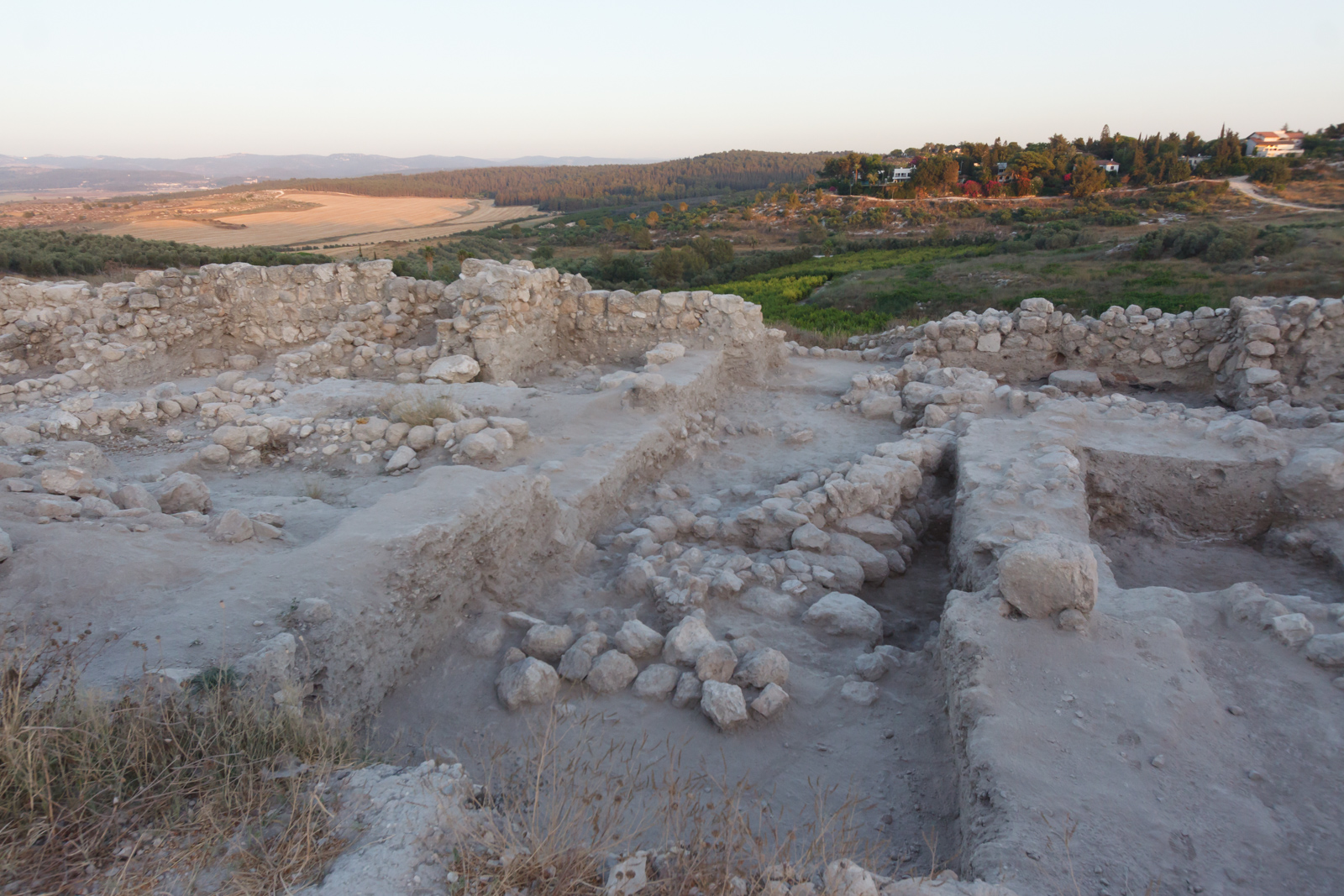
By Lyndelle Webster, Heritage Excavation Fellowship Recipient[/vc_column_text][vc_column_text]With the support of a 2017 Heritage Excavation Fellowship, I spent four weeks during May-June excavating at Tel Gezer. This is a beautiful site with an impressive view over the coastal plain and the Aijalon Valley. Located near the junction between the Via Maris and a major route to Jerusalem, this was a prominent site during the Middle Bronze through Iron Age periods. In the Late Bronze Age it was the center of a major city-state, whose rulers appear in the Amarna Letters.

There are two excavation teams currently working to address important research questions at Tel Gezer. The expedition led by Dr. Steve Ortiz of Southwestern Baptist Theological Seminary and Dr. Sam Wolff of the Israel Antiquities Authority, have been working near the Iron Age gateway (central-southern edge of the tell) for the past ten years. Another team from the Israel National Parks Authority and New Orleans Baptist Seminary have been exposing an impressive water system, now dated to the Middle Bronze Age; for the past few seasons they have also worked in the nearby Middle Bronze gateway.

My PhD research concerns Late Bronze Age chronology from the perspective of radiocarbon dating, and it is in this context that I began doing some work in cooperation with the Tandy excavation, whose directors kindly gave me the opportunity to work on their material. Whilst the Iron Age has been the predominant focus of research, in the past few seasons a series of early Iron Age and Late Bronze Age strata have been excavated. For me, this provided a great opportunity to extend my research, which had begun with the Late Bronze strata of Tel Azekah – another important current excavation in the Shephelah region.

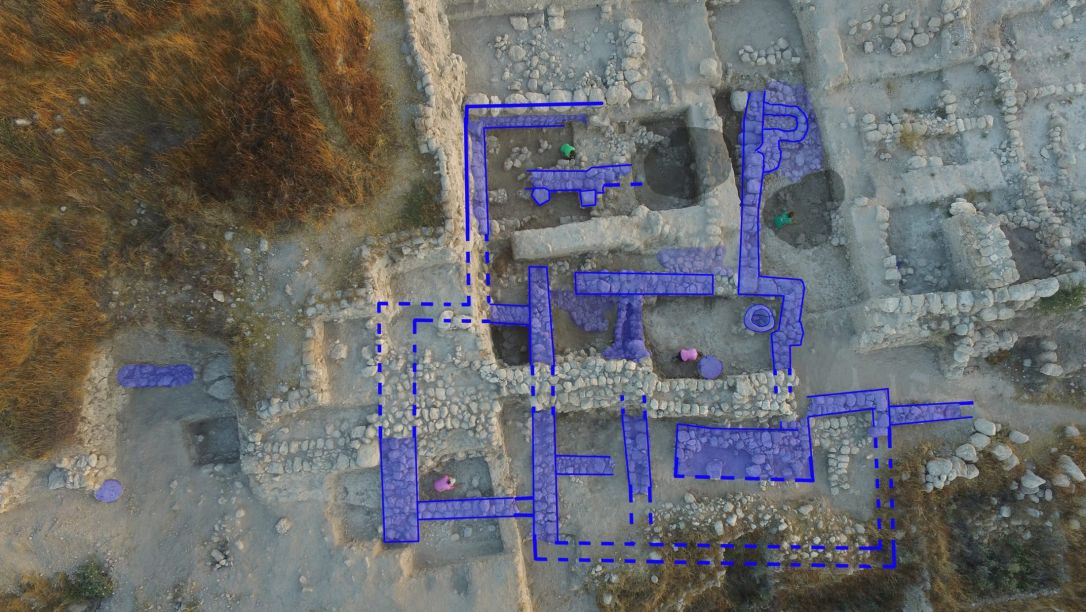
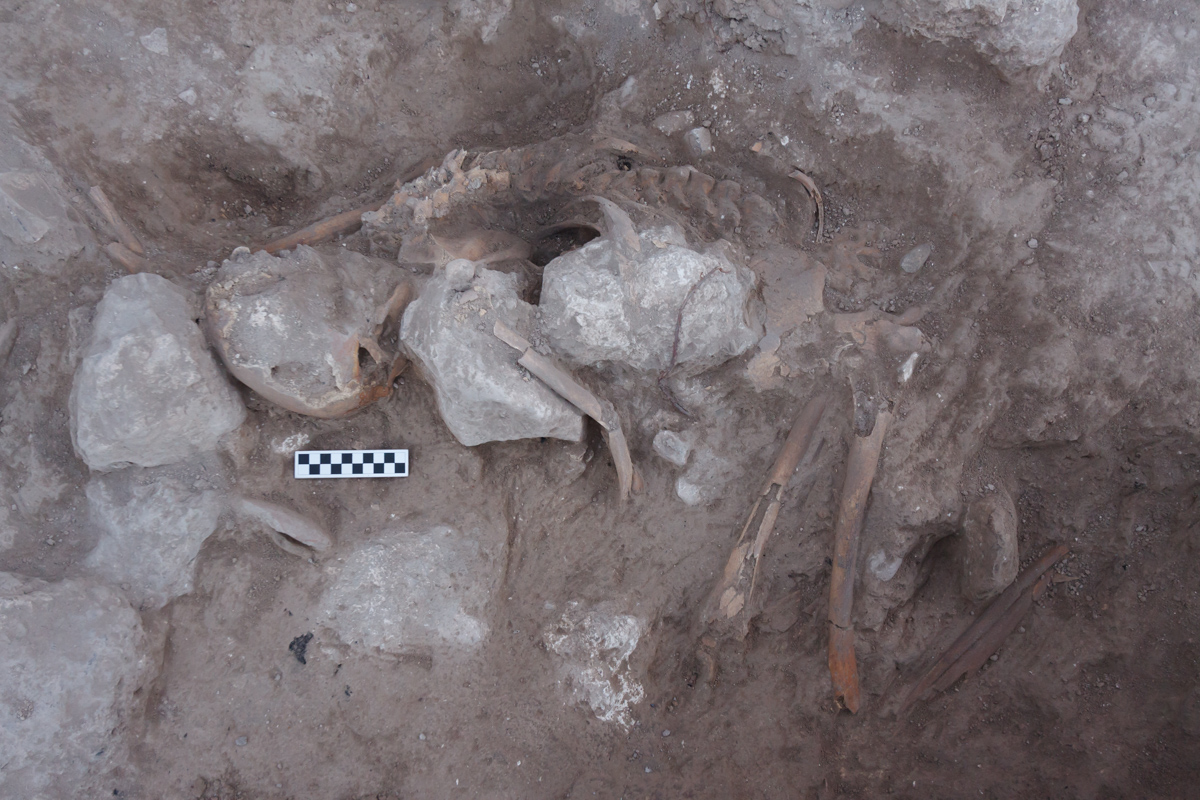
2017 was the last year in the field for the Tandy excavation team before going to publication stage. As such, it turned out to be a very exiting and productive season. A thick destruction layer was exposed, including complete vessels and much evidence of burning. Remains of three individuals were found who had clearly died as a result of the dramatic event. The excavators currently identify this destruction with the historically-recorded campaign of Merneptah in the late 13th century BCE. In the Merneptah Stela – famous for the first known reference to “Israel” – the pharaoh boasts of conquering several cities in southern Canaan, including Gezer. In another inscription Merneptah describes himself as the “subduer of Gezer”. These references make it clear that Gezer was a strategic, important site, and gaining control over it was worth boasting about.

Aerial view of Field W, highlighting the Late Bronze Age stratum
which ended with a dramatic destruction event.

My role in the field this season was to provide support in regard to sampling for radiocarbon dating. When working with radiocarbon samples and data it is incredibly valuable to have firsthand knowledge of the archaeological contexts. Working together with the team in the field gave opportunity to discuss and evaluate contexts, and put in focused efforts to improve the number of good contexts yielding suitable material. (The target material is short-lived organics, typically seeds; at a site like Gezer these are mainly carbonized – having been preserved by burning.)

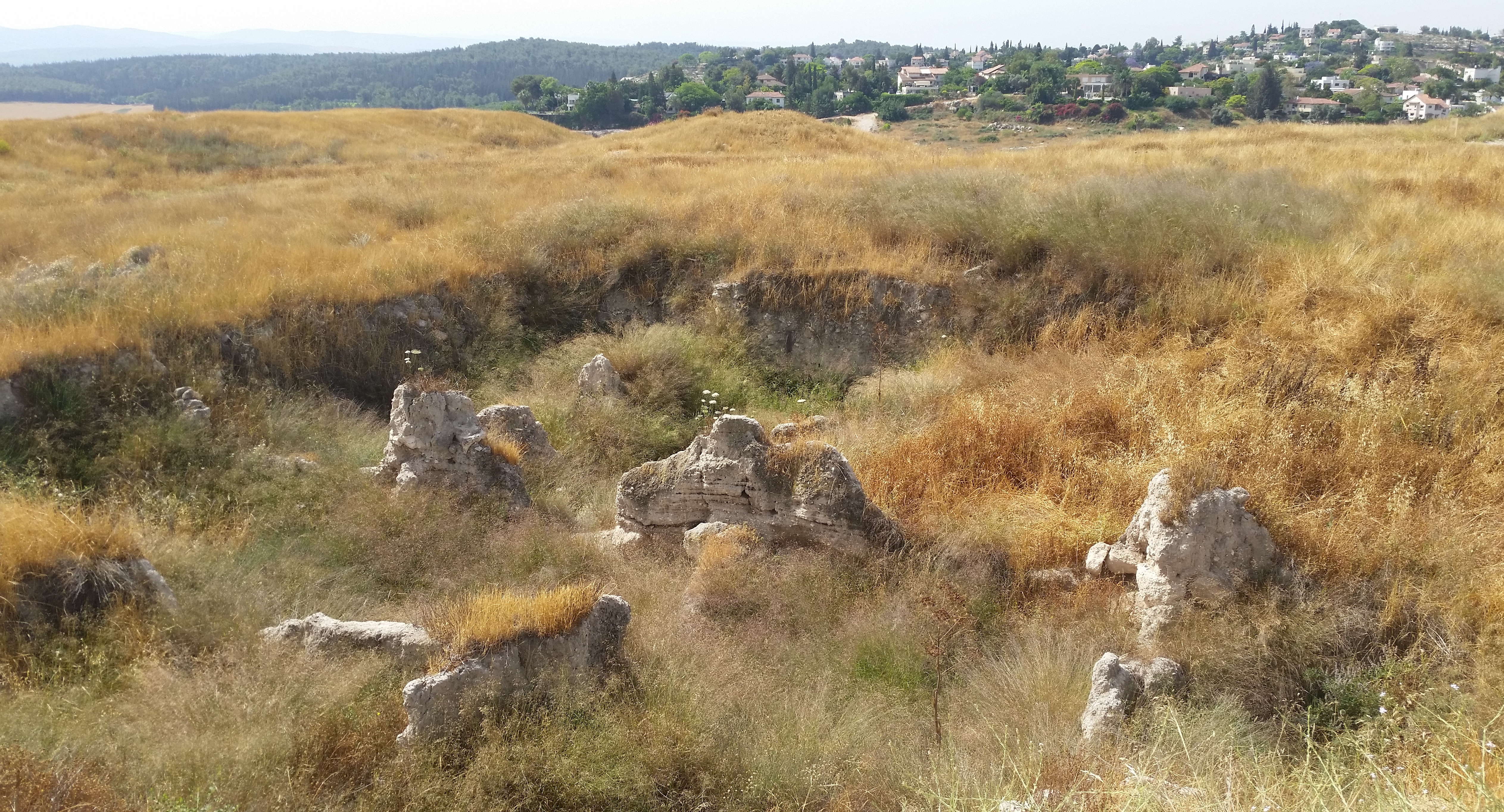
In addition to working with the excavation near the Iron Age gateway, I had the opportunity to carry out some small projects elsewhere on the tell, sampling from exposed sections left by the Hebrew Union College excavations that were conducted in the 1960s to 1980s under the direction of William Dever.

View southward across the tell; Field VI in the foreground
was excavated in the 1960s-70s by Hebrew Union College.

I am looking forward to seeing how new radiocarbon data from Tel Gezer contributes to our understanding of the Late Bronze Age, as well as other key periods under investigation at the site – the Iron and Middle Bronze Ages.

One of the best things about excavation is the people you meet and the friendships developed. It is always a little daunting to start working with a new site and a new team. I appreciated the warm welcome from the ‘Gezerites’, who quickly made me part of their team. It was a great season and wonderful group of people to work with. Thank you!

I want to express my sincerest thanks to ASOR and to Mr. Sheldon Fox, the donor for this fellowship, for supporting my field research this year.

Lyndelle Webster is a PhD student at Macquarie University and the University of Vienna. She is currently based in Vienna at the Institute for Oriental and European Archaeology at the Austrian Academy of Sciences, where she is a member of the project “Tracing transformations in the southern Levant: from collapse to consolidation in the mid-second millennium BC”. [/vc_column_text][/vc_column][vc_column border_color=”rgba(170,170,170,0.01)” width=”1/6″ css=”.vc_custom_1496684098866{margin-right: 5px !important;margin-bottom: 20px !important;border-right-width: 2px !important;border-bottom-width: 2px !important;padding-top: 30px !important;padding-right: 10px !important;padding-left: 10px !important;background-color: #ffffff !important;border-right-color: rgba(227,228,228,0.75) !important;border-bottom-color: rgba(227,228,228,0.75) !important;}”][vc_wp_posts title=”BROWSE THE NEWS ARCHIVE” number=”4″][/vc_column][vc_column border_color=”rgba(170,170,170,0.01)” width=”1/6″ css=”.vc_custom_1496684008271{margin-right: 10px !important;margin-bottom: 30px !important;border-right-width: 2px !important;border-bottom-width: 2px !important;padding-top: 30px !important;padding-right: 20px !important;padding-left: 20px !important;background-color: #ffffff !important;border-right-color: rgba(227,228,228,0.75) !important;border-bottom-color: rgba(227,228,228,0.75) !important;}”][vc_column_text] [/vc_column_text][/vc_column][/vc_row]

Job Opening: ASOR Office Assistant

[vc_row fullwidth=”true” attached=”true” css=”.vc_custom_1496247803139{padding-top: 0px !important;padding-right: 0px !important;padding-bottom: 0px !important;padding-left: 0px !important;}”][vc_column][mk_image src=”http://www.asor.org/wp-content/uploads/2017/12/banner-view-from-gezer2.jpg” image_width=”1920″ image_height=”400″ hover=”false” margin_bottom=”0″][/vc_column][/vc_row][vc_row fullwidth=”true” css=”.vc_custom_1496682730308{padding-top: 10px !important;padding-right: 0px !important;padding-bottom: 0px !important;padding-left: 0px !important;}”][vc_column width=”1/12″ css=”.vc_custom_1496683820796{margin-right: 10px !important;}” offset=”vc_hidden-md vc_hidden-sm vc_hidden-xs”][vc_column_text]

 SHARE

[/vc_column_text][mk_image src=”http://www.asortest.org/wp-content/uploads/2017/01/social-fb-icon4.jpg” image_width=”42″ image_height=”42″ hover=”false” custom_url=”https://www.facebook.com/ASOResearch/” margin_bottom=”0″][mk_image src=”http://www.asortest.org/wp-content/uploads/2017/01/social-tw-icon4.jpg” image_width=”42″ image_height=”42″ hover=”false” custom_url=”https://twitter.com/ASOResearch?ref_src=twsrc%5Egoogle%7Ctwcamp%5Eserp%7Ctwgr%5Eauthor” margin_bottom=”0″][mk_image src=”http://www.asortest.org/wp-content/uploads/2017/01/social-in-icon4.jpg” image_width=”42″ image_height=”42″ hover=”false” custom_url=”https://www.linkedin.com/company/american-schools-of-oriental-research” margin_bottom=”0″][mk_image src=”http://www.asortest.org/wp-content/uploads/2017/01/social-ml-icon_7.jpg” image_width=”42″ image_height=”42″ hover=”false” custom_url=”mailto:asor@bu.edu” margin_bottom=”0″][mk_image src=”http://www.asortest.org/wp-content/uploads/2017/01/blog-icon3.jpg” image_width=”42″ image_height=”42″ hover=”false” custom_url=”http://asorblog.org/” margin_bottom=”0″][/vc_column][vc_column border_color=”rgba(255,255,255,0.01)” width=”1/6″ css=”.vc_custom_1496683923840{margin-right: 20px !important;border-left-width: 2px !important;padding-right: 20px !important;padding-left: 20px !important;border-left-color: #99422f !important;}”][mk_divider divider_color=”rgba(255,255,255,0.01)” thickness=”1″ margin_top=”3″ margin_bottom=”3″][vc_column_text]

ASOR BLOG

NEWS@ASOR E-NEWSLETTER

ANCIENT NEAR EAST TODAY E-NEWSLETTER

PAST ASOR NEWS, MONTH BY MONTH

FY17 HONOR ROLL OF DONORS

ASOR ANNUAL MEETING

[/vc_column_text][/vc_column][vc_column border_color=”rgba(170,170,170,0.01)” width=”1/2″ css=”.vc_custom_1487276122024{margin-right: 10px !important;margin-bottom: 30px !important;border-right-width: 2px !important;border-bottom-width: 2px !important;padding-top: 30px !important;padding-right: 30px !important;padding-left: 20px !important;background-color: #ffffff !important;border-right-color: rgba(227,228,228,0.75) !important;border-bottom-color: rgba(227,228,228,0.75) !important;}”][vc_column_text responsive_align=”left”]

OFFICE ASSISTANT OPENING

[/vc_column_text][vc_column_text]ASOR seeks a candidate for a full-time, temporary position of Office Assistant to begin as soon as possible and to continue through at least June 30.

Founded in 1900 and currently located in Kenmore Square in Boston, the American Schools of Oriental Research (ASOR) is a non-profit 501(c)(3) organization whose mission is to initiate, encourage, and support research into, and public understanding of, the history and cultures of the Near East and wider Mediterranean world, from the earliest times. Please visit www.asor.org for more information.

Primary Responsibilities:

  • Work with members of the ASOR staff to maintain high-quality customer service for our members and subscribers.
  • Answer the ASOR telephone and email account. Provide customer service for ASOR’s 1,800 members.
  • Assist with ASOR’s off-site Annual Meeting by processing payments, answering questions, and making all potential attendees feel welcome.
  • General office support including ordering supplies, processing mail, and general office maintenance.
  • Under the direction of other ASOR staff, supervise student assistants.
  • Additional duties as assigned, including processing payments and updating website (WordPress); processing fellowship applications; collecting author contracts; and invoicing for institutional memberships.

Qualifications / Skills Needed:

  • Associate Degree or equivalent work experience; Bachelor’s Degree preferred.
  • 1-3 years of office experience preferred; experience with databases, Microsoft Office, WordPress, general office management also preferred.
  • Excellent communication and interpersonal skills.
  • Attention to detail; ability to multitask and to prioritize.

Compensation and Benefits: Hourly pay between $15.00 and $17.00 per hour. Benefits include paid vacation and sick time; paid holidays; employer retirement contribution (6%); and benefit dollars ($500 per month).

How To Apply: E-mail letter of interest, resume, and contact information for three references to Britta Abeln at info@asor.org. Please include your name and “ASOR Office Assistant” in the subject line.


ASOR is an equal opportunity employer and all qualified applicants will receive consideration for employment without regard to race, color, gender, religion, national origin, disability, veteran status, age, marital status, sexual orientation, gender identity, genetic information, or any other class protected by federal or state law (EEO/AA).[/vc_column_text][/vc_column][vc_column border_color=”rgba(170,170,170,0.01)” width=”1/6″ css=”.vc_custom_1496684098866{margin-right: 5px !important;margin-bottom: 20px !important;border-right-width: 2px !important;border-bottom-width: 2px !important;padding-top: 30px !important;padding-right: 10px !important;padding-left: 10px !important;background-color: #ffffff !important;border-right-color: rgba(227,228,228,0.75) !important;border-bottom-color: rgba(227,228,228,0.75) !important;}”][vc_wp_posts title=”BROWSE THE NEWS ARCHIVE” number=”4″][/vc_column][vc_column border_color=”rgba(170,170,170,0.01)” width=”1/6″ css=”.vc_custom_1496684008271{margin-right: 10px !important;margin-bottom: 30px !important;border-right-width: 2px !important;border-bottom-width: 2px !important;padding-top: 30px !important;padding-right: 20px !important;padding-left: 20px !important;background-color: #ffffff !important;border-right-color: rgba(227,228,228,0.75) !important;border-bottom-color: rgba(227,228,228,0.75) !important;}”][vc_column_text] [/vc_column_text][/vc_column][/vc_row][vc_row][vc_column][vc_column_text]

[/vc_column_text][/vc_column][/vc_row]