Friends of ASOR present the next webinar in the 2023-2024 season on April 18, 2024, at 3:00 pm EDT, presented by Dr. Aaron Burke.
The Amorites, an ancient Near Eastern group, are infamous in the Bible, where they are remembered among Canaan’s inhabitants at the time of its conquest by Israel. Yet, in Near Eastern studies the Amorite’s origins are only poorly understood. As a collective identity, they are best known for their encounters with the military establishments of Akkad and Ur in the late third millennium, and their alleged role as pastoralists par excellence. However, the shaping of this collective identity must be set against the backdrop of both Akkadian imperial intervention and the declining environmental conditions of this period in the marginal zones of the Fertile Crescent. Tracing the migration of Amorite refugees from agropastoral communities into nearby regions, mercenarism and militarism are seen to play a crucial role in the acquisition of economic and political power by Amorites between 2100 and 1900 BC. Members of this group became founders of well-known Amorite dynasties from Bahrain in the Persian Gulf to the Egyptian Delta. In the wake of the emergence of these dynasties in the early second millennium, traditional means of legitimation served to consolidate their power. Driven by a shared interest in the legitimation of their control, they patronized long-distance trade, construction projects, religious orders, the arts, warfare, fortification building, and standardizations of law. The extensive nature of these efforts have led some to refer to this as “the age of Amorites,” and it may be argued that the material effects of this contributed to the construction of an Amorite koine. This lecture explores the origins of Amorite identity, why it spread, and why it was remembered in later Near Eastern traditions.
Aaron A. Burke received his Ph.D. in Near Eastern Archaeology from The University of Chicago. He is Professor of the Archaeology of Ancient Israel and the Levant, and the Kershaw Chair of the Ancient Eastern Mediterranean Studies in the Department of Near Eastern Languages and Cultures at The University of California, Los Angeles. He is also a member of UCLA’s Cotsen Institute of Archaeology, serving as its editor-in-chief since 2016.
Since 1994, he has excavated in Israel but also Egypt and Turkey, and travelled extensively throughout the Levant from Syria to Lebanon, Jordan, Cyprus, and in Greece, collaborating in field research at Jerusalem, Jaffa, and Tel Dan. He directs The Jaffa Cultural Heritage Project since 2007 and has co-edited three volumes resulting from research in Jaffa, Israel. Expanding upon this research, in 2017 he inaugurated Turning Points, an initiative aimed at exploring the context out of which ancient Israel emerged during the Early Iron Age in the southern Levant, ca. 1200–1000 B.C.
Burke’s research focuses on the social history of the Levant and Eastern Mediterranean during the Bronze and Iron Ages with a particular interest in identity transformations surrounding warfare, forced migration, and long-distance exchange. His first monograph, “Walled Up to Heaven”: The Evolution of Middle Bronze Age Fortification Strategies in the Levant, addressed warfare during a period of Amorite political hegemony. He is also author of The Amorites and the Bronze Age Near East (CUP 2021), which seeks to reconstruct a social history of the Amorites from 2500 to 1500 BC. Since 2021, he is also the series editor for Elements in the Archaeology of Ancient Israel (CUP).
This webinar will be recorded and all paid registrants will be sent a link to view the recording.
*Please log in to the Online Portal BEFORE registering for the webinar. Once you have logged in, you will be able to register under our Events page linked above.
Please e-mail membership@asor.org with any questions or issues with registering.
All proceeds from this webinar are used to fund scholarships for members as well as increasing ASOR’s online resources, which are free to the public.
READY FOR A WEBINAR SEASON PASS?
Buy a season pass for all the webinars* of the 2023-2024 FOA Webinar Season! With a season pass, you will automatically be registered for every webinar in the season, and you will receive the recording of each webinar automatically after the event.
If you have missed webinars earlier in the season and still want to buy the pass, you will receive the links to the recordings of the webinars you missed in your automatic confirmation email after you buy the pass.
*Special symposiums may be excluded from the season pass price.
No more registering for a year if you buy your pass today!
Pricing:
ASOR Sustaining Members: $0 (automatic registration for each webinar) Members: $75 Public: $150
Several levels of support from $50-$1,000 are available. Proceeds go towards membership scholarships and towards increasing ASOR’s virtual resources. Each sponsorship is tax-deductible and you can give your friends free registrations to a webinar! Sponsor a webinar here.
Bronze Level ($50): up to 2 guest registrations Silver Level ($100): up to 5 guest registrations Gold Level ($500): up to 20 guest registrations Platinum Level ($1,000): up to 50 guest registrations
After you sign up for a sponsorship online or over the phone, email the names and email addresses of your guests to Katherine Schmitt at membership@asor.org, who will send your guests a confirmation and the Zoom link before the webinar.
WANT TO SAVE $6.00 ON THE NEXT WEBINAR?
Join ASOR as a member! Click here for more details about discounts for events and other benefits of membership. Memberships start at $40 for the year as an Associate Member.
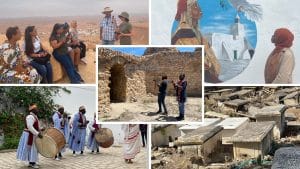
ASOR CHI proudly announces Cultural Heritage Initiatives in Africa Today, a free three-day symposium that highlights the work of local heritage professionals, academics, and civil society organizations to protect, preserve, and promote cultural heritage in North Africa and the Sahel. ASOR welcomes you to attend the symposium via Zoom from April 11–13, which will feature work in Libya (April 11), the Maghreb (April 12), and the Sahel (April 13). Each session will last from 11:00–13:00 EDT.
No registration is necessary to attend this event. Please return to this webpage on each day of the symposium to access the Zoom link.
Simultaneous translation in Arabic, English, and French will be provided.
The Imperiled Jewish Cemetery of Soliman (Tunisia) Facing Disappearance
Jamel Eddine Ben Saidane
Carthagina, Tunisia
Documenting Endangered Heritage as a Tool for Connecting Tunisian Minorities
Lassaad Dandani & Nawel Drissi
University of Manouba, Tunisia
Cemeteries of the Jewish Minority in Tunisia: Between Heritage Conception and Tourism Employment: The Finalization of an Interactive Map of Jewish Cemeteries
Jamal Maghiouzi
American Society of Overseas Research (ASOR)
Towards Heritage Preservation and Intercultural Dialogues
Abdelkarim Ouguinaz
High Atlas Foundation, Morocco
Preserving Morocco’s Tangible Heritage: Condition Assessment and Mapping Efforts by the High Atlas Foundation and the American Society of Overseas Research
Ratiba Rigalma
Ibn Zohr University, Morocco
The Suitcase Museum Experience in Morocco
Assia Sabri, Ibtissem Sabri, & Belgacem Guemri
Laboratory Douiret, Tunisia
The Amazigh Heritage within ASOR’s project in Tunisia
Safouane Tlili
Carthagina, Tunisia
Ibadi Mosques on the Tunisian island of Djerba: A Legacy on the Way to Extinction
Insecurity, Challenges and Current Perspectives about the Heritage of the Sahel
Aboutou Konate
AESPAT, Mali
Training in Documenting the Threatened Heritage of Communities in Mali
II – Roles of Cultural Associations in Preserving Heritage
Kadiatou Sow
AESPAT, Mali
Raising Community Awareness and Documenting Threatened Cultural Heritage in the Commune of Minidjan in Mali
Boureima Teme
Association Dogon Initiatives (ADI), Mali
The Efforts of the Dogon Initiatives Association for the Documentation and Preservation of the Cultural Heritage of Mali
Rahina Balarabé
Oralité Plus, Niger
Oralité Plus’ Cultural Heritage Work in Niger
Pierre Guindo
Mission Culturelle Bandiagara, Mali
Mission Culturelle of Bandiagara (Mali): Work on the Bandiagara Cliffs (Mali) in Partnership with ADI and ASOR
III – Safeguarding and Preserving Heritage through Community Action
Maki Garba
Culture, Art et Humanité (CAH), Niger
The Valorization and Revitalization of Traditional Cultures and Skills in Niger: The Case of Practical Transmission of Women Potters from Boubon
Kientega Pingdewindé Gérard
Koombi Culture, Burkina Faso
Role and Place of the Blacksmith in the Society of the Mossé in Burkina Faso
Speakers / Presenters
Dr. Mftah Alhddad is Professor of Archaeology and Ancient History at Azzaytuna University in Tarhuna, Libya. He received his doctorate in Archaeology from the University of Leicester in 2010. In 2012, he became the first director of the Libyan Department of Archaeology’s Documentation and Digitization Centre for Cultural Heritage. He has since been involved in a number of collaborative projects between DoA and foreign archaeological missions and institutions, including EAMENA, Training in Action, and Partnership for Heritage.
Awatef Bahroun is a heritage consultant and curator of the Leader Habib Bourguiba Museum. She is also a doctoral student, researching the Jewish community of Nabeul and its affect on the Jews of Cap Bon.
Rahina Balarabé, born in Niamey, Niger, Ms. Balarabé fell in love with storytelling at a very young age. In 2007, she made her storytelling debut and by 2008 had founded her theater company. She currently leads the artistic and cultural organization, Oralité plus.
Issouf Balima works with IKAM Burkina Sarl, a non-profit specializing in training in cultural entrepreneurship (Maaya), management, and cultural administration. IKAM serves as a resource center for the cultural and creative industries in Burkina Faso.
Jamel Eddine ben Saidane is a member of the Tunisian Amazigh minority. He is passionate about history and is involved in various initiatives aiming to protect, document, and promote Tunisian heritage. Jamel is a member of the Carthagina Association.
Dr. Ahmed M. A. Buzaian is a Research Associate at EAMENA, School of Archaeology and Ancient History, University of Leicester, UK. He also served as a Full-time lecturer in classical archaeology at the Department of Archaeology, Benghazi University, from 1994 to 2012, including teaching courses on Roman pottery, Field archaeology and Techniques in archaeological excavations, as well as post-excavation skills. Dr. Buzaian has directed numerous field projects including excavations at the ancient city of Teucheira (modern Tocra) from 1994 to 2012, Omar al-Mukhtar University training excavations at the ancient site of Balagrae (modern al-Beida) from 2001 to 2006, and Co-director of the Anglo/Libyan excavations at Euesperides (1995-2006).
Lassaad Dandani is Assistant Professor at the Higher Institute of Heritage Professions of Tunis. He holds a PhD in Contemporary History. He researches tourism and heritage in Tunisia and the Maghreb. Author of several articles on the history of tourism in Tunisia, he recently published a book on “Automotive Tourism in Tunisia.”
Nawel Drissi, a University teaching assistant at the Faculty of Letters, Arts, and Humanities, Manouba. A PhD researcher (final year) in American Politics and International Relations. I hold a master degree in American Foreign Policy from Leicester University, UK. I am also a UNESCO peace ambassador.
Dr. Aida M. Ejroushi, an architect from Libya, obtained her doctoral degree in Land Use, Planning, Management, and Design with a specialization in historic preservation from the College of Architecture at Texas Tech University. Dr. Ejroushi’s research revolves around historic preservation planning, planning history, international planning and development, critical theory, uneven development, and Science and Technology Studies. She examines the intersection between historic preservation and urbanization.
Geoff Emberling is an archaeologist and museum curator specializing in the Middle East and North Africa. Since 2016 he has worked with a team of Sudanese and international archaeologists and conservators to engage communities in education and preservation of the UNESCO World Heritage site of “Gebel Barkal and Sites of the Napatan Region” in northern Sudan. This work has spanned a popular revolution, a military coup, and now a civil war in Sudan.
Dr. Ahmad S. M. Emrage is an associate professor at the Department of Archaeology, Faculty of Arts, University of Benghazi’s. He holds a BA and an MA in Archaeology from University of Benghazi. In 2014, he completed a PhD at the School of Archaeology and Ancient History, University of Leicester, The UK.
During the 2019–20 academic year, Emrage held a Fulbright Fellowship to teach courses on Libyan cultural heritage at Oberlin College (Ohio, USA).
As ASOR’s representative for heritage activities in Libya, Dr. Emrage manages ASOR’s cultural heritage grants and activities in Libya.
Maki Garba holds a Professional Master’s degree in Cultural Heritage Management from Senghor University of Alexandria, Egypt. He is president and founder of the Culture, Art and Humanity Association (CAH). Garba works for cultural heritage on associative and public lands in Niger. Garba coordinates several projects in the fields of culture, development and social cohesion in Niger through the Cultural Diversity Portal: https://niger.spla.pro
Belgacem Guemri is a mechanical engineer and freelance photographer, who is interested in methods and techniques for documenting and preserving cultural and civilizational heritage.
Pierre Guindo was born in Nombori (Bandiagara) in Mali. He holds a Master’s degree in History-Geography from the Ecole Normale Supérieure of Bamako-Mali obtained in 1999, and a Diploma of Advanced Professional Studies (equivalent to a Master II) in Cultural Heritage Management from the Senghor University of Alexandria in Egypt obtained in 2005.
Professional therefore in the field of cultural heritage, after two years of service in the world of NGOs, he has worked and continues to work for the preservation and promotion of cultural values at the level of the Cultural Mission of Bandiagara where he is manager, holding the position of head of department since 2013.
Dr. Khaled el Haddar is Associate Professor of Archaeology at the University of Benghazi in eastern Libya. Since the Libyan revolution of 2011, he has played an instrumental role in documenting and raising awareness about the illicit trafficking of Libyan cultural property. In 2022, the Libyan Historic Cities Authority published his book, The Missing Benghazi Treasure: a Documentary Study, detailing the disappearance of the significant archaeological collection that had been housed in the National Trade Bank in Benghazi.
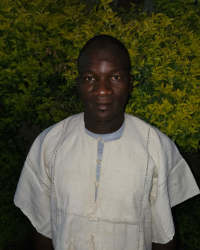
Aboutou Konate is a graduate with a Masters in Culture and Development from the University of Social Sciences and Management, Bamako, Mali. Currently, Mr. Konate serves as an archaeologist and instructor for the Faculty of History and Geography at the University of Social Sciences and Management, as well as an ASOR Local Coordinator Consultant in Mali as part of the Cultural Heritage Initiatives in the Sahel.
Jean-Paul KOUDOUGOU. Trained as a historian, multimedia communicator and cultural heritage management consultant, he has benefited from a series of high-level training courses in cultural heritage management. He has held several senior positions in the field of museum management and has a good knowledge of African museum policies. He is the President of the ICOM Africa Regional Alliance (ICOM-Africa) and Consultant for ASOR.
Jamal Maghiouzi was born in Dades Valley, Tinghir, Morocco. He has bachelor’s degree in English from Kaddi Ayyad University, Marrakech. He was always interested in culture and heritage. He became a field cultural coordinator at High Atlas Foundation USAID-Dakira program / Religious and Ethnic Minorities Program and at Asor HIC Program between 2021 and 2023. During these experiences, he developed his interests in ethnography, anthropology, local heritage, and inter-cultural dialogues.
Julia Nikolaus is an archaeologist specializing in North Africa, with a focus on remote sensing and heritage protection particularly in Libya, Egypt and Tunisia. Her research centers around long-term changes to archaeological sites and landscapes, which includes the exploration of more recent challenges to heritage such as urbanization, agricultural expansion and climate related impacts.
Abdelkarim Ouguinaz is a Ph.D. GIS expert with 8 years of experience in the field of GIS. He is capable of managing spatial databases and creating maps to undertake urban and rural planning projects. As a GIS engineer, he worked in various offices and NGOs and was also a freelance consultant. His duties include collecting and analyzing the data using Remote Sensing to process satellite images, creating interactive maps on online platforms, and mastering GIS software such as ArcGIS, QGIS, Google Earth Pro, and SasPlanet. Additionally, he has experience with photogrammetric processing of digital images and generating 3D spatial data for use in GIS applications and cultural heritage documentation.
Kientega Pingdewindé Gérard (aka KPG) anchors his profession as a blacksmith from Burkina Faso based on ancestral knowledge transmitted by his father. He also trained in theatrical art in Ouagadougou and established himself as a renowned storyteller, which led him to win the Silver Medal at the 2009 XVI Francophonie Games in Beirut. Transmission of intangible cultural heritage is at the heart of his vision; for this, he created in 2008 the Koombi Cultural Center in Arbollé, his native village, to train young people in the practices of storytelling, dance, and music.
Ratiba Rigalma is a professor at Ibn Zohr University, specializing in archaeology and heritage. She is a graduate of the National Institute of Archaeology and Heritage and a former department head at the Moroccan Ministry of Culture. Professor Rigalma has published several articles on archaeology and heritage and has participated in seminars at the national and international level.
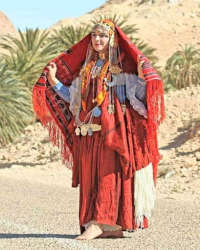
Assia Sabri holds a university degree in accounting and finance. She is also a traditional jewelry maker and civil society activist.
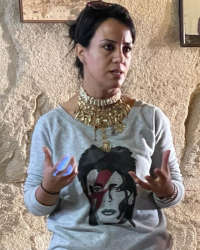
Ibtissem Sabri is a civil society activist in Tataouine in southern Tunisia. She is also a representative on the local council of Tataouine Sud in Douiret.
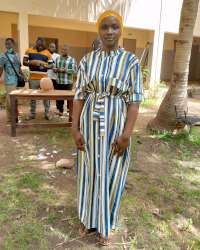
Kadiatou Sow is originally from western Mali, more precisely from the Nioro region in the Sahel region. She is president of the Association of Students and Supporters for the Protection of Cultural Heritage (AESPAT). Kadiatou is passionate about culture, reading, travel and discoveries.
Boureima Teme was born in Yendouma Sogol, Dogon Country. He obtained his master’s degree in History and Archaeology in 2011 after defending his dissertation on the theme of sigui and its teachings in the area of Tôôrô. He has been working with the NGO Association Dogon Initiatives (ADI) since March 2016 in the culture section as a program manager.
Safouane Tlili is a photographer who specializes in documenting the material and intangible heritage of Tunisia, especially on the island of Djerba. He has held several art exhibitions and is a civil activist in several human rights and cultural associations.
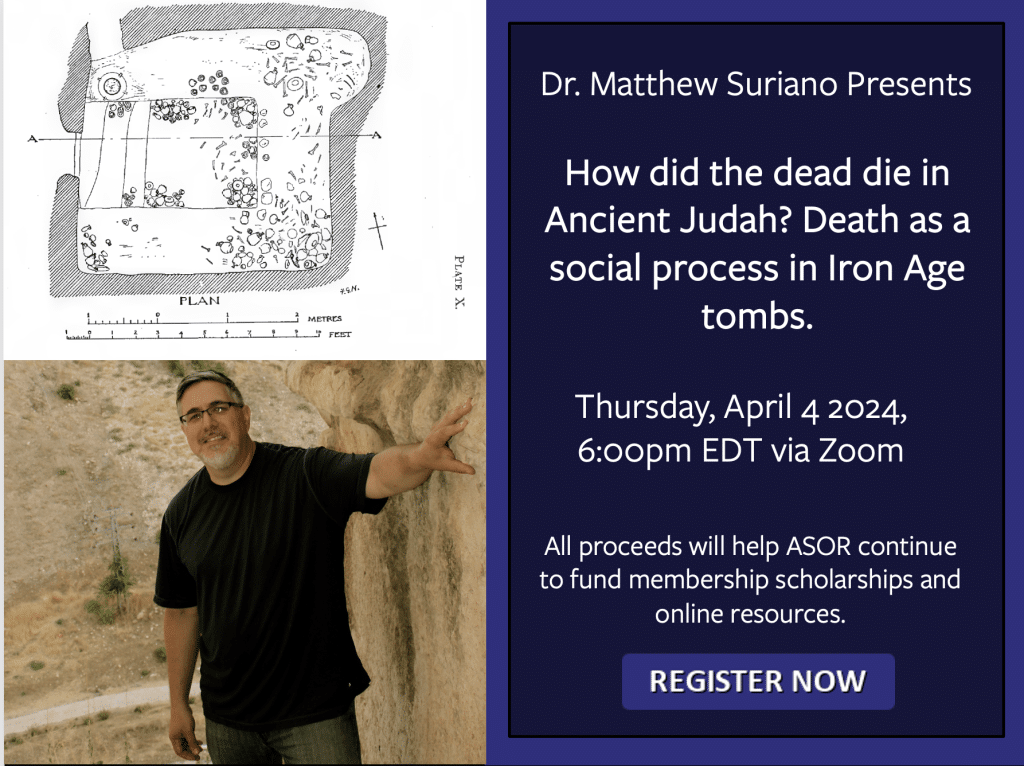
How did the dead die in Ancient Judah? Death as a social process in Iron Age tombs
Friends of ASOR present the next webinar in the 2023-2024 season on April 4, 2024, at 6:00 pm EDT, presented by Dr. Matthew Suriano.
The descriptions of death, dying, and burial in the Hebrew Bible are brief and ambiguous. The biblical text contains instructions on how to remove the ritual impurity of the dead, but does not contain any instructions for how to bury the dead. Likewise, the description of postmortem existence is ambiguous and seemingly contradictory. The psalms often depict the place of the dead, called Sheol, in tomb-like terms. In poetic passages like Psalm 88, Sheol is described in tomb-like terms as a dark and dreary place. Yet other passages like Gen 37:35, 44:29–31, and Eccl 9:10 imply that Sheol is the common fate for all humanity. Yet the tomb also holds positive connotations in biblical literature. An ideal death involved being buried with your kin inside the family tomb (2 Sam 19:38). Idioms for death used in the Bible, such as “gathered to one’s kin” (see Gen 25:8) and “lay down with one’s fathers” (see 1 Kg 2:10), imply the collective burial rites that would have occurred inside the family tomb. So how do we reconcile these contrasting images? The archaeological exploration of ancient Israelite mortuary remains provides insight into this problem. The excavation and survey of Iron Age tombs from Judah show that the dead received two burials, an initial interment when the body was brought to the tomb, and a secondary burial when their bones were transferred to a collection of bones (called a repository) stored inside the tomb. Death as transition, in ancient Judah, was observed through the physical changes that occurred in the corpse. This talk will examine the possible meanings of this transition, where the body moved from a burial bench to a re-interment inside a bin of bones, and suggest that it indicates a process of dying that began once the corpse was brought to the tomb. This process of dying, which contrasts with our modern concept of clinical death, provides new ways of looking at the complex images of death we find in the Hebrew Bible such as Sheol.
Matthew J. Suriano is an Associate Professor in the Joseph and Rebecca Meyerhoff Center for Jewish Studies at the University of Maryland where he teaches Hebrew Bible, ancient religions, and archaeology. A former fellow at the W.F. Albright Institute of Archaeological Research in Jerusalem, Suriano has also participated in several archaeological excavations and surveys in Israel, most recently at Tel Burna. He has written extensively on death and burial in the ancient world, and his book A History of Death in the Hebrew Bible (Oxford University Press, 2018) won the American Society for Overseas Research’s Frank Moore Cross Award. His research interests also involve Jerusalem and he is currently studying the monolithic tombs in Silwan.
This webinar will be recorded and all paid registrants will be sent a link to view the recording.
*Please log in to the Online Portal BEFORE registering for the webinar. Once you have logged in, you will be able to register under our Events page linked above.
Please e-mail membership@asor.org with any questions or issues with registering.
All proceeds from this webinar are used to fund scholarships for members as well as increasing ASOR’s online resources, which are free to the public.
READY FOR A WEBINAR SEASON PASS?
Buy a season pass for all the webinars* of the 2023-2024 FOA Webinar Season! With a season pass, you will automatically be registered for every webinar in the season, and you will receive the recording of each webinar automatically after the event.
If you have missed webinars earlier in the season and still want to buy the pass, you will receive the links to the recordings of the webinars you missed in your automatic confirmation email after you buy the pass.
*Special symposiums may be excluded from the season pass price.
No more registering for a year if you buy your pass today!
Pricing:
ASOR Sustaining Members: $0 (automatic registration for each webinar) Members: $75 Public: $150
Several levels of support from $50-$1,000 are available. Proceeds go towards membership scholarships and towards increasing ASOR’s virtual resources. Each sponsorship is tax-deductible and you can give your friends free registrations to a webinar! Sponsor a webinar here.
Bronze Level ($50): up to 2 guest registrations Silver Level ($100): up to 5 guest registrations Gold Level ($500): up to 20 guest registrations Platinum Level ($1,000): up to 50 guest registrations
After you sign up for a sponsorship online or over the phone, email the names and email addresses of your guests to Katherine Schmitt at membership@asor.org, who will send your guests a confirmation and the Zoom link before the webinar.
WANT TO SAVE $6.00 ON THE NEXT WEBINAR?
Join ASOR as a member! Click here for more details about discounts for events and other benefits of membership. Memberships start at $40 for the year as an Associate Member.
ASOR WELCOMES DARREN ASHBY AS NEW CHI PROGRAMS MANAGER
Dr. Darren P. Ashby joined ASOR as ASOR CHI’s Programs Manager on March 1. He previously worked at ASOR from 2017 to 2019 where he reported on threats and damage to cultural heritage and led a project to document the current condition of Jewish cultural heritage in Iraq and Syria. In his new role, Darren will work with CHI leadership to support ongoing projects, strengthen relationships between ASOR’s members and partners, and further develop ASOR’s abilities to protect, preserve, and promote the rich cultural heritage of Southwest Asia and North Africa in collaboration with local communities, heritage professionals, and civil society organizations.
Darren received his Ph.D. from the University of Pennsylvania’s Department of Near Eastern Languages and Civilizations in 2017 with a specialization in the archaeology, art, and history of Ancient Mesopotamia. His doctoral research explored Early Bronze Age economy and society through the study of religious architecture excavated at Tell al-Hiba in Dhi Qar Governorate, Iraq. After graduation, he pursued further archaeological research in Iraq as a member of field excavations at the sites of Tell al-Hiba, Nineveh, and Nimrud.
Most recently, he was Program Manager of the University of Pennsylvania’s Iraq Heritage Stabilization Program (IHSP) where he worked from 2019 to 2024. In this role, he worked closely with IHSP’s leadership and local and international partners to document, stabilize, and restore built and archaeological heritage in northern and central Iraq. Major projects include the restoration of the Sanctuary of Sheikh Adi at Lalish and the Monastery of St. George (Deir Mar Gorgis) in East Mosul with support from the U.S. Department of State as well as the restoration of a 19th-century home (Beit al-Tutunji) in Mosul’s Old City and the emergency assessment and stabilization of the Taq Kisra at Ctesiphon with support from the ALIPH Foundation.
Darren is excited to rejoin the ASOR CHI team and eager to hear more from the ASOR community about their thoughts on ASOR CHI’s current work and future priorities. He can be reached at dashby@asor.org.
ASOR WELCOMES REGAN BAKER AS NEW OFFICE COORDINATOR
Regan Baker graduated from The George Washington University with a Bachelor’s of Art in Archaeology in May 2023. As an archaeology student, Regan quickly became familiar with ASOR, and she is excited to be coming on as the Office Coordinator. Previously, she interned at the Colosseum while studying abroad in Rome, Italy during the Fall 2022 semester. There, she worked in collections storage under the guidance of a supervising archaeologist and assisted with a project on marble pieces from the Imperial Box.
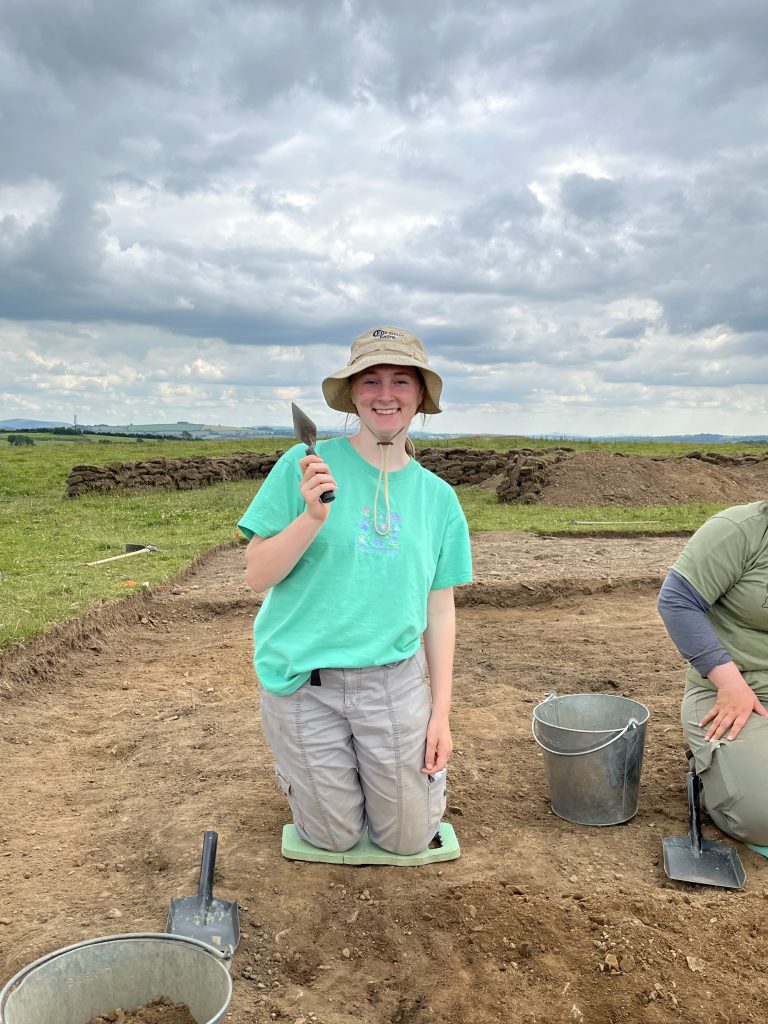
Regan completed her first archaeological field school in 2022 at the site of Dún Ailinne in County Kildare, Ireland. While participating in this field school, she helped excavate a section of what is believed to have been an Iron Age ceremonial site. In addition to learning the basics of field archaeology, she also had the opportunity to receive introductory training in artifact photography and GIS technology. During the four-week field school, Regan took several field trips with the team to other archaeological sites around Ireland, furthering her hands-on experience.
ASOR is pleased to welcome Regan as she begins her role of Office Coordinator. As Office Coordinator, she will be responsible for assisting the office staff with all administrative tasks, website maintenance, and being the first point of contact for members who email, call, or visit the James F. Strange Center. Regan greatly looks forward to growing within her new role and getting to know the inner workings of ASOR!
The Stele of Goddess Lama and Mesopotamian Engagement with the Past
For the people of Mesopotamia, the past was a source of knowledge and inspiration. Their reverence, both in terms of preserving early buildings and monuments and reviving images and ancient writing styles, is evident in archaeological and textual records. While Mesopotamian monuments and images were produced as historical works, inscribed with texts that marked them clearly and linked them to specific events and times, their efficacy was understood to be unlimited. Dated to the reign of king Nazi-Maruttash (ca. 1307–1282 BCE), the stele of the Goddess Lama, currently in the collections of the Metropolitan Museum, offers an excellent opportunity to explore Mesopotamian interaction with the past during the Kassite period (ca. 1574–1157 BCE). Through visual and textual analysis, this talk examines the survival of Lama imagery in this period. It reflects on the religious/political significance of the stele’s production within a broader context. The aim is to demonstrate that the crudely carved and seemingly unimaginative reuse of an earlier protective goddess figure was a deliberately archaizing image and an inspired citation of the past.
This webinar will be recorded and all paid registrants will be sent a link to view the recording.
Helen Malko is the Associate Director of the Stanford Humanities Center, where she oversees various academic programs in the humanities and interpretive social sciences. Before joining Stanford, she worked at the American Center of Research (ACOR) and Columbia University Global Center in Amman, Jordan. Helen holds a Ph.D. in Anthropology and Archaeology from Stony Brook University and a BA from Baghdad University, and she is trained in cultural heritage and preservation studies. She has been awarded multiple fellowships at the Metropolitan Museum and Columbia University in New York and has conducted fieldwork and capacity-building projects in Iraq, Jordan, and Turkey.
*Please log in to the Online Portal BEFORE registering for the webinar. Once you have logged in, you will be able to register under our Events page linked above.
Please e-mail membership@asor.org with any questions or issues with registering.
All proceeds from this webinar are used to fund scholarships for members as well as increasing ASOR’s online resources, which are free to the public.
READY FOR A WEBINAR SEASON PASS?
Buy a season pass for all the webinars* of the 2023-2024 FOA Webinar Season! With a season pass, you will automatically be registered for every webinar in the season, and you will receive the recording of each webinar automatically after the event.
If you have missed webinars earlier in the season and still want to buy the pass, you will receive the links to the recordings of the webinars you missed in your automatic confirmation email after you buy the pass.
*Special symposiums may be excluded from the season pass price.
No more registering for a year if you buy your pass today!
Pricing:
ASOR Sustaining Members: $0 (automatic registration for each webinar) Members: $75 Public: $150
Several levels of support from $50-$1,000 are available. Proceeds go towards membership scholarships and towards increasing ASOR’s virtual resources. Each sponsorship is tax-deductible and you can give your friends free registrations to a webinar! Sponsor a webinar here.
Bronze Level ($50): up to 2 guest registrations Silver Level ($100): up to 5 guest registrations Gold Level ($500): up to 20 guest registrations Platinum Level ($1,000): up to 50 guest registrations
After you sign up for a sponsorship online or over the phone, email the names and email addresses of your guests to Katherine Schmitt at membership@asor.org, who will send your guests a confirmation and the Zoom link before the webinar.
WANT TO SAVE $6.00 ON THE NEXT WEBINAR?
Join ASOR as a member! Click here for more details about discounts for events and other benefits of membership. Memberships start at $40 for the year as an Associate Member.
Please e-mail the Membership office if you have any questions.
Pp. 4–13: “Religion(s) in Seals: Old and New Challenges,” by Fabio Porzia
Although seals are very mobile items and often reused, and although they can be regarded as mass media products given their large distribution in time, space, and different social classes, they are often used by scholars as a tool to map political, cultural, and religious borders. This contribution aims at reassessing the validity of using religious iconography on seals from the first-millennium BCE southern Levant for the study of ancient religion(s) from three aspects: that religion is thematized beyond ethnic borders; that religious motifs are studied beyond the quest of their origin; and that divine images are studied beyond the compulsion to provide them with proper names. Introducing the notion of adaption as a short form for adoption and adaptation, this article supports a more nuanced understanding of seal iconography in terms of shared cultural infrastructure and a common cultural landscape.
ASOR Members with online access: log into ASOR’s Online Portal here. Once logged in, click the JOURNALS tab in the top navigation bar. Tutorials for how to log in to the Online Portal as well as how to navigate to the Portal Journals page can be found here.
Pp. 14-19: “Mastering the Seven-Headed Serpent: A Stamp Seal from Hazor Provides a Missing Link between Cuneiform and Biblical Mythology,” by Christoph Uehlinger
The Stamp Seals from the Southern Levant (SSSL) project is based on a comprehensive corpus, big data, and complex historical scenarios. Sometimes, though, an individual artifact stands out as a highlight in its own right. Such is the case with a stamp seal discovered recently at Tel Hazor. It is unusual in several respects, but mainly because of its spectacular base engraving. The main scene represents a hero fighting a coiled, seven-headed serpent; it is enhanced by a series of mixed creatures and secondary motifs. This article offers a description and analysis of the object, situating its iconography in the long history of combat myths spanning from mid-third-millennium southern Mesopotamia through second-millennium northern Syria to first-millennium Phoenicia and Israel. Most significant for a historian of Near Eastern mythology, the seal provides a visual missing link in the main motif’s literary transition from Late Bronze Age Ugarit to the Hebrew Bible.
ASOR Members with online access: log into ASOR’s Online Portal here. Once logged in, click the JOURNALS tab in the top navigation bar. Tutorials for how to log in to the Online Portal as well as how to navigate to the Portal Journals page can be found here.
Pp. 20-25: “Stamp Seals as Jewelry: Identifying Body Ornaments through Seal Impressions,” by Noa Ranzer
Stamp seals had various functions in the Iron Age southern Levant. In addition to their use as stamping devices, they were also worn on the body like other pieces of jewelry and thus formed but one part of a larger design comprising different objects (e.g., metal wires, pins, fibulae). In their archaeological contexts, however, most seals are detached from their original mountings. Thus, we are left wondering how such a seal was displayed when worn on the body. As part of a more extensive ongoing study on the function of stamp seals during the Iron Age, this article examines how seal impressions can serve as an important dataset to begin identifying specific mounting techniques and, thus, the possible ways different seals were used as jewelry.
ASOR Members with online access: log into ASOR’s Online Portal here. Once logged in, click the JOURNALS tab in the top navigation bar. Tutorials for how to log in to the Online Portal as well as how to navigate to the Portal Journals page can be found here.
Pp. 26-31: “Making a Good Impression: A Typology of Mounted Seal Impressions in the Middle Bronze Age Southern Levant,” by Tatjana Beuthe
Mounted seals have frequently been uncovered in Middle Bronze Age archaeological contexts in the Levant and Egypt. However, direct evidence for the deployment of such seals to mark objects does not appear to have been systematically studied to date. This article presents an initial typology of impressions made using mounted seals found in the southern Levant. Material from the Corpus of Stamp Seals from the Southern Levant (CSSL) database indicates southern Levantine stamp seals set in rings and attached to other types of ornamentation were widely used as tools to create impressions.
ASOR Members with online access: log into ASOR’s Online Portal here. Once logged in, click the JOURNALS tab in the top navigation bar. Tutorials for how to log in to the Online Portal as well as how to navigate to the Portal Journals page can be found here.
Pp. 32-40: “‘Male until Proven Otherwise?’: Searching for Women with the Help of Inscribed Stamp Seals from Jerusalem,” by Bruno Biermann
Archaeological finds are often framed within androcentric biases, for example, representing inscribed seals as male-owned and used objects. However, this picture crumbles under critical examination. This article addresses presumptions about sex and seal ownership, focusing on inscribed seals from the Iron Age IIB–III from Jerusalem. Therefore, this article demonstrates how gender-archaeological research can contribute to new perspectives on Levantine stamp seals and material culture. This approach is based on provenanced artifacts found in archaeological excavations and their context and the careful examination of how gender is expressed or remains ambiguous in the inscriptions on these small objects. The presented dataset of inscribed seals and impressions on sealings and jar handles from Jerusalem suggests that women owned and used inscribed seals for a variety of purposes, including commerce and sealing of containers and jars, as well as being buried with them.
ASOR Members with online access: log into ASOR’s Online Portal here. Once logged in, click the JOURNALS tab in the top navigation bar. Tutorials for how to log in to the Online Portal as well as how to navigate to the Portal Journals page can be found here.
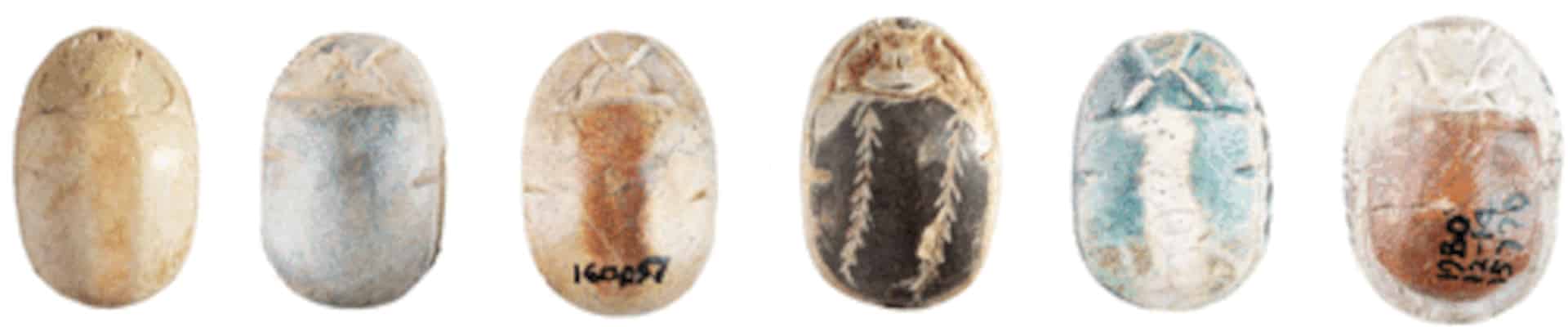
Pp. 42-52: “Scratching the Surface of Middle Bronze Age Scarabs: Investigating Enigmatic Marks on Stamp Seals from Lachish and Megiddo,” by Nadia Ben-Marzouk and Ben Greet
A distinct feature on many Middle Bronze Age scarabs from the southern Levant is the presence of chromatic marks on the backs of these objects, often described as longitudinal lines. Previous explanations have fallen into one of three proposals: Either they are the product of production-related techniques related to firing and glazing, intentionally applied marks, or the byproduct of use-wear related or depositional practices. To date, no critical investigation of these enigmatic marks has been published and thus no consensus reached. However, through new high-resolution photography of the stamp seals from the sites of Lachish and Megiddo in the southern Levant, a systematic analysis was recently permitted. This paper presents the results from a study on these enigmatic marks and a discussion on what the new photography reveals about previous interpretations and possible new directions for the study of this corpus.
ASOR Members with online access: log into ASOR’s Online Portal here. Once logged in, click the JOURNALS tab in the top navigation bar. Tutorials for how to log in to the Online Portal as well as how to navigate to the Portal Journals page can be found here.
Collection Overview Title: Nelson Glueck papers, 1932-2005 Creator: Glueck, Nelson (1900-1971) Extent: 25.0 Boxes Arrangement: Arranged alphabetically by subject. Boxes 18-37 Glass Plate Negatives are a later accrual from the Albright Institute. The original numbering of these boxes has been maintained. (There is no Box 8-17.) Languages: English, Hebrew, French
Scope and Contents The collection contains the personal and professional papers of eminent biblical archaeologist and rabbi Nelson Glueck. The four Albums of photographs were collected and arranged by Glueck from 1936-1939 during his first tenure as Director of the American School in Jerusalem. The Correspondence files are organized alphabetically by correspondent, with the exception of correspondence concerning Glueck after his death in 1971. These files precede the alphabetical sequence. The Correspondence files contain letters Glueck received from colleagues regarding the logistics of running the organization, and publishing ASOR’s journals. Correspondence after 1971 concerns memorial services in honor of Glueck, material regarding his successor at Hebrew Union College, and materials regarding the transfer of Glueck’s papers from Cincinnati to Cambridge. The Diaries contain informal accounts of Glueck’s travels from 1942-1943, and notebooks with brief descriptions of dozens of sites from 1942-1944. The Press and Writings files contain writings by and about Glueck and the projects with which he was affiliated. These files are organized chronologically. Included are articles, excavation reports, booklets from Hebrew Union College announcing his inauguration, and booklets from his memorial service. Correspondence is scattered throughout these files. The 1927 file contains Glueck’s dissertation. The Photographs: General files contain photographs taken of Glueck by professional photographers for various publications. The Photographs: Albums files contain photographs taken and captioned by Glueck. The Photographs: The Other Side of the Jordan files contain images used in Glueck’s publication of the same name. Diary entries on specific sites may correspond to folders in the Eleanor Vogel Photograph Collection.
Administrative Information Use Restrictions: These materials have been made accessible for purposes of education and research. We have indicated what we know about copyright and rights of privacy, publicity, or trademark. Due to the nature of archival collections, we are not always able to identify this information. We are eager to hear from any rights owners, so that we may obtain accurate information. Upon request, we will remove material from public view while we address a rights issue.
This collection has been made accessible through the generosity of the National Endowment for the Humanities, the Lanier Theological Library, and the David Berg Foundation.
Box 5: Folder 1-2: Press and Writings, 1927-2009 Folder 3-5: Research These files contain compiled information about granaries, lamps, and seals from sites related to those excavated by Glueck. Folder 3: Granaries, n.d., 1947-1963 Folder 4: Lamps, 1966-1969 Folder 5: Seals, n.d., 1961 Folder 6-10: Vogel, Eleanor: “Bibliography of Holy Land Sites.”, 1974 Folder 11: Photographs: General, n.d., 1938 These files contain photographs taken of Glueck by professional photographers for various publications.
Box 6: Folder 1-17: Photographs Folder 1-8: General, 1942-1970 These files are organized in chronological order. Folder 9-11: Albums, 1936-1939 These files contain photographs, primarily taken by Glueck during his explorations in Transjordan and the Negev. Folder 12-17: The Other Side of the Jordan, 1970 These files contain images used in Glueck’s The Other Side of the Jordan
Box 7: Folder 1: Diaries, 1967-1968 Additional diaries in Box 2, Folders 20-22 (stored at the Semitic Museum, Harvard University.)
Collection Overview
Title: ASOR Photograph Collection, 1936-2000
Creator: American Schools of Oriental Research
Extent: 1.0 Boxes
Arrangement: The collection is arranged alphabetically by subject.
Languages: English
Scope and Contents of the Materials This collection contains miscellaneous photographs that are not associated with other collections. The collection contains both black and white and color photographs of the people, events, and excavations associated with ASOR, AIAR, ACOR, and CAARI, and other subjects.[/vc_column_text][vc_column_text]Box and Folder List
Box 1:
Folder 1-2: General, n.d., 1985-1986
Folder 3-4: ACOR, n.d., 1985
Folder 5: AIAR: Interior, n.d., 1969-1978
Folder 6: AIAR: Exterior, n.d., 1978
Folder 7-9: AIAR: People, n.d., 1936, 1983-1989
Folder 10: AIAR: Events, n.d., 1999
Folder 11: CAARI, n.d.
Folder 12: Centennial, 2000
Folder 13: Excavations: General, n.d., 1936, 1979-1987
Folder 14: Excavations: Lehav, 1979
Folder 15: Excavations: Jerash, 1982
Folder 16: Excavations: Jerusalem, n.d., 1987 | Tell Miqne-Ekron and Tell el-Hesi
Folder 17: Excavations: Tell Hesban, n.d.
Folder 18: Excavations: Wadi al Khaniq, 1982
Folder 19: Excavations: Qumran Caves, 1952
This file contains photographs taken at Qumran soon after the initial discovery of the Dead Sea Scrolls. The photos document the exploration of the caves, and the discovery of the Copper Scroll. Photograph captions have been transcribed from an index contemporary with the photographs.
Folder 20: International Congress on Biblical Archaeology, 1984
Folder 21: Philadelphia Office, n.d., 1982-1983
Folder 22: Semitic Museum, 1983
Folder 23: Unidentified People, n.d.
Collection Overview Title: Ancient Manuscripts Committee Records, 1963-1981 Creator: American Schools of Oriental Research Ancient Manuscripts Committee Extent: 1.0 Boxes Arrangement: The collection is arranged in one alphabetical series by subject. Languages: English
Scope and Contents The majority of the collection is correspondence regarding the study, publication rights, and preservation of the Dead Sea Scrolls, and the funding of the Committee. The correspondence also documents the discovery and purchase of manuscripts by other organizations. A significant portion of the letters were written by, or contain information about Elizabeth Hay Bechtel and John Trever. The Ancient Biblical Manuscript Center file contains administrative materials for that organization, which, though separate from ASOR, aided ASOR in the acquisition of manuscripts. As with the correspondence, many of the materials were created by, or pertain to Elizabeth Hay Bechtel, who served as president of the organization.

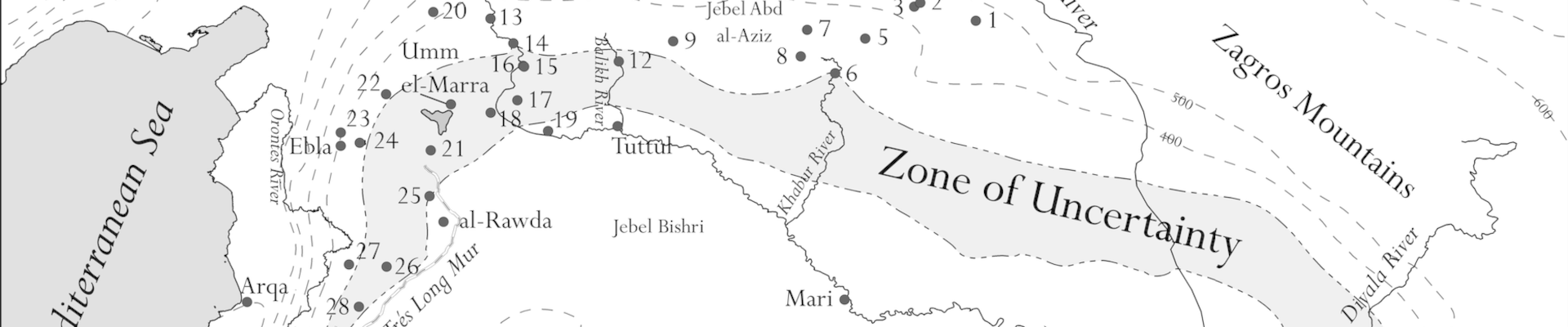

 The Amorites, an ancient Near Eastern group, are infamous in the Bible, where they are remembered among Canaan’s inhabitants at the time of its conquest by Israel. Yet, in Near Eastern studies the Amorite’s origins are only poorly understood. As a collective identity, they are best known for their encounters with the military establishments of Akkad and Ur in the late third millennium, and their alleged role as pastoralists par excellence. However, the shaping of this collective identity must be set against the backdrop of both Akkadian imperial intervention and the declining environmental conditions of this period in the marginal zones of the Fertile Crescent. Tracing the migration of Amorite refugees from agropastoral communities into nearby regions, mercenarism and militarism are seen to play a crucial role in the acquisition of economic and political power by Amorites between 2100 and 1900 BC. Members of this group became founders of well-known Amorite dynasties from Bahrain in the Persian Gulf to the Egyptian Delta. In the wake of the emergence of these dynasties in the early second millennium, traditional means of legitimation served to consolidate their power. Driven by a shared interest in the legitimation of their control, they patronized long-distance trade, construction projects, religious orders, the arts, warfare, fortification building, and standardizations of law. The extensive nature of these efforts have led some to refer to this as “the age of Amorites,” and it may be argued that the material effects of this contributed to the construction of an Amorite koine. This lecture explores the origins of Amorite identity, why it spread, and why it was remembered in later Near Eastern traditions.
 Aaron A. Burke received his Ph.D. in Near Eastern Archaeology from The University of Chicago. He is Professor of the Archaeology of Ancient Israel and the Levant, and the Kershaw Chair of the Ancient Eastern Mediterranean Studies in the Department of Near Eastern Languages and Cultures at The University of California, Los Angeles. He is also a member of UCLA’s Cotsen Institute of Archaeology, serving as its editor-in-chief since 2016.




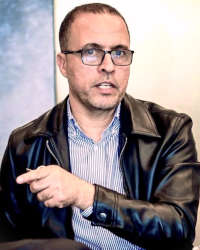
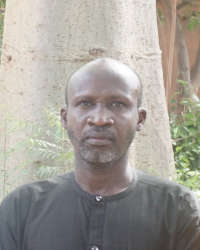
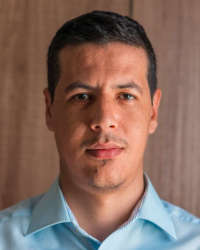
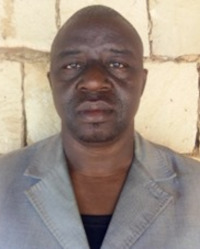

 Matthew J. Suriano is an Associate Professor in the Joseph and Rebecca Meyerhoff Center for Jewish Studies at the University of Maryland where he teaches Hebrew Bible, ancient religions, and archaeology. A former fellow at the W.F. Albright Institute of Archaeological Research in Jerusalem, Suriano has also participated in several archaeological excavations and surveys in Israel, most recently at Tel Burna. He has written extensively on death and burial in the ancient world, and his book A History of Death in the Hebrew Bible (Oxford University Press, 2018) won the American Society for Overseas Research’s Frank Moore Cross Award. His research interests also involve Jerusalem and he is currently studying the monolithic tombs in Silwan.

 Dr. Darren P. Ashby joined ASOR as ASOR CHI’s Programs Manager on March 1. He previously worked at ASOR from 2017 to 2019 where he reported on threats and damage to cultural heritage and led a project to document the current condition of Jewish cultural heritage in Iraq and Syria. In his new role, Darren will work with CHI leadership to support ongoing projects, strengthen relationships between ASOR’s members and partners, and further develop ASOR’s abilities to protect, preserve, and promote the rich cultural heritage of Southwest Asia and North Africa in collaboration with local communities, heritage professionals, and civil society organizations.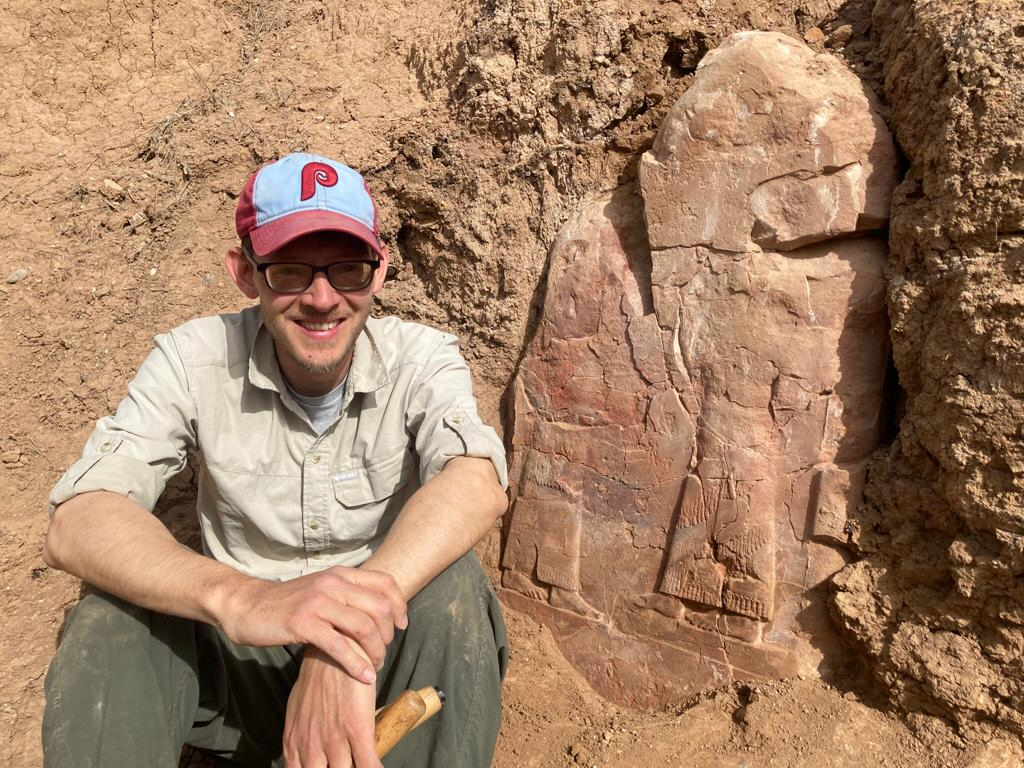
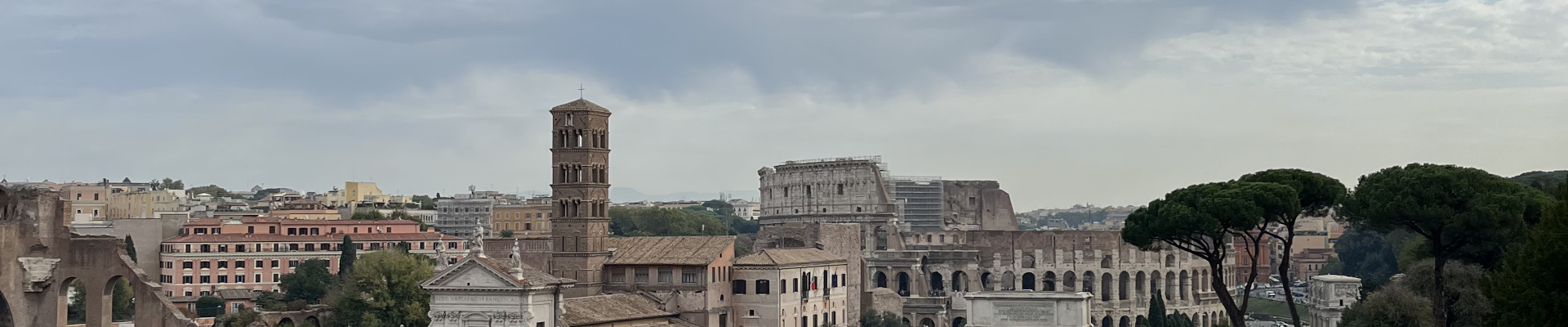
 Regan Baker graduated from The George Washington University with a Bachelor’s of Art in Archaeology in May 2023. As an archaeology student, Regan quickly became familiar with ASOR, and she is excited to be coming on as the Office Coordinator. Previously, she interned at the Colosseum while studying abroad in Rome, Italy during the Fall 2022 semester. There, she worked in collections storage under the guidance of a supervising archaeologist and assisted with a project on marble pieces from the Imperial Box.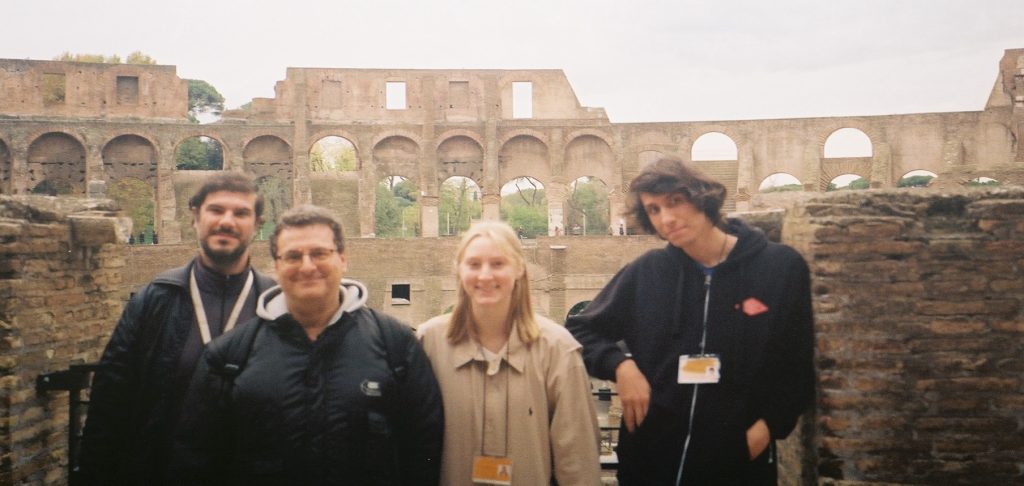

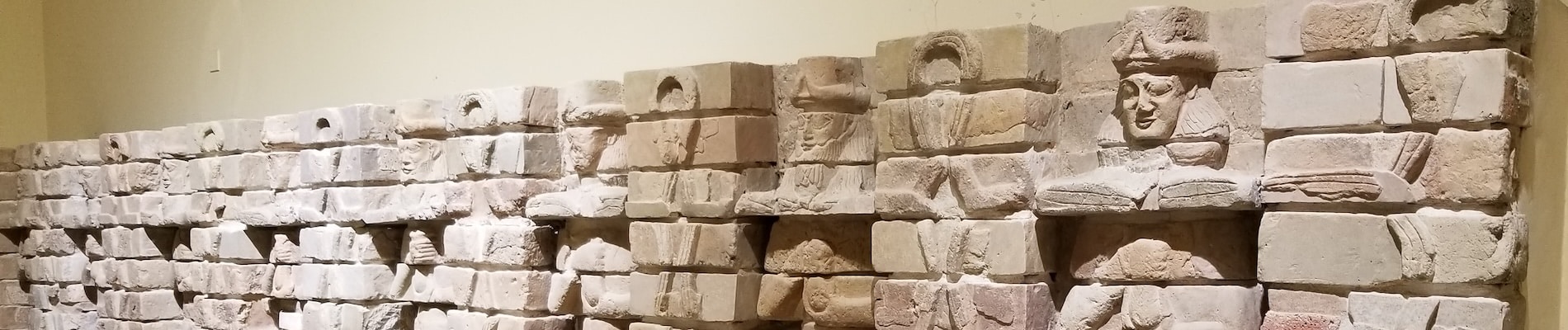
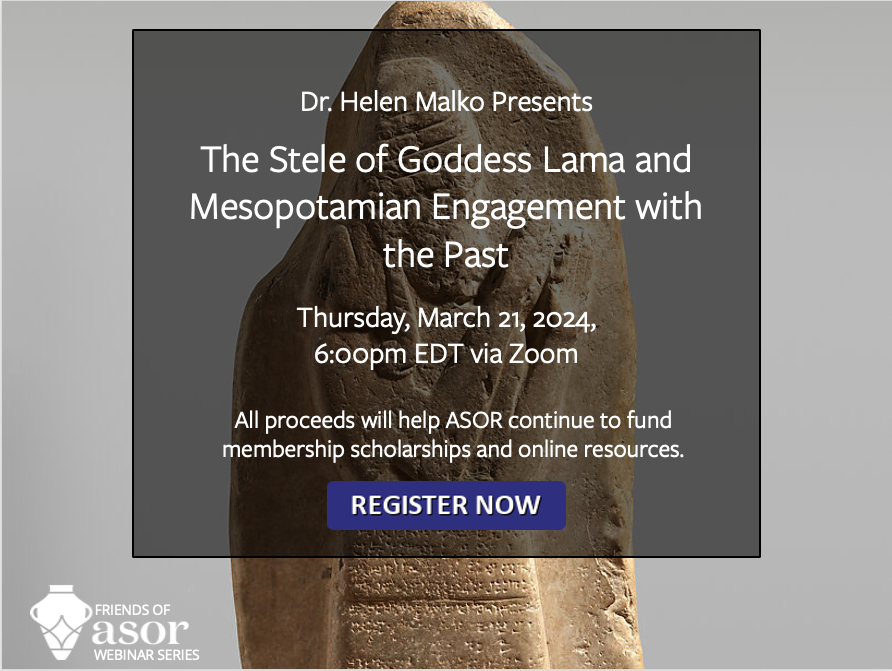
 For the people of Mesopotamia, the past was a source of knowledge and inspiration. Their reverence, both in terms of preserving early buildings and monuments and reviving images and ancient writing styles, is evident in archaeological and textual records. While Mesopotamian monuments and images were produced as historical works, inscribed with texts that marked them clearly and linked them to specific events and times, their efficacy was understood to be unlimited. Dated to the reign of king Nazi-Maruttash (ca. 1307–1282 BCE), the stele of the Goddess Lama, currently in the collections of the Metropolitan Museum, offers an excellent opportunity to explore Mesopotamian interaction with the past during the Kassite period (ca. 1574–1157 BCE). Through visual and textual analysis, this talk examines the survival of Lama imagery in this period. It reflects on the religious/political significance of the stele’s production within a broader context. The aim is to demonstrate that the crudely carved and seemingly unimaginative reuse of an earlier protective goddess figure was a deliberately archaizing image and an inspired citation of the past.
 Helen Malko is the Associate Director of the Stanford Humanities Center, where she oversees various academic programs in the humanities and interpretive social sciences. Before joining Stanford, she worked at the American Center of Research (ACOR) and Columbia University Global Center in Amman, Jordan. Helen holds a Ph.D. in Anthropology and Archaeology from Stony Brook University and a BA from Baghdad University, and she is trained in cultural heritage and preservation studies. She has been awarded multiple fellowships at the Metropolitan Museum and Columbia University in New York and has conducted fieldwork and capacity-building projects in Iraq, Jordan, and Turkey.


 Pp. 4–13: “Religion(s) in Seals: Old and New Challenges,” by Fabio Porzia
 Pp. 14-19: “Mastering the Seven-Headed Serpent: A Stamp Seal from Hazor Provides a Missing Link between Cuneiform and Biblical Mythology,” by Christoph Uehlinger
 Pp. 20-25: “Stamp Seals as Jewelry: Identifying Body Ornaments through Seal Impressions,” by Noa Ranzer
 Pp. 26-31: “Making a Good Impression: A Typology of Mounted Seal Impressions in the Middle Bronze Age Southern Levant,” by Tatjana Beuthe
 Pp. 32-40: “‘Male until Proven Otherwise?’: Searching for Women with the Help of Inscribed Stamp Seals from Jerusalem,” by Bruno Biermann
 Pp. 42-52: “Scratching the Surface of Middle Bronze Age Scarabs: Investigating Enigmatic Marks on Stamp Seals from Lachish and Megiddo,” by Nadia Ben-Marzouk and Ben Greet