FOA Webinar: Meet the Directors of the Overseas Research Centers on Feb. 11

FRIENDS OF ASOR WEBINARS

Meet the Directors—Fundraiser to Support ASOR’s Affiliated Overseas Research Centers
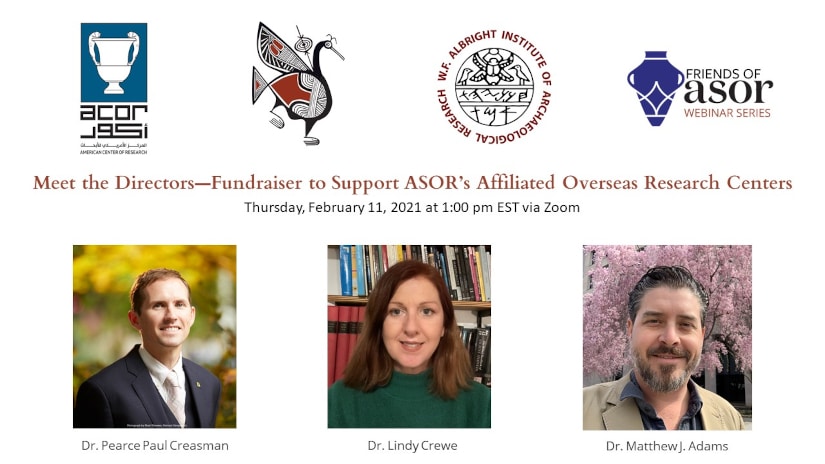
Join us for a roundtable discussion with the directors of the 3 Overseas Research Centers affiliated with ASOR—located in Jerusalem (AIAR: W. F. Albright Institute of Archaeological Research), Nicosia, Cyprus (CAARI: Cyprus American Archaeological Research Institute), and Amman, Jordan (ACOR: American Center of Research). All proceeds will support the three research centers. The webinar will begin with an introduction about the mission of each center and each center’s current and future projects. A discussion will follow, moderated by former ASOR President, Prof. Susan Ackerman of Dartmouth College. The webinar will conclude with a Q&A portion with the audience.

Dr. Matthew J. Adams (AIAR) has been the Director of the W.F. Albright Institute of Archaeological Research in Jerusalem since 2014. He is a specialist in Egyptology and Near Eastern Archaeology and broad interests across space and time in the ancient world. He is currently Director of the Jezreel Valley Regional Project and Co-director of the Megiddo Expedition and the excavations of the base of the Roman Legio VI Ferrata at Legio, Israel. His work in Palestine includes co-directing the excavations at Solomon’s Pools. He is also a Field Director at the site of Mendes in Egypt, which formed the subject of his Ph.D. dissertation at The Pennsylvania State University.

Dr. Pearce Paul Creasman (ACOR) has been director of ACOR since February 2020. From 2009-2020, he was a professor and curator at the University of Arizona, focusing on the heritage, archaeology, and environment of the Middle East and North Africa, where he remains affiliated faculty. Since 2012, he served as director of the University of Arizona’s Egyptian Expedition. Having worked in several countries in the region, his most recent archaeological project is directing the excavations at the pyramids and royal necropolis of Nuri, Sudan, a UNESCO World Heritage Site. Dr. Creasman’ s formal training includes a Ph.D. in nautical archaeology from Texas A&M University. With more than 100 publications, he has been recognized for his work by several institutions including: the White House’s Office of Science and Technology Policy, as a fellow of The Explorer’s Club and the Royal Geographic Society, and was honored as one of the National Geographic Society’s “Geniuses” for 2021.

Dr. Lindy Crewe (CAARI) was awarded her Ph.D. in Archaeology from the University of Edinburgh in 2004. She is the author of two monographs, two edited volumes and over 30 articles on Cypriot archaeology. Her research has focussed on the prehistory of the eastern Mediterranean, primarily Cyprus and interconnections with the surrounding region. She is an expert on Bronze Age Cypriot pottery and is Director of excavations at the Bronze Age settlement of Kissonerga Skalia near Paphos. She previously worked as Curator of Cypriot Antiquities in the Department of Greece in Rome at the British Museum, as a Lecturer in Archaeology at the University of Manchester and has been in her current role of Director of the Cyprus American Archaeological Research Institute (CAARI) in Nicosia since 2017.

ASOR Sustaining Members: $0 | ASOR Members: $5 | Public: $10

To receive your ASOR member discount, log into the online store. If you are new to ASOR, please click on the “New Visitor Registration” link to register your e-mail address and choose a password for our online store. Once logged in, navigate to “Meeting and Event Registration” to register for the webinar and pay the fee. Each paid registrant will receive a confirmation e-mail when you pay for the webinar. If you do not receive this e-mail, then you are not registered. Please e-mail membership@asor.org with any questions or issues with registering.

You will be e-mailed the Zoom Webinar link in the week prior to the lecture on February 11, 2021. If you do not receive the link by the close of business on the Monday before the webinar, please e-mail membership@asor.org immediately. All webinars are recorded and all paid registrants will be sent a link to view the recording.

All proceeds from this webinar will support ASOR’s affiliated Overseas Research Centers (ACOR, AIAR, and CAARI).

WHY SPONSOR A WEBINAR?

Several levels of support from $50-$1,000 are available. Proceeds go towards membership scholarships and towards increasing ASOR’s virtual resources. Each sponsorship is tax-deductible and you can give your friends free registrations to a webinar!

Bronze Level ($50): up to 2 guest registrations
Silver Level ($100): up to 5 guest registrations
Gold Level ($500): up to 20 guest registrations
Platinum Level ($1,000): up to 50 guest registrations

After you sign up for a sponsorship online or over the phone, email the names and email addresses of your guests to Felice Herman at membership@asor.org, who will send your guests a confirmation and the Zoom link before the webinar.

WANT TO SAVE $5.00 ON THE NEXT WEBINAR?

Join ASOR as a member! Click here for more details about discounts for events and other benefits of membership. Memberships start at $40 for the year as an Associate Member.

Not ready to join yet? Become a Friend of ASOR for FREE!

Click here for more details about our online resources.

PAST WEBINARS

You can now purchase the link to the recording of any webinar. You can also purchase the bundle packages of all webinars from the 2020-2022 seasons. Please e-mail membership@asor.org for purchase details.

To see a printable pdf of the webinar titles from the 2020-2021 season, please click here. To see a printable pdf of the webinar titles from the 2021-2022 season, please click here.

Pricing:

Members: $6.00 per recording
Non-Members: $12.00 per recording
Bundle of 2020-2021 Webinars: $75.00
Bundle of 2021-2022 Webinars: $75.00
Bundle of 2020-2022 Webinars: $125.00

2021-2022 Season

A World at War: Protecting Cultural Heritage in Times of Conflict
Patty Gerstenblith (DePaul University), Lisa Ackerman (Columbus Citizens Foundation), Andrew Cohen (Government Professional and Cultural Heritage Expert) | May 12, 2022

Preserving Cultural Heritage in Hisban and Umm al-Jimal, Jordan
Øystein LaBianca (Andrews University), Elizabeth Osinga (Umm al-Jimal Archaeological Project), Darrell Rohl (Calvin University) | April 24, 2022

Back to the Field: Recent Discoveries & Summer Plans 2022
Lorenzo d’Alfonso (ISAW), Kathryn Grossman (NC State University), James R. Strange (Samford University) | April 3, 2022

Uncovering What is Nubian Beneath the Veneer of Egyptianness: Excavating the Archives
Debora Heard (University of Chicago) | March 20, 2022

Where Are They Now?: A Preview of 2022 ASOR-Affiliated Fieldwork Projects
Michael Given (University of Glasgow), Xenia-Paula Kyriakou (Florida Gulf Coast University), Stephen Batiuk (University of Toronto), Monique Roddy (Walla Walla University), Kent Bramlett (La Sierra University), Friedbert Ninow (La Sierra University), and Michael Hoff (University of Nebraska-Lincoln) | March 8, 2022

Excavations at Tel Gezer: A Personal Story
Sam Wolff (Tel Gezer Laboratory) | February 20, 2022

Tel Rehov: A Major Bronze and Iron Age City in the Jordan Valley
Amihai Mazar (Hebrew University of Jerusalem), Nava Panitz-Cohen ( Hebrew University of Jerusalem), Nota Kourou (Athens University), Naama Yahalom-Mack (Hebrew University of Jerusalem), Robert Mullins (Azusa Pacific University) | February 10, 2022

The Not-So-Innocents Abroad: The Beginnings of American Biblical Archaeology
Rachel Hallote (Samford University) | January 20, 2022

Synagogues as Jesus Knew Them
James R. Strange (Samford University) | December 2, 2021

Under Jerusalem: The Buried History of the World’s Most Contested City
Andrew Lawler | November 4, 2021

Jesus and Jerusalem on TV: How Do Bible Documentaries Get Made?
Robert Cargill (University of Iowa) | October 17, 2021

Digging the Divine?: Judahite Pillar Figurines and the Archaeology of Israelite Religion
Erin Darby (University of Tennessee) | October 7, 2021

David, Solomon, and Rehoboam’s Kingdom—The Archaeological Evidence
Yosef Garfinkel (Hebrew University of Jerusalem) | September 19, 2021

From Standing Stones to Sacred Emptiness: Textual and Visual Portrayals of Israel’s God
Theodore Lewis (Johns Hopkins University) | August 29, 2021

2020-2021 Season

Making May Matter: Webinarathon to Endow Diversity
Multiple Speakers | May 21-23, 2021

Archaeogaming: Why Video Games Deserve Their Own Archaeology
Tine Rassalle (University of North Carolina at Chapel Hill), Shannon Martino (Morton College), Matthew Winter (University of Arizona), Michael Zimmerman (Rhode Island) | April 18, 2021

How the Bible Became a Book
William Schniedewind (UCLA) | March 21, 2021

The Mysteries of Mithras in Caesarea: Exploring the Cult’s Rites and Remains
Jane DeRose Evans (Temple University), Alexandra Ratzlaff (Brandeis University) | March 11, 2021

Archaeology and the Hidden Religious Culture of Israelite Women
Carol Meyers (Duke University) | February 21, 2021

Meet the Directors—Fundraiser to Support ASOR’s Affiliated Overseas Research Centers
Matthew J. Adams (AIAR), Pearce Paul Creasman (ACOR), Lindy Crewe (CAARI) | February 11, 2021

Early Synagogues, Jesus, and Galilee—A Jewish Perspective
Eric Meyers (Duke University) | December 13, 2020

Home Sweet Home: Ancient Israelite Households in Context
Cynthia Shafer-Elliott (William Jessup University) | October 18, 2020

Priestesses in the Days of Solomon and Ahab
Susan Ackerman (Dartmouth College) | September 13, 2020

Digging Deeper: How Archaeology Works
Eric H. Cline (The George Washington University) | August 9, 2020

2021 ASOR Excavation Grants and Summer Stipends

[vc_row fullwidth=”true” attached=”true” css=”.vc_custom_1496247803139{padding-top: 0px !important;padding-right: 0px !important;padding-bottom: 0px !important;padding-left: 0px !important;}”][vc_column][vc_single_image image=”67772″ img_size=”full” alignment=”center”][/vc_column][/vc_row][vc_row fullwidth=”true” css=”.vc_custom_1496682730308{padding-top: 10px !important;padding-right: 0px !important;padding-bottom: 0px !important;padding-left: 0px !important;}”][vc_column width=”1/12″ css=”.vc_custom_1496683820796{margin-right: 10px !important;}” offset=”vc_hidden-md vc_hidden-sm vc_hidden-xs”][vc_column_text]

 SHARE

[/vc_column_text][mk_image src=”http://www.asortest.org/wp-content/uploads/2017/01/social-fb-icon4.jpg” image_width=”42″ image_height=”42″ hover=”false” custom_url=”https://www.facebook.com/ASOResearch/” margin_bottom=”0″][mk_image src=”http://www.asortest.org/wp-content/uploads/2017/01/social-tw-icon4.jpg” image_width=”42″ image_height=”42″ hover=”false” custom_url=”https://twitter.com/ASOResearch?ref_src=twsrc%5Egoogle%7Ctwcamp%5Eserp%7Ctwgr%5Eauthor” margin_bottom=”0″][mk_image src=”http://www.asortest.org/wp-content/uploads/2017/01/social-in-icon4.jpg” image_width=”42″ image_height=”42″ hover=”false” custom_url=”https://www.linkedin.com/company/american-schools-of-oriental-research” margin_bottom=”0″][mk_image src=”http://www.asortest.org/wp-content/uploads/2017/01/social-ml-icon_7.jpg” image_width=”42″ image_height=”42″ hover=”false” custom_url=”mailto:info@asor.org” margin_bottom=”0″][mk_image src=”http://www.asortest.org/wp-content/uploads/2017/01/blog-icon3.jpg” image_width=”42″ image_height=”42″ hover=”false” custom_url=”http://asor.org/blog” margin_bottom=”0″][/vc_column][vc_column border_color=”rgba(255,255,255,0.01)” width=”1/6″ css=”.vc_custom_1496683923840{margin-right: 20px !important;border-left-width: 2px !important;padding-right: 20px !important;padding-left: 20px !important;border-left-color: #99422f !important;}”][mk_divider divider_color=”rgba(255,255,255,0.01)” thickness=”1″ margin_top=”3″ margin_bottom=”3″][vc_column_text]

NEWS@ASOR E-NEWSLETTER

ANCIENT NEAR EAST TODAY E-NEWSLETTER

PAST ASOR NEWS, MONTH BY MONTH

LIFETIME HONOR ROLL OF DONORS

FY20 HONOR ROLL OF DONORS

ASOR ANNUAL MEETING

[/vc_column_text][/vc_column][vc_column border_color=”rgba(170,170,170,0.01)” width=”1/2″ css=”.vc_custom_1487276122024{margin-right: 10px !important;margin-bottom: 30px !important;border-right-width: 2px !important;border-bottom-width: 2px !important;padding-top: 30px !important;padding-right: 30px !important;padding-left: 20px !important;background-color: #ffffff !important;border-right-color: rgba(227,228,228,0.75) !important;border-bottom-color: rgba(227,228,228,0.75) !important;}”][vc_column_text responsive_align=”left”]

UPDATES TO ASOR GRANTS AND FELLOWSHIPS FOR 2021

[/vc_column_text][mk_divider][vc_wp_text]In light of the global pandemic, ASOR’s Committee on Archaeological Research and Policy (CAP) decided to limited grants and scholarships to proposals that do not entail international travel and can be verified as safe and feasible at the time of application. Thus, excavation grants and fellowships to individuals will look a little different this year.

Grants to Archaeological Projects. ASOR will again be offering Charles Harris Grants (three grants of $2500 each), and a Joe D. Seger Grant (one grant of $2500 in matching funds). Applications for these grants should come from the PIs of ASOR-affiliated projects and applicants for the Seger grant should be prepared to describe their matching funds. For the 2021 granting cycle, the Harris and Seger grants cannot be used to support international travel or fieldwork. Instead, these grants will support any non-fieldwork research, analysis, or publication components of ASOR affiliated projects during 2021. Applications for Harris and Seger Grants will be due February 15, 2021. The project must demonstrate that the proposal is safe and feasible given current conditions and restrictions.

Individual Support (Summer Stipends). For almost 15 years, ASOR has been providing students and volunteers the opportunity to participate in archaeological research overseas via our Excavation Fellowships (Dig Scholarships). In 2021, we plan to continue our support for research participation in non-fieldwork contexts; rather than providing dig scholarships, we will be supporting summer employment for research that is safe and feasible. This year, we will be offering twenty five (25) Summer Stipends of $1500 (undergraduates) or $2000 (graduate students) each to support participation in qualifying non-fieldwork components of ASOR-affiliated research projects. Applications for the 2021 Summer Stipends will be made jointly by students and the PI of the project they intend to work on. PIs should select no more than two students with whom they wish to apply for funding (one graduate student and one undergraduate student). We expect that no excavation project will be awarded more than one Summer Stipend. Ten Summer Stipends will be reserved for graduate students, and ten for undergraduates. In addition, five more Summer Stipends will be dedicated for students from under-represented groups, who identify as BIPOC. Students must be ASOR members to apply, but that requirement will be waived for the five stipends dedicated for BIPOC students. Those who receive a Summer Stipend will also be eligible to apply for a registration scholarship for the 2021 ASOR Annual Meeting. Scholarships for the Annual Meeting will be guaranteed if the students state that they have a financial need. BIPOC students will be eligible for partial travel grants to the Annual Meeting. Applications for Summer Stipends will be due February 15, 2021.

Click here for more information on applying for Summer Stipends.

[/vc_wp_text][/vc_column][vc_column border_color=”rgba(170,170,170,0.01)” width=”1/6″ css=”.vc_custom_1496684098866{margin-right: 5px !important;margin-bottom: 20px !important;border-right-width: 2px !important;border-bottom-width: 2px !important;padding-top: 30px !important;padding-right: 10px !important;padding-left: 10px !important;background-color: #ffffff !important;border-right-color: rgba(227,228,228,0.75) !important;border-bottom-color: rgba(227,228,228,0.75) !important;}”][vc_wp_posts title=”BROWSE THE NEWS ARCHIVE” number=”4″][/vc_column][vc_column border_color=”rgba(170,170,170,0.01)” width=”1/6″ css=”.vc_custom_1496684008271{margin-right: 10px !important;margin-bottom: 30px !important;border-right-width: 2px !important;border-bottom-width: 2px !important;padding-top: 30px !important;padding-right: 20px !important;padding-left: 20px !important;background-color: #ffffff !important;border-right-color: rgba(227,228,228,0.75) !important;border-bottom-color: rgba(227,228,228,0.75) !important;}”][vc_column_text] [/vc_column_text][/vc_column][/vc_row]

Table of Contents for NEA 83.4 (2020)

[vc_row fullwidth=”true” attached=”true” css=”.vc_custom_1496247803139{padding-top: 0px !important;padding-right: 0px !important;padding-bottom: 0px !important;padding-left: 0px !important;}”][vc_column][vc_single_image image=”71038″ img_size=”full” alignment=”center”][/vc_column][/vc_row][vc_row fullwidth=”true” css=”.vc_custom_1496682730308{padding-top: 10px !important;padding-right: 0px !important;padding-bottom: 0px !important;padding-left: 0px !important;}”][vc_column width=”1/12″ css=”.vc_custom_1496683820796{margin-right: 10px !important;}” offset=”vc_hidden-md vc_hidden-sm vc_hidden-xs”][vc_column_text]

 SHARE

[/vc_column_text][mk_image src=”http://www.asortest.org/wp-content/uploads/2017/01/social-fb-icon4.jpg” image_width=”42″ image_height=”42″ hover=”false” custom_url=”https://www.facebook.com/ASOResearch/” margin_bottom=”0″][mk_image src=”http://www.asortest.org/wp-content/uploads/2017/01/social-tw-icon4.jpg” image_width=”42″ image_height=”42″ hover=”false” custom_url=”https://twitter.com/ASOResearch?ref_src=twsrc%5Egoogle%7Ctwcamp%5Eserp%7Ctwgr%5Eauthor” margin_bottom=”0″][mk_image src=”http://www.asortest.org/wp-content/uploads/2017/01/social-in-icon4.jpg” image_width=”42″ image_height=”42″ hover=”false” custom_url=”https://www.linkedin.com/company/american-schools-of-oriental-research” margin_bottom=”0″][mk_image src=”http://www.asortest.org/wp-content/uploads/2017/01/social-ml-icon_7.jpg” image_width=”42″ image_height=”42″ hover=”false” custom_url=”mailto:asor@bu.edu” margin_bottom=”0″][mk_image src=”http://www.asortest.org/wp-content/uploads/2017/01/blog-icon3.jpg” image_width=”42″ image_height=”42″ hover=”false” custom_url=”http://asorblog.org/” margin_bottom=”0″][/vc_column][vc_column border_color=”rgba(255,255,255,0.01)” width=”1/6″ css=”.vc_custom_1496683923840{margin-right: 20px !important;border-left-width: 2px !important;padding-right: 20px !important;padding-left: 20px !important;border-left-color: #99422f !important;}”][mk_divider divider_color=”rgba(255,255,255,0.01)” thickness=”1″ margin_top=”3″ margin_bottom=”3″][vc_column_text]

NEWS@ASOR

ANCIENT NEAR EAST TODAY

PAST ASOR NEWS, MONTH BY MONTH

LIFETIME HONOR ROLL OF DONORS

FY20 HONOR ROLL OF DONORS

ASOR VIRTUAL ANNUAL MEETING

[/vc_column_text][/vc_column][vc_column border_color=”rgba(170,170,170,0.01)” width=”1/2″ css=”.vc_custom_1487276122024{margin-right: 10px !important;margin-bottom: 30px !important;border-right-width: 2px !important;border-bottom-width: 2px !important;padding-top: 30px !important;padding-right: 30px !important;padding-left: 20px !important;background-color: #ffffff !important;border-right-color: rgba(227,228,228,0.75) !important;border-bottom-color: rgba(227,228,228,0.75) !important;}”][vc_row_inner][vc_column_inner width=”1/4″ css=”.vc_custom_1570040186774{padding-right: 10px !important;}”][mk_image src=”http://www.asor.org/wp-content/uploads/2021/01/Cover-NEA-83.4-Deccember-2020.jpg” image_width=”152″ image_height=”200″ hover=”false” custom_url=”https://www.journals.uchicago.edu/toc/nea/current”][/vc_column_inner][vc_column_inner width=”3/4″][vc_column_text]

Table of Contents for Near Eastern Archaeology 83.4 (December 2020)

[/vc_column_text][/vc_column_inner][/vc_row_inner][vc_row_inner][vc_column_inner css=”.vc_custom_1570040186774{padding-right: 10px !important;}”][vc_column_text]

You can receive NEA (and other ASOR publications) through an ASOR Membership. Please e-mail the Membership office if you have any questions.

[/vc_column_text][/vc_column_inner][/vc_row_inner][mk_divider][vc_row_inner][vc_column_inner width=”1/4″ css=”.vc_custom_1570041002103{padding-right: 10px !important;}”][mk_image src=”http://www.asor.org/wp-content/uploads/2021/01/Carnelian-Intaglio-Anubis-NEA-83.4-TOC.jpg” image_width=”200″ image_height=”500″ crop=”false” hover=”false” custom_url=”https://www.journals.uchicago.edu/doi/10.1086/708651″][/vc_column_inner][vc_column_inner width=”3/4″][vc_column_text]

Pp. 200–209: “Adorning and Protecting: Glass Intaglios and the Changing Character of Being a Sardian in the Early Imperial Period,” by Jane DeRose Evans

Glass intaglios found on a hilltop in Sardis, Turkey are dated by archaeological context to the Augustan period. Iconographic details and the state of the intaglios show that they were made in Sardis, very likely near where they were found. The group of about forty gems gives us insight into the changing sociocultural history of the Sardians at a time when they are adapting to new political realities; they also give us a glimpse of favored motifs of the lower classes, in contrast to the magistrates who paid for local coinages and other euergistic projects.[/vc_column_text][/vc_column_inner][/vc_row_inner][vc_column_text responsive_align=”left”]ASOR Members with online access: navigate to the token link email sent to you (search for “token link” in inbox) before attempting to read this article. Once you have activated your member token, click here to access the above article on The University of Chicago Press Journals’ website.[/vc_column_text][mk_divider][vc_row_inner][vc_column_inner width=”1/4″ css=”.vc_custom_1570041002103{padding-right: 10px !important;}”][mk_image src=”http://www.asor.org/wp-content/uploads/2021/01/Isin-Larsa-Monumental-Building-NEA-83.4-TOC.jpg” image_width=”200″ image_height=”500″ crop=”false” hover=”false” custom_url=”https://www.journals.uchicago.edu/doi/10.1086/708510″][/vc_column_inner][vc_column_inner width=”3/4″][vc_column_text]

Pp. 210–221: “Rediscovering the Heartland of Cities: Early Southern Mesopotamian States in Their Setting through New Field Research,” by Nicolò Marchetti andFederico Zaina

The 2016–2018 QADIS survey project is a joint Iraqi-Italian initiative aimed at achieving a new understanding of the processes that led to the formation and development of urban centers in central-southern Iraq from the fourth millennium BCE to modernity. The project applied an integrated methodology including a combined set of techniques, from remote sensing to aerial mapping, from archaeological surface collection to test soundings, from geoarchaeological investigation to the study of epigraphic materials. As a result, a more detailed reconstruction of the urban layout of several ancient Mesopotamian centers, as well as a comprehensive understanding of the cultural landscape of the region through time, is now possible.[/vc_column_text][/vc_column_inner][/vc_row_inner][vc_column_text responsive_align=”left”]ASOR Members with online access: navigate to the token link email sent to you (search for “token link” in inbox) before attempting to read this article. Once you have activated your member token, click here to access the above article on The University of Chicago Press Journals’ website.[/vc_column_text][mk_divider][vc_row_inner][vc_column_inner width=”1/4″ css=”.vc_custom_1570041002103{padding-right: 10px !important;}”][mk_image src=”http://www.asor.org/wp-content/uploads/2021/01/Trench-B-NEA-83.4-TOC.jpg” image_width=”200″ image_height=”500″ crop=”false” hover=”false” custom_url=”https://www.journals.uchicago.edu/doi/10.1086/710097″][/vc_column_inner][vc_column_inner width=”3/4″][vc_column_text]

Pp. 222–233: “A Newly Discovered Administrative Center of the Late Sasanian Empire: Tappe Bardnakoon, Farsan, Iran,” by Alireza Khosrowzadeh,Aliasghar Norouzi, andHossein Habibi

The two first seasons of excavation at the large settlement of Tappe Bardnakoon unearthed remarkable archaeological material, including huge architectural structures, a large corpus of 559 clay bullae and sealings, and collections of ceramics, gems, and metal and stone objects from the Sasanian period. The acquired data indicate that Bardnakoon is a hitherto unidentified administrative center of the late Sasanian Empire. The space excavated in Trench B possibly locates a repository at this center where the used sealings were kept. Given the location of the site in a region between different Sasanian provinces, its discovery offers new insights into the structural organization of the state. Further examination of the findings may cast light on the onomastica, either personal or place names, beliefs, and interregional interactions in a strategic yet largely overlooked region in the late-antique Central Zagros.[/vc_column_text][/vc_column_inner][/vc_row_inner][vc_column_text responsive_align=”left”]ASOR Members with online access: navigate to the token link email sent to you search for “token link” in inbox) before attempting to read this article. Once you have activated your member token, click here to access the above article on The University of Chicago Press Journals’ website.[/vc_column_text][mk_divider][vc_row_inner][vc_column_inner width=”1/4″ css=”.vc_custom_1570041002103{padding-right: 10px !important;}”][mk_image src=”http://www.asor.org/wp-content/uploads/2021/01/Cyclopean-Wall-Karum-NEA-83.4-TOC.jpg” image_width=”200″ image_height=”500″ crop=”false” hover=”false” custom_url=”https://www.journals.uchicago.edu/doi/10.1086/708506″ align=”center”][/vc_column_inner][vc_column_inner width=”3/4″][vc_column_text]Pp. 234–247: “New Evidence on Central Anatolia during the Second Millennium BCE Excavations at Büklükale,” by Kimiyoshi Matsumura

The circumstances behind the emergence of the Hittite kingdom remain one of the unsolved questions in Hittite history. In particular, the decades between the end of the kārum period and the establishment of Hattusa as the Hittite capital remain largely unknown. The site of Büklükale, a second-millennium BCE city situated on the banks of the Kızılırmak River in central Anatolia, is a promising candidate for filling this gap. Eleven years of research have revealed a large-scale, fortified city that was settled throughout the second millennium BCE. In the excavations on the citadel area, traces of intensive settlement in the Hittite period and a substantial building constructed using cyclopean masonry in the kārum period were found, indicating continued settlement into the Hittite period. Finds such as a Hattian foundation ceremony, a Hurrian glass bottle, and early Luwian hieroglyphs also reveal the multicultural character of the site. Its multicultural nature may be a clue to comprehending the emergence process of the Hittite Kingdom in Anatolia.[/vc_column_text][/vc_column_inner][/vc_row_inner][vc_column_text responsive_align=”left”]ASOR Members with online access: navigate to the token link email sent to you (search for “token link” in inbox) before attempting to read this article. Once you have activated your member token, click here to access the above article on The University of Chicago Press Journals’ website.[/vc_column_text][mk_divider][vc_row_inner][vc_column_inner width=”1/4″ css=”.vc_custom_1570041002103{padding-right: 10px !important;}”][mk_image src=”http://www.asor.org/wp-content/uploads/2021/01/Camper-Practices-Archaeological-Drawing-NEA-83.4-TOC.jpg” image_width=”200″ image_height=”500″ crop=”false” hover=”false” custom_url=”https://www.journals.uchicago.edu/doi/10.1086/708509″][/vc_column_inner][vc_column_inner width=”3/4″][vc_column_text]

Pp. 248–255: “Education beyond Preservation: An Archaeological Camp for Girls in Armenia,” by Lori Khatchadourian

Since the early 2000s, public archaeology has begun to ask how archaeological education can be unfettered from preservation and stewardship, instead responding to wider educational or social needs among the publics it is meant to serve. This new direction in archaeological education has yet to influence informal education programs offered in the context of research-based fieldwork, particularly in southwest Asia. In 2017 and 2018, the Aragats Foundation, a nonprofit organization affiliated with the American-Armenian research initiative known as Project ArAGATS, organized an archaeological camp for girls in the Republic of Armenia. This program was designed in response to social-justice concerns surrounding gender inequality in Armenia and disparities in opportunities between rich and poor, as well as urban and rural children. The camp harnessed the full research capacities of Project ArAGATS to provide girls with a multidimensional, hands-on learning experience that emphasized science and technology over heritage preservation.[/vc_column_text][/vc_column_inner][/vc_row_inner][vc_column_text responsive_align=”left”]ASOR Members with online access: navigate to the token link email sent to you (search for “token link” in inbox) before attempting to read this article. Once you have activated your member token, click here to access the above article on The University of Chicago Press Journals’ website.[/vc_column_text][mk_divider][vc_row_inner][vc_column_inner width=”1/4″ css=”.vc_custom_1570041002103{padding-right: 10px !important;}”][mk_image src=”http://www.asor.org/wp-content/uploads/2021/01/Amphoriskos-Flask-NEA-83.4-TOC.jpg” image_width=”200″ image_height=”500″ crop=”false” hover=”false” custom_url=”https://www.journals.uchicago.edu/doi/10.1086/710096″][/vc_column_inner][vc_column_inner width=”3/4″][vc_column_text]

Pp. 256–263: “Curating The World Between Empires: Art and Identity in the Ancient Middle East,” by Blair Fowlkes-Childs andMichael Seymour

The World between Empires was an international loan exhibition held at The Metropolitan Museum of Art from March 18 through June 23, 2019 that featured nearly 190 works of art from twenty museums in the Middle East, Europe, and the U.S. as well as from the Met’s collection. The exhibition covered the period when the Roman and Parthian Empires competed for control of the Middle East and its trade routes (ca. 100 B.C.–A.D. 250), and was focused on how the cultural, religious, and personal identities of people and communities in the region that formed the imperial border were expressed through art. The two curators discuss the curatorial process and why The World between Empires represented an exceptional opportunity both to disseminate recent scholarship and to contribute to research on the art, history, religions, and culture of the Middle East during the Roman and Parthian period. Several of the iconic archaeological sites included in the exhibition, including Palmyra and Dura-Europos in Syria and Hatra in Iraq, have suffered extensive damage in recent years, and the curators offer their thoughts on their efforts to include a nuanced discussion of the destruction of cultural heritage in conjunction with ongoing humanitarian crises, and of current and future responses.[/vc_column_text][/vc_column_inner][/vc_row_inner][vc_column_text responsive_align=”left”]ASOR Members with online access: navigate to the token link email sent to you (search for “token link” in inbox)  before attempting to read this article. Once you have activated your member token, click here to access the above article on The University of Chicago Press Journals’ website.[/vc_column_text][mk_divider][vc_row_inner][vc_column_inner width=”1/4″ css=”.vc_custom_1570041002103{padding-right: 10px !important;}”][mk_image src=”http://www.asor.org/wp-content/uploads/2021/01/Limestone-Male-Votary-Head-NEA-83.4-TOC.jpg” image_width=”200″ image_height=”500″ crop=”false” hover=”false” custom_url=”https://www.journals.uchicago.edu/doi/10.1086/712391″][/vc_column_inner][vc_column_inner width=”3/4″][vc_column_text]

Pp. 264–269: “A Square Peg in a Round Hole: Rethinking Archaeological Publication,” by Kevin Garstki, Derek B. Counts, Erin Walcek Averett, Sarah Whitcher Kansa, and Eric C. Kansa

This essay offers a first-hand look at how one archaeological project (the Athienou Archaeological Project on Cyprus) decided to rethink the definition of “final” and contribute to the growing discourse surrounding 3D visualization, archaeological publication, archival data, and access.[/vc_column_text][/vc_column_inner][/vc_row_inner][vc_column_text responsive_align=”left”]ASOR Members with online access: navigate to the token link email sent to you (search for “token link” in inbox)  before attempting to read this article. Once you have activated your member token, click here to access the above article on The University of Chicago Press Journals’ website.[/vc_column_text][mk_divider][vc_column_text responsive_align=”left”]

ASOR Members with online access: navigate to the token link email sent to you before attempting to read this issue. Once you have activated your member token, click here to access the the entire issue, including book reviews, on The University of Chicago Press Journals’ website.

[/vc_column_text][/vc_column][vc_column border_color=”rgba(170,170,170,0.01)” width=”1/6″ css=”.vc_custom_1496684098866{margin-right: 5px !important;margin-bottom: 20px !important;border-right-width: 2px !important;border-bottom-width: 2px !important;padding-top: 30px !important;padding-right: 10px !important;padding-left: 10px !important;background-color: #ffffff !important;border-right-color: rgba(227,228,228,0.75) !important;border-bottom-color: rgba(227,228,228,0.75) !important;}”][vc_wp_posts title=”BROWSE THE NEWS ARCHIVE” number=”4″][/vc_column][vc_column border_color=”rgba(170,170,170,0.01)” width=”1/6″ css=”.vc_custom_1496684008271{margin-right: 10px !important;margin-bottom: 30px !important;border-right-width: 2px !important;border-bottom-width: 2px !important;padding-top: 30px !important;padding-right: 20px !important;padding-left: 20px !important;background-color: #ffffff !important;border-right-color: rgba(227,228,228,0.75) !important;border-bottom-color: rgba(227,228,228,0.75) !important;}”][vc_column_text] [/vc_column_text][/vc_column][/vc_row]

2021 Annual Meeting: 2 Components, 2 Dates

[vc_row fullwidth=”true” attached=”true” css=”.vc_custom_1512671582587{padding-top: 0px !important;padding-right: 0px !important;padding-bottom: 0px !important;padding-left: 0px !important;}”][vc_column][vc_single_image image=”57798″ img_size=”full” alignment=”center”][/vc_column][/vc_row][vc_row fullwidth=”true” css=”.vc_custom_1496682730308{padding-top: 10px !important;padding-right: 0px !important;padding-bottom: 0px !important;padding-left: 0px !important;}”][vc_column width=”1/12″ css=”.vc_custom_1496683820796{margin-right: 10px !important;}” offset=”vc_hidden-md vc_hidden-sm vc_hidden-xs”][vc_column_text]

 SHARE

[/vc_column_text][mk_image src=”http://www.asortest.org/wp-content/uploads/2017/01/social-fb-icon4.jpg” image_width=”42″ image_height=”42″ hover=”false” custom_url=”https://www.facebook.com/ASOResearch/” margin_bottom=”0″][mk_image src=”http://www.asortest.org/wp-content/uploads/2017/01/social-tw-icon4.jpg” image_width=”42″ image_height=”42″ hover=”false” custom_url=”https://twitter.com/ASOResearch?ref_src=twsrc%5Egoogle%7Ctwcamp%5Eserp%7Ctwgr%5Eauthor” margin_bottom=”0″][mk_image src=”http://www.asortest.org/wp-content/uploads/2017/01/social-in-icon4.jpg” image_width=”42″ image_height=”42″ hover=”false” custom_url=”https://www.linkedin.com/company/american-schools-of-oriental-research” margin_bottom=”0″][mk_image src=”http://www.asortest.org/wp-content/uploads/2017/01/social-ml-icon_7.jpg” image_width=”42″ image_height=”42″ hover=”false” custom_url=”mailto:info@asor.org” margin_bottom=”0″][mk_image src=”http://www.asortest.org/wp-content/uploads/2017/01/blog-icon3.jpg” image_width=”42″ image_height=”42″ hover=”false” custom_url=”http://asor.org/blog” margin_bottom=”0″][/vc_column][vc_column border_color=”rgba(255,255,255,0.01)” width=”1/6″ css=”.vc_custom_1496683923840{margin-right: 20px !important;border-left-width: 2px !important;padding-right: 20px !important;padding-left: 20px !important;border-left-color: #99422f !important;}”][mk_divider divider_color=”rgba(255,255,255,0.01)” thickness=”1″ margin_top=”3″ margin_bottom=”3″][vc_widget_sidebar sidebar_id=”ca-sidebar-39801″][/vc_column][vc_column border_color=”rgba(170,170,170,0.01)” width=”1/2″ css=”.vc_custom_1487276122024{margin-right: 10px !important;margin-bottom: 30px !important;border-right-width: 2px !important;border-bottom-width: 2px !important;padding-top: 30px !important;padding-right: 30px !important;padding-left: 20px !important;background-color: #ffffff !important;border-right-color: rgba(227,228,228,0.75) !important;border-bottom-color: rgba(227,228,228,0.75) !important;}”][vc_column_text responsive_align=”left”]

2021 ANNUAL MEETING: CHICAGO AND VIRTUAL

CHICAGO: NOVEMBER 17-20
VIRTUAL: DECEMBER 9-12[/vc_column_text][mk_divider][vc_column_text]ASOR’s 2021 Annual Meeting will have both in-person and virtual components. The in-person component will take place November 17-20 at the Hilton Chicago in downtown Chicago. The virtual component will take place online December 9-12.

ASOR members may propose sessions and workshops for either or both components through January 15.  The proposal form and full details can be found in the 2021 Call for Member-Organized Session and Workshop Proposals. The Call for Papers will be open from February 15 to March 15 and members can choose to if they would like to submit their research for in-person presentation in Chicago or for the virtual component.

Registration is open and one rate will give you access to both components.

Scholarships are available: Due to COVID-19, and thanks to ASOR’s generous members, all current ASOR members with a need may request a 25%, 50%, or full scholarship for annual meeting registration. E-mail programs@asor.org with requests. We are committed to meeting 100% of requests from members. We will do our best to meet requests from non-members.

Meeting safely and providing diverse and inclusive options for participation are our top priorities. Our 2020 Virtual Annual Meeting showed us that it is possible provide an online platform for global scholars to connect, engage, and share their research. We are committed to expanding our online resources and look forward to continuing this work as part of the 2021 Annual Meeting.

We look forward to meeting together in Chicago this November and to seeing you online in December!
[/vc_column_text][vc_wp_text][/vc_wp_text][/vc_column][vc_column border_color=”rgba(170,170,170,0.01)” width=”1/6″ css=”.vc_custom_1496684098866{margin-right: 5px !important;margin-bottom: 20px !important;border-right-width: 2px !important;border-bottom-width: 2px !important;padding-top: 30px !important;padding-right: 10px !important;padding-left: 10px !important;background-color: #ffffff !important;border-right-color: rgba(227,228,228,0.75) !important;border-bottom-color: rgba(227,228,228,0.75) !important;}”][vc_wp_posts title=”BROWSE THE NEWS ARCHIVE” number=”4″][/vc_column][vc_column border_color=”rgba(170,170,170,0.01)” width=”1/6″ css=”.vc_custom_1496684008271{margin-right: 10px !important;margin-bottom: 30px !important;border-right-width: 2px !important;border-bottom-width: 2px !important;padding-top: 30px !important;padding-right: 20px !important;padding-left: 20px !important;background-color: #ffffff !important;border-right-color: rgba(227,228,228,0.75) !important;border-bottom-color: rgba(227,228,228,0.75) !important;}”][vc_column_text] [/vc_column_text][/vc_column][/vc_row]

ARS 27: Caesarea Maritima

[vc_row fullwidth=”true” attached=”true” css=”.vc_custom_1496247803139{padding-top: 0px !important;padding-right: 0px !important;padding-bottom: 0px !important;padding-left: 0px !important;}”][vc_column][vc_single_image image=”36770″ img_size=”full” alignment=”center”][/vc_column][/vc_row][vc_row fullwidth=”true” css=”.vc_custom_1496682730308{padding-top: 10px !important;padding-right: 0px !important;padding-bottom: 0px !important;padding-left: 0px !important;}”][vc_column width=”1/12″ css=”.vc_custom_1496683820796{margin-right: 10px !important;}” offset=”vc_hidden-md vc_hidden-sm vc_hidden-xs”][vc_column_text]

 SHARE

[/vc_column_text][mk_image src=”http://www.asortest.org/wp-content/uploads/2017/01/social-fb-icon4.jpg” image_width=”42″ image_height=”42″ hover=”false” custom_url=”https://www.facebook.com/ASOResearch/” margin_bottom=”0″][mk_image src=”http://www.asortest.org/wp-content/uploads/2017/01/social-tw-icon4.jpg” image_width=”42″ image_height=”42″ hover=”false” custom_url=”https://twitter.com/ASOResearch?ref_src=twsrc%5Egoogle%7Ctwcamp%5Eserp%7Ctwgr%5Eauthor” margin_bottom=”0″][mk_image src=”http://www.asortest.org/wp-content/uploads/2017/01/social-in-icon4.jpg” image_width=”42″ image_height=”42″ hover=”false” custom_url=”https://www.linkedin.com/company/american-schools-of-oriental-research” margin_bottom=”0″][mk_image src=”http://www.asortest.org/wp-content/uploads/2017/01/social-ml-icon_7.jpg” image_width=”42″ image_height=”42″ hover=”false” custom_url=”mailto:info@asor.org” margin_bottom=”0″][mk_image src=”http://www.asortest.org/wp-content/uploads/2017/01/blog-icon3.jpg” image_width=”42″ image_height=”42″ hover=”false” custom_url=”http://asor.org/blog” margin_bottom=”0″][/vc_column][vc_column border_color=”rgba(255,255,255,0.01)” width=”1/6″ css=”.vc_custom_1496683923840{margin-right: 20px !important;border-left-width: 2px !important;padding-right: 20px !important;padding-left: 20px !important;border-left-color: #99422f !important;}”][mk_divider divider_color=”rgba(255,255,255,0.01)” thickness=”1″ margin_top=”3″ margin_bottom=”3″][vc_widget_sidebar sidebar_id=”ca-sidebar-39801″][/vc_column][vc_column border_color=”rgba(170,170,170,0.01)” width=”1/2″ css=”.vc_custom_1487276122024{margin-right: 10px !important;margin-bottom: 30px !important;border-right-width: 2px !important;border-bottom-width: 2px !important;padding-top: 30px !important;padding-right: 30px !important;padding-left: 20px !important;background-color: #ffffff !important;border-right-color: rgba(227,228,228,0.75) !important;border-bottom-color: rgba(227,228,228,0.75) !important;}”][vc_column_text responsive_align=”left”]

NEW ARCHAEOLOGICAL REPORTS PUBLICATION

[/vc_column_text][mk_divider][vc_wp_text]

Caesarea Maritima Excavations in the Old City 1989-2003

Conducted by the University of Maryland and the University of Haifa, Final Reports

Volume 1: The Temple Platform (Area TP), Neighboring Quarters (Area TPS and Z), and the Inner Harbor Quays (Area I): Hellenistic Evidence, King Herod’s Harbor Temple, Intermediate Occupation, and the Octagonal Harbor Church

edited by Kenneth G. Holum

This volume presents the results of the many years of excavation by the Combined Caesarea Expeditions, organized to explore the city and harbor of ancient Caesarea. Holum presents CCE’s original research questions, the overall stratigraphy of the site, and the team’s findings about Caesarea from the Hellenistic period to the end of antiquity in the seventh century CE. In so doing, the volume makes a significant contribution to our understanding of the transition from paganism to Christianity in Late Antiquity. It explores in depth King Herod’s pagan temple, which existed until about 400 CE, when the now Christian authorities deliberately dismantled it, removing all but its deepest foundations, and let the site lose its holiness. A century later, the authorities built a grand Octagonal Church in exactly the same spot and on the same alignment as Herod’s temple, so that it functioned as a harbor church, visible from far at sea. In the Byzantine period, Caesarea prospered and reached its largest extent. The volume presents the archaeological evidence for these developments, paying careful attention to the foundations of the temple and church, fragments of the superstructure of both monumental buildings, the Herodian and Byzantine staircases that rose directly from the harbor to the temple and church, the pottery, coins, and other evidence.

ASOR Archaeological Reports, Volume 27, Series Editor Hanan Charaf, January 2021, 472 pages, 256 b/w figures, 13 tables, 3 fold-out maps, ISBN 978-0-89757-115-9, $89.95.

Available from ISD — Distributor of Scholarly Books
www.isdistribution.com

[/vc_wp_text][/vc_column][vc_column border_color=”rgba(170,170,170,0.01)” width=”1/6″ css=”.vc_custom_1496684098866{margin-right: 5px !important;margin-bottom: 20px !important;border-right-width: 2px !important;border-bottom-width: 2px !important;padding-top: 30px !important;padding-right: 10px !important;padding-left: 10px !important;background-color: #ffffff !important;border-right-color: rgba(227,228,228,0.75) !important;border-bottom-color: rgba(227,228,228,0.75) !important;}”][vc_wp_posts title=”BROWSE THE NEWS ARCHIVE” number=”4″][/vc_column][vc_column border_color=”rgba(170,170,170,0.01)” width=”1/6″ css=”.vc_custom_1496684008271{margin-right: 10px !important;margin-bottom: 30px !important;border-right-width: 2px !important;border-bottom-width: 2px !important;padding-top: 30px !important;padding-right: 20px !important;padding-left: 20px !important;background-color: #ffffff !important;border-right-color: rgba(227,228,228,0.75) !important;border-bottom-color: rgba(227,228,228,0.75) !important;}”][vc_column_text] [/vc_column_text][/vc_column][/vc_row]

Artemis Joukowsky Remembrance

[vc_row fullwidth=”true” attached=”true” css=”.vc_custom_1496247803139{padding-top: 0px !important;padding-right: 0px !important;padding-bottom: 0px !important;padding-left: 0px !important;}”][vc_column][vc_single_image image=”36766″ img_size=”full” alignment=”center”][/vc_column][/vc_row][vc_row fullwidth=”true” css=”.vc_custom_1496682730308{padding-top: 10px !important;padding-right: 0px !important;padding-bottom: 0px !important;padding-left: 0px !important;}”][vc_column width=”1/12″ css=”.vc_custom_1496683820796{margin-right: 10px !important;}” offset=”vc_hidden-md vc_hidden-sm vc_hidden-xs”][vc_column_text]

 SHARE

[/vc_column_text][mk_image src=”http://www.asortest.org/wp-content/uploads/2017/01/social-fb-icon4.jpg” image_width=”42″ image_height=”42″ hover=”false” custom_url=”https://www.facebook.com/ASOResearch/” margin_bottom=”0″][mk_image src=”http://www.asortest.org/wp-content/uploads/2017/01/social-tw-icon4.jpg” image_width=”42″ image_height=”42″ hover=”false” custom_url=”https://twitter.com/ASOResearch?ref_src=twsrc%5Egoogle%7Ctwcamp%5Eserp%7Ctwgr%5Eauthor” margin_bottom=”0″][mk_image src=”http://www.asortest.org/wp-content/uploads/2017/01/social-in-icon4.jpg” image_width=”42″ image_height=”42″ hover=”false” custom_url=”https://www.linkedin.com/company/american-schools-of-oriental-research” margin_bottom=”0″][mk_image src=”http://www.asortest.org/wp-content/uploads/2017/01/social-ml-icon_7.jpg” image_width=”42″ image_height=”42″ hover=”false” custom_url=”mailto:info@asor.org” margin_bottom=”0″][mk_image src=”http://www.asortest.org/wp-content/uploads/2017/01/blog-icon3.jpg” image_width=”42″ image_height=”42″ hover=”false” custom_url=”http://asor.org/blog” margin_bottom=”0″][/vc_column][vc_column border_color=”rgba(255,255,255,0.01)” width=”1/6″ css=”.vc_custom_1496683923840{margin-right: 20px !important;border-left-width: 2px !important;padding-right: 20px !important;padding-left: 20px !important;border-left-color: #99422f !important;}”][mk_divider divider_color=”rgba(255,255,255,0.01)” thickness=”1″ margin_top=”3″ margin_bottom=”3″][vc_widget_sidebar sidebar_id=”ca-sidebar-39801″][/vc_column][vc_column border_color=”rgba(170,170,170,0.01)” width=”1/2″ css=”.vc_custom_1487276122024{margin-right: 10px !important;margin-bottom: 30px !important;border-right-width: 2px !important;border-bottom-width: 2px !important;padding-top: 30px !important;padding-right: 30px !important;padding-left: 20px !important;background-color: #ffffff !important;border-right-color: rgba(227,228,228,0.75) !important;border-bottom-color: rgba(227,228,228,0.75) !important;}”][vc_column_text responsive_align=”left”]

ASOR REMEMBERS ARTEMIS JOUKOWSKY

by Megan Perry, with tribute quotations by ASOR presidents and other leaders

[/vc_column_text][mk_divider][vc_wp_text]

Arte and Martha Joukowsky in 2006.
(Photo credit Barbara A. Porter)

Artemis A.W. Joukowsky, a long-time friend and supporter of ASOR, passed away on December 11, 2020 at the age of 89 due to complications of COVID-19. Arte had strong ties to Near Eastern archaeology, serving as President of the ACOR Board of Trustees for almost 20 years and assisting his wife Dr. Martha Sharp Joukowsky in her archaeological research and fieldwork in Jordan. Arte was born in Shanghai, China and immigrated as a child to New York with his family. He attended Brown University as part of the class of 1955, and later worked for American International Group (AIG), which took him and his family to many parts of the world, including Turkey and Lebanon. He maintained a strong and meaningful relationship with his alma mater, eventually serving as a Trustee, then Vice Chancellor and Chancellor, and finally as Chancellor Emeritus, along with other honorary positions.

Probably the most meaningful outcome of his time at Brown was meeting his beloved wife, Martha Sharp when they were both undergraduate students. Martha introduced Arte to the world of archaeology during their overseas stints and since 1982, as an archaeology faculty member at Brown University. After fieldwork in Lebanon, Hong Kong, Turkey, Italy, and Greece, Martha directed the Petra Great Temple Excavations in Jordan from 1993 to 2009. Arte joined Martha and her excavation team, which sometimes included other members of their family, in the field almost every summer and served as the official dig photographer. In 2004, Arte and Martha’s dedication to archaeological research culminated in the establishment at Brown of the Artemis A.W. and Martha Sharp Joukowsky Institute for Archaeology and the Ancient World, which has served as the home institution for many ASOR members. Arte and his family’s foundation also supported archaeological research and conservation projects and assisted local communities Jordan.

Arte presents ACOR Board member Mohammad Asfour the Distinguished Service Award in 1993. (Photo credit Bill Lyons)

Arte was involved with ASOR largely through his role as President of ACOR’s Board from 1992 until 2011. Dr. Pierre Bikai, then Director of ACOR, knew Arte and Martha from their days in Lebanon in the 1960s and 1970s and felt the institution could benefit from his executive experience and connections. As president, Arte ensured ACOR’s financial survival during the difficult years after the First Gulf War and provided stalwart leadership as the institution grew both in size and scope in the 1990s and 2000s. Arte and his close friend Professor Jim Wiseman were both financially and administratively instrumental in securing ASOR’s long-time Boston home in Kenmore Square. His accomplishments were recognized in 2007 with a W.F. Albright Service Award presented at the ASOR Annual Meeting in San Diego. ASOR’s past president Tim Harrison noted that Arte provided support and wise counsel in his early years serving as ASOR president. Arte’s advice was sought and given to many.

Arte had a generous spirit, welcoming visitors with open arms at both the Great Temple excavation and at his and Martha’s home in Providence. He took great pride in showing off the work of Martha and her team while serving as the unofficial site steward. Arte quickly grew to love Jordan and its inhabitants and worked to give back to ACOR’s host country. In addition to his service to ACOR, Arte was a trustee of the King Hussein Foundation and received the Order of Independence medal from Jordan in 1996.

Arte is survived by his wife Martha Sharp Joukowsky, their three children, Nina Joukowsky Koprülü, Artemis Joukowsky III, and Michael Joukowsky, and eight grandchildren.

-Megan Perry

[/vc_wp_text][mk_divider][vc_wp_text]

Arte was a true gentleman whether in the field or in a Board room. Always nattily attired and full of warmth and vigor, it was always a pleasure to engage with him one way or another. He and Martha were a pair to be admired in so many ways. His efforts in behalf of ASOR in getting space at BU for so many years was only one of the many ways he was helpful to the ASOR family, especially ACOR. He will be sorely missed.
Eric Meyers
Past ASOR President, 1990–1996 and 2006–2007

[/vc_wp_text][mk_divider][vc_wp_text]

As President of the Albright Institute and later of ASOR I had the great pleasure of working for many years with Arte Joukowsky, ACOR’s long term Board Chair. While a determined promoter of ACOR,  Arte took full view of the big picture of American archaeological work in the Middle East and provided formative support for ASOR and all of its overseas affiliates. This was featured specially in his initiative which gave the ASOR family a rent-free home at BU for two decades and led to the formation of the “656 Beacon Street Affiliates” group where the leadership of ASOR and the centers met annually for discussion on issues of mutual support. Arte was a thoughtful and most constructive participant in these meetings. He was also in all situations a most congenial host. I recall especially how warmly he received and accommodated me (and assuredly also other visitors) on a visit to Petra while Martha was excavating there. His formative support and leadership will be sincerely missed by ACOR and the whole ASOR family.
Joe Seger
Past ASOR President, 1996–2003

[/vc_wp_text][mk_divider][vc_wp_text]

From the start, I felt a special affinity for Arte Joukowsky because we both grew up in China during World War II. I came to know him, though, through Martha and her enviable archaeological reputation. As vice-president for ACOR, and chair of its search for a president, it fell my lot to travel to Brown and talk Arte into filling that role—and what an amazing transformation in ACOR he was responsible for! Working with Pierre and Patricia Bikai, and later, with Barbara Porter, they put ACOR on a sound financial footing that has enabled its unparalleled success. Arte’s enthusiastic support for Martha’s work at Petra’s Great Temple, in and out of the field, was inspiring to behold. When I became ASOR president, I looked to Arte for counsel and advice—something I could always count on. In addition to his generous financial support for both ACOR and ASOR, he was ever ready and available to share his considerable administrative and business acumen with me during ASOR’s consolidation in Boston. Both ASOR and I have lost one of our most avid and dependable supporters but his heritage and influence live on to make us a stronger society.
Lawrence T. Geraty 
Past ASOR President, 2003–2006

[/vc_wp_text][mk_divider][vc_wp_text]

Arte was a tenacious champion for ASOR, as he was for so many other institutions and organizations dedicated to the study of the ancient world. This included timely interventions at critical moments in ASOR’s history, and it took on a very personal focus for me during the rocky early months of my first term, when he provided a steadying hand and wise counsel to a woefully inexperienced and unsure president. I will never forget our quiet conversations at the annual meetings, usually with a favorite drink in hand, and I will be forever grateful of his unwavering support and encouragement during that turbulent time. His calming influence helped instill confidence we could work through the seemingly insurmountable challenges we confronted, especially the deep structural deficits and organizational problems we faced, when so many others doubted ASOR’s future. Arte will be dearly missed. We have lost a true champion and friend. Thankfully, Martha and he have left a rich legacy that will live on, ensuring their shared passion for the study of the ancient world will continue to thrive and flourish.
Tim Harrison
Past ASOR President, 2007–2013

[/vc_wp_text][mk_divider][vc_wp_text]

Together with his wife Martha, Arte Joukowsky was one of ASOR’s most generous lifetime donors, and he was always generous with his time and wisdom as well. ASOR counted him as a dear and forever friend.
Susan Ackerman
Past ASOR President, 2014–2019

[/vc_wp_text][mk_divider][vc_wp_text]

ASOR has been truly blessed since its inception by a cadre of generous benefactors from the “real” world who have provided sage advice, organizational acumen, and financial resources that greatly enhance our wide-reaching endeavors. Arte Joukowsky was legendary among these for his energy, wisdom, and good will. We will miss him.
Sharon C. Herbert
ASOR President, 2020–present

[/vc_wp_text][mk_divider][vc_wp_text]

I became director of ACOR in May of 1991 when the effects of the first Gulf War had seriously impacted the institution. It was, in effect, closed and I needed help. So I called my friend of twenty years, Arte, and asked him if he would be willing to become the chair. He said yes and over the next fifteen years we worked together and laughed together and made ACOR the strong institution that it is now.
Pierre Michel Bikai
Past Director of ACOR

[/vc_wp_text][mk_divider][vc_wp_text]

I was fortunate to know Arte and his family since the late 1960s in Lebanon, and in the late 1970s in New York City. However it was the years working with him as ACOR Board President after I became the ACOR Director in 2006 that provided the chance to get to know him even better, and also benefit from his guidance and profound care for Jordan and ACOR. Special trips to Petra when he was there with Martha and the Brown team afforded me a chance to spend special time with them and so too visits to their wonderful home in Providence. He helped and influenced many individuals, including myself, and that is part of his legacy.
Barbara A. Porter
Past Director of ACOR

[/vc_wp_text][mk_divider][vc_wp_text]

Artemis Joukowsky was a person of great intelligence and an extraordinary leader. When assuming the presidency of the ACOR Board of Trustees in 1992 he demanded a thorough and long overdue review of ACOR’s mission, bylaws, and reorganization of its board. He then led a major fund-raising drive, funded in large part from his own resources, that literally saved ACOR from a precarious financial predicament in the aftermath of the First Gulf War. His leadership and personal generosity continued in the following years as ACOR paid off the mortgage on its permanent headquarters, expanded its physical plant and programs, and began building a significant endowment. He effectively delegated responsibility among the officers and other members of the ACOR board in order to fulfill its role while trusting in the administrative leadership of the ACOR Directors, initially Pierre and Patricia Bikai and then Barbara Porter. During Arte’s two decades (1992-2011) as President of the Board of Trustees, ACOR was literally transformed into one of the leading research centers of the Middle East.
S. Thomas Parker
ACOR Second Vice President, 2001–present

[/vc_wp_text][mk_divider][/vc_column][vc_column border_color=”rgba(170,170,170,0.01)” width=”1/6″ css=”.vc_custom_1496684098866{margin-right: 5px !important;margin-bottom: 20px !important;border-right-width: 2px !important;border-bottom-width: 2px !important;padding-top: 30px !important;padding-right: 10px !important;padding-left: 10px !important;background-color: #ffffff !important;border-right-color: rgba(227,228,228,0.75) !important;border-bottom-color: rgba(227,228,228,0.75) !important;}”][vc_wp_posts title=”BROWSE THE NEWS ARCHIVE” number=”4″][/vc_column][vc_column border_color=”rgba(170,170,170,0.01)” width=”1/6″ css=”.vc_custom_1496684008271{margin-right: 10px !important;margin-bottom: 30px !important;border-right-width: 2px !important;border-bottom-width: 2px !important;padding-top: 30px !important;padding-right: 20px !important;padding-left: 20px !important;background-color: #ffffff !important;border-right-color: rgba(227,228,228,0.75) !important;border-bottom-color: rgba(227,228,228,0.75) !important;}”][vc_column_text] [/vc_column_text][/vc_column][/vc_row]

Table of Contents for BASOR 384 (November 2020)

[vc_row fullwidth=”true” attached=”true” css=”.vc_custom_1496247803139{padding-top: 0px !important;padding-right: 0px !important;padding-bottom: 0px !important;padding-left: 0px !important;}”][vc_column][vc_single_image image=”70929″ img_size=”full” alignment=”center”][/vc_column][/vc_row][vc_row fullwidth=”true” css=”.vc_custom_1496682730308{padding-top: 10px !important;padding-right: 0px !important;padding-bottom: 0px !important;padding-left: 0px !important;}”][vc_column width=”1/12″ css=”.vc_custom_1496683820796{margin-right: 10px !important;}” offset=”vc_hidden-md vc_hidden-sm vc_hidden-xs”][vc_column_text]

 SHARE

[/vc_column_text][mk_image src=”http://www.asortest.org/wp-content/uploads/2017/01/social-fb-icon4.jpg” image_width=”42″ image_height=”42″ hover=”false” custom_url=”https://www.facebook.com/ASOResearch/” margin_bottom=”0″][mk_image src=”http://www.asortest.org/wp-content/uploads/2017/01/social-tw-icon4.jpg” image_width=”42″ image_height=”42″ hover=”false” custom_url=”https://twitter.com/ASOResearch?ref_src=twsrc%5Egoogle%7Ctwcamp%5Eserp%7Ctwgr%5Eauthor” margin_bottom=”0″][mk_image src=”http://www.asortest.org/wp-content/uploads/2017/01/social-in-icon4.jpg” image_width=”42″ image_height=”42″ hover=”false” custom_url=”https://www.linkedin.com/company/american-schools-of-oriental-research” margin_bottom=”0″][mk_image src=”http://www.asortest.org/wp-content/uploads/2017/01/social-ml-icon_7.jpg” image_width=”42″ image_height=”42″ hover=”false” custom_url=”mailto:asor@bu.edu” margin_bottom=”0″][mk_image src=”http://www.asortest.org/wp-content/uploads/2017/01/blog-icon3.jpg” image_width=”42″ image_height=”42″ hover=”false” custom_url=”http://asorblog.org/” margin_bottom=”0″][/vc_column][vc_column border_color=”rgba(255,255,255,0.01)” width=”1/6″ css=”.vc_custom_1496683923840{margin-right: 20px !important;border-left-width: 2px !important;padding-right: 20px !important;padding-left: 20px !important;border-left-color: #99422f !important;}”][mk_divider divider_color=”rgba(255,255,255,0.01)” thickness=”1″ margin_top=”3″ margin_bottom=”3″][vc_column_text]

NEWS@ASOR E-NEWSLETTER

ANCIENT NEAR EAST TODAY E-NEWSLETTER

PAST ASOR NEWS, MONTH BY MONTH

FY18 HONOR ROLL OF DONORS

ASOR ANNUAL MEETING

[/vc_column_text][/vc_column][vc_column border_color=”rgba(170,170,170,0.01)” width=”1/2″ css=”.vc_custom_1487276122024{margin-right: 10px !important;margin-bottom: 30px !important;border-right-width: 2px !important;border-bottom-width: 2px !important;padding-top: 30px !important;padding-right: 30px !important;padding-left: 20px !important;background-color: #ffffff !important;border-right-color: rgba(227,228,228,0.75) !important;border-bottom-color: rgba(227,228,228,0.75) !important;}”][vc_column_text]

Table of Contents for Bulletin of ASOR 384 (November 2020)

You can receive BASOR (and other ASOR publications) through an ASOR Membership. Please e-mail the Membership office if you have any questions.

[/vc_column_text][vc_column_text responsive_align=”left”]

Pp. 1–19: “The Ördekburnu and Katumuwa Stelae: Some Reflections on Two Grabdenkmäler,” by K. Lawson Younger Jr.

The recent discovery of the Katumuwa Stele and the new edition of the Ördekburnu Stele have invigorated the study of ancient Yādiya/Samʾal, in particular the study of its Grabdenkmäler. This article will investigate some of the ways in which the two are mutually informing of one another. It will address some of the important interpretive difficulties in these monuments, especially as they bear on religion in that ancient polity.

ASOR Members with online access: navigate to the token link email sent to you before attempting to read this article. Once you have activated your member token, click here to access the above article on The University of Chicago Press Journals’ website.

Pp. 21-43: “Marble Sculptures from the Great Eastern Baths of Gerasa (Jordan): The Sources of the Marbles,” by Khaled Al-Bashaireh, Thomas M. Weber-Karyotakis, Nizar Abu-Jaber, and Thomas Lepaon

This paper aims to examine the provenance of Roman marble statues uncovered from the Eastern Roman Baths (Gerasa of the Decapolis, Jordan) during the 2016 and 2017 excavation campaigns. The samples were characterized using magnifying lenses, an x-ray diffractometer, a stable isotope mass spectrometer, and a polarized light microscope. The results show that the Aphrodite and drapery marbles are dolomitic and most probably from the Cape Vathy of Thassos Island (Greece); the Asklepios and Zeus marbles are fine-grained and most probably from Docimium (Turkey); the Melopmene, Demetrius Aphrodite, and eagle marbles are fine-grained and most probably from Penteli (Greece); the dancing satyr and Apollo marbles are coarse-grained and most probably from Lakkos (Paros Island, Greece); and the marble fragments of unknown statues are coarse-grained and most probably from Marmara (Proconnesus-1) Island, Turkey. The results indicate that sculptors preferred fine white marbles for carving sculptures in spite of their source, price, and sculpture workshop. The results agree with previous studies that showed a wide variety of marble sources, indicating that Gerasa prospered in its location on the King’s Highway and participated in a well-established trade network with the major cities and marble sources in the Roman Empire.

ASOR Members with online access: navigate to the token link email sent to you before attempting to read this article. Once you have activated your member token, click here to access the above article on The University of Chicago Press Journals’ website.

Pp. 45–67: “Basileus Meets Imperator: Herod’s Evolving Honors to Augustus,” by Barbara Burrell

This paper uses recent finds and reinterpretations (archaeological, epigraphic, and historical) to re-examine and place in a wider context Herod the Great’s actions towards honoring Augustus in his realm. As a king formerly allied with Antony, Herod needed to placate Augustus quickly after Actium. At first he showered his new overlord with service, money, and supplies, but it may have been in imitation of cities like Pergamon in Asia that he established a festival in Augustus’s honor in Jerusalem. We hear nothing of actual temples, however, until after Augustus granted Herod new territories; it was there, in non-Jewish areas, that Herod founded cities (which was what kings did), named them in honor of his sole superior, and built in them temples to Augustus and Roma, perhaps again on the model of Hellenic cities of Asia or Bithynia, or of Alexandria in Egypt. Herod did this not for the sake of Hellenization or Romanization, but to reify his relationship with Augustus before his kingdom and the world, enshrining him in the sole place in the hierarchy that a king could tolerate, and also, not incidentally, to show his own magnificence.

ASOR Members with online access: navigate to the token link email sent to you before attempting to read this article. Once you have activated your member token, click here to access the above article on The University of Chicago Press Journals’ website.

Pp. 69–76: “Hazon Gabriel: A Display of Negligence,” by Årstein Justnes and Josephine Munch Rasmussen

How do recently crafted objects of dubious provenance become ancient manuscripts of serious scientific interest? In this article, we will explore the curious case of Hazon Gabriel. We will demonstrate how this unprovenanced stone inscription was turned into an “authentic” artifact with an ideal provenance, and we will discuss the role of the owner and the scholarly community in this process.

ASOR Members with online access: navigate to the token link email sent to you before attempting to read this article. Once you have activated your member token, click here to access the above article on The University of Chicago Press Journals’ website.

Pp. 77–103: “Crime and Punishment: Deportation in the Levant in the Age of Assyrian Hegemony,” by Jonathan Valk

Assyrian imperialism is closely associated with the practice of mass deportation. This practice has been explained by recourse to many different motivations. But can we hope to pinpoint the logic informing deportation rather than merely identifying its advantages? This paper surveys the evidence of deportation in the Levant in the period 745–620 b.c.e. Focusing on deportation in this circumscribed time and place enables a more concentrated account of its use. Deportation is generally argued to have served three broad ends: bolstering the supply of human resources in the Assyrian heartland, meeting particular strategic needs, and dealing with dissent. This paper finds that despite the many uses of deportation, it was first and foremost a punitive instrument intended to curb resistance to Assyrian hegemony. This punitive dimension constituted the foundation of Assyrian deportation in the Levant in the age of Assyrian hegemony.

ASOR Members with online access: navigate to the token link email sent to you before attempting to read this article. Once you have activated your member token, click here to access the above article on The University of Chicago Press Journals’ website.

Pp. 105–132: “Foreigners at Beni Hassan: Evidence from the Tomb of Khnumhotep I (No. 14),” by Anna-Latifa Mourad

The procession of Asiatics in the tomb of Khnumhotep II (No. 3) at Beni Hassan is one of the most famous scenes alluding to ancient Egypt’s interactions with its neighbors. Khnumhotep II, however, was not the only official at Beni Hassan to include representations of foreigners. The tomb of his possible grandfather, Khnumhotep I (No. 14), additionally features unique depictions of a number of individuals who can be identified as of non-Egyptian origin. These foreigners signal that particular cross-cultural relations could remain under the auspices of specific families in the early Middle Kingdom, perhaps influencing power and political dynamics that helped shape the 12th Dynasty. The following presents the most recent recordings of the depictions as completed by The Australian Centre for Egyptology, commenting on their nature and historical significance in relation to Khnumhotep I and the Oryx nome.

ASOR Members with online access: navigate to the token link email sent to you before attempting to read this article. Once you have activated your member token, click here to access the above article on The University of Chicago Press Journals’ website.

Pp. 133–158: ““Beloved of the Lady Are Those Who …”: A Recurring Memorial Formula in the Sinaitic Inscriptions,” by Aren M. Wilson-Wright

This paper proposes a revised interpretation of the recurring sequence ḏ t b ṯ n m ṯ found in the early alphabetic inscriptions from Serabit el-Khadem, an Egyptian turquoise mining facility located in the Sinai Peninsula. I argue that this sequence combines with the well-known phrase m(ʾ)hb(b)ʿlt “beloved of the Lady” in Sinai 351, 353, 360, and 361 to form a memorial formula meaning “Beloved of the Lady are those who tell people about Māṯ.” It thus expresses a sentiment similar to contemporaneous Egyptian inscriptions from Serabit el-Khadem: the author of the inscriptions—in this case Māṯ—asks the reader to perform some action on his behalf. In return, he assures the reader that they will be beloved of the Lady (i.e., Hathor, the patron goddess of the mining district).

ASOR Members with online access: navigate to the token link email sent to you before attempting to read this article. Once you have activated your member token, click here to access the above article on The University of Chicago Press Journals’ website.

Pp. 159–182: “The People Behind the Stamps: A Newly-Found Group of Bullae and a Seal from the City of David, Jerusalem,” by Anat Mendel-Geberovich, Ortal Chalaf, and Joe Uziel

The article presents a group of thirteen inscribed bullae and a stamp seal, dated to the late 8th–early 6th centuries B.C.E., discovered in the recent excavations of Area U in the City of David, Jerusalem. Following the presentation of the archaeological context and palaeographic analysis of the finds, we discuss the names appearing on them and their contribution to the broader topic of the history of Jerusalem, with a special emphasis on the connection of the findings to the importance of the Gihon Spring and to the debate regarding Israelite refugees in Judah.

ASOR Members with online access: navigate to the token link email sent to you before attempting to read this article. Once you have activated your member token, click here to access the above article on The University of Chicago Press Journals’ website.

Pp. 183–190: “The Morphology of Iron Age Storage Jars and Its Relation to the Handbreadth Measure (Biblical Tefach),” by Avshalom Karasik, Ortal Harush, and Uzy Smilansky

In this paper we compare morphological features of three groups of Iron Age storage jars that were unearthed in several Judahite and Israelite sites. The most famous group is the royal Judahite storage jars with stamped handles (“lmlk,” “rosette,” etc.). The other two groups are the “Hippo” jars found abundantly in Israelite sites and the jars from Khirbet Qeiyafa (Judah), assigned chronologically to the early 10th century b.c.e. We scanned most of the available jars in 3D and compared them in a detailed morphological study. We extracted several metric measures and observed large variations between jars within a group and, to a larger extent, between jars from different groups. The only exception is the inner rim diameter, which shows surprising uniformity. Moreover, the distribution of inner rim diameters is consistent with anthropometric measurements of the handbreadth of the human male. We provide a detailed description of our methodology and findings and offer a few alternative explanations for the clear correlation between the measured inner rim diameter and the human tefach.

ASOR Members with online access: navigate to the token link email sent to you before attempting to read this article. Once you have activated your member token, click here to access the above article on The University of Chicago Press Journals’ website.

Pp. 191–209: “Yehud Stamp Impressions from Ramat-Raḥel: An Updated Tabulation,” by Oded Lipschits and David S. Vanderhooft

The 2011 publication of the corpus of the Yehud stamp impressions of the Persian and Early Hellenistic periods included 582 items—307 of them were excavated at Ramat Raḥel. A few additional handles with Yehud stamp impressions were discovered since then, mainly in Jerusalem, but 33 more stamped handles were discovered in the “Babylonian-Persian Pit” at Ramat Raḥel (five of these were previously published and one is unidentified). Forty-one more were discovered during processing, cataloging, and restoration of material from the 2009–2010 seasons (three of them are unidentified), bringing the total number of identified Yehud stamp impressions from all sites to 647. In this paper we present all the unpublished stamped handles, as well as a final tabulation of Yehud stamp impressions excavated at Ramat Raḥel, and reflect on the significance of the site for the administration of the province during the Persian and early Hellenistic periods.

ASOR Members with online access: navigate to the token link email sent to you before attempting to read this article. Once you have activated your member token, click here to access the above article on The University of Chicago Press Journals’ website.

Pp. 211–240: “Radiocarbon-Dating the Late Bronze Age: Cultural and Historical Considerations on Megiddo and Beyond,” by Mario A. S. Martin, Israel Finkelstein, and Eli Piasetzky

Megiddo, with its tight stratigraphy and well-controlled ceramic typology, yielded more than half of the radiocarbon determinations for the time span of the Middle Bronze II to the Iron I in the southern Levant. Here we present two radiocarbon models for this entire sequence, focusing on the Late Bronze Age—1) for Megiddo; 2) for Megiddo and Beth-Shean—adding a third model for sites which provide results relevant to the Middle Bronze III/Late Bronze I transition. We then discuss the impact of the results on the material culture and history of Megiddo in particular and the southern Levant (and eastern Mediterranean) in general.

ASOR Members with online access: navigate to the token link email sent to you before attempting to read this article. Once you have activated your member token, click here to access the above article on The University of Chicago Press Journals’ website.

[/vc_column_text][mk_divider][vc_column_text]

ASOR Members with online access: navigate to the token link email sent to you before attempting to read this issue. Once you have activated your member token, click here to access the the entire issue, including book reviews, on The University of Chicago Press Journals’ website.

[/vc_column_text][/vc_column][vc_column border_color=”rgba(170,170,170,0.01)” width=”1/6″ css=”.vc_custom_1496684098866{margin-right: 5px !important;margin-bottom: 20px !important;border-right-width: 2px !important;border-bottom-width: 2px !important;padding-top: 30px !important;padding-right: 10px !important;padding-left: 10px !important;background-color: #ffffff !important;border-right-color: rgba(227,228,228,0.75) !important;border-bottom-color: rgba(227,228,228,0.75) !important;}”][vc_wp_posts title=”BROWSE THE NEWS ARCHIVE” number=”4″][/vc_column][vc_column border_color=”rgba(170,170,170,0.01)” width=”1/6″ css=”.vc_custom_1496684008271{margin-right: 10px !important;margin-bottom: 30px !important;border-right-width: 2px !important;border-bottom-width: 2px !important;padding-top: 30px !important;padding-right: 20px !important;padding-left: 20px !important;background-color: #ffffff !important;border-right-color: rgba(227,228,228,0.75) !important;border-bottom-color: rgba(227,228,228,0.75) !important;}”][vc_column_text] [/vc_column_text][/vc_column][/vc_row]

ECS Brown Bag Panel on Academic Careers

[vc_row fullwidth=”true” attached=”true” css=”.vc_custom_1496247803139{padding-top: 0px !important;padding-right: 0px !important;padding-bottom: 0px !important;padding-left: 0px !important;}”][vc_column][vc_single_image image=”36828″ img_size=”1920×400″ alignment=”center”][/vc_column][/vc_row][vc_row fullwidth=”true” css=”.vc_custom_1496682730308{padding-top: 10px !important;padding-right: 0px !important;padding-bottom: 0px !important;padding-left: 0px !important;}”][vc_column width=”1/12″ css=”.vc_custom_1496683820796{margin-right: 10px !important;}” offset=”vc_hidden-md vc_hidden-sm vc_hidden-xs”][vc_column_text]

 SHARE

[/vc_column_text][mk_image src=”http://www.asortest.org/wp-content/uploads/2017/01/social-fb-icon4.jpg” image_width=”42″ image_height=”42″ hover=”false” custom_url=”https://www.facebook.com/ASOResearch/” margin_bottom=”0″][mk_image src=”http://www.asortest.org/wp-content/uploads/2017/01/social-tw-icon4.jpg” image_width=”42″ image_height=”42″ hover=”false” custom_url=”https://twitter.com/ASOResearch?ref_src=twsrc%5Egoogle%7Ctwcamp%5Eserp%7Ctwgr%5Eauthor” margin_bottom=”0″][mk_image src=”http://www.asortest.org/wp-content/uploads/2017/01/social-in-icon4.jpg” image_width=”42″ image_height=”42″ hover=”false” custom_url=”https://www.linkedin.com/company/american-schools-of-oriental-research” margin_bottom=”0″][mk_image src=”http://www.asortest.org/wp-content/uploads/2017/01/social-ml-icon_7.jpg” image_width=”42″ image_height=”42″ hover=”false” custom_url=”mailto:info@asor.org” margin_bottom=”0″][mk_image src=”http://www.asortest.org/wp-content/uploads/2017/01/blog-icon3.jpg” image_width=”42″ image_height=”42″ hover=”false” custom_url=”http://asor.org/blog” margin_bottom=”0″][/vc_column][vc_column border_color=”rgba(255,255,255,0.01)” width=”1/6″ css=”.vc_custom_1496683923840{margin-right: 20px !important;border-left-width: 2px !important;padding-right: 20px !important;padding-left: 20px !important;border-left-color: #99422f !important;}”][mk_divider divider_color=”rgba(255,255,255,0.01)” thickness=”1″ margin_top=”3″ margin_bottom=”3″][vc_widget_sidebar sidebar_id=”ca-sidebar-39801″][/vc_column][vc_column border_color=”rgba(170,170,170,0.01)” width=”1/2″ css=”.vc_custom_1487276122024{margin-right: 10px !important;margin-bottom: 30px !important;border-right-width: 2px !important;border-bottom-width: 2px !important;padding-top: 30px !important;padding-right: 30px !important;padding-left: 20px !important;background-color: #ffffff !important;border-right-color: rgba(227,228,228,0.75) !important;border-bottom-color: rgba(227,228,228,0.75) !important;}”][vc_column_text responsive_align=”left”]

EARLY CAREER SCHOLARS BROWN BAG PANEL ON BUILDING PATHS TO ACADEMIC CAREERS

[/vc_column_text][mk_divider][vc_column_text]The Early Career Scholars of ASOR will hold a virtual panel discussion on building paths to academic careers on February 4, 2021 at 12pm EST via Zoom. The expert panel includes professors from across the US and Israel and originate from various fields in history and archaeology. Speakers will include: Dr. Jay Crisostomo (University of Michigan, Middle East Studies Dept.), Dr. Jane DeRose Evans (Temple University, Art History Dept.), Dr. Aren Maeir (Bar-Ilan University, Land of Israel Studies and Archaeology Dept.), Dr. Julia Troche (Missouri State University, History Dept.), and Dr. K. Lawson Younger (Trinity International University, Divinity School).

The panelists will address topics such as choosing advisors, schools, dissertation topics, building CVs, what skills to acquire as an MA, PhD, post-doc etc. and the current status of the academic job market. To a large extent, the discussion will be shaped by your questions. Please ask them here.

The event, a part of our brown bag lunch series, is a *FREE* benefit for ASOR members. Registration is limited to ASOR members and students at ASOR member schools on a first come, first serve basis. Registrants will receive an email with Zoom access information prior to the event.

[/vc_column_text][/vc_column][vc_column border_color=”rgba(170,170,170,0.01)” width=”1/6″ css=”.vc_custom_1496684098866{margin-right: 5px !important;margin-bottom: 20px !important;border-right-width: 2px !important;border-bottom-width: 2px !important;padding-top: 30px !important;padding-right: 10px !important;padding-left: 10px !important;background-color: #ffffff !important;border-right-color: rgba(227,228,228,0.75) !important;border-bottom-color: rgba(227,228,228,0.75) !important;}”][vc_wp_posts title=”BROWSE THE NEWS ARCHIVE” number=”4″][/vc_column][vc_column border_color=”rgba(170,170,170,0.01)” width=”1/6″ css=”.vc_custom_1496684008271{margin-right: 10px !important;margin-bottom: 30px !important;border-right-width: 2px !important;border-bottom-width: 2px !important;padding-top: 30px !important;padding-right: 20px !important;padding-left: 20px !important;background-color: #ffffff !important;border-right-color: rgba(227,228,228,0.75) !important;border-bottom-color: rgba(227,228,228,0.75) !important;}”][vc_column_text] [/vc_column_text][/vc_column][/vc_row]