December 2024 Update: This position has been filled.
The American Society of Overseas Research (ASOR) seeks candidates for a full-time Communications Manager to oversee outreach efforts in the areas of social media and communications with ASOR members and the public. This person will also manage the Friends of ASOR (FOA) outreach program. This in-person position is located at The James F. Strange Center—headquarters of ASOR, 209 Commerce St., in historic Old Town Alexandria, VA.
Founded in 1900, the ASOR is a 501(c)(3) non-profit whose mission is to initiate, encourage, and support research into, and public understanding of, the history and cultures of the Near East and wider Mediterranean world, from the earliest times.
The Communications Manager is responsible for ASOR’s marketing and communications strategies. They directly oversee all FOA programming and manage ASOR social media strategies to engage both the public and ASOR members and friends. This position reports to ASOR’s Assistant Director, Marta Ostovich.
Primary Responsibilities:
Communications
Under the direction of the Assistant Director, develop and implement a media relations and outreach program. Provide expertise and oversight for ASOR’s social media.
Under the direction of the Assistant Director, develop and implement ASOR’s social media strategies using key platforms that connect with our membership and build relationships with those interested in archaeology and history to expand our membership.
Monitor and engage with followers on ASOR’s social media accounts, and analyze social media metrics to improve engagement with the public.
Work with ASOR staff members to maintain high-quality customer service for our 2,200 members and 17,000 Friends of ASOR (FOA).
Work with ASOR staff members to write and edit copy for internal and external communications including press releases, newsletters, social media posts, and website content for a general audience. Ensure consistent brand messaging across all communications.
Help prepare materials for presentations, speeches, and meetings.
Assist with ASOR’s off-site Annual Meeting (in November of each year) by providing general administrative support including but not limited to, processing payments, answering questions, assisting with communications for attendees, and making all attendees feel welcome. Travel to the meeting is required (once per year).
Friends of ASOR
Expand the communications component of FOA, building membership and generating interest in the programs.
Design new FOA programming and oversee operating budget for growing FOA programming.
Develop and implement a 5-year plan to increase revenue from FOA programs.
Qualifications / Skills Needed:
Bachelor’s degree (or equivalent work experience) in a related field such as Communications, Public Relations, or Marketing.
1-2 years of experience (3-5 preferred) in a communications role, with demonstrated experience and expertise in social media.
Familiarity with AP Style.
Understanding of digital marketing concepts and strategies.
Ability to work effectively in a team environment.
Excellent attention to detail and accuracy.
Strong written and verbal communication skills.
Excellent organizational and time management skills.
Ability to work independently and handle multiple tasks simultaneously.
Experience with social media management.
Proficient in Microsoft Office, graphic/image editing (Adobe Creative Suite, Canva, etc.), and popular social media platforms. Website maintenance experience (WordPress) is a plus.
Compensation and Benefits: Salary $60,000-$75,000, based on experience. Benefits include paid vacation, holidays, and sick time; employer retirement contribution after vesting period (currently 6%); and benefit dollars (currently $650 per month).
How To Apply: E-mail letter of interest, resume, and contact information for three references to Marta Ostovich at programs@asor.org. The letter of interest should discuss how ASOR as an organization fits into the applicant’s training and career goals. Please include your name and “Communications Manager” in the subject line.
We are currently reviewing applications on a rolling basis.
ASOR is an equal opportunity employer and all qualified applicants will receive consideration for employment without regard to race, color, gender, religion, national origin, disability, veteran status, age, marital status, sexual orientation, gender identity, genetic information, or any other class protected by federal or state law (EEO/AA).
Friends of ASOR present the first webinar of the 2024-2025 season on September 4, 2024, at 7:00 pm EDT, presented by Prof. Jodi Magness and moderated by Prof. Eric Cline. This webinar will be free and open to the public thanks to partial sponsorship by Oxford University Press. Registration through Zoom (with a valid email address) is required.
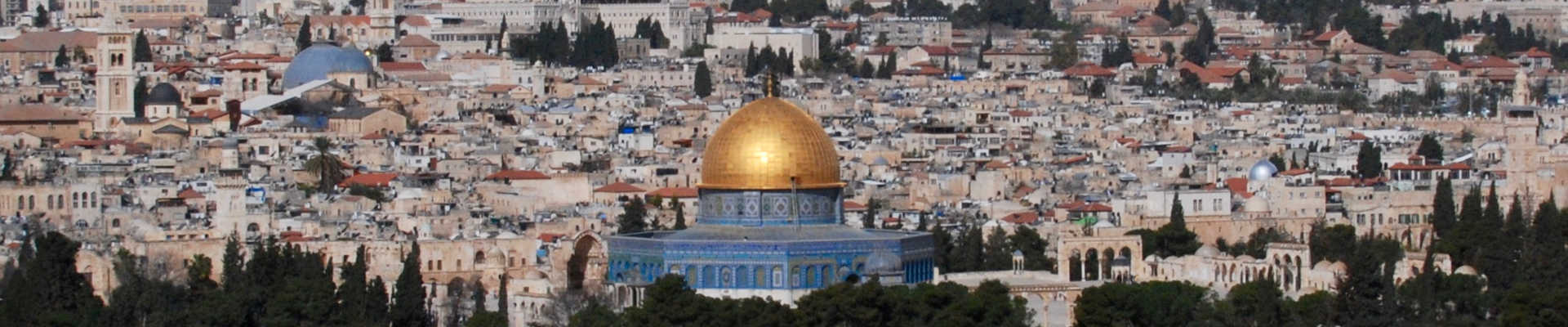
“Holy City of God, Jerusalem, how I long to stand even now at your gates, and go in, rejoicing!” Around 600 CE, Sophronius, a monk from a monastery near Jerusalem who had been posted to Egypt, Sinai, and North Africa, composed a poem expressing his longing to return to the holy city – a wish that was fulfilled thirty years later when he was appointed patriarch. For Sophronius, not even Alexandria, the cosmopolitan cultural capital of the Mediterranean, could compete with Jerusalem. Sophronius’ words echo Psalm 122:1-3, which was written hundreds of years earlier and attributed to King David: “I was glad when they said to me, ‘Let us go to the house of the Lord!’ Our feet are standing within your gates, O Jerusalem. Jerusalem – built as a city that is bound firmly together.”
Throughout the ages, pilgrims have shared Sophronius’ desire to stand in the gates of Jerusalem. Why has this poor and isolated mountain town exerted such a powerful hold on billions of people worldwide over the course of millennia? The simple answer is that for followers of the three Abrahamic faiths, Jerusalem is the place where the presence of the God of Israel dwells, and the Last Judgement will take place. It is the meeting point of heaven and earth – the locus of divine and human interaction. In this talk, Prof. Magness explores how these beliefs came to be associated with Jerusalem.
This webinar will be recorded and all registrants will be sent a link to view the recording.
Jodi Magness (www.JodiMagness.org) is a member of the American Academy of Arts and Sciences. Since 2002, she has been the Kenan Distinguished Professor for Teaching Excellence in Early Judaism in the Department of Religious Studies at the University of North Carolina at Chapel Hill. She received her B.A. in Archaeology and History from the Hebrew University of Jerusalem, and her Ph.D. in Classical Archaeology from the University of Pennsylvania. Magness’ research interests focus on Palestine in the Roman, Byzantine, and early Islamic periods, and Diaspora Judaism in the Roman world. Her most recent books are Jerusalem Through the Ages: From Its Beginnings to the Crusades (New York: Oxford University, March 2024); and Ancient Synagogues in Palestine: A Reevaluation Nearly a Century After Sukenik’s Schweich Lectures. The Schweich Lectures of the British Academy 2022 (London: The British Academy/Oxford University Press, anticipated publication July 2024). Three of Magness’ books have won awards: Masada: From Jewish Revolt to Modern Myth (Princeton: Princeton University, 2019); The Archaeology of Qumran and the Dead Sea Scrolls (Grand Rapids, MI: Eerdmans, 2002; revised edition 2021); and The Archaeology of the Early Islamic Settlement in Palestine (Winona Lake, IN: Eisenbrauns, 2003). Magness has participated on 20 different excavations in Israel and Greece, including co-directing the 1995 excavations in the Roman siege works at Masada. Since 2011, she has directed excavations at Huqoq in Galilee (www.huqoq.org). Magness is an Honorary President of the Archaeological Institute of America (AIA), having served as President from 2017-2020), a member of the Managing Committee of the American School of Classical Studies at Athens, and a member of the Board of Trustees of the W.F. Albright Institute of Archaeological Research in Jerusalem.
SPONSOR A WEBINAR!
Several levels of support from $50-$1,000 are available. Proceeds go towards membership scholarships and towards increasing ASOR’s virtual resources. Each sponsorship is tax-deductible and includes benefits! Sponsor a webinar here.
2024 ANNUAL MEETING STUDENT TRAVEL GRANTS AND SESSION ASSISTANT SUPPORT
Student Travel Grants
Application Deadline: 5PM ET, August 26, 2024
ASOR is once again pleased to announce up to ten travel scholarships of $250 for students enrolled at an institution that is an institutional member of ASOR (see list of Institutional Members). Funding for these scholarships comes from the institutional membership fees. Applications must be submitted by email and are due by 5PM ET on August 26, 2024. In order to receive the funds, the institutional dues for the student’s school must be current for 2024-2025, and the student must stay at the ASOR hotel. Students need not present a paper in order to be eligible. Preference will be given to students from schools that did not receive an award recipient in the previous year. Recipients will be notified on or around September 6, 2024.
Eligibility: Students must be enrolled at at an institution that is an institutional member of ASOR (see list of Institutional Members).
Apply: Email Marta Ostovich with the following information with the subject heading “Student Travel Grants Application”:
A brief (200 words) statement explaining why you want to attend the Annual Meeting and how the experience will help your career goals.
Information about the degree program in which you are presently enrolled.
ASOR is seeking Session/Workshop Assistants to help support the hybrid aspects of the 2024 Annual Meeting. In exchange for Session Assistant service, ASOR will cover a set number of nights at the Hilton Boston Park Plaza as well as Annual Meeting registration fees. Funding for Session Assistants is made possible through the Thomas/Bishop Annual Meeting Endowment. Session Assistants provide technical support to Session Chairs during sessions in Boston and on Zoom.
Eligibility: Zoom proficiency and the ability to multi-task are required. Session Assistants will need to be present for all three days (Thursday-Saturday, November 21-23) of the Annual Meeting, and for a training session on Wednesday, November 20.
Email Marta Ostovich at programs@asor.org with any questions. ASOR will contact those who have been selected as Session Assistants in August to work on scheduling.
*All of our fall internships have been filled. Thank you for your interest.* ASOR seeks candidates for part-time internship positions to begin on or around September 9th. These paid internships are for the fall semester (September-December) with the possibility of renewal for the spring semester. Interns are expect to work 10–15 hours per week at ASOR’s headquarters—The James F. Strange Center, 209 Commerce St., in historic Old Town Alexandria, VA. Hours and schedule are flexible depending on school or other commitments.
Founded in 1900, the ASOR is a 501(c)(3) non-profit whose mission is to initiate, encourage, and support research into, and public understanding of, the history and cultures of the Near East and wider Mediterranean world, from the earliest times. Please visit www.asor.org for more information.
Primary Responsibilities:
Maintain high-quality customer service for ASOR’s members and friends
Assist with maintenance of ASOR’s website.
Assist with ASOR’s Annual Meeting in Boston (November 20-23) by providing off-site administrative support including but not limited to, processing registration and exhibitor payments, answering attendee questions via email, and promoting the Annual Meeting on the ASOR website and social media platforms.
Provide general office support (e.g., scanning, copying, ordering supplies, and processing mail, orders, and bills)
Assist with membership and donation mailings
Perform other office duties as assigned
Qualifications / Skills Desired:
General office skills
Customer service
Microsoft Office
Database management
Familiarity with social media platforms (Instagram, Facebook, TikTok, and X/Twitter)
Graphic and image design and editing (Adobe Photoshop, Canva, etc.)
Website management (WordPress or similar)
Excellent communication and interpersonal skills
Attention to detail; ability to multitask and to prioritize
Compensation: $15/hr
How To Apply: E-mail your resume and a brief statement of interest to Marta Ostovich at programs@asor.org. Please include your name and “ASOR Internship” in the subject line.
Review of applications will begin immediately and continue until the positions are filled.
ASOR is an equal opportunity employer and all qualified applicants will receive consideration for employment without regard to race, color, gender, religion, national origin, disability, veteran status, age, marital status, sexual orientation, gender identity, genetic information, or any other class protected by federal or state law (EEO/AA).
Please e-mail the Membership office if you have any questions.
Pp. 3–26: “A Campaign of Southern City-States against Kiš as Documented in the ED IIIa Sources from Šuruppak (Fara),” by Piotr Steinkeller
A group of ED IIIa texts from Šuruppak (Fara) describes a mobilization of troops from Uruk, Adab, Nippur, Lagaš, Umma, and Šuruppak, clearly in anticipation of a major military operation. It is argued that the target of that campaign, which was led by Uruk, was the city-state of Kiš. The analysis of various other sources further suggests that, during the ED IIIa period, Uruk was able to bring significant portions of southern Babylonia under its control. This development was a reversal of the situation existing in ED I and II, when much of that region remained under the hegemony of Kiš.
ASOR Members with online access: log into ASOR’s Online Portal here. Once logged in, click the JOURNALS tab in the top navigation bar. From here you may select which journal you would like to read. If you have online access, you will see your selected journal’s current issue Table of Contents. Click on the “Current Issue” button and you will then be redirected to the University of Chicago Press’s (UCP) platform to immediately start reading any issue of your choice. Tutorials for how to log in to the Online Portal as well as how to navigate to the Portal Journals page can be found here.
Pp. 27-52: “A Sargonic Exercise Tablet Listing ‘Places of Inanna’ and Personal Names,” by Jana Matuszak and Hanan Abd Alhamza Alessawe
This article publishes a remarkable school tablet, probably from Sargonic Umma, which contains two lexical exercises. While the reverse appears to be an ad hoc list of personal names, many of which start with or contain the sign a, the obverse compiles “places” (ki) where certain mythological events involving the goddess Inanna had occurred. Unusually for lexical lists, each of these places is described in a complete sentence following a loosely alternating structure, which gives the list almost literary qualities. After discussing the list-like vs. literary features and comparing the compilation of places to a similar lexical fragment of Ur III date and the Early Dynastic Word List F, we analyze the mythological allusions and potential ritual associations.
ASOR Members with online access: log into ASOR’s Online Portal here. Once logged in, click the JOURNALS tab in the top navigation bar. From here you may select which journal you would like to read. If you have online access, you will see your selected journal’s current issue Table of Contents. Click on the “Current Issue” button and you will then be redirected to the University of Chicago Press’s (UCP) platform to immediately start reading any issue of your choice. Tutorials for how to log in to the Online Portal as well as how to navigate to the Portal Journals page can be found here.
Pp. 53-101: “Sumerian Model Contracts from the Old Babylonian Period in the Arkeoloji Müzeleri of Istanbul,” by Gabriella Spada and William W. Hallo
This article presents twenty fragmentary multicolumn tablets containing Sumerian model contracts from Old Babylonian Nippur, which are currently kept at the Arkeoloji Müzeleri in Istanbul, Turkey. Initial work on these was initiated by the late William W. Hallo in 1971 but he was unable to complete the project so it was taken over and completed by Gabriella Spada. Their content is limited to loan contracts of silver or barley, sometimes with the presence of antichretic pledges (slaves, fields, gardens, and lumps of silver).
ASOR Members with online access: log into ASOR’s Online Portal here. Once logged in, click the JOURNALS tab in the top navigation bar. From here you may select which journal you would like to read. If you have online access, you will see your selected journal’s current issue Table of Contents. Click on the “Current Issue” button and you will then be redirected to the University of Chicago Press’s (UCP) platform to immediately start reading any issue of your choice. Tutorials for how to log in to the Online Portal as well as how to navigate to the Portal Journals page can be found here.
Pp. 103-126: “The Manchester Tammuz,” by Dylan Guerra and Niek Veldhuis
This contribution provides a new edition of the Manchester Tammuz, a sequence of Emesal love songs concerning Inana and Dumuzi. The text offers many irregular spellings, some of which may be resolved by means of a fragmentary duplicate from Nippur. The relationship between the Manchester text and several other Old Babylonian Emesal liturgies that share characteristics of orthography, paleography, and layout is discussed briefly. A line-drawing of the object by Theophilus G. Pinches, published in 1904, is added to the end of the article.
ASOR Members with online access: log into ASOR’s Online Portal here. Once logged in, click the JOURNALS tab in the top navigation bar. From here you may select which journal you would like to read. If you have online access, you will see your selected journal’s current issue Table of Contents. Click on the “Current Issue” button and you will then be redirected to the University of Chicago Press’s (UCP) platform to immediately start reading any issue of your choice. Tutorials for how to log in to the Online Portal as well as how to navigate to the Portal Journals page can be found here.
Pp. 127-161: “Old Babylonian Lunar-Eclipse Omen Tablets in the British Museum,” by Andrew George and Junko Taniguchi
This article presents a first edition of four clay tablets inscribed with omens arising from eclipses of the moon. As products of the middle and late Old Babylonian periods they represent the oldest examples of compendia of lunar-eclipse omens yet discovered and thus provide important new information about celestial divination among the peoples of southern Mesopotamia in the early second millennium BCE. The tablets are edited with appended philological apparatus. They are all found to bear witness to a single text, which organizes the omens of lunar eclipse by time of night, movement of shadow, duration, and date. A composite translation also takes account of two other early versions of the text published eleven years ago. The article is concluded by discussions of variants and scribal annotations in the text. The cuneiform texts are illustrated by scale drawings of the tablets.
ASOR Members with online access: log into ASOR’s Online Portal here. Once logged in, click the JOURNALS tab in the top navigation bar. From here you may select which journal you would like to read. If you have online access, you will see your selected journal’s current issue Table of Contents. Click on the “Current Issue” button and you will then be redirected to the University of Chicago Press’s (UCP) platform to immediately start reading any issue of your choice. Tutorials for how to log in to the Online Portal as well as how to navigate to the Portal Journals page can be found here.
Pp. 163-183: “30 − 1 = 30: Old Babylonian Month Lengths, the Finale?,” by Michel Tanret
The Old Babylonian administrative calendar always consisted of thirty days, regardless of early moon sightings. The ud.da.gíd.da days, viewed by some as days to be excluded due to an early moon sighting, were not used to shorten the month; rather, they denoted the number of days when no rations were distributed. This is demonstrated on the basis of Old Babylonian documentary texts.
ASOR Members with online access: log into ASOR’s Online Portal here. Once logged in, click the JOURNALS tab in the top navigation bar. From here you may select which journal you would like to read. If you have online access, you will see your selected journal’s current issue Table of Contents. Click on the “Current Issue” button and you will then be redirected to the University of Chicago Press’s (UCP) platform to immediately start reading any issue of your choice. Tutorials for how to log in to the Online Portal as well as how to navigate to the Portal Journals page can be found here.
Pp. 185-190: “Hittite UZUmu/aḫḫ(a)r(a)i– ‘Flesh of the Thigh, Ham,’” by H. Craig Melchert
Hittite UZUmu/aḫḫ(a)r(a)i– is a body part belonging to various mammals, including humans, but almost exclusively attested as a component of cooked meat offerings to deities. New evidence supports its identification as the fleshy part of the thigh, thus English “ham” in the anatomical sense, but when served as food in Hittite removed from the thigh bone. A recent text join furnishes not only a further instance of juxtaposition with the expression for “thigh bone,” but also the crucial detail that the m. is skewered before being cooked.
ASOR Members with online access: log into ASOR’s Online Portal here. Once logged in, click the JOURNALS tab in the top navigation bar. From here you may select which journal you would like to read. If you have online access, you will see your selected journal’s current issue Table of Contents. Click on the “Current Issue” button and you will then be redirected to the University of Chicago Press’s (UCP) platform to immediately start reading any issue of your choice. Tutorials for how to log in to the Online Portal as well as how to navigate to the Portal Journals page can be found here.
Pp. 191-197: “Once Again on the Distribution of Cuneiform Luwian =ša/za,” by Zsolt Simon
This article argues that the Cuneiform Luwian nominal particle =ša/za was not assigned on a word-by-word basis in the -r-, -r/n-, -l-stem classes but followed a regular pattern, thus Jasanoff’s rule of the distribution of this particle can be extended and confirmed.
ASOR Members with online access: log into ASOR’s Online Portal here. Once logged in, click the JOURNALS tab in the top navigation bar. From here you may select which journal you would like to read. If you have online access, you will see your selected journal’s current issue Table of Contents. Click on the “Current Issue” button and you will then be redirected to the University of Chicago Press’s (UCP) platform to immediately start reading any issue of your choice. Tutorials for how to log in to the Online Portal as well as how to navigate to the Portal Journals page can be found here.
Pp. 199-220: “The Middle Assyrian Funerary Inscriptions,” by Jacob Jan de Ridder
This article presents revised editions of a group of four similar funerary inscription from Assyria, dating to about the thirteenth century BCE. The paleography of these texts is unusual, characterized by similarities with the writing from Tell Taban and the kingdom of Ḫana. However, the invocation of the Hurrian deity Šuriḫa, the patron of the town of Šūru, suggests this ancient settlement as its provenance. These funerary inscriptions would be among the earliest texts from the Middle Assyrian settlement that existed at this location.
ASOR Members with online access: log into ASOR’s Online Portal here. Once logged in, click the JOURNALS tab in the top navigation bar. From here you may select which journal you would like to read. If you have online access, you will see your selected journal’s current issue Table of Contents. Click on the “Current Issue” button and you will then be redirected to the University of Chicago Press’s (UCP) platform to immediately start reading any issue of your choice. Tutorials for how to log in to the Online Portal as well as how to navigate to the Portal Journals page can be found here.
Pp. 221-227: “Zanua, the Carpet-Maker: Urartian CTU 4 CB An-1 Revisited,” by Yervand Grekyan
Evidence of Urartian textiles is mostly limited to pictorial representations, along with a few textual references and finds of fragments of textiles in archaeological contexts. The study of an Urartian royal letter gives some new idea on craftsmen who wove textiles in Urartu.
ASOR Members with online access: log into ASOR’s Online Portal here. Once logged in, click the JOURNALS tab in the top navigation bar. From here you may select which journal you would like to read. If you have online access, you will see your selected journal’s current issue Table of Contents. Click on the “Current Issue” button and you will then be redirected to the University of Chicago Press’s (UCP) platform to immediately start reading any issue of your choice. Tutorials for how to log in to the Online Portal as well as how to navigate to the Portal Journals page can be found here.
This fiscal year (July 1, 2023–June 30, 2024) was a record one for ASOR. Donor numbers have been steadily increasing over the past couple of years and this year 905 of ASOR members chose to make a gift of $5 or more! In addition, another 407 people made a gift of less than $5 (primarily from donations to cover credit card fees). Even better news—the cash donations in FY 2024 totaled more than $1,600,000!
Thanks to you, our generous donors, for helping ASOR carry out our mission. It is truly gratifying to see our members and friends choosing to invest in ASOR. Please review the long list of colleagues who donated to make ASOR’s work possible this fiscal year. We are still updating and checking this list, so please contact us with any corrections or comments (info@asor.org).
This large number of donors (almost half of ASOR’s membership) is something that distinguishes ASOR from all other learned societies. And it matters, as the high level of donor participation from our membership engages the attention of foundations and major donors outside ASOR and helps us attract gifts and support from them.
Your donations also enable ASOR to carry out our mission. Subscriptions and memberships only account for about a quarter of our annual budget, so we rely on grants and donations from our members and friends. Even modest gifts add up to create significant support for ASOR, Truly, every donor is important, and every gift is meaningful.
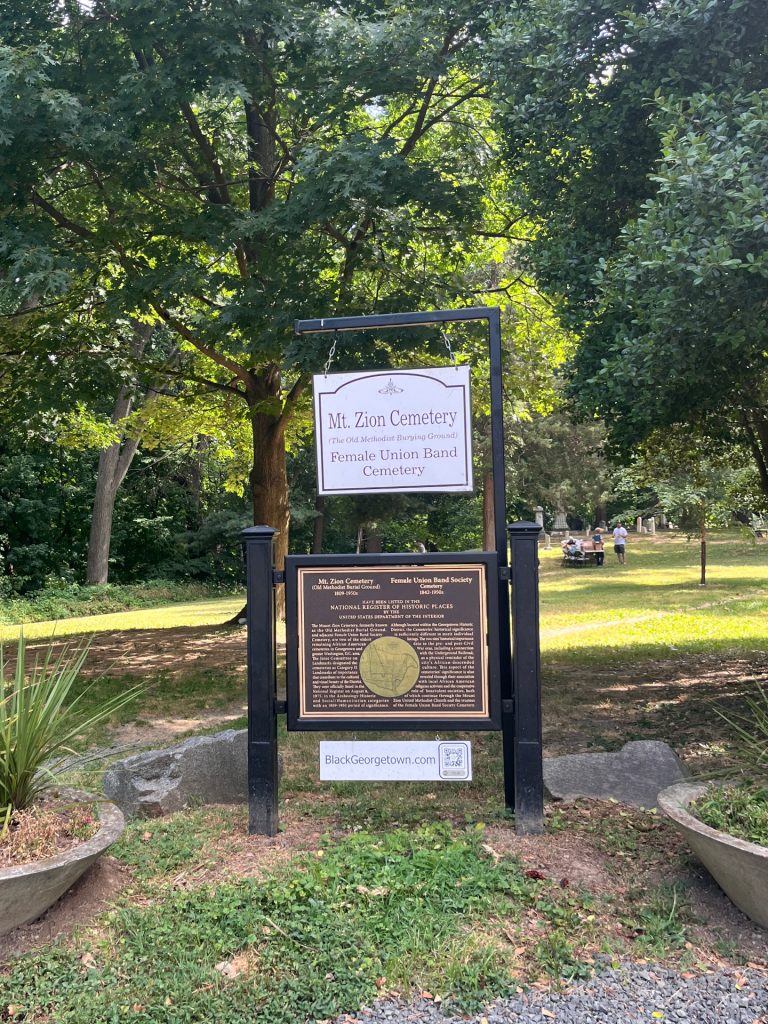
The entrance to Mount Zion - Female Union Band Society Cemetery.
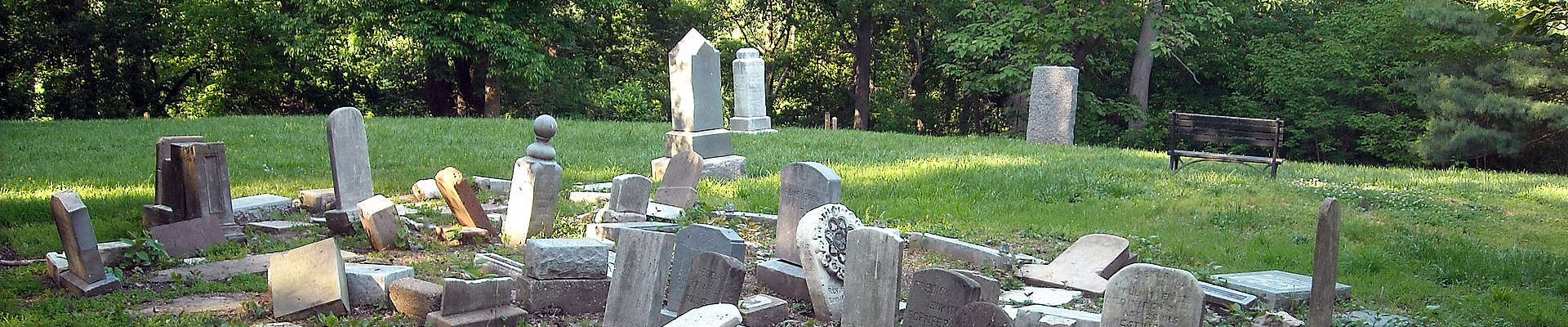
The workshop commenced with a Zoom session on June 27 covering a brief history of the cemetery, the fundamentals of cemetery documentation, and an introduction to the two heritage documentation techniques participants would use at the in-person session – KoboToolbox and photogrammetry. The session was recorded and can be viewed here.
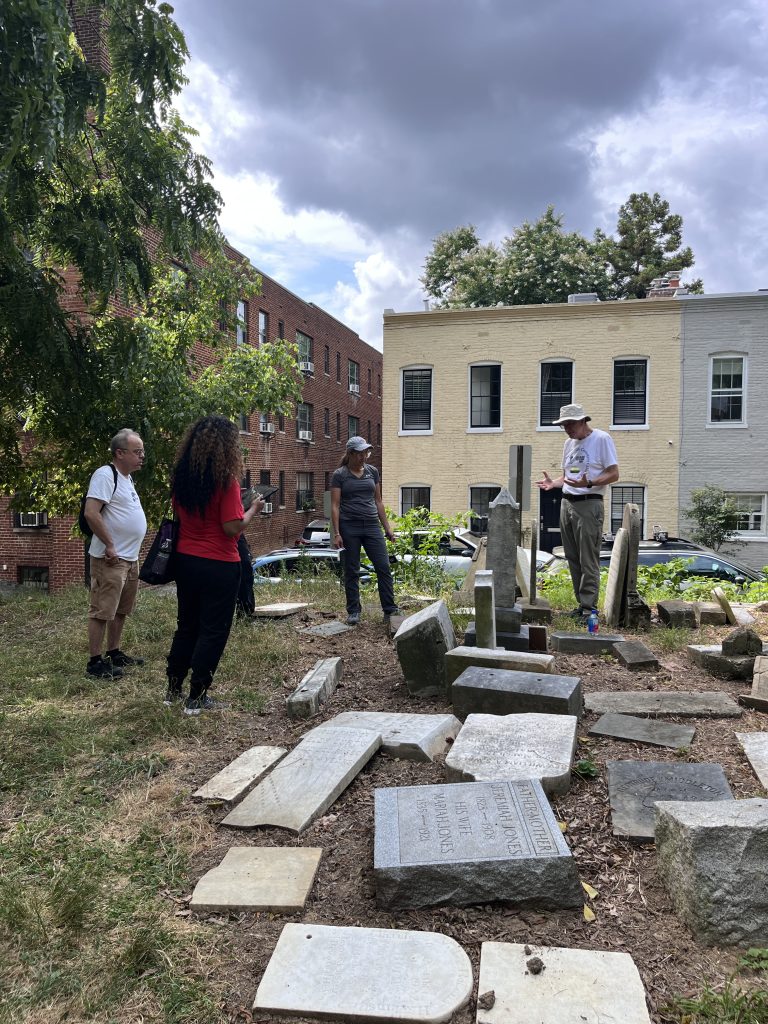
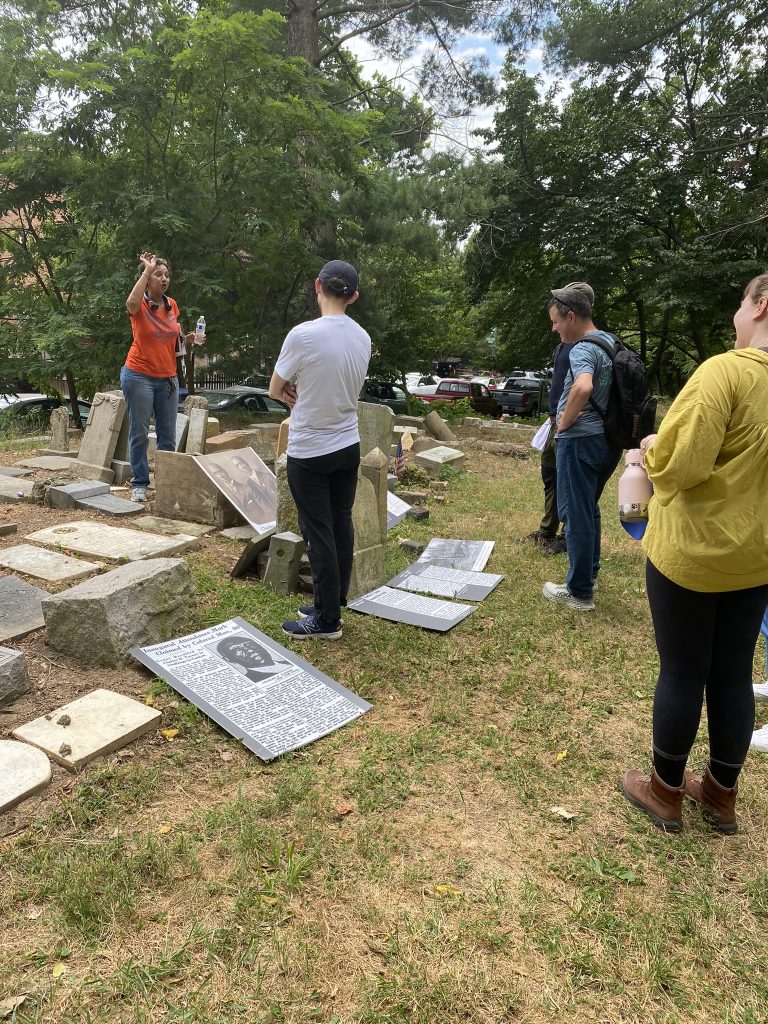
On June 29, participants joined staff from ASOR, AITC, and Black Georgetown Foundation, as well as members from the William Leo Hansberry Society, at the cemetery to engage in the on-site training session and gain valuable, practical experience in cemetery documentation techniques. This included cataloging tombstones and historical markers using KoboToolbox, a free and open source software for location and descriptive data collection. Participants were sorted into groups to practice recording different sections of the cemetery. Using tools like handheld GPS devices, tape measures, whiteboards, and photo scales, participants compiled data from the tombstones and uploaded them into a custom form on KoboToolbox.
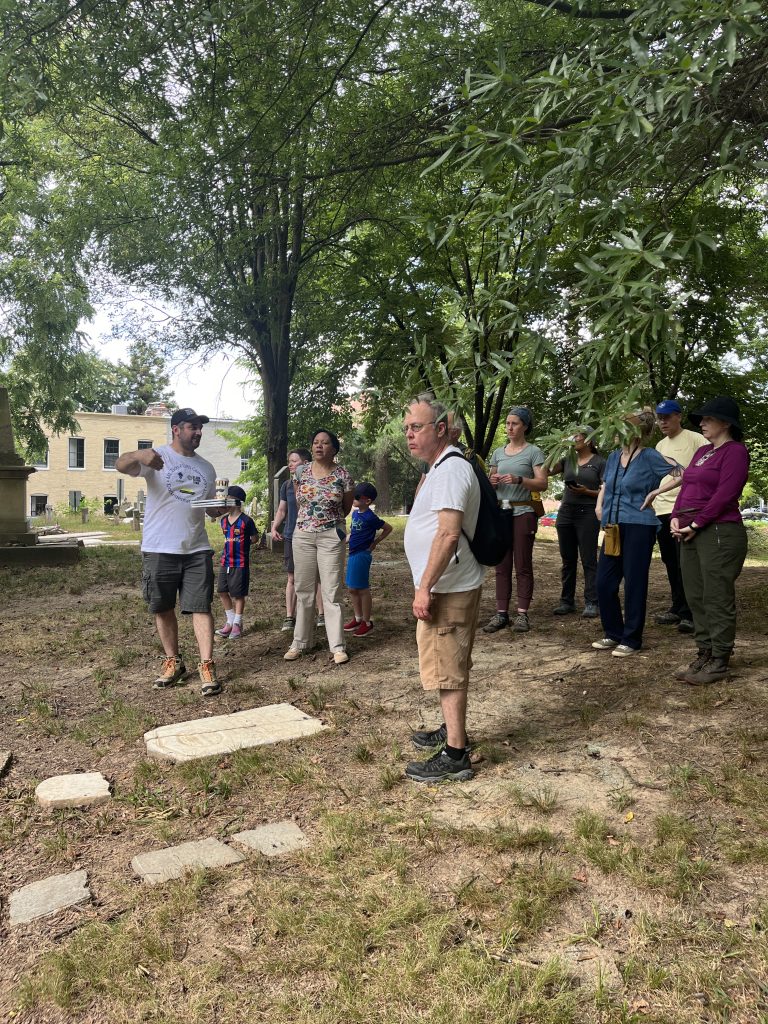
Participants attending the on-site training on June 29 at the cemetery.
ASOR staff instruct participants on how to use Kobotoolbox to collect data.
ASOR staff and participants discuss how to document a tombstone.
After collecting data via KoboToolbox, staff proceeded to instruct participants on the basics of photogrammetry. Photogrammetry is a process using two-dimensional (2D) images to provide measurement data which can then be input into photogrammetric software, such as Agisoft Metashape, to create 3D models. These 3D models can be highly useful and aid archaeologists in uncovering hidden details of objects and buildings. This method also preserves heritage sites digitally and facilitates accurate reconstructions.
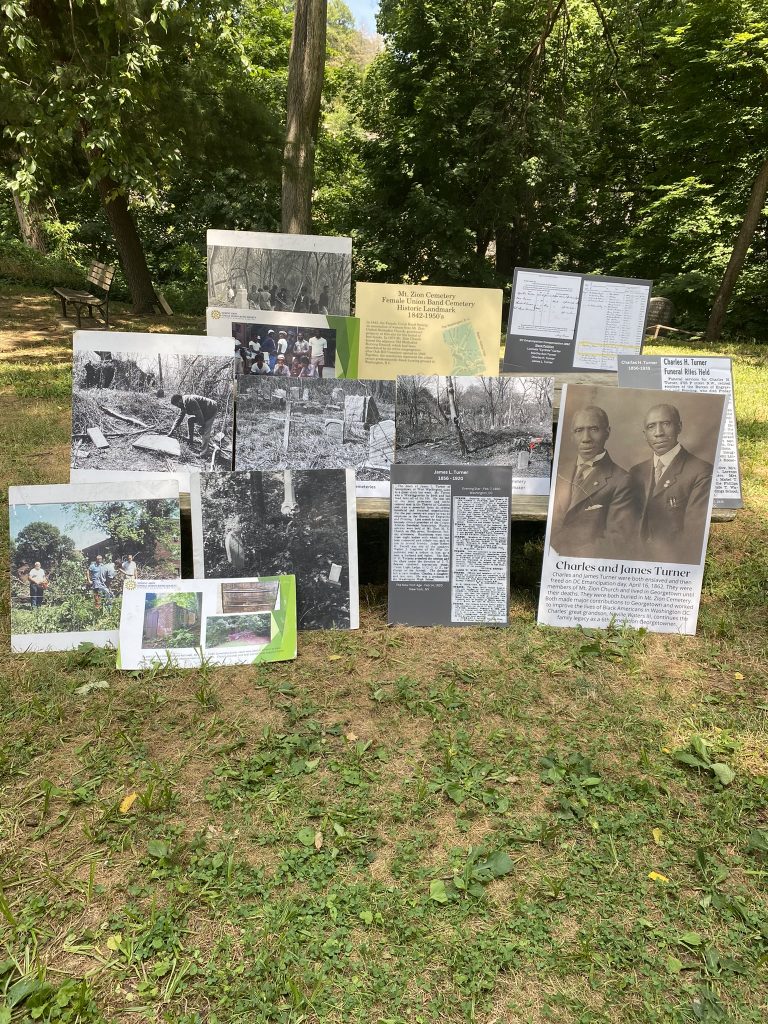
Lisa Fager, the Executive Director of Black Georgetown Foundation, was able to join the on-site training and offer an extensive and fascinating tour of the cemetery grounds. Bringing along several posters and visual aids for participants to view, Lisa described the history of African-American cemeteries in Washington, D.C., the cemetery’s association with the Underground Railroad, and the notable individuals buried on the grounds including Charles Turner, also known as “the Black Mayor of Georgetown.” Read more about the history of the cemetery here.
ASOR staff instruct participants on how to take photographs for photogrammetry.
Lisa Fager, the Executive Director of Black Georgetown Foundation, gives a tour of the cemetery.
Posters about the history of the cemetery.
The final session of the workshop on June 30 via Zoom focused on how to process & analyze data collected through KoboToolbox and how to create 3D models through photogrammetry. The session was recorded and can be viewed here. ASOR staff collected photos from participants and processed them to create 3D models; one of the models is shown below.
ASOR is proud to have hosted this successful introduction to heritage documentation workshop. Part of our core mission is to develop engaging programs of outreach for the general public, and we are grateful for all those who participated in this event. Thank you to everyone who attended, and we hope to see you at future events!
2024 Collections Fellowship Report: Social Mobility of the Medieval Mediterranean: The Case of the Franciscan Custody
Jon Paul Heyne, Assistant Professor of History at the University of Dallas
Shortly after the collapse of the Crusader States in the late thirteenth century, small bands of Franciscan friars traveled to Jerusalem to undertake a daunting task: the renewal of a Latin Christian presence in the Holy Land. Courting patronage from the monarchs and pontiffs of Europe and cooperation from the Mamluk sultans of Egypt, the friars succeeded in their project. Forming the Franciscan Custody of the Holy Land c.1333, they gained not only important rights at many of the Holy City’s Christian shrines but also ownership of plots of property—with gardens, cisterns, and residences—first on Mt. Sion in Jerusalem but then later in Bethlehem and Ramla.
Beyond significantly marking a new phase in Latin Christian relations with the Levant, this establishment of the Franciscan Custody demonstrates the social fluidity of the Late Medieval Mediterranean. In uprooting themselves from the Latin West to reside in the Islamic world of the Eastern Mediterranean, the Franciscans dramatically altered their social dynamics with numerous parties—rising in standing in the eyes of some, falling to a minority status in the eyes of others, and taking on social relations with many whom they would never have encountered without making the transit across the sea.
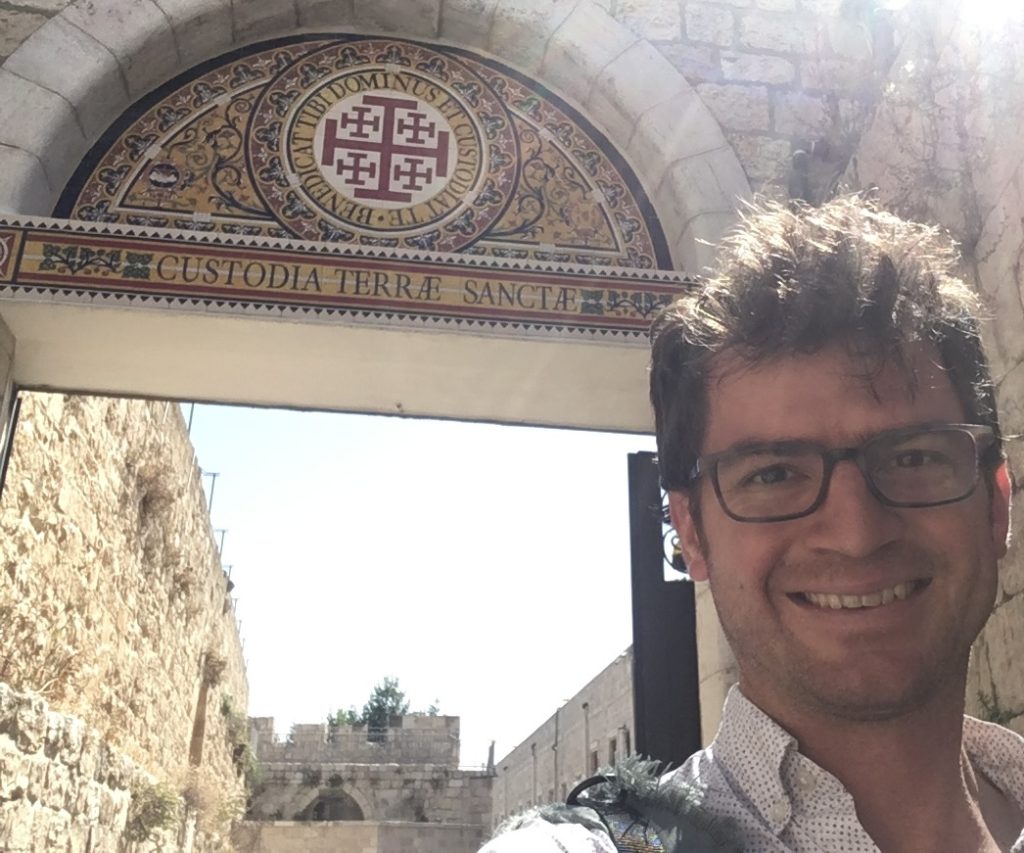
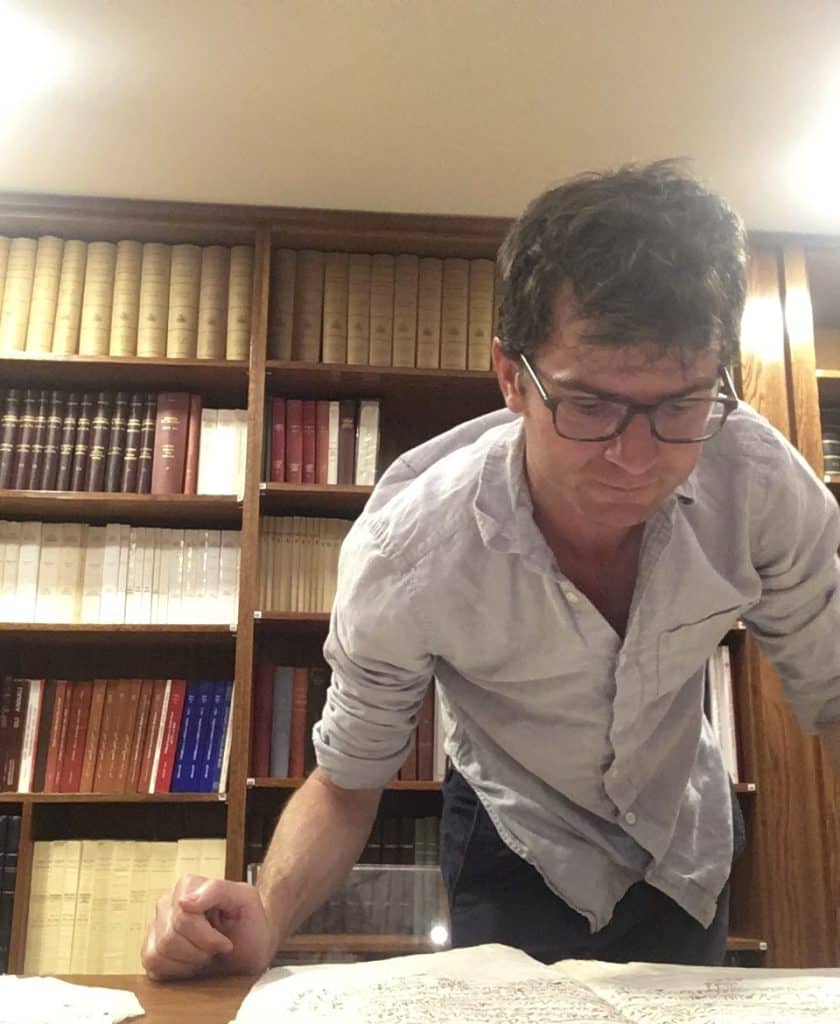
In front of the Franciscan Archivio Storico della Custodia di Terra Santa in Jerusalem. Photo courtesy of author.
With generous funding from ASOR’s Collections Fellowship and the assistance of archivist Fr. Narcyz Klimas, I returned to the Franciscan Archivio Storico della Custodia di Terra Santa to hunt down several unedited purchase deeds related to the history of the Custody. Seemingly dull and overly formulaic, these deeds recount the friars’ acquisition of properties throughout the Holy Land and thus offer some of the most concrete evidence for the development and expansion of their presence in the region in the fourteenth and fifteenth centuries. Additionally, these records provide fascinating details on the Franciscans’ relationships with others in the area, illustrating how the friars negotiated with local Muslim authorities, Italian laywomen, merchants in Ramla, and Armenian archbishops (to name just a few). As I continue the work of transcribing and translating these documents, I offer my sincerest thanks to ASOR and its donors for this opportunity to advance my research.
Examining one of the records related to the history of the Custody. Photo courtesy of author.

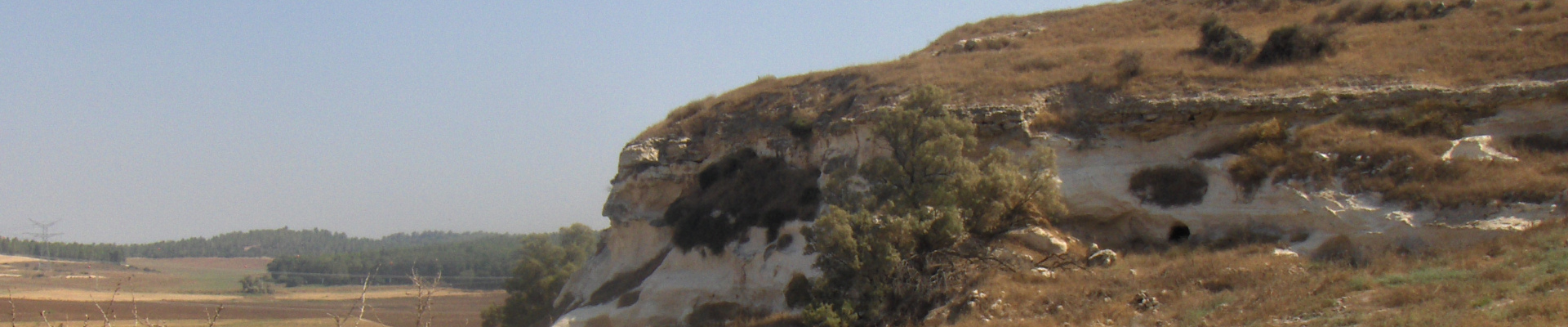

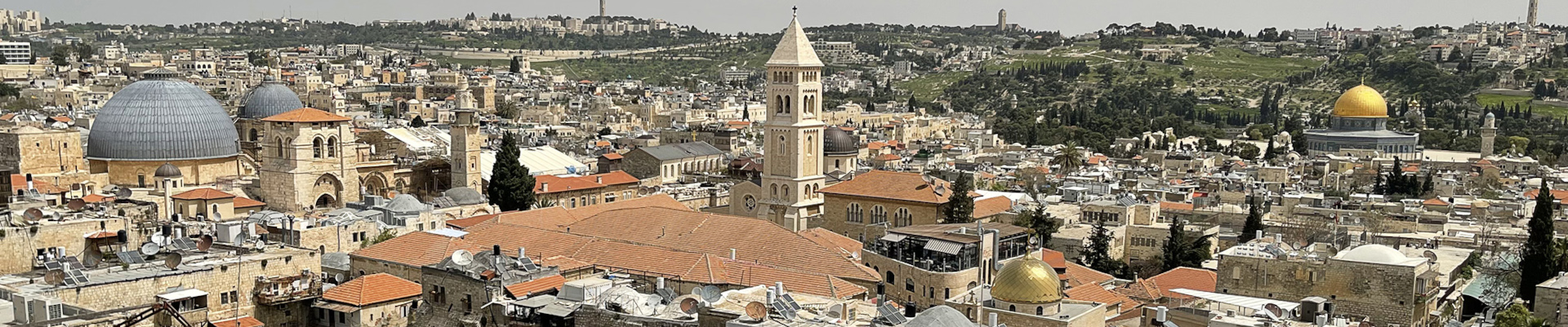

 “Holy City of God, Jerusalem, how I long to stand even now at your gates, and go in, rejoicing!” Around 600 CE, Sophronius, a monk from a monastery near Jerusalem who had been posted to Egypt, Sinai, and North Africa, composed a poem expressing his longing to return to the holy city – a wish that was fulfilled thirty years later when he was appointed patriarch. For Sophronius, not even Alexandria, the cosmopolitan cultural capital of the Mediterranean, could compete with Jerusalem. Sophronius’ words echo Psalm 122:1-3, which was written hundreds of years earlier and attributed to King David: “I was glad when they said to me, ‘Let us go to the house of the Lord!’ Our feet are standing within your gates, O Jerusalem. Jerusalem – built as a city that is bound firmly together.”
 Throughout the ages, pilgrims have shared Sophronius’ desire to stand in the gates of Jerusalem. Why has this poor and isolated mountain town exerted such a powerful hold on billions of people worldwide over the course of millennia? The simple answer is that for followers of the three Abrahamic faiths, Jerusalem is the place where the presence of the God of Israel dwells, and the Last Judgement will take place. It is the meeting point of heaven and earth – the locus of divine and human interaction. In this talk, Prof. Magness explores how these beliefs came to be associated with Jerusalem.
 Her most recent books are Jerusalem Through the Ages: From Its Beginnings to the Crusades (New York: Oxford University, March 2024); and Ancient Synagogues in Palestine: A Reevaluation Nearly a Century After Sukenik’s Schweich Lectures. The Schweich Lectures of the British Academy 2022 (London: The British Academy/Oxford University Press, anticipated publication July 2024). Three of Magness’ books have won awards: Masada: From Jewish Revolt to Modern Myth (Princeton: Princeton University, 2019); The Archaeology of Qumran and the Dead Sea Scrolls (Grand Rapids, MI: Eerdmans, 2002; revised edition 2021); and The Archaeology of the Early Islamic Settlement in Palestine (Winona Lake, IN: Eisenbrauns, 2003). Magness has participated on 20 different excavations in Israel and Greece, including co-directing the 1995 excavations in the Roman siege works at Masada. Since 2011, she has directed excavations at Huqoq in Galilee (