[/vc_wp_text][/vc_column_inner][/vc_row_inner][mk_divider thickness=”1″ margin_top=”10″][vc_column_text responsive_align=”left”]University of Chicago Press E-Books are 30% off right now! Use the code “EBOOK30” at checkout.
In partnership with our Libyan colleagues, and with support from the U.S. Department of State’s Ambassadors Fund for Cultural Preservation (AFCP), the Cultural Antiquities Task Force (CATF), and the U.S. Libyan External Office (LEO), ASOR is bringing a message of hope through Cultural Heritage Volunteer Weekends (“pop-up” events) and through one-day heritage workshops. ASOR’s one-day Cultural Heritage Outreach and Awareness Events utilize museum suitcase “tool kits” that were described in the Libya Museum Suitcase Overview. The popularity of the Museum Suitcases in Libya continues to grow thanks to the hard work of our team (see previous essays from Ghadames and Tripoli). The essay below reports on a meeting in Derj, where local officials met with members of ASOR’s Museum Suitcase Project team and asked to be part of the project.
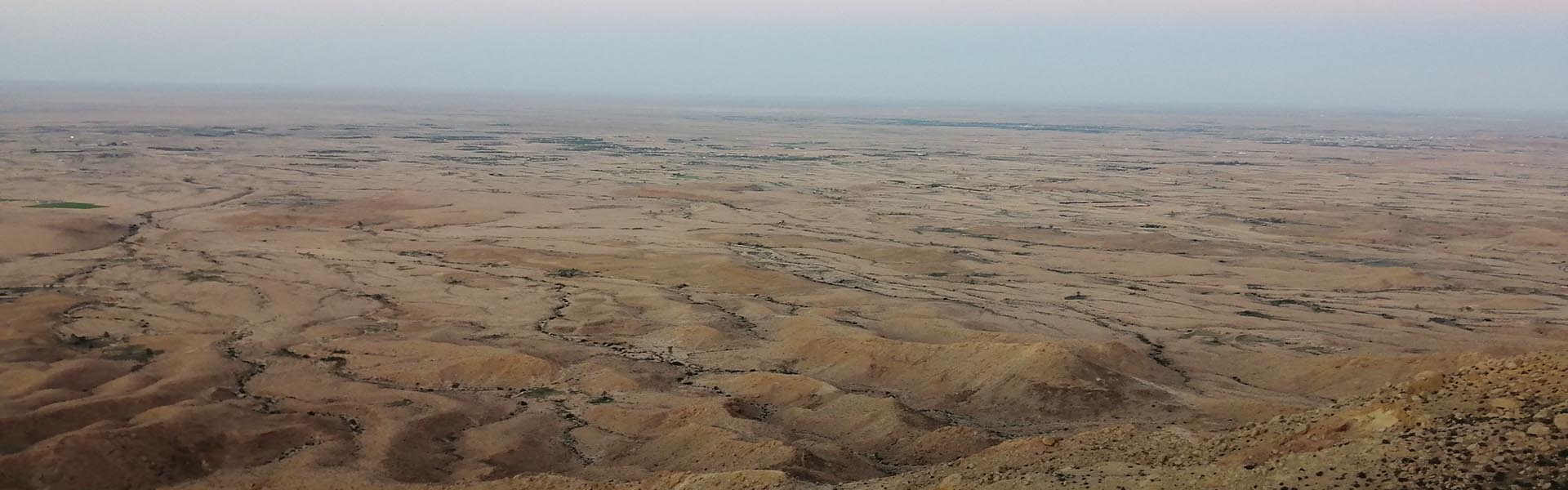
Derj is in western Libya, between Nalut and Ghadames. It is marked on the map in red box.
Even in more stable times, a spring road trip into the Libya desert could be hazardous. The gibli winds of March, blowing north from the heart of the Sahara, caused sand dunes to shift in unpredictable ways, stretching and accumulating in new patterns over a matter of hours. In the worst cases, a driver discovered the road ahead was closed by sand. By the time they turned around and retraced their route, they found that another errant dune had closed the road behind them as well, trapping them until they found an alternate way around or through. Under such conditions, careful planning and patience have always been necessary.
Given the current dysfunction of Libyan public services, the roads have become even worse as all maintenance has ceased. A drive that would normally take half an hour now takes an hour and a half. As the Museum in a Suitcase team packed to travel to the UNESCO World Heritage site of Ghadames to host another in our series of cultural heritage outreach events, we knew that we had a long road trip in front of us. At the last possible moment, we received an invitation from the residents of Derj, a small oasis town at the crossroads between Ghadames and the central desert. They had heard about our project and wanted to find a way for the people of Derj to benefit from and join us in our efforts to protect Libyan heritage. After weighing the risks with the team, we all agreed. We couldn’t turn down such an invitation even though it would delay us on our route.
We arrived in Derj with a convoy of five cars, and we needed gas. For years now, there have been fuel shortages around the country, and it has become normal to wait in line for hours to fill up. It wasn’t surprising to find that there were already ten or fifteen cars assembled in front of the only gas station in town, so we decided to join the back of the line and begin our wait before we went to the city offices to meet our hosts. As soon as the residents in Derj heard about our mission, they waved us forward to front of the line and we filled our tanks immediately.
This was just the beginning of our welcome. The mayor greeted us in his office, offering us each a cup of milk and a serving of dates, traditional oasis hospitality. Their sweetness perked us up after a long morning on the road. He then invited us to join him and the rest of the municipal council for a large lunch consisting of lamb and vegetables served over couscous and ftat, a traditional flat bread soaked in oil.
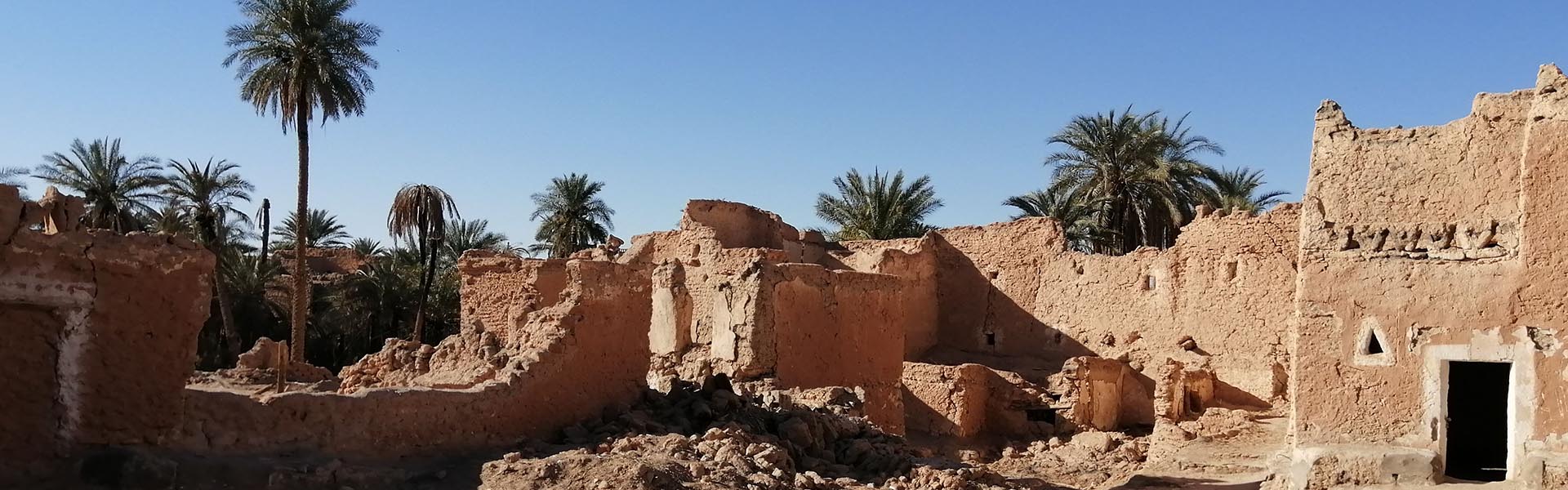
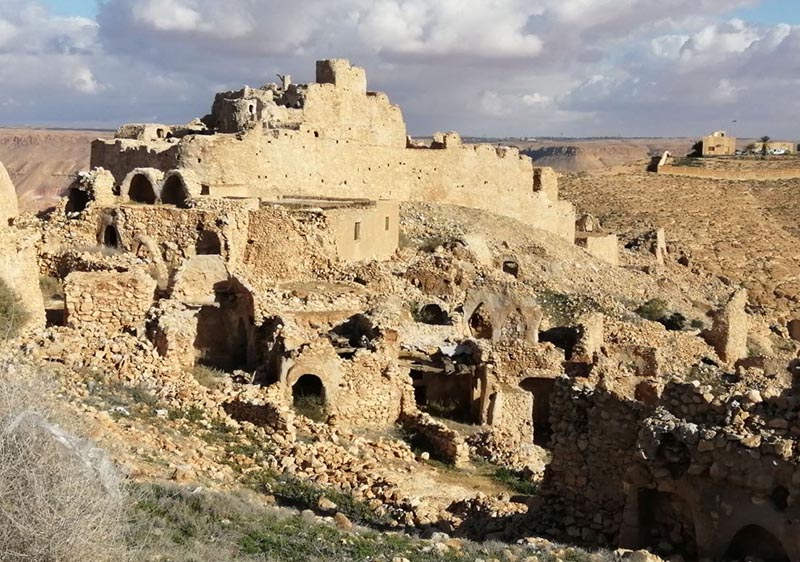
During the meal, Mohammed Harb, a local Scout leader, explained that Derj needed our help. According to him, the historic sites of the city, including the Diab Kasbah, which dates back to the eleventh century A.D., and Taigha Square, which is surrounded by ancient mud brick buildings and has long served as the heart of town, are as important as any historic site in Ghadames but they have never enjoyed the same kind of attention.
He asked for our assistance in building up a community of support for historic Derj by joining the Suitcase Museum project and then assisting the community to connect the historic sites of the city to local and international resources that could help protect them. We saw the hope in his eyes and so we couldn’t refuse.
Though we have now distributed all of the project Suitcases (they are currently active in seventeen cities around Libya) and we had no extra material for Derj, our team member from Zliten decided to gift his suitcase to the city to help jumpstart their program. There is no stronger example of the camaraderie of our team. We intended to present a longer program in Derj on our way back from Ghadames, but the coronavirus pandemic intervened. We will return to this remarkable oasis town as soon as it is written in our fate.
Mud brick buildings surround Taigha Square in Derj.
This historic tower, part of the Diab Kasbah, stands 12m tall and is one of the most prominent landmarks of old Derj.
Members of ASOR’s Museum Suitcase team were welcomed by local officials and community members.
[/vc_column_text][mk_divider][vc_wp_text]ASOR celebrates 120 years in 2020. In honor of this anniversary, throughout the year we will be posting a history of ASOR, from its foundation to the present. This will include the many accomplishments and activities of ASOR members and ASOR as an organization. Join us as we delve deeper into ASOR’s history with images and anecdotes from the ASOR archives.
Imperial Firman issued to the American Schools of Oriental Research by the Ottoman Empire.
The foundation of ASOR can be traced to the late Nineteenth Century, when multiple academic organizations recognized the need for “establishing an overseas research center in the Near East” (Meyers 2001; 4). With the help of the Archaeological Institute of America (AIA), American Oriental Society (AOS), and the Society for Biblical Literature (SBL), ASOR was founded as the American School of Oriental Study and Research in Palestine. Originally intended as an organization to study scripture in the Holy Land, its parameters were expanded to include “linguistic, archaeological, historical, and other kindred studies and researches” within the Levant (From Founding Resolutions, 1900 in Meyers 200; 3). With support from 21 academic institutions, the scope of the American School of Oriental Study and Research in Palestine began to include research from different time periods and cultures throughout the Near East.
With the research goals established, ASOR needed a physical home from which to conduct business and research. Under leadership from the first Director, Charles C. Torrey, an Imperial Firman from the Ottoman Empire was granted for the formation of offices in Jerusalem. Beginning at the Grand New Hotel near the Jaffa Gate, the American School of Oriental Study and Research in Palestine led a nomadic existence for the next 24 years. There was no permanent home for the organization until 1924 when under the direction of William F. Albright, the Jerusalem School was constructed.
Sarcophagus from excavation at Sidon.
Throughout the first two-decades of ASOR’s existence, research took place at an inconsistent pace due to the instability of the region, the First World War and the collapse of the Ottoman Empire. Despite this, the first archaeological excavation, led by Torrey, began in 1901 at the tombs at Sidon. Further excavations were led to Samaria in 1908 through the funding of Reverend James B. Nies, PhD., a regular and generous donor to ASOR during its first years. A significant step for ASOR was the publication of first issue of Bulletin of the American School of Oriental Research (BASOR) in 1919. Publication of this annual journal has occurred for the past 101 years, detailing research in the Near East.
The most significant moment in ASOR’s early decades was the legal incorporation of the organization in the United States in 1921. These articles formally changed the name to the American Schools of Oriental Research, which “was suggestive of the expansion of geographical interests and the development of other research institutes” (Meyers 2001; 11). This marked a turning point for ASOR in which the organization broadened its research interests and capabilities.
Sources:
Meyers, Eric M. and Joe D. Seger. 2001. ASOR: A History of the American Schools of Oriental Research. In An ASOR Mosaic, edited by Joe D. Seger, pp. 2-103. American Schools of Oriental Research, Boston.[/vc_wp_text][/vc_column][vc_column border_color=”rgba(170,170,170,0.01)” width=”1/6″ css=”.vc_custom_1496684098866{margin-right: 5px !important;margin-bottom: 20px !important;border-right-width: 2px !important;border-bottom-width: 2px !important;padding-top: 30px !important;padding-right: 10px !important;padding-left: 10px !important;background-color: #ffffff !important;border-right-color: rgba(227,228,228,0.75) !important;border-bottom-color: rgba(227,228,228,0.75) !important;}”][vc_wp_posts title=”BROWSE THE NEWS ARCHIVE” number=”4″][/vc_column][vc_column border_color=”rgba(170,170,170,0.01)” width=”1/6″ css=”.vc_custom_1496684008271{margin-right: 10px !important;margin-bottom: 30px !important;border-right-width: 2px !important;border-bottom-width: 2px !important;padding-top: 30px !important;padding-right: 20px !important;padding-left: 20px !important;background-color: #ffffff !important;border-right-color: rgba(227,228,228,0.75) !important;border-bottom-color: rgba(227,228,228,0.75) !important;}”][vc_column_text]Tweets by ASOResearch [/vc_column_text][/vc_column][/vc_row]
The ASOR family is a strong and close one, and that fact has never been more evident than in these challenging and stressful times. Due to the rapidly changing situation with the COVID-19 crisis, we plan to update this letter at least bi-monthly.
Please know that we at ASOR are doing all that we can to serve our constituents, while keeping the safety and health of our members, volunteers, officers, and employees as our highest priority.
First, we want to share (and in some cases repeat) the things we are doing to ensure that everyone is as safe as possible:
Health and Safety of ASOR members and staff—To date, no ASOR full-time staff have experienced a COVID-19 illness. One former part-time staff member was presumptively positive, and fortunately that person has now recovered. Related, we learned that one member contracted the virus, and fortunately that member also has recovered. We are sad to report that one parent of a member passed away from a COVID-19 illness. If you are aware of anyone who has experienced an illness and if ASOR might provide assistance, please e-mail Andy Vaughn.
The ASOR Office—The James F. Strange Center—in Old Town Alexandria is operating on remote-only work schedule. The staff is staying in touch with frequent messaging and video conferencing. No layoffs have occurred, and we have received word that we have been approved for a SBA Paycheck Protection Program (PPP) Loan that was made available through the CARES Act. Pending finalization of the loan and receipt of funds, we anticipate that much of this loan will be forgiven and effectively become a “grant.” Our dedicated staff has been, and continues to be, outstanding.
Physical Mail Delivery—ASOR’s ability to receive and to process physical mail has been greatly reduced. Please consider making membership payments and gifts via our secure online store. Please e-mail info@asor.org if you have questions or need help. You may also send us a phone number by e-mail if you would like us to call you to make a credit card payment over the phone (please do not send credit card information by e-mail).
The ASOR Board Meeting: We have rescheduled the meeting for May 14th, and it will be held as a virtual meeting. ASOR continues to test our new Zoom subscription, which we are using this platform more and more to carry out essential business.
Dig Scholarships, Excavation Grants, and Research Fellowships—After much consideration, ASOR decided to postpone all dig scholarships for excavation participants until 2021. We did not reach this decision lightly. We heard that more than 80% of ASOR-affiliated excavations have canceled their summer field work, and the remainder of the projects will most likely cancel as well. We anticipate deciding about excavation grants and research fellowships in late April or early May. We will segregate endowment distributions and gifts already received for awards in 2021, if necessary. Calendar year 2020 was shaping up to be our largest year ever for scholarships, grants, and fellowships, for which we are grateful to all of our supporters. We hope that the segregated funds will enable a 50% increase in funding over 2019 levels in 2021.
Second, we want to share some of the things that we are doing to support you, our members, while many are practicing social and physical distancing:
Membership Scholarships Available—If you have experienced a financial challenge because of the COVID-19 crisis (or if you know of an ASOR member who has a need), please ask about a membership scholarship. Some generous members of the ASOR family have pledged funds to pay the membership dues for anyone who has lost employment or substantial income because of this crisis. To date, we have awarded four such scholarships, and have pledges to support the anticipated need through June. Please contact Felice Herman or Andy Vaughn for more information.
Online Resources—The ASOR office staff (led by Marta Ostovich) has launched webpages to share resources supporting students, professors, and teachers at all levels who are participating in online education with little advance notice. These pages are expanding daily; we invite you to participate so that we can help each other by sharing ideas and expertise.
Online access to ASOR journals—The full-text and enhanced online access to ASOR journals have never been more important. Members with online access to journals can not only view the full text of articles, but all illustrations and figures may be downloaded seamlessly into Powerpoint. Click here for a webpage that outlines all of these features. Please e-mail Felice Herman if you have questions.
Publications—Thanks to the excellent work of our editorial teams, the ASOR staff, and our partnerships with University of Chicago Press and ISD, the production and distribution of ASOR journals and books continue without interruption. Everyone is working remotely as much as possible, and we do not anticipate any interruptions in fulfilling this vital member service.
Annual Meeting—We continue to prepare for our largest and best Annual Meeting in Boston in November. We expect more than 1,200 attendees; as of April 20, 2020, we already have 700 registrants. Because of the uncertainty of travel, we have extended the Early Bird registration rate until July 8, 2020. In late June, we will re-evaluate the situation and determine if a further extension is warranted. The Program Committee and ASOR staff are working remotely to ensure that the Annual Meeting program will be the strongest ever. We, of course, will keep the health of all participants as our highest priority.
General Operations—The ASOR staff and our volunteers continue to respond to e-mails and phone calls. With our staff working remotely, answering phones and voicemail may be delayed. Please consider sending an e-mail if you are able.
Shepard Urgent Action Grants—In the midst of so many things being postponed, we are thrilled to announce a new initiative that we hope to implement in spite of social distancing and self-quarantining efforts. Launched on April 2, 2020, these new grants are designed to address urgent needs for cultural heritage site mitigation and stabilization. Funding may be available in as little as 4-6 weeks following an application. Please check out the webpage and announcement.
Third, we need to share some challenges. We will continue to update you on these items. If you are aware of other issues that we should communicate in subsequent member correspondence, please let us know.
The programs at our Overseas Research Centers in Amman, Jerusalem, and Nicosia are suffering from travel restrictions and cutbacks in fieldwork. Significant portions of their income derive from visits to and work on ASOR field projects and other research, for which they provide essential support and services. For the most part, these projects have been cancelled for 2020. We have been in touch with all the directors. They are coping effectively with the changing circumstances. The Albright in Jerusalem has been particularly hit hard.
ASOR’s Endowment Accounts—Like many institutions, ASOR has invested our endowment accounts using an 80/20 allocation—80% in equities and 20% in bonds and cash. We have thus experienced a significant correction over the first quarter of 2020. As of March 31, 2020, most of our endowment accounts were down 12.1% for the fiscal year (July 1 – June 30). Because we maintain a 20% allocation in bonds and cash, we re-balanced our portfolios in April 2020, per our investment guidelines. We also make quarterly distributions based on averages from the last 12 quarters, so we will continue to be conservative in distributing funds from endowments. In addition, the Finance Committee voted unanimously to forego distributions from endowment accounts for excavation grants and dig scholarships for the 1st and 2nd quarters of 2020 in order to allow our accounts to recover some of their market losses. We have taken our normal distribution from our endowment for operations account, and we continue to use a conservative 3.5% withdraw rate.
ASOR’s Annual Fund (unrestricted giving)—While ASOR remains in sound financial shape, while we anticipate receiving a Paycheck Protection Program Loan to assist with staff salaries, and while we have modest accumulated funds to see us through a challenging year, we need members to consider unrestricted contributions and gifts. To date in this fiscal year (ends June 30, 2020), we have received less than half of the $125,000 that we budgeted for unrestricted giving. Click here to make a gift online.
Finally, we want to conclude as we began—your health and well-being is our highest concern. We are grateful for your continued support of ASOR and of your fellow members. You are, and continue to be, amazing.
Best regards,
Sharon Herbert, ASOR President (president@asor.org)
Richard Coffman, ASOR Board Chair (RCoffman@coffmanlawfirm.com)
Andy Vaughn, ASOR Executive Director (executive-director@asor.org)[/vc_wp_text][/vc_column][vc_column border_color=”rgba(170,170,170,0.01)” width=”1/6″ css=”.vc_custom_1496684098866{margin-right: 5px !important;margin-bottom: 20px !important;border-right-width: 2px !important;border-bottom-width: 2px !important;padding-top: 30px !important;padding-right: 10px !important;padding-left: 10px !important;background-color: #ffffff !important;border-right-color: rgba(227,228,228,0.75) !important;border-bottom-color: rgba(227,228,228,0.75) !important;}”][vc_wp_posts title=”BROWSE THE NEWS ARCHIVE” number=”4″][/vc_column][vc_column border_color=”rgba(170,170,170,0.01)” width=”1/6″ css=”.vc_custom_1496684008271{margin-right: 10px !important;margin-bottom: 30px !important;border-right-width: 2px !important;border-bottom-width: 2px !important;padding-top: 30px !important;padding-right: 20px !important;padding-left: 20px !important;background-color: #ffffff !important;border-right-color: rgba(227,228,228,0.75) !important;border-bottom-color: rgba(227,228,228,0.75) !important;}”][vc_column_text]Tweets by ASOResearch [/vc_column_text][/vc_column][/vc_row]
DEADLINE FOR EARLY-BIRD REGISTRATION EXTENDED TO JULY 8
[/vc_column_text][mk_divider][vc_wp_text]The ASOR staff and our many volunteers continue to prepare for our best Annual Meeting to date. At this point, we expect more than 1,200 attendees, and we are thrilled that we already have more than 700 registrants. Additionally, we are exploring ways that we might enhance the Annual Meeting with prerecorded online presentations and discussions.
Because of the uncertainty of travel during the ongoing COVID-19 pandemic, and because of the changing situation for many of our members, we have extended the Early Bird registration rate until July 8, 2020. In late June, we will re-evaluate the situation and see if a further extension seems warranted. The Program Committee and ASOR staff are working remotely to ensure that the program will be the strongest ever.
During a time when so much is uncertain due to the COVID-19 pandemic, everyone at ASOR will do our best to provide information and answers in a timely manner. We, of course, will keep the health of all participants as our highest priority. If you have any questions, please contact Arlene Press, ASOR’s Director of Meetings and Events, atmeetings@asor.org.[/vc_wp_text][/vc_column][vc_column border_color=”rgba(170,170,170,0.01)” width=”1/6″ css=”.vc_custom_1496684098866{margin-right: 5px !important;margin-bottom: 20px !important;border-right-width: 2px !important;border-bottom-width: 2px !important;padding-top: 30px !important;padding-right: 10px !important;padding-left: 10px !important;background-color: #ffffff !important;border-right-color: rgba(227,228,228,0.75) !important;border-bottom-color: rgba(227,228,228,0.75) !important;}”][vc_wp_posts title=”BROWSE THE NEWS ARCHIVE” number=”4″][/vc_column][vc_column border_color=”rgba(170,170,170,0.01)” width=”1/6″ css=”.vc_custom_1496684008271{margin-right: 10px !important;margin-bottom: 30px !important;border-right-width: 2px !important;border-bottom-width: 2px !important;padding-top: 30px !important;padding-right: 20px !important;padding-left: 20px !important;background-color: #ffffff !important;border-right-color: rgba(227,228,228,0.75) !important;border-bottom-color: rgba(227,228,228,0.75) !important;}”][vc_column_text]Tweets by ASOResearch [/vc_column_text][/vc_column][/vc_row]
Nalut Hosts Workshop for Cultural Heritage Protection
Talal Bariun and Will Raynolds
In partnership with our Libyan colleagues, and with support from the U.S. Department of State’s Ambassadors Fund for Cultural Preservation (AFCP), the Cultural Antiquities Task Force (CATF), and the U.S. Embassy Libya External Office (LEO), ASOR is bringing a message of hope through Cultural Heritage Volunteer Weekends (“pop-up” events) and through one-day heritage workshops.
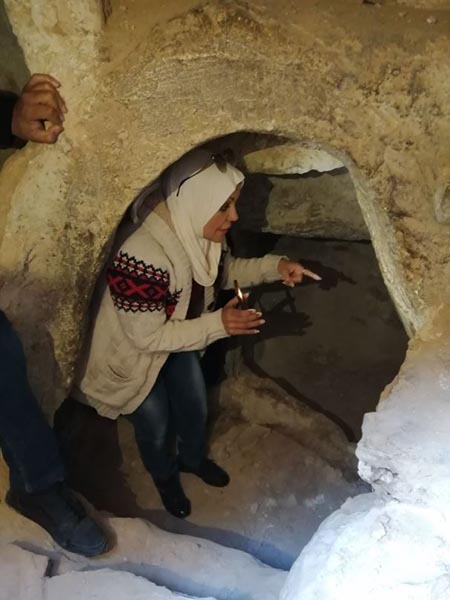
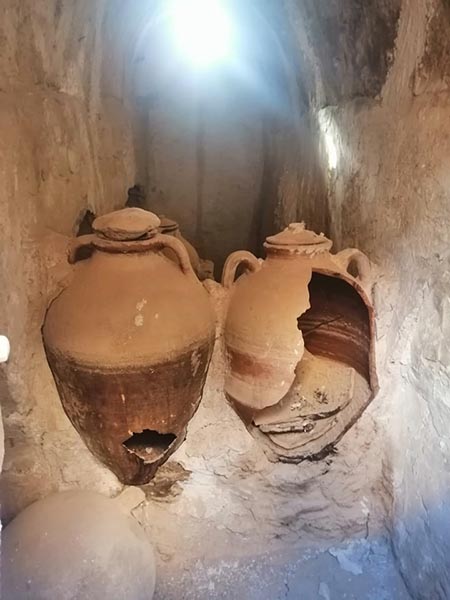
Intisar al Arebi, one of the most dedicated and intrepid members of the Suitcase Museum team, crawled down into a small, darkened enclosure. She waved the light of her mobile phone in front of her to guide the way. “The temperature was cool inside and there were clay storage vessels built into the walls,” she explained after resurfacing, “good for keeping all kinds of food fresh, like wheat, barley, olive oil and dried dates and figs. As I looked around, I was surprised to find a plaster relief in the form of a cross carefully attached to the back wall.”
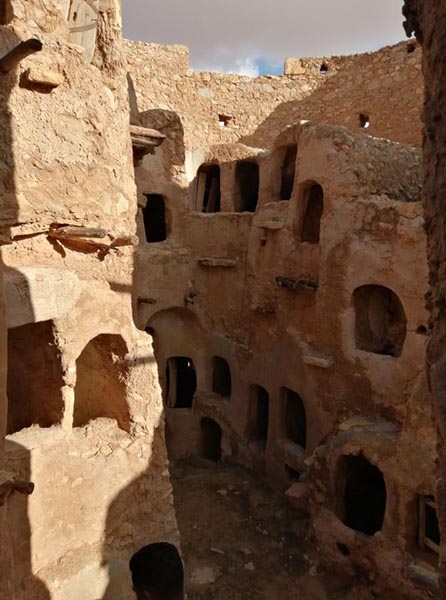
She had entered the earthen heart of Qasr Nalut, a fortified granary that for centuries served as a sort of central bank for the city. Roughly circular in form, it consists of hundreds of small cells, hosting the food stores of individual families. Each cell was a combination between a safety deposit box and a refrigerator. According to our guide, Suliman Amru Ahmad, the design is both a testament to the ingenuity of the community as well as a sign of the dangers they faced. Persistent raiders attempted to steal the harvests from farmers along the edge of Libya’s Jebel Nafusa, and the granary was a strategy for communal protection and survival.
Intisar al Arebi exploring one of the granaries of Qasr Nalut.
Clay storage vessels within one of the cells.
Though Qasr Nalut is one of many fortified granaries that characterize towns throughout the Nafusa region, including other notable examples at Qasr Hajj and Kabaw, it is the only one that is so densely built, with a freestanding tower at its center, a sign of its relative success. Suliman explained that the sign of the cross found by Intisar was not unusual given that the fortified site had once served a diverse community including both Jews and Christians. The nearby Abi Mohammed Kabawi Mosque also bears signs of the cross and the Star of David, testament to successive reuse through time.
Community members described a society that was more tolerant of religious differences because of their common ethnic identity. In Nalut and throughout the Nafusa region, the majority self-identifies as Libyan Berber or Amazigh. Thought to be the descendants of the Numidians who joined Rome in defeating Hannibal Barca at the battle of Zama in 202 BC, the Amazigh remain united through a strong commitment to a shared language and culture. Yet this culture has been swiftly changing.
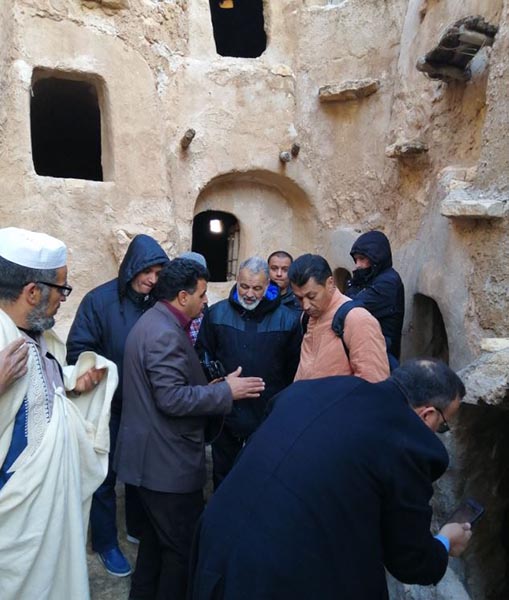
Team members visit Qasr Nalut.
Qasr Nalut granaries.
Since the early 1980’s, both the Qasr and the surrounding old city were abandoned by residents who built new houses with low-interest loans from the government and began to store their food in pantries and refrigerators instead of mud brick rooms. Nalut expanded rapidly over this period, and the historic core began to decay after its residents left. One elder member of the local Scout troop, Khalifa Kafu, had lived through these changes. Like many of his peers, he remembered life in the old city as better than life in the new, much larger houses where his family lives now. He returns to his abandoned home frequently and would like to find a way to offer lasting protection to the old city and share it with future generations.
The old city of Nalut has been abandoned and continues to decay.
The Amazigh of the Nafusa region struggled to access state resources under the Gaddafi regime. However, since the Libyan revolution of 2011, communities like Nalut have been particularly active in marshalling resources to protect their cultural heritage, and they now seek to connect with partners who share this goal. This was exactly the kind of conversation we had hoped to convene with our latest cultural heritage outreach workshop in Nalut.
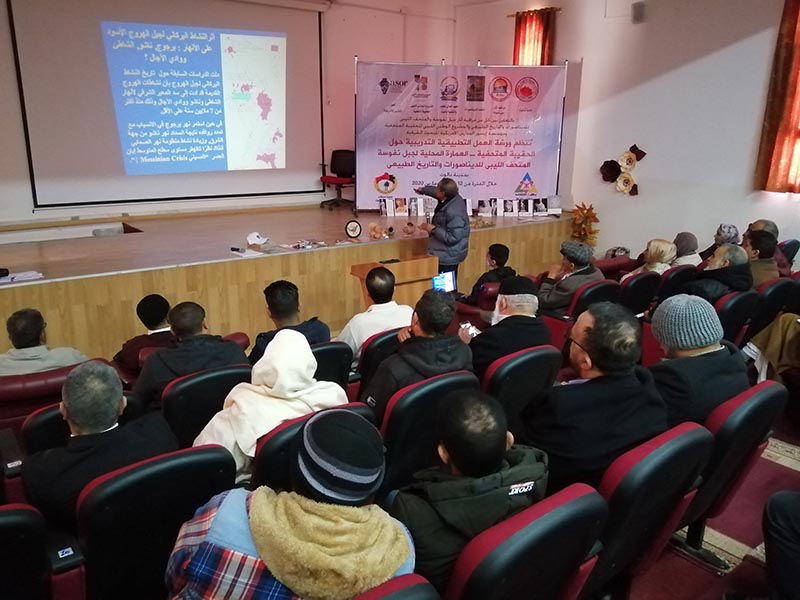
Departing Tripoli earlier in the day, our team heard heavy artillery fire downtown, and we had taken a circuitous route to avoid active conflict areas during our travel. The hardship and risk we faced while on the road were made up for by the enthusiasm that greeted us in Nalut. Over the course of four days, 168 people representing 12 national and regional institutions gathered to discuss the richness of this cultural heritage as well as strategies for its protection. We plan to translate this conversation into action through both the ongoing Suitcase Museum program as well as marshalling volunteers to contribute to ongoing maintenance projects.
Community members engage with the lecture materials presented during the workshop.
This article reports on the first two days of the Nalut Cultural Heritage Protection Workshop. Stay tuned for more news from the Nalut Workshop in News@ASOR and ANE Today!
الحقيبة المتحفية الليبية : ورشة عمل ليوم واحد في طرابلس
بالتعاون مع الزملاء في ليبا ومن خلال دعم وزاره الخارجية الأمريكية عن طريق تمويل السفير للحفاظ علي التراث و فريق عمل الثقافة والآثار ومكتب السفاره الأمريكية الليبي الخارجي
قامت ASOR بنشر رساله امل من خلال يوم تطوعي للتراث والثقافة في العطلة وذلك من خلال ورشه عمل لمده يوم واحد.
ألعاب الفسيفساء للأطفال : أنشطة تعليمية ممتعة لحماية التراث الليبي
قبل بداية الإغلاق الوطني الليبىى لدرء الوباء العالمي ، صاغ زملاؤنا في ليبيا أرضية جديدة في مشروع اسور الحالي “الحقائب المتحفية المتنقلة”. بتمويل من سفارة الولايات المتحدة في ليبيا ووزارة الخارجية الأمريكية ، دفعت شعبية ونجاح البرنامج الفريق إلى ابتكار أنشطة توعية إضافية لتعريف التلاميذ والطلاب من مختلف الأعمار بثراء وغنى التراث الثقافي الليبي
تعد الفسيفساء ، مثل لوحة الفصول الأربعة فورسيزونز الشهيرة في موقع التراث العالمي لليونسكو شحات سيريني ، من بين الأعمال الأكثر تميزًا للفن القديم في ليبيا ، ولكن من الصعب غالبًا زيارتها و رؤيتها عن قرب بسبب هشاشتها وحساسيتها ، لذلك فهى محمية فى مكان مغلق ويصعب الإقتراب منها . عليه واستيحاءاً من مجموعة “اصنع الفسيفساء الخاصة بك” في متحف باردو في تونس ، قام الفريق بتكييف هذه المواد مع السياق الليبي ودمجها مع الحقائب المتحفية الـ 23 في 18 مدينة ليبية ، لمساعدة وترغيب وتحفيز الأطفال على فهم كيفية صنع الفسيفساء ومنحهم فرصة لتجربتها بأنفسهم
أعطى الفريق هذه المواد الجديدة ، فرصة تجريبية في نشاط التوعية بالمحافظة على التراث للتراث الثقافي في 4 مارس 2020 لتلاميذ الصف الأول والصف الرابع في مدرسة غرناطة الابتدائية في طرابلس. بعد شرح موجز للتاريخ الليبى ولتاريخ الفسيفساء وانتشارها في ليبيا ، تم تقسيم الأطفال إلى مجموعات صغيرة وأتيحت لهم الفرصة لتجميع الفسيفساء
ووفقاً لرأى المعلمة أحلام الوفللي ومساعدتها المعلمة ريما ، كانت النتائج مذهلة. مرت ساعة ونصف الساعة بسرعة ، حيث انغمس جميع التلاميذ في اختيار القطع الصغيرة المناسبة لتتناسب مع لوحة الفسيفساء المزمع تركيبها . وفقًا لطلال بريون ، مندوب إيسور في ليبيا ، “كان الجو في صالة المسرح هادئًا ومنسجماً ومتناغمًا حيث عمل التلاميذ معًا أضاءت عيون الأطفال وهم فى طريقهم للنجاح في تجميع قطع صغيرة من الحجر في فسيفساء جميلة جدا
قدمت لعبة الفسيفساء طريقة عملية لتعليم التاريخ والحضارة وعلم الآثار وبالتأكيد على أهمية الحفاظ على التراث الثقافي
تصف انتصار العريبي ، عضو فريق الحقيبة المتحفية ، تاريخ وفنون إبداع الفسيفساء لتلاميذ الصف الرابع في طرابلس
تلاميذ يستطلعون بعض المواد من محتويات الحقيبة المتحفية
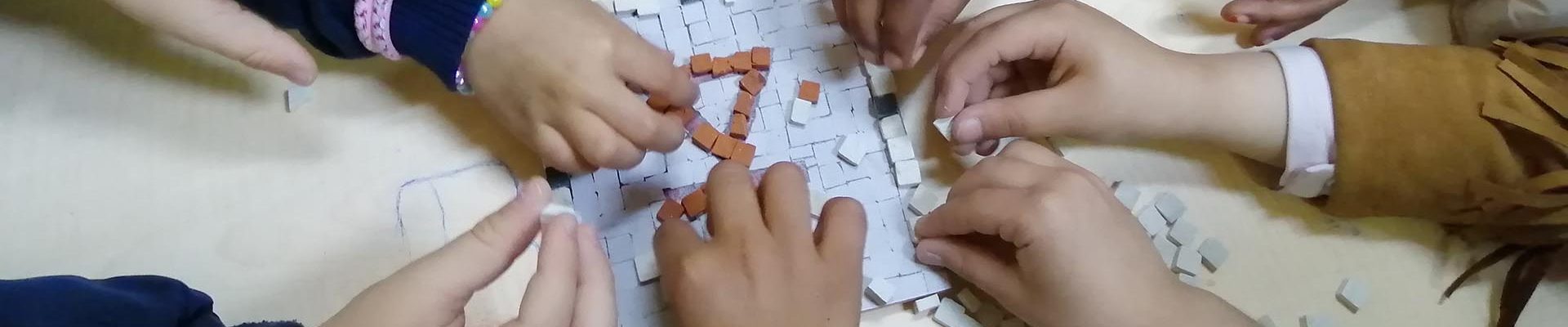
تلاميذ يعملون على تجميع الفسيفساء في مجموعات صغيرة
المشاركون في نشاط التوعية التثقيفي في مدرسة غرناطة بطرابلس
In partnership with our Libyan colleagues, and with support from the U.S. Department of State’s Ambassadors Fund for Cultural Preservation (AFCP), the Cultural Antiquities Task Force (CATF), and the U.S. Embassy Libya External Office (LEO), ASOR is bringing a message of hope through Cultural Heritage Volunteer Weekends (“pop-up” events) and through one-day heritage workshops. This essay is an update on a Cultural Heritage Outreach and Awareness Event held in Tripoli, Libya at the Granada School. These one-day workshops utilize museum suitcase “tool kits” that were described in the Libya Museum Suitcase Overview.
Mosaic Games for Children: Fun and Engaging Educational Activities to Protect Libyan Heritage
Prior to the onset of a national lockdown in response to the global pandemic, our colleagues in Libya forged new ground in ASOR’s ongoing “Museum in a Suitcase” project. Funded by the U.S. Embassy to Libya, the U.S. Department of State’s Ambassadors Fund for Cultural Preservation (AFCP), and the Cultural Antiquities Task Force (CATF), the program’s popularity has driven the team to devise additional outreach activities familiarizing students of diverse ages with the richness of Libyan cultural heritage.
Mosaics like the famous Four Seasons panel at the UNESCO World Heritage site of Cyrene are among the most distinctive works of ancient art in Libya, yet are often difficult to appreciate up close due to their fragility. Inspired by a “Make Your Own Mosaic” kit at the Bardo Museum in Tunis, the team has adapted these materials to the Libyan context and incorporated them into the 23 museum bags in 18 Libyan cities, helping children understand how mosaics are made and giving them a chance to try it themselves.
The team gave these new materials a trial run at the Cultural Heritage Outreach and Awareness event on March 4, 2020 for the fourth grade students at the Granada Elementary School in Tripoli. After a brief explanation of the history of mosaics and their prevalence in Libya, the children were divided into small groups and given the opportunity to assemble a mosaic.
According to the teacher, Ahlam al Waflai, and her aide Reema, the results were amazing. An hour and a half passed quickly, as all of the students were engrossed in selecting the right tesserae to match the pattern. According to Talal Bariun, ASOR’s liaison in Libya, “the atmosphere in the room was calm and harmonious as the students worked together. The students’ eyes lit up as they succeeded in assembling small pieces of stone into very beautiful mosaics.” The mosaic game offered a hands-on way to teach history, civilization, and archaeology and emphasize the importance of preserving cultural heritage.
Museum in a Suitcase team member Intisar al Arebi describes the history of mosaics and the artistry of their creation to fourth graders in Tripoli.
Students studying materials from the Museum in a Suitcase.
Students working on mosaics in small groups.
Participants in the Cultural Heritage Outreach and Awareness Event at the Granada School in Tripoli.
More updates on Outreach and Awareness One-Day Events will be featured in forthcoming News@ASOR and ANE Today.
Did you know that online access with an ASOR Academic Membership includes access to all three ASOR journals? Did you know that Associate and Contributing members get access to NEA online as well as print delivery? Did you know that all the back issues of ASOR journals are available to view online? Or that you can view any issue using special features on the University of Chicago Press Journals platform?
Full Text Articles: This easy-to-use feature reveals the entire text of the article as well as downloadable images and figures! Use the images for slides for lectures or online learning or to archive them for later research.
Go To Button: Use this link to skip to certain sections of the Full Text view such as the conclusions or the references.
As you scroll through the text, each citation has an embedded link in the year that enables the reader to jump to the reference at the end of the article.
Each figure or image is also a link that pulls up the image.
After you select an image, click on the links at the bottom of the images to download into a PowerPoint slide containing the image. The View Large Image link, by contrast, downloads an actual high-res image that the user could import into a PowerPoint document.
Abstracts of Articles: Preview articles by reading the abstracts for each article from the table of contents or when you click on the article itself.
PDF Articles: View each article as a PDF that can be downloaded and read offline or printed. There are no downloadable images when using this view.
Previous/Next Article or Issue: Use these buttons to easily navigate to the previous or next article in a single issue. You can also click between issues from a journal from a TOC page.
Search Features: The quick search form at the top of every page allows searching across the entire site (including all 3 ASOR publications) or limited to a single journal. Search results page includes several filters for refining a search.
Free Articles: The “Free” icon on TOC pages identifies articles that are free to read without a subscription.
REFERENCES/CITATIONS
When you are ready to start typing up your research, UCP also provides easy to use citation tools:
Downloadable citations and bibliographies.
Specific article citation prominently displayed in the right-hand sidebar navigation in the Full Text view.
Each item in an article’s reference list is followed by useful links: First Citation in Article, Google Scholar, OpenURL, and a link to the online cited article itself.
Other tools available for each article include “Email A Friend” (sends anyone you specify a link to the article) and “Track Citation” (sends you an alert when the article is cited by new publications). These article tools can be applied to several articles at once by using the checkboxes on the TOC pages.
E-BOOKS OF EACH ISSUE OF ASOR JOURNALS
If you would like to read the entire journal issue on your mobile device you can always download the e-book version of the issue! Entire issues are available for individual members to download and read on their iPad, iPhone, Kindle, Android, or desktop computer. Click here for more e-Book FAQs from UCP. Look for this box on the right-hand side of the table of contents of each issue:
ASOR MEMBERSHIP & ONLINE ACCESS
As always, you can contact Regan Baker (membership@asor.org) if you have questions about which type of membership you have (print delivery, online access, or both). If you would like to switch to online-only or add online access to your print delivery membership, please email membership@asor.org.
Are there features that you use on the UCP website that are not listed here? Do you have other suggestions or comments? Let us know!
University of Chicago Press Journals is also committed to keeping its readers and users updated with their developments, especially during the COVID-19 crisis. Click here for their page of resources.
ISD – PLATINUM SPONSOR
Ian Stevens
70 Enterprise Dr., Suite 2
Bristol, CT 06010
Tel: 860-584-6546
E-mail: ian@isdistribution.com
ISD is a full-service book distribution company focusing exclusively on scholarly and specialist books in the Humanities. We represent some of the world’s finest publishing houses—including Acumen Publishing, Brepols Publishers, Equinox Publishing, Harrassowitz Verlag, Peeters Publishers, and many more—and are located in Bristol, CT. Visit www.isdistribution.com to see our full range of distributed publications.[/vc_column_text][mk_divider divider_color=”#d8d8d8″ thickness=”1″ margin_top=”10″ margin_bottom=”10″][vc_column_text]
THE UNIVERSITY OF CHICAGO PRESS | JOURNALS – PLATINUM SPONSOR
Marsha Ross
1427 East 60th Street
Chicago, IL 60637
Tel: 773-702-8185
E-mail: mar@uchicago.edu
The University of Chicago Press publishes more than 80 journals in print and electronic editions, presenting original research from international scholars. View our newly acquired journal, Res: Anthropology and aesthetics, and sample issues of the Journal of Near Eastern Studies, which covers Assyriology, Egyptology, Hittitology, Hebrew Bible, with an emphasis in early, medieval, and early-modern Islamic studies.[/vc_column_text][mk_divider divider_color=”#d8d8d8″ thickness=”1″ margin_top=”10″ margin_bottom=”10″][vc_column_text]PENN STATE UNIVERSITY PRESS – GOLD SPONSOR
Contact: Patrick Alexander
920 N. University Drive, USB 1, Suite C
University Park, PA 16802
Tel: 1-814-865-1327
E-mail: pha3@psu.edu
Penn State University Press publishes scholarly works of exceptional quality in the humanities and social sciences. We’re pleased to announce that Eisenbrauns is now an imprint of our award-winning publication program. Visit us in the exhibit hall at the 2019 ASOR meeting or at PSUPress.org for more information.[/vc_column_text][mk_divider divider_color=”#d8d8d8″ thickness=”1″ margin_top=”10″ margin_bottom=”10″][vc_column_text]THE ARIZONA CENTER FOR JUDAIC STUDIES – COFFEE BREAK SPONSOR
THE UNIVERSITY OF ARIZONA
J. Edward Wright, Director
The Arizona Center for Judaic Studies at
The University of Arizona
845 N. Park Ave., Suite 420
Tucson, AZ 85721
Tel: 520-626-5758
E-mail: edwright@email.arizona.edu[/vc_column_text][mk_divider divider_color=”#d8d8d8″ thickness=”1″ margin_top=”10″ margin_bottom=”10″][vc_column_text]
2019 EXHIBITORS
[/vc_column_text][mk_divider divider_color=”#d8d8d8″ thickness=”1″ margin_top=”10″ margin_bottom=”10″][vc_column_text]AMERICAN RESEARCH CENTER IN EGYPT (ARCE)
Louise Bertini, Executive Director
2 Midan Símon Bolívar (Qasr al-Dubara)
Garden City
Cairo 11461 Egypt
Tel: 20 2 2794-8239
E-mail: info@arce.org
ARCE U.S. Office: 909 North Washington Street, Suite 320, Alexandria, VA 22314; Tel: 703-721-3479
ARCE’s mission is to support research on all aspects of Egyptian history and culture, foster a broader knowledge about Egypt among the general public, and strengthen American-Egyptian cultural ties.[/vc_column_text][mk_divider divider_color=”#d8d8d8″ thickness=”1″ margin_top=”10″ margin_bottom=”10″][vc_column_text]ANDREWS UNIVERSITY PRESS
Sam Neri, Customer Service
Sutherland House
Berrien Springs, MI 49104-1700
Tel: 269-471-6134;
E-mail: aupo@andrews.edu
The primary mission of Andrews Press is to publish books, journals and papers that make a scholarly and/or professional contribution to their respective fields and are in harmony with the mission of Andrews University. Publication emphases include such areas as archaeology, biblical studies, religion, education, and science.[/vc_column_text][mk_divider divider_color=”#d8d8d8″ thickness=”1″ margin_top=”10″ margin_bottom=”10″][vc_column_text]ARCHAEOLOGICAL INSTITUTE OF AMERICA
Laurel Sparks
44 Beacon St.
Boston, MA 02108
Tel: 857-305-9360
E-mail: Lsparks@archaeological.org www.archaeological.org
The Archaeological Institute of America (AIA) promotes archaeological inquiry and public understanding of the material record of the human past to foster an appreciation of diverse cultures and our shared humanity. The AIA supports archaeologists, their research and its dissemination, and the ethical practice of archaeology. The AIA educates people of all ages about the significance of archaeological discovery and advocates the preservation of the world’s archaeological heritage.[/vc_column_text][mk_divider divider_color=”#d8d8d8″ thickness=”1″ margin_top=”10″ margin_bottom=”10″][vc_column_text]
BAKER ACADEMIC & BRAZOS PRESS Steve Ayers
6030 E Fulton
Ada, MI 49301
Tel: 616-676-9185
E-mail: sayers@bakerpublishinggroup.com
At Baker Academic we count it a privilege to partner with authors who make vital contributions to conversations of consequence within the academic community. Our books serve the academy and the church, draw from a broad range of scholarship, and are published according to the highest standards.[/vc_column_text][mk_divider divider_color=”#d8d8d8″ thickness=”1″ margin_top=”10″ margin_bottom=”10″][vc_column_text]
BRILL Katelyn Chin
2 Liberty Square, 11th Floor
Boston, MA 02109
Tel: 617-263-2323
E-mail: chin@brill.com
Founded in 1683, Brill is a leading international academic publisher in the ancient Near East and Egypt; Middle East and Islamic Studies; Asian Studies; Classical Studies; History; Biblical and Religious Studies; and Language & Linguistics. Brill is also a major provider of primary source materials online and on microform through its imprint IDC.[/vc_column_text][mk_divider divider_color=”#d8d8d8″ thickness=”1″ margin_top=”10″ margin_bottom=”10″][vc_column_text] CAMBRIDGE UNIVERSITY PRESS
Kamini Ramphal
1 Liberty Plaza
New York, NY 10006
Tel: 212-337-5000
E-mail: kramphal@cambridge.org
Cambridge University Press’ publishing in books and journals combines state-of-the-art content with the highest standards of scholarship, writing and production. Visit our stand to browse new titles, available at 20% discount, and to pick up sample copies of our journals. Visit our website to find out more about what we do: www.cambridge.org/academic
CASEMATE ACADEMIC
Michaela Goff
1950 Lawrence Rd.
Havertown PA 19083
United States
Tel: 610-853-9131
E-mail: michaela.goff@casematepublishers.com
Casemate Academic is the leading distributor of archaeological publications in North America. Publishers represented include our own imprint Oxbow Books, the British Museum Press, Sidestone Press, the McDonald Institute for Archaeological Research, Barkhuis, International Monographs in Prehistory, and Archaeopress Archaeology.
[/vc_column_text][mk_divider divider_color=”#d8d8d8″ thickness=”1″ margin_top=”10″ margin_bottom=”10″][vc_column_text]DE GRUYTER
Dr. Albrecht Döhnert
Genthiner Str. 13
10785 Berlin
Tel: +49 30 26 005 195
E-mail: Albrecht.doehnert@degruyter.com
As an independent academic publisher, De Gruyter can look back at a company history of over 260 years. Today, we publish more than 1,300 titles each year, available in print and as e-books, more than 700 journals, and a variety of digital products. See us at the bookstand or visit our website, www.deguyter.com.[/vc_column_text][mk_divider divider_color=”#d8d8d8″ thickness=”1″ margin_top=”10″ margin_bottom=”10″][vc_column_text]
GORGIAS PRESS, LLC
Joan Shields
954 River Road
Piscataway, NJ 08854
Tel: 732-885-8900
E-mail: helpdesk@gorgiaspress.com
Website: www.gorgiaspress.com
Gorgias Press is an independent academic publisher of books and journals run for scholars by scholars. Our publishing includes fields of study in the Hebrew Bible, the Ancient Near East, Judaism, Early Christianity, Eastern Christianity, Arabic and Islam, Classics, Middle Eastern Studies and Semitic Linguistics.[/vc_column_text][mk_divider divider_color=”#d8d8d8″ thickness=”1″ margin_top=”10″ margin_bottom=”10″][vc_column_text]
HENDRICKSON PUBLISHERS
Chelsea Gonzalez
140 Summit Street
Peabody, MA 01961
Tel: 978-573-2116
E-mail: cgonzalez@hendrickson.com
Hendrickson Publishers has a strong history of producing outstanding books for the religious studies academic community. We publish works on the Hebrew Bible, ancient Near Eastern studies and archaeology, New Testament and Greek language, theology, and religion. Hendrickson is also delighted to be partnering with the German Bible Society and Carta Jerusalem.
[/vc_column_text][mk_divider divider_color=”#d8d8d8″ thickness=”1″ margin_top=”10″ margin_bottom=”10″][vc_column_text]THE INSTITUTE FOR FIELD RESEARCH Dan Zborover
2999 Overland Ave. #103
Los Angeles CA
Tel: 877-839-4374
E-mail: info@ifrglobal.org
The IFR is dedicated to supporting excellence in archaeological research through field schools. With over 40 programs across the world, we use economies of scale to ensure field schools are accessible & affordable. Each field school is peer-reviewed annually by our Academic Board and students earn 12 UCLA credit units.[/vc_column_text][mk_divider divider_color=”#d8d8d8″ thickness=”1″ margin_top=”10″ margin_bottom=”10″][vc_column_text]NATIONAL ENDOWMENT FOR THE HUMANITIES
Sarah Lepinski
Senior Program Officer slepinski@neh.gov
Sarah Lepinski, Senior Program Officer in the Division of Preservation and Access and Challenge Grants, National Endowment for the Humanities, will be at the 2019 ASOR Annual Meeting and is available on Thursday, November 21 between 8:30am and 12:30pm to meet with those interested in learning more about NEH funding opportunities, particularly in Preservation and Access, the Digital Humanities, Research, and Education.
To schedule a time to meet, please email Sarah directly at slepinski@neh.gov. Projects may be at any stage of development, so come with your ideas and questions! More information regarding the NEH can be found at the display table in the ASOR Exhibit Hall.
[/vc_column_text][mk_divider divider_color=”#d8d8d8″ thickness=”1″ margin_top=”10″ margin_bottom=”10″][vc_column_text]PRINCETON UNIVERSITY PRESS
E-mail: webmaster@press.princeton.edu
Please visit the Princeton University Press table to view Eric Cline’s titles, Three Stones Make a Wall: The Story of Archaeology and 1177 B.C: The Year Civilization Collapsed. Pick up an order form and enter coupon code ASOR19 online at press.princeton.edu to receive 30% off all titles. Offer expires 12/31/19.[/vc_column_text][mk_divider divider_color=”#d8d8d8″ thickness=”1″ margin_top=”10″ margin_bottom=”10″][vc_column_text]ROTHBERG INTERNATIONAL SCHOOL | THE HEBREW UNIVERSITY OF JERUSALEM
Alicia Gansz | Christian Outreach Initiative
One Battery Park Plaza, 25th Floor
New York, NY 10004
Tel: 817-247-1904
E-mail: Agansz@hebrewu.org http://overseas.huji.ac.il
The Hebrew University of Jerusalem is Israel’s oldest and most prestigious academic institution, founded in 1918 by luminaries such as Albert Einstein and Sigmund Freud. It is one of the leading research institutions in the world, renowned for technological, scientific, and medical breakthroughs that have changed and improved lives everywhere. The Rothberg International School (RIS) hosts the vast majority of Hebrew University’s English-language programming. Through seminars, courses, and no less than seven Archaeological Field Schools, Rothberg provides access to the Hebrew University’s preeminent Institute of Archaeology (founded in 1934).[/vc_column_text][mk_divider divider_color=”#d8d8d8″ thickness=”1″ margin_top=”10″ margin_bottom=”10″][vc_column_text]SBL PRESS
Kathie Klein
Marketing Manager, SBL Press
Society of Biblical Literature
825 Houston Mill Road, Suite 350
Atlanta, GA USA 30329-4217
Tel: 404-727-2325
E-mail: kathie.klein@sbl-site.org
Website: http://www.sbl-site.org
SBL Press publishes essential research in biblical studies for scholars and students. Cutting edge reference works, textbooks, monographs, anthologies, and translations cover everything from ancient Near Eastern and Greco-Roman texts to ancient and contemporary methods and interpretations. SBL Press is the publishing arm of the Society of Biblical Literature, the flagship organization for biblical studies.[/vc_column_text][mk_divider divider_color=”#d8d8d8″ thickness=”1″ margin_top=”10″ margin_bottom=”10″][vc_column_text]THE ACADEMIC RESEARCH INSTITUTE IN IRAQ (TARII)
Amanda Long
PO Box 37012, MRC 178
Washington, DC 20013
Tel: 202-633-4455
E-mail: info@tarii.org http://www.tarii.org/
TARII was established in 1989 to promote scholarly research on and in Iraq and ancient Mesopotamia. The Institute, a consortium of American universities and museums, provides funds for graduate and post-graduate fellowships for Americans and Iraqis, as well as awarding doctoral dissertation prizes every two years. TARII initiates its own research projects and fosters joint projects between American and Iraqi academics. Like similar American overseas research centers, TARII has as its primary focus the humanities and social sciences, as well as closely related natural sciences, but it will facilitate outstanding research in any legitimate academic field focusing on Iraq and/or Mesopotamia.[/vc_column_text][mk_divider divider_color=”#d8d8d8″ thickness=”1″ margin_top=”10″ margin_bottom=”10″][vc_column_text]
UNIVERSITY PRESS OF COLORADO
Beth Svinarich
245 Century Circle, Suite 202
Louisville, CO 80027
Tel: 720-406-8849 x803
E-mail: beth@upcolorado.com
The University Press of Colorado publishes books in Mesoamerican, Latin American, North American and Southwestern anthropology and archaeology, and is currently expanding this list into Near Eastern archaeology.[/vc_column_text][mk_divider divider_color=”#d8d8d8″ thickness=”1″ margin_top=”10″ margin_bottom=”10″][vc_column_text]
WM. B. EERDMANS PUBLISHING COMPANY
Andrew Knapp
4035 Park East Court SE
Grand Rapids, MI 49536
Tel: 616-234-0538
E-mail: aknapp@eerdmans.com
Located in Grand Rapids, Michigan, Wm. B. Eerdmans Publishing Company is an independent publisher of religious books, from academic books and reference works in theology, biblical studies, ancient Near Eastern studies, and religious history to popular titles in spirituality, social and cultural criticism, and literature.[/vc_column_text][mk_divider divider_color=”#d8d8d8″ thickness=”1″ margin_top=”10″ margin_bottom=”10″][vc_column_text]