Table of Contents for NEA 84.4 (2021)

Table of Contents for Near Eastern Archaeology 84.4 (December 2021)


You can receive NEA (and other ASOR publications) through an ASOR Membership. Please e-mail the Membership office if you have any questions.

Pp. 252–261: “New Evidence of Two Transitions in the Neolithic Sequence of Northeastern Iran,” by Kourosh Roustaei and Hasan Rezvani

As early as the 1950s the Zagros range in western Iran has been one of the main arenas for seeking the earliest villages and domestication of plants and animals in the eastern wing of the Fertile Crescent. Pioneering works of Robert Braidwood during the 1950s and early 1960s at a number of sites in Iraqi Kurdestan and the central Zagros region of western Iran, such as Karim Shahir, Jarmo, Asiab, Sarab, not only produced the first information on the Neolithic of this region, but also motivated a series of fieldworks targeting the Neolithic period in western Iran during the 1960s–1970s (e.g., Braidwood). Excavations at the early Neolithic sites of Guran, Ganj Darreh, Abdul Hosein, Ali Kosh, and Chogha Sefid during these two decades contributed significantly to a clearer picture of the Neolithic of the Zagros region and suggested this region as one possible center of early domestication in the Near East (e.g., Hole, Flannery, and Neely). Although this status of the Zagros was partly eclipsed because of both a two-decade hiatus in Neolithic research during 1980s–1990s and the concurrent, increasing investigations on the early Neolithic in the Levant and southeastern Anatolia, it seems that the Zagros is regaining its position regarding early domestication and the initial stages of the Neolithic way of life in the Fertile Crescent through the crucial information obtained from recent excavations at some early Holocene sites, such as Chogha Golan and Sheikhi Abad (e.g., Matthews, Matthews, and Homamadifar; Riehl et al.).


ASOR Members with online access: navigate to the token link email sent to you (search for “token link” in inbox) before attempting to read this article. Once you have activated your member token, click here to access the above article on The University of Chicago Press Journals’ website.

Pp. 262–271: “Umm an-Nar Ritual Building in Dahwa 1 (DH1), Northern Al-Batinah, Oman,” by Nasser S. Al-Jahwari and Khaled A. Douglas

The Umm an-Nar Culture was identified after the first scientific archaeological excavations took place in the Oman Peninsula (modern-day Oman and United Arab Emirates) during the late 1950s by the Danish team at the Umm an-Nar Island in Abu-Dhabi (Frifelt 1991, 1995). Since then, several sites have been excavated by different teams in the region, such as Hili (Cleuziou 1980, 1982), Ras al-Jinz (Cleuziou and Tosi 2000), Bat (Thornton, Cable, and Possehl 2016), Meyaser (Weisgerber 1978, 1981), Bisya/Salut (Orchard and Stanger 1999; Orchard and Orchard 2002), Tell Abraq (Potts 1989, 1990, 1991, 2000), and Asimah (Vogt 1994). These excavations have revealed abundant material about the culture of these third-millennium BCE (2700–2000 BCE) communities. The inhabitants of this region had developed an intensive and complex long-distance trade network with societies in Mesopotamia and the Indus Valley (Cleuziou 2003).


ASOR Members with online access: navigate to the token link email sent to you (search for “token link” in inbox) before attempting to read this article. Once you have activated your member token, click here to access the above article on The University of Chicago Press Journals’ website.

Pp. 272–280: “Gender, Deities, and the Public Image of Sobekneferu,” by Kelly-Anne Diamond

Beginning as early as the Twelfth Dynasty, female masculinity was an alternative for Egyptian royal women seeking to legitimize their claim to the throne, communicate their power, and exercise their authority. The Eighteenth Dynasty female king Hatshepsut (ca. 1473–1458 BCE) attracted the most attention for not conforming to traditional western gender norms. However, three hundred years before Hatshepsut, a lesser-known female king—Sobekneferu (ca. 1777–1773 BCE)—embodied power through her performance of masculinity (Halberstam 1998: 1–5). She promoted herself as king of Egypt by assuming a full royal titulary, employing kingly accoutrements, appropriating masculine garb, portraying herself in strong masculine poses, and adopting male prerogatives. Some of Sobekneferu’s preserved imagery illustrates clearly a woman in masculine poses with royal insignia, but her statue in the Louvre (E 27135) shows her with the addition of male dress items (fig. 1; Berman and Letellier 1996: 47; Grajetzki 2006, 63; Callender 1998a: 233–35). With the creation of this statue, Sobekneferu intentionally modified her attire and intensified her expression of female masculinity.


ASOR Members with online access: navigate to the token link email sent to you search for “token link” in inbox) before attempting to read this article. Once you have activated your member token, click here to access the above article on The University of Chicago Press Journals’ website.

Pp. 282–292: “Discovering Early Syrian Magic: New Aramaic Sources for a Long-Lost Art,” by Jessie DeGrado and Madadh Richey

Few magical texts have been recovered from the Levant dating to the first millennium BCE. Three recently published early Aramaic inscriptions help fill this lacuna: an inscribed cosmetic container from Zincirli, a Lamaštu amulet from the same site, and an Aramaic-inscribed Pazuzu statuette. These texts, dated paleographically to the ninth and eighth centuries BCE, afford a window onto local traditions in the Levant and their interactions with Mesopotamian magic. They also provide an impetus for a reanalysis of the infamous Arslan Tash amulets, offering further context for their texts and iconography.


ASOR Members with online access: navigate to the token link email sent to you (search for “token link” in inbox) before attempting to read this article. Once you have activated your member token, click here to access the above article on The University of Chicago Press Journals’ website.

Pp. 293–305: “The Temple of the Winged Lions, Petra: Reassessing a Nabataean Ritual Complex,” by Pauline Piraud-Fournet, John D. M. Green, Noreen Doyle, and Pearce Paul Creasman

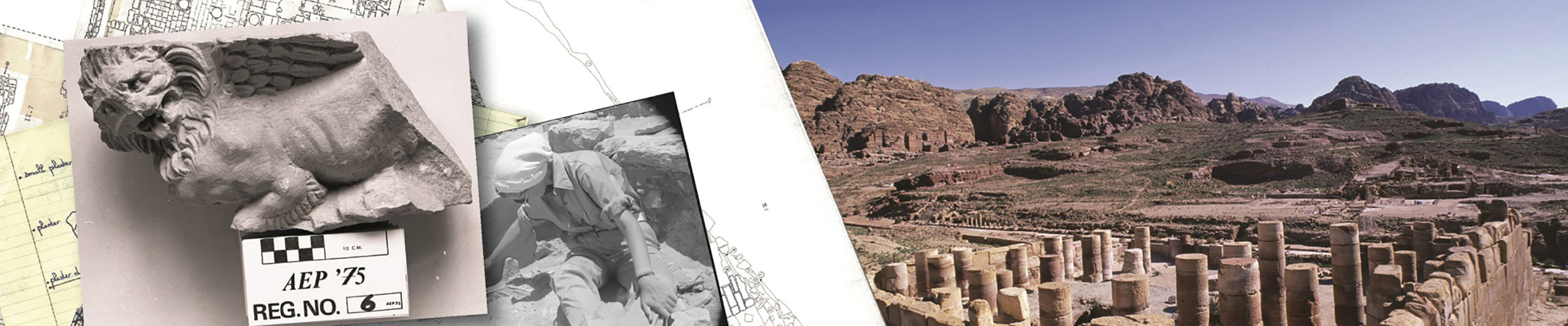
The Temple of the Winged Lions (TWL) in Petra is a Nabataean- and Roman-era ritual complex thought to have been founded in the early first century CE (banner photograph and fig. 1). It fell out of use following a major earthquake in 363 CE. This is a contextually rich site for the study of ancient ritual, economy, and society in the Nabataean and Greco-Roman world and part of a larger complex including workshops and domestic spaces. The deity (or deities) once worshiped there remains unknown. The most common suggestion is that the temple was dedicated to Al-‘Uzza, the Arabian divinity whose Greek equivalent was Aphrodite.


ASOR Members with online access: navigate to the token link email sent to you (search for “token link” in inbox) before attempting to read this article. Once you have activated your member token, click here to access the above article on The University of Chicago Press Journals’ website.

Pp. 306–315: “A Sasanian Triumphal Arch in Bishapur,” by Alireza Shahmohammadpour

The Sasanian Kingdom (224–651 CE) was the last dynasty before the Muslim-Arab invasion of Iran (Pourshariati 2008: 1–2). Sasanian-era architectural remains—mostly including palaces, castles, temples, bridges, and dams—are scattered throughout ancient Iran. However, the density of monuments in the southwestern regions of the country and in Mesopotamia is higher than anywhere else. Many of the Sasanian buildings excavated and exposed to the elements in the nineteenth and early twentieth centuries were incorrectly or insufficiently identified by their excavators and have not been subjected to systematic analysis since their initial publication. In the years that have elapsed, erosion and human activity have damaged or erased architectural features that might be useful for understanding Sasanian architecture. One such site is the city of Bishapur in the southwest of Iran. This city was established by Shapur I, the second king of the dynasty, in the middle of the third century and was occupied until the eleventh century, more than four centuries after the fall of the Sasanian Empire (Mehryar 1999: 33). Even at present the surface of the site is covered by apparently random piles of stones, at first glance making recognition of the buildings difficult (fig. 1).


ASOR Members with online access: navigate to the token link email sent to you (search for “token link” in inbox) before attempting to read this article. Once you have activated your member token, click here to access the above article on The University of Chicago Press Journals’ website.
ASOR Office Coordinator Opening

[vc_row fullwidth=”true” attached=”true” css=”.vc_custom_1496247803139{padding-top: 0px !important;padding-right: 0px !important;padding-bottom: 0px !important;padding-left: 0px !important;}”][vc_column][vc_single_image image=”78679″ img_size=”full” alignment=”center”][/vc_column][/vc_row][vc_row fullwidth=”true” css=”.vc_custom_1496682730308{padding-top: 10px !important;padding-right: 0px !important;padding-bottom: 0px !important;padding-left: 0px !important;}”][vc_column width=”1/12″ css=”.vc_custom_1496683820796{margin-right: 10px !important;}” offset=”vc_hidden-md vc_hidden-sm vc_hidden-xs”][vc_column_text]

 SHARE

[/vc_column_text][mk_image src=”http://www.asortest.org/wp-content/uploads/2017/01/social-fb-icon4.jpg” image_width=”42″ image_height=”42″ hover=”false” custom_url=”https://www.facebook.com/ASOResearch/” margin_bottom=”0″][mk_image src=”http://www.asortest.org/wp-content/uploads/2017/01/social-tw-icon4.jpg” image_width=”42″ image_height=”42″ hover=”false” custom_url=”https://twitter.com/ASOResearch?ref_src=twsrc%5Egoogle%7Ctwcamp%5Eserp%7Ctwgr%5Eauthor” margin_bottom=”0″][mk_image src=”http://www.asortest.org/wp-content/uploads/2017/01/social-in-icon4.jpg” image_width=”42″ image_height=”42″ hover=”false” custom_url=”https://www.linkedin.com/company/american-schools-of-oriental-research” margin_bottom=”0″][mk_image src=”http://www.asortest.org/wp-content/uploads/2017/01/social-ml-icon_7.jpg” image_width=”42″ image_height=”42″ hover=”false” custom_url=”mailto:info@asor.org” margin_bottom=”0″][mk_image src=”http://www.asortest.org/wp-content/uploads/2017/01/blog-icon3.jpg” image_width=”42″ image_height=”42″ hover=”false” custom_url=”http://asor.org/blog” margin_bottom=”0″][/vc_column][vc_column border_color=”rgba(255,255,255,0.01)” width=”1/6″ css=”.vc_custom_1496683923840{margin-right: 20px !important;border-left-width: 2px !important;padding-right: 20px !important;padding-left: 20px !important;border-left-color: #99422f !important;}”][mk_divider divider_color=”rgba(255,255,255,0.01)” thickness=”1″ margin_top=”3″ margin_bottom=”3″][vc_widget_sidebar sidebar_id=”ca-sidebar-39801″][/vc_column][vc_column border_color=”rgba(170,170,170,0.01)” width=”1/2″ css=”.vc_custom_1487276122024{margin-right: 10px !important;margin-bottom: 30px !important;border-right-width: 2px !important;border-bottom-width: 2px !important;padding-top: 30px !important;padding-right: 30px !important;padding-left: 20px !important;background-color: #ffffff !important;border-right-color: rgba(227,228,228,0.75) !important;border-bottom-color: rgba(227,228,228,0.75) !important;}”][vc_column_text responsive_align=”left”]

ASOR OFFICE COORDINATOR OPENING

[/vc_column_text][mk_divider][vc_column_text]The American Society of Overseas Research (ASOR) seeks candidates for a full-time Office Coordinator to begin in January 2022. This position is located at The James F. Strange Center—headquarters of ASOR, 209 Commerce St., in historic Old Town Alexandria, VA.

Founded in 1900, the ASOR is a 501(c)(3) non-profit whose mission is to initiate, encourage, and support research into, and public understanding of, the history and cultures of the Near East and wider Mediterranean world, from the earliest times. Please visit www.asor.org for more information.

Primary Responsibilities:

  • Maintain high-quality customer service for our 2,200 members and 16,000 Friends
  • Answer the general ASOR telephone and information e-mail account
  • Assist with ASOR’s off-site Annual Meeting (in November of each year) by providing general administrative support including but not limited to, processing payments, answering questions, and making all attendees feel welcome. Travel to the meeting may be required (once per year)
  • Provide general office support (e.g., scanning, copying, ordering supplies, and processing mail, orders, and bills)
  • Process membership dues, donations, and event registrations in organizational database (NetForumPro)
  • Assist with membership and donation mailings
  • Perform other office duties as assigned

Qualifications / Skills Needed:

  • Associate Degree or equivalent work experience; Bachelor’s Degree preferred
  • 2 years of office experience strongly preferred
  • Experience with databases, Microsoft Office, WordPress, and general office management software required. Experience with social media platforms and website management (using WordPress or similar) preferred
  • Excellent communication and interpersonal skills
  • Attention to detail; ability to multitask and to prioritize

Compensation and Benefits: Hourly pay between $20–24/hr based on experience and qualifications. Benefits include paid vacation and sick time; 10 paid holidays per year; employer retirement contribution (6%); and benefit dollars ($500 per month).

How To Apply: E-mail letter of interest, resume, and contact information for three references to Marta Ostovich at programs@asor.org. The letter of interest should discuss how ASOR as an organization fits into the applicant’s training and career goals. Please include your name and “ASOR Coordinator” in the subject line.

Review of applications will begin immediately and continue until the position is filled.


ASOR is an equal opportunity employer and all qualified applicants will receive consideration for employment without regard to race, color, gender, religion, national origin, disability, veteran status, age, marital status, sexual orientation, gender identity, genetic information, or any other class protected by federal or state law (EEO/AA).[/vc_column_text][/vc_column][vc_column border_color=”rgba(170,170,170,0.01)” width=”1/6″ css=”.vc_custom_1496684098866{margin-right: 5px !important;margin-bottom: 20px !important;border-right-width: 2px !important;border-bottom-width: 2px !important;padding-top: 30px !important;padding-right: 10px !important;padding-left: 10px !important;background-color: #ffffff !important;border-right-color: rgba(227,228,228,0.75) !important;border-bottom-color: rgba(227,228,228,0.75) !important;}”][vc_wp_posts title=”BROWSE THE NEWS ARCHIVE” number=”4″][/vc_column][vc_column border_color=”rgba(170,170,170,0.01)” width=”1/6″ css=”.vc_custom_1496684008271{margin-right: 10px !important;margin-bottom: 30px !important;border-right-width: 2px !important;border-bottom-width: 2px !important;padding-top: 30px !important;padding-right: 20px !important;padding-left: 20px !important;background-color: #ffffff !important;border-right-color: rgba(227,228,228,0.75) !important;border-bottom-color: rgba(227,228,228,0.75) !important;}”][vc_column_text] [/vc_column_text][/vc_column][/vc_row]

ASOR Annual Year-End Appeal Letter

Year-End Appeal Letter From ASOR’s President

December 5, 2022

Dear ASOR Members and Friends,

I am writing today to ask you to consider a gift to ASOR before the end of the year. ASOR is leaving 2022 with a larger membership and wider reach than ever before. Our outreach efforts in cultural heritage and education continue to expand both in the U.S. and abroad. We just completed a resoundingly successful Annual Meeting in Boston, where many of you presented your fieldwork and other research in stimulating papers, posters, and workshops attended by nearly 900 participants. Members came from around the world, many for the first time thanks to travel fellowships made possible by members’ generous donations and State Department Embassy grants. ASOR now has over 100 affiliated fieldwork and publication projects in 18 countries, and our prestigious Archaeological Report Series is producing its 30th volume in as many years. Your gifts funded scholarships, fellowships, and grants for many of these programs. You enabled ASOR to award more than $222,000 in 2022.

In recent years, ASOR has been forging new partnerships in our ever changing 21st century world to broaden our investigations of the ancient world, our collective human past, and cultural heritage. We are now reaching new and underserved audiences in efforts to make ASOR’s work more accessible. These efforts range from simultaneous translation of papers to ambitious educational projects fostering community involvement from the people and scholars in the areas in which we work (see the call for such activities by Iraqi archaeologist Jaafar Jotheri in the most recent issue of our Friends of ASOR Newsletter, The Ancient Near East Today X, No. 12). Meanwhile, your support helps ASOR increase benefits to our original constituencies of biblical specialists and experts in Semitic languages and literatures. In 2023, you will see ASOR add Maarav: A Journal for the Study of the Northwest Semitic Languages and Literatures as our fourth journal. Maarav will be available for no additional charge to all ASOR members above the Associate level.

ASOR is an organization that strives to unite people and transcend ethnic, racial, and religious boundaries. We have made great strides in many areas, and with your continued help we can do much more. The secret to vibrant non-profit growth is a virtuous circle of work and support. The generous funding from you, our donors, enables ASOR to accomplish so much as an organization, but also to award member scholarships and grants for even more external research. The products of this work in turn attract more members and donors to produce and fund even more pioneering efforts. Please help to keep that circle unbroken. Give to ASOR today!

Best wishes for a safe and happy holiday season,

Sharon Herbert
ASOR President

Call for Nominations: DEI Committee

Call for DEI Committee Nominations

At its November 21, 2021, meeting, the ASOR Board of Trustees established a standing committee to work on fostering Diversity, Equity and Inclusion in our organization. The Board appointed Erin Darby of the University of Tennessee as the chair of the newly formed DEI Committee. This committee grew out of DEI Task Force established by President Sharon Herbert in the fall of 2020, and several members of that Task Force will serve on the Committee. We are now seeking volunteers and nominations for additional members of the Committee. Its responsibilities as envisioned by the Board are described briefly in section 5.21 of ASOR’s by-laws as advising ASOR leaders “regarding initiatives ASOR might undertake either individually or jointly with other bodies to reach out to and include diverse communities in ASOR activities in meaningful and sustainable ways. In North America, these communities include, but are not limited to, BIPOC, LGBTQ+, and other underserved groups. Overseas, ASOR will focus on serving its international membership and working with local archaeological communities to promote public engagement in ASOR activities.” Further information on ASOR’s DEI initiatives can be found in section 3 of the 2021-2025 Strategic Plan. Once its full membership is determined, the DEI Committee will work on an expanded charge. Nominations and applications should be sent to Erin Darby and Marta Ostovich.

Stipend Report: Sebastian Millien

Mapping it Out: Geo-Referencing Data from the Erbil Plain

Sebastian Millien, 2021 Strange/Midkiff Families Summer Stipend Recipient

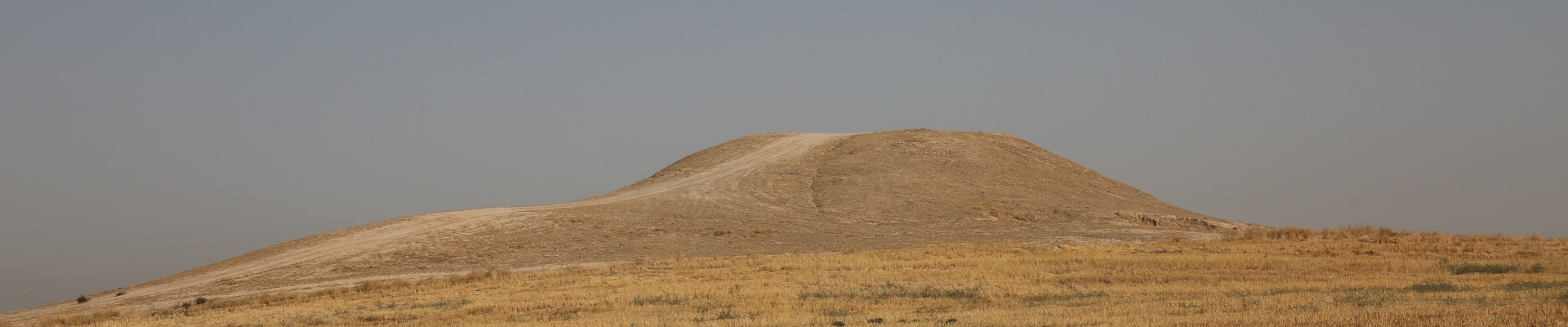
Aliawa (Site 246). Photo courtesy of the Erbil Plain Archaeological Survey.

This summer, I worked with Dr. Jason Ur on the Erbil Plain Archaeological Survey Project. The project was focused on the Kurdistan region of Iraq, particularly the Erbil Plain. An archaeological survey was done on large mounds and the surrounding environment, and the landscape was captured was drone and satellite imaging. As a result of the surveys, a large amount of data has been collected thus far. These include images of different artifacts collected from the location (mainly pottery shards from the mounds) as well as drone images of the various sites and lots surveyed in the region. Dr. Ur’s goal following this large collection of data was to build an interactive and collaborative web dashboard where the drone and satellite images could be geo-referenced on a GIS map. These images would be linked to the sites they came from, as well as the photos of the pottery shards from that respective site. In other words, the objective was a massive processing of the archaeological finds to make the data more accessible to everyone involved in the project and correlate the data to physical location on the site.

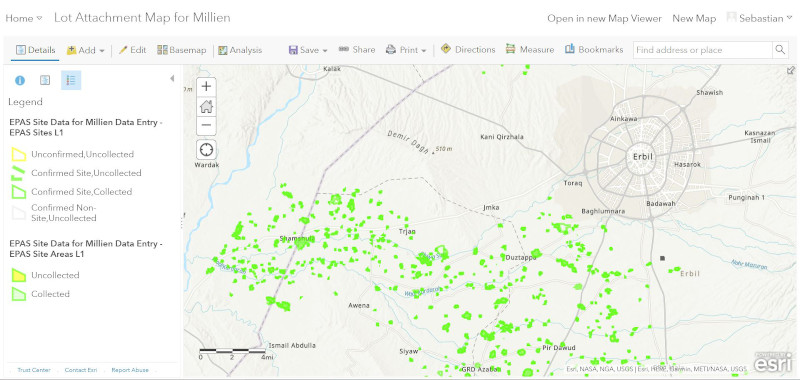
My role in the project was to categorize and label the different data so that I could then input it into the dashboard. The images of the pottery shards had to be re-named to correspond with the site and lot they were collected from. Additionally, the images of the sites from the drones needed to be matched with the locations on the GIS map. Once I had all the renamed and categorized, I then uploaded them into the lot attachment map. This data would then appear on the interactive dashboard. On the dashboard, the different sites are labeled, and selecting a particular site would make all the data correlating for that site immediately available.

Shown above is the lot attachment map dashboard that I used to georeference the data for the interactive dashboard.
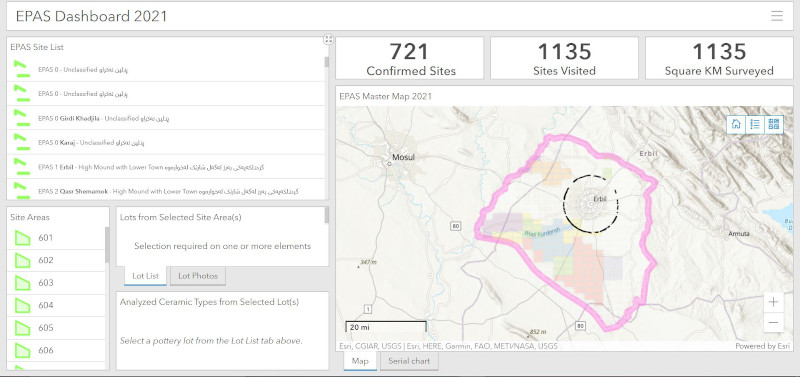
Shown above is the interactive dashboard when first opened. The options for all the sites are shown and the map of the general survey region is also shown.
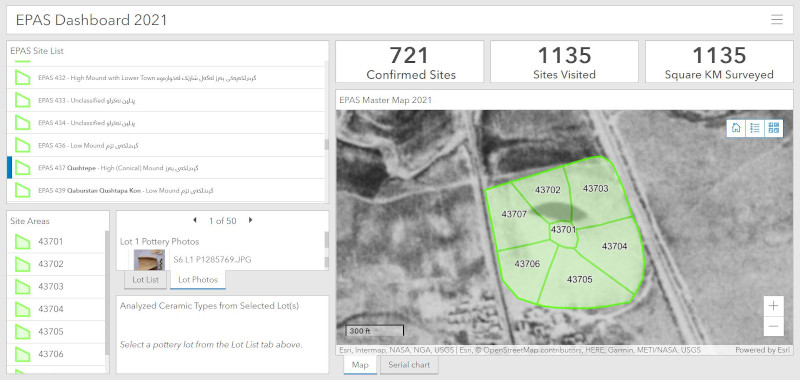
Shown above is the interactive map in action- a site (437) was selected. The map immediately zooms in onto the site and the different lots associated with the site are highlighted. The images of the different artifacts (pottery, bones, etc.) are made available in the bottom left as well as a description of the type of artifact.

My name is Sebastian Millien, and I am currently and undergraduate at Harvard university studying Chemical and Physical Biology and Archaeology. I was born and raised in Brooklyn, but my family is from Haiti. In the future, I hope to combine biochemistry and archaeology to discover even more about the past.

Read more about the Erbil Plain Archaeological Survey.

During the summer of 2021, ASOR supported 27 undergraduate and graduate students through the Summer Stipend Program. These students undertook non-fieldwork archaeological research projects led by ASOR-affiliated project directors. They also took part in monthly cohort group meetings hosted via zoom. Read a summary of these cohort meetings here.

Stay tuned for more updates from the 2021 Summer Stipend recipients!

STRATEGIC PLAN

Banner Image for Dominique Langis-Barsetti Post

THE ASOR 2026-2030 STRATEGIC PLAN

Adopted (unanimously) by the ASOR Board on May 2, 2026

The American Society of Overseas Research (formerly the American Schools of Oriental Research) has grown from an organization rooted in Biblical scholarship and archaeology of the Levant to one in which its members now undertake research, education, and outreach related to the archaeologies, cultures, histories, legacies, and connections from the Mediterranean to the Indian Ocean, and Europe to the African Sahel (see map). ASOR’s purpose is to initiate, encourage, and support research into, and public understanding of, these regions from earliest times to the present day. ASOR has no political or religious affiliation.


Priorities:

ASOR’s Place in the World

ASOR encourages the study of the past through archaeological, art historical, historical, linguistic, and cultural research, with conservation by fostering conversations about our members’ research and the impact of our studies on the contemporary world. ASOR members promote the preservation of cultural heritage as it relates to global history. Over the next five to ten years, ASOR will undertake the following initiatives to demonstrate our conception of our role in the world.

  1. Support high-quality academic research in various venues, giving space for innovative, paradigm-shifting contributions, for example in ASOR’s publications, annual meeting sessions and workshops, and early career scholars and Friends of ASOR.
  2. Cultivate partnerships in all educational and outreach efforts through the work of ASOR committees and overseas centers.
  3. Further develop relationships and collaborative research with local stakeholders and especially affiliated overseas centers, in order to enhance the understanding, preservation, and viability of cultural heritage related to our members’ research and local needs.
  4. Assist members in the practical and financial aspects of international research through enlargement of our ongoing grants programs as well as creating and furnishing venues for providing expert information and counsel.


Looking Outward

We aspire to be a leader, communicator, and supporter of innovative, high-quality, forward-thinking scholarship, education, and partnerships related to the study of the Mediterranean to the Indian Ocean, from Europe to the African Sahel.

  1. Strengthen existing platforms and media and activate new fora for scholars and the public alike to enlarge the impact of our members’ contributions to the study of the past as an essential aspect of solutions to issues of today.
  2. Increase collaborative educational initiatives geared towards the public and primary and secondary education classroom settings.
  3. Develop clear strategies and policies for public-facing outreach and clear communication strategies for access, including translations of materials, for members and other interested parties.


Preparation for the Future

ASOR seeks to continue to expand the audience for its work beyond traditional academics to enhance public understanding of the past and its impact on the present. We aim to support question-based research in the production and preservation of knowledge in the world. ASOR supports diversity that broadens the fields of archaeology, art history, history, linguistics, cultural research, and conservation beyond traditional academic careers, by mentoring and supporting early career scholars and scholars in partner countries, and by providing archaeological and technical training for a broad range of interested individuals. ASOR will continue to create and foster support from a broad range of sources to maintain ASOR’s financial stability and resources for our growing membership.

  1. Continue expanding and engaging ASOR’s membership, including efforts to increase membership and engagement from groups underrepresented in the field.
  2. Foster opportunities through mentorship and skills development to prepare members for diverse fields in a rapidly-shifting social and economic environment; and to harness the experience of ASOR’s membership to guide members along their chosen paths.
  3. Enhance funding relationships to accomplish our mission and strategic goals.
 

Previous Strategic Plans

2021-2025 Strategic Plan

ASOR BOARD OF TRUSTEES APPROVES NEW 2021-2025 STRAGETIC PLAN

At its November 21, 2021 meeting in Chicago the ASOR Board of Trustees unanimously approved the adoption of a strategic plan for 2021-2025. Periodic strategic planning is a valuable exercise that promotes reflection on and reevaluation of an organization’s goals and priorities. Until this year ASOR had been working successfully under a 2016-2020 strategic plan crafted in a committee led by former President Susan Ackerman.  The new plan represents a revision of that plan and a rebalance of our priorities in light of changing circumstances. At its center is a recommitment to ASOR’s core missions “to initiate, encourage, and support research into, and public understanding of, the history and cultures of the Near East and wider Mediterranean from the earliest times…”, with an expansion of our areas of research to “Western Asia and the wider Mediterranean”.

The plan has been under development since January of 2020 under the supervision of the current President, Sharon Herbert. All ASOR’s standing committees contributed to the new plan, and it was discussed and revised by the Chairs Coordinating Committee under the leadership of Vice President Chuck Jones from the summer of 2020 through fall 2021, when it was approved by them in October. The version voted on by the Board also profited from discussion in the Executive Committee.

This new plan focuses on six areas of ASOR’s activities: Area 1: The Annual Meeting; Area 2: Cultural Heritage; Area 3: Diversity, Equity, and Inclusion; Area 4: Publications; Area 5: Public Outreach; Area 6: Supporting the Work of Our Members. It also considers how ASOR’s new offices at the James Strange Center in Alexandria, VA can be best used to to facilitate the sorts of community engagements and interactions with governmental agencies and other relevant agencies and organizations that we foresaw at the time we purchased the building.

This plan is the result of careful thought and input from all areas of the ASOR community. Although we will certainly face unpredictable changes, challenges, and opportunities in the coming years, we are confident that it will prove an inspiring road map for progress.

Read the full text of the 2021-2025 Strategic Plan.

Table of Contents for BASOR 386 (November 2021)

Table of Contents for Bulletin of ASOR 386 (November 2021)


You can receive BASOR (and other ASOR publications) through an ASOR Membership. Please e-mail the Membership office if you have any questions.

Pp. 1–22: “The Making of a Script: Cretan Hieroglyphic and the Quest for Its Origins,” by Silvia Ferrara, Barbara Montecchi, and Miguel Valério

What is the origin of the earliest script in Europe? Is it invented locally or borrowed from an external template? How can we go about addressing this problem? A common view is that the script in question, Cretan Hieroglyphic, is locally created but externally inspired, probably through an influence from Egypt. But this appreciation should be the result of a full examination of the evidence, rather than a superficial appraisal of the script signs. This article reframes this approach, starting with generic assessments on origin and stimulus, and so opens a new avenue that takes into account the following aspects: 1) the establishment of a methodology for cross-comparisons between the Egyptian and Cretan scripts; 2) the situated context of the Egyptian and Cretan scripts in the mid-3rd to late 3rd millennium b.c.e.; 3) the local Cretan seal imagery; and 4) case studies of sign shapes, representing physical and immaterial referents across the Egyptian Hieroglyphic and Cretan repertoires. Only from this broad, multicentric framework, which has input from archaeology, epigraphy, iconography, and paleography, can we establish a solid method to address the origin of Cretan Hieroglyphic.

ASOR Members with online access: navigate to the token link email sent to you before attempting to read this article. Once you have activated your member token, click here to access the above article on The University of Chicago Press Journals’ website.

Pp. 23–46: “Judean Pillar Figurines and “Bed Models” from Tell en-Naṣbeh: Typology and Petrographic Analysis,” by David Ben-Shlomo and Lauren K. McCormick

This article discusses the Judean Pillar Figurines found in Tell en-Naṣbeh. The site yielded the highest number of these Iron Age II figurines after Jerusalem. Our study focuses on the significance of this distribution, the contexts in which the figurines were found at the site, as well as a compositional (petrographic) analysis of their clay. Fifteen anthropomorphic figurines as well as five “bed models” were analyzed by thin section petrography. The results indicate these objects were not made of the commonly used local clay and were probably not locally produced at Tell en-Naṣbeh, though other types of clay objects were. The possibility that the figurines were produced in Jerusalem is discussed, as well as the implications of these results.

ASOR Members with online access: navigate to the token link email sent to you before attempting to read this article. Once you have activated your member token, click here to access the above article on The University of Chicago Press Journals’ website.

Pp. 47–76: “Recent Early Bronze Age Glyptic Finds from Lebanon: The Evidence from Tell Fadous-Kfarabida,” by Hermann Genz and Alexander Ahrens

While Early Bronze Age glyptic finds from the southern Levant as well as from Syria have received considerable attention in the scholarly literature, unfortunately the same cannot be said about the glyptic material from Lebanon. For a long time, Byblos was the only site with a considerable number of Early Bronze Age glyptic finds, but the often unclear stratigraphic and contextual situation of the material hugely diminished its scientific value. Fortunately, in recent years more clearly stratified material has emerged from Sidon, Tell Arqa, and Tell Fadous-Kfarabida, which for the first time enables us to better define the glyptic styles in use in the central Levant during the 4th and 3rd millennia b.c.e. The paper presents the glyptic finds from Tell Fadous-Kfarabida, located on the Lebanese coast just 12 km north of Byblos, with a special emphasis on the iconography of the seals and seal impressions, as well as their contribution towards the external relations of the site.

ASOR Members with online access: navigate to the token link email sent to you before attempting to read this article. Once you have activated your member token, click here to access the above article on The University of Chicago Press Journals’ website.
Pp. 77–93: “A Radiocarbon Sequence for the Late Bronze to Iron Age Transition at Ashkelon: Timing Early Philistine Pottery,” by Yotam Asscher, Mario A. S. Martin, Daniel Master, and Elisabetta Boaretto

From 1985–2014, the Leon Levy Expedition to Ashkelon excavated a trench on the north side of Ashkelon’s central mound (Grid 38) exposing a Bronze and Iron Age sequence over an area of some 450 m2. By combining different radiocarbon sampling strategies used over the years of excavation, an absolute chrono-cultural scheme is constructed for the latter half of the 2nd millennium b.c.e. with a focus on the transition to the Iron Age. This chronology is then synchronized with several nearby sites.

ASOR Members with online access: navigate to the token link email sent to you before attempting to read this article. Once you have activated your member token, click here to access the above article on The University of Chicago Press Journals’ website.
Pp. 95–112: “Performance Frozen in Time: A New Iron Age II Female Ceramic Figurine from Jneneh, North Central Jordan,” by Regine Hunziker-Rodewald and Khaled A. Douglas

To date, about 470 female ceramic figurines are known to originate from Iron Age sites across Jordan. This article sheds light on a distinct type by studying a recently discovered figurine from a newly excavated settlement at Jneneh, Wadi az-Zarqa, in north central Jordan.

ASOR Members with online access: navigate to the token link email sent to you before attempting to read this article. Once you have activated your member token, click here to access the above article on The University of Chicago Press Journals’ website.

Pp. 113–132: “Cybele, Atargatis, or Allāt? A Surprising Tomb Artifact from Petra’s North Ridge,” by Robert Wenning and Megan A. Perry

The complex Nabataean “Götterwelt” incorporates deities from both their own tradition as well as imports from the larger Mediterranean and peninsular Arabian context. In 2014, a small naiskos depicting a possible imported deity was discovered in a tomb containing at minimum eight individuals, located on the northern edge of the ancient city of Petra. Geochemical investigation of the individuals buried in the tomb using strontium (87Sr/86Sr) and oxygen (δ18O) isotopes indicated only locally born individuals were interred within the tomb. The goddess depicted in the bas-relief sculpture is wearing a tunic and covered by a cloak and is flanked by two lions. Comparanda from the eastern Mediterranean showing similar iconography of the naiskos point to the goddess’s identity as Cybele, Atargatis, or Allāt, with most evidence suggesting Allāt. However, the emic perceptions of and ritual praxis involving this object and the goddess beyond its mortuary inclusion remain unclear. Therefore, regardless of the identification of the goddess it venerates, this portable naiskos served an important mortuary purpose for an individual locally born in the Petra region.

ASOR Members with online access: navigate to the token link email sent to you before attempting to read this article. Once you have activated your member token, click here to access the above article on The University of Chicago Press Journals’ website.

Pp. 133–175: “Islamic and Pre-Islamic Glass from Nippur,” by Carol Meyer

Excavation of Area WG at Nippur in 1989 yielded a large corpus of glass ranging in date from late Parthian to Islamic, mainly Abbasid. Islamic glass from Iraq is poorly studied and scrappily published, often concentrating on fancy, luxury vessels. This makes the large group of excavated, datable, domestic glassware from Nippur important for archaeologists dealing with the early Islamic period in Iraq and for those researching Abbasid glass. Further, I propose that Abbasid Levels III and II run later than suggested in the preliminary report, with Level II extending most likely into the early 10th century. This means that at least part of the site of Nippur remained occupied into the period when almost all of southern Iraq was severely depopulated. Finally, I raise the question of what can be gleaned from old, partial field records from a country devastated by decades of sanctions and war.

ASOR Members with online access: navigate to the token link email sent to you before attempting to read this article. Once you have activated your member token, click here to access the above article on The University of Chicago Press Journals’ website.

Pp. 177–207: “Sifting Through: The Characteristics and Significance of Ceramic Strainer-Vessels in the Chalcolithic Period of the Southern Levant,” by Edwin Cornelis Martinus van den Brink, Rivka Chasan, and Danny Rosenberg

A strainer is an autonomous utensil (sieve or colander) or an integral part (filter) of a utensil designed to separate mixtures based on grain size. In the southern Levant, strainer vessels made of clay are known since the Early Chalcolithic period, albeit few in number. The onset of the Late Chalcolithic period reflects a significant increase in the numbers and distribution of these particular vessels even though their numbers per site remain relatively low. This paper surveys foremost Late Chalcolithic strainer vessels from the southern Levant, discussing their morphology, significance and possible role as straining and sifting devices for liquids (e.g., olive or other oils, herbal or botanical mixtures, and alcoholic beverages) and solid substances (e.g., fats and flour). While results from our ongoing organic residue analysis concerning this and other types of Late Chalcolithic vessels are yet to come, we can already suggest that these vessels entail a variety of tasks and that they were used in a number of different contexts based on the variability of strainer vessel types and the strainer morphology.

ASOR Members with online access: navigate to the token link email sent to you before attempting to read this article. Once you have activated your member token, click here to access the above article on The University of Chicago Press Journals’ website.

Pp. 209–220: “Identity Creation and Resource Controlling Strategies: Thoughts on Edomite Ethnogenesis and Development,” by Aren M. Maeir

In this paper I suggest that the evolution of the control of natural resources and trade routes in the Arabah Valley and its environs was the basis for the formation of Edomite identity in the early Iron Age. Building on insights on ethnogenesis in Southeast Asia in the studies of Joseph Scott and James Warren, I attempt to align this with recent discussions on early Edom, and the role that this group played in the regional economic web of the Iron Age.

ASOR Members with online access: navigate to the token link email sent to you before attempting to read this article. Once you have activated your member token, click here to access the above article on The University of Chicago Press Journals’ website.

Pp. 221–236: “The Origin of Imported Jars from 6th Dynasty Abusir: New Light on Early Bronze Age Egyptian-Levantine Relations,” by Karin Sowada, Mary Ownby, and Miroslav Bárta

Thin-section petrography on imported Combed jars from the 6th Dynasty Abusir tomb complex of Qar and his family identified the central Levant, between Beirut and Tripoli, as the production zone of the vessels. Dating to the reign of 6th Dynasty king Pepy II (ca. 2278–2184 b.c.), the jars were made of the same mixed Cretaceous clay type used for imports of the early Old Kingdom. None of the Abusir material was an Egyptian imitation, contrary to previous assessments. The petrography demonstrates the long continuity of exchange networks with a specific area of the central Levant for over 350 years. During the Old Kingdom from the early 4th Dynasty to the late 6th Dynasty, exchange networks with the region intensified, confirming long-held understandings based on fragmentary archaeological data and the slender textual record.

ASOR Members with online access: navigate to the token link email sent to you before attempting to read this article. Once you have activated your member token, click here to access the above article on The University of Chicago Press Journals’ website.

Pp. 237–282: “The Archaeology of Regional Muslim Pilgrimage Reevaluated: The Site of Nabi Rubin (Israel) as a Case Study,” by Itamar Taxel, Avraham (Avi) Sasson, Moshe Fischer, and Nitzan Amitai-Preiss

This research constitutes a first attempt to discuss a Muslim pilgrimage site from a holistic, in-depth archaeological perspective. Our case study is Nabi Rubin, on the southern coastal plain of Israel, which was active from at least the early 15th century until the late British Mandate period and was one of the major foci of Muslim pilgrimage in historical Palestine. Pilgrimage to Nabi Rubin was characterized by a one-month-long organized celebration that took place every summer and attracted masses of pilgrims from Jaffa in the north to Gaza in the south. The research uses the site’s architectural and other human-created and natural landscape features—including historical trees and the rich material culture remnants left behind by pilgrims and other visitors, in addition to the written and photographic historical evidence related to Nabi Rubin—in order to draw additional information that can assist in interpreting the mute physical elements. The study provides a synthesis and interpretation of the site’s chronology, material culture, the activities and behaviors that took place there during festival periods, and methodological aspects of the interpretation of historical trees. The results highlight the uniqueness of Nabi Rubin compared to other Muslim pilgrimage sites in Palestine, and its significant potential for an archaeological research of Muslim pilgrimage in the region.

ASOR Members with online access: navigate to the token link email sent to you before attempting to read this article. Once you have activated your member token, click here to access the above article on The University of Chicago Press Journals’ website.

Ad Hoc Climate Impact Committee

[vc_row fullwidth=”true” css=”.vc_custom_1490224714943{padding-top: 0px !important;padding-right: 0px !important;padding-bottom: 0px !important;padding-left: 0px !important;}”][vc_column][vc_single_image image=”71842″ img_size=”full” alignment=”center”][/vc_column][/vc_row][vc_row][vc_column][vc_column_text][/vc_column_text][/vc_column][/vc_row][vc_row fullwidth=”true” css=”.vc_custom_1490225468623{padding-top: 0px !important;padding-right: 0px !important;padding-bottom: 0px !important;padding-left: 0px !important;}”][vc_column width=”1/12″ css=”.vc_custom_1490225195470{margin-right: 10px !important;}” offset=”vc_hidden-sm vc_hidden-xs”][vc_column_text]

  SHARE

[/vc_column_text][mk_image src=”http://www.asortest.org/wp-content/uploads/2017/01/social-fb-icon4.jpg” image_width=”42″ image_height=”42″ hover=”false” custom_url=”https://www.facebook.com/ASOResearch/” margin_bottom=”0″][mk_image src=”http://www.asortest.org/wp-content/uploads/2017/01/social-tw-icon4.jpg” image_width=”42″ image_height=”42″ hover=”false” custom_url=”https://twitter.com/ASOResearch?ref_src=twsrc%5Egoogle%7Ctwcamp%5Eserp%7Ctwgr%5Eauthor” margin_bottom=”0″][mk_image src=”http://www.asortest.org/wp-content/uploads/2017/01/social-in-icon4.jpg” image_width=”42″ image_height=”42″ hover=”false” custom_url=”https://www.linkedin.com/company/american-schools-of-oriental-research” margin_bottom=”0″][mk_image src=”http://www.asortest.org/wp-content/uploads/2017/01/social-ml-icon_7.jpg” image_width=”42″ image_height=”42″ hover=”false” custom_url=”mailto:asor@bu.edu” margin_bottom=”0″][mk_image src=”http://www.asortest.org/wp-content/uploads/2017/01/blog-icon3.jpg” image_width=”42″ image_height=”42″ hover=”false” custom_url=”http://asorblog.org/” margin_bottom=”0″][/vc_column][vc_column border_color=”rgba(255,255,255,0.01)” width=”1/6″ css=”.vc_custom_1490365673198{margin-right: 20px !important;border-left-width: 2px !important;padding-right: 20px !important;padding-left: 20px !important;border-left-color: #99422f !important;}” el_class=”sticky-sidenav”][mk_divider divider_color=”rgba(255,255,255,0.01)” thickness=”1″ margin_top=”3″ margin_bottom=”3″][vc_widget_sidebar sidebar_id=”ca-sidebar-37292″ el_class=”.widget { overflow: hidden; margin-bottom: 0; }”][/vc_column][vc_column border_color=”rgba(170,170,170,0.01)” width=”1/2″ css=”.vc_custom_1490225606852{margin-right: 10px !important;margin-bottom: 30px !important;border-right-width: 2px !important;border-bottom-width: 2px !important;padding-top: 30px !important;padding-right: 30px !important;padding-left: 20px !important;background-color: #ffffff !important;border-right-color: rgba(227,228,228,0.75) !important;border-bottom-color: rgba(227,228,228,0.75) !important;}”][vc_column_text responsive_align=”left”]

AD HOC CLIMATE IMPACT COMMITTEE

Charge

It has long been recognized that climate degradation in the form of air pollution, fire, and flooding poses serious threats to cultural monuments central to ASOR’s mission. The accelerating climate emergency calls for ASOR to uphold this mission by addressing the contribution of its own activities to this global problem. A poster presentation by Lucas Stephens and Virginia Herrmann at the 2019 Annual Meeting, “Mitigating the Climate Impact to the ASOR Annual Meeting”, provided some first steps in this process. The poster performed an analysis of the carbon emissions of travel to the annual meeting from 2013 to 2018 based on attendees’ points of origin and the destination city, finding that emissions varied considerably based on the city and number of international attendees, and proposing several strategies to reduce travel emissions. The Board of Trustees has engaged in conversations about this issue over the past two years and working toward a carbon neutral Annual Meeting by 2025 is one of the goals of the 2021-2025 Strategic plan.

With these considerations in mind we are establishing an Ad Hoc Committee on the climate impact of ASOR activities with particular attention to the Annual Meeting. The committee is charged with the following specific tasks:

1) to assess the carbon footprint of the Annual Meeting and ASOR’s other activities;

2) to evaluate the feasibility of the goal to make the Annual Meeting carbon neutral by 2025; and

3) to make recommendations to the Board of Trustees on how this might be achieved.

While the carbon footprint of ASOR is not limited to the Annual Meeting, the meeting is likely the largest direct contributor to it. We therefore ask the committee to focus primarily on recommendations for reducing or eliminating the climate impact of the Annual Meeting. Additional discussions, study, analysis and recommendations for reducing the climate impact of other areas of activity (such as day-to-day operations, publications, and even ASOR-affiliated fieldwork) will be gratefully received, however, and may lay the groundwork for future initiatives.

It is envisioned that a starting point for the committee can be the 2019 study of Stephens and Herrmann, supplemented potentially by additional data and by comparison with studies of other academic conferences and mitigation efforts of other societies. In formulating its recommendations to the Board, the committee should consider the lessons learned from the 2020 virtual and 2021 virtual-component meetings, including issues of logistics, sustainability, finances, participation, and member experiences. The service of ASOR Executive Director Andrew Vaughn as committee co-chair will facilitate the incorporation of these details, but information and input should also be sought from the Program Committee and Director of Meetings and Events Arlene Press. In addition to considering future virtual, hybrid, and/or distributed meeting modalities, the committee should also explore ways to incentivize members to shift toward more sustainable travel and consumption options.

We ask the committee to present a report answering the questions of whether and how the Annual Meeting can become carbon neutral by 2025 for the Fall 2022 Board of Trustees’ meeting. It is hoped that an interim report might be available for Board discussion at the Spring 2022 Meeting in May.

  • Virginia Herrmann, co-chair
  • Andrew Vaughn, co-chair
  • Stephanie Budin
  • Antonietta Catanzariti
  • Helen Dixon
  • Ömür Harmanşah
  • Craig Harvey
  • Morag Kersel
  • Alex MacAllister
  • Lucas Proctor

Ad Hoc Climate Impact Committee Final Report, “Mitigating the Climate Impact of the ASOR Annual Meeting”

[/vc_column_text][vc_empty_space height=”100px”][/vc_column][vc_column border_color=”rgba(170,170,170,0.01)” width=”1/6″ css=”.vc_custom_1490571214409{margin-right: 10px !important;margin-bottom: 30px !important;border-right-width: 2px !important;border-bottom-width: 2px !important;padding-top: 30px !important;padding-right: 20px !important;padding-left: 20px !important;background-color: #ffffff !important;border-right-color: rgba(227,228,228,0.75) !important;border-bottom-color: rgba(227,228,228,0.75) !important;}”][vc_wp_posts title=”BROWSE THE NEWS ARCHIVE” number=”4″][/vc_column][vc_column border_color=”rgba(170,170,170,0.01)” width=”1/6″ css=”.vc_custom_1490225688999{margin-right: 10px !important;margin-bottom: 30px !important;border-right-width: 2px !important;border-bottom-width: 2px !important;padding-top: 30px !important;padding-right: 30px !important;padding-left: 20px !important;background-color: #ffffff !important;border-right-color: rgba(227,228,228,0.75) !important;border-bottom-color: rgba(227,228,228,0.75) !important;}”][vc_column_text] [/vc_column_text][/vc_column][/vc_row][vc_row][vc_column][vc_column_text]

[/vc_column_text][/vc_column][/vc_row]

Ad Hoc Archives Committee

[vc_row fullwidth=”true” css=”.vc_custom_1490224714943{padding-top: 0px !important;padding-right: 0px !important;padding-bottom: 0px !important;padding-left: 0px !important;}”][vc_column][vc_single_image image=”72644″ img_size=”full” alignment=”center”][/vc_column][/vc_row][vc_row][vc_column][vc_column_text][/vc_column_text][/vc_column][/vc_row][vc_row fullwidth=”true” css=”.vc_custom_1490225468623{padding-top: 0px !important;padding-right: 0px !important;padding-bottom: 0px !important;padding-left: 0px !important;}”][vc_column width=”1/12″ css=”.vc_custom_1490225195470{margin-right: 10px !important;}” offset=”vc_hidden-sm vc_hidden-xs”][vc_column_text]

  SHARE

[/vc_column_text][mk_image src=”http://www.asortest.org/wp-content/uploads/2017/01/social-fb-icon4.jpg” image_width=”42″ image_height=”42″ hover=”false” custom_url=”https://www.facebook.com/ASOResearch/” margin_bottom=”0″][mk_image src=”http://www.asortest.org/wp-content/uploads/2017/01/social-tw-icon4.jpg” image_width=”42″ image_height=”42″ hover=”false” custom_url=”https://twitter.com/ASOResearch?ref_src=twsrc%5Egoogle%7Ctwcamp%5Eserp%7Ctwgr%5Eauthor” margin_bottom=”0″][mk_image src=”http://www.asortest.org/wp-content/uploads/2017/01/social-in-icon4.jpg” image_width=”42″ image_height=”42″ hover=”false” custom_url=”https://www.linkedin.com/company/american-schools-of-oriental-research” margin_bottom=”0″][mk_image src=”http://www.asortest.org/wp-content/uploads/2017/01/social-ml-icon_7.jpg” image_width=”42″ image_height=”42″ hover=”false” custom_url=”mailto:asor@bu.edu” margin_bottom=”0″][mk_image src=”http://www.asortest.org/wp-content/uploads/2017/01/blog-icon3.jpg” image_width=”42″ image_height=”42″ hover=”false” custom_url=”http://asorblog.org/” margin_bottom=”0″][/vc_column][vc_column border_color=”rgba(255,255,255,0.01)” width=”1/6″ css=”.vc_custom_1490365673198{margin-right: 20px !important;border-left-width: 2px !important;padding-right: 20px !important;padding-left: 20px !important;border-left-color: #99422f !important;}” el_class=”sticky-sidenav”][mk_divider divider_color=”rgba(255,255,255,0.01)” thickness=”1″ margin_top=”3″ margin_bottom=”3″][vc_widget_sidebar sidebar_id=”ca-sidebar-37292″ el_class=”.widget { overflow: hidden; margin-bottom: 0; }”][/vc_column][vc_column border_color=”rgba(170,170,170,0.01)” width=”1/2″ css=”.vc_custom_1490225606852{margin-right: 10px !important;margin-bottom: 30px !important;border-right-width: 2px !important;border-bottom-width: 2px !important;padding-top: 30px !important;padding-right: 30px !important;padding-left: 20px !important;background-color: #ffffff !important;border-right-color: rgba(227,228,228,0.75) !important;border-bottom-color: rgba(227,228,228,0.75) !important;}”][vc_column_text responsive_align=”left”]

AD HOC ARCHIVES COMMITTEE

Charge

The vast majority of the ASOR archives consists of records, photographs, publications, and diaries amassed between ASOR’s founding in 1900 and the closing of its office at 656 Beacon St. in Boston in 2018.  At that time most, with the exception of publications now stored at the Strange Center in Alexandria, were moved to the Harvard Semitic Museum (now the Harvard Museum of the Ancient Near East—HMANE) and remain there today. Some few others are stored elsewhere—Glueck materials owned by Harvard, AIAR records at the AIA, and the Leo Boer collection (see Ackerman document, pp. 6,7).  The HMANE is no longer able to house the materials transferred in 2018 collection,[1] and ASOR must determine how best to curate them. The decision involves four interlocking issues for the ad hoc committee to consider: location; organization, maintenance, and accessibility.

The first decision, on which the rest hinge, is location. Should we move the papers to the Strange Center or a library or other archival facility?  We have the space on the third floor of the Strange Center for the roughly 125 archive boxes (1.5 cu. ft.), 73 boxes of glass plates (8” x 5” x 5.5”), plus tubes (two 26″x 24″ and two 30″x 34″), flat portfolios, and rolled up large format sheets transferred to Harvard in 2018. The climate conditions at the Strange Center are as good as the Boston offices, but not up to top archival standards. Housing the archives at the Strange Center would put the maintenance and organization of them in the hands of the ASOR staff, which has plusses (expertise and interest) and minuses (time commitment).

Turning to accessibility. The archives are stored in archival boxes, and there is a detailed finding aid. In an ideal word they would be fully digitized and accessible to researchers. This is not the case. Some material has been digitized, and at one point this digitized material was available on the archives webpage. Unfortunately, in Fall 2015, the Boston University server housing our archives database failed. Today, we have available a partial outline of ASOR’s holdings, and a “zombie database” that is used in-house. Digital materials can only be accessed on this “zombie database” by a staff member through a fairly cumbersome request process (see Ackerman document, pp. 5-6). A key question for the committee is how to improve that process. Non-digitized materials are for all intents and purposes currently inaccessible, given their current location at Harvard.

The Ackerman document also poses some issues regarding organization and maintenance that the committee will need to address: for example, work that might be done “in house” to reorganize the information we do have available on the web and to reorganize the “zombie database”; also, issues regarding our archiving policy and ambitions regarding collection augmentation going forward.

  • Susan Ackerman, chair
  • Paul Flesher
  • Eric Meyers
  • Jason Ur

[1] Harvard might want to keep some of our Glueck materials (see Ackerman document pp. 7-8).[/vc_column_text][vc_empty_space height=”100px”][/vc_column][vc_column border_color=”rgba(170,170,170,0.01)” width=”1/6″ css=”.vc_custom_1490571214409{margin-right: 10px !important;margin-bottom: 30px !important;border-right-width: 2px !important;border-bottom-width: 2px !important;padding-top: 30px !important;padding-right: 20px !important;padding-left: 20px !important;background-color: #ffffff !important;border-right-color: rgba(227,228,228,0.75) !important;border-bottom-color: rgba(227,228,228,0.75) !important;}”][vc_wp_posts title=”BROWSE THE NEWS ARCHIVE” number=”4″][/vc_column][vc_column border_color=”rgba(170,170,170,0.01)” width=”1/6″ css=”.vc_custom_1490225688999{margin-right: 10px !important;margin-bottom: 30px !important;border-right-width: 2px !important;border-bottom-width: 2px !important;padding-top: 30px !important;padding-right: 30px !important;padding-left: 20px !important;background-color: #ffffff !important;border-right-color: rgba(227,228,228,0.75) !important;border-bottom-color: rgba(227,228,228,0.75) !important;}”][vc_column_text] [/vc_column_text][/vc_column][/vc_row][vc_row][vc_column][vc_column_text]

[/vc_column_text][/vc_column][/vc_row]