Fellowship Report: Joanna Smith

2019 STUDY OF COLLECTIONS FELLOWSHIP REPORT: JOANNA SMITH

Weighty Matters

In May and June of 2019 I studied objects connected with Iron Age Cypriot textile production. Research for this project began during study seasons on Cyprus in Polis Chrysochous (ancient Marion and Arsinoe) where I have been a long-time member of the Princeton University excavation team. Each year since 2014 while doing inventories of the finds I have documented textile tools from across the excavations. These tools come from workshop and household contexts ranging in date from the Cypro-Geometric to the early Hellenistic period. Primarily they were made and used by people who lived in the ancient city of Marion. Some tools attest to continuity in craft production in the city even after its destruction by King Ptolemy I, Soter, in 312 BCE. The ASOR Collections Fellowship gave me the opportunity to continue study of the tools in Polis and to study assemblages of textile tools from three other contemporary Cypriot settlements, Kition, Kouklia, and Kourion, in order to have more of an island-wide view of Cypriot Iron Age textiles. Locating and rediscovering objects held in the storerooms of the museums of Cyprus was just as eye-opening as unearthing objects during field excavation.


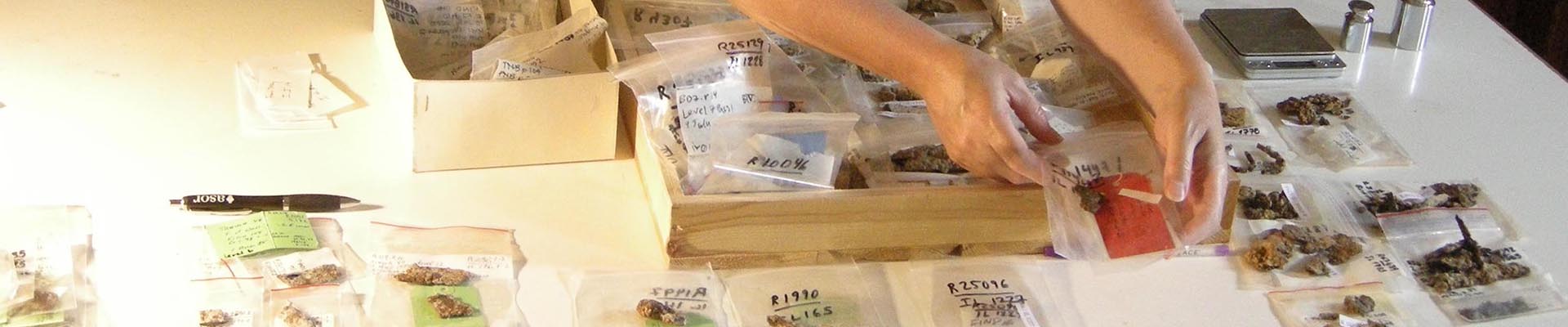
Top, Joanna S. Smith working with metal tools in the Local Museum of Marion and Arsinoe (Polis Chrysochous). Below, a series of iron sword fragments from Area E.F2 (trench r09, 1986).

Among the tools I studied are whorls for spinning, weights that held down warp fibers on looms, and dyestuffs such as crushed murex for the color purple. Yet textile tools can take unexpected forms. An object may seem unconnected when taken in isolation, but when seen in view of its archeological context it can reveal whole new meaning. A case in point comes from Polis. To understand the textile-working contexts there better in 2018 I began to look back through all the other associated finds and found several fragmentary iron sword blades. In 2019 I reexamined all the metal finds and confirmed that the find contexts of all the swords are the same as the contexts with the largest concentrations of whorls, loom weights, and dyestuffs.

Some fragments have the distinctive squared tip of a weaving sword (see Laura Mazow 2017 in Archaeological Textiles Review). Weaving swords were used to pack or beat in weft fibers woven through the warp threads strung on the loom. Some blade fragments have a triangular tip, more like a combat sword. Possibly weavers were reusing and refashioning weapons. These are the first weaving swords yet identified in any Mediterranean workshop context.

Fiber arts rarely survive in the archaeological record in climates subject to extremes of hot and cold, and damp and dry weather. To figure out what kinds of fibers and fabrics were made, it is important to know the weights of the tools used and key measurements such as spindle whorl diameter and loom weight thickness. Whorl weight, diameter, and shape determine the weight and tightness of the spun thread. The weight and width of a loom weight indicate the density and weight of the warp thread count in a fabric. Even these simple measurements, however, can raise questions. For example, some loom weights tend to rotate when hung on the loom becoming ever more rounded on the edges over time. This is especially the case with pyramidal weights, such as this example from Kition-Kathari.


At left, measuring one possibility for the width of a truncated pyramidal loom weight from Kition-Kathari (Kit-II/3898). At right, a cylindrical loom weight from Kouklia-Evreti (TE F 39).

Thus, one must explore the range of possibilities through multiple measurements. This observation helped to explain the enduring popularity of another weight shape, the flat disc or short cylinder. Weights of this shape vary widely in size and quality of crafting. Some weigh nearly 500 grams, while others are less than 40 grams, as with this example from Kouklia-Evreti. Yet short cylindrical weights would have hung on the loom in a predictable way, with their flat sides next to one another. Cloth woven with these weights ranges from light-weight and gauzy to heavy and dense, perhaps sail cloth.


At left, a broken cylindrical loom weight marked with three impressed dots and a seal-ring impression from the Kourion acropolis (Penn excavations no. Mi 387). At right, detail of the seal-ring impression: standing Aphrodite, at right, and a standing Eros with large wing, at left.

Few spindle whorls come from these settlement sites. Some spinning tools were placed in tombs and may have been linked closely with their owners, while weaving tools rarely accompanied people to the grave. Close observation and handling of many loom weights caused me to wonder what their makers/owners/users thought about them. The cylindrical weights cited above are especially telling. Over the course of the first millennium BCE these weights were made in an increasingly sturdy fashion, changing from expedient and lumpy unfired clay objects, to low-fired and smoothed terracotta, to hard-fired ceramics with more sharply defined edges. Labeling of these weights with seal rings and other marks is only a feature of the more permanent, fired weights. Initially people placed stamps on the curved surfaces that could be seen while weaving, suggesting a practical as well as perhaps a personal connection. People marked the high-fired late Classical and Hellenistic period weights, however, on the flat surfaces, as on this fragmentary example found by the University of Pennsylvania team on the Kourion acropolis.

These marks were hidden when weights were in use on the loom, which suggests that such marks were more personal than practical. The stamped seal-ring designs are not always easily legible; raking light, however, clearly reveals this ring’s design of Aphrodite and Eros, a fitting and exciting find during a season of study on the island of Cyprus.


Joanna S. Smith the co-Director of the Princeton Cyprus Expedition and a Consulting Scholar in the Mediterranean Section at the Penn Museum. She currently works as the Consulting Curator of Ancient Art at The John and Mable Ringling Museum of Art in Sarasota, Florida, and the copy-editor of the Kyrenia Ship Project.

ASOR is accepting applications for 2020 Study of Collections Fellowships! The deadline for applications is January 15, 2020 and information on applying can be found here.

2019 Annual Meeting Recap

[vc_row fullwidth=”true” attached=”true” css=”.vc_custom_1512671582587{padding-top: 0px !important;padding-right: 0px !important;padding-bottom: 0px !important;padding-left: 0px !important;}”][vc_column][vc_single_image image=”42403″ img_size=”full” alignment=”center”][/vc_column][/vc_row][vc_row fullwidth=”true” css=”.vc_custom_1496682730308{padding-top: 10px !important;padding-right: 0px !important;padding-bottom: 0px !important;padding-left: 0px !important;}”][vc_column width=”1/12″ css=”.vc_custom_1496683820796{margin-right: 10px !important;}” offset=”vc_hidden-md vc_hidden-sm vc_hidden-xs”][vc_column_text]

 SHARE

[/vc_column_text][mk_image src=”http://www.asortest.org/wp-content/uploads/2017/01/social-fb-icon4.jpg” image_width=”42″ image_height=”42″ hover=”false” custom_url=”https://www.facebook.com/ASOResearch/” margin_bottom=”0″][mk_image src=”http://www.asortest.org/wp-content/uploads/2017/01/social-tw-icon4.jpg” image_width=”42″ image_height=”42″ hover=”false” custom_url=”https://twitter.com/ASOResearch?ref_src=twsrc%5Egoogle%7Ctwcamp%5Eserp%7Ctwgr%5Eauthor” margin_bottom=”0″][mk_image src=”http://www.asortest.org/wp-content/uploads/2017/01/social-in-icon4.jpg” image_width=”42″ image_height=”42″ hover=”false” custom_url=”https://www.linkedin.com/company/american-schools-of-oriental-research” margin_bottom=”0″][mk_image src=”http://www.asortest.org/wp-content/uploads/2017/01/social-ml-icon_7.jpg” image_width=”42″ image_height=”42″ hover=”false” custom_url=”mailto:info@asor.org” margin_bottom=”0″][mk_image src=”http://www.asortest.org/wp-content/uploads/2017/01/blog-icon3.jpg” image_width=”42″ image_height=”42″ hover=”false” custom_url=”http://asor.org/blog” margin_bottom=”0″][/vc_column][vc_column border_color=”rgba(255,255,255,0.01)” width=”1/6″ css=”.vc_custom_1496683923840{margin-right: 20px !important;border-left-width: 2px !important;padding-right: 20px !important;padding-left: 20px !important;border-left-color: #99422f !important;}”][mk_divider divider_color=”rgba(255,255,255,0.01)” thickness=”1″ margin_top=”3″ margin_bottom=”3″][vc_column_text]

NEWS@ASOR E-NEWSLETTER

ANCIENT NEAR EAST TODAY E-NEWSLETTER

PAST ASOR NEWS, MONTH BY MONTH

FY19 HONOR ROLL OF DONORS

ASOR ANNUAL MEETING

[/vc_column_text][/vc_column][vc_column border_color=”rgba(170,170,170,0.01)” width=”1/2″ css=”.vc_custom_1487276122024{margin-right: 10px !important;margin-bottom: 30px !important;border-right-width: 2px !important;border-bottom-width: 2px !important;padding-top: 30px !important;padding-right: 30px !important;padding-left: 20px !important;background-color: #ffffff !important;border-right-color: rgba(227,228,228,0.75) !important;border-bottom-color: rgba(227,228,228,0.75) !important;}”][vc_column_text responsive_align=”left”]

2019 ANNUAL MEETING RECAP

[/vc_column_text][mk_divider][vc_column_text]Nearly 950 people attended ASOR’s 2019 Annual Meeting in San Diego, California last month at The Westin San Diego. ASOR’s Executive Director, Andrew Vaughn, has said it was one of the best, if not the best, meetings so far. The academic program was especially strong, with 103 sessions and more than 500 papers and posters. Eric H. Cline gave the Plenary Address, “Dirt, Digging, Dreams, and Drama: Why Presenting Proper Archaeology to the Public is Crucial for the Future of our Field,” which can be viewed here on ASORtv.

Other highlights of the 2019 Annual Meeting included a luncheon in honor of past ASOR President Lawrence T. Geraty and the establishment of the Geraty Community Archaeology Endowment, the Initiative on the Status of Women in ASOR’s Mentoring Lunch organized by Beth Alpert Nakhai, and a reception on the last night of the meeting hosted by UCLA’s Department of Near Eastern Languages and Cultures.

A list of those who received honors and awards at the meeting in San Diego can be found here. President Susan Ackerman received the Richard J. Scheuer Medal for her excellent service to the organization. She offered her heartfelt gratitude to the ASOR family during her acceptance speech at the Members’ Meeting on November 22. As we bid farewell to the long-standing President, join us in thanking her for shepherding us to the next chapter of ASOR’s history. We could not have done it without her.

If you attended the Annual Meeting and have not completed the Annual Meeting Evaluation, please take a few minutes to provide us with important feedback that will help make the 2020 Annual Meeting an even greater success!

We wish you all a joyful holiday season and look forward to seeing you next year at ASOR’s 2020 Annual Meeting, November 18-21, at The Westin Boston Waterfront!

Take a moment to enjoy these photos of friends, colleagues, academic sessions, and social events at the Annual Meeting in San Diego. Thank you for being a part of this wonderful event and for ensuring that ASOR is a place that anyone and everyone can feel at home.[/vc_column_text][mk_divider][vc_single_image image=”55588″ img_size=”full” add_caption=”yes” alignment=”center” onclick=”link_image”][mk_divider][vc_single_image image=”55497″ img_size=”full” add_caption=”yes” alignment=”center” onclick=”link_image”][mk_divider][vc_single_image image=”55494″ img_size=”full” add_caption=”yes” alignment=”center” onclick=”link_image”][mk_divider][vc_single_image image=”55587″ img_size=”full” add_caption=”yes” alignment=”center” onclick=”link_image”][mk_divider][vc_single_image image=”55602″ img_size=”full” add_caption=”yes” alignment=”center” onclick=”link_image”][mk_divider][vc_single_image image=”55586″ img_size=”full” add_caption=”yes” alignment=”center” onclick=”link_image”][mk_divider][vc_single_image image=”55584″ img_size=”full” add_caption=”yes” alignment=”center” onclick=”link_image”][mk_divider][vc_single_image image=”55581″ img_size=”full” add_caption=”yes” alignment=”center” onclick=”link_image”][mk_divider][vc_single_image image=”55594″ img_size=”full” add_caption=”yes” alignment=”center” onclick=”link_image”][mk_divider][vc_single_image image=”55593″ img_size=”full” add_caption=”yes” alignment=”center” onclick=”link_image”][mk_divider][vc_single_image image=”55592″ img_size=”full” add_caption=”yes” alignment=”center” onclick=”link_image”][mk_divider][vc_single_image image=”55583″ img_size=”full” add_caption=”yes” alignment=”center” onclick=”link_image”][mk_divider][vc_single_image image=”55582″ img_size=”full” add_caption=”yes” alignment=”center” onclick=”link_image”][mk_divider][vc_single_image image=”55589″ img_size=”full” add_caption=”yes” alignment=”center” onclick=”link_image”][mk_divider][vc_single_image image=”55590″ img_size=”full” add_caption=”yes” alignment=”center” onclick=”link_image”][mk_divider][vc_single_image image=”55591″ img_size=”full” add_caption=”yes” alignment=”center” onclick=”link_image”][mk_divider][vc_single_image image=”55600″ img_size=”full” add_caption=”yes” alignment=”center” onclick=”link_image”][mk_divider][vc_single_image image=”55601″ img_size=”full” add_caption=”yes” alignment=”center” onclick=”link_image”][mk_divider][vc_single_image image=”55639″ img_size=”full” add_caption=”yes” alignment=”center” onclick=”link_image”][mk_divider][vc_single_image image=”55595″ img_size=”full” add_caption=”yes” alignment=”center” onclick=”link_image”][mk_divider][vc_single_image image=”55598″ img_size=”full” add_caption=”yes” alignment=”center” onclick=”link_image”][mk_divider][vc_single_image image=”55599″ img_size=”full” add_caption=”yes” alignment=”center” onclick=”link_image”][mk_divider][vc_single_image image=”55597″ img_size=”full” add_caption=”yes” alignment=”center” onclick=”link_image”][mk_divider][vc_single_image image=”55596″ img_size=”full” add_caption=”yes” alignment=”center” onclick=”link_image”][mk_divider][vc_single_image image=”55585″ img_size=”full” add_caption=”yes” alignment=”center” onclick=”link_image”][mk_divider][vc_single_image image=”55495″ img_size=”full” add_caption=”yes” alignment=”center” onclick=”link_image”][mk_divider][vc_single_image image=”55496″ img_size=”full” add_caption=”yes” alignment=”center” onclick=”link_image”][mk_divider][vc_single_image image=”55498″ img_size=”full” add_caption=”yes” alignment=”center” onclick=”link_image”][/vc_column][vc_column border_color=”rgba(170,170,170,0.01)” width=”1/6″ css=”.vc_custom_1496684098866{margin-right: 5px !important;margin-bottom: 20px !important;border-right-width: 2px !important;border-bottom-width: 2px !important;padding-top: 30px !important;padding-right: 10px !important;padding-left: 10px !important;background-color: #ffffff !important;border-right-color: rgba(227,228,228,0.75) !important;border-bottom-color: rgba(227,228,228,0.75) !important;}”][vc_wp_posts title=”BROWSE THE NEWS ARCHIVE” number=”4″][/vc_column][vc_column border_color=”rgba(170,170,170,0.01)” width=”1/6″ css=”.vc_custom_1496684008271{margin-right: 10px !important;margin-bottom: 30px !important;border-right-width: 2px !important;border-bottom-width: 2px !important;padding-top: 30px !important;padding-right: 20px !important;padding-left: 20px !important;background-color: #ffffff !important;border-right-color: rgba(227,228,228,0.75) !important;border-bottom-color: rgba(227,228,228,0.75) !important;}”][vc_column_text] [/vc_column_text][/vc_column][/vc_row]

Membership and Outreach Committee Seeks Members

[vc_row fullwidth=”true” css=”.vc_custom_1567005170772{padding-top: 0px !important;padding-right: 0px !important;padding-bottom: 0px !important;padding-left: 0px !important;}”][vc_column][vc_single_image image=”36792″ img_size=”full” alignment=”center”][/vc_column][/vc_row][vc_row fullwidth=”true” css=”.vc_custom_1567017064108{padding-right: 0px !important;padding-bottom: 0px !important;padding-left: 0px !important;}”][vc_column width=”1/12″ css=”.vc_custom_1496683820796{margin-right: 10px !important;}” offset=”vc_hidden-md vc_hidden-sm vc_hidden-xs”][vc_column_text]

 SHARE

[/vc_column_text][mk_image src=”http://www.asortest.org/wp-content/uploads/2017/01/social-fb-icon4.jpg” image_width=”42″ image_height=”42″ hover=”false” custom_url=”https://www.facebook.com/ASOResearch/” margin_bottom=”0″][mk_image src=”http://www.asortest.org/wp-content/uploads/2017/01/social-tw-icon4.jpg” image_width=”42″ image_height=”42″ hover=”false” custom_url=”https://twitter.com/ASOResearch?ref_src=twsrc%5Egoogle%7Ctwcamp%5Eserp%7Ctwgr%5Eauthor” margin_bottom=”0″][mk_image src=”http://www.asortest.org/wp-content/uploads/2017/01/social-in-icon4.jpg” image_width=”42″ image_height=”42″ hover=”false” custom_url=”https://www.linkedin.com/company/american-schools-of-oriental-research” margin_bottom=”0″][mk_image src=”http://www.asortest.org/wp-content/uploads/2017/01/social-ml-icon_7.jpg” image_width=”42″ image_height=”42″ hover=”false” custom_url=”mailto:info@asor.org” margin_bottom=”0″][mk_image src=”http://www.asortest.org/wp-content/uploads/2017/01/blog-icon3.jpg” image_width=”42″ image_height=”42″ hover=”false” custom_url=”http://asor.org/blog” margin_bottom=”0″][/vc_column][vc_column border_color=”rgba(255,255,255,0.01)” width=”1/6″ css=”.vc_custom_1496683923840{margin-right: 20px !important;border-left-width: 2px !important;padding-right: 20px !important;padding-left: 20px !important;border-left-color: #99422f !important;}”][mk_divider divider_color=”rgba(255,255,255,0.01)” thickness=”1″ margin_top=”3″ margin_bottom=”3″][vc_column_text]

NEWS@ASOR E-NEWSLETTER

ANCIENT NEAR EAST TODAY E-NEWSLETTER

PAST ASOR NEWS, MONTH BY MONTH

FY19 HONOR ROLL OF DONORS

ASOR ANNUAL MEETING

[/vc_column_text][/vc_column][vc_column border_color=”rgba(170,170,170,0.01)” width=”1/2″ css=”.vc_custom_1567019678113{margin-right: 10px !important;margin-bottom: 30px !important;border-right-width: 2px !important;border-bottom-width: 2px !important;padding-top: 30px !important;padding-right: 30px !important;padding-left: 20px !important;background-color: #ffffff !important;border-right-color: rgba(227,228,228,0.75) !important;border-bottom-color: rgba(227,228,228,0.75) !important;}”][vc_column_text responsive_align=”left”]

MEMBERSHIP AND OUTREACH COMMITTEE SEEKS NEW MEMBERS

[/vc_column_text][vc_column_text]Interesting in serving on an ASOR Committee? ASOR’s Committee on Membership and Outreach is seeking new members!

The Committee on Membership and Outreach takes responsibility for discussing matters regarding ASOR institutional and individual memberships, including (but not limited to) strategies for membership growth, appropriate membership benefits, the most fitting way to categorize individual memberships (student, recent graduate, etc.), greater enfranchisement of ASOR’s international members, and resources that members might like ASOR to provide. The committee also oversees ASOR’s outreach efforts. These include, preeminently, the Friends of ASOR program (a program for individuals who share ASOR members’ interest in the archaeology and history of the Near East and wider Mediterranean but who are not themselves members). In addition, it advises the ASOR staff about the presentation and content of several of ASOR’s digital platforms, including the ASOR Facebook page, the ASOR Twitter account, the ASOR LinkedIn page, ASORTv, and ASOR’s e-magazine News@ASOR. 

Those interested in serving on the Membership and Outreach Committee should email the incoming Chair, Teddy Burgh, by January 31, 2020.[/vc_column_text][/vc_column][vc_column border_color=”rgba(170,170,170,0.01)” width=”1/6″ css=”.vc_custom_1567019695971{margin-right: 5px !important;margin-bottom: 20px !important;border-right-width: 2px !important;border-bottom-width: 2px !important;padding-top: 30px !important;padding-right: 10px !important;padding-left: 10px !important;background-color: #ffffff !important;border-right-color: rgba(227,228,228,0.75) !important;border-bottom-color: rgba(227,228,228,0.75) !important;}”][vc_wp_posts title=”BROWSE THE NEWS ARCHIVE” number=”4″][/vc_column][vc_column border_color=”rgba(170,170,170,0.01)” width=”1/6″ css=”.vc_custom_1496684008271{margin-right: 10px !important;margin-bottom: 30px !important;border-right-width: 2px !important;border-bottom-width: 2px !important;padding-top: 30px !important;padding-right: 20px !important;padding-left: 20px !important;background-color: #ffffff !important;border-right-color: rgba(227,228,228,0.75) !important;border-bottom-color: rgba(227,228,228,0.75) !important;}”][vc_column_text] [/vc_column_text][/vc_column][/vc_row][vc_row][vc_column][vc_column_text]

[/vc_column_text][/vc_column][/vc_row][vc_row][vc_column][vc_column_text]

[/vc_column_text][/vc_column][/vc_row]

Immediate Openings on Cultural Heritage Committee

[vc_row fullwidth=”true” css=”.vc_custom_1567005170772{padding-top: 0px !important;padding-right: 0px !important;padding-bottom: 0px !important;padding-left: 0px !important;}”][vc_column][vc_single_image image=”55426″ img_size=”full” alignment=”center”][/vc_column][/vc_row][vc_row fullwidth=”true” css=”.vc_custom_1567017064108{padding-right: 0px !important;padding-bottom: 0px !important;padding-left: 0px !important;}”][vc_column width=”1/12″ css=”.vc_custom_1496683820796{margin-right: 10px !important;}” offset=”vc_hidden-md vc_hidden-sm vc_hidden-xs”][vc_column_text]

 SHARE

[/vc_column_text][mk_image src=”http://www.asortest.org/wp-content/uploads/2017/01/social-fb-icon4.jpg” image_width=”42″ image_height=”42″ hover=”false” custom_url=”https://www.facebook.com/ASOResearch/” margin_bottom=”0″][mk_image src=”http://www.asortest.org/wp-content/uploads/2017/01/social-tw-icon4.jpg” image_width=”42″ image_height=”42″ hover=”false” custom_url=”https://twitter.com/ASOResearch?ref_src=twsrc%5Egoogle%7Ctwcamp%5Eserp%7Ctwgr%5Eauthor” margin_bottom=”0″][mk_image src=”http://www.asortest.org/wp-content/uploads/2017/01/social-in-icon4.jpg” image_width=”42″ image_height=”42″ hover=”false” custom_url=”https://www.linkedin.com/company/american-schools-of-oriental-research” margin_bottom=”0″][mk_image src=”http://www.asortest.org/wp-content/uploads/2017/01/social-ml-icon_7.jpg” image_width=”42″ image_height=”42″ hover=”false” custom_url=”mailto:info@asor.org” margin_bottom=”0″][mk_image src=”http://www.asortest.org/wp-content/uploads/2017/01/blog-icon3.jpg” image_width=”42″ image_height=”42″ hover=”false” custom_url=”http://asor.org/blog” margin_bottom=”0″][/vc_column][vc_column border_color=”rgba(255,255,255,0.01)” width=”1/6″ css=”.vc_custom_1496683923840{margin-right: 20px !important;border-left-width: 2px !important;padding-right: 20px !important;padding-left: 20px !important;border-left-color: #99422f !important;}”][mk_divider divider_color=”rgba(255,255,255,0.01)” thickness=”1″ margin_top=”3″ margin_bottom=”3″][vc_column_text]

NEWS@ASOR E-NEWSLETTER

ANCIENT NEAR EAST TODAY E-NEWSLETTER

PAST ASOR NEWS, MONTH BY MONTH

FY19 HONOR ROLL OF DONORS

ASOR ANNUAL MEETING

[/vc_column_text][/vc_column][vc_column border_color=”rgba(170,170,170,0.01)” width=”1/2″ css=”.vc_custom_1567019678113{margin-right: 10px !important;margin-bottom: 30px !important;border-right-width: 2px !important;border-bottom-width: 2px !important;padding-top: 30px !important;padding-right: 30px !important;padding-left: 20px !important;background-color: #ffffff !important;border-right-color: rgba(227,228,228,0.75) !important;border-bottom-color: rgba(227,228,228,0.75) !important;}”][vc_column_text responsive_align=”left”]

IMMEDIATE OPENINGS ON ASOR’S CULTURAL HERITAGE COMMITTEE

[/vc_column_text][vc_column_text]This committee is no longer accepting nominations.

The ASOR Cultural Heritage Committee is seeking new members. The Cultural Heritage Committee, which was instituted as an ASOR Standing Committee at the April 2019 Board of Trustees meeting, takes responsibility for overseeing ASOR initiatives on cultural heritage (CHI), including advising the Executive Director on grant applications; assistance and review as needed on ASOR cultural heritage activities and funding; working with other standing committees (e.g. the Publications Committee) and advising the Board of Trustees on issues pertaining to cultural heritage.[/vc_column_text][/vc_column][vc_column border_color=”rgba(170,170,170,0.01)” width=”1/6″ css=”.vc_custom_1567019695971{margin-right: 5px !important;margin-bottom: 20px !important;border-right-width: 2px !important;border-bottom-width: 2px !important;padding-top: 30px !important;padding-right: 10px !important;padding-left: 10px !important;background-color: #ffffff !important;border-right-color: rgba(227,228,228,0.75) !important;border-bottom-color: rgba(227,228,228,0.75) !important;}”][vc_wp_posts title=”BROWSE THE NEWS ARCHIVE” number=”4″][/vc_column][vc_column border_color=”rgba(170,170,170,0.01)” width=”1/6″ css=”.vc_custom_1496684008271{margin-right: 10px !important;margin-bottom: 30px !important;border-right-width: 2px !important;border-bottom-width: 2px !important;padding-top: 30px !important;padding-right: 20px !important;padding-left: 20px !important;background-color: #ffffff !important;border-right-color: rgba(227,228,228,0.75) !important;border-bottom-color: rgba(227,228,228,0.75) !important;}”][vc_column_text] [/vc_column_text][/vc_column][/vc_row][vc_row][vc_column][vc_column_text]

[/vc_column_text][/vc_column][/vc_row][vc_row][vc_column][vc_column_text]

[/vc_column_text][/vc_column][/vc_row]

2019 ASOR Honors & Awards

[vc_row fullwidth=”true” attached=”true” css=”.vc_custom_1496247803139{padding-top: 0px !important;padding-right: 0px !important;padding-bottom: 0px !important;padding-left: 0px !important;}”][vc_column][vc_single_image image=”36769″ img_size=”full” alignment=”center”][/vc_column][/vc_row][vc_row fullwidth=”true” css=”.vc_custom_1496682730308{padding-top: 10px !important;padding-right: 0px !important;padding-bottom: 0px !important;padding-left: 0px !important;}”][vc_column width=”1/12″ css=”.vc_custom_1496683820796{margin-right: 10px !important;}” offset=”vc_hidden-md vc_hidden-sm vc_hidden-xs”][vc_column_text]

 SHARE

[/vc_column_text][mk_image src=”http://www.asortest.org/wp-content/uploads/2017/01/social-fb-icon4.jpg” image_width=”42″ image_height=”42″ hover=”false” custom_url=”https://www.facebook.com/ASOResearch/” margin_bottom=”0″][mk_image src=”http://www.asortest.org/wp-content/uploads/2017/01/social-tw-icon4.jpg” image_width=”42″ image_height=”42″ hover=”false” custom_url=”https://twitter.com/ASOResearch?ref_src=twsrc%5Egoogle%7Ctwcamp%5Eserp%7Ctwgr%5Eauthor” margin_bottom=”0″][mk_image src=”http://www.asortest.org/wp-content/uploads/2017/01/social-in-icon4.jpg” image_width=”42″ image_height=”42″ hover=”false” custom_url=”https://www.linkedin.com/company/american-schools-of-oriental-research” margin_bottom=”0″][mk_image src=”http://www.asortest.org/wp-content/uploads/2017/01/social-ml-icon_7.jpg” image_width=”42″ image_height=”42″ hover=”false” custom_url=”mailto:info@asor.org” margin_bottom=”0″][mk_image src=”http://www.asortest.org/wp-content/uploads/2017/01/blog-icon3.jpg” image_width=”42″ image_height=”42″ hover=”false” custom_url=”http://asor.org/blog” margin_bottom=”0″][/vc_column][vc_column border_color=”rgba(255,255,255,0.01)” width=”1/6″ css=”.vc_custom_1496683923840{margin-right: 20px !important;border-left-width: 2px !important;padding-right: 20px !important;padding-left: 20px !important;border-left-color: #99422f !important;}”][mk_divider divider_color=”rgba(255,255,255,0.01)” thickness=”1″ margin_top=”3″ margin_bottom=”3″][vc_column_text]

NEWS@ASOR E-NEWSLETTER

ANCIENT NEAR EAST TODAY E-NEWSLETTER

PAST ASOR NEWS, MONTH BY MONTH

FY19 HONOR ROLL OF DONORS

ASOR ANNUAL MEETING

[/vc_column_text][/vc_column][vc_column border_color=”rgba(170,170,170,0.01)” width=”1/2″ css=”.vc_custom_1487276122024{margin-right: 10px !important;margin-bottom: 30px !important;border-right-width: 2px !important;border-bottom-width: 2px !important;padding-top: 30px !important;padding-right: 30px !important;padding-left: 20px !important;background-color: #ffffff !important;border-right-color: rgba(227,228,228,0.75) !important;border-bottom-color: rgba(227,228,228,0.75) !important;}”][vc_column_text responsive_align=”left”]

2019 ASOR HONORS & AWARDS

[/vc_column_text][vc_column_text]Each year at the Annual Meeting, ASOR recognizes individuals who have performed outstanding service for the organization or who have published exceptional academic work or otherwise made significant contributions to our field. The following award recipients were honored at the 2019 Annual Meeting in San Diego, CA. Awards were presented by Laura Mazow, Chair of ASOR’s Honors and Awards Committee and Associate Professor at East Carolina University.[/vc_column_text][mk_divider][vc_column_text]The W. F. Albright Award. This award honors an individual who has shown special support or made outstanding service contributions to one of the overseas centers, ACOR, AIAR, CAARI, or to one of the overseas committees – the Baghdad Committee and the Damascus Committee. (This award is given when such an individual is identified.)

ACOR: Awarded to Randolph B. Old, President, ACOR Board of Trustees.

CAARI: Awarded to Birgitta Lindros Wohl, Professor Emerita, Art and Art History, California State University at Northridge (Los Angeles).[/vc_column_text][mk_divider][vc_column_text]The Charles U. Harris Service Award. This award is given in recognition of long term and/or special service as an ASOR Officer or Trustee. (One award is given annually.)

Awarded to Lawrence T. Geraty, President Emeritus, Director of the Foundation Board and Associate Director of the Center for Near Eastern Studies at La Sierra University.[/vc_column_text][mk_divider][vc_column_text]The P. E. MacAllister Field Archaeology Award. This award honors an archaeologist who, during his/her career, has made outstanding contributions to ancient Near Eastern and eastern Mediterranean archaeology. (One award is given annually.)

Awarded to Amnon Ben-Tor, Professor Emeritus, Institute of Archaeology, The Hebrew University.[/vc_column_text][mk_divider][vc_column_text]ASOR Membership Service Award. This award recognizes individuals who have made special contributions on behalf of the ASOR membership, through committee, editorial, or office services. (Up to three awards are given annually.)

Awarded to Gary Arbino, Professor of Archaeology and Old Testament Interpretation, Gateway Seminary.

Awarded to Geoff Emberling, Associate Research Scientist, Kelsey Museum, University of Michigan.

Awarded to Randall (Randy) Younker, Professor of Archaeology and History of Antiquity; Director, PhD (Biblical and Ancient Near Eastern Archaeology) Program; and Director, Institute of Archaeology, Andrews University.[/vc_column_text][mk_divider][vc_column_text]The Richard J. Scheuer Medal. This award honors an individual who has provided truly outstanding, long-term support and service contributions to ASOR. (This medal is awarded when such an individual is identified.)

Awarded to Susan Ackerman, Preston H. Kelsey Professor of Religion, Dartmouth College.[/vc_column_text][mk_divider][vc_column_text]The G. Ernest Wright Award. This award is given to the editor/author of the most substantial volume(s) dealing with archaeological material, excavation reports and material culture from the ancient Near East and eastern Mediterranean. This work must be the result of original research published within the past two years. (One award is given annually.)

Awarded to Assaf Yasur-Landau (Associate Professor, Department of Maritime Civilizations, University of Haifa), Eric H. Cline (Professor of Classical and Ancient Near Eastern Studies and Anthropology, George Washington University) and Yorke M. Rowan (Research Associate Professor, Oriental Institute, University of Chicago), for The Social Archaeology of the Levant, Cambridge University Press.[/vc_column_text][mk_divider][vc_column_text]The Frank Moore Cross Award. This award is presented to the author/editor of the most substantial volume(s) related to the history and/or religion of the ancient Near East and Eastern Mediterranean. Primary consideration will be given to historical, epigraphic, textual, and comparative literary studies; or to works that advance and/or evaluate new methodological approaches to the literary record(s). This work must be the result of original research published during the past two years. (One award is given annually.)

Awarded to Sidnie White Crawford, the Willa Cather Professor of Biblical Studies Emerita at the University of Nebraska-Lincoln, for Scribes and Scrolls at Qumran, Wm. B. Eerdmans.[/vc_column_text][mk_divider][vc_column_text]The Nancy Lapp Popular Book Award. This award is presented to the author/editor of a book published in the last two years that offers a new synthesis of archaeological or textual evidence intended to reach an audience of scholars as well as students and the broader public. (One award is given annually.)

Awarded to Kara Cooney, Professor of Egyptian Art and Architecture, UCLA, for When Women Ruled the World: Six Queens of Egypt.[/vc_column_text][mk_divider][vc_column_text]The Joy Ungerleider Poster Award. This award is conferred upon the author(s) of the poster presenting the results of a study about ancient Near Eastern societies in a clear, legible fashion using original graphic content. Subject matter may be based in archaeological sciences, history, anthropology, epigraphy, ethnography, heritage or other scholarly approaches to understanding ancient people in the areas covered by ASOR.(One award is given annually.)

Awarded to Christopher J. Davey, Luis R. Siddall, Carla A. Raymond, and Joseph J. Bevitt, for their poster: “Hidden Text: Imaging and reading an ancient tablet in an envelope.”[/vc_column_text][/vc_column][vc_column border_color=”rgba(170,170,170,0.01)” width=”1/6″ css=”.vc_custom_1496684098866{margin-right: 5px !important;margin-bottom: 20px !important;border-right-width: 2px !important;border-bottom-width: 2px !important;padding-top: 30px !important;padding-right: 10px !important;padding-left: 10px !important;background-color: #ffffff !important;border-right-color: rgba(227,228,228,0.75) !important;border-bottom-color: rgba(227,228,228,0.75) !important;}”][vc_wp_posts title=”BROWSE THE NEWS ARCHIVE” number=”4″][/vc_column][vc_column border_color=”rgba(170,170,170,0.01)” width=”1/6″ css=”.vc_custom_1496684008271{margin-right: 10px !important;margin-bottom: 30px !important;border-right-width: 2px !important;border-bottom-width: 2px !important;padding-top: 30px !important;padding-right: 20px !important;padding-left: 20px !important;background-color: #ffffff !important;border-right-color: rgba(227,228,228,0.75) !important;border-bottom-color: rgba(227,228,228,0.75) !important;}”][vc_column_text] [/vc_column_text][/vc_column][/vc_row]

Nominations Requested for Honors & Awards Committee

[vc_row fullwidth=”true” attached=”true” css=”.vc_custom_1496247803139{padding-top: 0px !important;padding-right: 0px !important;padding-bottom: 0px !important;padding-left: 0px !important;}”][vc_column][vc_single_image image=”55204″ img_size=”full” alignment=”center”][/vc_column][/vc_row][vc_row fullwidth=”true” css=”.vc_custom_1496682730308{padding-top: 10px !important;padding-right: 0px !important;padding-bottom: 0px !important;padding-left: 0px !important;}”][vc_column width=”1/12″ css=”.vc_custom_1496683820796{margin-right: 10px !important;}” offset=”vc_hidden-md vc_hidden-sm vc_hidden-xs”][vc_column_text]

 SHARE

[/vc_column_text][mk_image src=”http://www.asortest.org/wp-content/uploads/2017/01/social-fb-icon4.jpg” image_width=”42″ image_height=”42″ hover=”false” custom_url=”https://www.facebook.com/ASOResearch/” margin_bottom=”0″][mk_image src=”http://www.asortest.org/wp-content/uploads/2017/01/social-tw-icon4.jpg” image_width=”42″ image_height=”42″ hover=”false” custom_url=”https://twitter.com/ASOResearch?ref_src=twsrc%5Egoogle%7Ctwcamp%5Eserp%7Ctwgr%5Eauthor” margin_bottom=”0″][mk_image src=”http://www.asortest.org/wp-content/uploads/2017/01/social-in-icon4.jpg” image_width=”42″ image_height=”42″ hover=”false” custom_url=”https://www.linkedin.com/company/american-schools-of-oriental-research” margin_bottom=”0″][mk_image src=”http://www.asortest.org/wp-content/uploads/2017/01/social-ml-icon_7.jpg” image_width=”42″ image_height=”42″ hover=”false” custom_url=”mailto:info@asor.org” margin_bottom=”0″][mk_image src=”http://www.asortest.org/wp-content/uploads/2017/01/blog-icon3.jpg” image_width=”42″ image_height=”42″ hover=”false” custom_url=”http://asor.org/blog” margin_bottom=”0″][/vc_column][vc_column border_color=”rgba(255,255,255,0.01)” width=”1/6″ css=”.vc_custom_1496683923840{margin-right: 20px !important;border-left-width: 2px !important;padding-right: 20px !important;padding-left: 20px !important;border-left-color: #99422f !important;}”][mk_divider divider_color=”rgba(255,255,255,0.01)” thickness=”1″ margin_top=”3″ margin_bottom=”3″][vc_column_text]

ASOR BLOG

NEWS@ASOR

ANCIENT NEAR EAST TODAY

PAST ASOR NEWS, MONTH BY MONTH

FY19 HONOR ROLL OF DONORS

ASOR ANNUAL MEETING

[/vc_column_text][/vc_column][vc_column border_color=”rgba(170,170,170,0.01)” width=”1/2″ css=”.vc_custom_1487276122024{margin-right: 10px !important;margin-bottom: 30px !important;border-right-width: 2px !important;border-bottom-width: 2px !important;padding-top: 30px !important;padding-right: 30px !important;padding-left: 20px !important;background-color: #ffffff !important;border-right-color: rgba(227,228,228,0.75) !important;border-bottom-color: rgba(227,228,228,0.75) !important;}”][vc_column_text responsive_align=”left”]

ASOR SEEKS VOLUNTEERS FOR HONORS & AWARDS COMMITTEE

[/vc_column_text][vc_column_text]

Committee Nominations Form

The Honors and Awards Committee is an ASOR standing committee with openings for two new members to serve three-year terms. ASOR invites nominations, including self-nominations, from ASOR members who are interested in being considered by the committee for this opening. The deadline for nomination is December 15, 2019.

The ASOR Bylaws state: This committee [Honors and Awards] will oversee all ASOR honors. As the name suggests, this committee oversees ASOR’s efforts to recognize and reward individuals who have demonstrated notable service to the organization, as well as those who have produced exceptional recent scholarship (books and posters).

To ensure balanced representation of different sub-fields within the committee, preference will be given to individuals who complement the committee makeup.

Please email Lynn Welton, incoming Chair of the Honors and Awards committee, with all inquiries.[/vc_column_text][/vc_column][vc_column border_color=”rgba(170,170,170,0.01)” width=”1/6″ css=”.vc_custom_1496684098866{margin-right: 5px !important;margin-bottom: 20px !important;border-right-width: 2px !important;border-bottom-width: 2px !important;padding-top: 30px !important;padding-right: 10px !important;padding-left: 10px !important;background-color: #ffffff !important;border-right-color: rgba(227,228,228,0.75) !important;border-bottom-color: rgba(227,228,228,0.75) !important;}”][vc_wp_posts title=”BROWSE THE NEWS ARCHIVE” number=”4″][/vc_column][vc_column border_color=”rgba(170,170,170,0.01)” width=”1/6″ css=”.vc_custom_1496684008271{margin-right: 10px !important;margin-bottom: 30px !important;border-right-width: 2px !important;border-bottom-width: 2px !important;padding-top: 30px !important;padding-right: 20px !important;padding-left: 20px !important;background-color: #ffffff !important;border-right-color: rgba(227,228,228,0.75) !important;border-bottom-color: rgba(227,228,228,0.75) !important;}”][vc_column_text] [/vc_column_text][/vc_column][/vc_row]

Immediate Openings on Publications Committee

[vc_row fullwidth=”true” attached=”true” css=”.vc_custom_1496247803139{padding-top: 0px !important;padding-right: 0px !important;padding-bottom: 0px !important;padding-left: 0px !important;}”][vc_column][vc_single_image image=”55191″ img_size=”full” alignment=”center”][/vc_column][/vc_row][vc_row fullwidth=”true” css=”.vc_custom_1496682730308{padding-top: 10px !important;padding-right: 0px !important;padding-bottom: 0px !important;padding-left: 0px !important;}”][vc_column width=”1/12″ css=”.vc_custom_1496683820796{margin-right: 10px !important;}” offset=”vc_hidden-md vc_hidden-sm vc_hidden-xs”][vc_column_text]

 SHARE

[/vc_column_text][mk_image src=”http://www.asortest.org/wp-content/uploads/2017/01/social-fb-icon4.jpg” image_width=”42″ image_height=”42″ hover=”false” custom_url=”https://www.facebook.com/ASOResearch/” margin_bottom=”0″][mk_image src=”http://www.asortest.org/wp-content/uploads/2017/01/social-tw-icon4.jpg” image_width=”42″ image_height=”42″ hover=”false” custom_url=”https://twitter.com/ASOResearch?ref_src=twsrc%5Egoogle%7Ctwcamp%5Eserp%7Ctwgr%5Eauthor” margin_bottom=”0″][mk_image src=”http://www.asortest.org/wp-content/uploads/2017/01/social-in-icon4.jpg” image_width=”42″ image_height=”42″ hover=”false” custom_url=”https://www.linkedin.com/company/american-schools-of-oriental-research” margin_bottom=”0″][mk_image src=”http://www.asortest.org/wp-content/uploads/2017/01/social-ml-icon_7.jpg” image_width=”42″ image_height=”42″ hover=”false” custom_url=”mailto:info@asor.org” margin_bottom=”0″][mk_image src=”http://www.asortest.org/wp-content/uploads/2017/01/blog-icon3.jpg” image_width=”42″ image_height=”42″ hover=”false” custom_url=”http://asor.org/blog” margin_bottom=”0″][/vc_column][vc_column border_color=”rgba(255,255,255,0.01)” width=”1/6″ css=”.vc_custom_1496683923840{margin-right: 20px !important;border-left-width: 2px !important;padding-right: 20px !important;padding-left: 20px !important;border-left-color: #99422f !important;}”][mk_divider divider_color=”rgba(255,255,255,0.01)” thickness=”1″ margin_top=”3″ margin_bottom=”3″][vc_column_text]

NEWS@ASOR E-NEWSLETTER

ANCIENT NEAR EAST TODAY E-NEWSLETTER

PAST ASOR NEWS, MONTH BY MONTH

FY19 HONOR ROLL OF DONORS

ASOR ANNUAL MEETING

[/vc_column_text][/vc_column][vc_column border_color=”rgba(170,170,170,0.01)” width=”1/2″ css=”.vc_custom_1487276122024{margin-right: 10px !important;margin-bottom: 30px !important;border-right-width: 2px !important;border-bottom-width: 2px !important;padding-top: 30px !important;padding-right: 30px !important;padding-left: 20px !important;background-color: #ffffff !important;border-right-color: rgba(227,228,228,0.75) !important;border-bottom-color: rgba(227,228,228,0.75) !important;}”][vc_column_text responsive_align=”left”]

IMMEDIATE OPENINGS ON ASOR’S PUBLICATIONS COMMITTEE

[/vc_column_text][vc_column_text]The ASOR Publications Committee is seeking new members. The Publications Committee takes responsibility for overseeing ASOR publications, including ASOR’s three scholarly journals — the Bulletin of ASOR, Near Eastern Archaeology, and the Journal of Cuneiform Studies — and ASOR’s three monograph series — the Annual of ASOR (AASOR), the ASOR Archaeological Reports Series (ASOR – ARS), and the Journal of Cuneiform Studies Supplement Series (JCCSS). The committee oversees as well as ASOR’s digital database, the Levantine Ceramics Project, and ASOR’s Friends of ASOR e-newsletter, The ANE Today. In addition, the Publications Committee conducts searches for and recommends to the ASOR Board of Trustees individuals to serve as editors or in some cases co-editors of ASOR’s scholarly journals and monograph series. Finally, the committee discusses and advises ASOR regarding new publication initiatives, especially digital publishing initiatives and making ASOR publications available through open access.

If you are interested in serving on the Publications Committee, please email the Chair of the Committee, Kevin McGeough.[/vc_column_text][/vc_column][vc_column border_color=”rgba(170,170,170,0.01)” width=”1/6″ css=”.vc_custom_1496684098866{margin-right: 5px !important;margin-bottom: 20px !important;border-right-width: 2px !important;border-bottom-width: 2px !important;padding-top: 30px !important;padding-right: 10px !important;padding-left: 10px !important;background-color: #ffffff !important;border-right-color: rgba(227,228,228,0.75) !important;border-bottom-color: rgba(227,228,228,0.75) !important;}”][vc_wp_posts title=”BROWSE THE NEWS ARCHIVE” number=”4″][/vc_column][vc_column border_color=”rgba(170,170,170,0.01)” width=”1/6″ css=”.vc_custom_1496684008271{margin-right: 10px !important;margin-bottom: 30px !important;border-right-width: 2px !important;border-bottom-width: 2px !important;padding-top: 30px !important;padding-right: 20px !important;padding-left: 20px !important;background-color: #ffffff !important;border-right-color: rgba(227,228,228,0.75) !important;border-bottom-color: rgba(227,228,228,0.75) !important;}”][vc_column_text] [/vc_column_text][/vc_column][/vc_row][vc_row][vc_column][vc_column_text]

[/vc_column_text][/vc_column][/vc_row][vc_row][vc_column][vc_column_text]

[/vc_column_text][/vc_column][/vc_row]

Apply for a Mesopotamian Fellowship

[vc_row fullwidth=”true” css=”.vc_custom_1567005170772{padding-top: 0px !important;padding-right: 0px !important;padding-bottom: 0px !important;padding-left: 0px !important;}”][vc_column][vc_single_image image=”36899″ img_size=”full” alignment=”center”][/vc_column][/vc_row][vc_row fullwidth=”true” css=”.vc_custom_1567017064108{padding-right: 0px !important;padding-bottom: 0px !important;padding-left: 0px !important;}”][vc_column width=”1/12″ css=”.vc_custom_1496683820796{margin-right: 10px !important;}” offset=”vc_hidden-md vc_hidden-sm vc_hidden-xs”][vc_column_text]

 SHARE

[/vc_column_text][mk_image src=”http://www.asortest.org/wp-content/uploads/2017/01/social-fb-icon4.jpg” image_width=”42″ image_height=”42″ hover=”false” custom_url=”https://www.facebook.com/ASOResearch/” margin_bottom=”0″][mk_image src=”http://www.asortest.org/wp-content/uploads/2017/01/social-tw-icon4.jpg” image_width=”42″ image_height=”42″ hover=”false” custom_url=”https://twitter.com/ASOResearch?ref_src=twsrc%5Egoogle%7Ctwcamp%5Eserp%7Ctwgr%5Eauthor” margin_bottom=”0″][mk_image src=”http://www.asortest.org/wp-content/uploads/2017/01/social-in-icon4.jpg” image_width=”42″ image_height=”42″ hover=”false” custom_url=”https://www.linkedin.com/company/american-schools-of-oriental-research” margin_bottom=”0″][mk_image src=”http://www.asortest.org/wp-content/uploads/2017/01/social-ml-icon_7.jpg” image_width=”42″ image_height=”42″ hover=”false” custom_url=”mailto:info@asor.org” margin_bottom=”0″][mk_image src=”http://www.asortest.org/wp-content/uploads/2017/01/blog-icon3.jpg” image_width=”42″ image_height=”42″ hover=”false” custom_url=”http://asor.org/blog” margin_bottom=”0″][/vc_column][vc_column border_color=”rgba(255,255,255,0.01)” width=”1/6″ css=”.vc_custom_1496683923840{margin-right: 20px !important;border-left-width: 2px !important;padding-right: 20px !important;padding-left: 20px !important;border-left-color: #99422f !important;}”][mk_divider divider_color=”rgba(255,255,255,0.01)” thickness=”1″ margin_top=”3″ margin_bottom=”3″][vc_column_text]

NEWS@ASOR E-NEWSLETTER

ANCIENT NEAR EAST TODAY E-NEWSLETTER

PAST ASOR NEWS, MONTH BY MONTH

FY19 HONOR ROLL OF DONORS

ASOR ANNUAL MEETING

[/vc_column_text][/vc_column][vc_column border_color=”rgba(170,170,170,0.01)” width=”1/2″ css=”.vc_custom_1567019678113{margin-right: 10px !important;margin-bottom: 30px !important;border-right-width: 2px !important;border-bottom-width: 2px !important;padding-top: 30px !important;padding-right: 30px !important;padding-left: 20px !important;background-color: #ffffff !important;border-right-color: rgba(227,228,228,0.75) !important;border-bottom-color: rgba(227,228,228,0.75) !important;}”][vc_column_text responsive_align=”left”]

MESOPOTAMIAN FELLOWSHIP

2020/2021 Application Guidelines

Please note: The deadline for 2020/2021 fellowships will be November 7, 2019.[/vc_column_text][vc_column_text]The Mesopotamian Fellowship provides support in the amount of $9,000 for a period of research lasting three months to a year. $1,000 of this Fellowship amount will be allocated for registration and travel support to the 2020 or 2021 ASOR Annual Meeting, where the successful applicant will be expected to present a paper on his or her research. This Fellowship is primarily intended to support field/research on ancient Mesopotamian civilization carried out in the Middle East, but other projects such as travel to work on museum collections or archives related to ancient Mesopotamia will also be considered. The award may only be used for allowable direct expenses. Indirect and/or overhead expenses are not permitted.

The Mesopotamian Fellowship is based on a July 1, 2020, to June 30, 2021, fiscal year. A recipient who does not use the fellowship for at least three months must forfeit part of the fellowship and return a prorated amount of the stipend. Fellowship time should be continuous, without frequent trips outside the Middle East.

Pre-doctoral students and post-doctoral scholars from any country are invited to apply. Applicants must be affiliated with an institution that is an institutional member of ASOR (see list of Institutional Members) or must obtain individual membership in ASOR.

Applications consist of a coversheet and a short proposal. Applicants should provide three recommendations.

  • Coversheet – (Download here.) The coversheet should include contact information, project title, a brief abstract, and ASOR membership information (or a statement that the candidate is enrolled at an ASOR-member school.)
  • Short proposal – The proposal should detail the research project to be pursued and outline plans for the fellowship period. It should also include appropriate documentation and a short bibliography. The proposal may include illustrations, if necessary. Illustrations or figures can be added to the end of the application. Please limit the number of high resolution images. (No more than 1,500 words and a one page, single-spaced bibliography.)
  • Recommendations – All applicants should provide three recommendations endorsing their proposals.

Applicants should submit their proposals as a .docx or .pdf attachment to programs@asor.org and ask recommenders to do the same with their letters. Applicants or recommenders who are unable to submit proposals or letters by email may send them to the address given below.

Each recipient must submit a written report within two months of the conclusion of the award period, according to ASOR guidelines. A portion of the stipend will be withheld until the report is received. An acknowledgment of ASOR support must be included in the published reports of the project.

The deadline for applications is November 7, 2019. Successful applicants will be notified by February 15, 2020.

View our list of past recipients.[/vc_column_text][/vc_column][vc_column border_color=”rgba(170,170,170,0.01)” width=”1/6″ css=”.vc_custom_1567019695971{margin-right: 5px !important;margin-bottom: 20px !important;border-right-width: 2px !important;border-bottom-width: 2px !important;padding-top: 30px !important;padding-right: 10px !important;padding-left: 10px !important;background-color: #ffffff !important;border-right-color: rgba(227,228,228,0.75) !important;border-bottom-color: rgba(227,228,228,0.75) !important;}”][vc_wp_posts title=”BROWSE THE NEWS ARCHIVE” number=”4″][/vc_column][vc_column border_color=”rgba(170,170,170,0.01)” width=”1/6″ css=”.vc_custom_1496684008271{margin-right: 10px !important;margin-bottom: 30px !important;border-right-width: 2px !important;border-bottom-width: 2px !important;padding-top: 30px !important;padding-right: 20px !important;padding-left: 20px !important;background-color: #ffffff !important;border-right-color: rgba(227,228,228,0.75) !important;border-bottom-color: rgba(227,228,228,0.75) !important;}”][vc_column_text] [/vc_column_text][/vc_column][/vc_row][vc_row][vc_column][vc_column_text]

[/vc_column_text][/vc_column][/vc_row][vc_row][vc_column][vc_column_text]

[/vc_column_text][/vc_column][/vc_row]

ASOR Board Nominees (2019)

[vc_row fullwidth=”true” attached=”true” css=”.vc_custom_1496247803139{padding-top: 0px !important;padding-right: 0px !important;padding-bottom: 0px !important;padding-left: 0px !important;}”][vc_column][vc_single_image image=”54387″ img_size=”full” alignment=”center”][/vc_column][/vc_row][vc_row fullwidth=”true” css=”.vc_custom_1496682730308{padding-top: 10px !important;padding-right: 0px !important;padding-bottom: 0px !important;padding-left: 0px !important;}”][vc_column width=”1/12″ css=”.vc_custom_1496683820796{margin-right: 10px !important;}” offset=”vc_hidden-md vc_hidden-sm vc_hidden-xs”][vc_column_text]

 SHARE

[/vc_column_text][mk_image src=”http://www.asortest.org/wp-content/uploads/2017/01/social-fb-icon4.jpg” image_width=”42″ image_height=”42″ hover=”false” custom_url=”https://www.facebook.com/ASOResearch/” margin_bottom=”0″][mk_image src=”http://www.asortest.org/wp-content/uploads/2017/01/social-tw-icon4.jpg” image_width=”42″ image_height=”42″ hover=”false” custom_url=”https://twitter.com/ASOResearch?ref_src=twsrc%5Egoogle%7Ctwcamp%5Eserp%7Ctwgr%5Eauthor” margin_bottom=”0″][mk_image src=”http://www.asortest.org/wp-content/uploads/2017/01/social-in-icon4.jpg” image_width=”42″ image_height=”42″ hover=”false” custom_url=”https://www.linkedin.com/company/american-schools-of-oriental-research” margin_bottom=”0″][mk_image src=”http://www.asortest.org/wp-content/uploads/2017/01/social-ml-icon_7.jpg” image_width=”42″ image_height=”42″ hover=”false” custom_url=”mailto:info@asor.org” margin_bottom=”0″][mk_image src=”http://www.asortest.org/wp-content/uploads/2017/01/blog-icon3.jpg” image_width=”42″ image_height=”42″ hover=”false” custom_url=”http://asor.org/blog” margin_bottom=”0″][/vc_column][vc_column border_color=”rgba(255,255,255,0.01)” width=”1/6″ css=”.vc_custom_1496683923840{margin-right: 20px !important;border-left-width: 2px !important;padding-right: 20px !important;padding-left: 20px !important;border-left-color: #99422f !important;}”][mk_divider divider_color=”rgba(255,255,255,0.01)” thickness=”1″ margin_top=”3″ margin_bottom=”3″][vc_column_text]

NEWS@ASOR E-NEWSLETTER

ANCIENT NEAR EAST TODAY E-NEWSLETTER

PAST ASOR NEWS, MONTH BY MONTH

FY19 HONOR ROLL OF DONORS

ASOR ANNUAL MEETING

[/vc_column_text][/vc_column][vc_column border_color=”rgba(170,170,170,0.01)” width=”1/2″ css=”.vc_custom_1487276122024{margin-right: 10px !important;margin-bottom: 30px !important;border-right-width: 2px !important;border-bottom-width: 2px !important;padding-top: 30px !important;padding-right: 30px !important;padding-left: 20px !important;background-color: #ffffff !important;border-right-color: rgba(227,228,228,0.75) !important;border-bottom-color: rgba(227,228,228,0.75) !important;}”][vc_column_text responsive_align=”left”]

ASOR BOARD OF TRUSTEES NOMINEES (2019)

[/vc_column_text][vc_column_text]ASOR is pleased to announce that the Trustee Nominations Committee has selected seven highly qualified members to stand for election for five open positions on the ASOR Board of Trustees (two openings for Member-elected Trustees and three openings for Institutionally-elected Trustees). The ASOR Board sets the direction for ASOR and provides oversight for our organization. Among other responsibilities, members of the Board agree to attend two meetings each year at their own expense, to participate thoughtfully in the governance process, and to contribute financially to ASOR.

There are four candidates running for two openings as Member-elected Trustees for 3-year terms. There are three candidates (running unopposed) for three openings as Institutionally-elected Trustees (one opening for a 2-year term, two openings for 3-year terms). All ASOR members are eligible to vote in the Member-elected Trustee Election, while only Institutional Representatives of the 70 ASOR-member schools may vote in the Institutionally-elected Trustee Election.

ASOR will conduct the elections by online ballot, and all members and Institutional Representatives will receive the appropriate ballot(s) on or about October 22, 2019. We will send out two reminders, and all ballots must be completed by 2:00PM Eastern Time on Friday, November 15. If you would like to receive a paper ballot or if you have difficulties completing the online ballot (once they are distributed), please contact Marta Ostovich at programs@asor.org.[/vc_column_text][vc_column_text responsive_align=”left”]

Nominees for Membership-elected Trustees
(two to be elected)

[/vc_column_text][vc_row_inner][vc_column_inner width=”1/4″][mk_image src=”http://www.asor.org/wp-content/uploads/2019/05/Paul-photo-by-Sam.jpg” image_width=”150″ image_height=”250″ hover=”false”][/vc_column_inner][vc_column_inner width=”3/4″][vc_column_text]

Paul V.M. Flesher

My primary training is in the history of ancient Judaism and its texts, but I have always seen archaeological research as an important source for understanding the ancient Near East. I began studying Judaism of the land of Israel during the Roman and early Byzantine periods at the University of Rochester, and then undertook an M.Phil. with Geza Vermes at Oxford University (1982) and a Ph.D. with Jacob Neusner at Brown University (1988).

During my undergraduate days, I also studied computer programming and for the last 40 years have used computers in my research. When I was on the staff of the Tel Miqne excavations in 1995, I was responsible for designing a pottery database and recording finds. More recently, I served on the Huqoq staff for four years, first designing their database, and then guiding recording. Currently, I help lead a project to create an online database archive of the excavation records from the four upper-Galilean synagogues and the Jewish quarter at Sepphoris which Eric and Carol Meyers excavated and published.

When I served as the Seymour Gitin Distinguished Professor at the Albright in 2016, I began a multi-disciplinary project investigating how Jewish ritual took place in now-excavated Galilean synagogues. And, unable to stay away from excavation, I served as an area supervisor at Legio (part of the Jezreel Valley Regional Project) this past summer, under the directorship of Matt Adams and Susan Cohen.

Finally, part of what I can bring to the Board is a broad expertise in public outreach that could help ASOR promote Near Eastern archaeology more effectively. I have been an associate editor of the Bible and Interpretation website from its founding, written a bi-monthly newspaper column called Religion Today for 20 years, and for the last decade have organized and promoted a faculty-based lecture series across my state called Saturday University.

Mission Statement: The heart of ASOR is archaeological excavation. Indeed, fieldwork provides the fastest growing body of knowledge of the ancient Near East. For more than a century, ASOR has provided support structures and a strong disciplinary environment that have advanced and enhanced American archaeological work in the region.

Today excavations and their results need to reach audiences beyond the archaeological community. In this era of fewer academic positions and dwindling resources, ASOR needs to make a strong case for the relevance of archaeology and the ancient world more broadly, for the understanding of ancient peoples continues to be relevant today. ASOR’s Strategic plan lays out a multi-pronged strategy to accomplish that, focusing on outreach, publication and education. If elected to the Board, I would work to guide ASOR’s strategy for accomplishing those goals.

Outreach is more than splashy newspaper headlines. Effective outreach requires a variety of digital and internet platforms, supported by networking social media; it requires marketing to the general public and to students—to say nothing of face-to-face interaction in local communities.

Education is another area where ASOR needs to renew its approach. As archaeologists retire, positions are disappearing. We are losing access to our undergraduates, to our future. We need to work with our cognate disciplines to strengthen each other’s position in the academy. We need to make our case now to persuade our institutions that Near East archaeology is an area they should hire.

ASOR needs to continue and even expand its traditional publications, but it also needs to move solidly into digital publication. Lots of experimentation with digital and internet publication has taken place over the last two decades; it is time to assess what has worked, what has not, and then develop our own outlets in a methodical and persistent manner.

Digital publication modes are needed for both new and old research. In current excavations, many new technological techniques require innovative forms of dissemination. For past excavations, ASOR should promote the publication of data archives. While final reports are necessary, their limitations are increasing clear. For proper scientific debate, all excavation data needs to be available for both further analysis and teaching.

If elected an ASOR trustee, I will use my experience in these three areas to help promote the importance of excavations to broader audiences for the benefit of ASOR and its constituents.[/vc_column_text][vc_column_text][/vc_column_text][/vc_column_inner][/vc_row_inner][vc_row_inner][vc_column_inner width=”1/4″ css=”.vc_custom_1503684320408{padding-right: 15px !important;}”][mk_image src=”http://www.asor.org/wp-content/uploads/2019/05/SuziHeadshot2.jpg” image_width=”150″ image_height=”250″ hover=”false”][/vc_column_inner][vc_column_inner width=”3/4″][vc_column_text]

Suzi Wilczynski Keehn

Suzi Wilczynski Keehn is the founder and CEO of Dig-iT! Games, a world leader in social studies gaming. A self-taught designer, Suzi’s games have won multiple accolades for educational value and design, including Common Sense Media’s ON for Learning Award, and Apple AppStore Game of the Day. Suzi oversees all game design and educational integration at Dig-iT! Games. She is responsible for setting learning goals for games, designing gameplay, and creating historical content for Dig-iT! Games products. Suzi brings a background as a middle-school educator, degrees in Classical and Mediterranean Archaeology from Dartmouth College and the University of Pennsylvania, and extensive research on games as learning tools to her game-based learning products with a proven methodology that starts with identifying learning goals and translating inquiry- and object-based learning into fun, interactive game experiences.

Suzi founded Dig-iT! Games with a mission of engaging all types of learners and enhancing middle-school education with high-quality, standards-based learning games. Kids who play her games walk away with a wealth of knowledge, and they’re having fun doing it. She also cares deeply about exposing kids to new ideas and opportunities and getting them to see the world in new and exciting ways. Through her games, Suzi seeks to raise awareness about the importance of preserving our ancient heritage and the value of archaeology as primary tool for cultural exploration. Suzi believes that by educating players about the need to protect and preserve our past, the dangers of looting and destruction, and the value of cultural preservation, we will create culturally aware global citizens dedicated to preserving our shared history. For many students (and teachers and parents), Dig-iT! games are their first opportunity to see and interact with real artifacts, and their only chance to experience archaeological sites. Through her game designs, Suzi has exposed hundreds of thousands of kids and teachers worldwide to archaeology, ancient life and the imperative of protecting cultural heritage.

Mission Statement: Although I have been out of the field for far longer than I care to admit, I continue to value my connection to ASOR. It has been exciting to watch as ASOR moves into the digital world and I am eager to contribute as that process continues. Our world has changed dramatically in just the last decade, due in large part to the ubiquitous presence of a smartphone in every pocket and purse. Today, ideas spread worldwide in a matter of hours, sometimes minutes, crossing political, cultural and language barriers. I was honored to have the opportunity at the 2017 meetings in Boston to begin a discussion of how archaeologists can leverage the power of digital media, and especially games, to influence societal views and behaviors to spread the message of the urgent need for preservation of archaeological material worldwide. I look forward to working with the ASOR Board and membership to explore new, creative ways to expand ASOR’s impact and relevance through both digital and traditional outreach.

I believe that I will bring a new perspective to discussions around engaging new members, increasing financial support, and exposing a broader audience to the need to preserve archaeological sites, support archaeological projects and protect our history. Good game design centers on the capacity to step outside your understanding and see your product from the player’s perspective. Educational game design requires understanding of the needs of multiple stakeholders and the ability to translate complex information into easy to grasp concepts. I welcome the prospect of using the skills I have developed over a decade of game design–communication, creative problem solving, the ability to analyze large amounts of information and the desire to search for answers to complex questions—to help ASOR grow and continue to be a strong voice for scholarship, advocacy and cultural understanding.[/vc_column_text][/vc_column_inner][/vc_row_inner][vc_row_inner][vc_column_inner width=”1/4″ css=”.vc_custom_1503684320408{padding-right: 15px !important;}”][mk_image src=”http://www.asor.org/wp-content/uploads/2019/10/SEM.jpg” image_width=”150″ image_height=”250″ hover=”false”][/vc_column_inner][vc_column_inner width=”3/4″][vc_column_text]

Sheila McGinn

Sheila E. McGinn, Ph.D. (Northwestern University, 1989), serves as Professor of New Testament and Early Christianity in the Department of Theology and Religious Studies at John Carroll University, the Jesuit university in Cleveland.

A frequent lecturer and author of numerous articles and books, her main areas of interest concern the development of the earliest churches (including “dissenting” movements) and of early Christian writings in their social and cultural environments. Her central provenance for research is ancient Anatolia, including the highlands of Phrygia, and her range of works include commentaries on the Gospel According to Matthew, the Montanist Oracles, and the Acts of Thecla; a comprehensive bibliography on the Book of Revelation; and studies on several letters in the Pauline corpus. She also contributes to the scholarship on “engaged” methods of adult pedagogy.

Her most recent works include The Jesus Movement and the World of the Early Church (Winona, MN: Anselm Academic Press, 2014), and By Bread Alone: The Bible through the Eyes of the Hungry (Minneapolis: Fortress Press, 2014; coedited with Lai Ling Elizabeth Ngan and Ahida Calderón Pilarski). She currently is writing a socio-rhetorical commentary on the Acts of Thecla.

Mission Statement: ASOR’s mission to support and promote archaeological excavation, scholarly research, student training, and the dissemination of information about the cultures and history of the Near East, is even more important today that it has been in the past. ASOR provides a strong voice to counter cultural “looting” and destruction of cultural heritage artifacts and sites. I would like to broaden members’ and prospective students’ awareness of significant challenges to cultural-heritage preservation, and would support efforts make our corporate voice heard in light of these contemporary challenges.[/vc_column_text][/vc_column_inner][/vc_row_inner][vc_row_inner][vc_column_inner width=”1/4″ css=”.vc_custom_1503684320408{padding-right: 15px !important;}”][mk_image src=”http://www.asor.org/wp-content/uploads/2019/05/9997-ROBERT-MULLINS-APU2.jpg” image_width=”150″ image_height=”250″ hover=”false”][/vc_column_inner][vc_column_inner width=”3/4″][vc_column_text]

Robert Mullins

Robert Mullins is a professor of Biblical Studies at Azusa Pacific University in Los Angeles where he is also Chair of the Department of Biblical and Religious Studies. He received his Ph.D. in Archaeology from the Hebrew University of Jerusalem where he supervised areas at Tel Beth Shean and Tel Rehov under the direction of Prof. Amihai Mazar with whom he also worked with as a research assistant. Outside of Israel, he worked for two projects in southeastern Turkey at Tell Atchana (Alalakh) and Zincirli Hoyuk (Samal) under the auspices of the University of Chicago. Bob currently co-directs the archaeological project at Abel Beth Maacah in northern Israel together with two long-time friends and colleagues from the Hebrew University of Jerusalem. His research interests encompass Egyptian-Canaanite interaction during the Late Bronze Age, the Late Bronze/Iron Age I transition, Canaanite and Israelite religious cult, and cross-cultural interaction in the Levant and Eastern Mediterranean. Two recently published works are “The Late Bronze Age” with Eli Yannai in Volume 3 of The Pottery of Ancient Israel and Its Neighbors and the Atlas of the Biblical World (Fortress Press, 2019) with Mark Vitalis Hoffman.

Mission Statement: I have been a regular member of ASOR since 1996. In the past, I have served as an ASOR trustee and I would like to renew that commitment. I believe in ASOR and I will continue to support its mission regarding the history, people, and cultures of the Near East. I want to see us continue to move in the direction of a creative, vibrant, and diverse organization that serves the needs of its members and instills a greater appreciation of our profession to the public. I want us to continue to foster a culture of inquiry, scholarship, and collegiality that engages students and encourages international involvement, especially among students and professionals from underrepresented regions. With all that is going on in Syria and other war torn regions, we need to support heritage documentation and preservation as a professional responsibility. As the co-director of an archaeological project that has benefited from students having access to ASOR-funded excavation scholarships, I want to ensure that our ASOR membership does not lessen its financial commitment. Finally, I would like to see ASOR take the lead in reaching out to students and other scholars who normally attend SBL to have at least one joint session since everyone benefits from peer interaction and informed dialogue. I believe that ASOR has much to gain from a vision that articulates a clear purpose, demonstrates a high level of integrity, maintains fiscal stability, and promotes organizational structures and processes that effectively fulfill its purposes.[/vc_column_text][/vc_column_inner][/vc_row_inner][vc_column_text responsive_align=”left”]

Nominees for Institutionally-elected Trustees
(three to be elected)

[/vc_column_text][vc_row_inner][vc_column_inner width=”1/4″ css=”.vc_custom_1503684320408{padding-right: 15px !important;}”][mk_image src=”http://www.asor.org/wp-content/uploads/2019/05/headshot.jpg” image_width=”150″ image_height=”250″ hover=”false”][/vc_column_inner][vc_column_inner width=”3/4″][vc_column_text]

Erin Darby

Erin Darby is an associate professor of Religious Studies at the University of Tennessee and the co-director of the CAP-affiliated ‘Ayn Gharandal Archaeological Project in southern Jordan. She graduated with her Ph.D. in Religious Studies from Duke University in 2011. Erin is an expert in the Hebrew Bible, archaeology, and ancient Near Eastern history and literature. Her publications, including her book, Interpreting Judean Pillar Figurines: Gender and Empire in Judean Apotropaic Ritual (Mohr Siebeck 2014), focus on the archaeology of ancient religion and the interpretation of religious iconography. As the co-director of the ‘Ayn Gharandal Archaeological Project, she is excavating a Nabataean-Islamic period site and leads the UT Dig Jordan study abroad program. At the University of Tennessee, she is one of the founding members of the Partnership for the Academic Study of Early Judaism, the Knoxville ArabFest cultural festival, the UT Archaeology Day outreach event, and the Tennessee Initiative for Middle East Studies. Erin also works closely with the UT Office of the Vice Chancellor for Diversity and Engagement, the Center for Global Engagement, the Office of Undergraduate Research, the Office of Experience Learning, and the Office of Development.

Mission Statement: I have been an active ASOR member since 2008 and have had the privilege of serving in a variety of ways. I was the co-chair of the Junior Scholars Committee (now ‘Early Career Scholars’) for seven years, overseeing its transition to a standing committee and representing the committee on the Chairs Coordinating Council. In this capacity, I also collaborated with the Ethics Working Group and the Initiative on the Status of Women. I have served as the program chair for the Archaeology of the Near East: Bronze and Iron Ages and as co-chair for a number of member-organized sessions. Most recently, I served on the ASOR Ad Hoc Committee for the Location of the Annual Meeting, and I was honored to receive an ASOR Membership Service Award in 2017. I have been the ASOR institutional representative for the University of Tennessee since encouraging the university to join ASOR in 2014.

Serving on the Board of Trustees is a new way for me to demonstrate my gratitude for how central ASOR has been in my professional life and in the lives of my students. My work with ASOR and with university administration has impressed upon me the importance of supporting ASOR in this time of transition in higher education. Alongside all of our current initiatives, I am particularly interested in thinking creatively about the value we bring to institutional members, ways we can articulate that value to institutions, and how we can maximize our connection to students in their classrooms and through ASOR-affiliated field schools. The challenges that are affecting higher education will certainly have an impact on scholarly societies like ASOR, but I believe that the type of learning encouraged through our programs is unique in the field of higher education and has the potential to yield new development initiatives.[/vc_column_text][/vc_column_inner][/vc_row_inner][vc_row_inner][vc_column_inner width=”1/4″ css=”.vc_custom_1503684320408{padding-right: 15px !important;}”][mk_image src=”http://www.asor.org/wp-content/uploads/2018/06/foran.jpg” image_width=”150″ image_height=”250″ hover=”false”][/vc_column_inner][vc_column_inner width=”3/4″][vc_column_text]

Debra Foran

Debra Foran is Assistant Professor in the Department of Archaeology and Heritage Studies at Wilfrid Laurier University. Her research focuses on pilgrimage and trade during the Late Byzantine period (5th to 8th centuries CE) in Jordan.

From 2006 and 2012, Dr. Foran directed the Tell Madaba Archaeological Project. Currently, she is the Director of the Town of Nebo Archaeological Project, which is investigating the role of landscape in the religious and economic development of the site of Khirbat al-Mukhayyat (Jordan). This project is part of a larger regional research effort designed to investigate the development of centralized institutions and state-ordered societies in central Jordan. Dr. Foran has also participated in archaeological field projects in Syria and Tunisia.

Foran has chaired several ASOR sessions on the archaeology of Jordan and the Byzantine and Early Islamic Near East. She served as Vice-President and Treasurer of ASOR-Canada (CASOR) from 2004 to 2007, at which time she was elected President, a position she still holds.

Foran joined the ASOR Board in January 2017.

Mission Statement: As a member of the Board of Trustees, I will uphold ASOR’s mandate to promote research into and public understanding of the cultures and history of the Near East. As an institutional member of the Board, I would like to seek out ways for ASOR’s current Institutional Members to become more active participants in ASOR’s programs and initiatives. I would also work on strategies to recruit more Institutional Members. I also wish to foster collaboration with the local communities that are directly affected by the archaeological research of ASOR members. One way of encouraging this collaboration that is of particular interest to me is the integration of national cultural heritage into school curricula. I would like to explore how, as a foreign researchers, the work of ASOR members can contribute to this. Finally, I want to explore innovative ways of incorporating undergraduate education into active excavation and research projects. The inclusion of both North American students and students from local communities will nurture their appreciation for the cultural heritage of the Near East and help safeguard the continuation and future of our discipline.[/vc_column_text][/vc_column_inner][/vc_row_inner][vc_row_inner][vc_column_inner width=”1/4″ css=”.vc_custom_1503684320408{padding-right: 15px !important;}”][mk_image src=”http://www.asor.org/wp-content/uploads/2018/06/hasel.jpg” image_width=”150″ image_height=”250″ hover=”false”][/vc_column_inner][vc_column_inner width=”3/4″][vc_column_text]

Michael Hasel

Michael G. Hasel is Director of the Institute of Archaeology and Lynn H. Wood Archaeological Museum at Southern Adventist University, where he has also served as Professor of Near Eastern Studies and Archaeology since 1998.

Hasel has participated and served in administrative capacities on ten different excavations in the Middle East, including Gezer, Ashkelon, Dor, Miqne-Ekron, Masada, and Hazor, in Israel; Idalion, Cyprus; and Jalul in Jordan. He has directed excavations at Khirbet Qeiyafa and currently is co-director of the Fourth Expedition to Lachish. As curator of the Lynn H. Wood Archaeological Museum, Hasel was responsible for planning and displaying art and objects from the ancient Near East in a state-of-the-art exhibit entitled “Vessels in Time: A Journey into the Biblical World.”

Hasel, an ASOR member since 1989, has chaired several ASOR sessions and served on the Agenda Committee. He held the Samuel H. Kress Fellowship at the W. F. Albright Institute for Archaeological Research (AIAR) in 1995-96 and a Fulbright at the Cyprus American Archaeological Research Institute (CAARI) in 2005. He is also a fellow of the Institute for Biblical Research. He has served two terms on the Board of Trustees since 2014.

Mission Statement: I have served as an active participant of ASOR since 1989 while still an undergraduate student and have missed one meeting in 30 years. I have watched ASOR grow into a strong society representing a wide variety of interests and research foci in the ancient Near Eastern and Mediterranean worlds. During that same period, I have been actively involved in excavations in Israel, Jordan, and Cyprus while also engaged in Egyptological research. I have co-directed projects at Khirbet Qeiyafa, Socoh and Lachish. As a director of an Institute of Archaeology and museum, part of my vision is to make our field relevant to this and future generations. Over the years I have noticed an increased separation in our field from an interdisciplinary historical approach as witnessed in the roots of ASOR. My concern is that without that connection we are at risk of losing an important and relevant voice to a large segment in North America. It seems that as we have grown, we have also experienced an increased fragmentation which leaves our younger scholars searching for direction and belonging. ASOR has been an important force in facilitating work in the modern Middle East and I would be happy to continue to support and serve as a member of the Board of Trustees.[/vc_column_text][/vc_column_inner][/vc_row_inner][/vc_column][vc_column border_color=”rgba(170,170,170,0.01)” width=”1/6″ css=”.vc_custom_1496684098866{margin-right: 5px !important;margin-bottom: 20px !important;border-right-width: 2px !important;border-bottom-width: 2px !important;padding-top: 30px !important;padding-right: 10px !important;padding-left: 10px !important;background-color: #ffffff !important;border-right-color: rgba(227,228,228,0.75) !important;border-bottom-color: rgba(227,228,228,0.75) !important;}”][vc_wp_posts title=”BROWSE THE NEWS ARCHIVE” number=”4″][/vc_column][vc_column border_color=”rgba(170,170,170,0.01)” width=”1/6″ css=”.vc_custom_1496684008271{margin-right: 10px !important;margin-bottom: 30px !important;border-right-width: 2px !important;border-bottom-width: 2px !important;padding-top: 30px !important;padding-right: 20px !important;padding-left: 20px !important;background-color: #ffffff !important;border-right-color: rgba(227,228,228,0.75) !important;border-bottom-color: rgba(227,228,228,0.75) !important;}”][vc_column_text] [/vc_column_text][/vc_column][/vc_row]

Exclusive Funding for ASOR-Affiliated Digs

[vc_row fullwidth=”true” attached=”true” css=”.vc_custom_1496247803139{padding-top: 0px !important;padding-right: 0px !important;padding-bottom: 0px !important;padding-left: 0px !important;}”][vc_column][vc_single_image image=”54379″ img_size=”full” alignment=”center”][/vc_column][/vc_row][vc_row fullwidth=”true” css=”.vc_custom_1567017047675{padding-right: 0px !important;padding-bottom: 0px !important;padding-left: 0px !important;}”][vc_column width=”1/12″ css=”.vc_custom_1496683820796{margin-right: 10px !important;}” offset=”vc_hidden-md vc_hidden-sm vc_hidden-xs”][vc_column_text]

 SHARE

[/vc_column_text][mk_image src=”http://www.asortest.org/wp-content/uploads/2017/01/social-fb-icon4.jpg” image_width=”42″ image_height=”42″ hover=”false” custom_url=”https://www.facebook.com/ASOResearch/” margin_bottom=”0″][mk_image src=”http://www.asortest.org/wp-content/uploads/2017/01/social-tw-icon4.jpg” image_width=”42″ image_height=”42″ hover=”false” custom_url=”https://twitter.com/ASOResearch?ref_src=twsrc%5Egoogle%7Ctwcamp%5Eserp%7Ctwgr%5Eauthor” margin_bottom=”0″][mk_image src=”http://www.asortest.org/wp-content/uploads/2017/01/social-in-icon4.jpg” image_width=”42″ image_height=”42″ hover=”false” custom_url=”https://www.linkedin.com/company/american-schools-of-oriental-research” margin_bottom=”0″][mk_image src=”http://www.asortest.org/wp-content/uploads/2017/01/social-ml-icon_7.jpg” image_width=”42″ image_height=”42″ hover=”false” custom_url=”mailto:info@asor.org” margin_bottom=”0″][mk_image src=”http://www.asortest.org/wp-content/uploads/2017/01/blog-icon3.jpg” image_width=”42″ image_height=”42″ hover=”false” custom_url=”http://asor.org/blog” margin_bottom=”0″][/vc_column][vc_column border_color=”rgba(255,255,255,0.01)” width=”1/6″ css=”.vc_custom_1496683923840{margin-right: 20px !important;border-left-width: 2px !important;padding-right: 20px !important;padding-left: 20px !important;border-left-color: #99422f !important;}”][mk_divider divider_color=”rgba(255,255,255,0.01)” thickness=”1″ margin_top=”3″ margin_bottom=”3″][vc_column_text]

NEWS@ASOR E-NEWSLETTER

ANCIENT NEAR EAST TODAY E-NEWSLETTER

PAST ASOR NEWS, MONTH BY MONTH

FY19 HONOR ROLL OF DONORS

ASOR ANNUAL MEETING

[/vc_column_text][/vc_column][vc_column border_color=”rgba(170,170,170,0.01)” width=”1/2″ css=”.vc_custom_1567019671319{margin-right: 10px !important;margin-bottom: 30px !important;border-right-width: 2px !important;border-bottom-width: 2px !important;padding-top: 30px !important;padding-right: 30px !important;padding-left: 20px !important;background-color: #ffffff !important;border-right-color: rgba(227,228,228,0.75) !important;border-bottom-color: rgba(227,228,228,0.75) !important;}”][vc_column_text]

ASOR-AFFILIATED PROJECTS ARE ELIGIBLE FOR EXCLUSIVE GRANTS AND FELLOWSHIPS

[/vc_column_text][mk_divider][vc_column_text]Is your excavation project ASOR-affiliated? Are you thinking about participating in an ASOR-affiliated excavation this summer? Good news! ASOR affiliation now means that your project and participants in your project are eligible for all of our grants and fellowships.

And new for 2020: all dig scholarship recipients must participate in ASOR-affiliated excavations. If you are a dig director and your dig is not yet affiliated, there is still time to join the ASOR team. Any ASOR member can affiliate, regardless of nationality. Click here for information about affiliating.

Dig Scholarships for Participants on ASOR-Affiliated Archaeological Projects:

Grants to Support ASOR-Affiliated Excavation Projects:

  • Denise L. Gold Grant: Established in 2017 with annual contributions, the Denise L. Gold Fund was created to support ASOR-affiliated excavation projects. There will be one award of $2,500 for the summer of 2020, and the application deadline is January 15, 2020.
  • Harris Grant: This grant was made possible by a generous endowment given by the late Rev. Charles Harris. These funds support excavation work of ASOR-affiliated projects. There will be two awards of $5,000 for the summer of 2020, and the application deadline is January 15, 2020.
  • Seger Grant: This fellowship was established in 2016 through generous gifts made by an anonymous donor and by friends and students of Joe D. Seger. These funds support excavation work of ASOR-affiliated projects. There will be one award of $2,500 (to be matched with $2,500 from another institution) for the summer of 2020, and the application deadline is January 15, 2020.

Research Fellowships for ASOR Members

  • Dever Fellowship: Established in 2015 by annual contributions from an anonymous donor, a two–month travel-study award of $7,000 will be made available in the summer of 2020 to a qualified American or American-based non-tenured faculty member in the field of biblical studies who wants to acquire elementary, first-hand experience in field archaeology and research in Israel on an ASOR-affiliated project. The application deadline is January 15, 2020.

Why seek ASOR affiliation for your project?

ASOR affiliation means that your project is part of a dynamic network of scholars carrying out research in the Middle East region. Currently there are 73 ASOR-affiliated projects (48 field projects and 25 publication projects) overseen by ASOR’s Committee on Archaeological Research and Policy (CAP). CAP supports excavations and related research in the Middle East and Eastern Mediterranean regions by encouraging high standards for excavations and fostering deliberate and ethical practices for research. Scholars, project directors, and academic institutions are encouraged to apply for ASOR affiliation for their projects through CAP, and more information may be found here. ASOR-affiliated archaeological projects all adhere to the principles set forth in the ASOR Policy on Professional Conduct and the CAP Standards and Policies. The CAP Fellowship Committee is responsible for disbursing a number of grants to field projects, particularly to newer and smaller projects to help them get started, as well as other ASOR-affiliated projects to give support for research and analysis leading to the publication of materials. The Fellowship Committee also awards fellowships to students and individuals wishing to participate on an ASOR-affiliated project, and a full list of fellowships available is provided here.

The application deadline for all ASOR fellowships and grants is January 15, 2020. Please email programs@asor.org with any questions.
[/vc_column_text][/vc_column][vc_column border_color=”rgba(170,170,170,0.01)” width=”1/6″ css=”.vc_custom_1567019699606{margin-right: 5px !important;margin-bottom: 20px !important;border-right-width: 2px !important;border-bottom-width: 2px !important;padding-top: 30px !important;padding-right: 10px !important;padding-left: 10px !important;background-color: #ffffff !important;border-right-color: rgba(227,228,228,0.75) !important;border-bottom-color: rgba(227,228,228,0.75) !important;}”][vc_wp_posts title=”BROWSE THE NEWS ARCHIVE” number=”4″][/vc_column][vc_column border_color=”rgba(170,170,170,0.01)” width=”1/6″ css=”.vc_custom_1496684008271{margin-right: 10px !important;margin-bottom: 30px !important;border-right-width: 2px !important;border-bottom-width: 2px !important;padding-top: 30px !important;padding-right: 20px !important;padding-left: 20px !important;background-color: #ffffff !important;border-right-color: rgba(227,228,228,0.75) !important;border-bottom-color: rgba(227,228,228,0.75) !important;}”][vc_column_text] [/vc_column_text][/vc_column][/vc_row][vc_row][vc_column][vc_column_text]

[/vc_column_text][/vc_column][/vc_row]