ALERT: Fraudulent E-Mails, Calls, and Phishing Scams
[/vc_column_text][vc_column_text]Many organizations, including ASOR, are being targeted by fraudulent companies and individuals that mine for contact information to use in phishing scams such as mailing lists, fake hotel reservations, and money transfer requests. Unfortunately, ASOR members have reported receiving e-mails from fraudsters posing as ASOR representatives, even using the ASOR logo, trying to sell marketing lists or other services.
These individuals are not authorized by ASOR, the Annual Meeting hotel, or any of ASOR’s partners, to contact you on our behalf. No one from ASOR will contact you to ask for credit card information or banking details to be sent by e-mail. Always check the e-mail address of the sender – a message from ASOR will end in @asor.org (not gmail or another account).
When making hotel reservations for ASOR’s Annual Meeting, book directly in ASOR’s Room Block at the conference hotel via the link or telephone number listed on ASOR’s website. No one will call you from ASOR or the hotel asking you to make a hotel reservation. Please let us know if you receive a fraudulent e-mail or phone call. We will do everything we can to address this situation and we appreciate your cooperation.
More information on phishing scams is available on the Federal Trade Commission’s website.[/vc_column_text][/vc_column][vc_column border_color=”rgba(170,170,170,0.01)” width=”1/6″ css=”.vc_custom_1496684098866{margin-right: 5px !important;margin-bottom: 20px !important;border-right-width: 2px !important;border-bottom-width: 2px !important;padding-top: 30px !important;padding-right: 10px !important;padding-left: 10px !important;background-color: #ffffff !important;border-right-color: rgba(227,228,228,0.75) !important;border-bottom-color: rgba(227,228,228,0.75) !important;}”][vc_wp_posts title=”BROWSE THE NEWS ARCHIVE” number=”4″][/vc_column][vc_column border_color=”rgba(170,170,170,0.01)” width=”1/6″ css=”.vc_custom_1496684008271{margin-right: 10px !important;margin-bottom: 30px !important;border-right-width: 2px !important;border-bottom-width: 2px !important;padding-top: 30px !important;padding-right: 20px !important;padding-left: 20px !important;background-color: #ffffff !important;border-right-color: rgba(227,228,228,0.75) !important;border-bottom-color: rgba(227,228,228,0.75) !important;}”][vc_column_text]Tweets by ASOResearch [/vc_column_text][/vc_column][/vc_row]
[/vc_column_text][vc_column_text]Each year at the Annual Meeting, ASOR recognizes individuals who have performed outstanding service for the organization, those who have published exceptional academic work, and those who made significant contributions to our field. The following award recipients were honored at the 2020 Virtual Annual Meeting. Awards were presented by Lynn Welton, Chair of ASOR’s Honors and Awards Committee.[/vc_column_text][mk_divider][vc_column_text]The W. F. Albright Award. This award honors an individual who has shown special support or made outstanding service contributions to one of the overseas centers, ACOR, AIAR, CAARI, or to one of the overseas committees – the Baghdad Committee and the Damascus Committee. (This award is given when such an individual is identified.)
Nisreen Abu Al Shaikh
ACOR: Awarded to Nisreen Abu Al Shaikh, Chief Financial Officer & Deputy Director, ACOR.
ASOR: Awarded to Lisa Cooper, Committee Member, ASOR Damascus Committee
CAARI: Awarded to Achilleas Demetriades, Legal Counsel, CAARI.[/vc_column_text][mk_divider][vc_column_text]The P. E. MacAllister Field Archaeology Award. This award honors an archaeologist who, during his/her career, has made outstanding contributions to ancient Near Eastern and eastern Mediterranean archaeology. (One award is given annually.)
Awarded to Mary M. Voigt, Chancellor Professor of Anthropology, Emerita, College of William and Mary.[/vc_column_text][mk_divider][vc_column_text]ASOR Membership Service Award. This award recognizes individuals who have made special contributions on behalf of the ASOR membership, through committee, editorial, or office services.
Emily Miller Bonney
Awarded to Laura Mazow, Associate Professor, Department of Anthropology, East Carolina University
Awarded to Emily Miller Bonney, Professor, Department of Liberal Studies, California State University, Fullerton
Awarded to Christopher Rollston, Associate Professor, George Washington University
Awarded to Eric H. Cline, Professor, George Washington University[/vc_column_text][mk_divider][vc_column_text]ASOR Special Recognition Book Award
Awarded to Pinar Durgun for An Educator’s Handbook for Teaching About the Ancient World, Archaeopress Publishing, Oxford.[/vc_column_text][mk_divider][vc_column_text]The G. Ernest Wright Award. This award is given to the editor/author of the most substantial volume(s) dealing with archaeological material, excavation reports and material culture from the ancient Near East and eastern Mediterranean. This work must be the result of original research published within the past two years. (One award is given annually.)
Awarded to Raphael Greenberg, Associate Professor, Tel Aviv University, for The Archaeology of the Bronze Age Levant: From Urban Origins to the Demise of City-States, 3700-1000 BCE, Cambridge University Press.[/vc_column_text][mk_divider][vc_column_text]The Frank Moore Cross Award. This award is presented to the author/editor of the most substantial volume(s) related to the history and/or religion of the ancient Near East and Eastern Mediterranean. Primary consideration will be given to historical, epigraphic, textual, and comparative literary studies; or to works that advance and/or evaluate new methodological approaches to the literary record(s). This work must be the result of original research published during the past two years. (One award is given annually.)
Awarded to Theodore J. Lewis, Blum-Iwry Professor, Johns Hopkins University, for The Origin and Character of God: Ancient Israelite Religion Through the Lens of Divinity, Oxford University Press.[/vc_column_text][mk_divider][vc_column_text]The Nancy Lapp Popular Book Award. This award is presented to the author/editor of a book published in the last two years that offers a new synthesis of archaeological or textual evidence intended to reach an audience of scholars as well as students and the broader public. (One award is given annually.)
Awarded to D. Fairchild Ruggles, Professor, University of Illinois, for Tree of Pearls: The Extraordinary Architectural Patronage of the 13th-Century Egyptian Slave-Queen Shajar al-Durr, Oxford University Press.[/vc_column_text][mk_divider][vc_column_text]The Joy Ungerleider Poster Award. This award is conferred upon the author(s) of the poster presenting the results of a study about ancient Near Eastern societies in a clear, legible fashion using original graphic content. Subject matter may be based in archaeological sciences, history, anthropology, epigraphy, ethnography, heritage or other scholarly approaches to understanding ancient people in the areas covered by ASOR.(One award is given annually.)
Awarded to Rachel Banks, Cassandra DeGaglia, Amy Dixon, and Kara Larson, for their poster: “The Spaces Between: Spatial Reconstruction of a Proposed Iron Age IIB Domestic House at Tel Halif, Israel.”[/vc_column_text][mk_divider][vc_column_text]Student Paper Award. This award is conferred upon the author(s) of a paper presented during the Annual Meeting that conveys the results of a study about ancient Near Eastern and wider Mediterranean societies in a clear, understandable and convincing fashion. The first author and presenter of the paper must be a registered student at the time of presentation in order to be eligible for consideration for this award.
Awarded to Noam Cohen, New York University, for the paper: “How to Talk about Domestic Abuse in Old Babylonian.”[/vc_column_text][/vc_column][vc_column border_color=”rgba(170,170,170,0.01)” width=”1/6″ css=”.vc_custom_1496684098866{margin-right: 5px !important;margin-bottom: 20px !important;border-right-width: 2px !important;border-bottom-width: 2px !important;padding-top: 30px !important;padding-right: 10px !important;padding-left: 10px !important;background-color: #ffffff !important;border-right-color: rgba(227,228,228,0.75) !important;border-bottom-color: rgba(227,228,228,0.75) !important;}”][vc_wp_posts title=”BROWSE THE NEWS ARCHIVE” number=”4″][/vc_column][vc_column border_color=”rgba(170,170,170,0.01)” width=”1/6″ css=”.vc_custom_1496684008271{margin-right: 10px !important;margin-bottom: 30px !important;border-right-width: 2px !important;border-bottom-width: 2px !important;padding-top: 30px !important;padding-right: 20px !important;padding-left: 20px !important;background-color: #ffffff !important;border-right-color: rgba(227,228,228,0.75) !important;border-bottom-color: rgba(227,228,228,0.75) !important;}”][vc_column_text]Tweets by ASOResearch [/vc_column_text][/vc_column][/vc_row]
[/vc_column_text][mk_divider][vc_wp_text]At the 2019 Annual Meeting in San Diego, Randy Old (President of ACOR’s Board of Trustees) received the W. F. Albright Award. This award honors an individual who has shown special support or made outstanding service contributions to one of the overseas centers, ACOR, AIAR, CAARI, or to one of the overseas committees.
Randy Old receives the Albright Award at the 2019 Annual Meeting in San Diego.
Randolph B. Old, President, ACOR Board of Trustees, has been involved with ACOR since he and his family initially moved to Amman in 1975, when he met then ACOR Director Jim Sauer, thus beginning his long dedication to ACOR. This relationship was sustained even after they moved away from Jordan in the 1980s. Due to Randy’s expertise and commitment to the cultural heritage of Jordan, he was invited by the board to become a trustee in 1990, and by 1992 he assumed the role of Treasurer, overseeing the Board’s fiduciary responsibility for a full decade. Upon the retirement of Artemis Joukowsky from the Board Presidency in 2011, Randy was elected as Artie’s successor and has served in that role ever since. Randy presided over the Board during a period of expansion, as well as for ACOR’s 50th Anniversary Year in 2018. Randy’s enduring loyalty to ACOR has been manifested in many ways, including his almost 30 years of Board service, his close ties to individuals involved with ACOR, and particularly through his support for the library. Most noteworthy has been his constant commitment to the well-being of the institute as a vital part of Jordanian intellectual life and as an important cultural bridge between Jordan and the United States.
While he did not make a speech at the meeting, Old made this statement in reaction to receiving the Albright Award.
“Of course I am honored to have received the Albright Award, but I feel the real reward for being a member of ACOR’s Board for the last 30 years has been the friendships, the site visits, the projects, the meetings, dinners, celebrations, and problem solving in the world of archaeology that people with a lay background like me do not get a chance to be part of. The ACOR/ASOR family is wide, talented, fun and very different from my stodgy banking background. I feel my wife, our three children and their five children have benefited immensely from our ACOR relationship. We have deep roots in Jordan, calling it a second home, and it has been a significant part of our lives and growth.”
Nominate someone for an award. The deadline for service award nominations is September 11, 2020. The deadline for book award nominations September 18, 2020.[/vc_wp_text][/vc_column][vc_column border_color=”rgba(170,170,170,0.01)” width=”1/6″ css=”.vc_custom_1496684098866{margin-right: 5px !important;margin-bottom: 20px !important;border-right-width: 2px !important;border-bottom-width: 2px !important;padding-top: 30px !important;padding-right: 10px !important;padding-left: 10px !important;background-color: #ffffff !important;border-right-color: rgba(227,228,228,0.75) !important;border-bottom-color: rgba(227,228,228,0.75) !important;}”][vc_wp_posts title=”BROWSE THE NEWS ARCHIVE” number=”4″][/vc_column][vc_column border_color=”rgba(170,170,170,0.01)” width=”1/6″ css=”.vc_custom_1496684008271{margin-right: 10px !important;margin-bottom: 30px !important;border-right-width: 2px !important;border-bottom-width: 2px !important;padding-top: 30px !important;padding-right: 20px !important;padding-left: 20px !important;background-color: #ffffff !important;border-right-color: rgba(227,228,228,0.75) !important;border-bottom-color: rgba(227,228,228,0.75) !important;}”][vc_column_text]Tweets by ASOResearch [/vc_column_text][/vc_column][/vc_row]
THE ARCHAEOLOGY OF OLIVE OIL: EXCAVATING KHIRBET GHOZLAN IN JORDAN
Dr. Jamie Fraser, 2019 Harris Grant Recipient
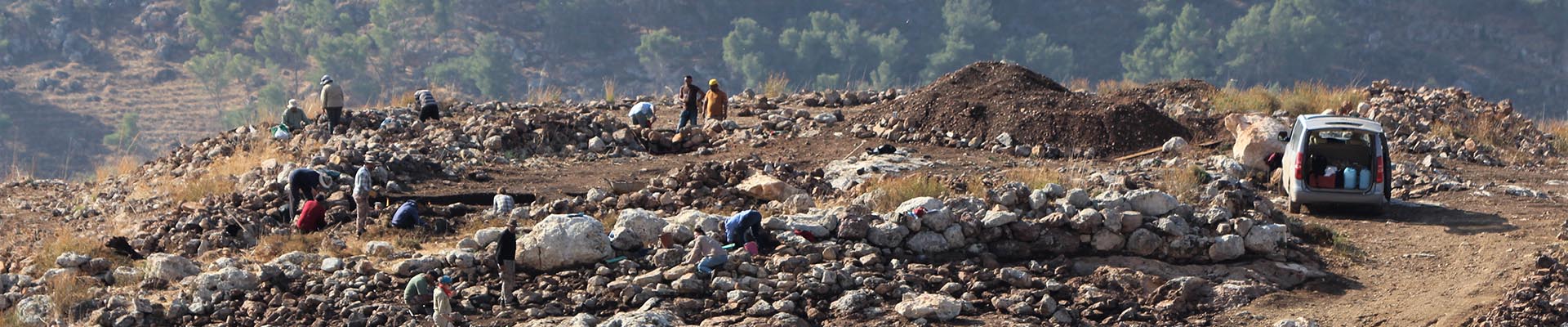
On November 2, 2019, I drove up to a small knoll overlooking the stunning Wadi Rayyan in north Jordan, and started laying our trenches for the second field season of the Khirbet Ghozlan Excavation Project. Using funds generously awarded as a Harris Grant by ASOR, this project is asking new questions about the relationship between olive oil production and rural complexity in a period of urban recession known as the Early Bronze Age IV (EB IV, 2600-2000 BCE).
View to Khirbet Um al-Ghozlan in the Wadi Rayyan, Jordan. The monumental enclosure is visible running across the low saddle over which the site is accessed. Photo by Adam Carr.
Khirbet Um al-Ghozlan
Most archaeological surveys would classify the site of Khirbet Um al-Ghozlan (the “Ruins of the Mother of the Gazelles”) a farmstead, hamlet or village, as the site is a miniscule 0.4 ha in size. In this respect, Khirbet Ghozlan sits comfortably with our traditional understanding of the EB IV, which is described as a period of ruralization in which people abandoned large, fortified, mounded sites and dispersed into small, undefended villages.
However, Khirbet Ghozlan is remarkable for its monumental enclosure wall. Built partly as a double row of massive, megalithic slabs, this enclosure controlled access to the Ghozlan knoll. Why defend such a tiny site?
Excavations around part of the monumental enclosure wall. Note destruction by bulldozer (left). Orthophoto by Guy Hazell.
Olive oil and the EB IV
The answer probably lies in the site’s upland location. Khirbet Ghozlan is one of several EB IV enclosure sites, all located on the well-drained slopes of the Jordan Rift Valley escarpment. As these hills are well-suited to horticultural production, this project proposes that small enclosure sites served as specialized processing centers for upland tree crops such as olive (Olea europaea), and were defended to protect seasonally-produced stockpiles of high-value liquid commodities such as oil. In other words, could Khirbet Ghozlan be a 4,500 year-old olive oil factory and storehouse?
Excavating Khirbet Ghozlan
To test this model, a team from the British Museum and University of Sydney undertook excavations at Khirbet Ghozlan in March 2017 and November 2019.
Archaeologist Beau Spry excavating a broken-but-complete store jar in an EB IV storage compound. Photo by Adam Carr.
The results strongly support the olive hypothesis. Excavations uncovered a large architectural compound with several storage bins, and storage wares dominate the ceramic assemblage, including 26 partly-complete store jars and spouted decanting vats. Several long, notched Canaanean flint blades were possibly used as pruning saws, and four rock-cut olive presses were recorded nearby.
However, the most compelling data lies in the microscopic botanical remains. Using scanning electron microscopy, Dr Caroline Cartwright (Senior Research Scientist, British Museum), identified crushed olive stones and charred olive wood in the organic remains obtained through soil flotation. These data suggest that olive fruit was pressed for oil and olive wood was burned as fuel, likely stockpiled as orchard prunings.
Furthermore, the absence of other plant species such as domestic cereal grains and legumes suggests that people did not live at Khirbet Ghozlan permanently; rather, they probably visited the site seasonally to harvest and maintain their orchards. The single phase of unmodified architecture is consistent with limited occupation, and the paucity of domestic debris such as cooking pots and hearths suggests non-domestic activity.
Broken and complete Canaanean blades found during the 2019 excavation season. Photo by Adam Carr.
Removing crushed olive paste (jift) from fibrous mat at the Toubneh olive mill after the oil has been pressed. Photo by Annette Dukes.
It was particularly thrilling to dig our trenches through this ancient olive factory at the same time as farmers were picking olives in the orchards that surround the site. Olives are harvested in October-November, after the first autumn rains wash away the summer dust. The fruit is pressed in local olive mills. Locked up for most of the year, these factories come alive each autumn, when they turn the olive harvest into oil for domestic consumption or local trade.
We were lucky to accompany the Jordanian Minister for Agriculture on a visit to a traditional olive mill in the village of Toubneh in north Jordan. Although oil extraction is now mechanized, the stages of washing, crushing and pressing are unchanged. The Toubneh mill was a powerful analogy for interpreting our discoveries at Khirbet Ghozlan – two seasonal olive factories separated by 4,500 years.
Dr. Jamie Fraser is Senior Curator at the Nicholson Museum (University of Sydney), but will leave Australia to become Curator for the Ancient Levant and Anatolia at the British Museum in April 2020. His book Dolmens in the Levant was awarded the G. Ernest Wright Book Award at the 2018 ASOR Annual Meeting.
Additional links
Dr. Fraser presented a public lecture on this ASOR-funded project to ACOR in Amman on Oct 30, 2019. This lecture is available on-line at ACOR’s YouTube page here:
ASOR BOOK AWARD SPOTLIGHT: THE SOCIAL ARCHAEOLOGY OF THE LEVANT
[/vc_column_text][mk_divider][vc_wp_text]At the 2019 ASOR Annual Meeting in San Diego, Assaf Yasur-Landau, Eric H. Cline and Yorke M. Rowan were awarded the G. Ernest Wright Award for their book, The Social Archaeology of the Levant (Cambridge University Press). This award is given to the editor/author of the most substantial volume(s) dealing with archaeological material, excavation reports and material culture from the ancient Near East and eastern Mediterranean. This work must be the result of original research published within the past two years. One award is given annually.
The editors at the 2019 Annual Meeting in San Diego.
“In The Social Archaeology of the Levant, Assaf Yasur-Landau (Associate Professor, Department of Maritime Civilizations, University of Haifa), Eric H. Cline (Professor of Classical and Ancient Near Eastern Studies and Anthropology, George Washington University) and Yorke M. Rowan (Research Associate Professor, Oriental Institute, University of Chicago), bring together a carefully curated and well-edited collection of contributions focusing on the southern Levant. These contributions represent a wide temporal span, ranging from the Palaeolithic to the Islamic period and beyond, but they share a common approach that gives the volume a strong sense of unity. This shared approach is defined by an emphasis on bottom-up processes and perspectives to engage with big-picture questions of how ancient people lived their lives. Within this shared framework, however, individual authors emphasize different kinds of data, methodologies and theoretical frameworks to achieve this goal, from biological anthropology to epigraphy, and from the archaeology of gender to public heritage. The result is a significant contribution to the archaeology of the region that refocuses research agendas for the modern era by concentrating on big questions that are often lost in the detailed minutiae of ongoing archaeological debates.”
Upon accepting the award, the editors thanked the contributors to the volume: Arwa Badran, Edward B. Banning, Anna Belfer-Cohen, Erez Ben-Yosef, Andrea M. Berlin, Stephanie L. Budin, Shlomo Bunimovitz, Meredith S. Chesson, Susan L. Cohen, Yoram Cohen, Avraham Faust, Bill Finlayson, Nigel Goring-Morris, Philip Graham, Leore Grosman, Susan Guise Sheridan, Felix Höflmayer, David Ilan, Ian W. N. Jones, Rabei G. Khamisy, Morag M. Kersel, Aren M. Maeir, Nimrod Marom, Daniel M. Master, Natalie D. Munro, Benjamin W. Porter, Alexandra L. Ratzlaff, Gary O. Rollefson, Christopher A. Rollston, Ruth Shahack-Gross, Sariel Shalev, Katharina Streit, Oren Tal, and Itamar Taxel. They also thank the volume’s editors, Beatrice Rehl and Asya Graf, and copyeditor, Heather Heinrich.
The editors hope to enjoy such a large gathering with friends again soon![/vc_wp_text][mk_divider][vc_wp_text]
Nominate a book for the G. Ernest Wright award. The deadline for book award nominations September 18, 2020. The deadline for service award nominations is September 11, 2020.[/vc_wp_text][/vc_column][vc_column border_color=”rgba(170,170,170,0.01)” width=”1/6″ css=”.vc_custom_1496684098866{margin-right: 5px !important;margin-bottom: 20px !important;border-right-width: 2px !important;border-bottom-width: 2px !important;padding-top: 30px !important;padding-right: 10px !important;padding-left: 10px !important;background-color: #ffffff !important;border-right-color: rgba(227,228,228,0.75) !important;border-bottom-color: rgba(227,228,228,0.75) !important;}”][vc_wp_posts title=”BROWSE THE NEWS ARCHIVE” number=”4″][/vc_column][vc_column border_color=”rgba(170,170,170,0.01)” width=”1/6″ css=”.vc_custom_1496684008271{margin-right: 10px !important;margin-bottom: 30px !important;border-right-width: 2px !important;border-bottom-width: 2px !important;padding-top: 30px !important;padding-right: 20px !important;padding-left: 20px !important;background-color: #ffffff !important;border-right-color: rgba(227,228,228,0.75) !important;border-bottom-color: rgba(227,228,228,0.75) !important;}”][vc_column_text]Tweets by ASOResearch [/vc_column_text][/vc_column][/vc_row][vc_row][vc_column][vc_column_text]
[/vc_column_text][mk_divider][vc_wp_text]By Andrea M. Berlin
Pottery from a single day of excavations at Tel Kedesh, Israel, laid out for study. Photo by author. Courtesy of the Tel Kedesh Excavations.
Of all material remains recovered by archaeologists, the most abundant is pottery. From the sixth millennium BCE down to the early twentieth century people have made clay vessels to store, prepare, cook, and serve food; hold perfume; ship commodities; burn oil for light; contain or serve as votive offerings; and, finally, help settle the dead in a more comfortable afterlife. Pottery leads us down a human path; it makes people visible.
The advantages of pottery go hand-in-hand with a huge obstacle: it is very hard to effectively disseminate all the information it conveys. Print publication has been, and continues to be, the most common mode. But print is ill-suited for fostering discussion or relaying changing ideas. Digital initiatives are an obvious solution, and several do exist that focus on pottery. All, however, are static repositories that enfold what is known at a certain moment in time. As archaeologists, we are always in a mode of discovery: finding new sites and more data, re-thinking older ideas. We need tools that can keep up, help us bring recent ideas into dialogue with older material, are easy to use, foster sharing, and enable us to readily learn from one other.
William Flinders Petrie, examining pottery from Tell el-Far’ah South, 1927, and Meg Morden, registering pottery at Tel Kedesh, 2008. Photo by author. Courtesy of the Tel Kedesh Excavations.
The Levantine Ceramics Project (LCP) is such a tool. The LCP is a custom-built, open access web application with a wide focus: all ceramics produced anywhere in the greater Levant, meaning the modern countries of Turkey, Syria, Cyprus, Lebanon, Israel, Jordan, and Egypt, from Neolithic times (c. 5500 BCE) until the end of the Ottoman era (c. 1920 CE).
How does it work?
The LCP was built to be easy to use. It is free and open: anybody can consult the site, and anybody can register as a contributor and submit information, whether newly studied or long published, on ceramic wares and petro-fabrics, individual vessels and illustrations, petrographic descriptions and thin-sections, and kiln/workshop sites. There are no restrictions on terminology; contributors may submit the information they have, using their own names and descriptions. All submitted information remains linked to its original contributor(s), thus maintaining intellectual property, and contributors can edit their entries at any time. In terms of privacy, there are three sharing options: public, meaning fully visible to anybody who consults the site; restricted to specified individuals; or private (specific choices are easy to change). Finally, every page has a “get citation” button, making each entry a stable, digital publication.
[/vc_wp_text][vc_single_image image=”58854″ img_size=”full” add_caption=”yes” alignment=”center”][mk_padding_divider][vc_single_image image=”58834″ img_size=”full” add_caption=”yes” alignment=”center”][mk_padding_divider][vc_single_image image=”58856″ img_size=”full” add_caption=”yes” alignment=”center”][mk_padding_divider][vc_wp_text]The LCP is not only an archive. It is also a tool for research. One example: maps! On the display pages for vessels, wares, and petrographic thin-sections, you can click a “View on map” button. Once on the map page, you can find a wide array of related data. For example, when viewing a vessel, you can ask to see other vessels of that shape, ware, date, etc. When viewing a ware, you can ask where vessels of that ware appear, where kilns producing that ware are, etc. Filter boxes allow you to refine displayed results.
Another analytical feature, introduced in 2019, is Edit History. When a contributor changes an entry, s/he has the option to keep a record of those changes via ‘edit history.’ On each display page, users can click a “View Edit History” button, which shows what was changed, and when, along with the earlier version. Over time, Edit History will create a history of scholarship about Levantine ceramics.
Digital and Print: long-term partners
The LCP offers a way to amplify the power of ASOR’s (and other) print publications. By submitting relevant ceramic data to the LCPin advance of publication, LCP links can be included in published print and digital versions. This will help craft a true partnership between print and digital platforms. At any future point, anyone reading an original print publication (even in digital form) can click on an LCP link and go directly to the relevant page, learn about any new or changed aspects, and also connect that object or ware to other data on the site. LCP pages have stable URLs and so will stay reachable; edits can be viewed in Edit History. A partnership between the LCP and print will help maintain the relevance of publications, and enhance their long-term scholarly utility.[/vc_wp_text][mk_padding_divider][vc_single_image image=”58832″ img_size=”full” add_caption=”yes” alignment=”center”][mk_padding_divider][vc_wp_text]Connecting scholars to scholarship
What is the future of this collaborative, crowd-sourced project? The numbers tell the story. When we launched LCP 1.0 in 2011, we had 29 contributors, about 200 vessels, and less than 100 page views. We are now humming along with LCP 5.0: easier submission process, notifications, new analytical tools like maps and comparisons – (and, coming soon, lightable!). As of writing (March 26, 2020), the LCP has 410 contributors, over 10,500 vessels, over 5,000 petrographic thin-sections, 100 petro-fabrics, and almost 500 ceramic wares spanning 7,000 years (the numbers keep going up so check out the LCP front page to see the latest total). In 2019, the site had over 55,000 page views, with each session lasting over five minutes.
As for where those page views are coming from, check out the map from Google Analytics below. The colored countries are ones in which somebody consulted the LCP in 2019. So if you think that the subject of Levantine ceramics is too arcane, something of a deep hole that only a specialist could care about – then think again![/vc_wp_text][mk_padding_divider][vc_single_image image=”58802″ img_size=”full” add_caption=”yes” alignment=”center”][mk_padding_divider][vc_wp_text]Eventually the LCP will allow archaeologists and other researchers to address the sorts of research questions for which ceramics offer basic evidence. Examples: what is the relationship between an imperial economy and local prosperity? Under what conditions do small-scale producers expand? Is the vitality of major exporting centers a function of location, political circumstance, or resource advantages? Do certain clay types lend themselves to certain types of products across long periods of time? Today, such queries are difficult to pursue; it is simply impossible to collect a sufficient amount and variety of data. By continuing to build up the LCP’s storehouse of information and introduce new analytical features, we will create an ever more robust tool.
So if you are an archaeologist who works in the Levant, please consider registering and submitting material to the site. Together we are building a resource to open up the past to everyone.
The ASOR family is a strong and close one, and that fact has never been more evident than in these challenging and stressful times. Due to the rapidly-changing situation with the COVID-19 crisis, we plan to update this letter at least bi-monthly.
Please know that we at ASOR are doing all that we can to continue serving our constituents, while keeping the safety and health of our members, volunteers, officers, and employees as our highest priority.
First, we want to share (and in some cases repeat) the things that we are doing to ensure that everyone is as safe as possible:
Health and Safety of ASOR members and staff—As far as we know, no ASOR members or staff have experienced a COVID-19 illness. If you are aware of anyone who has experienced an illness and if ASOR might provide assistance, please e-mail Andy Vaughn.
The ASOR Office—The James F. Strange Center—in Old Town Alexandria, is operating on remote-only work schedule. The staff is staying in touch with frequent messaging and video conferencing. No layoffs have occurred, and we have applied for a SBA Paycheck Protection Program Loan that was made available through the CARES Act. We anticipate that much of this loan will be forgiven and become similar to a “grant.” Our dedicated staff has been, and continues to be, outstanding.
Physical Mail Delivery—ASOR’s ability to receive and to process physical mail has been greatly reduced. Please consider making membership payments and gifts via our secure online store. Please e-mail info@asor.org if you have questions or need help. You may also send us a phone number by e-mail if you would like us to call you to make a credit card payment over the phone (please do not send credit card information by e-mail).
The ASOR Board Meeting (rescheduled for mid-May) will be held as a virtual video meeting. ASOR continues to test our new Zoom subscription, and we are using this platform more and more to carry out essential business.
Dig Scholarships, Excavation Grants, and Research Fellowships—We have postponed making decisions until at least April 15th. As of the date of this letter, it looks like dig scholarships will be postponed until 2021. We anticipate making a decision on excavation grants and research fellowships later in April or early May. We will segregate endowment distributions and gifts already received for awards in 2021, if necessary. 2020 had been our largest year ever for scholarships, grants, and fellowships, and we are so grateful to all of our supporters. If awards are not made in 2020, the segregated funds will enable a 50% increase in funding over 2019 levels for 2021.
Second, we want to share some of the things that we are doing to support you, our members, while many are practicing social distancing or self-quarantining:
Membership Scholarships Available—If you have experienced a financial challenge because of the COVID-19 crisis (or if you know of an ASOR member who has a need), please ask about a membership scholarship. Some generous members of the ASOR family have pledged funds to pay for membership dues of anyone that has lost employment or substantial income because of this crisis. Please contact Felice Herman or Andy Vaughn for more information.
Online Resources—The ASOR office staff (led by Marta Ostovich [programs@asor.org]) has launched webpages to share resources that will support students, professors, and teachers at all levels who are participating in online education with little advance notice. These pages are expanding daily, and we invite you to participate so that we can help each other by sharing ideas and expertise.
Online access to ASOR journals—The full-text and enhanced online access to ASOR journals have never been more important. Members with online access to journals can not only view the full text of articles, but all illustrations and figures may be downloaded seamlessly into Powerpoint. Click here for a web-page that outlines all of these features. Please e-mail Felice Herman (membership@asor.org) if you have questions.
Publications—Thanks to the excellent work of our editorial teams, the ASOR staff, and our partnerships with University of Chicago Press and with ISD, the production and distribution of ASOR journals and books continue without interruption. Everyone is working remotely as much as possible, and we do not anticipate any interruptions in fulfilling this vital member service.
Annual Meeting—We continue to prepare for our largest and best Annual Meeting in Boston in November. The Program Committee and ASOR staff are working remotely to ensure that the program will be the strongest ever. We, of course, will keep the health of all participants as our highest priority.
General Operations—The ASOR staff and our volunteers continue to respond to e-mails and phone calls. With our staff working remotely, answering phones and voicemail may be delayed. Please consider sending an e-mail if you are able.
Shepard Urgent Action Grants—In the midst of so many things being postponed, we are thrilled to announce a new initiative that we hope can take place in spite of social distancing and self-quarantining efforts. Launched on April 2, 2020, these new grants are designed to address urgent needs for site mitigation and stabilization. Funding may be available in as little as 4-6 weeks following an application. Please check out the webpage and announcement.
Third, we need to share some challenges. We will continue to update you on these items. If you are aware of other issues that we should communicate in subsequent member correspondence, please let us know.
The programs at our Overseas Research Centers in Amman, Jerusalem, and Nicosia are suffering from travel restrictions and cutbacks in fieldwork. Significant portions of their income derive from visits to and work on ASOR field projects and other research, for which they provide essential support and services. These projects for 2020 are being cancelled for the most part. We have been in touch with all the directors. They are coping effectively with the changing circumstances. The Albright in Jerusalem has been particularly hit hard.
ASOR’s Endowment Accounts—Like many institutions, ASOR has invested our endowment accounts using an 80/20 allocation—80% in equities and 20% in bonds and cash. We have thus experienced a significant correction over the first quarter of 2020, and most of our endowments accounts are down 12.1% for the fiscal year (July 1 – June 30). Because we maintain a 20% allocation in bonds and cash, we will re-balance our portfolios this month (April 2020) per our investment guidelines. We also make quarterly distributions based on averages from the last 12 quarters, so we will continue to be conservative in distributing funds from endowments. In addition, the Finance Committee is considering a recommendation to forego distributions for the 1st quarter of 2020 in order to allow our accounts to recover some of their market losses.
ASOR’s Annual Fund (unrestricted giving)—While ASOR remains in sound financial shape, while we have applied for a Paycheck Protection Program Loan, and while we have modest accumulated funds to see us through a challenging year, we need members to consider unrestricted contributions and gifts for member scholarships. To date in this fiscal year (ends June 30, 2020), we have received less than half of the $125,000 that we budgeted for unrestricted giving. Click here to make a gift online.
Finally, we want to conclude as we began—your health and well-being is our highest concern. We are grateful for your continued support of ASOR and of your fellow members. You are, and continue to be, amazing.
Best regards,
Sharon Herbert, ASOR President (president@asor.org)
Andy Vaughn, ASOR Executive Director (executive-director@asor.org)[/vc_column_text][/vc_column][vc_column border_color=”rgba(170,170,170,0.01)” width=”1/6″ css=”.vc_custom_1496684098866{margin-right: 5px !important;margin-bottom: 20px !important;border-right-width: 2px !important;border-bottom-width: 2px !important;padding-top: 30px !important;padding-right: 10px !important;padding-left: 10px !important;background-color: #ffffff !important;border-right-color: rgba(227,228,228,0.75) !important;border-bottom-color: rgba(227,228,228,0.75) !important;}”][vc_wp_posts title=”BROWSE THE NEWS ARCHIVE” number=”4″][/vc_column][vc_column border_color=”rgba(170,170,170,0.01)” width=”1/6″ css=”.vc_custom_1496684008271{margin-right: 10px !important;margin-bottom: 30px !important;border-right-width: 2px !important;border-bottom-width: 2px !important;padding-top: 30px !important;padding-right: 20px !important;padding-left: 20px !important;background-color: #ffffff !important;border-right-color: rgba(227,228,228,0.75) !important;border-bottom-color: rgba(227,228,228,0.75) !important;}”][vc_column_text]Tweets by ASOResearch [/vc_column_text][/vc_column][/vc_row]
IN MEMORIAM: DRS. R. THOMAS SCHAUB AND MARILYN MCNAMARA SCHAUB
Meredith S. Chesson and Morag M. Kersel
[/vc_column_text][vc_column_text]
Figure 1: Marilyn and Tom Schaub in Safi, Jordan in 2004 (Photograph by Meredith S. Chesson, EDSP Archives)
Editorial note: this post is the first in a series of essays honoring ASOR members who have made a legacy gift to ASOR.
The legacy of Tom and Marilyn Schaub’s substantial scholarly and deeply personal contributions to ASOR resonate strongly today, offering a promise of a healthy future for the organization. Their professional engagements with ASOR, such as their roles as Trustee members and service in other administrative capacities, are well known and can easily be traced through public and archival records. Instead of attempting to enumerate these profound accomplishments in such a short space, we prefer to dedicate our time to the less official but equally important contributions they made to ASOR and to the field of Early Bronze Age archaeology in the southern Levant as tremendous scholars and generous human beings (Figure 1).
We begin at the start of their professional and personal association: as young members of the Dominican Order, they met in Jerusalem at the École Biblique in a course taught by the archaeologist Roland De Vaux in the mid-1960s. Shortly thereafter, when Paul Lapp needed an architect for excavations at the Early Bronze Age site of Bab adh-Dhra` (Jordan), Marilyn McNamara (already a team member and holding a PhD from Freiburg) suggested that he invite Tom Schaub to fulfill that role. In 1967, they worked on Lapp’s team, and this professional foundation flourished over decades of their lifelong partnership (Figure 2). Fewer than 10 years after that initial season at Bab adh-Dhra`, they had left the order, married, become parents, Tom finished his PhD at the University of Pittsburgh, and they both accepted teaching positions: Marilyn at Duquesne University and Tom at Indiana University of Pennsylvania.
Figure 2: Tom and Marilyn carrying Bab adh-Dhra` tomb pottery back up to Karak in 1967 (Photograph by Paul Lapp, EDSP Archives)
In 1973, Tom and Marilyn collaborated with Walter and Susanna Rast to establish the Expedition to the Dead Sea Plain (EDSP). During that same year, they conducted their initial survey of the region, identifying several prehistoric and historic sites and establishing the professional groundwork for more than four decades of archaeological research. This survey season, and the subsequent archaeological excavations at the Early Bronze Age sites of Bab adh-Dhra`, Numayra, Ras an-Numayra, Fifa, and Khirbat Khanazir, represent a disciplinary watershed in prehistoric archaeology in the region. By adopting and demonstrating the power of the New Archaeology’s methods and theories, with a focus on environmental archaeology in the Levant, they changed the discipline. To investigate Early Bronze Age urban society, they built a research team encompassing a wide variety of specialties, including geology, palynology, ceramic technology, paleoethnobotany, and bioarchaeology.
Using this multidisciplinary research design, they planned their excavations with two key objectives:
(1) To investigate how the local environment shaped and influenced the emergence of fortified towns (small scale urbanism) in this region, and (2) To examine both the residential contexts as well as the cemeteries, temples, palaces, and fortification walls.
Figure 3: Marilyn excavating an EB IA cist tomb at Fifa, December 1989-January 1990 (EDSP Archives)
They adopted scientific and systematic ways to collect and to analyze the artifacts they found within settlement and cemetery sites while applying innovative research methods. For instance, together with Smithsonian Institution’s bioarchaeologists Don Ortner and Bruno Fröhlich, they used magnetometry to identify shaft tombs below the surface at Bab adh-Dhra` in 1981. Working closely with Bob Johnston, Tom investigated EBA ceramic technology, setting new scholarly standards by combining SEM and petrographic analyses of fabrics with ethnoarchaeological studies of traditional potters working with and without wheel technologies. No longer was pottery a simple chronological marker, function and technique were a focus.
Figure 4: Pottery Reading at Karak Castle, 1977. Marilyn (standing) and Tom (seated on left) reading pottery with the field supervisors (Photograph by Mark McConnaughy, EDSP Archives)
While Tom and Walt acted as the Co-Directors of the EDSP, Marilyn worked tirelessly as Administrative Director of this large and complicated project. In the field, she was a skilled excavator, whose field notebooks stand as exemplars of the genre, while also helping to manage the artifact registration, pottery readings, and any other daily challenges familiar to all excavation field directors (Figures 3 and 4). Throughout the years, Tom and Marilyn, together with Walt, Susanna, and Nancy Lapp, worked collectively to conduct this research.
Figure 5: Tom working with Helen in the Fifa excavations, with Walter Rast looking down from the trench edge in December 1989-January 1990 (EDSP Archives)
The success of this team over many decades emerged from the community that Marilyn, Tom, Walt, Susanna, and Nancy fostered. Often, fieldwork was not only a collective effort, but also a family affair. Helen Schaub grew up on the excavations, and in the 1989-90 season she excavated at Fifa along with her parents (Figure 5). Tom and Marilyn worked together with Walt, Susanna, and Nancy to nurture this scholarly community, weaving together their families and colleagues over many years to sustain a long-term research endeavor. This archaeological community was nourished by respect, friendship, compromise, and engaged listening.
In her eulogy for her mother, Helen celebrated Marilyn’s gift of friendship. In many ways, Tom’s and Marilyn’s largest contributions to ASOR and the field of southern Levantine archaeology emerge from the very humane and human way they approached research: through generosity, friendship, and community. The decades of work by Marilyn and Tom, together with Walt, Susanna, and Nancy, teach us more than how to excavate or how to understand the Early Bronze Age emergence of urbanism. Their legacy offers us crucial lessons about how to be good scholars, profoundly good people, and how to learn from and teach others about collective responsibility, not simply serving our academic selves. As the new Co-Directors of the EDSP, we hope that we can honor their legacy by creating such a vibrant community, offering support to young scholars, and fulfilling our obligations to the Jordanian people with whom we collaborate and for whom we ultimately work.[/vc_column_text][mk_divider][vc_column_text]Legacy gifts to ASOR: Tom and Marilyn Schaub not only devoted their lives to the service of our fields and institutions like ASOR, but they also had the foresight to think about how to continue that support in perpetuity. In the case of the Schaub’s, they decided to leave a percentage of an IRA held with TIAA/CREF. The ASOR Board voted unanimously to invest this gift in ASOR’s endowment for operations. Their gift will thus produce income to support the ongoing work of ASOR—and continue the Schaub legacy—in perpetuity. With the passage of new tax laws that took effect on January 1, 2020, the donation of an IRA, 401(k), or 403(b) to ASOR or another charity may be even more beneficial than ever in terms of estate taxes. Of course, you should consult your tax adviser. If you are interested in finding out more about ASOR’s Legacy Circle or how you might make a planned gift to ASOR, please contact ASOR Executive Director, Andy Vaughn.[/vc_column_text][/vc_column][vc_column border_color=”rgba(170,170,170,0.01)” width=”1/6″ css=”.vc_custom_1496684098866{margin-right: 5px !important;margin-bottom: 20px !important;border-right-width: 2px !important;border-bottom-width: 2px !important;padding-top: 30px !important;padding-right: 10px !important;padding-left: 10px !important;background-color: #ffffff !important;border-right-color: rgba(227,228,228,0.75) !important;border-bottom-color: rgba(227,228,228,0.75) !important;}”][vc_wp_posts title=”BROWSE THE NEWS ARCHIVE” number=”4″][/vc_column][vc_column border_color=”rgba(170,170,170,0.01)” width=”1/6″ css=”.vc_custom_1496684008271{margin-right: 10px !important;margin-bottom: 30px !important;border-right-width: 2px !important;border-bottom-width: 2px !important;padding-top: 30px !important;padding-right: 20px !important;padding-left: 20px !important;background-color: #ffffff !important;border-right-color: rgba(227,228,228,0.75) !important;border-bottom-color: rgba(227,228,228,0.75) !important;}”][vc_column_text]Tweets by ASOResearch [/vc_column_text][/vc_column][/vc_row]
LETTER FROM ASOR’S PRESIDENT: MARCH FELLOWSHIP MADNESS SUSPENDED & OTHER ASOR RESPONSES TO PANDEMIC
[/vc_column_text][vc_column_text]Dear Fellow ASOR community members,
First and foremost, I hope that you, your family and your friends remain safe and healthy. I am writing to update you about ASOR’s plans to move forward responsibly in these uncertain times, and about your success in funding scholarships for fieldwork.
First, to your success: As your President, I am proud and grateful to each of you who has contributed already. We have raised the most funds in our 120-year history toward dig scholarships. This is such good news!
Secondly: After consultation with our Executive Director, Chairs of the Development Committee and Committee on Archaeological Research and Policy and its sub-committee on fellowships, we have decided, in view of the concerns about the safety and wisdom of travel, that we are going to end our March Madness fundraising effort early. We will segregate the funds that already have been given, so that they remain available for the same purpose in the future—summer fieldwork.
If it proves infeasible to award dig scholarships in 2020, due to travel restrictions and the need for social distancing, we will make these funds available in 2021. If the situation changes, and field experiences are able to move forward, we will revisit this decision by April 15th. It seems unlikely that digs will go forward this year, however. Excavation does not lend itself to social distancing. The Universities that send students to our fieldwork projects are already restricting travel, and ASOR has a community responsibility to join in the efforts to be part of the solution in slowing the spread of the Coronavirus.
Our Overseas Research Centers in Amman, Jerusalem, and Nicosia are also suffering greatly from these travel restrictions and cutbacks in fieldwork. Much of their income derives from visits to and work on ASOR field projects for which they provide essential support and services. We will be providing reports from the directors in upcoming issues of News@ASOR and on our web page, but for now you can learn about their situations at ACOR, the Albright Institute, and CAARI.
Finally, instead, ASOR staff will work to serve our community now, this week, by launching a series of webpages devoted to bringing online resources to our many members who are required to teach online courses with very little notice. Also, these resources may be of great interest to Friends of ASOR and others for whom the past matters.
We will continue to look for other ways to actively support our members and their research as we all deal with the Coronavirus pandemic. I invite you to share ideas with me or Andy Vaughn, our Executive Director, or anyone on ASOR’s Executive Committee.
With wishes for your good health,
Sharon C. Herbert
President, American Schools of Oriental Research
Charles K. Williams, II Distinguished University Professor of Classical Archaeology Emerita
Department of Classical Studies
Research Associate, Kelsey Museum of Archaeology
University of Michigan
Ann Arbor, Michigan 48109 president@asor.org[/vc_column_text][/vc_column][vc_column border_color=”rgba(170,170,170,0.01)” width=”1/6″ css=”.vc_custom_1496684098866{margin-right: 5px !important;margin-bottom: 20px !important;border-right-width: 2px !important;border-bottom-width: 2px !important;padding-top: 30px !important;padding-right: 10px !important;padding-left: 10px !important;background-color: #ffffff !important;border-right-color: rgba(227,228,228,0.75) !important;border-bottom-color: rgba(227,228,228,0.75) !important;}”][vc_wp_posts title=”BROWSE THE NEWS ARCHIVE” number=”4″][/vc_column][vc_column border_color=”rgba(170,170,170,0.01)” width=”1/6″ css=”.vc_custom_1496684008271{margin-right: 10px !important;margin-bottom: 30px !important;border-right-width: 2px !important;border-bottom-width: 2px !important;padding-top: 30px !important;padding-right: 20px !important;padding-left: 20px !important;background-color: #ffffff !important;border-right-color: rgba(227,228,228,0.75) !important;border-bottom-color: rgba(227,228,228,0.75) !important;}”][vc_column_text]Tweets by ASOResearch [/vc_column_text][/vc_column][/vc_row]
[/vc_column_text][vc_column_text]In just the past two weeks, most (if not all) institutions associated with ASOR have moved to online teaching. Many of our members have been directed to switch to online instruction, sometimes with very little notice. The ASOR family is a close and strong one, so we are coming together in an effort to assemble an online collection of resources and teaching materials to support our members and the student whom they teach.
This portal of online resources will grow organically with submissions from our members and friends. During this initial phase, we are asking our members to share online resources, websites, teaching aids, guidelines, or advice that they feel could be useful. We recognize that many have been forced into a position of teaching online, and ASOR wants to provide a portal where we can share ideas and help each other. Please email Marta Ostovich at programs@asor.org with any resources you would like to share with your colleagues. We also welcome your suggestions and offers to volunteer in helping us set up these resources.
Stay tuned for more to come!
Much of the content for these online resources came from H.Dixon, “What’s Already Out There? Online Resources for Teaching Ancient Near Eastern Studies and Cognate Fields,” Creative Pedagogies for Teaching the Ancient Near East and Egypt session (M. Ameri and H. Dixon, chairs), 2019 ASOR Annual Meeting, San Diego.”[/vc_column_text][/vc_column][vc_column border_color=”rgba(170,170,170,0.01)” width=”1/6″ css=”.vc_custom_1567019695971{margin-right: 5px !important;margin-bottom: 20px !important;border-right-width: 2px !important;border-bottom-width: 2px !important;padding-top: 30px !important;padding-right: 10px !important;padding-left: 10px !important;background-color: #ffffff !important;border-right-color: rgba(227,228,228,0.75) !important;border-bottom-color: rgba(227,228,228,0.75) !important;}”][vc_wp_posts title=”BROWSE THE NEWS ARCHIVE” number=”4″][/vc_column][vc_column border_color=”rgba(170,170,170,0.01)” width=”1/6″ css=”.vc_custom_1496684008271{margin-right: 10px !important;margin-bottom: 30px !important;border-right-width: 2px !important;border-bottom-width: 2px !important;padding-top: 30px !important;padding-right: 20px !important;padding-left: 20px !important;background-color: #ffffff !important;border-right-color: rgba(227,228,228,0.75) !important;border-bottom-color: rgba(227,228,228,0.75) !important;}”][vc_column_text]Tweets by ASOResearch [/vc_column_text][/vc_column][/vc_row][vc_row][vc_column][vc_column_text]



 At the 2019 Annual Meeting in San Diego, Randy Old (President of ACOR’s Board of Trustees) received the


 Dr. Jamie Fraser is Senior Curator at the Nicholson Museum (University of Sydney), but will leave Australia to become Curator for the Ancient Levant and Anatolia at the British Museum in April 2020. His book Dolmens in the Levant was awarded the G. Ernest Wright Book Award at the 2018 ASOR Annual Meeting.
 At the 2019 ASOR Annual Meeting in San Diego, Assaf Yasur-Landau, Eric H. Cline and Yorke M. Rowan were awarded the G. Ernest Wright Award for their book,


 UPDATED LETTER ON ASOR’S RESPONSES TO COVID-19


