2023 Finance Committee

[vc_row fullwidth=”true” css=”.vc_custom_1490224714943{padding-top: 0px !important;padding-right: 0px !important;padding-bottom: 0px !important;padding-left: 0px !important;}”][vc_column][vc_single_image image=”65406″ img_size=”full” alignment=”center”][/vc_column][/vc_row][vc_row][vc_column][vc_column_text][/vc_column_text][/vc_column][/vc_row][vc_row fullwidth=”true” css=”.vc_custom_1490225468623{padding-top: 0px !important;padding-right: 0px !important;padding-bottom: 0px !important;padding-left: 0px !important;}”][vc_column width=”1/12″ css=”.vc_custom_1490225195470{margin-right: 10px !important;}” offset=”vc_hidden-sm vc_hidden-xs”][vc_column_text]

  SHARE

[/vc_column_text][mk_image src=”http://www.asortest.org/wp-content/uploads/2017/01/social-fb-icon4.jpg” image_width=”42″ image_height=”42″ hover=”false” custom_url=”https://www.facebook.com/ASOResearch/” margin_bottom=”0″][mk_image src=”http://www.asortest.org/wp-content/uploads/2017/01/social-tw-icon4.jpg” image_width=”42″ image_height=”42″ hover=”false” custom_url=”https://twitter.com/ASOResearch?ref_src=twsrc%5Egoogle%7Ctwcamp%5Eserp%7Ctwgr%5Eauthor” margin_bottom=”0″][mk_image src=”http://www.asortest.org/wp-content/uploads/2017/01/social-in-icon4.jpg” image_width=”42″ image_height=”42″ hover=”false” custom_url=”https://www.linkedin.com/company/american-schools-of-oriental-research” margin_bottom=”0″][mk_image src=”http://www.asortest.org/wp-content/uploads/2017/01/social-ml-icon_7.jpg” image_width=”42″ image_height=”42″ hover=”false” custom_url=”mailto:asor@bu.edu” margin_bottom=”0″][mk_image src=”http://www.asortest.org/wp-content/uploads/2017/01/blog-icon3.jpg” image_width=”42″ image_height=”42″ hover=”false” custom_url=”http://asorblog.org/” margin_bottom=”0″][/vc_column][vc_column border_color=”rgba(255,255,255,0.01)” width=”1/6″ css=”.vc_custom_1490365673198{margin-right: 20px !important;border-left-width: 2px !important;padding-right: 20px !important;padding-left: 20px !important;border-left-color: #99422f !important;}” el_class=”sticky-sidenav”][mk_divider divider_color=”rgba(255,255,255,0.01)” thickness=”1″ margin_top=”3″ margin_bottom=”3″][vc_widget_sidebar sidebar_id=”ca-sidebar-37292″ el_class=”.widget { overflow: hidden; margin-bottom: 0; }”][/vc_column][vc_column border_color=”rgba(170,170,170,0.01)” width=”1/2″ css=”.vc_custom_1490225606852{margin-right: 10px !important;margin-bottom: 30px !important;border-right-width: 2px !important;border-bottom-width: 2px !important;padding-top: 30px !important;padding-right: 30px !important;padding-left: 20px !important;background-color: #ffffff !important;border-right-color: rgba(227,228,228,0.75) !important;border-bottom-color: rgba(227,228,228,0.75) !important;}”][vc_column_text responsive_align=”left”]

2023 FINANCE COMMITTEE

Archived webpage for the 2023 Finance Committee Members; This page has been replaced.
The Finance Committee (a) advises the Executive Committee on matters related to the financial management of ASOR and supervision of bids for the annual audit; (b) supervises the investments of ASOR’s funds; and (c) oversees the preparation of the annual budget and monitors compliance with the final budget approved by the Trustees to assure that expenditures do not exceed budgeted amounts.

  • Emily Miller Bonney, Chair (Treasurer, until December 31, 2023)
  • Sharon Herbert (President, until December 31, 2025)
  • Kiersten Neumann (Co-chair of the Program Committee, until December 31, 2025)
  • Alison Thomason (Co-chair of the Program Committee, until December 31, 2025)
  • Kevin McGeough (Chair of Publications Committee, until December 31, 2024)
  • At-large: Lisa Ackerman (until December 31, 2025)
  • At-large: Susan Ackerman (until December 31, 2025)
  • At-large: Sheldon Fox (until December 31, 2025)
  • At-large: Lynn Swartz Dodd (until December 31, 2024)
  • At-large: Tiffany Earley-Spadoni (until December 31, 2024)
  • Andrew G. Vaughn (ex officio, non-voting)
  • Britta Abeln (ex officio, non-voting)
[/vc_column_text][mk_divider][vc_column_text]

Past Finance Committee Members

[/vc_column_text][vc_empty_space height=”300px”][/vc_column][vc_column border_color=”rgba(170,170,170,0.01)” width=”1/6″ css=”.vc_custom_1490571214409{margin-right: 10px !important;margin-bottom: 30px !important;border-right-width: 2px !important;border-bottom-width: 2px !important;padding-top: 30px !important;padding-right: 20px !important;padding-left: 20px !important;background-color: #ffffff !important;border-right-color: rgba(227,228,228,0.75) !important;border-bottom-color: rgba(227,228,228,0.75) !important;}”][vc_wp_posts title=”BROWSE THE NEWS ARCHIVE” number=”4″][/vc_column][vc_column border_color=”rgba(170,170,170,0.01)” width=”1/6″ css=”.vc_custom_1490225688999{margin-right: 10px !important;margin-bottom: 30px !important;border-right-width: 2px !important;border-bottom-width: 2px !important;padding-top: 30px !important;padding-right: 30px !important;padding-left: 20px !important;background-color: #ffffff !important;border-right-color: rgba(227,228,228,0.75) !important;border-bottom-color: rgba(227,228,228,0.75) !important;}”][vc_column_text] [/vc_column_text][/vc_column][/vc_row][vc_row][vc_column][vc_column_text] [/vc_column_text][/vc_column][/vc_row]

التوثيق الرقمي للتراث الثقافي بالمغرب

التوثيق الرقمي للتراث الثقافي بالمغرب

بقلم عبد الكريم أوكيناز

تلقيت دعوة للمشاركة في الجولة الثقافية التي نظمها فريق برنامج ذاكرة الممول من قبل الوكالة الأمريكية للتنمية الدولية وتنفذه مؤسسة الأطلس الكبير مع مجموعة من الشركاء المحليين. استغرقت جولة ذاكرة في الجنوب 6 أيام، ابتداء من 28 شتنبر/ايلول إلى 03 أكتوبر/تشرين الاول، وجمعت 7 جماعات قروية من أربع أقاليم هي ورززات وتارودانت وتزنيت وكلميم. كان الهدف الرئيسي منها الاحتفاء بالتعددية الثقافية التي تتميز بها هذه المناطق والتي تنعكس على مستوى تقاليدها المحلية

وقد قمت خلال هذه الجولة، التي استمتعت بها كثيرا، بتقديم مجموعة من التكوينات لفائدة مجموعات من الشباب المحليين اللذين ينتمون الى الجماعات الترابية السبع التي زرناها، حول موضوع استعمال التقنيات والبرامج الحديثة المفتوحة المصدر لتوثيق التراث الثقافي المتنوع بالمغرب

تدخل هذه التكوينات في إطار الشراكة التي تجمع بين مؤسسة الأطلس الكبير والجمعية الأمريكية للبحوث الخارجية. ويتكون عمليا هذا البرنامج، الممول من قبل متبرع مجهول، والذي يهدف إلى توثيق مختلف المواقع التراثية التي تعود للأقليات الدينية والعرقية بشمال إفريقيا من شقين: الأول يهم جرد وتوثيق وأرشفة مواقع التراث الثقافي، والثاني مرتبط بإنجاز سلسلة من التكوينات في مجال التوثيق الرقمي للتراث، أنجزنا منها إلى حد الآن ثلاث دورات في كل من مدن الدار البيضاء والصويرة وتارودانت. ومن المقرر أن تجرى تكوينات أخرى في المستقبل في نفس الموضوع لمجموعة من المشاركين من شمال المغرب

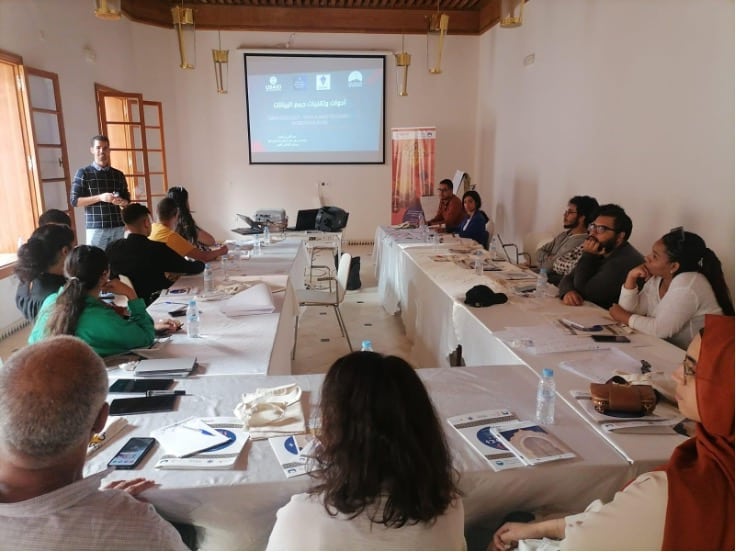
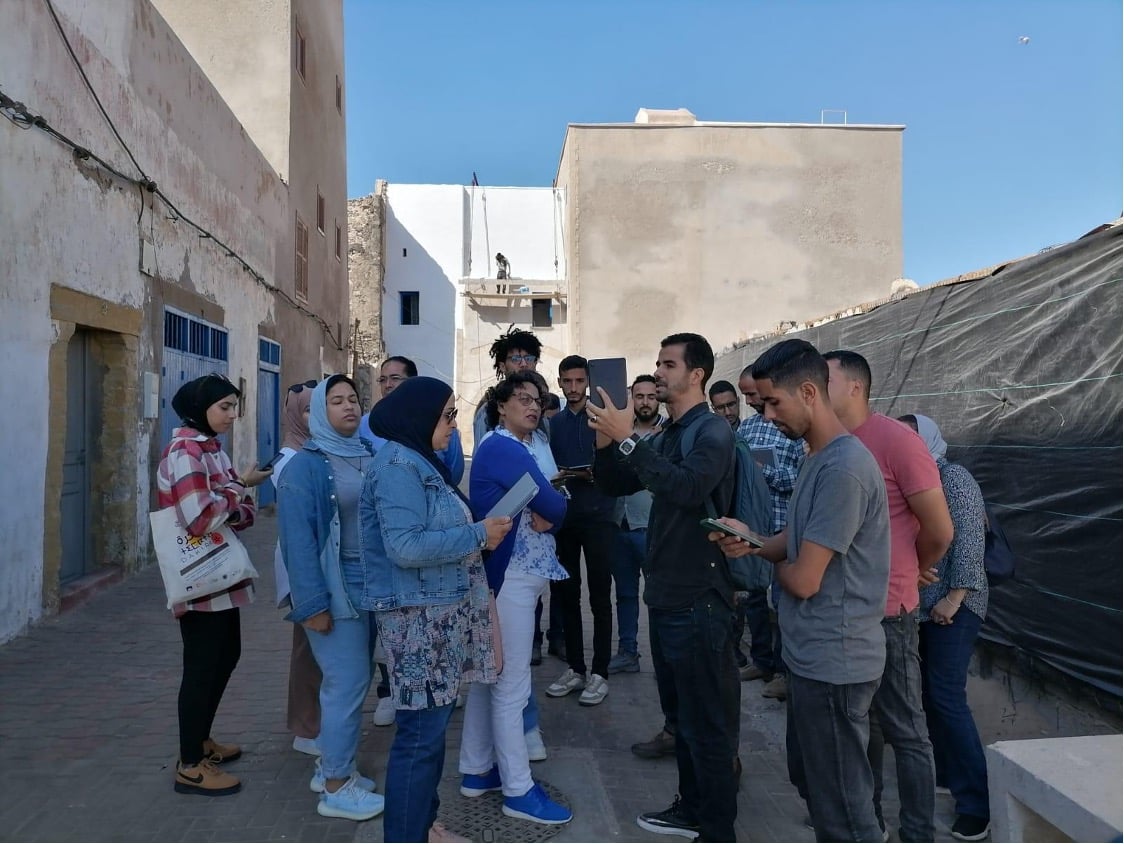
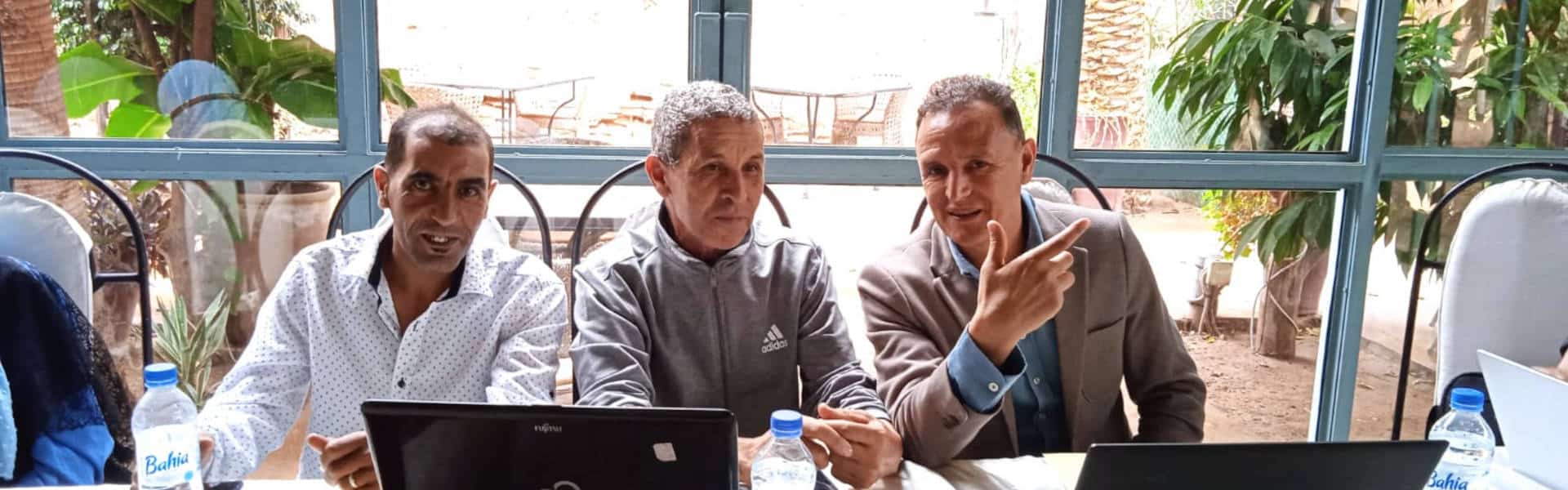
صورة من الدورة التكوينية المنظمة بملاح مدينة الصويرة في شقها التطبيقي

يشمل كل تكوين حصصا تدريبية نظرية وتطبيقية بالميدان، بمعدل ساعتين لكل حصة، الهدف منها جعل المشاركين قادرين على جمع وتوثيق وأرشفة المعطيات حول المواقع التراثية انطلاقا من استبيانات وتقييمات المشروع الذي يقومون بإنشائه على منصة الكوبو تول بوكس، والتي تمكننا من جمع المعلومات عن مواقع التراث باستعمال الأجهزة اللوحية والهواتف المحمولة أو من خلال واجهة متصفح الويب

صورة من الدورة التكوينية المنظمة بملاح مدينة الصويرة في شقها التطبيقي

بعد ذلك نمر إلى التعرف على طرق مزامنة بيانات المواقع التراثية والبيانات الوصفية المسجلة في الميدان مع مختلف برامج نظم المعلومات الجغرافية باستعمال برنامج قيو.جي.اي.اس المفتوح المصدر، وإظهار البيانات المجمعة على شكل خرائط ثابتة وأخرى تفاعلية

وتعتبر تقنية المسح التصويري المكون الثالث لهذا التكوين، وتقوم على استخدام صور ثنائية الأبعاد لبنايات أثرية أو نقوش صخرية أو كتابات منحوتة على الألواح أو البيوت أو القبور إلى غير ذلك للحصول على مجسم ثلاثي الأبعاد بالاستعانة بآلات تصوير وبرامج حاسوبية خاصة مثل ميتاشايب، حيث يمكن الرجوع إلى هذه النماذج ثلاثية الأبعاد كلما اقتضى الأمر ذلك


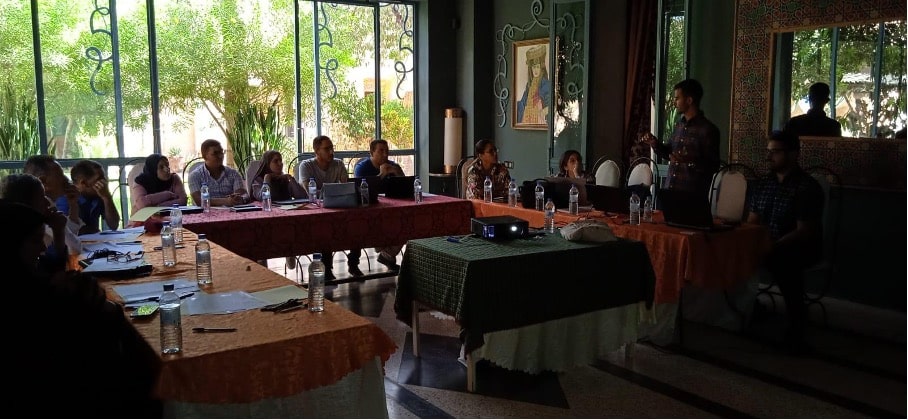
صورة من الدورة التكوينية المنظمة بمدينة تارودانت في شقها النظري

أضحت عملية توثيق التراث والمواقع الأثرية في جميع أنحاء البلاد ضرورة قصوى بالنظر إلى المخاطر والتحديات التي أضحت تحدق بها من قبل الكوارث الطبيعية كالفيضانات أو تلك الناتجة عن بعض الأفعال الطائشة للإنسان كالحرائق أو السرقة أو التخريب الذي قد يطالها من بعض الجاهلين بقيمتها وأهميتها التراثية، فاحتمال ضياع أو تلف أو اندثار أجزاء من هذا التراث يبقى أمرا واردا، وذلك يعني فقدان الذاكرة التاريخية للمجال المعني في غياب التوثيق الآني والمناسب له

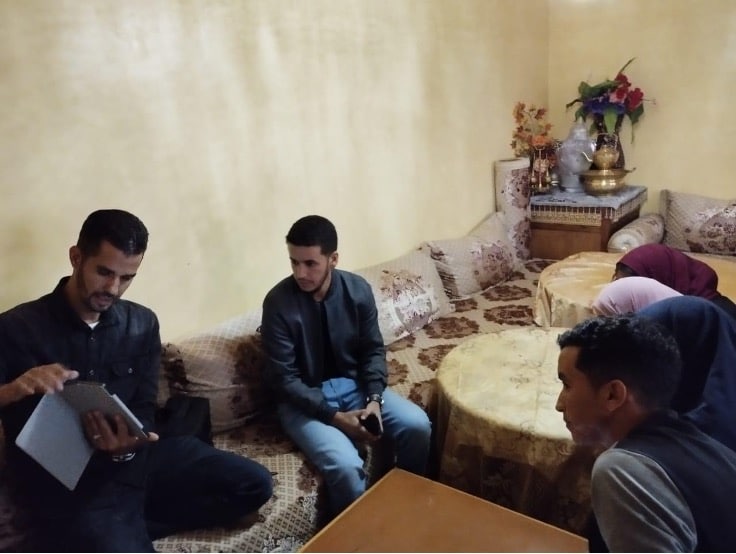
صورة من الدورة التكوينية التي نظمت لفائدة مجموعة شباب بقرية تمزريت التابعة لجماعة إغرم نوكدال بإقليم ورززات

لمسنا أثناء تنشيطنا لهذه التكوينات استعدادا كبيرا من المشاركين الشباب لهذه التكوينات التي سوف تمكنهم من تقوية قدراتهم في هذه التقنيات الحديثة التي تسهل جمع توثيق وأرشفة المعطيات، سواء في إطار برنامج توثيق المواقع التراثية او في مشاريعهم الخاصة سواء كانت أكاديمية أو عملية

تتوخى مؤسسة الأطلس الكبير وشركائها من هذه التكوينات تنمية قدرات أكبر عدد ممكن من الشباب في التقنيات المشار إليها أعلاه، أولا لتحسيسهم بأهمية الاعتناء بالتراث الثقافي باعتبـاره أحـد المكـونـات الأصيلـة للهـويـة المغـربيـة المـوحـدة، الغنيـة بتعـدد روافـدها، وجعلهم متمكنين من هذه التقنيات في أفق تمريرها لمجموعات أخرى في المستقبل، ثم توثيق وأرشفة وتعميم ونشر المعطيات المجمعة ضمن خريطة تفاعلية ستنشر على شبكة الأنترنيت لزيادة إمكانيات الوصول إليها والتعريف بها وحمايتها وإحيائها لفائدة الأجيال المقبلة، و استعمالها ايضا كموارد ومؤهلات ثقافية مشجعة للسياحة

Call for Honors and Awards Committee Members

Call for Honors and Awards Committee Members

The Honors and Awards Committee seeks nominations to serve on the G. Ernest Wright Book Award and Frank Moore Cross Book Award sub-committees. ASOR invites nominations, including self-nominations, from ASOR members who are interested in being considered by the committee for these openings. Committee members will serve a three-year term with the possibility of two consecutive terms. Nominees must fill out the online form by February 17, 2023. The Honors and Awards Committee takes responsibility for determining the awardees for the three book awards, the field archaeology award, the “best poster” award, and the multiple membership service awards that ASOR gives annually; conducting the awards ceremony during the Members’ Meeting at the ASOR Annual Meeting; and discussing and advising the ASOR Board of Trustees about ASOR’s awards, including recommending to the Board the creation of new awards as deemed appropriate. 

One candidate is sought for the Frank Moore Cross Award sub-committee. This award is presented to the author/editor of the most substantial volume(s) related to the history and/or religion of the ancient Near East and Eastern Mediterranean. Primary consideration will be given to historical, epigraphic, textual, and comparative literary studies; or to works that advance and/or evaluate new methodological approaches to the literary record(s). This work must be the result of original research published during the past two years. (One award is given annually.)

One candidate is sought for the G. Ernest Wright Award sub-committee. This award is given to the author/editor of the most substantial volume(s) dealing with archaeological material, excavation reports and material culture from the ancient Near East and Eastern Mediterranean. This work must be the result of original research published within the past two years. (One award is given annually.)

In order to receive full consideration by the committee the online form must be submitted by noon EST on February 17, 2023. For questions and concerns, please contact Marta Ostovich (programs@asor.org) 

Fieldwork Report: Tucker Deady

Khirbat Iskandar Field Season and Landscape Explorations 2022

Tucker Deady, 2022 Katherine Barton Platt Fieldwork Scholarship Recipient

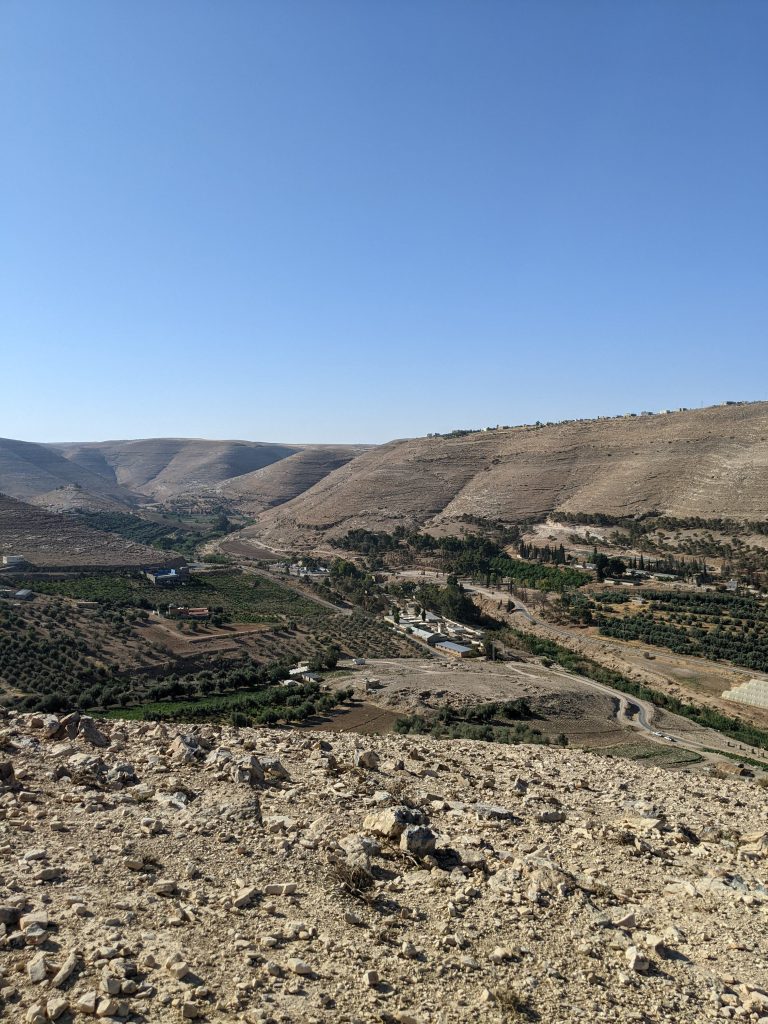
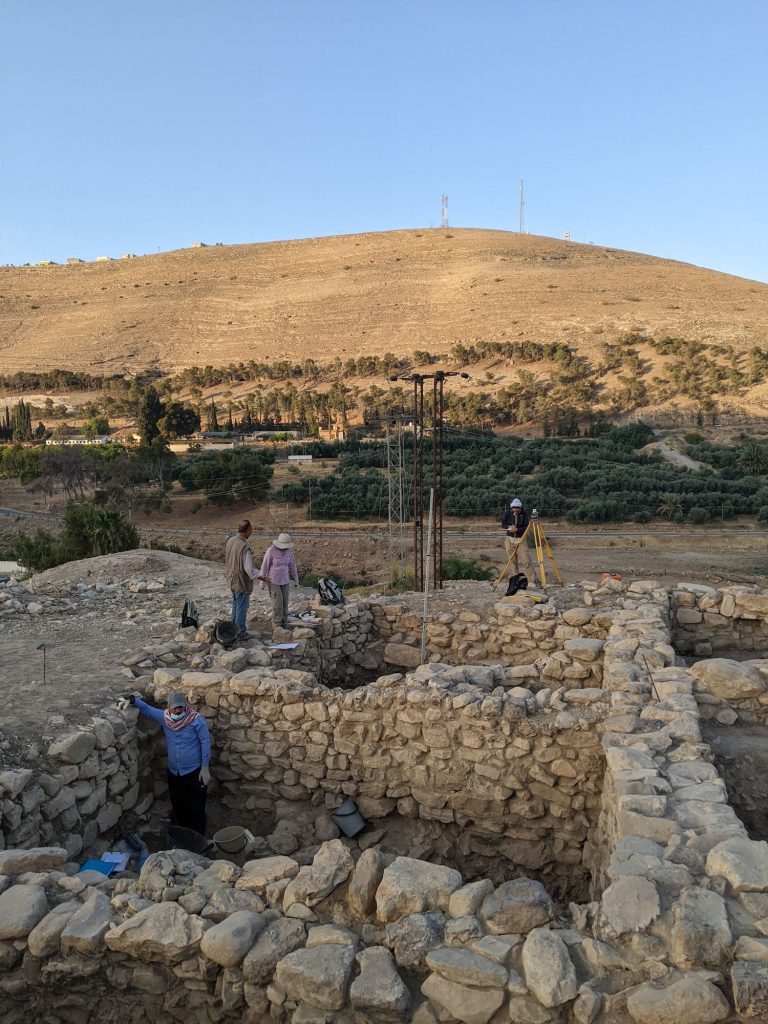
Driving south from the bustling town of Madaba, the sun rises over the rolling plains of the plateau. As we descend into the Wadi al-Wala canyon, the Khirbat Iskandar (KI) mound comes into view. Its position provides visual access east and west along the wadi and south to the slopes that lead into Dhiban. It is easy to see the importance of its position in the landscape. As we climb the gravely path to the site, the sun crests the hill to the east and the light slowly begins to illuminate the EB III and IV contexts in which we have been meticulously working this season.

Khirbat Iskandar and the Wadi al-Wala from above.

Excavations at KI have been ongoing since the 1980s, each season further revealing the site’s significance as an urban settlement during a time often marked by trends of ruralization in the southern Levant. The 2022 field season at KI shed new light on the pivotal Early Bronze III/IV nexus and provided new contexts that help expose the continuation of habitation at the site. We began the season with a clear set of goals divided between three excavation units. With a team of only 10, we were limited in what we could achieve in a set period of time. But with the experience at hand we were able to efficiently and effectively answer questions lingering from seasons before and build upon existing theories about KI’s role during the later EBA. The main objective was to continue to define the phasing for Area C, an excavation field in the southeastern corner of the tell. We aimed to do this by linking loci between trenches with known and new architectural and material phasing. In doing so, we could gain a more well-rounded picture of the associated phasing of the EB IV within Area C and in turn, the EB III/IV horizon.

We were successful in all our excavation goals, but archaeology is about more than just digging. My dissertation research focuses on micro and macro scales of the KI landscape and this field season provided the opportunity to not only develop my understanding of the EB III/IV at the site, but it also allowed me to garner a better appreciation of KI’s position in the greater region. KI’s setting along a possible route of travel is what initially inspired me to explore the connections between EBA sites in the Central Moab area. One of my personal goals this season was to take time to visit other regional sites and the spaces in between to better understand KI’s physical connections to neighboring locales. I was able to do so, moving at my own pace and experiencing these distances between sites, which caused me to think more about other aspects that impact movement and connections between spaces. A visit to the Chalcolithic and EB IA site of Murayghat was particularly impactful. Its position on a plateau surrounded on three sides with slopes covered in dolmens and the fourth side, a sweeping view into the valley below and hilltops beyond, provided a unique context by which to think about the relationships of spaces dedicated to both mortuary and domestic settings and how they could be perceived by visitors. A stop at Bab adh-Dhra’ was likewise a highlight and furthered my interest in the topic of the intersection of the living and dead spaces and how the various uses and perceptions of these spaces may have been communicated throughout the EBA. While I have studied these sites individually and tried to assess their spatial and social proximities digitally, I still lacked the ability to grasp what travel across some of these landforms and distances meant in reality. As I continue to develop my research on landscape-based approaches to the spatial and social connections in the southern Levant, field seasons like this greatly improve my ability to accurately contextualize and represent movement at the time.


Tucker Deady is currently a PhD student at the University of Toronto in the Department of Near and Middle Eastern Civilizations. Tucker’s areas of interest include landscape archaeology, GIS, and the Early Bronze Age of the Southern Levant.


Read more about the Khirbat Iskandar project here.

ASOR is now accepting applications for 2023 Fieldwork Participation Scholarships!

Learn more about applying here. 

Want to help more students and early career archaeologists get into the field? Donate to the cause today by selecting “Student Support” as your gift purpose!

2023 Early Career Scholars Committee

[vc_row fullwidth=”true” css=”.vc_custom_1490224714943{padding-top: 0px !important;padding-right: 0px !important;padding-bottom: 0px !important;padding-left: 0px !important;}”][vc_column][vc_single_image image=”30862″ img_size=”full” alignment=”center”][/vc_column][/vc_row][vc_row][vc_column][vc_column_text][/vc_column_text][/vc_column][/vc_row][vc_row fullwidth=”true” css=”.vc_custom_1490225468623{padding-top: 0px !important;padding-right: 0px !important;padding-bottom: 0px !important;padding-left: 0px !important;}”][vc_column width=”1/12″ css=”.vc_custom_1490225195470{margin-right: 10px !important;}” offset=”vc_hidden-sm vc_hidden-xs”][vc_column_text]

  SHARE

[/vc_column_text][mk_image src=”http://www.asortest.org/wp-content/uploads/2017/01/social-fb-icon4.jpg” image_width=”42″ image_height=”42″ hover=”false” custom_url=”https://www.facebook.com/ASOResearch/” margin_bottom=”0″][mk_image src=”http://www.asortest.org/wp-content/uploads/2017/01/social-tw-icon4.jpg” image_width=”42″ image_height=”42″ hover=”false” custom_url=”https://twitter.com/ASOResearch?ref_src=twsrc%5Egoogle%7Ctwcamp%5Eserp%7Ctwgr%5Eauthor” margin_bottom=”0″][mk_image src=”http://www.asortest.org/wp-content/uploads/2017/01/social-in-icon4.jpg” image_width=”42″ image_height=”42″ hover=”false” custom_url=”https://www.linkedin.com/company/american-schools-of-oriental-research” margin_bottom=”0″][mk_image src=”http://www.asortest.org/wp-content/uploads/2017/01/social-ml-icon_7.jpg” image_width=”42″ image_height=”42″ hover=”false” custom_url=”mailto:info@asor.org” margin_bottom=”0″][mk_image src=”http://www.asortest.org/wp-content/uploads/2017/01/blog-icon3.jpg” image_width=”42″ image_height=”42″ hover=”false” custom_url=”http://asor.org/blog” margin_bottom=”0″][/vc_column][vc_column border_color=”rgba(255,255,255,0.01)” width=”1/6″ css=”.vc_custom_1490365673198{margin-right: 20px !important;border-left-width: 2px !important;padding-right: 20px !important;padding-left: 20px !important;border-left-color: #99422f !important;}” el_class=”sticky-sidenav”][mk_divider divider_color=”rgba(255,255,255,0.01)” thickness=”1″ margin_top=”3″ margin_bottom=”3″][vc_widget_sidebar sidebar_id=”ca-sidebar-37292″ el_class=”.widget { overflow: hidden; margin-bottom: 0; }”][/vc_column][vc_column border_color=”rgba(170,170,170,0.01)” width=”1/2″ css=”.vc_custom_1490225606852{margin-right: 10px !important;margin-bottom: 30px !important;border-right-width: 2px !important;border-bottom-width: 2px !important;padding-top: 30px !important;padding-right: 30px !important;padding-left: 20px !important;background-color: #ffffff !important;border-right-color: rgba(227,228,228,0.75) !important;border-bottom-color: rgba(227,228,228,0.75) !important;}”][vc_column_text responsive_align=”left”]

2023 EARLY CAREER SCHOLARS COMMITTEE

Archived webpage for the 2023 Committee Members; This page has been replaced

The Early Career Scholars Committee takes responsibility for championing the views and needs of ASOR’s early career scholars (a group defined as including all ASOR members who qualify for the Undergraduate, Graduate, and Early Career membership rates); hosting a luncheon and other programming as deemed appropriate for Early Career Scholars at the ASOR Annual Meeting; and working with the ASOR staff, ASOR leadership, and the ASOR Board of Trustees to further the goal articulated in the ASOR 2021-2025 Strategic Plan, to develop strategies to foster the next generation of scholars of the Near East and wider Mediterranean and promote their success. ASOR Early Career Scholars include all ASOR members who qualify for the following levels of membership: Early Career, Graduate, and Undergraduate.

  • Tiffany Earley-Spadoni, Co-Chair (until December 31, 2024)
  • Vanessa Workman, Co-Chair (until December 31, 2025)
  • Shira Albaz, Early Career Scholar Member (until December 31, 2023)
  • Noelle Astillero, Undergraduate Student Member, (until December 31, 2024)
  • Owen Chesnut, Early Career Scholar Member (until December 31, 2024)
  • Cecelia Chisdock, Graduate Student Member (until December 31, 2023)
  • Elena De Rosa, Early Career Scholar Member (until December 31, 2024)
  • Maggie Geoga, Early Career Scholar Member (until December 31, 2024)
  • Ashley Koca, Undergraduate Student Member, (until December 31, 2024)
  • Marta Ostovich, ASOR Staff Member (ex officio, non-voting)
  • Luiza Osorio G. Silva, Early Career Scholar Member, (until December 31, 2024)
  • Avary Taylor, Early Career Scholar Member (until December 31, 2024), Liaison to the DEI Committee
  • Zachary Thomas, Early Career Scholar Member (until December 31, 2024)
  • Jessica Tomkins, Early Career Scholar Member (until December 31, 2023)
  • Sarah Wenner, Early Career Scholar Member, (until December 31, 2024), Liaison to the Program Committee

Subcommittees

Community & Networking

Tiffany Earley-Spadoni (chair), Cecilia Chisdock, Elena De Rosa, Zachary Thomas

Academic and Professionalization Programming

Vanessa Workman (chair), Shira Albaz, Owen Chesnut, Maggie Geoga, Luiza Osorio G. Silva, Jessica Tomkins


Early Career Member Resources

ASOR Early Career Scholars Facebook Page[/vc_column_text][mk_divider][vc_column_text]

Past Early Career Scholars Committee Members

[/vc_column_text][/vc_column][vc_column border_color=”rgba(170,170,170,0.01)” width=”1/6″ css=”.vc_custom_1490571214409{margin-right: 10px !important;margin-bottom: 30px !important;border-right-width: 2px !important;border-bottom-width: 2px !important;padding-top: 30px !important;padding-right: 20px !important;padding-left: 20px !important;background-color: #ffffff !important;border-right-color: rgba(227,228,228,0.75) !important;border-bottom-color: rgba(227,228,228,0.75) !important;}”][vc_wp_posts title=”BROWSE THE NEWS ARCHIVE” number=”4″][/vc_column][vc_column border_color=”rgba(170,170,170,0.01)” width=”1/6″ css=”.vc_custom_1490225688999{margin-right: 10px !important;margin-bottom: 30px !important;border-right-width: 2px !important;border-bottom-width: 2px !important;padding-top: 30px !important;padding-right: 30px !important;padding-left: 20px !important;background-color: #ffffff !important;border-right-color: rgba(227,228,228,0.75) !important;border-bottom-color: rgba(227,228,228,0.75) !important;}”][vc_column_text] [/vc_column_text][/vc_column][/vc_row][vc_row][vc_column][vc_column_text]

[/vc_column_text][/vc_column][/vc_row]

2023 Publications Committee

[vc_row fullwidth=”true” css=”.vc_custom_1490224714943{padding-top: 0px !important;padding-right: 0px !important;padding-bottom: 0px !important;padding-left: 0px !important;}”][vc_column][vc_single_image image=”30182″ img_size=”full”][/vc_column][/vc_row][vc_row][vc_column][vc_column_text][/vc_column_text][/vc_column][/vc_row][vc_row fullwidth=”true” css=”.vc_custom_1490225468623{padding-top: 0px !important;padding-right: 0px !important;padding-bottom: 0px !important;padding-left: 0px !important;}”][vc_column width=”1/12″ css=”.vc_custom_1490225195470{margin-right: 10px !important;}” offset=”vc_hidden-sm vc_hidden-xs”][vc_column_text]

  SHARE

[/vc_column_text][mk_image src=”http://www.asortest.org/wp-content/uploads/2017/01/social-fb-icon4.jpg” image_width=”42″ image_height=”42″ hover=”false” custom_url=”https://www.facebook.com/ASOResearch/” margin_bottom=”0″][mk_image src=”http://www.asortest.org/wp-content/uploads/2017/01/social-tw-icon4.jpg” image_width=”42″ image_height=”42″ hover=”false” custom_url=”https://twitter.com/ASOResearch?ref_src=twsrc%5Egoogle%7Ctwcamp%5Eserp%7Ctwgr%5Eauthor” margin_bottom=”0″][mk_image src=”http://www.asortest.org/wp-content/uploads/2017/01/social-in-icon4.jpg” image_width=”42″ image_height=”42″ hover=”false” custom_url=”https://www.linkedin.com/company/american-schools-of-oriental-research” margin_bottom=”0″][mk_image src=”http://www.asortest.org/wp-content/uploads/2017/01/social-ml-icon_7.jpg” image_width=”42″ image_height=”42″ hover=”false” custom_url=”mailto:info@asor.org” margin_bottom=”0″][mk_image src=”http://www.asortest.org/wp-content/uploads/2017/01/blog-icon3.jpg” image_width=”42″ image_height=”42″ hover=”false” custom_url=”http://asor.org/blog” margin_bottom=”0″][/vc_column][vc_column border_color=”rgba(255,255,255,0.01)” width=”1/6″ css=”.vc_custom_1490365673198{margin-right: 20px !important;border-left-width: 2px !important;padding-right: 20px !important;padding-left: 20px !important;border-left-color: #99422f !important;}” el_class=”sticky-sidenav”][mk_divider divider_color=”rgba(255,255,255,0.01)” thickness=”1″ margin_top=”3″ margin_bottom=”3″][vc_widget_sidebar sidebar_id=”ca-sidebar-37292″ el_class=”.widget { overflow: hidden; margin-bottom: 0; }”][/vc_column][vc_column border_color=”rgba(170,170,170,0.01)” width=”1/2″ css=”.vc_custom_1490225606852{margin-right: 10px !important;margin-bottom: 30px !important;border-right-width: 2px !important;border-bottom-width: 2px !important;padding-top: 30px !important;padding-right: 30px !important;padding-left: 20px !important;background-color: #ffffff !important;border-right-color: rgba(227,228,228,0.75) !important;border-bottom-color: rgba(227,228,228,0.75) !important;}”][vc_column_text responsive_align=”left”]

2023 PUBLICATIONS COMMITTEE

Archived webpage for the 2023 Committee Members; This page has been replaced

The Publications Committee takes responsibility for overseeing ASOR publications, including ASOR’s three scholarly journals — the Bulletin of ASOR, Near Eastern Archaeology, and the Journal of Cuneiform Studies — and ASOR’s three monograph series — the Annual of ASOR (AASOR), the ASOR Archaeological Reports Series (ASOR – ARS), and the Journal of Cuneiform Studies Supplement Series (JCCSS). The committee oversees as well as ASOR’s digital database, the Levantine Ceramics Project, and ASOR’s Friends of ASOR e-newsletter, The ANE Today. In addition, the Publications Committee conducts searches for and recommends to the ASOR Board of Trustees individuals to serve as editors or in some cases co-editors of ASOR’s scholarly journals and monograph series. Typically, editors serve for three-year terms and can be renewed for a second term. Finally, the committee discusses and advises ASOR regarding new publication initiatives, especially digital publishing initiatives and making ASOR publications available through open access.

Kevin McGeough, Chair (until December 31, 2024)

Class of 2023

Mara Horowitz
Jeff Howry

Class of 2024

Jake Lauinger
Jennifer Singletary
Samuel Wolff

Class of 2025

Gary Arbino
Eric Kansa
Jimmy Schryver

Editors of ASOR Journals and Monographs

Susan Cohen (BASOR)
Marwan Kilani (BASOR)
Jana Mynářová (BASOR)
Regine Pruzsinszky (BASOR)
Stephanie Lynn Budin (NEA)
Piotr Michalowski (JCS)
Simeon Chavel (Ma’arav)
Bill Caraher (AASOR)
Jennie Ebeling (ASOR-ARS)
Jessica Nitschke (ANE Today)
Andrea Berlin (LCP)


Sharon Herbert (ex officio)
Andrew G. Vaughn (ex officio, non-voting)[/vc_column_text][mk_divider][vc_wp_text]

Past Publications Committee Members

[/vc_wp_text][mk_divider][vc_wp_text]

Minutes

November 2013
November 2012
November 2011
November 2006
November 2005
April 2005
November 2004
November 2003
May 2003
November 2002
April 2002
November 2001
November 2000
April 2000
November 1999
November 1998[/vc_wp_text][/vc_column][vc_column border_color=”rgba(170,170,170,0.01)” width=”1/6″ css=”.vc_custom_1490571214409{margin-right: 10px !important;margin-bottom: 30px !important;border-right-width: 2px !important;border-bottom-width: 2px !important;padding-top: 30px !important;padding-right: 20px !important;padding-left: 20px !important;background-color: #ffffff !important;border-right-color: rgba(227,228,228,0.75) !important;border-bottom-color: rgba(227,228,228,0.75) !important;}”][vc_wp_posts title=”BROWSE THE NEWS ARCHIVE” number=”4″][/vc_column][vc_column border_color=”rgba(170,170,170,0.01)” width=”1/6″ css=”.vc_custom_1490225688999{margin-right: 10px !important;margin-bottom: 30px !important;border-right-width: 2px !important;border-bottom-width: 2px !important;padding-top: 30px !important;padding-right: 30px !important;padding-left: 20px !important;background-color: #ffffff !important;border-right-color: rgba(227,228,228,0.75) !important;border-bottom-color: rgba(227,228,228,0.75) !important;}”][vc_column_text] [/vc_column_text][/vc_column][/vc_row][vc_row][vc_column][vc_column_text]

[/vc_column_text][/vc_column][/vc_row]

FOA Webinar: Sarah Parcak on February 8

FRIENDS OF ASOR WEBINARS

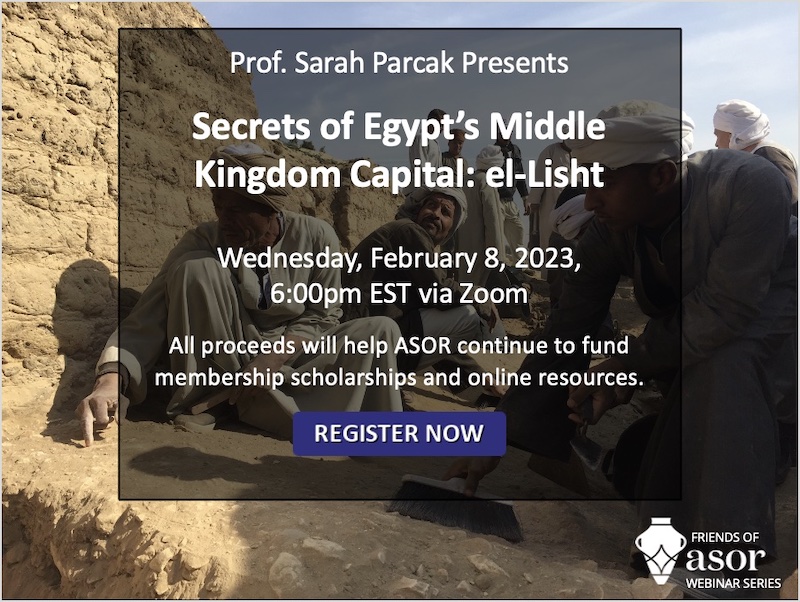
Secrets of Egypt’s Middle Kingdom Capital: el-Lisht

Friends of ASOR present the next webinar in our monthly series on February 8, 2023, at 6:00 pm EST, featuring Prof. Sarah Parcak and moderated by Prof. Kara Cooney. This lecture will discuss exciting new discoveries and ongoing work at the site of Lisht, Egypt. Lisht was Egypt’s Middle Kingdom Capital, called Itj-Tawy, dating to ca. 1900 BCE, and contains the pyramids of the two co-founders of Dynasty 12, Amenemhat 1 and Senwosret 1 (father and son), as well as a cemetery with the tombs of the many thousands of officials, artisans, and soldiers who called Itj-Tawy home. The city itself is buried in the floodplain, and its exact location is not known by Egyptologists. It is Egypt’s greatest primarily unexcavated ancient capital, and contains countless treasures that will help to rewrite the history of a period of time about which we know relatively little compared to Egypt’s Old and New Kingdoms (The Pyramid age and Egypt’s Golden age).

The Lisht Mission, a Joint project between the University of Alabama at Birmingham and Egypt’s Ministry of Antiquities, commenced work in 2015, discovering a tomb of a previously unattested individual, over 800 Middle Kingdom tombs, and the hints of Itj-tawy’s suburbs. We will discuss the project, as well as future plans at the site using new mapping technologies.

Join Prof. Parcak as she uncovers the secrets of this intriguing site and what it can tell us about life in Egypt during the Middle Kingdom period. The webinar will conclude with a Q&A session with fellow Egyptologist, Prof. Kara Cooney (University of California, Los Angeles).

Sarah Parcak, is an Archaeologist and Egyptologist and has worked on excavations in 14 countries across the globe since 1999. Sarah attended Yale University for her BA, and received her M.Phil and PhD degrees from Cambridge University in the UK in 2005. She lectured at the University of Wales-Swansea before starting work in the Dept of Anthropology at the University of Alabama at Birmingham in 2006, where she is now a full Professor.

Sarah is the author of Satellite Remote Sensing For Archaeology (Routledge 2009) and Archaeology from Space: How the Future Shapes Our Past (Henry Holt 2019), which won the Phi Beta Kappa 2020 Book Award for Science, as well as many peer-reviewed academic papers. She is a National Geographic Society Explorer, a Young Global Leader, a Fellow of the Society of Antiquaries, a TED Senior Fellow, winner of the 2016 TED Prize, 2016 recipient of the Smithsonian Institute American Ingenuity Award, a 2018 recipient of the Explorer’s Club Lowell Thomas Award, and a 2020 recipient of the Roy Chapman Andrews Society Distinguished Explorer’s Award.

Sarah serves as the Founder and President of Globalxplorer, a non-profit dedicated to using cutting edge technologies to protect and preserve cultural heritage. She co-directs the Joint Lisht Mission with Egypt’s Ministry of Antiquities, which focuses on the excavation and survey of Egypt’s Middle Kingdom capital. Her research has been featured in multiple BBC-Discovery Channel and PBS-Nova documentaries.

Sarah collaborates with her husband, Dr. Greg Mumford, on multiple archaeology projects, when they are not busy chasing after their 10 year-old son Gabriel, who already knows more about ancient Egypt than they do. Her hobbies include birdwatching, golf, and baking.

This webinar will be recorded and all paid registrants will be sent a link to view the recording.

ASOR Sustaining Members: $0 | ASOR Members: $6 | Public: $12
Season Pass: ASOR Sustaining Members: $0 | ASOR Members: $75 | Public: $150
Buy one here!

To receive your ASOR member discount, log into the online store. If you are new to ASOR, please click on the “New Visitor Registration” link to register your e-mail address and choose a password for our online store. Once logged in, navigate to “Meeting and Event Registration” to register for the webinar and pay the fee. Each paid registrant will receive a confirmation e-mail when you pay for the webinar. If you do not receive this e-mail, then you are not registered. Please e-mail membership@asor.org with any questions or issues with registering.

You will be e-mailed the Zoom Webinar link in the week prior to the lecture on February 8, 2023. If you do not receive the link by the close of business two days before the webinar, please e-mail membership@asor.org immediately. This webinar will be recorded and all paid registrants will be sent a link to view the recording.

All proceeds from this webinar are used to fund scholarships for members as well as increasing ASOR’s online resources, which are free to the public.

READY FOR A WEBINAR SEASON PASS?

Buy a season pass for all the webinars* of the 2022-2023 FOA Webinar Season! 1) You will automatically receive the Zoom link for each webinar so no need to register each time. 2) You will also receive the recording of each webinar automatically after the event.

If you have missed webinars earlier in the season and still want to buy the pass, you will receive the links to the recordings of the webinars you missed in your automatic confirmation email after you buy the pass.

*Special symposiums may be excluded from the season pass price.

No more registering for a year if you buy your pass today!

Pricing:

Members: $75.00
Non-Members: $150.00
ASOR Sustaining Members: $0 (automatic registration for each webinar)
Not a member yet? Click here to join as a member and receive the 50% off a season pass!


Log into our online store to purchase the season pass for 2022-2023. If you are new to ASOR and do not have a record in our store yet, click here to register. After you login, navigate to the left to “Meeting and Event Registration.” Please e-mail membership@asor.org if you have any questions or issues.

WHY SPONSOR A WEBINAR?

Several levels of support from $50-$1,000 are available. Proceeds go towards membership scholarships and towards increasing ASOR’s virtual resources. Each sponsorship is tax-deductible and you can give your friends free registrations to a webinar!

Bronze Level ($50): up to 2 guest registrations
Silver Level ($100): up to 5 guest registrations
Gold Level ($500): up to 20 guest registrations
Platinum Level ($1,000): up to 50 guest registrations

After you sign up for a sponsorship online or over the phone, email the names and email addresses of your guests to Felice Herman at membership@asor.org, who will send your guests a confirmation and the Zoom link before the webinar.

WANT TO SAVE $6.00 ON THE NEXT WEBINAR?

Join ASOR as a member! Click here for more details about discounts for events and other benefits of membership. Memberships start at $40 for the year as an Associate Member.

Not ready to join yet? Become a Friend of ASOR for FREE!

Click here for more details about our online resources.

PAST WEBINARS

You can now purchase the link to the recording of any webinar. You can also purchase the bundle packages of all webinars from the 2020-2022 seasons. Please e-mail membership@asor.org for purchase details.

To see a printable pdf of the webinar titles from the 2020-2021 season, please click here. To see a printable pdf of the webinar titles from the 2021-2022 season, please click here.

Pricing:

Members: $6.00 per recording
Non-Members: $12.00 per recording
Bundle of 2020-2021 Webinars: $75.00
Bundle of 2021-2022 Webinars: $75.00
Bundle of 2020-2022 Webinars: $125.00

2021-2022 Season

A World at War: Protecting Cultural Heritage in Times of Conflict
Patty Gerstenblith (DePaul University), Lisa Ackerman (Columbus Citizens Foundation), Andrew Cohen (Government Professional and Cultural Heritage Expert) | May 12, 2022

Preserving Cultural Heritage in Hisban and Umm al-Jimal, Jordan
Øystein LaBianca (Andrews University), Elizabeth Osinga (Umm al-Jimal Archaeological Project), Darrell Rohl (Calvin University) | April 24, 2022

Back to the Field: Recent Discoveries & Summer Plans 2022
Lorenzo d’Alfonso (ISAW), Kathryn Grossman (NC State University), James R. Strange (Samford University) | April 3, 2022

Uncovering What is Nubian Beneath the Veneer of Egyptianness: Excavating the Archives
Debora Heard (University of Chicago) | March 20, 2022

Where Are They Now?: A Preview of 2022 ASOR-Affiliated Fieldwork Projects
Michael Given (University of Glasgow), Xenia-Paula Kyriakou (Florida Gulf Coast University), Stephen Batiuk (University of Toronto), Monique Roddy (Walla Walla University), Kent Bramlett (La Sierra University), Friedbert Ninow (La Sierra University), and Michael Hoff (University of Nebraska-Lincoln) | March 8, 2022

Excavations at Tel Gezer: A Personal Story
Sam Wolff (Tel Gezer Laboratory) | February 20, 2022

Tel Rehov: A Major Bronze and Iron Age City in the Jordan Valley
Amihai Mazar (Hebrew University of Jerusalem), Nava Panitz-Cohen ( Hebrew University of Jerusalem), Nota Kourou (Athens University), Naama Yahalom-Mack (Hebrew University of Jerusalem), Robert Mullins (Azusa Pacific University) | February 10, 2022

The Not-So-Innocents Abroad: The Beginnings of American Biblical Archaeology
Rachel Hallote (Samford University) | January 20, 2022

Synagogues as Jesus Knew Them
James R. Strange (Samford University) | December 2, 2021

Under Jerusalem: The Buried History of the World’s Most Contested City
Andrew Lawler | November 4, 2021

Jesus and Jerusalem on TV: How Do Bible Documentaries Get Made?
Robert Cargill (University of Iowa) | October 17, 2021

Digging the Divine?: Judahite Pillar Figurines and the Archaeology of Israelite Religion
Erin Darby (University of Tennessee) | October 7, 2021

David, Solomon, and Rehoboam’s Kingdom—The Archaeological Evidence
Yosef Garfinkel (Hebrew University of Jerusalem) | September 19, 2021

From Standing Stones to Sacred Emptiness: Textual and Visual Portrayals of Israel’s God
Theodore Lewis (Johns Hopkins University) | August 29, 2021

2020-2021 Season

Making May Matter: Webinarathon to Endow Diversity
Multiple Speakers | May 21-23, 2021

Archaeogaming: Why Video Games Deserve Their Own Archaeology
Tine Rassalle (University of North Carolina at Chapel Hill), Shannon Martino (Morton College), Matthew Winter (University of Arizona), Michael Zimmerman (Rhode Island) | April 18, 2021

How the Bible Became a Book
William Schniedewind (UCLA) | March 21, 2021

The Mysteries of Mithras in Caesarea: Exploring the Cult’s Rites and Remains
Jane DeRose Evans (Temple University), Alexandra Ratzlaff (Brandeis University) | March 11, 2021

Archaeology and the Hidden Religious Culture of Israelite Women
Carol Meyers (Duke University) | February 21, 2021

Meet the Directors—Fundraiser to Support ASOR’s Affiliated Overseas Research Centers
Matthew J. Adams (AIAR), Pearce Paul Creasman (ACOR), Lindy Crewe (CAARI) | February 11, 2021

Early Synagogues, Jesus, and Galilee—A Jewish Perspective
Eric Meyers (Duke University) | December 13, 2020

Home Sweet Home: Ancient Israelite Households in Context
Cynthia Shafer-Elliott (William Jessup University) | October 18, 2020

Priestesses in the Days of Solomon and Ahab
Susan Ackerman (Dartmouth College) | September 13, 2020

Digging Deeper: How Archaeology Works
Eric H. Cline (The George Washington University) | August 9, 2020

FOA Webinar: Katie Paul on January 26

FRIENDS OF ASOR WEBINARS

Antiquities Trafficking in the Age of Social Media: How Big Tech Facilitates and Profits from the Digital Black Market

Friends of ASOR present the next webinar in our monthly series on January 26, 2023, at 6:00pm EST, featuring Katie A. Paul and moderated by Prof. Eric Cline. From the invasion of Ukraine to conflict in Syria, tech platforms like Facebook, YouTube, and TikTok have democratized global engagement in black markets. A new generation of tech-driven traffickers are capitalizing on Big Tech’s unregulated algorithms to maximize reach. Tech companies and traffickers alike profit from crime, providing monetization tools for antiquities looters to make money even without a sale.

When it comes to trafficking of cultural heritage and the financing of terrorism and organized crime, Big Tech platforms like Facebook and YouTube have provided digital toolkits that not only facilitate, but also accelerate the black market in cultural property while lining the pockets of both terror groups and tech companies alike.

Since 2018, the ATHAR Project has tracked networks of black-market antiquities trafficking groups across Facebook and other Big Tech platforms and documented thousands of artifacts trafficked in private and public Facebook groups to preserve critical evidence of looting and trafficking in the MENA region.

Technology companies have largely allowed traffickers and extremists to utilize these tools with impunity. The reach provided by Big Tech platforms has added a new dimension to terror finance and transnational crime, enabling illicit actors to more effectively traffic artifacts and finance their activities.

Facebook announced a ban of the trade of artifacts on its platform in June 2020. But a policy is only as valuable as its enforcement, and despite our multiple efforts to report antiquities trafficking content, Facebook makes no attempt to enforce their policy. Facebook is essentially knowingly facilitating the trafficking of cultural property that can amount to war crimes—and profiting from it.

No innovation of this kind has previously been so readily available to terror groups, transnational criminal organizations, or the average looter as it is today. The ATHAR Project’s years of research on Big Tech’s antiquities black market gives new insights into the next generation of traffickers and the type of regulation needed to reel in the growth of online black markets.

Join Katie Paul as she exposes the illegalities that lurk in plain sight on your favorite social media platforms. The webinar will conclude with a live Q&A session moderated by Prof. Eric Cline (The George Washington University).

Katie A. Paul (@AnthroPaulicy) is an anthropologist and investigative researcher who serves as the director of the Tech Transparency Project (TTP), where she specializes in tracking extremism, disinformation, and criminal activity on online platforms such as Facebook. She also serves as co-director and co-founder of the Antiquities Trafficking and Heritage Anthropology Research (ATHAR) Project and a founding member of the Alliance to Counter Crime Online (ACCO) where she focuses on trafficking, terror finance, and organized crime facilitated by Big Tech platforms.

Previously, Katie served as chief of staff and a research fellow at the Antiquities Coalition, a Washington, DC-based non-profit dedicated to combating cultural racketeering. She holds a bachelor’s degree from Miami University (OH) with a double major in Anthropology and Ancient Greek and earned an M.A. in Anthropology at The George Washington University.

This webinar will be recorded and all paid registrants will be sent a link to view the recording.

ASOR Sustaining Members: $0 | ASOR Members: $6 | Public: $12
Season Pass: ASOR Sustaining Members: $0 | ASOR Members: $75 | Public: $150
Buy one here!

To receive your ASOR member discount, log into the online store. If you are new to ASOR, please click on the “New Visitor Registration” link to register your e-mail address and choose a password for our online store. Once logged in, navigate to “Meeting and Event Registration” to register for the webinar and pay the fee. Each paid registrant will receive a confirmation e-mail when you pay for the webinar. If you do not receive this e-mail, then you are not registered. Please e-mail membership@asor.org with any questions or issues with registering.

You will be e-mailed the Zoom Webinar link in the week prior to the lecture on January 26, 2023. If you do not receive the link by the close of business two days before the webinar, please e-mail membership@asor.org immediately. This webinar will be recorded and all paid registrants will be sent a link to view the recording.

All proceeds from this webinar are used to fund scholarships for members as well as increasing ASOR’s online resources, which are free to the public.

READY FOR A WEBINAR SEASON PASS?

Buy a season pass for all the webinars* of the 2022-2023 FOA Webinar Season! 1) You will automatically receive the Zoom link for each webinar so no need to register each time. 2) You will also receive the recording of each webinar automatically after the event.

If you have missed webinars earlier in the season and still want to buy the pass, you will receive the links to the recordings of the webinars you missed in your automatic confirmation email after you buy the pass.

*Special symposiums may be excluded from the season pass price.

No more registering for a year if you buy your pass today!

Pricing:

Members: $75.00
Non-Members: $150.00
ASOR Sustaining Members: $0 (automatic registration for each webinar)
Not a member yet? Click here to join as a member and receive the 50% off a season pass!


Log into our online store to purchase the season pass for 2022-2023. If you are new to ASOR and do not have a record in our store yet, click here to register. After you login, navigate to the left to “Meeting and Event Registration.” Please e-mail membership@asor.org if you have any questions or issues.

WHY SPONSOR A WEBINAR?

Several levels of support from $50-$1,000 are available. Proceeds go towards membership scholarships and towards increasing ASOR’s virtual resources. Each sponsorship is tax-deductible and you can give your friends free registrations to a webinar!

Bronze Level ($50): up to 2 guest registrations
Silver Level ($100): up to 5 guest registrations
Gold Level ($500): up to 20 guest registrations
Platinum Level ($1,000): up to 50 guest registrations

After you sign up for a sponsorship online or over the phone, email the names and email addresses of your guests to Felice Herman at membership@asor.org, who will send your guests a confirmation and the Zoom link before the webinar.

WANT TO SAVE $6.00 ON THE NEXT WEBINAR?

Join ASOR as a member! Click here for more details about discounts for events and other benefits of membership. Memberships start at $40 for the year as an Associate Member.

Not ready to join yet? Become a Friend of ASOR for FREE!

Click here for more details about our online resources.

PAST WEBINARS

You can now purchase the link to the recording of any webinar. You can also purchase the bundle packages of all webinars from the 2020-2022 seasons. Please e-mail membership@asor.org for purchase details.

To see a printable pdf of the webinar titles from the 2020-2021 season, please click here. To see a printable pdf of the webinar titles from the 2021-2022 season, please click here.

Pricing:

Members: $6.00 per recording
Non-Members: $12.00 per recording
Bundle of 2020-2021 Webinars: $75.00
Bundle of 2021-2022 Webinars: $75.00
Bundle of 2020-2022 Webinars: $125.00

2021-2022 Season

A World at War: Protecting Cultural Heritage in Times of Conflict
Patty Gerstenblith (DePaul University), Lisa Ackerman (Columbus Citizens Foundation), Andrew Cohen (Government Professional and Cultural Heritage Expert) | May 12, 2022

Preserving Cultural Heritage in Hisban and Umm al-Jimal, Jordan
Øystein LaBianca (Andrews University), Elizabeth Osinga (Umm al-Jimal Archaeological Project), Darrell Rohl (Calvin University) | April 24, 2022

Back to the Field: Recent Discoveries & Summer Plans 2022
Lorenzo d’Alfonso (ISAW), Kathryn Grossman (NC State University), James R. Strange (Samford University) | April 3, 2022

Uncovering What is Nubian Beneath the Veneer of Egyptianness: Excavating the Archives
Debora Heard (University of Chicago) | March 20, 2022

Where Are They Now?: A Preview of 2022 ASOR-Affiliated Fieldwork Projects
Michael Given (University of Glasgow), Xenia-Paula Kyriakou (Florida Gulf Coast University), Stephen Batiuk (University of Toronto), Monique Roddy (Walla Walla University), Kent Bramlett (La Sierra University), Friedbert Ninow (La Sierra University), and Michael Hoff (University of Nebraska-Lincoln) | March 8, 2022

Excavations at Tel Gezer: A Personal Story
Sam Wolff (Tel Gezer Laboratory) | February 20, 2022

Tel Rehov: A Major Bronze and Iron Age City in the Jordan Valley
Amihai Mazar (Hebrew University of Jerusalem), Nava Panitz-Cohen ( Hebrew University of Jerusalem), Nota Kourou (Athens University), Naama Yahalom-Mack (Hebrew University of Jerusalem), Robert Mullins (Azusa Pacific University) | February 10, 2022

The Not-So-Innocents Abroad: The Beginnings of American Biblical Archaeology
Rachel Hallote (Samford University) | January 20, 2022

Synagogues as Jesus Knew Them
James R. Strange (Samford University) | December 2, 2021

Under Jerusalem: The Buried History of the World’s Most Contested City
Andrew Lawler | November 4, 2021

Jesus and Jerusalem on TV: How Do Bible Documentaries Get Made?
Robert Cargill (University of Iowa) | October 17, 2021

Digging the Divine?: Judahite Pillar Figurines and the Archaeology of Israelite Religion
Erin Darby (University of Tennessee) | October 7, 2021

David, Solomon, and Rehoboam’s Kingdom—The Archaeological Evidence
Yosef Garfinkel (Hebrew University of Jerusalem) | September 19, 2021

From Standing Stones to Sacred Emptiness: Textual and Visual Portrayals of Israel’s God
Theodore Lewis (Johns Hopkins University) | August 29, 2021

2020-2021 Season

Making May Matter: Webinarathon to Endow Diversity
Multiple Speakers | May 21-23, 2021

Archaeogaming: Why Video Games Deserve Their Own Archaeology
Tine Rassalle (University of North Carolina at Chapel Hill), Shannon Martino (Morton College), Matthew Winter (University of Arizona), Michael Zimmerman (Rhode Island) | April 18, 2021

How the Bible Became a Book
William Schniedewind (UCLA) | March 21, 2021

The Mysteries of Mithras in Caesarea: Exploring the Cult’s Rites and Remains
Jane DeRose Evans (Temple University), Alexandra Ratzlaff (Brandeis University) | March 11, 2021

Archaeology and the Hidden Religious Culture of Israelite Women
Carol Meyers (Duke University) | February 21, 2021

Meet the Directors—Fundraiser to Support ASOR’s Affiliated Overseas Research Centers
Matthew J. Adams (AIAR), Pearce Paul Creasman (ACOR), Lindy Crewe (CAARI) | February 11, 2021

Early Synagogues, Jesus, and Galilee—A Jewish Perspective
Eric Meyers (Duke University) | December 13, 2020

Home Sweet Home: Ancient Israelite Households in Context
Cynthia Shafer-Elliott (William Jessup University) | October 18, 2020

Priestesses in the Days of Solomon and Ahab
Susan Ackerman (Dartmouth College) | September 13, 2020

Digging Deeper: How Archaeology Works
Eric H. Cline (The George Washington University) | August 9, 2020
Find One—Fund One 2023

Find One — Fund One: 2023 ASOR Scholarships and Grants

ASOR plans to celebrate our 123rd year (2023) by awarding more than $223,000 in fellowships, scholarships, and grants! This extraordinary commitment to our members has been made possible by you, our members and donors, who have established endowments or made annual contributions to these programs.


2022 William G. Dever Fellow, Krysta Fauria, at Legio, Israel.

We invite you to FIND ONE (a scholarship, fellowship, or grant) or to help FUND ONE (designated gifts to enable us to award even more, or unrestricted gifts to help with the costs of administering and distributing the awards).

ASOR plans to make four types of awards:

The deadline to apply for fieldwork scholarships and grants is a little over a month away (February 15 for scholarships, February 28 for grants). We invite you to apply and to share the word through your social media and other networks (please share this post).


Scholarship recipient Kathleen Forste teaches Menorca Archaeological Project (Spain) team members how to recover plant remains and microartifacts through flotation.

ASOR is able to provide these scholarships with the partnership of you, our many members and donors. You are enabling ASOR to establish new scholarships and grants through endowed funds, but your annual support (i.e., gifts this year) will allow ASOR to send more eager students and early-career scholars into the field. Please support archaeology’s next generation by making a gift today.

Because of the ongoing pandemic, your gifts are especially needed this year (2023) to fund . Your gifts to the  (unrestricted) help defray the costs of administering and distributing the growing number of scholarships and grants. You may also make a designated gift by choosing any category from the drop-down menu on the donations module.

Please spread the word and don’t hesitate to contact us if you have any questions (e-mail or call [703-789-9233]).

-The ASOR Team

ASOR LEGACY CIRCLE MEMBERS

ASOR’S LEGACY CIRCLE

The following people have made planned gifts and are members of the Legacy Circle:

Anonymous*
Susan Ackerman
Jeffrey A. Blakely
Emily Miller Bonney
Marcia Borowski
Oded Borowski
Vivian Bull*
Hanan Charaf
Eric H. Cline
Marion Dana
Stevan Dana
Lynn Dodd
Ted Dodd
Jane DeRose Evans
Debbie Fox
Sheldon Fox
Lawrence T. Geraty
Denise Gold
Timothy P. Harrison
Sharon C. Herbert
Norma Kershaw*
Ann-Marie Knoblauch
Alina Levy
Tom Levy
P. E. MacAllister*
Carol Meyers
Eric Meyers
Bob Mullins
Kiersten Neumann
Jonathan Rosenbaum
Susan Rosenbaum
James F. Ross*
Marilyn Schaub*
R. Thomas Schaub*
Joe D. Seger
Wayne Russell Shepard
H. Katharine Sheeler
Stuart Tyson Smith
Carolyn Midkiff Strange*
James F. Strange*
Andy Vaughn
Wendell W. Weir*
Frederick Winter
J. Edward Wright
Keeley Wright

*deceased

Please contact ASOR Executive Director Andy Vaughn (703-789-9232) for more information about joining the Legacy Circle or to let ASOR know if you have already made such a gift. Please consult your attorney and estate planning professional as you consider any planned gift.