ANE TODAY – 201712 – Child Sacrifice in Ancient Israel


December 2017

Vol. 5, No. 12

Child Sacrifice in Ancient Israel

By Heath D. Dewrell

“For the Judahites have done evil in my sight”—an oracle of Yahweh—“they have set their abominations in the House over which my Name is invoked, defiling it. They build the shrines of the Topheth, which is in the Valley of the Son of Hinnom, to burn their sons and their daughters in the fire—which I did not command, nor did it arise in my mind.” (Jeremiah 7:30–31)

Among the many accusations that the prophets of the Hebrew Bible level at their contemporaries, child sacrifice certainly ranks among the most egregious. The idea that the Israelites would sacrifice their own children is so shocking that one may be tempted to dismiss the charge merely as hyperbolic. But the accusation is hardly limited to Jeremiah. For instance, among the first commands in Deuteronomy’s collection of laws is:

When Yahweh your god has cut off before you the peoples among whom you are about to enter to dispossess, and you have dispossessed them and lived in their land, be careful lest you are ensnared by them, after they have been destroyed before you—lest you inquire about their gods, saying, “How did these peoples serve their gods? I also will do likewise.” You must not do likewise for Yahweh your god, because every abomination to Yahweh that he hates they have done for their gods—for they even burn their sons and their daughters in the fire to their gods! (Deut 12:29–31)

This is a warning to the Israelites not to imitate the depraved Canaanites by sacrificing Israelite children to Yahweh in the same way that Canaanites sacrificed their sons and daughters to their gods. But why would such a command exist among the corpora of biblical laws unless some Israelites were at least tempted to sacrifice their children to Yahweh? Further, the fact that the oracle in Jeremiah accuses them of precisely that only strengthens the suspicion that the practice of child sacrifice was a very real, and apparently quite controversial, issue in ancient Israel.
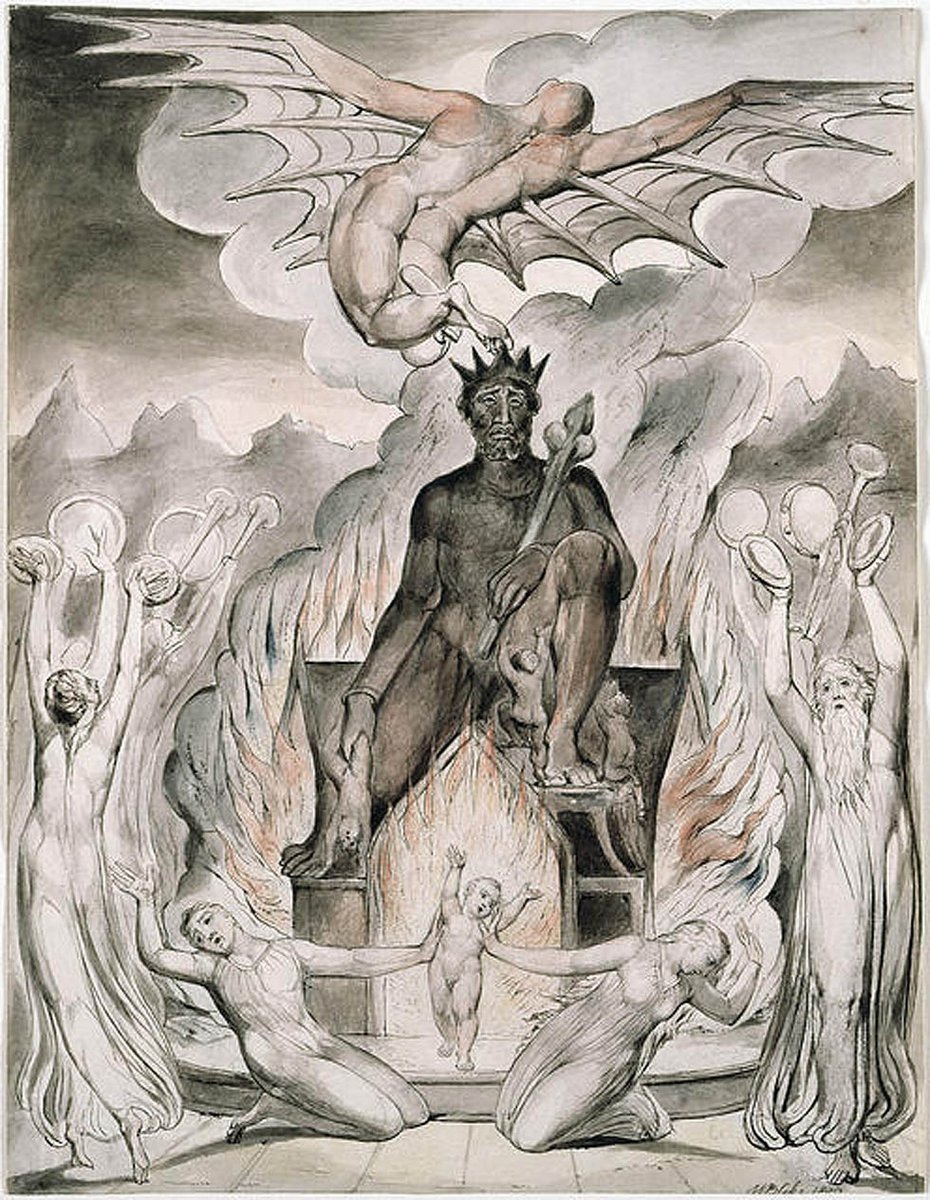

William Blake, The Flight of Moloch, 1809 (PBS)
Abraham’s Big Test (christianbook.org)

These are far from the only references to child sacrifice in the Hebrew Bible. While the story of Abraham’s near sacrifice of Isaac (Gen 22) is probably the most famous example, there are also less well-known tales, such as Jephthah’s sacrifice of his daughter in fulfillment of a vow (Judg 11–12) and King Mesha of Moab’s sacrifice of his firstborn son during what appeared to be a hopeless siege (2 Kgs 3). Various biblical law codes demand that the firstborn of one’s cattle and flocks be handed over as a sacrifice to Yahweh, but some passages suggest that the requirement applied to firstborn children as well. In most cases, firstborn children are to be “redeemed” via the offering of a sheep (e.g., Exod 34:19–20) or a cash payment to the priests (e.g., Num 18:15–16). But in at least one case no form of redemption is mentioned (Exod 22:28–29), possibly indicating that firstborn children were sacrificed in some Yahwistic circles.

Scholars have long debated whether the Israelites could have ever actually sacrificed their children. If so, to which god (or gods) and how pervasive was the practice? There is a general consensus that child sacrifice did indeed take place in ancient Israel, although there is little agreement on the extent to which the practice occurred or on other specifics. Some argue that children were never offered to Yahweh, but only to foreign Canaanite gods like “Molek,” while others argue that child sacrifice was an ancient part of Yahwistic religion, which only fell out of favor after such rites were condemned as foreign syncretism by revisionist rhetoric, including that of the Hebrew Bible.

In my recent monograph, Child Sacrifice in Ancient Israel, I address these arguments and, like most scholars, argue that at least some Israelites did sacrifice their children, probably to Yahweh. My primary objective, however, is not merely to address the existence or non-existence of Israelite child sacrifice. Instead, I collect all of the different types of evidence—biblical, archaeological, and epigraphic—to attempt to untangle the various forms of child sacrifice. “Child sacrifice” was not a homogeneous phenomenon any more than “sheep sacrifice.”

In some cases, children are said to have been sacrificed “as a mōlek-offering.” These offerings have good parallels in the Punic colonies, where an identically named rite involving child sacrifice appears in conjunction with vows. In other cases, firstborn children are offered during times of distress, such as a famine or a siege. In yet others, firstborn children are offered as a matter of course in acknowledgment of Yahweh’s claim to the first portion of all produce. Children were sacrificed for a variety of purposes in a variety of circumstances, and it appears that different groups of Yahwists practiced different forms of child sacrifice, while some—like those most prominently represented in the Hebrew Bible—practiced none of them.
Child Sacrifice in Ancient Israel
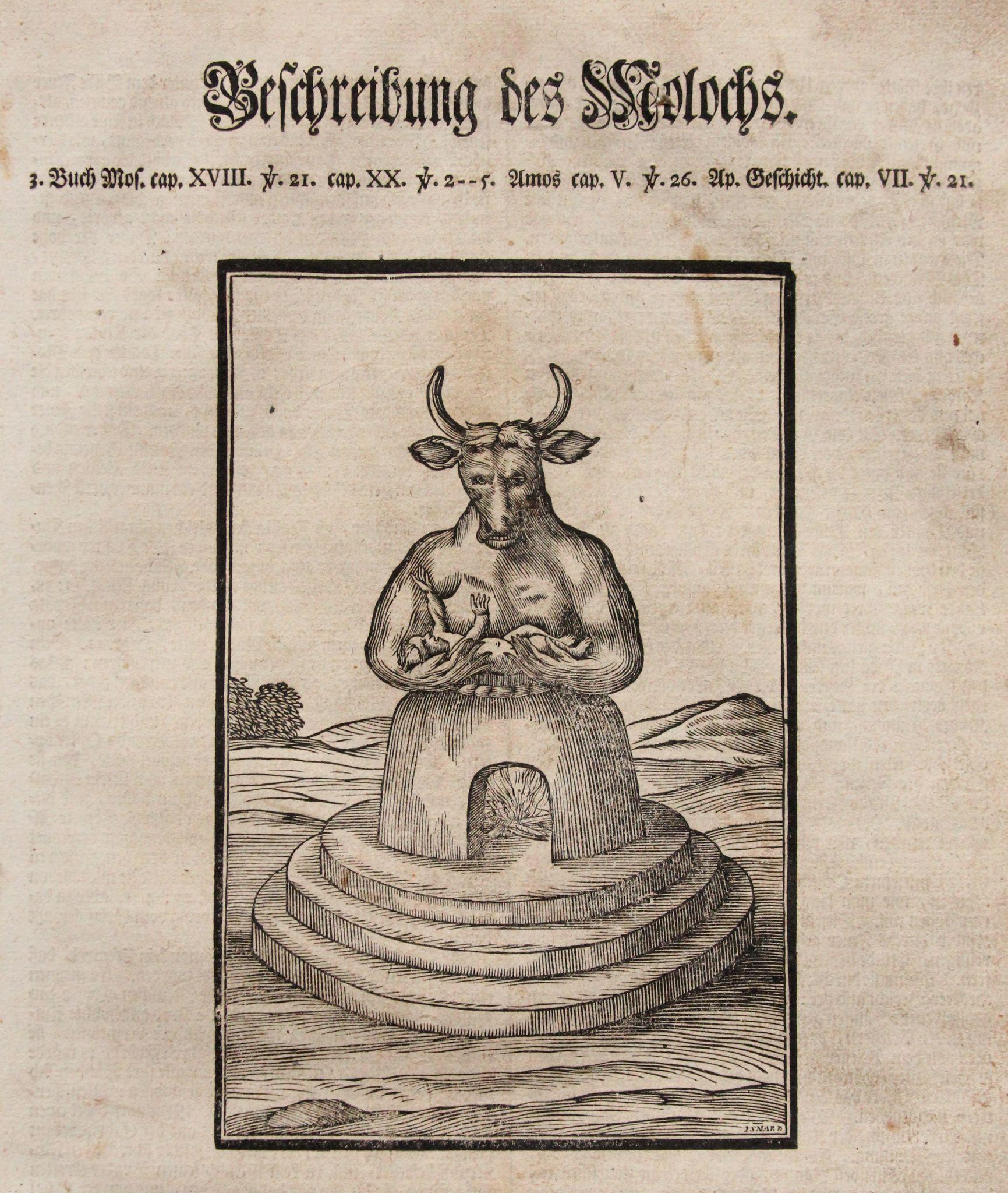
Molek by Isnard from a 1753 Martin Luther Bible

Turning to the rhetoric of the Hebrew Bible itself, it is interesting to note that, even among the groups that practiced no form of child sacrifice, there was a diversity of opinion on the topic. For instance, some biblical writers seem to assume that firstborn children were indeed owed to Yahweh, but that this obligation could be carried out via a substitute offering of some sort. Others, however, reject out of hand the idea that Yahweh’s claim to firstlings ever applied to children at all. Some texts, like the one from Deuteronomy quoted above, accuse reprobate Israelites of sacrificing their children to Yahweh as if he were one of the foreign gods of the Canaanites. Others, however, equate child sacrifice with the worship of Baal or idols and deny that Yahweh was ever linked with such offerings, even by “bad” Yahwists.

One striking example of such rhetorical disagreements among biblical authors opposing child sacrifice is the question of whether Yahweh ever commanded that children be sacrificed. In the Jeremiah passage quoted above, Yahweh flatly declares that child sacrifice is a thing that “I did not command, nor did it arise in my mind” (Jer 7:31). Ezekiel, on the other hand, suggests that Yahweh did command that children be sacrificed, but only as a punishment for the Israelites’ repeated faithlessness. There Yahweh declares that, because the Israelites did not follow Yahweh’s good laws by which they could live, “I gave them statutes that are not good and precepts by which they could not live. I defiled them by their gifts, in causing to pass over every firstborn, so that I might desolate them” (Ezek 20:25–26). In this case, there seems to be a disagreement about whether the version of the law of the firstborn that lacks any sort of redemption clause constitutes a legitimate Yahwistic law at all. Thus, examining the rhetoric surrounding child sacrifice reveals differences in opinion concerning which biblical law codes were authoritative, as well as how they ought to be interpreted.

Exploring the practice of child sacrifice provides a window into the diversity of Israelite Yahwism. There was diversity in practice among those Yahwists who sacrificed their children, but there were also a variety of rhetorical strategies employed by those who opposed such rites. While the Hebrew Bible today overwhelmingly condemns child sacrifice as abominable, this biblical consensus only emerged as the result of a struggle over the relationship of Yahweh worship to the sacrifice of children. While those who opposed all forms of child sacrifice obviously (and thankfully!) won the day, the fact that these debates are preserved at all indicates that at least some Israelites saw things differently.

Heath D. Dewrell is assistant professor of Old Testament at Princeton Theological Seminary.
ANE TODAY VOL V n12 (2017)

[vc_row fullwidth=”true” css=”.vc_custom_1486761987223{padding-top: 0px !important;padding-right: 0px !important;padding-bottom: 0px !important;padding-left: 0px !important;}”][vc_column][vc_single_image image=”33901″ img_size=”full”][/vc_column][/vc_row][vc_row fullwidth=”true” css=”.vc_custom_1487275830783{padding-top: 10px !important;padding-right: 0px !important;padding-bottom: 0px !important;padding-left: 0px !important;}”][vc_column width=”1/12″ css=”.vc_custom_1493002455400{margin-right: 10px !important;}” offset=”vc_hidden-md vc_hidden-sm vc_hidden-xs”][vc_column_text]

 SHARE

[/vc_column_text][mk_image src=”http://www.asortest.org/wp-content/uploads/2017/01/social-fb-icon4.jpg” image_width=”42″ image_height=”42″ hover=”false” custom_url=”https://www.facebook.com/ASOResearch/” margin_bottom=”0″][mk_image src=”http://www.asortest.org/wp-content/uploads/2017/01/social-tw-icon4.jpg” image_width=”42″ image_height=”42″ hover=”false” custom_url=”https://twitter.com/ASOResearch?ref_src=twsrc%5Egoogle%7Ctwcamp%5Eserp%7Ctwgr%5Eauthor” margin_bottom=”0″][mk_image src=”http://www.asortest.org/wp-content/uploads/2017/01/social-in-icon4.jpg” image_width=”42″ image_height=”42″ hover=”false” custom_url=”https://www.linkedin.com/company/american-schools-of-oriental-research” margin_bottom=”0″][mk_image src=”http://www.asortest.org/wp-content/uploads/2017/01/social-ml-icon_7.jpg” image_width=”42″ image_height=”42″ hover=”false” custom_url=”mailto:asor@bu.edu” margin_bottom=”0″][mk_image src=”http://www.asortest.org/wp-content/uploads/2017/01/blog-icon3.jpg” image_width=”42″ image_height=”42″ hover=”false” custom_url=”http://asorblog.org/” margin_bottom=”0″][/vc_column][vc_column border_color=”rgba(255,255,255,0.01)” width=”1/6″ css=”.vc_custom_1493004112151{margin-right: 20px !important;border-left-width: 2px !important;padding-right: 20px !important;padding-left: 20px !important;border-left-color: #99422f !important;}”][mk_divider divider_color=”rgba(255,255,255,0.01)” thickness=”1″ margin_top=”3″ margin_bottom=”3″][vc_widget_sidebar sidebar_id=”sidebar-16″ el_class=”.widget { overflow: hidden; margin-bottom: 0; }”][/vc_column][vc_column border_color=”rgba(170,170,170,0.01)” width=”8/12″ css=”.vc_custom_1487276122024{margin-right: 10px !important;margin-bottom: 30px !important;border-right-width: 2px !important;border-bottom-width: 2px !important;padding-top: 30px !important;padding-right: 30px !important;padding-left: 20px !important;background-color: #ffffff !important;border-right-color: rgba(227,228,228,0.75) !important;border-bottom-color: rgba(227,228,228,0.75) !important;}”][vc_row_inner][vc_column_inner width=”1/3″ css=”.vc_custom_1515087099843{padding-right: 20px !important;}”][mk_image src=”http://www.asor.org/wp-content/uploads/2017/12/foa-reduced-100.png” image_width=”190″ image_height=”100″ crop=”false” hover=”false”][/vc_column_inner][vc_column_inner width=”2/3″][vc_column_text responsive_align=”left”]

December 2017

Vol. 5, No. 12

[/vc_column_text][/vc_column_inner][/vc_row_inner][mk_divider thickness=”1″ margin_top=”0″][vc_row_inner][vc_column_inner][vc_column_text]

ANET December issue e-book:

  • “Child Sacrifice in Ancient Israel” by Heath D. Dewrell
  • “Visitors from the Intermediate Bronze Age? Crescent Headed Figures in Negev Rock Art” by Lior Schwimer and Yuval Yekutieli
  • “Of Stones and Social Complexity: The Shamir Dolmen Field and the Intermediate Bronze Age” by Uri Berger and Gonen Sharon
  • “A Magnificent Manor: Majdal Yaba: A Fortified Ottoman and British Mandate Period Manor House in Central Israel” by Itamar Taxel and Tsvika Tsuk


[/vc_column_text][mk_divider thickness=”1″ margin_top=”10″][vc_column_text]

A Magnificent Manor: Majdal Yābā – A Fortified Ottoman and British Mandate Period Manor House in Central Israel

By Itamar Taxel and Tsvika Tsuk

Within view of the modern town of Rosh Ha-‘Ayin is a site that was continuously inhabited between the Iron Age II and the British Mandate. Majdal Yābā is located on a hill at the western fringes of Samaria, overlooking the coastal plain and the eastern basin of the Yarqon River. Thanks to the impressive and well-preserved remains of a fortified monumental structure on the summit, it is visible from a distance. The site provides a unique view on not only the landscape but upper class Ottoman period society.

READ MORE

[/vc_column_text][/vc_column_inner][/vc_row_inner][mk_divider thickness=”1″ margin_top=”10″][vc_row_inner][vc_column_inner][vc_column_text]

Of Stones and Social Complexity – The Shamir Dolmen Field and the Intermediate Bronze Age

By Uri Berger and Gonen Sharon

Dolmens – megalithic stone tombs – are among the earliest archaeological features documented in the Levant, first reported in 1817. In 1850 the French researcher De Saulcy first used the term “dolmen” to describe the megaliths at Adeimeh in Jordan. During the 1880s, C.R. Conder of the Palestine Exploration Fund laid the foundation for dolmen studies, mapping, describing, and drawing dozens of them from Syria, the Jordan Valley, the Upper Galilee, and the Golan Heights.

READ MORE

[/vc_column_text][/vc_column_inner][/vc_row_inner][mk_divider thickness=”1″ margin_top=”10″][vc_row_inner][vc_column_inner][vc_column_text]

Visitors from the Intermediate Bronze Age? Crescent Headed Figures in Negev Rock Art

By Lior Schwimer and Yuval Yekutieli

The Negev is renowned for its countless examples of rock art, which date from remote proto-history until the modern period. Many of these are difficult to date, but new research suggests that a special class dates to the still enigmatic mid-third millennium BCE. Do they indicate something unexpected about that society?

READ MORE

[/vc_column_text][/vc_column_inner][/vc_row_inner][mk_divider thickness=”1″ margin_top=”10″][vc_row_inner][vc_column_inner][vc_column_text]

Child Sacrifice in Ancient Israel

By Heath D. Dewrell

“For the Judahites have done evil in my sight”—an oracle of Yahweh—“they have set their abominations in the House over which my Name is invoked, defiling it. They build the shrines of the Topheth, which is in the Valley of the Son of Hinnom, to burn their sons and their daughters in the fire—which I did not command, nor did it arise in my mind.” (Jeremiah 7:30–31)

Among the many accusations that the prophets of the Hebrew Bible level at their contemporaries.

READ MORE

[/vc_column_text][/vc_column_inner][/vc_row_inner][mk_divider thickness=”1″ margin_top=”10″][/vc_column][/vc_row]

ANE TODAY VOL V n11 (2017)

[vc_row fullwidth=”true” css=”.vc_custom_1486761987223{padding-top: 0px !important;padding-right: 0px !important;padding-bottom: 0px !important;padding-left: 0px !important;}”][vc_column][vc_single_image image=”33901″ img_size=”full”][/vc_column][/vc_row][vc_row fullwidth=”true” css=”.vc_custom_1487275830783{padding-top: 10px !important;padding-right: 0px !important;padding-bottom: 0px !important;padding-left: 0px !important;}”][vc_column width=”1/12″ css=”.vc_custom_1493002455400{margin-right: 10px !important;}” offset=”vc_hidden-md vc_hidden-sm vc_hidden-xs”][vc_column_text]

 SHARE

[/vc_column_text][mk_image src=”http://www.asortest.org/wp-content/uploads/2017/01/social-fb-icon4.jpg” image_width=”42″ image_height=”42″ hover=”false” custom_url=”https://www.facebook.com/ASOResearch/” margin_bottom=”0″][mk_image src=”http://www.asortest.org/wp-content/uploads/2017/01/social-tw-icon4.jpg” image_width=”42″ image_height=”42″ hover=”false” custom_url=”https://twitter.com/ASOResearch?ref_src=twsrc%5Egoogle%7Ctwcamp%5Eserp%7Ctwgr%5Eauthor” margin_bottom=”0″][mk_image src=”http://www.asortest.org/wp-content/uploads/2017/01/social-in-icon4.jpg” image_width=”42″ image_height=”42″ hover=”false” custom_url=”https://www.linkedin.com/company/american-schools-of-oriental-research” margin_bottom=”0″][mk_image src=”http://www.asortest.org/wp-content/uploads/2017/01/social-ml-icon_7.jpg” image_width=”42″ image_height=”42″ hover=”false” custom_url=”mailto:asor@bu.edu” margin_bottom=”0″][mk_image src=”http://www.asortest.org/wp-content/uploads/2017/01/blog-icon3.jpg” image_width=”42″ image_height=”42″ hover=”false” custom_url=”http://asorblog.org/” margin_bottom=”0″][/vc_column][vc_column border_color=”rgba(255,255,255,0.01)” width=”1/6″ css=”.vc_custom_1493004112151{margin-right: 20px !important;border-left-width: 2px !important;padding-right: 20px !important;padding-left: 20px !important;border-left-color: #99422f !important;}”][mk_divider divider_color=”rgba(255,255,255,0.01)” thickness=”1″ margin_top=”3″ margin_bottom=”3″][vc_widget_sidebar sidebar_id=”sidebar-16″ el_class=”.widget { overflow: hidden; margin-bottom: 0; }”][/vc_column][vc_column border_color=”rgba(170,170,170,0.01)” width=”8/12″ css=”.vc_custom_1487276122024{margin-right: 10px !important;margin-bottom: 30px !important;border-right-width: 2px !important;border-bottom-width: 2px !important;padding-top: 30px !important;padding-right: 30px !important;padding-left: 20px !important;background-color: #ffffff !important;border-right-color: rgba(227,228,228,0.75) !important;border-bottom-color: rgba(227,228,228,0.75) !important;}”][vc_row_inner][vc_column_inner width=”1/3″ css=”.vc_custom_1515087305797{padding-right: 20px !important;}”][mk_image src=”http://www.asor.org/wp-content/uploads/2017/12/foa-reduced-100.png” image_width=”190″ image_height=”100″ crop=”false” hover=”false”][/vc_column_inner][vc_column_inner width=”2/3″][vc_column_text responsive_align=”left”]

November 2017

Vol. 5, No. 11

[/vc_column_text][/vc_column_inner][/vc_row_inner][mk_divider thickness=”1″ margin_top=”0″][vc_row_inner][vc_column_inner][vc_column_text]

Not Just for the Birds: Pigeons in the Roman and Byzantine Near East

By Jennifer Ramsay

When we think of pigeons today, it is generally not with admiration but rather annoyance or even dread of being targeted by them. The original meaning of ‘for the birds’ was that something was worthless, which may be where we get our modern conception of pigeons. Nonetheless pigeons have played a unique role in human history.

READ MORE

[/vc_column_text][/vc_column_inner][/vc_row_inner][mk_divider thickness=”1″ margin_top=”10″][vc_row_inner][vc_column_inner][vc_column_text]

The Bible as Tool for Learning to Evaluate Competing Voices in an Age of “Fake News”

By Brendon C. Benz

Nicholas Lemann, professor of journalism at Columbia, opened his column, “Solving the Problem of Fake News” with the following observation: What we are now calling fake news—misinformation that people fall for—is nothing new.

READ MORE

[/vc_column_text][/vc_column_inner][/vc_row_inner][mk_divider thickness=”1″ margin_top=”10″][vc_row_inner][vc_column_inner][vc_column_text]

 An Affair of Herbal Medicine? The ‘Special’ Kitchen in the Royal Palace of Ebla

By Agnese Vacca, Luca Peyronel, and Claudia Wachter-Sarkady

In antiquity, like today, humans needed a wide range of medicines, but until recently there has been little direct archaeological evidence for producing medicines. That evidence, however, also suggests that Near Eastern palaces may have been in the pharmaceutical business.

READ MORE

[/vc_column_text][mk_divider thickness=”1″ margin_top=”10″][/vc_column_inner][/vc_row_inner][vc_row_inner][vc_column_inner][vc_column_text]

Beyond the Texts: An Archaeological Portrait of Ancient Israel and Judah

By William G. Dever

Countless books have been written about ancient Israel. But this work is the first mainstream history of ancient Israel to be published in English in 40 years. It also differs from previous scholarship by attempting to prove an alternative, archaeological based history, or as the title has it, a “portrait.”

READ MORE

[/vc_column_text][mk_divider thickness=”1″ margin_top=”10″][/vc_column_inner][/vc_row_inner][vc_row_inner][vc_column_inner][vc_column_text]The Ancient Near East Today features contributions from diverse academics, a forum featuring debates of current developments from the field, and links to news and resources. The ANE Today covers the entire Near East, and each issue presents discussions ranging from the state of biblical archaeology to archaeology after the Arab Spring.

Take a look at the contents of this e-book!

  • Beyond the Texts: An Archaeological Portrait of Ancient Israel and Judah
  • An Affair of Herbal Medicine? The ‘Special’ Kitchen in the Royal Palace of Ebla
  • The Bible as Tool for Learning to Evaluate Competing Voices in an Age of “Fake News”
  • Not Just for the Birds: Pigeons in the Roman and Byzantine Near East
DOWNLOAD E-BOOK

[/vc_column_text][mk_divider thickness=”1″ margin_top=”10″][/vc_column_inner][/vc_row_inner][/vc_column][/vc_row]

ANE TODAY Recent Articles

[vc_row fullwidth=”true” css=”.vc_custom_1486761987223{padding-top: 0px !important;padding-right: 0px !important;padding-bottom: 0px !important;padding-left: 0px !important;}”][vc_column][vc_single_image image=”33901″ img_size=”full”][/vc_column][/vc_row][vc_row fullwidth=”true” css=”.vc_custom_1487275830783{padding-top: 10px !important;padding-right: 0px !important;padding-bottom: 0px !important;padding-left: 0px !important;}”][vc_column width=”1/12″ css=”.vc_custom_1493002455400{margin-right: 10px !important;}” offset=”vc_hidden-md vc_hidden-sm vc_hidden-xs”][vc_column_text]

 SHARE

[/vc_column_text][mk_image src=”http://www.asortest.org/wp-content/uploads/2017/01/social-fb-icon4.jpg” image_width=”42″ image_height=”42″ hover=”false” custom_url=”https://www.facebook.com/ASOResearch/” margin_bottom=”0″][mk_image src=”http://www.asortest.org/wp-content/uploads/2017/01/social-tw-icon4.jpg” image_width=”42″ image_height=”42″ hover=”false” custom_url=”https://twitter.com/ASOResearch?ref_src=twsrc%5Egoogle%7Ctwcamp%5Eserp%7Ctwgr%5Eauthor” margin_bottom=”0″][mk_image src=”http://www.asortest.org/wp-content/uploads/2017/01/social-in-icon4.jpg” image_width=”42″ image_height=”42″ hover=”false” custom_url=”https://www.linkedin.com/company/american-schools-of-oriental-research” margin_bottom=”0″][mk_image src=”http://www.asortest.org/wp-content/uploads/2017/01/social-ml-icon_7.jpg” image_width=”42″ image_height=”42″ hover=”false” custom_url=”mailto:info@asor.org” margin_bottom=”0″][mk_image src=”http://www.asortest.org/wp-content/uploads/2017/01/blog-icon3.jpg” image_width=”42″ image_height=”42″ hover=”false” custom_url=”http://asor.org/blog” margin_bottom=”0″][/vc_column][vc_column border_color=”rgba(255,255,255,0.01)” width=”1/6″ css=”.vc_custom_1493004112151{margin-right: 20px !important;border-left-width: 2px !important;padding-right: 20px !important;padding-left: 20px !important;border-left-color: #99422f !important;}”][mk_divider divider_color=”rgba(255,255,255,0.01)” thickness=”1″ margin_top=”3″ margin_bottom=”3″][vc_widget_sidebar sidebar_id=”sidebar-16″ el_class=”.widget { overflow: hidden; margin-bottom: 0; }”][vc_row_inner][vc_column_inner css=”.vc_custom_1632941263398{padding-top: 10px !important;padding-right: 10px !important;padding-bottom: 5px !important;padding-left: 10px !important;background-image: url(https://www.asor.org/wp-content/uploads/2021/09/ASOR_Patterns_CMYK_Blue_Thin.jpg?id=77162) !important;}”][vc_column_text]

Not a Friend of ASOR yet? Sign up here to receive ANE Today in your inbox weekly!

[/vc_column_text][/vc_column_inner][/vc_row_inner][/vc_column][vc_column border_color=”rgba(170,170,170,0.01)” width=”8/12″ css=”.vc_custom_1487276122024{margin-right: 10px !important;margin-bottom: 30px !important;border-right-width: 2px !important;border-bottom-width: 2px !important;padding-top: 30px !important;padding-right: 30px !important;padding-left: 20px !important;background-color: #ffffff !important;border-right-color: rgba(227,228,228,0.75) !important;border-bottom-color: rgba(227,228,228,0.75) !important;}”][mk_divider thickness=”1″ margin_top=”10″][vc_row_inner][vc_column_inner width=”1/3″ css=”.vc_custom_1515088776988{padding-right: 20px !important;}”][mk_image src=”http://www.asor.org/wp-content/uploads/2017/12/foa-reduced-100.png” image_width=”190″ image_height=”100″ crop=”false” hover=”false”][/vc_column_inner][vc_column_inner width=”2/3″][vc_column_text responsive_align=”left”]

Read the latest exciting articles from The Ancient Near East Today

[/vc_column_text][/vc_column_inner][/vc_row_inner][vc_column_text]

Are Possession and Other Spirit Phenomena Depicted in the Hebrew Bible?

By Reed Carlson

Many scholars rule out the presence of spirit phenomena in the Hebrew Bible. Reed Carlson explains why this is a mistake. Read More[/vc_column_text][mk_divider thickness=”1″ margin_top=”10″][vc_column_text]

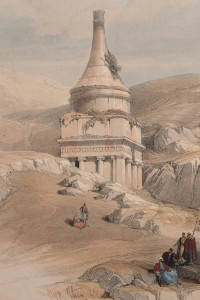
The “Tomb of Absalom”: The Earliest Judeo-Christian Place of Pilgrimage in Jerusalem

By Joe Zias

The so-called Tomb of Absalom is one of the most enigmatic monuments in Jerusalem. Can new archaeological discoveries shed light on its puzzling history? Read More[/vc_column_text][mk_divider thickness=”1″ margin_top=”10″][vc_column_text]

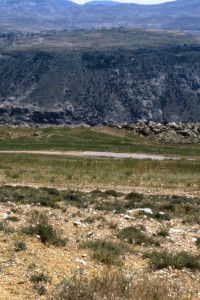
The Emergence of Edom: Recent Debate

By Piotr Bienkowski

It’s long been believed that the kingdom of Edom emerged in the 8th century BCE in the highlands of southern Jordan. Do recent discoveries of early Iron Age copper production change that? Read More[/vc_column_text][mk_divider thickness=”1″ margin_top=”10″][vc_column_text]

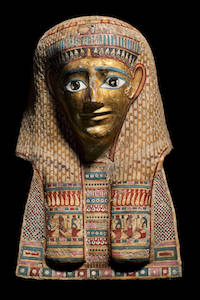
Achieving Divinity: “Golden Mummies of Egypt” at Manchester Museum

By Campbell Price

The primary purpose of the ancient Egyptian mummification ritual wasn’t to preserve the mortal body for the afterlife — it was to transform the deceased into a divine being. Read More[/vc_column_text][mk_divider thickness=”1″ margin_top=”10″][vc_column_text]

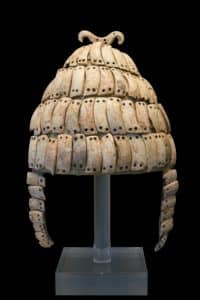
What can Mythological Narratives tell us about Mycenaean Long-Distance Trade in the Bronze Age?

By Jörg Mull

It’s still an open question among scholars whether Mycenaeans participated in long-distance metallurgical trade in the Bronze Age. The mythological narratives found in Greek literary tradition suggest they did. Read More[/vc_column_text][mk_divider thickness=”1″ margin_top=”10″][/vc_column][/vc_row]

ANE TODAY VOL V.12 (2017) (Design 2)

[vc_row fullwidth=”true” css=”.vc_custom_1486761987223{padding-top: 0px !important;padding-right: 0px !important;padding-bottom: 0px !important;padding-left: 0px !important;}”][vc_column][vc_single_image image=”33716″ img_size=”full”][/vc_column][/vc_row][vc_row fullwidth=”true” css=”.vc_custom_1487275830783{padding-top: 10px !important;padding-right: 0px !important;padding-bottom: 0px !important;padding-left: 0px !important;}”][vc_column width=”1/12″ css=”.vc_custom_1493002455400{margin-right: 10px !important;}” offset=”vc_hidden-md vc_hidden-sm vc_hidden-xs”][vc_column_text]

 SHARE

[/vc_column_text][mk_image src=”http://www.asortest.org/wp-content/uploads/2017/01/social-fb-icon4.jpg” image_width=”42″ image_height=”42″ hover=”false” custom_url=”https://www.facebook.com/ASOResearch/” margin_bottom=”0″][mk_image src=”http://www.asortest.org/wp-content/uploads/2017/01/social-tw-icon4.jpg” image_width=”42″ image_height=”42″ hover=”false” custom_url=”https://twitter.com/ASOResearch?ref_src=twsrc%5Egoogle%7Ctwcamp%5Eserp%7Ctwgr%5Eauthor” margin_bottom=”0″][mk_image src=”http://www.asortest.org/wp-content/uploads/2017/01/social-in-icon4.jpg” image_width=”42″ image_height=”42″ hover=”false” custom_url=”https://www.linkedin.com/company/american-schools-of-oriental-research” margin_bottom=”0″][mk_image src=”http://www.asortest.org/wp-content/uploads/2017/01/social-ml-icon_7.jpg” image_width=”42″ image_height=”42″ hover=”false” custom_url=”mailto:asor@bu.edu” margin_bottom=”0″][mk_image src=”http://www.asortest.org/wp-content/uploads/2017/01/blog-icon3.jpg” image_width=”42″ image_height=”42″ hover=”false” custom_url=”http://asorblog.org/” margin_bottom=”0″][/vc_column][vc_column border_color=”rgba(255,255,255,0.01)” width=”1/6″ css=”.vc_custom_1493004112151{margin-right: 20px !important;border-left-width: 2px !important;padding-right: 20px !important;padding-left: 20px !important;border-left-color: #99422f !important;}”][mk_divider divider_color=”rgba(255,255,255,0.01)” thickness=”1″ margin_top=”3″ margin_bottom=”3″][vc_column_text]

ANE TODAY HOME

RECENT ARTICLES

FRIENDS OF ASOR

VOL V (2017)

VOL IV (2016)

VOL III (2015)

VOL II (2014)

VOL I (2013)

[/vc_column_text][/vc_column][vc_column border_color=”rgba(170,170,170,0.01)” width=”8/12″ css=”.vc_custom_1487276122024{margin-right: 10px !important;margin-bottom: 30px !important;border-right-width: 2px !important;border-bottom-width: 2px !important;padding-top: 30px !important;padding-right: 30px !important;padding-left: 20px !important;background-color: #ffffff !important;border-right-color: rgba(227,228,228,0.75) !important;border-bottom-color: rgba(227,228,228,0.75) !important;}”][vc_row_inner][vc_column_inner width=”1/3″][mk_image src=”http://www.asor.org/wp-content/uploads/2017/12/Screen-Shot-2017-12-05-at-1.54.20-PM_crop.png” image_width=”250″ crop=”false” hover=”false”][/vc_column_inner][vc_column_inner width=”2/3″][vc_column_text]

Child Sacrifice in Ancient Israel

By Heath D. Dewrell

“For the Judahites have done evil in my sight”—an oracle of Yahweh—“they have set their abominations in the House over which my Name is invoked, defiling it. They build the shrines of the Topheth, which is in the Valley of the Son of Hinnom, to burn their sons and their daughters in the fire—which I did not command, nor did it arise in my mind.” (Jeremiah 7:30–31)

Among the many accusations that the prophets of the Hebrew Bible level at their contemporaries…[READ MORE][/vc_column_text][/vc_column_inner][/vc_row_inner][mk_divider thickness=”1″ margin_top=”10″][/vc_column][/vc_row]

ANE TODAY VOL V.12 (2017) (Design 1)

[vc_row fullwidth=”true” css=”.vc_custom_1486761987223{padding-top: 0px !important;padding-right: 0px !important;padding-bottom: 0px !important;padding-left: 0px !important;}”][vc_column][vc_single_image image=”33901″ img_size=”full”][/vc_column][/vc_row][vc_row fullwidth=”true” css=”.vc_custom_1487275830783{padding-top: 10px !important;padding-right: 0px !important;padding-bottom: 0px !important;padding-left: 0px !important;}”][vc_column width=”1/12″ css=”.vc_custom_1493002455400{margin-right: 10px !important;}” offset=”vc_hidden-md vc_hidden-sm vc_hidden-xs”][vc_column_text]

 SHARE

[/vc_column_text][mk_image src=”http://www.asortest.org/wp-content/uploads/2017/01/social-fb-icon4.jpg” image_width=”42″ image_height=”42″ hover=”false” custom_url=”https://www.facebook.com/ASOResearch/” margin_bottom=”0″][mk_image src=”http://www.asortest.org/wp-content/uploads/2017/01/social-tw-icon4.jpg” image_width=”42″ image_height=”42″ hover=”false” custom_url=”https://twitter.com/ASOResearch?ref_src=twsrc%5Egoogle%7Ctwcamp%5Eserp%7Ctwgr%5Eauthor” margin_bottom=”0″][mk_image src=”http://www.asortest.org/wp-content/uploads/2017/01/social-in-icon4.jpg” image_width=”42″ image_height=”42″ hover=”false” custom_url=”https://www.linkedin.com/company/american-schools-of-oriental-research” margin_bottom=”0″][mk_image src=”http://www.asortest.org/wp-content/uploads/2017/01/social-ml-icon_7.jpg” image_width=”42″ image_height=”42″ hover=”false” custom_url=”mailto:asor@bu.edu” margin_bottom=”0″][mk_image src=”http://www.asortest.org/wp-content/uploads/2017/01/blog-icon3.jpg” image_width=”42″ image_height=”42″ hover=”false” custom_url=”http://asorblog.org/” margin_bottom=”0″][/vc_column][vc_column border_color=”rgba(255,255,255,0.01)” width=”1/6″ css=”.vc_custom_1493004112151{margin-right: 20px !important;border-left-width: 2px !important;padding-right: 20px !important;padding-left: 20px !important;border-left-color: #99422f !important;}”][mk_divider divider_color=”rgba(255,255,255,0.01)” thickness=”1″ margin_top=”3″ margin_bottom=”3″][vc_column_text]

ANE TODAY HOME

RECENT ARTICLES

FRIENDS OF ASOR

VOL V (2017)

VOL IV (2016)

VOL III (2015)

VOL II (2014)

VOL I (2013)

[/vc_column_text][/vc_column][vc_column border_color=”rgba(170,170,170,0.01)” width=”8/12″ css=”.vc_custom_1487276122024{margin-right: 10px !important;margin-bottom: 30px !important;border-right-width: 2px !important;border-bottom-width: 2px !important;padding-top: 30px !important;padding-right: 30px !important;padding-left: 20px !important;background-color: #ffffff !important;border-right-color: rgba(227,228,228,0.75) !important;border-bottom-color: rgba(227,228,228,0.75) !important;}”][vc_row_inner][vc_column_inner width=”1/3″][mk_image src=”http://www.asor.org/wp-content/uploads/2017/12/foa-reduced-100.png” image_width=”190″ image_height=”100″ crop=”false” hover=”false”][/vc_column_inner][vc_column_inner width=”2/3″][vc_column_text responsive_align=”left”]

Read the latest exciting articles from ANE Today

[/vc_column_text][/vc_column_inner][/vc_row_inner][mk_divider thickness=”1″ margin_top=”10″][vc_row_inner][vc_column_inner width=”1/3″][mk_image src=”http://www.asor.org/wp-content/uploads/2017/12/Screen-Shot-2017-12-05-at-1.54.20-PM_crop.png” image_width=”250″ crop=”false” hover=”false”][/vc_column_inner][vc_column_inner width=”2/3″][vc_column_text]

Child Sacrifice in Ancient Israel

By Heath D. Dewrell

“For the Judahites have done evil in my sight”—an oracle of Yahweh—“they have set their abominations in the House over which my Name is invoked, defiling it. They build the shrines of the Topheth, which is in the Valley of the Son of Hinnom, to burn their sons and their daughters in the fire—which I did not command, nor did it arise in my mind.” (Jeremiah 7:30–31)

Among the many accusations that the prophets of the Hebrew Bible level at their contemporaries…[READ MORE][/vc_column_text][/vc_column_inner][/vc_row_inner][mk_divider thickness=”1″ margin_top=”10″][/vc_column][/vc_row]

GOLD PROJECT GRANTS

DENISE L. GOLD PROJECT GRANTS

Denise L. Gold

ASOR plans to award one Gold Project Grant of $2,500, pending the receipt of funds, during 2026 (see Disclaimer below).

Established in 2017 with annual contributions, the Denise L. Gold Fund was created to support ASOR-affiliated archaeological projects. Gold has been a member of the ASOR family for more than three decades, and she has participated in numerous excavation projects in Israel, including Megiddo and Lachish. She is a faithful attendee at the ASOR Annual Meeting and a generous supporter of ASOR and of archaeology in the greater Mediterranean world.

The Gold Fund provides modest annual grants to worthy field projects that are ASOR-affiliated, particularly to newer and smaller projects, to help them get started, and to discrete components of larger projects that can be completed with an award. Funds may be use to purchase a piece of equipment or to pay for a discrete smaller initiative. The grant also may provide support for off-season research and/or analysis. One Gold Grant of $2,500 will be awarded in 2026.


Guidelines

1. Applications should be submitted by directors of ASOR-affiliated projects. Per the guidelines received from the donor, projects must be located in one of the following countries: Cyprus, Egypt, Israel/Palestine, Jordan, Lebanon, or Turkey.

2. Only one application from a project or site will be funded in any given year. In addition, the Gold Selection Committee will give preference to excavation projects that have not received an ASOR Project Grant (Dana, Gold, Harris, or Seger) in the past three years.

3. Gold Project Grants are not designed to fund travel for student volunteers or junior staff members (see Scholarships for Fieldwork Participation).

4. Funds will be made available from the ASOR office, and recipients may receive a Form 1099 for the funds received. In order for ASOR to distribute funds to an institution, certain restrictions may apply. Only direct expenses are permitted, and no indirect or overhead may be charged.

Apply for ASOR Affiliation for a Project

Disclaimer: If for any reason many archaeological excavations cannot take place during 2026, ASOR may at its sole discretion decide not to offer fieldwork scholarships. If ASOR deems such a decision as necessary, applicants may reapply for non-fieldwork summer stipends if ASOR can offer stipends for 2026. Regrettably, applicants and successful applicants may not postpone fieldwork scholarships to another year if the applicant or ASOR decides that fieldwork scholarships will not be awarded in 2026. If the pandemic or any other reason causes a cancellation of fieldwork in 2026, applicants must reapply for funding in 2027 (or for stipends if they can be made available in 2026).

Previous Grant Recipients: $5,000 awarded

2022: $2,500
  1. Lindy Crewe, CAARI, “Kissonerga-Skalia Bronze Age Settlement Excavation”
2018: $2,500
  1. Kathryn Grossman, North Carolina State University, “Makounta-Voules Archaeological Project (Geomorphological Survey)”

SEGER PROJECT GRANTS

JOE D. SEGER PROJECT GRANTS

ASOR plans to award one Seger Project Grant of $2,500 during 2026.

Established in 2016 through generous gifts made by an anonymous donor and by friends and students of Joe D. Seger, The Joe D. Seger Excavation Grants are designed to support ASOR-affiliated excavation projects. Joe Seger has been a part of the ASOR family since the 1960’s, and he has served in numerous leadership positions. Notably, Seger served six years as ASOR President (1996-2003). He  is a recipient of ASOR’s highest award, the Richard Scheuer Medal. Today, he continues his service through membership on the ASOR Board of Trustees.

The Seger Endowment provides modest grants to worthy field projects that are ASOR-affiliated, particularly to newer and smaller projects, to help them get started, and to discrete components of larger projects that can be completed with an award. Per the guidelines from the primary (and anonymous) donor to the endowment, the selection committee will give preference to an Principal Investigator (PI) who has received matching funds (normally $2,500 or more) from his or her institution or another funding source. The endowment funds are intended both to support a particular need for an archaeological project and to help the PI and the project secure matching funds. ASOR plans to award two Seger Grants of $2,500 each in 2026.


Guidelines

1. Applications should be submitted by directors of ASOR-affiliated projects.

2. Only one application from a project will be funded in any given year. In addition, the Seger Selection Committee will give preference to excavation projects that have not received an ASOR Grant (Dana, Gold, Harris, or Seger) in the past three years.

3. Seger Project Grants are not designed to fund travel for student volunteers or junior staff members (see Scholarships for Fieldwork Participation).

4. Funds will be made available from the ASOR office, and recipients may receive a Form 1099 for the funds received. Certain restrictions apply for ASOR to distribute funds to an institution. Only direct expenses are permitted, and no indirect or overhead may be charged.

Apply for ASOR Affiliation for a Project

Disclaimer: IIf for any reason many archaeological excavations cannot take place during 2026, ASOR may at its sole discretion decide not to offer project grants. If ASOR deems such a decision as necessary, applicants may reapply for non-fieldwork summer stipends if ASOR can offer stipends for 2026. Regrettably, applicants and successful applicants may not postpone project grants to another year if the applicant or ASOR decides that project grants will not be awarded in 2026. If the pandemic or any other reason causes a cancellation of fieldwork in 2026, applicants must reapply for funding in 2027 (or for stipends if they can be made available in 2026).

Previous Grant Recipients: $30,000 awarded

2026: $5,000 awarded
  1. Lindy Crewe, CAARI, “Kissonerga-Skalia Bronze Age Settlement”
  2. Luiza Osorio G. Silva, University of California-Irvine, “Kom Firin Archaeological Project”
2025: $2,500 awarded
  1. Hanna Erfetnbeck, Colgate University, and Natalia Handziuk, University of Notre Dame, “Tall al-Handaquq South Archaeological Project”
2024: $5,000 awarded
  1. Khaled Abu Jayyab, University of Toronto, “Paths to Urban Growth in the Nineveh Plain”
  2. Asil Yaman, University of Pennsylvania, “Phoenix Archaeological Project”
2023: $2,500 awarded
  1. Mara Horowitz, Purchase College, SUNY, “Kalavasos-Laroumena and Arkhangelos Archaeological Research Project”
2022: $5,000 awarded
  1. Shawn Bubel, University of Lethbridge, “Final Analysis of the Chipped Stone Tools Excavated from Tel Beth-Shemesh”
  2. Darrell J. Rohl, Calvin University, “Religion and Society at Umm al-Jimal”
2021: $2,500 awarded
  1. John Oleson, University of Victoria, “Humayma Excavation Publication Project”
2020: $2,500 awarded
  1. Glenn Schwartz, Johns Hopkins University, “Umm el-Marra Publication Project”
2019: $2,500 awarded
  1. Kathryn Morgan, University of Chicago, “Chicago-Tubingen Expedition to Zincirli: Documenting a Middle Bronze Age Destruction”
2018: $2,500 awarded
  1. Patricia Fall, University of North Carolina at Charlotte, “Stable Isotope Analysis of Prehistoric Deer Feasting on Cyprus”

DEADLINES FOR 2018 ANNUAL MEETING

[vc_row fullwidth=”true” css=”.vc_custom_1490224714943{padding-top: 0px !important;padding-right: 0px !important;padding-bottom: 0px !important;padding-left: 0px !important;}”][vc_column][vc_single_image image=”34910″ img_size=”full” alignment=”center”][/vc_column][/vc_row][vc_row][vc_column][vc_column_text][/vc_column_text][/vc_column][/vc_row][vc_row fullwidth=”true” css=”.vc_custom_1490225468623{padding-top: 0px !important;padding-right: 0px !important;padding-bottom: 0px !important;padding-left: 0px !important;}”][vc_column width=”1/12″ css=”.vc_custom_1490225195470{margin-right: 10px !important;}” offset=”vc_hidden-sm vc_hidden-xs”][vc_column_text]

  SHARE

[/vc_column_text][mk_image src=”http://www.asortest.org/wp-content/uploads/2017/01/social-fb-icon4.jpg” image_width=”42″ image_height=”42″ hover=”false” custom_url=”https://www.facebook.com/ASOResearch/” margin_bottom=”0″][mk_image src=”http://www.asortest.org/wp-content/uploads/2017/01/social-tw-icon4.jpg” image_width=”42″ image_height=”42″ hover=”false” custom_url=”https://twitter.com/ASOResearch?ref_src=twsrc%5Egoogle%7Ctwcamp%5Eserp%7Ctwgr%5Eauthor” margin_bottom=”0″][mk_image src=”http://www.asortest.org/wp-content/uploads/2017/01/social-in-icon4.jpg” image_width=”42″ image_height=”42″ hover=”false” custom_url=”https://www.linkedin.com/company/american-schools-of-oriental-research” margin_bottom=”0″][mk_image src=”http://www.asortest.org/wp-content/uploads/2017/01/social-ml-icon_7.jpg” image_width=”42″ image_height=”42″ hover=”false” custom_url=”mailto:asor@bu.edu” margin_bottom=”0″][mk_image src=”http://www.asortest.org/wp-content/uploads/2017/01/blog-icon3.jpg” image_width=”42″ image_height=”42″ hover=”false” custom_url=”http://asorblog.org/” margin_bottom=”0″][/vc_column][vc_column border_color=”rgba(255,255,255,0.01)” width=”1/6″ css=”.vc_custom_1490365673198{margin-right: 20px !important;border-left-width: 2px !important;padding-right: 20px !important;padding-left: 20px !important;border-left-color: #99422f !important;}” el_class=”sticky-sidenav”][mk_divider divider_color=”rgba(255,255,255,0.01)” thickness=”1″ margin_top=”3″ margin_bottom=”3″][vc_widget_sidebar sidebar_id=”ca-sidebar-38526″ el_class=”.widget { overflow: hidden; margin-bottom: 0; }”][/vc_column][vc_column border_color=”rgba(170,170,170,0.01)” width=”1/2″ css=”.vc_custom_1490225606852{margin-right: 10px !important;margin-bottom: 30px !important;border-right-width: 2px !important;border-bottom-width: 2px !important;padding-top: 30px !important;padding-right: 30px !important;padding-left: 20px !important;background-color: #ffffff !important;border-right-color: rgba(227,228,228,0.75) !important;border-bottom-color: rgba(227,228,228,0.75) !important;}”][vc_column_text responsive_align=”left”]

DEADLINES FOR 2018 ANNUAL MEETING

Materials must be RECEIVED by end of day on the following dates.  All materials must be submitted online via the appropriate web form on the ASOR website unless otherwise noted.

December 15, 2017 New Member-Organized Session or Workshop Proposal Forms due to the Program Committee.
January 8-10, 2018 Notification by ASOR office of accepted or rejected new Member-Organized Sessions and new Workshop Sessions.
January 15, 2018 Call for Papers and Posters to post, and Online Abstract Management System to open for submissions.
February 15, 2018 Deadline to submit Abstracts via the online submission system, and deadline for presenters to complete meeting registration and ASOR membership requirements.
February 15 – March 1, 2018 We have implemented a two-week grace period. Submissions will still be accepted for two weeks following the Feb. 15 deadline but with an administrative fee of $25. This fee does NOT apply to those submissions that were solicited by session chairs after Feb. 15, 2018.
March 26, 2018 Member-Organized Session Chairs submit online Acceptance/Rejection of Papers to main ASOR office. (April 7th deadline for ASOR-sponsored Session Chairs)
April 25, 2018 Session chairs must submit Program and Abstract documents for their session/workshop to the ASOR Office.
May 15, 2018 Notification by ASOR office to individual submitters of acceptance or rejection of papers.
August 1, 2018 Deadline for abstract submissions for the Projects on Parade Poster Session. Those interested in participating in the “Projects on Parade Poster Session” must send a message of intent to Jennifer Ramsay prior to submitting an abstract.
September 1, 2018 Deadline to change your affiliation or make minor corrections to program book listing
September 15, 2018 All refunds must be requested in writing by September 15, 2018. A $75 administrative fee will be assessed per registration.

[/vc_column_text][mk_divider divider_color=”rgba(255,255,255,0.01)” thickness=”10″ margin_top=”5″ margin_bottom=”5″][/vc_column][vc_column border_color=”rgba(170,170,170,0.01)” width=”1/6″ css=”.vc_custom_1490571214409{margin-right: 10px !important;margin-bottom: 30px !important;border-right-width: 2px !important;border-bottom-width: 2px !important;padding-top: 30px !important;padding-right: 20px !important;padding-left: 20px !important;background-color: #ffffff !important;border-right-color: rgba(227,228,228,0.75) !important;border-bottom-color: rgba(227,228,228,0.75) !important;}”][vc_wp_posts title=”BROWSE THE NEWS ARCHIVE” number=”4″][/vc_column][vc_column border_color=”rgba(170,170,170,0.01)” width=”1/6″ css=”.vc_custom_1490225688999{margin-right: 10px !important;margin-bottom: 30px !important;border-right-width: 2px !important;border-bottom-width: 2px !important;padding-top: 30px !important;padding-right: 30px !important;padding-left: 20px !important;background-color: #ffffff !important;border-right-color: rgba(227,228,228,0.75) !important;border-bottom-color: rgba(227,228,228,0.75) !important;}”][vc_column_text] [/vc_column_text][/vc_column][/vc_row][vc_row][vc_column][vc_column_text]

[/vc_column_text][/vc_column][/vc_row]

2018 CALL FOR SESSIONS

[vc_row fullwidth=”true” css=”.vc_custom_1490224714943{padding-top: 0px !important;padding-right: 0px !important;padding-bottom: 0px !important;padding-left: 0px !important;}”][vc_column][vc_single_image image=”30029″ img_size=”full” alignment=”center”][/vc_column][/vc_row][vc_row][vc_column][vc_column_text][/vc_column_text][/vc_column][/vc_row][vc_row fullwidth=”true” css=”.vc_custom_1490225468623{padding-top: 0px !important;padding-right: 0px !important;padding-bottom: 0px !important;padding-left: 0px !important;}”][vc_column width=”1/12″ css=”.vc_custom_1490225195470{margin-right: 10px !important;}” offset=”vc_hidden-sm vc_hidden-xs”][vc_column_text]

  SHARE

[/vc_column_text][mk_image src=”http://www.asortest.org/wp-content/uploads/2017/01/social-fb-icon4.jpg” image_width=”42″ image_height=”42″ hover=”false” custom_url=”https://www.facebook.com/ASOResearch/” margin_bottom=”0″][mk_image src=”http://www.asortest.org/wp-content/uploads/2017/01/social-tw-icon4.jpg” image_width=”42″ image_height=”42″ hover=”false” custom_url=”https://twitter.com/ASOResearch?ref_src=twsrc%5Egoogle%7Ctwcamp%5Eserp%7Ctwgr%5Eauthor” margin_bottom=”0″][mk_image src=”http://www.asortest.org/wp-content/uploads/2017/01/social-in-icon4.jpg” image_width=”42″ image_height=”42″ hover=”false” custom_url=”https://www.linkedin.com/company/american-schools-of-oriental-research” margin_bottom=”0″][mk_image src=”http://www.asortest.org/wp-content/uploads/2017/01/social-ml-icon_7.jpg” image_width=”42″ image_height=”42″ hover=”false” custom_url=”mailto:asor@bu.edu” margin_bottom=”0″][mk_image src=”http://www.asortest.org/wp-content/uploads/2017/01/blog-icon3.jpg” image_width=”42″ image_height=”42″ hover=”false” custom_url=”http://asorblog.org/” margin_bottom=”0″][/vc_column][vc_column border_color=”rgba(255,255,255,0.01)” width=”1/6″ css=”.vc_custom_1490365673198{margin-right: 20px !important;border-left-width: 2px !important;padding-right: 20px !important;padding-left: 20px !important;border-left-color: #99422f !important;}” el_class=”sticky-sidenav”][mk_divider divider_color=”rgba(255,255,255,0.01)” thickness=”1″ margin_top=”3″ margin_bottom=”3″][vc_column_text]

ABOUT THE ANNUAL MEETING

CALL FOR SESSIONS

CALL FOR PAPERS

RULES FOR PARTICIPATION

REGISTER

SCHEDULE

EXHIBITORS & SPONSORS

HOTEL & CITY

AWARD NOMINATIONS

PAST & FUTURE MEETINGS

[/vc_column_text][mk_header menu_location=”second-menu” show_logo=”false” show_search=”false” show_cart=”false”][/vc_column][vc_column border_color=”rgba(170,170,170,0.01)” width=”1/2″ css=”.vc_custom_1490225606852{margin-right: 10px !important;margin-bottom: 30px !important;border-right-width: 2px !important;border-bottom-width: 2px !important;padding-top: 30px !important;padding-right: 30px !important;padding-left: 20px !important;background-color: #ffffff !important;border-right-color: rgba(227,228,228,0.75) !important;border-bottom-color: rgba(227,228,228,0.75) !important;}”][vc_column_text responsive_align=”left”]

2018 CALL FOR PROPOSALS FOR MEMBER-ORGANIZED SESSIONS & WORKSHOPS

2018 List of Approved Sessions and Workshops

ASOR members are invited to propose new sessions and workshops for the 2018 Annual Meeting to be held in Denver, CO, November 14-17, 2018.

Deadline for session and workshop proposals is December 15, 2017

ASOR members may propose Member-Organized Sessions around a specific theme or Member-Organized Workshops that minimize formal presentations in favor of open discussion. Sessions and workshops may be approved for up to 3 years and can accommodate presenters invited by the session chair as well as papers submitted by ASOR members (with the approval of the session chair).

The application form is simple. Ideally, proposals will include a session/workshop title and a list of at least four speakers, indicating the subject of their presentation. Multi-year proposals should also indicate the planned focus for each subsequent year. Proposals will be evaluated by the Programs Committee based on the interest of the proposal itself, but also based on potential overlap with standing ASOR-Sponsored Sessions and with existing Member-Organized Sessions. A list of sessions and workshops already approved for 2018 can be found here, while the Instructions for Session Chairs can be found here.

After all session and workshop proposals have been evaluated, the chair will be notified if his or her proposal has been accepted for one or more years and accepted sessions will be listed online with the description provided in the proposal, as well as in ASOR’s Online Abstract Management System. Paper submission will open January 15, 2018, and the final deadline for papers is February 15, 2018. Watch for the Call for Papers in January.

Your research may also be best presented in poster format. Poster submission will open January 15, 2018, and will close on August 1, 2018. Poster abstracts must be submitted through ASOR’s Online Abstract Management System as well.

If you are interested in submitting a new session or workshop proposal, we encourage you to contact the Programs Committee co-chairs, Geoff Emberling and Helen Dixon . For questions about the application process, you may also contact Arlene Press in the ASOR office.[/vc_column_text][/vc_column][vc_column border_color=”rgba(170,170,170,0.01)” width=”1/6″ css=”.vc_custom_1490571214409{margin-right: 10px !important;margin-bottom: 30px !important;border-right-width: 2px !important;border-bottom-width: 2px !important;padding-top: 30px !important;padding-right: 20px !important;padding-left: 20px !important;background-color: #ffffff !important;border-right-color: rgba(227,228,228,0.75) !important;border-bottom-color: rgba(227,228,228,0.75) !important;}”][vc_wp_posts title=”BROWSE THE NEWS ARCHIVE” number=”4″][/vc_column][vc_column border_color=”rgba(170,170,170,0.01)” width=”1/6″ css=”.vc_custom_1490225688999{margin-right: 10px !important;margin-bottom: 30px !important;border-right-width: 2px !important;border-bottom-width: 2px !important;padding-top: 30px !important;padding-right: 30px !important;padding-left: 20px !important;background-color: #ffffff !important;border-right-color: rgba(227,228,228,0.75) !important;border-bottom-color: rgba(227,228,228,0.75) !important;}”][vc_column_text] [/vc_column_text][/vc_column][/vc_row][vc_row][vc_column][vc_column_text]

[/vc_column_text][/vc_column][/vc_row]