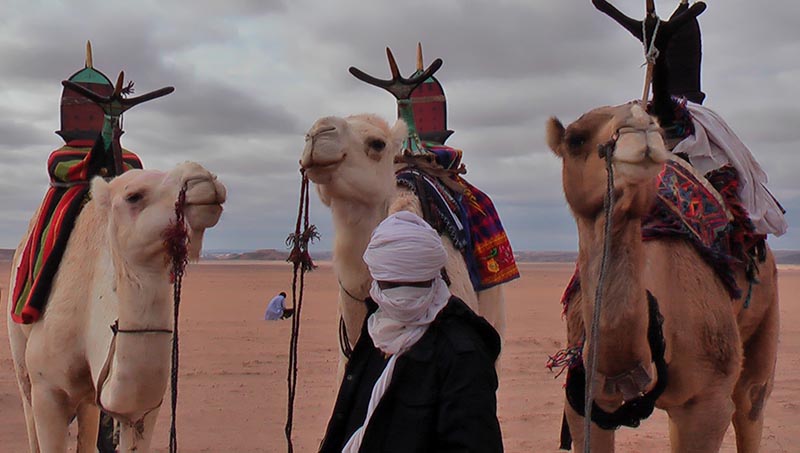
In partnership with our Libyan colleagues, and with support from the U.S. Department of State’s Ambassadors Fund for Cultural Preservation (AFCP), the Cultural Antiquities Task Force (CATF), and the U.S. Embassy Libya External Office (LEO), ASOR is bringing a message of hope through Cultural Heritage Volunteer Weekends (“pop-up” events) and through one-day heritage workshops. This article reports on the beginning of a Volunteer Weekend held in Ghadames in March 2020.
Standing at the base of the Ras Al Ghoul Castle atop Jabal Al-Sahabah, we could see Libya’s barren border with Tunisia and Algeria, and a fringe of date palms representing the oasis of Ghadames. From this vantage point, it was easier to imagine the view of an approaching caravan after many days of travel across the desert, and the relief that would come with the sighting of something green.
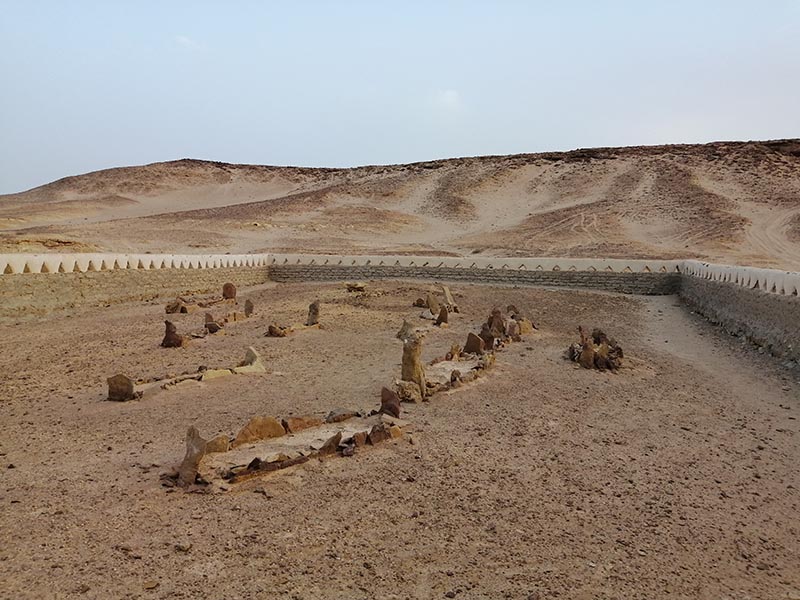
For thousands of years, the oasis of Ghadames has been the jewel of a necklace of oases spanning the desert and sustaining a vast network of trade that thrived despite many challenges. According to Saeed Hamed, a local historian and our guide, the promontory where we stood had once served as a Roman military fortress of the third Augustan legion during the first and second centuries BCE and was later used for fortifications built during the Islamic conquests of North Africa. The inscriptions at a nearby cemetery bear witness to the fort’s use as a border control point during Ottoman rule and the period of Italian and the French administration of the region.
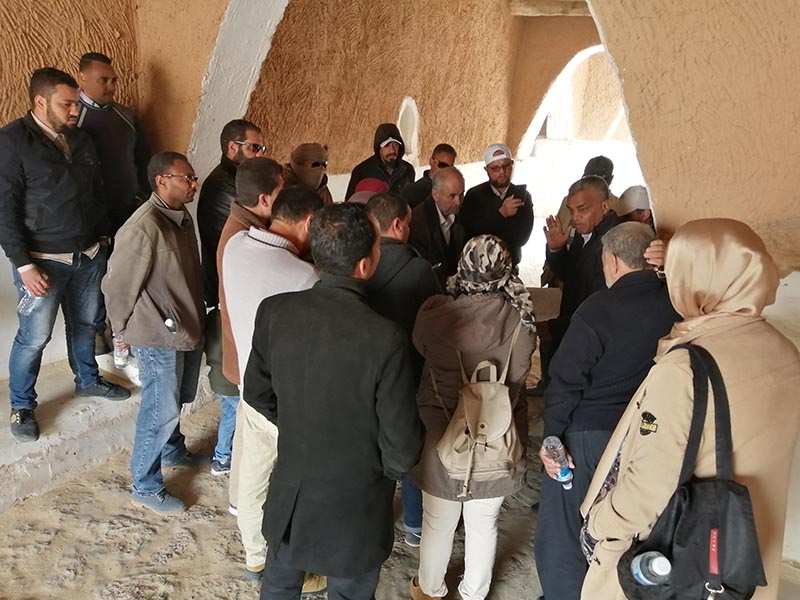
The built heritage of Libya feels endlessly layered and rich, whereas the intangible practices and traditions that have helped sustain communities around the country are too often dismissed as an afterthought. During the course of this Volunteer Weekend hosted at the Culture House of Ghamdames, we would endeavor to shed light on both, making connections wherever possible to the ongoing work of our Suitcase Museum program. Mr. Mansour Abdel Salam Mansour, Director of the Ghadames Museum and the local office of the Libyan Department of Antiquities, gave a comprehensive introduction to the museum and the old city of Ghadames, as well as the traditional industries in Ghadames and their transmission between the generations which has helped sustain the city. Ms. Fawzia Saeed Ammar, Professor of Ancient History at the University of Sirte, had traveled across half the country to share her own perspective on the vital role of Libya’s intangible heritage in sustaining community.
زيارة جبل الصحابة.
إقتراب عاصفة رملية عند مغادرتنا للقلعة .
مقبرة الصحابة قرب الحصن.
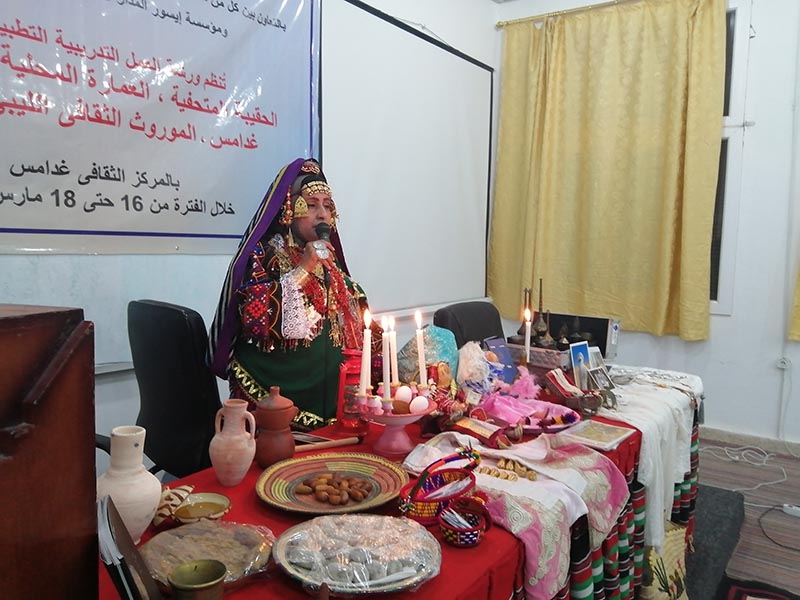
Despite being a relatively small city, Ghadames has long produced prominent Libyans who have known success around the country and internationally. In fact, Bukhari Salem Hoda, who was the national Director of the Libyan Boy Scouts and Girl Guides for nearly three decades, was our honored guest throughout the weekend. What was the secret of this remarkable place? At least part of the answer seems to lie in the way in which it has preserved and sustained many intangible traditions. Suleima Al-Amari performed a distinguished introduction to the intangible cultural heritage of the city, wearing the the traditional female Ghadamsi wedding attire, and sharing folk stories and old mysteries with us.
سوليمة العامري تتحدث عن التراث الثقافي غير المادي لغدامس.
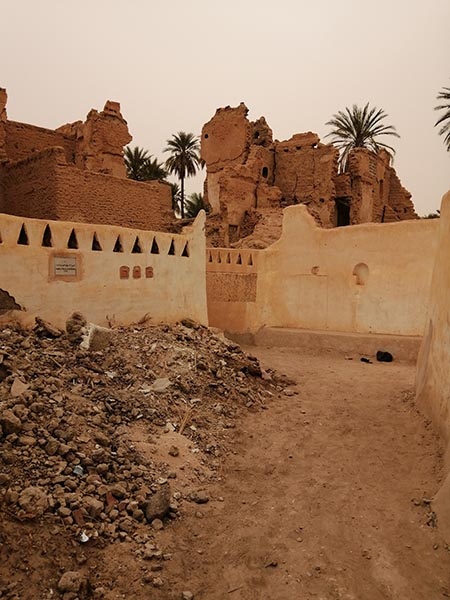
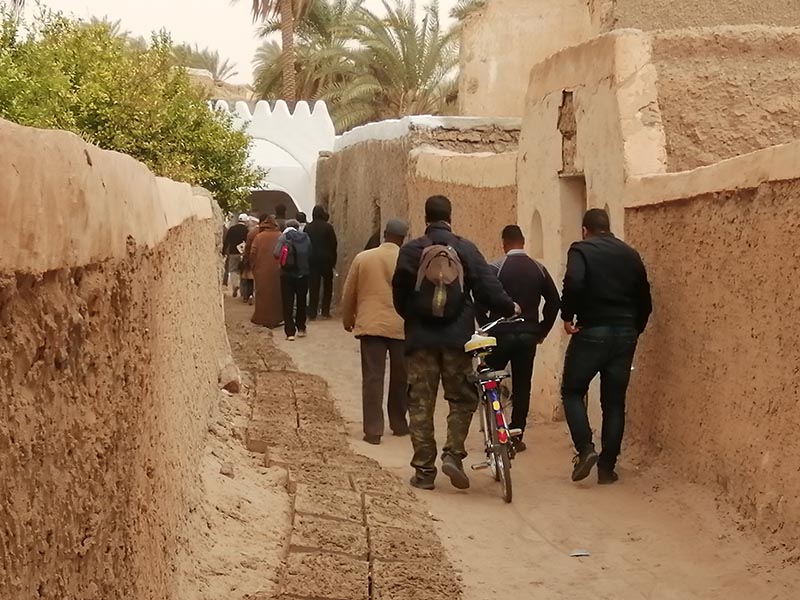
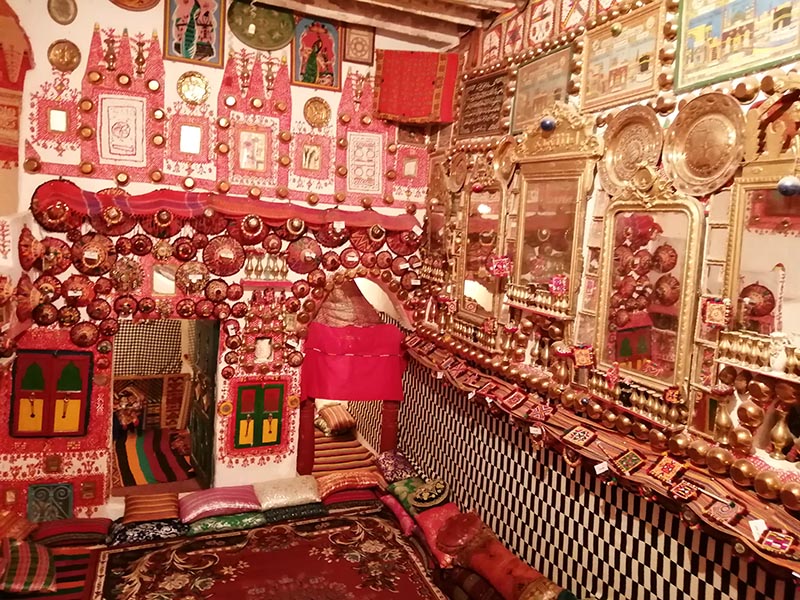
The following morning, strong winds loaded with coarse sand swept across the city and left our faces raw after even a short walk. We witnessed firsthand how the traditions of building with mud brick had created a remarkably comfortable environment from readily available natural materials. As we passed through Bab Al-Ba’ar, one of the gates of the old city of Ghadames, we all noticed that the wind completely disappeared. The city was built to regulate the extreme climate of the region. During the cold winter, the houses in the old city remained relatively warm and in the summer the city was cool. The hot, southern winds laden with sand that so often accompany warmer weather have been held at bay by thick mud brick walls for centuries.
Unfortunately, the master craftsmen who once created and maintained the city are now in short supply. Traditions are unable to sustain themselves without people serving as vessels, receiving them and passing them along to the next generation. During heavy floods in 2017, many houses in the old city sustained damage which has yet to be repaired.
مدينة غدامس القديمة التاريخية.
السيد منصور عبد السلام منصور يقدم جولة إرشادية.
المشي في شوارع المدينة القديمة.
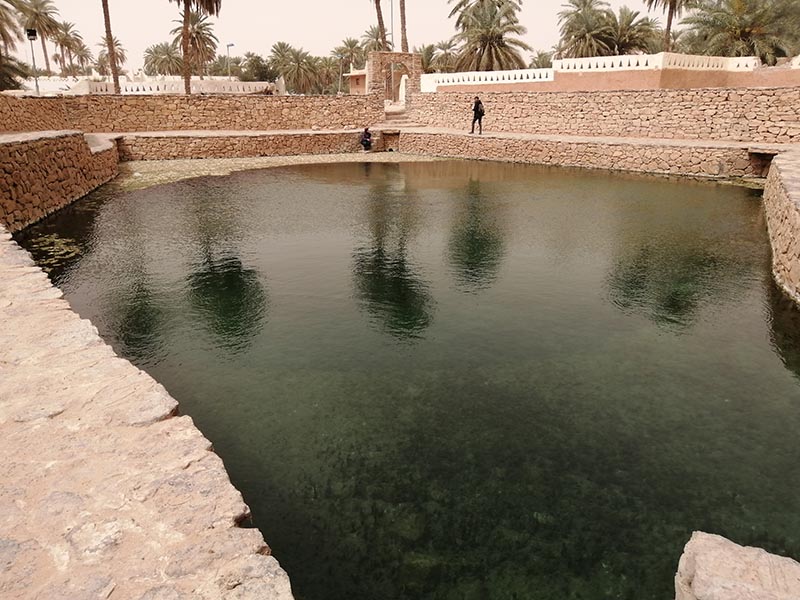
The central reason that the city was built and the source of its sustenance comes down to one substance: water. We visited the oasis spring, so large and strong that it appears to meet the surface as a lake. From that central pond, freshwater was distributed through a series of small canals to the surrounding orchards of date palms. The logic of that system was similar to the way in which trade was sustained from Ghadames across large stretches of desert: both required a network sustained through the continuous effort of the community. As we learned more about how mail was distributed over thousands of miles, how water flowed from source to grove, how individual houses were distinguished by number, and how the urban plan of the old city evolved, we were reminded that none of this was possible without a durable social fabric reinforced through intangible traditions.
تجمع المياه العذبة.
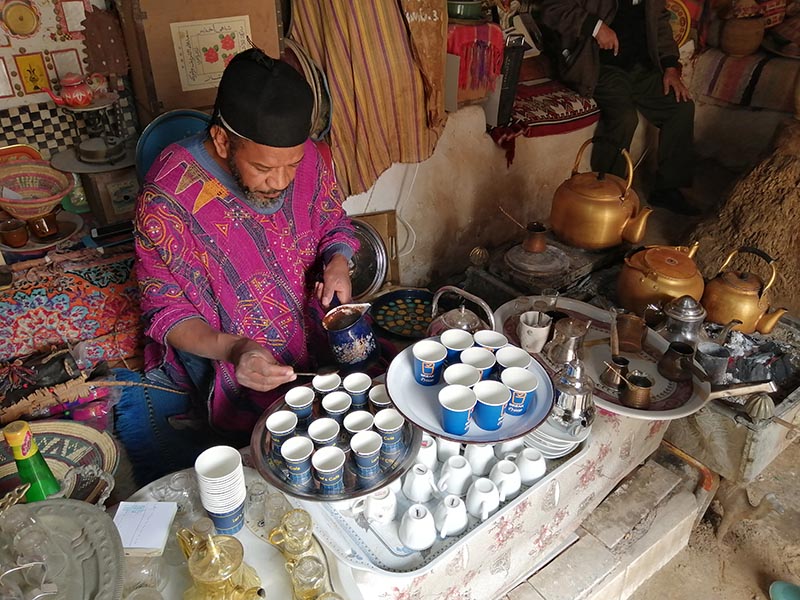
المرطبات خلال زيارتنا للمدينة القديمة.
As the Volunteer Weekend came to a close, we celebrated with a traditional lunch of ftat, a meal “of small pieces.” Round, thin flatbread had been torn into small pieces, fried in olive oil and spices and covered with ladles full of lamb stew. Our hosts insisted that we continue to eat more, long past the point where we were full. We all agreed that we were very happy to do our part to sustain such a delicious tradition.
The 2021 ASOR Annual Meeting will take place at the Hilton Chicago located at 720 South Michigan Avenue in downtown Chicago. Overlooking Grant Park and Lake Michigan, the Hilton Chicago is ideally situated within walking distance of many great restaurants, shopping, public transportation, and many of Chicago’s top attractions like the Museum Campus and Millennium Park. The Hilton Chicago is a contemporary environment to enjoy ASOR sessions during the day and explore Chicago during the evening.
Reservations: ASOR has negotiated the discounted rates of $159 single/double, $184 triple, and $209 quad for rooms at the Hilton Chicago. You are encouraged to make your reservation early as ASOR’s block of rooms usually sells out before the meeting. Cancellations may be made up to 72 hours prior to arrival. Make your reservation online in ASOR’s group block or call the hotel reservations department at 1-800-865-5320 and reference the American Schools of Oriental Research (ASOR) Annual Meeting.
Parking: The parking garage at the Hilton Chicago offers self and valet options starting at $65/night with in/out privileges.
Public Transportation: The Hilton Chicago is 1/2 mile from the Roosevelt stop on the CTA Orange Line, and just over 1/2 mile from the CTA Blue Line, Jackson stop.
Dining: At the Hilton Chicago you can enjoy farm-to-fork fare, tap-to-pint favorites, and live entertainment at Kitty O’Sheas pub, or sit down to a formal dinner at 720 South Bar + Grill to experience Midwest flavors with fresh ingredients from the rooftop garden. Light fare and “on the go” items are available at Herb N’ Kitchen. Within a short walk of the hotel you will find a variety of restaurants from casual to fine dining.
Childcare: Neither ASOR nor the Hilton Chicago are in the position to hire or recommend childcare providers.
Chicago Highlights: Did you know that Chicago is home to 56 museums, 125 art galleries, and 20 neighborhood art centers? It boasts 26 miles of lakefront, 580 parks and 26 beaches. We will be updating this page regularly with fun facts about the Windy City and links to some of Chicago’s best attractions.
LETTER TO MEMBERS ANNOUNCING THAT THE 2020 MEETING WILL SHIFT TO VIRTUAL
[/vc_column_text][mk_divider][vc_wp_text]Dear Members and Annual Meeting Participants,
It is with regret we write to inform you that we have determined ASOR’s 2020 Annual Meeting, scheduled for November 18-21 in Boston, cannot be held in person due to the Covid-19 pandemic. This is particularly disappointing because 2020 marks the 120th anniversary of ASOR’s founding, and we had a particularly special meeting planned.
Even though the pandemic has forced us to hold a different type of meeting, the ASOR staff and Program Committee are preparing to rework this exciting program into a virtual format that will deliver the full content of our record-breaking number of submissions in a manner that will serve our community most effectively. This is a complicated endeavor, but we are confident that the outcome will be a positive new first for ASOR. Please bear with us in the short term; we plan to write with more specifics by mid-July.
In the meantime, we have suspended registration for the Boston in-person meeting. We will be in touch with you by mid-July regarding the 2020 Virtual Annual Meeting logistics and other key information, including how we will handle registration fees that have already been paid.
Questions? Please call or email us.
Sharon Herbert, President
Richard Coffman, Chair of the Board of Trustees
Andy Vaughn, Executive Director[/vc_wp_text][/vc_column][vc_column border_color=”rgba(170,170,170,0.01)” width=”1/6″ css=”.vc_custom_1496684098866{margin-right: 5px !important;margin-bottom: 20px !important;border-right-width: 2px !important;border-bottom-width: 2px !important;padding-top: 30px !important;padding-right: 10px !important;padding-left: 10px !important;background-color: #ffffff !important;border-right-color: rgba(227,228,228,0.75) !important;border-bottom-color: rgba(227,228,228,0.75) !important;}”][vc_wp_posts title=”BROWSE THE NEWS ARCHIVE” number=”4″][/vc_column][vc_column border_color=”rgba(170,170,170,0.01)” width=”1/6″ css=”.vc_custom_1496684008271{margin-right: 10px !important;margin-bottom: 30px !important;border-right-width: 2px !important;border-bottom-width: 2px !important;padding-top: 30px !important;padding-right: 20px !important;padding-left: 20px !important;background-color: #ffffff !important;border-right-color: rgba(227,228,228,0.75) !important;border-bottom-color: rgba(227,228,228,0.75) !important;}”][vc_column_text]Tweets by ASOResearch [/vc_column_text][/vc_column][/vc_row]
The Ad Hoc Committee on ASOR’s Name was appointed by outgoing President Susan Ackerman and incoming President Sharon Herbert at the beginning of January, 2020. Its members include Trustees Randy Helm (chair), Emily Bonney, Lisa Ackerman, and Eric Welch, and members Eric Cline, Emily Hammer, and Kiersten Neumann. The charge to the committee is included as Attachment 1.
Process
Shortly after its membership was confirmed, Chair Helm distributed to the committee study documents relevant to past discussions of ASOR’s name. A list of these documents is included as Attachment 2.
The Committee met four times by Zoom between January 21 and April 22, 2020. After reviewing the materials and discussing the issues, we agreed on a work plan that would (a) assess the possible impact of a name change on the ability to access ASOR publications in the future; and (b) develop a survey that would provide a sense of ASOR members’ views on this question. The subcommittee on publications quickly determined that any impact of a name change on access to publications would be negligible. The survey subcommittee developed an instrument for the committee’s review.
With the assistance of ASOR staff, the survey was made available online to all ASOR members from March 18 – March 28. We received a very healthy response rate of approximately 30 percent. Comparing the demographics of survey respondents to the actual demographics of ASOR’s membership, we noted an overrepresentation of members who have belonged to ASOR for ten or more years (42.6% of respondents v. 29.7% of members). While we agreed that this was worth noting, we also agreed that the robust response made the survey results a reliable guide to members’ views on the issue of the organization’s name.
Survey Respondents skew younger: 56.3% are younger than 55; 43.7% are older than 54. However, we don’t have age data for all ASOR members, so we don’t know if this is representative.
Areas of Consensus
70.3% agree or strongly agree that it is important that the society’s name reflects the geographical scope of ASOR’s work. Only 15% disagree or strongly disagree.
55.9% of respondents agree or strongly agree that it is important that the name reflects the chronological scope of ASOR’s work. Only 25.6% disagree or strongly disagree that this is important.
N.B. The current name does not communicate either the geographical or chronological scope of ASOR’s work.
Areas of Disagreement
Keep the name “American Schools of Oriental Research?
45.3% agree or strongly agree
40.9% disagree or strongly disagree
13.8% undecided
Eliminate the name, but keep the acronym ASOR?
Approximately half of respondents (50.1%) disagree or strongly disagree
A minority (32.2%) agree or strongly agree.
Undecided = 17.7% (somewhat more than are undecided about keeping the historical name).
Create a new name retrofitted to the ASOR acronym?
41.6% disagree or strongly disagree;
34.2% agree or strongly agree;
Observation: Enthusiasm for a retrofitted name is a popular option for members under 35 years old, but drops off sharply among respondents older than 35 and members for more than ten years.
Create an entirely new name that is descriptive in nature (e.g. “Society for Ancient Studies”)?
41.9% have a poor or very poor impression;
35.6% have a good or very good impression.
22.5% are neutral.
Observation: No age group had a majority approving this option; support dropped off sharply among members of more than 10 years
Create an entirely new name based on an ancient word or concept (e.g. “Amphora”)?
48% have a poor or very poor impression;
25.6% have a good or very good impression;
26.4% are neutral.
Observation: This would seem to be the least popular option. No age group had a majority approving this option; support dropped off sharply among members of more than 10 years.
Create a new name that is a new acronym (e.g. “Archaeological Research and Cultural Heritage Education” – ARCHE)?
42.2% have a poor or very poor impression;
33% have a good or very good impression;
24.8% are neutral.
Viable Options
The Committee discussed these results in some detail, noting that older respondents favor retaining the full name and younger respondents favor a change. We acknowledged that the younger respondents represent the future of the organization, while the older respondents represent a group with deep loyalty to and knowledge of the organization.
We also discussed the difficulties that the current name and acronym create for younger scholars in terms of the publication and service records in their tenure and promotion dossiers. Neither the full name nor the acronym explains the organization’s purpose or work. Dossier readers outside the field are unlikely to understand the organization’s relevance or importance.
While the option of a new descriptive name that yields an acronym failed to find majority support among any age group, almost half of the younger members liked it, with stronger disapproval showing up as the age of members increased. We considered the possibility that this option could address the consensus on geographical and chronological descriptors in the name, and make it easier to explain to dossier-readers, younger scholars, and others.
We also noted that keeping the acronym ASOR as the only name of the organization might, even with a descriptive tagline, result in increasing confusion about the name’s meaning and the organization’s purpose over the passage of time. Some committee members felt that this would result in another committee needing to consider the name issue a few years down the road.
ASOR Board Discussion
Committee Member Trustees Ackerman, Bonney, Helm, and Welch provided the ASOR Board with an interim report at its May 14th meeting. While no straw polls were requested or taken, Board members generally agreed that the most productive option would seem to be to come up with a new name that is descriptive of our work and creates an acronym (either a new one, or one that comes close to the present one).
Next Steps
The Committee agreed that this is a suitable moment to seek the membership’s reaction to the survey results and the proposed course of action. Our preliminary assessment of possible names/acronyms yielded the following top five choices:
Society for Archaeology, Philology, and History of the Middle East (SAPHME)
Association for Archaeological Research and Cultural Heritage Education (AARCHE)
Society for Ancient Near Eastern Research (SANER)
Association for Archaeology, Research, Cultural Heritage, and Education (AARCHE)
Society for Archaeology, Philology, and History of the Ancient Near East (SAPHANE)
Two options inspired enthusiastic responses but few votes and received honorable mention as “beautiful losers:”
International Society for Ancient Near Eastern Research (INSANER)
Society for Middle Eastern Research and Social History (SMERSH)
Your Ideas?
We now solicit feedback on the above listed possibilities, as well as new suggestions from all members for a name/acronym that describes our organization’s geographical, chronological, and methodological scope.
Because of the uncertainty of the format of the Fall meeting and the fullness of its schedule (if it happens), the Ad Hoc Committee agrees that this interim report – and our request for feedback – will eliminate the need for an open forum in November. Our hope is to process feedback and suggestions, and suggest naming options to the ASOR Board of Trustees in November.
[/vc_column_text][mk_divider][vc_column_text]Attachment 1: Charge to the Committee
We write, as the outgoing and incoming ASOR Presidents, to ask you to serve on an ad hoc committee charged with evaluating the name of our organization. ASOR Trustee Randy Helm has agreed to chair this committee and has agreed that he would very much like you to serve on this group. We hope you will accept. You are being invited because you have been active in ASOR and, we believe, because you have an open mind on this question. If you feel that you do not meet this last criterion, please let us know. We anticipate that there will be a wide diversity of strongly held opinions on this issue, and it will be important for the Committee to have credibility as a thoughtful and objective group who will be open to the ideas and arguments of others.
Background
ASOR members have been discussing the possibility of changing the organization’s name since at least 1982. Most recently, a workshop was offered at the 2018 ASOR Annual Meeting in Denver on “What’s in a Name? Re-assessing the Oriental in the American Schools of Oriental Research.” The workshop was very well attended, and the presentations and discussion were both thoughtful and provocative. As a result, the organizers created a summary of the workshop’s conversations and forwarded them to various governing bodies within ASOR, including the ASOR Board of Trustees. That summary was delivered in Fall 2019.
After considering this summary, the ASOR Board voted, at its November 2019 meeting, to continue the discussion by forming an ad hoc committee to study ASOR’s name.
Charge
The committee’s charge is to consider whether ASOR’s name is still appropriate for the organization and, if not, to recommend to the Board of Trustees a new name, or a modified name, or some selection of new or modified names that ASOR might adopt instead. Any decision to change or modify ASOR’s name would ultimately be made by the Board.
While this charge is succinctly stated, we do not mean to suggest it is easily undertaken. At a minimum, we envision that the committee will need (1) to review previous discussions about ASOR’s name; (2) review discussions other “O” organizations have had about their names and the decisions they have made, for example, the Oriental Institute at the University of Chicago and the School of Oriental and African Studies at the University of London; (3) review the experiences of other learned societies that have changed their names or have decided not to, including these learned societies’ discussions regarding the names of their publications; and (4) actively solicit and carefully consider input from the ASOR membership about ASOR’s current name and any possible name change.
We anticipate that the committee’s work should take between twelve to fifteen months, depending on how the committee chooses to go about its work, and especially its work of collecting feedback from the ASOR membership. The committee should thus plan on submitting its final report to the ASOR Board, with recommendations, no later than the April 2021 Board meeting. We look forward to supporting the committee in every way that we can, and we have already provided Randy with multiple documents to help in the committee’s deliberations and its decision-making process.
We hope that you will be able to serve on the important committee. Many thanks for considering this invitation, and we look forward to hearing from you.
Sincerely,
Susan Ackerman
ASOR President
Sharon Herbert
ASOR Vice President and President-Elect
Chair, Chairs Coordinating Council[/vc_column_text][mk_divider][vc_column_text]Attachment 2: Study Documents reviewed by Committee Members
C&G Partners, Discovery Findings and Recommendations for ASOR Branding and Website Redesign, March 22, 2016
Orientalism Session – Raw Data 2018
Melissa Bailey Kutner, “Getting Oriented” 2018
Ian W. N. Jones, “’Isn’t that a Little Racist, Dr. Jones,’ or What I learned Trying tro Explain ASOR to High School Students” 2018
Danielle Steen Fatkin, “Orientalism in America: East Asia, West Asia, and the American Racial Imagination” 2018
Danielle Steen Fatkin, “Report to the CCC regarding the workshop ‘What’s in a Name? Re-assessing the Oriental in the American Schools of Oriental Research’ at the November 2018 Annual Meeting”
Michael M. Homan, “Why the Term ‘Oriental’ in ASOR is Neither Accurate Nor Appropriate.” 2018.
Pp. 3–21: “Der Beruf su-si-(ig) im 3. Jahrtausend,” by M. Such-Gutiérrez
The Sumerian professional designation su-si-(ig) has been usually translated as “animal handler” or “skinner” on the basis of texts from the Old Babylonian period. Written sources from the third millennium, however, indicate that these translations are not applicable in earlier times, since people so designated worked on the first steps of leather processing or with the preparation of the bare skins for tanning. Therefore, in such texts the translation Blößenvorbereiter, that is “preparer of cleaned animal skins” is a better fit. Moreover, third-millennium texts provide further information on the profession su-si-(ig), which was apparently practiced only by men who worked in the large temple and palace public institutions and in some cases could hold high social positions.
ASOR Members with online access: navigate to the token link email sent to you before attempting to read this article. Once you have activated your member token, click here to access the above article on The University of Chicago Press Journals’ website.
Pp. 23–33: “„Das Schilfrohr umherspringen lassen”: Bemerkungen zum Rohrflechten Babyloniens im dritten bzw. frühen zweiten Jahrtausend v. Chr.,” by Krisztián Simkó
In spite of extensive research conducted in the field, there are some areas of Babylonian reed industries that have eluded understanding since the first comprehensive overview was published on this topic in 1989. The aim of this communication is to provide some insights into one such area, the preparation of pliable reed strands. On the basis of partly overlooked philological evidence, it will be argued that phrases like gi gu4- ud, na4 ad-KID, and na4ša-ga-ra relate, one way or another, to this procedure.
ASOR Members with online access: navigate to the token link email sent to you before attempting to read this article. Once you have activated your member token, click here to access the above article on The University of Chicago Press Journals’ website.
Pp. 35–46: “Du nouveau chez les Šakkanakkus de Mari: nouvelles lectures des empreintes ME64, ME196, et ME14,” by L. Colonna d’Istria
Cylinder seal impressions rank highly among the epigraphic sources concerning the šakkanakkus (rulers) of Mari, especially those that reigned during the 20th and first part of 19th centuries BCE, that is the final phase of the šakkanakku period that preceded the reign of Yaḫdun-Lîm in Mari ca. 1820/1810 BC. New readings of the seal impressions ME64+ME196 and ME14 indicate that they all belong to the same cylinder seal belonging to a ruler named Tīnīn-Dagan, whose father was Iddin-Dagan. Both rulers were previously unknown.
ASOR Members with online access: navigate to the token link email sent to you before attempting to read this article. Once you have activated your member token, click here to access the above article on The University of Chicago Press Journals’ website.
Pp. 47-64: “The Royal Herdsmen of Ur: Compensation and Centralization in the Reign of Shulgi,” by Ryan Winters
Centralization functioned on multiple complementary levels during the Ur III period. On the one hand, the royal government controlled vast herds of livestock, which it distributed for tending to herdsmen located in various provinces throughout the entire empire. On the other, it exercised direct control over land located in these provinces, which it then used to compensate royal workers in charge of tending these animals. This article studies the evidence for the royal herdsmen, their organization and activities, and their compensation through royal grants of real estate.
ASOR Members with online access: navigate to the token link email sent to you before attempting to read this article. Once you have activated your member token, click here to access the above article on The University of Chicago Press Journals’ website.
Pp. 65-86: “The Discovery of the Location of Malgium (Tell Yassir),” by Ahmed Ali Jawad, Barhan Abd Al-Reza, Ali Jabarat Nasir, Ahmed Abbas As’id, and Rients de Boer
This article establishes that the ancient city of Malgium is located at modern Tell Yassir.The results of a survey of the site and its surroundings are given together with the publication of a number of new brick inscriptions belonging to early Old Babylonian kings of Malgium.
ASOR Members with online access: navigate to the token link email sent to you before attempting to read this article. Once you have activated your member token, click here to access the above article on The University of Chicago Press Journals’ website.
Pp. 87-99: “Perpendicular Lines and Diagonal Triples in Old Babylonian Surveying,” by Daniel F. Mansfield
The tablet Si. 427 demonstrates that diagonal triples, or Pythagorean triples as they are now known,were used by Old Babylonian surveyors to construct perpendicular field boundaries accurately. This is the only known application of diagonal triples from this time, and one of the most complete examples of applied geometry from the ancient world.
ASOR Members with online access: navigate to the token link email sent to you before attempting to read this article. Once you have activated your member token, click here to access the above article on The University of Chicago Press Journals’ website.
Pp. 101-116: “Three New Multiplication Tables From the Louvre: AO 8900, AO 8901, AND AO 8902,” by Carlos Gonçalves
AO 8900, AO 8901, and AO 8902 are three hitherto unpublished Old Babylonianmathematical cuneiform tablets containing multiplication tables. Their physical and textual characteristics suggest that they were produced in the same ancient context. What is remarkable about this small set of tablets is that, unlike most such tablets, two of them have colophons: in AO 8900 we find a month-and-day date, while in AO 8901 we find a damaged year name. These tablets are published here for the first time, together with a discussion of how the information about the year name in AO 8901 fits in what is known about the dating of Old Babylonian mathematics.
ASOR Members with online access: navigate to the token link email sent to you before attempting to read this article. Once you have activated your member token, click here to access the above article on The University of Chicago Press Journals’ website.
Pp. 117-128: “A Fragmentary Explanatory God List from Old Babylonian Nippur with a Thematic Connection to Lugale and An : Anum: A Glimpse into the Origins of Mesopotamian Hermeneutical Tradition,” by Jeremiah Peterson
This article provides an edition of the previously unpublished Old Babylonian tablet fragment that may be part of an explanatory god list. With all due caution, it is possible to suggest that it provides a rare example of a god list with extended commentary from the Old Babylonian period with each preserved entry seemingly eliciting an explanation. The format is unique in that it occurs as running text without columned entry or any other topical demarcation, arranged according to divine name and its respective explanation or equivalent. Likewise, although the fragmentary state of this piece rules out any definitive interpretation, it is possible that it may refer to certain lines in the Ninurta poem Lugale.
ASOR Members with online access: navigate to the token link email sent to you before attempting to read this article. Once you have activated your member token, click here to access the above article on The University of Chicago Press Journals’ website.
Pp. 129-142: “Sumerian Cultic Songs from Old Babylonian Nippur with a Connection to the Temple Hymns,” by Jeremiah Peterson
Several fragmentary Sumerian cultic songs from Old Babylonian Nippur, including one that seems to be for Ninurta (“Ninurta H”), contain enumerations of major cultic centers in southern Mesopotamia that are unmistakably reminiscent of the Sumerian Temple Hymns, as well as two hymns to King Shulgi. The following communication considers the potential parameters of intertexuality that may be involved with these texts. Such proximity to the corpus of cultic songs qualifies the Sitz im Leben of the Temple Hymns at Old Babylonian Nippur.
ASOR Members with online access: navigate to the token link email sent to you before attempting to read this article. Once you have activated your member token, click here to access the above article on The University of Chicago Press Journals’ website.
Pp. 143-155: “The Authorship of the Old Hittite Palace Chronicle (CTH 8): A Case for Anitta,” by Alwin Kloekhorst
It is generally thought that the Old Hittite Palace Chronicle was composed by Muršili I (reigned ca. 1620–1590 BCE) and that the anecdotes featuring in this composition thus took place during the reign of his predecessor Ḫattušili I (ca. 1650–1620 BCE). Recently, Forlanini proposed that the text’s author was not Muršili I but rather Ḫattušili I, who tells about the times of his predecessor Labarna I (ca. 1680(?)–1650 BCE). In the present article it will be argued that both views are difficult to maintain. Instead, six arguments will be presented that rather indicate that the Palace Chronicle may have been authored by Anitta, king of Nēša (reigned ca. 1740–1725 BCE), and that the composition recounts the reign of Anitta’s father Pitḫāna, with some anecdotes even dating back to the times before Pitḫāna’s conquest of the city of Nēša, i.e. before 1750 BCE.
ASOR Members with online access: navigate to the token link email sent to you before attempting to read this article. Once you have activated your member token, click here to access the above article on The University of Chicago Press Journals’ website.
Pp. 157-163: “The Personal Name in Ugaritic Script pǵm˹w˺ (RS 10.052 iv 1) = Luwian piḫamuwa,” by Dennis Pardee and Madadh Richey
The proposal is here offered to read the Ugaritic administrative text RS 10.052 iv 1 as containing the personal name pǵmw, the Ugaritic writing of the Luwian name Piḫamuwa.
ASOR Members with online access: navigate to the token link email sent to you before attempting to read this article. Once you have activated your member token, click here to access the above article on The University of Chicago Press Journals’ website.
Pp. 165–198: “Minor Archives from First-Millennium Bce Babylonia: The Archive of Iššar-Tarībi from Sippar,” by Reinhard Pirngruber
The present contribution provides full editions of all texts belonging to the archive of the Sipparean businessman Iššar-tarībi, who was active during the last years of the Neo-Babylonian kingdom and the early years of Achaemenid rule, as well as a brief discussion of its central features. It is part of a larger collaborative effort to make available the so-called “satellite archives” of the Ṣāḫiṭ-ginê A archive and related and unrelated smaller archives from Sippar. The results will be published in forthcoming volumes of this journal; archives in preparation include those of Adad-šamê, Mušēzib, Rēˀi-sisê, and Ša-nāšišu A (Y. Levavi), Balīhu, Aqūba, and Šamaš-iddin/Rēmūt (J. Hackl), as well as Šangû-Šamaš and Šangû-Ištar-Bābili (M. Gross). A companion volume containing copies of all tablets published in this series as well as a comprehensive prosopography is in preparation for the JCS Supplemental Series.
ASOR Members with online access: navigate to the token link email sent to you before attempting to read this article. Once you have activated your member token, click here to access the above article on The University of Chicago Press Journals’ website.
[/vc_column_text][mk_divider][vc_column_text]ASOR Members with online access: navigate to the token link email sent to you before attempting to read this issue. Once you have activated your member token, click here to access the the entire issue, including book reviews, on The University of Chicago Press Journals’ website.[/vc_column_text][/vc_column][vc_column border_color=”rgba(170,170,170,0.01)” width=”1/6″ css=”.vc_custom_1567019974102{margin-right: 5px !important;margin-bottom: 20px !important;border-right-width: 2px !important;border-bottom-width: 2px !important;padding-top: 30px !important;padding-right: 10px !important;padding-left: 10px !important;background-color: #ffffff !important;border-right-color: rgba(227,228,228,0.75) !important;border-bottom-color: rgba(227,228,228,0.75) !important;}”][vc_wp_posts title=”BROWSE THE NEWS ARCHIVE” number=”4″][/vc_column][vc_column border_color=”rgba(170,170,170,0.01)” width=”1/6″ css=”.vc_custom_1496684008271{margin-right: 10px !important;margin-bottom: 30px !important;border-right-width: 2px !important;border-bottom-width: 2px !important;padding-top: 30px !important;padding-right: 20px !important;padding-left: 20px !important;background-color: #ffffff !important;border-right-color: rgba(227,228,228,0.75) !important;border-bottom-color: rgba(227,228,228,0.75) !important;}”][vc_column_text]Tweets by ASOResearch [/vc_column_text][/vc_column][/vc_row]
Pp. 72-79: “Twenty-Five Years of Research at Çatalhöyük,” by Ian Hodder
Çatalhöyük is a 9,000 year-old tell site in central Turkey. First excavated by James Mellaart in the 1960s (e.g., 1967), a new project began in 1993 (Hodder 1996, 2000). At first the focus was on surface study and survey, and excavation began in 1995. Excavation ended in 2017 and there was a study season in Catania, Sicily, in 2018. This introduction summarizes the work over the last twenty-five years and describes some of the results outlined in the ensuing articles of this issue of NEA. An additional set of results will be published in the September 2020 issue.[/vc_column_text][/vc_column_inner][/vc_row_inner][vc_column_text responsive_align=”left”]ASOR Members with online access: navigate to the token link email sent to you before attempting to read this article. Once you have activated your member token, click here to access the above article on The University of Chicago Press Journals’ website.[/vc_column_text][mk_divider][vc_row_inner][vc_column_inner width=”1/4″ css=”.vc_custom_1570041002103{padding-right: 10px !important;}”][mk_image src=”http://www.asor.org/wp-content/uploads/2020/06/Magnetic-GPR-at-Catalhuyuk-NEA-83.2-TOC.jpg” image_width=”200″ image_height=”500″ crop=”false” hover=”false”][/vc_column_inner][vc_column_inner width=”3/4″][vc_column_text]
Pp. 80-87: “Integrating Magnetic and GPR Survey at Çatalhöyük,” by Kristian Strutt, Stefano Campana, Jessica Ogden, Gianluca Catanzariti, and Gianfranco Morelli
As part of the 2010 and 2012 field seasons at the site of Çatalhöyük, geophysical survey was conducted with the aim of mapping parts of the subsurface remains at the site. While extensive excavations have been conducted on the East Mound, a considerable part of the area of this mound is still largely unknown in terms of the presence of archaeological deposits and possible Neolithic structures.[/vc_column_text][/vc_column_inner][/vc_row_inner][vc_column_text responsive_align=”left”]ASOR Members with online access: navigate to the token link email sent to you before attempting to read this article. Once you have activated your member token, click here to access the above article on The University of Chicago Press Journals’ website.[/vc_column_text][mk_divider][vc_row_inner][vc_column_inner width=”1/4″ css=”.vc_custom_1570041002103{padding-right: 10px !important;}”][mk_image src=”http://www.asor.org/wp-content/uploads/2020/06/Catalhuyuk-Landscape-NEA-83.2-TOC.jpg” image_width=”200″ image_height=”500″ crop=”false” hover=”false”][/vc_column_inner][vc_column_inner width=”3/4″][vc_column_text]
Pp. 88-97: “Çatalhöyük and Its Landscapes,” by Gianna Ayala and John Wainwright
T he landscape surrounding the site of Çatalhöyük has been transformed by centuries of land use and agricultural improvements. The most recent transformations started in the early twentieth century aiming to improve agricultural productivity by carrying out extensive irrigation and land-reclamation programs (Roberts 1990). Irrigation water was brought via the Beyşehir-Sugla canal system which was completed around 1911 (Money 1919), bringing irrigation water from Lake Beyşehir to the south. Further regulation of water supplies in the 1950s and 1960s included the construction of the Apa Dam on the Çarşamba River (completed in 1962) and World Bank support for extending irrigation schemes. Unsurprisingly, archaeological and palaeoenvironmental evidence from Çatalhöyük suggests significantly different environments at the time of occupation from that of the modern landscape. Therefore, it is essential for archaeological interpretations to be underpinned by robust palaeoenvironmental reconstructions.[/vc_column_text][/vc_column_inner][/vc_row_inner][vc_column_text responsive_align=”left”]ASOR Members with online access: navigate to the token link email sent to you before attempting to read this article. Once you have activated your member token, click here to access the above article on The University of Chicago Press Journals’ website.[/vc_column_text][mk_divider][vc_row_inner][vc_column_inner width=”1/4″ css=”.vc_custom_1570041002103{padding-right: 10px !important;}”][mk_image src=”http://www.asor.org/wp-content/uploads/2020/06/Wetlands-at-Catalhuyuk-NEA-83.2-TOC.jpg” image_width=”200″ image_height=”500″ crop=”false” hover=”false”][/vc_column_inner][vc_column_inner width=”3/4″][vc_column_text]Pp. 98-109: “The Seasonality of Wetland and Riparian Taskscapes at Çatalhöyük,” by Jesse Wolfhagen, Rena Veropoulidou, Gianna Ayala, Dragana Filipović, Ceren Kabukcu, Carla Lancelotti, Marco Madella, Kamilla Pawłowska, Carlos G. Santiago-Marrero, and John Wainwright
Seasonal variation in the natural world of Neolithic Çatalhöyük shaped the organization of daily life and the social world of its residents. Seasonal cycles in climatic patterns, hydrology, growing seasons of wild and domestic plants, and seasonal behaviors of herded, hunted, and gathered animals would have affected the overall productivity of the landscape and consequently the rhythms of social life (e.g., Fairbain et al. 2005; Pels 2010). These created social conceptions of seasonal patterns and activities shaped the ways in which people interacted with their local environments and structured the timing and spatial requirements of everyday tasks.[/vc_column_text][/vc_column_inner][/vc_row_inner][vc_column_text responsive_align=”left”]ASOR Members with online access: navigate to the token link email sent to you before attempting to read this article. Once you have activated your member token, click here to access the above article on The University of Chicago Press Journals’ website.[/vc_column_text][mk_divider][vc_row_inner][vc_column_inner width=”1/4″ css=”.vc_custom_1570041002103{padding-right: 10px !important;}”][mk_image src=”http://www.asor.org/wp-content/uploads/2020/06/OPen-Spaces-at-Catalhuyuk-NEA-83.2-TOC.jpg” image_width=”200″ image_height=”500″ crop=”false” hover=”false”][/vc_column_inner][vc_column_inner width=”3/4″][vc_column_text]
Pp. 110-119: “Common Ground: Reevaluating Open Spaces at Çatalhöyük,” by Justine Issavi, Kamilla Pawłowska, Milena Vasić, and Rena Veropoulidou
Investigations of open spaces within the context of the Southwest Asian Neolithic are varied in approach and in how explicitly they center these spaces within the study. The term “open space,” for this article, refers to any space not covered by an architectural feature such as a roof or other permanent covering. Open spaces have variously been discussed as arenas of daily or utilitarian activities, shared property or communal space, places of ritual, public spaces, courtyards (yards), conduits for movement, or undifferentiated spaces.[/vc_column_text][/vc_column_inner][/vc_row_inner][vc_column_text responsive_align=”left”]ASOR Members with online access: navigate to the token link email sent to you before attempting to read this article. Once you have activated your member token, click here to access the above article on The University of Chicago Press Journals’ website.[/vc_column_text][mk_divider][vc_row_inner][vc_column_inner width=”1/4″ css=”.vc_custom_1570041002103{padding-right: 10px !important;}”][mk_image src=”http://www.asor.org/wp-content/uploads/2020/06/Thermal-Alterations-to-Human-Remains-at-Catalhuyuk-NEA-83.2-TOC.jpg” image_width=”200″ image_height=”500″ crop=”false” hover=”false”][/vc_column_inner][vc_column_inner width=”3/4″][vc_column_text]
Pp. 120-128: “Thermal Alterations to Human Remains in Çatalhöyük,” by Cassie E. Skipper, Scott D. Haddow, and Marin A. Pilloud
The Neolithic East Mound at Çatalhöyük, dating to 7100–5950 cal BCE (Bayliss et al. 2015), in central Anatolia is well known as a large, early agricultural village. Like other Neolithic sites in this region, the site had distinct mortuary practices, which at Çatalhöyük are dominated by primary interments beneath house floors, accounting for 83 percent of stratified individuals recovered to date (Haddow et al. in press). While commingling of skeletal elements due to repeated use of house platforms as burial locations is common (Boz and Hager 2013; Haddow, Sadvari et al. 2016), there is also evidence of secondary burial practices including post-interment cranial retrieval and the occurrence of loose and partially articulated skeletal elements moved from a previous location (Haddow and Knüsel 2017). Such observations suggest the practice of delayed burial for certain individuals, a pattern that appears to increase in frequency over time (Haddow et al. in press).[/vc_column_text][/vc_column_inner][/vc_row_inner][vc_column_text responsive_align=”left”]ASOR Members with online access: navigate to the token link email sent to you before attempting to read this article. Once you have activated your member token, click here to access the above article on The University of Chicago Press Journals’ website.[/vc_column_text][/vc_column][vc_column border_color=”rgba(170,170,170,0.01)” width=”1/6″ css=”.vc_custom_1496684098866{margin-right: 5px !important;margin-bottom: 20px !important;border-right-width: 2px !important;border-bottom-width: 2px !important;padding-top: 30px !important;padding-right: 10px !important;padding-left: 10px !important;background-color: #ffffff !important;border-right-color: rgba(227,228,228,0.75) !important;border-bottom-color: rgba(227,228,228,0.75) !important;}”][vc_wp_posts title=”BROWSE THE NEWS ARCHIVE” number=”4″][/vc_column][vc_column border_color=”rgba(170,170,170,0.01)” width=”1/6″ css=”.vc_custom_1496684008271{margin-right: 10px !important;margin-bottom: 30px !important;border-right-width: 2px !important;border-bottom-width: 2px !important;padding-top: 30px !important;padding-right: 20px !important;padding-left: 20px !important;background-color: #ffffff !important;border-right-color: rgba(227,228,228,0.75) !important;border-bottom-color: rgba(227,228,228,0.75) !important;}”][vc_column_text]Tweets by ASOResearch [/vc_column_text][/vc_column][/vc_row]
Click here for a list of Fiscal Year 2020 Honorific and Memorial Gifts.[/vc_column_text][vc_column_text]
Benefactor ($20,000 and up)
[/vc_column_text][vc_row_inner][vc_column_inner width=”1/2″][vc_column_text]Susan Ackerman ∞
Arnold and Porter, LLC (in kind) ∞
Stevan B. Dana ‡
Sharon Herbert ‡[/vc_column_text][/vc_column_inner][vc_column_inner width=”1/2″][vc_column_text]P. E. MacAllister* ∞
Richard F. Natarian ‡
Wayne R. Shepard ◊
Carolyn Midkiff Strange ∞[/vc_column_text][/vc_column_inner][/vc_row_inner][vc_column_text]
Patron ($10,000 – $19,999)
[/vc_column_text][vc_row_inner][vc_column_inner width=”1/2″][vc_column_text]La Sierra University
W. Mark Lanier Theological Library ‡
Eric and Carol Meyers ∞[/vc_column_text][/vc_column_inner][vc_column_inner width=”1/2″][vc_column_text]Joe D. Seger ∞
Virginia Theological Seminary
Rabbi Yosef Wosk[/vc_column_text][/vc_column_inner][/vc_row_inner][vc_column_text]
Friend ($5,000 – $9,999)
[/vc_column_text][vc_row_inner][vc_column_inner width=”1/2″][vc_column_text]Anonymous ∞
Anonymous ◊
Anonymous
Anonymous
Sheila T. Bishop ∞
Sonya and Richard Coffman ◊
Michael Hasel ◊[/vc_column_text][/vc_column_inner][vc_column_inner width=”1/2″][vc_column_text]Norma Kershaw ∞
Oystein and Asta LaBianca ∞
Thomas R. Pickering ∞
Timothy Potts
Marsha Rozenblit
Charles W. Steinmetz
Andy and Amy Vaughn ∞[/vc_column_text][/vc_column_inner][/vc_row_inner][vc_column_text]
Sponsor ($1,000 – $4,999)
[/vc_column_text][vc_row_inner][vc_column_inner width=”1/2″][vc_column_text]Lisa Marilyn Ackerman
William S. Andreas ‡
Andrea Berlin ◊
Emily Miller Bonney ◊
James Bucko ◊
Wallace Cameron ◊
Ted Dodd and Lynn Swartz Dodd ‡
Sheldon and Debbie Fox ∞
Paul Gaylo ∞
Elizabeth R. Gebhard
Denise Gold ◊
Timothy P. Harrison ∞
Peyton R. Helm ◊[/vc_column_text][/vc_column_inner][vc_column_inner width=”1/2″][vc_column_text]David Hendin ◊
Brian Landers
Carol Landes ∞
Albert Leonard ◊
Alex and Bridget MacAllister ◊
Byron R. McCane ◊
David Rosenstein ∞
Ann V. Sahlman
H. Katharine Sheeler ‡
Abraham Sofaer and Marian Scheuer Sofaer ◊
John Sweetland
Donald Whitcomb and Janet Johnson
Malcolm H. Wiener[/vc_column_text][/vc_column_inner][/vc_row_inner][vc_column_text]
Sustainer ($500 – $999)
[/vc_column_text][vc_row_inner][vc_column_inner width=”1/2″][vc_column_text]Betty Adams
Gary Arbino ∞
Jeffrey A. Blakely and Brauna Hartzel ∞
Douglas Clark ‡
Robert and Erin Darby
P. M. Michèle Daviau ◊
Jane DeRose Evans ‡
Jerry and Jane Ford
Jürgen Friede ‡
Lawrence T. Geraty ∞
Joseph Greene ‡
Carroll Kobs ◊
Thomas R.W. Longstaff ◊
Dale Manor ‡
Vincent Mauer ◊[/vc_column_text][/vc_column_inner][vc_column_inner width=”1/2″][vc_column_text]Robert A. Mullins ‡
Beth Alpert Nakhai ∞
Suzanne Richard ∞
Thomas Schneider ◊
Daniel Schowalter ◊
Audrey Shaffer ∞
Joanna Strange
Jeanne Marie Teutonico ◊
Mitchell and Patsy Tyner
Joseph J. Weinstein ∞
Eric Welch ◊
J. Edward and Keeley Wright ‡
K. Lawson Younger ‡
Randall Younker ∞[/vc_column_text][/vc_column_inner][/vc_row_inner][vc_column_text]
Supporter ($250 – $499)
[/vc_column_text][vc_row_inner][vc_column_inner width=”1/2″][vc_column_text]Lamar Barden ‡
Robert D. Bates
Kent Bramlett
Joan R. Branham
Theodore Burgh ◊
Pearce Paul Creasman
Janet Crisler
Steven E. Falconer and Patricia Fall
Paul V. M. Flesher ◊
David Fosse
Joe Furr
Jody Garfinkle
Kristine S. Garroway
Seymour Gitin ∞
Edward Hanlon ◊
James F. Joyner III ‡
Lisa Kahn
Aren LaBianca
Jennifer Lile[/vc_column_text][/vc_column_inner][vc_column_inner width=”1/2″][vc_column_text]Andrew McCarthy
Heather McKee
Richard H. Meadow
Barbara O. Miley
Steve Phelps
Julie Piller
Barbara A. Porter ∞
John Poss
Jonathan Rosenbaum ◊
Jennifer Schneider
Lee R. Seeman ◊
Gary Smith ◊
John R. Spencer ‡
Jane C. Waldbaum ∞
F. Bryan Wilkins
Jacob Wright
Joseph Yellin ◊
Rev Joseph Donald Zarro[/vc_column_text][/vc_column_inner][/vc_row_inner][vc_column_text]
Contributor ($100 – $249)
[/vc_column_text][vc_row_inner][vc_column_inner width=”1/2″][vc_column_text]Elie M. Abemayor ◊
Khaled Abu Jayyab
Matthew J. Adams ‡
Henry Addkison ◊
Amazon Smile ◊
Steven Matthew Anderson
Wako Anazawa
Vernon Appleby ◊
Rami Arav ◊
Randall C. Bailey
Bruce Basile
Mildred Bilt ◊
Lee Raffaele Biondi
Elizabeth Bloch-Smith ◊
Oded Borowski ∞
Karen Borstad ◊
Roger Bove
Margaret Brandt
Thomas Brayshaw
Wilfred F. Bunge ◊
Cynthia Ruth Burdge ◊
Katherine Strange Burke
Philip Caddell
Frances Cahill ◊
Christopher Carr ◊
Mark Chancey ‡
Scott Chesworth
W. Malcolm Clark ‡
Kathleen Cleveland
Eric Cline ◊
Betty Coffman
Margaret E. Cohen ◊
William Cook
Robert E. Cooley
Sarah Kielt Costello ◊
Janice Courtney
Gregorio del Olmo Lete
Bert DeVries ◊
Paul J. Dirkes
Stephanie Elkins
Raymond Ewing ‡
Brian Facemire ◊
Valerie Fargo
Aaron Faust
Paul Fischer
Marjorie Fisher ◊
Debra Foran
Catherine P. Foster ‡
Deirdre Fulton
Constance Gane
Steven Garfinkle ‡
Robert Gauld
Barry M. Gittlen ‡
Kathryn Gleason
Richard Cartier Godfrey ◊
Morris Golik ◊
Angela Goodwin ‡
David Gordon
Marylinda Govaars ‡
Arnold J. Gutierrez ◊
Mosab Hawarey
Joseph P. Healey ◊
Ellen Herscher
Susan Tower Hollis ◊
Thomas Hoyt ◊
Herbert B. Huffmon ◊
Regine Hunziker-Rodewald
David Ilan ‡
Roger Isaacs[/vc_column_text][/vc_column_inner][vc_column_inner width=”1/2″][vc_column_text]Charles Ellwood Jones ◊
Jeffery Keefe
Ruth E. Kent ◊
Charles Knapp
Ann-Marie Knoblauch ‡
Michael Koko
Edward Koskie ‡
Steve Kover
Joel Kramer
David Laird
Andrew Lawler
Mark Leson
Christine Lilyquist
JoAnn Long ◊
Meir Lubetski
Elizabeth Macaulay-Lewis ◊
Frank Maddox
Christina Mahle
Charles Marlin ◊
Faith Mason
Sandy Mermelstein ◊
Garold Mills
Andrew Moelis
Abbas Mokhtarzadeh
Jenna Morton
Nawal Nasrallah and Shakir Mustafa
Orlyn Nelson
Kiersten Neumann
David Norris ‡
Kazumi Oguchi
John P. Oleson ◊
Dee Pendley
Stephen Pfann
Donald Polaski
Arlene and Michael Press
Jennifer Ramsay ◊
Robert W. Randle
William Raynolds
M. Barbara Reeves ◊
Barbara Rentenbach
Robert Leo Reynolds
Thomas Roby
Bruce Romanic
B. W. Ruffner ∞
Mark Rufo
Jeremy B. Rutter ◊
Ryland and Carol Scott ‡
David and Ruth Seigle ◊
Harriet Seiler
Maria-Louise Sidoroff
Alan Simmons ◊
Kathryn Simonsen ◊
Ondrej Stehlik
James Riley Strange
Janet Sullivan
Dwight Tawney ◊
Edward Thomas ◊
Allison Karmel Thomason
Gilbert Valentine
Carolyn Waldron ‡
James L. Walker ‡
Joseph J. Weinstein ∞
Jane Cahill West ‡
Robert R. Wilson ◊
Rita Winston
Frederick Winter
Ziony Zevit
Frank Zindler ◊[/vc_column_text][/vc_column_inner][/vc_row_inner][vc_column_text]
Donor (up to $100)
[/vc_column_text][vc_row_inner][vc_column_inner width=”1/2″][vc_column_text]Randy Akers ∞
Pauline Albenda
Susan J. Allen
Nathanael J. Andrade ◊
Anonymous
Brenda Baker ◊
Jill Baker
Neal Bierling
Nic Birt
Odette Boivin
Abdelhamid Bouzouzou
Alan Bower ◊
Joyceen Boyle
Daniel C. Browning
Terrence T. Buck
Joel P. Butler MW
John Calderone
Mervyn Carson ◊
Christian Dane Casey
Hanan Charaf ◊
Miriam Chernoff ◊
Richard Claman
Emmert Clevenstine
Stephen L. Cook
Marta D’Andrea
John D. Darst ◊
Peter Davids
Aaron Demsky ◊
J. P. Dessel
Helen Dixon ◊
Leslie Dobbs-Allsopp
Pinar Durgun
Carl Ebert
A. Asa Eger
Jeanne Evans
Kevin Fisher
Amy Rebecca Gansell
Susan Gidley
Eran Gluska
Samuel Greengus
Robert Griffin
Carl Guzzo ‡
Robert Haak ∞
Linda Halliburton
Britt Hartenberger
Rick Hauser ◊
Elliot Heifetz
Kerry Hennigan
Shirlee Hoffman
Janet Horowitz
Deborah Hurn
Benedict Janecko
Craig Jones
Marshall Kaiser
Debra Kalodner ◊
Ido Koch
Thomas Kock
William Krieger
Joel Kvitky
Betsy Weiss Lafferty[/vc_column_text][/vc_column_inner][vc_column_inner width=”1/2″][vc_column_text]Joseph I. Lauer
Ehud Lenz
Richard Lobban
Matthew Loran
Jaimie Luria
Peter Machinist
David Maltsberger
Suzanne Malush
Maurice Margulies
Susan Rebecca Martin
Robert Matteo
Stanley Maxwell
Anne McKinney Dehnisch
Martin McNamara ◊
Myles Miller
Teresa Moore
Nathan Morello
Caterina Moro
Melissa Muendel
Allen C. Myers
David L. Nelson
Erika Marie Niemann
Sam Oppenheim
Paul Orselli
David Payne
Laurie E. Pearce
George Allen Pierce
Taube Ponce
George R. Rapp
Paul Ray Jr.
Carol Recker
Charlotte Rose
Mitchell Rothman
Richard Sarason
Pamela Sayre
Volker Schmitz
William Schniedewind ‡
Paul Schreiber
Bettina Schwarz-Seibert
Carl D. Shankweiler
Felicia Silcox
H.D. Uriel Smith
Stephen R. and Betty Snow
Bruno Soltic
Sharon Steadman
Theodore Swanson ◊
Aldo Tamburrino and Violeta Tavantzis
Richard Jude Thompson
Oya Topcuoglu
Herbert Unger ◊
Annelies Van de Ven
Michael G. VanZant
Armando Vargas
Peeranut Visetsuth
Beau Wadsworth
Charles Wilson
Thomas Wu
Naama Yahalom-Mack
Shigeo Yamada
Jaime Young[/vc_column_text][/vc_column_inner][/vc_row_inner][vc_column_text]ASOR is grateful to our generous donors and has made every effort to ensure accuracy in recognizing them. Please contact us at info@asor.org if we have made an error in acknowledging you as a donor.
* = Deceased
◊ = 5–9 years of consecutive giving
‡ = 10–14 years of consecutive giving
∞ = 15+ years of consecutive giving[/vc_column_text][/vc_column][vc_column border_color=”rgba(170,170,170,0.01)” width=”1/6″ css=”.vc_custom_1496377378685{margin-right: 10px !important;margin-bottom: 30px !important;border-right-width: 2px !important;border-bottom-width: 2px !important;padding-top: 30px !important;padding-right: 20px !important;padding-left: 20px !important;background-color: #ffffff !important;border-right-color: rgba(227,228,228,0.75) !important;border-bottom-color: rgba(227,228,228,0.75) !important;}”][vc_wp_posts title=”BROWSE THE NEWS ARCHIVE” number=”4″][/vc_column][vc_column border_color=”rgba(170,170,170,0.01)” width=”1/6″ css=”.vc_custom_1496375380556{margin-right: 10px !important;margin-bottom: 30px !important;border-right-width: 2px !important;border-bottom-width: 2px !important;padding-top: 30px !important;padding-right: 20px !important;padding-left: 20px !important;background-color: #ffffff !important;border-right-color: rgba(227,228,228,0.75) !important;border-bottom-color: rgba(227,228,228,0.75) !important;}”][vc_column_text]Tweets by ASOResearch [/vc_column_text][/vc_column][/vc_row]
بالشراكة مع جمعية غدامس للتراث والمخطوطات ، وبدعم من مؤسسة وايتنغ ومتحف ومكتبة هيل للمخطوطات ، تواصل إيسور تسهيل رقمنة (نسخ الوثائق والمخطوطات القديمة بالتصوير الفوتوغرافى عالى الجودة والدقة) مجموعة مهمة من المخطوطات ضمن موقع التراث العالمي لليونسكو في غدامس ، ليبيا
لأكثر من خمسة عشر قرنا ، توقفت قوافل الإبل للتبادل التجارى ، و للراحة وإعادة التموين في واحة غدامس ، بالقرب من النقطة التي تتقاطع فيها الحدود حالياً بين ليبيا و تونس والجزائر. ربط مفترق الطرق القديم هذا مسالك ومسارات لقوافل الإبل بين الشرق والغرب يمتد من مصر إلى موريتانيا ، وطريق من الشمال إلى الجنوب يربط ساحل البحر الأبيض المتوسط بكانو وتومبكتو وادي نهر النيجر والسودان الإفريقى على الجانب البعيد من الصحراء الكبرى
جنبا إلى جنب مع السلع المكدسة عالياً على ظهور الجمال ، سهلت تجارة القوافل تدفق حركة الأفكار والمعتقدات الدينية والمفاهيم الثقافية و العلمية ، وتم تشكيل ثقافة المنطقة بأسرها. يعتمد هذا التدفق ، بالإضافة إلى شبكة الأشخاص التي دعمته عبر مسافات شاسعة ، على نظام متطور للتوثيق والتسجيل وسجلات محاسبية بعدة لغات. كانت غدامس واحدة من ألمع العقد الفريدة على طول هذه الشبكة وأصبحت مستودعًا مهمًا للمخطوطات التي توثق هذه العلاقات التي نشأت وأزدهرت عبر مساحات رملية شاسعة وقاسية . وجدت المعاملات الاقتصادية والسياسية والإجتماعية والضرائب ورسوم الحماية والمرور والمخطوطات الدينية والإقتصادية والعلمية والنجاحات وخيبات الأمل والمعاملات الإنسانية الفردية والجماعية ، وشن الحرب وبناء السلام على مر القرون ، طريقها إلى الأراشيف التي تحتفظ بها أسر غدامس ، كمعاملات تجارية وقانونية وتوثيق وضمان الحقوق وإثبات الإلتزامات
بناء وإستكمالاً لجهود والده ، عمل السيد قاسم يوشا بلا كلل أو ملل لفهرسة مجموعات ضخمة من الوثائق والمخطوطات ورقمنتها. في عام 2013 ، أسس جمعية غدامس للتراث والمخطوطات ، وهي أول منظمة غير حكومية ليبية تعمل في هذا المجال. تتجمع الجهود التطوعية في الجمعية لجمع وتوثيق وحفظ مخطوطات المدينة. يتذكر السيد يوشع قائلاً: “لقد بدأنا بعدد قليل من الأشخاص ومجرد فكرة ، ثم جمعنا شيئًا فشيئًا معدات وأجهزة تم التبرع بها وجمعنا فريقًا من المتطوعين ذوي الخبرات المتنوعة لإنجاح المشروع
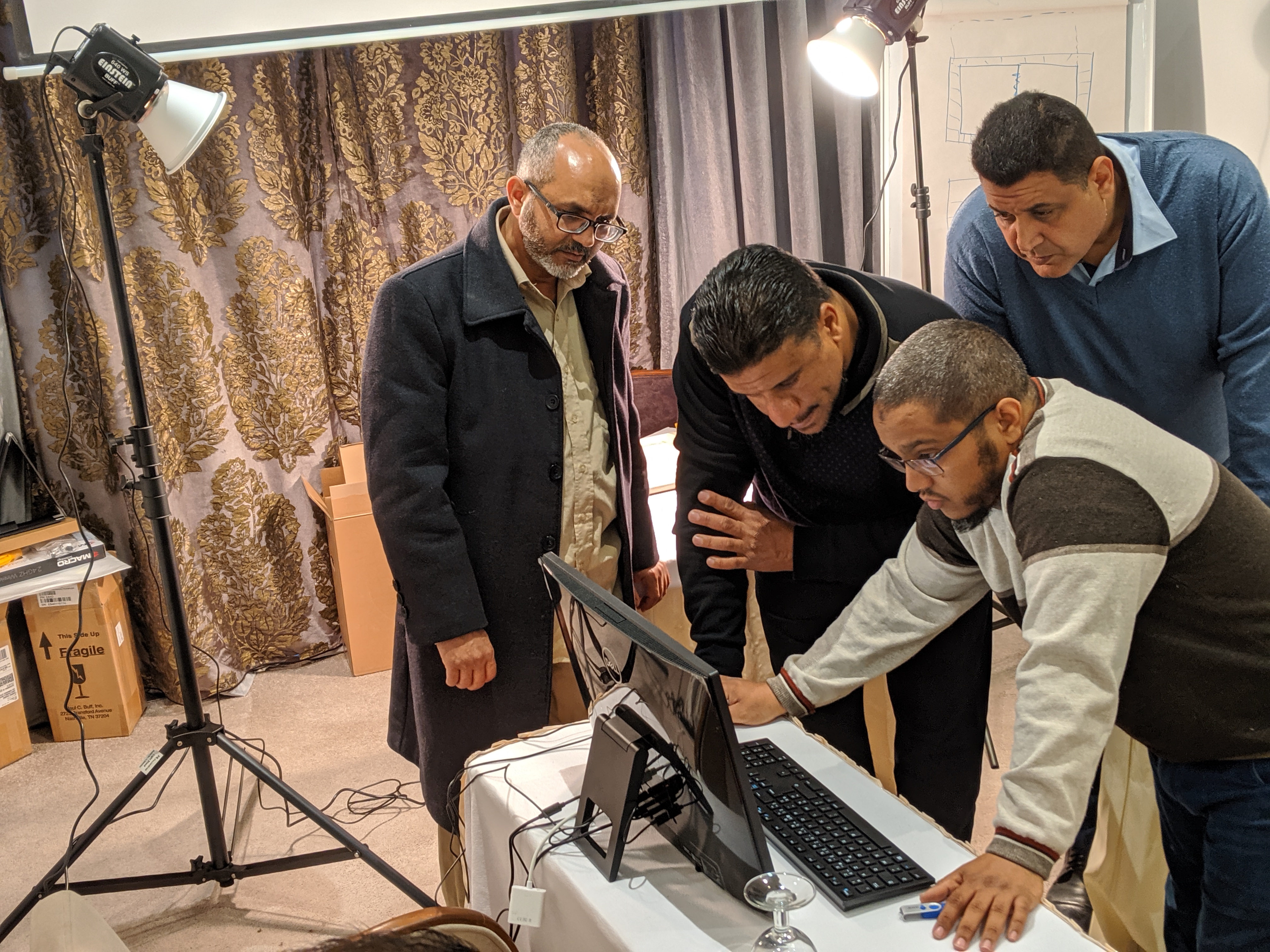
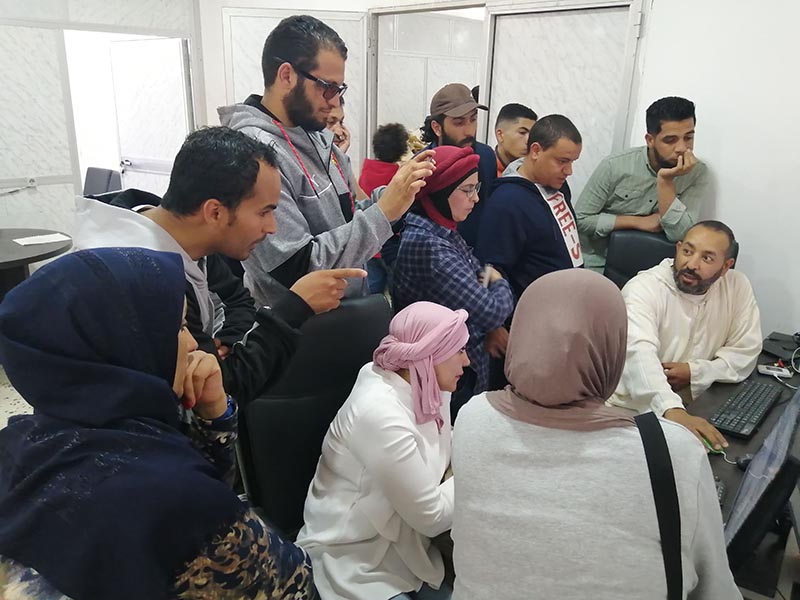
منذ ما يقرب من عامين ، اتصل السيد يوشع بإيسور لطلب المساعدة. وبدعم مالي من مؤسسة وايتنغ فاونديشن وخبرة متحف هيل ومكتبة المخطوطات بجامعة سانت جيمس بولاية مينيسوتا الأمريكية ، شرعت إيسور في هذه الشراكة الجديدة من خلال ورشة تدريبية على الرقمنة في تونس في نهاية فبراير وبداية مارس 2020
قاد السيد وليد مراد ، المدير الميداني والمدرب الرئيسي في هيمل ، ورشة العمل لخمسة أعضاء من مجموعة جمعية غدامس للتراث والمخطوطات ، الذين تعلموا استخدام معدات عالية الجودة ومعايير دقيقة لدعم عملهم الرقمي المستمر. ووفقًا للسيد يوشع ، “قبل ورشة العمل ، لم يكن لدينا سوى ماسح ضوئي في مكتبنا ، واستمر العمل ببطء شديد أثناء قيامنا بمسح صفحة تلو الأخرى. لقد كانت الكاميرا الجديدة المتصلة بالأجهزة التي قدمها لنا وليد بمثابة تحسن كبير ، ونحن ممتنون لأن إيسور أعادتنا إلى غدامس بكل المعدات التي استخدمناها أثناء التدريب
عاد فريق جمعية غدامس للتراث والمخطوطات إلى غدامس مع كامل المعدات وتم تركيب استوديو الرقمنة في مقر الجمعية. في حين تأخر التقدم خلال جائحة كورونا ، فقد قاموا برقمنة عدد من المخطوطات والكتب النادرة وعددها تسعة على الأقل حتى الأن ، التي يشاركونها عبر صفحتهم على شبكة فيس بوك وموقعهم الإلكتروني. في حين ساعدت البيئة الجافة وإنخفاض معدلات الرطوبة لغدامس مجموعات كبيرة من المخطوطات على البقاء على مر القرون ، فإن العديد من هذه الوثائق في حالة هشة وتتطلب حفظها بالشكل العلمى الصحيح . حيث لا تتوفر لدى الجمعية الخبرة الكافية في معالجة وترميم المخطوطات ولكنها تعمل على تنظيمها تدريجيًا وفقًا للموضوع وبدء مشروع الرقمنة على المدى الطويل
يشجع السيد يوشع المتطوعين وغيرهم من أفراد المجتمع على قضاء الوقت في المكتب من خلال تقديم إنترنت مجاني عالي السرعة والقهوة والشاي. كما قدم دورات في محو الأمية الحاسوبية لكبار السن من سكان المدينة كوسيلة لجذبهم ، وتزويدهم بالمهارات الأساسية التي قد يستخدمونها للمساهمة في المجتمع وكذلك تشجيع مشاركتهم في عمل الجمعية المستمر لتسجيل التواريخ الشفوية للمدينة الموغلة فى القدم
مباشرة قبل جائحة الوباء ، أقام فريق المشروع الوطنى الليبى للحقيبة المتحفية إيسور ورشة عمل تطوعية للتوعية بأهمية المحافظة على الموروث الثقافى لعدة أيام في غدامس. حيث قمنا بزيارة مقر جمعية غدامس للتراث والمخطوطات التى كان بعض أعضاءها أصدقاء لنا من قبل ، وبشرح مستفيض من السيد قاسم يوشع ، أعجب العمل جميع الحاضرين
بالإضافة إلى المخطوطات ، قامت الجمعية أيضًا برقمنة تسجيلات الأشرطة النادرة للمهرجانات الموسيقية السياحية والثقافية في غدامس وإنتاج مقاطع فيديو ثقافية للقناة الخاصة بالجمعية على شبكة يوتيوب. وشدد السيد يوشع على إن عمل الجمعية يتجاوز مجرد الرقمنة ، لدى الجمعية حاجة كبيرة لخبرة الحفظ ومستلزمات التخزين والأرشفة ذات الصلة لتمكينها من الحفاظ على مجموعاتها بشكل صحيح ، حيث قال “نأمل مع نمونا كجمعية ، سنتمكن في النهاية من توظيف موظفين يتمتعون بالخبرة المناسبة و في الوقت الحالي ، نعتمد على المتطوعين الذين يحذبهم الإنترنت السريع والقهوة
في هذه الأثناء ، تواصل الجمعية مشاركة نتائج الرقمنة مع هيميل ، وهي واحدة من المستودعات العالمية الكبرى للمخطوطات الرقمية. على الرغم من القيود الحالية على السفر ، لا يزال وليد مراد من هيمل على اتصال منتظم بالفريق في غدامس ، حيث يقدم التشجيع والمساعدة حسب الحاجة. وفقًا لكولومبا ستيوارت ، المدير التنفيذي لـ هيمل ، “بفضل مشروع إيسور و وايتنغ في غدامس ، يمكننا توفير إمكانية الوصول إلى مجموعة تاريخية مهمة ولكن لا يمكن ربطها بالمخطوطات ذات العلاقات الثقافية الفكرية لعمل في مالي والشرق الأوسط . إن شجاعة الفريق المحلي بجمعية غدامس للتراث والمخطوطات ، الذى تمزق بلاده الحرب الأهلية ، هو عمل يلهمنا فى هيمل و في إلتزامنا الخاص بالحفاظ على التراث أينما وجد ومهما كان معرضًا للخطر
THE BULLETIN OF ASOR (BASOR) EDITORIAL TEAM ANNOUNCED
[/vc_column_text][mk_divider][vc_wp_text]ASOR is pleased to announce the appointment of the new editors of The Bulletin of the American Schools of Oriental Research (BASOR)—a team of four scholars from the United States and Europe. Susan Cohen of Montana State University and Regine Pruzsinszky of the Albert-Ludwigs-University Freiburg will lead the team as co-editors. Working with them will be two associate editors: Jana Mynářová of the Charles University in Prague; and Marwan Kilani, currently a postdoc researcher associated with the Freie Universität in Berlin and the Swiss National Science Foundation. All four team members come to the position with extensive editorial experience and diverse academic backgrounds that reflect the diversity of ASOR’s membership and mandate. The editors were nominated by the BASOR Editorial Search Committee after an extensive public search process. The nomination was unanimously endorsed by ASOR’s Publications Committee, and the editors were unanimously approved by the ASOR Board of Trustees in May 2020.
The May 2020 issue of BASOR.
Susan Cohen is an archaeologist, focusing on rural-urban relations and interactions and chronological connections between Egypt and the southern Levant. Regine Pruzsinszky is an Assyriologist with a particular interest in Semitic and Hurrian onomastics, Mesopotamian chronology of the second millennium BCE, and the socio-cultural role of musicians in the Ancient Near East. Jana Mynářová is an Assyriologist and Egyptologist, focusing on political and cultural relations of Egypt and the Near East. Marwan Kilani is an Egyptologist and linguist working on cultural and linguistic interactions between Egypt and the Levant. He has a strong interest in methodological questions, and in digital humanities and computational methods applied to the study of the ancient world. BASOR editors are appointed for a three-year term, with the possibility of being re-appointed for a second term. Their initial term will run from 2021–2023.
The new editors will succeed the current co-editors, Eric Cline and Christopher Rollston, in January 2021. Those interested in publishing in BASOR should continue to submit manuscripts through the online submission system.[/vc_wp_text][/vc_column][vc_column border_color=”rgba(170,170,170,0.01)” width=”1/6″ css=”.vc_custom_1496684098866{margin-right: 5px !important;margin-bottom: 20px !important;border-right-width: 2px !important;border-bottom-width: 2px !important;padding-top: 30px !important;padding-right: 10px !important;padding-left: 10px !important;background-color: #ffffff !important;border-right-color: rgba(227,228,228,0.75) !important;border-bottom-color: rgba(227,228,228,0.75) !important;}”][vc_wp_posts title=”BROWSE THE NEWS ARCHIVE” number=”4″][/vc_column][vc_column border_color=”rgba(170,170,170,0.01)” width=”1/6″ css=”.vc_custom_1496684008271{margin-right: 10px !important;margin-bottom: 30px !important;border-right-width: 2px !important;border-bottom-width: 2px !important;padding-top: 30px !important;padding-right: 20px !important;padding-left: 20px !important;background-color: #ffffff !important;border-right-color: rgba(227,228,228,0.75) !important;border-bottom-color: rgba(227,228,228,0.75) !important;}”][vc_column_text]Tweets by ASOResearch [/vc_column_text][/vc_column][/vc_row]










 as “animal handler” or “skinner” on the basis of texts from the Old Babylonian period. Written sources from the third millennium, however, indicate that these translations are not applicable in earlier times, since people so designated worked on the first steps of leather processing or with the preparation of the bare skins for tanning. Therefore, in such texts the translation Blößenvorbereiter, that is “preparer of cleaned animal skins” is a better fit. Moreover, third-millennium texts provide further information on the profession su-si-(ig), which was apparently practiced only by men who worked in the large temple and palace public institutions and in some cases could hold high social positions.
 epigraphic sources concerning the šakkanakkus (rulers) of Mari, especially those that reigned during the 20th and first part of 19th centuries BCE, that is the final phase of the šakkanakku period that preceded the reign of Yaḫdun-Lîm in Mari ca. 1820/1810 BC. New readings of the seal impressions ME64+ME196 and ME14 indicate that they all belong to the same cylinder seal belonging to a ruler named Tīnīn-Dagan, whose father was Iddin-Dagan. Both rulers were previously unknown.
 The results of a survey of the site and its surroundings are given together with the publication of a number of new brick inscriptions belonging to early Old Babylonian kings of Malgium.
 were used by Old Babylonian surveyors to construct perpendicular field boundaries accurately. This is the only known application of diagonal triples from this time, and one of the most complete examples of applied geometry from the ancient world.
 mathematical cuneiform tablets containing multiplication tables. Their physical and textual characteristics suggest that they were produced in the same ancient context. What is remarkable about this small set of tablets is that, unlike most such tablets, two of them have colophons: in AO 8900 we find a month-and-day date, while in AO 8901 we find a damaged year name. These tablets are published here for the first time, together with a discussion of how the information about the year name in AO 8901 fits in what is known about the dating of Old Babylonian mathematics.
 The proposal is here offered to read the Ugaritic administrative text RS 10.052 iv 1 as containing the personal name pǵmw, the Ugaritic writing of the Luwian name Piḫamuwa.